
Judge, 1928-11-17 · page 20 of 36
Judge — November 17, 1928 — page 20: what you’re looking at
What you’re looking at
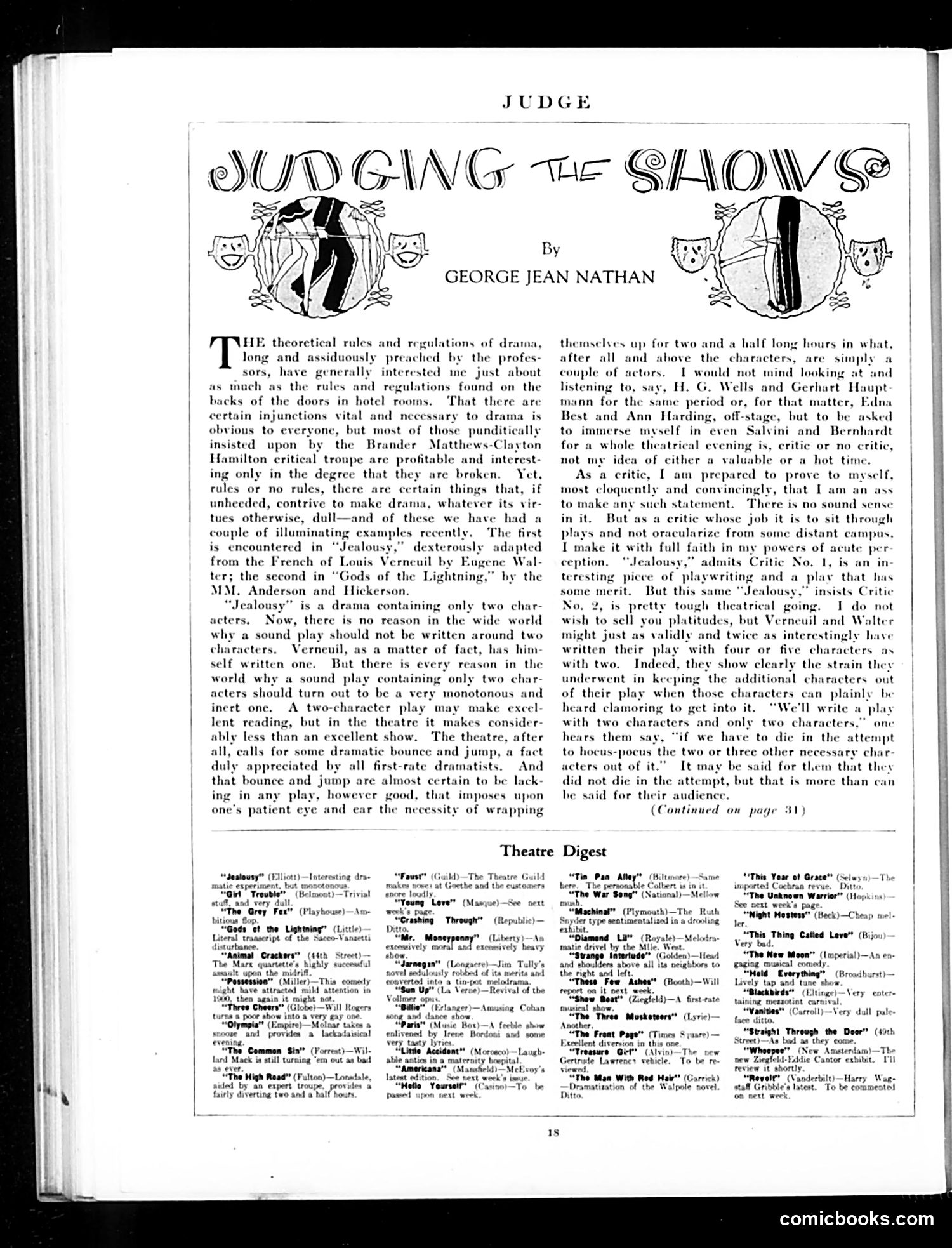
This is not a cartoon but an article by George Jean Nathan, Judge magazine's drama critic. Nathan argues against rigid theatrical rules, using two recent plays as examples. The piece discusses *"Jealousy,"* a French adaptation by Eugene Walters and M.M. Anderson/Hickerson featuring only two characters. Nathan contrasts two critics' opposing views: Critic No. 1 praises it as interesting; Critic No. 2 finds it tedious theatrical fare. Nathan's central point: while two-character plays can work as literature, theater audiences demand "dramatic bounce and jump." A two-person play risks monotony on stage, even if well-written. He references actors H.G. Wells, Gerhart Hauptmann, Edna Best, Ann Harding, Salvini, and Bernhardt—names meant to illustrate that even great performers cannot sustain theatrical interest alone. The satire targets both rigid dramatic theory and critics who mechanically apply it without considering theatrical practicality.
📄 Transcribed text from this page (OCR, searchable)
Machine-transcribed from the original scan — historical spelling and the odd misread are preserved.
JUDGE HE theoretical rules and regulations of drama, — themselves up for two and a half long hours in what, long and assiduously preached by the profes- after all and above the characters, are. simply a sors, have generally interested me just about couple of actors. [ would not mind looking at as much as the rules and regulations found on the — listening to, say, H. G. Wells and Gerhart I | backs of the doors in hotel rooms. Tha mann for the ne period or, for that matter, Edna | certain injunctions vital and necessary Best and Ann Harding, off-stage, but to be asked | obvious to everyone, but most of those punditically to immerse myself in even Salvini and Bernhardt | j insisted upon by the Brander Matthews-Clayton for a whole theatrical evening is, critic or no crit | } Hamilton critical troupe are profitable and interest- not my idea of cither a valuable or a hot time. | ing only in the degree that they are broken, Yet. rules or no rules, there are certain thing unheeded, contrive to make drama, w tues otherwise, dull As a critic, I am prepared to prove to myself, | that, if most eloquently and convineingly, that [am an ass atever its vir- to ma nd of these we have had a Pany such statement. ‘There is no sound sense | But as a critic whose job it is to sit through | | | soove and provides a lackadaisical enlivened by Irene Bordosi and some very tasty lyrics “Little Comman ” (Soroaco)— Laugh lard Mack is still turing able antics in a maternity hoep © "The High Read” (Fulton) — Latest edition Jed by an expert trou “Helle Ye fairly diverting two and a balf pawed “The Froat Page” (Times S juare) — Excellent diversion in this one “Treasure Git" (Alvin)—The new Gertrute Lawrences vehicle. To be re- Jarrick) novel. couple of illumir amples recently. The first. plays and not oracularize from some distant campus. | is encountered in lousy,” dexterousls pted I make it with full faith in my powers of acute per | from the French of Louis Verneuil by Eugene Wal- ception, “Jealousy,” admits Critic No. 1, is an in ter; the second in “Gods of the Lightning,” by the — teresting picce of playwriting and a play that has | M M. Anderson and Hickers: some merit. But this same “Jealousy,” insists Critic | alousy” is a drama containing only two char- 2, is pretty tough theatrical going. 1 do not | acters. Now, there is no reason in the wide world wish to sell you platitudes, but Verneuil and Walter | } | why a sound play should not be written around two t just as validly and twice as interestingly have | characters. Verneuil, as a matter of fact, has him- written their 1 with four or five cha | self written one. But there is every reason in the with two. Indeed, they show clearly the str: an | world why a sound play containing only two char- underwent in keeping the additional characters out | } | | acters should turn out to be a very monotonous and of their play when those cl inly be | ] } | inert one. A two-character play t make excel- heard clamoring to get into it. “ell write a Uplay | | | lent reading, but in the theatre it makes consider- with two characters and only two characters,” one | ably less than an excellent show. The theatre, after hears them » “if we have to die in the attempt | all, calls for some dramatic bounce and jump, a fact — to hocus-pocus the two or three other necessary char- duly appreciated by all first-rate dramatists. And — acters out of i It may be said for them that the | that bounce and jump are almost certain to be lack- did not die in the attempt, but that is more than c | | ing in any play, however good, that imposes upon — be said for their audience. i] | one’s patient eye and ear the necessity of wrapp (Continued on page 31) | \ Theatre Digest | / rk here. The personabl 3 orted Cochran revue. Dit i “The War Seng” all he Unknown Warrier” (1!) | | A Ck oi schinat” (PI; The tien’ “7s, ceet renee bees } “Crashing Through” (Republic)— Snyder type sentimentalizad in a drooling fey NAME Mestess™ (Heck) —Cheap : exhitat | | ” “ ‘This Thing Called Love” (Bijou) — | Literal transerigh of the, Boco0-Vansed (Liberty) An (Royale)—Melotra- 9 iF i) ent ~ excemively todd tal exekeaves heavy matte dneel by the Mie, Woe Very bad | ‘Animal Crackers (44th Street) — ab “Su intertude”* (olden) —Head “The New Moon” (Icmperial)—An en- | The Marx quartette’s highly successful am Tully's and shoulders above all its neighbors to yusical comedy. amault apon the m night and left. ‘Held Everything” (Broadhurst) — “Pos y” (Miller)—This comely rama. These Fe Ashes (Booth)—Will Lively tap ne show. tight have attracted ld attention in jevival of the report oa it next week “lack 19 = oo “sere Boat” (Ziegfeld)—A first-rate taining mes: (Erlanger)—Armusing Cohan musical sho re " song. and dance show “The Musketeers” (Lyric)— —_¢,Vaniten Olympia” (Empire) —Moloar tases “Paris” (Music Bot)—A feeble show Another. ‘St aight Throogh the Deer (40th s od as they come. (New Amate Cantor ex) Vanderbilt)—Harey latest. To be commented comicbooks.com