
A complete issue · 36 pages · 1928
Judge — November 17, 1928
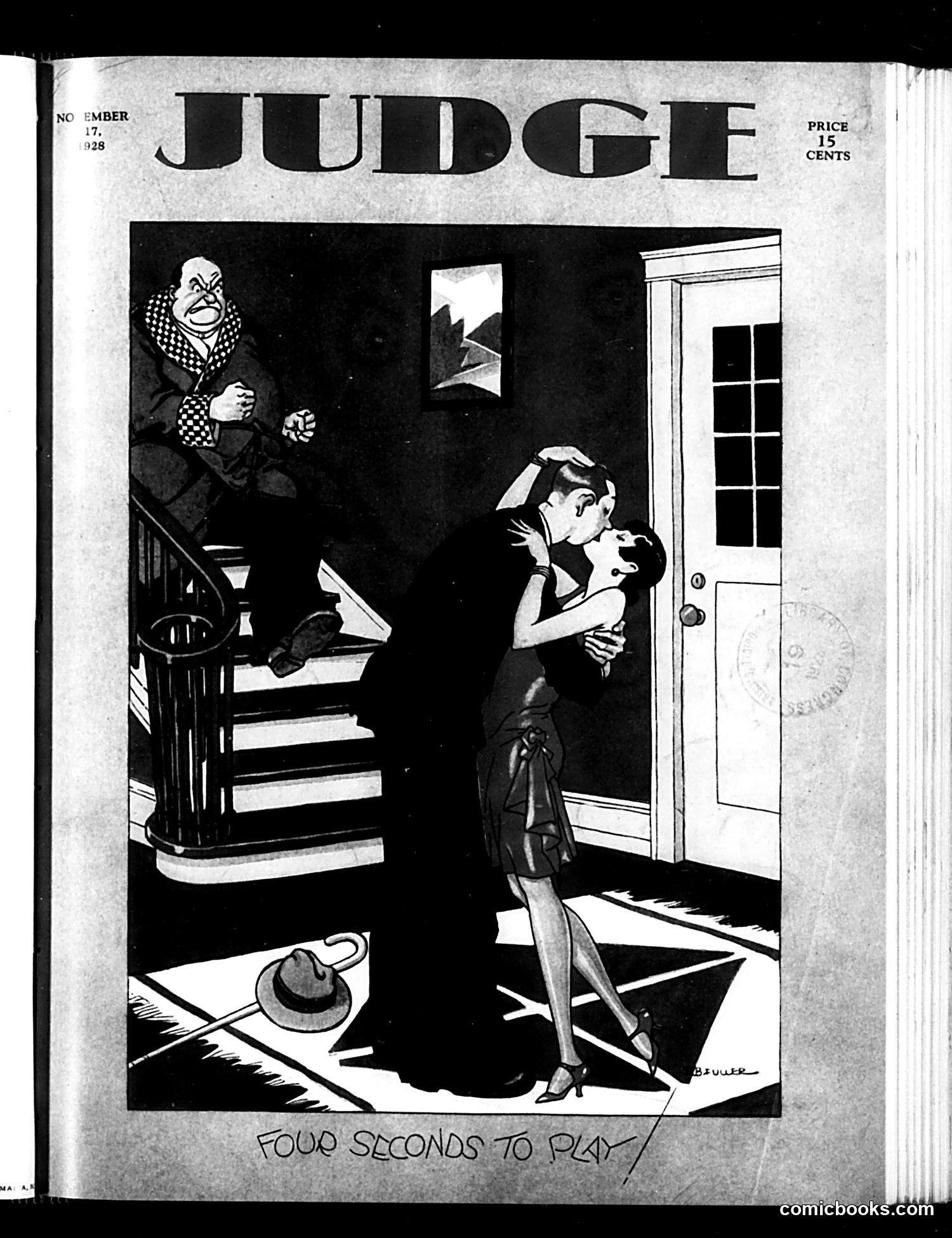
**The Cartoon:** "Four Seconds to Play" depicts a domestic scene where a young couple embraces near an open door while an older woman (likely a mother-in-law or chaperone) descends the stairs, appearing to have caught them in an intimate moment. **The Satire:** This plays on 1920s social anxieties about changing courtship norms. The "four seconds" refers to the brief window before the older generation discovers the couple's unsupervised romance—a commentary on the tension between Victorian propriety and modern youth behavior. The exaggerated facial expressions of the disapproving woman above contrast sharply with the couple's casual intimacy below. **Context:** Judge used humor to reflect contemporary debates about generational values during the Jazz Age, when traditional moral standards were increasingly questioned among young Americans.
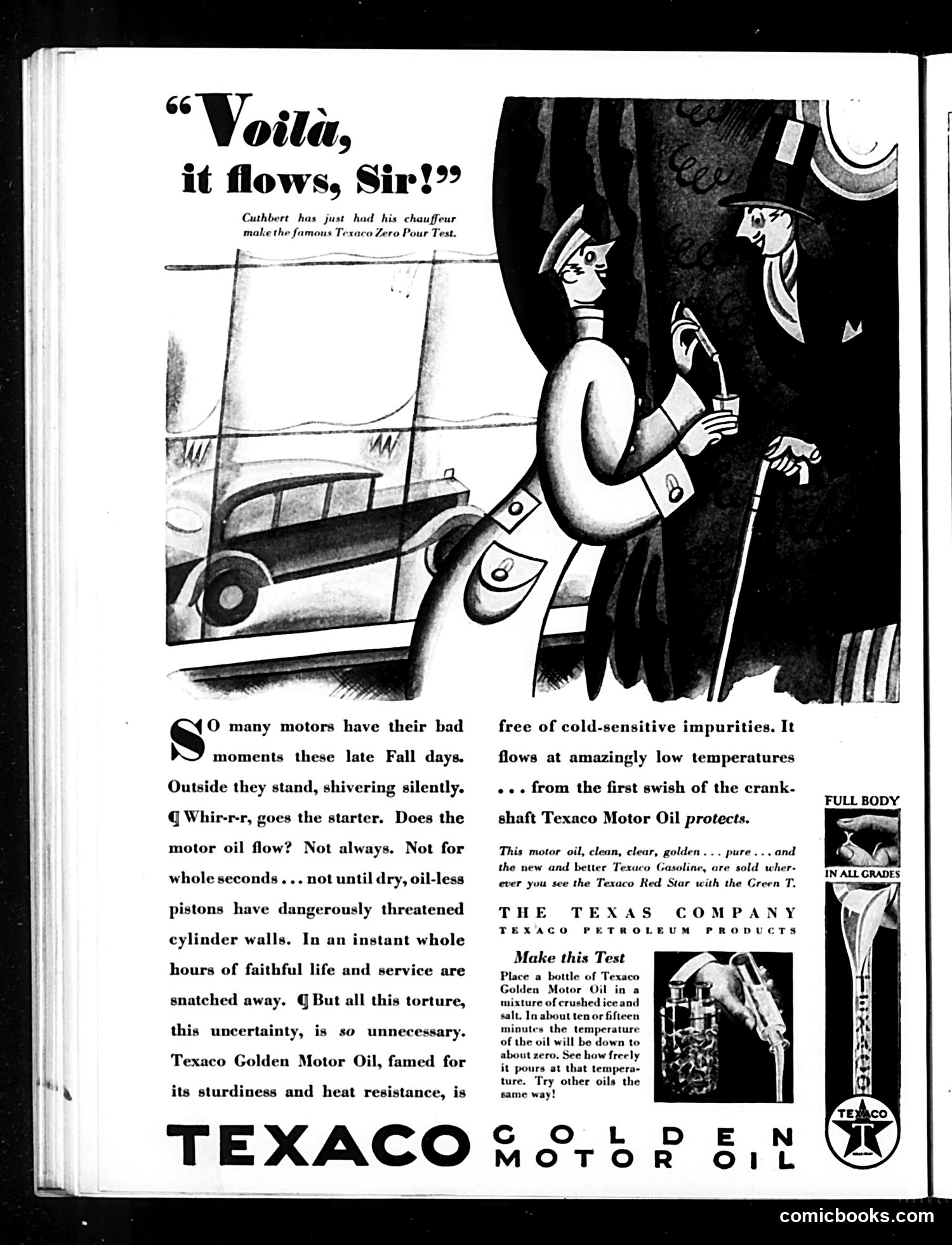
This is primarily a **commercial advertisement**, not political satire. The page features a Texaco motor oil ad with a humorous illustration rather than social commentary. The cartoon depicts a wealthy gentleman (labeled "Culbert") in formal evening wear, instructing his chauffeur about the quality of Texaco Golden Motor Oil. The joke plays on class distinction: the well-dressed employer observes the oil's superior flow at cold temperatures, expressed in the colloquial phrase "Voilà, it flows, Sir!" The advertisement's humor derives from juxtaposing formal language ("Voilà") with casual vernacular, emphasizing how Texaco's product performs reliably in winter conditions when other motor oils thicken and fail. The chauffeur represents the working-class perspective on practical automotive concerns. This reflects 1920s-1930s advertising targeting affluent automobile owners.
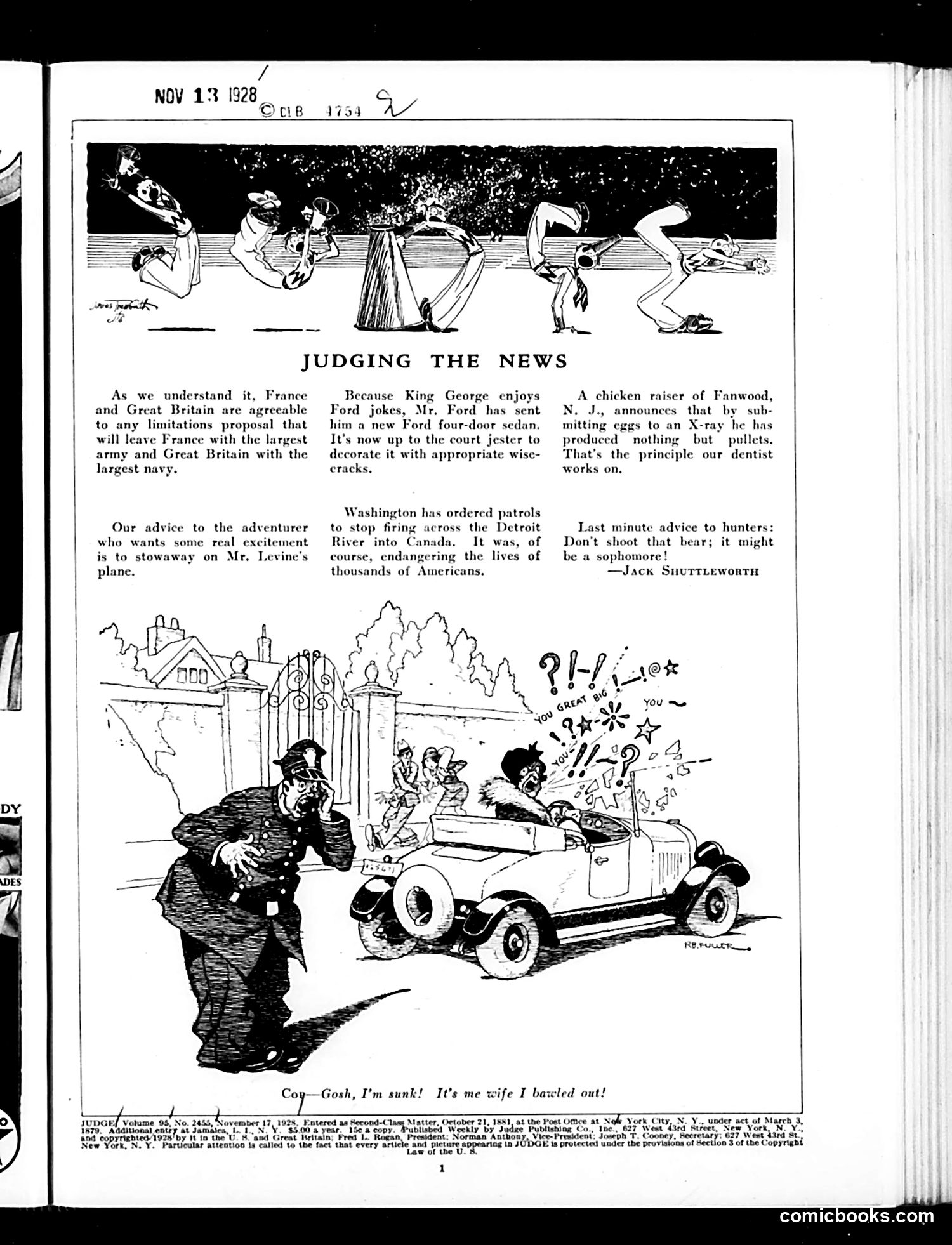
This satirical page mocks current events through brief quips and cartoons: **Top strip**: Silhouettes of various people performing absurd acts illustrate the section's title. **Main cartoon**: A man (likely a border guard or official) watches in shock as his wife drives a car wildly across what appears to be the Canada-U.S. border, with explosive effects. The caption reads "Cop—Gosh, I'm sunk! It's me wife I bawled out!" **Context**: The cartoon references Washington's recent orders to patrol the Detroit River to stop smuggling into Canada—likely related to Prohibition enforcement. The joke plays on a guard being caught in an embarrassing personal situation while on duty at the border. The accompanying text items mock King George's enjoyment of Ford jokes, a chicken farmer's X-ray egg scheme, and offer hunting safety advice.
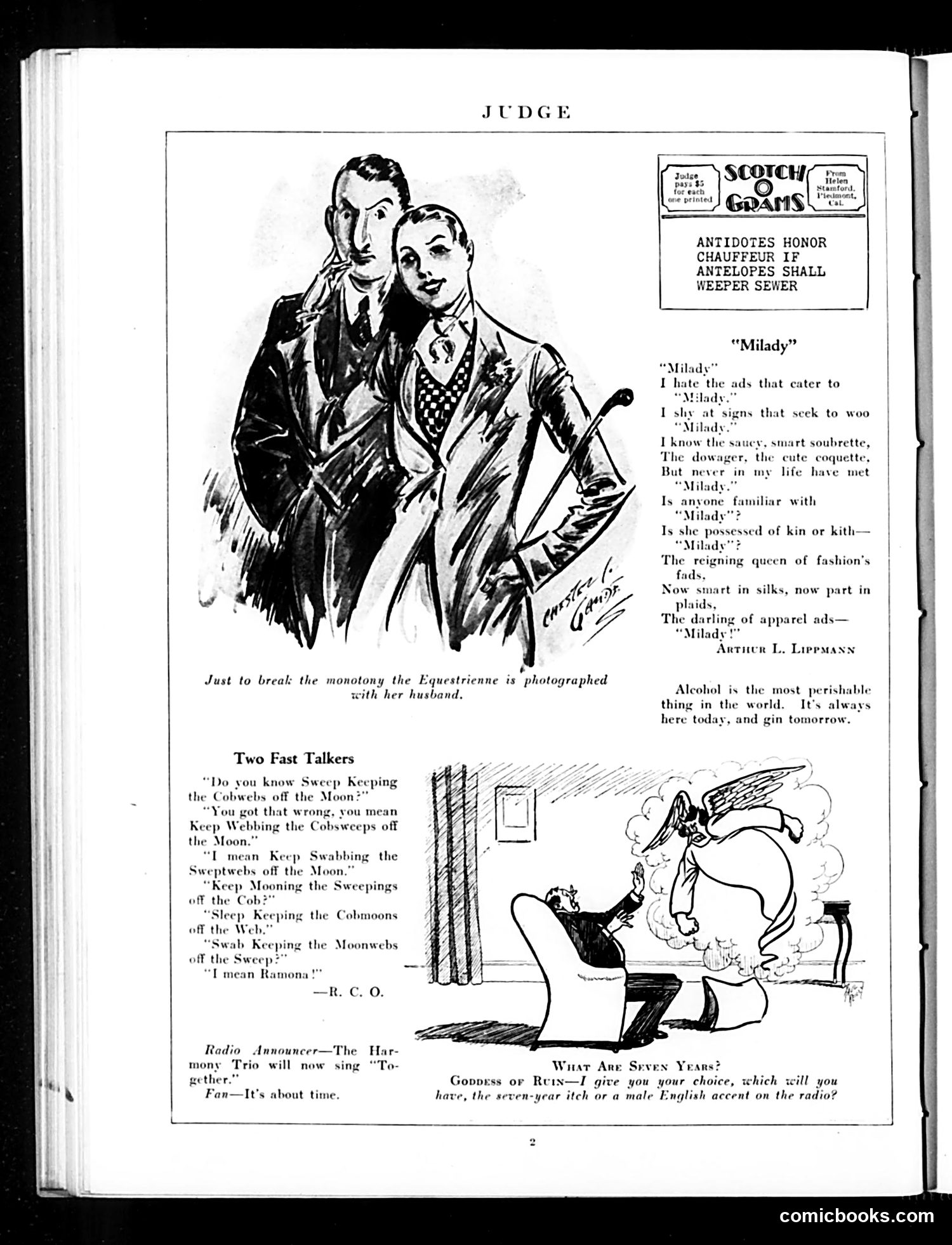
This page features early 20th-century satirical humor and advertisements. The top illustration depicts a couple with the caption about "Equestrienne" being photographed with her husband—likely mocking fashionable society women and equestrian culture. The "Milady" poem by Arthur L. Lippmann satirizes a stereotypical vain, fashion-obsessed woman who constantly changes her appearance and seeks male attention through trendy clothing. "Two Fast Talkers" presents wordplay about sweeping/mooning the Colhoons—appearing to be nonsensical tongue-twisters or rapid-fire comedy. The bottom cartoon "What Are Seven Years?" shows a woman choosing between two options presented by a goddess figure, likely referencing romantic dilemmas or the "seven-year itch" concept regarding marriage. The Scotch Grams advertisement occupies the right side, typical of Judge's commercial content.
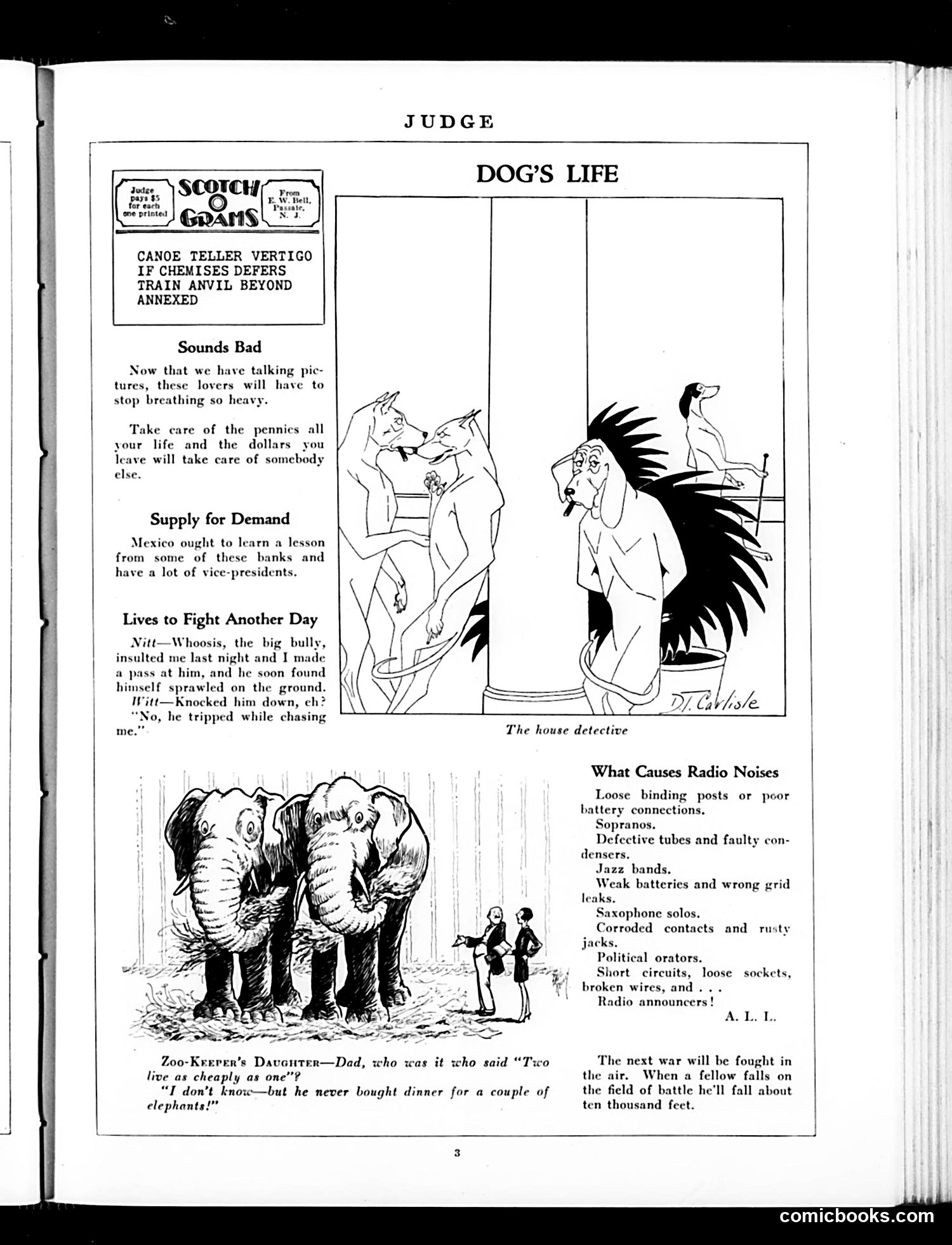
This page combines humor columns with satirical cartoons. The top cartoon "The house detective" depicts a disheveled dog confronting two men, likely satirizing domestic infidelity or suspicious behavior. Below, "Zoo-Keeper's Daughter" shows two elephants with a caption about cheap dinners, making a crude joke about animal cost versus feeding humans. The text sections mock contemporary issues: banking practices ("Supply for Demand" references Mexican vice-presidents), bullfighting ("Lives to Fight Another Day"), and radio interference ("What Causes Radio Noises"). The final commentary about future air combat appears to reference emerging aviation warfare, likely from the 1920s-1930s era. The "Scotch Grams" box references alcohol prohibition-era drinking. Overall, this is typical Judge content: mixing sexual innuendo, social commentary on current events, and puns with crude cartoon illustrations.
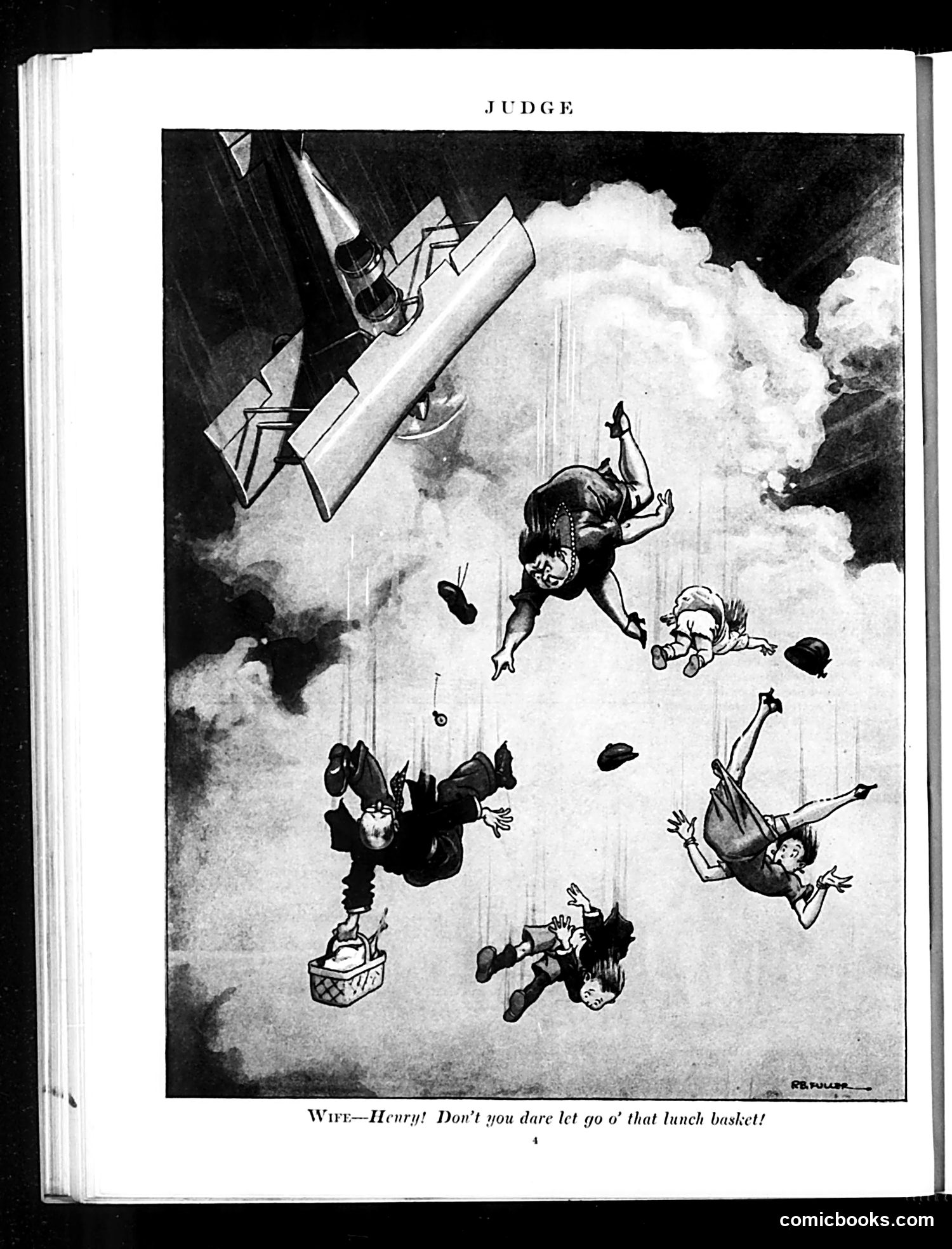
This cartoon satirizes domestic anxiety about airplane safety in the early aviation era. The scene depicts people falling from the sky while a husband (labeled "Henry") clutches a lunch basket—the caption reads "Wife—Henry! Don't you dare let go o' that lunch basket!" The joke inverts typical disaster priorities: rather than concern for human survival, the wife obsesses over preserving the meal. This reflects both early 20th-century humor about spousal nagging and genuine public nervousness about aircraft as experimental, dangerous technology. The chaotic composition with multiple falling figures emphasizes the absurdity of the situation and the wife's misplaced concern. The cartoon uses exaggeration and dark humor characteristic of Judge magazine's satirical style to comment on both aviation fears and domestic comedy.
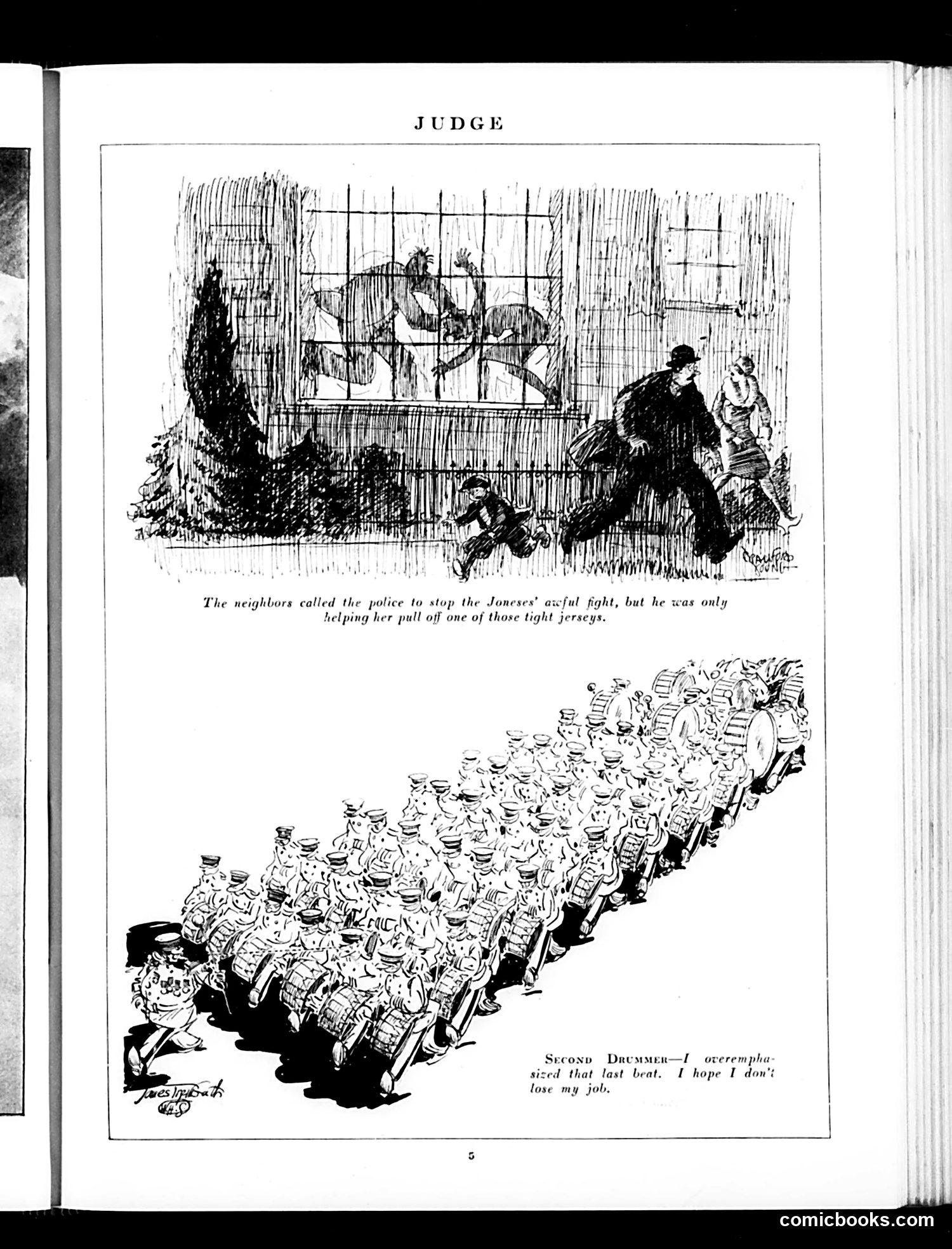
This page contains two satirical cartoons: **Top cartoon:** Shows neighbors calling police to stop a domestic "fight" between the Joneses, though the officer is merely helping remove a tight jersey from a woman. **Bottom cartoon:** Depicts a long procession of drummers in a marching band. The caption has a "Second Drummer" worrying he might lose his job after oversizing "that last beat." The humor in the bottom cartoon likely satirizes either labor anxiety during economic uncertainty, or the absurdity of excessive conformity and worry over minor mistakes in organized groups. The exaggerated procession emphasizes how trivial individual concerns become within large institutions. Both cartoons use visual exaggeration for comedic social commentary typical of Judge's satirical style.
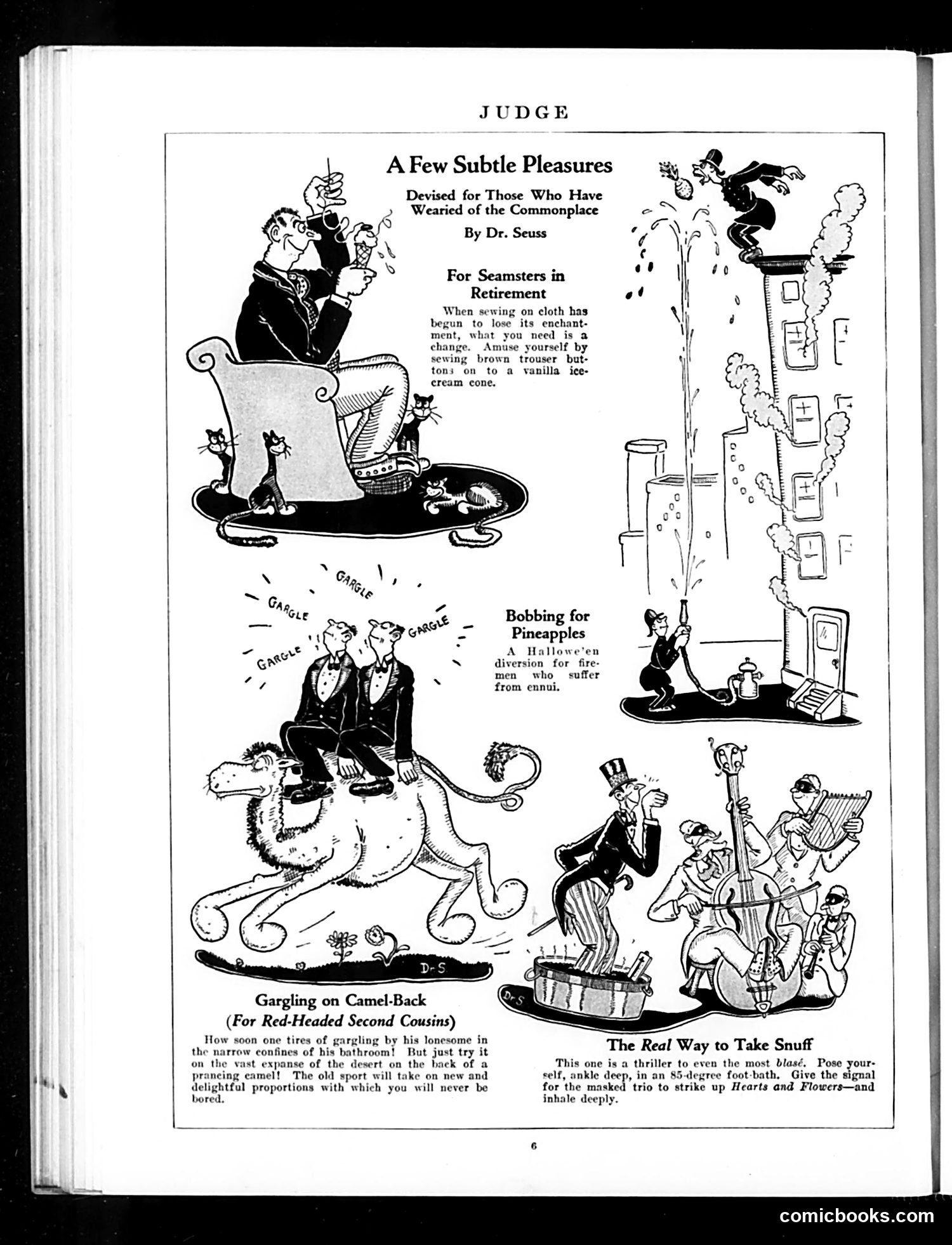
This Judge magazine page presents humorous "activities" for bored or wealthy people seeking novelty. The satire targets the idle rich and their ennui—the jaded exhaustion from overconsumption of conventional pleasures. Each illustrated vignette proposes absurd "solutions": retired seamstresses sewing buttons onto ice cream cones, firefighters bobbing for pineapples on Halloween, red-headed cousins gargling while riding camels, and sophisticated snuff-takers performing elaborate rituals in foot-baths while masked musicians play sentimental songs. The humor lies in the contrast between the pretentious, elaborate setup and the ridiculous or pointless activities. The subtitle "Devised for Those Who Have Wearied of the Commonplace" mocks upper-class complaints about boredom despite their advantages. Early Seuss's satirical style—whimsical yet cutting—critiques wealth and privilege's inability to generate genuine satisfaction.
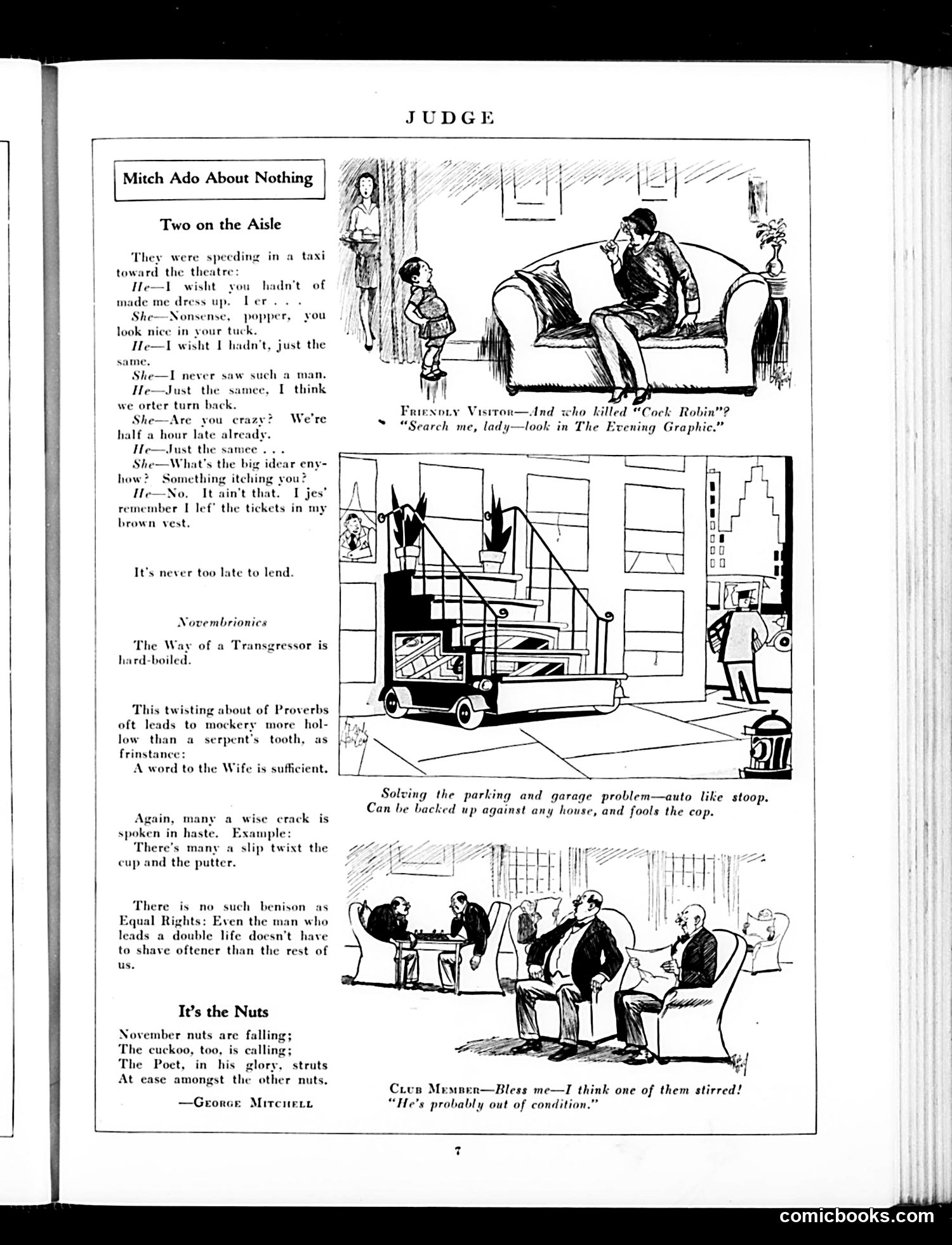
This page contains humorous sketches and commentary typical of 1920s-era American satire. **"Two on the Aisle"** depicts a couple rushing to theater who discover the husband left their tickets in his brown vest—a relatable comedy of errors about absent-mindedness. **The vehicle cartoon** shows an oversized, awkwardly-constructed auto designed to park against houses to evade police enforcement of parking regulations—satirizing both urban parking problems and people circumventing traffic laws. **"Novembrionics"** plays with twisted proverbs for comedic effect, including commentary on marriage dynamics ("A word to the Wife is sufficient"). **"It's the Nuts"** is a brief poem about November comparing foolish people to falling nuts and strutting poets. **The club scene** shows men discussing someone being "out of condition"—likely referring to intoxication during Prohibition-era America, when alcohol consumption was illegal but widespread. The page combines wordplay, visual gags, and social commentary typical of Judge's satirical approach to American life.
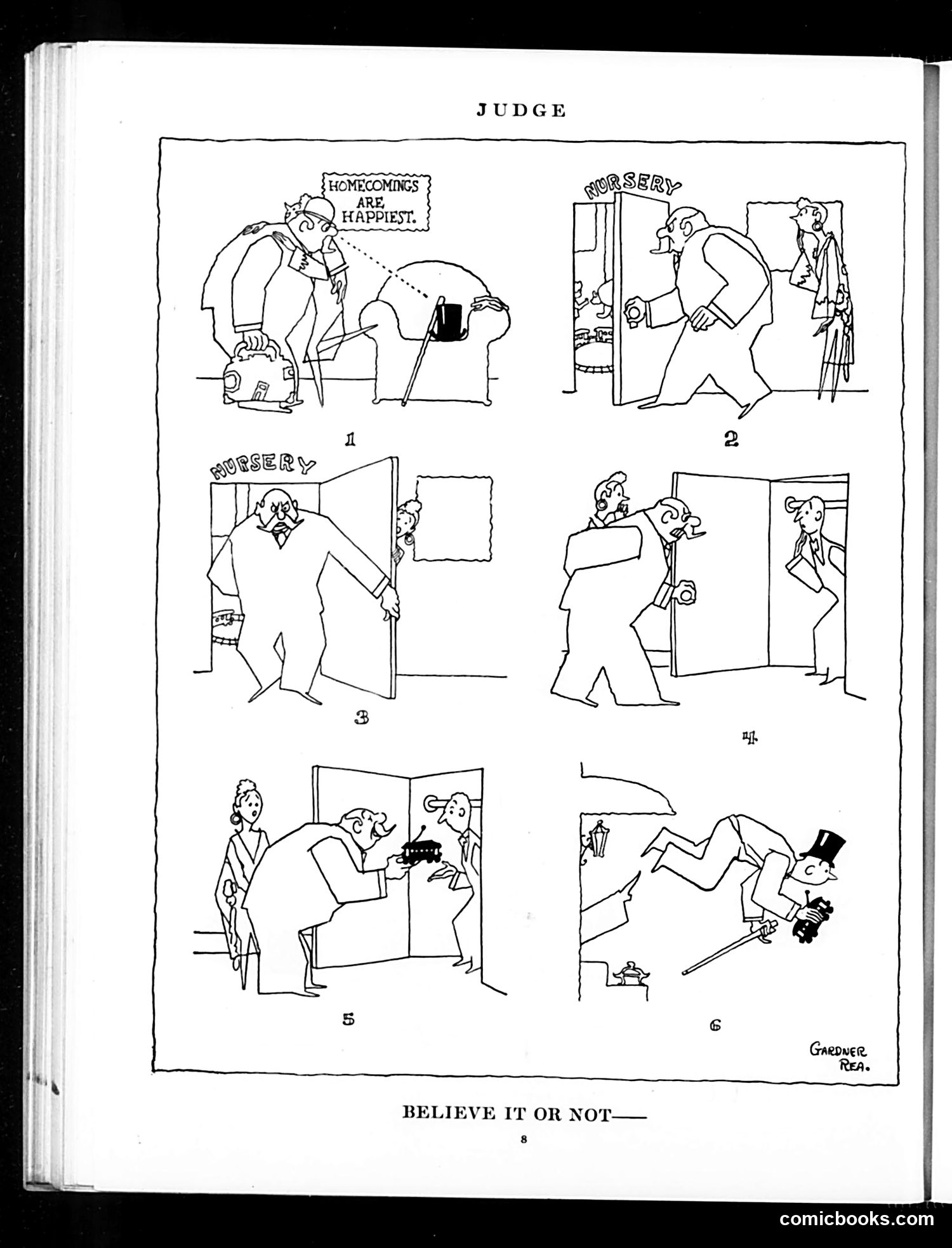
This is a six-panel satirical comic titled "Believe It or Not" by Gardner Rea, depicting a father's escalating attempts to manage his young child's behavior during homecomings and nursery visits. The sequence shows: (1) a father receiving news that "homecomings are happiest"; (2-4) the father visiting a nursery, increasingly frazzled as the child misbehaves; (5) the father appearing disheveled while interacting with the child and another adult; (6) the father collapsed in exhaustion on the floor. The satire mocks the sentimental ideal of joyful family homecomings by contrasting it with the chaotic reality of managing an energetic, disobedient toddler. The humor derives from the father's mounting distress and physical deterioration, suggesting that the cheerful domestic fantasy promoted in popular culture bears no resemblance to actual parenting experience.
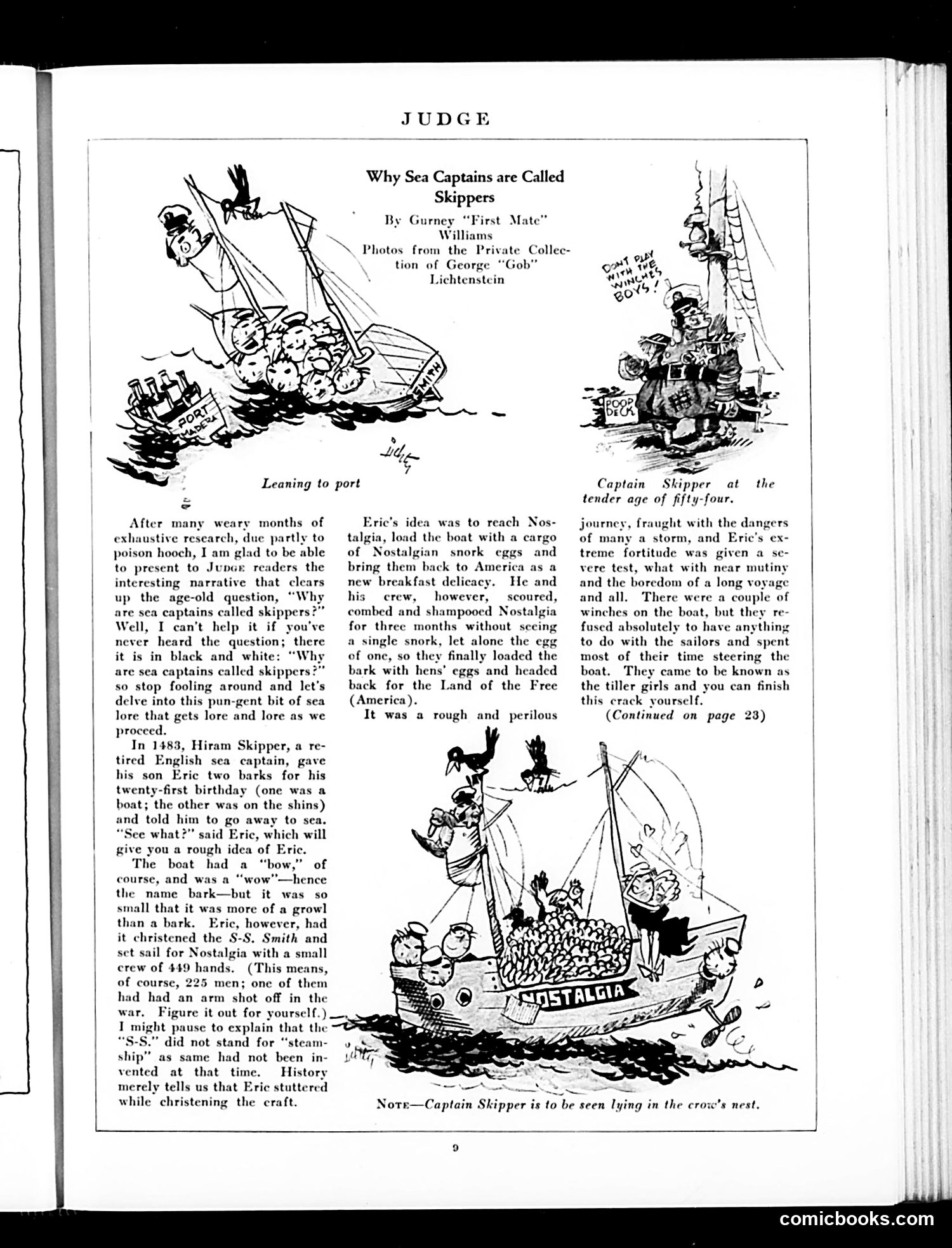
This is a humorous origin story disguised as serious historical inquiry. The joke is the entire premise: the author claims to explain why sea captains are called "skippers," but the explanation is purely absurdist wordplay rather than actual etymology. The story concerns Hiram Skipper, a retired captain who gives his son Eric two "barks" for his twenty-first birthday—a ship and a literal beating ("bark on the shins"). Eric sails to the fictional "Nostalgia" seeking snork eggs, fails, returns with hen eggs instead. The punchlines are deliberate groans: puns on nautical terms ("wow" = bark, "tiller girls" for winches, "leaning to port"). The satirical target appears to be *pseudo-intellectual magazine filler*—articles pretending to answer trivial questions with false scholarly authority. The cartoons show Eric's incompetent voyage, mocking adventure narratives. This is light humor for Judge's readers, poking fun at the magazine's own tendency toward elaborate nonsense presented as fact.
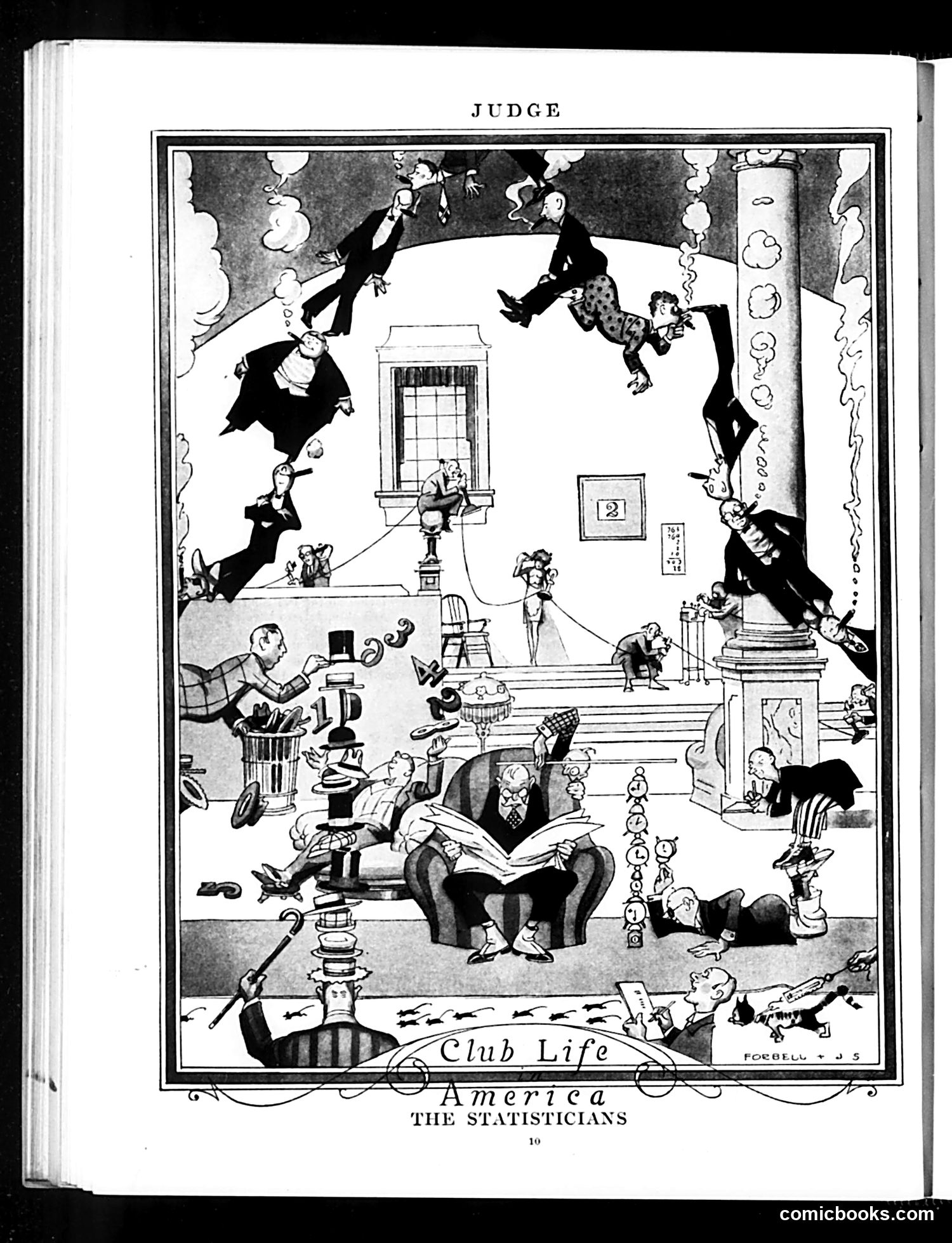
This satirical cartoon depicts a courtroom labeled "Judge" where a distinguished older gentleman sits reading what appears to be statistical data, surrounded by chaos. Lawyers and figures in formal dress float, tumble, and contort around him in an absurd manner. The title "The Statisticians" and the "Club Life America" attribution suggest this mocks how statistics were used (or misused) in legal arguments and public discourse. The satire likely criticizes lawyers who manipulated statistical evidence to confuse judges, or how statistics were weaponized in courtroom debates during this era. The anarchic, gravity-defying behavior of the legal figures suggests the absurdity of relying heavily on complex data rather than clear reasoning. The composed judge amid pandemonium implies his bewilderment at such arguments.
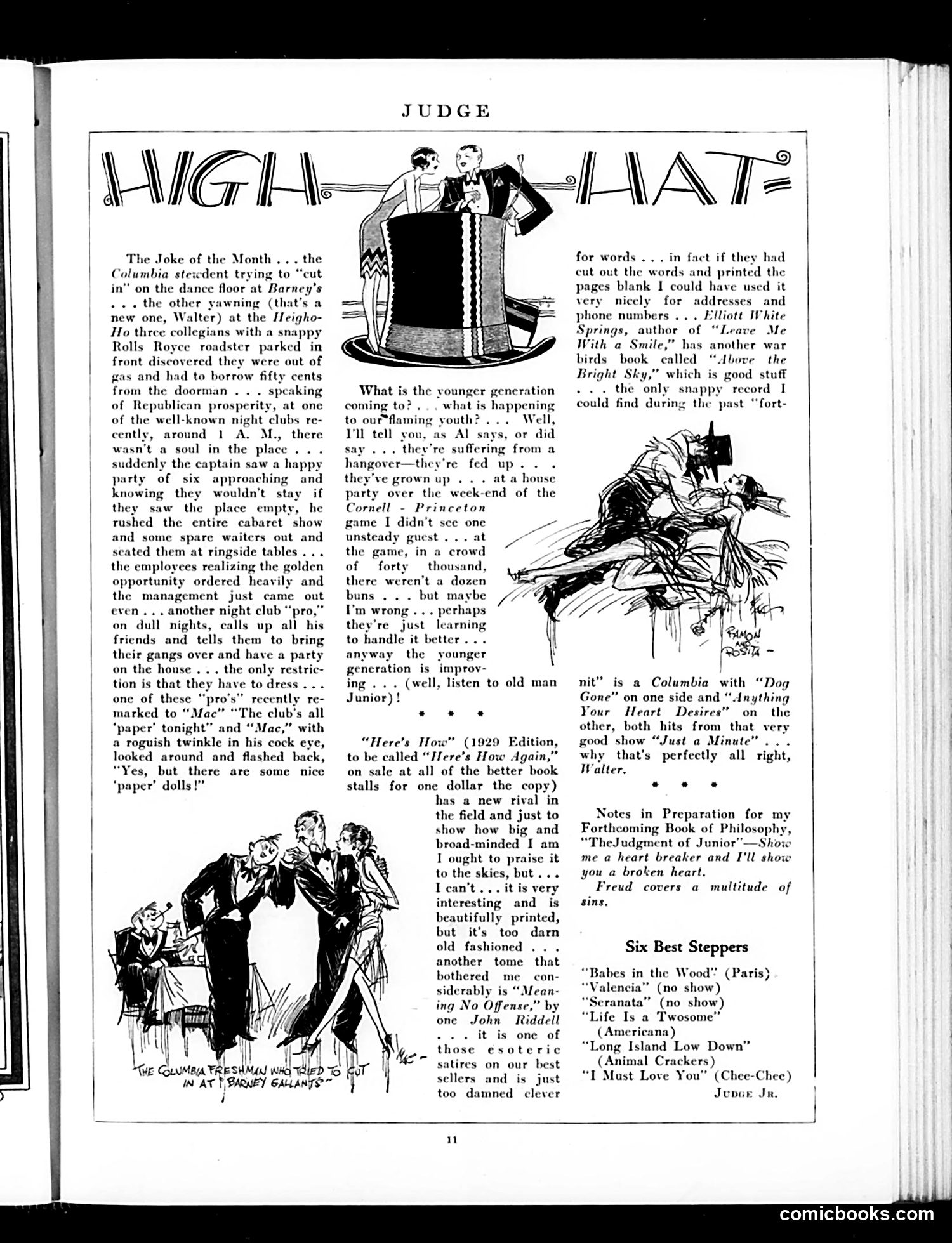
This is a humor column by "Judge Jr." satirizing 1920s youth culture and entertainment trends. The main targets are: **Jazz Age Nightlife**: The column mocks speakeasy culture during Prohibition—empty clubs that artificially fill their floors with hired "paper" (fake) guests, phonies dressed up pretending to have money. The cartoon depicts Columbia Records freshmen awkwardly trying to fit in at "Barney's" nightclub. **Youth Behavior**: Judge Jr. discusses the younger generation's drinking and parties with mock-serious concern, noting they seem more restrained than stereotypes suggest (fewer drunk people at Cornell-Princeton game). **Entertainment Industry**: The column reviews books and records with snobby dismissal—praising some while complaining others are "too damned clever" or "old fashioned." **The Satire**: Judge is gently mocking both the pretentious 1920s club scene and the column's own pompous narrator judging youth culture. The "paper dolls" punchline makes the nightclub fakery explicit—even the guests are artificial props.
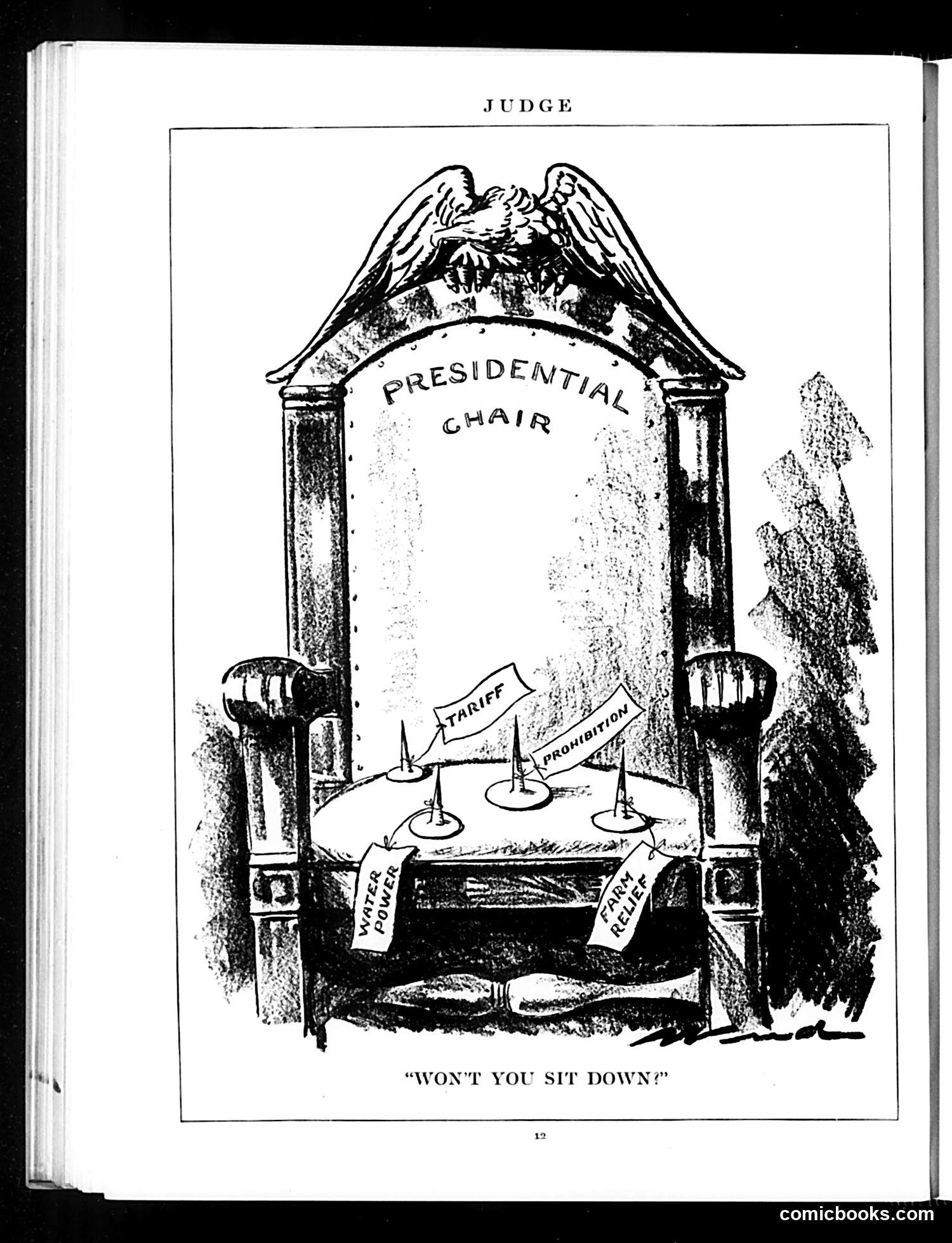
This political cartoon depicts a grand "Presidential Chair" topped with an eagle, labeled as a seat of judgment. The chair's base displays flags reading "Water Power," "Free Trade," "Tariff," and "Prohibition"—indicating major political debates of the era. The caption "Won't You Sit Down?" appears ironic, as the chair seems deliberately uncomfortable or unstable, surrounded by conflicting ideological positions. The cartoon satirizes the difficulty of occupying the presidency while navigating contradictory policy demands from different political factions. The specific issues (tariffs, free trade, prohibition, water power) suggest this dates to the early 20th century when these were volatile political battlegrounds. The cartoon implies that whoever sits in the presidency must somehow reconcile these fundamentally opposing positions—an impossible task.
This page from *Judge* satirizes debates over Prohibition repeal and democratic reform circa the 1920s-30s. **"Next Move?"** discusses the Eighteenth Amendment (Prohibition), noting that repeal faces structural obstacles—it could be blocked by a small percentage of voters strategically placed in thirteen states. The article proposes two paths: Congressional repeal of the Volstead Act, or a Supreme Court challenge arguing the Amendment itself was unconstitutional. **"Equality"** critiques historian Harry Elmer Barnes's proposal to replace democracy with a system of weighted voting based on intelligence tests, scientific credentials for office, and proportional representation. The author acknowledges human inequality but warns against abandoning equal economic opportunity—the real democratic principle. He argues America has come closest to providing equal chances for survival and advancement despite its injustices. The satirical point: Barnes's "scientific" elitism, while acknowledging real inequality, would concentrate power among supposed intellectual superiors—a dangerous anti-democratic impulse masked as rational reform.
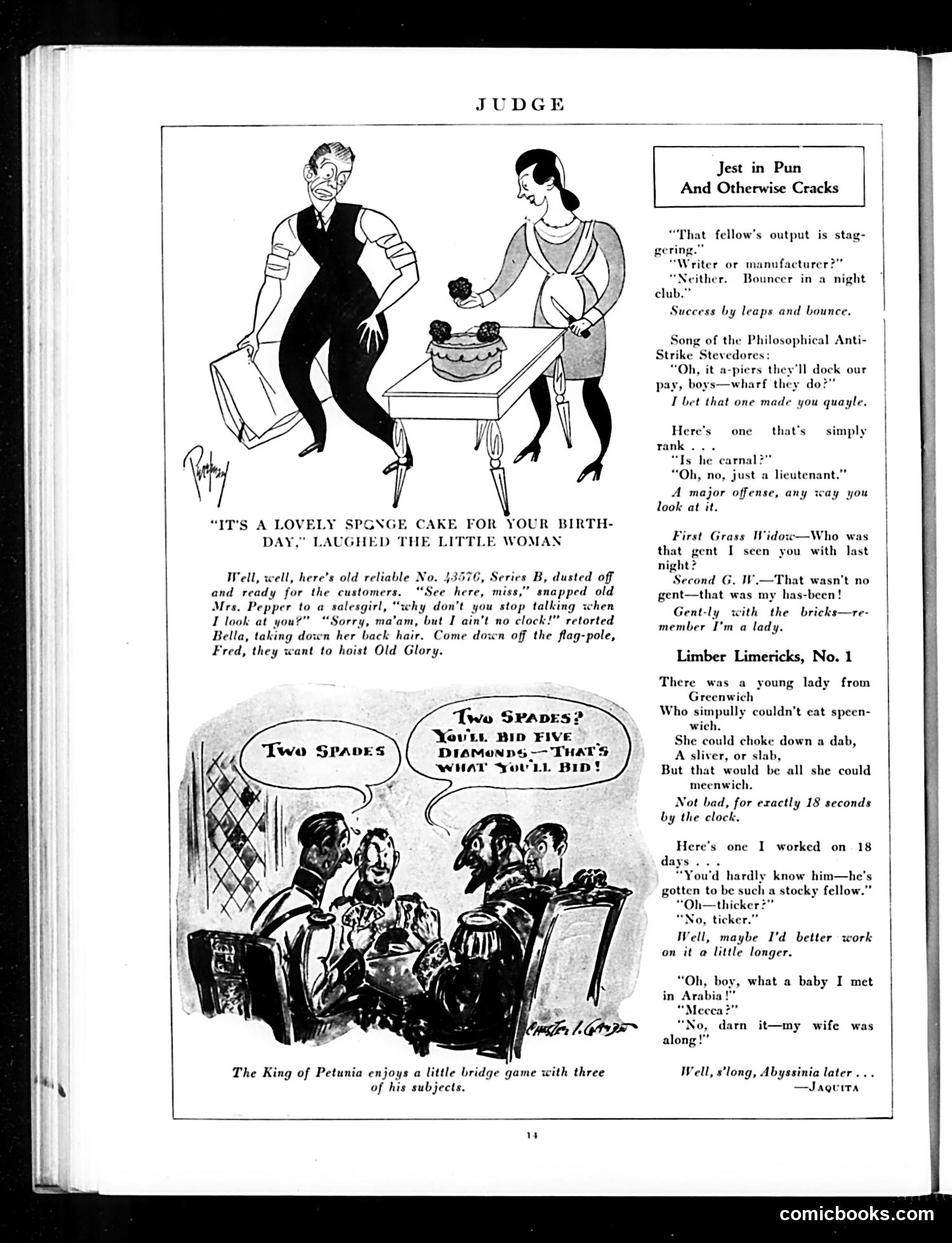
This page from *Judge* magazine contains light satirical humor typical of early 20th-century American comedy. The top cartoon depicts a domestic scene where a man and woman present a sponge cake, with accompanying quips about workplace dynamics and customer service interactions—standard observational humor about ordinary life. The larger cartoon below shows "The King of Petunia" playing bridge with three subjects, where one character repeatedly says "Two Spades" while another insists they should bid higher on diamonds. The joke appears to be a simple pun: the card game dialogue mimics the sound of spoken words in a comedic misunderstanding. The right column contains "Jests in Pun and Otherwise Cracks"—brief one-liners and limericks on mundane topics (occupations, relationships, food preferences). There's wordplay like "quayle" (likely "quail") and references to stenographers and war-era occupations. Overall, this represents *Judge*'s formula of gentle domestic and wordplay humor rather than sharp political satire, aimed at middle-class readers seeking lighthearted entertainment.
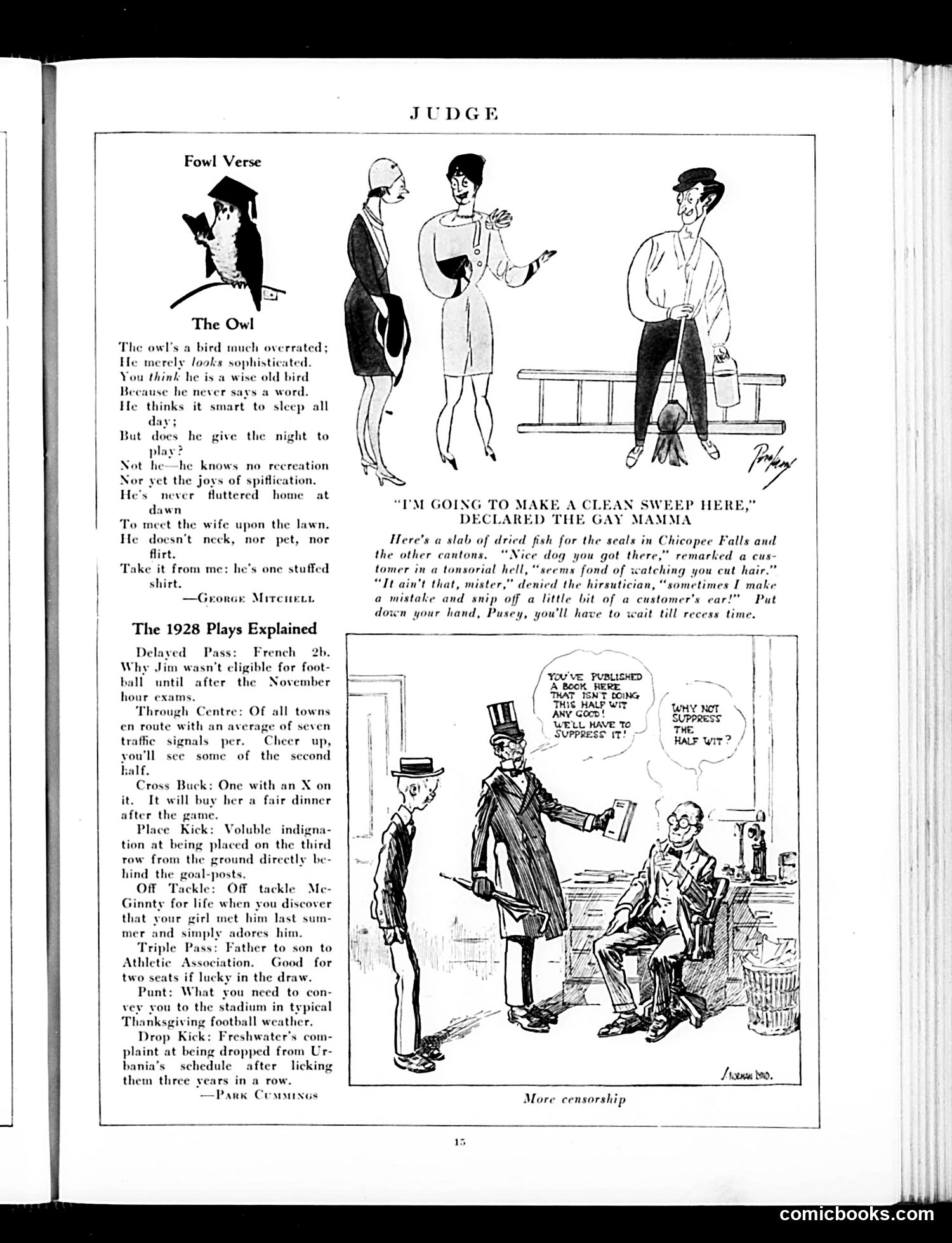
This page contains satirical commentary on 1920s American life and culture. **"The Owl" poem** (by George Mitchell) mocks the owl's reputation for wisdom. The satire suggests that the owl is overrated—it merely *appears* sophisticated through silence and daytime sleeping, but actually lives a dull, unsocial life without romance or recreation. This is likely social commentary on pretentious intellectuals who hide behind affected silence. **"The 1928 Plays Explained"** humorously decodes football terminology as metaphors for college social/romantic drama—e.g., a "delayed pass" explains why a student wasn't eligible for football, while "tackle McGinnity" means breaking up with him after learning he courted your girlfriend last summer. **"More Censorship"** (bottom cartoon) depicts book censorship. A publisher and censor discuss suppressing a book, with the censor claiming half of it isn't "any good." The satire critiques arbitrary censorship decisions—the censor's judgment appears capricious and authoritarian, reflecting 1920s concerns about censorship overreach.
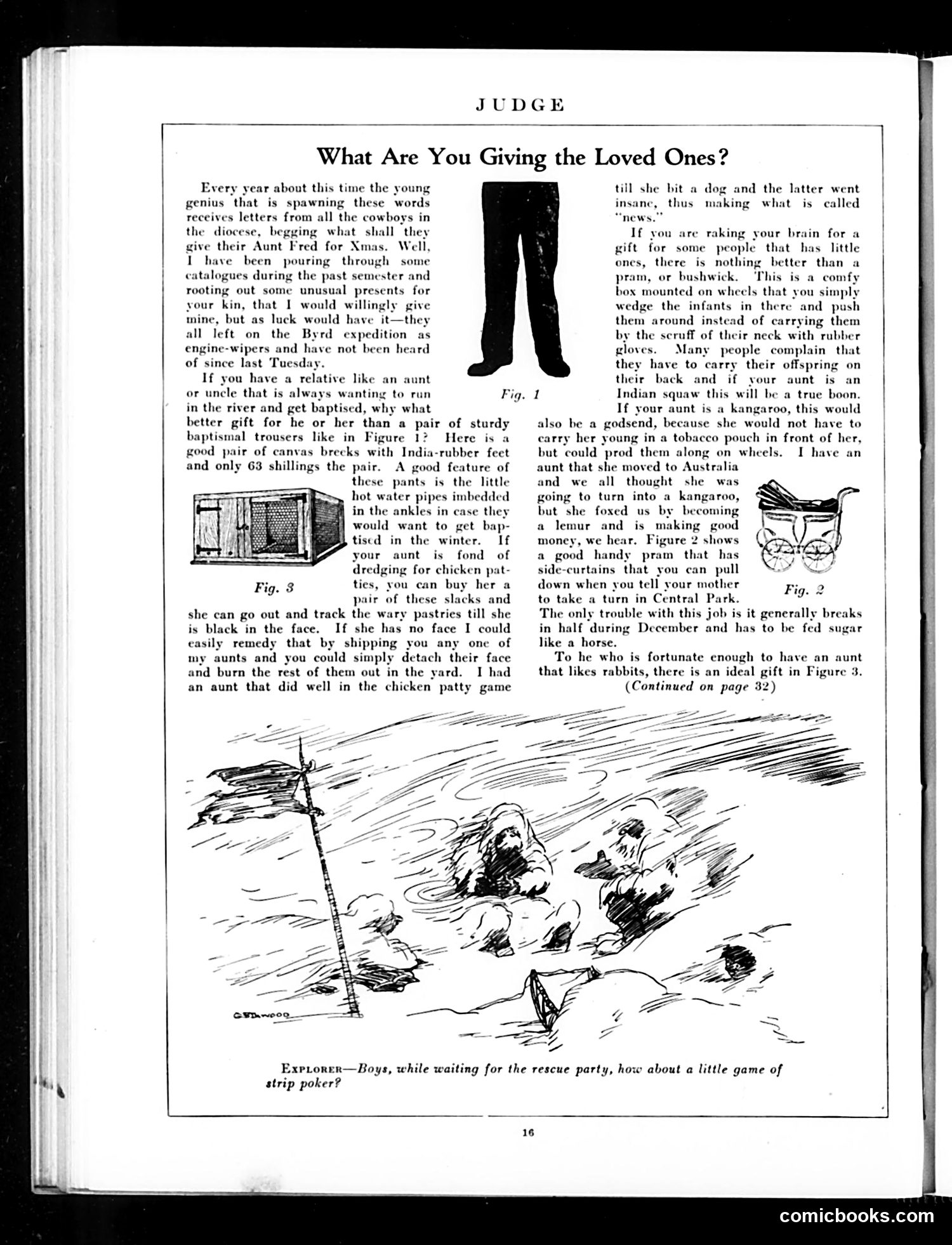
This is a humorous gift-giving advice column from Judge, likely from the 1920s-30s. The author sarcastically suggests absurd Christmas presents for relatives, employing deliberate nonsense and surreal humor typical of the era's satirical style. The three "inventions" shown—baptismal trousers with heated ankle pipes (Fig. 1), a baby pram/carriage (Fig. 2), and an unspecified rabbit-related device (Fig. 3)—are presented as practical solutions to ridiculous problems. The humor relies on exaggeration: trousers for river baptism, heated pipes for winter dunking, and speculation about relatives becoming kangaroos or lemurs. The final cartoon shows explorers awaiting rescue playing strip poker—darkly comedic commentary on human nature in crisis. The satire targets consumerism and gift-giving conventions by suggesting increasingly absurd "solutions," mocking both commercial culture and the era's pseudo-scientific product marketing.
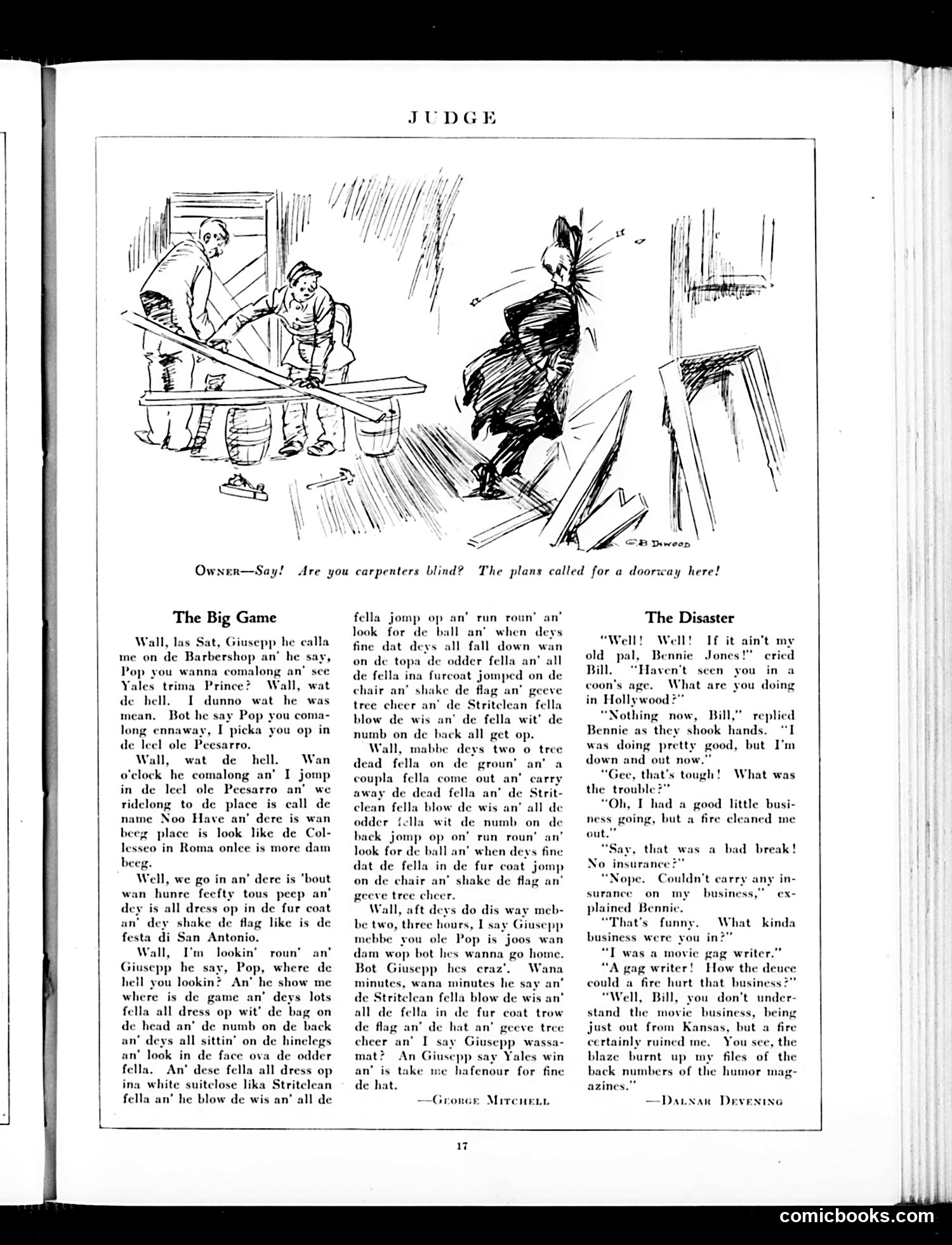
The page contains two distinct pieces of satirical content: **Top Cartoon:** Shows carpenters working while a rabbit-like figure (possibly representing a strike-breaker or scab worker) disrupts the scene. The caption satirizes workplace tensions—the owner accuses the carpenters of blindness for missing the "doorway" the interloper represents, likely mocking labor disputes or the hiring of non-union workers. **"The Big Game":** A phonetically-written monologue in exaggerated Italian-American dialect describing a football game (likely Yale vs. Princeton, given the reference to "Yales win"). The humor derives from the narrator's bewilderment at American football's rules and violence, presenting the sport through an immigrant outsider's comedic misunderstanding. **"The Disaster":** A conversation between two men about a movie gag writer who lost his business in a fire—specifically because his files of old humor magazines burned, leaving him unable to recycle ideas. It satirizes Hollywood's creative practices and the precariousness of the entertainment industry. All three pieces use humor based on class, labor, immigration, and industry-specific anxieties of the era.
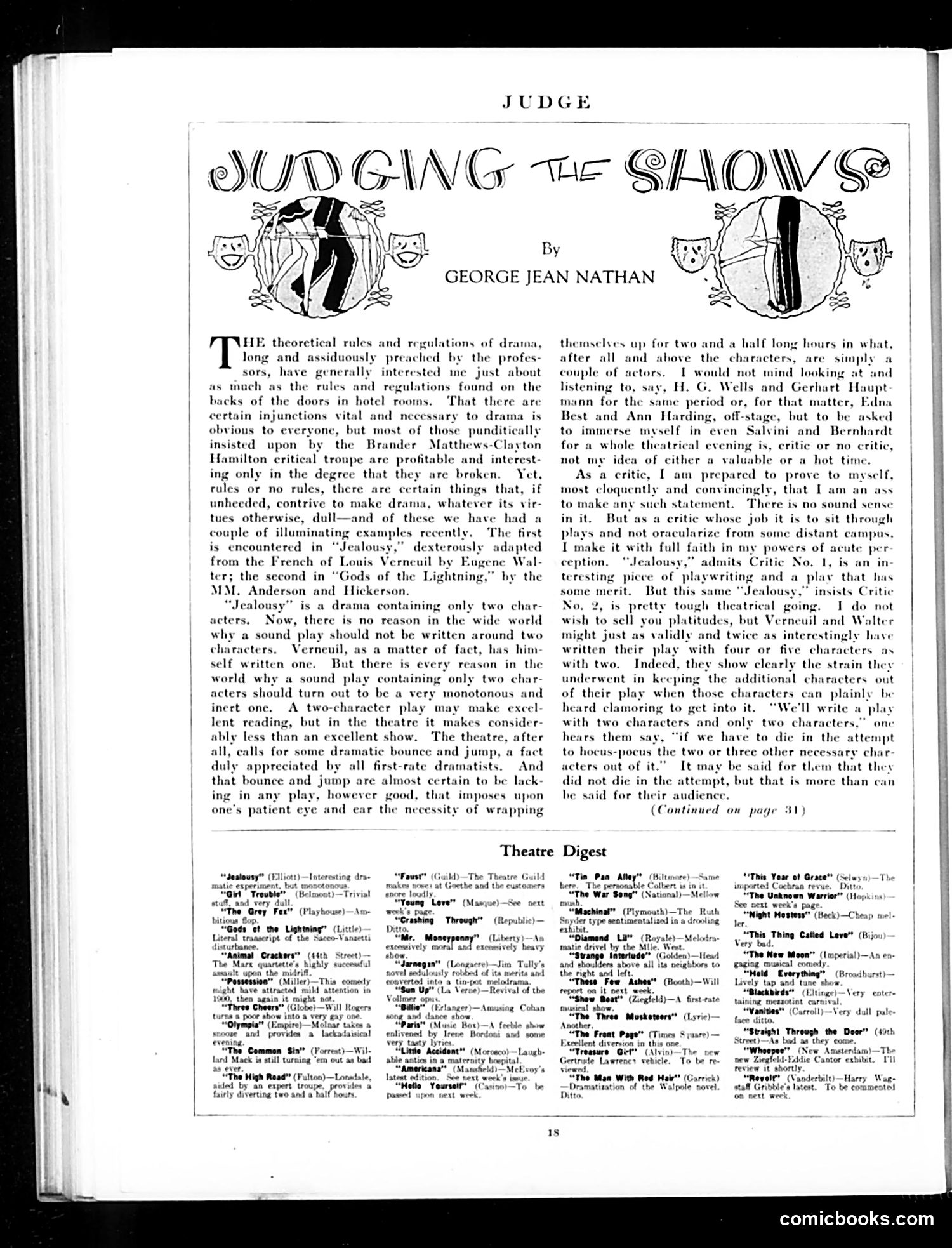
This is not a cartoon but an article by George Jean Nathan, Judge magazine's drama critic. Nathan argues against rigid theatrical rules, using two recent plays as examples. The piece discusses *"Jealousy,"* a French adaptation by Eugene Walters and M.M. Anderson/Hickerson featuring only two characters. Nathan contrasts two critics' opposing views: Critic No. 1 praises it as interesting; Critic No. 2 finds it tedious theatrical fare. Nathan's central point: while two-character plays can work as literature, theater audiences demand "dramatic bounce and jump." A two-person play risks monotony on stage, even if well-written. He references actors H.G. Wells, Gerhart Hauptmann, Edna Best, Ann Harding, Salvini, and Bernhardt—names meant to illustrate that even great performers cannot sustain theatrical interest alone. The satire targets both rigid dramatic theory and critics who mechanically apply it without considering theatrical practicality.
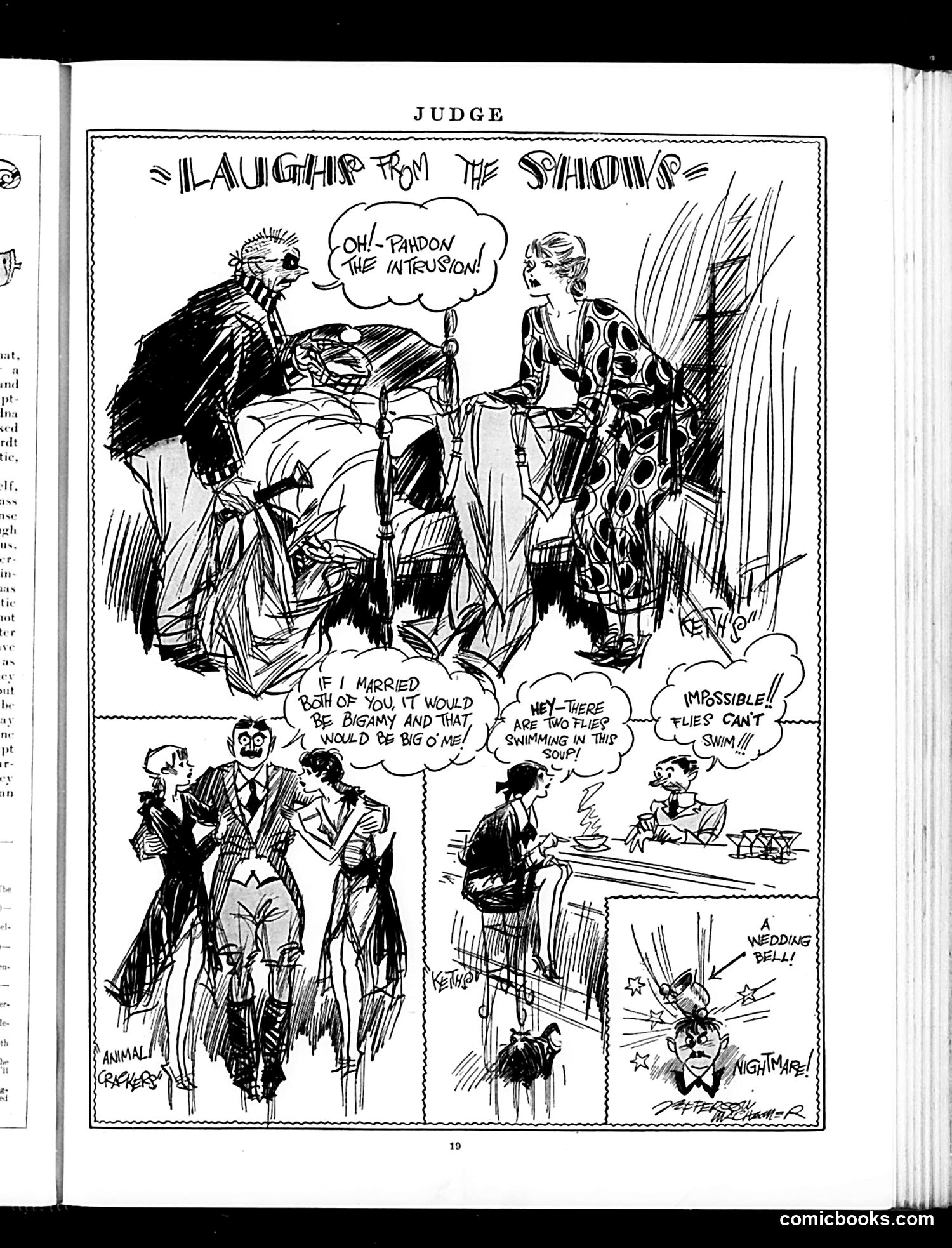
This is a satirical comic about marriage and infidelity. The top panel shows a man (appearing elderly or ghost-like) confronting a woman about "intrusion," suggesting an affair or marital betrayal. The subsequent panels mock the absurd consequences of bigamy: a man fantasizes about marrying two women simultaneously, boasting it would make him "big," while other panels show the chaotic results—a woman discovering two lovers "swimming in this soup," people labeling him an "animal cracker," and the final panel depicting his nightmarish fate ("wedding bell/nightmare"). The satire targets male vanity and the fantasy of having multiple wives, exposing the ridiculous and disastrous reality. It's typical early-20th-century humor mocking infidelity and marriage complications, using exaggeration and visual chaos to emphasize the foolishness of such desires. The artwork's expressionistic style emphasizes the emotional turmoil underlying the jokes.
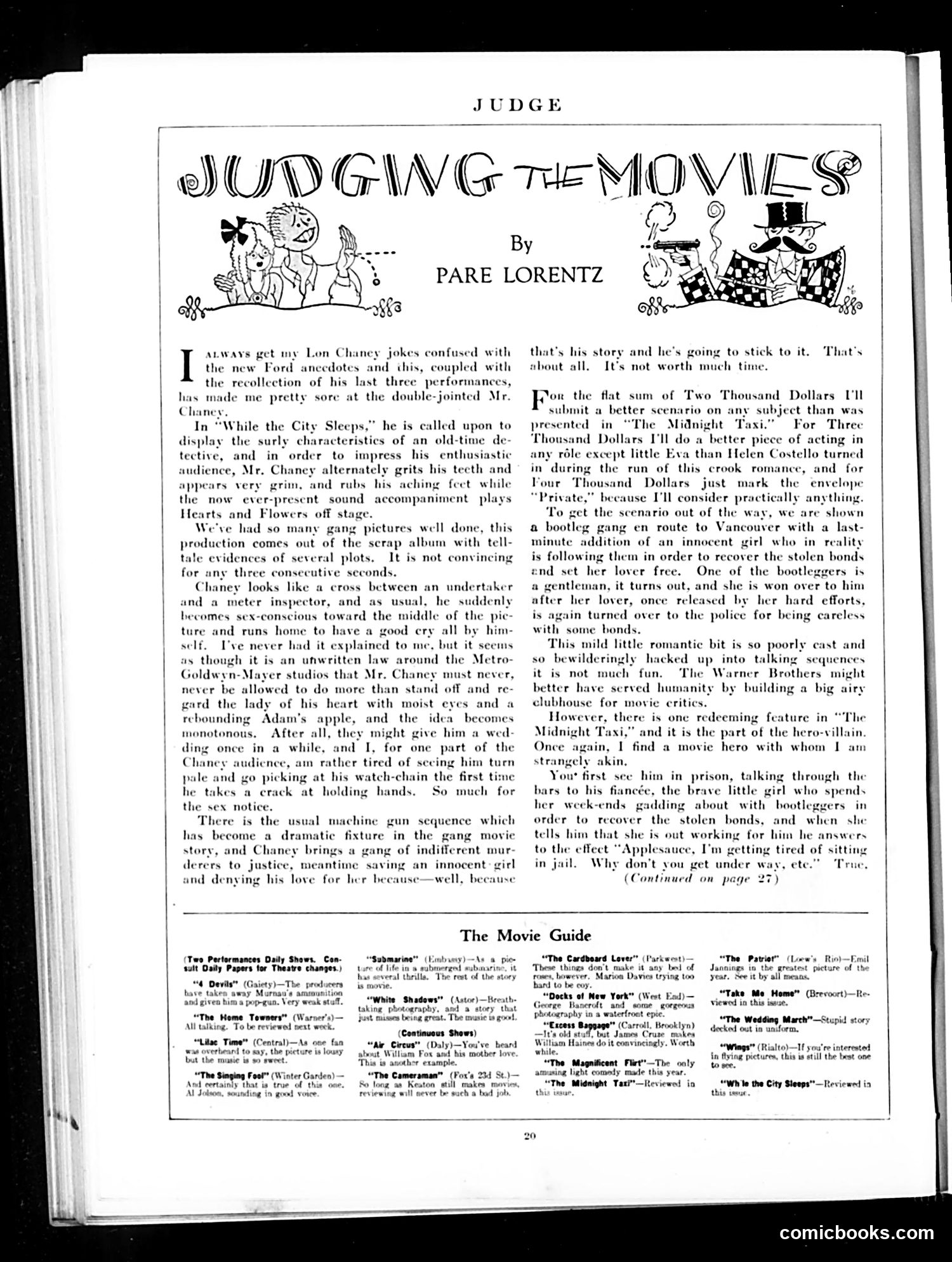
This page contains film reviews by critic Pare Lorentz. The main piece criticizes actor Lon Chaney's performance in "While the City Sleeps," a silent crime drama. Lorentz mocks Chaney's limited dramatic range—complaining that studio rules forbid him from doing anything beyond staring mournfully at his love interest with "moist eyes and a rebounding Adam's apple." The critic ridicules the recycled plot (another gang/crime picture), though he praises the villain character as the film's only redeeming element. The secondary review skewers "The Midnight Taxi" (likely a bootlegger melodrama), sarcastically offering to write better scenarios for payment. Lorentz finds it poorly cast and bewilderingly assembled, sardonically suggesting the Warner Brothers build "a big airy clubhouse for movie critics" instead of making films. The tone is acerbic Hollywood critique typical of Judge's satirical approach to entertainment.
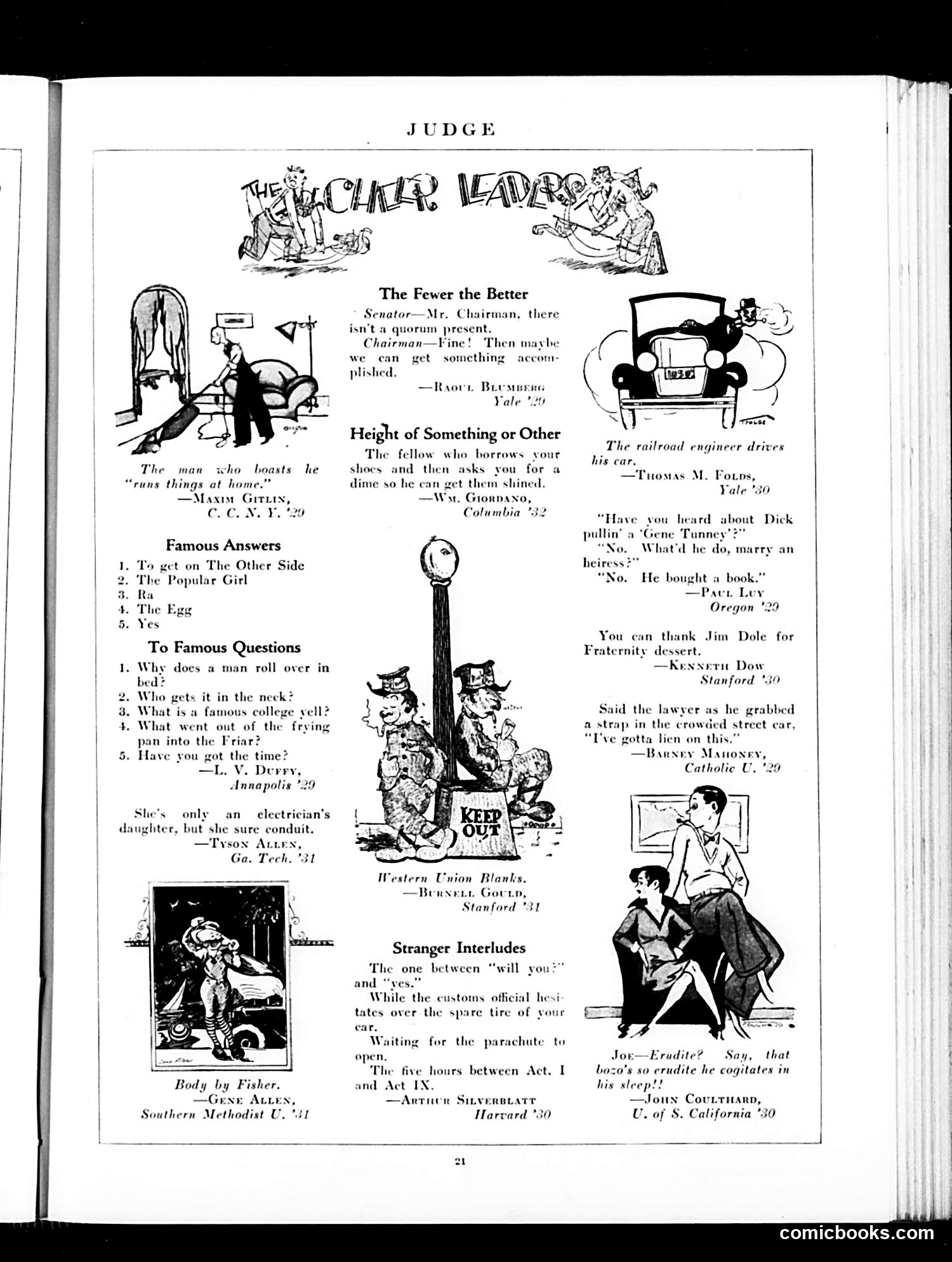
This page from *Judge* compiles humorous one-liners and cartoons from college contributors (note the repeated class years like '29, '30, '31). The content reflects 1920s-30s collegiate humor and social commentary: **Political satire**: "The Fewer the Better" mocks legislative inefficiency—a senator admits that without a quorum, Congress might actually accomplish something, suggesting partisan gridlock prevents productive governance. **Social humor**: Other jokes target everyday annoyances (borrowed shoes, marital dynamics) and college life stereotypes. "Height of Something or Other" plays on pretentious jargon. **Cultural references**: "Gene Tunney" alludes to the famous boxer; "Jim Dole" likely references pineapple magnate James Dole; the parachute and multi-act play jokes reference contemporary entertainment. The cartoons—a man boasting at home, a railroad engineer, figures discussing books—illustrate these observations visually. Overall, this represents *Judge*'s formula: light satirical commentary on politics, manners, and culture filtered through college-age contributors' perspectives.
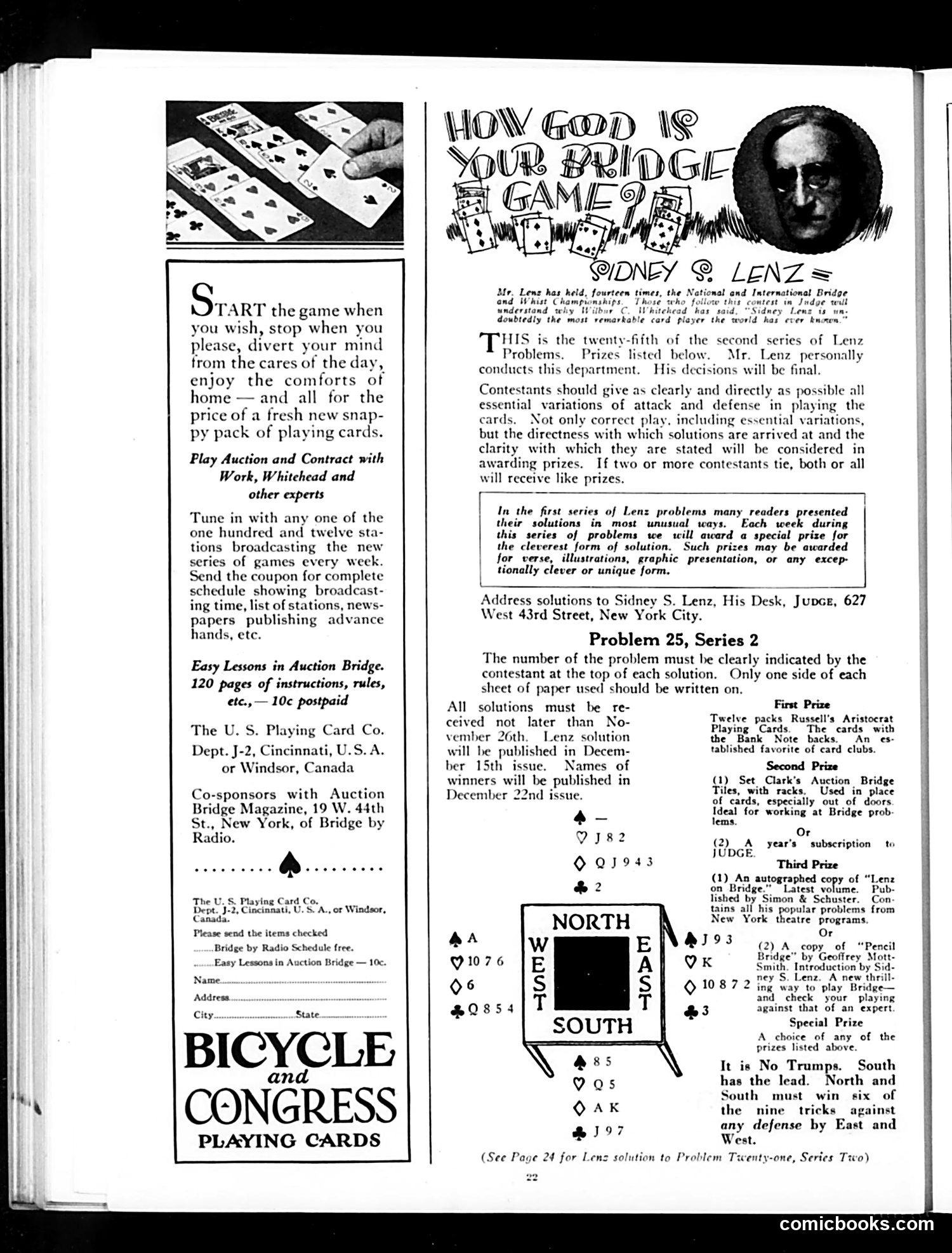
This page is primarily **advertising and puzzle content**, not political satire. The main feature is a bridge card game problem ("Problem 25, Series 2") sponsored by Sidney S. Lenz, a famous bridge expert of the era. The page advertises U.S. Playing Card Co.'s bridge instruction materials and broadcasting programs. The portrait appears to be **Sidney S. Lenz** himself, identified in the text as holding "fourteen times" national and international bridge championships. The page invites readers to solve his bridge problem for prize money and gifts (playing cards, subscriptions to Judge magazine, and books). The content reflects **1920s-30s leisure culture**: bridge was enormously popular among middle and upper-class Americans during this period. The emphasis on "divert your mind from the cares of the day" likely references economic anxiety, possibly the Depression era. The "Bicycle and Congress Playing Cards" advertisement emphasizes affordability and home entertainment—accessible escape for ordinary people.
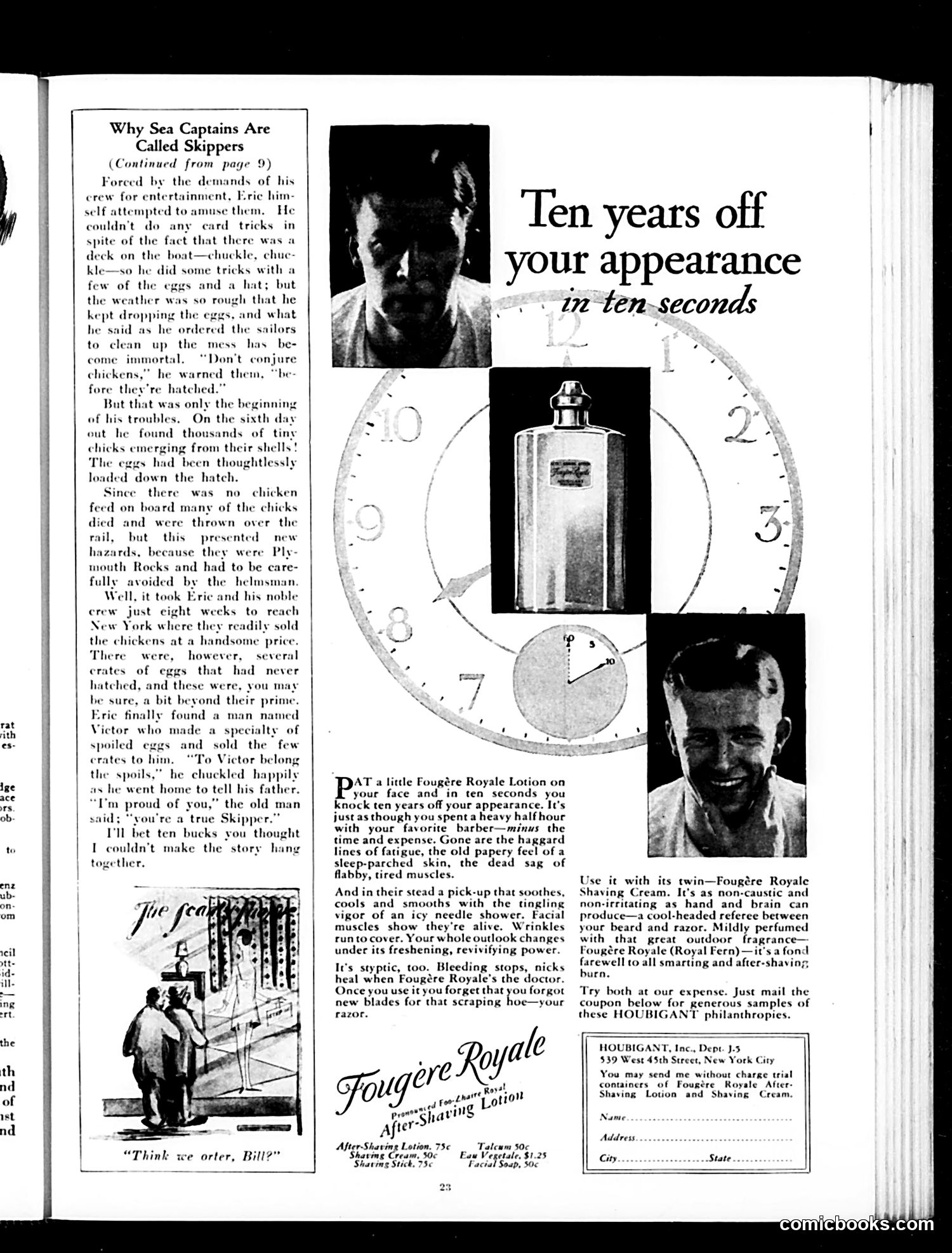
This page contains two distinct elements: **Left side:** A humorous short story titled "Why Sea Captains Are Called Skippers" (continued from an earlier page). The narrative follows a sea captain named Eric who attempts magic tricks to entertain his crew using eggs. When thousands of chicks inexplicably hatch during a voyage, the captain struggles to manage them. The story culminates in a pun: Eric successfully sells the chickens and spoiled eggs in New York, leading his father to declare "you're a true Skipper"—playing on the double meaning of "skipper" (ship captain) and the eggs that "skipped" or hatched unexpectedly. **Right side:** A full-page advertisement for Fougére Royale men's grooming products (shaving lotion, cream, and aftershave). The ad uses dramatic before-and-after photos and hyperbolic language claiming the lotion removes "ten years off your appearance in ten seconds." It emphasizes masculine benefits like soothing, healing nicks, and anti-irritant properties. The page is primarily advertising-driven, with the story serving as editorial filler.
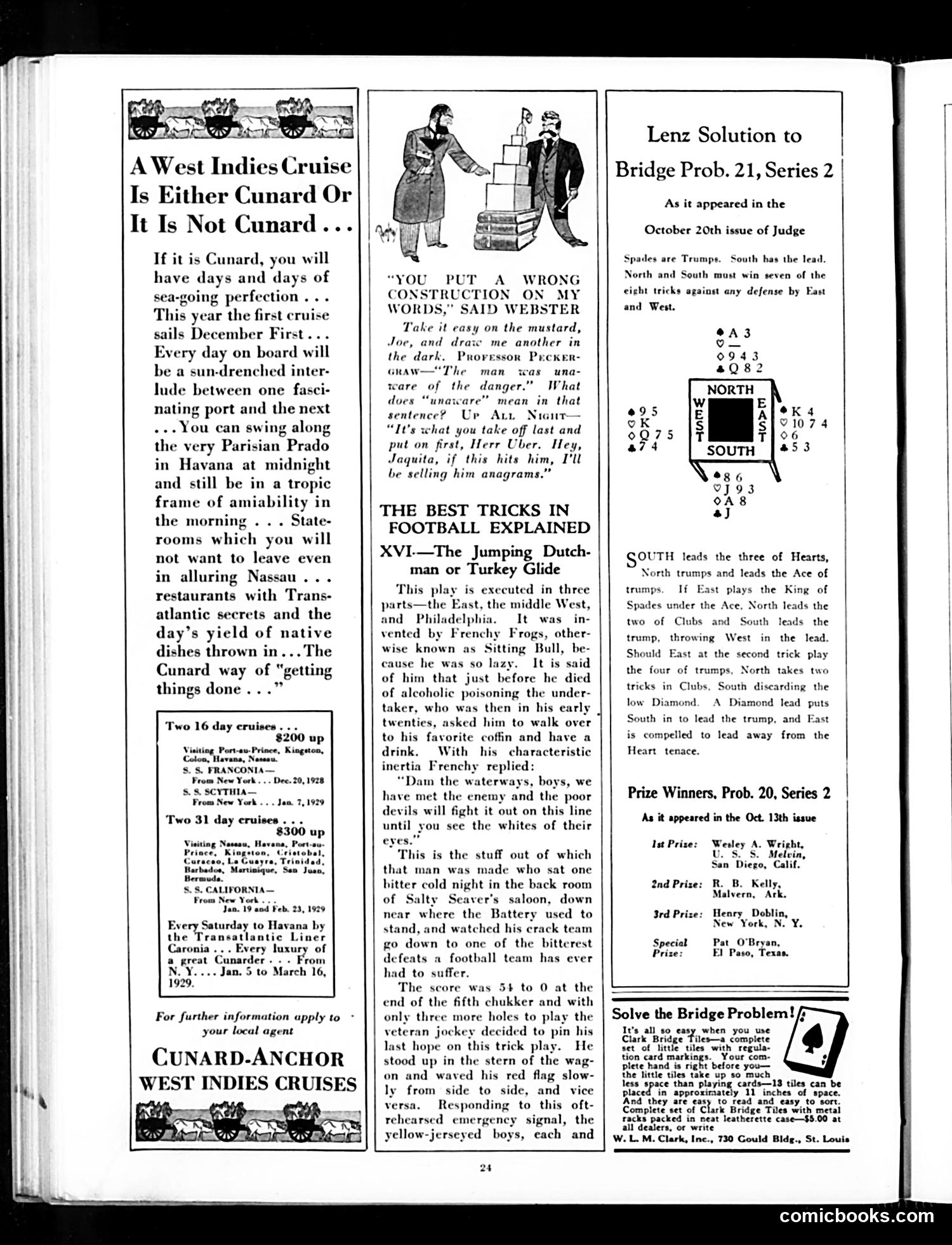
This page contains primarily **advertisements and game/puzzle content** rather than political satire. The left side features **Cunard cruise line advertising**, promoting luxurious Caribbean voyages departing December 1928-January 1929, emphasizing the "Cunard way of getting things done" with upscale amenities in ports like Havana and Nassau. The center contains a humorous **dialogue cartoon** about a professor misunderstanding slang ("unaware" meaning to remove clothing), followed by a satirical section mocking sports journalism—"The Best Tricks in Football Explained" absurdly describes a football play in nonsensical terms (mixing football with cricket terminology like "chukker" and "holes"), poking fun at overwrought sportswriting. The right side presents a **bridge card game problem and solution**, a typical Judge feature for readers interested in games. The overall page reflects 1928-1929 leisure culture: luxury travel, sports entertainment, and intellectual games for affluent audiences.
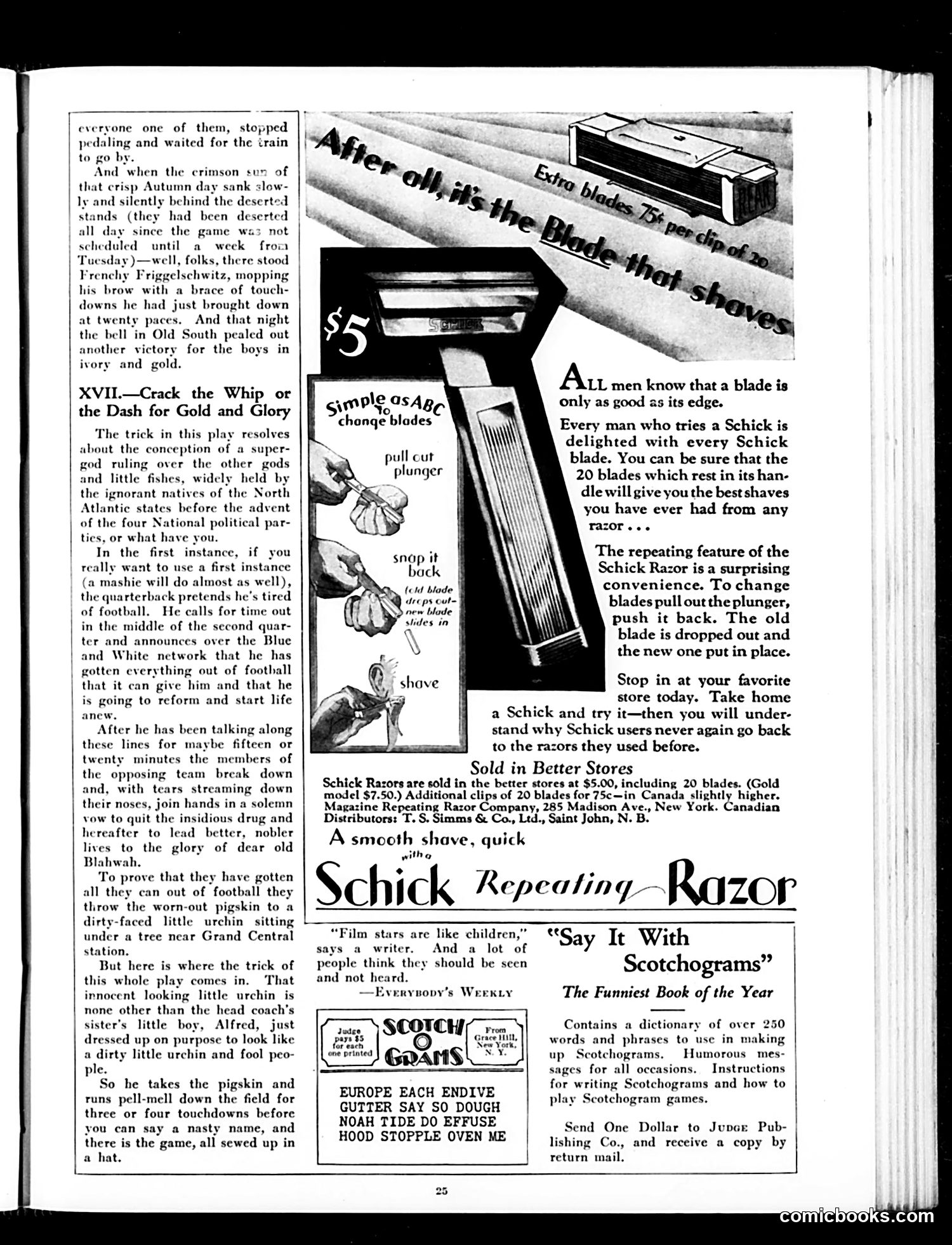
This page mixes sports satire with period advertising. The main text is a humorous football story titled "Crack the Whip or the Dash for Gold and Glory," which satirizes college football through absurdist storytelling. It mocks the sport's drama and emotional manipulation—depicting a quarterback's fake retirement speech that moves opponents to tears, only to reveal the "reformed" team then loses to a disguised coach's nephew. The satire suggests football is performative theater masking deception. The bulk of the page features advertisements: a **Schick Repeating Razor** ad highlighting its blade-changing convenience, and a **Scotchograms** book advertisement (a word-game product where words rearranged sound like phrases—the example "EUROPE EACH ENDIVE / GUTTER SAY SO DOUGH" becomes "You're a cheap skate / Good for nothing"). These ads are typical early 20th-century consumer products marketed to middle-class readers. The page is primarily commercial content with satirical editorial framing.
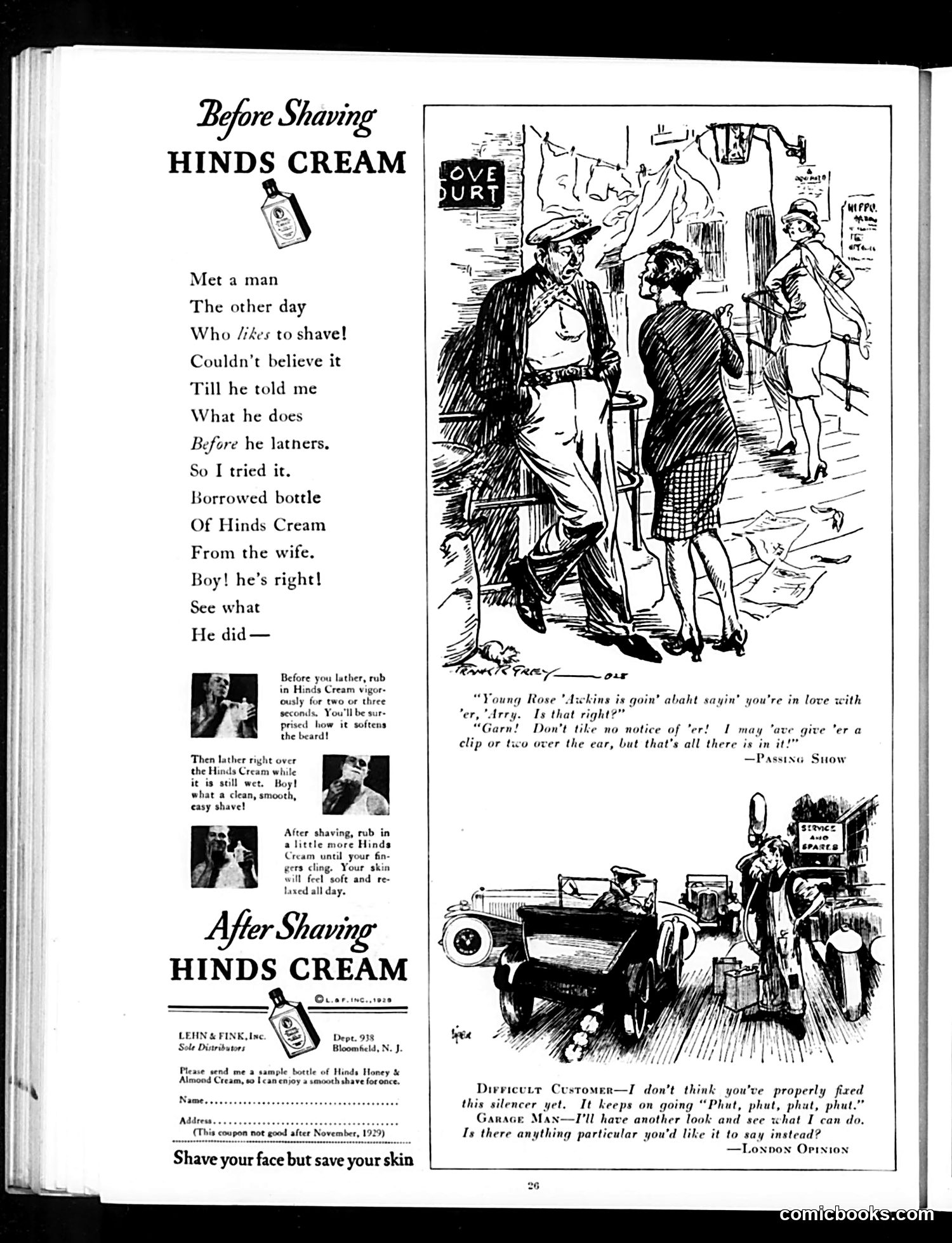
This page is primarily a **Hinds Cream shaving product advertisement** (left side) interspersed with three separate comic cartoons (right side). **The Advertisement:** Uses a testimonial format—a man enthusiastically endorses Hinds Cream as a pre- and post-shave moisturizer, claiming it softens the beard and leaves skin comfortable. **The Cartoons:** Three British-humor pieces unrelated to the ad: 1. "Young Rose 'Askins"—Working-class London dialogue (indicated by dialect spelling) where a man dismisses romantic rumors about a woman, claiming minimal contact. 2. "Silencer Problem"—A motorist complains to a garage mechanic that his car's silencer malfunctions, repeatedly making "phut" sounds. The mechanic sarcastically asks what sound *would* be preferred—humor based on the futility of fixing a broken silencer. All cartoons use period British slang and lower-class dialect, typical of Judge's international content appeal in the 1920s.
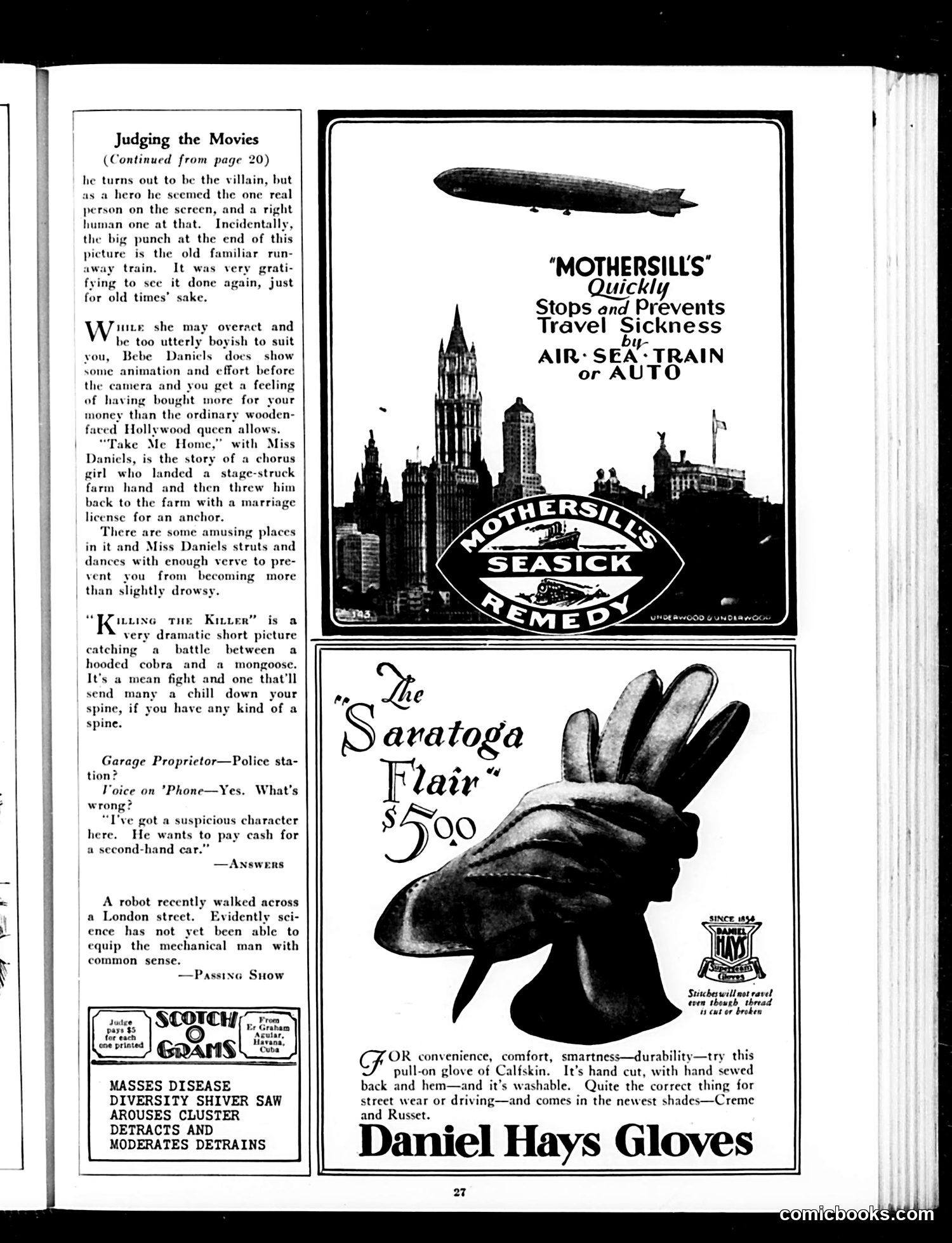
This page contains a **movie review column** ("Judging the Movies," continued from page 20) discussing several films, including one starring actress Bebe Daniels. The reviewer praises her animation and effort onscreen, and mentions films titled "Take Me Home" and a short called "Killing the Killer" about a cobra-mongoose fight. The page is otherwise dominated by **advertisements**: a Mothersills seasickness remedy ad (featuring a zeppelin and city skyline), a Saratoga Flair glove advertisement ($5.00), and Daniel Hays Gloves. There's also a brief humor item about a robot lacking common sense, and a police-station joke about someone paying cash for a used car. The satirical content is minimal—mainly the robot quip and the comedic phone exchange. This appears to be a typical Judge page blending entertainment critique with commercial advertising from the silent film era.
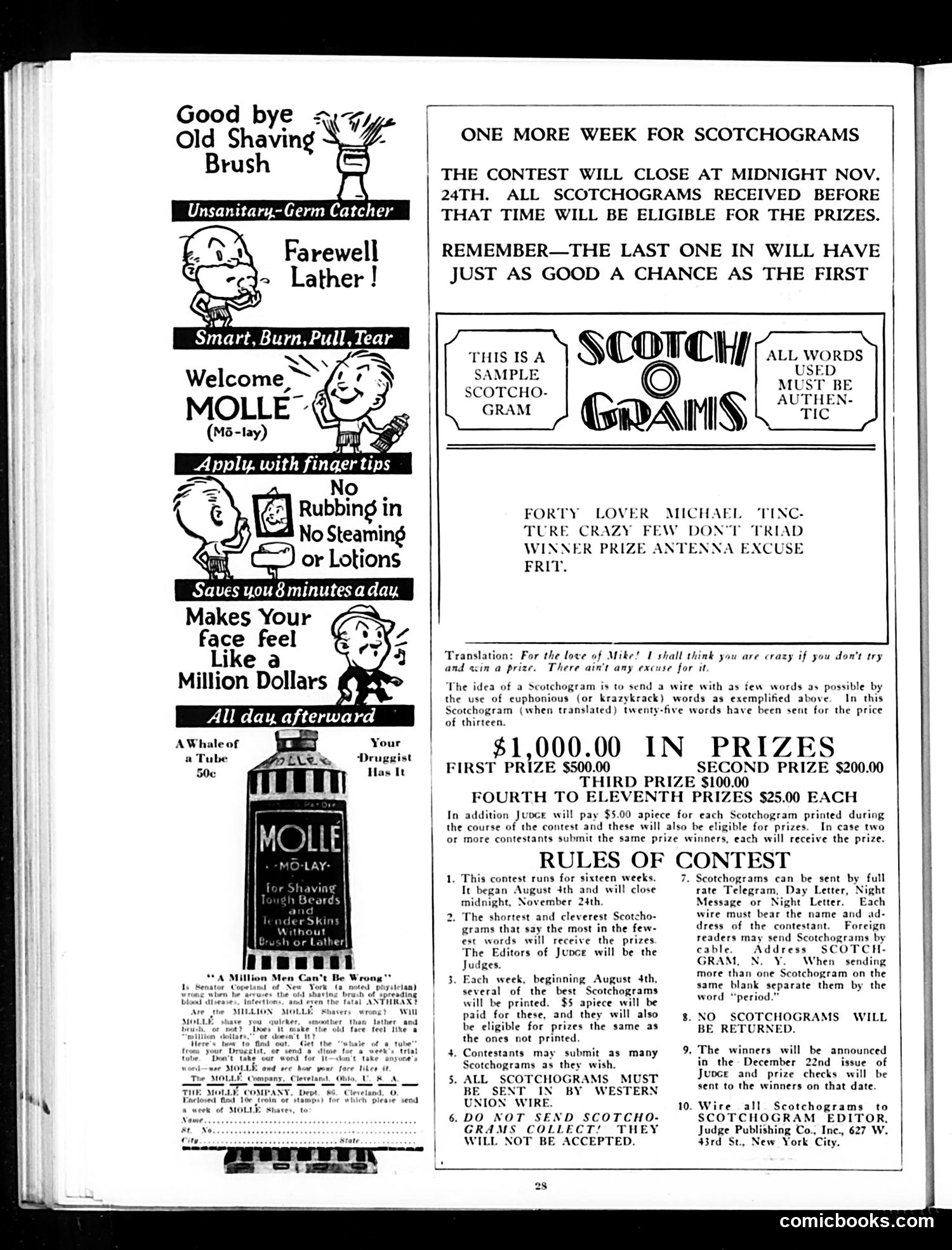
This page advertises Judge magazine's "Scotchogram" contest—a word-game competition running through November 24th with $1,000 in prizes. A "Scotchogram" is a telegraphed message using the fewest possible words to convey meaning, employing creative wordplay and made-up terms. The sample shown translates "Forty Lover Michael Tincture Crazy Few Don't Triad Winner Prize Antenna Excuse Frit" to "For the love of Mike! I shall think you are crazy if you don't try and win a prize. There ain't any excuse for it." The appeal was economical: sending fewer words via Western Union wire saved money, while the clever linguistic condensation made it entertaining. Contestants submitted entries hoping for publication ($5 payment) and prize eligibility. The left side advertises Mollé shaving products—standard magazine advertising from this era. This appears to be a typical Judge issue page mixing editorial contests with commercial promotions.
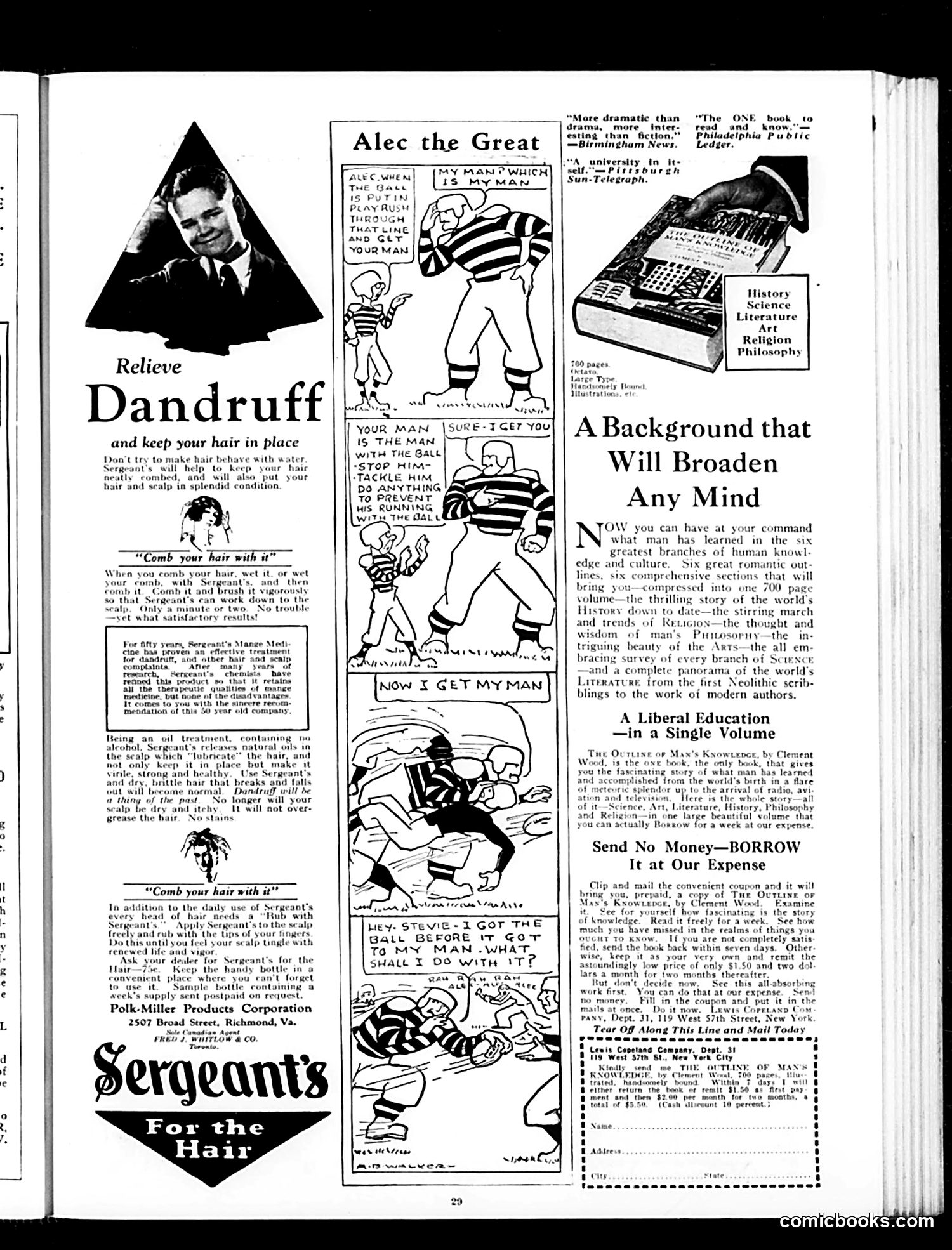
This page features a sports humor comic strip centered on a football player named "Alec the Great." The strip satirizes confused communication between teammates during a game. A small player repeatedly asks his larger teammate "which is my man?" regarding defensive assignments, leading to absurd miscommunications where Alec tackles and tackles again—eventually ending up wrestling with a woman instead of an opponent. The joke relies on the physical comedy of Alec's confusion and overzealousness, playing on contemporary football culture and the stereotype of athletes as not particularly intelligent. The humor is straightforward slapstick—the humor lies in escalating physical chaos rather than political or social commentary. The strip appears in *Judge*, a satirical magazine, though this particular content is entertainment-focused rather than political satire. The surrounding page includes hair product advertising and book promotion, indicating this is general-audience magazine content from the early-to-mid 20th century.
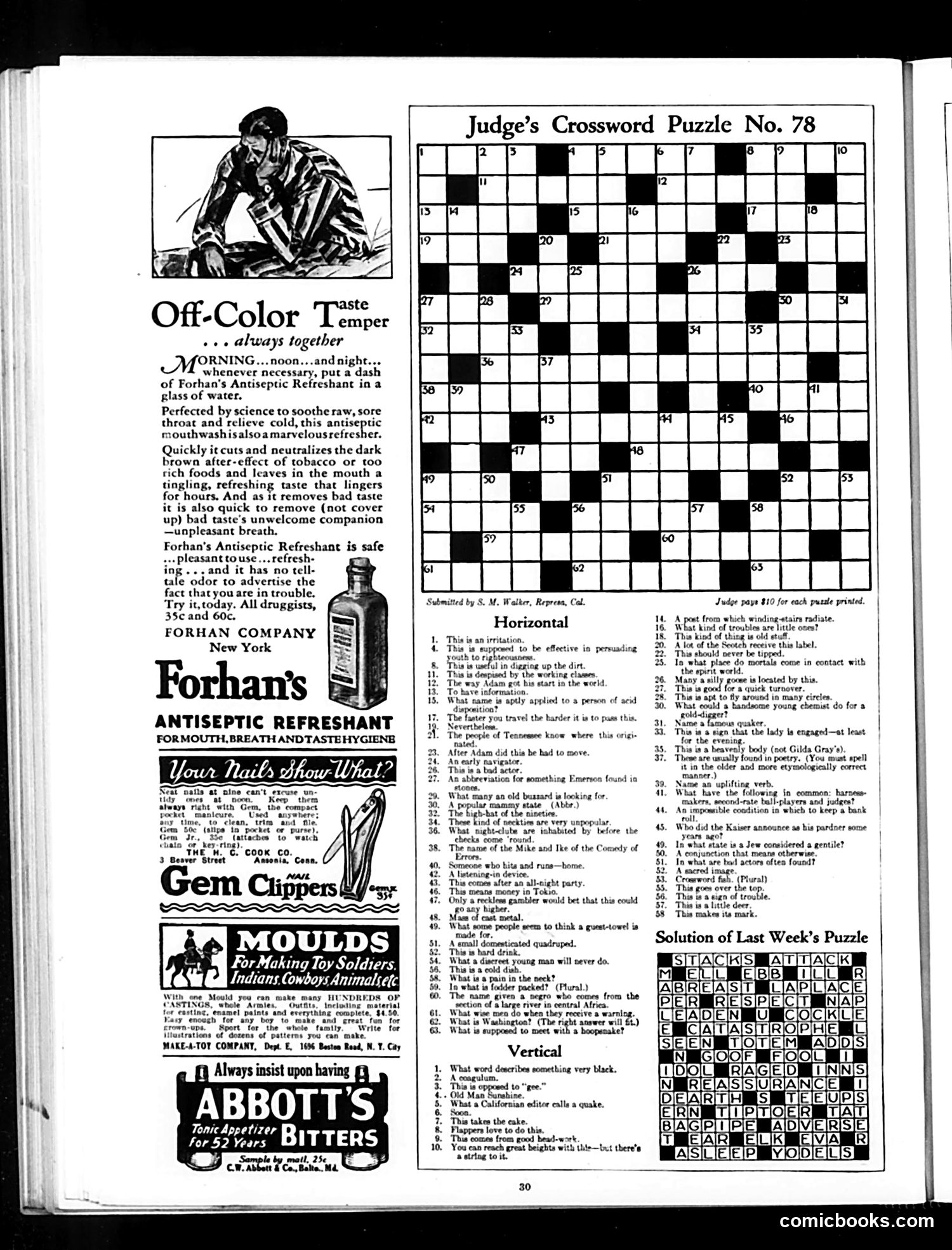
This page is primarily **a crossword puzzle** from Judge magazine, accompanied by period advertisements. The cartoon element is minimal—just a small illustration labeled "Off-Color Temper" depicting a contemplative man, which serves as the puzzle's visual header. The puzzle itself is not satirical but rather a standard word game with clues mixing straightforward definitions with period slang and social references. Clues reference contemporary 1920s-era concerns: Prohibition ("gold-digger"), labor tensions ("working classes"), and social conventions (engagements, fashion). The advertisements surrounding the puzzle—for Forhan's mouthwash, Gem nail clippers, toy soldier molds, and Abbott's Bitters—reveal the magazine's commercial function. These ads, alongside the puzzle, indicate Judge functioned as mainstream entertainment and consumer-oriented content, not purely political satire. **Bottom line:** This page demonstrates Judge as a general-interest humor and lifestyle publication rather than focused political commentary.
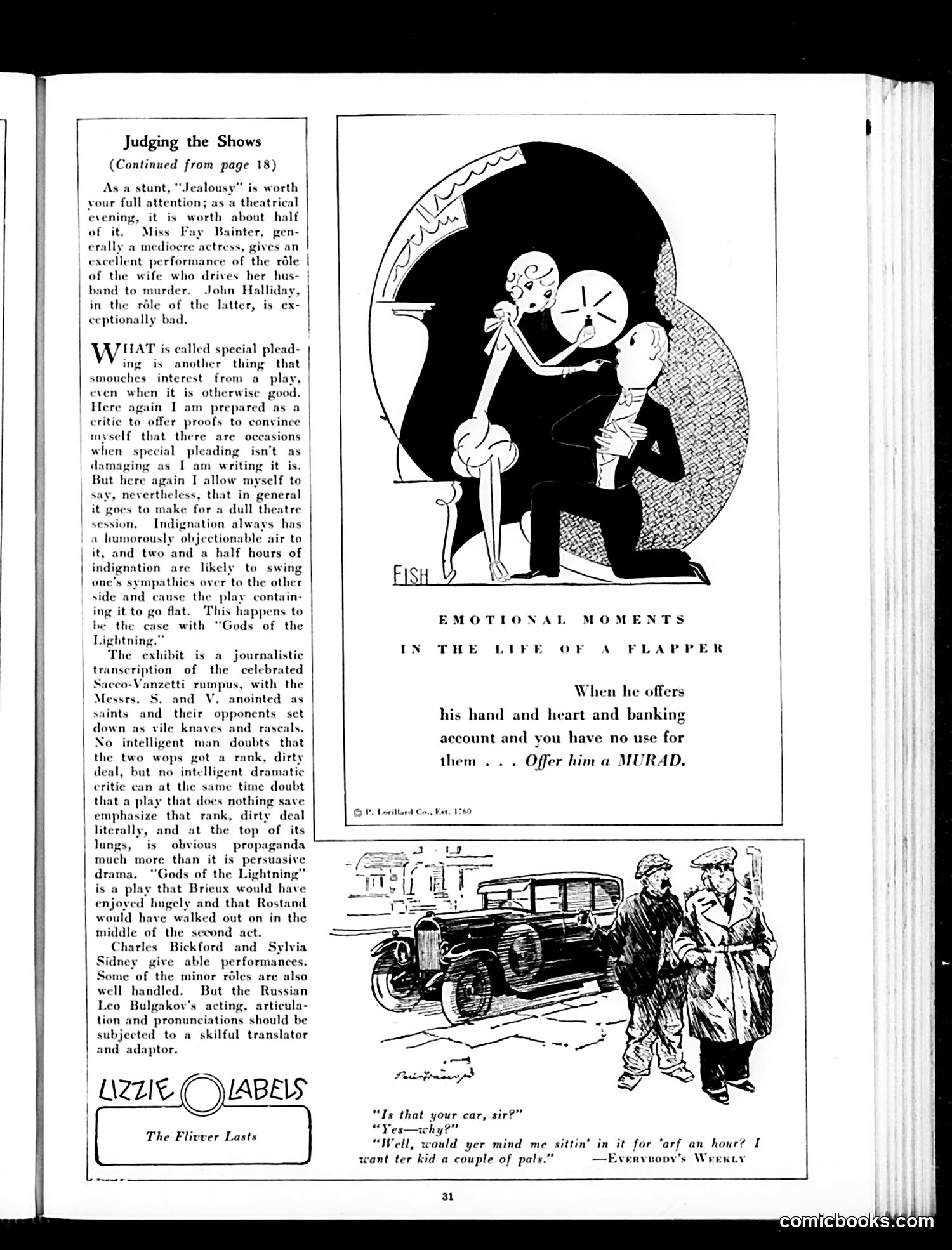
This page contains theatre criticism and satirical advertising. The main theater review discusses the play "Gods of the Lightning," a dramatization of the Sacco-Vanzetti case. The critic argues the play functions as heavy-handed propaganda rather than effective drama—it presents the defendants as saints and opponents as villains with such obvious indignation that it becomes tedious rather than persuasive. He acknowledges the historical injustice ("the two wops got a rank, dirty deal") but criticizes the artistic approach. The cartoon titled "Emotional Moments in the Life of a Flapper" is an advertisement for Murad cigarettes. It depicts a young woman rejecting a suitor's marriage proposal and financial offer, advising him to give a cigarette ("Murad") instead. This satirizes dating customs of the 1920s-30s while promoting cigarettes as a substitute for genuine emotional commitment—humor based on the era's cynicism about romance and consumption.
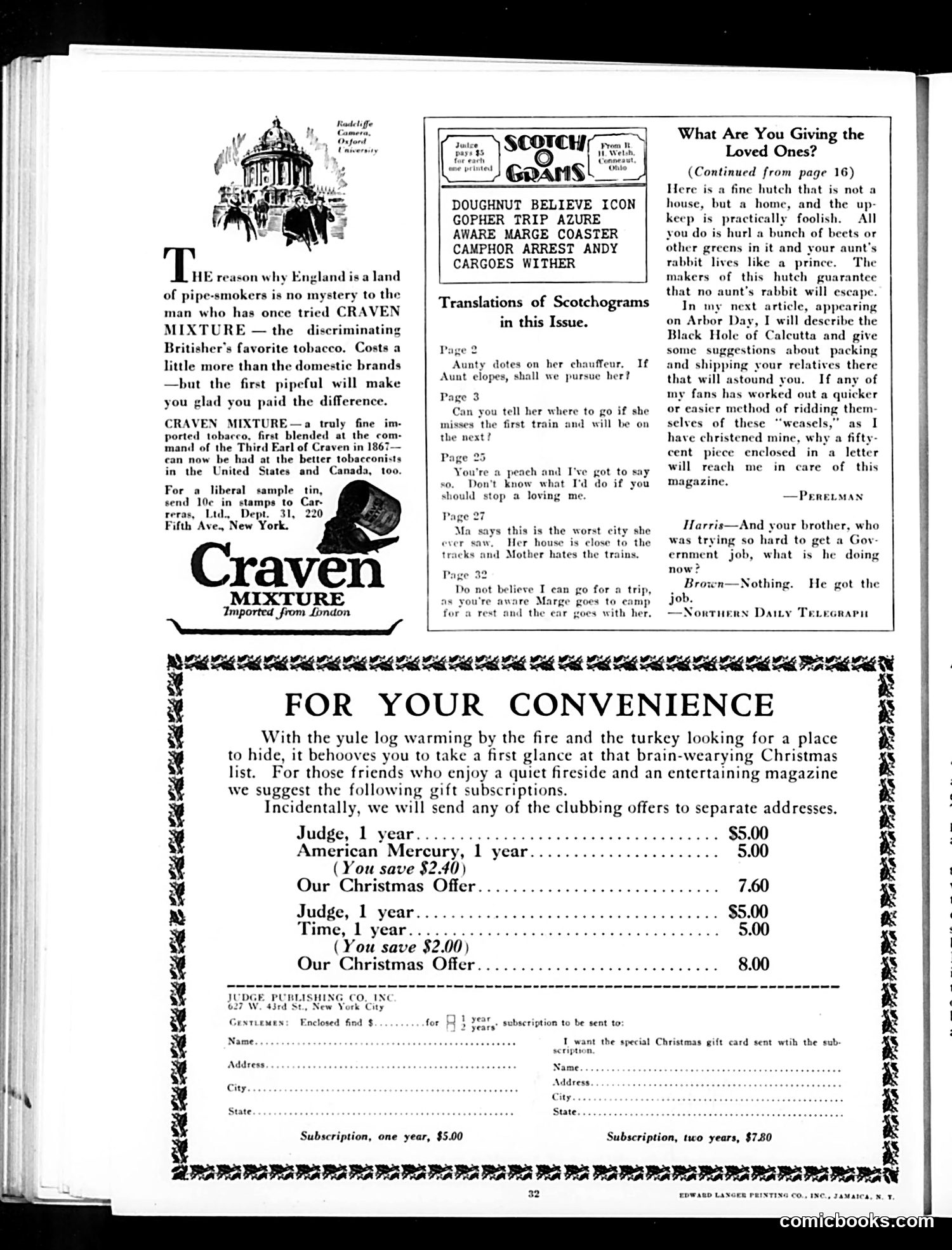
This page is primarily **advertising and subscription offers**, not satirical content. The main elements are: **Craven Mixture tobacco ad**: A British import pitched to American smokers as superior to domestic brands, emphasizing its English prestige and historical pedigree (supposedly favored by the Third Earl of Craven in 1862). **"Scotchograms"**: Cryptic word puzzles with Scottish references—these appear to be a recurring feature the magazine ran, with translations provided elsewhere in the issue. **"What Are You Giving the Loved Ones?"**: A humorous advice column (by S. J. Perelman, a famous humorist) sarcastically suggesting absurd gifts like rabbit hutches and joking about shipping annoying relatives to India. **Gift subscription section**: A Christmas-themed push encouraging readers to give Judge magazine subscriptions to friends. The page reflects 1920s consumer culture and magazine promotion rather than political satire. The humor is mild and domestic-focused.
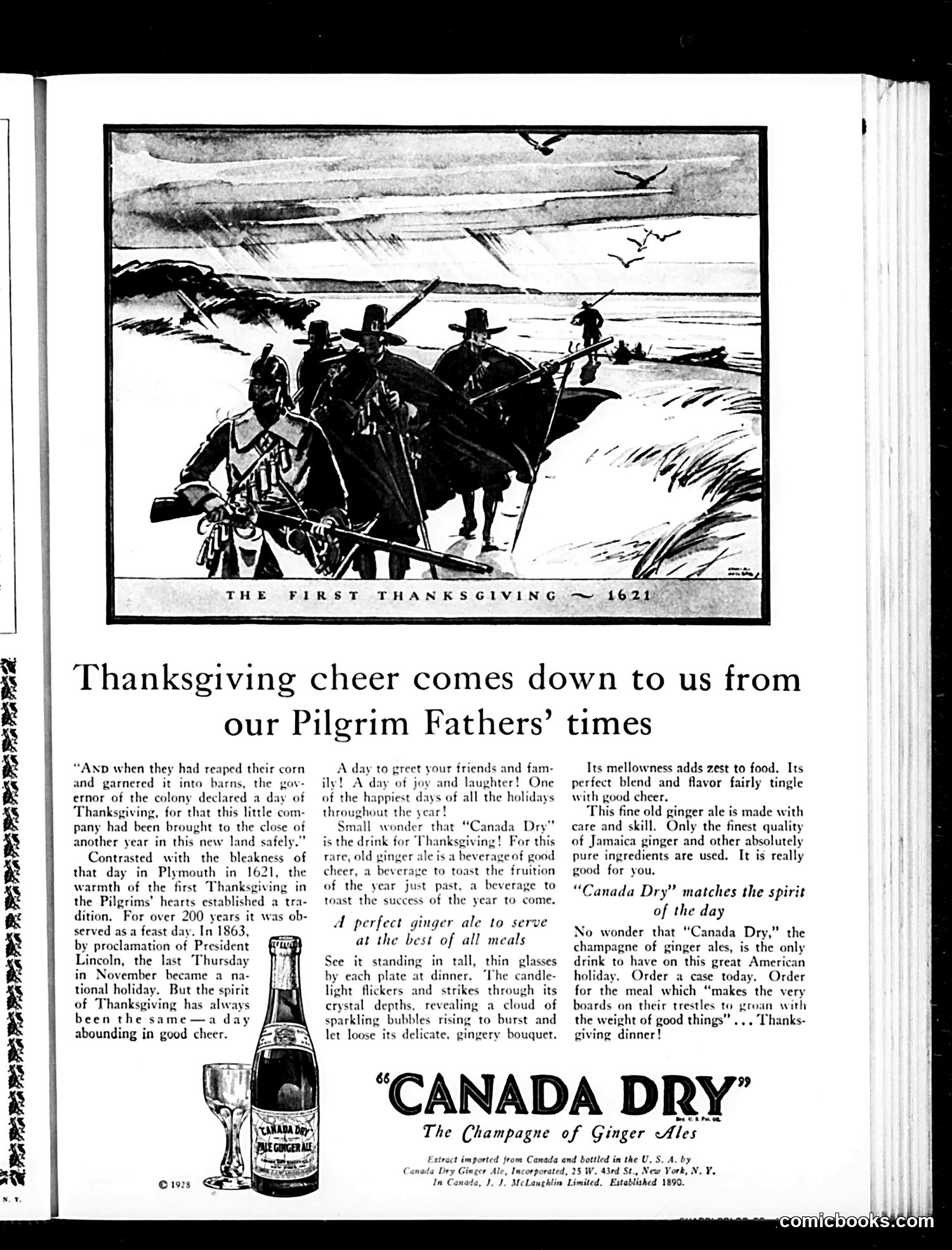
This is primarily a **ginger ale advertisement** masquerading as cultural commentary. The illustration depicts Pilgrims and Native Americans at the 1621 harvest celebration, establishing Thanksgiving's historical legitimacy. The text connects Thanksgiving tradition—from Plymouth 1621 through Lincoln's 1863 presidential declaration—to present-day celebration, then pivots to promote "Canada Dry" ginger ale as the appropriate Thanksgiving beverage. The pitch emphasizes the drink's "mellowness" and quality ingredients (Jamaican ginger), positioning it as refined and healthful ("really good for you"). The satire is **light and implicit**: the ad gently mocks American consumerism by suggesting that an alcoholic predecessor to ginger ale represents authentic Pilgrim "cheer," while framing a commercial product as essential to honoring centuries of tradition. For 1920s readers, this connected Prohibition-era ginger ale to nostalgic Americana. Modern readers might note the casual appropriation of Indigenous peoples' role in that first harvest.
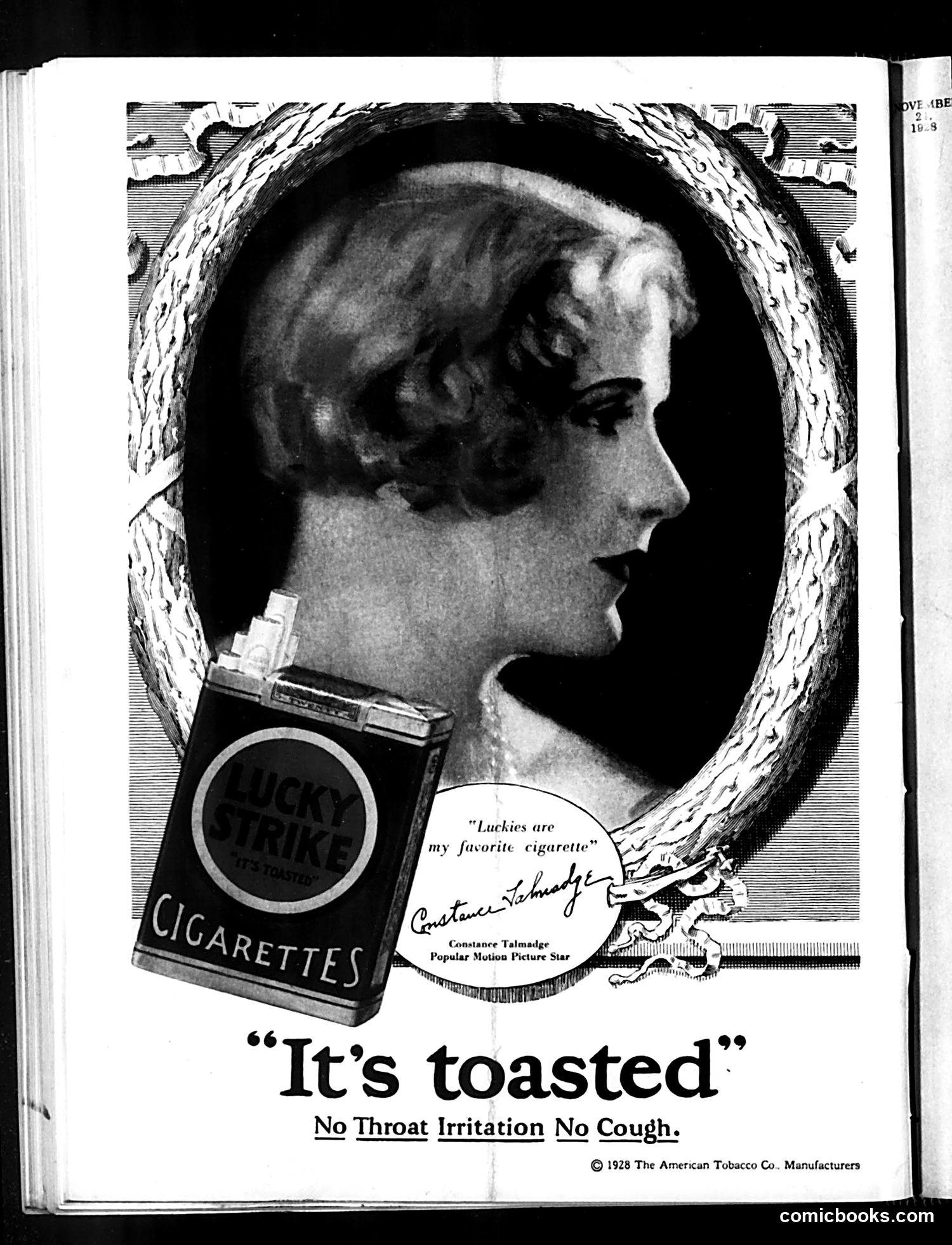
This is a **1928 cigarette advertisement**, not a political cartoon. It features a glamorous profile portrait of **Constance Talmadge**, a popular silent film actress of the era, endorsing Lucky Strike cigarettes. The ad makes health claims typical of that pre-regulation period: "It's toasted—No Throat Irritation No Cough." The "toasting" process was presented as a scientific innovation that supposedly made smoking safer, a marketing strategy to address growing health concerns about cigarettes. The celebrity endorsement leverages Talmadge's fame and perceived sophistication to make smoking appear desirable and glamorous to consumers, particularly women—a significant market expansion for tobacco companies in the 1920s. The ornate decorative frame emphasizes elegance and status.