
Judge, 1929-01-26 · page 22 of 34
Judge — January 26, 1929 — page 22: what you’re looking at
What you’re looking at
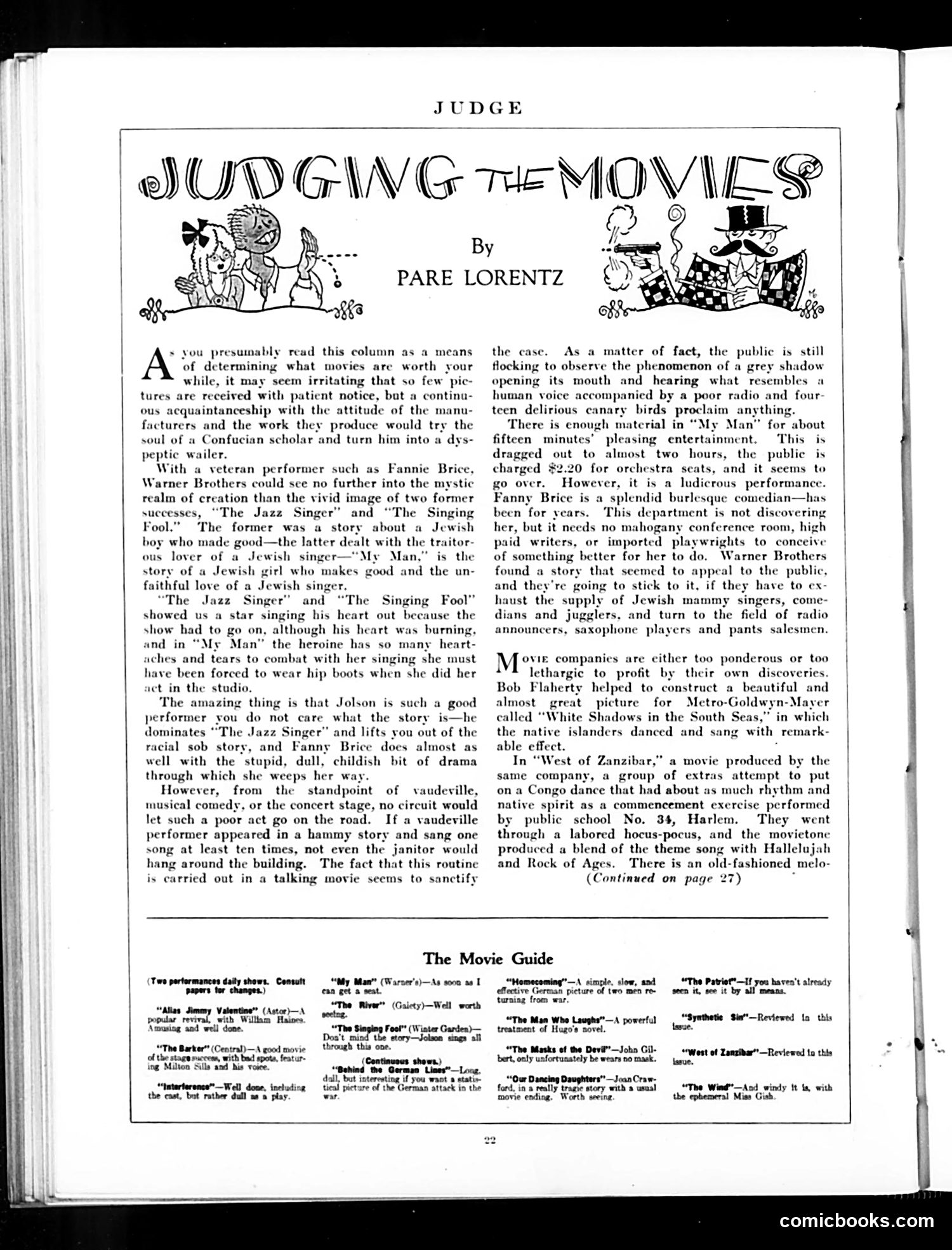
This is a film criticism column by Pare Lorentz reviewing early sound films. The satire targets Hollywood studios' creative laziness with talking pictures. **Main targets:** Lorentz criticizes Warner Brothers for recycling the same Jewish immigrant-success narrative across multiple Fannie Brice and Al Jolson films ("The Jazz Singer," "The Singing Fool," "My Man"). He argues the studios found one profitable formula and milk it endlessly rather than develop original material. **The joke:** While these performers are genuinely talented, the repetitive, emotionally manipulative plots would never survive on a vaudeville stage—audiences would reject such "hammy" material. Yet moviegoers tolerate (even pay premium prices for) the same tired storylines when filtered through the novelty of synchronized sound. Lorentz's broader complaint: studios are either too rigid or too lazy to innovate beyond their initial discoveries, instead exhausting entire categories of performers (Jewish singers, then comedians, then radio announcers) through the same worn dramatic template.
📄 Transcribed text from this page (OCR, searchable)
Machine-transcribed from the original scan — historical spelling and the odd misread are preserved.
JUD A> you presumably read this column as a means of determining what movies are worth your while, it may seem irritating that so few pic- tures are received with patient notice, but a continu- ous acquaintanceship with the attitude of the manu- facturers and the work they produce would try the soul of a Confucian scholar and turn him into a peptic wailer. With a veteran performer such as Fannie Brice, Warner Brothers could sce no further into the mystic realm of creation than the vivid image of two former successes, “The Jazz Singer” and “The Singing Fool.” The former was a story about a Jewish boy who made good—the latter dealt with the traitor- ous lover of Jewish singer—"My Man,” is the story of a Jewish girl who makes good and the un- faithful love of a Jewish singer. “The Jazz Singer’ and “The Singing Fool” showed us a star singing his heart out because the show had to go on, although his heart was burning, and in “My Man” the heroine has so many heart- aches and tears to combat with her singing she must have been forced to wear hip boots when she did her act in the studio. The amazing thing is that Jolson is such a good performer you do not care what the story is—he dominates “The Jazz Singer” and lifts you out of the racial sob story, and Fanny Brice does almost as well with the stupid, dull, childish bit of drama through which she weeps her way. However, from the standpoint of vaudeville, musical comedy, or the concert stage, no circuit would let such a poor act go on the road. If a vaudeville performer appeared in a hammy story and sang one song at least ten times, not even the janitor would hang around the building. The fact that this routine is carried out in a talking movie seems to sanctify dys- By a \ PARE LORENTZ ©» GE JUDGING T+ MOVIESS 7 the case. As a matter of fact, the public is still flocking to observe the phenomenon of a grey shadow opening its mouth and hearing what resembles a human voice accompanied by a poor radio and four teen delirious canary birds proclaim anything. There is enough material in “My Man” for about fifteen minutes’ pleasing entertainment. This is dragged out to almost two hours, the public is charged $2.20 for orchestra seats, and it seems to go over. However, it is a ludicrous performance. Fanny Brice is a splendid burlesque comedian— been for years. This department is not discovering her, but it needs no mahogany conference room, high paid writers, or imported playwrights to conceive of something better for her to do. Warner Brothers found a story that seemed to appeal to the publ and they're going to stick to it, if they have to ex- haust the supply of Jewish mammy singers, come- dians and jugglers. and turn to the field of radio announcers, saxophone players and pants salesmen. Me companies are either too ponderous oF too AVE lethargic to profit by their own discoveries. Bob Flaherty helped to construct a beautiful and almost great picture for Metro-Goldwyn-Mayer called “White Shadows in the South Seas,” in which the native islanders danced and sang with remark- able effect. . In “West of Zanzibar,” a movie produced by the same company, a group of extras attempt to put on a Congo dance that had about as much rhythm and native spirit as a commencement exercise performed by public school No. 34, Harlem. They went through a labored hocus-pocus, and the movietone produced a blend of the theme song with Hallelujah and Rock of Ages. There is an old-fashioned melo- (Continued on page . The Movie Guide ‘Two pertermances daily shows. Consult “Bly Man” (Warser's)—As soon as I papers for changes.) an get a peat. ui ’ (Astor) SeTbe River” (Gaiety) —Well worth popular revival, with William Haines. S® Amusing and well done. “The Foot” (Winter Garden) — Dos't mind the story—Jolson sings sli “The Barker” (Central)—A good movie through this one. of the stage mcceas, with bad spota, featur- ing Milton Sills and his voice. “Qehind tre German Lines”—Locg. dall, but interesting if you want » statis. “interference” —Well done, includina tical picture of the German attack in the the cast, but rather dull a a play. war. “Homecoming”—\ simple, slow, and “The Patriet—If you haven't already eflective German picture of two men re- seen it, see it by all means. turning from war. “The Man Whe Laughs”—A powerful “Synthetic Sin"—Reviewed In this treatment of Hugo's novel. tesue. “Tee Masks of the Devit”—Joho Gil = bert, only unfortunately be wears no ant. 4 Wrest Zanathar”—Reviewed to this “Our Dancing Daughters””—Joan Craw- ford, in a really tragve story with a usual “The Wind*—And windy It ta, with movie coding, Worth serine the ephemeral Miss Gish comicbooks.com