
A complete issue · 34 pages · 1929
Judge — January 26, 1929
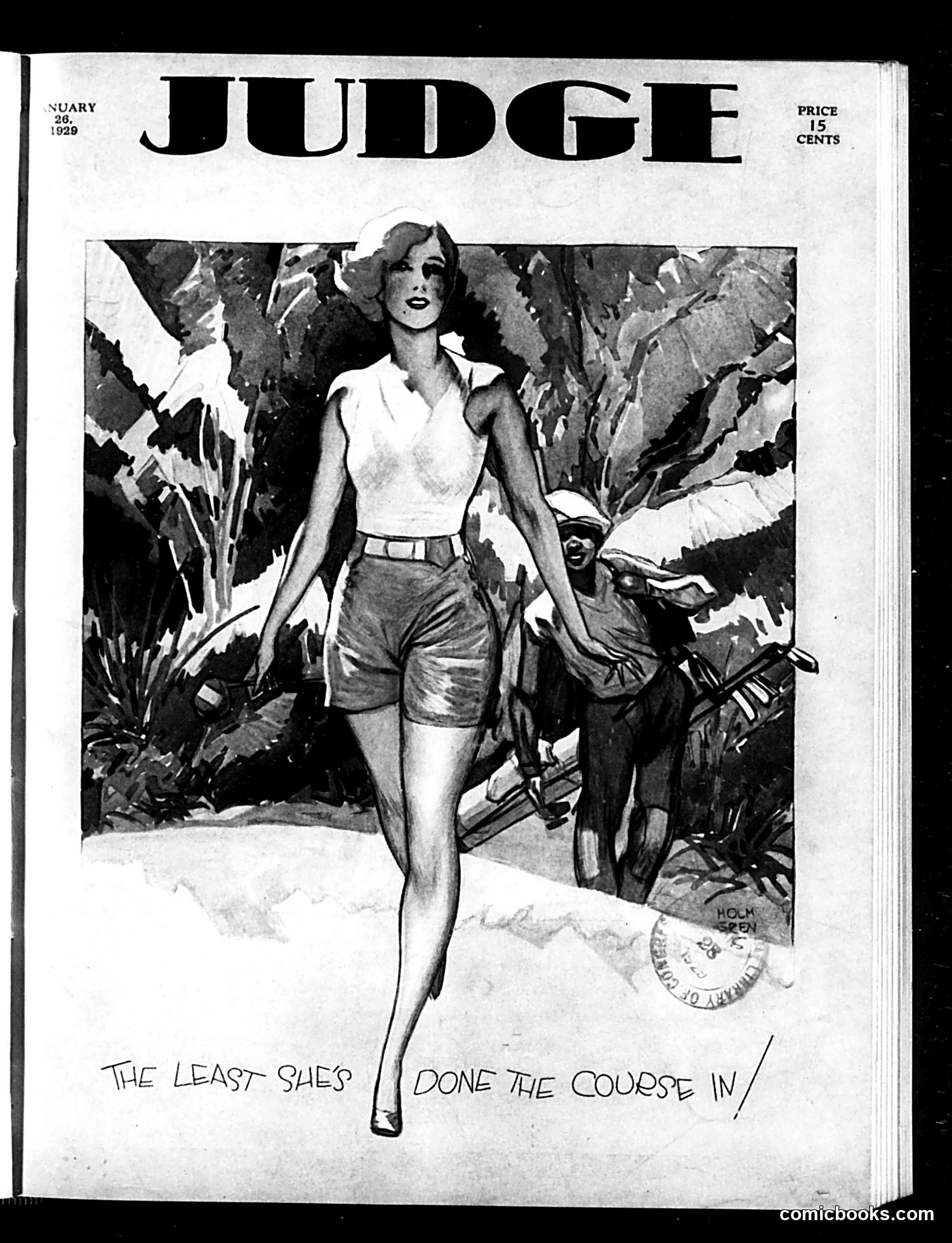
This cover features a woman in athletic wear walking on a beach with tropical vegetation. The caption reads "The Least She's Done the Course In!" The satire appears to target women's evolving fashion and behavior in the late 1920s ("Roaring Twenties"). The revealing athletic wear—particularly the shorts and fitted top—represents the modernization of women's clothing, which conservative society viewed as scandalous. The phrase "done the course" suggests she's completing some kind of journey or social transformation. This reflects Judge's satirical commentary on changing gender norms: women's increasing independence, participation in sports, and rejection of restrictive Victorian dress. The tropical setting adds an exotic, carefree element, emphasizing generational conflict between traditional values and modern liberation.
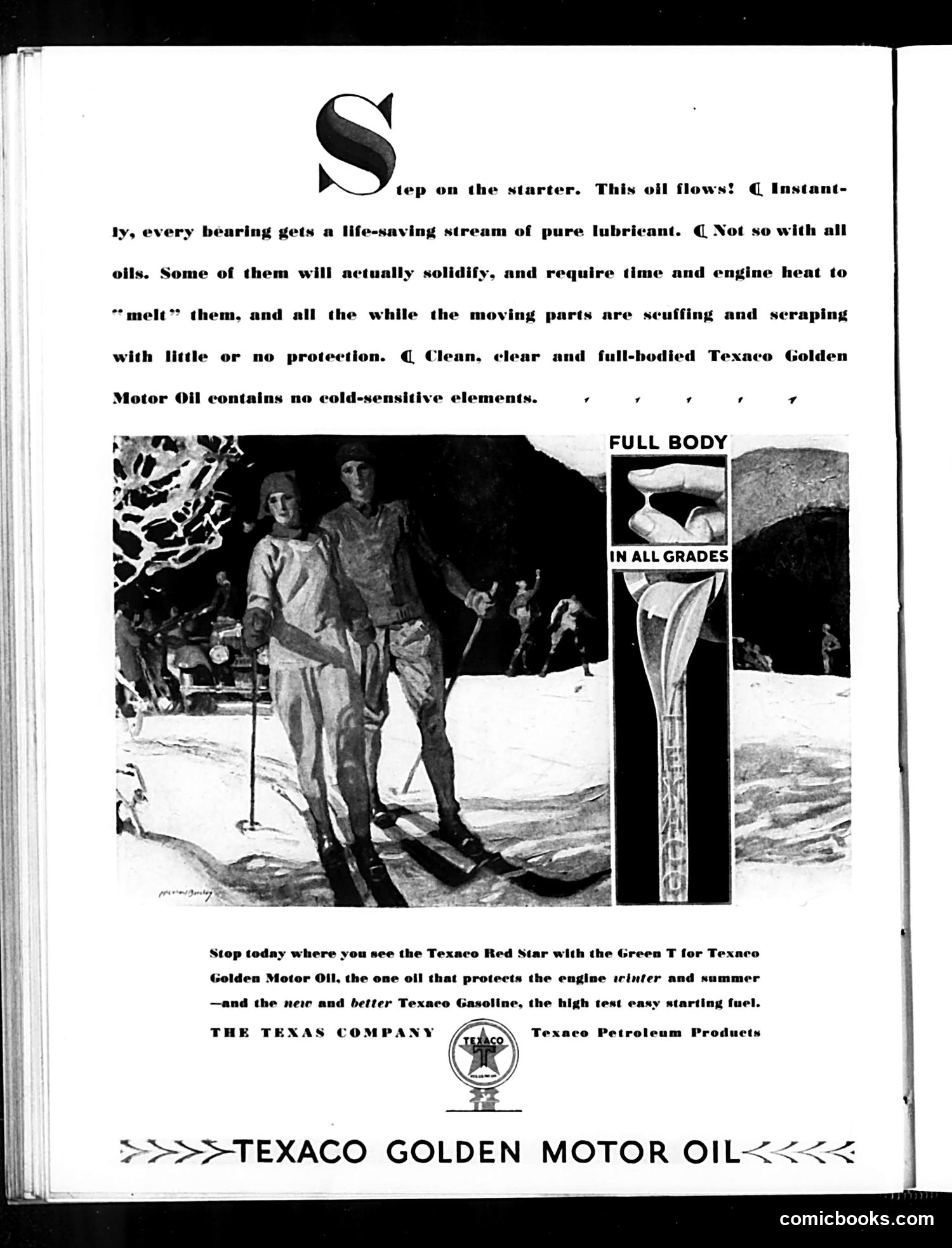
This page is primarily an **advertisement for Texaco Golden Motor Oil**, not political satire. The top text promotes the oil's superior lubricating properties, claiming it flows instantly and contains "no cold-sensitive elements"—addressing a common problem with inferior oils that would solidify in cold weather. The imagery shows two men in winter clothing on skis in a snowy mountain landscape, presumably demonstrating the product's reliability in harsh conditions. The central diagram displays the oil's "full body in all grades," visualizing viscosity across temperature ranges. The ad directs readers to Texaco stations (identified by the Red Star with Green T logo) and mentions their gasoline product. This is commercial content rather than editorial cartoon material.
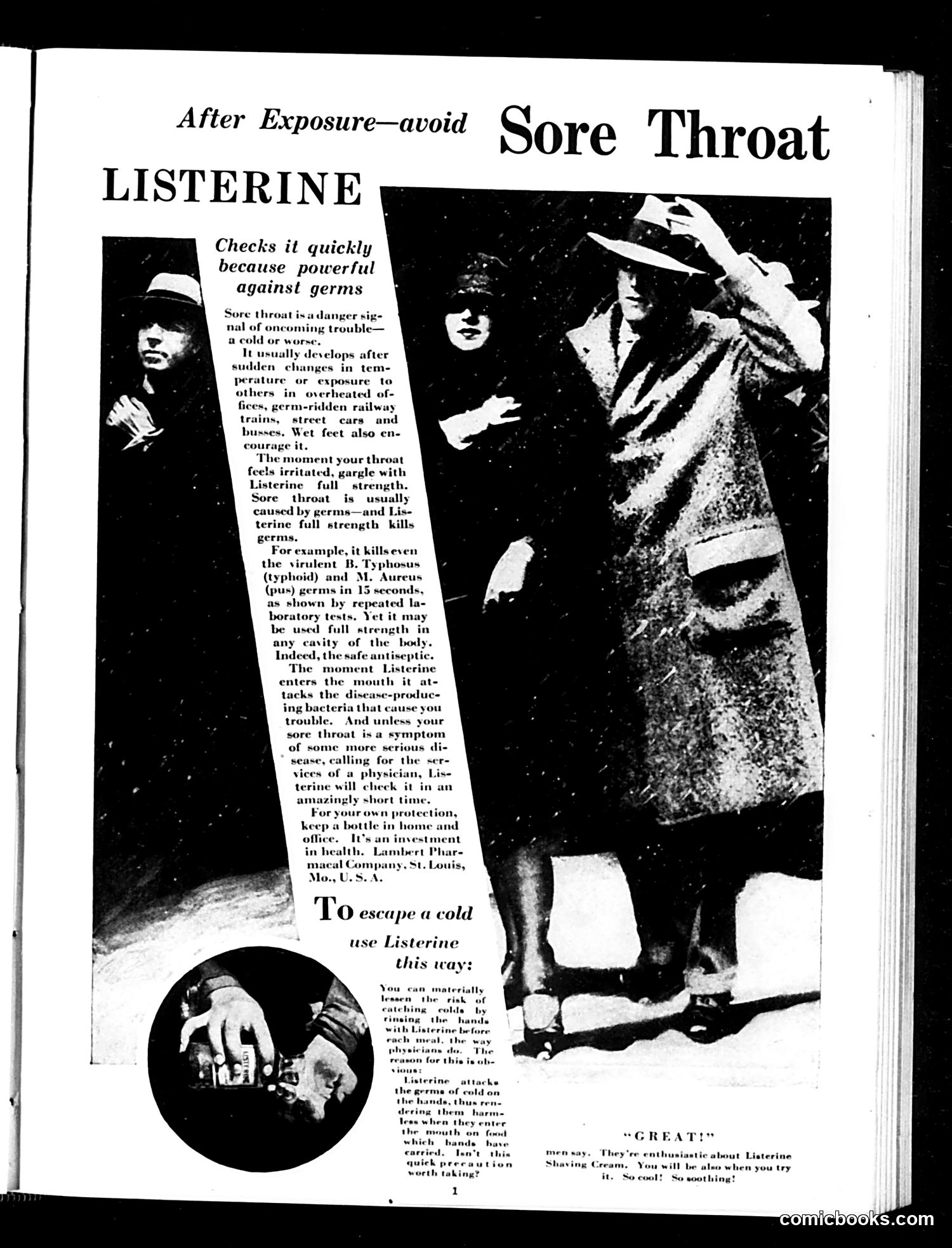
This page is primarily a **Listerine advertisement**, not political satire. It promotes Listerine mouthwash as a preventative and treatment for sore throats. The advertisement claims Listerine "checks it quickly because powerful against germs" and kills dangerous bacteria like B. Typhosus and M. Aureus within 15 seconds. It recommends keeping a bottle at home and office as a health investment. The images show people in 1920s-30s attire; one circular inset depicts hands being cleaned with Listerine. A bottom caption features men endorsing "Listerine Shaving Cream," calling it "GREAT!" This represents typical early-20th-century advertising making exaggerated medical claims before FDA regulations. The page contains no political cartoon or satire—it's commercial content, which was common in *Judge* magazine.
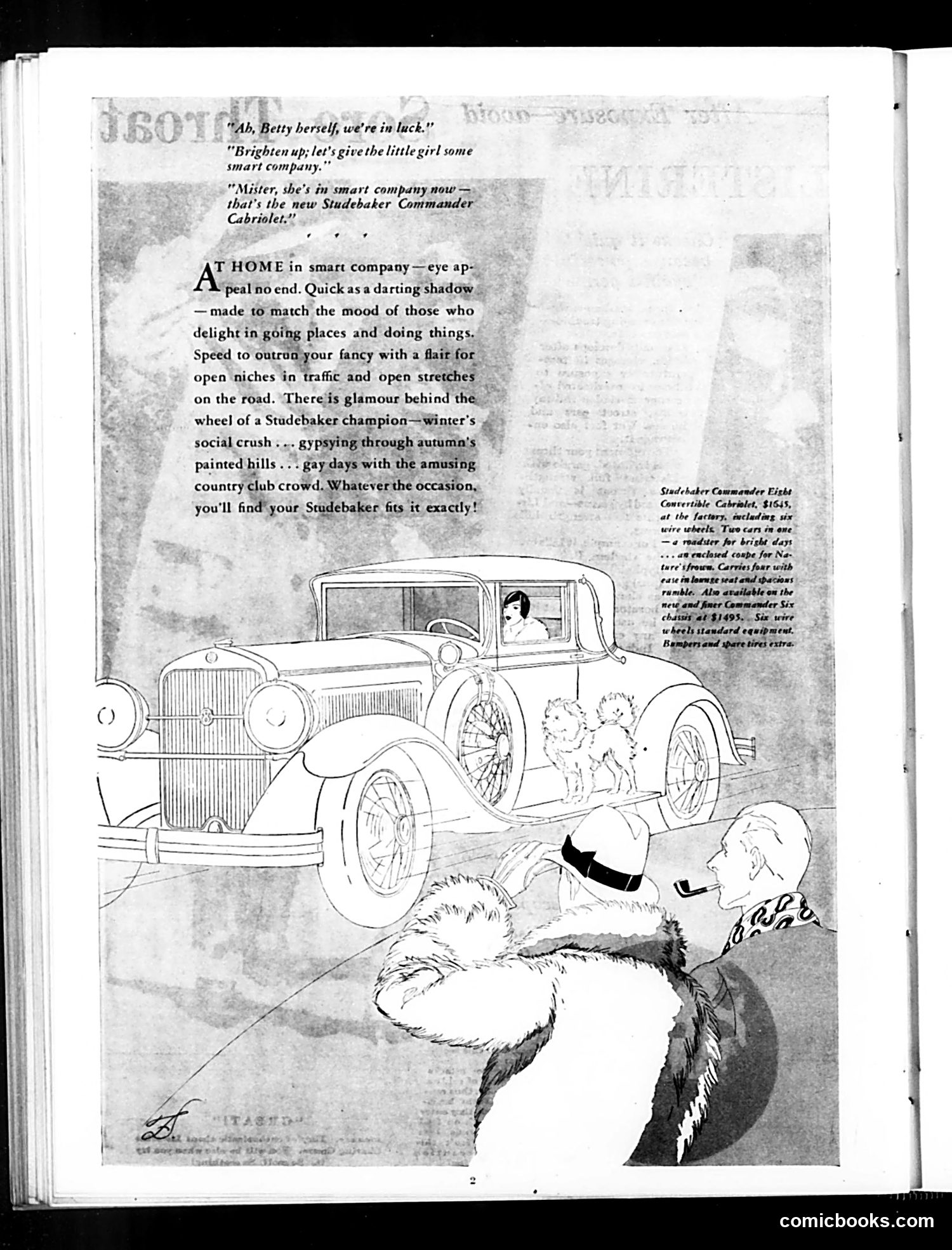
This page is primarily a **Studebaker automobile advertisement** rather than political satire. The cartoon depicts an elegantly dressed woman admiring a Studebaker Commander Eight convertible cabriolet, with a man visible in the driver's seat. The advertisement uses the satirical magazine's format to position the car as essential for "smart company" and social status—emphasizing speed, glamour, and fashionable living. The opening dialogue jokes that owning this car puts one "in luck" and provides "smart company," suggesting the vehicle itself becomes a social accessory. The ad highlights winter social events, country club activities, and the prestige associated with driving a Studebaker. This represents **branded content masquerading as editorial humor**—common in early 20th-century magazines where advertisements adopted the publication's satirical tone to appear more integrated and entertaining.
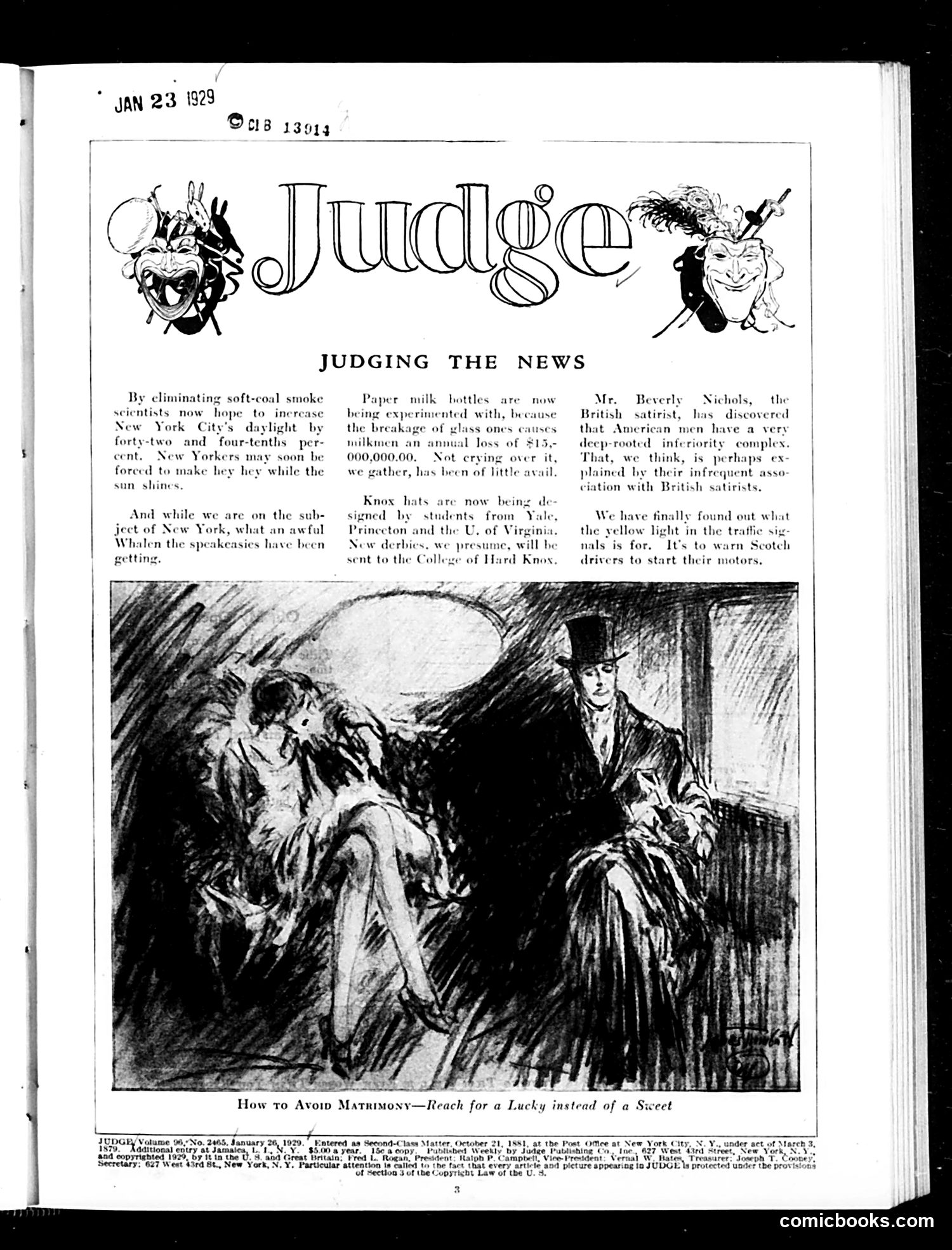
This satirical page critiques contemporary 1920s issues: **Top section** jokes about New York City's pollution (soft-coal smoke blocking daylight) and speakeasies operating openly despite Prohibition. **Main cartoon** titled "How to Avoid Matrimony—Reach for a Lucky instead of a Sweet" depicts a well-dressed man offering cigarettes to a woman instead of candy, mocking Lucky Strike cigarettes' famous "reach for a Lucky instead of a sweet" advertising campaign. The satire suggests smoking is presented as a romantic alternative to traditional courtship, ridiculing both the aggressive ad campaign and modern dating customs. The page also mentions paper milk bottles replacing glass (industrial innovation), British strikers, and traffic signals—typical 1920s modernization topics covered with Judge's characteristic irreverent humor.
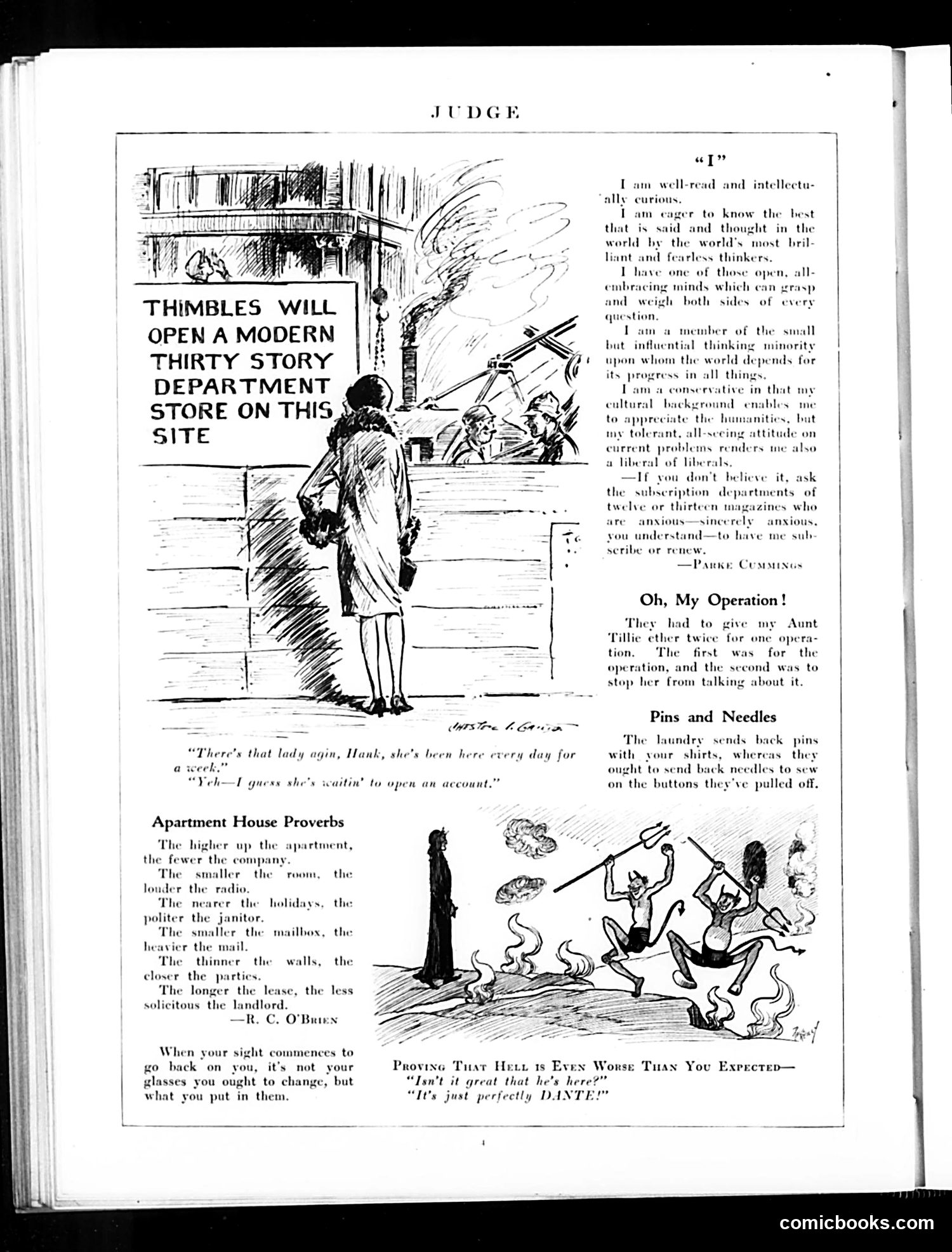
This page contains several satirical pieces about urban apartment living in early 20th-century America. The main cartoon shows a woman at a construction site where "Thimbles Will Open a Modern Thirty Story Department Store." The joke plays on the absurdity of increasingly cramped apartment buildings—a Thimble (a tiny sewing object) is an apt metaphor for the minuscule living spaces New Yorkers endured. "Apartment House Proverbs" offers dark humor about city dwelling: smaller rooms, noisier neighbors, higher rents for less space, and indifferent landlords. The accompanying cartoons joke about laundry mishaps and domestic chaos in close quarters. The overall satire critiques the exploitative housing market and overcrowded conditions of urban America, where developers prioritized profit over livability.
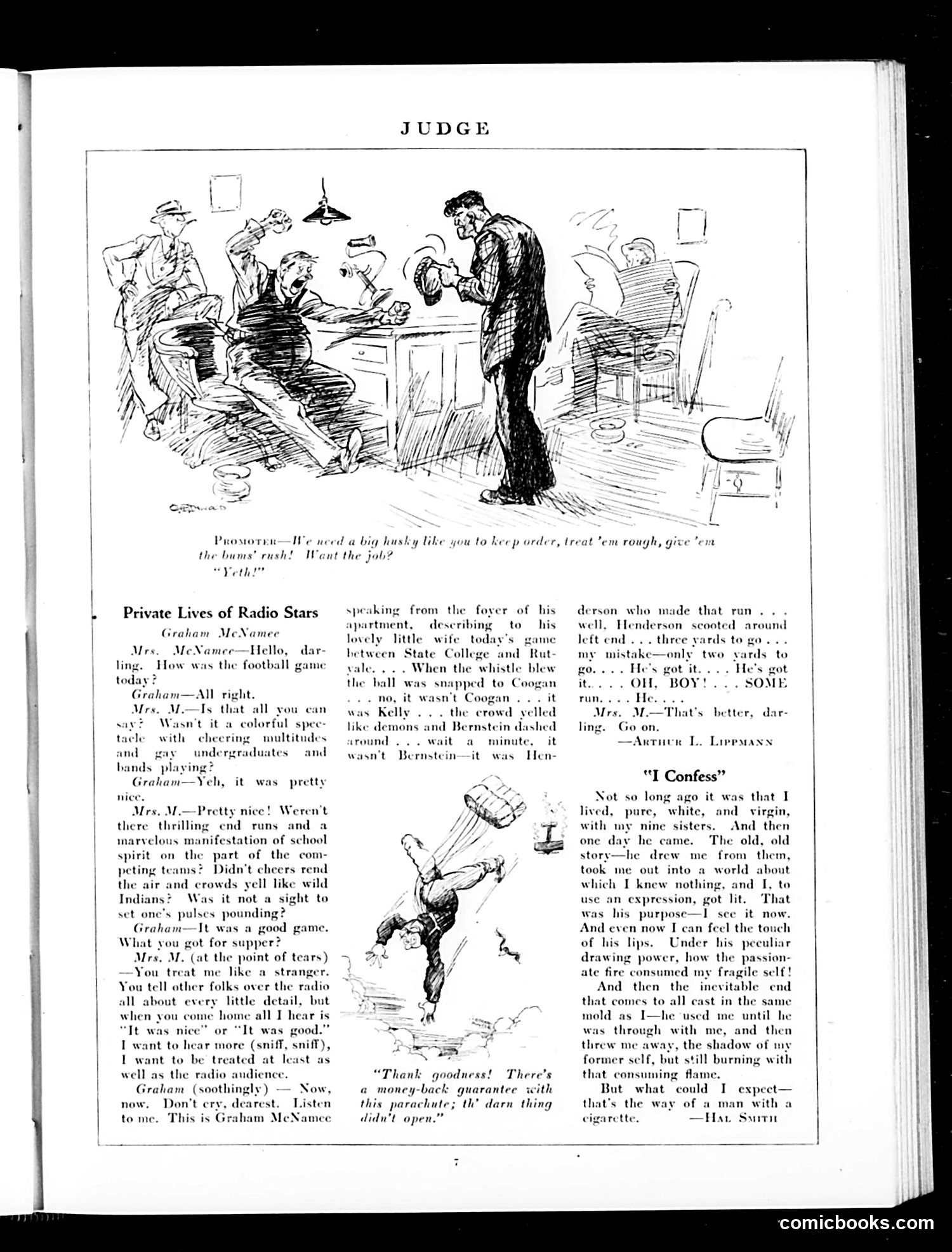
The top cartoon satirizes police management. A "Promoter" (likely a police official or politician) addresses officers in what appears to be a station house, suggesting they need "a big husky like you to keep order, treat 'em rough, give 'em the rough stuff." This mocks authoritarian policing tactics and suggests corruption or brutality within law enforcement leadership. The page also contains "Private Lives of Radio Stars," a humorous interview feature with Graham McNamee (a famous radio announcer of the 1920s-30s), discussing his everyday life and work. Below is a separate satirical story titled "I Confess" about seduction and abandonment—typical moralistic humor of the era reflecting period attitudes toward romance and feminine vulnerability. The cartoons and content reflect 1920s-30s American concerns about police conduct and popular entertainment culture.
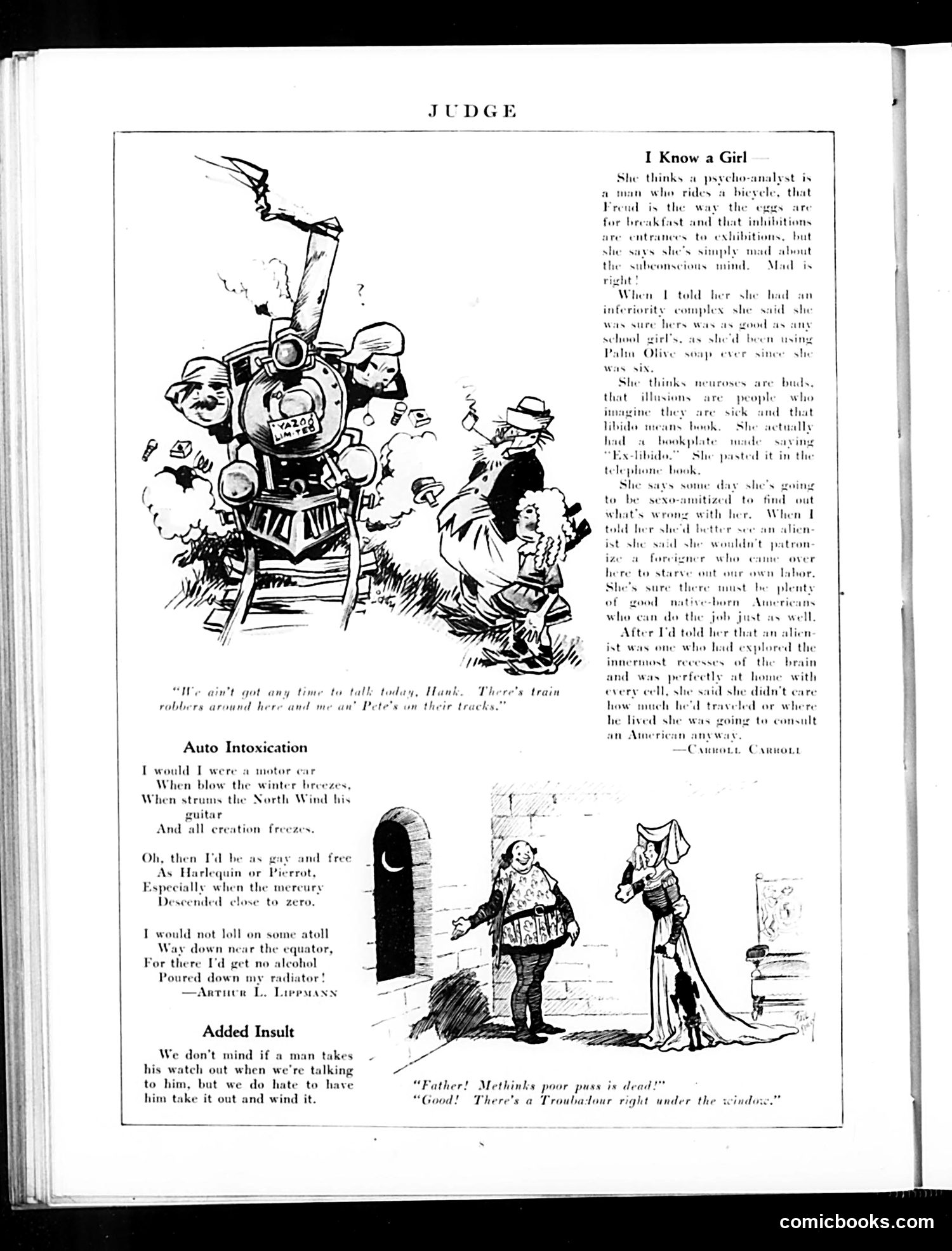
This page contains three separate humor pieces: **"I Know a Girl"** mocks a pretentious young woman who affects intellectual sophistication (mentioning psychoanalysis, Freud, "libido") while remaining fundamentally shallow. The satire targets 1920s-era pseudo-intellectualism among women adopting fashionable psychological jargon without genuine understanding. **"Auto Intoxication"** is a whimsical poem imagining being a motor car—likely satirizing the era's growing automobile obsession and the escapist fantasies it inspired. **"Added Insult"** is a brief joke about tolerating a man's habit of checking his watch during conversation, implying his rudeness compounds an already annoying situation. The illustration shows a medieval-costumed figure addressing someone, referencing "poor puss is dead" and a "Troubadour"—suggesting romantic or period-piece melodrama being mocked.
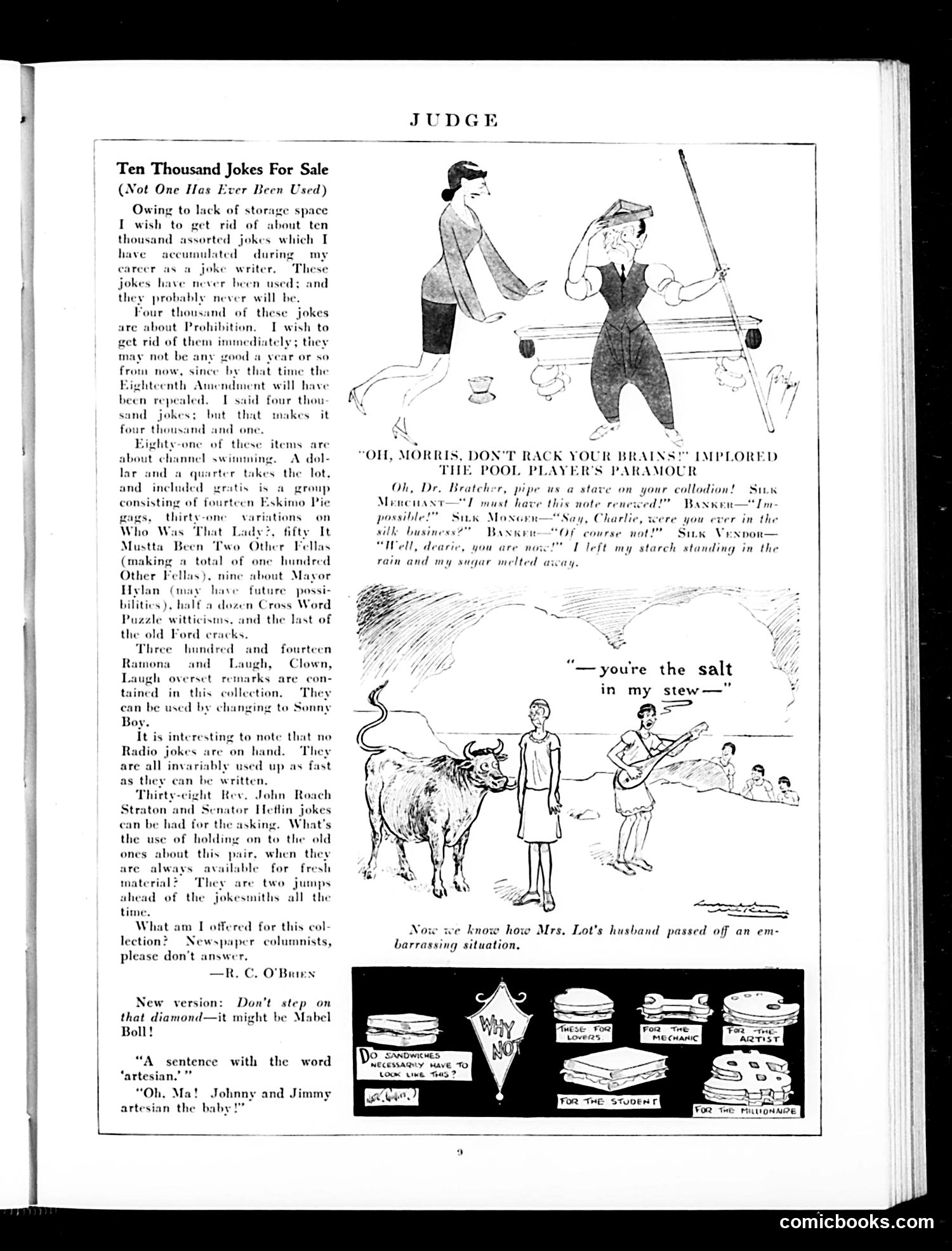
This page is a humor compilation from Judge magazine featuring jokes and cartoons about topical 1920s subjects. **Main text**: A writer humorously offers to sell 10,000 unused jokes accumulated over his career. He notes that 4,000 jokes about Prohibition are now worthless since the 18th Amendment will soon be repealed (suggesting this was written around 1933). Other categories include outdated references: 81 channel-swimming jokes, 314 jokes about the songs "Ramona" and "Laugh, Clown, Laugh," and jokes about Rev. John Roach Straton and Senator Heflin (religious and political figures of that era). **Cartoons**: - Top: A pool hall scene with double entendres about romance - Middle: A biblical reference joke about Lot's wife ("salt in my stew") - Bottom: A humorous chart showing "books for different professions" (lawyers, mechanics, students, etc.) The satire mocks how quickly topical humor becomes stale once cultural references fade.
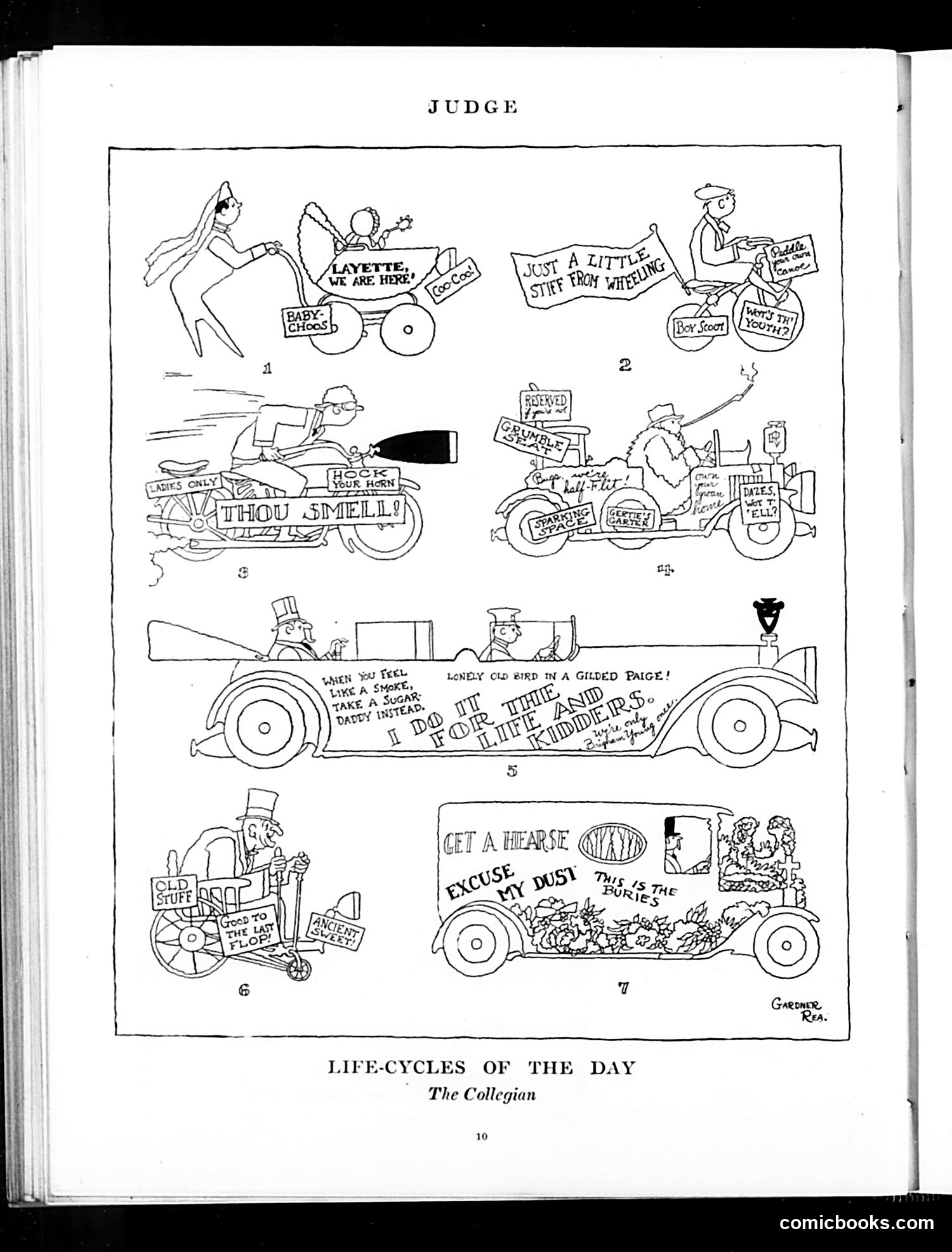
This satirical comic strip by Gardner Rea depicts seven stages of daily life targeting college students and young adults. Each panel mocks contemporary social behaviors: 1. **Women arriving** with excessive luggage ("Lafayette, we are here") 2. **Boy Scouts** on bicycles ("just a little stiff from wheeling") 3. **Women motorcyclists** labeled with derogatory terms about feminine hygiene 4. **A motorist** with crude references to bodily odors 5. **A car advertising sugar/sweets** as mood-lifters for loneliness 6. **An "old stuff" vehicle** carrying outdated trends 7. **A car full of chaos** labeled "excuse my dust" with complaints about "duties" The overall message satirizes the messiness, poor manners, and questionable hygiene of the era's youth culture. The repeated vehicle imagery suggests society's mobile, transient nature. The humor relies on period-specific anxieties about modernization, changing social norms, and generational behavior.
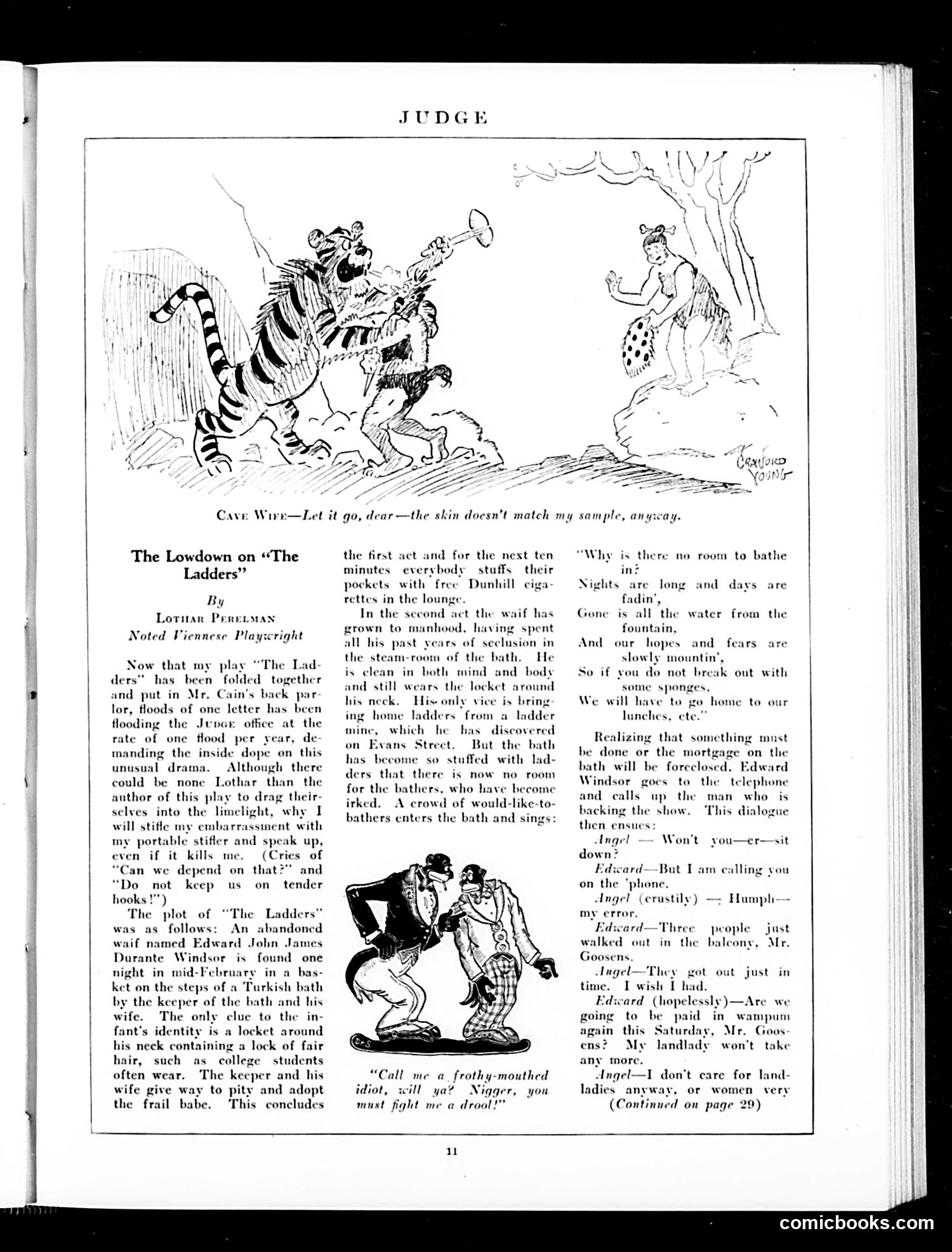
This page satirizes a pretentious avant-garde play called "The Ladders" by a self-important Viennese playwright. The joke is that the plot is deliberately absurd and nonsensical—an orphan raised in a Turkish bath obsessively brings home ladders from a "ladder mine," eventually filling the bathhouse so completely that actual bathers can't bathe. The show's financial collapse is treated as tragic. The humor works on multiple levels: it mocks experimental theater's obscurity, the financial desperation of Broadway productions, and the pomposity of European playwrights. The dialogue between Edward and his backer (Mr. Goosens/"Angel") shows a struggling production where actors aren't being paid and the lead desperately pitches the show's problems as if they're dramatic necessities rather than failures. The top cartoon about "cave wife" making skins appears unrelated—likely a separate gag mocking primitive domestic life.
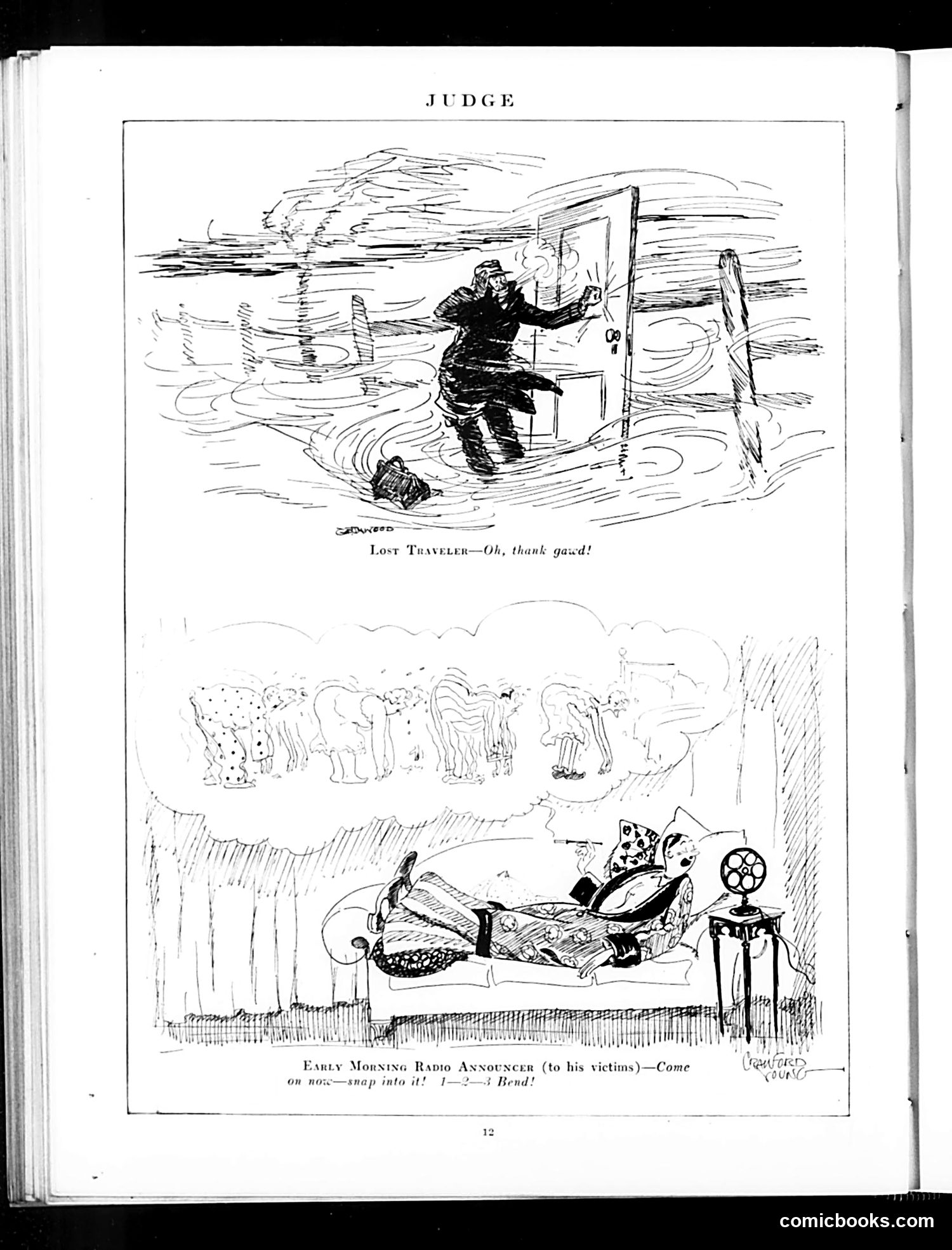
This page contains two satirical cartoons: **Top cartoon ("Lost Traveler—Oh, thank gawd!"):** A bedraggled man emerges from swirling snow/blizzard conditions, having apparently found shelter or safety. The humor derives from his relief at escaping harsh winter weather. **Bottom cartoon ("Early Morning Radio Announcer"):** A radio personality enthusiastically commands sleeping listeners to "snap into it!" while they remain sprawled in bed. The satire mocks the aggressive, cheerful tone of early morning radio broadcasts and their jarring effect on drowsy audiences who haven't yet fully awakened. Both cartoons use exaggerated line-work typical of Judge magazine's style. The satire targets everyday irritations—winter travel hazards and morning radio personalities—rather than specific political figures. These are gentle social commentaries on relatable modern inconveniences rather than pointed political satire. The page number indicates this is from a longer publication.
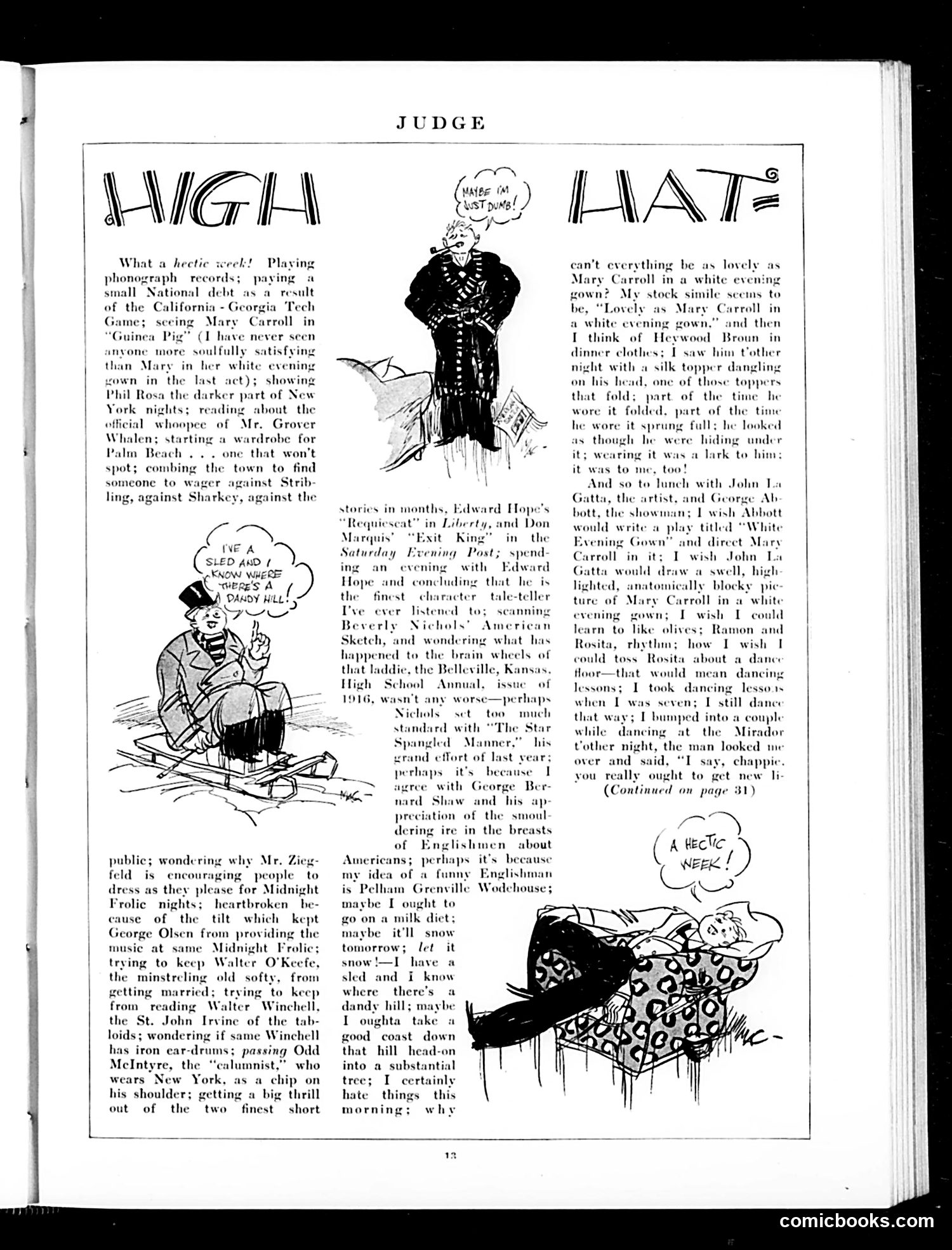
This is a satirical column titled "High Hate" by what appears to be a society/entertainment writer from the 1920s. The page mixes complaint-humor about New York social life with celebrity name-dropping. **Key References:** - Mary Carroll in "Guinea Pig" (theatrical production) — repeatedly cited as the ideal of beauty - Phil Rosa, George Olsen, Walter O'Keefe — entertainment figures - Heywood Broun — columnist/critic (mocked for his formal dinner attire) - Walter Winchell — gossip columnist (criticized for sensationalism) - Odd McIntyre — society columnist - Edward Hope, Don Marquis, Beverly Nichols — contemporary writers - George Bernard Shaw — invoked for his critical views of Americans - P.G. Wodehouse — humorist **The Satire:** The column humorously catalogs shallow grievances (weather, fashion, social events) mixed with genuine cultural commentary. It mocks New York's entertainment scene while simultaneously celebrating it. The repeated fixation on Mary Carroll's "white evening gown" parodies both fashion obsession and the writer's own pretentiousness. The cartoons appear to illustrate the writer's frantic mood swings between enthusiasm and irritability.
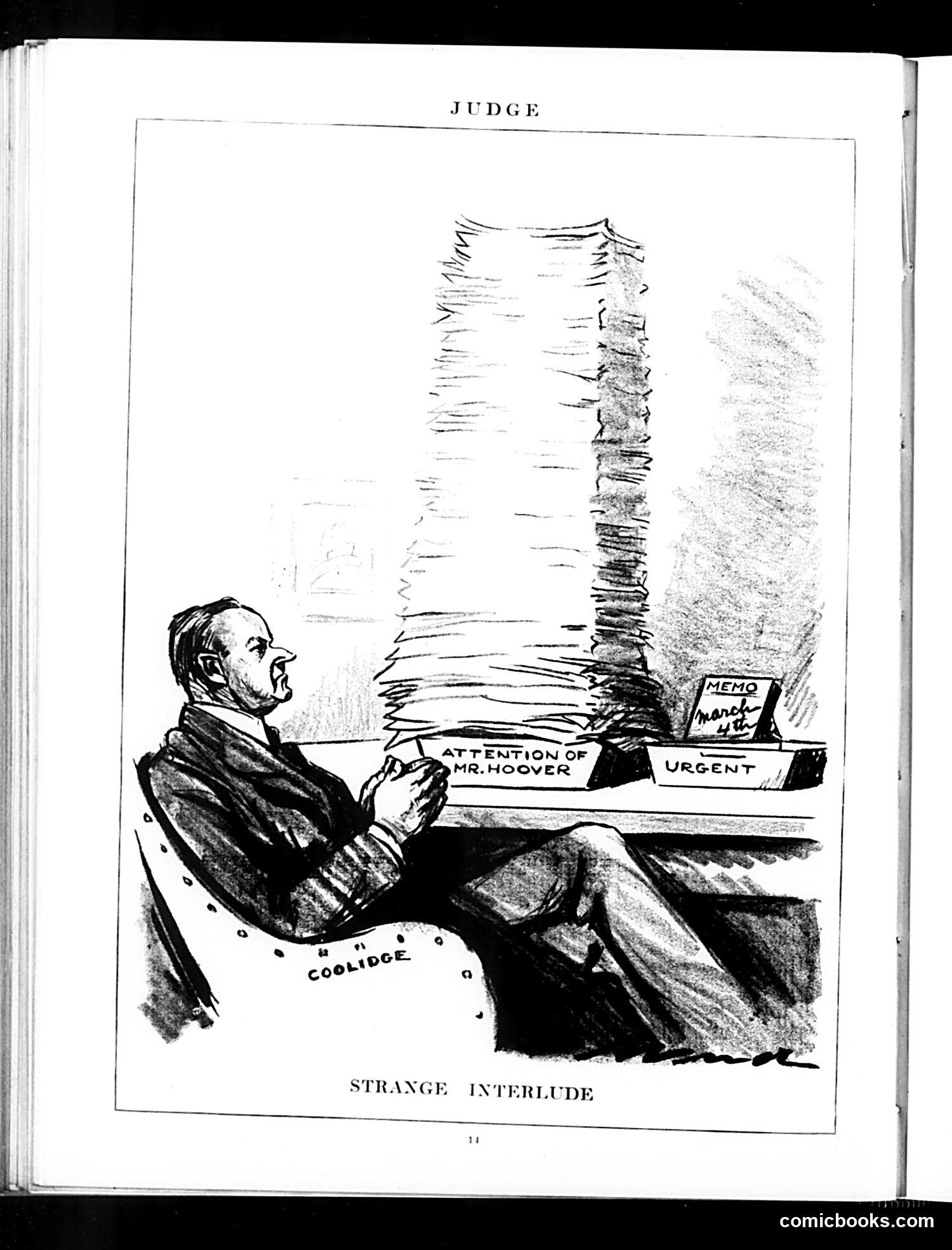
This cartoon depicts a man labeled "COOLIDGE" seated at a desk buried under enormous stacks of papers. The piles include folders marked "ATTENTION OF MR. HOOVER" and "URGENT," plus a memo dated "March 21." The satire targets President Calvin Coolidge's reputation for inaction and delegation. By showing him surrounded by mounting administrative work, the cartoon suggests Coolidge was overwhelmed by—or indifferent to—pressing governmental matters, instead passing responsibilities to subordinates like Hoover (likely Herbert Hoover, then Commerce Secretary). The title "Strange Interlude" (referencing a contemporary play) implies Coolidge's presidency was an odd, passive interlude in American governance. The cartoon critiques his hands-off leadership style during a period of significant national and international challenges.
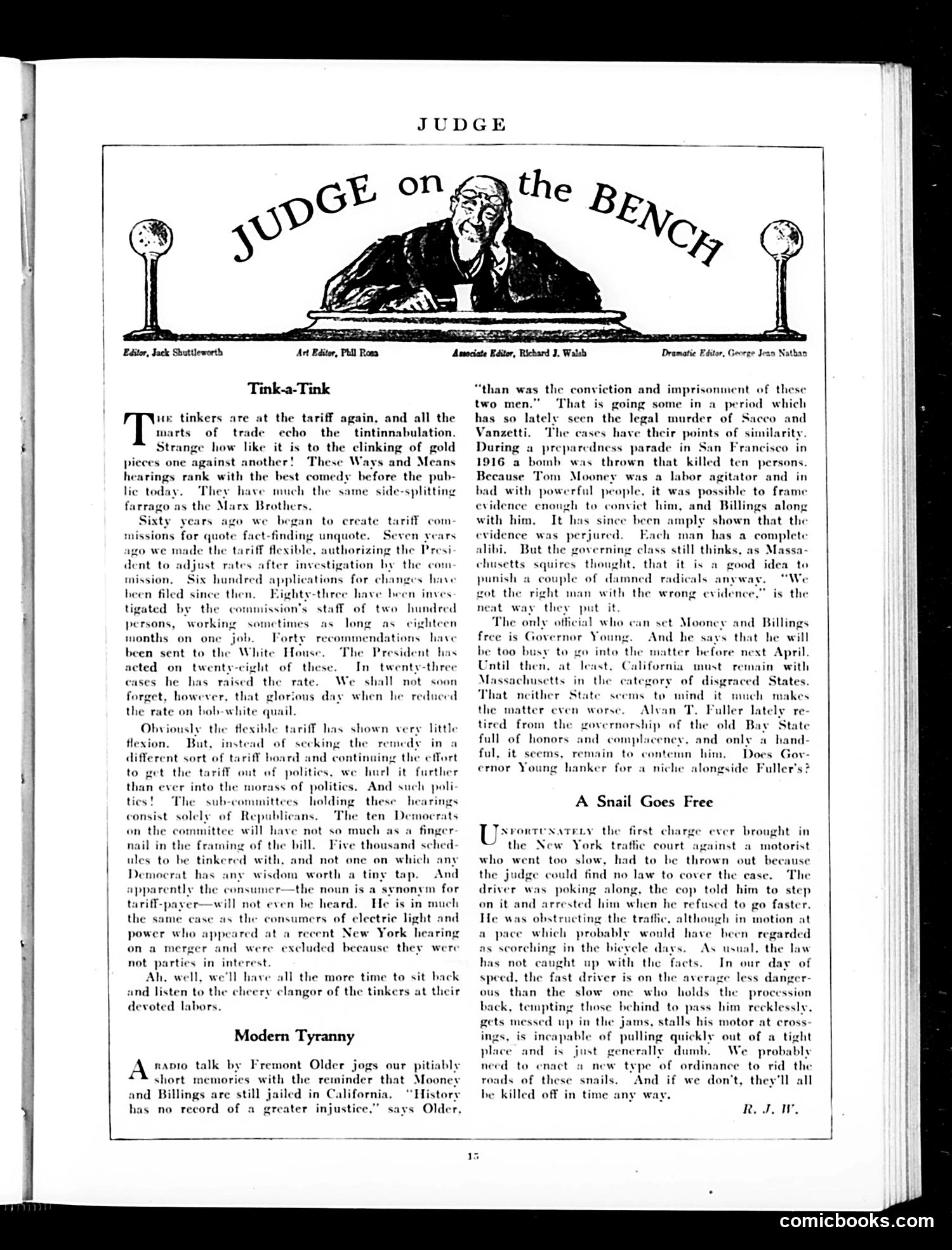
This page contains three political commentaries from the 1920s-era satirical magazine *Judge*. **"Tink-a-Tink"** mocks Republican-controlled tariff hearings. The author satirizes the "flexible tariff" commission as theatrical performance—comparing it to the Marx Brothers—while criticizing that only Republicans participate in drafting the bill. The punch line: among 5,000 schedules reviewed, the only rate reduction was on bob-white quail, suggesting the entire process is frivolous political theater rather than genuine economic policy. **"Modern Tyranny"** references the Mooney-Billings case: labor activists convicted on perjured evidence for a 1916 San Francisco bombing. The author draws parallels to the recent Sacco-Vanzetti executions, condemning Governor Young's refusal to pardon them and comparing California unfavorably to Massachusetts's injustice. **"A Snail Goes Free"** describes a New York traffic court case where a slow driver couldn't be prosecuted—the judge found no applicable law. The satire suggests absurdist legal gaps exist while trivial speeding violations are aggressively enforced.
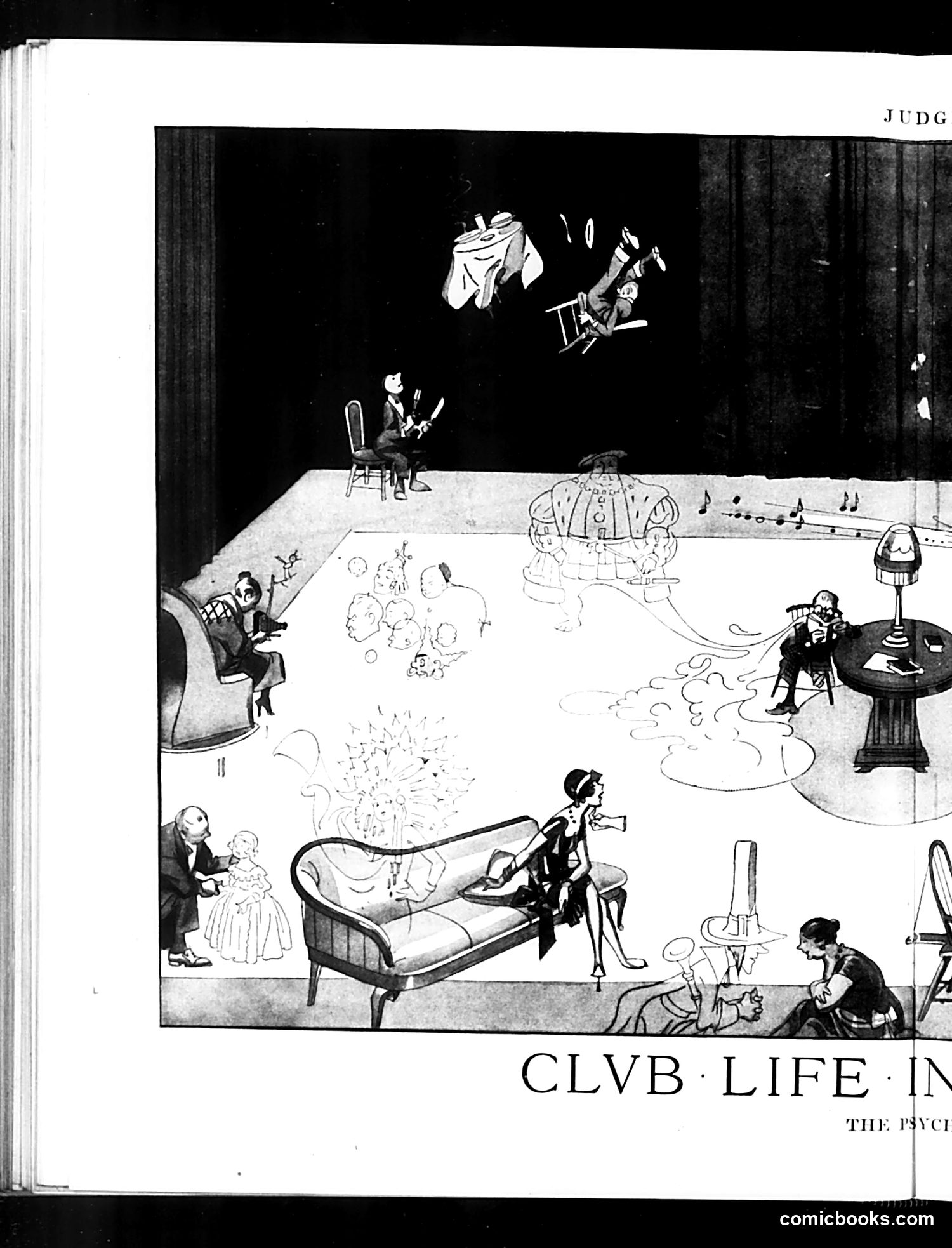
This satirical illustration depicts a surreal interior scene labeled "Club Life in The Psyche," appearing to reference Freudian psychology and the unconscious mind as a social space. The cartoon shows various figures engaged in activities within what resembles a nightclub or social gathering, with surreal elements floating overhead (drapery, mechanical objects). The satire likely mocks the early 20th-century fascination with Freudian psychology and psychoanalysis—treating abstract psychological concepts as if they were literal social venues. By visualizing "the psyche" as a club with socializing figures, the cartoonist satirizes both the trendiness of psychological theory among the wealthy and perhaps the pretension of intellectual pursuits in club society. The whimsical, dreamlike quality reinforces the psychological theme.
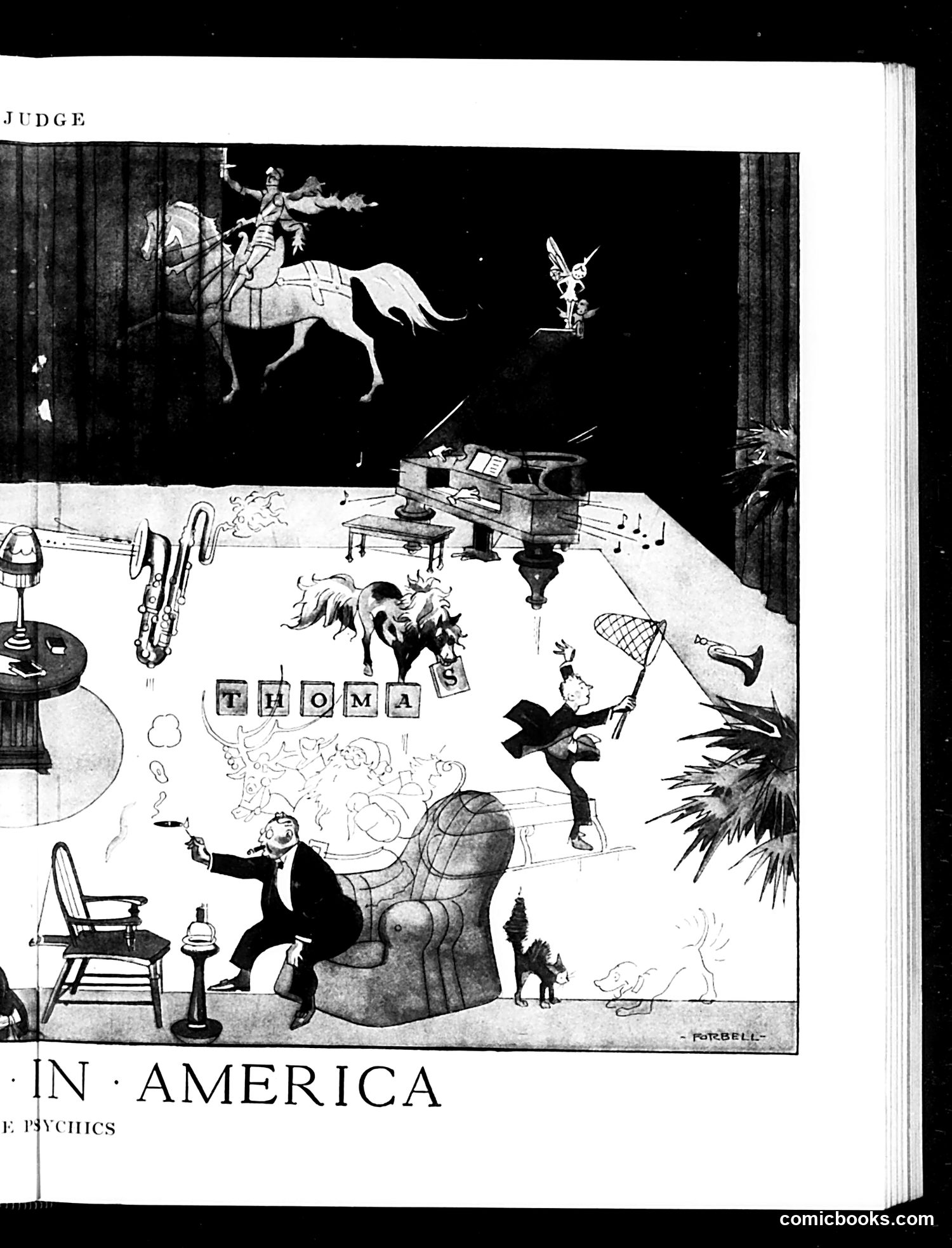
This satirical illustration, signed by Forcelli, depicts America as a chaotic scene of competing interests and distractions. A well-dressed man sits in an ornate chair labeled "THOMA[S]" (likely Thomas Jefferson or another Founding Father), presiding over a surreal landscape of conflicting elements: a horseman in the background, musical instruments, sports equipment, exotic animals, and various figures engaged in disparate activities. The cartoon critiques American society's fragmentation and lack of unified direction—citizens pursuing individual interests rather than collective purpose. The "psychics" reference in the OCR text suggests commentary on popular spiritualism or charlatanism. The titled "Judge in America" implies social judgment of the nation's confused values and priorities. Without a clear date visible, the exact historical context remains uncertain, though it reflects early-to-mid 20th century concerns about American cultural cohesion.
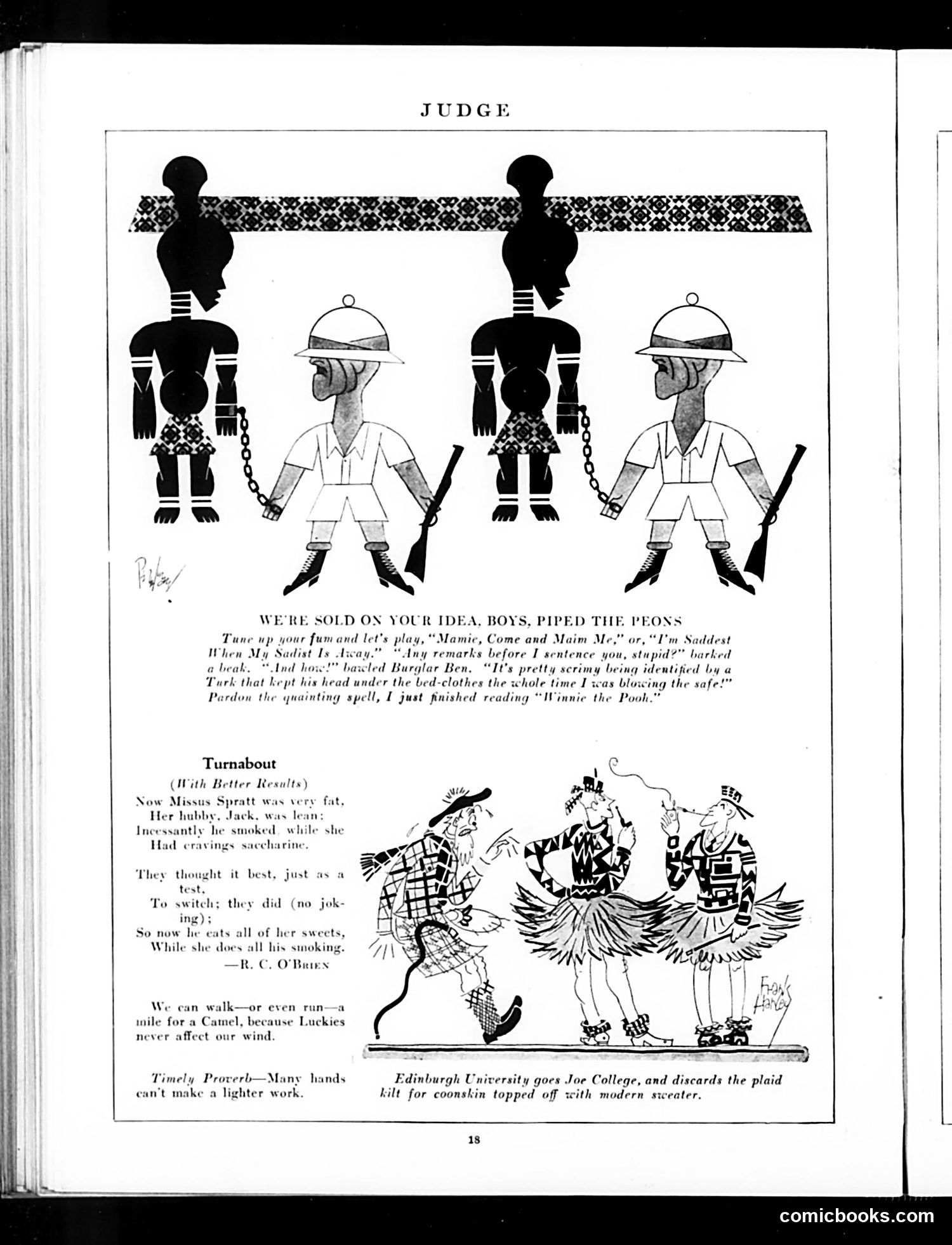
This page contains multiple satirical pieces typical of Judge magazine's humor: **Top Cartoon ("Judge")**: A silhouette illustration mocking judicial proceedings. The text describes criminals using modern slang ("peons," "beak" for judge, "scrimy") and references to popular culture ("Winnie the Pooh"). The satire targets both criminal argot and the pretentiousness of judges who don't understand contemporary language. **"Turnabout" Poem & Illustration**: A humorous poem by R.C. O'Bates about a married couple who swap habits—the husband smoking, the wife eating sweets—with comic results. The accompanying illustration shows three figures in Scottish dress dancing, likely satirizing faddish fashion trends. **Bottom Captions**: Include cigarette advertising ("Luckies") and references to Scottish university fashion ("Edinburgh University goes Joe College, and discards the plaid kilt"). Overall, the page satirizes modern slang, marital dynamics, criminal culture, and fashion trends through verse, illustration, and wordplay typical of 1920s-30s satirical magazines.
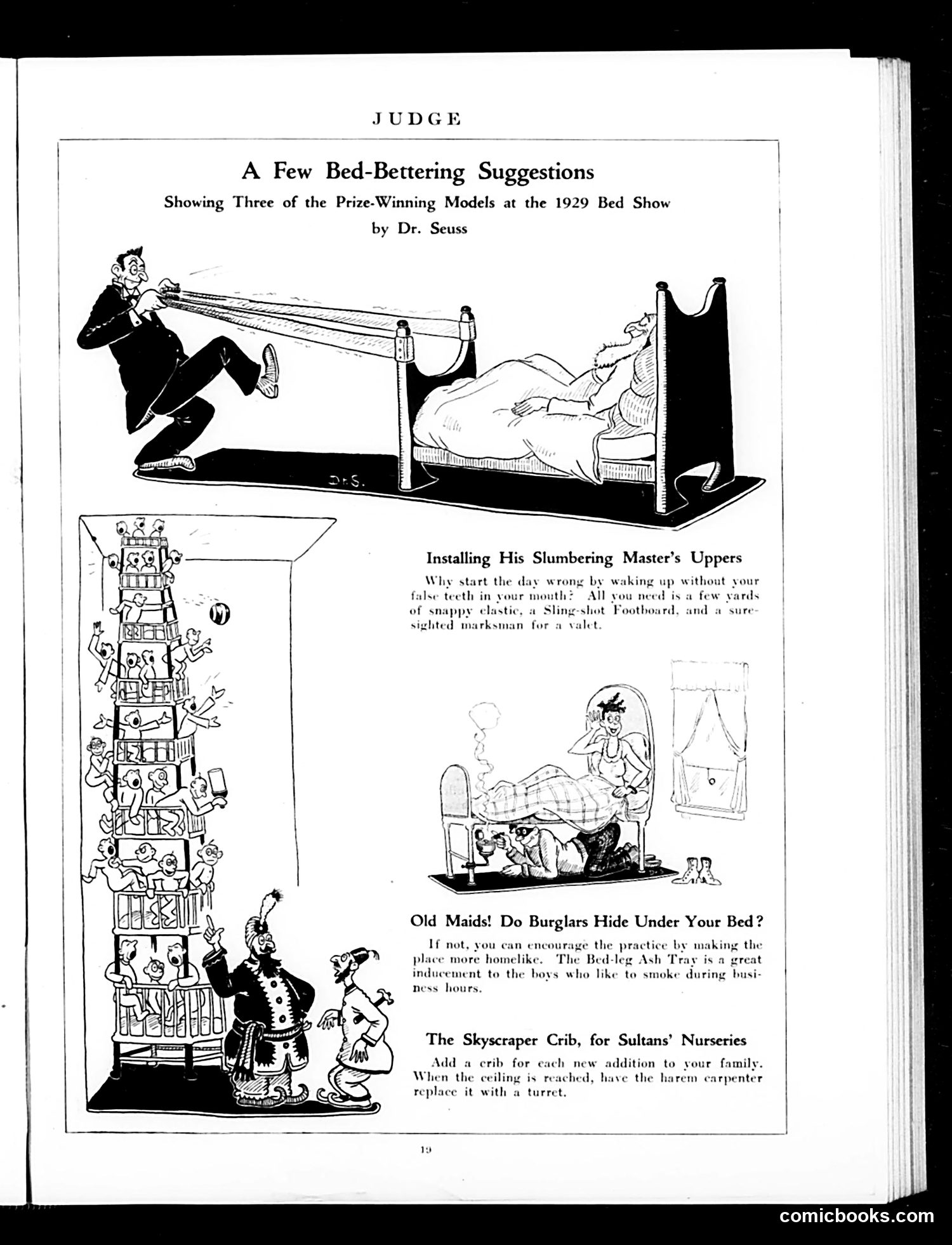
This is Dr. Seuss's humorous take on impractical bed inventions at a 1929 furniture show. The three illustrated concepts mock absurd "improvements": 1. **Installing false teeth via slingshot**: A servant uses a footboard contraption to launch dentures at a sleeping master—satirizing over-mechanized solutions to mundane problems. 2. **Burglar-friendly ash trays under beds**: A tongue-in-cheek suggestion that making beds hospitable to burglars (with cigarette amenities) somehow benefits "old maids"—mocking paranoid security concerns. 3. **Skyscraper crib for harems**: A towering multi-story crib that expands upward, replacing ceilings with turrets as families grow—absurdly exaggerating wealth and large families. The satire targets both the era's obsession with labor-saving gadgets and the pretentious design culture of the 1920s. These "prize-winning" concepts are deliberately impractical and ridiculous, poking fun at furniture industry excess during the pre-Depression economic boom.
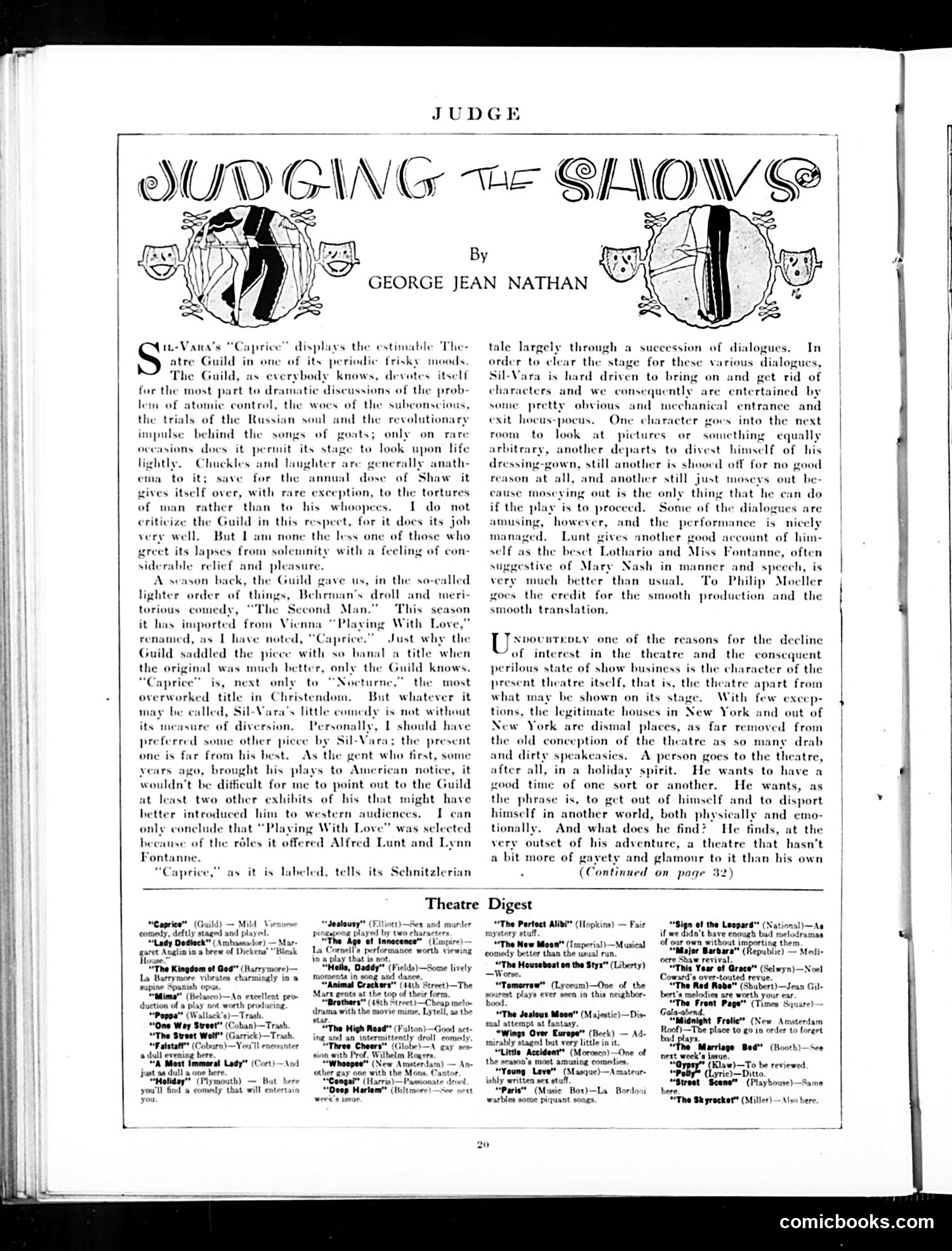
This is a theater criticism column by George Jean Nathan reviewing Sil-Vara's "Caprice," presented by the Theatre Guild. Nathan discusses the play's structure—it progresses through dialogue and character exits/entrances rather than traditional dramatic action. He praises performances by Alfred Lunt and Lynn Fontanne, and Philip Moeller's direction. Nathan uses the review to launch broader social commentary: he criticizes New York's legitimate theaters as dingy, unwelcoming "speakeasies" far removed from their former grandeur. He argues audiences attend theater seeking escape and recreation, but find disappointment instead of the glamorous world-away promised by theatrical tradition. The column reflects 1920s-30s concerns about theater's cultural decline amid changing entertainment options and urban conditions.
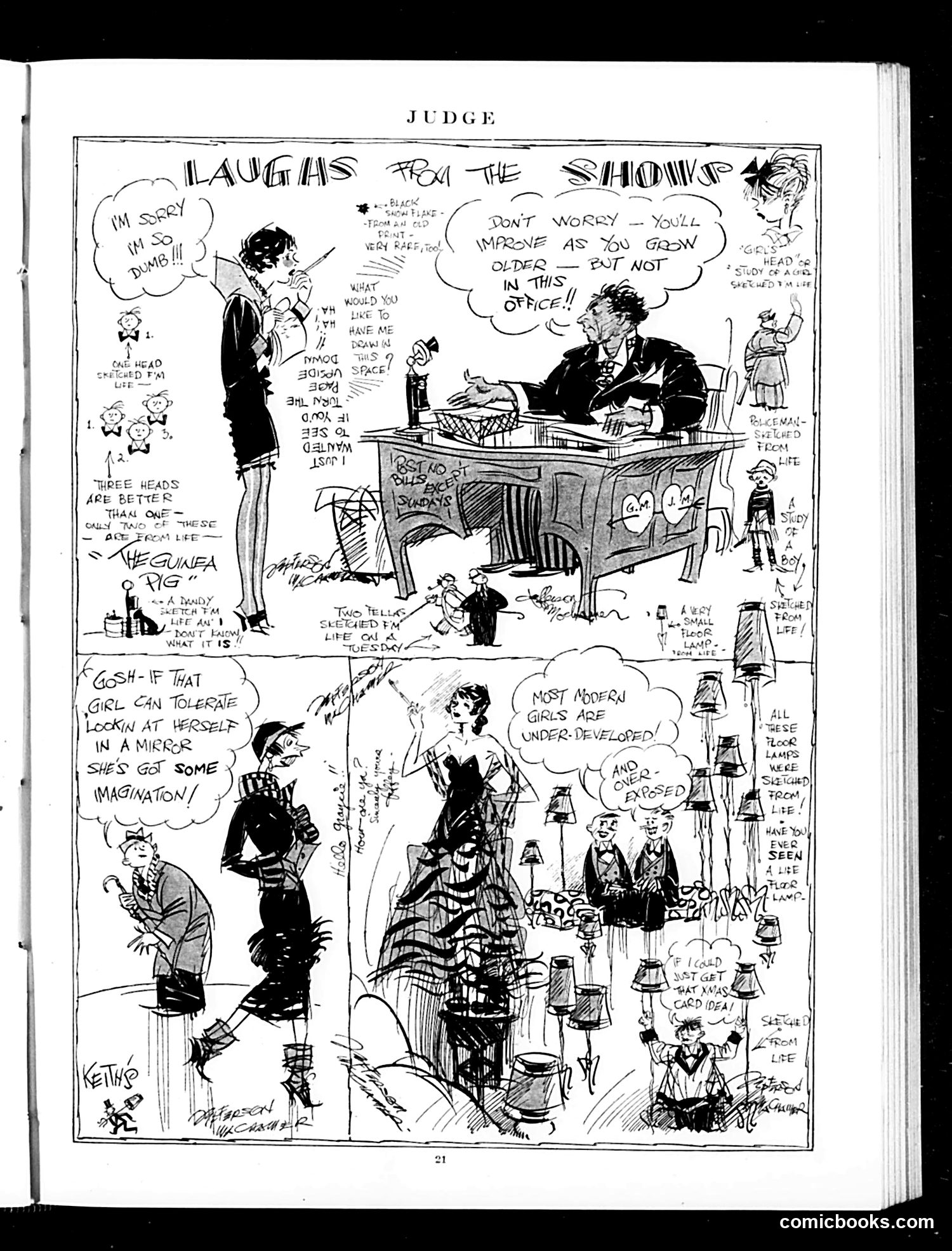
This appears to be a satirical comic about courtship and modern young women's behavior, likely from the early 20th century. The main scene shows a judge's office where a young woman appears before an older judge. The dialogue suggests commentary on changing female attitudes—the judge reassures her that looking at herself in mirrors and having "imagination" are normal, though he seems concerned about "modern girls" being "underdeveloped" and "exposed." The surrounding vignettes mock various social anxieties about contemporary courtship rituals and women's independence. The satire targets uptight social attitudes about female vanity and autonomy, portraying conventional moral guardians as out-of-touch with modern realities. The specific theatrical references in the title suggest this may comment on how stage shows influenced contemporary social behavior and attitudes toward women.
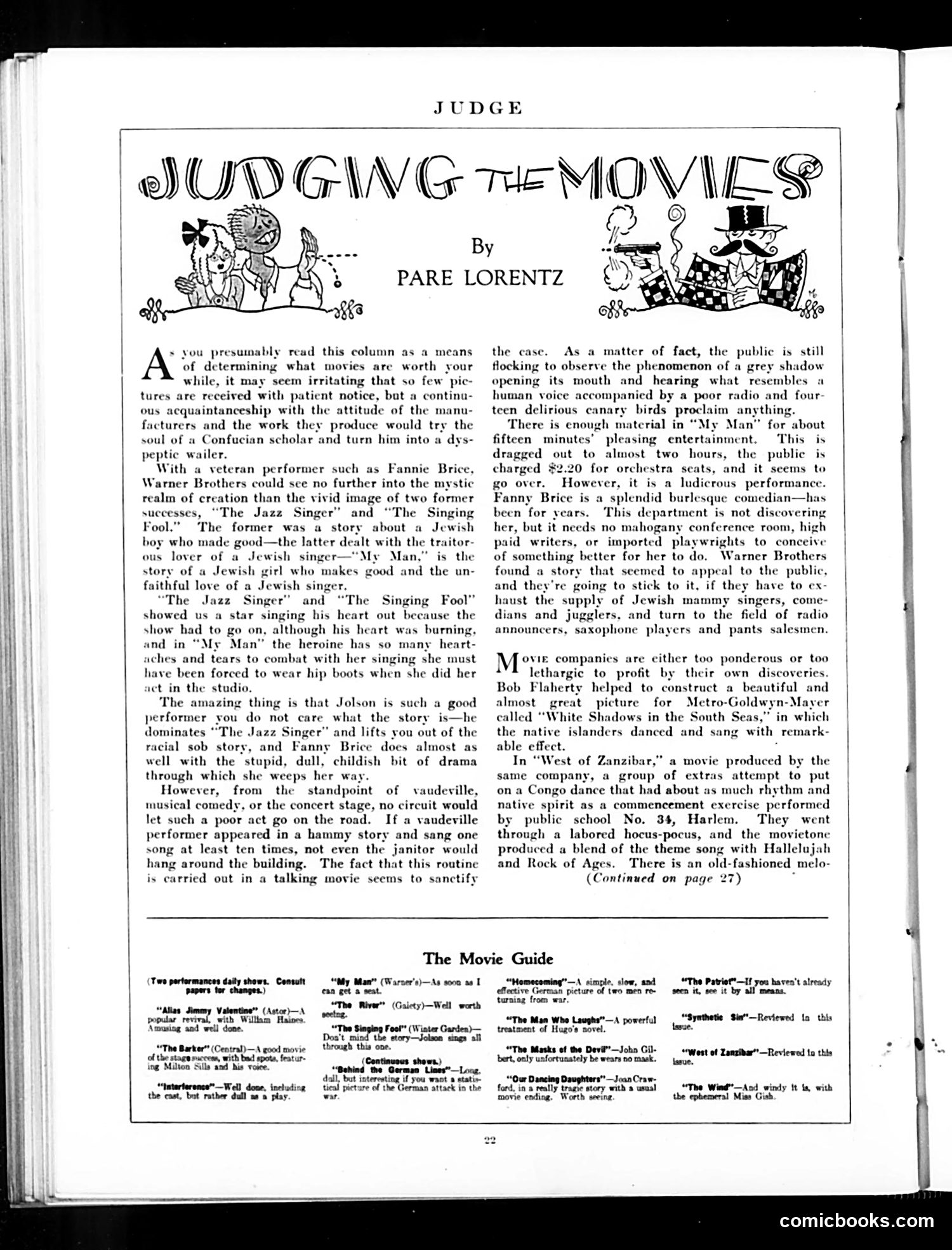
This is a film criticism column by Pare Lorentz reviewing early sound films. The satire targets Hollywood studios' creative laziness with talking pictures. **Main targets:** Lorentz criticizes Warner Brothers for recycling the same Jewish immigrant-success narrative across multiple Fannie Brice and Al Jolson films ("The Jazz Singer," "The Singing Fool," "My Man"). He argues the studios found one profitable formula and milk it endlessly rather than develop original material. **The joke:** While these performers are genuinely talented, the repetitive, emotionally manipulative plots would never survive on a vaudeville stage—audiences would reject such "hammy" material. Yet moviegoers tolerate (even pay premium prices for) the same tired storylines when filtered through the novelty of synchronized sound. Lorentz's broader complaint: studios are either too rigid or too lazy to innovate beyond their initial discoveries, instead exhausting entire categories of performers (Jewish singers, then comedians, then radio announcers) through the same worn dramatic template.
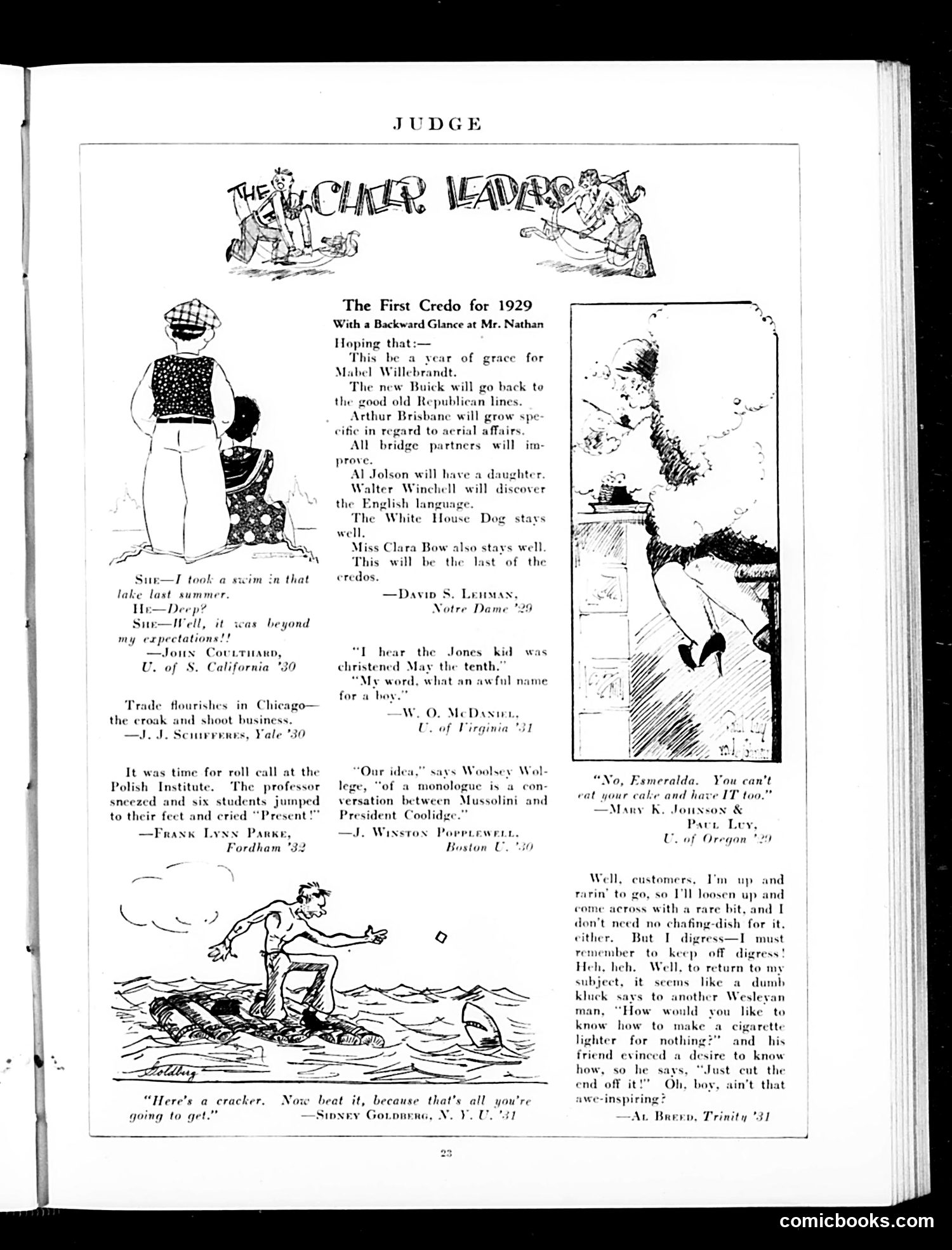
This satirical piece from Judge magazine presents humorous "hopes" for 1929, offering context on several topical figures and issues of the era: **Key References:** - **Mabel Willebrandt**: Prohibition enforcer; the joke suggests she needs "grace" (implying the futility of her enforcement efforts) - **New Buick**: Reference to Republican party alignment (unclear exact political context) - **Arthur Brisbane**: Newspaper columnist expected to become more specific on social affairs - **Al Jolson and Walter Winchell**: Entertainment figures whose public personas are mocked - **Clara Bow**: Silent film actress; the joke about her "staying well" suggests she'd been troubled or controversial The page also collects college-submitted humor and jokes from Yale, Notre Dame, and other universities—typical Judge content mixing political satire with lighthearted student humor. The cartoons appear to illustrate various comedic scenarios unrelated to the main credo. The overall tone is gentle mockery of 1920s public figures and optimistic irreverence about the year ahead.
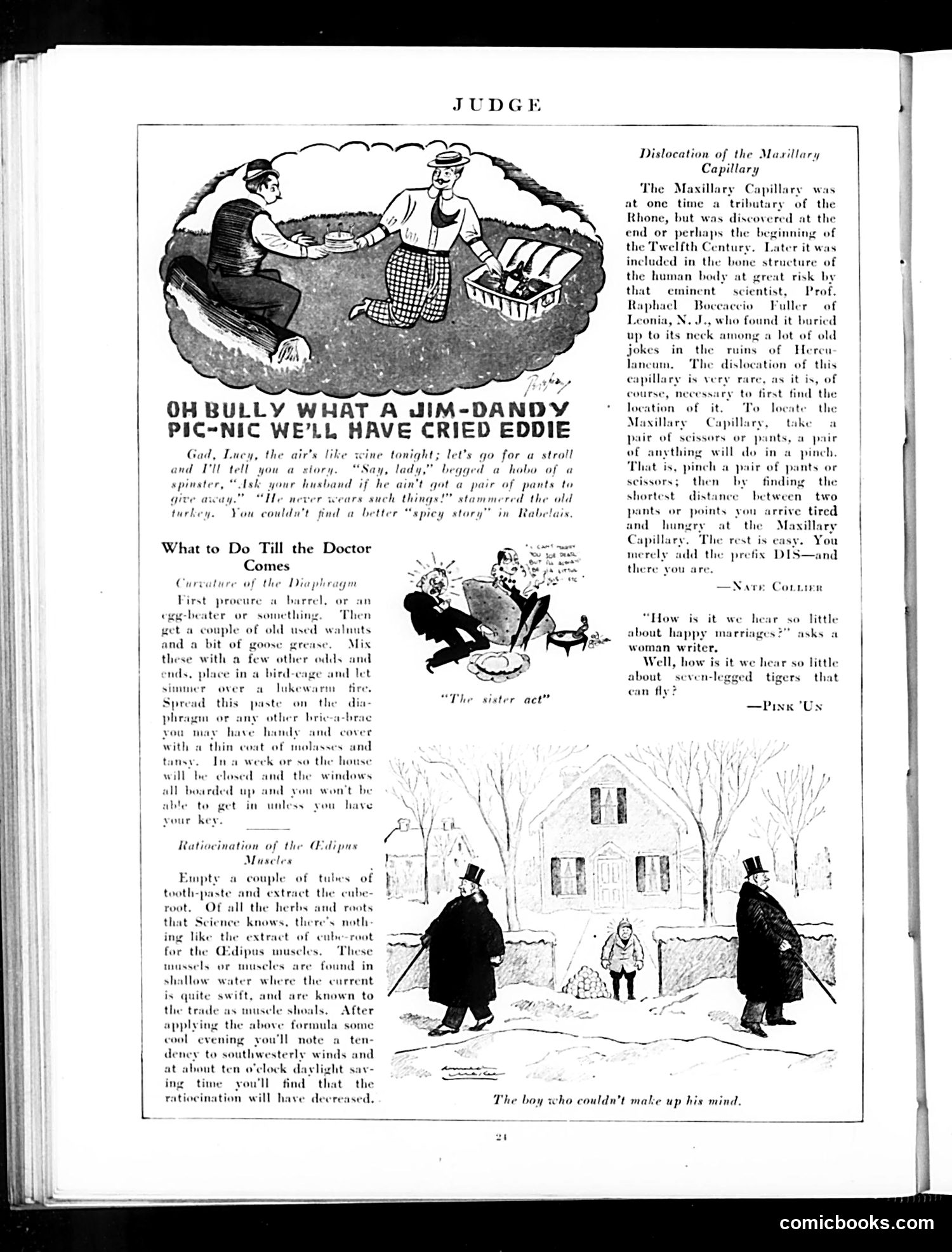
This page from the satirical magazine **Judge** contains absurdist humor typical of early-to-mid 20th century American comedy: **Main Content:** 1. **"Oh Bully What a Jim-Dandy Pic-nic"** – A crude joke about a husband without pants, presented as mock-risqué humor. 2. **Medical Pseudo-Science Satire** – Three fake medical treatments ("Dislocation of the Maxillary Capillary," "Curvature of the Diaphragm," "Ratiocination of the Oedipus Muscles") mock medical charlatans and pseudo-scientific nonsense. The invented "Prof. Raphael Boccaccio Fuller of Leonia, N.J." appears designed to ridicule pretentious practitioners. 3. **"The sister act"** cartoon – Shows slapstick comedy (appears to be physical mishap). 4. **Winter scene cartoon** – "The boy who couldn't make up his mind" depicts indecision through a snowy setting with well-dressed figures. **Overall**: The page satirizes medical quackery, uses absurdist humor, and includes period vaudeville-style jokes. The tone is lighthearted rather than politically pointed.
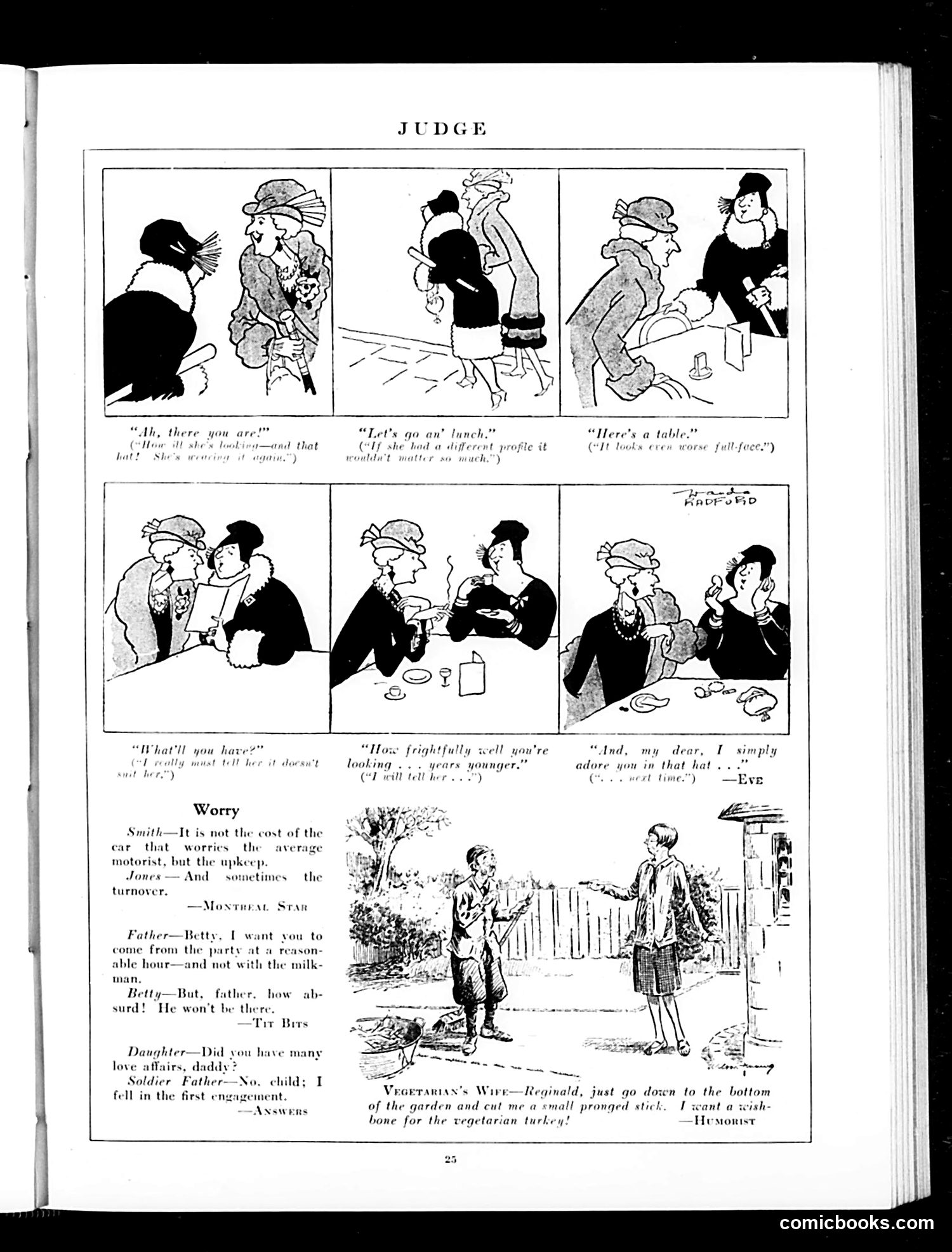
This page contains two distinct sections: **Top: "Judge" Comic Strip** A six-panel sequence depicting two women at lunch. The humor revolves around appearance and aging anxieties typical of early-20th-century satire. One woman compliments the other's youthful appearance, but the punchline reveals the compliment is backhanded—she looks "years younger" than she actually does, implying she appears considerably older than her stated age. This satirizes women's vanity and society's obsession with female youth and appearance. **Bottom: "Worry" and Miscellaneous Jokes** A collection of brief comedic exchanges and one illustration: - A joke about automobile maintenance costs - Father-daughter dialogue about party curfews and propriety - A soldier father's response about past romantic conquests - An illustration of a woman requesting her husband cut a "pronged stick" for preparing a "vegetarian turkey"—absurdist humor mocking vegetarianism as impractical or ridiculous The overall tone reflects early 1900s attitudes toward gender roles, automobiles as modern anxieties, and dismissive humor toward dietary preferences.
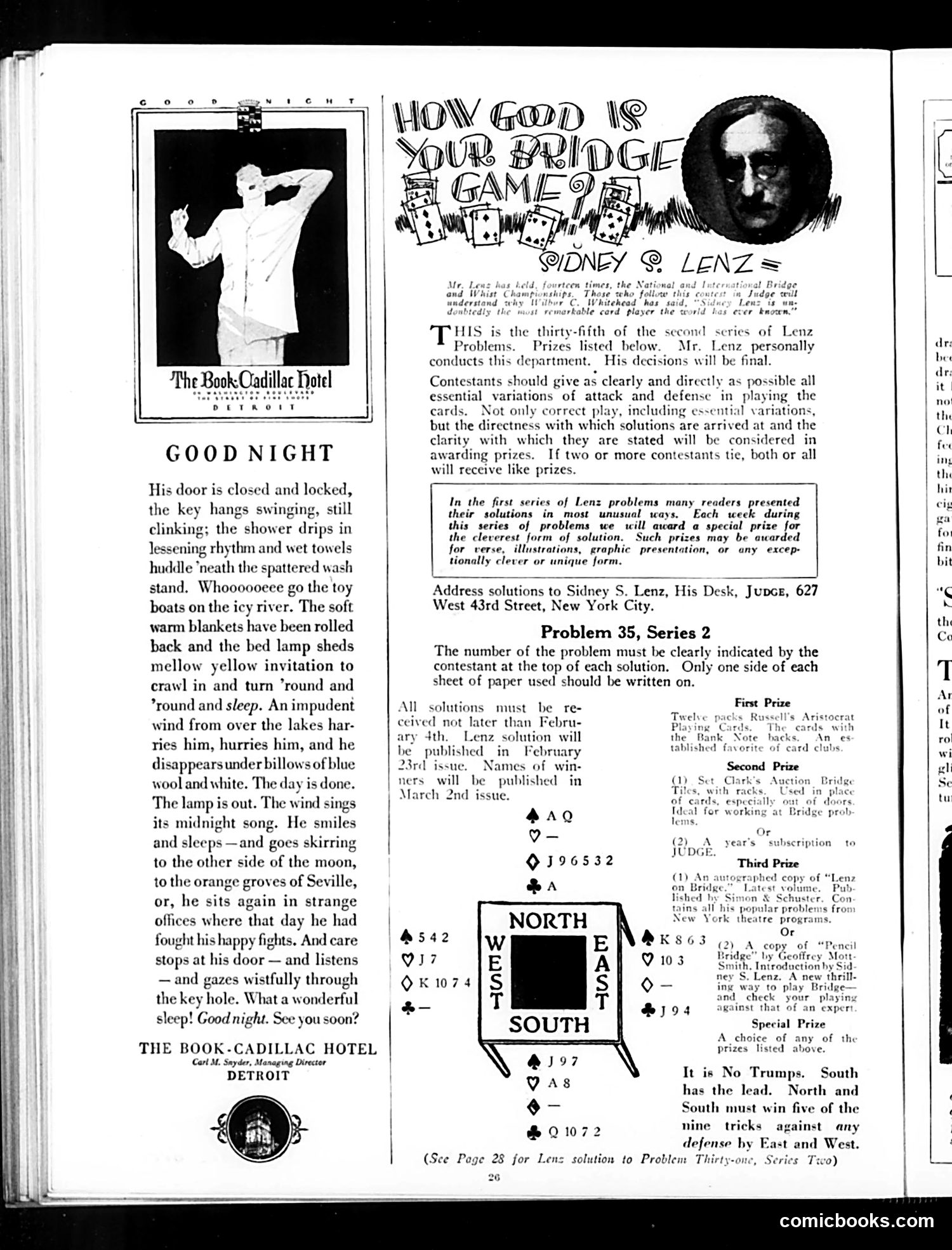
This page combines two distinct elements: **advertising and a bridge problem column**. The left side features a poetic advertisement for Detroit's Book-Cadillac Hotel, using romantic, dreamy language about sleep and rest to market the hotel's comfort. The accompanying illustration shows a relaxed man in bed—an aspirational image of luxury hospitality. The right side presents "Problem 35, Series 2" of **Sidney S. Lenz's bridge column**—a recurring feature in Judge magazine. Lenz was apparently a famous bridge expert whose contract bridge problems entertained readers. The page explains contest rules, prizes (including books and magazine subscriptions), and presents an actual bridge hand for readers to solve strategically. For modern readers: this reflects an era when **contract bridge was a popular intellectual pastime** among middle and upper-class Americans, similar to chess puzzles today. Judge's inclusion of such content shows the magazine served educated audiences interested in games and strategy, not just humor and satire.
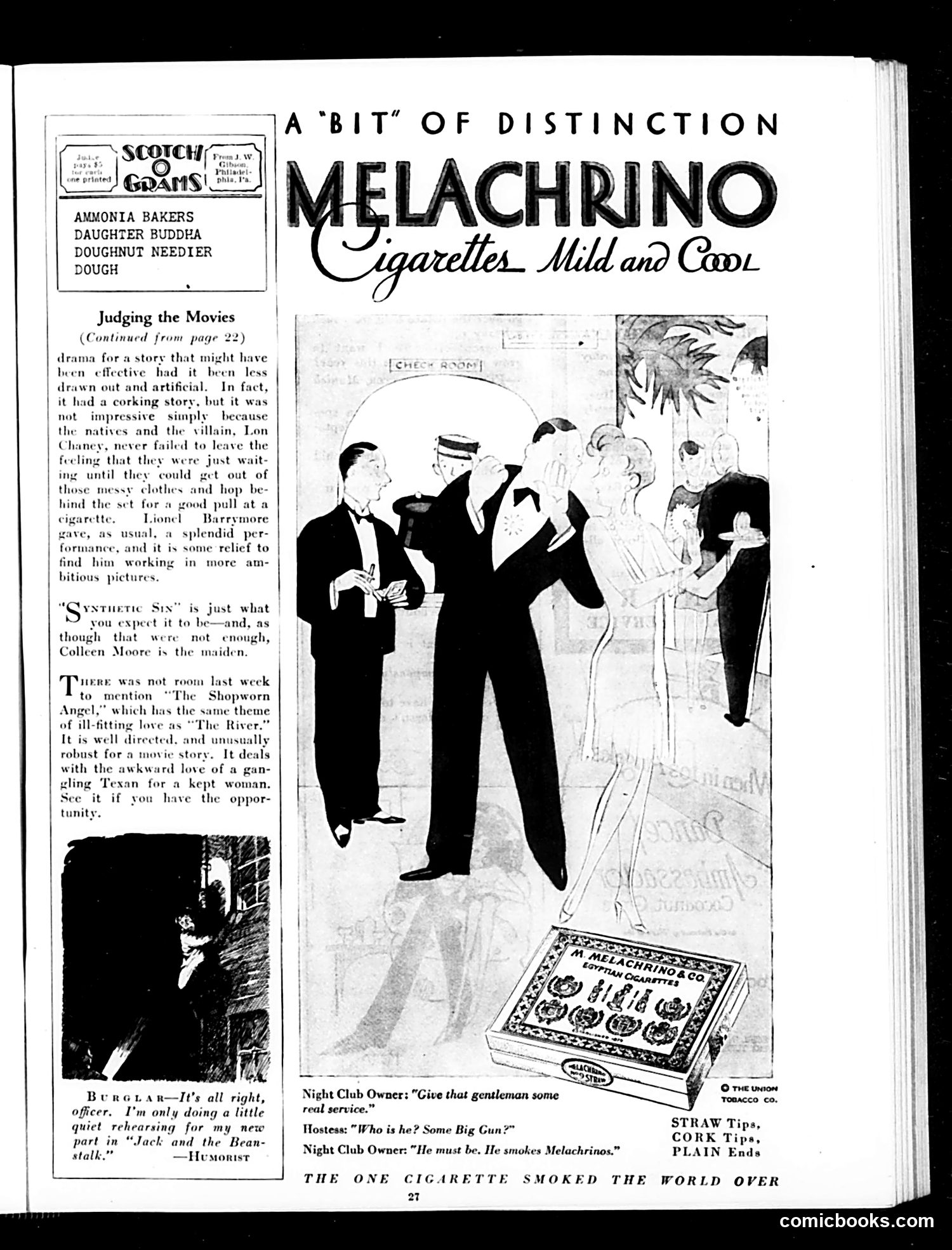
This page contains a **cigarette advertisement** for Melachrino cigarettes (right side) and film reviews (left side) from Judge magazine. The **main advertisement** uses a night-club scene as comedy. A hostess questions whether a gentleman is important ("Some Big Gun?"), and the owner responds that he *must* be important because he smokes Melachrinos—implying that smoking this brand signals high status and sophistication. This is a common advertising strategy of the era: associating a product with wealth, prestige, and social distinction. The accompanying illustration shows well-dressed men in formal attire at what appears to be an exclusive venue, reinforcing the aspirational messaging. The film review section discusses movies featuring actors like Lon Chaney and Colleen Moore, with commentary on whether films have engaging stories. The small "Burglar" cartoon at bottom left is a separate joke unrelated to the cigarette ad. **Context modern readers miss**: Early 20th-century advertising directly linked consumer products to social status without today's health warnings or regulations against such messaging.
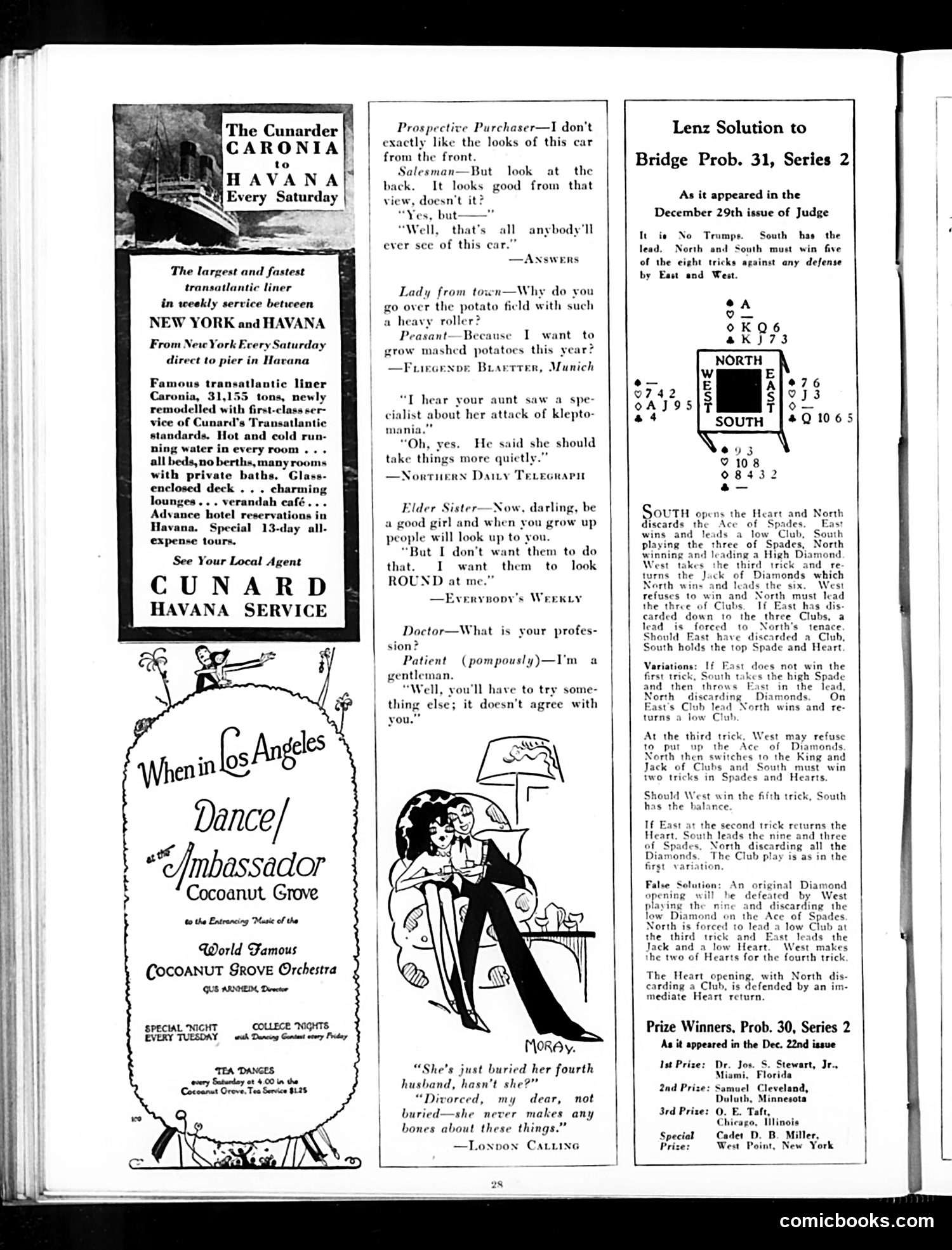
This page is primarily **advertising and humor content** rather than political satire. The visible cartoons feature **light social humor**: 1. **Car salesman joke**: A prospective buyer objects to the car's front appearance, but the salesman suggests looking at the back. The punchline—"that's all anybody'll ever see of this car"—jokes that the buyer will be left behind, implying the car is unreliable or will break down. 2. **Doctor and patient exchange**: A "gentleman" patient claims his profession is being a gentleman; the doctor retorts he should try something else because it "doesn't agree with you"—satirizing idle aristocrats. 3. **Divorce joke**: A woman who has "buried her fourth husband" is revealed to have actually divorced him, playing on the phrase "never makes any bones about." The **advertisements** promote the Cunard steamship line to Havana and the Cocoanut Grove nightclub in Los Angeles—reflecting 1920s leisure culture and travel. A **bridge problem solution** occupies the right column—typical puzzle content for Judge magazine.
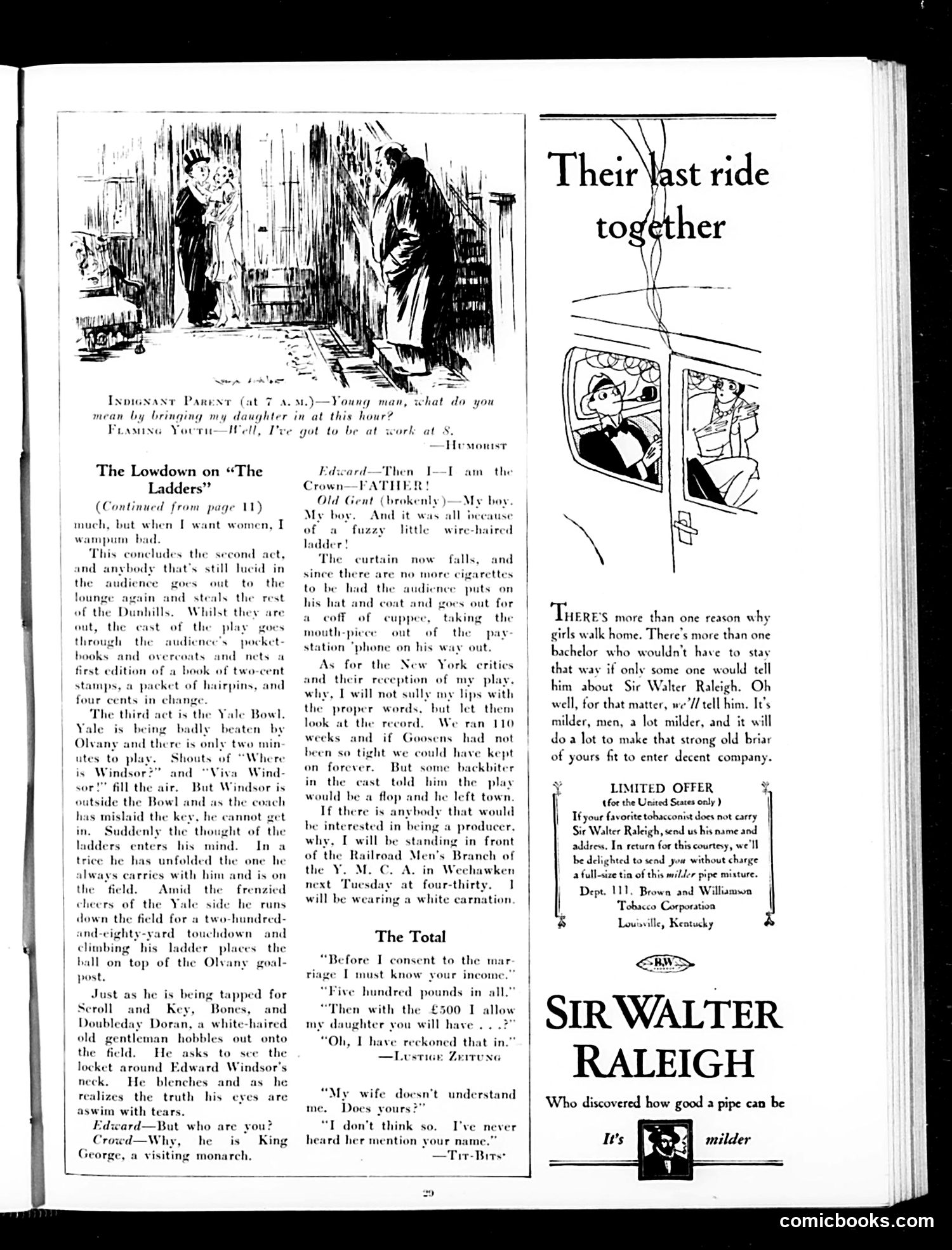
This Judge page combines a theatrical review with a tobacco advertisement. **Left side:** A satirical critique of a stage play called "The Ladders," mocking its absurd plot mechanics. The reviewer describes increasingly ridiculous scenarios—a character stealing from the audience during intermission, a Yale football game interrupted by a magical ladder that enables a 280-yard touchdown, and a climactic reveal that the old gentleman on stage is actually King George (the visiting British monarch). The satire targets both the play's contrived dramaturgy and New York theater critics' failures to recognize bad writing. **Right side:** A Sir Walter Raleigh pipe tobacco advertisement plays on the famous legend of Raleigh allegedly laying his cloak for Queen Elizabeth. The ad humorously suggests bachelors should smoke this "milder" tobacco to make themselves more socially acceptable—implying pipe smoking transforms one into "decent company." The advertisement offers free samples to tobacconists who stock the product.
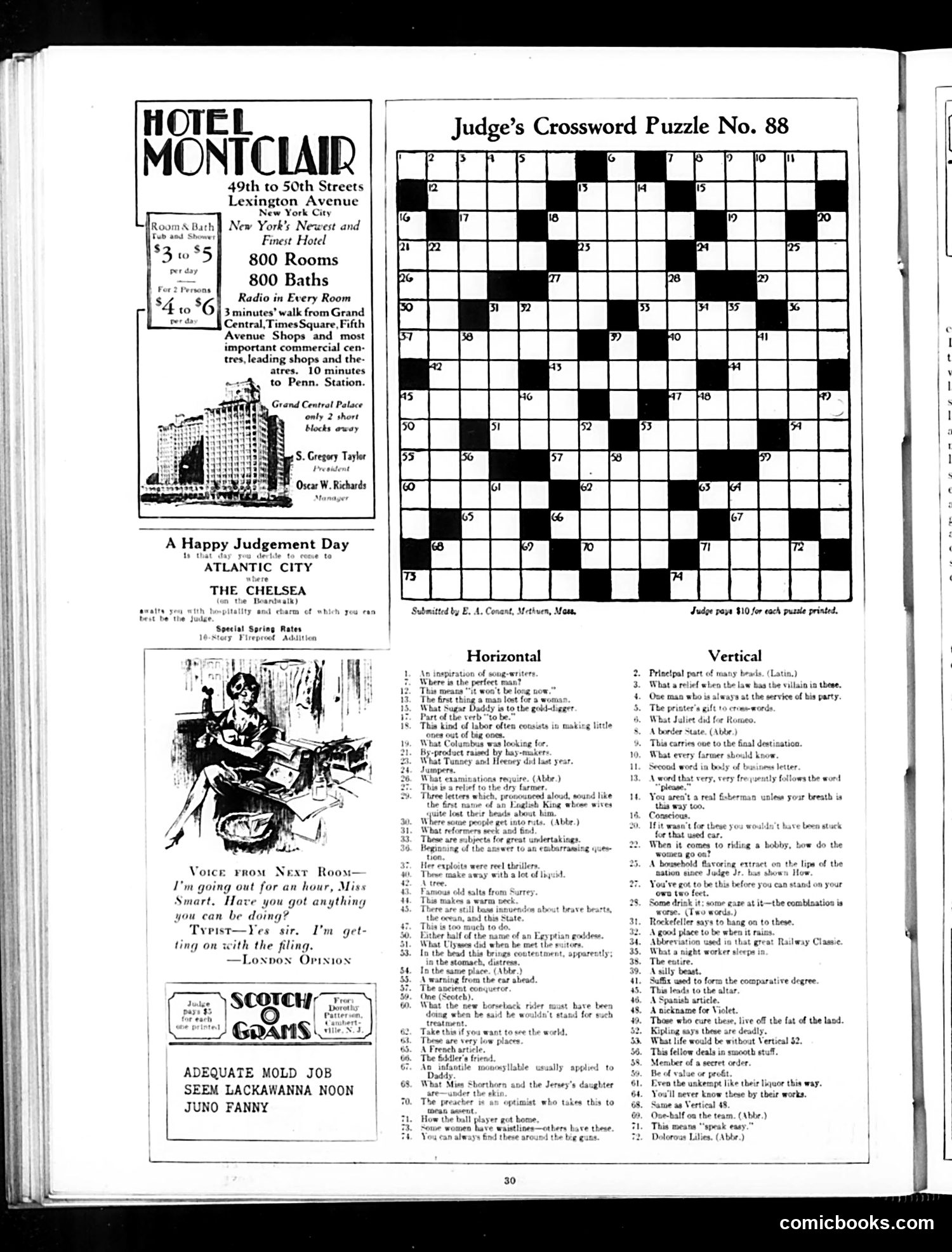
This page is primarily **advertising and crossword puzzle content**, not political satire. The main elements are: 1. **Hotel Montclair advertisement** (top left): A luxury Manhattan hotel promoting 800 rooms/baths and convenient location near Grand Central and Fifth Avenue—typical high-end hospitality marketing from this era. 2. **"Judge's Crossword Puzzle No. 88"** (top right): A standard crossword with clues. The clues reference contemporary 1920s culture (boxing champion Tunney, Rockefeller, references to "bootleggers" and "speak easy"—reflecting Prohibition-era slang). 3. **Small cartoon** (bottom left): A brief office dialogue between a boss and secretary about filing work—mild workplace humor with no political content. 4. **Other advertisements**: Including "Scotch Grains" shoes and references to Atlantic City and Chelsea venues. **Bottom line**: This is primarily a **recreation/leisure-focused publication page** with advertising, puzzles, and light humor—not satirical commentary.
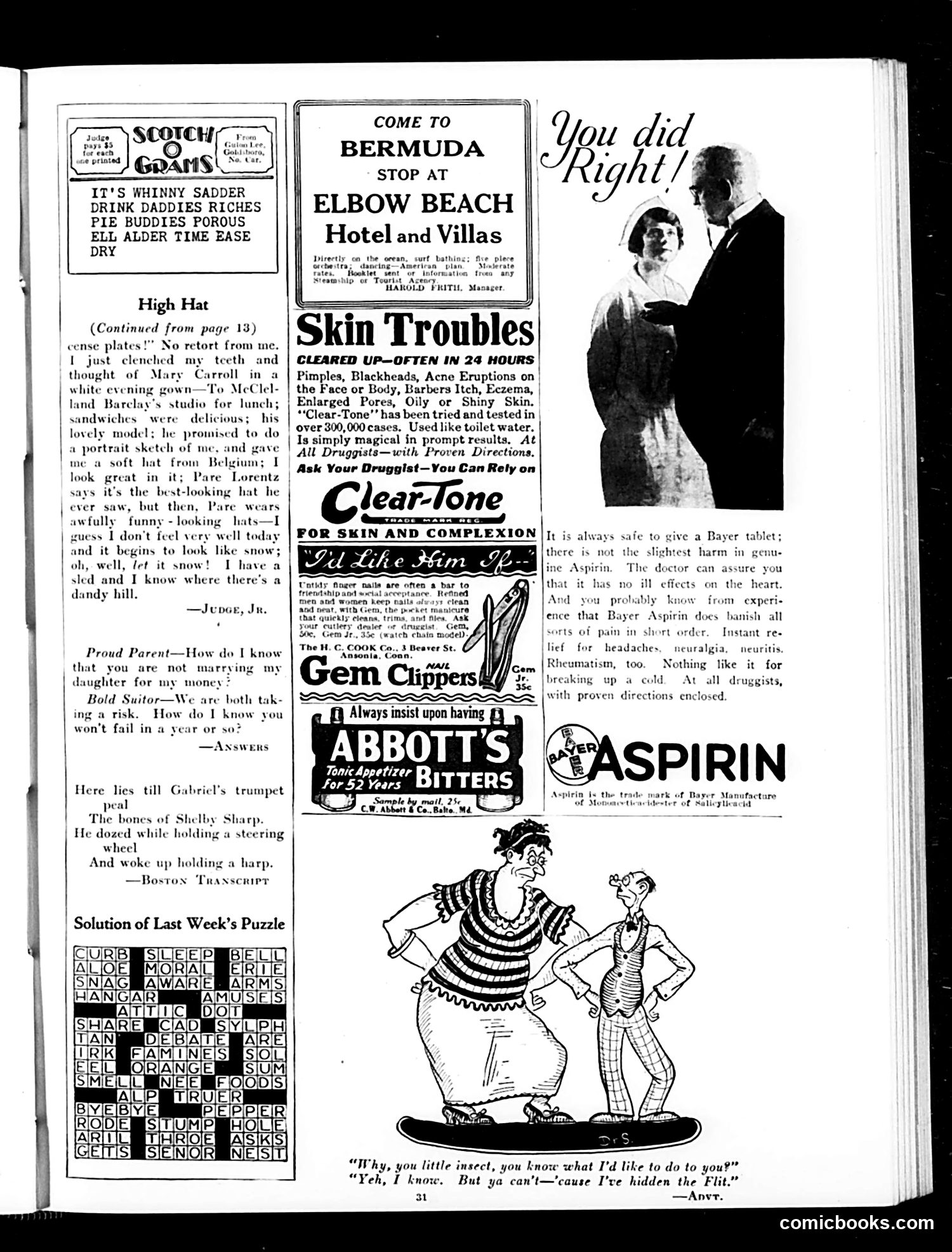
This page is primarily **advertising**, typical of 1920s magazines. The notable content includes: **Main Cartoon (bottom):** A domestic humor comic showing an adult threatening a child who has hidden the "Flit" (an insecticide spray). The joke relies on the era's common household pest problems and the popularity of Flit brand bug spray—the child's threat of hiding it represents genuine domestic disruption. This reflects 1920s anxieties about home sanitation. **Social Content:** The "High Hat" column contains society gossip about New York social figures and leisure activities (studio visits, lunch outings). The "Proud Parent/Bold Suitor" exchange satirizes courtship anxieties about financial security—a common Judge humor format. **Advertising:** The page is dominated by period product ads: Scotch Grain, Elbow Beach Hotel (Bermuda tourism), Clear-Tone (skin treatment), Gem Clippers, Abbott's Bitters, and Bayer Aspirin. These reflect contemporary consumer culture and medical advertising practices (including tonics and remedies). The puzzle solution appears to be filler content standard to the era.
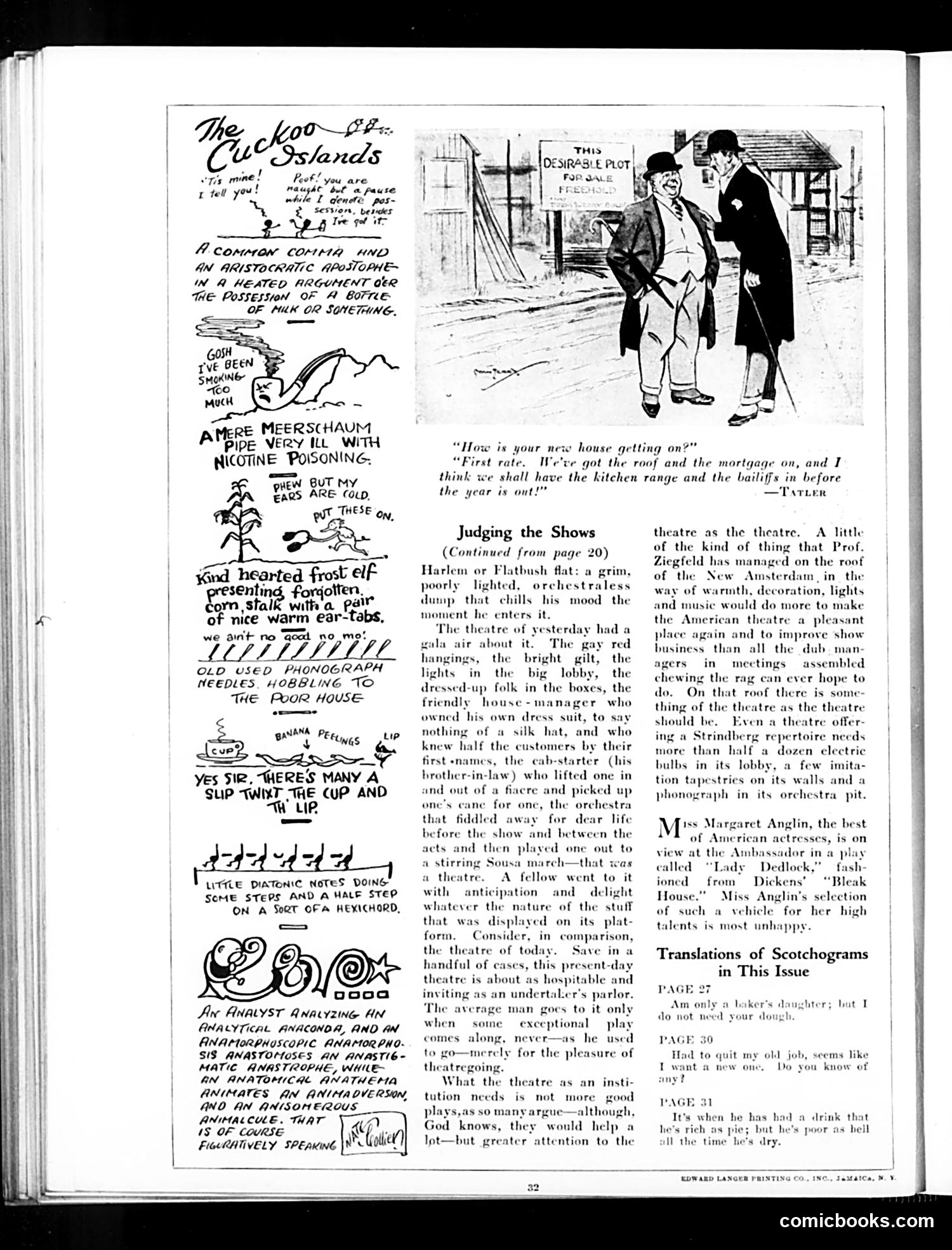
This page contains multiple satirical items typical of early 20th-century American humor: **Left side sketches** mock various absurdities: aristocratic squabbling over trivial possessions ("The Cuckoo Islands"), a diseased meerschaum pipe, worn-out phonograph needles heading to the poorhouse, and an intentionally nonsensical tongue-twister of alliteration ("Analytical Anaconda"). **Center cartoon** shows two men discussing a newly purchased house where they've financed the roof and mortgage, expecting "the kitchen range and the bailiffs in before the year is out"—satirizing the precarious financial position of homeowners struggling with mortgages and debt. **Right side article** critiques modern theater's decline, contrasting yesterday's ornate, hospitable playhouses with today's dreary, unwelcoming venues. The author argues theaters need attention to ambiance and comfort, not just better plays. He praises Ziegfeld's roof theater and criticizes actress Margaret Anglin's choice to perform in an adaptation of "Bleak House." The page blends light social commentary with absurdist humor.
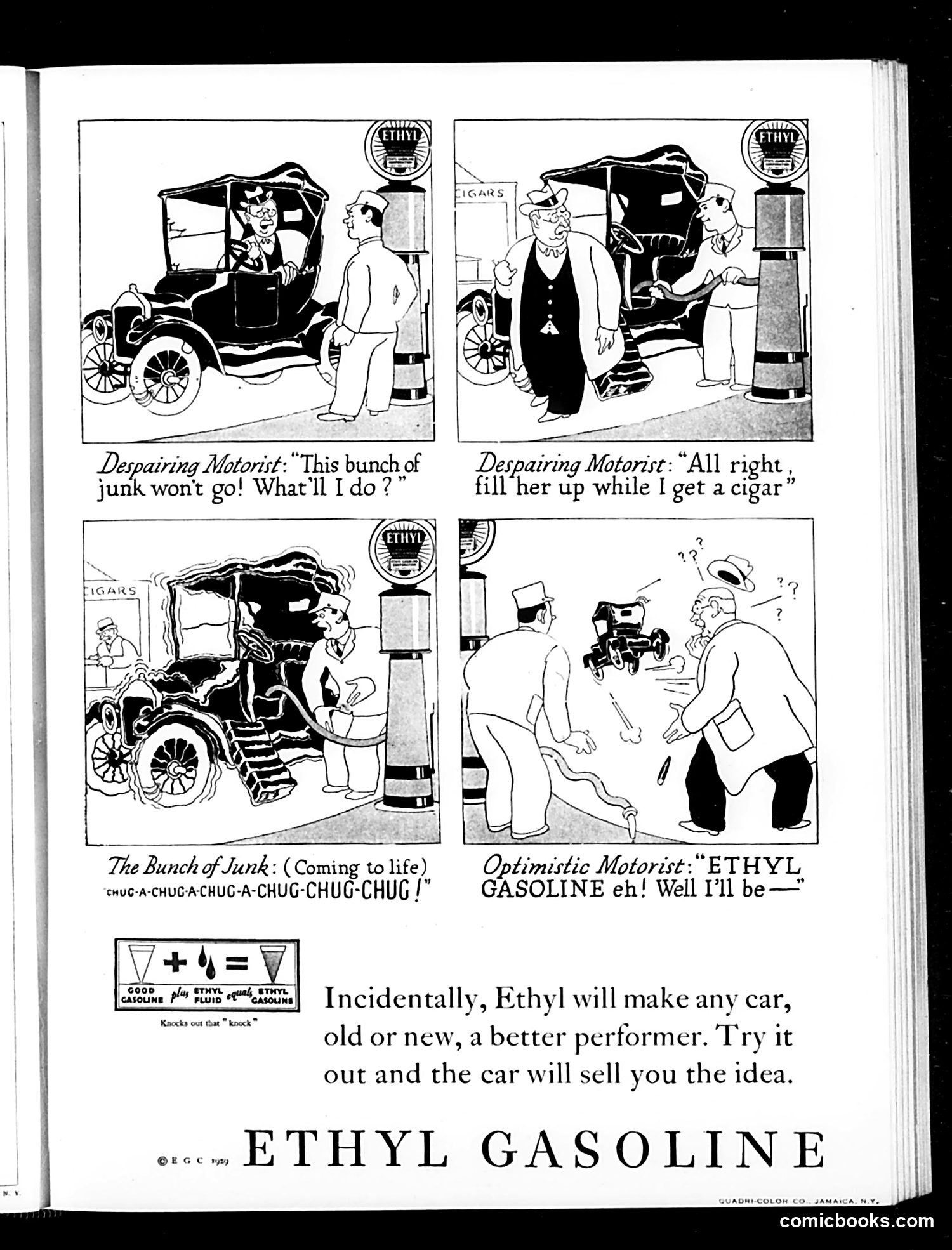
This is a **product advertisement** for Ethyl Gasoline, not political satire. The four-panel comic depicts a common motorist problem of the era: an old, unreliable car that won't start. The joke progresses: a "despairing motorist" with a broken-down vehicle seeks help at a gas station. The attendant suggests filling it with Ethyl Gasoline. Comically, the old car "comes to life" with renewed vigor, prompting the motorist's amazement at the product's transformative power. The advertisement claims Ethyl fuel improves any vehicle's performance—old or new—so effectively that "the car will sell you the idea." This reflects early 20th-century marketing for leaded gasoline additives, which genuinely improved engine performance (before health concerns emerged). The humor relies on exaggeration and personification to make a sales pitch entertaining.
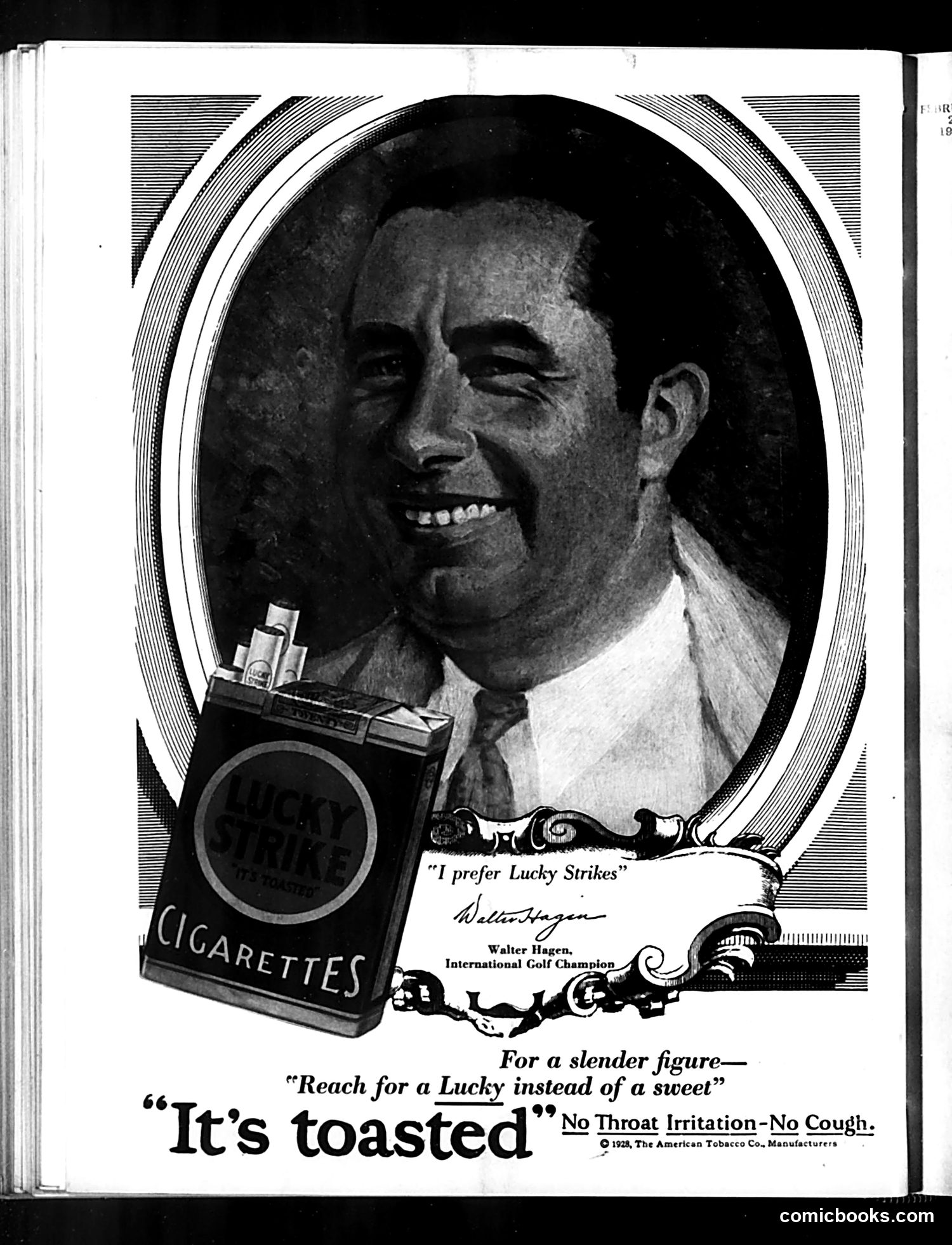
This is a cigarette advertisement rather than political satire. It features Walter Hagen, identified as an "International Golf Champion," endorsing Lucky Strike cigarettes. The ad's tagline—"Reach for a Lucky instead of a sweet"—promotes cigarettes as a weight-control alternative to candy, a common marketing strategy in early 20th-century tobacco advertising. The phrase "It's toasted" refers to Lucky Strike's manufacturing process. The ad emphasizes "No Throat Irritation—No Cough," claims typical of the era before cigarette health dangers were widely acknowledged. This reflects how cigarettes were openly advertised in mainstream publications using celebrity endorsements and health claims that would be illegal today.