
Judge, 1929-02-23 · page 23 of 36
Judge — February 23, 1929 — page 23: what you’re looking at
What you’re looking at
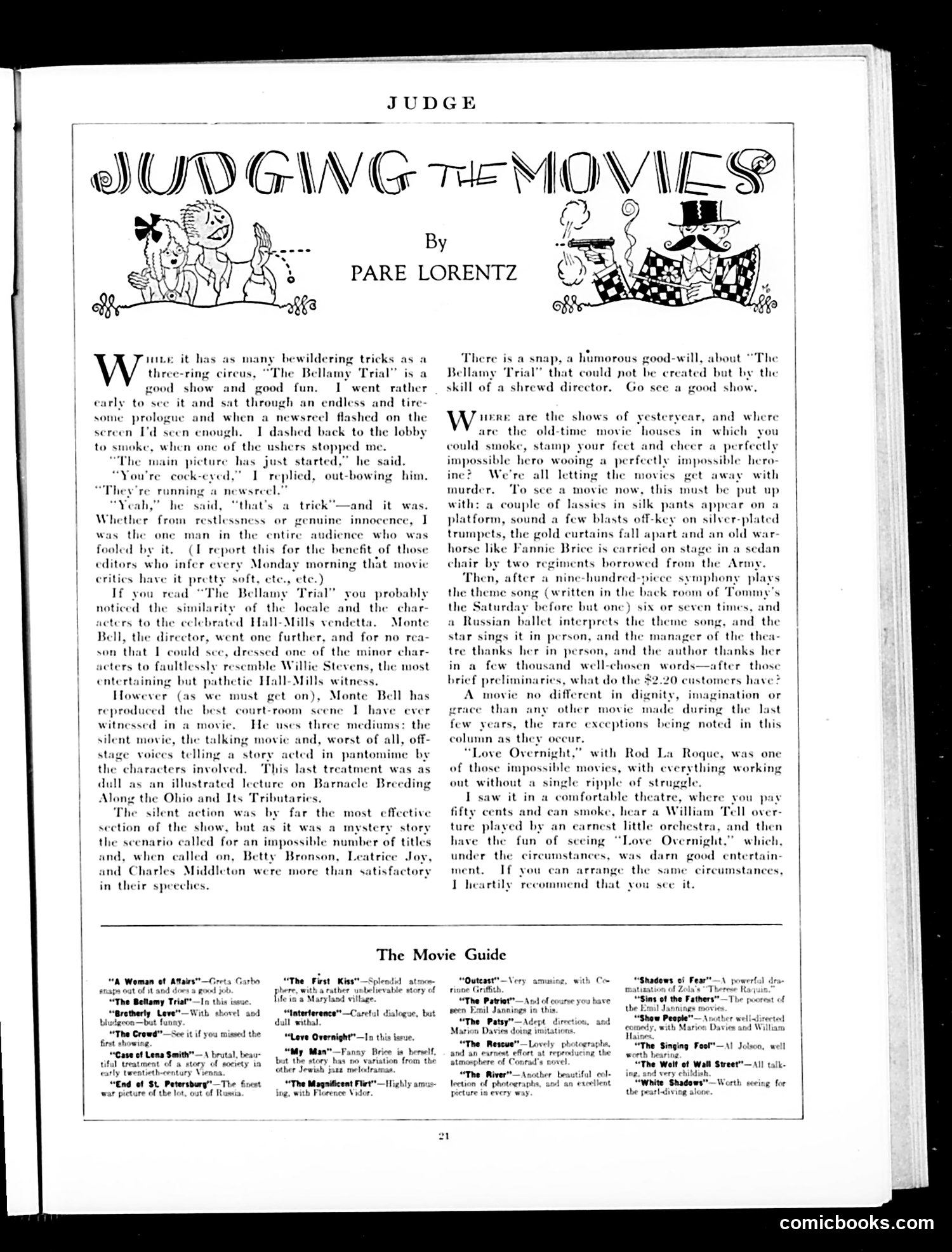
This is a film review column by Pare Lorentz critiquing "The Bellamy Trial," a recent movie mixing silent film, dialogue, and off-stage narration. Lorentz complains that this hybrid approach—using all three mediums simultaneously—is unnecessarily confusing and pretentious. His core complaint: modern movie theaters have become overly elaborate, forcing audiences to endure absurdly extended preambles (newsreels, orchestral symphonies, Russian ballet interludes) before the main feature begins. He laments that filmmakers use excessive production spectacle to compensate for weak storytelling, making even genuinely entertaining movies feel bloated. Lorentz praises "The Bellamy Trial" for its court-room scenes and cast (Betty Bronson, Leatrice Joy), and recommends "Love Overnight" as an example of a film that succeeds *despite* theatrical pretension when viewed in the right atmosphere. The implicit satire: 1920s cinema is strangling itself with over-production and technological novelty, forgetting that good direction and storytelling matter more than elaborate framing devices.
📄 Transcribed text from this page (OCR, searchable)
Machine-transcribed from the original scan — historical spelling and the odd misread are preserved.
JUD UDGIWG MOVIES line it has as many bewildering tricks as a W three-ring circus, “The Bellamy T) is a xd show and good fun, I’ went rather arly to see it and sat through an endless and tire- prologue and when a newsreel flashed on the sereen I'd seen enough. I dashed back to the lobby to smoke, when one of the ushers stopped me. “The main picture has just started,” he said. “You're cock-eved,” 1 ‘re runni son replied, out-bowing him. newsreel.” “that’s a trick” said, —and it was. Whether from restlessness or nuine innocence, I was the one man in the entire audience who was fooled by it. (I report this for the benefit of those editors who infer every Monday morning th critics have it pretty soft, ete., ete.) If you read “The Bellamy Trial” you probably noticed the similarity of the locale and the ers to the celebrated Hall-Mills vendetta. Bell, the director, went one further, and for no res son that I could see, dressed one of the minor char- acters to faultlessly resemble Willie Stevens, the most entertaining but pathetic Hall-Mills witness. However (as we must get on), Monte Bell has oduced the best court-room 1 have ever witnessed in a movie. He uses three mediums: the silent movie, the talking movie and, worst of all, off- stage voices telling a story acted in) pantomime by the characters involved. dull it movie char Monte rey This last treatment was as Barnacle Bri nd Its Tributaries. he on was by far the section of the show, but as it was a mystery story the scenario called for an impossible number of titles and, when called on, Betty Bronson, Leatrice Joy, and Charles Middleton were more than satisfactory in their speeches. as an illustrated lecture on ling silent a most effective GE There is a snap, a humorous good-will, about “The Bellamy Trial” that could pot be created but by the skill of a shrewd director. re the could: sme Go sce a od show, are the shows of yesteryear, and where ld-time movie houses in) which you ce, stamp your feet and cheer a perfectly impossible hero wooing a perfectly impossible hero- inc? We're all letting the movies t away with murder. ‘To see a movie now, this must be put up with: a couple of lassies in silk pants appear on a platform, sound a few blasts off-key on silver-plated trumpets, the gold curtains fall apart and an old war horse like Fannie Brice is carried on stage in a sedan chair by two regiments borrowed from the Army. Then, after a nine-hundred-picce symphony pl: the theme song (written in the back room of Tommy's the Saturday before but one) six or seven times, and a Russian ballet interprets the theme star sings it in person, tre thanks her in person, and the in a few thousand well-chosen brief preliminaries, what do the those words—after $2.20 customers have? A movie no different in dignity, imagination or urace than any other movie made during the last few years, the rare exceptions being noted in this column as they occur. “Love Overt ht,” with Rod La Roque, was onc of those impossible movies, with everything working out without a single ripple of str w it in a comfortable theatre nts and can smoke, h where you pay ara William Tell over- have the fun of s “Love Overnight.” whieh, under the circumstances, was darn good entertain- ment, ng If you can arrange the same circumstances, 1 heartily recommend that you sce it. The Movi splendid atmom believable story of age. “The First Kiss’ phere witha rather oa Maryland © “taterterence™”—Carefal dialogve, but dull withal “Leve Overnight” —In this isrue. “My Man” —Fanay Brice is herself, y has no variation from the jane “The Magnificent Flirt”*—Iighly amus- ing, with Florence Vidor: "The Bellamy Trial™—In this issue. With shovel and —See it if you missed the “Case of Lena Smith” —\ brutal, beau- tifal treatment of a story of society in early tw “End of St Petersburg’ war picture of the lot, out of fi ie Guide “Outcast rinne Griff “The Patriet’—Apd of coure you have geen Emil Jannings i Very amusing, with Co “Sins of the Fathers” the Es I Jannings movies ql and William, “The River’ ection of photographs picture is every way beautiful col comicbooks.com