
Life, 1928-12-21 · page 15 of 36
Life — December 21, 1928 — page 15: what you’re looking at
What you’re looking at
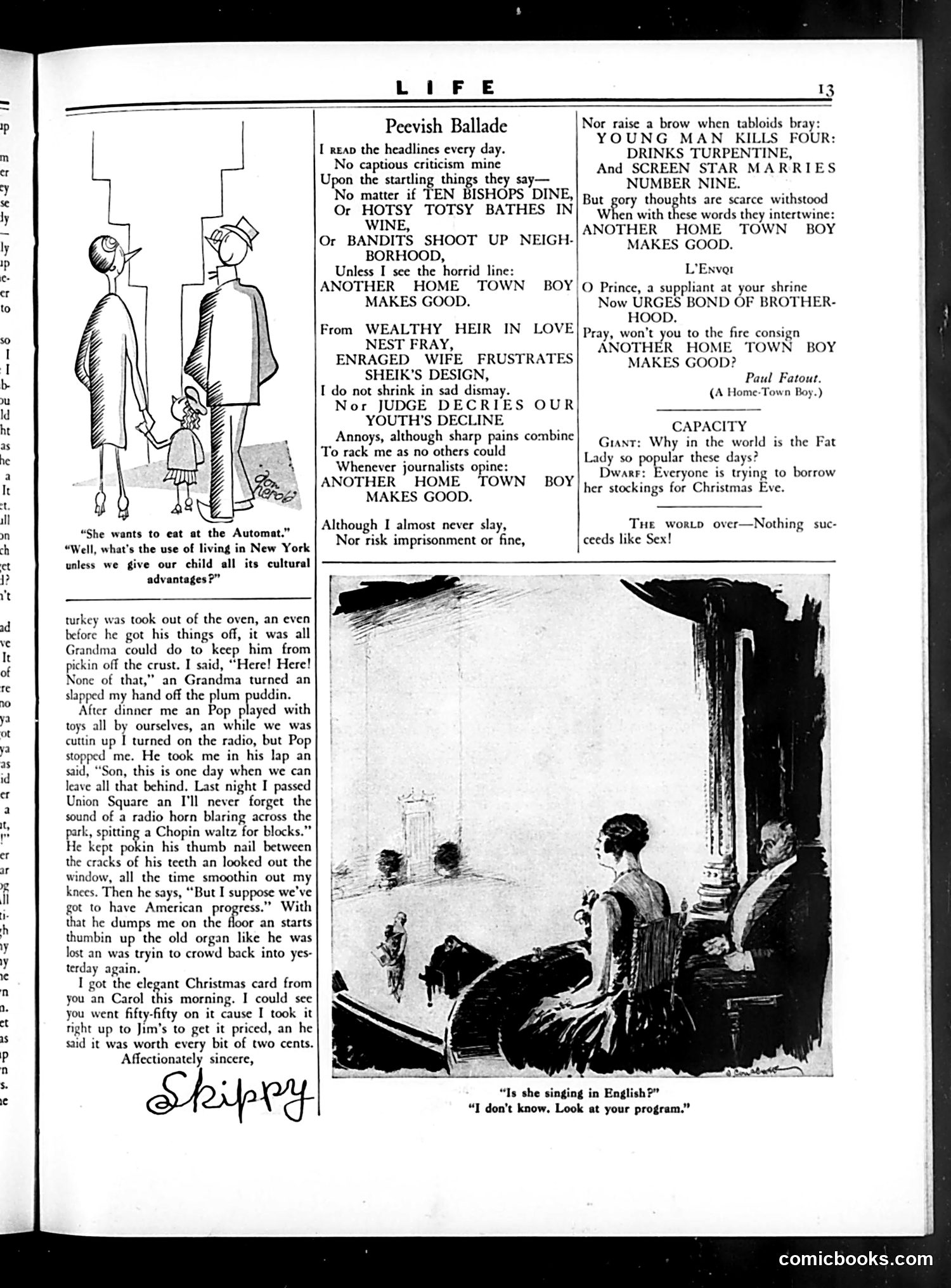
This page contains satirical commentary on American cultural anxieties of the early-to-mid 20th century. The "Peevish Ballade" mocks sensationalist newspaper headlines about crime and scandal ("Young Man Kills Four," "Screen Star Marries Number Nine"), suggesting media obsession with lurid stories. The poet criticizes this coverage while ironically noting such stories reassure readers that "another home town boy makes good." The cartoon illustration shows parents at what appears to be a theater or concert, with a child asking "'Is she singing in English?' / 'I don't know. Look at your program.'" This satirizes the cultural pretension of American audiences at sophisticated performances—suggesting people attend without understanding the content, relying on programs rather than actual comprehension. The page critiques both media sensationalism and middle-class cultural aspirations.
📄 Transcribed text from this page (OCR, searchable)
Machine-transcribed from the original scan — historical spelling and the odd misread are preserved.
LIFE 13 “She wants to eat at the Automat.” “Well, what's the use of living in New York unless we give our child all its cultural advantages?” turkey was took out of the oven, an even before he got his things off, it was all Grandma could do to keep him from pickin off the crust. I said, “Here! Here! None of that,” an Grandma turned an slapped my hand off the plum puddin. After dinner me an Pop played with toys all by ourselves, an while we was cuttin up I turned on the radio, but Pop stopped me. He took me in his lap an said, “Son, this is one day when we can leave all that behind. Last night I passed Union Square an I'll never forget the sound of a radio horn blaring across the park, spitting a Chopin waltz for blocks.” He kept pokin his thumb nail between the cracks of his teeth an looked out the window, all the time smoothin out my knees. Then he says, “But I suppose we've got to have American progress.” With that he dumps me on the floor an starts thumbin up the old organ like he was lost an was tryin to crowd back into yes- terday again, I got the elegant Christmas card from you an Carol this morning. I could see you went fifty-fifty on it cause I took it right up to Jim's to get it priced, an he said it was worth every bit of two cents. Affectionately sincere, MPa Peevish Ballade I reap the headlines every day. No captious criticism mine Upon the startling things they say— No matter if TEN BISHOPS DINE, Or HOTSY TOTSY BATHES IN WINE, Or BANDITS SHOOT UP BORHOOD, Unless I see the horrid line: ANOTHER HOME TOWN MAKES GOOD. From WEALTHY HEIR IN NEST FRAY, ENRAGED WIFE FRUSTRATES SHEIK’S DESIGN, I do not shrink in sad dismay. Nor JUDGE DECRIES OUR YOUTH’S DECLINE Annoys, although sharp pains combine To rack me as no others could Whenever journalists opine: ANOTHER HOME TOWN BOY MAKES GOOD. NEIGH- LOVE Although I almost never slay, Nor risk imprisonment or fine, “Is she singing in English?” Nor raise a brow when tabloids bray: YOUNG MAN KILLS FOUR: DRINKS TURPENTINE, And SCREEN STAR MARRIES NUMBER NINE. But gory thoughts are scarce withstood When with these words they intertwine: ANOTHER HOME MAKES GOOD. TOWN BOY | L’Exvar BOY O Prince, a suppliant at your shrine Now URGES BOND OF BROTHER- HOOD. Pray, won't you to the fire consign ANOTHER HOME TOWN MAKES GOOD? Paul Fatout. (A Home-Town Boy.) BOY CAPACITY Grant: Why in the world is the Fat Lady so popular these days? Dwarr: Everyone is trying to borrow her stockings for Christmas Eve. Tue worto over—Nothing suc- ceeds like Sex! “I don’t know. Look at your program.” comicbooks.com