
A complete issue · 36 pages · 1928
Life — December 21, 1928
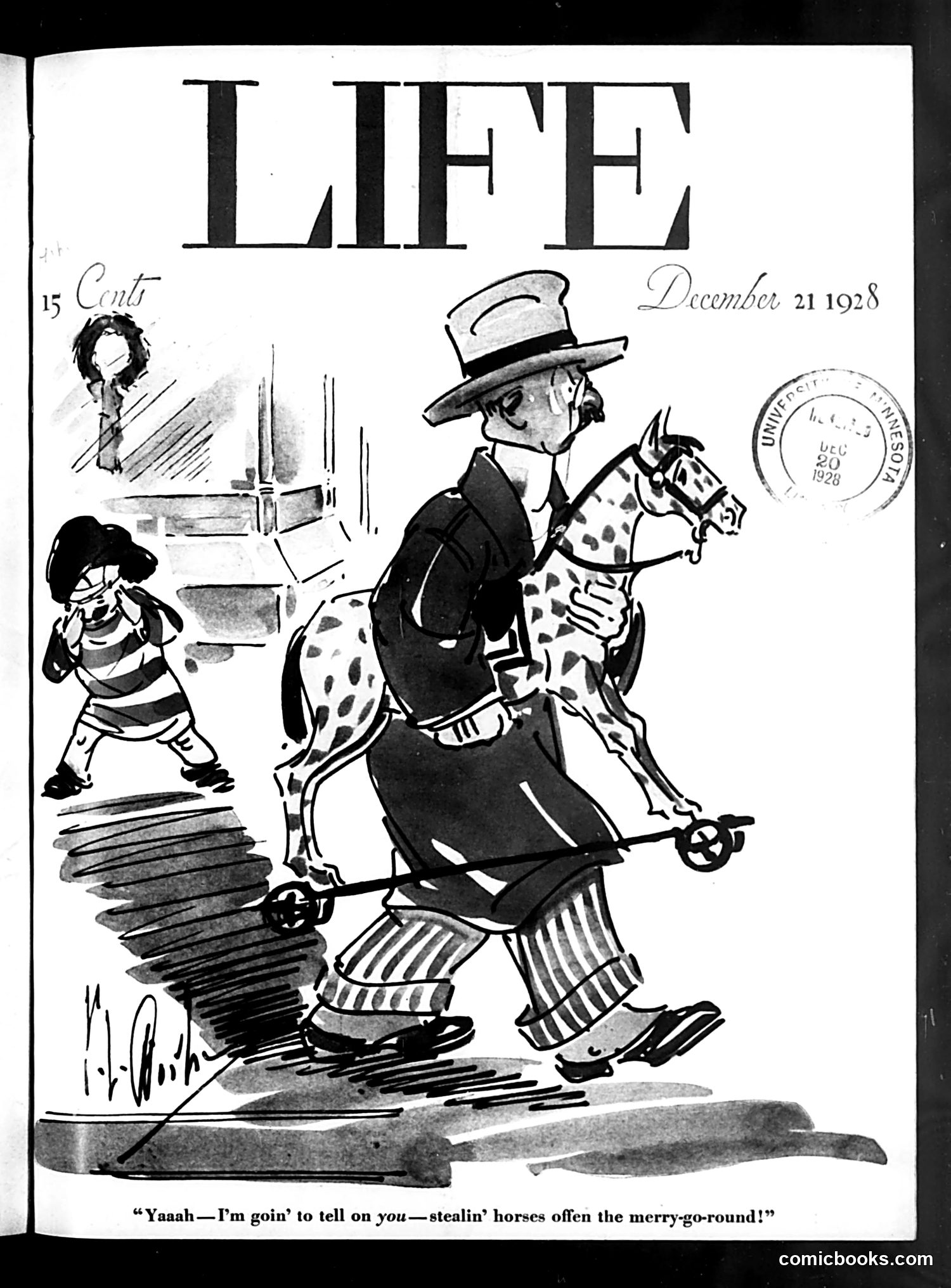
This satirical cover depicts a caricatured figure on horseback confronting a smaller character, with the caption: "Yaah—I'm goin' to tell on you—stealin' horses often the merry-go-round!" The joke appears to reference horse theft, a classic Western/frontier crime. The mounted figure's exaggerated features and formal attire suggest a wealthy or powerful person being accused of petty theft—specifically stealing carousel horses. The humor likely works through ironic contrast: a well-dressed gentleman engaged in childish mischief rather than serious criminality. The specific political or social context remains unclear without additional information about 1928 events or personalities this may reference. The image functions primarily as visual comedy about absurd accusations.
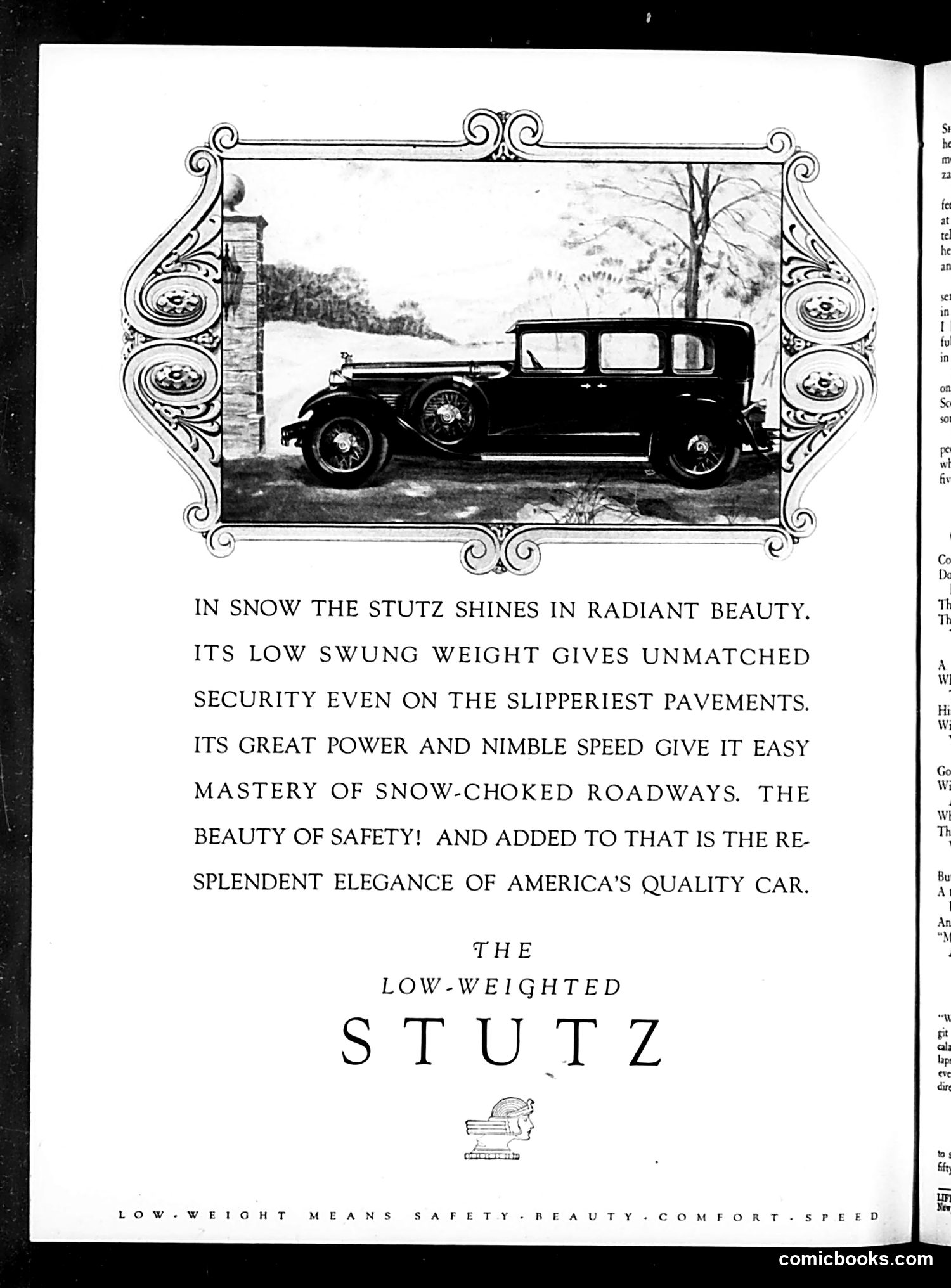
This is **not satire or political commentary**—it's a straightforward automobile advertisement for the Stutz car, appearing in *Life* magazine (which published both humor and ads). The ad highlights the Stutz's practical winter performance: its low weight provides traction on snow and ice, while its power and speed enable safe driving on treacherous roads. The decorative frame and formal typography reflect 1920s-era advertising aesthetics. The tagline "low-weight means safety, beauty, comfort, speed" emphasizes how the car's engineering solves real problems for motorists in snowy climates. This was a significant selling point when winter driving was genuinely hazardous and many cars lacked reliable traction control or modern safety features.
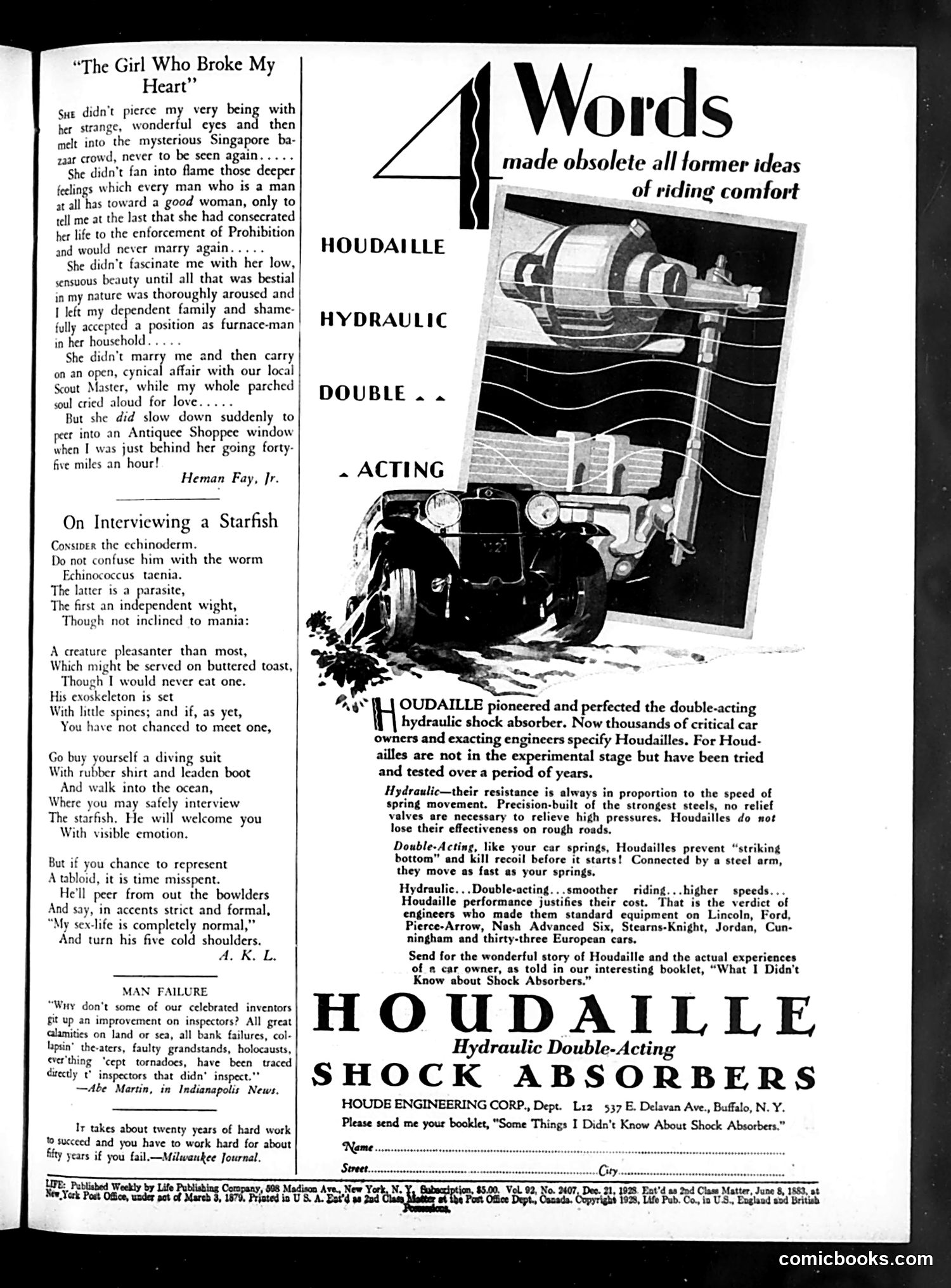
This page is primarily **advertising**, not political satire. The dominant content is a Houdaille shock absorber advertisement that occupies roughly two-thirds of the page. The ad uses the phrase "Words made obsolete all former ideas of riding comfort" to promote Houdaille's "hydraulic double-acting" shock absorbers for automobiles. It includes technical specifications and claims these absorbers were tested over years and used by major car manufacturers. The left column contains unrelated editorial content: a romantic short story ("The Girl Who Broke My Heart"), a humorous poem about starfish, and brief notes about inventors and inventors' failures. This is a typical **1920s-era Life magazine layout** mixing entertainment content with full-page commercial advertisements—not political commentary or satire.
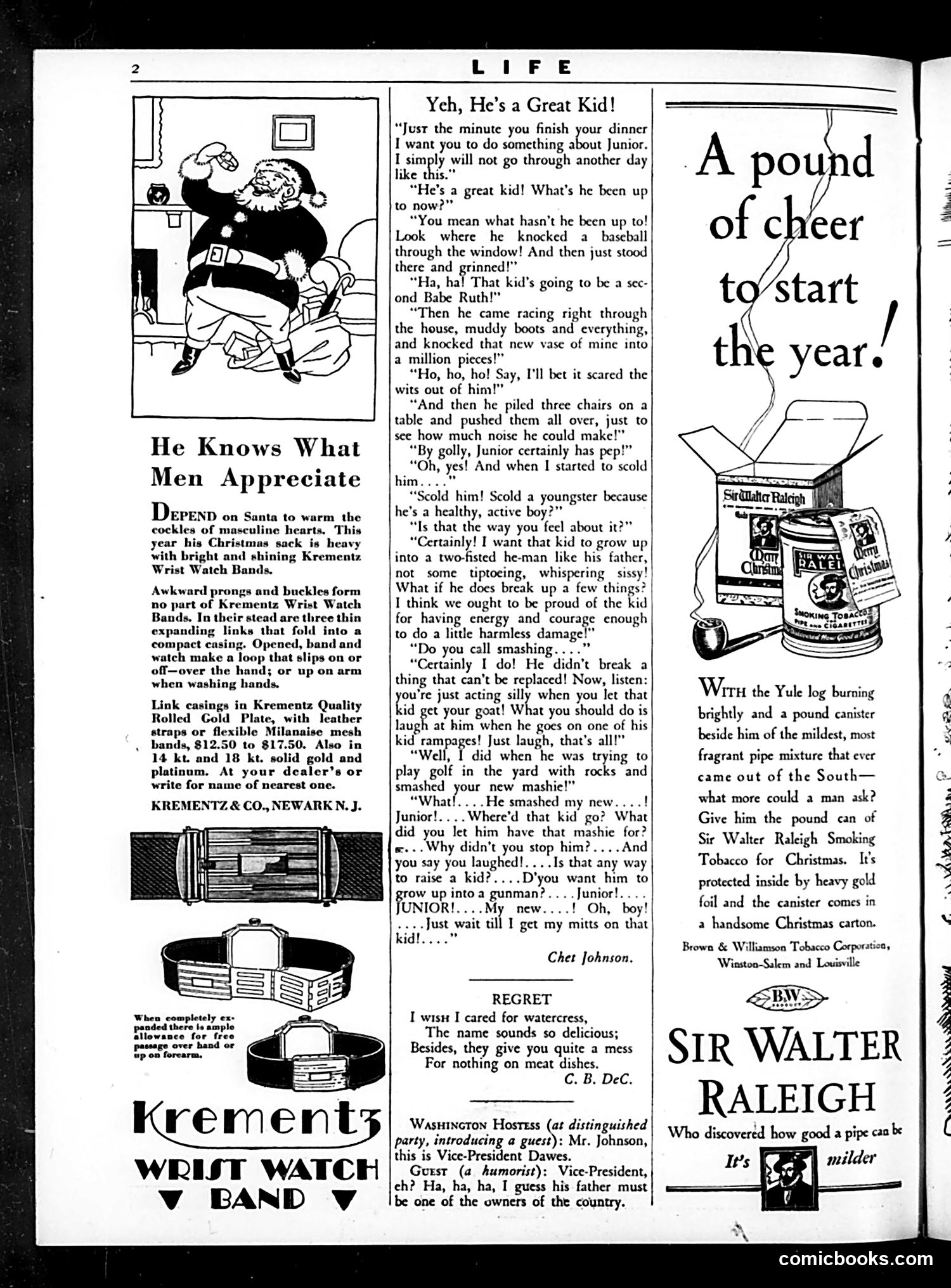
This page is primarily **advertising and light humor** rather than political satire. The main cartoon, "He Knows What Men Appreciate," depicts Santa Claus causing chaos in a home—breaking a vase, knocking over chairs—while a mother praises his "energy and courage." The joke satirizes parental double standards: parents celebrate destructive behavior in Santa but would scold their own child for identical mischief. The article by Chet Johnson elaborates this theme, humorously exploring how parents react differently to "Junior's" antics depending on framing. The page also features **advertisements** for Krementz Wrist Watch Bands and Sir Walter Raleigh pipe tobacco, typical of 1920s-era Life magazine content. No specific political figures or events are referenced.
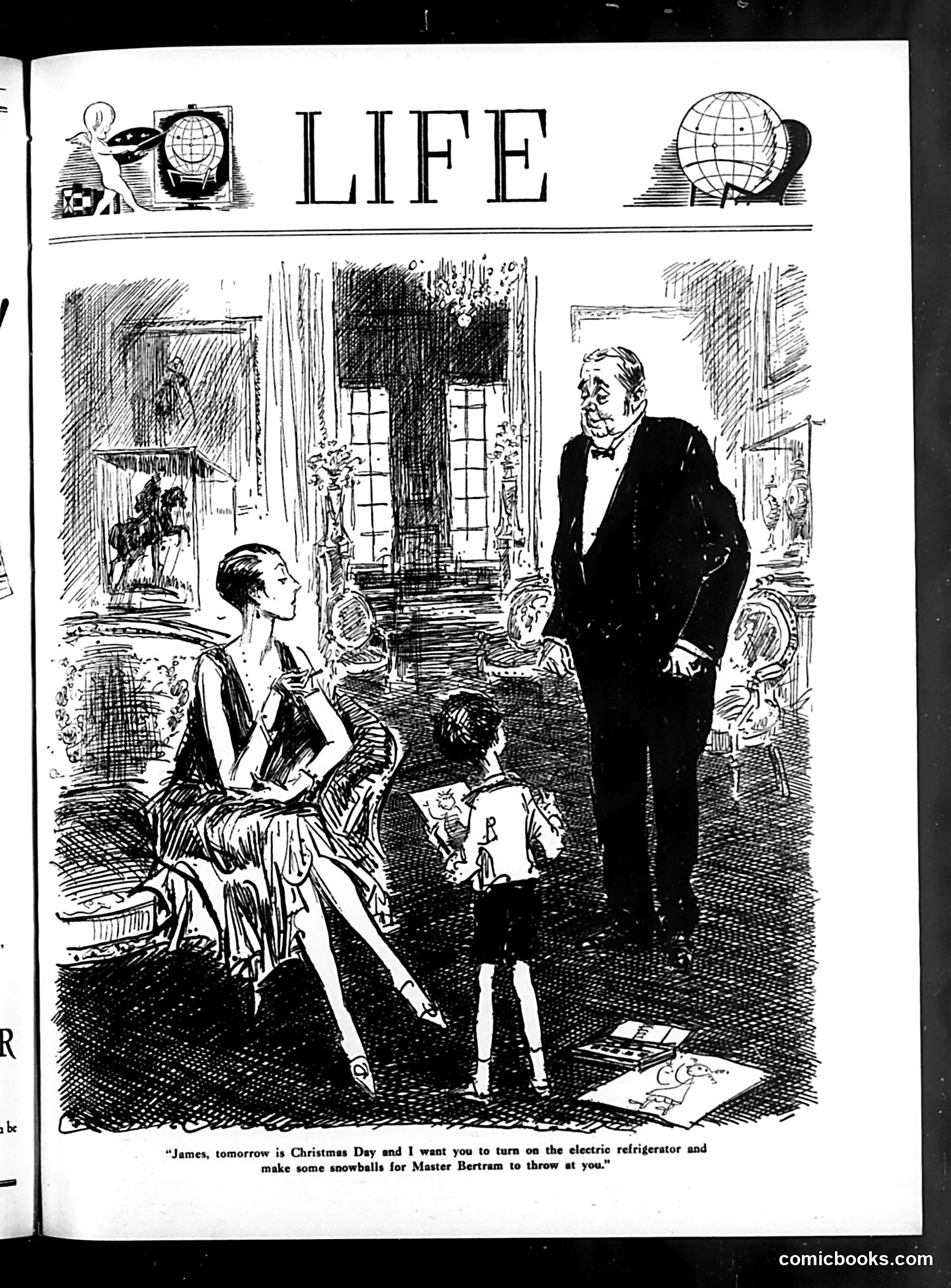
This cartoon depicts a domestic scene satirizing early refrigeration technology. A well-dressed man (likely the father/homeowner) stands while a woman and child sit nearby. The caption reads: "James, tomorrow is Christmas Day and I want you to turn on the electric refrigerator and make some snowballs for Master Bertram to throw at you." **The Satire:** The joke mocks the novelty and inefficiency of early electric refrigerators. Rather than being a reliable appliance, it's so unreliable that the mother must ask the servant to manually operate it to produce snow/ice for Christmas play—treating an expensive modern convenience as barely functional. The humor lies in the gap between technological promise and practical reality.
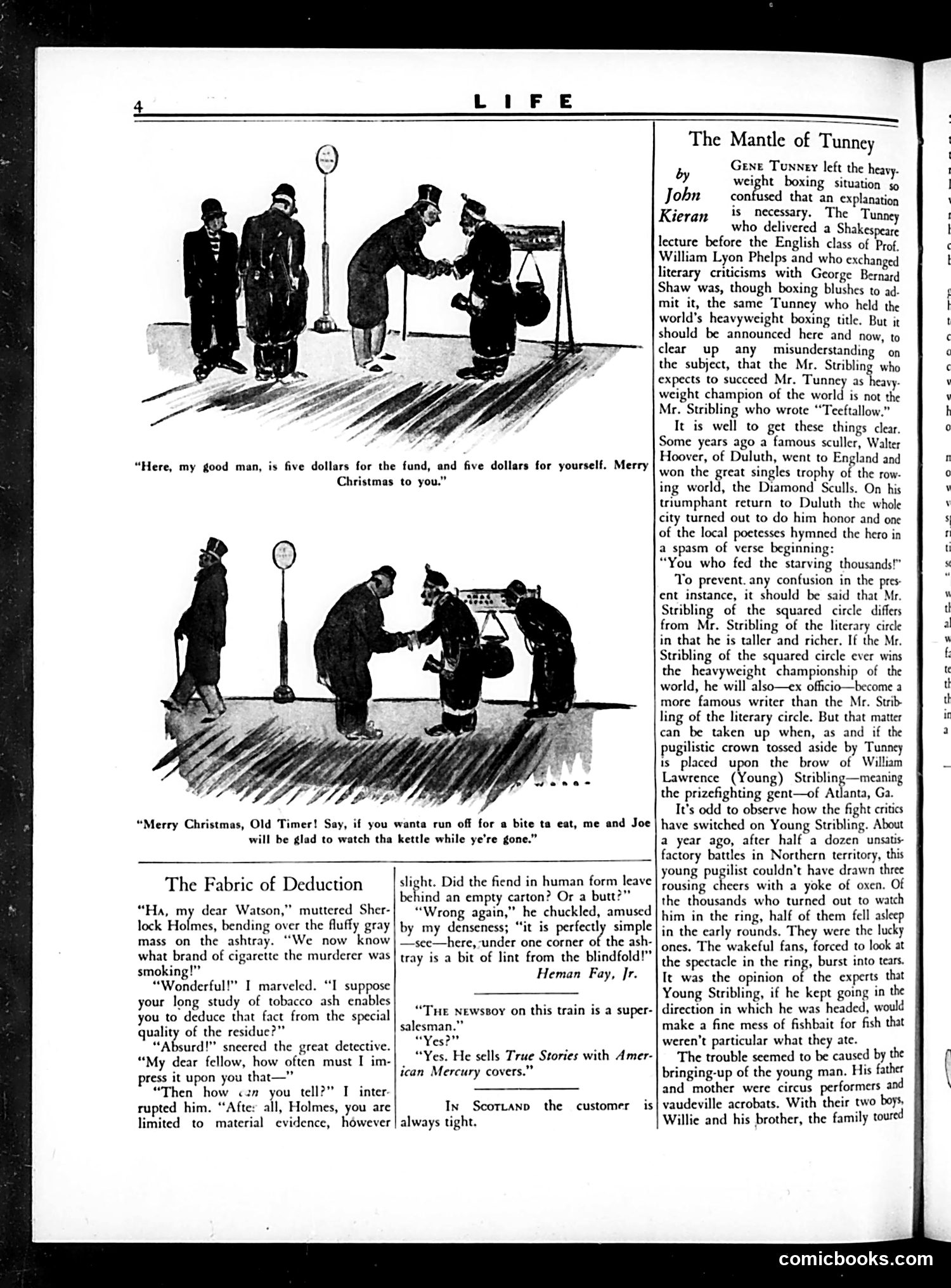
**The two cartoons** depict street-corner charity solicitation during the Christmas season. Both scenes show well-dressed men collecting donations for charitable funds, with humorous captions about giving money "for the fund" while also receiving personal benefit. The satire targets **hypocrisy in charitable giving**—specifically, the common practice where fundraisers or intermediaries personally profit from donations meant for the needy. The jokes suggest donors are naive to believe their money actually reaches those in need. **"The Fabric of Deduction"** section features a Sherlock Holmes parody, mocking the detective's deductive methods through an absurd example about lint and blindfolds—likely satirizing overwrought mystery fiction. The page also includes brief humorous observations about Scottish customers and various cultural references typical of 1920s Life magazine humor.
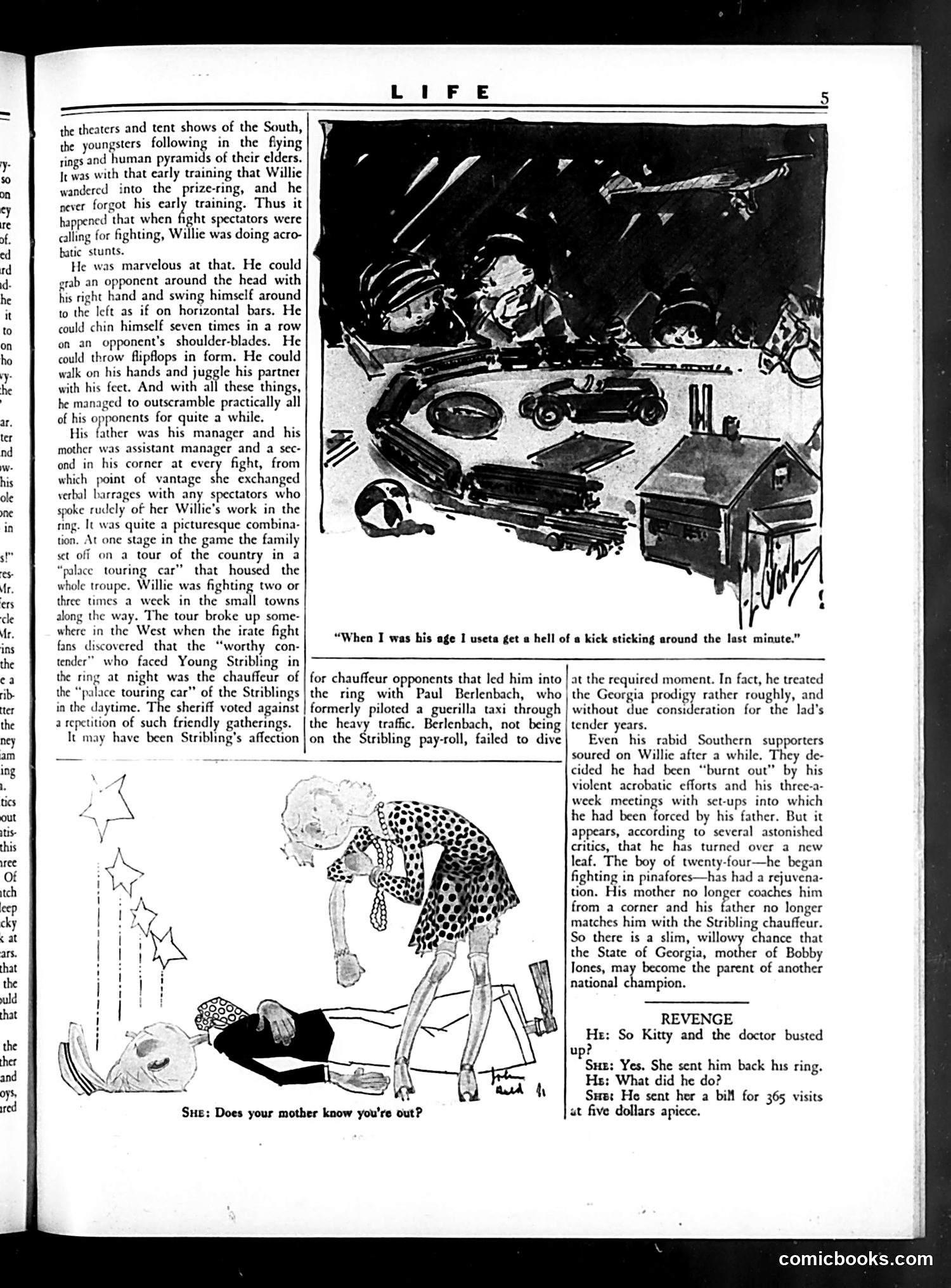
This page documents **Willie Stribling**, a professional boxer. The text describes his early circus training and acrobatic fighting skills, explaining how his theatrical background made him exceptionally skilled at opponent manipulation. The **top illustration** shows circus/acrobatic performance equipment—trapeze, rigging, and performer apparatus—visualizing his unconventional training background. The **bottom cartoon** depicts a skeletal figure (likely representing death or a medical condition) with a woman, captioned "Does your mother know you're out?"—a common joke format of the era implying the figure is not fit for polite company, possibly satirizing Stribling's rough appearance or questionable opponents. The final section, "REVENGE," is a brief humorous dialogue about Kitty and a doctor collecting payment. The content celebrates Stribling's unique boxing approach while mixing entertainment gossip with period-appropriate humor.
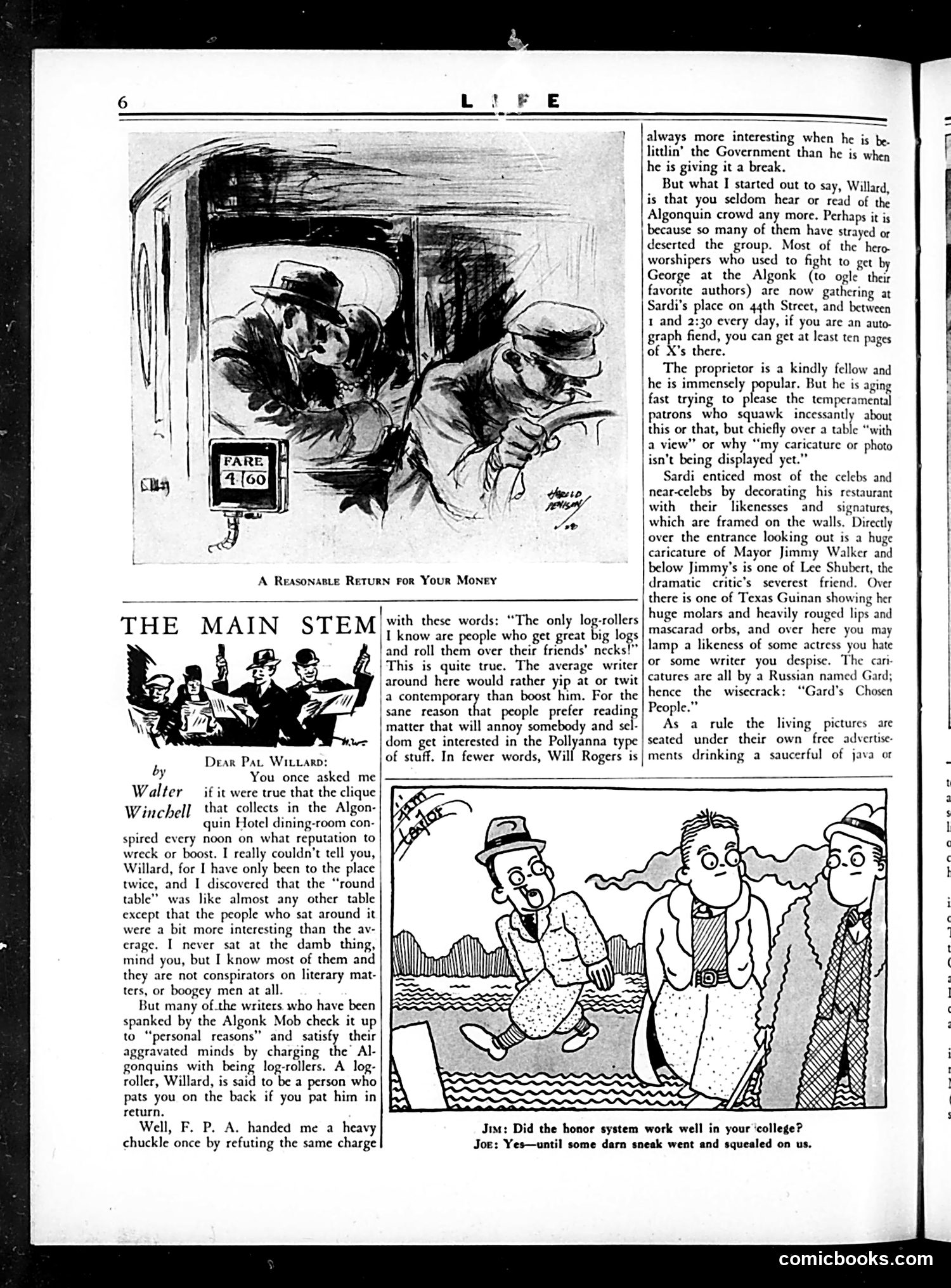
This page discusses New York's Algonquin Hotel dining room, a famous gathering place for writers and intellectuals. Winchell defends the venue against criticism that it attracts "log-rollers" (people who mutually promote each other's work). He argues the Algonquin actually hosts serious literary figures, not merely self-interested publicity-seekers. The top cartoon shows a taxi with "FARE 4/60" — satirizing inflated New York taxi fares as unreasonable. The bottom cartoon depicts three men at a beach discussing college honor systems. One admits a "sneak" betrayed their system by informing authorities — suggesting honor codes relied on mutual non-reporting, making them fundamentally flawed.
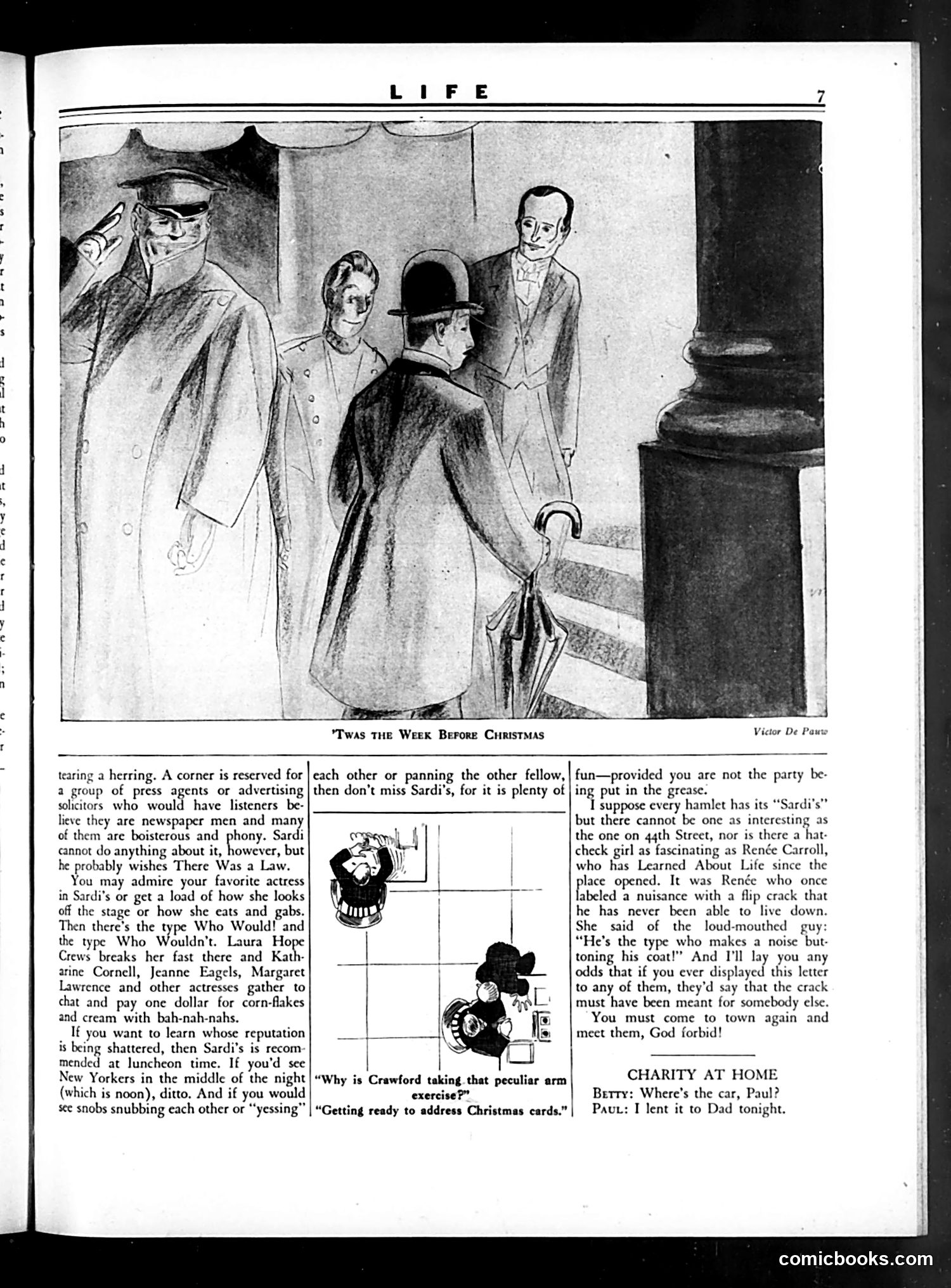
**Top Cartoon: "'Twas the Week Before Christmas"** by Victor De Paux This sketch depicts four people in an indoor setting, likely a theatrical or social venue. The humor appears to reference Broadway actors and the theatrical world during the Christmas season—the text mentions actresses like Laura Hope Crews and Katharine Cornell, suggesting this satirizes how theater people socialize and gossip during holidays. **Bottom Cartoons: Two small humorous sketches** about peculiar behaviors—one showing "Crawford taking that peculiar arm exercise" and another about "Getting ready to address Christmas cards." **"Charity at Home" section** presents a brief domestic joke where Paul has lent the family car to Dad. The page's overall tone is light social satire targeting theater culture and middle-class holiday customs of the era.
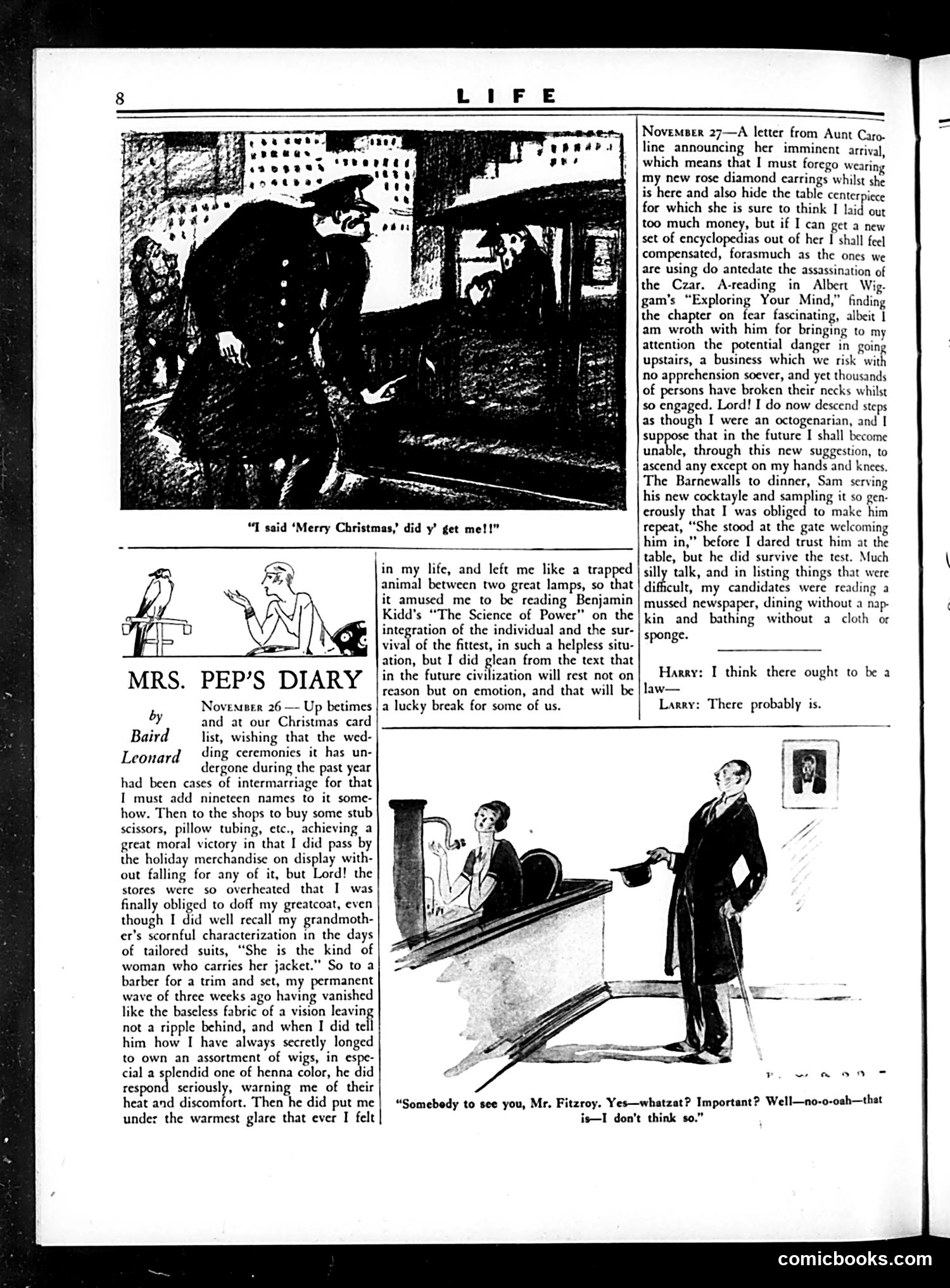
This page contains **"Mrs. Pep's Diary"** by Baird Leonard, a domestic humor column. The top illustration shows a woman confronting a man at a doorway with the caption "I said 'Merry Christmas,' did y' get me!!" — satirizing marital gift-giving expectations during the holidays. The lower cartoon depicts a man at what appears to be a barber shop counter speaking to another man, with the caption about Mr. Fitzroy. The humor appears to revolve around casual social encounters and communication mishaps. The right column contains Mrs. Pep's diary entry for November 26-27, detailing pre-Christmas shopping stress, family obligations, and domestic frustrations—typical satirical content mocking middle-class American life during the holiday season.
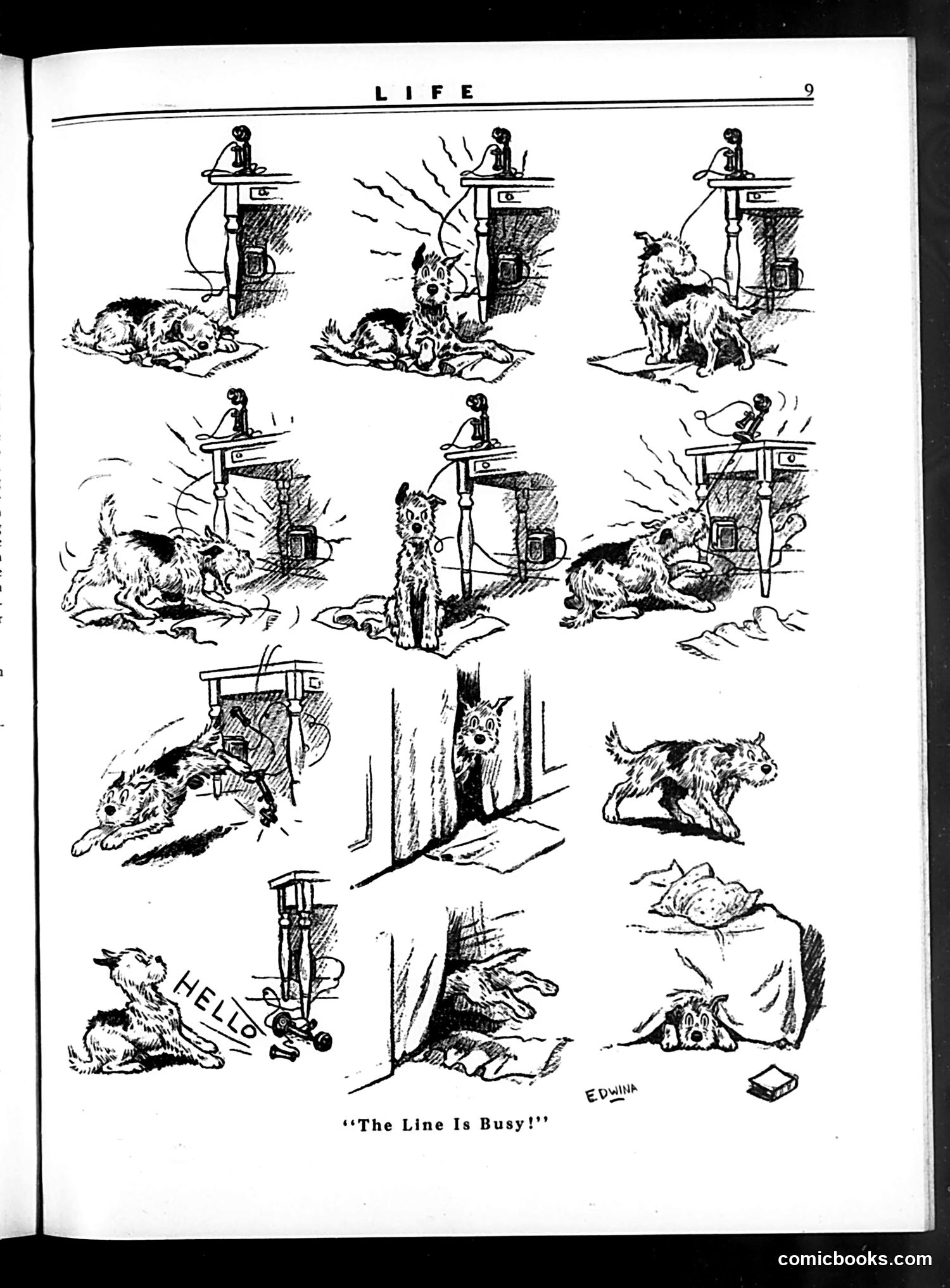
This comic strip, signed by Edwina, depicts a dog repeatedly attempting to use a telephone. The humor centers on a then-relatable frustration: trying to reach someone by phone only to get a "busy signal" — a common experience in the era of shared party lines and limited telephone infrastructure. The sequential panels show the dog's escalating desperation and creative attempts to use the phone, suggesting the absurdity of being persistently unable to connect. The title "The Line Is Busy!" is the punchline, playing on the dog's futile efforts. This reflects early-to-mid 20th-century telephone technology complaints, where getting through to someone could be genuinely difficult and frustrating for ordinary people.
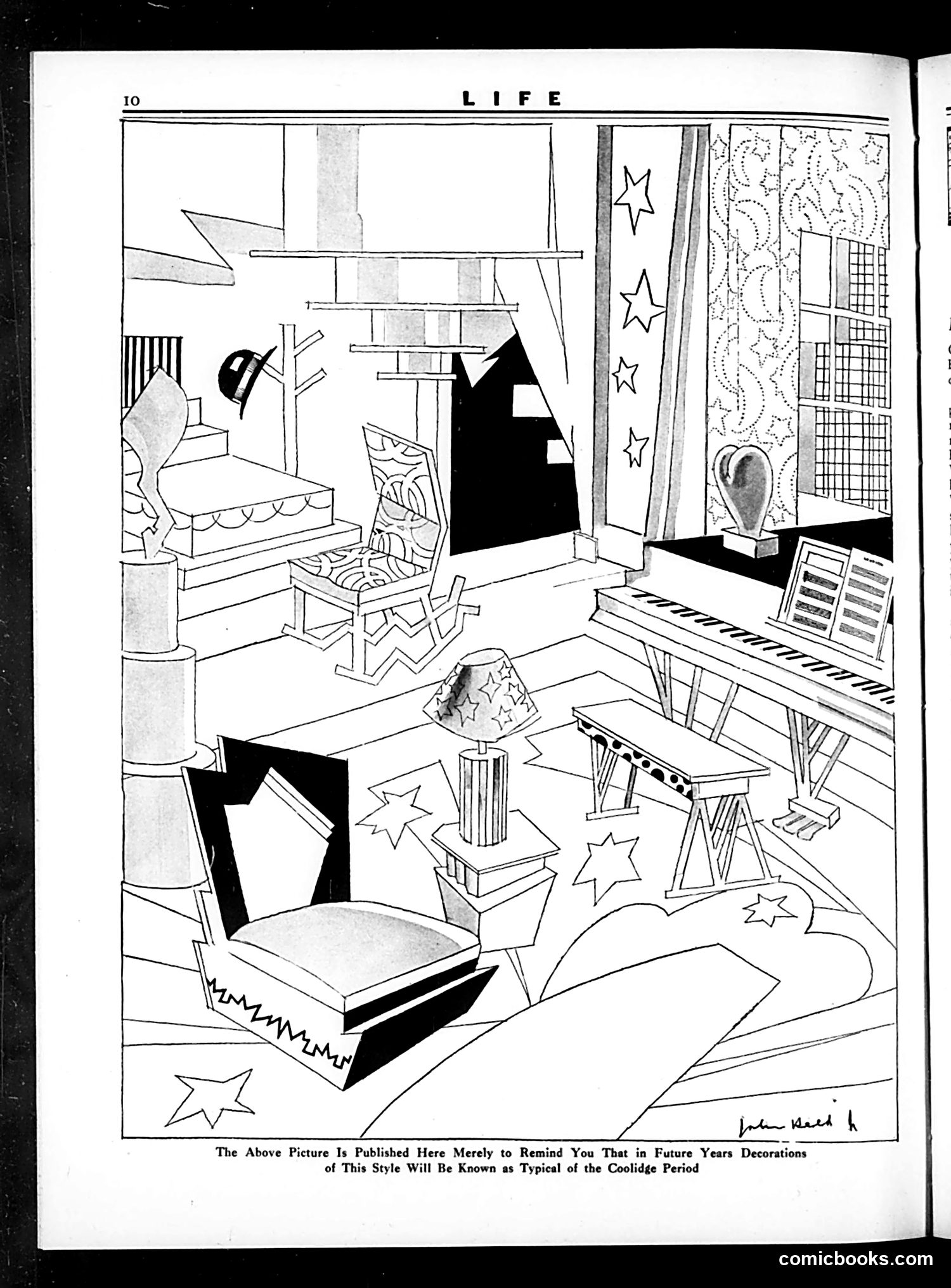
This is an architectural/interior design illustration satirizing modernist "Coolidge Period" decoration styles. The caption explicitly states the image serves "to remind you that in future years decorations of this style will be known as typical of the Coolidge period." The drawing depicts a futuristic bedroom with stark geometric furniture, angular shapes, stars as motifs, and minimalist elements—characteristic of Art Deco and early modernist design popular during Calvin Coolidge's presidency (1923-1929). The satire mocks how contemporary design trends will eventually appear dated and specific to an era. It's a humorous commentary on fashion cycles: what seems cutting-edge and stylish now will be recognized as period-specific kitsch in the future. The exaggerated geometric forms and star decorations emphasize the somewhat absurd extremes of modernist aesthetics.
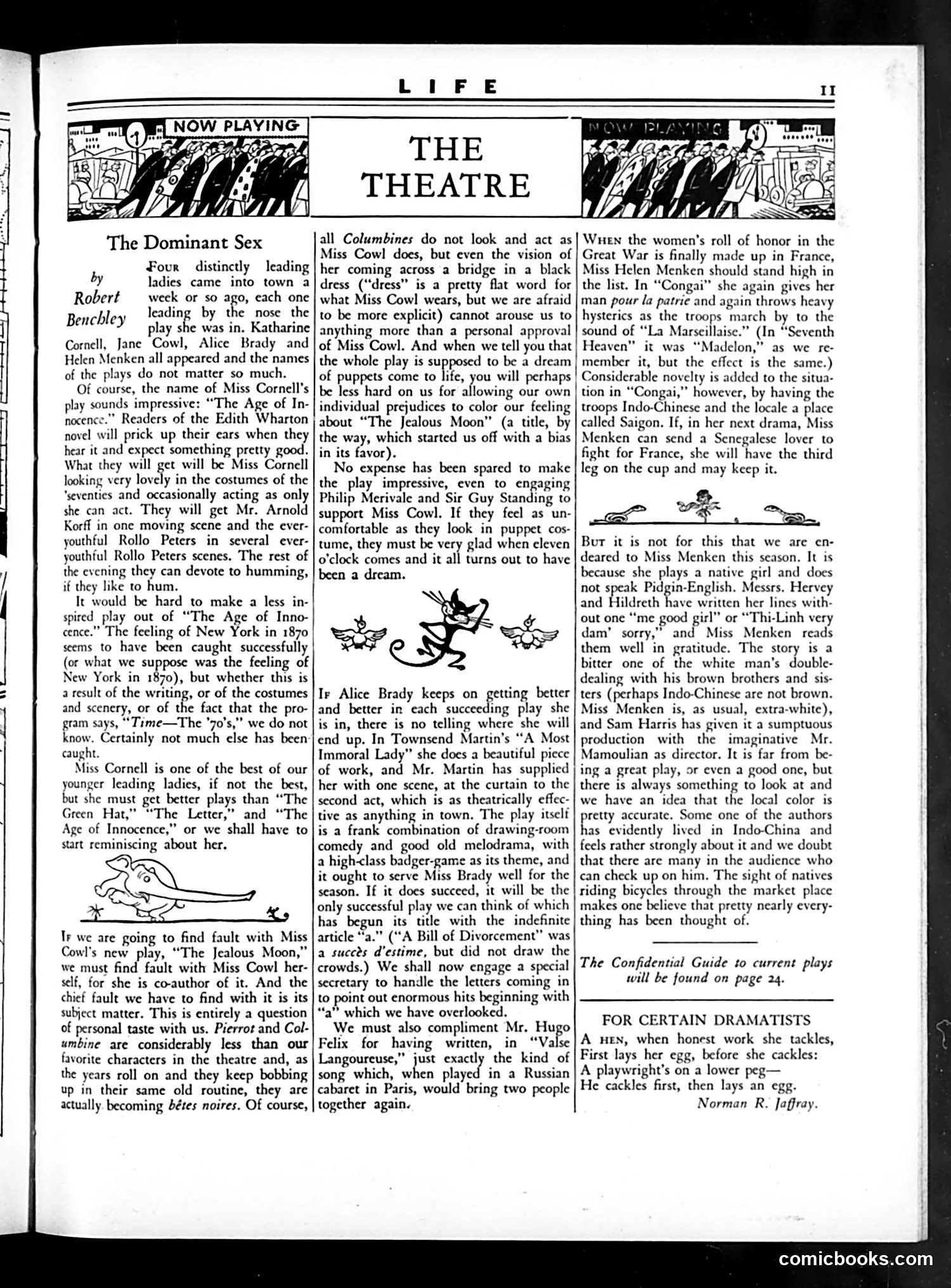
This is a theater review page from *Life* magazine discussing current Broadway productions. The main review criticizes "The Dominant Sex" by Robert Benchley, starring Jane Cowl and other leading ladies. The reviewer faults the play's lightweight premise—that women dream of dominating men—calling it uninspired despite featuring talented actresses in nice costumes. The small cartoons scattered throughout depict stylized figures in comedic poses, though they're not political satire but rather decorative illustrations reflecting the theatrical theme. The second review praises Alice Brady's performances and discusses other plays including "The Jealous Moon" and productions featuring Miss Menken. The page reflects early 1920s theater criticism, focusing on acting talent, production values, and plot merit rather than social commentary.
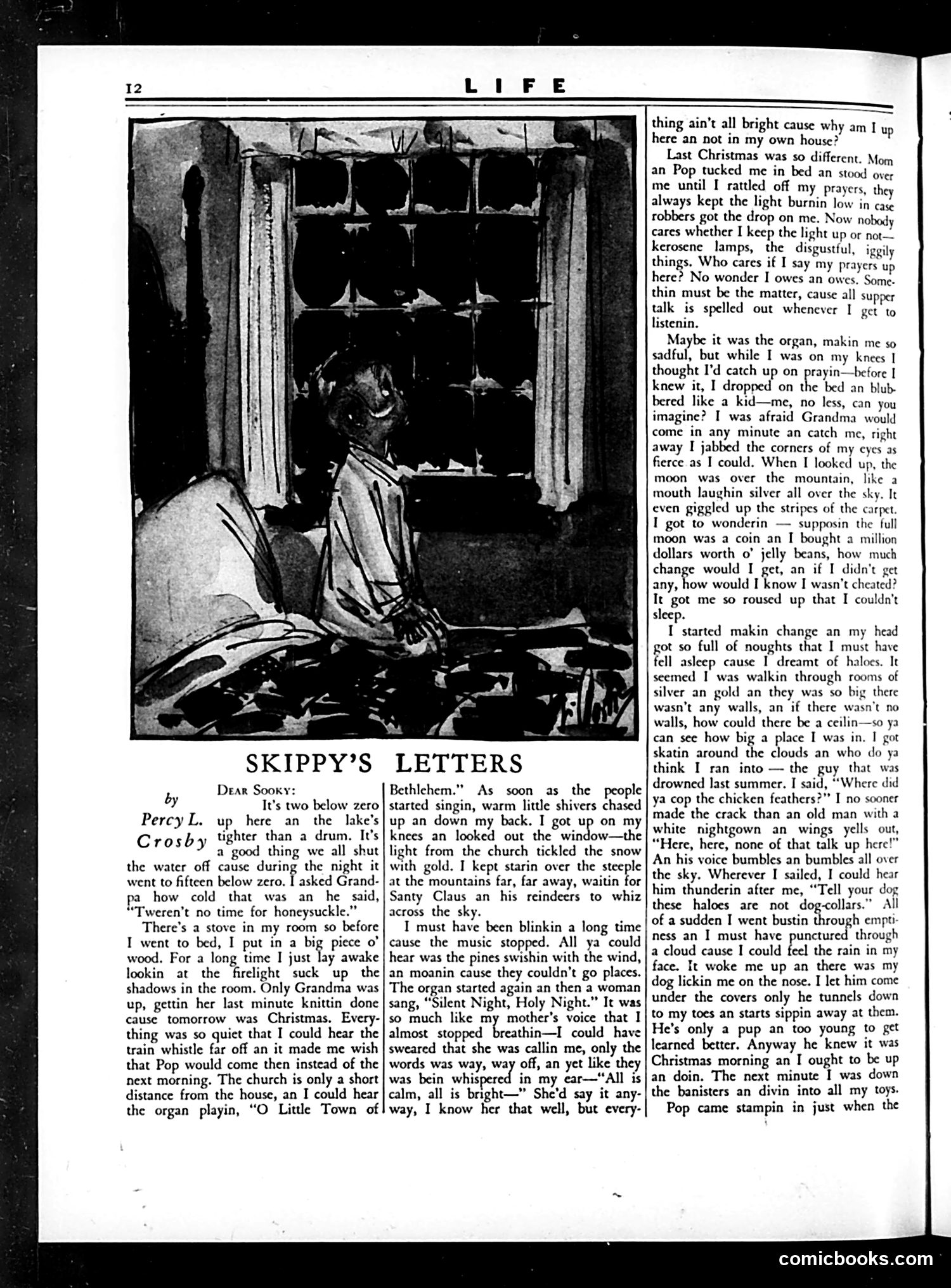
This page presents a serialized children's story titled "Skippy's Letters," written by cartoonist Percy L. Crosby. The accompanying illustration shows a young boy (Skippy) sitting at a window on Christmas Eve, looking out at a snowy night scene. The narrative is a sentimental tale of a child's Christmas Eve experience—his inability to sleep due to excitement, his religious thoughts, and his imaginative fantasies about the moon and clouds. The story captures early-20th-century childhood wonder, including details like playing with toy soldiers and anticipating Santa Claus's arrival. This appears to be entertainment content rather than political satire—a wholesome serial aimed at Life magazine's family readership during the Christmas season.
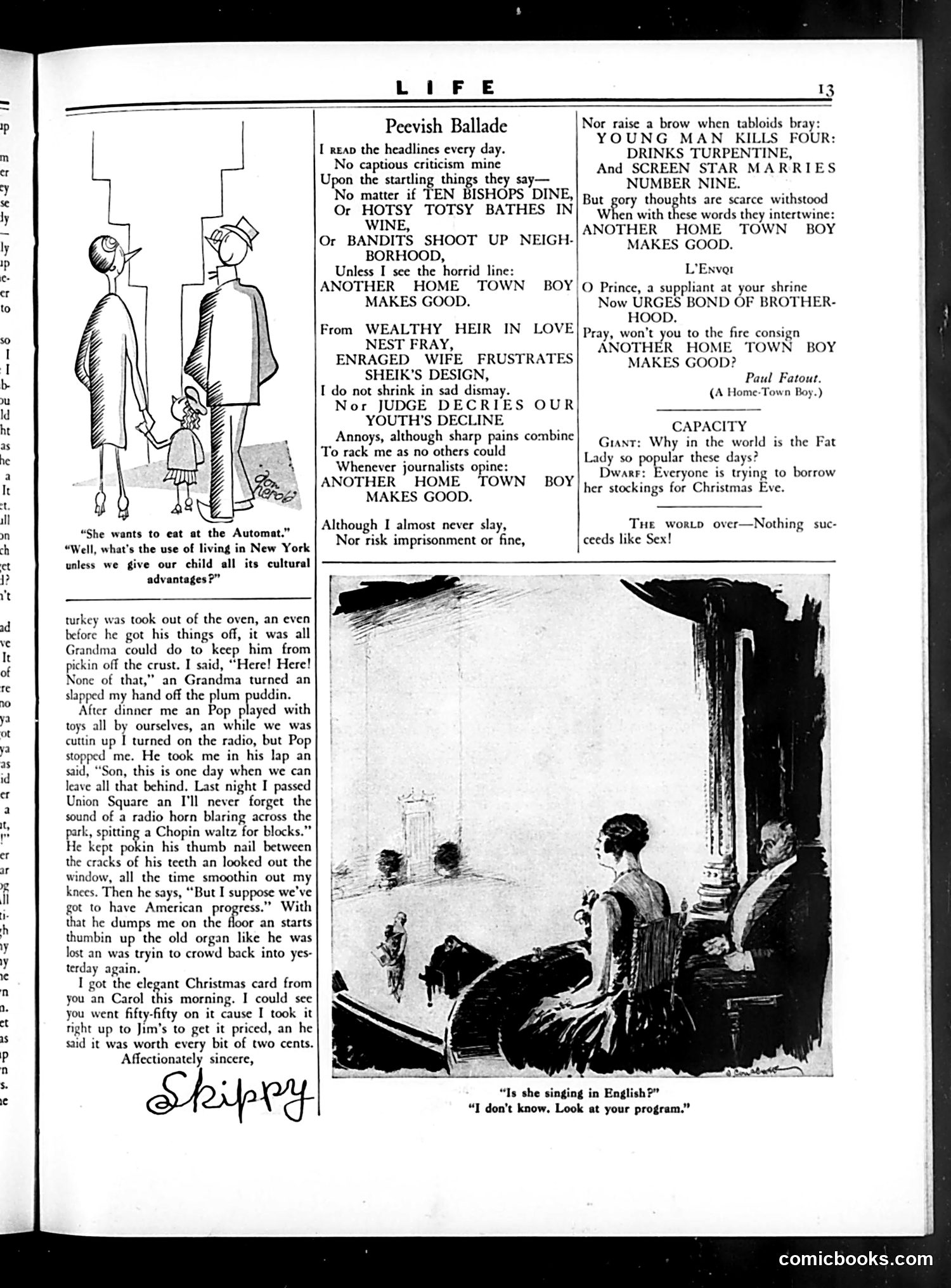
This page contains satirical commentary on American cultural anxieties of the early-to-mid 20th century. The "Peevish Ballade" mocks sensationalist newspaper headlines about crime and scandal ("Young Man Kills Four," "Screen Star Marries Number Nine"), suggesting media obsession with lurid stories. The poet criticizes this coverage while ironically noting such stories reassure readers that "another home town boy makes good." The cartoon illustration shows parents at what appears to be a theater or concert, with a child asking "'Is she singing in English?' / 'I don't know. Look at your program.'" This satirizes the cultural pretension of American audiences at sophisticated performances—suggesting people attend without understanding the content, relying on programs rather than actual comprehension. The page critiques both media sensationalism and middle-class cultural aspirations.
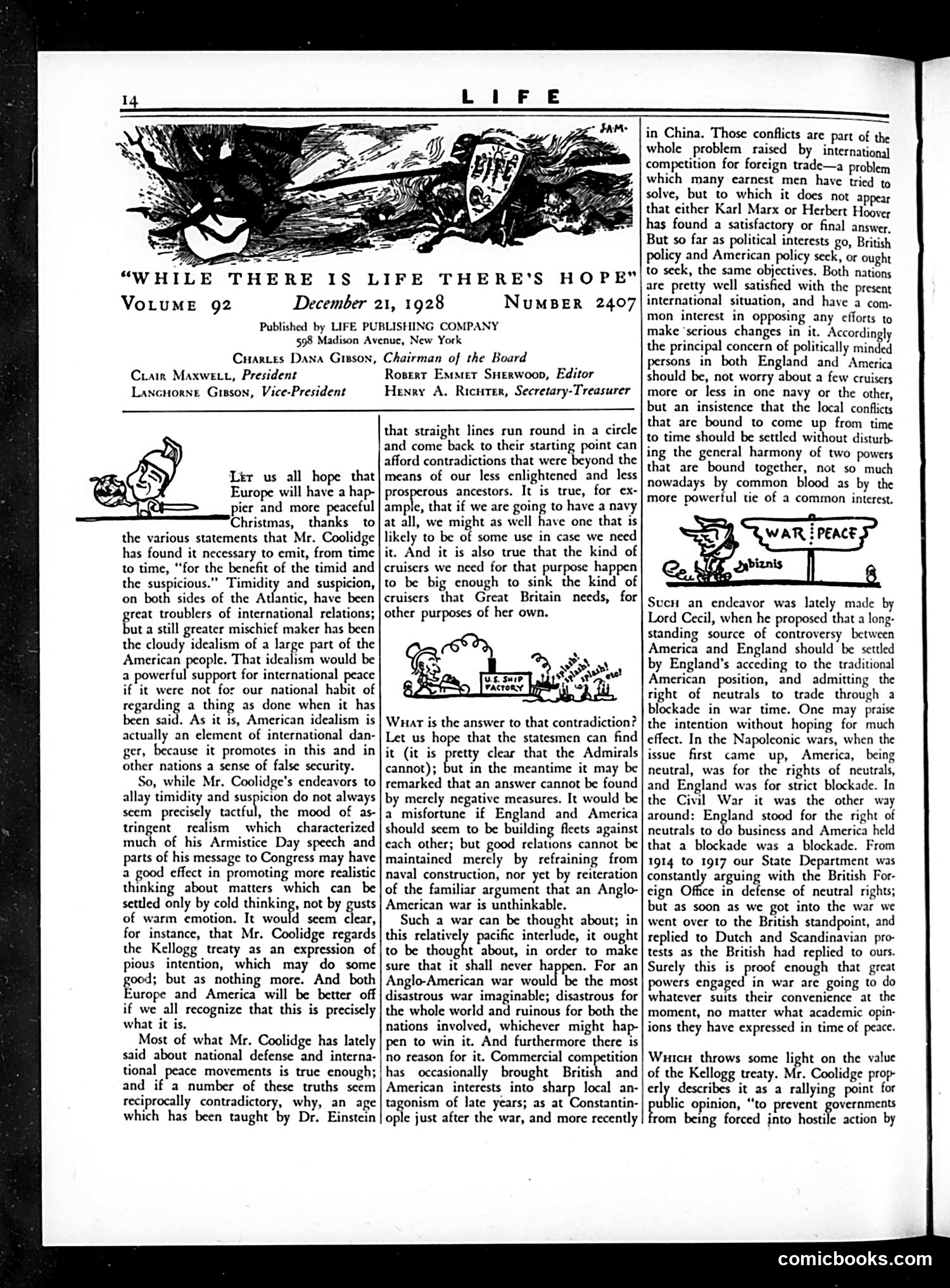
This Life magazine editorial page satirizes Secretary of State Frank B. Kellogg's peace treaty efforts. The small cartoon labeled "WAR PEACE" shows a seesaw balancing these opposing concepts—depicting the contradiction the article explores. The text critiques contradictions in American foreign policy: the U.S. promotes peace treaties (like Kellogg's) while simultaneously building naval fleets. The editorial questions how England and America can maintain "good relations" while constructing warships "against each other." The piece argues such contradictions undermine peace efforts and suggests that sincere disarmament would be more credible than rhetoric alone. It's a skeptical commentary on whether diplomatic treaties can genuinely prevent conflict when military buildup continues simultaneously.
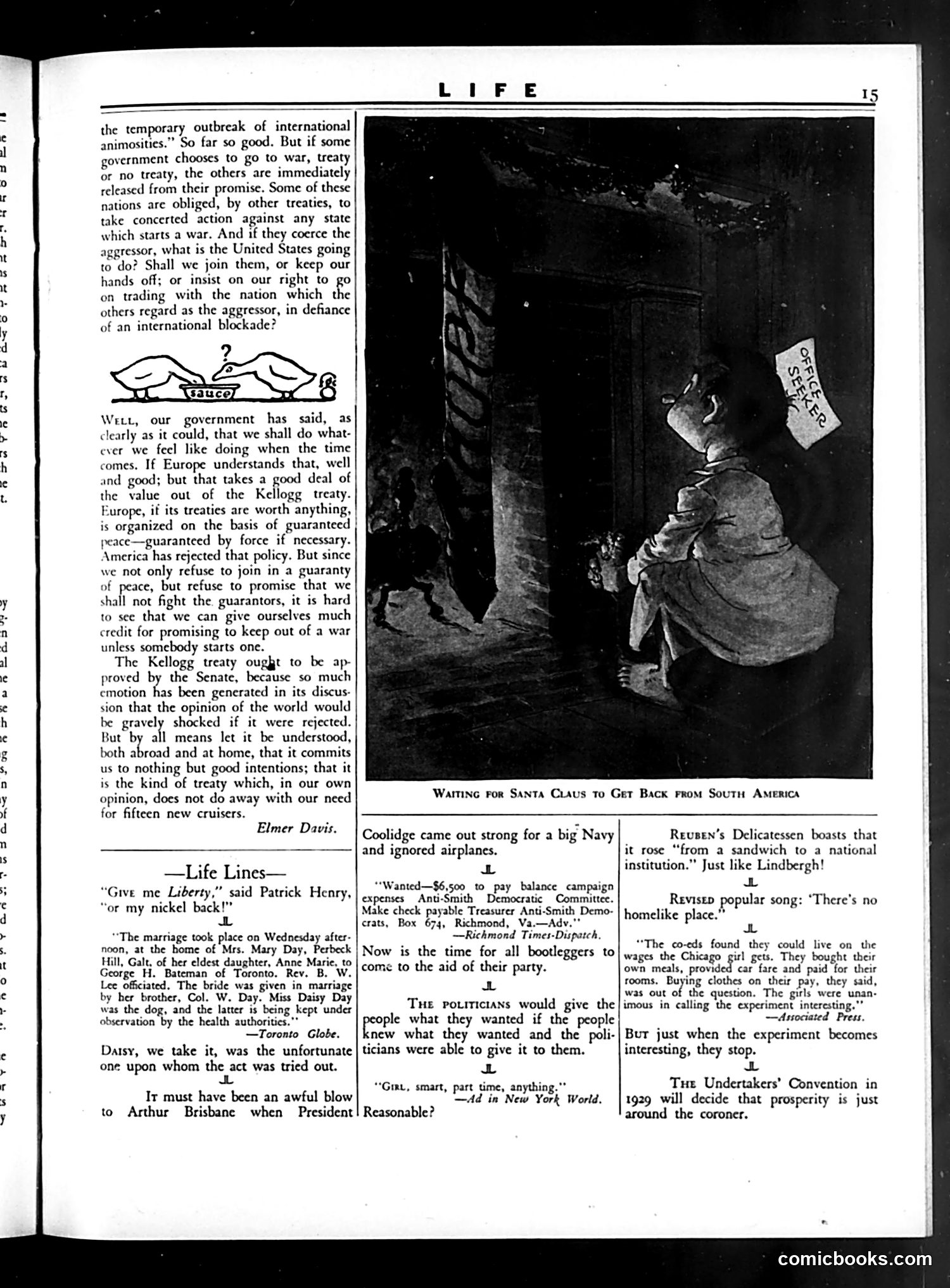
The main cartoon on this page depicts **"Waiting for Santa Claus to Get Back from South America,"** showing a figure labeled "Open Season" sitting in what appears to be a large basin or container—likely representing the U.S. political system or economy. The satire references the **Kellogg-Briand Pact** (mentioned prominently in the text), a 1928 international treaty renouncing war. The cartoon mocks American foreign policy: while the U.S. publicly supported peace treaties, it maintained military buildup and pursued interventionist interests in South America, contradicting pacifist rhetoric. "Santa Claus" represents American diplomatic promises, while the figure waits helplessly—suggesting the hypocrisy between stated peaceful intentions and actual geopolitical maneuvering.
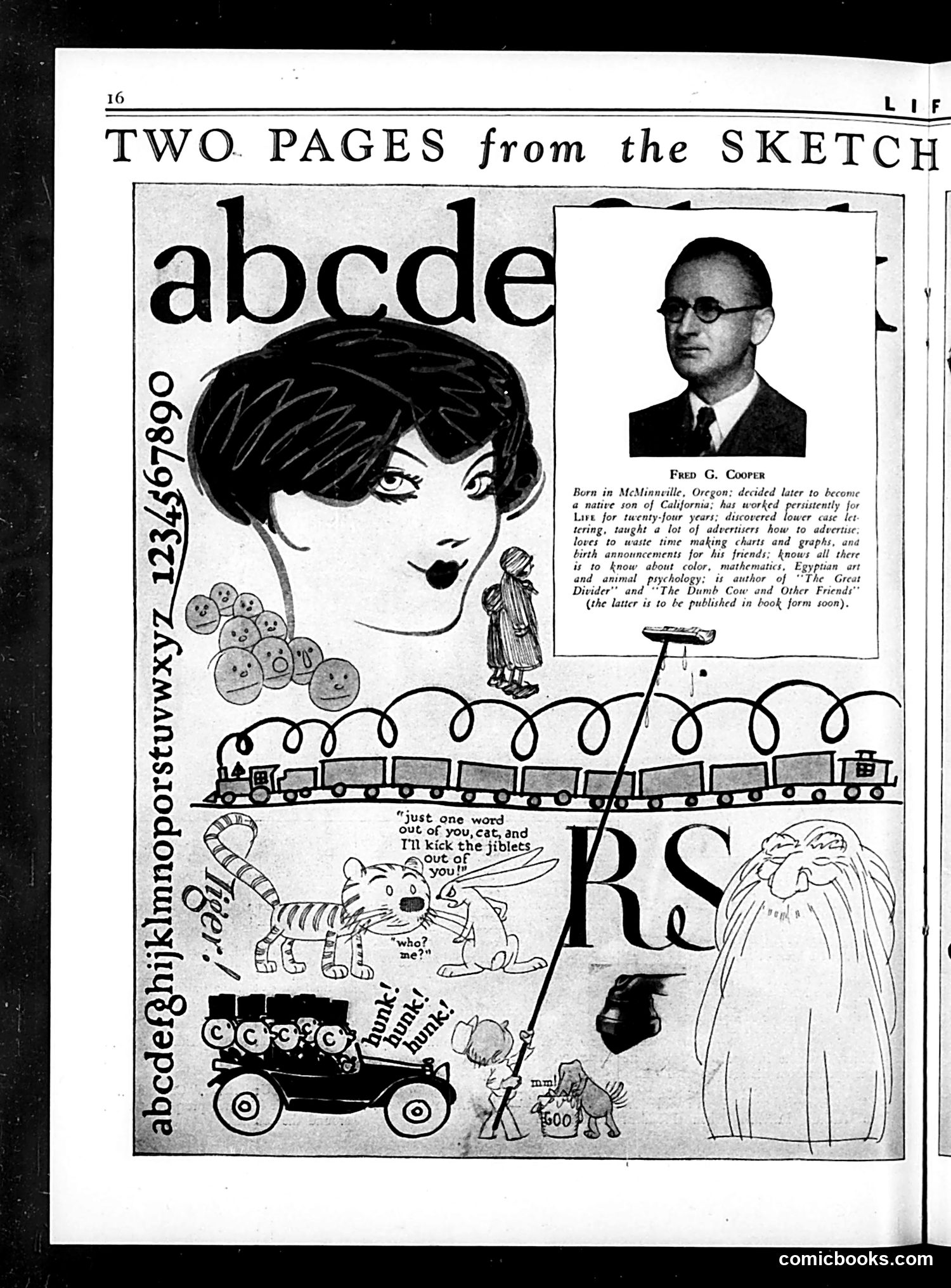
This page features "Two Pages from the Sketch" — appearing to be children's book illustrations or comic material. The left side shows "abcde" with whimsical drawings: a stylized woman's face, toy trains, a cat and mouse with dialogue ("just one word out of you, cat, and I'll kick the jiblets out of you!"), and a toy car with children. The right side profiles **Fred G. Cooper**, identified as born in Minnesota/Oregon who became a California native. The text describes him as a versatile illustrator who creates charts, graphics, and birth announcements for friends. He's noted as knowledgeable about color, mathematics, Egyptian art, and animal psychology, and is listed as author of children's books including "The Great Blinder" and "The Dumb Cow and Other Friends." This appears primarily promotional content about an illustrator rather than political satire.
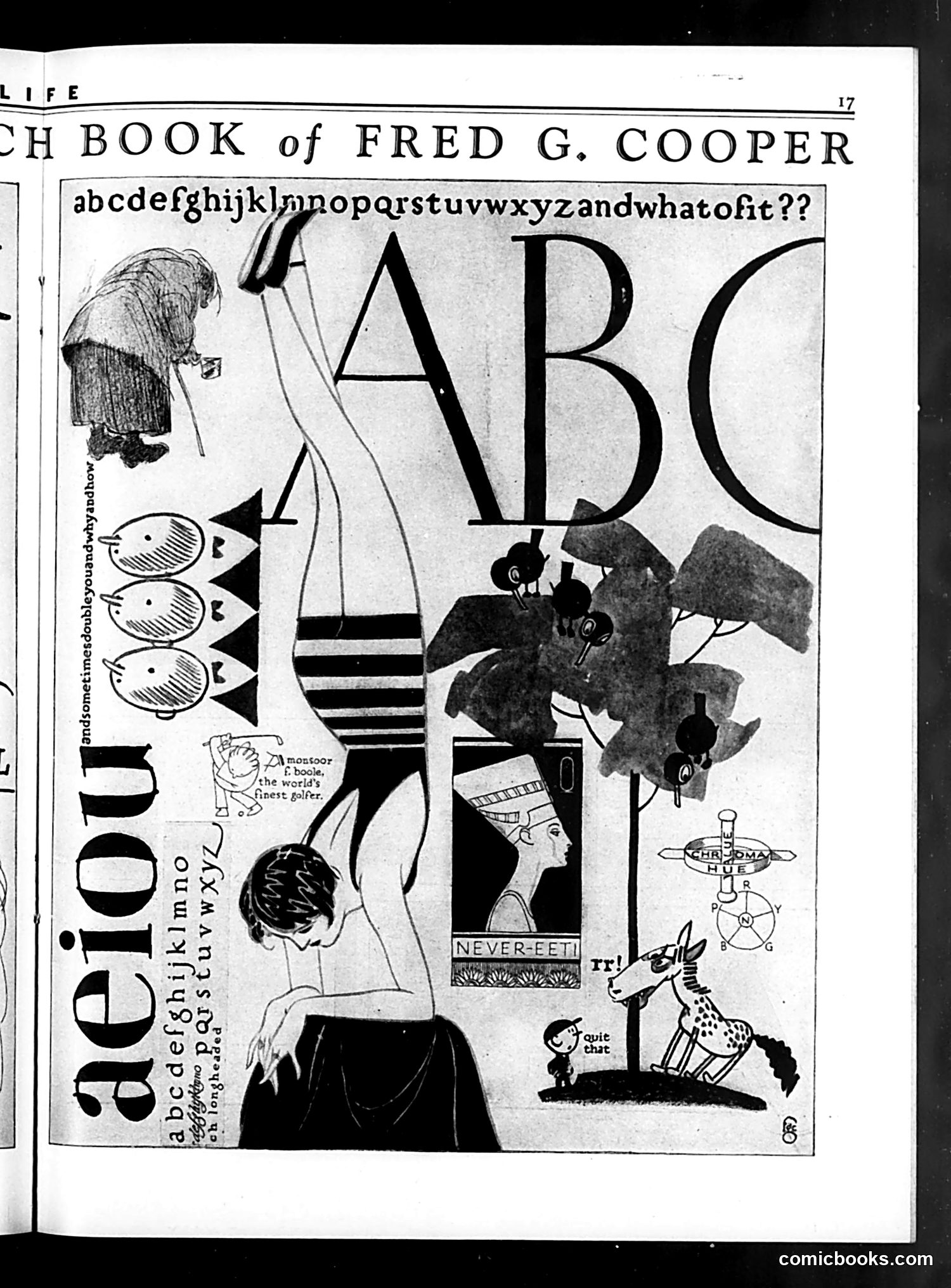
This is a playful alphabet page from Fred G. Cooper's "Sketch Book" in Life magazine. Rather than political satire, it's an illustrated alphabet primer with humorous drawings for each letter. The "A" section features whimsical illustrations: a figure in old-fashioned dress, three fish, a woman's face, ships, and various other drawings. Text snippets like "A mastodont hooch, the world's historic galler," "NEVER-FEET," and "quite that" appear to be nonsensical phrases or puns meant to accompany the illustrations. The page demonstrates Life's tradition of combining visual humor with wordplay. Without clearer text legibility, the specific jokes are difficult to determine, but the overall intent appears to be lighthearted entertainment through absurdist illustration and wit rather than political commentary.
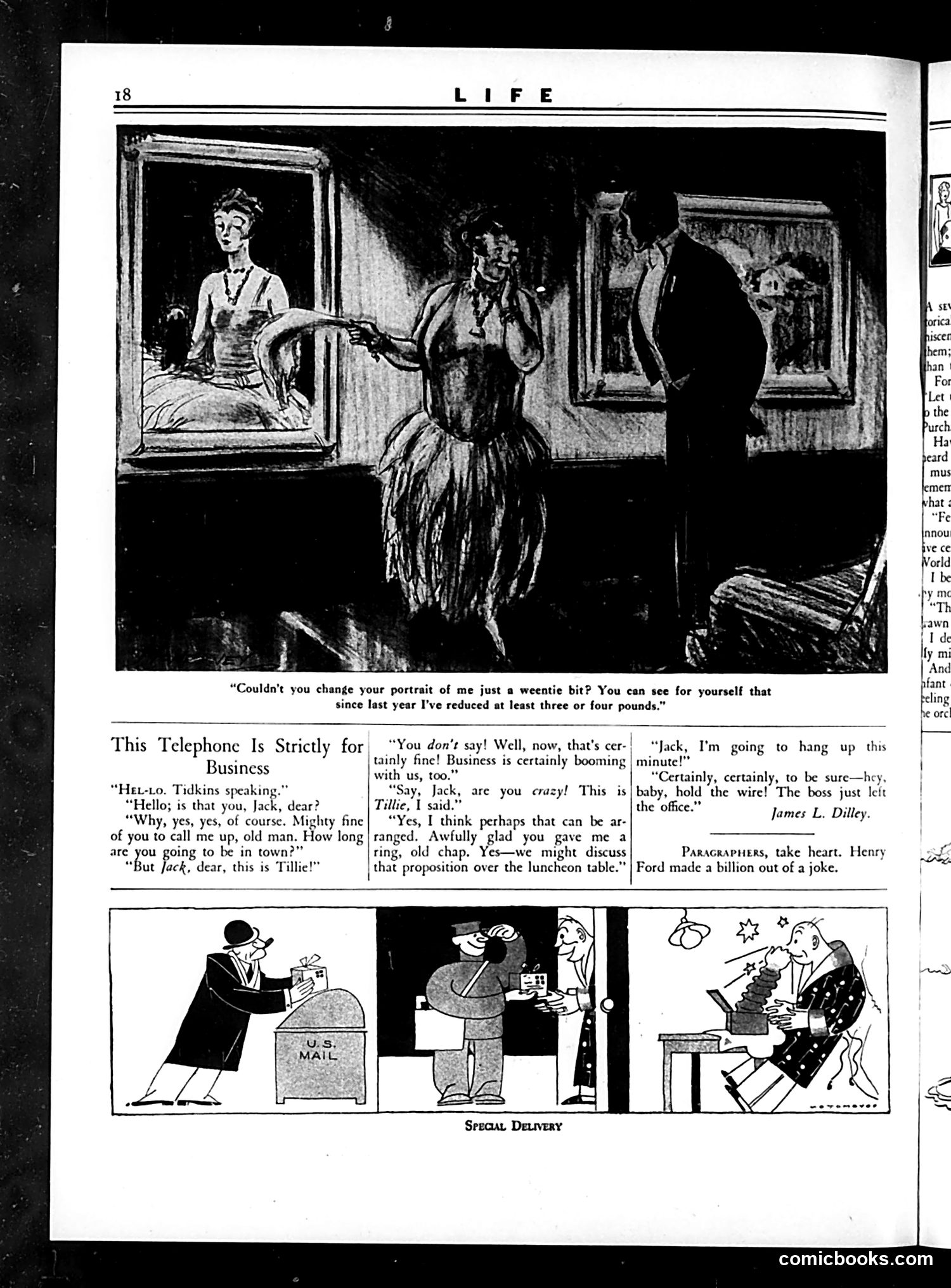
This page contains three satirical pieces about early 20th-century office and social life. The top cartoon mocks vanity: a woman at a portrait studio asks the artist to flatter her weight loss (three or four pounds), suggesting both her self-consciousness and the artist's diplomatic challenge. "This Telephone Is Strictly for Business" satirizes workplace hypocrisy. An employee tries to conduct personal business (calling "Tillie") on a company line while pretending it's business, then frantically tries to disconnect when the boss returns. The humor lies in the obvious conflict between stated policy and actual practice—workers sneaking personal calls during work hours. The bottom three-panel cartoon titled "Special Delivery" appears to show mail delivery scenarios, likely commenting on postal service inefficiencies or absurdities, though specific details are unclear. A brief note credits Henry Ford, suggesting contemporary business humor was in vogue. The overall theme emphasizes the gap between official propriety and actual behavior in modern office culture.
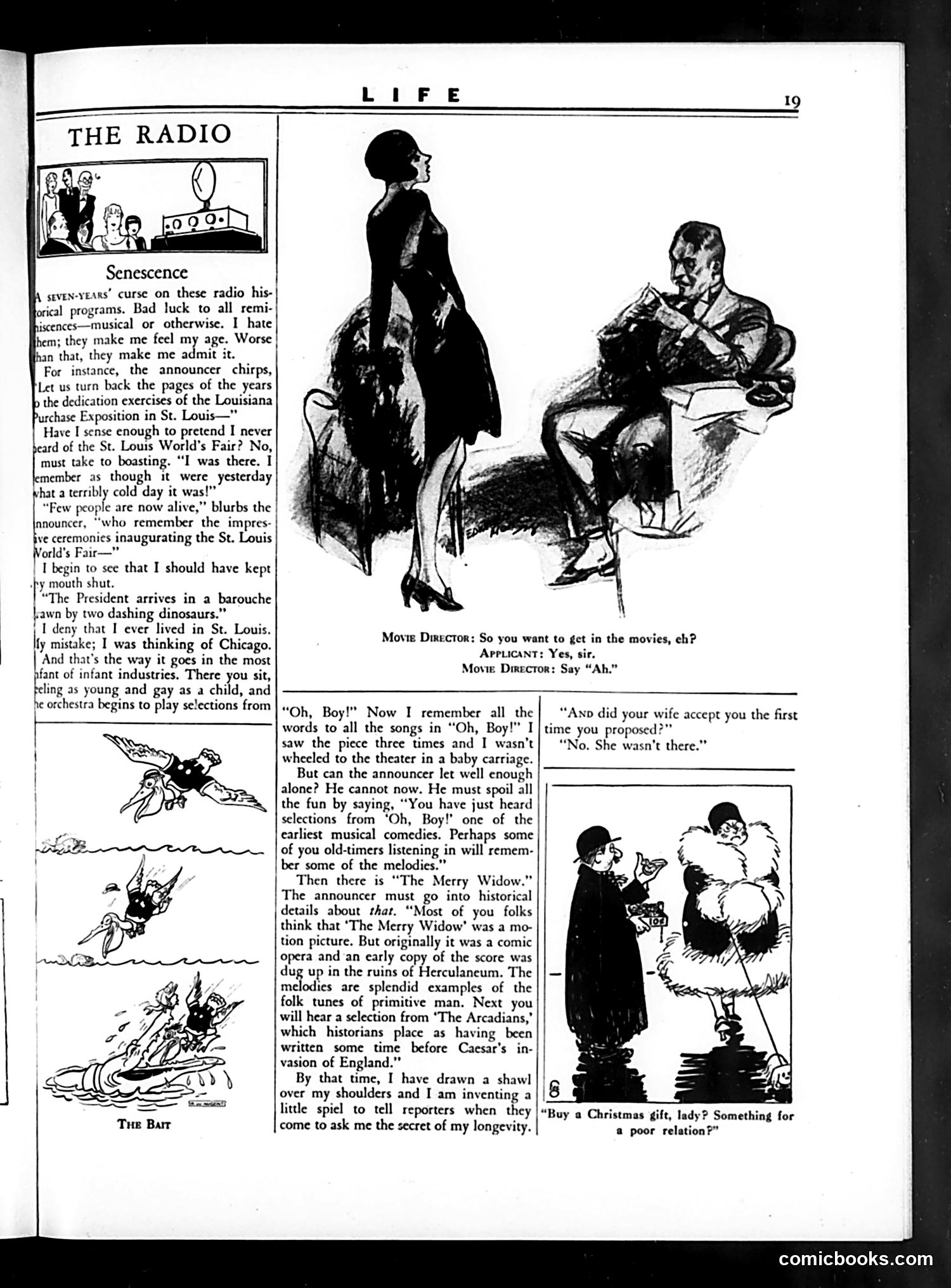
This satirical piece mocks radio's "historical programs" that broadcast old musical selections while adding tedious historical commentary. The author complains these nostalgia broadcasts make him feel old and embarrass him into admitting his age. The joke: Radio announcers frame decades-old entertainment (like the 1911 musical "Oh, Boy!") as ancient history, forcing older listeners to either pretend ignorance or confess they attended the original performances. The announcer's increasingly absurd claims—that "The Merry Widow" scores were "dug up in the ruins of Herculaneum"—amplify the satire on overwrought historical framing. The accompanying cartoons mock other industries: a movie director performing a ridiculous "talent test," and a Christmas gift-giver asking about buying for "poor relations." The "Bat" drawing is unclear but appears unrelated filler. The satire targets both radio programming excess and the universal discomfort of aging.
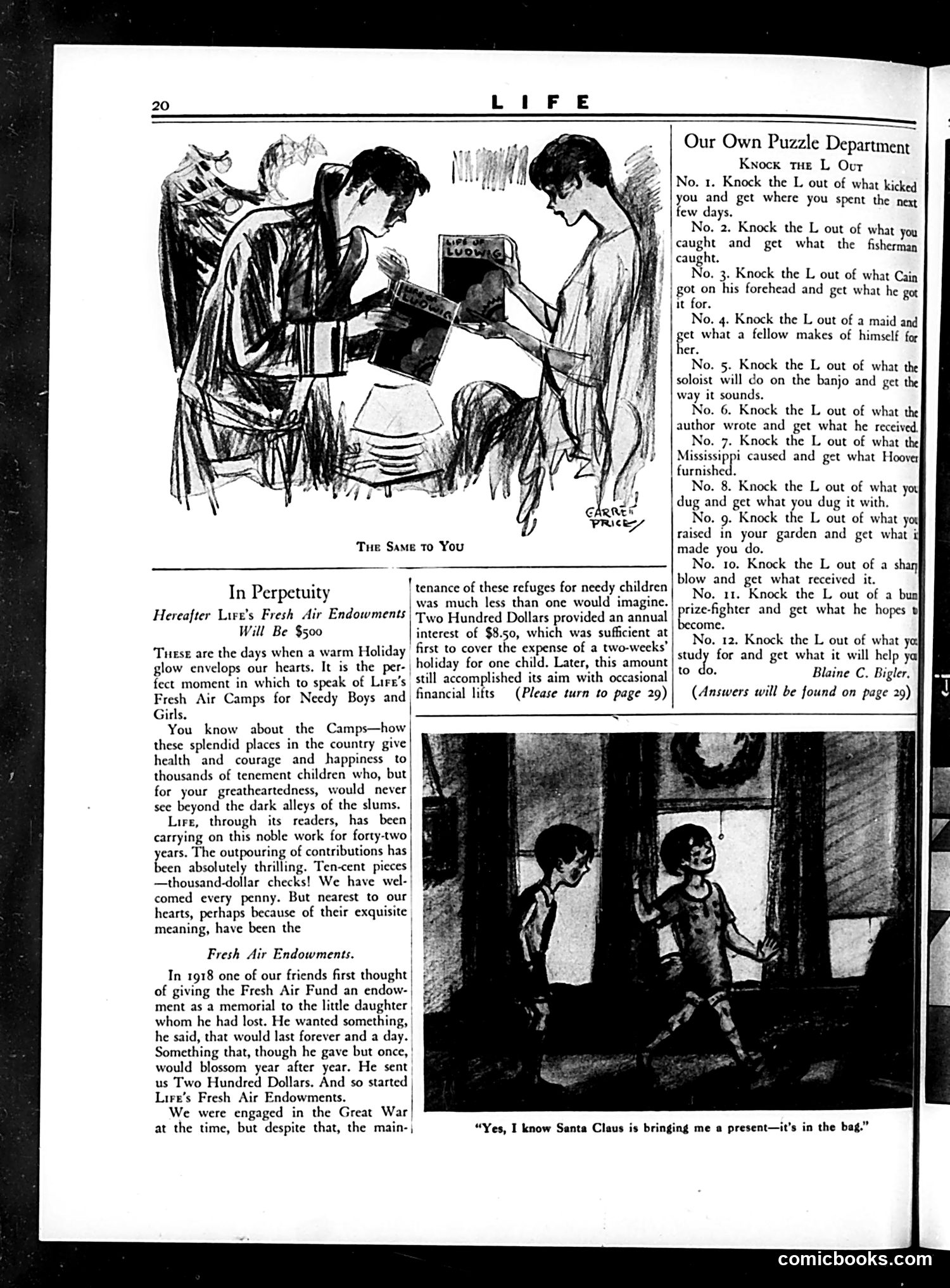
This page combines charitable fundraising with humor typical of Life's satirical approach. **Main Content:** An article promoting Life's Fresh Air Endowments—a charitable fund providing summer camps for poor urban children. The text emphasizes that a $200 memorial endowment from 1918 generates $8.50 annual interest, sufficient to give needy children two-week holidays away from tenement slums. **The Cartoons:** - Top illustration ("The Same to You"): Two well-dressed figures exchanging holiday gifts, likely satirizing wealthy donors' seasonal charity. - Bottom photograph with caption: Shows children, with one stating "Yes, I know Santa Claus is bringing me a present—it's in the bag," suggesting urban poor children's modest expectations. **The Puzzle Department:** Word games ("knock the L out") offering light entertainment while promoting the magazine. **Social Context:** The page reflects Progressive-era concern for urban poverty and child welfare, positioning Life as philanthropically engaged while maintaining its satirical tone about wealth disparity.
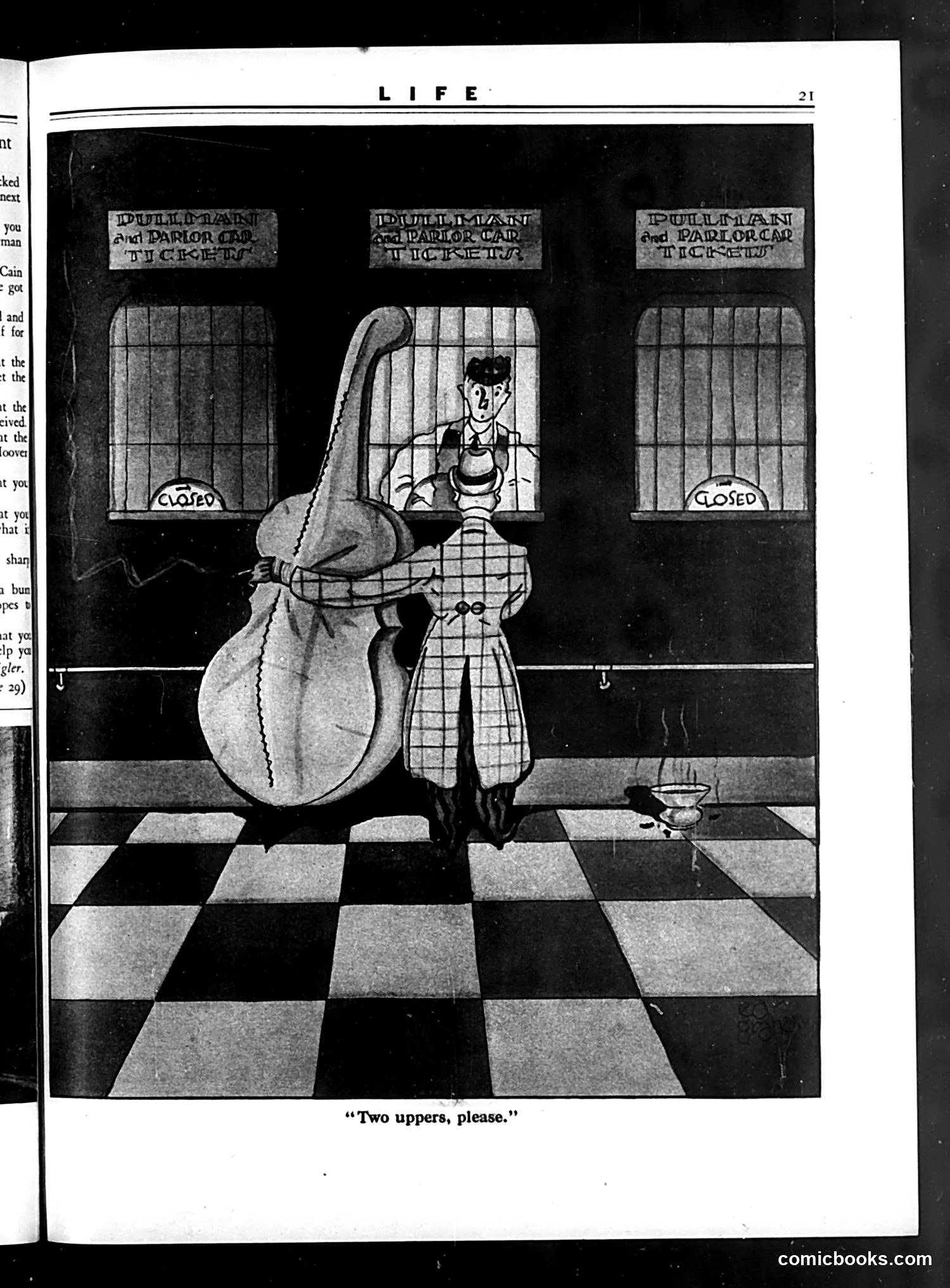
This is a single-panel cartoon from Life magazine's humor section (page 21). The joke depicts a woman at what appears to be a Pullman parlor car ticket window, requesting "two uppers, please"—referring to upper berths on a sleeper train car. The humor lies in a double entendre: "uppers" could refer to both train berths and stimulant drugs (slang for uppers/amphetamines). The cartoon plays on this ambiguity, suggesting the woman is innocently requesting train accommodations while the visual presentation allows readers to interpret her request as drug-related. The three "Pullman and Parlor Car Ticket" windows visible establish the setting as a legitimate transportation context, making the misinterpretation the source of the joke's humor.
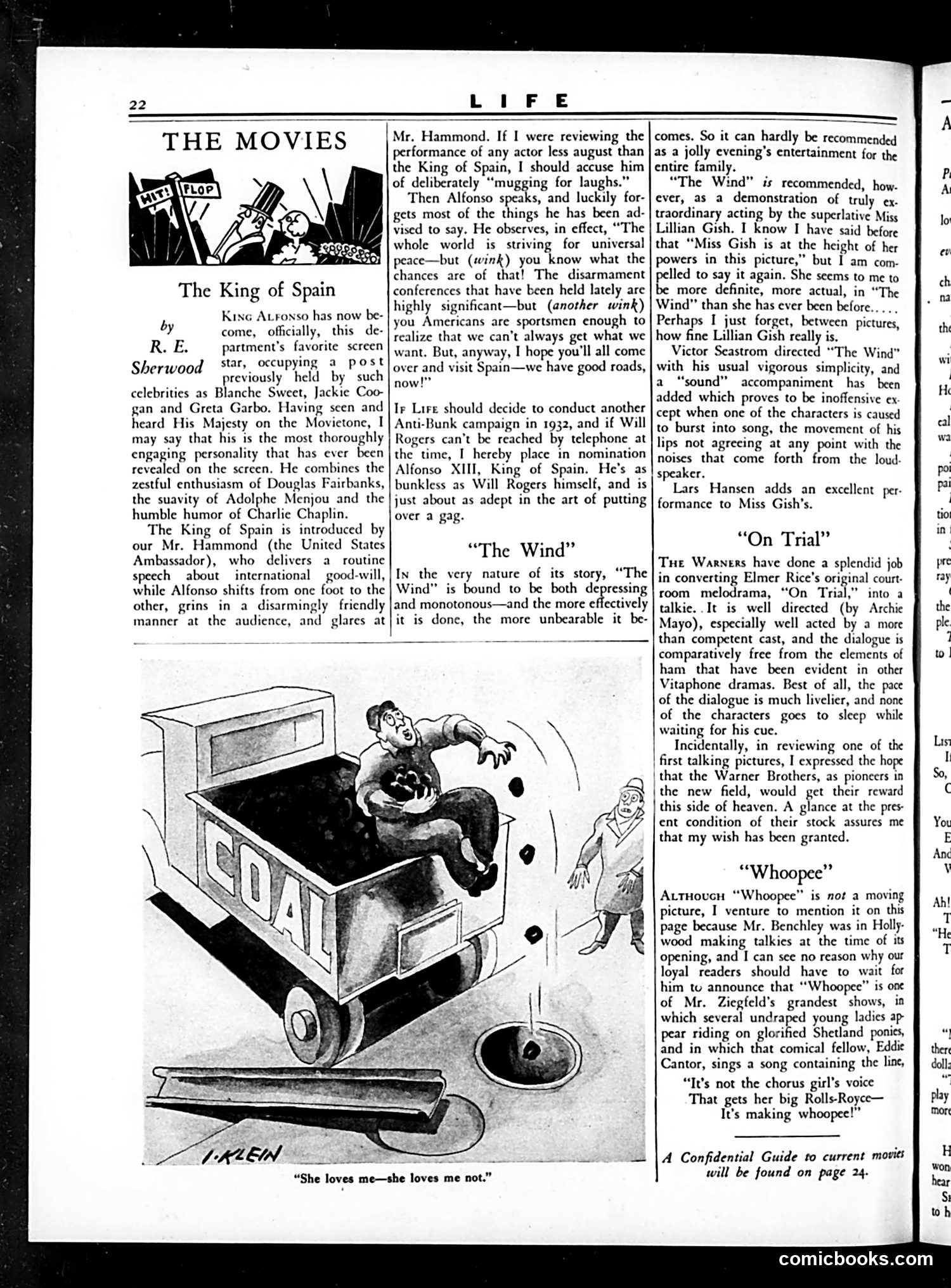
This page reviews three films. The main cartoon illustrates "The King of Spain," showing King Alfonso XIII of Spain literally inside a movie camera, with the caption "She loves me—she loves me not"—suggesting he's being manipulated by cinema like a prop. The review praises King Alfonso XIII's charisma in a Movietone newsreel appearance, comparing him favorably to Douglas Fairbanks and Charlie Chaplin. The satire targets his diplomatic speech about disarmament conferences and international peace, which the reviewer suggests Alfonso undermines with winks and knowing glances—implying such diplomatic rhetoric is hollow performance rather than genuine commitment. The page also reviews "The Wind" (praising Lillian Gish's acting), "On Trial" (a Warner Brothers talkie adaptation), and briefly mentions "Whoopee." This appears to be from the late 1920s, during the transition to talking pictures.
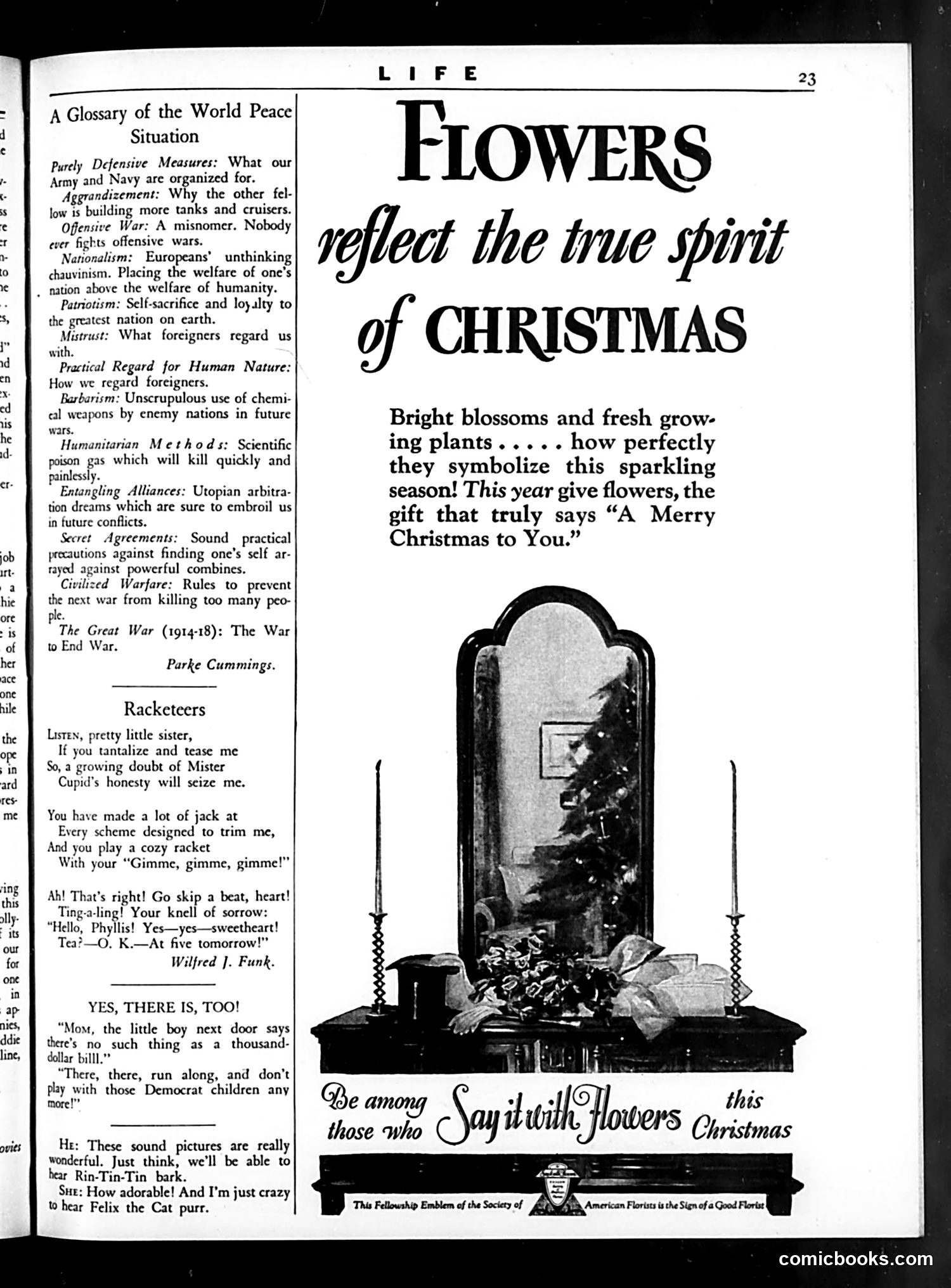
This page combines political satire with a Christmas flower advertisement. The left column presents "A Glossary of the World Peace Situation" by Parke Cummings—sharp satire mocking post-WWI diplomatic language. It exposes the hypocrisy of nations' self-serving definitions: "Purely Defensive Measures" vs. aggressive "Aggrandizement," "Patriotism" vs. foreign "Nationalism," and "Humanitarian Methods" (poison gas) vs. enemy "Barbarism." The glossary satirizes how governments justify identical actions differently depending on whose side commits them. Below are humorous poems about romance and a snippet mocking a child's naive belief in thousand-dollar bills, with a parent joking about "Democrat children." The right side features a full-page advertisement for flowers as Christmas gifts, with an elegant fireplace mantelpiece display—a commercial message framed within the magazine's satirical content. The juxtaposition highlights Life's dual role as both social commentator and advertising vehicle.
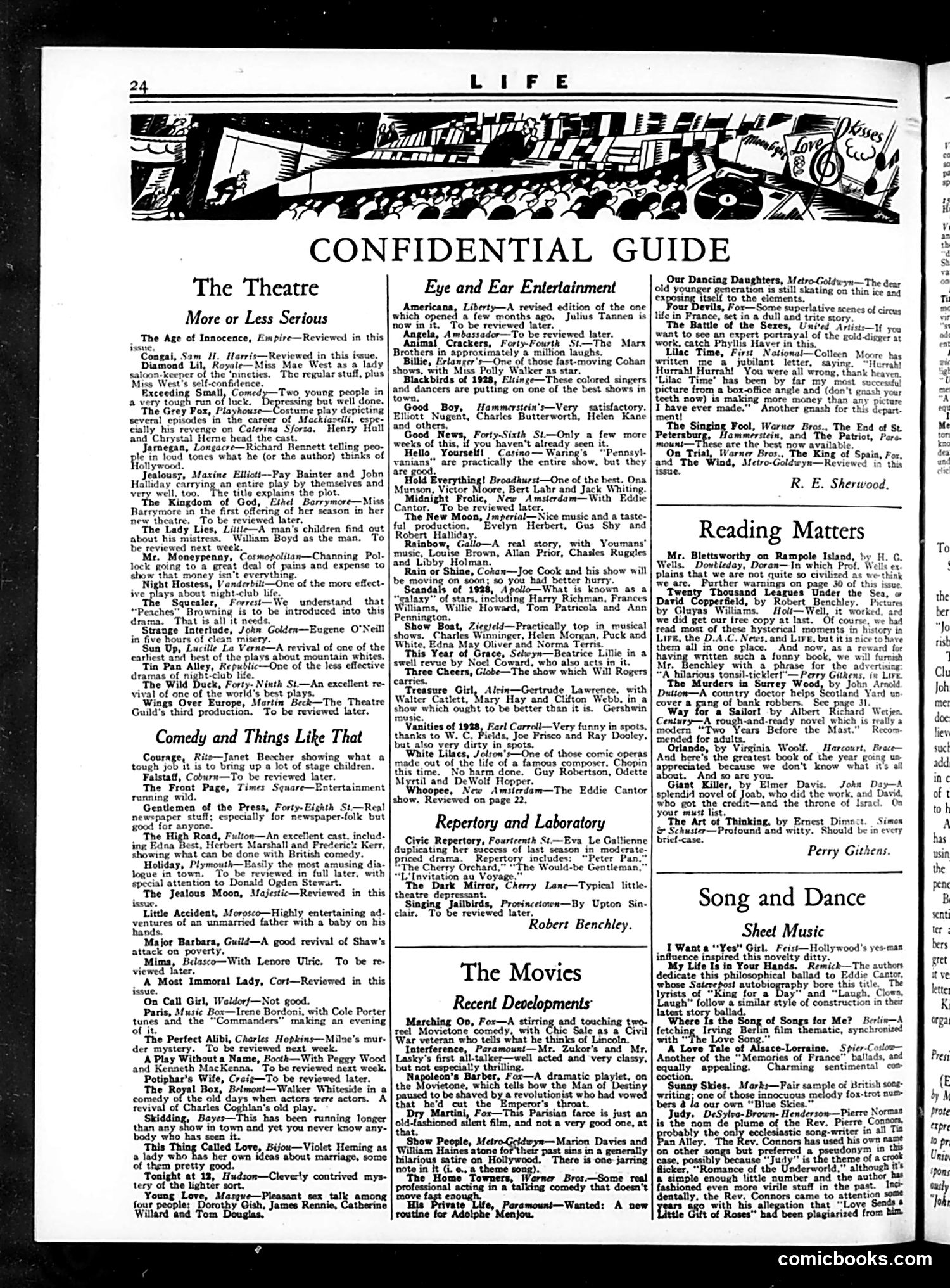
This is a **theater and entertainment review page**, not a political cartoon. The page presents a "Confidential Guide" to Broadway shows and movies currently running, organized by category: serious dramas, comedies, movies, and reading recommendations. The content reflects 1920s theatrical culture, featuring reviews of plays by prominent playwrights like Eugene O'Neill (*Strange Interlude*) and George Bernard Shaw (*Major Barbara*), along with star-studded casts including Ethel Barrymore and Irene Bordoni. Notable references include "Peaches" Browning (a scandal-era socialite) and mentions of Hollywood's growing influence on theater. The snide, gossipy tone ("you never know anybody who has seen it," regarding *Skidding*) is characteristic of Life's satirical style—mocking both theatrical pretension and audience taste rather than targeting specific political figures.
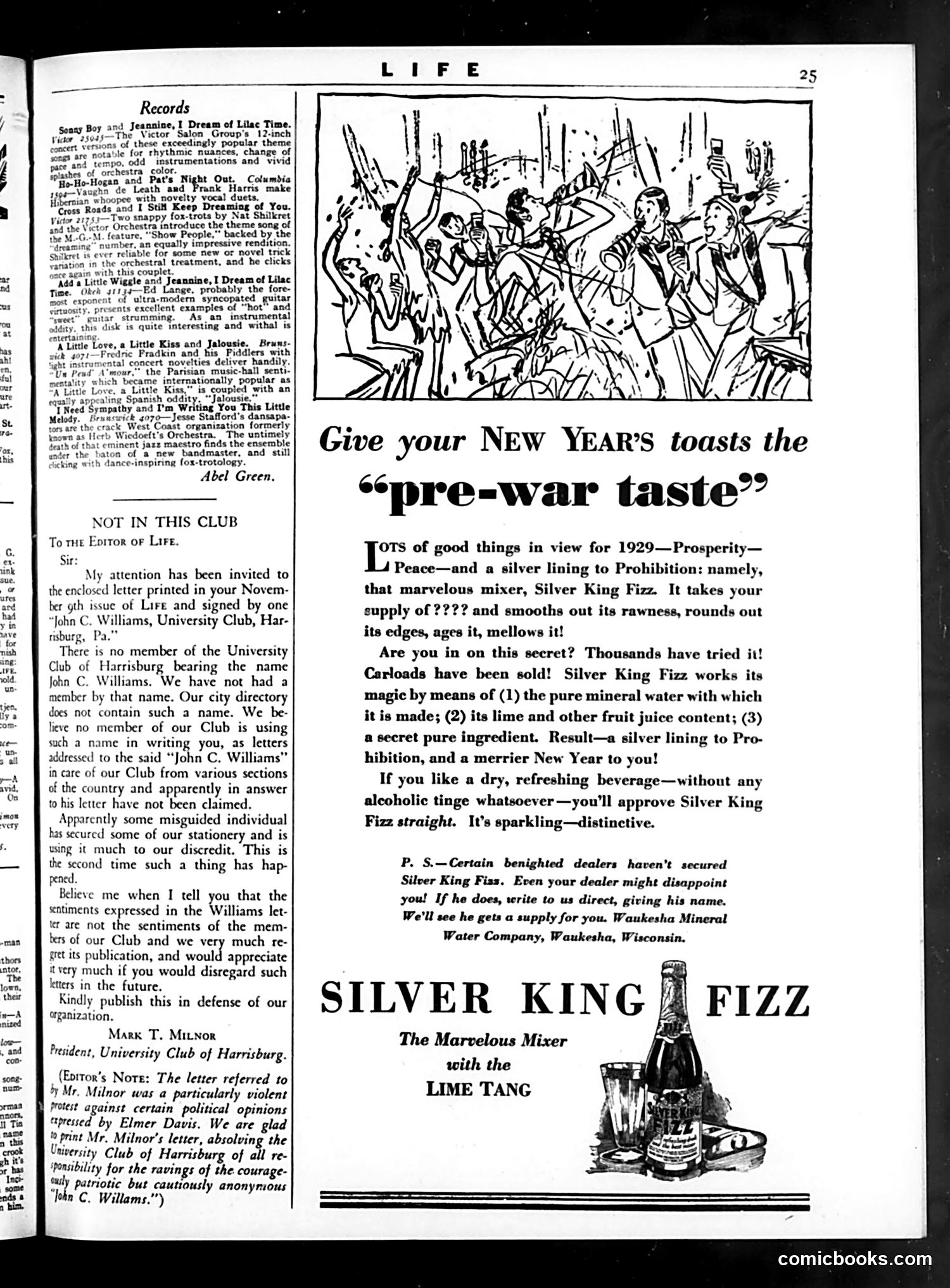
This page contains record reviews, a letter to the editor, and a full-page advertisement for Silver King Fizz. **The Letter ("Not in This Club"):** A club president denies that "John C. Williams" is a member, claiming someone fraudulently used the club's stationery to write a previous letter criticizing political commentator Elmer Davis. The editor notes the original letter was "particularly violent" but stands by publishing it, treating the anonymous author with ironic skepticism. **The Advertisement:** Silver King Fizz is marketed as a mixer for illegally-obtained alcohol during Prohibition. The ad brazenly acknowledges this—referencing "your supply of ????"—while claiming the product "ages" and "mellows" homemade liquor. It's a straightforward pitch to consumers circumventing Prohibition laws, packaged as a New Year's celebration aid. The humor lies in the barely-concealed winking at illegal activity.
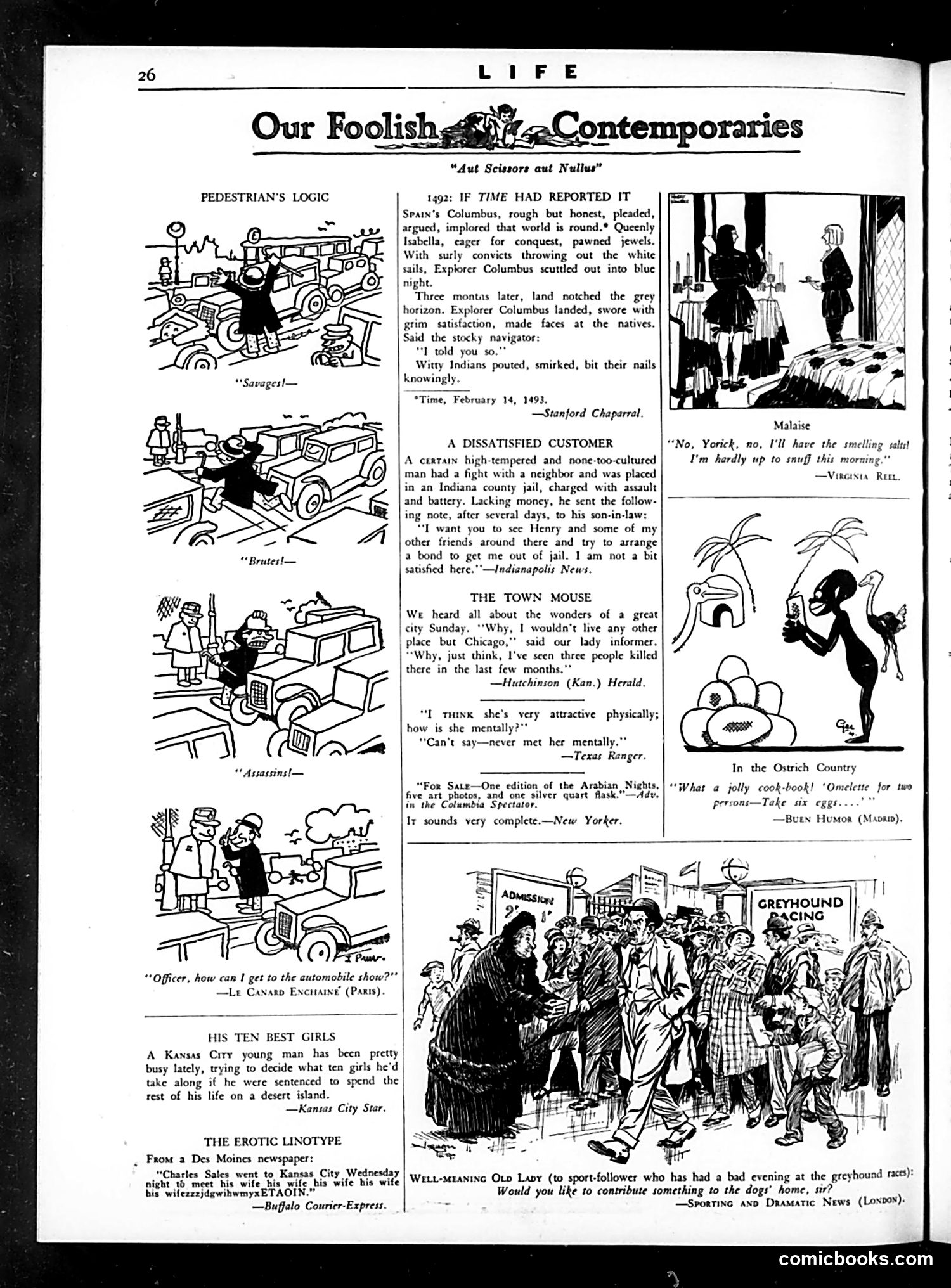
This is a humor anthology page collecting absurd newspaper items and jokes from contemporary sources. The left side features "Pedestrian's Logic"—four cartoon vignettes mocking traffic accidents and automobile chaos, with captions like "Sabotage!" and "Bruiser!" satirizing dangerous driving. The center and right contain reprinted newspaper clippings and brief jokes highlighting editorial absurdities: - **"1492: If Time Had Reported It"** parodies sensationalist journalism by reimagining Columbus's voyage in modern newspaper style - **"A Dissatisfied Customer"** quotes a jailed man complaining about jail conditions to his son-in-law - Various one-liners mock human foolishness: a woman praising Chicago for murders she witnessed; a man puzzled by a woman's "mental attractiveness"; an absurd cookbook for ostriches The large bottom illustration shows a crowd at a greyhound racing venue—the final joke involves someone suggesting donations to "the dogs' home" after a bad evening gambling. The page's satire targets human irrationality, media sensationalism, and newspaper culture itself.
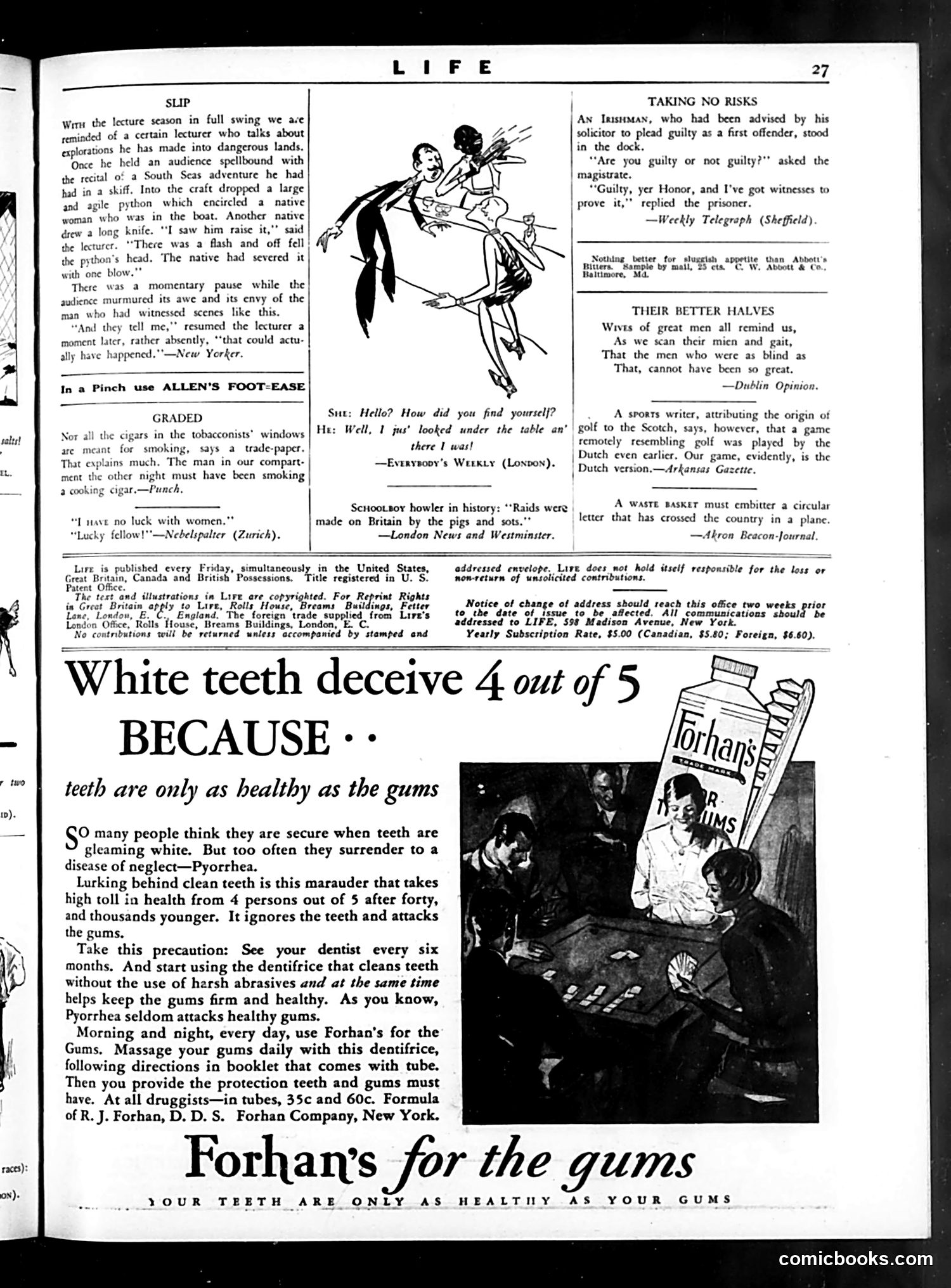
This page contains several brief satirical anecdotes and advertisements typical of Life's humor format. **"Slip"** mocks a travel lecturer whose dramatic tale—a native severing a python's head with one knife stroke—strains credulity. The joke: the lecturer himself undermines his own story by admitting "that could actually have happened," suggesting the original account was implausibly exaggerated. **"Taking No Risks"** presents wordplay on legal strategy: an Irish defendant, advised to plead guilty as a first offender, agrees—then insists he has witnesses to *prove* his guilt, defeating the purpose of a lenient first-offense plea. **"Their Better Halves"** is a verse mocking wives of famous men, suggesting that any woman married to a historically great man must herself be "blind" (foolish) not to recognize his genius. The page is otherwise dominated by period advertisements—Allen's Foot-Ease, Abbott's Bitters, and notably **Forhan's toothpaste**, which claims to prevent pyorrhea (gum disease) by maintaining gum health alongside tooth whiteness. The advertising reflects early-20th-century health anxieties about dental disease.
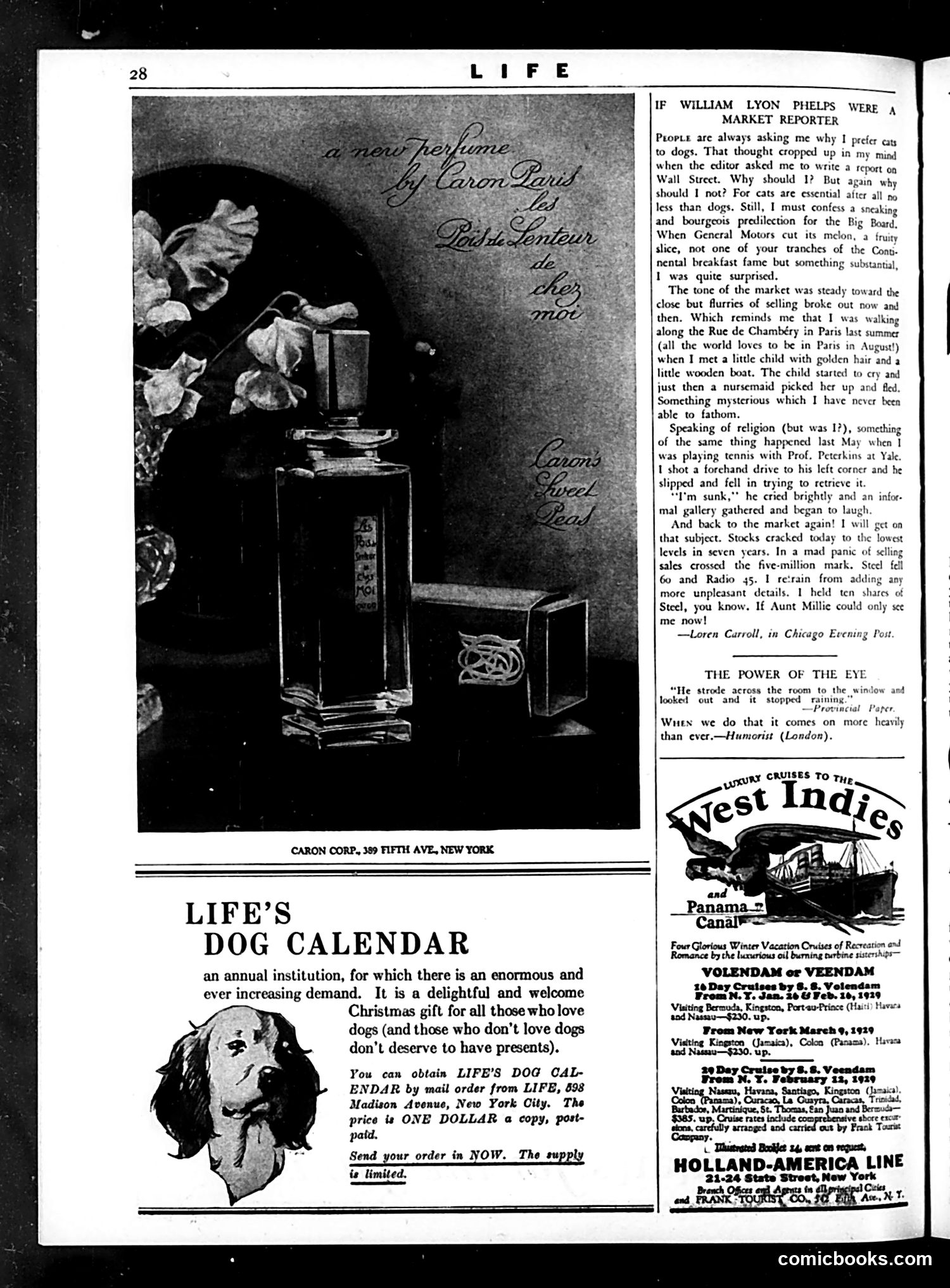
This page contains **satirical commentary on William Lyon Phelps**, a prominent Yale professor and literary critic known for his digressive, anecdote-filled writing style. The mock "Market Reporter" piece parodies Phelps's tendency to constantly veer off-topic with personal reminiscences—jumping from stock market analysis to stories about Paris, tennis with Professor Peterkins, and a child with a boat. The satire mocks how he would interrupt serious financial reporting with irrelevant tangents about his travels and social interactions. The irony is sharp: Phelps is asked to report on Wall Street's stock crash (which "cracked today to the lowest levels in seven years"), yet he treats this serious economic news with the same casual sentimentality he applies to everything else—even admitting "I held ten shares of Steel." The page's other content—a dog calendar advertisement and cruise ship ads—appears unrelated to the satire. The humor relies on readers' familiarity with Phelps's distinctive, rambling literary persona.
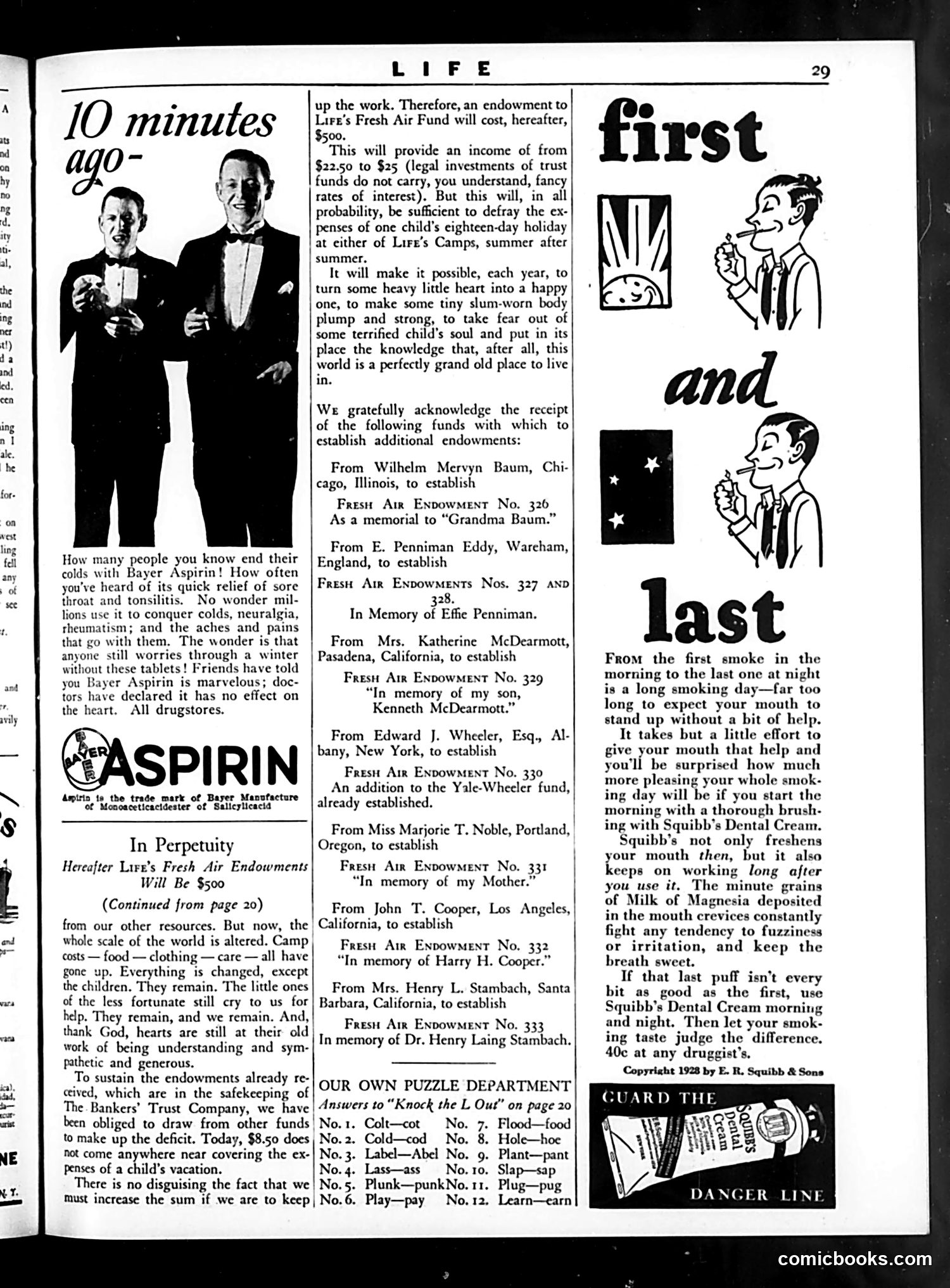
This page combines advertising with charitable fundraising, typical of 1920s magazines. **The Bayer Aspirin Ad:** A straightforward commercial occupying the left column, promoting aspirin for colds, neuralgia, and rheumatism. The accompanying illustration shows two well-dressed men—likely suggesting that aspirin is suitable for all social classes. **The Main Content:** The bulk of the page announces that Life magazine's "Fresh Air Fund" (a real charity providing summer camps for poor urban children) is increasing its endowment requirement from an unspecified amount to $500 per child's vacation. The text justifies this increase by noting inflation since the fund's establishment ("Everything is changed, except the children"). **The Squibb Dental Cream Ad:** A lighthearted endorsement using comic illustrations of men discussing toothbrushing benefits. The humor relies on the idea that regular brushing prevents "fuzziness" and maintains pleasant breath—a selling point for the era. **The Puzzle Section:** A simple word game where letters are removed ("Knock the L Out"). The page reflects 1920s American values: charitable concern for poor children, trust in branded products, and gentle humor.
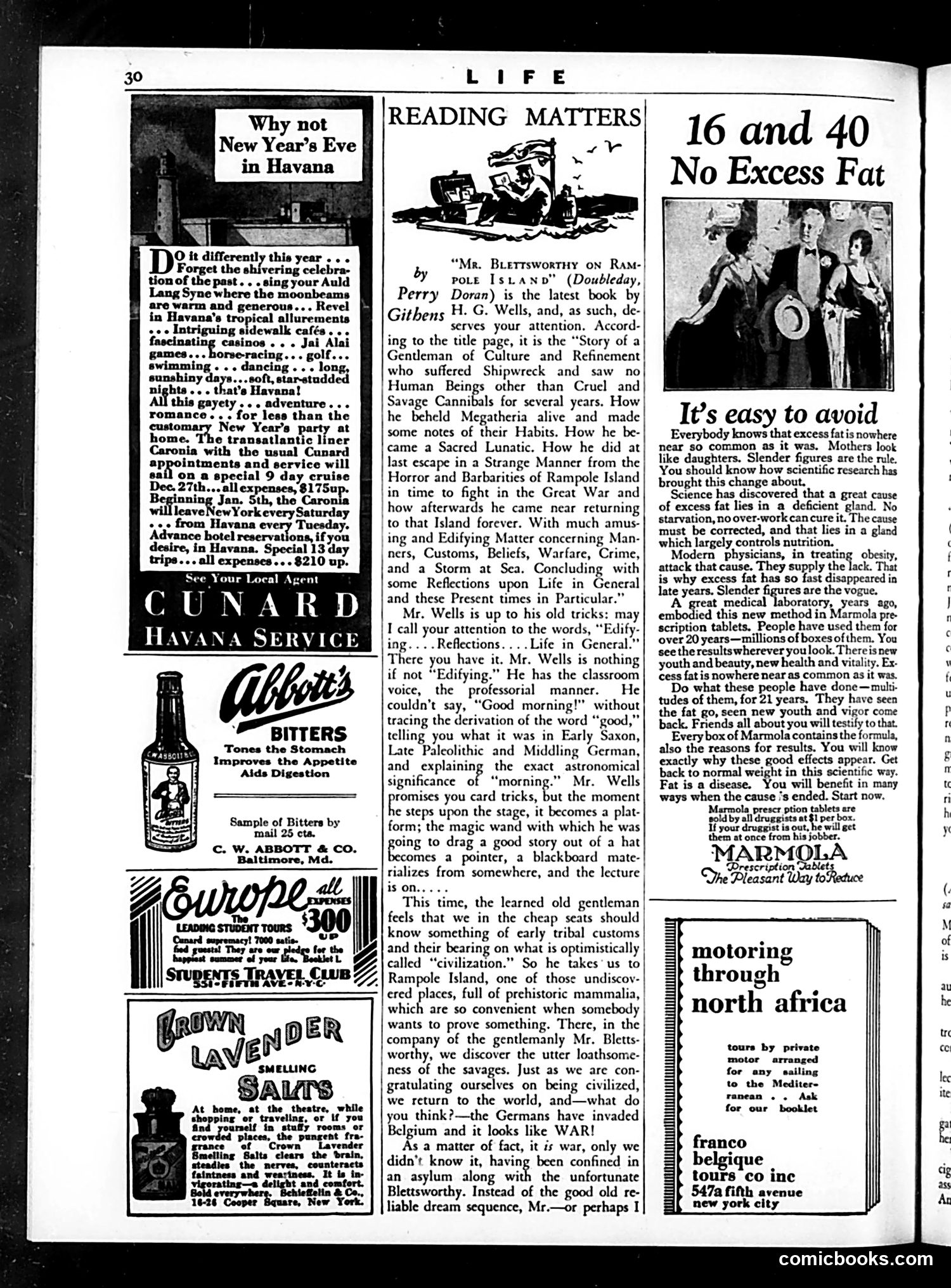
This page reviews H.G. Wells's latest novel about a cultured gentleman shipwrecked on an island with "Cruel and Savage Cannibals." The critic's tone is gently satirical toward Wells himself rather than the book's plot. The satire targets Wells's pedantic teaching style: the reviewer notes that Wells promises "card tricks" (entertainment) but inevitably transforms storytelling into a classroom lecture. When Wells attempts to "drag a good story out of a hat," his "magic wand" becomes a "pointer" and a "blackboard materializes." The review's punchline is darkly ironic: while the protagonist escapes primitive savagery, the "real" war (WWI in Belgium) erupts—suggesting that European "civilization" is itself barbaric. The critic implies Wells uses exotic primitivism to comment on contemporary horrors, but does so with characteristic professorial heavyhandedness rather than narrative grace. The satire is literary criticism disguised as plot summary—poking fun at Wells's inability to simply tell a story without moralizing.
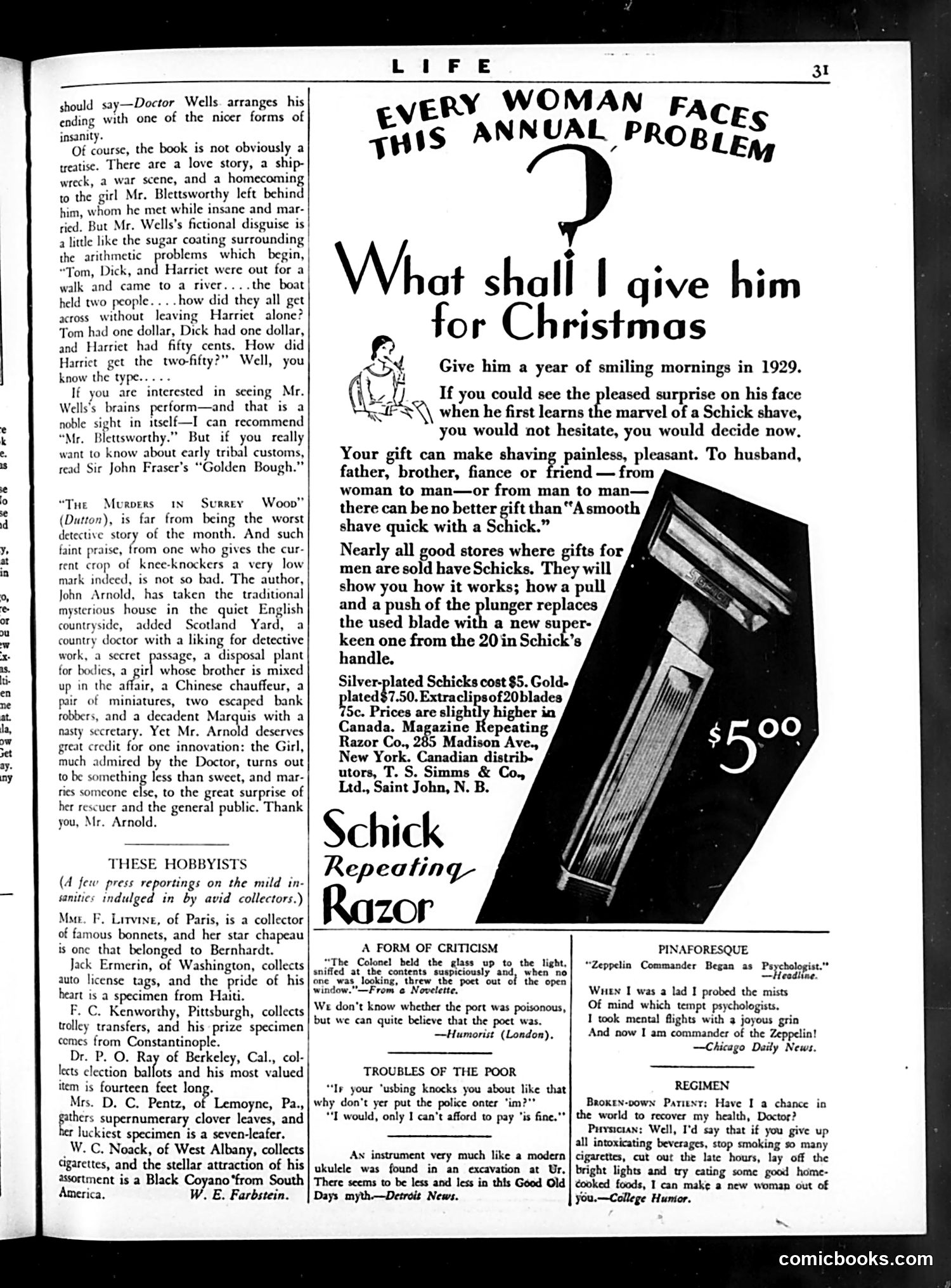
This page contains a book review section and a major **Schick razor advertisement** disguised as editorial content. **The Advertisement (dominant feature):** The large headline "What shall I give him for Christmas" frames a Schick Repeating Razor ad. It appeals to women as gift-givers, emphasizing that an electric razor provides "a year of smiling mornings in 1929"—suggesting painless, pleasant shaving. The ad lists prices ($5 silver-plated, $7.50 gold-plated) and distribution details. This is typical 1920s advertising strategy: embedding commercial messages within lifestyle editorial to appear as genuine advice rather than sales pitch. **The Book Reviews (left column):** Brief critiques of H.G. Wells' "Mr. Blettsworthy" and a detective novel "The Murders in Surrey Wood," with commentary on contemporary literary trends. **"These Hobbyists" Section:** Humorous documentation of eccentric collectors (bonnets, license tags, trolley transfers, clover leaves, cigarettes), poking gentle fun at obsessive collecting habits among the wealthy and leisured. The page reflects 1920s consumer culture and emerging advertising sophistication.
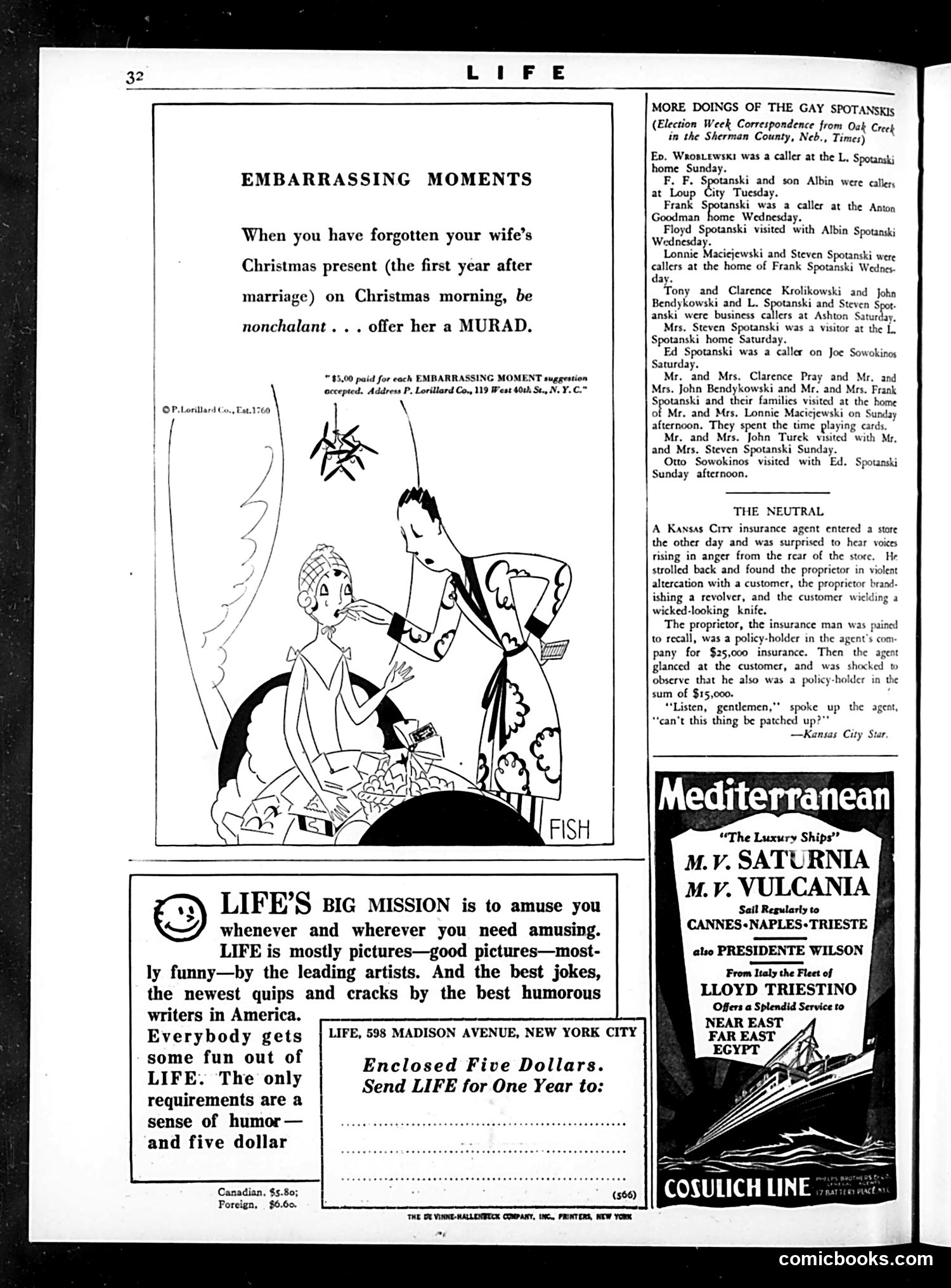
This page contains two distinct humor pieces from *Life* magazine: **"Embarrassing Moments"** (main cartoon): The central illustration shows a man awkwardly offering his wife a Murad cigarette box as a belated Christmas present, having forgotten to buy her a real gift. The joke satirizes the social embarrassment of marital neglect—the suggestion being that a luxurious cigarette brand can salvage a husband's blunder. *Life* solicited reader submissions for such scenarios at $5 each. **"The Neutral"** (sidebar anecdote): A Kansas City insurance agent encounters a store proprietor and customer in violent conflict—one brandishing a revolver, the other a knife. The agent's predicament: both combatants are his policy-holders ($25,000 and $15,000 respectively). His plea to "patch it up" satirizes the insurance agent's awkward neutrality when profit depends on both parties' survival. Both pieces mock social embarrassment and awkward professional situations through gentle domestic and commercial comedy typical of 1920s-era *Life* magazine humor.
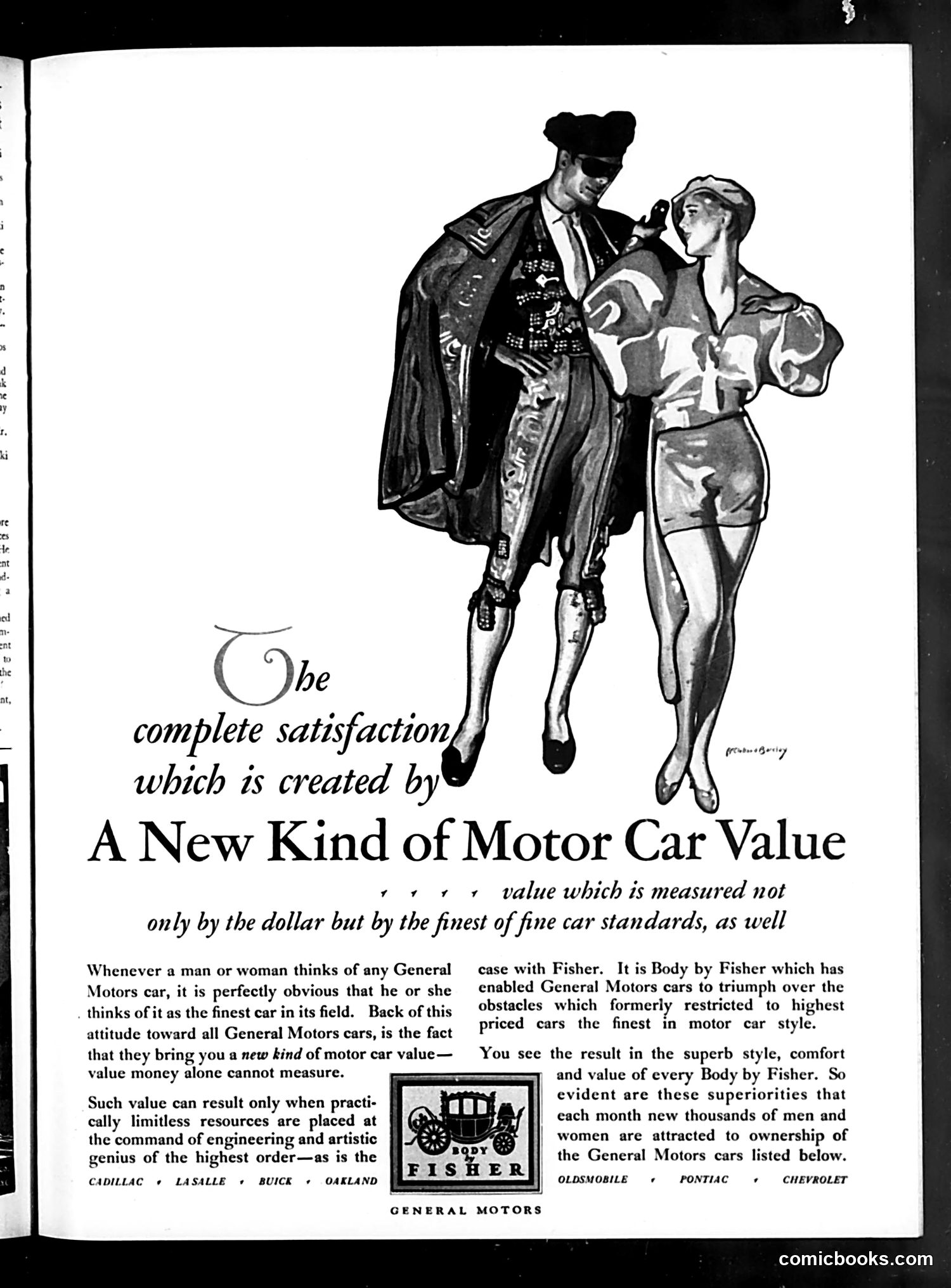
This is a **General Motors advertisement**, not political satire. It promotes "Body by Fisher," a coachbuilding brand owned by GM. The illustration shows a stylishly dressed couple—the man in an ornate coat and cap, the woman in fashionable attire—embodying luxury and sophistication. This visual conveys the ad's central message: GM cars offer aesthetic and engineering excellence beyond mere affordability. The text argues that General Motors has democratized "fine car value" through Fisher's design expertise, bringing luxury styling formerly reserved for expensive vehicles to GM's full range (Cadillac, LaSalle, Buick, Oakland, Oldsmobile, Pontiac, Chevrolet). **For modern readers:** This reflects 1920s consumer culture, where automotive design and styling—not just mechanical function—became marketing priorities. The gendered imagery (well-dressed couple) targets both male and female car buyers, relatively progressive for the era.
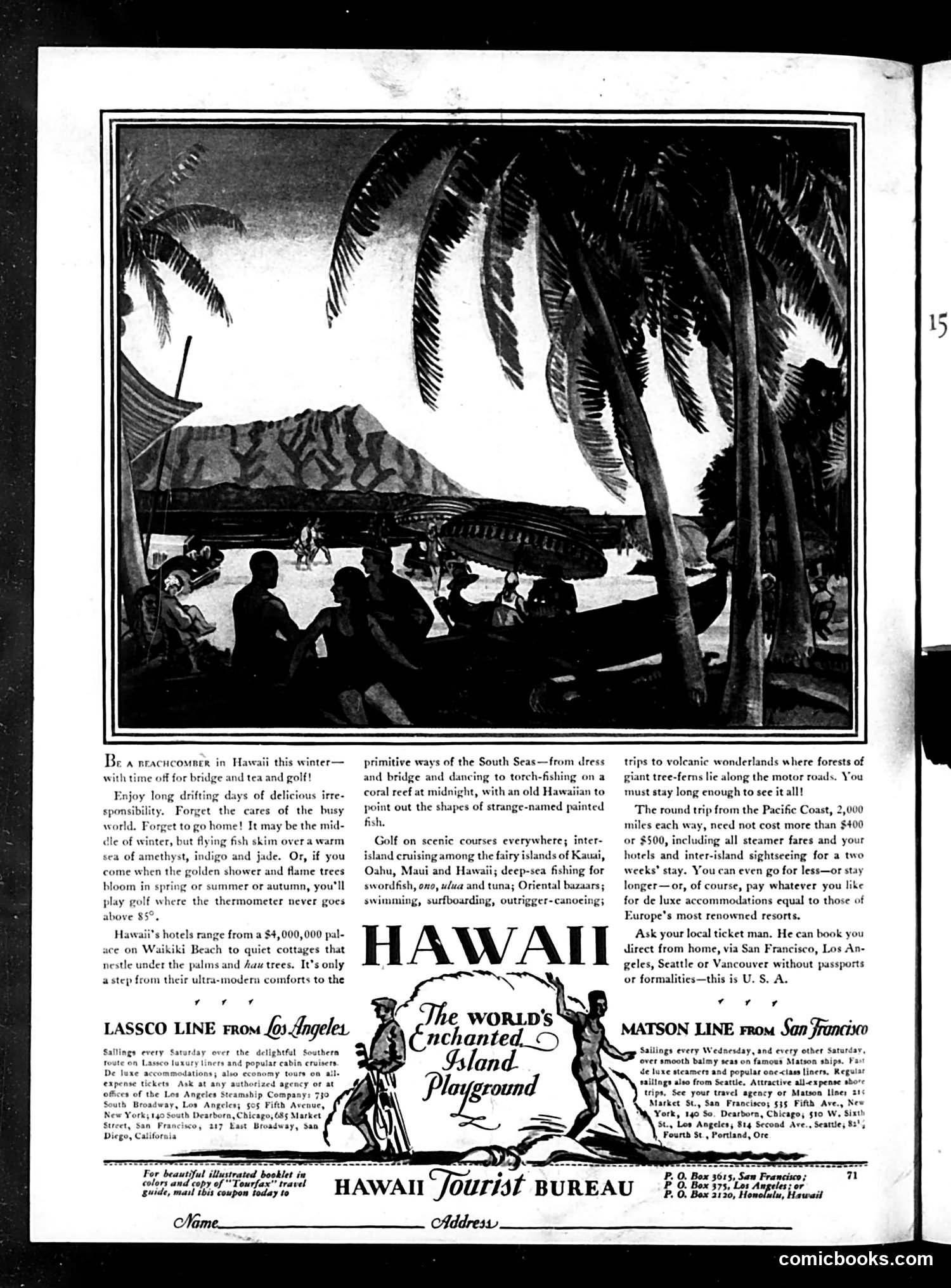
This page is primarily **travel advertising**, not political satire or comics. It promotes Hawaii as a winter vacation destination to American readers, emphasizing luxury and escape from responsibility. The imagery shows a romanticized tropical scene: silhouetted figures relaxing under palm fronds with a volcanic mountain and beach in the background—visual shorthand for exotic leisure. The text promises relief from "the cares of the busy world," golf, deep-sea fishing, inter-island cruising, and "primitive ways of the South Seas." This reflects early-20th-century attitudes toward Hawaii as a destination for wealthy Americans seeking both modern comfort (luxury hotels) and staged "exotic" experiences. Three shipping companies compete for business: LASSCO Line (Los Angeles), Matson Line (San Francisco), and others, offering round-trip packages for $400-$500 including steamship fares and accommodations. There is **no political cartoon or satire visible** on this page—it is straightforward commercial promotion targeting affluent leisure travelers.