
Life, 1928-12-21 · page 17 of 36
Life — December 21, 1928 — page 17: what you’re looking at
What you’re looking at
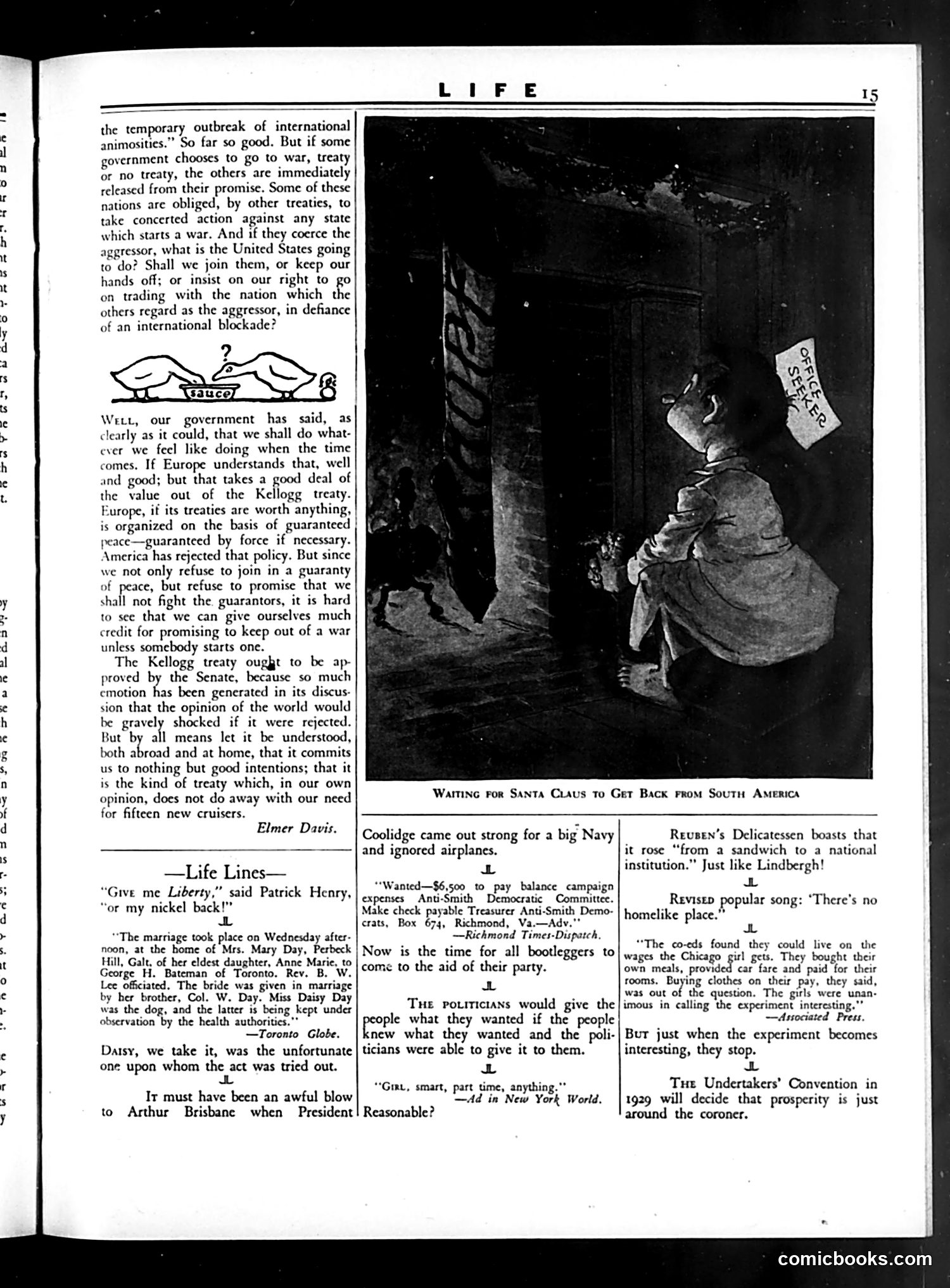
The main cartoon on this page depicts **"Waiting for Santa Claus to Get Back from South America,"** showing a figure labeled "Open Season" sitting in what appears to be a large basin or container—likely representing the U.S. political system or economy. The satire references the **Kellogg-Briand Pact** (mentioned prominently in the text), a 1928 international treaty renouncing war. The cartoon mocks American foreign policy: while the U.S. publicly supported peace treaties, it maintained military buildup and pursued interventionist interests in South America, contradicting pacifist rhetoric. "Santa Claus" represents American diplomatic promises, while the figure waits helplessly—suggesting the hypocrisy between stated peaceful intentions and actual geopolitical maneuvering.
📄 Transcribed text from this page (OCR, searchable)
Machine-transcribed from the original scan — historical spelling and the odd misread are preserved.
the temporary outbreak of international animosities.” So far so good. But if some government chooses to go to war, treaty or no treaty, the others are immediately released from their promise. Some of these nations are obliged, by other treaties, to take concerted action against any state which starts a war. And if they coerce the aggressor, what is the United States going to do? Shall we join them, or keep our hands off; or insist on our right to go on trading with the nation which the others regard as the aggressor, in defiance of an international blockade? Wett, our government has said, as clearly as it could, that we shall do what- ever we feel like doing when the time comes. If Europe understands that, well and good; but that takes a good deal of the value out of the Kellogg treaty. Europe, if its treaties are worth anything, is organized on the basis of guaranteed | peace—guaranteed by force if necessary. America has rejected that policy. But since we not only refuse to join in a guaranty of peace, but refuse to promise that we shall not fight the. guarantors, it is hard to see that we can give ourselves much credit for promising to keep out of a war unless somebody starts one. The Kellogg treaty ougt to be ap- proved by the Senate, because so much emotion has been generated in its discus- sion that the opinion of the world would be gravely shocked if it were rejected. But by all means let it be understood, both abroad and at home, that it commits us to nothing but good intentions; that it is the kind of treaty which, in our own opinion, does not do away with our need for fifteen new cruisers. Elmer Davis. —Life Lines— “Give me Liberty,” said Patrick Henry, “or my nickel back!” LL “The marriage took place on Wednesday after- noon, at the home of Mrs. Mary Day, Perbeck Hill, Galt, of her eldest daughter, Anne Marie, to George H. Bateman of Toronto. Rev. B. W. Lee officiated. The bride was given in marriage by her brother, Col. W. Day. Miss Daisy Day was the dog, and the latter is being kept under observation by the health authorities." —Toronto Globe. Datsy, we take it, was the unfortunate one upon whom the act was tried out. LL Tr must have been an awful blow to Arthur Brisbane when President Warne ror Santa Ciaus to Get Back From SoutH AMERICA Coolidge came out strong for a big Navy and ignored airplanes. LL “*Wanted—$6,500 to pay balance campaign expenses Anti-Smith Democratic Committee. Make check payable Treasurer Anti-Smith Demo- crats, Box 674, Richmond, Va.—Adv."* —Richmond Times-Dispatch. Now is the time for all bootleggers to come to the aid of their party. L Tue potrmicians would give the people what they wanted if the people new what they wanted and the poli- ticians were able to give it to them. LL “Girt, smart, part time, anything. —dAd in New York World. Reasonable? Reusen’s Delicatessen boasts that it rose “from a sandwich to a national institution.” Just like Lindbergh! LL Revisep popular song: ‘There's no homelike place.” “The co-eds found they could live on the wages the Chicago girl gets. They bought their Gon meals, provitel ci fare’ and paid for their rooms. Buying clothes on their pay, they said, was out of the question. The girls were unan- imous in calling the experiment interesting.”” —Asociated Press. Bur just when the experiment becomes interesting, they stop. Tue Undertakers’ Convention in 1929 will decide that prosperity is just around the coroner. comicbooks.com