
Life, 1928-12-21 · page 6 of 36
Life — December 21, 1928 — page 6: what you’re looking at
What you’re looking at
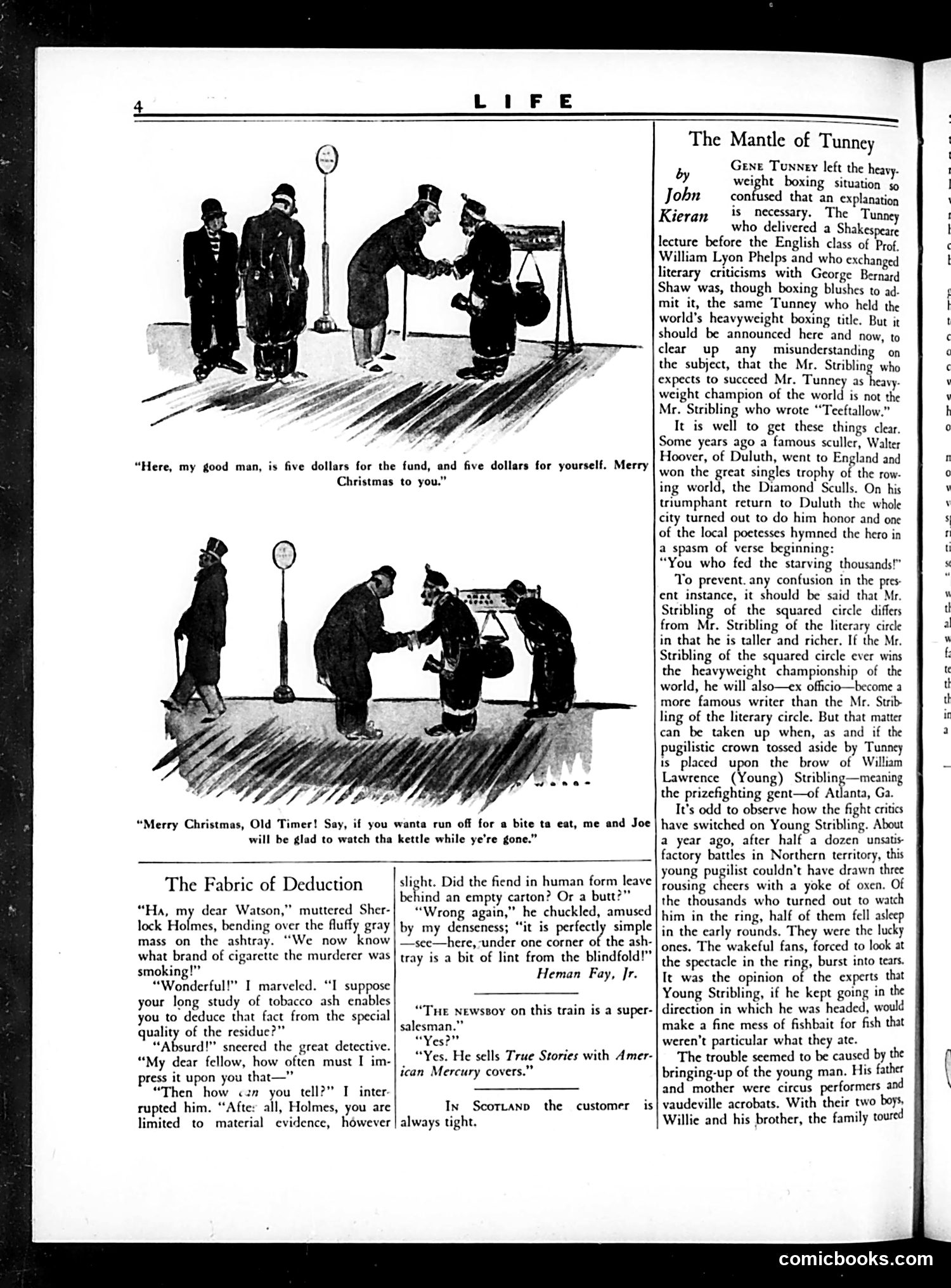
**The two cartoons** depict street-corner charity solicitation during the Christmas season. Both scenes show well-dressed men collecting donations for charitable funds, with humorous captions about giving money "for the fund" while also receiving personal benefit. The satire targets **hypocrisy in charitable giving**—specifically, the common practice where fundraisers or intermediaries personally profit from donations meant for the needy. The jokes suggest donors are naive to believe their money actually reaches those in need. **"The Fabric of Deduction"** section features a Sherlock Holmes parody, mocking the detective's deductive methods through an absurd example about lint and blindfolds—likely satirizing overwrought mystery fiction. The page also includes brief humorous observations about Scottish customers and various cultural references typical of 1920s Life magazine humor.
📄 Transcribed text from this page (OCR, searchable)
Machine-transcribed from the original scan — historical spelling and the odd misread are preserved.
4 LIFE “Here, my good man, is five dollars for the fund, and five dollars for yourself. Christmas to you.” “Merry Christmas, Old Timer! Say, if you will be glad to watch tha wanta run off for a bite ta eat, me and Joe kettle while ye’re gone.” The Fabric of Deduction “Ha, my dear Watson,” muttered Sher- lock Holmes, bending over the fluffy gray mass on the ashtray. “We now know what brand of cigarette the murderer was smoking!”” “Wonderful!” I marveled. “I suppose your long study of tobacco ash enables you to deduce that fact from the special quality of the residue?” “Absurd!” sneered the great detective. “My dear fellow, how often must I im- press it upon you that—” “Then how «in you tell?” I inter rupted him. “Afte: all, Holmes, you are limited to material evidence, however slight. Did the fiend in human form leave behind an empty carton? Or a butt?” “Wrong again,” he chuckled, amused by my denseness; “it is perfectl simple —see—here,-under one corner of the ash- tray is a bit of lint from the blindfold!” Heman Fay, Jr. “Tre Newssoy on this train is a super- salesman.” “Yes?” “Yes. He sells True Stories with Amer- ican Mercury covers.” In ScoTLanp always tight. the customer is The Mantle of Tunney Gene Tunney left the heavy. by weight boxing situation ie John confused that an explanation . is necessary. The Tun Kieran vt oiddliverd Shakespear, lecture before the English class of Prof. William Lyon Phelps and who exchanged literary criticisms with George Bernard Shaw was, though boxing blushes to ad- mit it, the same Tunney who held the world’s heavyweight boxing title. But it should be announced here and now, to clear up any misunderstanding on the subject, that the Mr. Stribling who expects to succeed Mr. Tunney as heavy- weight champion of the world is not the Mr. Stribling who wrote “Teeftallow.” Tt is well to get these things clear. Some years ago a famous sculler, Walter Hoover, of Duluth, went to England and won the great singles trophy of the row- ing world, the Diamond Sculls. On his triumphant return to Duluth the whole city turned out to do him honor and one of the local poetesses hymned the hero in a spasm of verse beginning: “You who fed the starving thousands!” To prevent. any confusion in the pres- ent instance, it should be said that Mr. Stribling of the squared circle differs from Mr. Stribling of the literary circle in that he is taller and richer. If the Mr. Stribling of the squared circle ever wins the heavyweight championship of the world, he will also—ex officio—become a more famous writer than the Mr. Strib- ling of the literary circle. But that matter can be taken up when, as and if the pugilistic crown tossed aside by Tunney ts placed upon the brow of William Lawrence (Young) Stribling—meaning the prizefighting gent—of Adanta, Ga. It’s odd to observe how the fight critics have switched on Young Stribling. About a year ago, after half a dozen unsatis- factory battles in Northern territory, this young pugilist couldn't have drawn three rousing cheers with a yoke of oxen. Of the thousands who turned out to watch him in the ring, half of them fell asleep in the early rounds, They were the lucky ones. The wakeful fans, forced to look at the spectacle in the ring, burst into tears. Tt was the opinion of the experts that Young Stribling, if he kept going in the direction in which he was headed, would make a fine mess of fishbait for fish that weren't particular what they ate. The trouble seemed to be caused by the bringing-up of the young man. His father and mother were circus performers and vaudeville acrobats. With their two boys, Willie and his brother, the family toured comicbooks.com aa am aa ta aa a a —