
Life, 1928-12-28 · page 18 of 37
Life — December 28, 1928 — page 18: what you’re looking at
What you’re looking at
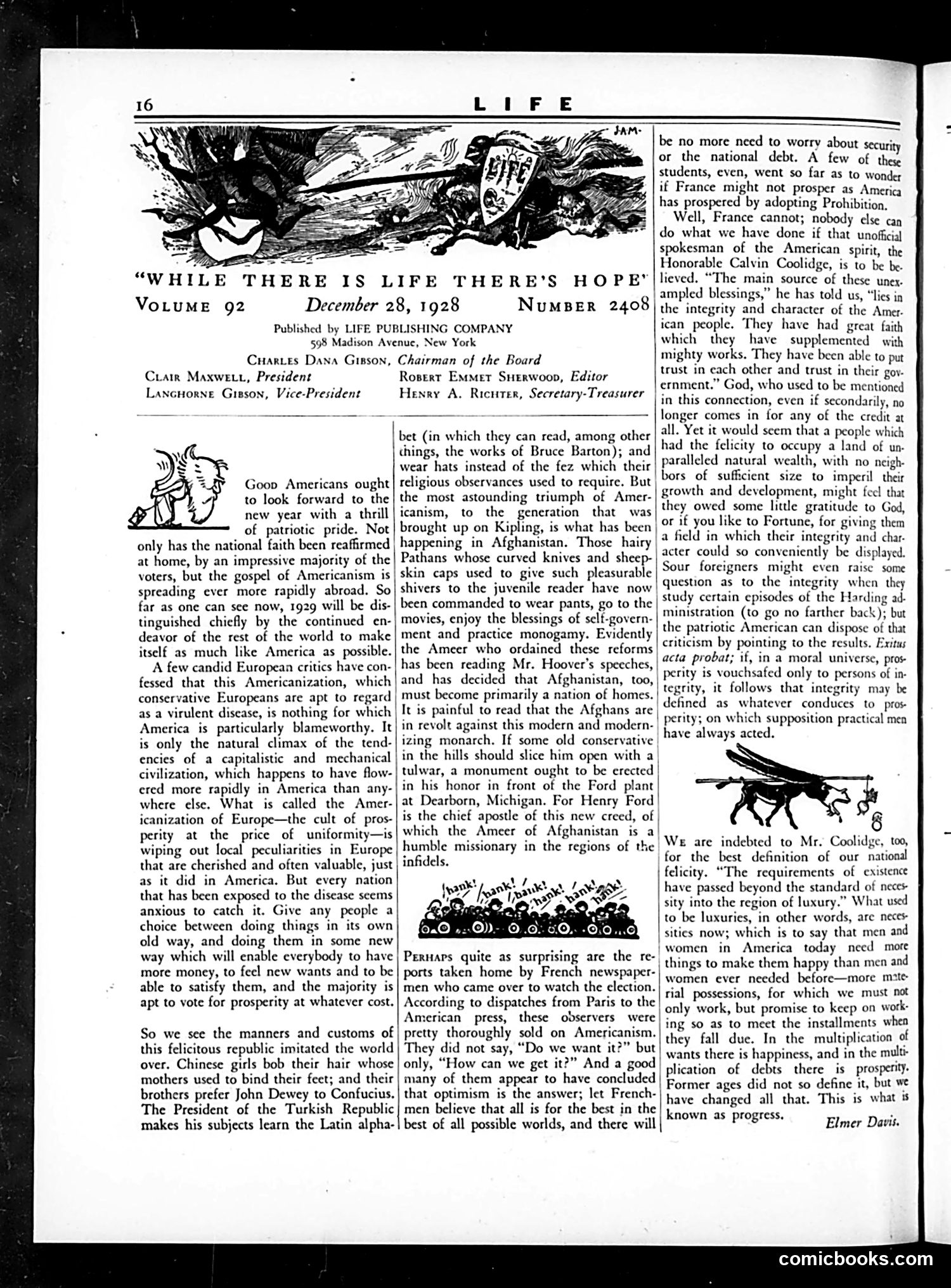
This Life magazine page (December 28, 1928) contains editorial commentary on American civilization and its global influence. The text celebrates American achievements—particularly Prohibition and the Ford Motor Company's modernization efforts—as evidence of American moral and technological superiority. The piece criticizes conservative Europeans who view Americanization as a threat to traditional culture. It argues Americans should take pride in exporting their values worldwide, citing examples like the adoption of Prohibition in Afghanistan and Ford's industrial methods in Michigan. The illustration appears to show a cow or livestock, likely satirizing rural or traditional elements being modernized by American industry and values—a visual representation of the "Americanization" debate the article discusses.
📄 Transcribed text from this page (OCR, searchable)
Machine-transcribed from the original scan — historical spelling and the odd misread are preserved.
“WHILE THERE IS LIFE THERE’S HOPE’ VoLUME 92 December 28, 1928 Published by LIFE PUBLISHING COMPANY 598 Madison Avenue, New York Cuarces Dana Gisson, Chairman of the Board NuMBER 2408 be no more need to worry about securi or the national debt. A few of these students, even, went so far as to wonder if France might not prosper as America has prospered by adopting Prohibition. Well, France cannot; nobody else can do what we have done if that unofficial spokesman of the American spirit, the Honorable Calvin Coolidge, is to be be- lieved. “The main source of these unex- ampled blessings,” he has told us, “lies in the integrity and character of the Amer- ican people. They have had great faith which they have supplemented with mighty works. They have been able to put Crain Maxwetu, President LancHorne Gisson, Vice-President Goopo Americans ought to look forward to the new year with a thrill of patriotic pride. Not only has the national faith been reaffirmed at home, by an impressive majority of the voters, but the gospel of Americanism is spreading ever more rapidly abroad. So far as one can see now, 1929 will be dis- tinguished chiefly by the continued en- deavor of the rest of the world to make itself as much like America as possible. A few candid European critics have con- fessed that this Americanization, which conservative Europeans are apt to regard as a virulent disease, is nothing for which America is particularly blameworthy. It is only the natural climax of the tend- encies of a capitalistic and mechanical | civilization, which happens to have flow- ered more rapidly in America than any- where else. What is called the Amer- icanization of Europe—the cult of pros- perity at the price of uniformity—is wiping out local peculiarities in Europe | that are cherished and often valuable, just as it did in America. But every nation that has been exposed to the disease seems anxious to catch it. Give any people a choice between doing things in its own old way, and doing them in some new way which will enable everybody to have more money, to feel new wants and to be able to satisfy them, and the majority is apt to vote for prosperity at whatever cost. So we see the manners and customs of this felicitous republic imitated the world over. Chinese girls bob their hair whose mothers used to bind their feet; and their brothers prefer John Dewey to Confucius. The President of the Turkish Republic makes his subjects learn the Latin alpha- Rosert Emmet Suerwoop, Editor Henry A. Ricuter, Secretary-Treasurer bet (in which they can read, among other things, the works of Bruce Barton); and wear hats instead of the fez which their | religious observances used to require. But the most astounding triumph of Amer- icanism, to the generation that was brought up on Kipling, is what has been happening in Afghanistan. Those hairy Pathans whose curved knives and sheep- skin caps used to give such pleasurable shivers to the juvenile reader have now been commanded to wear pants, go to the movies, enjoy the blessings of self-govern- ment and practice monogamy. Evidently the Ameer who ordained these reforms | has been reading Mr. Hoover's speeches, | and has decided that Afghanistan, too, | must become primarily a nation of homes. | It is painful to read that the Afghans are | in revolt against this modern and modern- izing monarch. If some old conservative in the hills should slice him open with a} tulwar, a monument ought to be erected | in his honor in front of the Ford plant at Dearborn, Michigan. For Henry Ford is the chief apostle of this new creed, of | which the Ameer of Afghanistan is a humble missionary in the regions of the infidels. Peruaps quite as surprising are the re- ports taken home by French newspaper- men who came over to watch the election. According to dispatches from Paris to the American press, these observers were pretty thoroughly sold on Americanism. They did not say, “Do we want it?” but only, “How can we get it?” And a good many of them appear to have concluded | that optimism is the answer; let French- men believe that all is for the best in the best of all possible worlds, and there will trust in cach other and trust in their gov- ernment.” God, who used to be mentioned in this connection, even if secondarily, no longer comes in for any of the credit at all. Yet it would seem that a people which had the felicity to occupy a land of un- paralleled natural wealth, with no neigh- bors of sufficient size to imperil their growth and development, might feel that they owed some little gratitude to God, or if you like to Fortune, for giving them a field in which their integrity and char- acter could so conveniently be displayed. Sour foreigners might even raise some question as to the integrity when they study certain episodes of the Harding ad- ministration (to go no farther back); but the patriotic American can dispose of that criticism by pointing to the results. Exitus acta probat; if, in a moral universe, pros- perity is vouchsafed only to persons of in- tegrity, it follows that integrity may be defined as whatever conduces to pros perity; on which supposition practical men have always acted. 1 We are indebted to Mr. Coolidge, too, for the best definition of our national felicity. “The requirements of existence have passed beyond the standard of neces sity into the region of luxury.” What used to be luxuries, in other words, are neces sities now; which is to say that men and women in America today need more | things to make them happy than men and women ever needed before—more mate- rial possessions, for which we must not | only work, but promise to keep on work- ing so as to meet the installments when they fall due. In the multiplication of | wants there is happiness, and in the mult- plication of debts there is prosperity. | Former ages did not so define it, but we have changed all that. This is what is known as progress. p Prog Elmer Davis. comicbooks.com