
A complete issue · 37 pages · 1928
Life — December 28, 1928
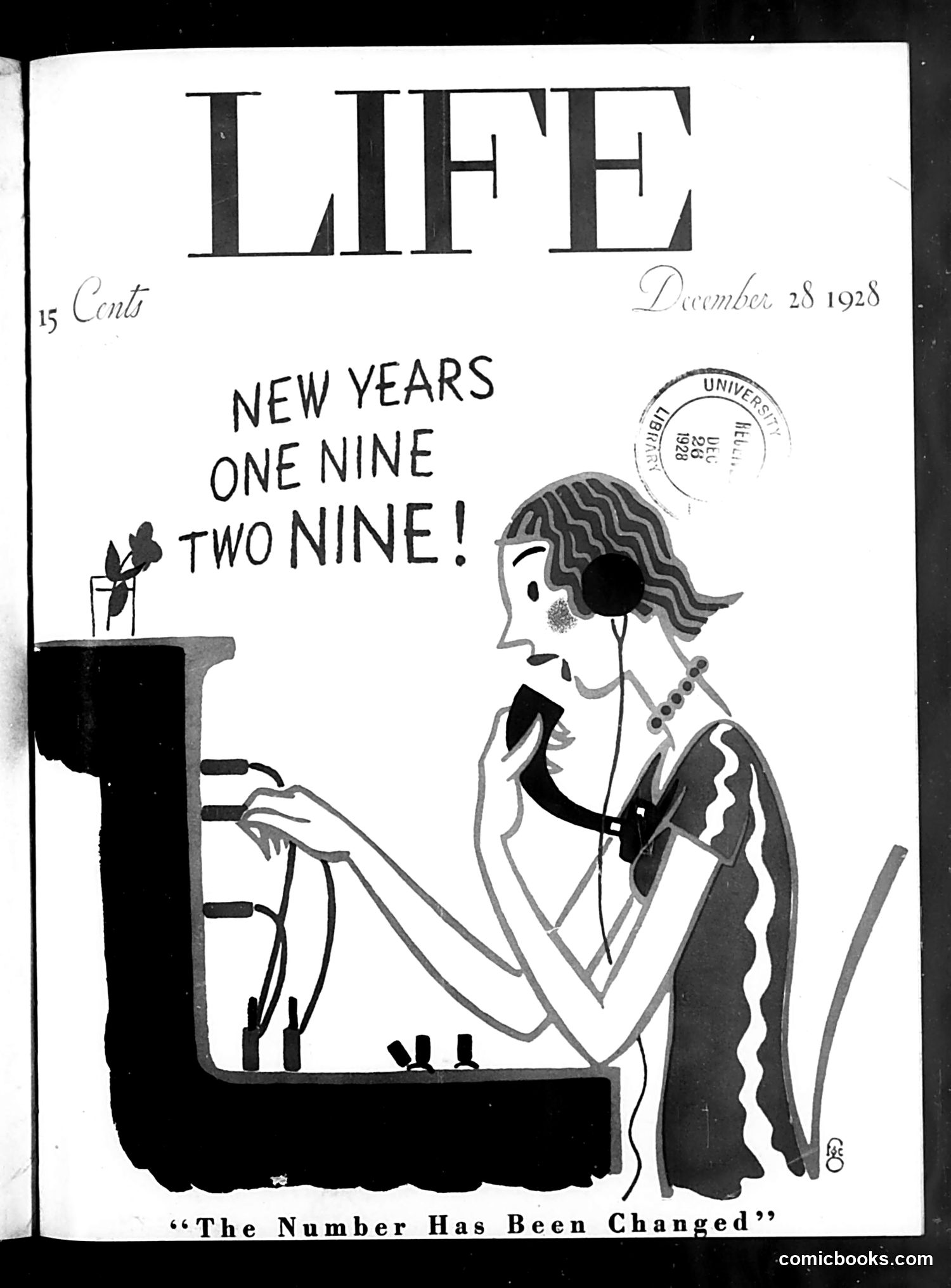
This is a Life magazine cover from December 28, 1928, marking the approaching new year transition from 1929 to 1930 (the "One Nine Two Nine!" referenced). The cartoon shows a stylishly dressed woman at a telephone—likely representing a society woman or "flapper" type popular in 1920s culture—with the caption "The Number Has Been Changed." The humor is straightforward: she's calling to wish someone a Happy New Year, but discovers the phone number format has changed with the new year's arrival. This appears to be satirizing both the modernization of telephone systems in the late 1920s and the social rituals of New Year's celebrations among the wealthy classes. The illustration style and fashion details are characteristic of 1920s Art Deco design.
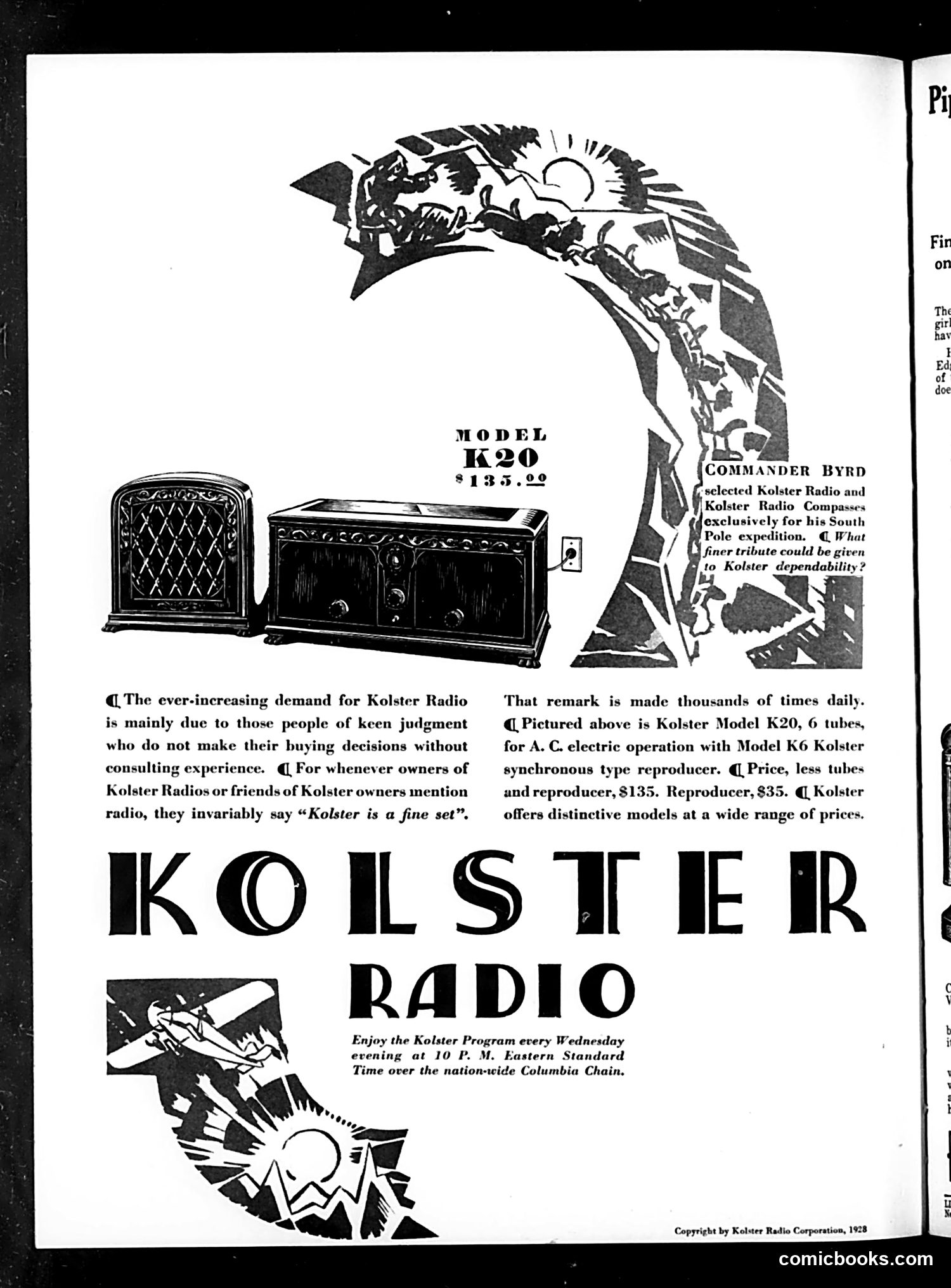
This page is primarily a **Kolster Radio advertisement** from 1928, not political satire. The main content promotes the Model K20 radio ($135.00), featuring two product illustrations and marketing copy emphasizing Kolster's reputation as "a fine set." The decorative cartoons—showing a figure (possibly Commander Byrd, mentioned in the text) and arctic/polar expedition imagery—reference **Richard Byrd's South Pole expedition** (1928-1930). The advertisement claims Kolster radios were "selected...exclusively" for Byrd's expedition, using this real-world exploration as endorsement credibility. The text notes Kolster broadcast programming on Columbia Chain radio network Wednesday evenings. This is commercial advertising leveraging contemporary exploration news, not political commentary.
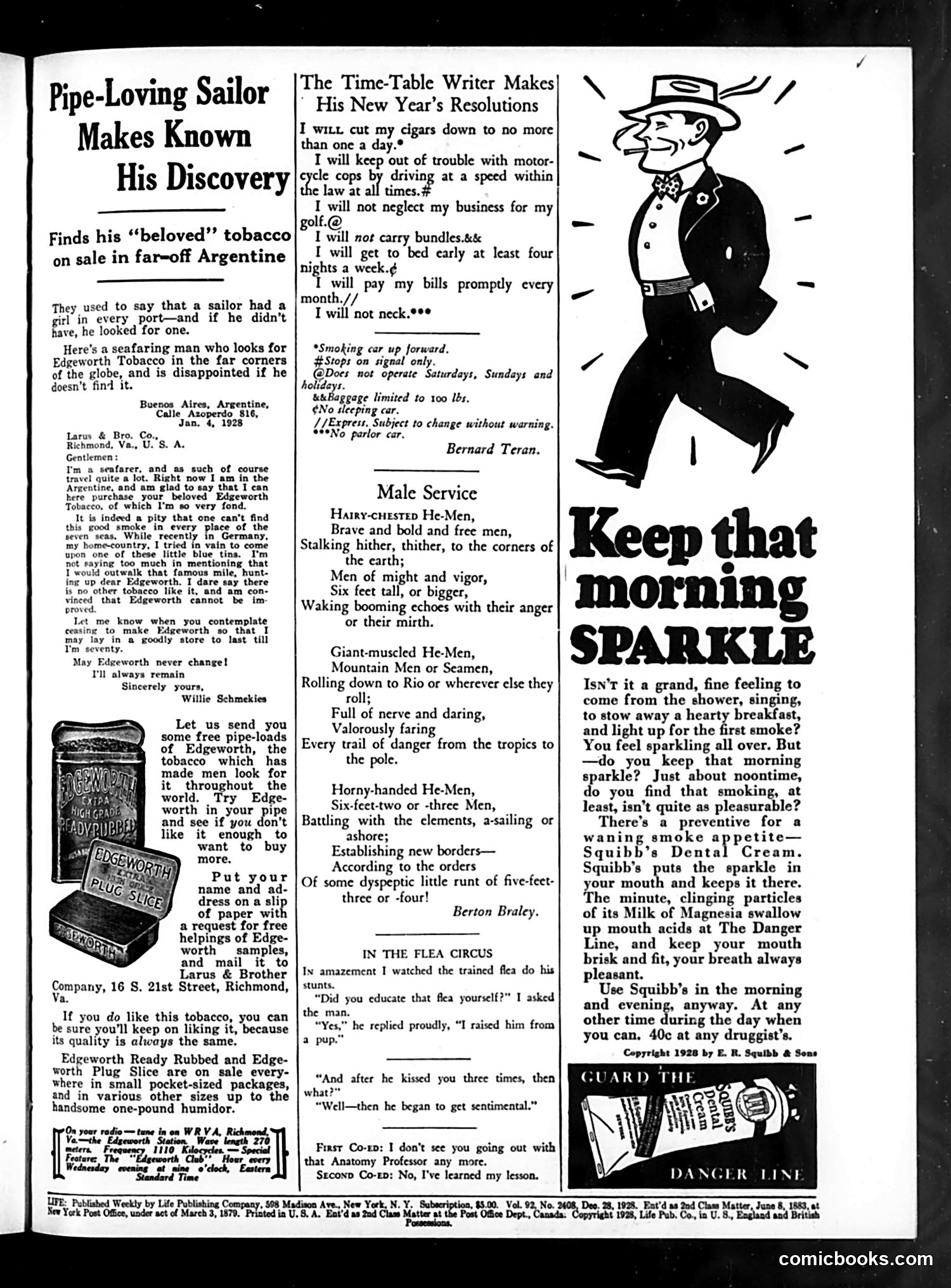
This page contains mostly **advertisements and humorous literary content** rather than political cartoons. The main content includes: 1. **"Pipe-Loving Sailor Makes Known His Discovery"** — A reader's letter from Buenos Aires about finding his preferred tobacco brand (Edgeworth) in Argentina, with testimonial praise for the product. 2. **"The Time-Table Writer Makes New Year's Resolutions"** — Satirical New Year's resolutions by Bernard Teran, poking fun at transportation schedules' unreliability (smoking restrictions, luggage limits, schedule changes). 3. **"Male Service"** — A poem by Berton Braley celebrating masculine ideals ("hairy-chested He-Men"). 4. **Squibb's Dental Cream advertisement** — A substantial ad promoting dental hygiene and fresh breath. The page reflects 1920s consumer culture and advertising-driven magazine content rather than political satire.
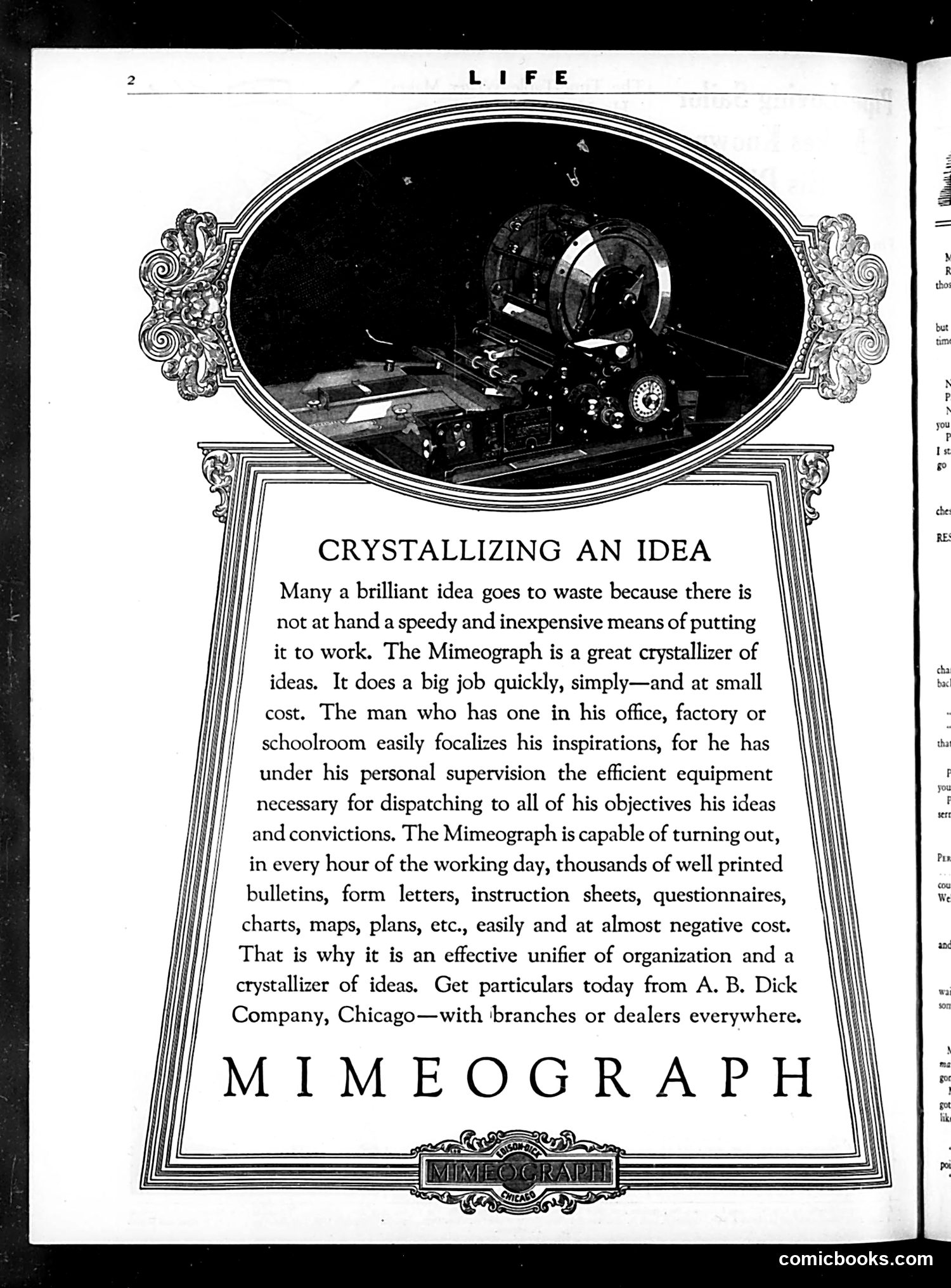
This is **not a political cartoon or satire**—it's a straightforward advertisement for the Mimeograph machine, placed in *Life* magazine (page 2). The image shows the mimeograph device itself (a duplicating machine), and the text promotes it as a tool for efficiently reproducing documents at low cost. The ad argues that the mimeograph helps people "crystallize" and distribute their ideas through printed bulletins, letters, forms, and instructional materials. The headline "Crystallizing an Idea" is a marketing metaphor suggesting the device transforms abstract thoughts into concrete, shareable documents. The ad targets office workers, factory managers, and educators, emphasizing speed and economy. It directs readers to contact A.B. Dick Company in Chicago for details. This reflects early 20th-century business culture and the emerging demand for office technology.
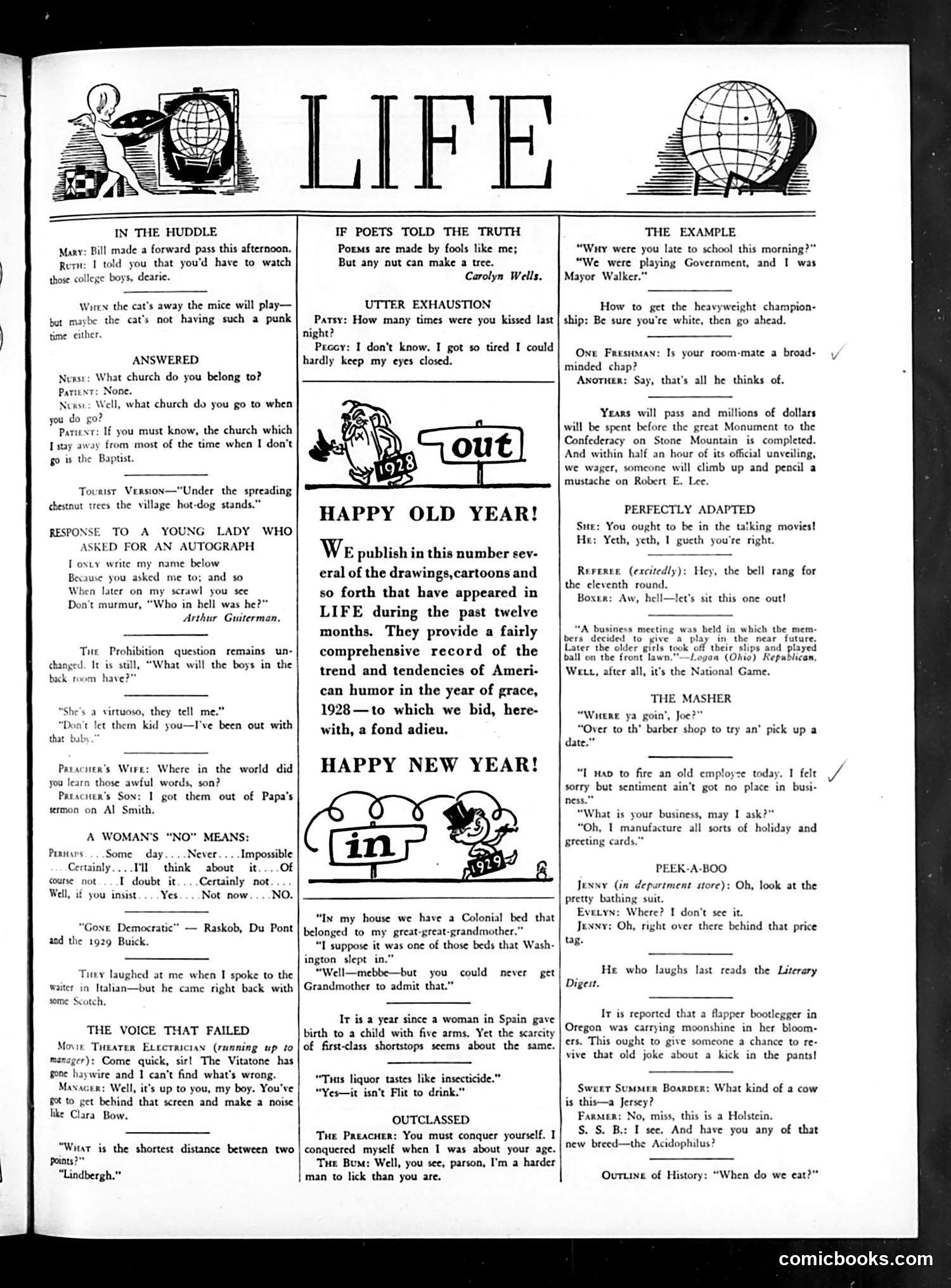
This page from Life magazine (dated 1928, based on the "Happy Old Year" reference) compiles short jokes and humorous anecdotes rather than political cartoons. The content reflects 1920s American humor: **Key references include:** - Prohibition era jokes ("This liquor tastes like insecticide") - Silent film culture ("Perfectly Adapted" - talkies were new) - Church/religion humor - General social commentary on dating, business meetings, and domestic life **Notable figures:** "Robert E. Lee" appears in one joke about a Confederate monument, referencing contemporary American historical memory debates. The page demonstrates Life's satirical approach to everyday American life, mores, and current events rather than direct political cartooning. The humor targets social pretension, generational attitudes, and cultural trends of the Jazz Age period.
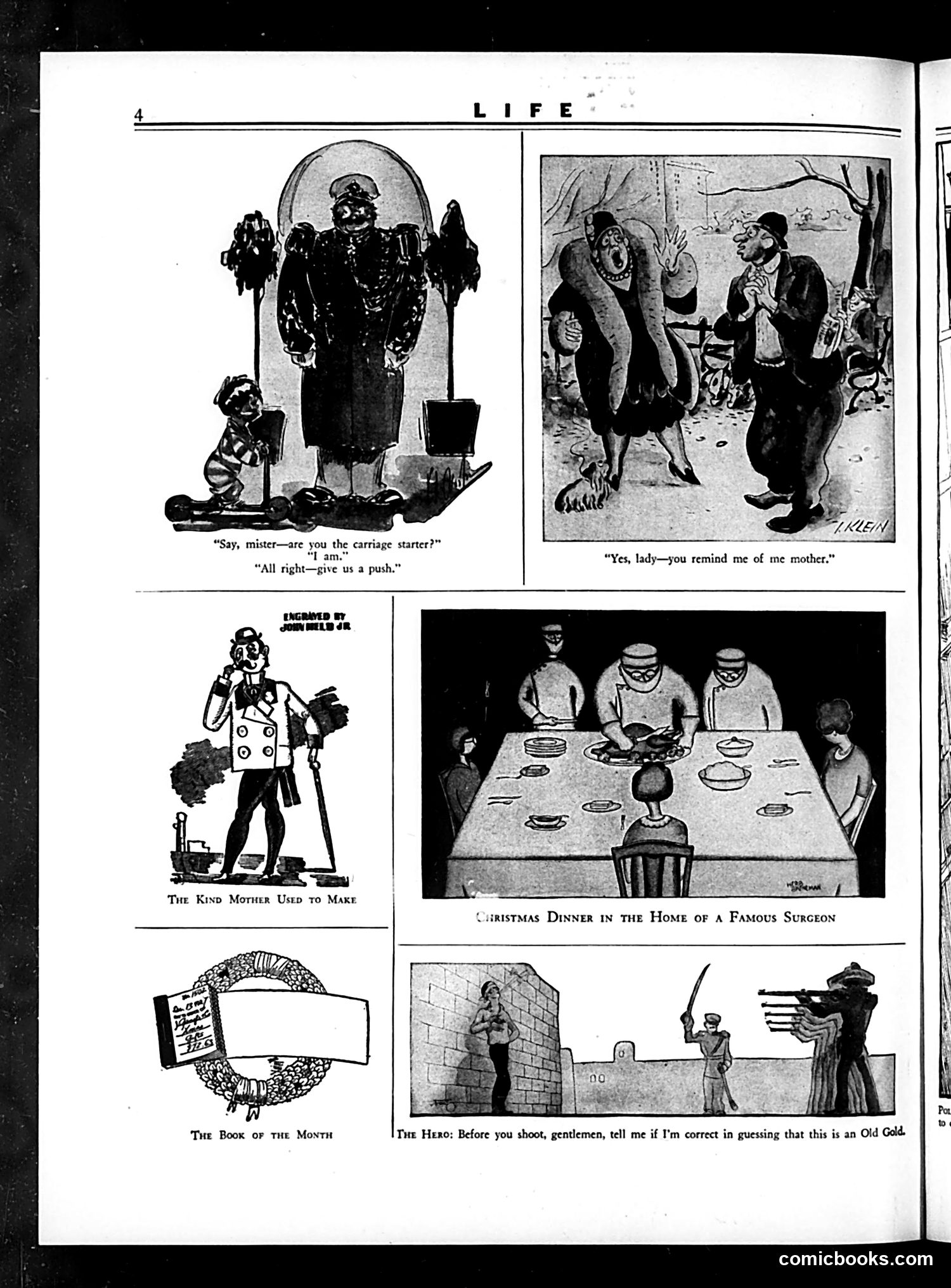
This page contains several satirical cartoons from an era when Life magazine published humor and social commentary: **Top left**: A joke about a car that won't start—a child asks a large man to push it, offering "All right—give us a push." **Top right**: A woman tells a man he "remind[s] me of me mother"—likely satirizing awkward romantic encounters or unflattering comparisons. **Middle left**: "The Kind Mother Used to Make"—appears to reference nostalgic domestic imagery, possibly mocking sentimentality about the past. **Center right**: "Christmas Dinner in the Home of a Famous Surgeon"—the dark humor likely jokes about surgical imagery applied to food preparation or carving. **Bottom**: "The Hero" depicts a Western standoff, playing on action-adventure tropes. The overall tone reflects early-to-mid 20th century American humor, mixing domestic comedy with satirical jabs at contemporary life.
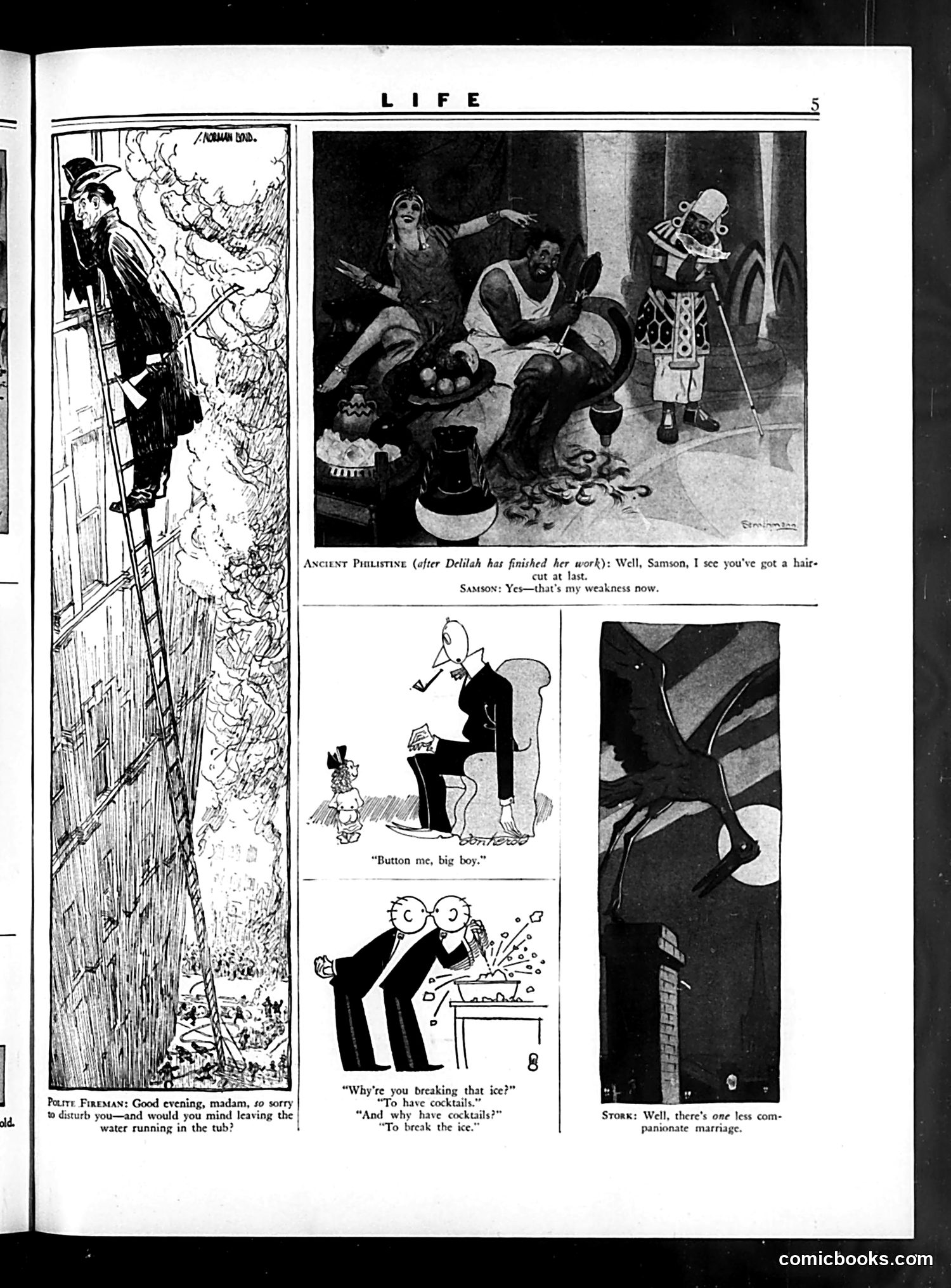
This page contains several satirical cartoons and comic vignettes typical of early 20th-century American humor: 1. **"Ancient Philistine"** (top): References the biblical story of Samson and Delilah. After Delilah cuts Samson's hair, he laments that this is now his "weakness"—satirizing how men blame women for their misfortunes. 2. **"Button me, big boy"** (middle): A small figure asks an adult to button him, playing on emasculation humor popular in the era. 3. **Cocktail/Ice scene** (bottom): Two men discuss breaking ice at cocktails, likely wordplay about social awkwardness. 4. **"Stork" caption** (right): Jokes about marriage failures with dark humor. The overall tone reflects period attitudes toward gender dynamics and domestic life through crude but pointed satire.
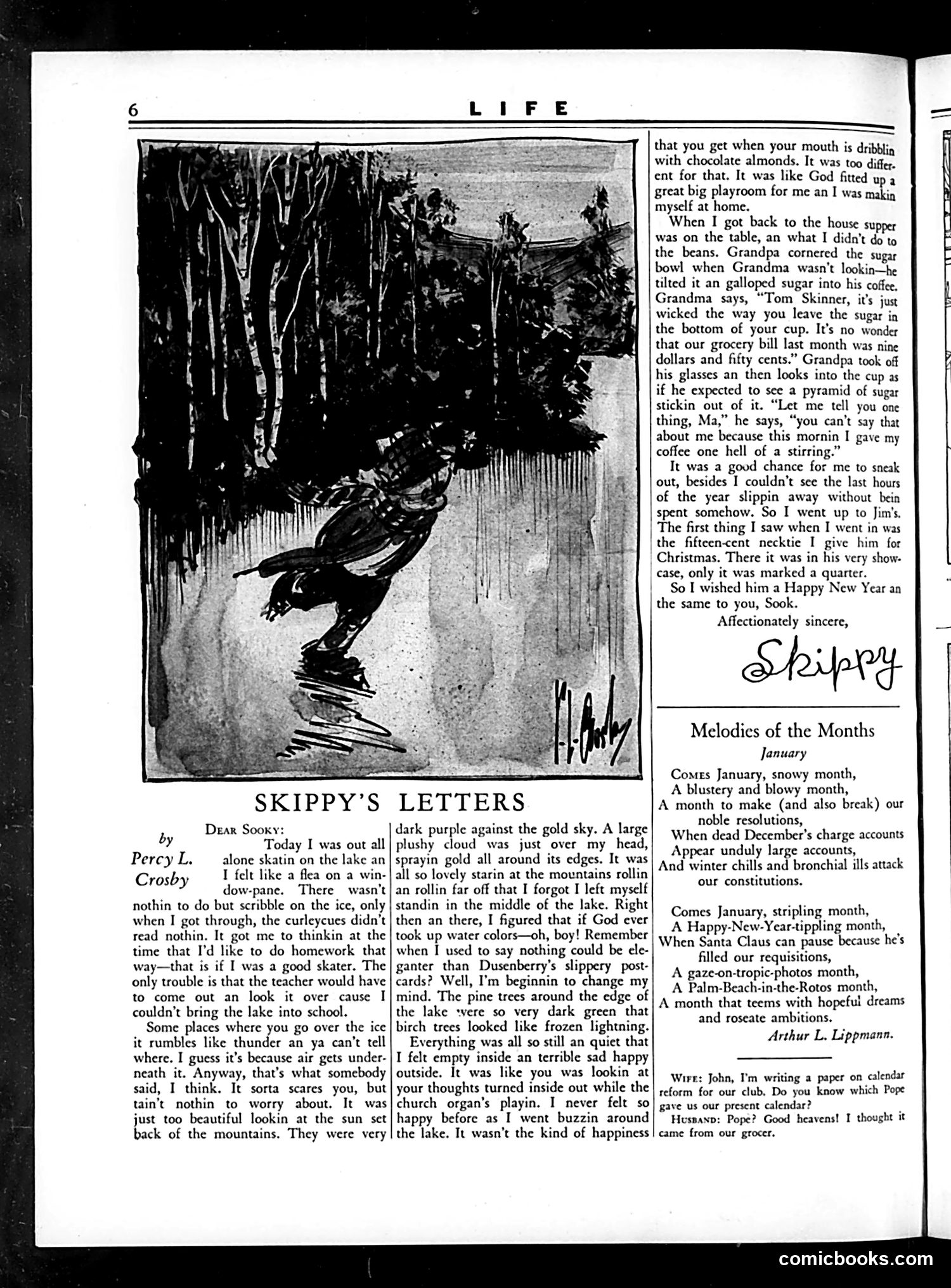
This page features "Skippy's Letters," a humorous advice/correspondence column from Life magazine's humor section. The illustration shows a young boy (Skippy) ice skating on a frozen lake surrounded by bare winter trees. The letter content is autobiographical fiction—Skippy describes a winter outing where he observed the frozen landscape and felt contemplative. He reflects on gift-giving (mentioning a fifteen-cent necktie) and New Year's wishes. Below appears "Melodies of the Months," a poem about January by Arthur L. Lippmann, celebrating the new year and winter's character. The page also includes a brief marital exchange about calendar reform, typical of Life's domestic humor. This represents early 20th-century family-oriented satire aimed at middle-class American readers, blending sentimental childhood observations with gentle social commentary.
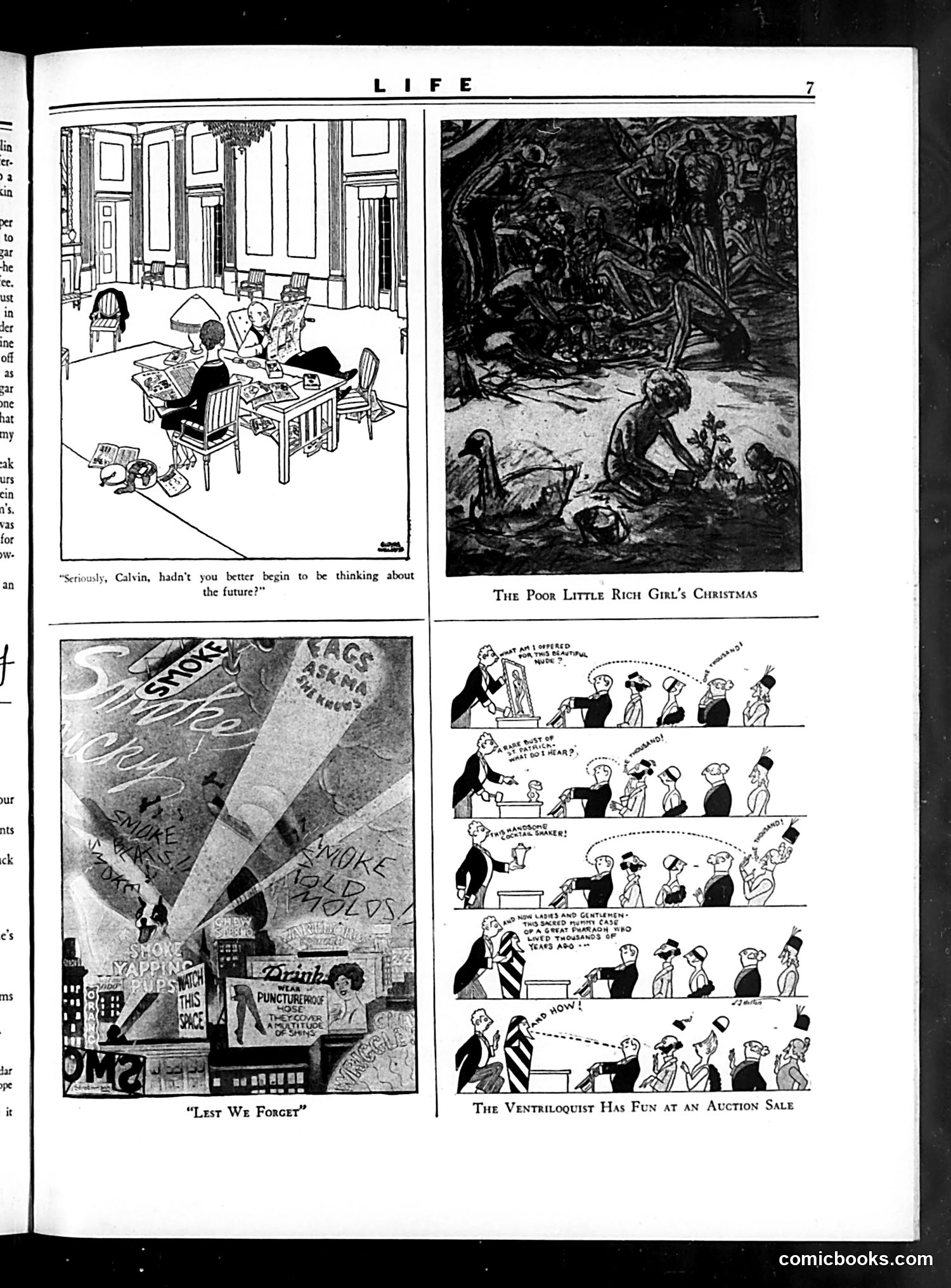
**Top Left Cartoon:** A domestic scene where a woman asks "Calvin, hadn't you better begin to be thinking about the future?" This references Calvin Coolidge, U.S. President (1923-1929), suggesting anxiety about his administration's future direction or policies. **Top Right:** "The Poor Little Rich Girl's Christmas" depicts a wealthy child receiving lavish gifts—satirizing extreme wealth inequality during the prosperous 1920s. **Bottom Left:** "Lest We Forget" shows a WWI battlefield monument amid modern commercial advertisements and signage, critiquing how American society was rapidly commercializing and forgetting the sacrifices of the recent war. **Bottom Right:** "The Ventriloquist Has Fun at an Auction Sale" appears to be a humorous comic strip about someone manipulating an auction through ventriloquism.
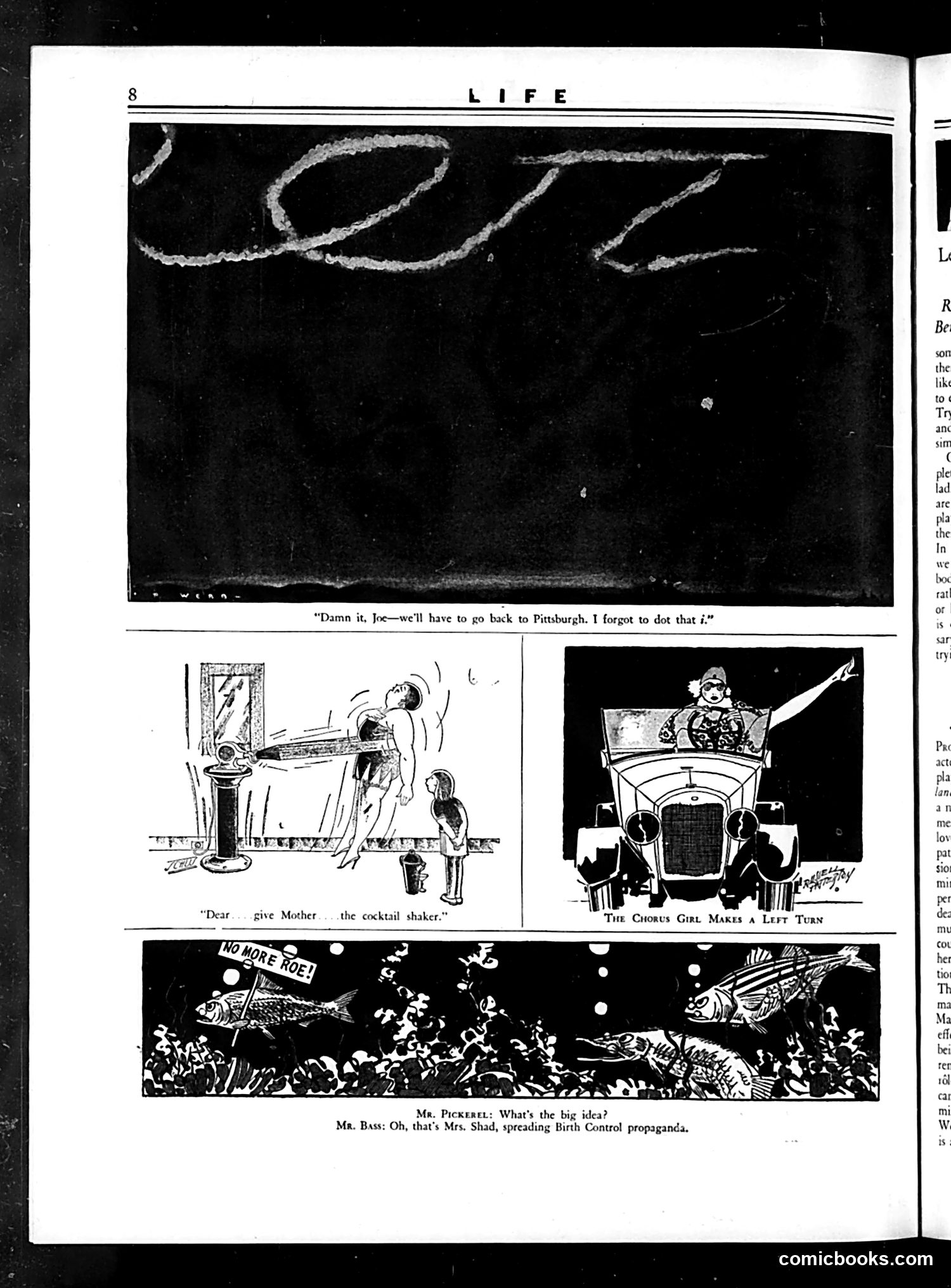
This page contains three separate cartoons satirizing 1920s social issues: 1. **Top cartoon**: A chalkboard gag about someone named Joe forgetting to "dot that i" — needing to return to Pittsburgh, likely referencing a common ethnic or regional stereotype. 2. **Middle cartoons**: The left shows a domestic scene about a "cocktail shaker," reflecting Prohibition-era humor. The right depicts "The Chorus Girl Makes a Life Turn," suggesting commentary on women in entertainment. 3. **Bottom cartoon**: An underwater scene with fish, where "Mr. Pickerel" and "Mr. Bass" discuss "Mrs. Shad spreading Birth Control propaganda." This directly satirizes the contemporary birth control debate—a major social controversy of the 1920s when discussing contraception was considered scandalous.
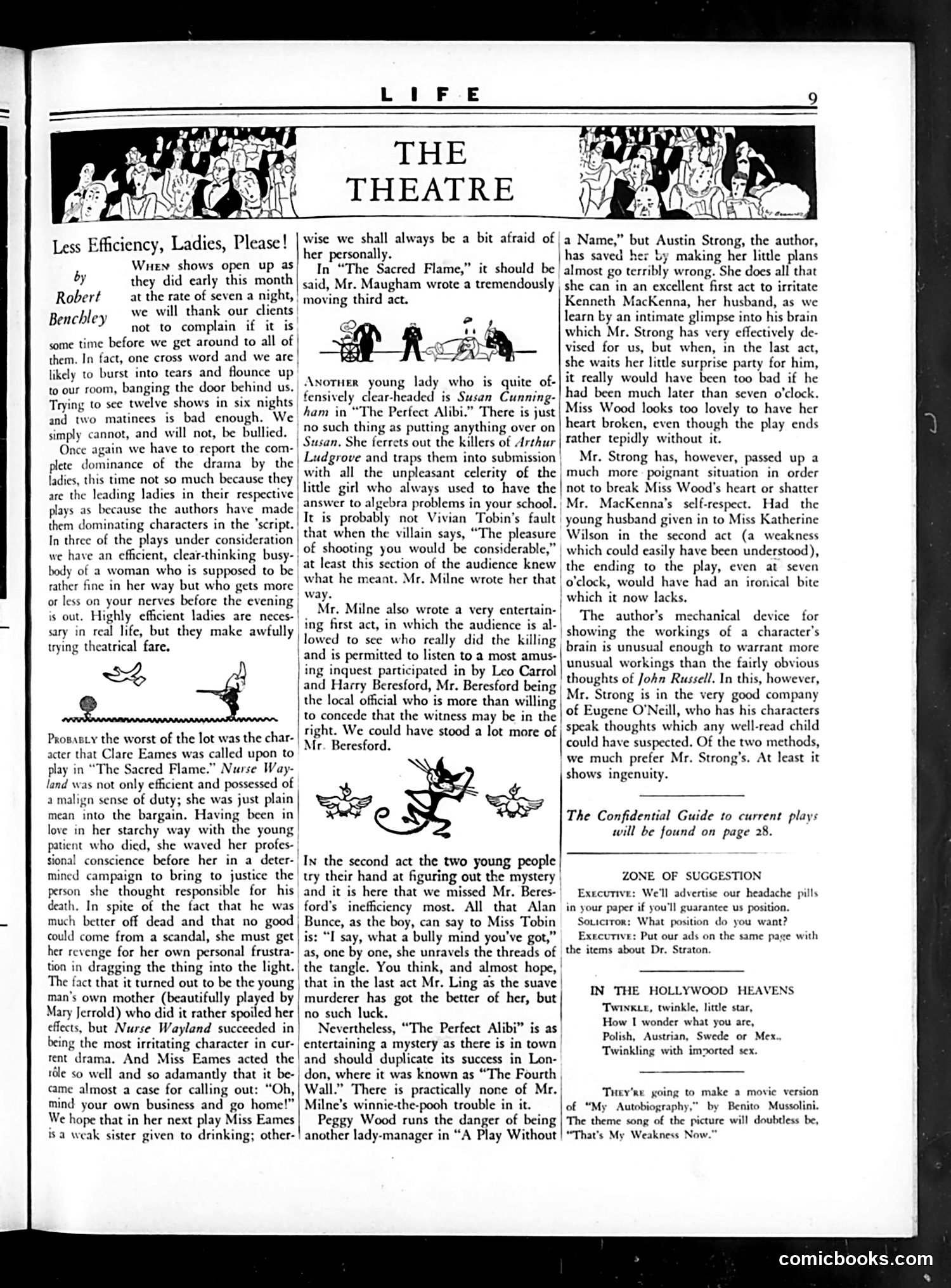
This is a theatre review page from *Life* magazine's "The Theatre" section. The content critiques several Broadway plays opening that month, with particular focus on female characters and acting efficiency. The main satirical point targets how playwrights create "inefficient" female characters—women who are supposedly fine but receive excessive stage time and emotional focus. The reviews mock plays like "The Sacred Flame" and "The Perfect Alibi" for centering weak or irritating female roles, suggesting authors have made dismissing characterization choices. The accompanying small cartoons appear to illustrate theatrical absurdities (figures in exaggerated poses), though specific caricatures aren't clearly identifiable from the image alone. The tone is witty complaint about theatrical excess and poor dramatic construction in contemporary Broadway productions.
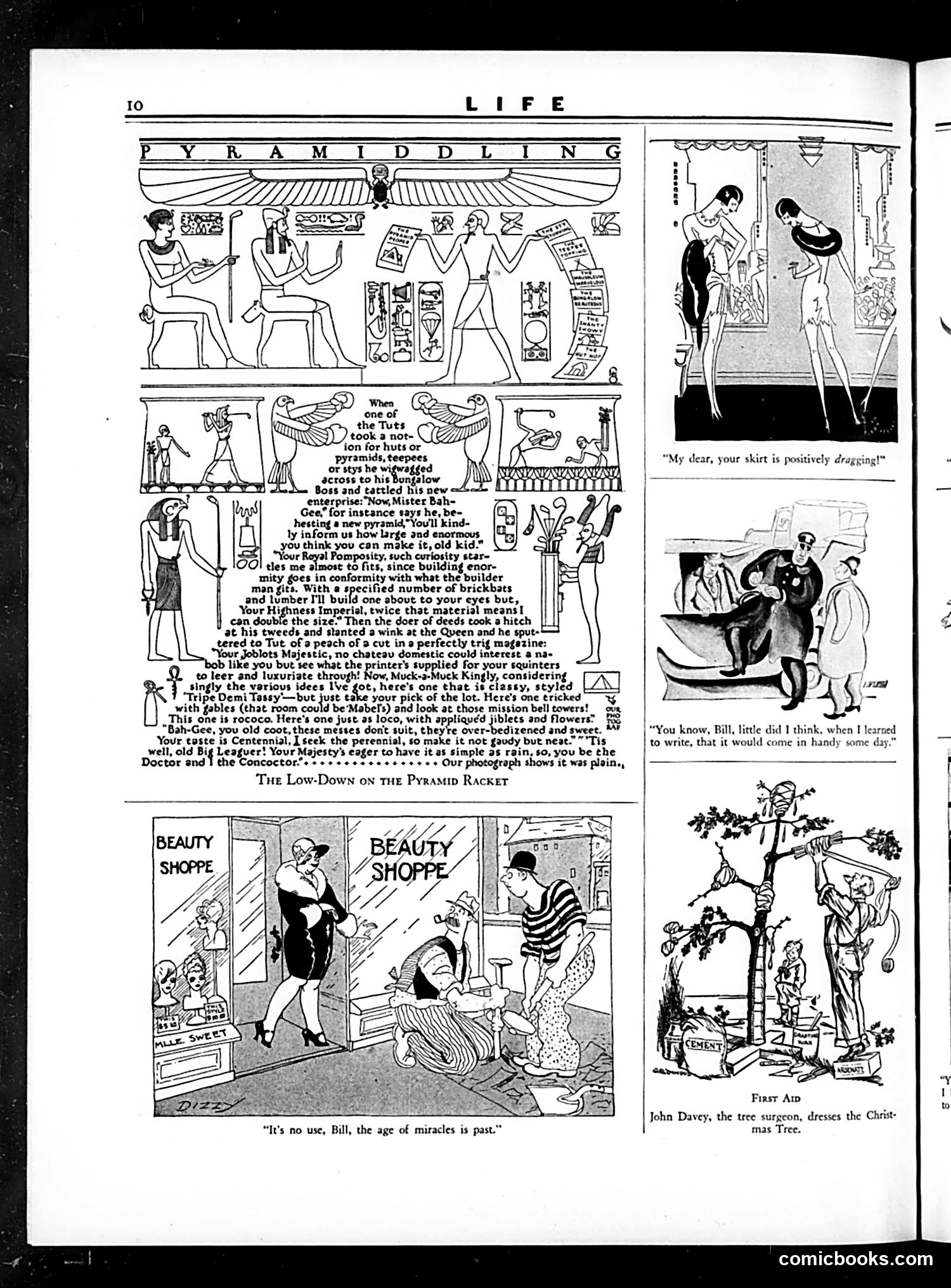
The top section depicts **Egyptian pyramid construction**, humorously suggesting the enormous scale and labor involved. The text parodies pseudo-scientific explanations for how ancient builders accomplished such feats, mocking the era's tendency to overestimate or misunderstand historical engineering. The middle cartoon titled **"The Low-Down on the Pyramid Racket"** satirizes this further, treating pyramid-building as a commercial scheme or con. The **"Beauty Shoppe"** cartoon shows a woman entering a beauty salon, with the caption "It's no use, Bill, the age of miracles is past"—mocking the impossibility of cosmetic transformation, likely referencing advertisements' exaggerated claims about beauty treatments. The final illustration, **"First Aid,"** depicts John Davey dressing a Christmas tree, presenting an absurd visual pun on tree surgery or care. Overall, the page combines historical and contemporary satire targeting pseudo-science and consumer culture claims.
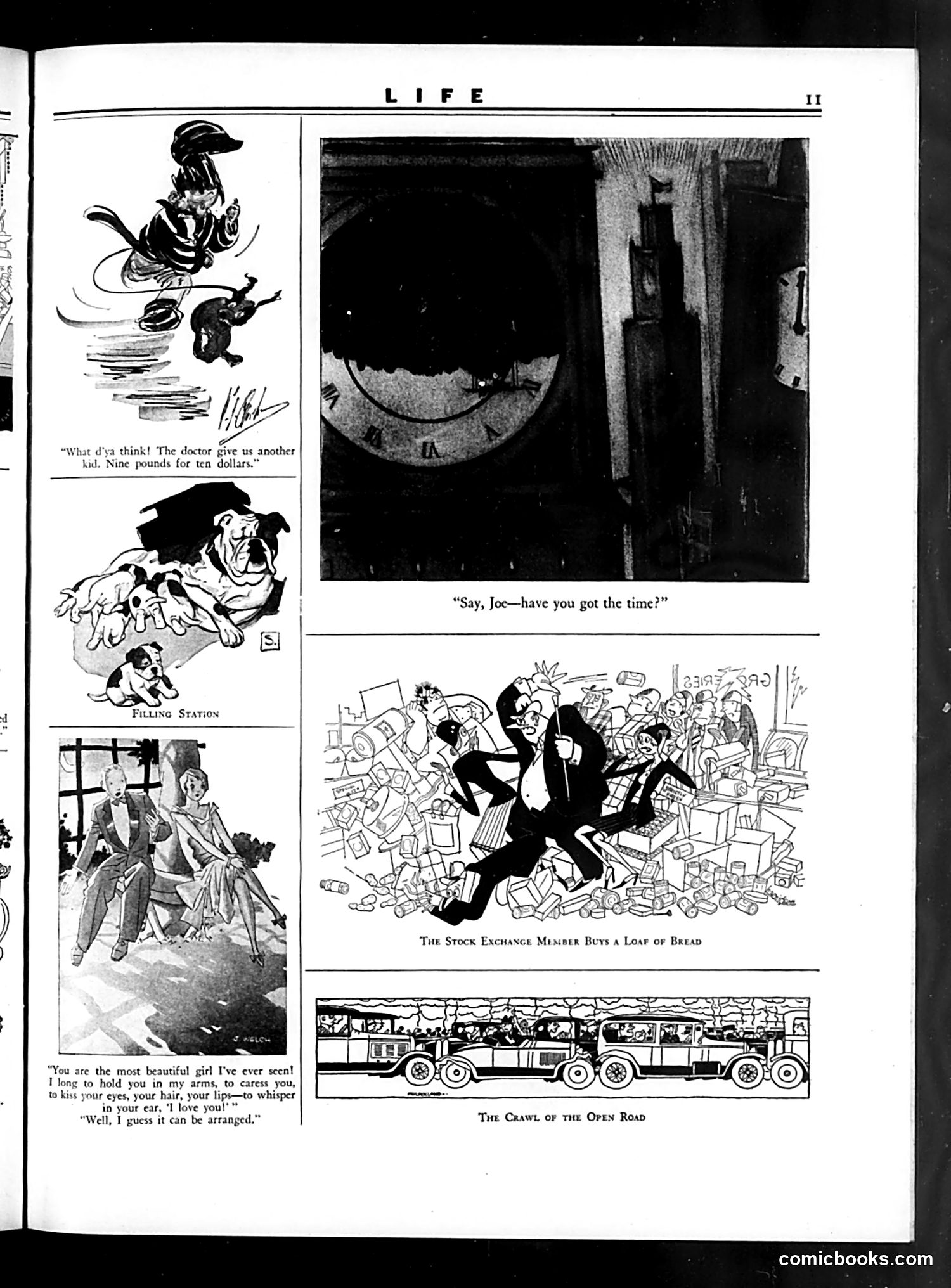
This page contains three satirical cartoons commenting on American social and economic life: 1. **"Filling Station"** (top left): Shows a doctor profiting from childbirth, joking that a newborn is worth "nine pounds for ten dollars"—mocking excessive medical fees. 2. **"The Stock Exchange Member Buys a Loaf of Bread"** (center): Depicts a well-dressed financier surrounded by chaos while purchasing bread, satirizing the contrast between wealthy Wall Street investors and ordinary economic necessities during what appears to be an inflationary period. 3. **"The Crawl of the Open Road"** (bottom): Shows a crowded touring car, likely commenting on automobile culture and vacation travel trends. The page reflects early-20th-century anxieties about medical costs, economic inequality, and modern consumer culture.
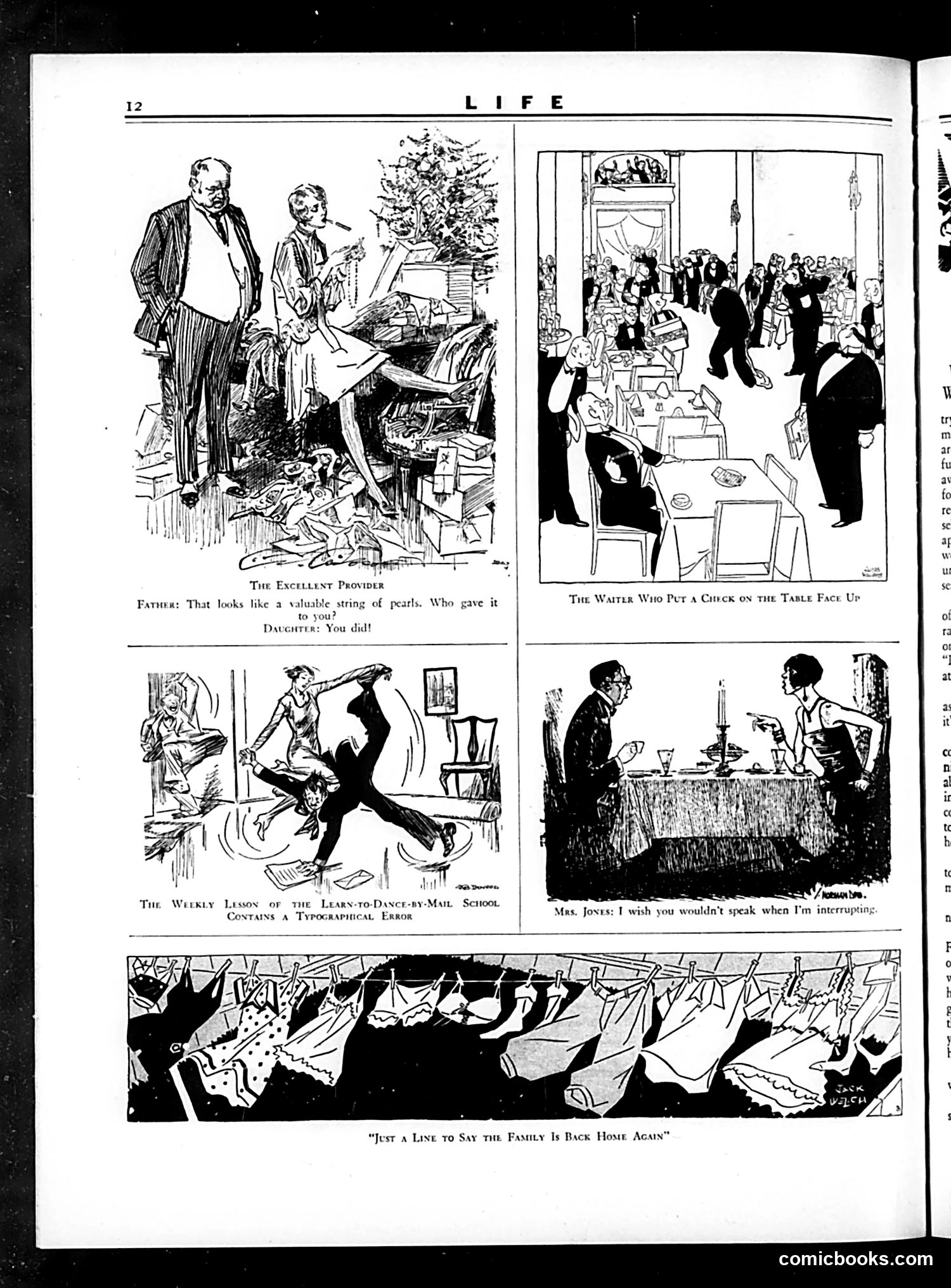
This page contains four humorous cartoons satirizing social situations: 1. **"The Excellent Provider"**: A father is confronted about a valuable pearl necklace. His daughter admits she purchased it, mocking paternal authority and suggesting financial irresponsibility. 2. **"The Waiter Who Put a Chuck on the Table Face Up"**: Shows a formal dinner scene with a waiter among guests, likely satirizing class confusion or service industry mishaps at upscale events. 3. **"The Weekly Lesson of the Learn-to-Dance-by-Mail School"**: A man appears to be falling or flailing during a dance lesson, mocking mail-order instruction's ineffectiveness. 4. **"Mrs. Jones"**: A domestic scene where a woman interrupts her husband, satirizing marital dynamics and communication struggles. 5. **Bottom panel**: Depicts laundry or clothing, captioned "Just a Line to Say the Family Is Back Home Again," likely satirizing mundane domestic life.
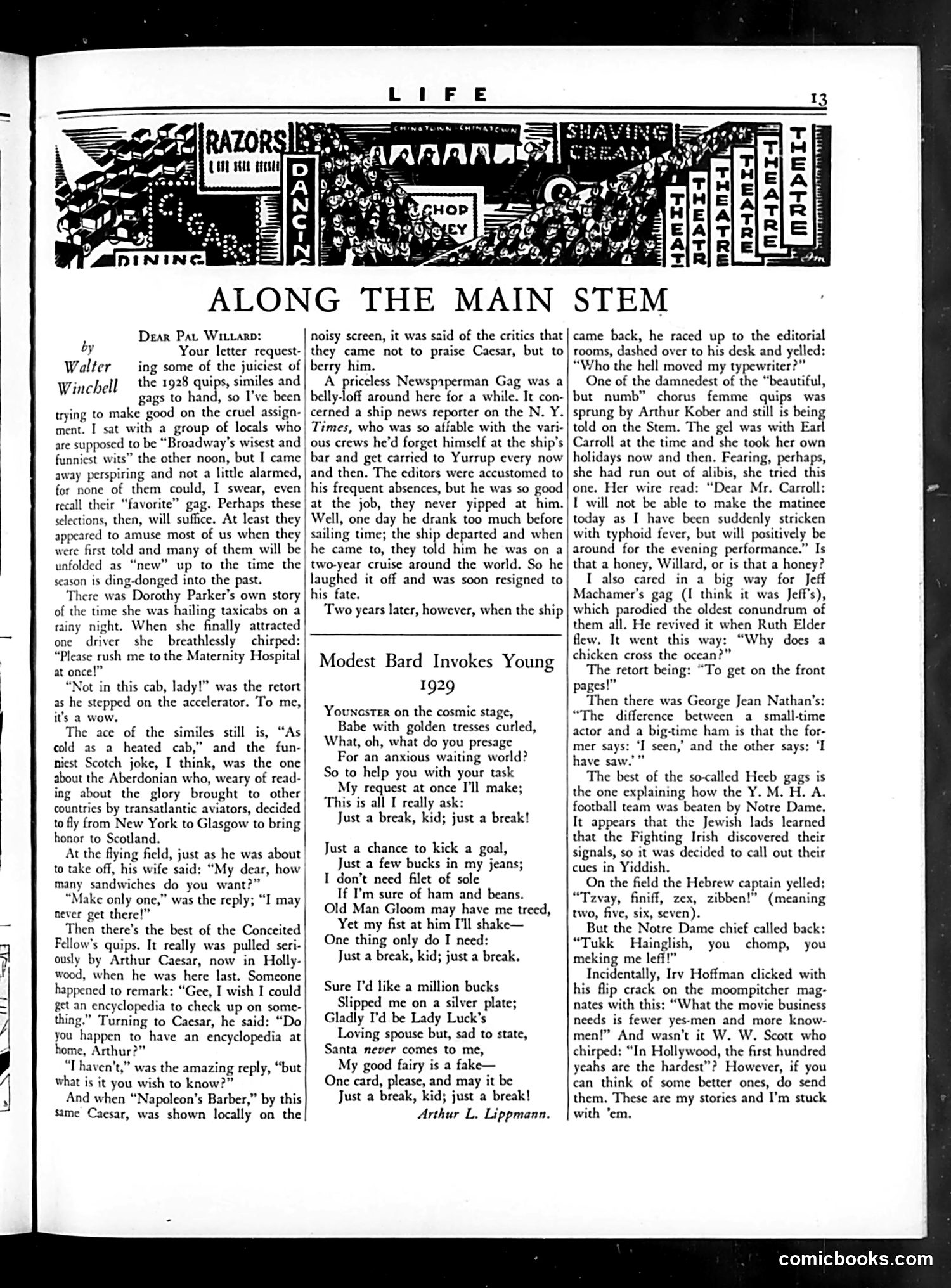
This page contains a humorous column titled "Along the Main Stem" by Walter Winchell, a famous gossip columnist. The header illustration shows various Manhattan businesses (razors, dining, shaving cream establishments). Winchell recounts anecdotes about Broadway personalities and theatrical life, including references to: - Dorothy Parker's wit - A "Newspaperman Gag" involving a character named Yurrup - Various Broadway performers and their escapades The center features a poem titled "Modest Bard Invokes Young 1929," credited to Arthur L. Lippmann, which is satirical verse about a young person seeking success and fortune. The overall tone is characteristic of Winchell's gossipy, rapid-fire style—mixing theatrical gossip with humorous observations about New York's entertainment scene and personalities of the era.
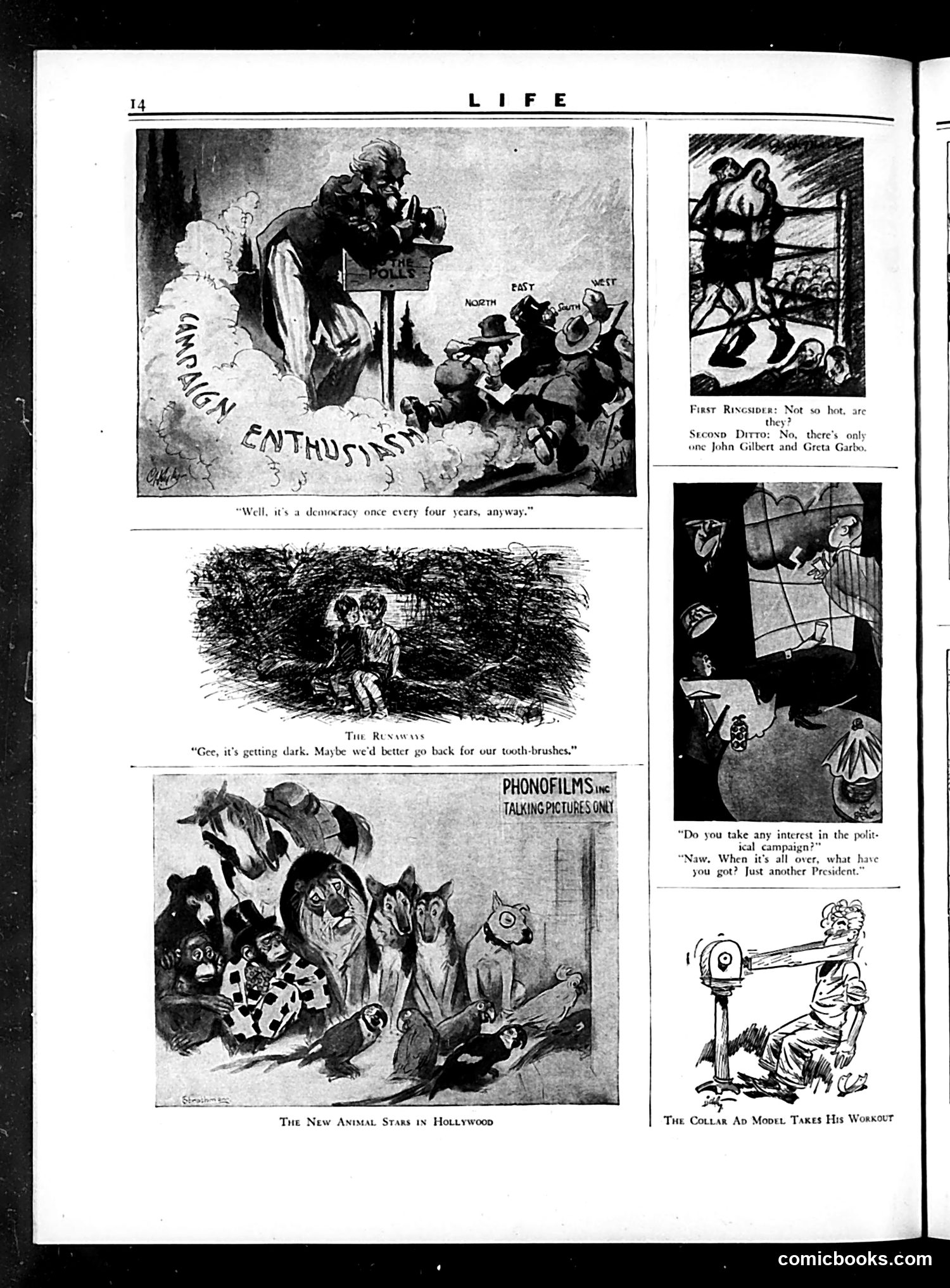
This page contains four political cartoons satirizing early 1920s American culture: 1. **Top cartoon** ("Well, it's a democracy once every four years, anyway"): A figure labeled "Waning Enthusiasm" stands atop a voting booth, suggesting public apathy between elections. 2. **"The Runaways"**: References children fleeing, likely commenting on social anxiety of the era (unclear specific reference). 3. **"The New Animal Stars in Hollywood"**: Depicts animals in a Phonofilms talking picture studio, satirizing Hollywood's transition to sound film and the absurdity of animal "actors." 4. **"The Collar Ad Model Takes His Workout"**: A man uses an exercise machine, satirizing fitness culture and commercial advertising. The page collectively mocks American political disengagement, entertainment industry trends, and consumer culture circa the 1920s.
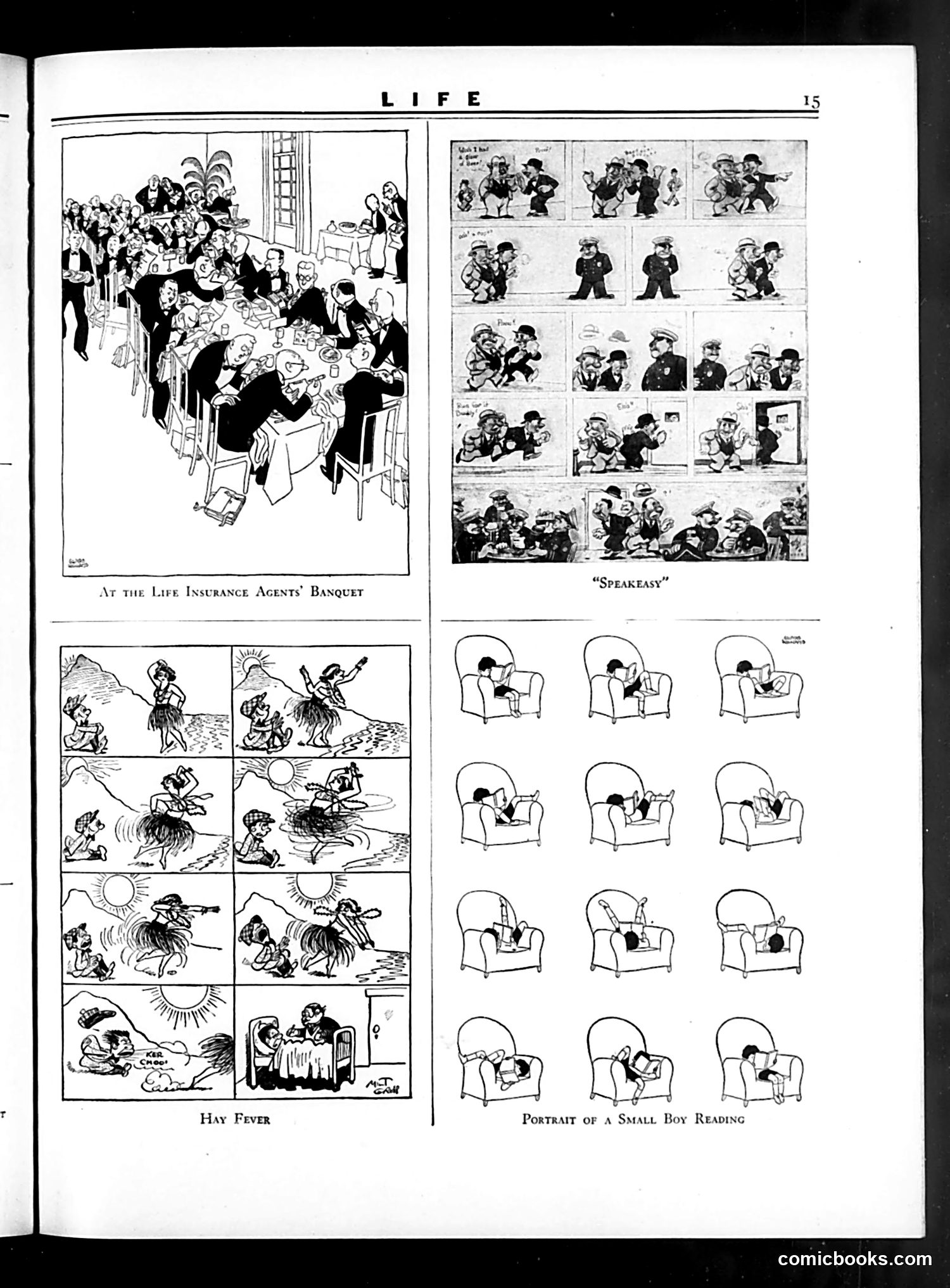
This page contains four distinct humorous cartoons: 1. **"At the Life Insurance Agents' Banquet"** (top left): A crowded formal dinner scene satirizing insurance salesmen's social gatherings. 2. **"Speakeasy"** (top right): A multi-panel comic strip referencing illegal bars during Prohibition, showing the furtive, comedic nature of underground alcohol consumption. 3. **"Hay Fever"** (bottom left): An eight-panel sequence depicting a man's escalating misery from allergic reactions—from outdoor sneezing to seeking refuge indoors. 4. **"Portrait of a Small Boy Reading"** (bottom right): Twelve simple panels showing a child's various contorted positions while absorbed in reading, humorously capturing childhood restlessness. These represent typical LIFE content: observational humor about everyday American experiences and social customs.
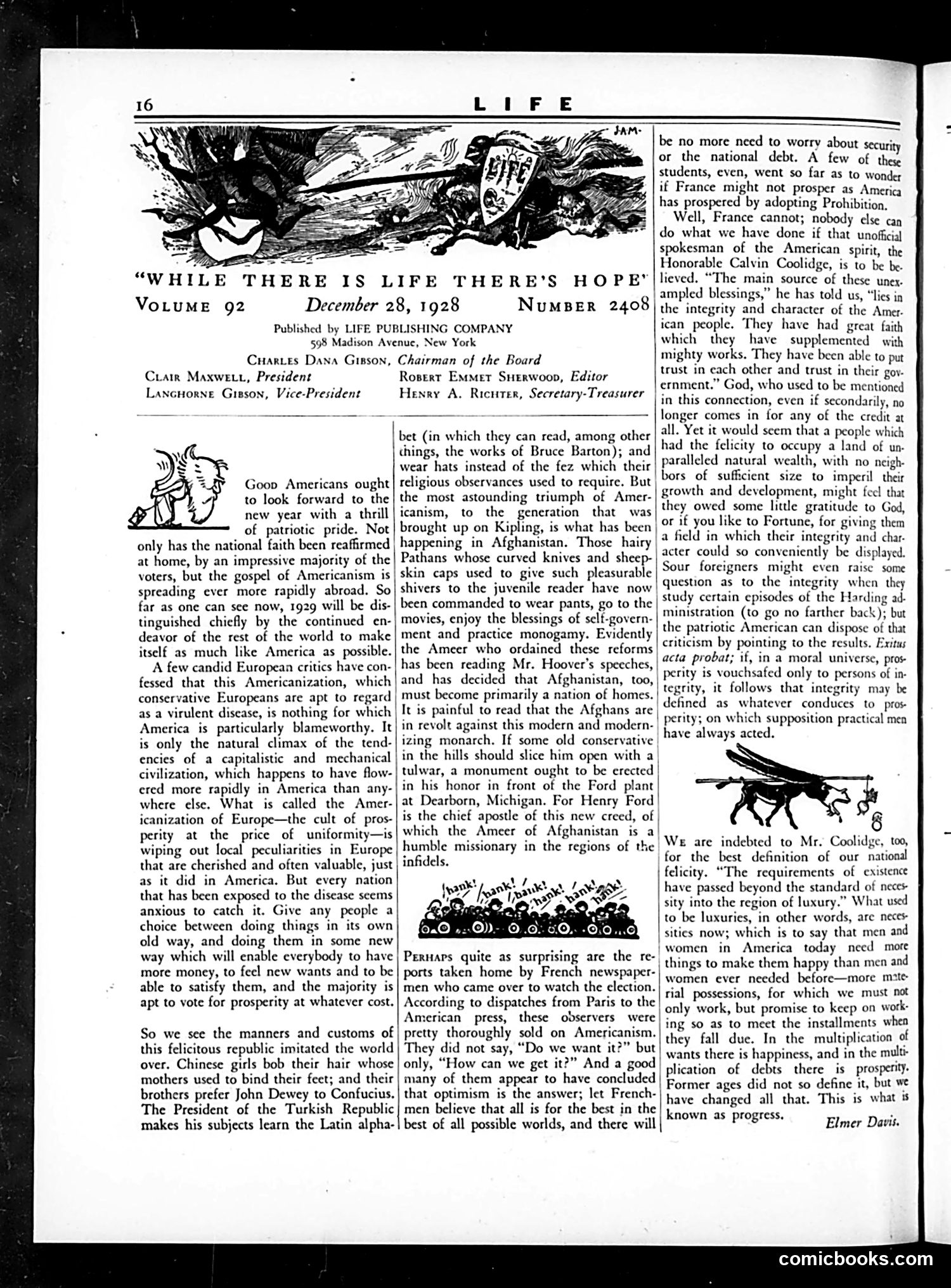
This Life magazine page (December 28, 1928) contains editorial commentary on American civilization and its global influence. The text celebrates American achievements—particularly Prohibition and the Ford Motor Company's modernization efforts—as evidence of American moral and technological superiority. The piece criticizes conservative Europeans who view Americanization as a threat to traditional culture. It argues Americans should take pride in exporting their values worldwide, citing examples like the adoption of Prohibition in Afghanistan and Ford's industrial methods in Michigan. The illustration appears to show a cow or livestock, likely satirizing rural or traditional elements being modernized by American industry and values—a visual representation of the "Americanization" debate the article discusses.
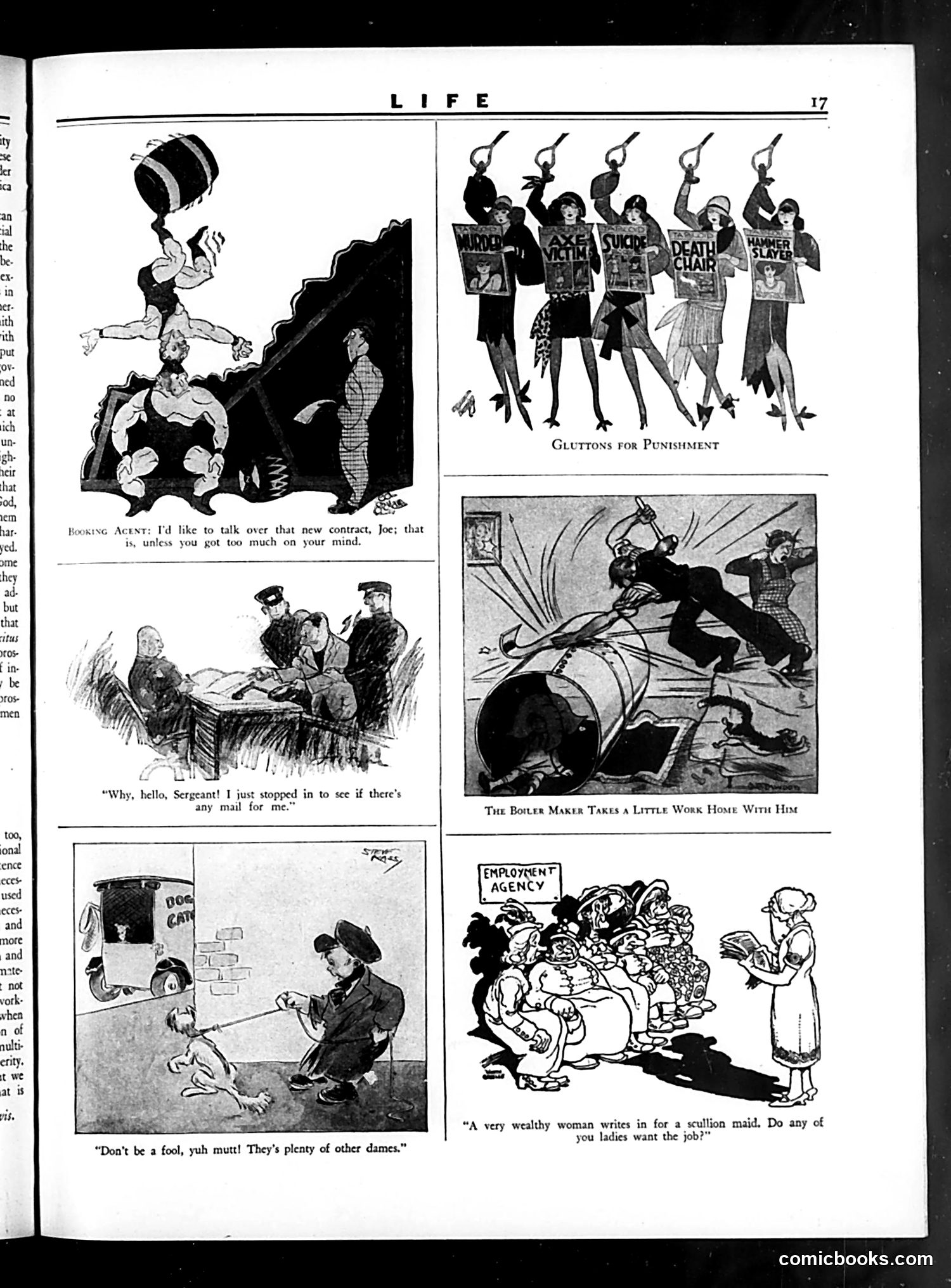
This page contains satirical cartoons addressing early 20th-century social issues: **"Gluttons for Punishment"** depicts women wielding various implements labeled with tools of domestic labor (axe, chair, hammer, slayer), suggesting women were willing participants in their own subjugation through housework. **"The Boiler Maker Takes a Little Work Home"** shows a working man struggling with industrial equipment at home, satirizing how labor-class work intruded on domestic life. **"Don't be a fool, yuh mutt!"** depicts a dog catcher, mocking recruitment or coercion tactics. **The employment agency cartoon** satirizes the desperation of job-seeking women, with a wealthy woman seeking a "scullion maid" while many applicants crowd the agency, commenting on economic inequality and exploitative labor practices.
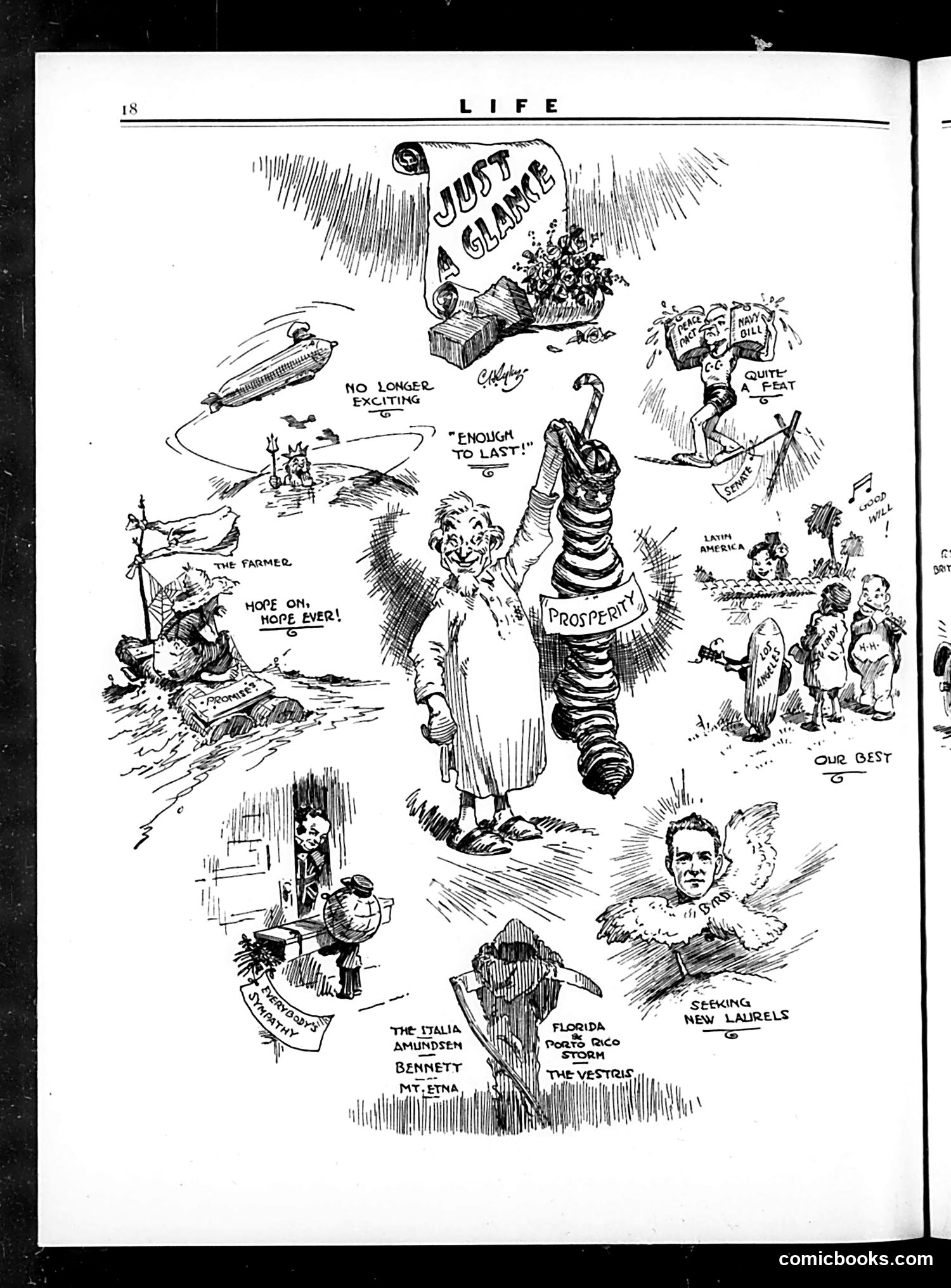
This is a satirical cartoon addressing early 1910s disasters and disappointments. The central figure holds "Prosperity" while surrounded by catastrophes: a sinking ship labeled "No Longer Exciting," a farmer saying "Hope On, Hope Ever," and references to major events including the Titania (likely the Titanic), Mt. Etna eruption, the Amundsen-Bennett polar expedition, the Florida Porto Rico Storm, and the Vestris shipwreck. The "Just a Glance" banner at top suggests fleeting optimism despite accumulating tragedies. The cartoon satirizes American optimism in the face of repeated disasters—both natural and man-made—questioning whether prosperity and hope can genuinely persist given such repeated setbacks. It's social commentary on resilience versus realism during a tumultuous period.
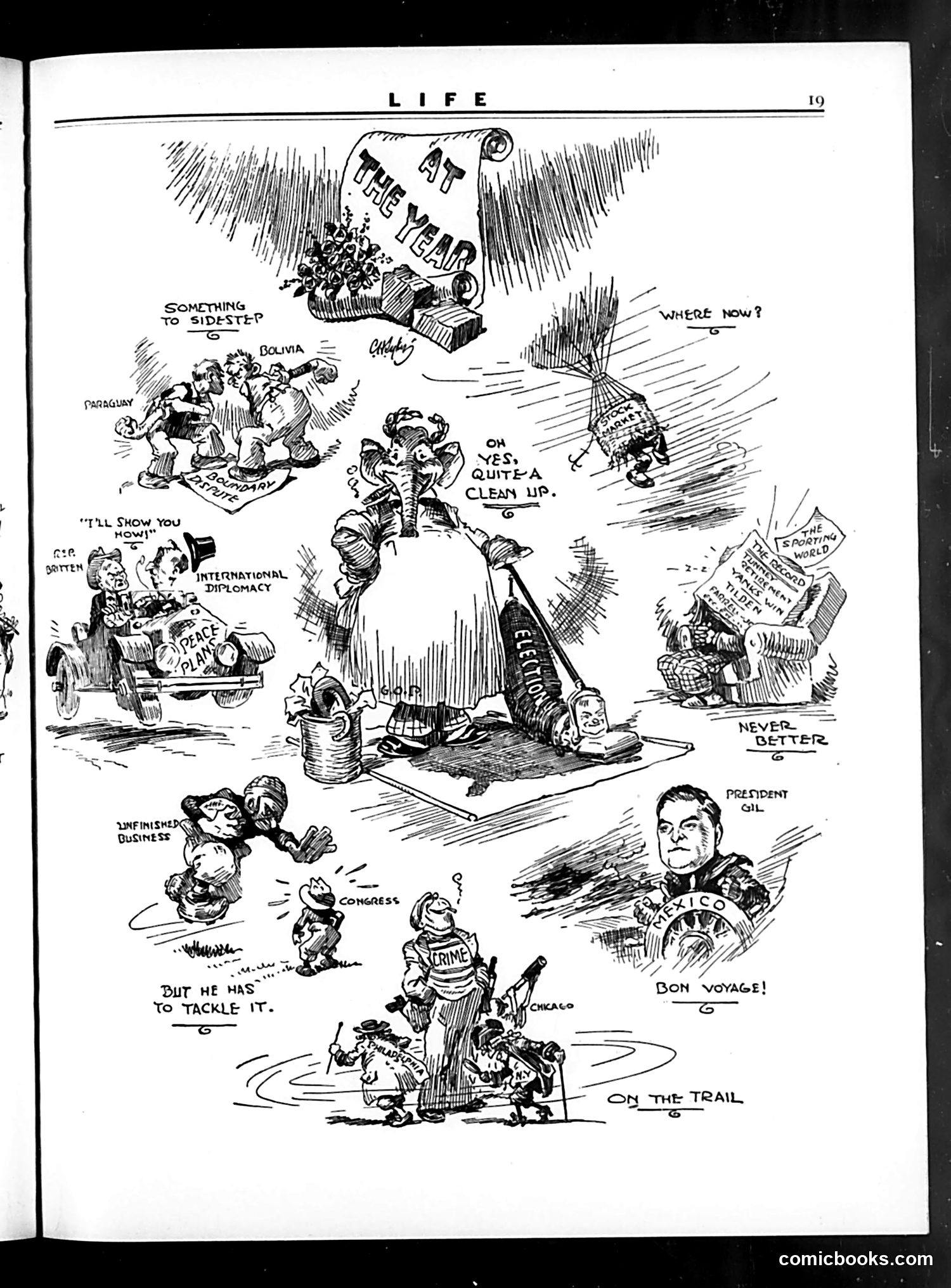
This Life magazine cartoon depicts the challenges facing a political leader (likely a U.S. President) at year's end. The central figure confronts multiple domestic and international crises represented as caricatured problems: - **Bolivia** and **Paraguay** represent Latin American diplomatic issues - **International Diplomacy** and a "peace plan" show foreign policy concerns - **Crime in Chicago** symbolizes urban lawlessness - **Congress** and **Unfinished Business** represent legislative gridlock - **Mexico** appears as a border concern ("Don Voyage!") The surrounding vignettes ("Where now?", "Never Better", "On the Trail") suggest the leader must navigate or "tackle" these competing pressures simultaneously. The cartoon satirizes how politicians attempt to sidestep serious problems while facing inevitable accountability—suggesting 1920s-era political chaos and the difficulty of governing amid multiple crises.
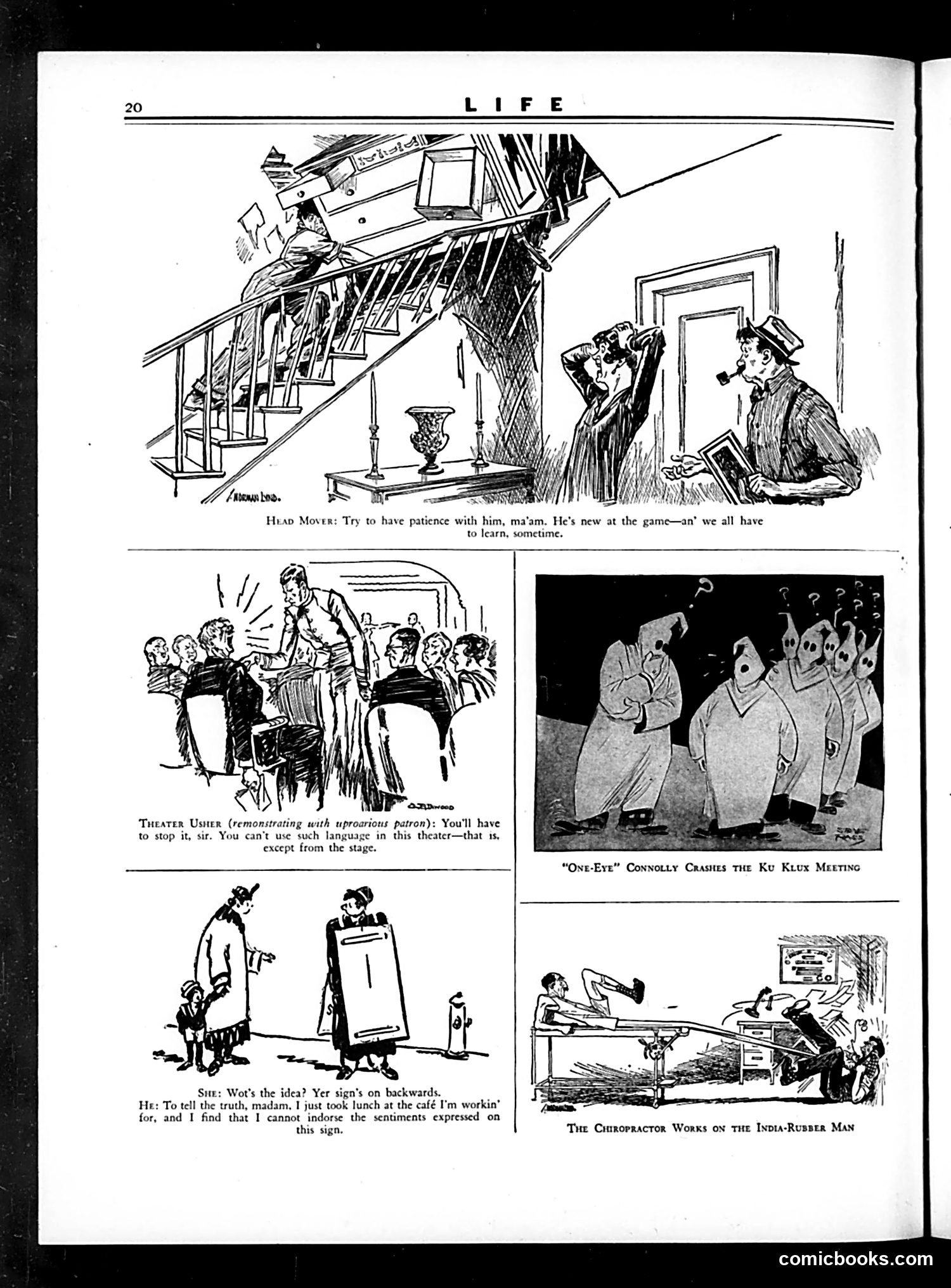
This page contains four separate satirical cartoons commenting on contemporary social issues: 1. **"Heap Mover"**: Jokes about incompetent moving companies and the need for patience with inexperienced workers. 2. **"Theater Usher"**: Satirizes theater etiquette—the irony being that profanity is acceptable "from the stage" (performers) but not from paying patrons, mocking theatrical hypocrisy. 3. **"Backwards Sign"**: A worker refuses to endorse his employer's café by displaying their sign backwards, criticizing either false advertising or poor working conditions. 4. **"One-Eye Connolly Crashes the Ku Klux Meeting"** (photograph) and **"Chiropractor Works on India-Rubber Man"**: Mock the KKK and quack medical practices respectively, reflecting early 20th-century concerns about extremist groups and fraudulent healthcare. The cartoons reflect ordinary working-class life and contemporary skepticism toward institutions.
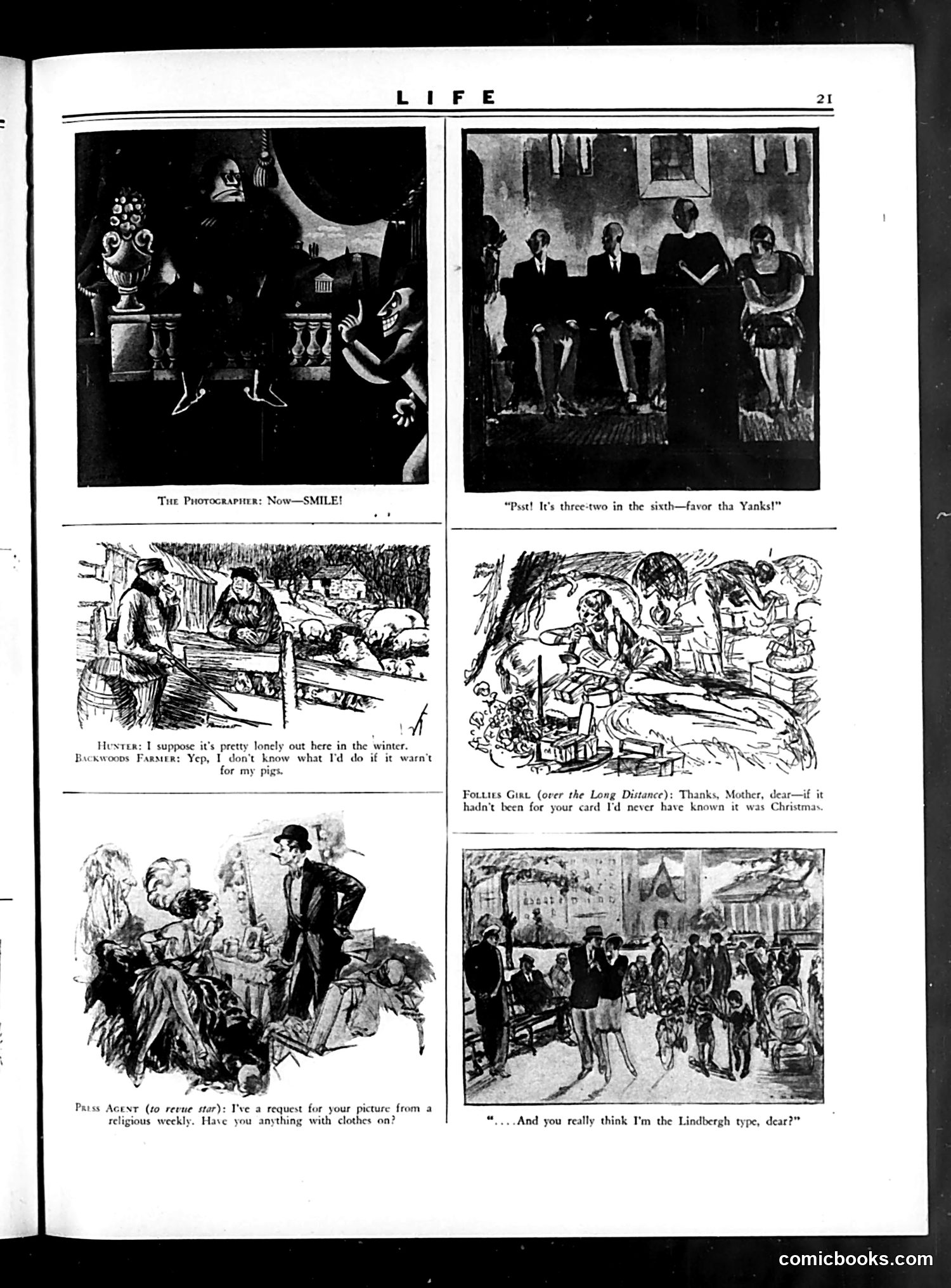
This page contains five separate humorous illustrations satirizing American social life circa the 1920s-30s: 1. **"The Photographer: Now—SMILE!"** mocks forced photo posing conventions. 2. **"Puff! It's three-two in the sixth"** jokes about baseball enthusiasm at formal events (possibly a courtroom or official setting). 3. **Hunter/Backwoods Farmer** satirizes rural isolation—the farmer's only companionship is his pigs. 4. **Follies Girl's long-distance call** mocks both rural disconnection from Christmas and maternal sentimentality. 5. **Film Agent to revue star** makes a double joke: the religious weekly's prudish request for clothed photos, and a sarcastic reference to "Lindbergh type" (likely playing on Charles Lindbergh's fame and possibly his physical appearance or public image as an idealized American). The page's humor targets class differences, rural versus urban life, and entertainment industry absurdities.
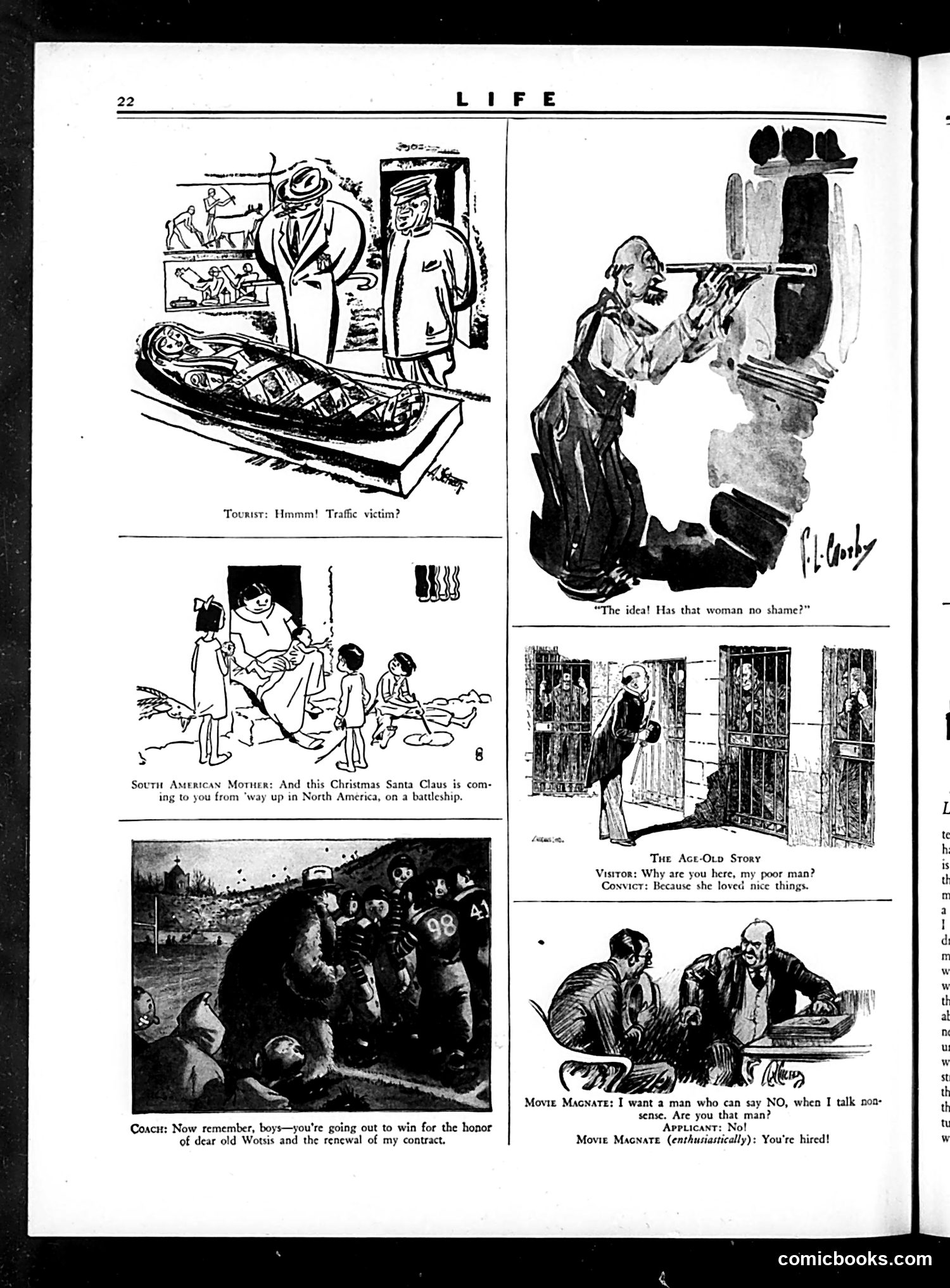
This satirical page contains several standalone gags mocking contemporary society: **Top left:** A tourist mistakes a dead body for a "traffic victim"—satirizing how common traffic deaths had become. **Middle left:** A South American mother references Santa arriving "on a battleship," likely mocking militarization or American military presence in the hemisphere. **Bottom left:** A coach pressures his team to win "for the honor" of their school and his contract renewal—exposing the hypocrisy of athletic institutions prioritizing profit over principle. **Right side comics:** "The Age-Old Story" depicts a convict imprisoned because "she loved nice things"—suggesting women's materialism causes crime. The "Movie Magnate" sketch plays on Hollywood's contradictions: hiring someone precisely *because* he refuses to question nonsense, inverting the stated requirement. Overall, the page satirizes American traffic culture, militarism, collegiate sports corruption, and Hollywood's absurd hiring practices.
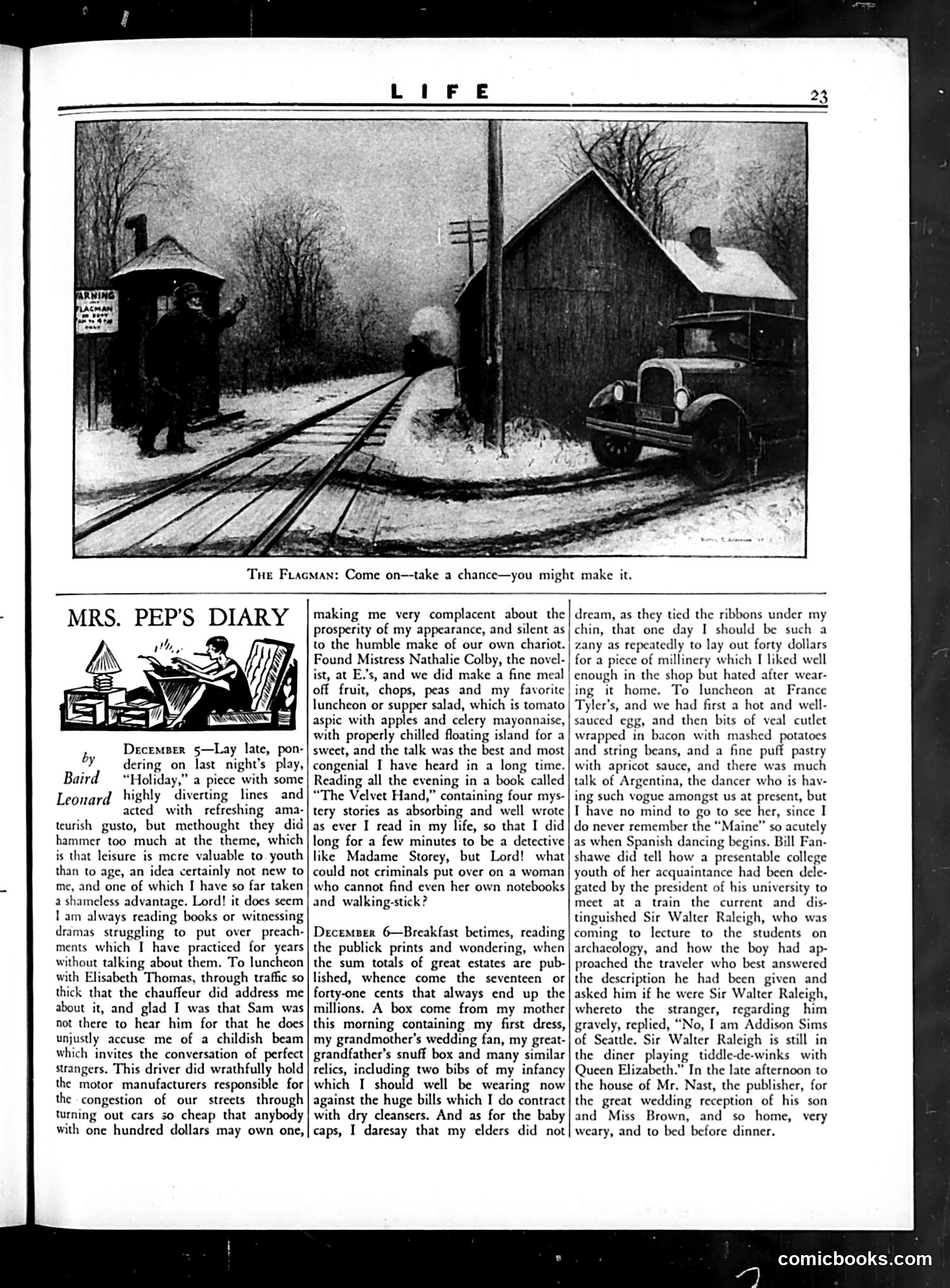
**The Cartoon:** The top image shows a flagman at railroad tracks warning a car driver to "take a chance"—implying the driver might not make it across. This satirizes the early automobile era's dangerous intersection with established rail infrastructure, reflecting contemporary anxieties about new technology and traffic safety. **"Mrs. Pep's Diary":** A humorous column by Baird Leonard depicting an upper-class woman's social observations. The entries (December 5-6) catalog leisurely activities—attending theater, lunching with literary acquaintances, reading mystery novels—while sardonically noting her own contradictions: she lectures others about virtue while indulging in luxury spending, and she complains about cheap automobiles congesting streets while riding in one herself. The humor relies on **social irony**: Mrs. Pep embodies the privileged class's obliviousness to hypocrisy. References like "The Velvet Hand" and the anecdote about Sir Walter Raleigh (humorously mistaken identity) were likely recognizable to Life's educated readership.
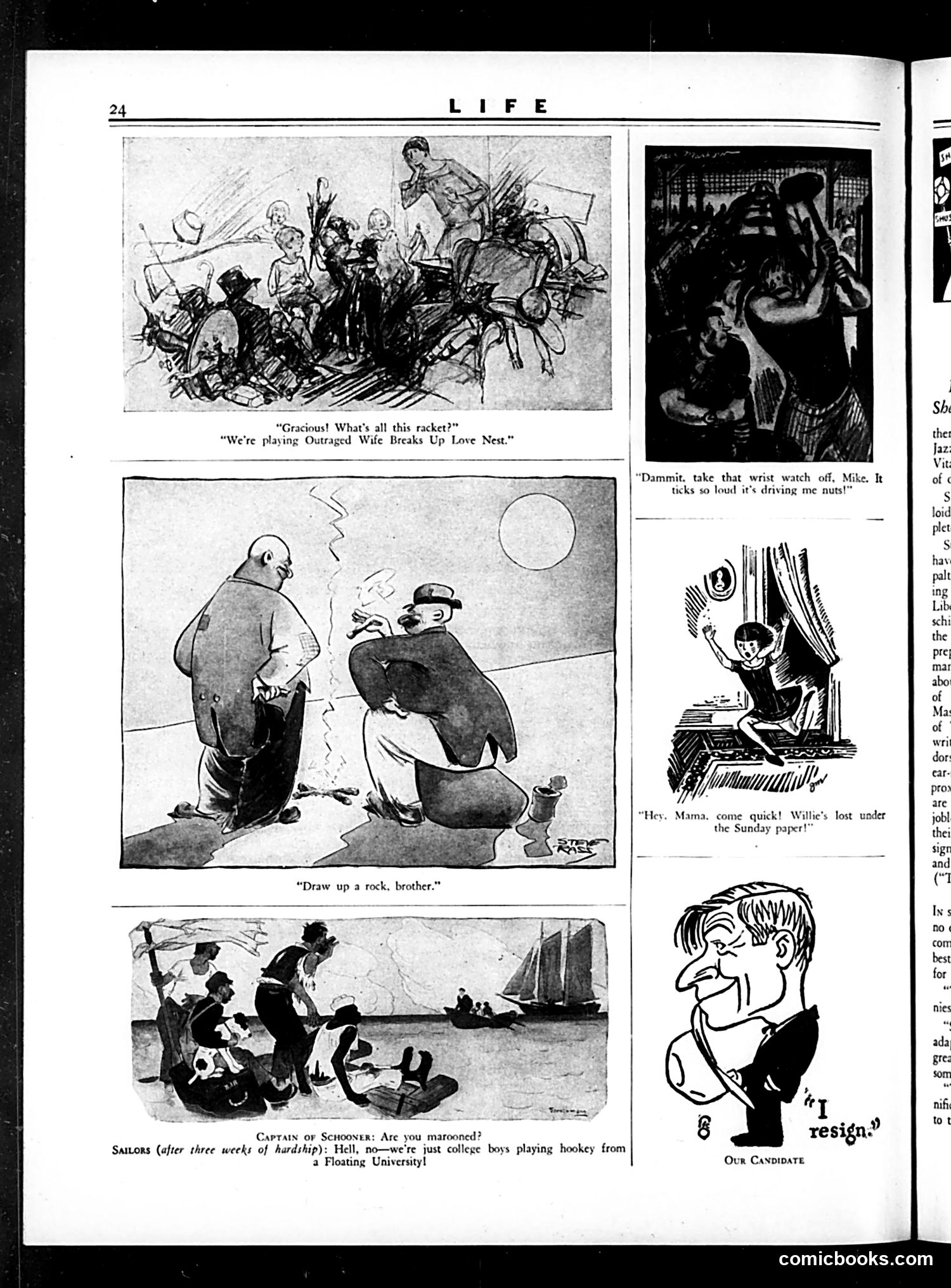
This page contains several humor cartoons satirizing domestic life and social situations circa early 20th century: **Top cartoon**: "Outraged Wife Breaks Up Love Nest" - mocks theatrical melodrama by showing people literally playing-acting this scenario, with one character complaining a wrist watch's ticking is too loud for the performance. **Middle cartoon**: "Draw up a rock, brother" - jokes about a child lost under a newspaper, reflecting on how newspapers dominate household attention. **Bottom cartoon**: Sailors claim to be "college boys playing hookey from a Floating University" rather than admit being marooned. This satirizes college pranks and youthful irresponsibility disguised as education. The final illustration shows "Our Candidate" - a caricatured political figure saying "I resign," likely mocking politicians' scandals forcing resignations. Overall, the page ridicules domestic pretense, theatrical excess, and youthful deception presented as innocent fun.
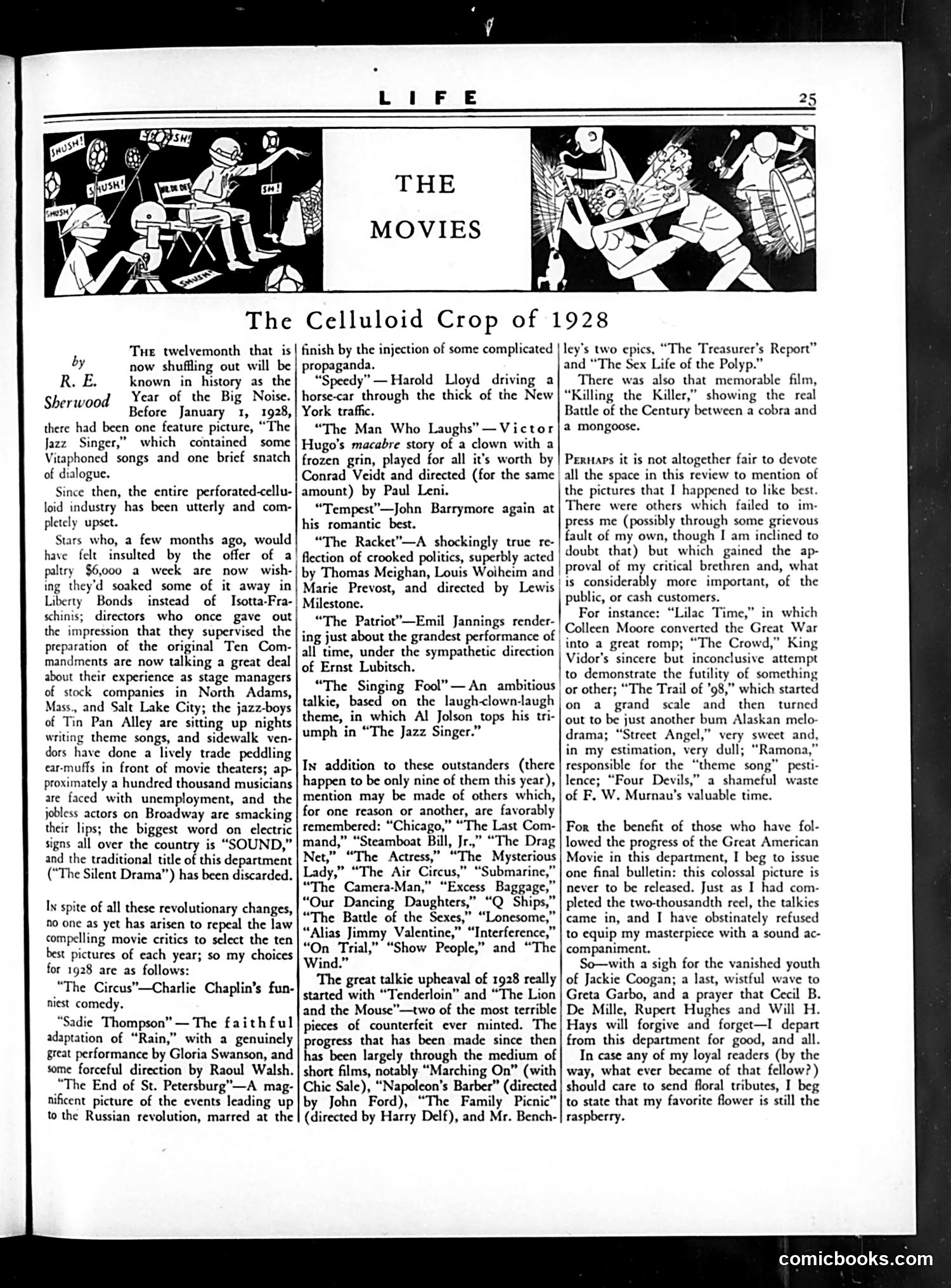
This page reviews 1928 films, a pivotal year when "talking pictures" (talkies) disrupted the silent film industry. The cartoons at the top depict the chaos of this transition—showing film crews, actors, and equipment in frantic disarray. The article explains the upheaval: silent film stars now feared obsolescence; unemployed stage actors suddenly became valuable; musicians who'd accompanied silent films lost jobs; and the industry scrambled to adapt. The author notes the ironic contradiction—despite this revolutionary turmoil, film critics still follow the old tradition of selecting "ten best pictures." The reviews praise films like Chaplin's *The Circus*, Gloria Swanson's *Sadie Thompson*, and notably *The Jazz Singer* (which launched talkies). The piece criticizes early talkies *Tenderloin* and *The Lion and the Mouse* as "terrible pieces of counterfeit," suggesting the transition's technical challenges. The satire captures 1928's anxiety: an established industry suddenly rendered obsolete by new technology, with widespread economic displacement and uncertainty about quality amid rapid change.
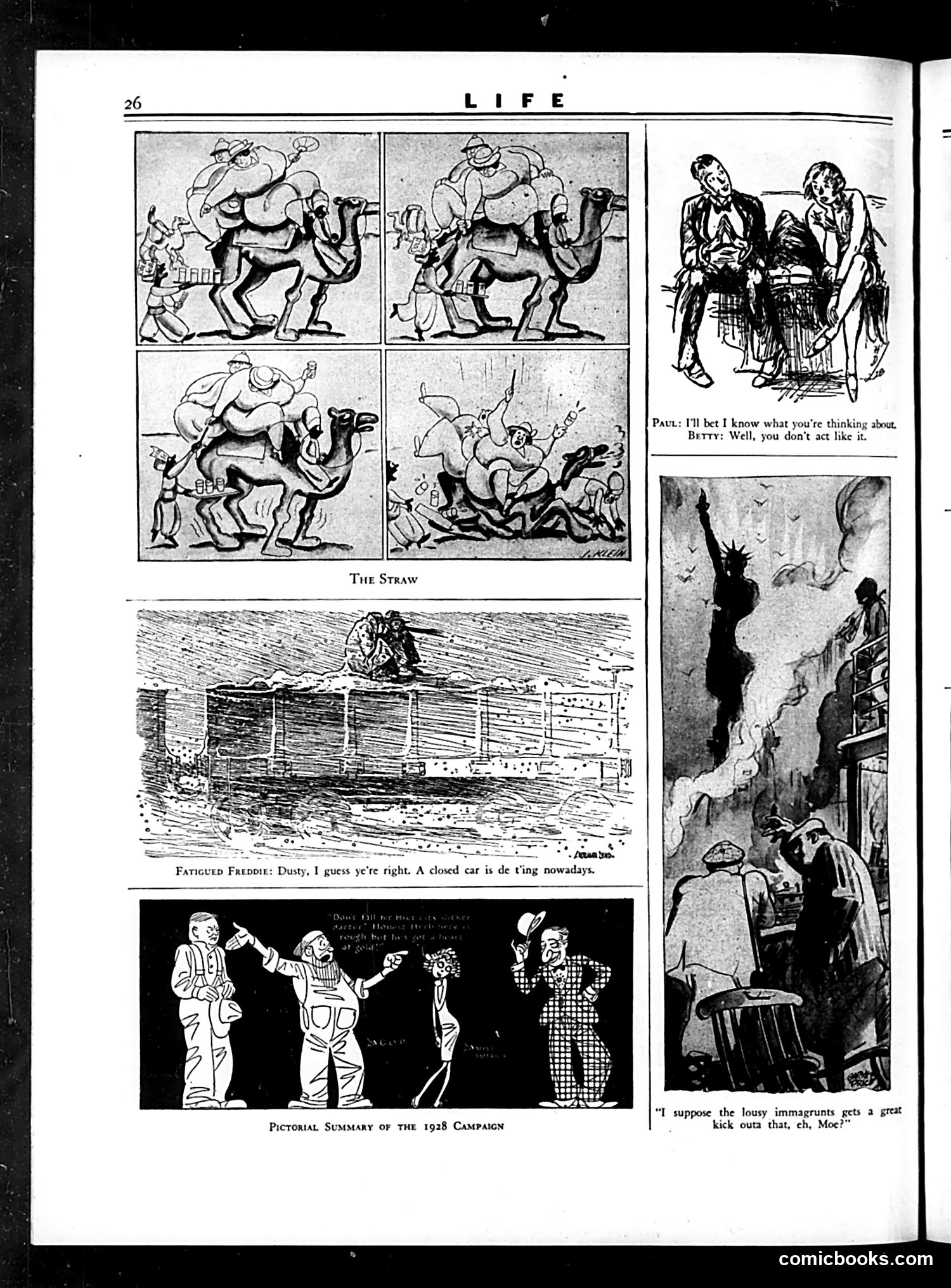
This page contains several cartoons satirizing the 1928 U.S. presidential campaign. "The Straw" depicts a heavily-laden camel collapsing under accumulated burdens—likely representing voter fatigue or the weight of campaign issues. The "Pictorial Summary of the 1928 Campaign" strip shows figures in exaggerated poses, apparently mocking the candidates' rhetoric or campaign theatrics. Two conversational comics address social themes: one depicts a domestic dispute about inattentiveness, while another uses ethnic stereotyping (the character "Moe" speaks in dialect) to mock immigrants' political engagement or exclusion. The latter reflects 1920s-era nativist sentiment and anti-immigrant attitudes prevalent in American media of that period—attitudes Life magazine's satire appears to be targeting, though the execution relies on offensive stereotypes typical of the era.
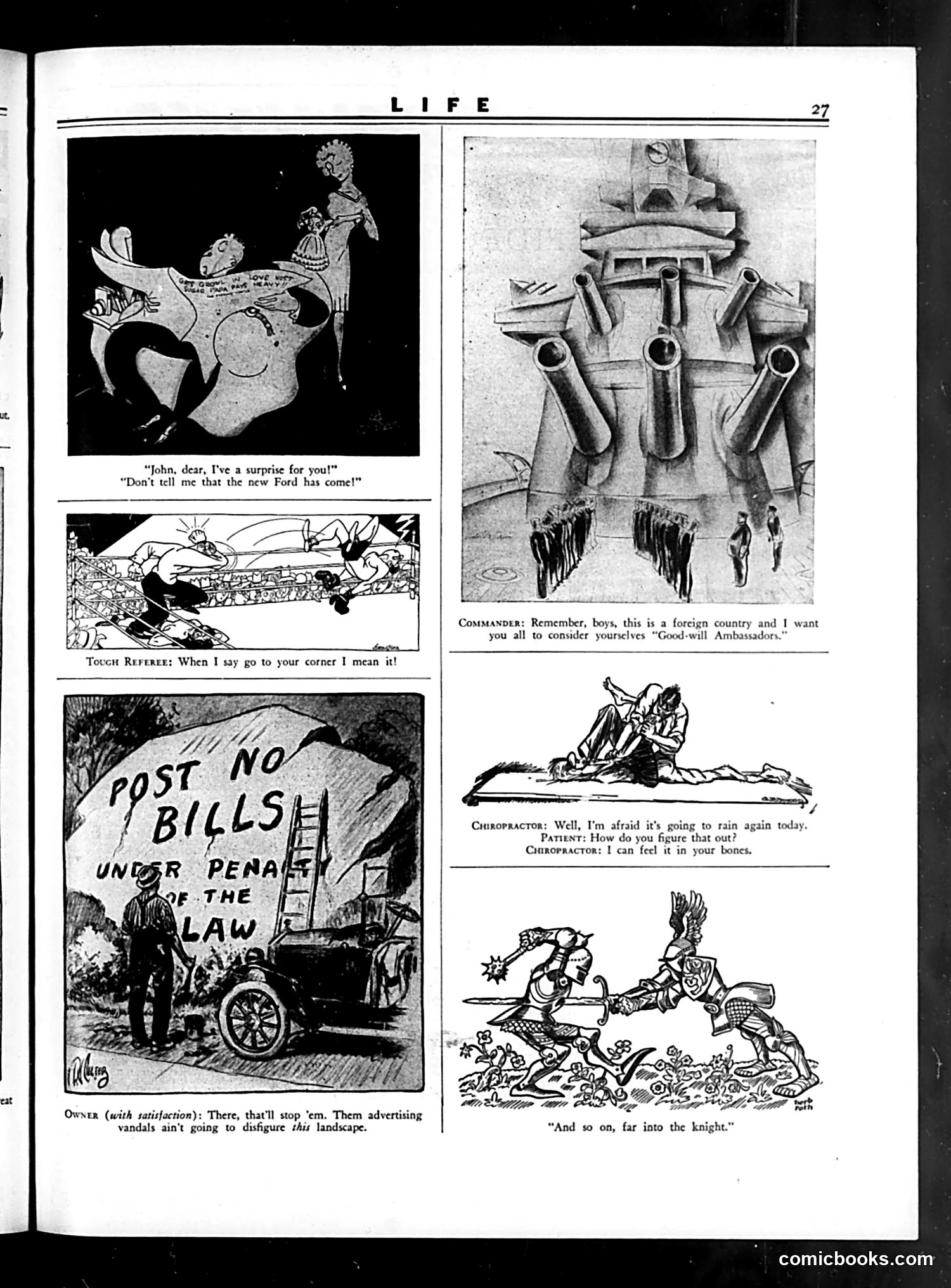
This page contains four separate comic strips satirizing early 20th-century American culture: 1. **Top left**: A domestic joke about the Ford automobile's popularity—a wife's surprise is assumed to be a new Ford, suggesting the car's cultural dominance. 2. **"Tough Referee"**: A sports humor piece about strict officiating. 3. **"Post No Bills" cartoon**: Mocks a property owner posting legal warnings against bill-posting/advertising vandalism on his land, but the sign itself becomes an advertisement, defeating his purpose. 4. **Chiropractor/Medical jokes**: Two separate gags—one about a chiropractor diagnosing rain by feeling bones (pseudoscientific absurdity), another about a knight ("far into the knight," a pun). 5. **Military cartoon**: Officers instructing soldiers to be "Good-will Ambassadors" in a foreign country, likely satirizing American military conduct abroad. The page demonstrates LIFE's focus on domestic humor, commercial critique, and gentle social satire typical of the era.
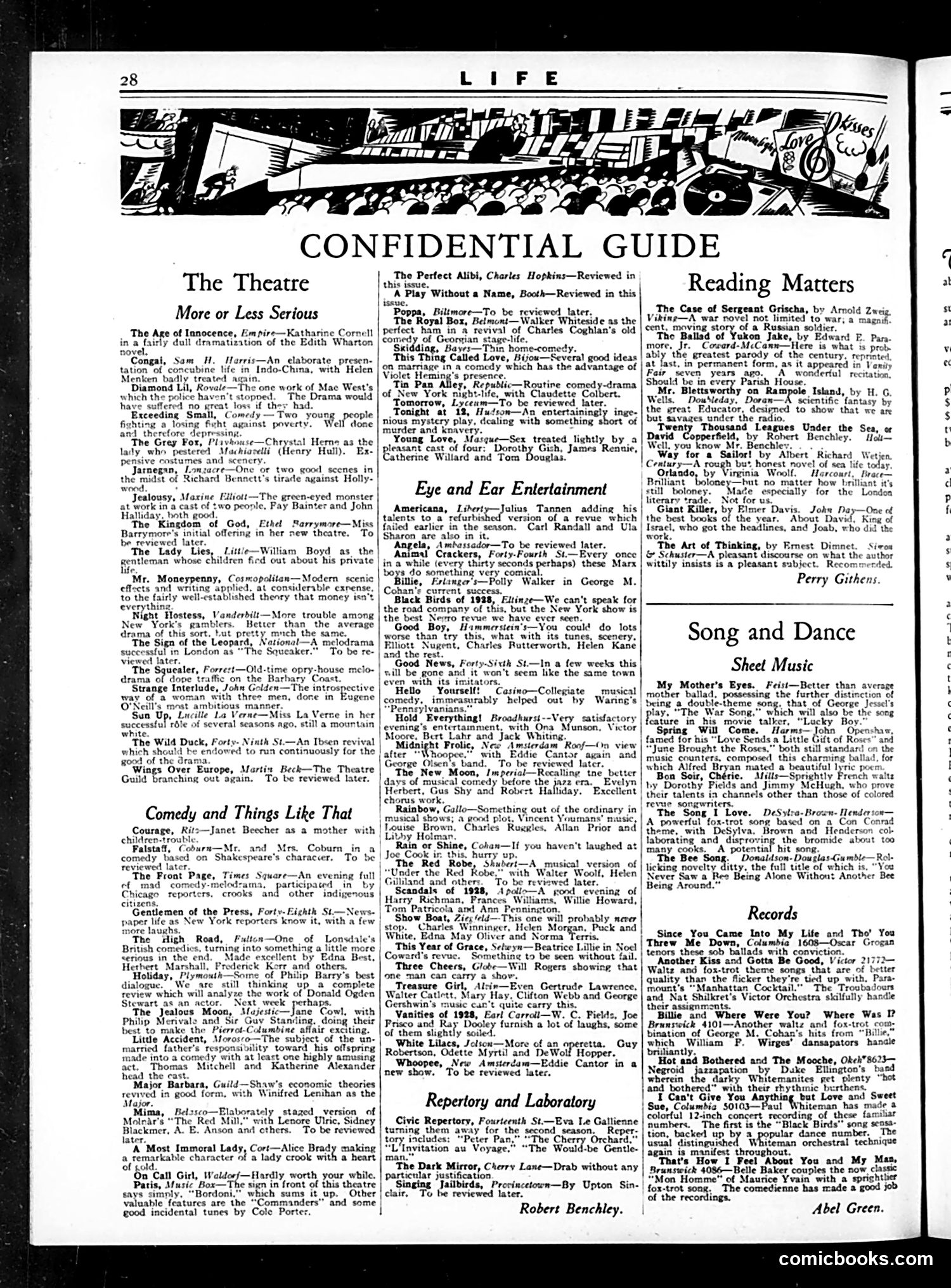
This page from Life magazine is not a cartoon or satirical piece, but rather a **"Confidential Guide"** — an entertainment review section listing Broadway theatrical productions, musicals, and records from the 1920s era. The guide contains brief critical summaries of numerous plays (such as *The Age of Innocence* with Katharine Cornell, Mae West's *Diamond Lil*, and Ibsen's *The Wild Duck*), organized by tone. Text notes which shows are worthwhile and which are tedious. The decorative header features **stylized theatrical and entertainment imagery** — musical notes, theater masks, audience silhouettes — typical Art Deco design common to the period. Rather than political satire, this represents **contemporary entertainment journalism**, helping affluent readers decide which Broadway shows merited their time and money. The frank, sometimes cutting reviews reflect Life's satirical voice applied to theater criticism rather than political commentary.
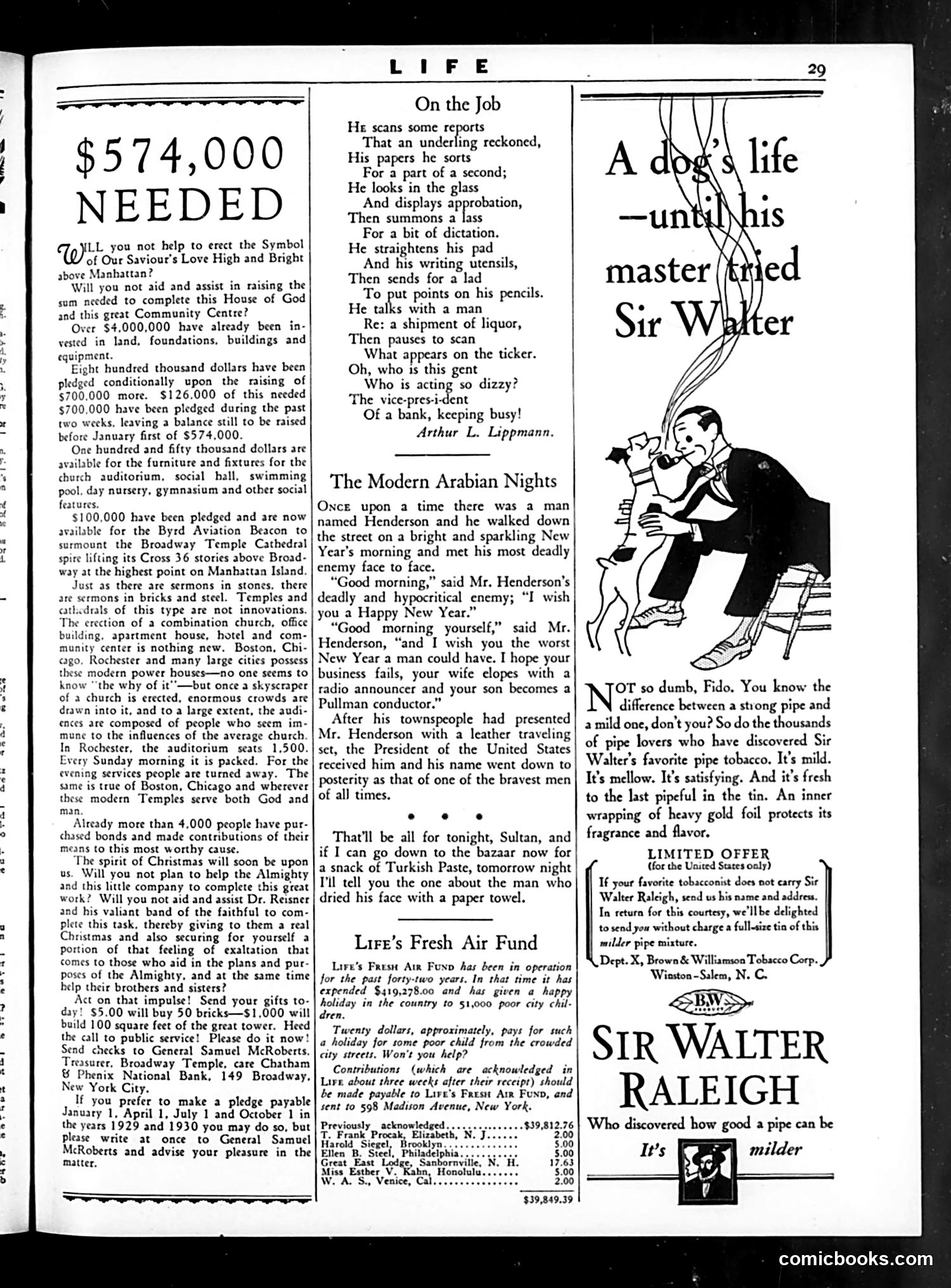
This page contains multiple elements: a fundraising appeal for Broadway Temple Cathedral (a massive church-office-hotel hybrid in Manhattan), a humorous poem about office inefficiency, and a satirical story. **"On the Job" poem** mocks a bank vice-president who appears busy but accomplishes nothing—scanning reports for seconds, summoning staff to sharpen pencils, checking stock tickers. The satire targets corporate pretense and performative busyness during the prosperous 1920s. **"The Modern Arabian Nights"** begins a story about a man named Henderson encountering his business rival on New Year's morning, wishing each other the worst possible luck (business failures, eloping wives, etc.). This gentle satire comments on competitive business culture. The large fundraising text promotes a combination church-apartment-office tower as a "modern power house," claiming similar structures in Boston and Chicago draw enormous crowds. This reflects 1920s architectural ambition and religious institution expansion. The page's overall tone suggests *Life* magazine's satirical stance toward American business culture, religious commercialism, and corporate theatricality.
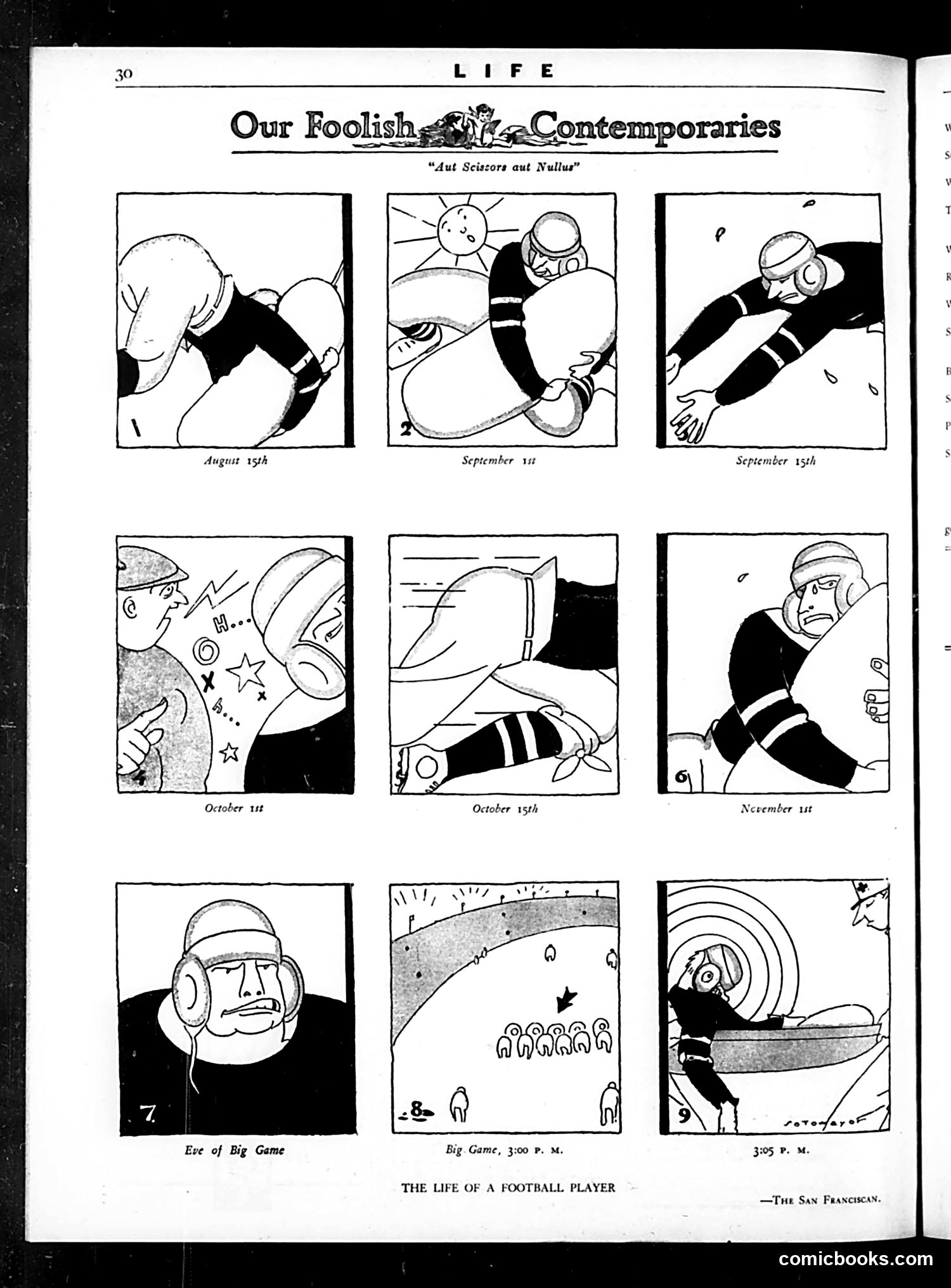
This is a satirical comic strip titled "The Life of a Football Player" subtitled "Aut Scizora aut Nullus" (Latin: "Either a scissors or nothing"). It mocks the physical toll of football through nine sequential panels dated August through November, chronicling a player's progressive injuries across the season. The panels show the player increasingly battered: starting with minor bruising in August, progressing through September collisions, October stars-and-birds injury effects, and by November appearing dazed and concussed. The final panels depict the player's deteriorating state during and after a game, culminating in what appears to be complete physical breakdown. The satire critiques football's brutality and the casual acceptance of player injury in early 20th-century sports culture. The Latin motto suggests the choice between violent injury ("scissors"—cutting/slashing) or nothing, implying football offered no middle ground.
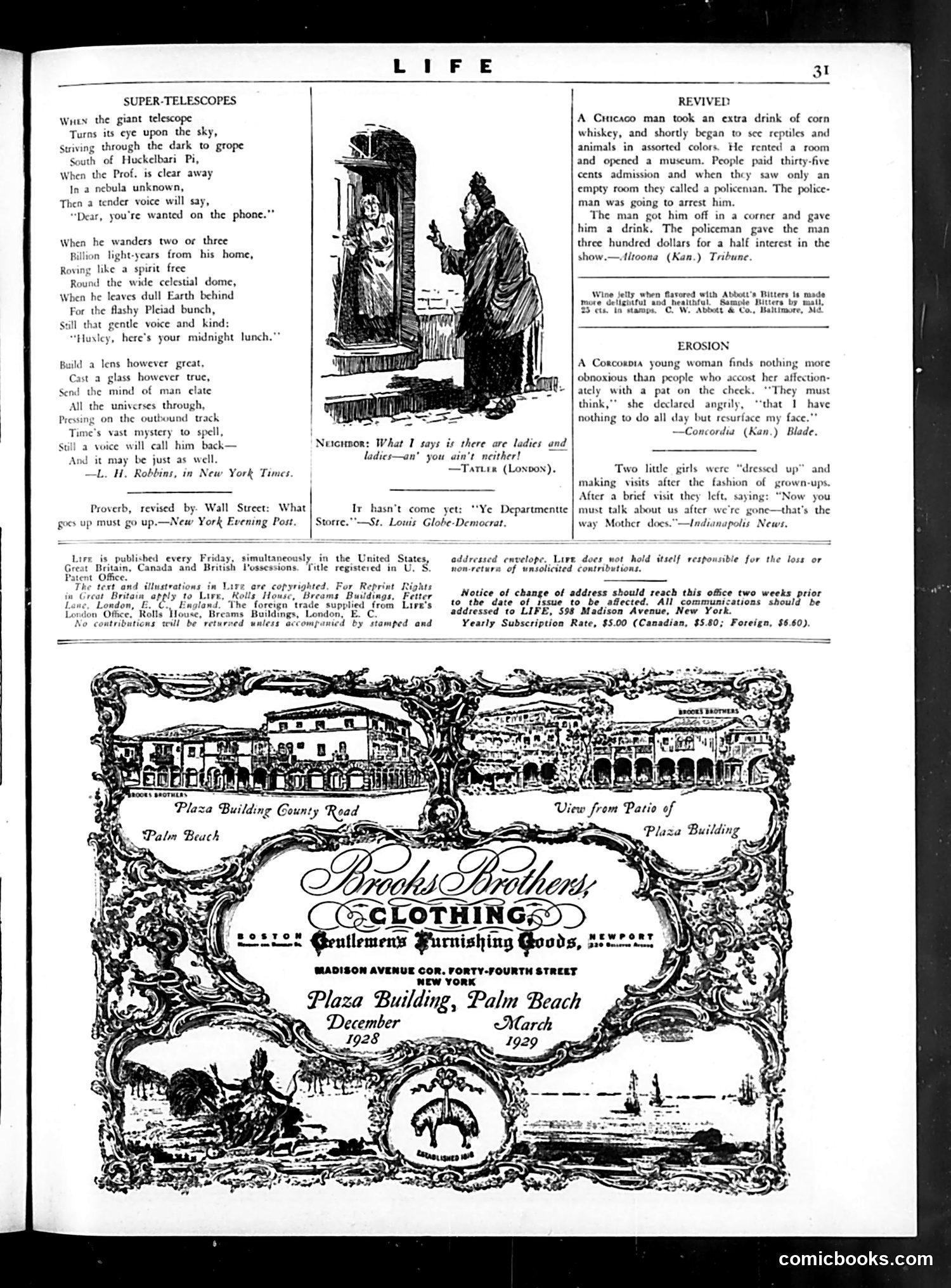
This page contains several short satirical pieces typical of Life's humor magazine format: **"Super-Telescopes"** (poem): A gentle satire on scientific ambition. A professor uses an advanced telescope to explore distant cosmic phenomena, yet domesticity intrudes—his wife repeatedly calls him back for mundane tasks like lunch. The joke: no matter how far human intellect reaches toward understanding the universe, personal/domestic obligations pull us earthward. It's a commentary on the conflict between intellectual aspiration and domestic responsibility. **Short Humor Items**: Three brief jokes satirizing contemporary American life—one about a con artist who profits from an empty "museum" of hallucinated animals; another mocking women's vanity about facial appearance; a third about children mimicking adult social behavior. **Advertisement**: The lower half features an ornate Brooks Brothers clothing ad for their Palm Beach location (December 1928-March 1929). The page primarily functions as entertainment and advertising rather than political commentary. The tone reflects 1920s urbane, middle-class satire with mild observations about gender roles, scientific pretension, and human nature.
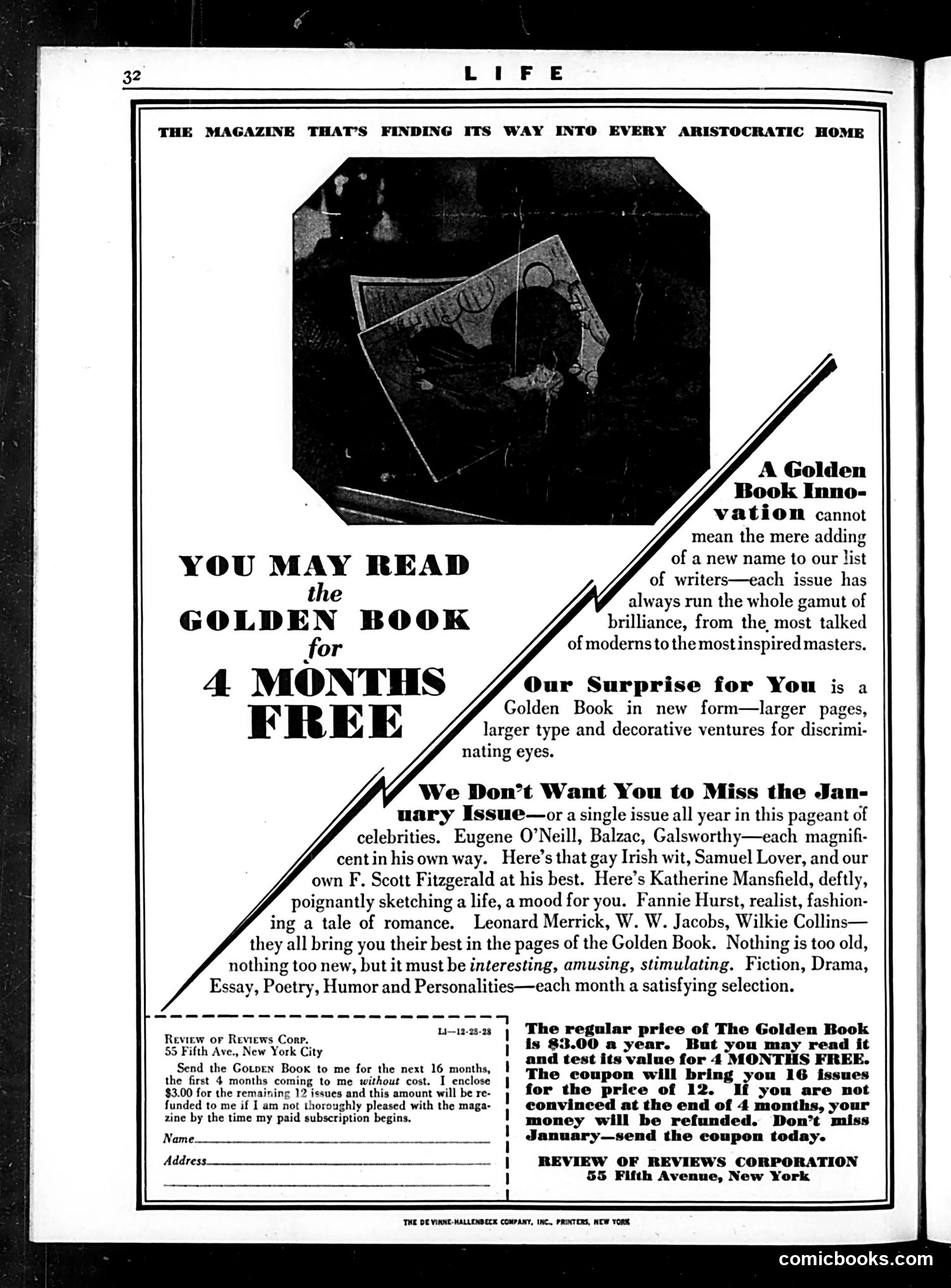
This is a **full-page advertisement**, not a political cartoon. It promotes *The Golden Book*, a literary magazine positioning itself as sophisticated and elite—"finding its way into every aristocratic home." The ad highlights prestigious literary contributors including Eugene O'Neill, F. Scott Fitzgerald, Katherine Mansfield, and others, appealing to readers who value high culture. The offer is a loss-leader: four free months plus 12 paid issues for $3.00 (normally $3/year full price), betting that free trial months will hook wealthy subscribers. The language emphasizes exclusivity and discriminating taste ("deftly," "stimulating," "discrimi-nating eyes"), marketing the magazine as a status symbol for the educated upper class. The dark photograph at left is unclear but appears decorative. This represents early 20th-century magazine marketing to affluent readers through appeals to cultural prestige.
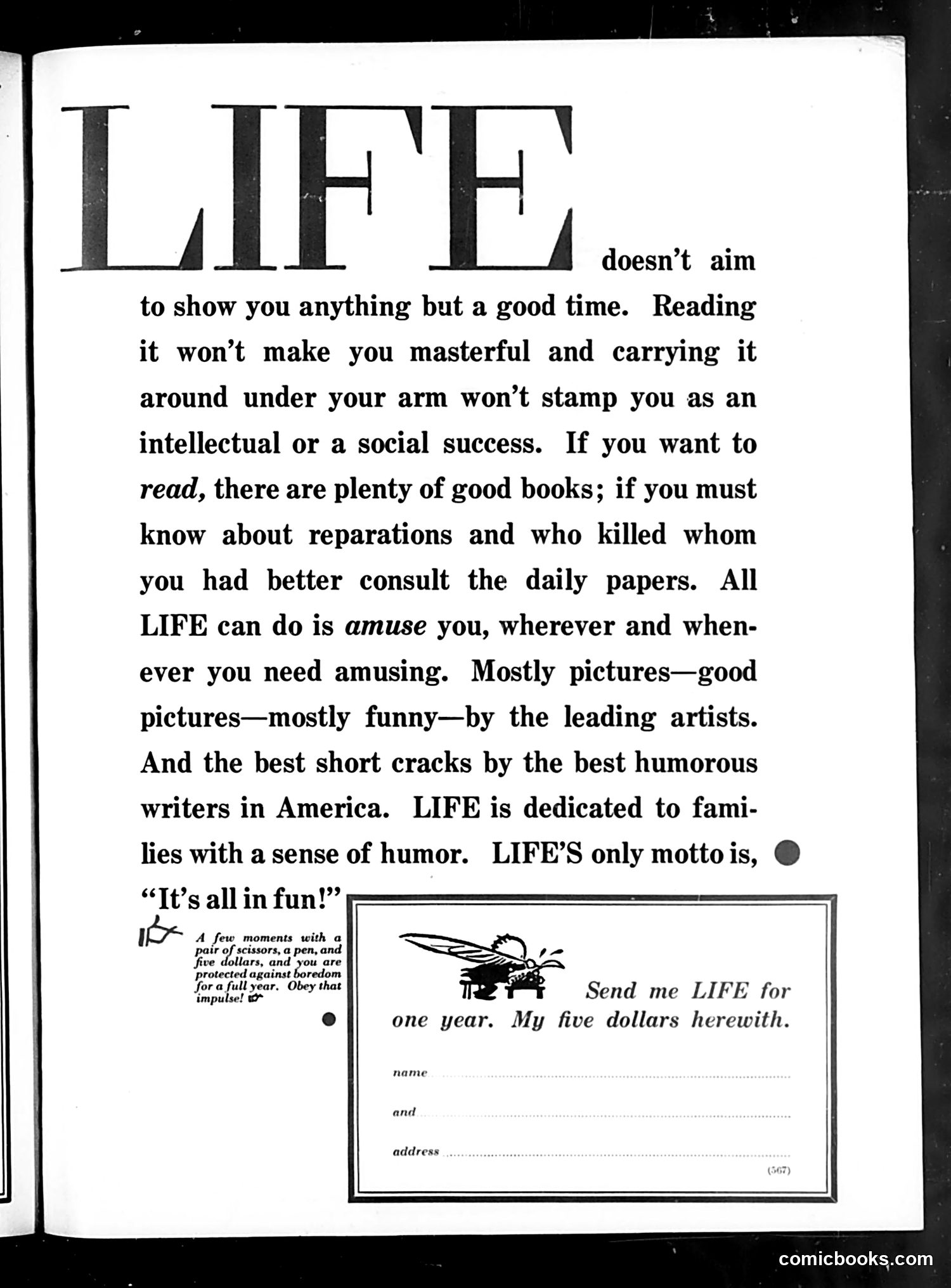
This is primarily **promotional copy** for *Life* magazine itself, not a political cartoon. The text is a tongue-in-cheek mission statement describing what *Life* offers readers. The key satirical point: *Life* explicitly disclaims any pretension to serious intellectual value. It won't make you "masterful" or socially successful—it's purely entertainment. The implied satire targets: - **Pretentious magazine readers** who carry publications to signal status - **Serious journalism** (the text dismisses topics like "reparations" and war news to newspapers) - **Self-improvement culture** of the era The tone is self-aware humor: *Life* is *admittedly* frivolous, dedicated to funny pictures and humorous writing. The subscription offer ($5/year) closes the pitch. The small illustration appears to show a flying creature (unclear what), likely accompanying a joke or humorous piece typical of the magazine's content.
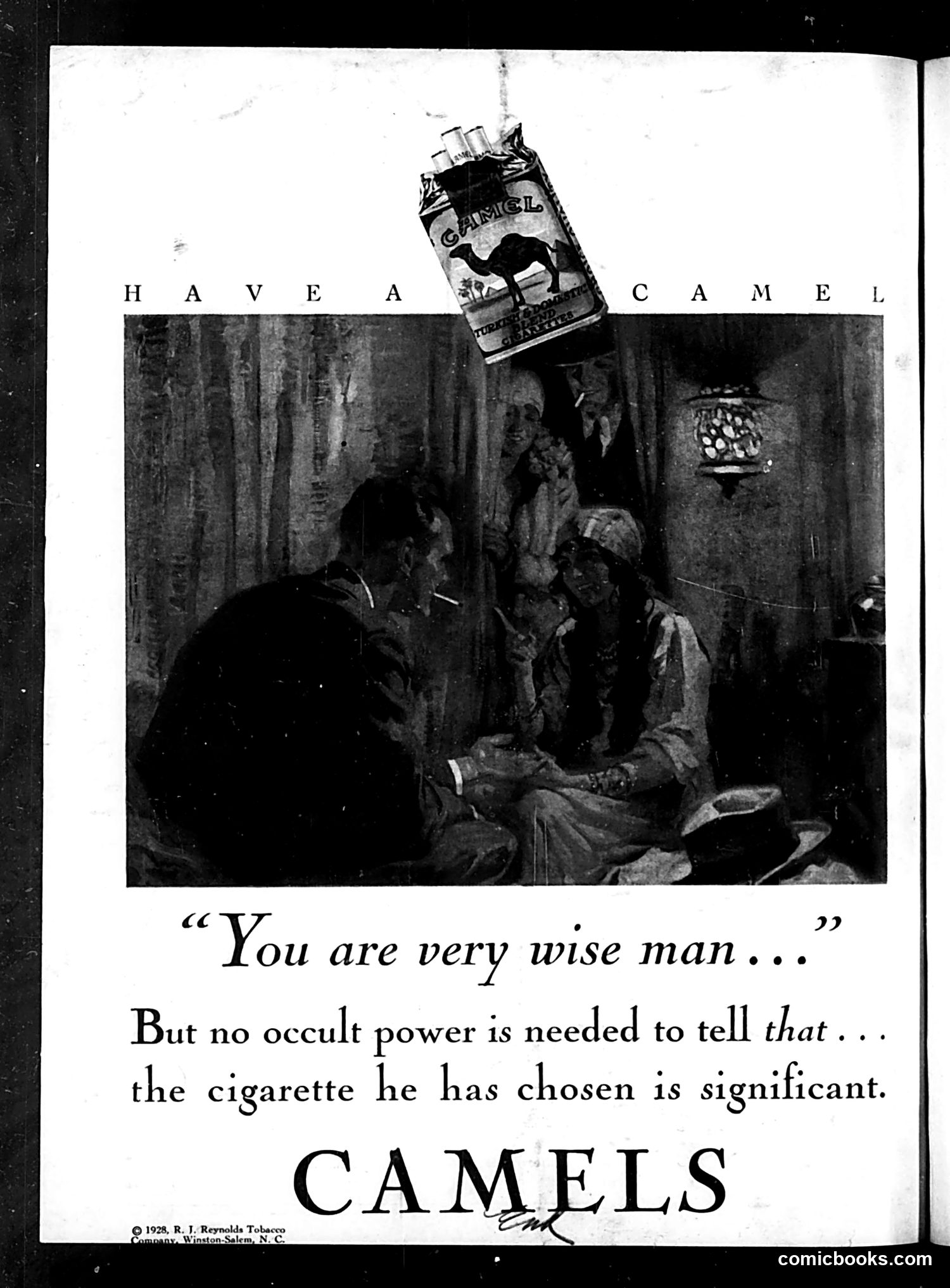
This is a **Camel cigarette advertisement** from 1928, not political satire. The ad uses a mysterious, pseudo-mystical framing to suggest that cigarette choice reveals character—a "wise man" smokes Camels. The image shows what appears to be a fortune-teller or mystic scene with multiple figures in shadowy, dramatic lighting. The ad's joke is that you don't need actual occult powers to recognize that choosing Camels demonstrates wisdom. This leverages the appeal of sophistication and discernment. This reflects 1920s advertising strategies: associating cigarettes with maturity, intelligence, and social status. The pseudo-exotic "mystical" staging was common marketing imagery of the era, trading on orientalist aesthetics and suggesting Camels' exotic origins.

I can see this is a blank or nearly blank page from what appears to be a Life magazine issue, with only the watermark "comicbooks.com" visible at the bottom. There is no discernible cartoon, text content, or imagery to analyze on this page itself. Without visible content—whether satirical cartoons, caricatures, political commentary, or advertisements—I cannot identify figures, explain references, or interpret any intended satire or jokes. This appears to be either a blank page from the publication, a scanning artifact, or a page that has deteriorated significantly over time, leaving no recoverable content to discuss. To provide the historical analysis requested, a page with visible editorial or illustrative content would be needed.