
Life, 1929-01-11 · page 30 of 36
Life — January 11, 1929 — page 30: what you’re looking at
What you’re looking at
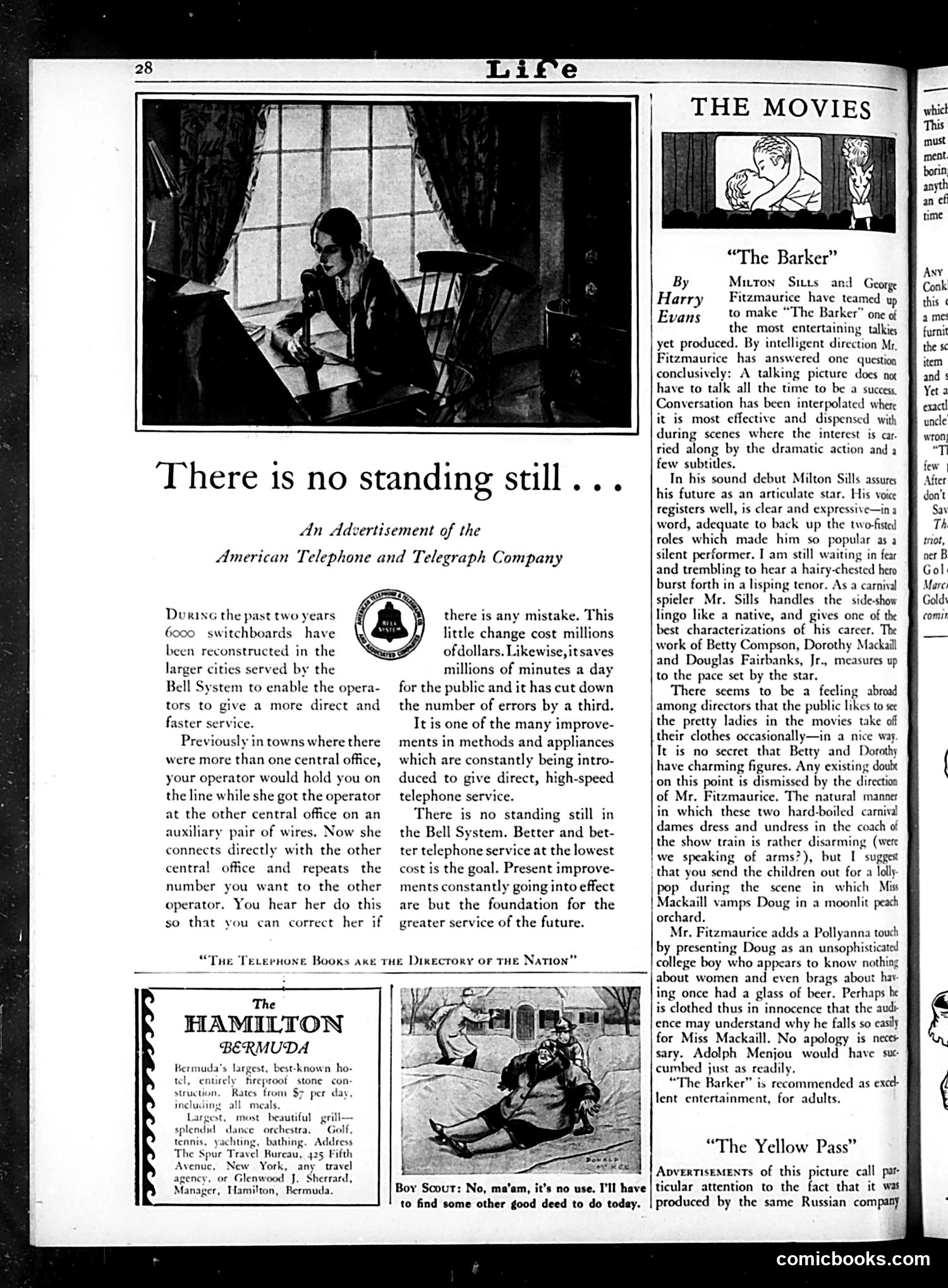
This page mixes advertising with film criticism from an early sound-film era (likely late 1920s). **The Main Advertisement** promotes AT&T's Bell System telephone improvements—specifically faster switchboard connections between central offices. The accompanying illustration shows a woman operator at a switchboard. The message: progress requires constant investment and technological advancement. The tagline "There is no standing still" was literal corporate messaging. **The Boy Scout Cartoon** (bottom left) is a small joke: a scout seeking a "good deed" finds telephone operators already doing them through improved service—a pun connecting scouting ethics to corporate virtue. **"The Barker" Film Review** discusses Milton Sills' sound-film debut, praising how director Fitzmaurice uses dialogue strategically rather than constantly (innovative for early talkies). The reviewer notes Sills' clear voice and carnival-barker accent work. References to actresses "taking off their clothes" reflect 1920s filmmaking's interest in glamour and partial nudity, treated as artistic rather than exploitative by this critic.
📄 Transcribed text from this page (OCR, searchable)
Machine-transcribed from the original scan — historical spelling and the odd misread are preserved.
There is no standing still... An Advertisement of the American Telephone and Telegraph Company Durinc the past two years 6000 switchboards been reconstructed in the larger cities served by the Bell System to enable the opera- tors to give a more direct and have faster servic Previously in towns where there were more than one central office, your operator would hold you on the line while she got the operator at the other central office on an auxiliary pair of wires. Now she connects directly with the other central office and repeats the number you want to the other operator. You hear her do this so that you can correct her if there is any mistake. This little change cost millions ofdollars. Likewise, it saves millions of minutes a day for the public and it has cut down the number of errors by a third. It is one of the many improve- ments in methods and appliances which are constantly being intro- duced to give direct, high-speed telephone service. There is no standing still in the Bell System. Better and bet- ter telephone service at the lowest cost is the goal. Present improve- ments constantly going into effect are but the foundation for the greater service of the future. “Tue Tecernone Booxs ake tHe Directory or THE Nation” The HAMILTON BERMUDA Bermuda's largest, best-known ho- tel, entirely fireproof stone con- Rates from $7 per day, all meals. Largest, most beautiful grill— splendid dance orchestra, — Golf, tennis, yachting, bathing. Address The Spur Travel Bureau, 425 Fifth Avenue, New York, any travel agency, or Glenwood J. Sherrard, Manager, Hamilton, Bermuda. struction. incluciing. Boy Scout: No, ma‘am, it’s no use. I'll have to find some other good deed to do today. THE MOVIES “The Barker” Mitton Sits and George Fitzmaurice have teamed up to make “The Barker” one of the most entertaining talkies yet produced. By intelligent direction Mr, Fitzmaurice has answered one question conclusively: A talking picture does not have to talk all the time to be a success, Conversation has been interpolated where it is most effective and dispensed with during scenes where the interest is car. ried along by the dramatic action and a few subtitles. In his sound debut Milton Sills assures his future as an articulate star. His voice registers well, is clear and expressive—in a word, adequate to back up the two-fisted roles which made him so popular as a silent performer. I am still waiting in fear and trembling to hear a hairy-chested hero burst forth in a lisping tenor. As a carnival spieler Mr. Sills handles the side-show lingo like a native, and gives one of the best characterizations of his career. The work of Betty Compson, Dorothy Mackaill and Douglas Fairbanks, Jr., measures up to the pace set by the star. There seems to be a feeling abroad among directors that the public likes to se the pretty ladies in the movies take off their clothes occasionally—in a nice way Tt is no secret that Betty and Dorothy have charming figures. Any existing doubt on this point is dismissed by the direction of Mr. Fitzmaurice. The natural manner in which these two hard-boiled carnival dames dress and undress in the coach of the show train is rather disarming (were we speaking of arms?), but I sugges By Harry Evans jthat you send the children out for a lolly pop during the scene in which Mis Mackaill vamps Doug in a moonlit peach orchard. Mr. Fitzmaurice adds a Pollyanna touch by presenting Doug as an unsophisticated | college boy who appears to know nothing about women and even brags about hav ing once had a glass of beer. Perhaps he is clothed thus in innocence that the aud ence may understand why he falls so easily for Miss Mackaill. No apology is neces sary. Adolph Menjou would have su- cumbed just as readily. “The Barker” is recommended as exce- lent entertainment, for adults. “The Yellow Pass” ApvertiseMENTs of this picture call pat ticular attention to the fact that it was produced by the same Russian company Ayy Conk this a me: furnit the sc vtem. and | Yet a enact uncle wron; “Tl few | After comicbooks.com