
Life, 1929-01-18 · page 25 of 44
Life — January 18, 1929 — page 25: what you’re looking at
What you’re looking at
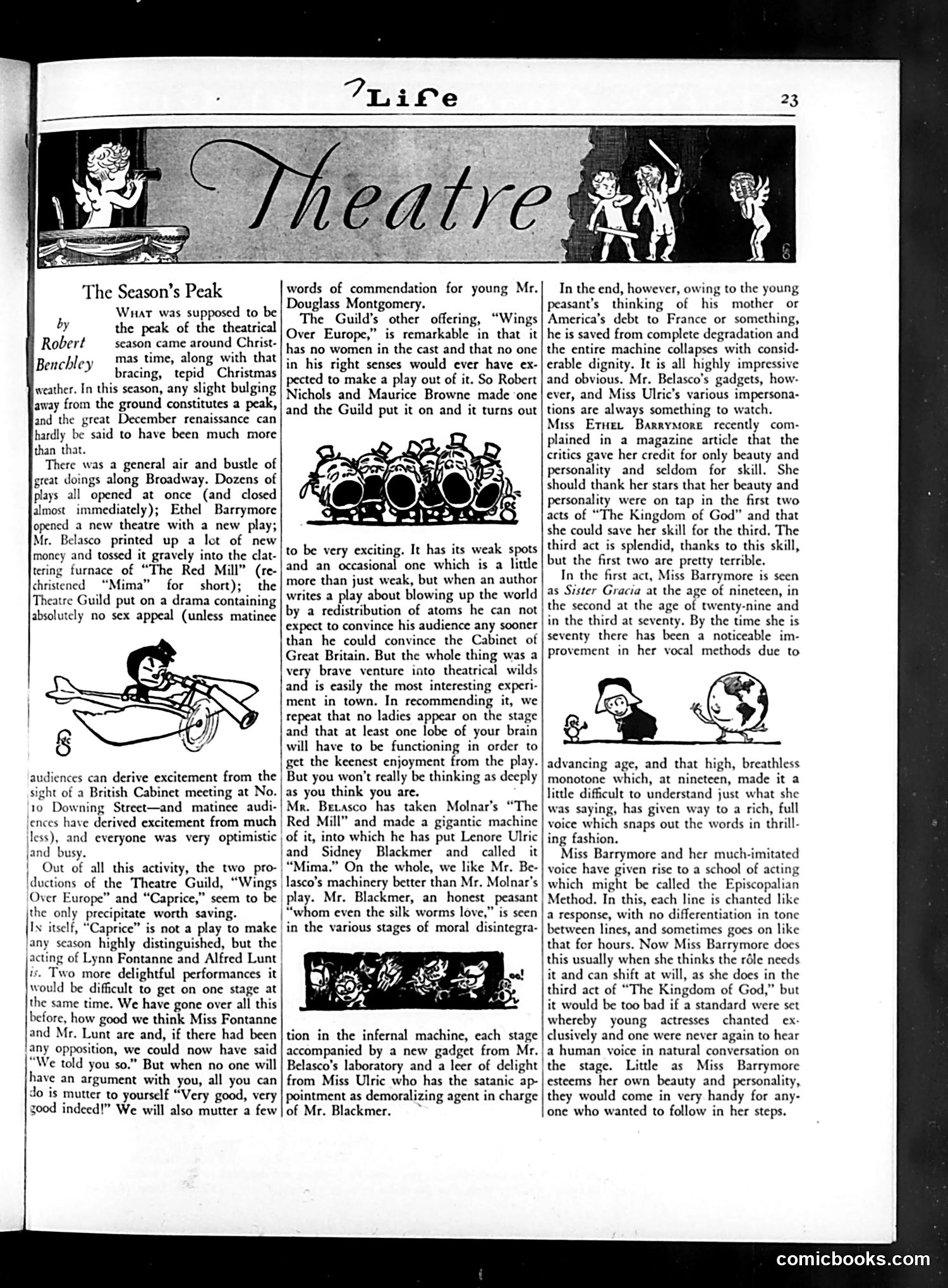
This theater review column discusses Broadway's December theatrical season. Benchley satirizes the industry's self-congratulatory attitude—calling it a "peak" when it's merely busy, comparing excitement to watching a British Cabinet meeting. He praises two Theatre Guild productions: "Caprice" (starring Lynn Fontanne and Alfred Lunt) and "Wings Over Europe" (a play about atomically destroying the world, notably all-male). He's witty about the latter's intellectual pretensions, saying audiences "won't really be thinking as deeply as you think you are." He mocks producer David Belasco's "Mima" (adapted from Molnár's "The Red Mill"), criticizing how Belasco's elaborate machinery and gadgetry overwhelm the original play. The plot—a peasant's moral corruption reversed by patriotic sentiment—is dismissed as "highly impressive and obvious." The page's cartoon illustrations support Benchley's irreverent tone toward theatrical excess and sentimentality.
📄 Transcribed text from this page (OCR, searchable)
Machine-transcribed from the original scan — historical spelling and the odd misread are preserved.
The Season’s Peak Wuat was supposed to be the peak of the theatrical Robert season ame around ate » mas time, along with that Benchley bracing, tepid Christmas weather. In this season, any slight bulging away from the ground constitutes a peak, and the great December renaissance can hardly be said to have been much more than that. There was a general air and bustle of great doings along Broadway. Dozens of plays all opened at once (and closed almost immediately); Ethel Barrymore opened a new theatre with a new play; Mr. Belasco printed up a lot of new money and tossed it gravely into the clat- tering furnace of “The Red Mill” (re- christened “Mima” for short); the Theatre Guild put on a drama containing absolutely no sex appeal (unless matinee by A) a Ae) 8 audiences can derive excitement from the sight of a British Cabinet meeting at No. 10 Downing Street—and matinee audi- ences have derived excitement from much less), and everyone was very optimistic | jand busy. | Out of all this activity, the two pro- ductions of the Theatre Guild, “Wings Over Europe” and “Caprice,” seem to be the only precipitate worth saving. Ix itself, “Caprice” is not a play to make any season highly distinguished, but the acting of Lynn Fontanne and Alfred Lunt ts. Two more delightful performances it would be difficult to get on one stage at the same time. We have gone over all this before, how good we think Miss Fontanne and Mr. Lunt are and, if there had been any opposition, we could now have said “We told you so.” But when no one will have an argument with you, all you can do is mutter to yourself “Very good, very good indeed!” We will also mutter a few words of commendation for young Mr. Douglass Montgomery. The Guild’s other offering, “Wings Over Europe,” is remarkable in that it has no women in the cast and that no one in his right senses would ever have ex- pected to make a play out of it. So Robert Nichols and Maurice Browne made ‘one and the Guild put it on and it turns out to be very exciting. It has its weak spots and an occasional one which is a litle more than just weak, but when an author writes a play about blowing up the world by a redistribution of atoms he can not expect to convince his audience any sooner than he could convince the Cabinet of Great Britain. But the whole thing was a very brave venture into theatrical wilds and is easily the most interesting experi- ment in town. In recommending it, we repeat that no ladies appear on the stage and that at least one lobe of your brain will have to be functioning in order to get the keenest enjoyment from the play. But you won't really be thinking as deeply as you think you are. Mr. Betasco has taken Molnar’s “The Red Mill” and made a gigantic machine of it, into which he has put Lenore Ulric and Sidney Blackmer and called it “Mima.” On the whole, we like Mr. Be- lasco’s machinery better than Mr. Molnar’s play. Mr. Blackmer, an honest peasant | “‘whom even the silk worms love,” is seen in the various stages of moral disintegra- tion in the infernal machine, each stage accompanied by a new gadget from Mr. Belasco’s laboratory and a leer of delight from Miss Ulric who has the satanic ap- pointment as demoralizing agent in charge of Mr. Blackmer. ~ In the end, however, owing to the young peasant’s thinking of his mother or America’s debt to France or something, he is saved from complete degradation and the entire machine collapses with consid- erable dignity. It is all highly impressive and obvious. Mr. Belasco’s gadgets, how- ever, and Miss Ulric’s various impersona- tions are always something to watch. Miss Etter Barrymore recently com- plained in a magazine article that the critics gave her credit for only beauty and personality and seldom for skill. She should thank her stars that her beauty and personality were on tap in the first two acts of “The Kingdom of God” and that she could save her skill for the third. The third act is splendid, thanks to this skill, but the first two are pretty terrible. In the first act, Miss Barrymore is seen as Sister Gracia at the age of nineteen, in the second at the age of twenty-nine and in the third at seventy. By the time she is seventy there has been a noticeable im- provement in her vocal methods due to advancing age, and that high, breathless monotone which, at nineteen, made it a little difficult to understand just what she was saying, has given way to a rich, full voice which snaps out the words in thrill- ing fashion. Miss Barrymore and her much-imitated voice have given rise to a school of acting | which might be called the Episcopalian Method. In this, each line is chanted like a response, with no differentiation in tone between lines, and sometimes goes on like that for hours. Now Miss Barrymore docs this usually when she thinks the rdle needs it and can shift at will, as she does in the third act of “The Kingdom of God,” but it would be too bad if a standard were set whereby young actresses chanted ex- clusively and one were never again to hear |a human voice in natural conversation on |the stage. Little as Miss Barrymore esteems her own beauty and personality, they would come in very handy for any- one who wanted to follow in her steps. comicbooks.com