
A complete issue · 44 pages · 1929
Life — January 18, 1929
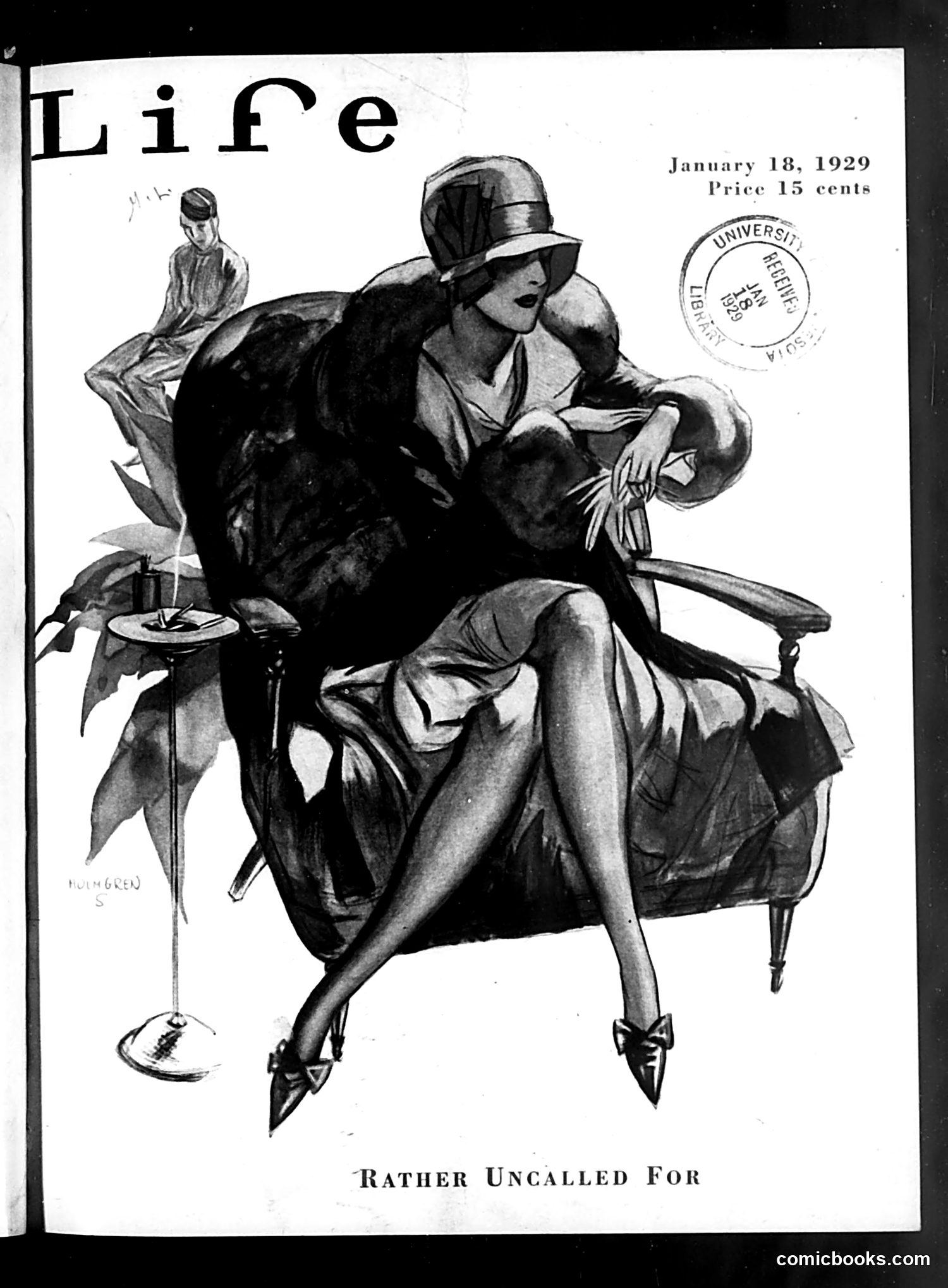
This satirical cover titled "Rather Uncalled For" depicts a fashionably dressed woman in 1920s attire sitting in a chair, appearing flustered or startled. A man in dark clothing looms behind her in an aggressive or threatening posture. A small figure in the background appears to be observing the scene. The cartoon likely satirizes contemporary social behavior—possibly commenting on unwanted advances, inappropriate male behavior in social settings, or violations of propriety during the Jazz Age. The woman's elaborate outfit and the domestic interior setting suggest this occurs in polite society, making the man's "uncalled for" conduct the source of satire. The specific incident or social commentary referenced is unclear without additional context, but it appears to critique aggressive male behavior toward women.
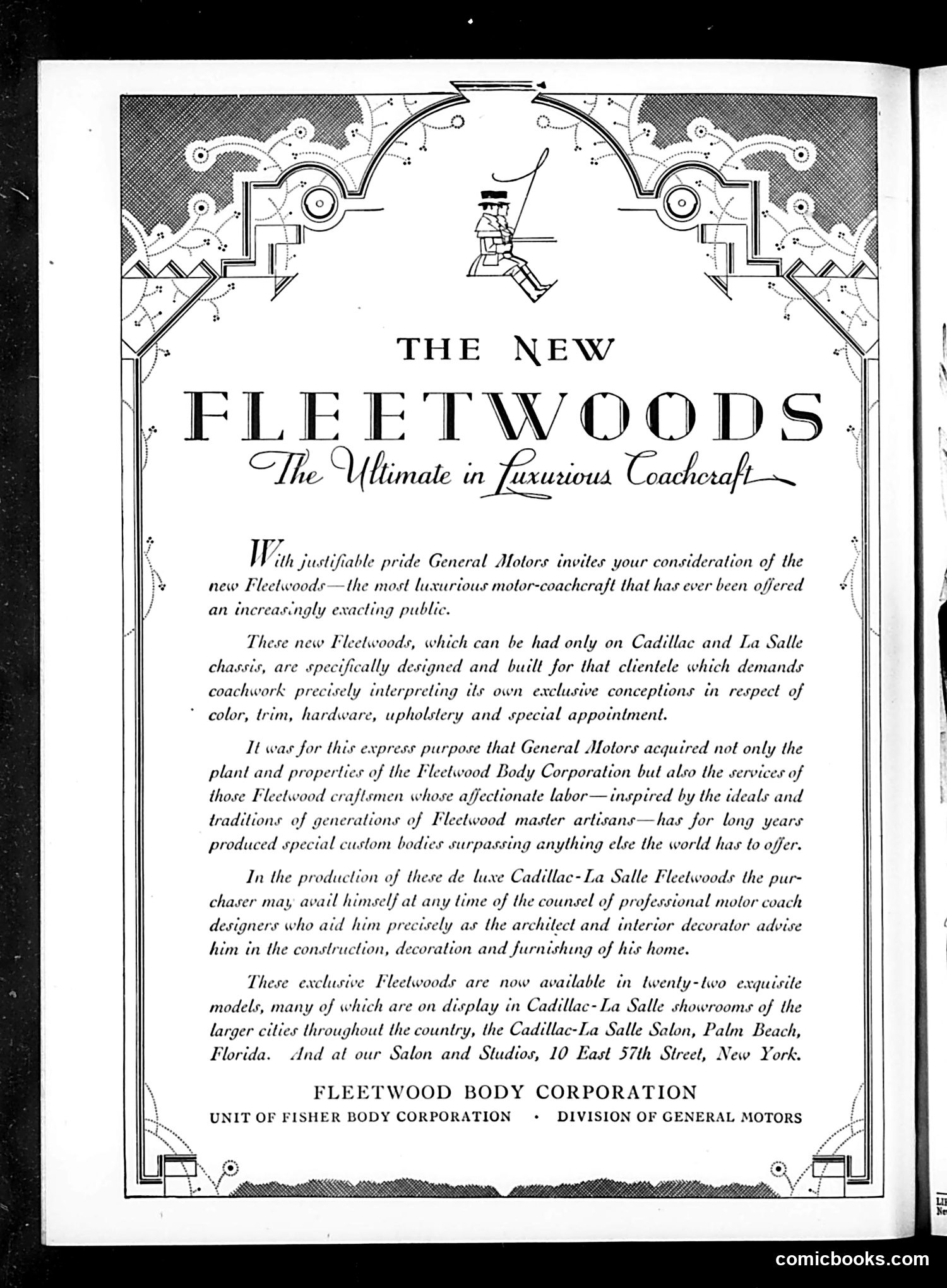
This page is primarily an advertisement for the "New Fleetwoods," luxury motor coaches produced by General Motors through the Fleetwood Body Corporation. The decorative art deco border features a small illustration of a figure on a swing at the top center, which appears purely ornamental rather than satirical. The ad emphasizes exclusivity, claiming these custom-built vehicles represent "the ultimate in luxurious coachcraft" available only on Cadillac and La Salle chassis. It highlights General Motors' acquisition of Fleetwood craftsmen and facilities to produce bespoke vehicles, and mentions showrooms in Palm Beach, Florida and New York City. This is straightforward advertising rather than political satire or social commentary—typical of Life magazine's commercial content from this era.
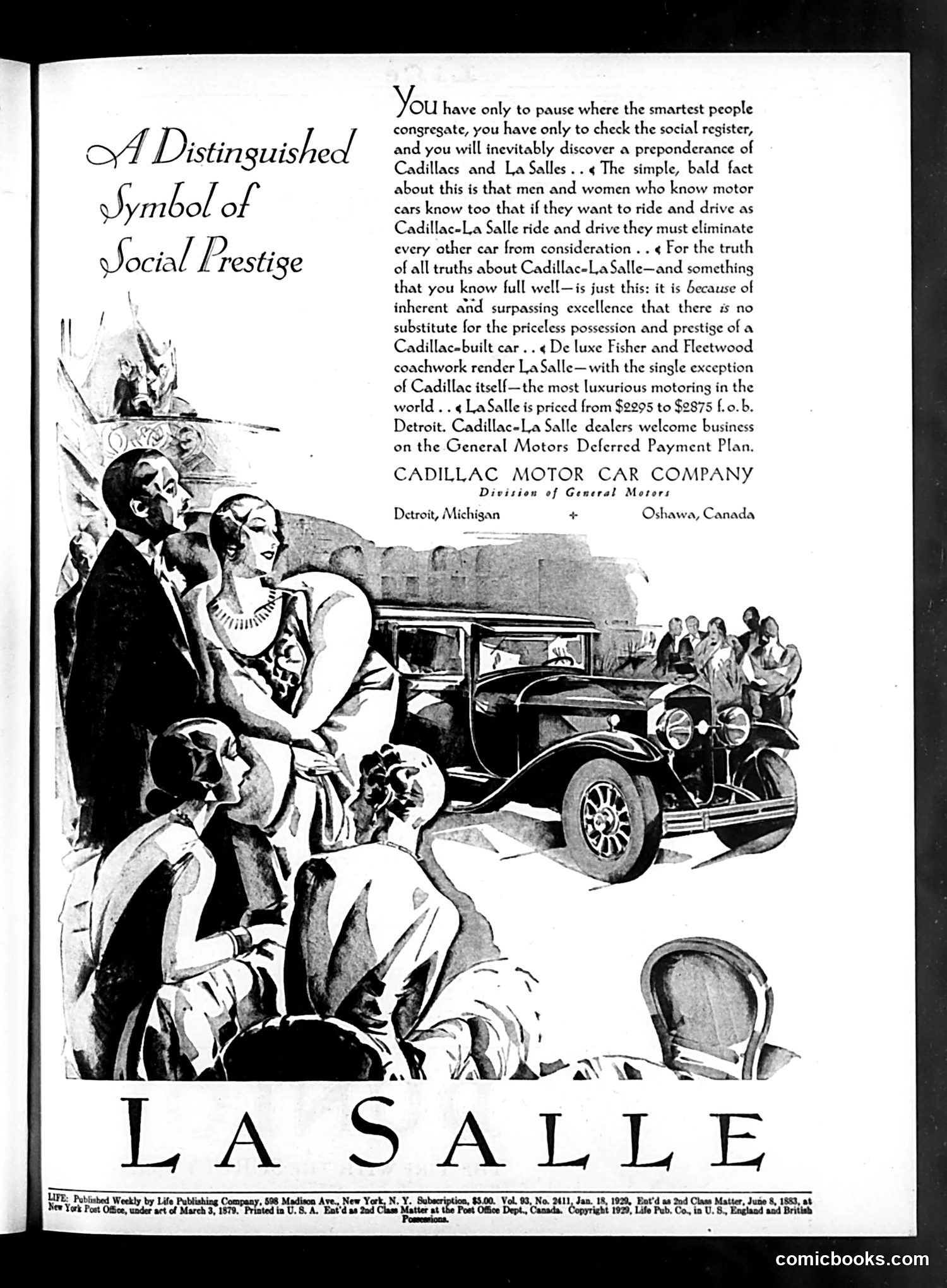
This is a **luxury car advertisement**, not a political cartoon. It promotes the Cadillac La Salle automobile as "a distinguished symbol of social prestige." The illustration depicts elegantly dressed figures in formal attire—a man in a tuxedo and woman in an evening gown—examining the vehicle at what appears to be a high-society event. Onlookers in the background suggest exclusivity and status. The text's core message: owning a La Salle demonstrates wealth and refined taste. It claims the car is found wherever "smartest people congregate" and that anyone serious about motor cars must consider it. Prices range from $2,295 to $2,875 (significant sums in 1929). This reflects pre-Depression advertising targeting the wealthy, emphasizing automobile ownership as a status symbol.
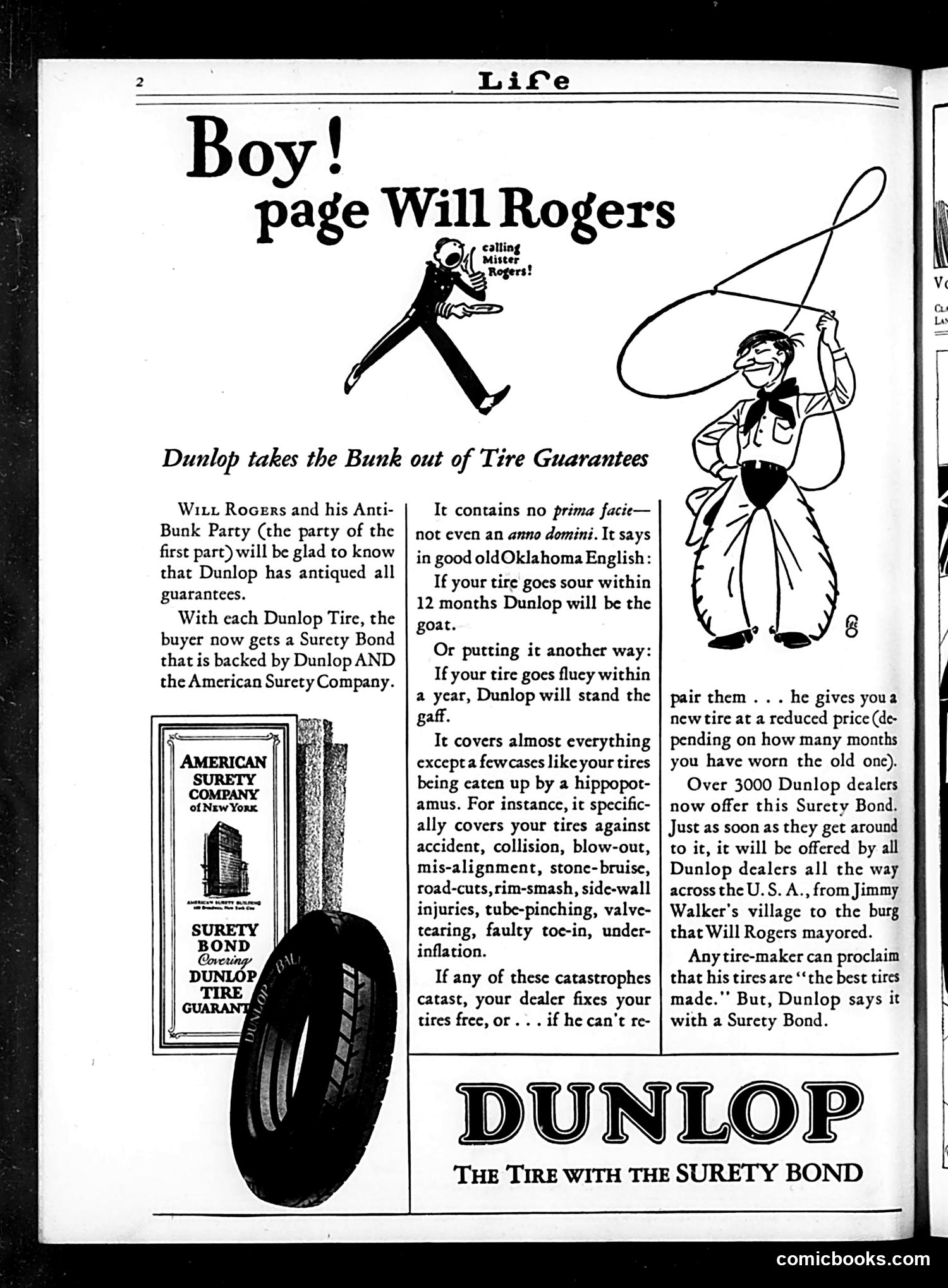
This is primarily a **Dunlop tire advertisement** disguised as editorial content, featuring Will Rogers as the celebrity endorser. The cartoon shows Rogers with a lasso, playing on his famous cowboy persona and Oklahoma roots. The "joke" is that Dunlop tires have "antiquated all guarantees" through their new Surety Bond backing (underwritten by American Surety Company). The ad satirizes competitors' tire guarantees as worthless, using folksy Oklahoma language: "If your tire goes sour within 12 months Dunlop will be the goat." The advertisement lists extensive coverage (accidents, blowouts, misalignment, etc.) while mocking other tire-makers' claims of quality. Rogers's credibility as a trusted public figure lends authority to the product pitch. This represents early 20th-century advertorial marketing—blending entertainment with commercial promotion.
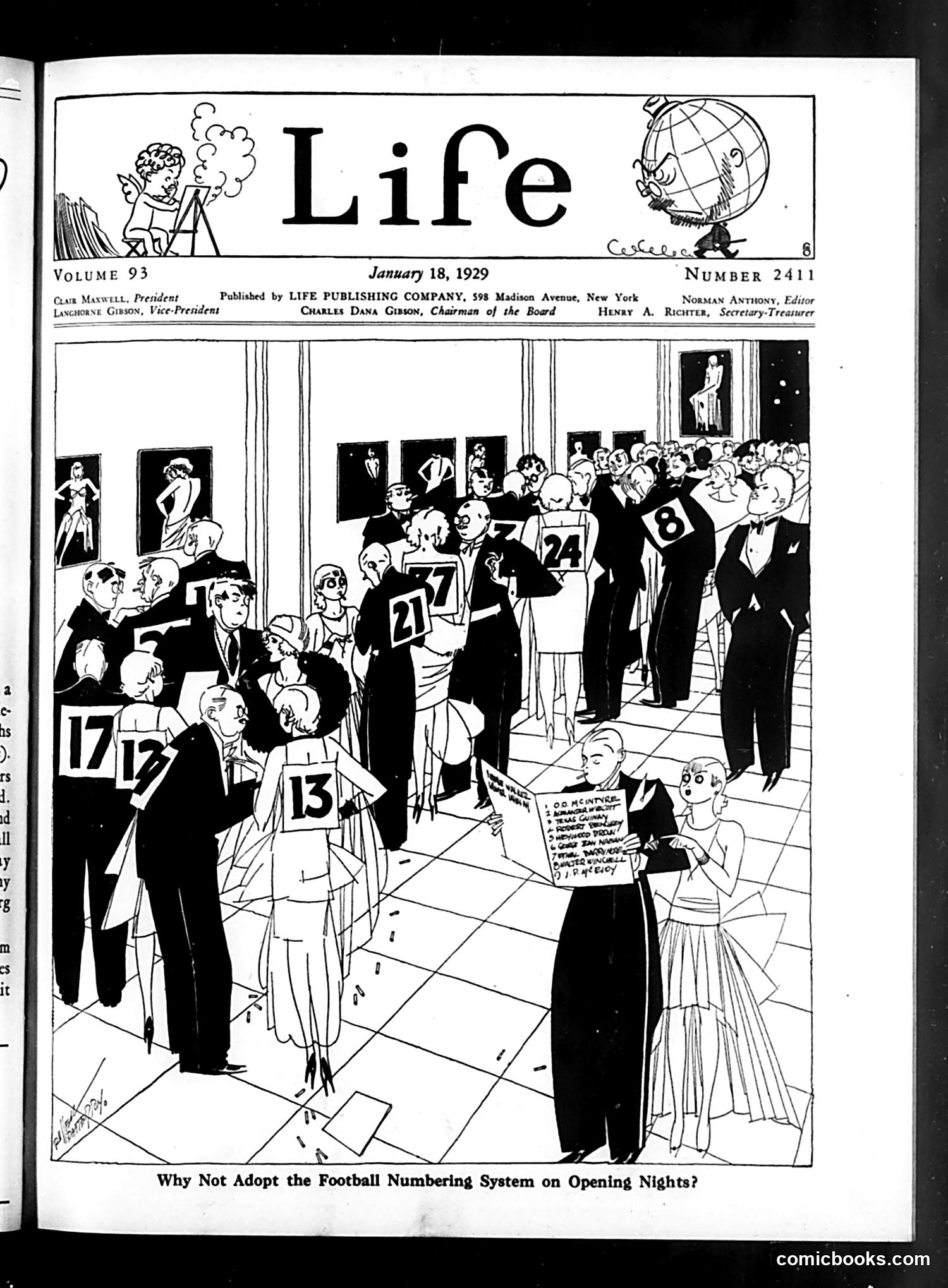
This satirical cartoon mocks the idea of applying football's jersey numbering system to theater opening nights. The illustration shows well-dressed attendees at what appears to be a formal premiere or social event, each wearing large numbers (13, 17, 21, 24, 8, etc.) like football players. The joke critiques the chaos and crowding of opening night theater events in 1920s New York. By suggesting a numbering system similar to sports, the cartoonist humorously implies that theater openings had become as organized and impersonal as athletic competitions, with attendees treated as interchangeable players rather than distinguished guests. The caption's rhetorical question invites readers to consider this absurd solution to managing the social disorder of premiere events.
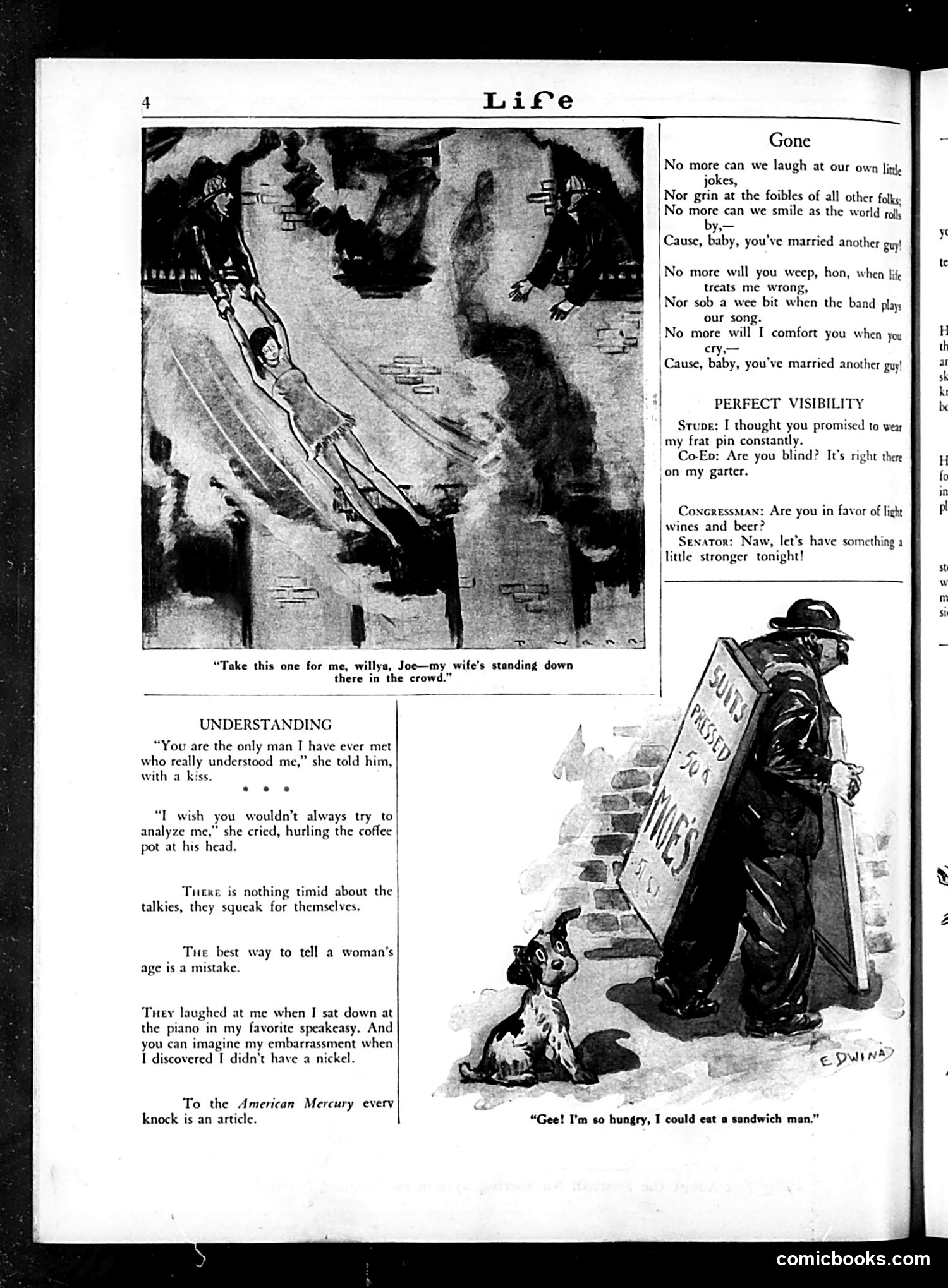
This page contains three humor sections typical of early 20th-century Life magazine: **Top Image**: A crowd scene captioned "Take this one for me, willy, Joe—my wife's standing down there in the crowd." The satire targets working-class marital dynamics and public spectacle, likely depicting a boxing match or similar event where a man asks his friend to participate so he can impress his watching wife. **"Understanding" Section**: Satirizes romantic relationships through brief anecdotes about misunderstandings between couples—critiquing both male insensitivity and female emotionality as stereotypes. **Bottom Cartoon**: A starving man and dog beside a "Sun Crust" bread sign, with the caption "Gee! I'm so hungry, I could eat a sandwich man." This plays on Depression-era poverty and hunger through visual wordplay. The humor reflects period attitudes toward class, gender, and hardship.
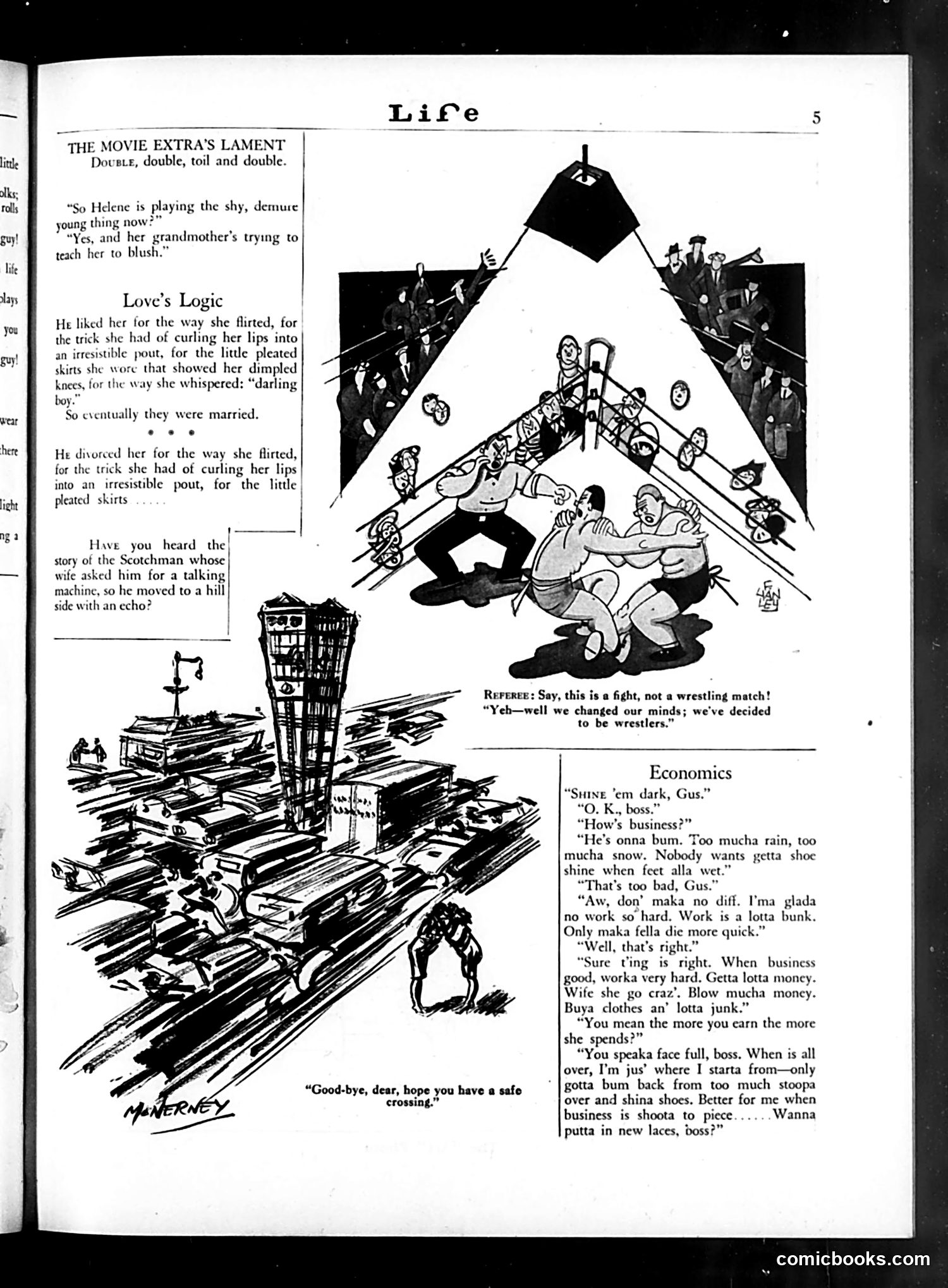
This page contains three separate humorous pieces: **"The Movie Extra's Lament"** and **"Love's Logic"** are brief text jokes about romance and marriage, including a quip about a Scotsman and a talking machine. **The main cartoon** (center-right) depicts a wrestling match with spectators on bleachers. The referee announces they've "changed our minds; we've decided to be wrestlers"—apparently the fighters were initially doing something else (the joke's specific reference is unclear from context alone). **"Economics"** (bottom-right) is a dialect-heavy dialogue between characters named Gus and a woman, discussing financial hardship: rain, snow, struggling business, and the difficulty of making ends meet. This appears to reference working-class economic struggles, likely from the post-WWI era when Life regularly satirized labor and poverty issues. The artwork style and heavy use of working-class dialect humor was typical of Life's satirical approach.
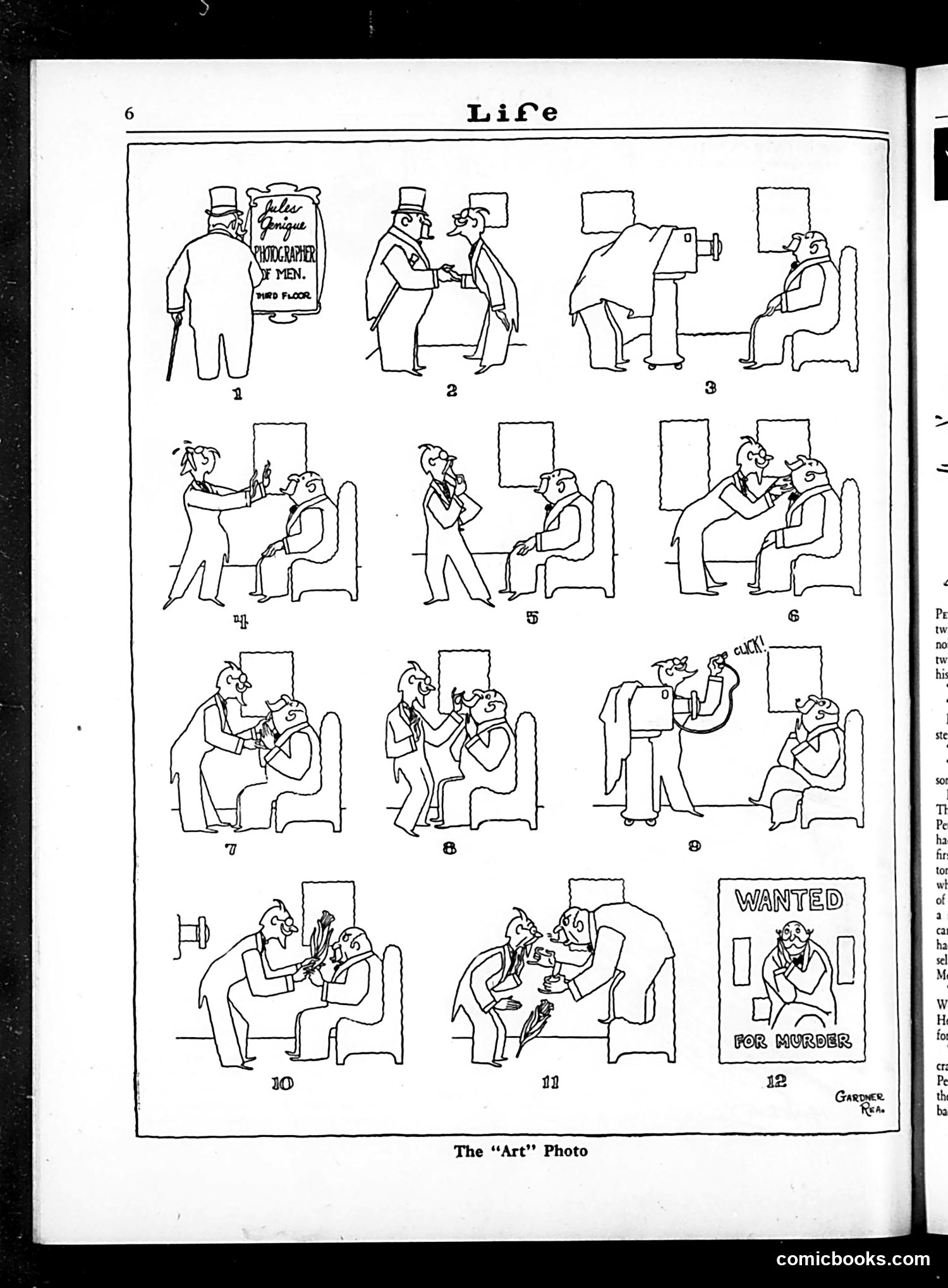
This is a sequential comic strip satirizing how people pose for photographs. It begins with panel 1 showing a man with a sign advertising "False Tongue" portraits on the "Third Floor," suggesting fake or theatrical photo sessions. Panels 2-11 depict a man visiting a photographer, who manipulates him into increasingly awkward and undignified poses while holding blank signs. The man becomes progressively more contorted and uncomfortable. Panel 12 shows the final result: a "Wanted for Murder" poster—implying the ridiculous poses made him look criminal or villainous. The satire mocks both photographers who force unnatural poses on subjects and the vanity of people seeking flattering portraits. It suggests that pursuing "artistic" photography often produces absurd, unflattering results instead.
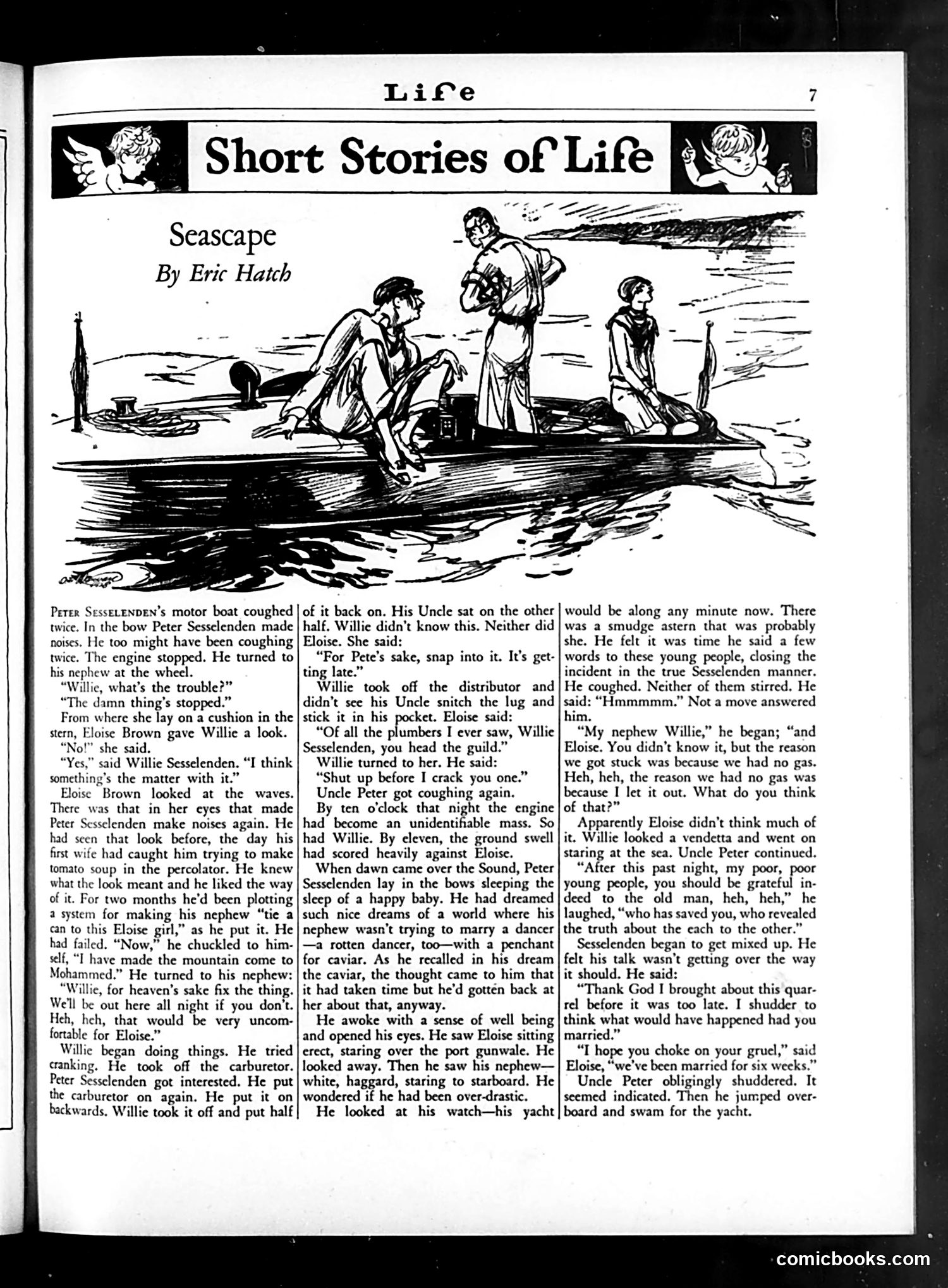
This is a short fiction story rather than political satire or cartoon. The illustration depicts a motorboat scene with five figures, and the text describes a domestic drama involving Peter Sesselenden, his nephew Willie, and Eloise Brown. The narrative centers on a broken-down motor boat and romantic/marital tensions. Willie has mechanical troubles; Eloise worries about being "a dancer" versus marriage; and Uncle Peter coughs persistently. The story plays on class and social pretensions—references to "plumbers," "caviar," and concerns about propriety suggest early 20th-century middle-class anxieties about romance and respectability. This appears to be general entertainment fiction for Life magazine's readers, not political commentary.
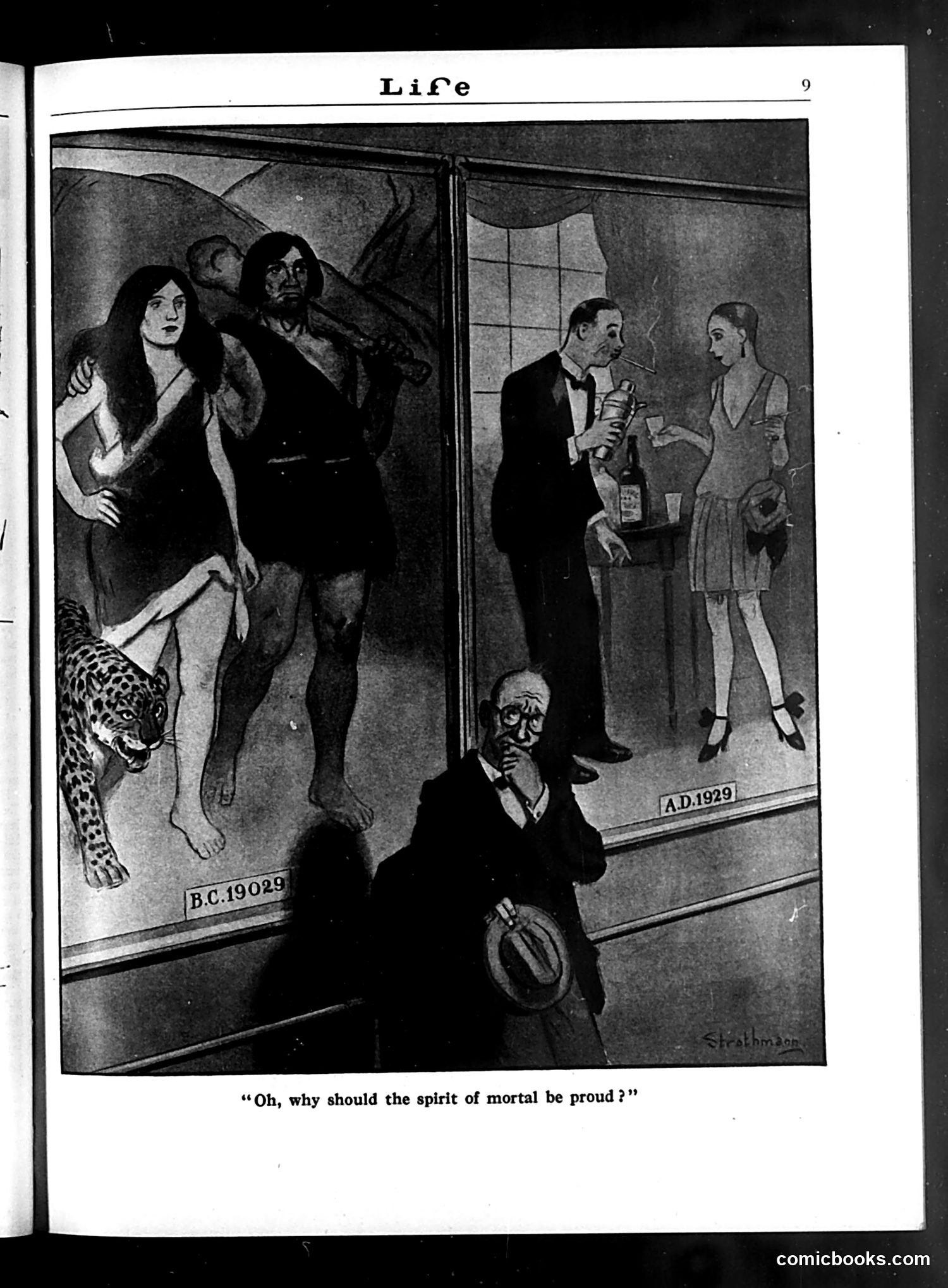
This is a single satirical cartoon dated 1929, signed by Strathmann. It depicts a museum visitor viewing two display cases: one labeled "B.C. 19029" showing primitive humans with a leopard, and another labeled "A.D.1929" showing well-dressed modern people at a cocktail party. The caption reads: "Oh, why should the spirit of mortal be proud?" The satire compares ancient and modern civilization unfavorably. Despite nearly 20,000 years of progress, the cartoon suggests humanity hasn't genuinely advanced—both eras show humans driven by base instincts (hunting/survival versus drinking and socializing). It's a critique of modern society's pretensions to civilization, implying 1920s sophistication masks unchanged human nature and moral emptiness.
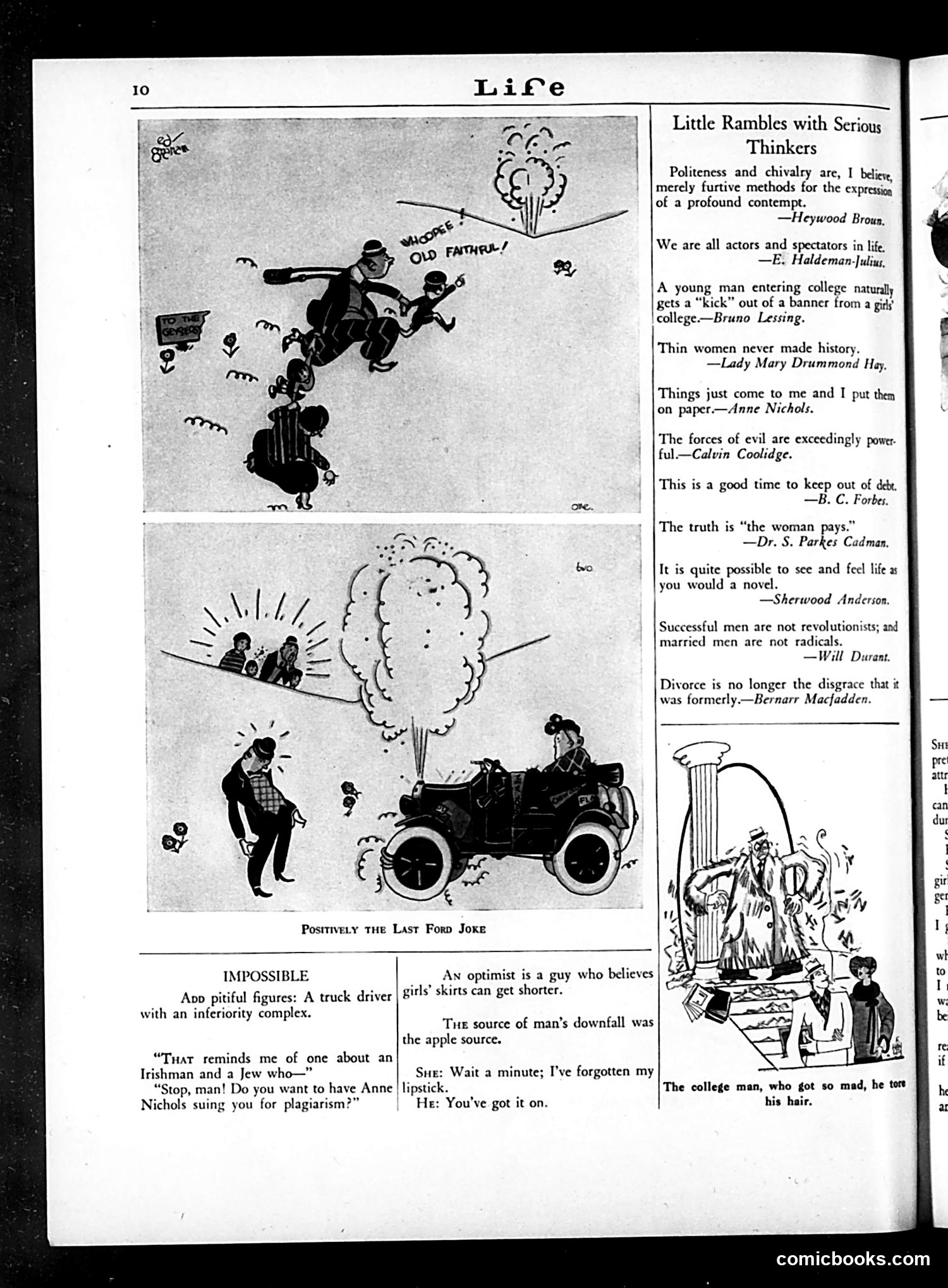
This page contains satirical cartoons and humorous quotes about early 20th-century life and social attitudes. The top cartoon labeled "OLD FAITHFUL!" depicts figures being launched upward, likely satirizing something repeatedly cyclic or predictable—the reference is unclear without more context. The middle cartoon titled "POSITIVELY THE LAST FORD JOKE" shows a car and suggests Ford automobiles were such a common subject of humor that jokes about them had become exhausted. The right column features "Little Rambles with Serious Thinkers"—witty one-liners from notable figures (Heywood Broun, E. Haldeman-Julius, etc.) commenting on contemporary social issues: marriage, divorce, women's roles, and economic anxiety. The bottom cartoon shows a college man whose anger caused hair loss—a visual gag about youthful frustration. The page exemplifies Life's satirical approach to modern American society and manners.
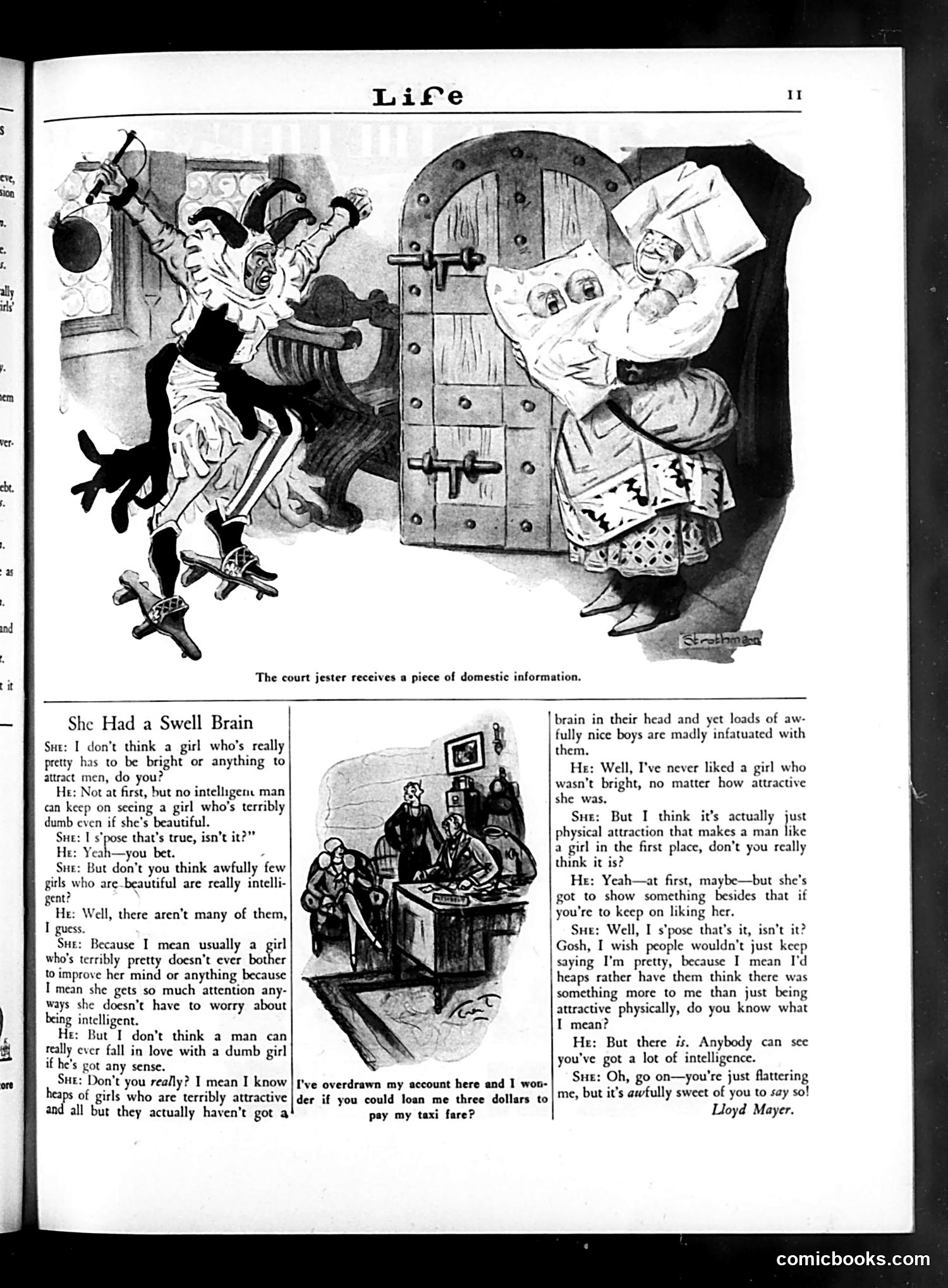
**Top Cartoon:** A court jester delivers gossip through a heavy vault door to a woman in royal dress. The caption reads "The court jester receives a piece of domestic information." This satirizes how court gossip and domestic scandals spread, likely mocking both the jester's role as information-carrier and the woman's eager reception of rumors. **Text Piece "She Had a Swell Brain":** A dialogue between a man and woman debating whether intelligence or physical attractiveness matters more in romantic relationships. The woman argues that brains are essential; the man eventually admits intelligence is important but suggests physical attraction initiates romance. The piece satirizes gender expectations and dating attitudes of its era, with the final line crediting Lloyd Mayer suggesting this is humorous commentary on romantic contradictions.
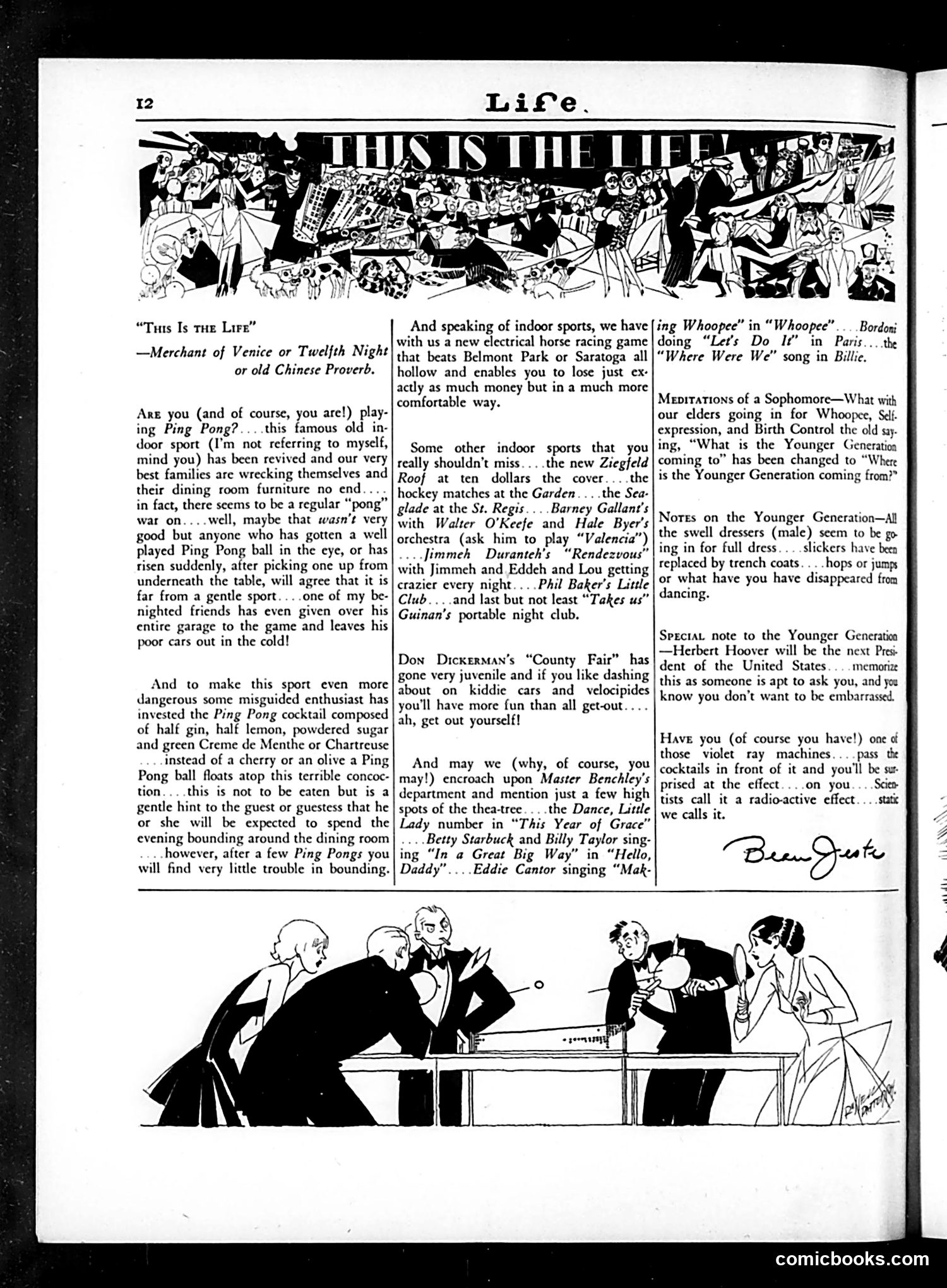
This page satirizes leisure activities and social trends of the era. The top banner "THIS IS THE LIFE" illustrates various entertainments—sports, dining, dancing, entertainment venues. The main text discusses **Ping Pong** as a revival among wealthy families, joking that players get so absorbed they neglect their cars in the cold. It mocks an invented "Ping Pong cocktail" (gin, lemon, sugar, crème de menthe) as dangerously strong. References include Don Dickerman's "County Fair," various theatrical acts and performers of the period, and mentions of **Herbert Hoover** becoming the next U.S. President—suggesting this predates his 1929 election. The bottom illustration shows men playing table tennis, capturing the fad's social importance. The satire targets how middle and upper-class Americans obsess over fashionable pastimes while neglecting practical responsibilities.
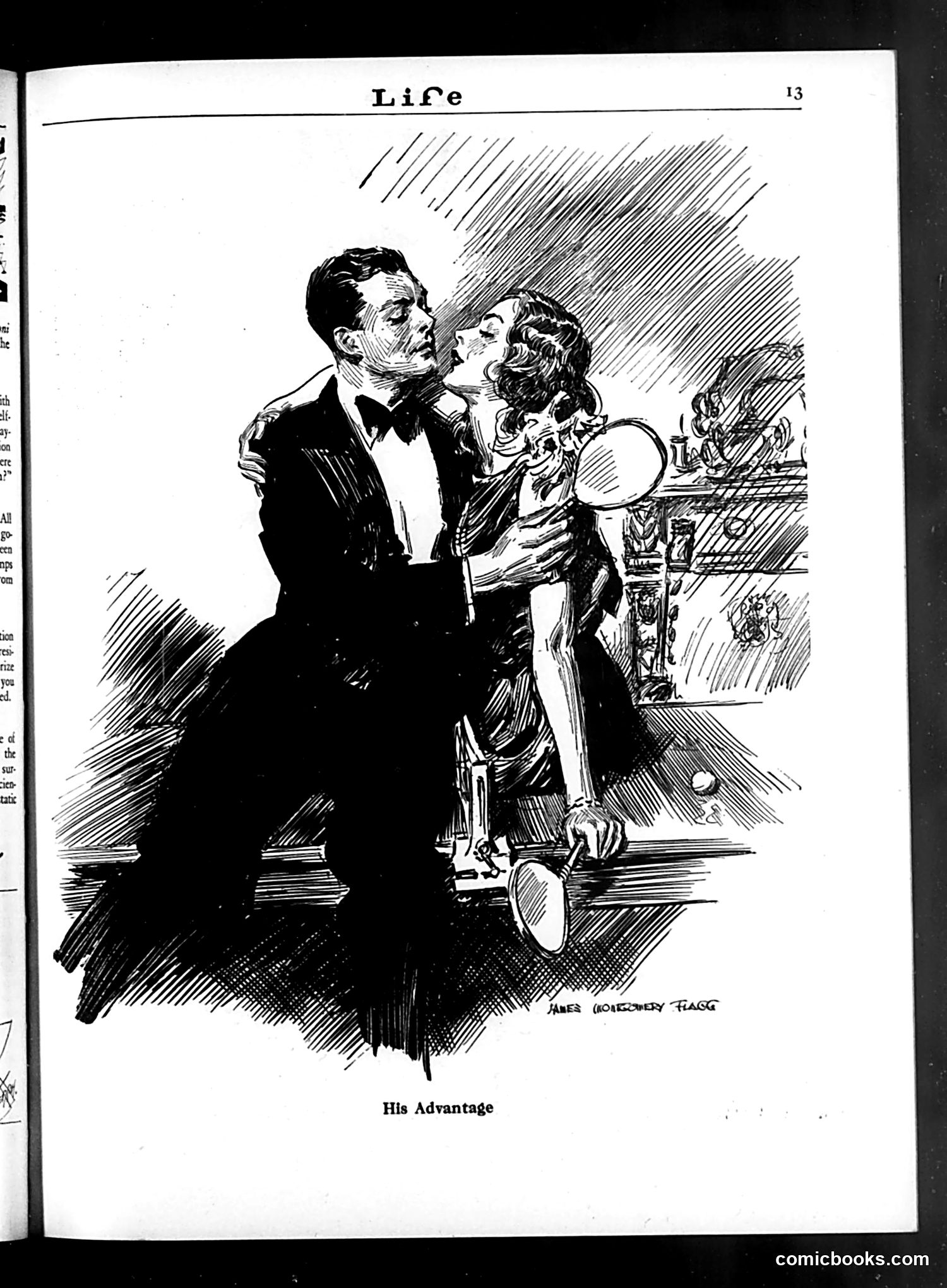
This cartoon, credited to James Montgomery Flagg, depicts a man in formal evening wear (tuxedo and bow tie) embracing a woman in what appears to be an intimate moment. The woman holds a hand mirror, suggesting vanity or self-regard. The title "His Advantage" implies the man is benefiting from the woman's self-absorption or distraction with her appearance. The satire appears to comment on gender dynamics and courtship—suggesting a man can take romantic or physical advantage when a woman is preoccupied with her own reflection or vanity. The cartoon reflects early 20th-century attitudes about female vanity as both a character flaw and a vulnerability that men might exploit. Without additional context, the specific social commentary or target remains somewhat unclear.
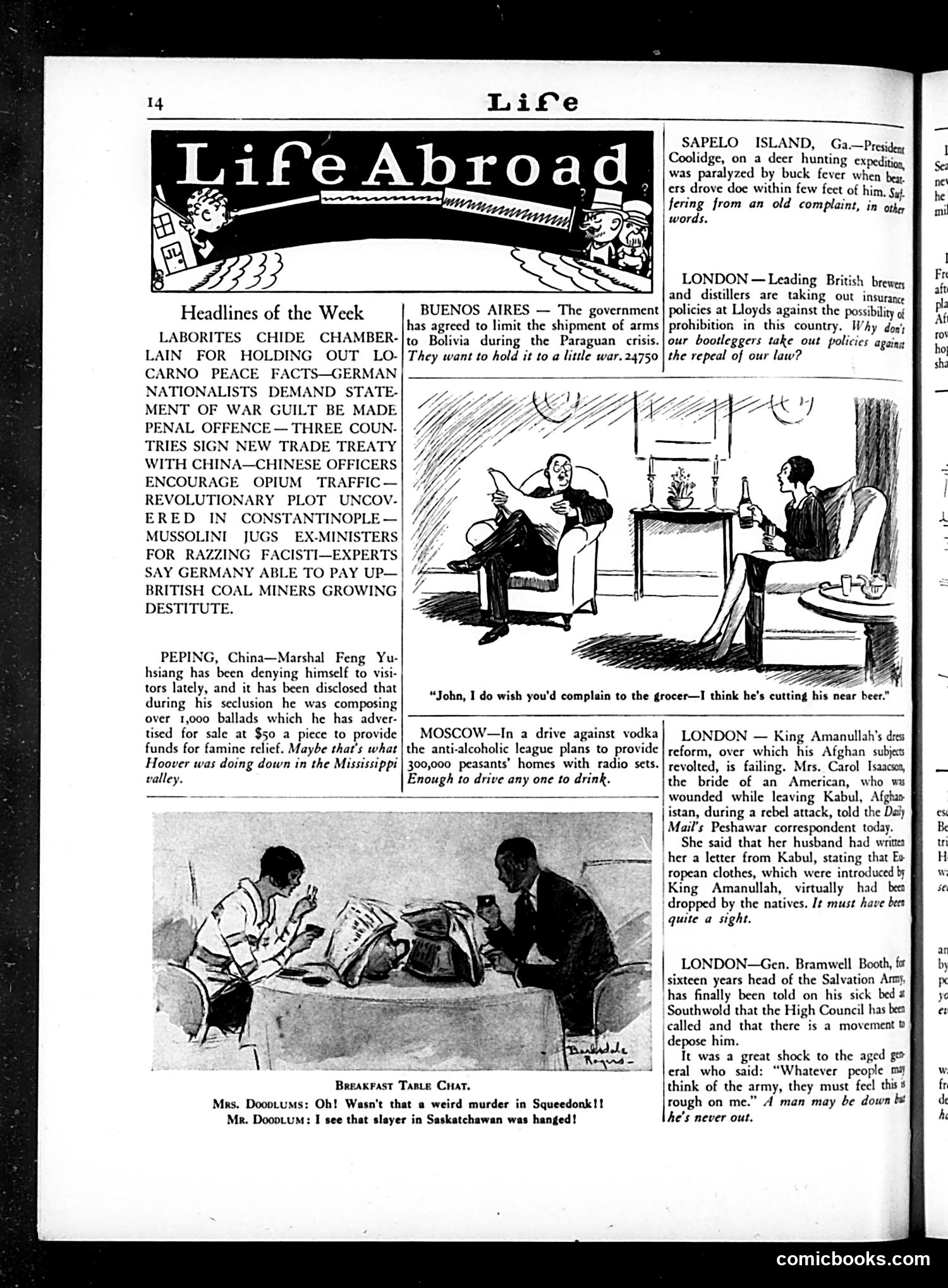
This page contains international news briefs and two cartoons satirizing domestic life and contemporary issues. **Top cartoon**: Shows a couple in a living room. The husband, relaxing in a chair, says to his wife: "John, I do wish you'd complain to the grocer—I think he's cutting his near beer." This jokes about Prohibition-era "near beer" (legally non-alcoholic but supposedly nearly so), suggesting even this weak substitute is being watered down further—a commentary on how Prohibition's enforcement led to widespread fraud and inferior black-market products. **Bottom cartoon** ("Breakfast Table Chat"): A husband and wife discuss violent crimes from newspapers, mentioning murders in Squeedonk and a hanging in Saskatchewan. This satirizes how sensationalist crime reporting dominated newspapers of the era, making such violence seem commonplace in conversation. Both reflect 1920s American anxieties: Prohibition's failures and crime's prevalence.
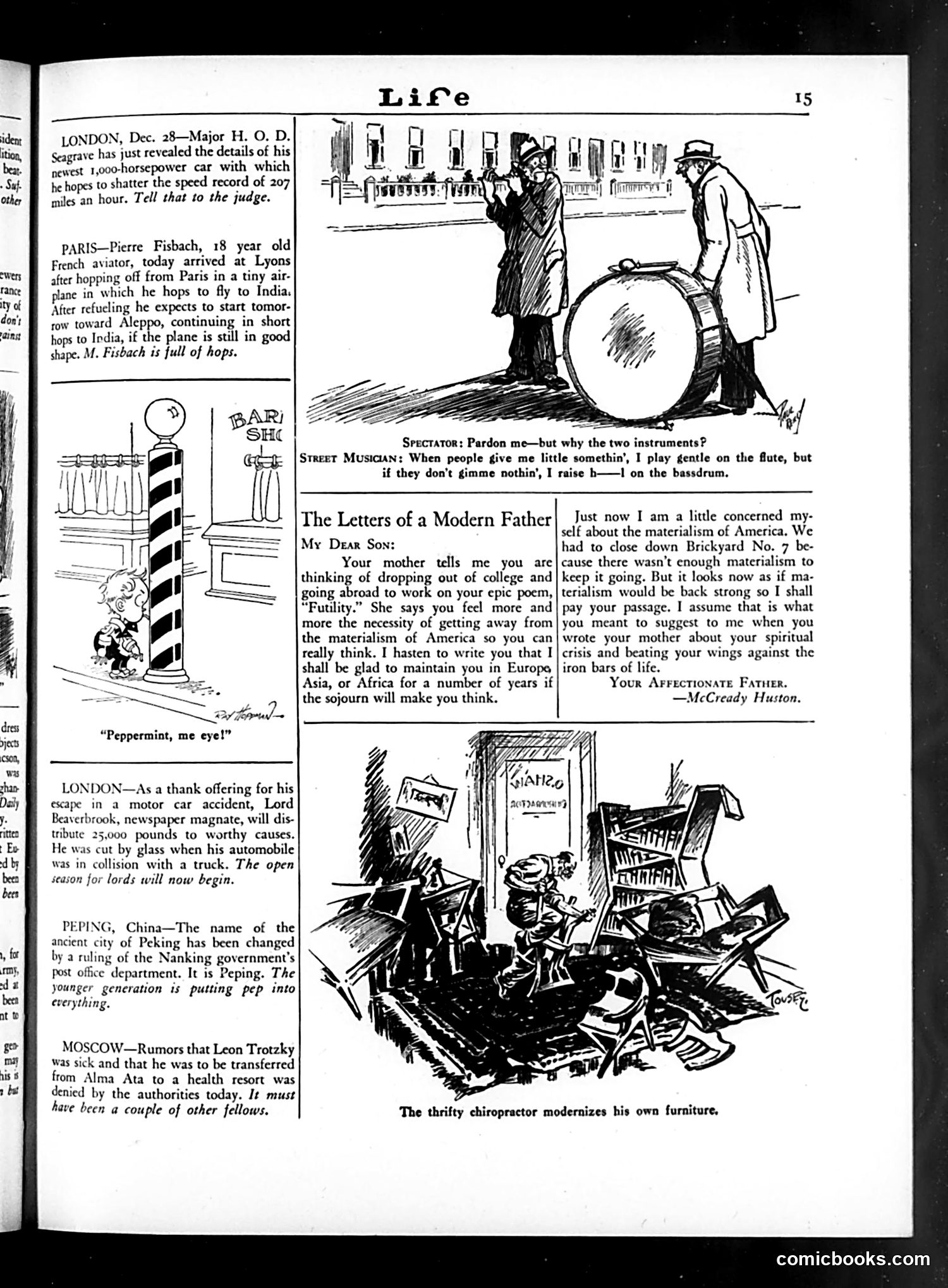
**Top Cartoon:** A street musician with a drum and flute explains to a spectator why he carries both instruments—when people give him money, he plays gently on the flute, but when they don't, he raises the drum's pitch to annoy them into paying. This is satire on busking tactics and how street performers use noise as coercion. **"The Letters of a Modern Father":** A father advises his son against dropping out of college, arguing that materialism in America is overstated. He suggests the son should travel to Europe, Asia, or Africa to gain perspective before deciding his path—satirizing wealthy fathers who rationalize their sons' wanderlust as self-improvement rather than idle privilege. **Bottom Cartoon:** Titled "The thrifty chiropractor modernizes his own furniture," showing a chiropractor surrounded by broken, twisted furniture in his office—visual humor suggesting his profession involves breaking things.
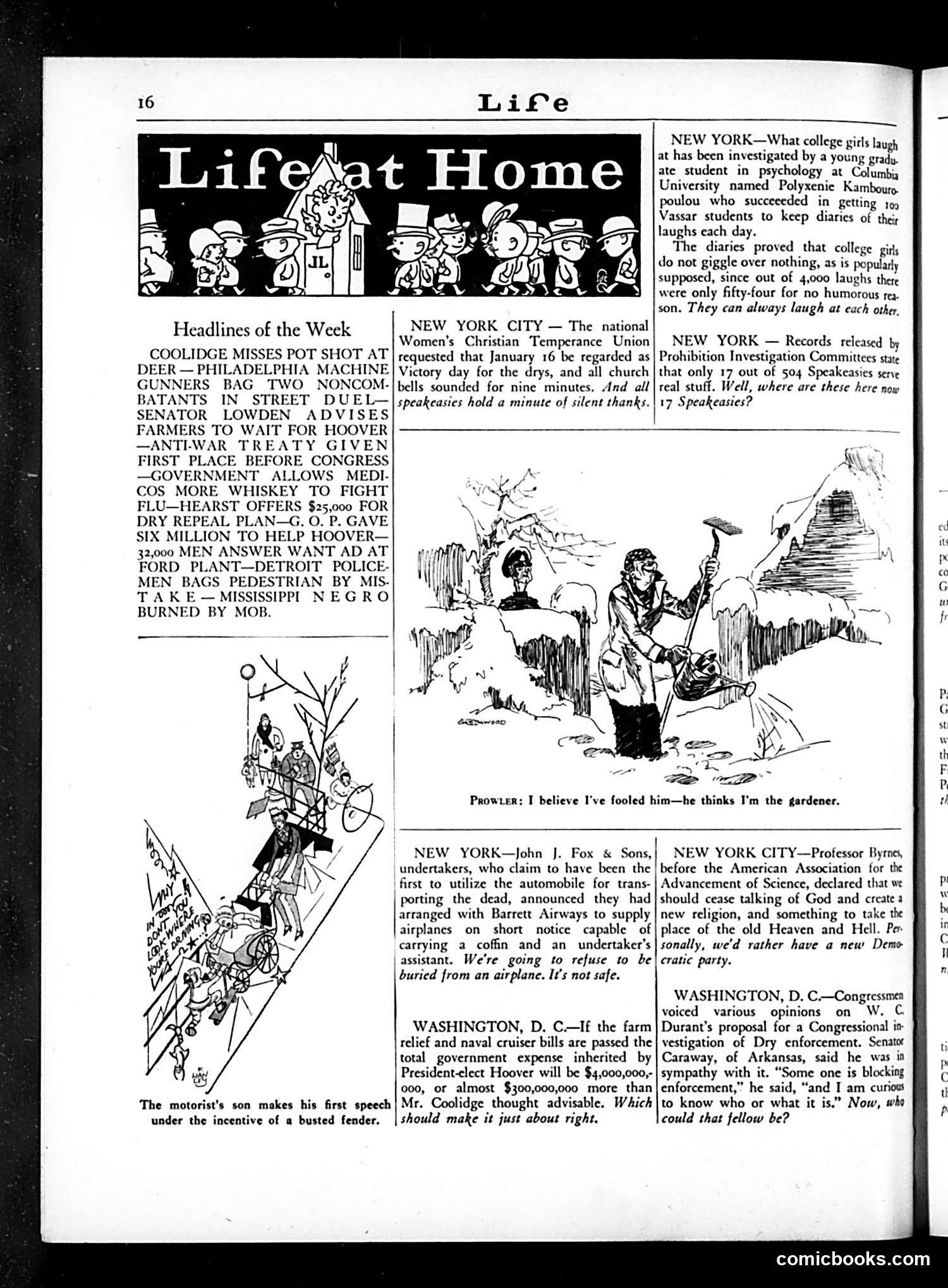
This page from *Life* magazine presents satirical news briefs and cartoons mocking contemporary 1920s American events. **The cartoons:** - Bottom left: A child's first speech occurs while his father has a "busted fender," satirizing how parents use accidents as teaching moments. - Center: A gardener successfully deceives a wealthy homeowner ("Prowler: I believe I've fooled him—he thinks I'm the gardener"), poking fun at class distinctions and the difficulty distinguishing servants from intruders. **The news items** mock: - Women's temperance activism (requesting silent prayer for Prohibition) - Political spending proposals during the Coolidge era - A professor's suggestion to replace traditional religion with a "Democratic party"—satirizing secular progressivism The overall tone mocks 1920s American social pretensions, class anxieties, and political reformism.
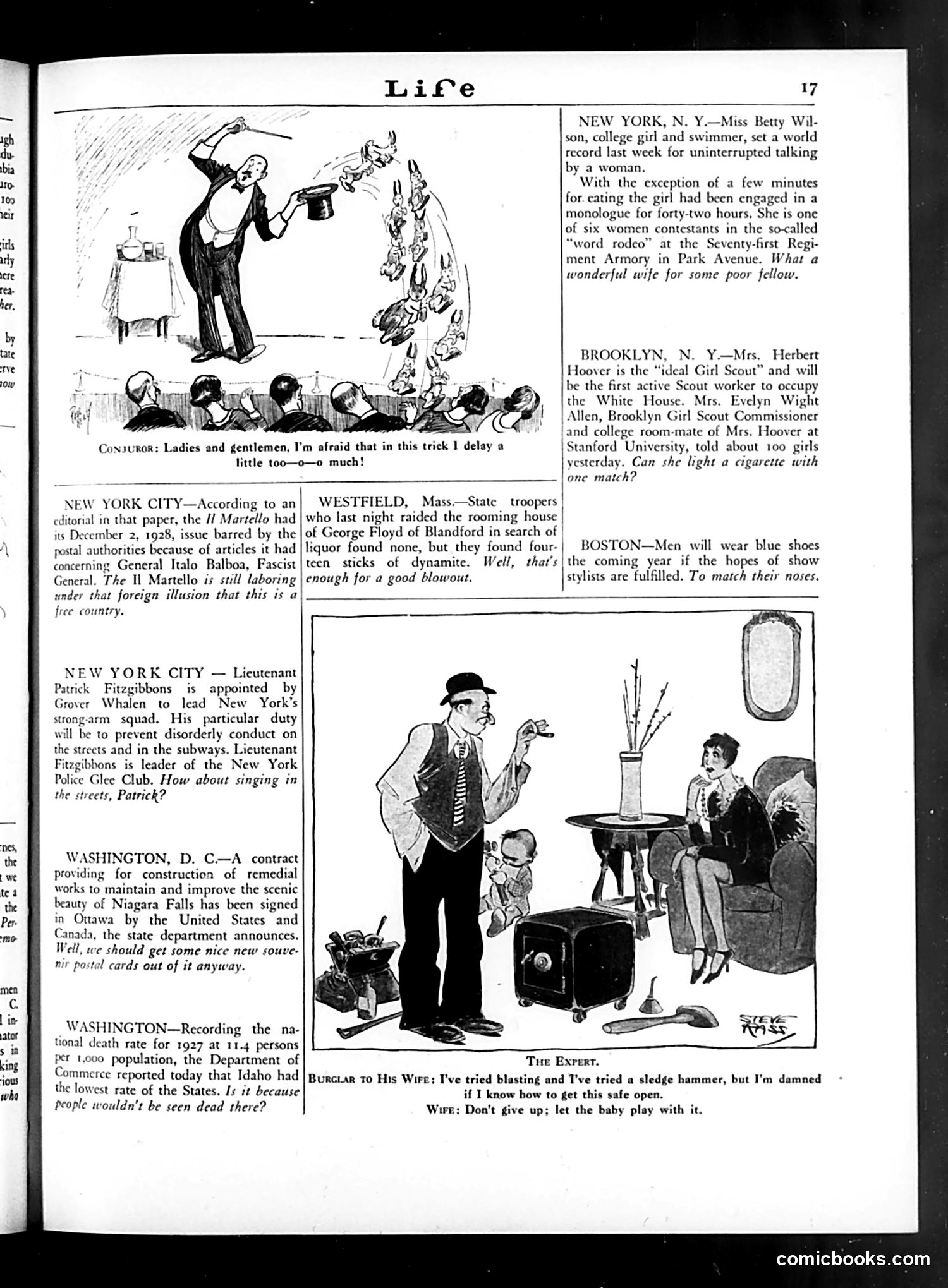
**Top Cartoon:** A magician/conductor performs a trick for an audience of seated onlookers. The caption jokes: "Ladies and gentlemen, I'm afraid that in this trick I delay a little too—o—so much!" This appears to satirize a magician whose act is running long or whose tricks aren't working smoothly—a commentary on entertainment or performance failures. **Bottom Cartoon ("The Expert"):** A burglar struggles with a safe while his wife offers unhelpful advice. He's tried hammers and a sledge; she suggests letting the baby play with it. This is domestic humor mocking both the burglar's incompetence and the wife's absurd "solutions"—typical of period comic strips about foolish criminals or marriage dynamics. Both rely on visual slapstick humor common to 1920s Life magazine.
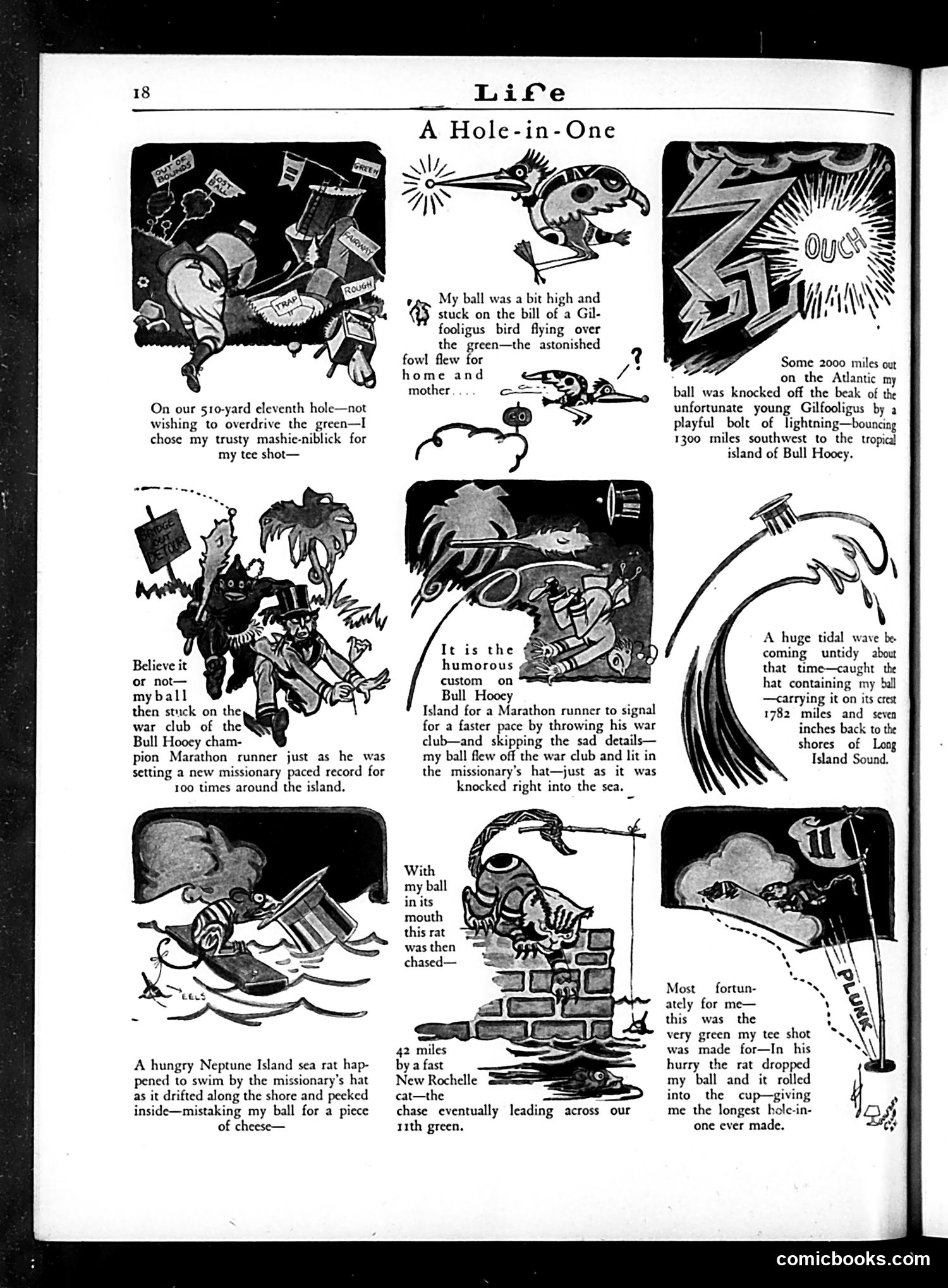
This is a tall-tale comic about an impossibly long golf hole-in-one. The joke satirizes the exaggerated fishing-story tradition—a golfer claims his ball traveled an absurd 2,000+ miles across improbable adventures before landing in the cup. The narrative absurdly chains impossible events: the ball gets caught on a "Gilfooligus bird," struck by lightning, caught in a tidal wave, chased by a sea rat and cat (across islands named "Bull Hooey"), and finally rolls into the cup on the 11th green. "Bull Hooey Island" is clearly a pun on "bull" (lies). The entire conceit mocks boastful sportsmen who embellish trivial events into fantastical sagas. The cartoonist exaggerates the form to ridicule its absurdity—by making the story *completely* impossible, Life emphasizes how ridiculous such tall tales actually are when taken literally. The humor targets masculine braggadocio about sports exploits.
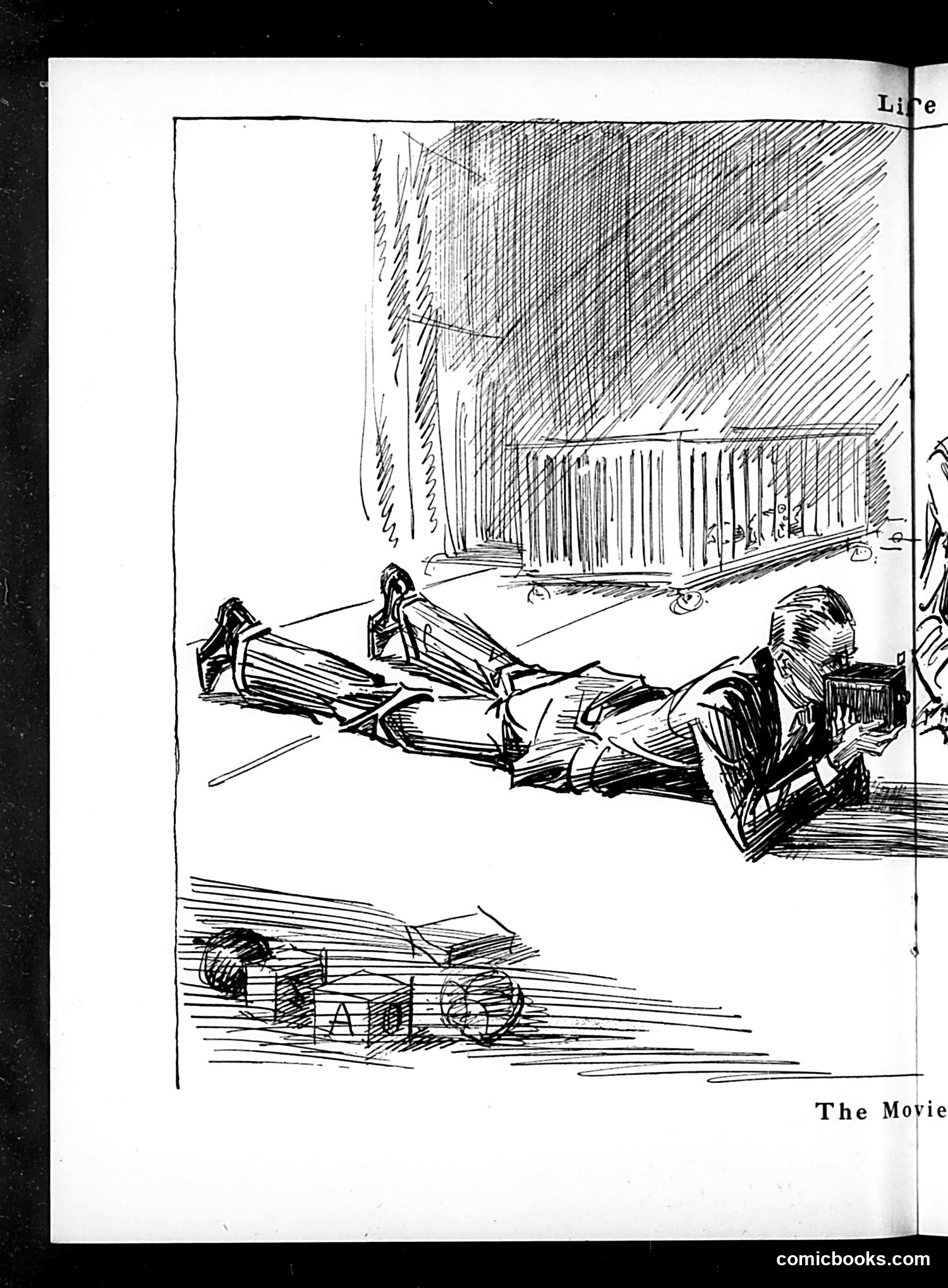
This sketch depicts a film production scene, showing three figures lying prone on the ground in exaggerated poses typical of early cinema's melodramatic acting style. A fourth figure stands observing on the right. In the background, a simple set with a fence and building is visible. The satire likely mocks the overwrought, theatrical performances common in silent films of the early 20th century. The title "The Movie" combined with these absurdly prostrate actors suggests ridicule of how actors would throw themselves into scenes with excessive physical drama for the camera. The smaller sketch below appears to show filmmaking equipment, though details are unclear. This page satirizes silent film conventions and the artificiality of early movie performance—a recurring target of Life magazine's humor.
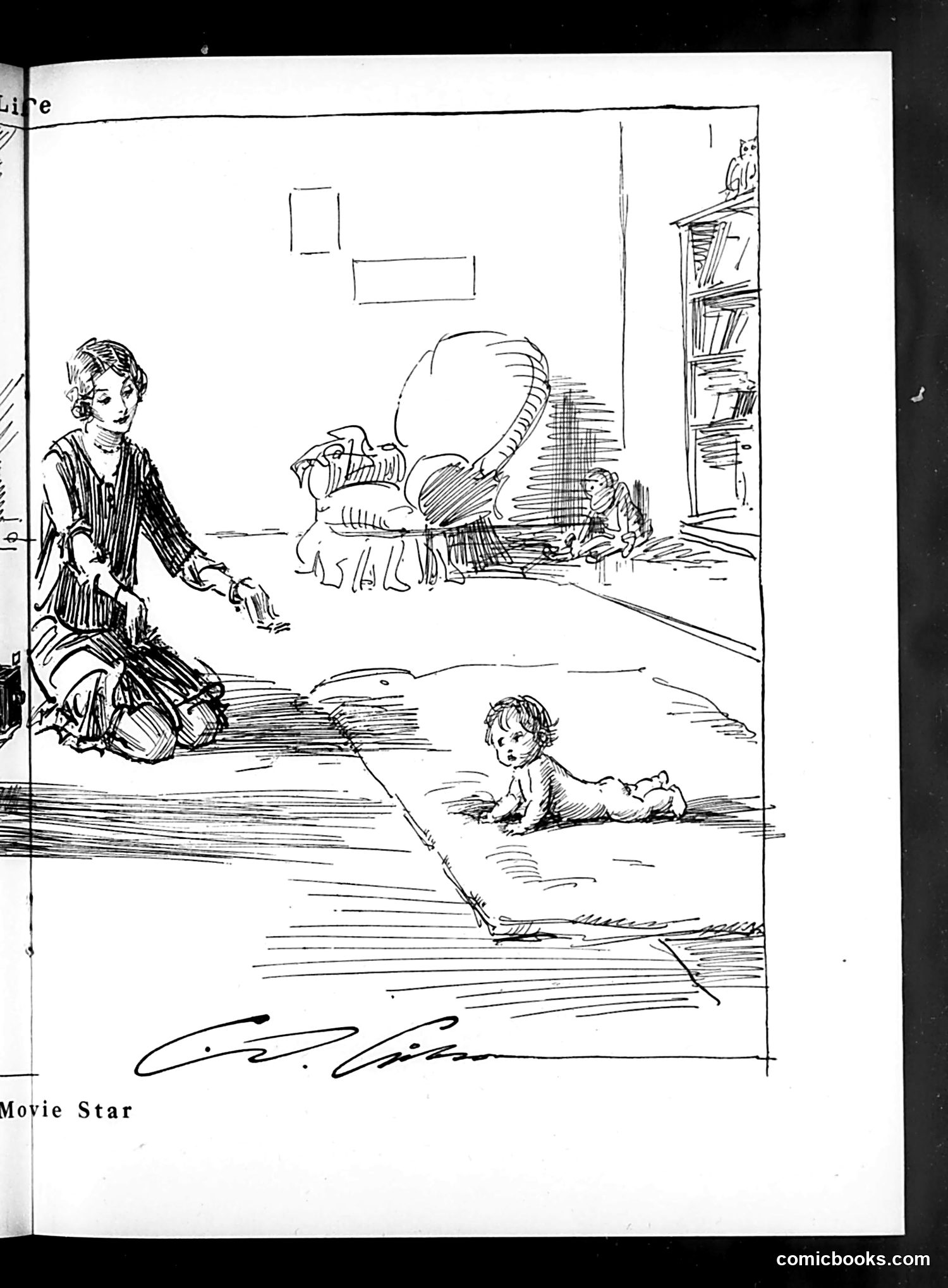
This appears to be a satirical illustration from *Life* magazine labeled "Movie Star." The sketch depicts a well-dressed woman kneeling beside a baby on the floor, with a large pram/carriage, toys, and a bookshelf visible in the interior setting. The satire likely mocks the contrast between a glamorous "movie star" persona and the unglamorous reality of motherhood and domestic life. The illustration emphasizes this gap through the woman's fashionable attire and styled appearance juxtaposed against the messy, humble scene of childcare. The joke critiques either the pretensions of Hollywood celebrities or societal expectations placed on women to seamlessly balance stardom with traditional domestic duties—a recurring theme in early-to-mid 20th century American satire.
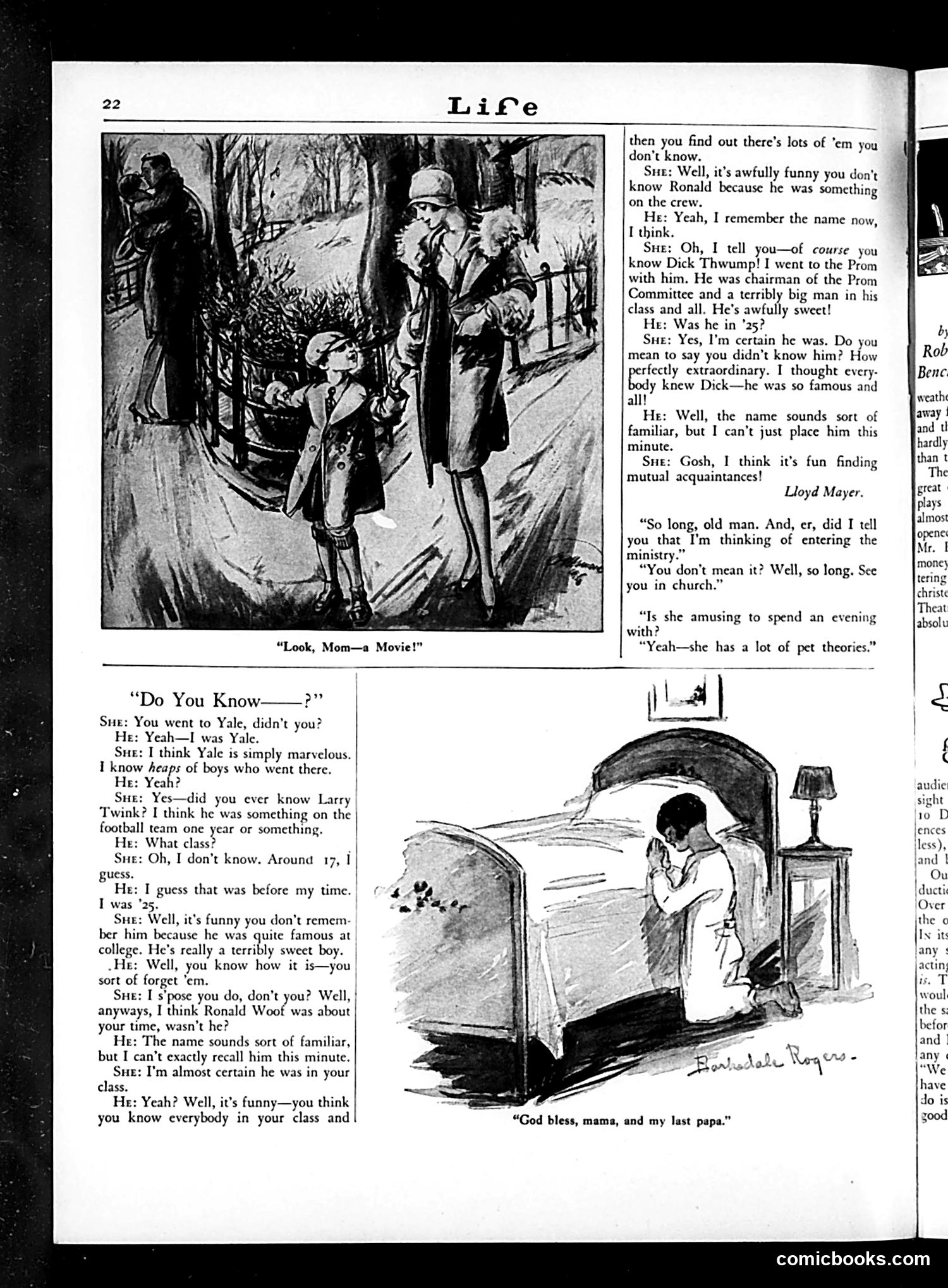
This page satirizes the awkwardness of social encounters between people who attended the same college at different times. The top dialogue shows a man and woman ("He" and "Sue") attempting to establish common ground through Yale alumni connections. Sue confidently names classmates she believes he should know—Dick Thwump, Larry Twink, Ronald Woof—but he repeatedly claims not to remember them, claiming their names sound "sort of familiar." The humor lies in the absurdity: either these people didn't actually exist, or the man is being evasive/forgetful about his own classmates. The satirical point critiques the social pretense of appearing well-connected and the awkward performance of shared memories among alumni. The bottom cartoon shows a child's bedtime prayer emphasizing family ("God bless, mama, and my last papa"), likely mocking sentimental period attitudes toward children's piety. Both pieces gently mock social conventions and the gap between appearance and reality in 1920s American society.
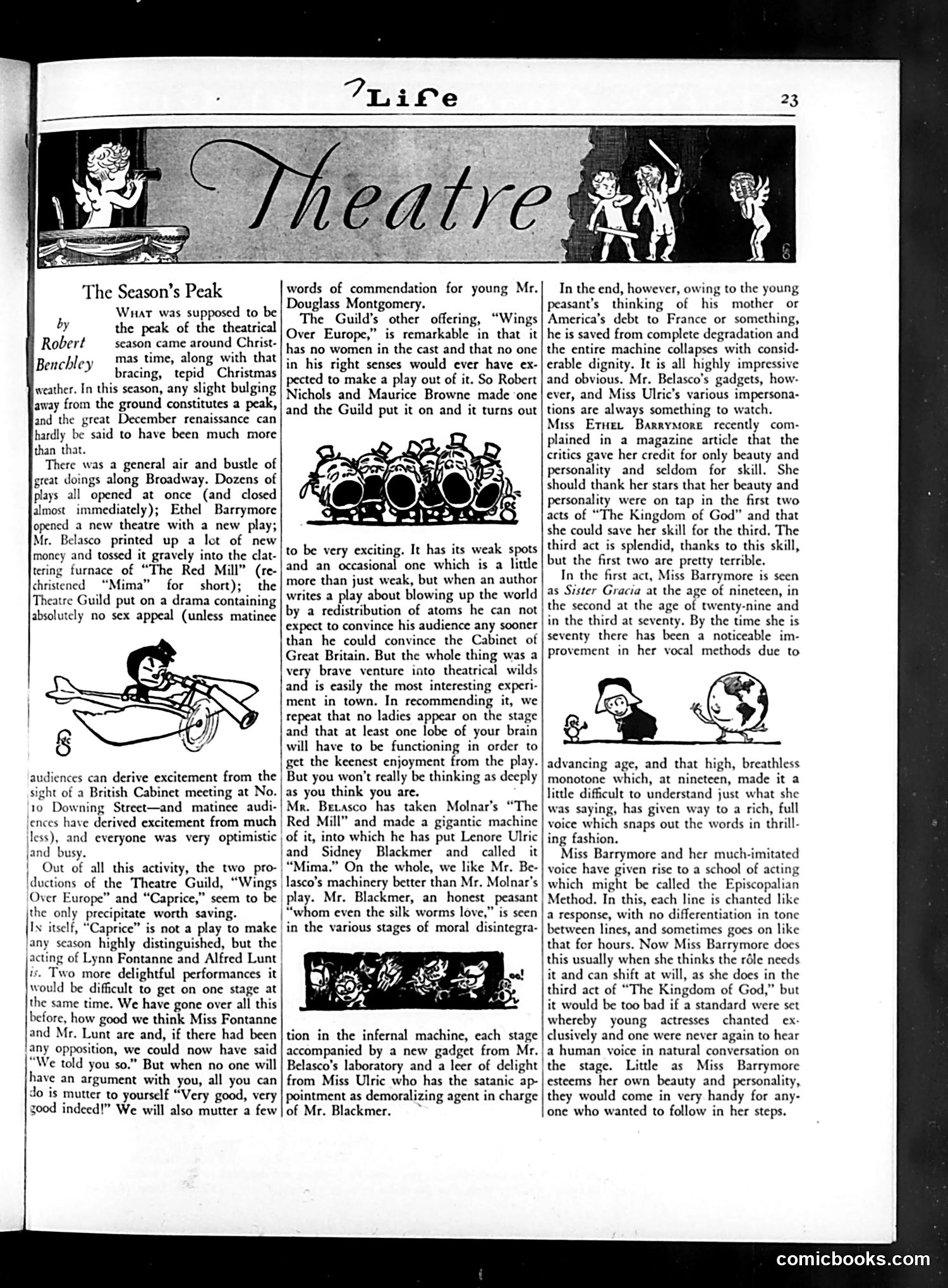
This theater review column discusses Broadway's December theatrical season. Benchley satirizes the industry's self-congratulatory attitude—calling it a "peak" when it's merely busy, comparing excitement to watching a British Cabinet meeting. He praises two Theatre Guild productions: "Caprice" (starring Lynn Fontanne and Alfred Lunt) and "Wings Over Europe" (a play about atomically destroying the world, notably all-male). He's witty about the latter's intellectual pretensions, saying audiences "won't really be thinking as deeply as you think you are." He mocks producer David Belasco's "Mima" (adapted from Molnár's "The Red Mill"), criticizing how Belasco's elaborate machinery and gadgetry overwhelm the original play. The plot—a peasant's moral corruption reversed by patriotic sentiment—is dismissed as "highly impressive and obvious." The page's cartoon illustrations support Benchley's irreverent tone toward theatrical excess and sentimentality.
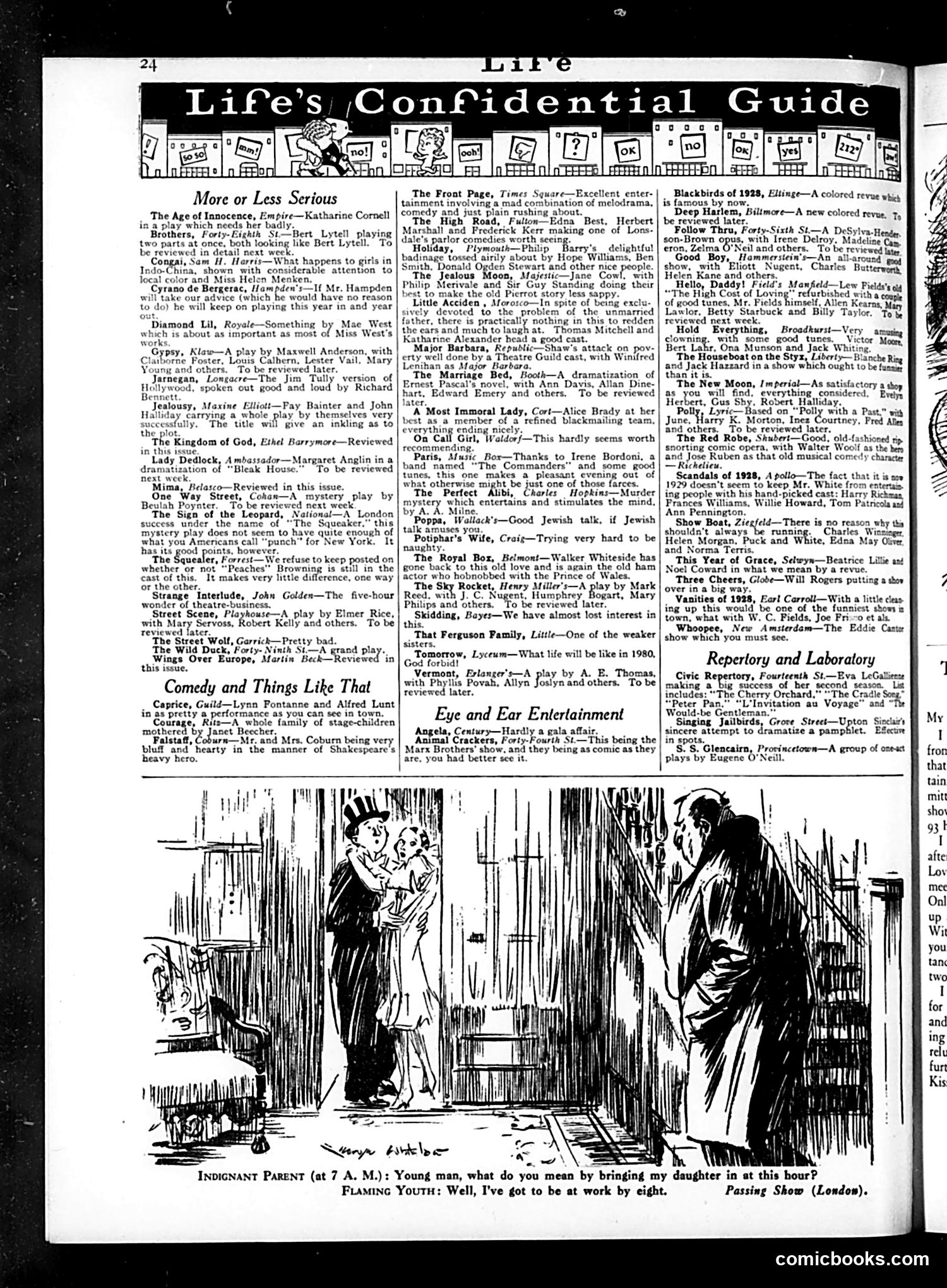
This page from Life magazine presents theatrical reviews and a single cartoon. The cartoon depicts an "Indignant Parent" confronting a young man at 7 A.M., demanding to know why he's bringing the parent's daughter home at that hour. The young man responds he must be at work by eight. The joke satirizes the tension between parental morality and modern youth behavior in the 1920s. The "Flaming Youth" caption references contemporary anxieties about young people's sexual freedom and late-night socializing—concerns that dominated cultural discourse during the Jazz Age. The cartoon mocks both the stern parent's outrage and the young man's casual dismissal of propriety, reflecting Life's satirical stance toward generational conflict over changing social mores regarding courtship and propriety.
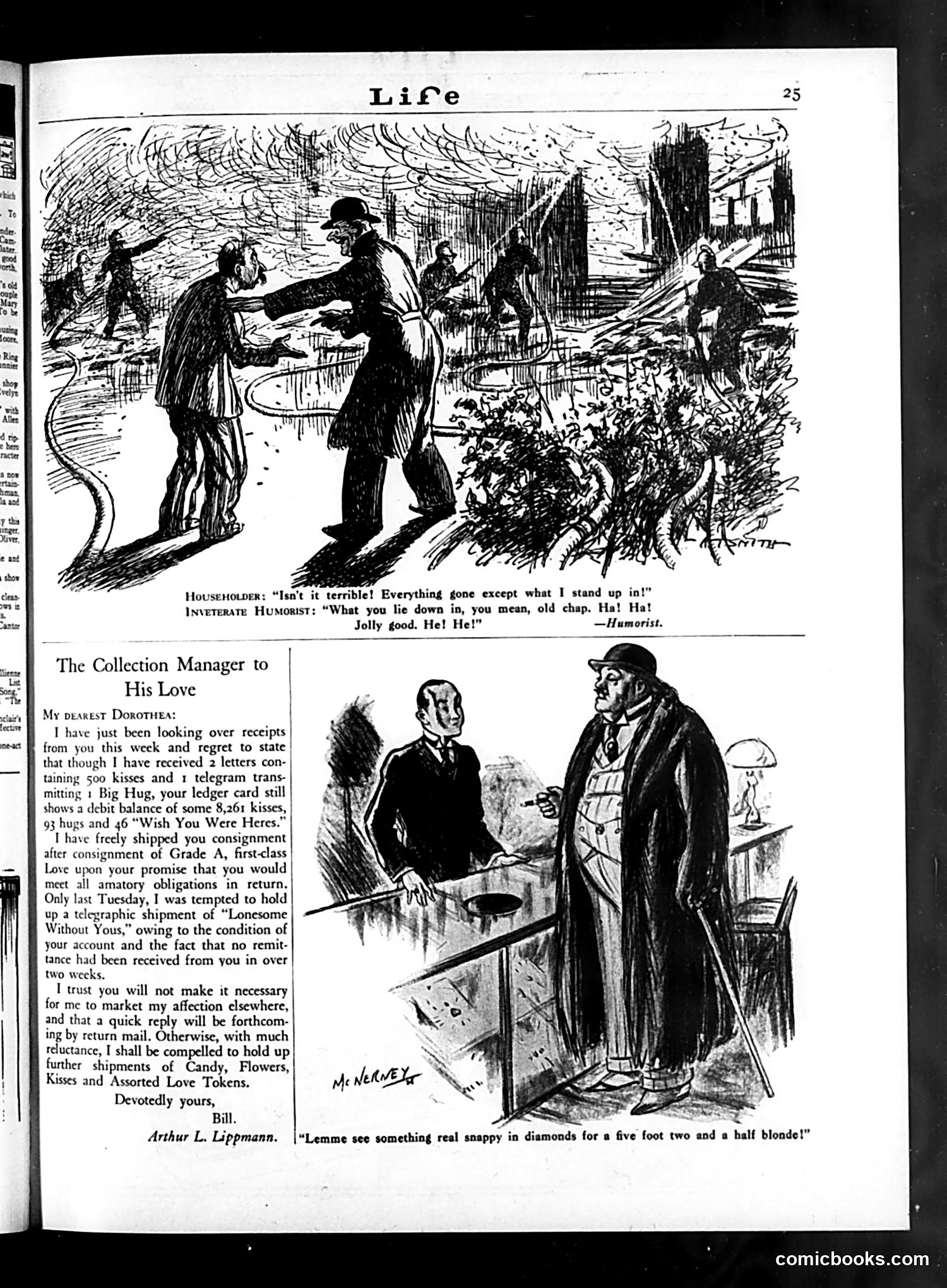
**Top Cartoon:** A householder surveying bomb damage during what appears to be WWI or WWII makes a rueful comment about losing everything. An "inveterate humorist" makes a dark joke—twisting "stand up in" to mean the householder is lying down (dead) rather than merely homeless. The satire mocks those who make inappropriate jokes during genuine tragedy. **"The Collection Manager to His Love":** A humorous letter from "Bill" (Arthur L. Lippmann) to his girlfriend "Dorothea," written in mock-business language. Bill treats romantic gestures—kisses, hugs, "love tokens"—as commercial transactions, keeping a ledger of what he's "shipped" versus what she owes. The satire gently mocks both overly-transactional approaches to romance and the commercialization of sentiment. The closing threat to "market affection elsewhere" if payment isn't made plays on the absurdity of treating love as business debt. Both pieces use humor to deflate pretension.
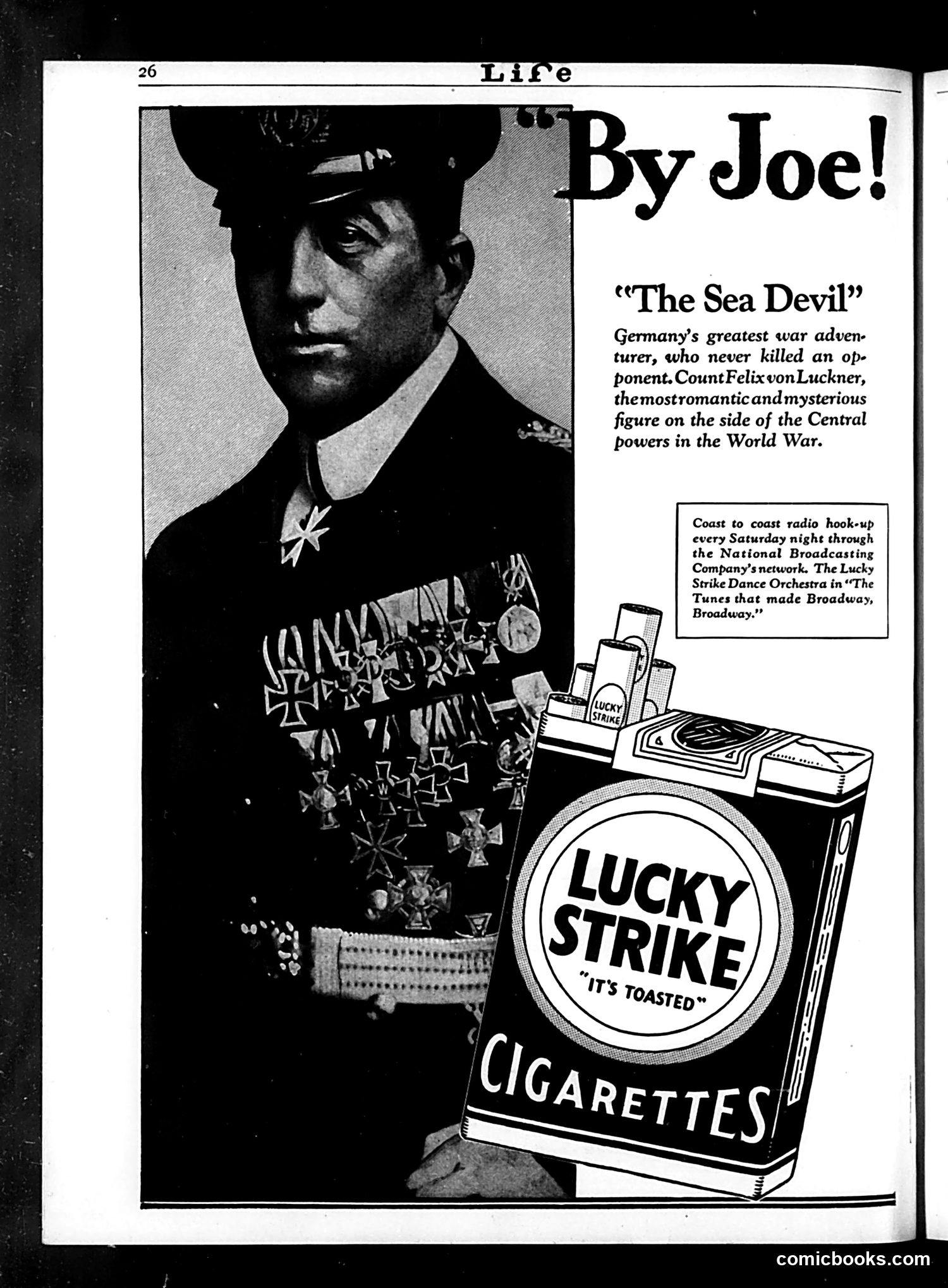
This is a Lucky Strike cigarette advertisement disguised as editorial content. It features Count Felix von Luckner, a German World War I naval commander known as "The Sea Devil" for his ship-raiding exploits. The ad exploits his romanticized wartime reputation to sell cigarettes to American readers. The copy emphasizes von Luckner's supposed honor ("never killed an opponent") and mystique, attempting to transfer these qualities to the Lucky Strike brand. The advertisement cross-promotes a radio program featuring the Lucky Strike Dance Orchestra, leveraging von Luckner's notoriety for brand exposure. Notably, this advertisement appeared during or shortly after WWI, when such German military figures were recent enemies. The ad's strategy reveals how companies used celebrity endorsement and patriotic/military imagery to market products, even to audiences who had recently fought against the figures being promoted.
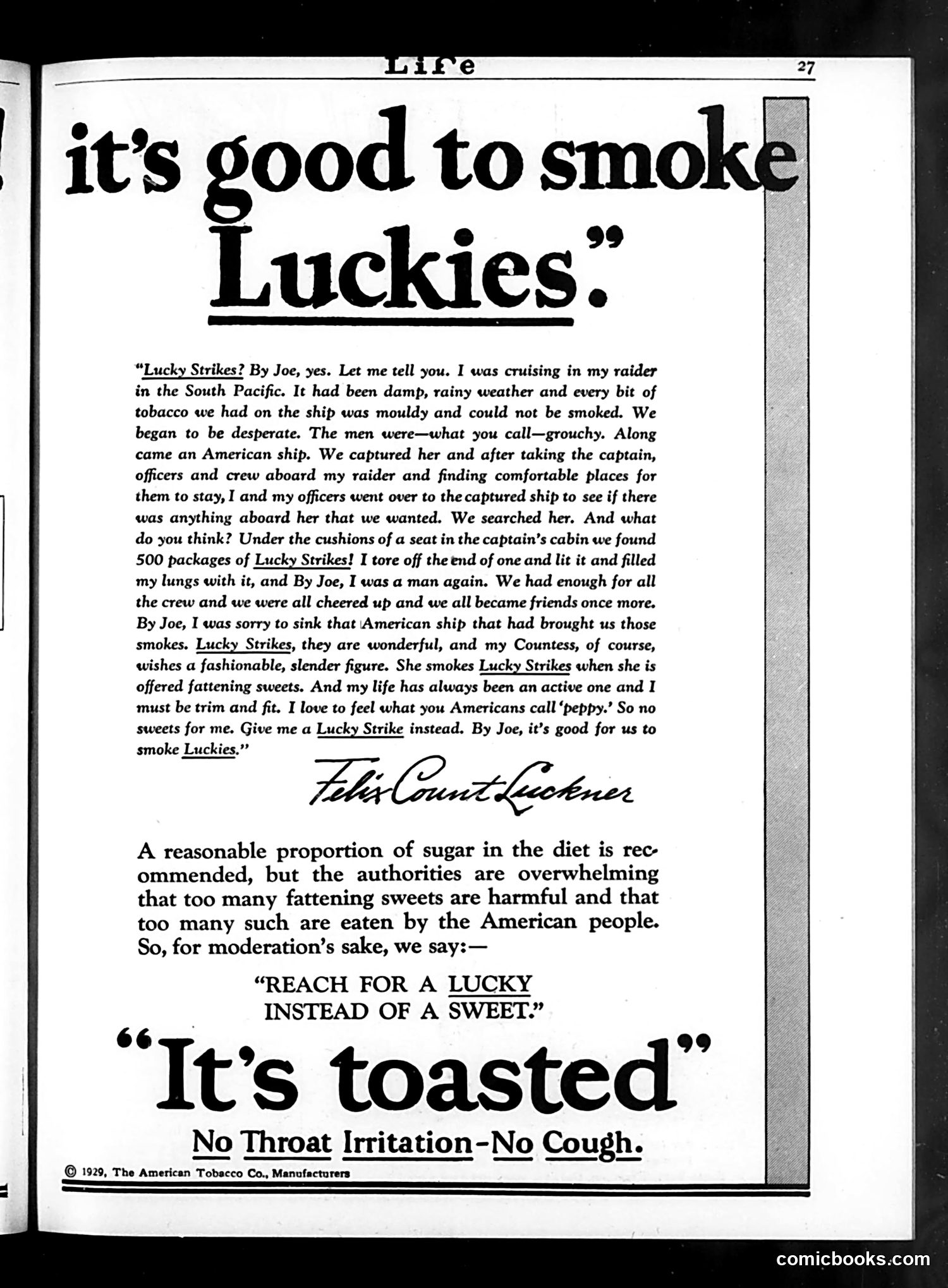
This is a **cigarette advertisement**, not satire—though it reads absurdly to modern eyes. The "Life" magazine page features a testimonial attributed to "Felix Count Luckner," apparently a German military figure endorsing Lucky Strikes cigarettes. The ad's pitch is remarkable: it argues Americans should "reach for a Lucky instead of a sweet" for health reasons, positioning cigarettes as a weight-control aid rather than a health risk. The fictional narrative—a German raider captain finding 500 Lucky Strikes on a captured American ship and bonding with enemies over them—serves as propaganda disguised as adventure. The "No Throat Irritation—No Cough" claim exemplifies early tobacco marketing's false health assurances. By 1929 (copyright date), such ads were common before smoking's dangers were widely acknowledged or regulated. The endorsement weaponizes a supposed foreign authority figure to validate American tobacco consumption.
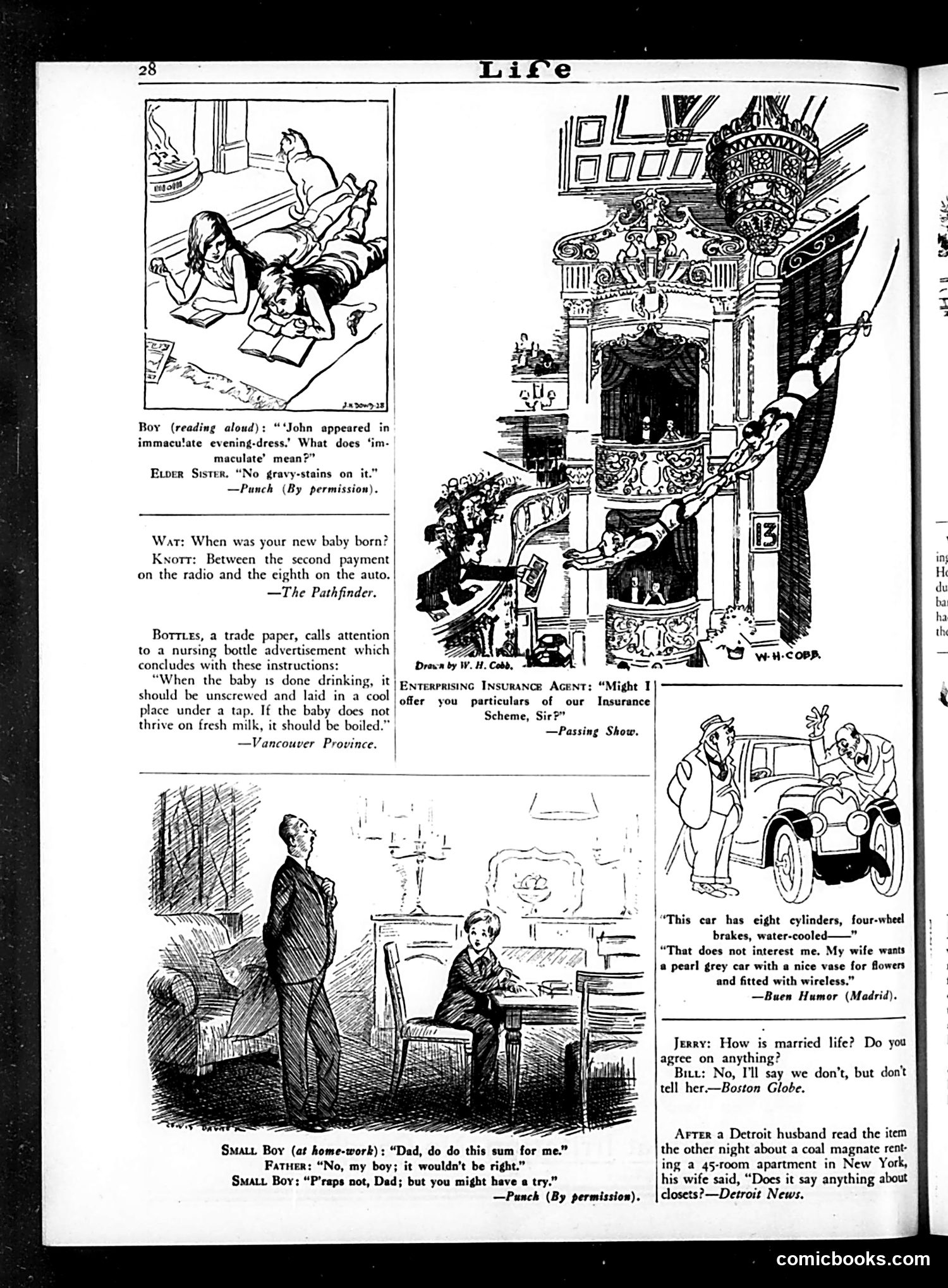
This page collects brief humorous anecdotes and jokes typical of 1920s-30s satirical magazines. The humor reflects period anxieties and social observations: **Key Jokes:** 1. **"Immaculate"** - Elder sister defines it by working-class reference (gravy stains), poking fun at pretentious vocabulary. 2. **Baby payment timing** - Satire on consumer debt: parents can only afford a baby between installment payments on luxury goods (radios, automobiles), mocking 1920s consumer culture. 3. **Nursing bottle instruction** - Absurdist humor about poorly-written product instructions that make the baby sound like an object to be "unscrewed." 4. **Insurance/car/marriage jokes** - Domestic humor about wives' priorities (car aesthetics over specs; closet space over luxury apartments). The page exemplifies how early-20th-century satire targeted consumerism, marital dynamics, and linguistic pretension among the middle class. All jokes assume contemporary reader familiarity with installment buying, radio ownership, and gender role expectations.
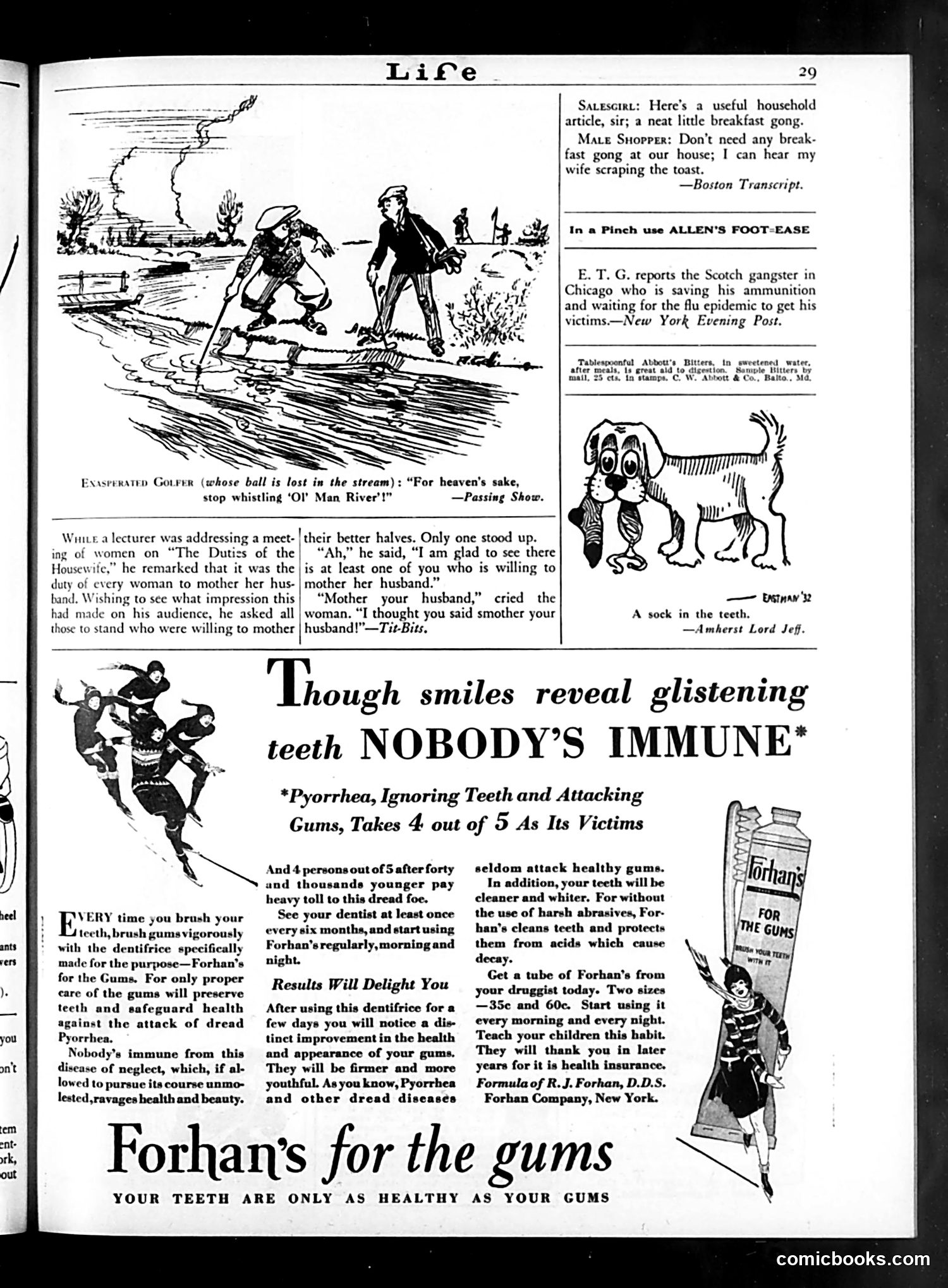
This page contains several brief humorous anecdotes and a dental advertisement, typical of Life's satirical content. ## The Cartoons/Jokes: 1. **"Exasperated Golfer"**: A golfer has lost his ball in a stream and asks someone to stop whistling "Ol' Man River"—a reference to the popular 1927 song. The joke is that the whistling is annoying while he searches. 2. **Housewife lecture joke**: A lecturer tells women their duty is to "mother" their husbands. Only one woman volunteers, claiming she misheard "mother" as "smother"—a dark joke about marital discord and wives wanting to kill their husbands. 3. **Breakfast gong**: A salesman pitches a breakfast gong to a customer, who jokes he doesn't need one—his wife's loud toast-scraping serves the purpose. 4. **Chicago gangster**: A brief quip about a Scottish gangster saving ammunition, waiting for the flu epidemic to claim his victims. ## The Advertisement: The majority of the page is a Forhan's toothpaste ad warning about pyorrhea (gum disease), claiming 4 of 5 people suffer from it. The "sock in the teeth" cartoon is part of this ad, emphasizing dental health.
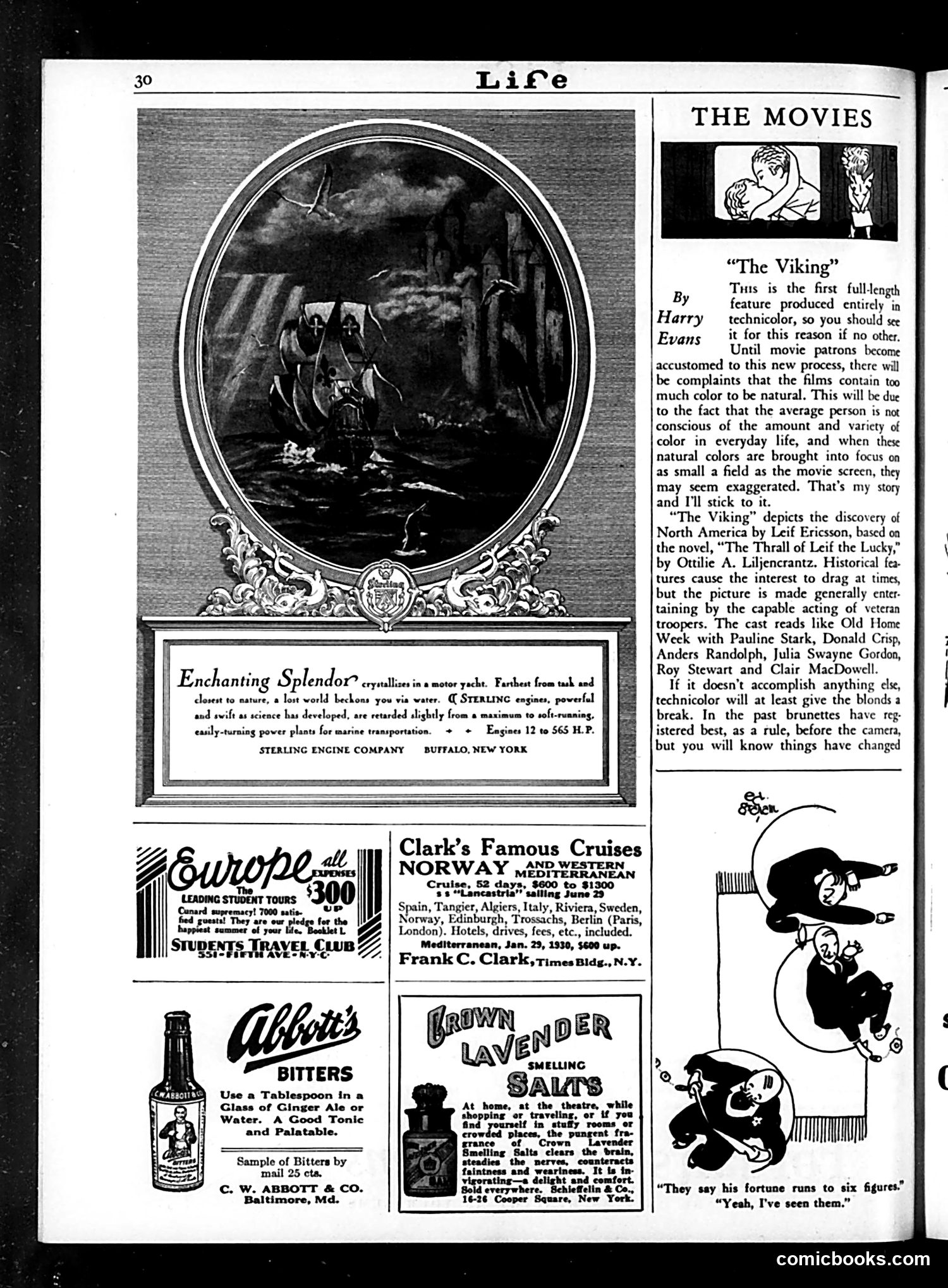
This page is primarily **advertising and entertainment reviews** rather than political satire. The main content is Harry Evans's review of "The Viking," the first full-length technicolor feature film, depicting Leif Erikson's discovery of North America. Evans's commentary addresses a key concern for 1920s audiences: technicolor's vivid palette may seem unnaturally saturated because viewers aren't accustomed to seeing such vibrant color reproduction on screen. The bottom right contains a **wordless cartoon joke** about wealth: two figures observe someone, with one saying his fortune "runs to six figures," and the other replies "Yeah, I've seen them"—a pun suggesting the wealthy person literally walks around displaying large numbers rather than possessing substantial money. The page is otherwise filled with **period advertisements**: Sterling engines, European cruises, Abbott's Bitters tonic, and Brown Lavender Smelling Salts—typical luxury goods marketed to Life's affluent readership.
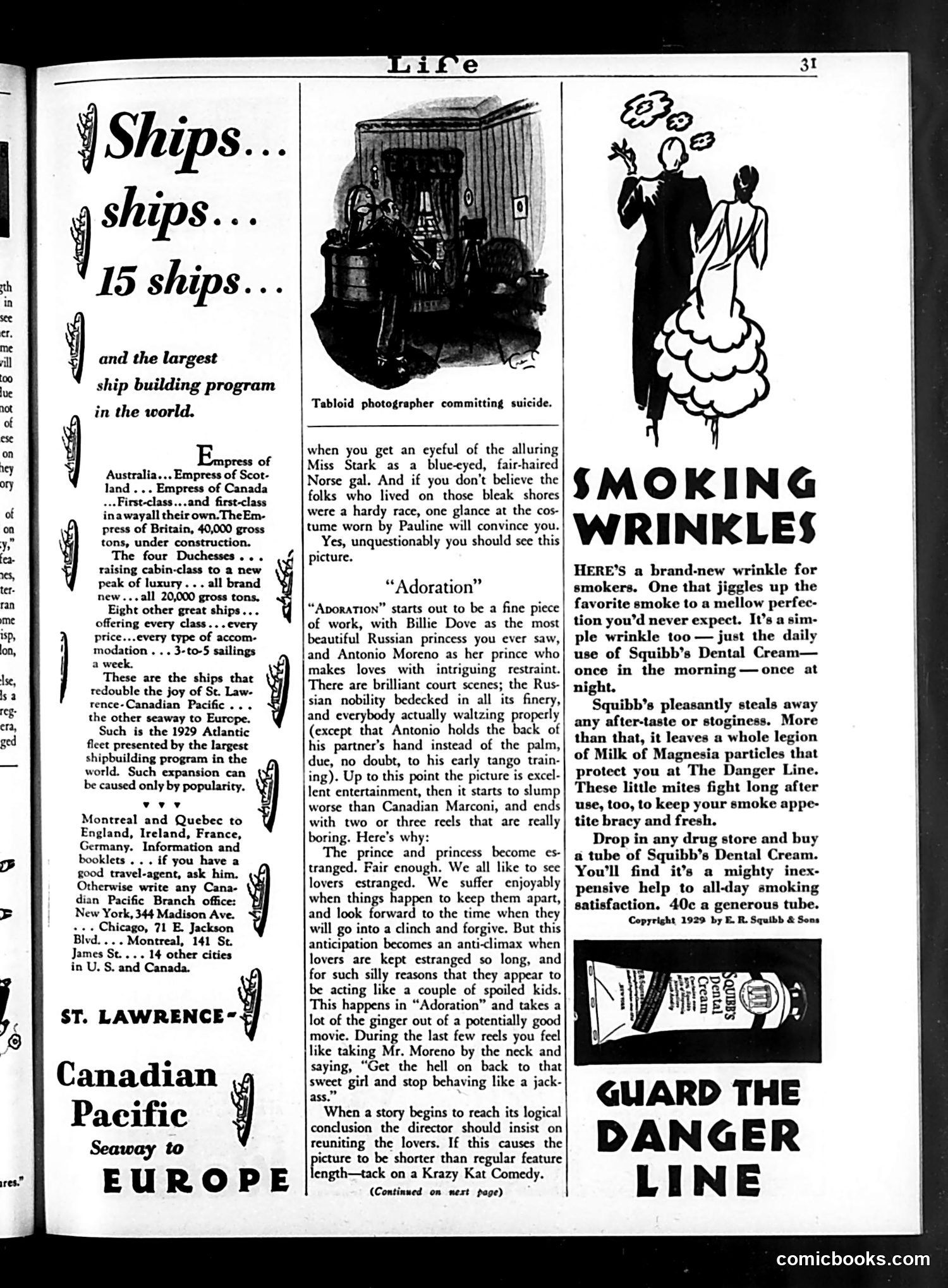
This page contains three distinct sections: a shipping advertisement, a film review, and a dental cream advertisement. The **"Ships" section** promotes Canadian Pacific's 1929 fleet expansion—15 new vessels offering transatlantic passage to Europe. It's straightforward commercial copy. The **"Adoration" review** critiques a film starring Billie Dove and Antonio Moreno. The reviewer praises the early court scenes and Russian nobility costumes but faults the plot for keeping the lovers estranged too long on "silly reasons," making them seem like "spoiled kids." The tone is sarcastic when he imagines wanting to shake the male lead for not reconciling. The suggestion to add a "Krazy Kat Comedy" if the film runs short is satirical criticism of weak plotting. The **"Smoking Wrinkles"** ad is a humor-based product pitch claiming Squibb's Dental Cream eliminates smokers' breath and staining through daily use. The language is deliberately whimsical ("wrinkles," "jiggles") to make dental hygiene entertaining. The page reflects 1929's mix of leisure travel, silent cinema criticism, and consumer goods marketing.
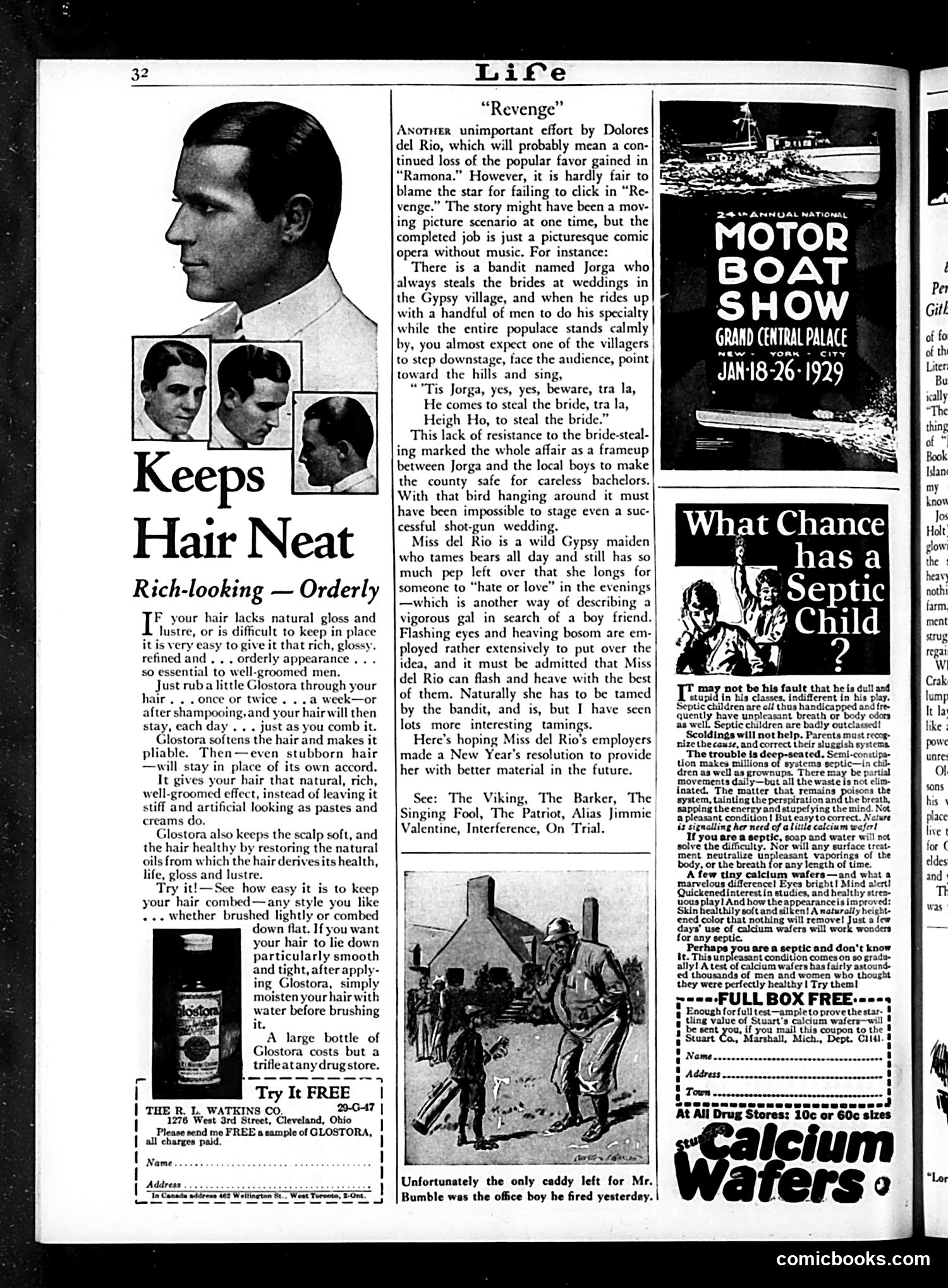
This page mixes advertisements with entertainment criticism, typical of Life's format as a satirical weekly. **Main Content:** A review of the film "Revenge" starring Mexican actress Dolores del Rio criticizes the movie as a poorly constructed "comic opera without music." The reviewer mocks its implausible plot—a bandit repeatedly stealing brides while villagers passively watch—suggesting it lacks dramatic coherence. Despite acknowledging del Rio's physical appeal ("flashing eyes and heaving bosom"), the critic dismisses the film as uninspired and calls on her studio to provide better material. **Advertisements:** The page features Glostora hair product (emphasizing "well-groomed" appearance for men), a 1929 Motor Boat Show announcement, and Calcium Wafers (marketed to parents of "septic children"—likely referring to toxemia or general ill health in children). The review exemplifies Life's satirical approach: witty, somewhat condescending critique of popular entertainment, treating even a major star's work as disposable product.
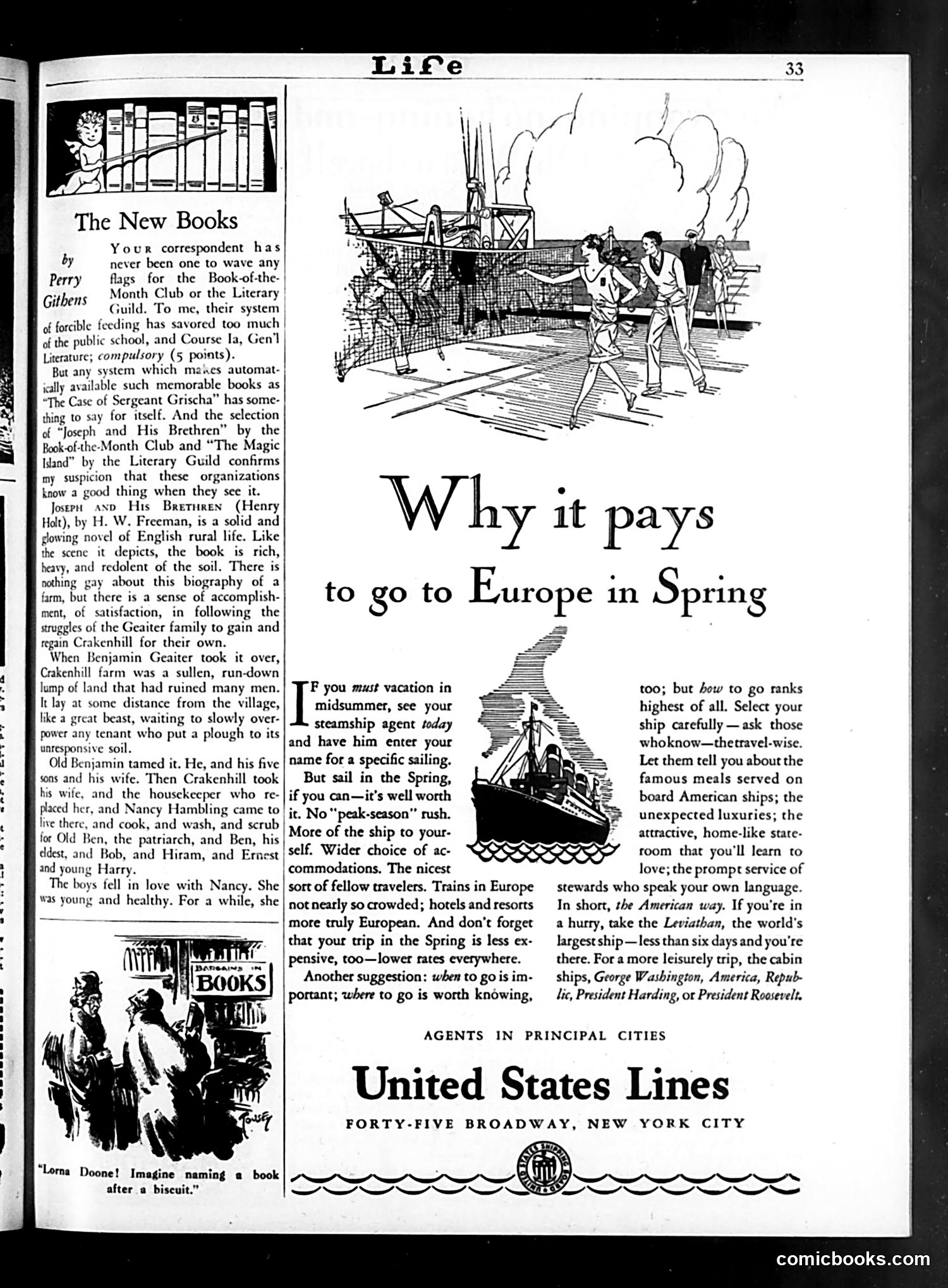
This page combines a book review column with a major shipping advertisement. **The Book Review (left):** Perry Gibbens critiques the Book-of-the-Month Club's mandatory selection system, though he grudgingly admits it occasionally identifies quality literature. He reviews "Joseph and His Brethren" by H.W. Freeman—a novel about an English farming family's struggles to reclaim their land, Crakenhill farm. The tone is literary criticism typical of 1920s magazines. **The Cartoon (bottom left):** A small joke showing two figures discussing books, with the caption "Lorna Doone! Imagine naming a book after a biscuit." This is satire about the absurdity of literary titles coinciding with commercial product names—likely referencing the actual Lorna Doone biscuit brand. **The Advertisement (right):** United States Lines promotes spring European travel by ship, emphasizing comfort, fewer crowds, lower prices, and superior American service compared to European travel. It mentions specific ships: the Leviathan, George Washington, America, Republic, and ships named after presidents.
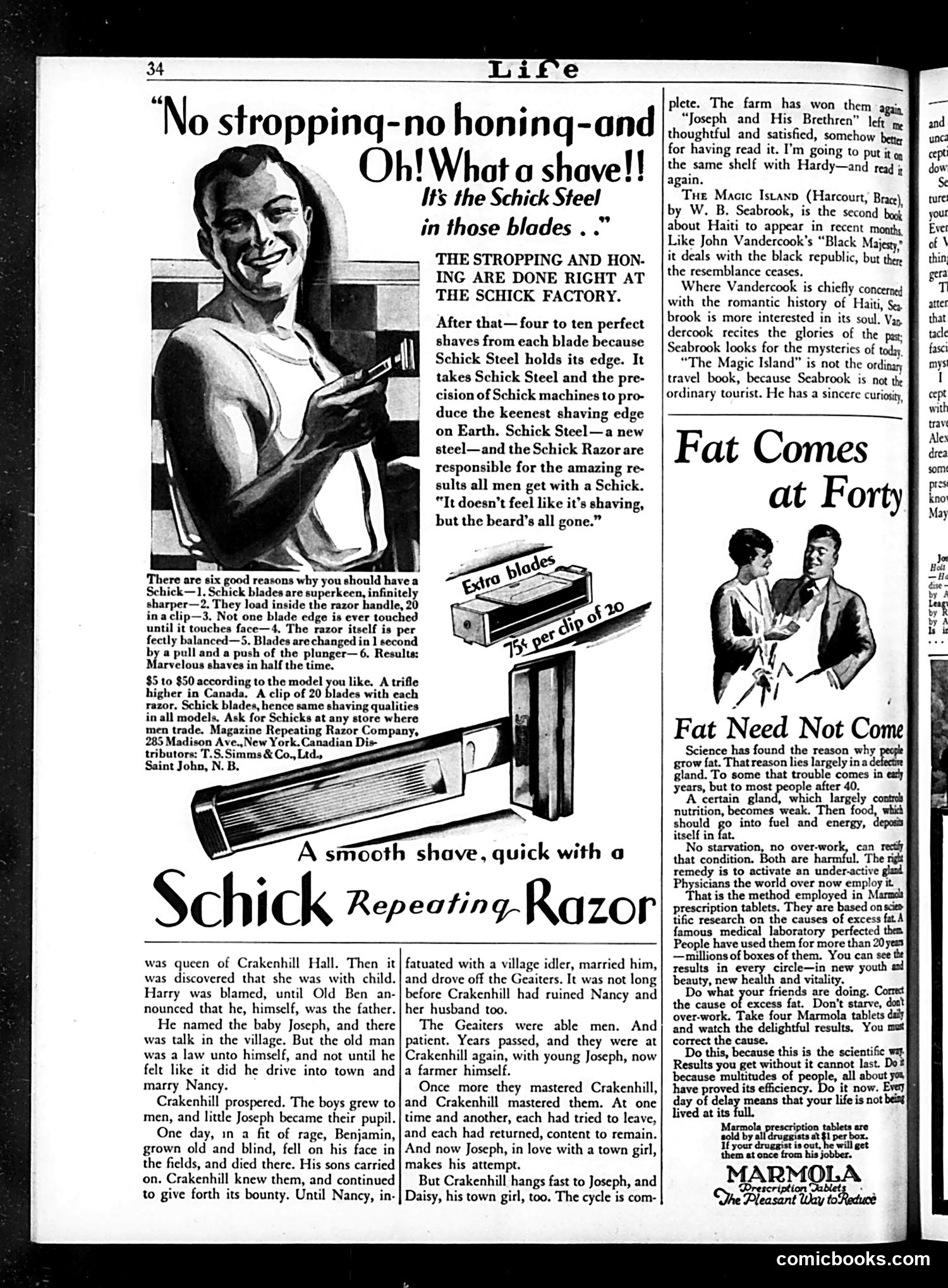
This page is primarily **advertising**, not satire or political commentary. The dominant content is a **Schick Repeating Razor advertisement** featuring a smiling man holding the product. The ad emphasizes the razor's innovation: blades load inside the handle in a clip system, requiring no stropping or honing (manual sharpening methods then standard). The copy highlights six advantages, including that blades stay sharp for "four to ten perfect shaves." Pricing ranges $5-$50 depending on model. Below the main ad is a serialized story excerpt about "Crakenhill," apparently a rural narrative about a farm's enduring hold on its inhabitants across generations. On the right side are brief book reviews and a **Marmola weight-loss tablet advertisement**, promoting these as a scientific solution for post-40 weight gain caused by glandular weakness. For modern readers: these ads reflect 1920s-30s consumer culture—the Schick represented cutting-edge razor technology, while Marmola tablets exemplify now-discredited patent medicine marketing.
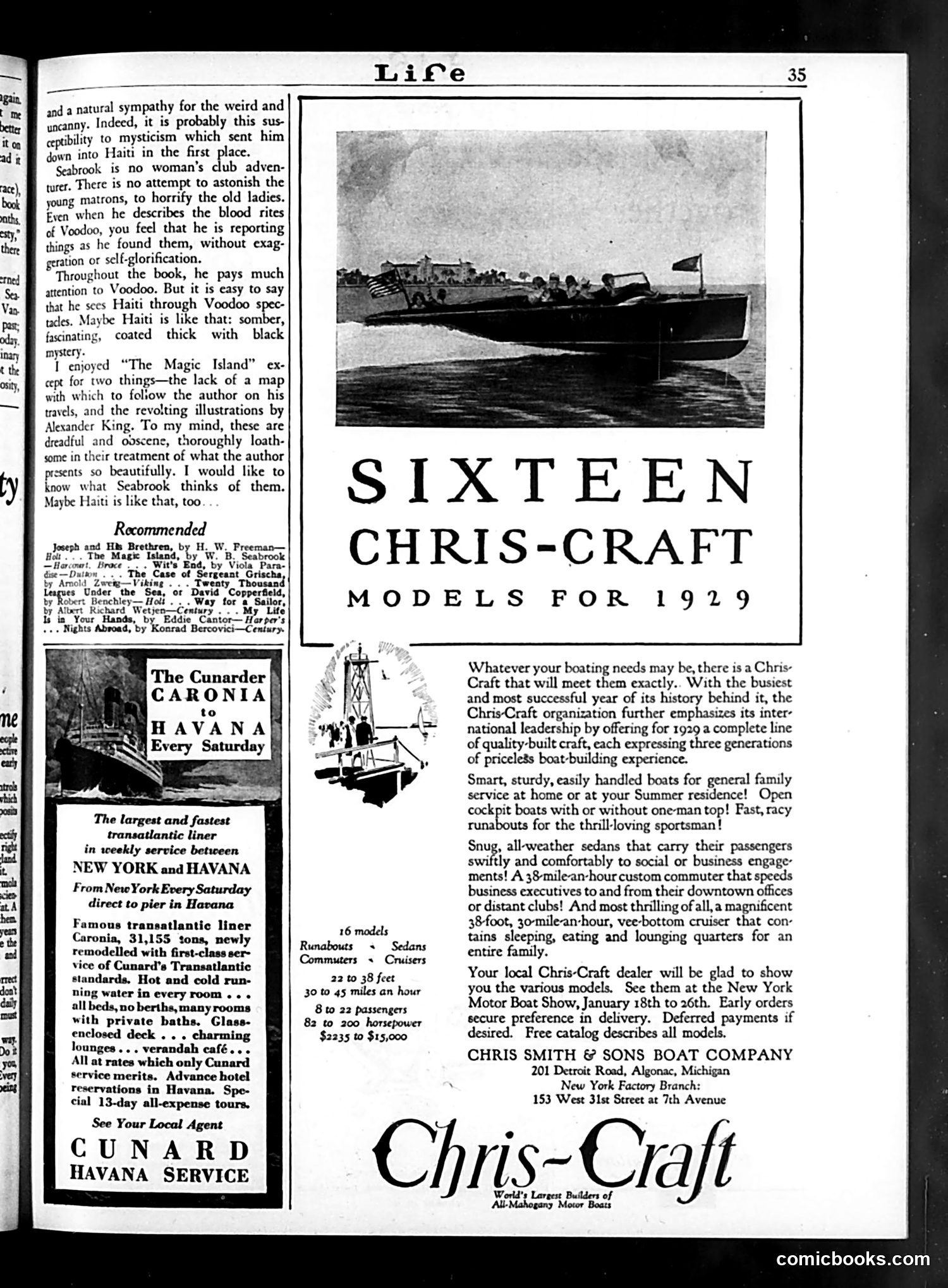
This page contains **no political cartoon**. The left column reviews W.B. Seabrook's book *The Magic Island* about Haiti and Voodoo practices, praising Seabrook's reportorial objectivity while criticizing the "dreadful and obscene" illustrations by Alexander King. A "Recommended" reading list follows. The page is primarily **advertising**: the Cunard Line promotes weekly transatlantic service to Havana (appealing to leisure travelers), and Chris-Craft advertises its 1929 motorboat models (ranging 22-38 feet, priced $2,235-$15,000) for wealthy recreational boaters. Both ads target affluent Americans in the prosperous late 1920s. The boat image shows a sleek Chris-Craft vessel.
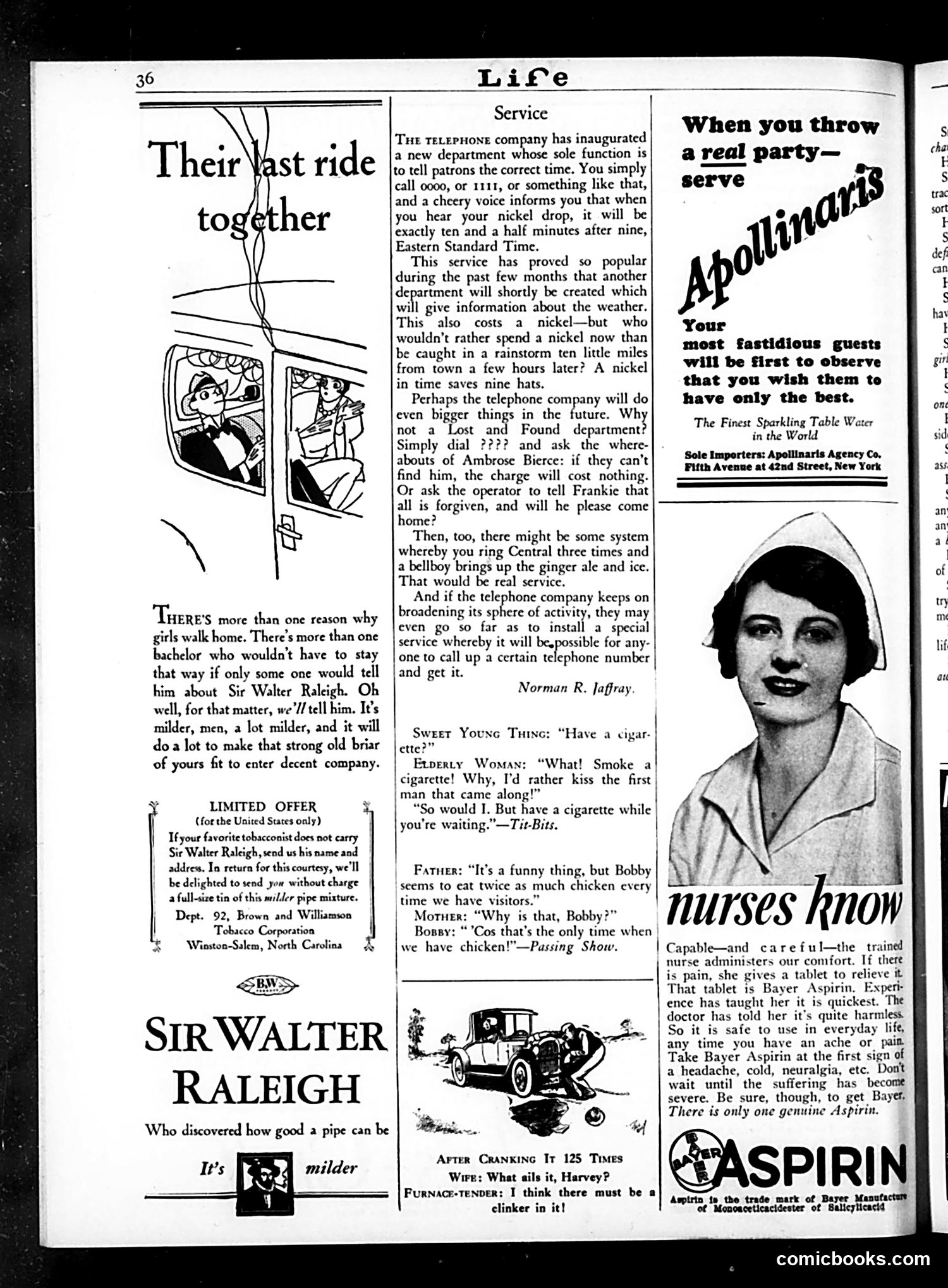
This page from *Life* magazine contains satirical commentary and advertisements typical of the 1920s-30s era. **Main Cartoon ("Their Last Ride Together"):** Depicts two figures in a taxi cab, illustrating the article's humorous commentary on new telephone services. The telephone company has introduced a "time service" (dial a number to hear the correct time), and the author jokingly proposes absurd expansions: a weather service, a "Lost and Found" to locate the writer Ambrose Bierce, and even a service to deliver drinks via bellboy. **Subtext:** The satire mocks both the telephone company's expansion into frivolous services and modern convenience culture—questioning whether people really need to pay a nickel to know the time when they could simply look outside. **Sir Walter Raleigh Advertisement:** References the historical figure who allegedly laid his cloak for Queen Elizabeth, reframing him as a pipe tobacco brand. The tagline "milder, men" targets masculine consumers with humor about courtship. **Bayer Aspirin Advertisement:** Shows nurses endorsing the product, exploiting professional credibility to market pain relief as safe for everyday use. The page mixes humor with commercial messaging, typical of *Life's* format.
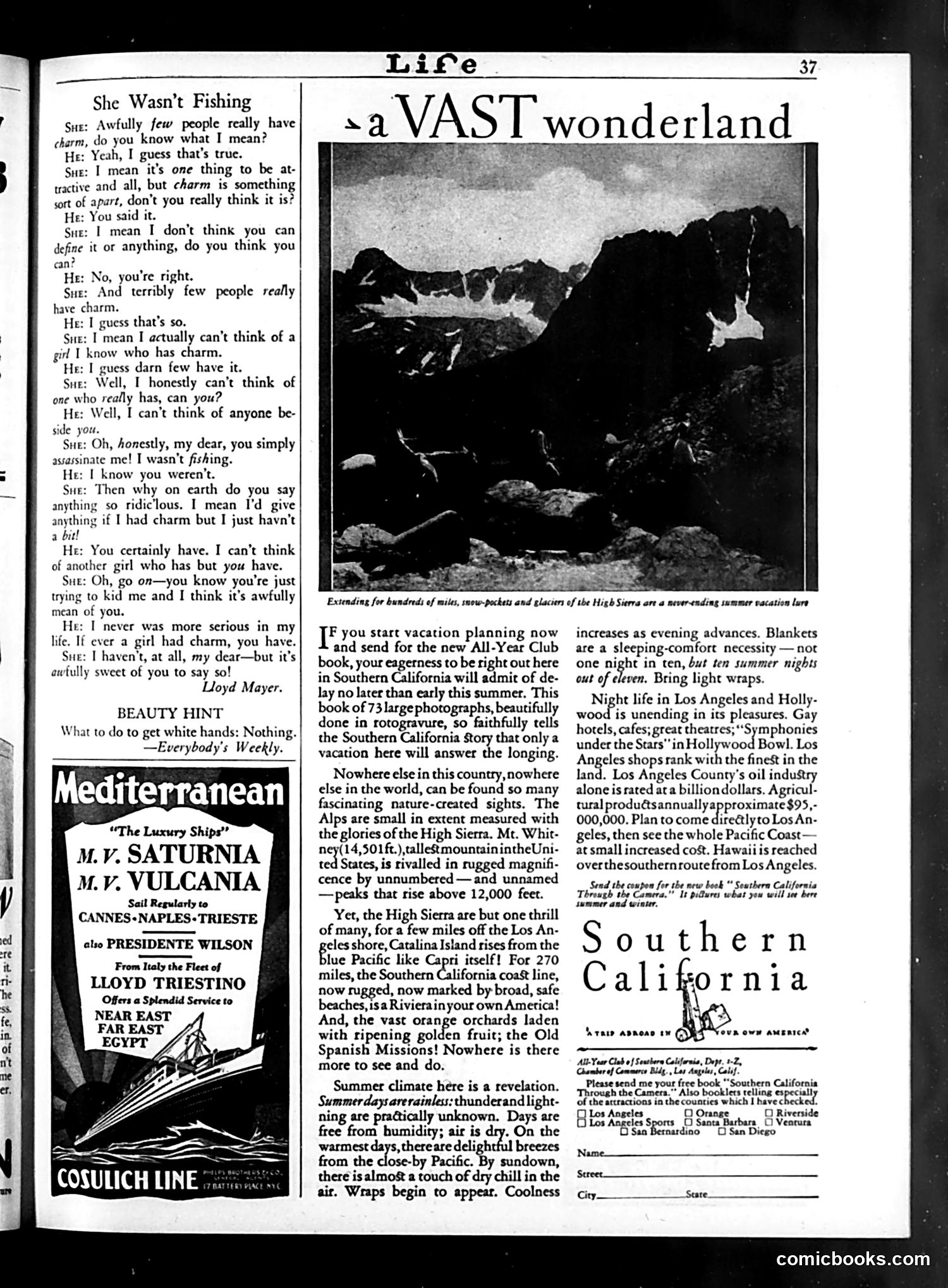
This page contains **no political cartoon**, but rather a social satire dialogue titled "She Wasn't Fishing" by Lloyd Mayer. The piece mocks feminine manipulation tactics of the era. A woman repeatedly denies having "charm" while fishing for compliments from a man, who dutifully provides them. The satire targets her transparent strategy: she feigns modesty ("I just haven't a bit!") to extract reassurance, then accuses him of "kidding" when he complies. The title ironically confirms she *was* fishing for compliments despite her protests. This reflects 1920s gender dynamics where women were expected to perform coyness and false modesty, and men were socially obligated to provide flattery. The humor satirizes both the woman's obvious manipulation and the man's complicity in the transparent charade. The rest of the page is advertising for Mediterranean cruise lines and Southern California tourism.
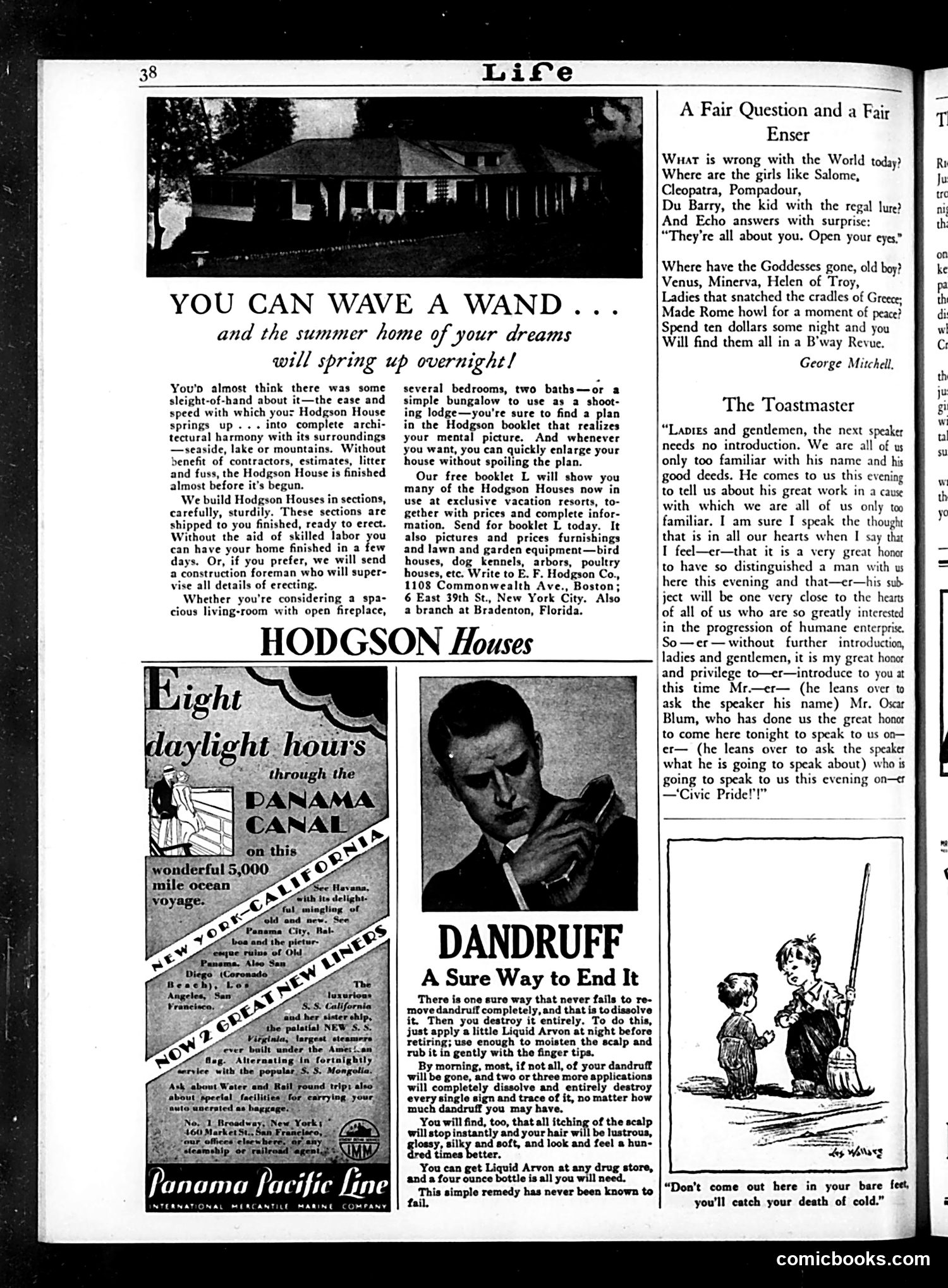
This page is primarily **advertising and filler content** rather than political satire. The main advertisements include: 1. **Hodgson Houses** — prefabricated kit homes marketed as easy-to-assemble vacation properties, emphasizing speed and convenience without skilled labor. 2. **Panama Pacific Line** — a cruise company promoting eight-day voyages through the Panama Canal as a luxury ocean voyage destination. 3. **Liquid Arvon** — a dandruff treatment product claiming to dissolve dandruff completely with simple application. The page also contains light humor pieces: a poem about missing classical goddesses (by George Mitchell) suggesting they're now found in Broadway revues, and "The Toastmaster" — a humorous take on tedious, circular introductory speeches at formal events. There are no significant political cartoons or social satire requiring historical context — this appears to be typical 1920s-era magazine filler mixing advertisements with mild entertainment content.
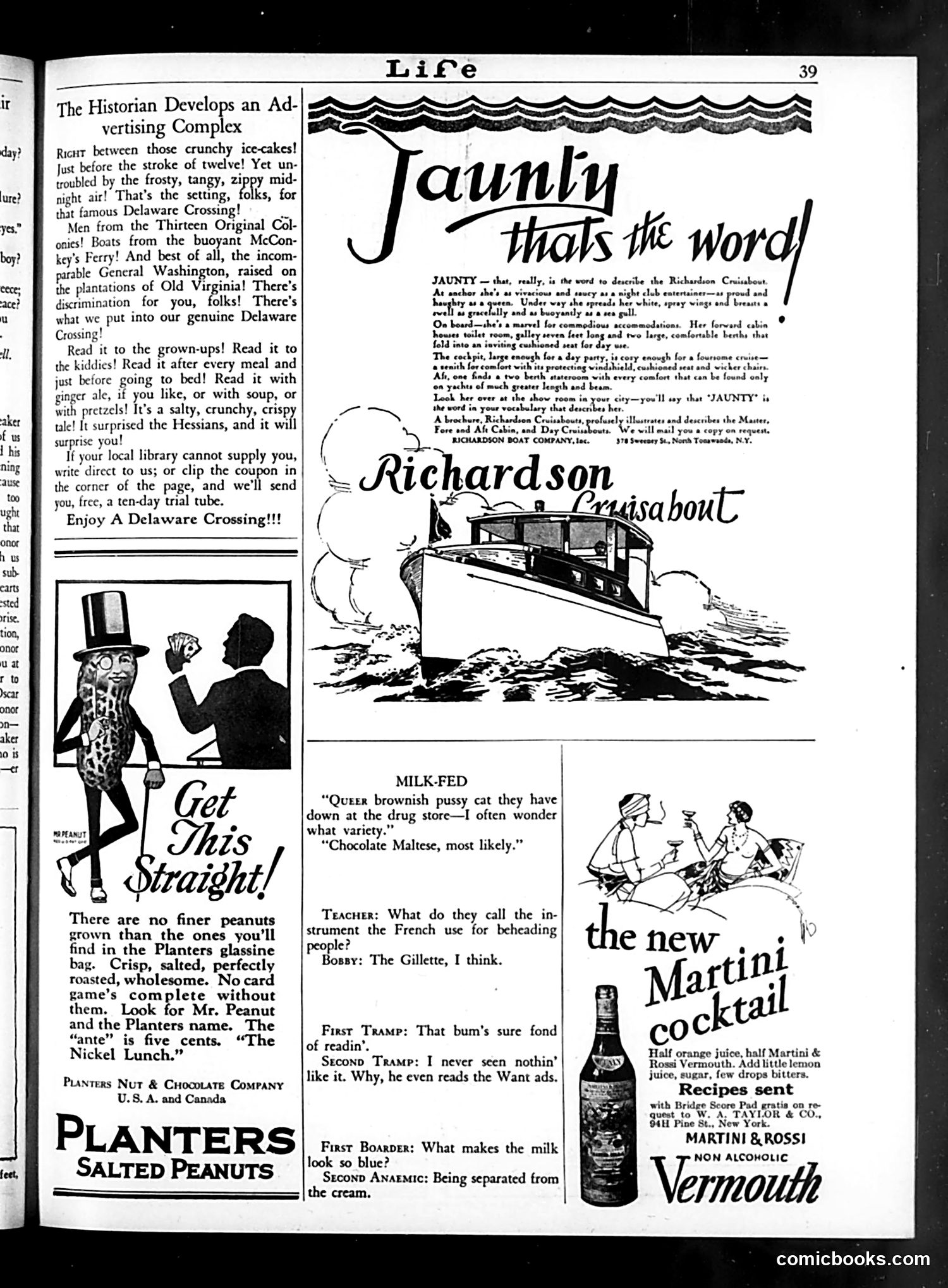
This page satirizes how American advertisers exploit historical narratives and cultural touchstones for commercial purposes. **Main Cartoon:** "The Historian Develops an Advertising Complex" mocks the overcommercialization of George Washington's Delaware Crossing—treating this iconic Revolutionary War moment as if it were a consumer product ("crunchy ice-cakes," "salty, crunchy, crisp tale"). The satire suggests advertisers have colonized even sacred history, packaging patriotic narratives with product pitches for peanuts and other goods. **Humor Throughout:** The page contains multiple jokes exploiting wordplay and double meanings—a "chocolate Maltese" cat, a "Gillette" as a beheading instrument, and milk "separated from the cream." These demonstrate period humor style. **Context:** This reflects 1920s-30s anxieties about advertising's growing pervasiveness and the commercialization of American culture and history. The piece critiques how marketing infiltrates every aspect of life, even education and national memory.
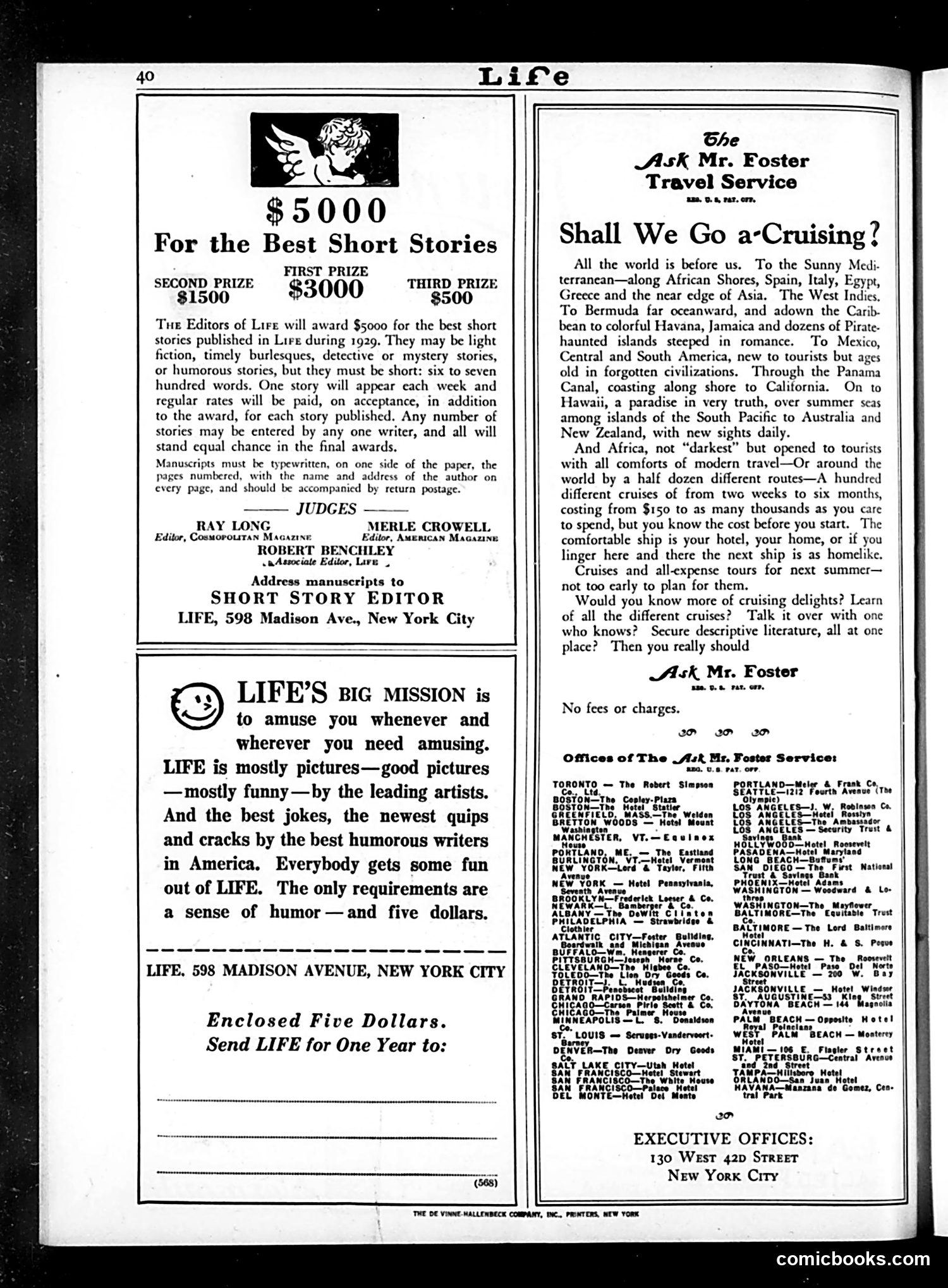
This page contains no political cartoons or satirical content. Instead, it consists primarily of **advertising and magazine promotions**: **Left side:** A short-story writing contest offering $5,000 first prize, judged by Ray Long, Merle Crowell, and Robert Benchley. Stories must be 600-700 words, published in Life during 1929. Below that is Life's self-promotion emphasizing its mission: to amuse readers through pictures and humor, requiring only "a sense of humor—and five dollars" (subscription cost). The smiley-face logo suggests the lighthearted tone. **Right side:** An advertisement for "Ask Mr. Foster Travel Service," promoting cruise vacations to Mediterranean, Caribbean, Panama Canal, Hawaii, Australia, and African destinations—ranging from $150 to thousands of dollars. The ad lists travel agency offices across major American cities. The page reflects 1929's leisure culture and the magazine's target audience of affluent, educated readers interested in travel and literary contests.
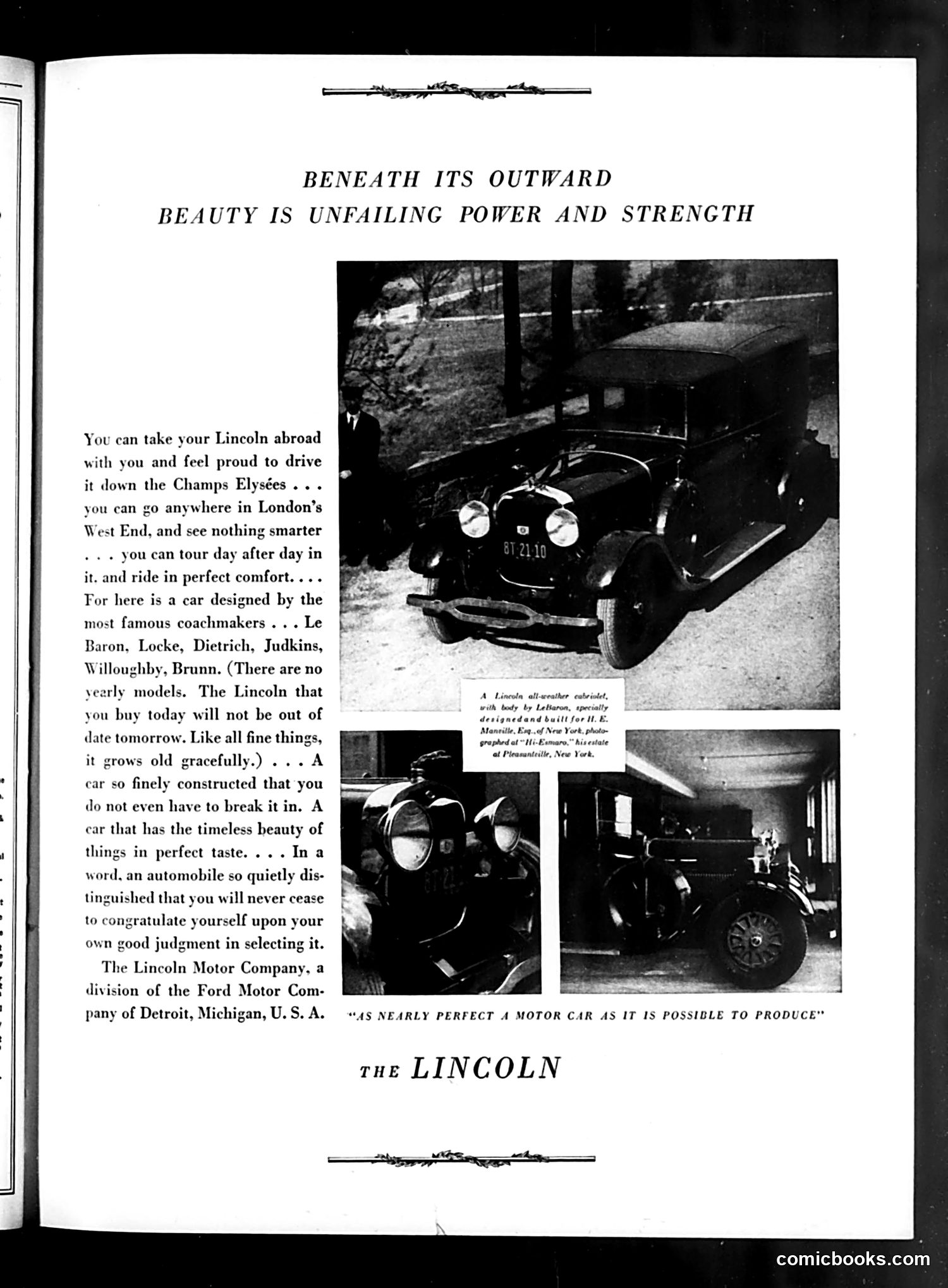
This is **not a cartoon or satire**—it's a straightforward luxury automobile advertisement for the Lincoln automobile, a division of Ford Motor Company. The page uses aspirational marketing language targeting wealthy consumers, emphasizing that a Lincoln can be driven proudly on the Champs-Élysées in Paris or London's West End without appearing inferior. It highlights famous coachmakers (Le Baron, Locke, Dietrich, Judkins, Willoughby, Brunn) as designers and stresses timeless elegance, durability, and the absence of yearly model changes. The three photographs show the vehicle from exterior angles and interior detail shots. One photo appears to feature a car belonging to someone identified as "Lt. E___, Esq. of New York," suggesting celebrity or wealthy endorsement through vehicle ownership. The headline—"Beneath Its Outward Beauty Is Unfailing Power and Strength"—positions the car as combining aesthetic refinement with mechanical reliability, appealing to early-20th-century upper-class sensibilities about quality craftsmanship.
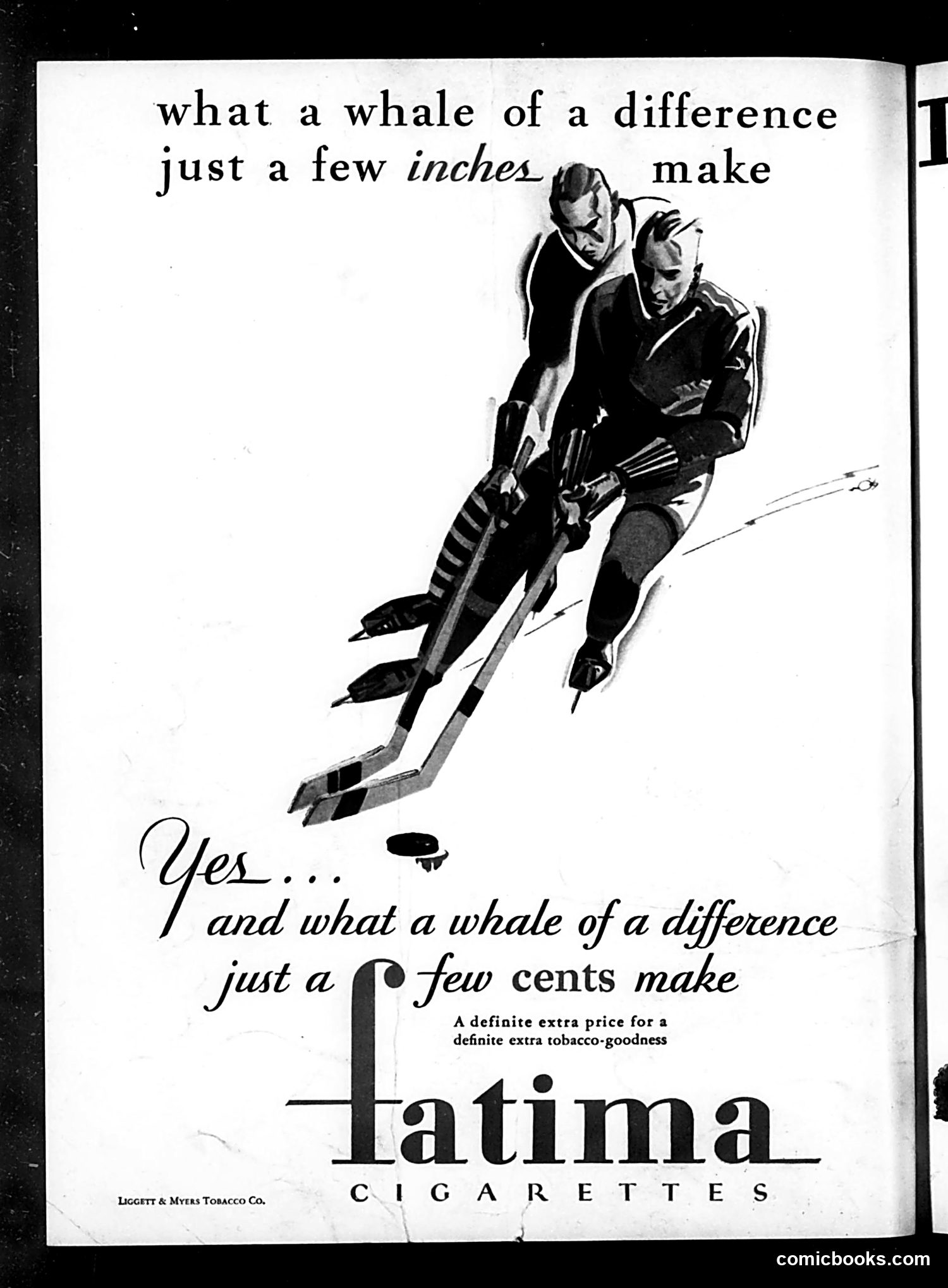
This is a **cigarette advertisement**, not political satire. It promotes Latima cigarettes by Liggett & Myers Tobacco Co. The image shows two hockey players in action, emphasizing speed and competition. The ad's wordplay plays on "a whale of a difference"—claiming that just a few inches (in hockey) or a few cents (in price) create significant quality differences. The tagline promises "a definite extra price for a definite extra tobacco-goodness," positioning Latima as a premium product worth the modest price increase. This reflects **early-to-mid 20th century advertising conventions**: using sports imagery to appeal to masculine consumers and justifying higher prices through claimed superior quality. The OCR text contains errors, but the core message is that Latima cigarettes offer better tobacco at a reasonable premium cost.