
Life, 1929-02-01 · page 25 of 40
Life — February 1, 1929 — page 25: what you’re looking at
What you’re looking at
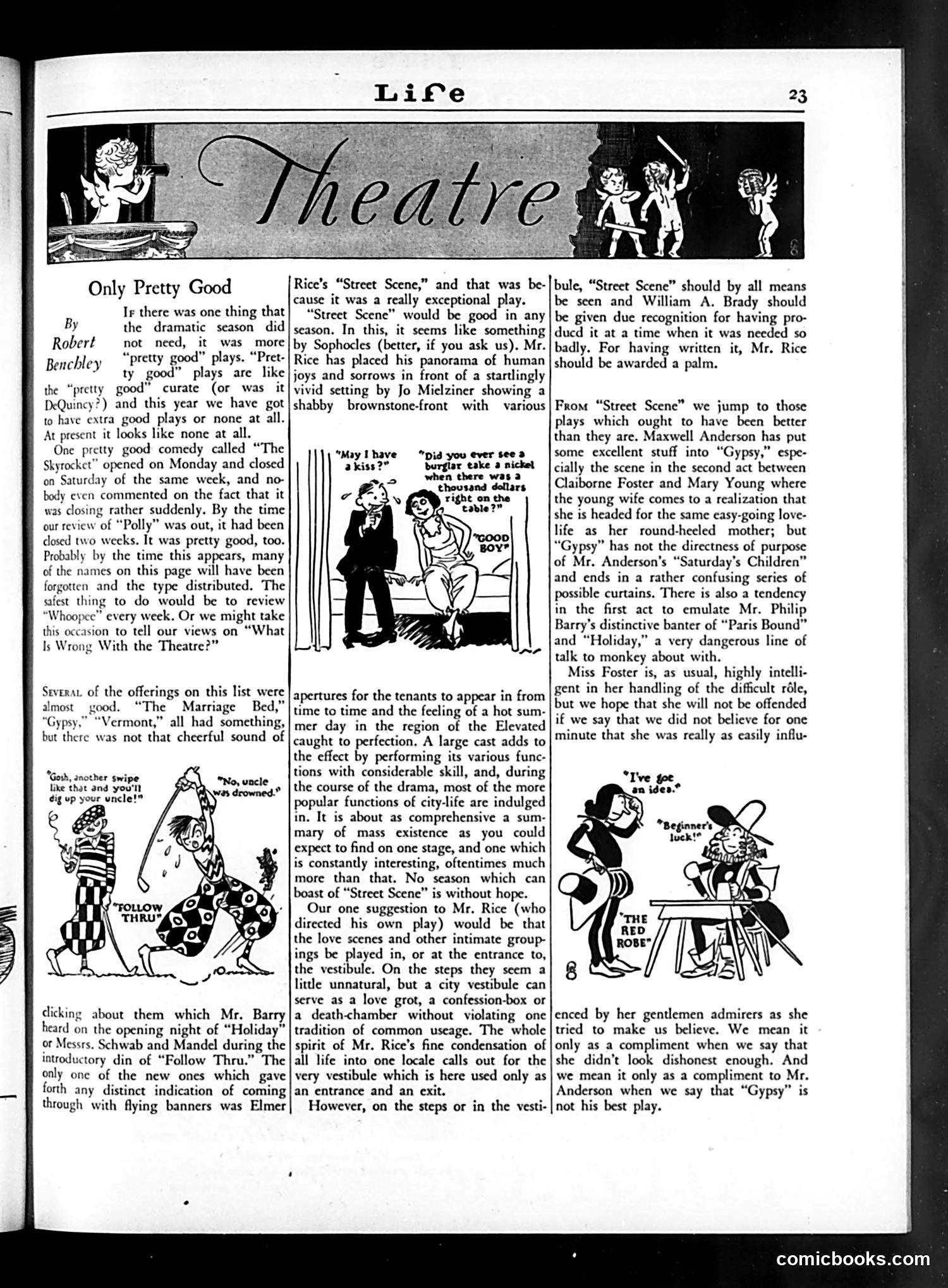
Robert Benchley's column critiques the 1928 Broadway season, lamenting a glut of mediocre plays. He argues the theatre needs *excellent* productions, not merely "pretty good" ones. **Key points:** - **"Street Scene"** by Elmer Rice is praised as genuinely exceptional—compared to Sophocles—with vivid staging by Jo Mielziner depicting tenement life. Benchley's only suggestion: move intimate scenes from the front steps into the vestibule for better dramatic effect. - **Other plays mentioned** ("Gypsy," "The Marriage Bed," "Vermont") had merit but lacked distinction. "The Skyrocket" closed after one week without notice. - **The cartoons** appear to illustrate theatrical absurdities—a couple's domestic quarrel, slapstick business about money—typical of the "pretty good" comedies he dismisses. Benchley's satire targets theatrical mediocrity: productions that are competent but forgettable, closing unnoticed while critics scramble to review them.
📄 Transcribed text from this page (OCR, searchable)
Machine-transcribed from the original scan — historical spelling and the odd misread are preserved.
SM Only Pretty Good Ir there was one thing that By the dramatic season did Robert not need, it Ps more ,4) “pretty good” plays. “Pret- Benchley $ ood” plays are like the “pretty good” curate (or was it DeQuincy?) and this year we have got to have extra good plays or none at all. At present it looks like none at all. One pretty good comedy called “The Skyrocket” opened on Monday and closed on Saturday of the same week, and no- body even commented on the fact that it was closing rather suddenly. By the time our review of “Polly” was out, it had been dosed two weeks. It was pretty good, too. Probably by the time this appears, many of the names on this page will have been forgotten and the type distributed. The safest thing to do would be to review “Whoopee” every week. Or we might take this occasion to tell our views on “What Is Wrong With the Theatre?” Severat of the offerings on this list were almost. good. “The Marriage Bed,” “Gypsy.” “Vermont,” all had something, but there was not that cheerful sound of “Gosh, another swipe Like that and you'll dicking about them which Mr. Barry heard on the opening night of “Holiday” or Messrs. Schwab and Mandel during the introductory din of “Follow Thru.” The only one of the new ones which gave forth any distinct indication of coming through with flying banners was Elmer Rice’s “Street Scene,” and that was be- cause it was a really exceptional play. “Street Scene” would be good in any season. In this, it seems like something by Sophocles (better, if you ask us). Mr. Rice has placed his panorama of human joys and sorrows in front of a startlingly vivid setting by Jo Mielziner showing a shabby brownstone-front with various “Maylhave “pid you ever see a burglar take 2 nickel when there was a apertures for the tenants to appear in from time to time and the feeling of a hot sum- mer day in the region of the Elevated caught to perfection. A large cast adds to the effect by performing its various func- tions with considerable skill, and, during the course of the drama, most of the more popular functions of city-life are indulged in. It is about as comprehensive a sum- mary of mass existence as you could expect to find on one stage, and one which is constantly interesting, oftentimes much more than that. No season which can boast of “Street Scene” is without hope. Our one suggestion to Mr. Rice (who directed his own play) would be that the love scenes and other intimate group- ings be played in, or at the entrance to, the vestibule. On the steps they seem a litde unnatural, but a city vestibule can serve as a love grot, a confession-box or a death-chamber without violating one tradition of common useage. The whole spirit of Mr. Rice’s fine condensation of all life into one locale calls out for the very vestibule which is here used only as an entrance and an exit. However, on the steps or in the vesti- bule, “Street Scene” should by all means be seen and William A. Brady should be given due recognition for having pro- ducd it at a time when it was needed so badly. For having written it, Mr. Rice should be awarded a palm. From “Street Scene” we jump to those plays which ought to have been better than they are. Maxwell Anderson has put some excellent stuff into “Gypsy,” espe- cially the scene in the second act between Claiborne Foster and Mary Young where the young wife comes to a realization that she is headed for the same easy-going love- life as her round-heeled mother; but “Gypsy” has not the directness of purpose of Mr. Anderson's “Saturday's Children” and ends in a rather confusing series of possible curtains. There is also a tendency in the first act to emulate Mr. Philip Barry’s distinctive banter of “Paris Bound” and “Holiday,” a very dangerous line of talk to monkey about with. Miss Foster is, as usual, highly intelli- gent in her handling of the difficult réle, but we hope that she will not be offended if we say that we did not believe for one minute that she was really as easily influ- “I've ee an ides. enced by her gentlemen admirers as she tried to make us believe. We mean it only as a compliment when we say that she didn’t look dishonest enough. And we mean it only as a compliment to Mr. Anderson when we say that “Gypsy” is not his best play. comicbooks.com