
A complete issue · 40 pages · 1929
Life — February 1, 1929
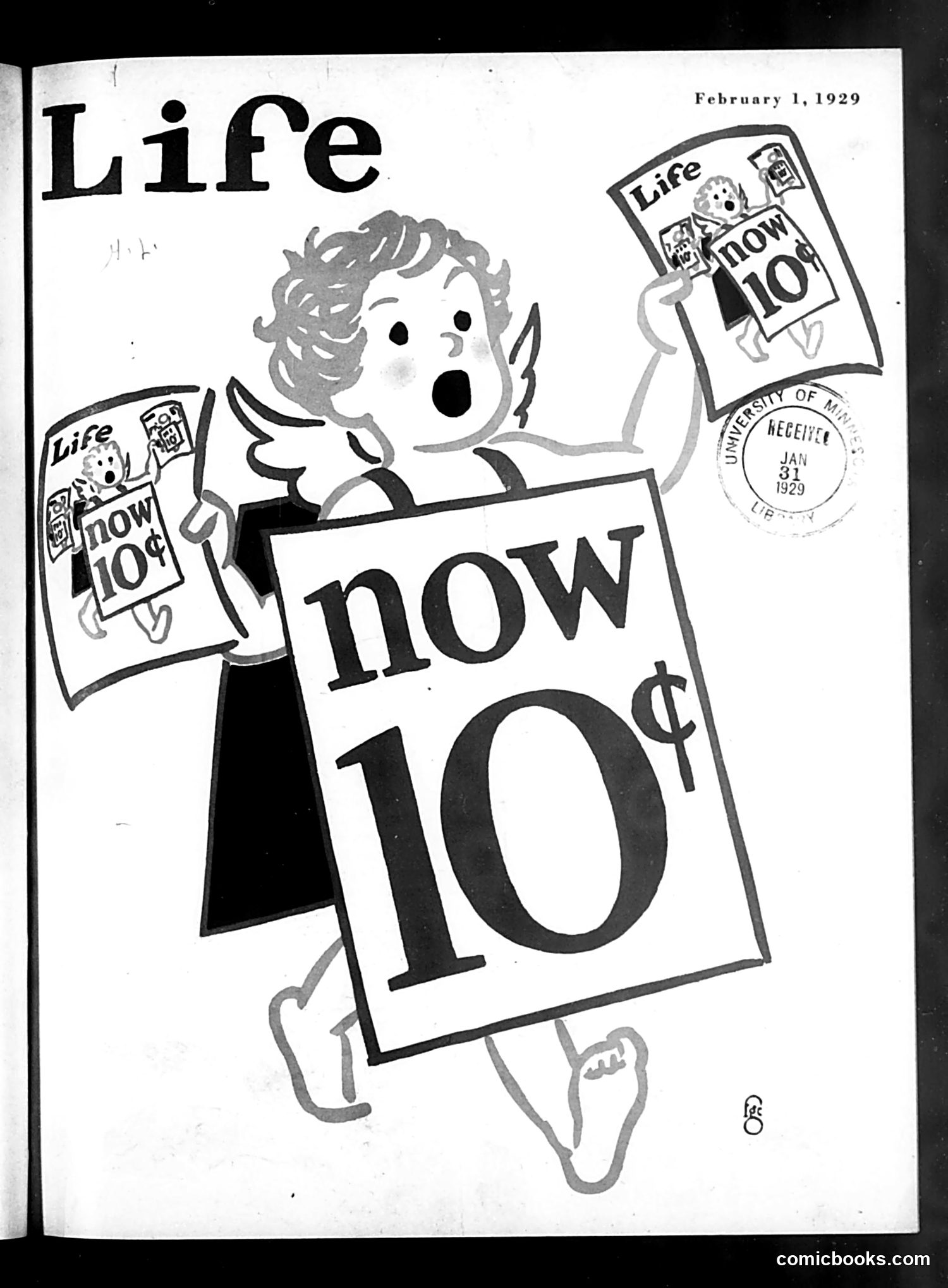
This is a **magazine cover advertisement**, not political commentary. It features a cheerful young woman enthusiastically holding an oversized sign reading "now 10¢" while displaying copies of Life magazine marked "now 10¢." The message is straightforward: Life magazine's price has been **reduced to ten cents**, presented as exciting news worthy of celebration. The woman's exaggerated expression and dynamic pose emphasize this as a bargain or promotional offer. This timing is historically significant—the cover appears just weeks before the **stock market crash of October 1929**. The optimistic tone about affordable pricing reflects pre-crash American consumer confidence, making this cover an unintentional time capsule of the prosperity before economic disaster.
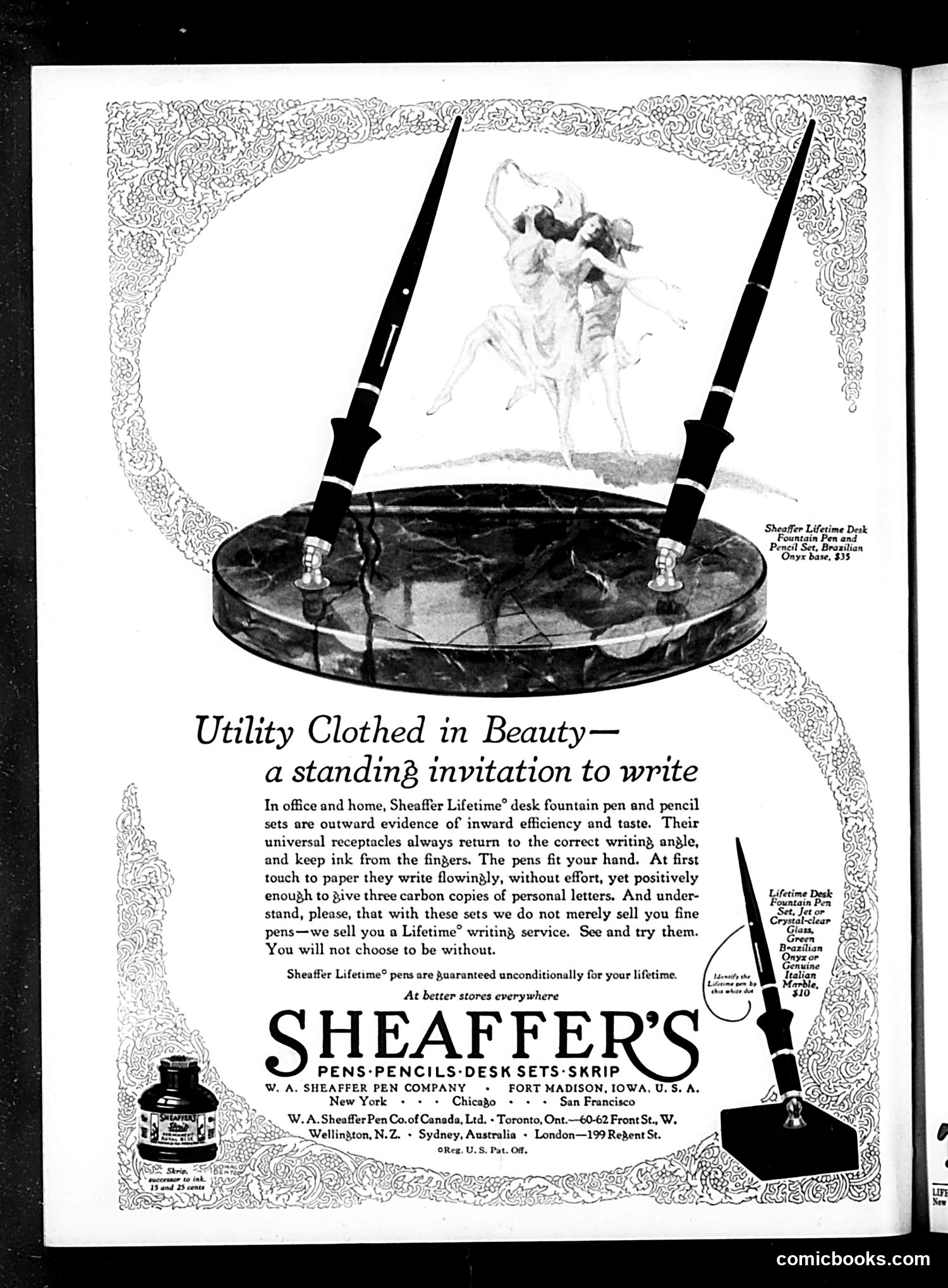
This page is primarily a **Sheaffer pen and pencil advertisement**, not political satire. The ad uses the tagline "Utility Clothed in Beauty" to market desk fountain pen and pencil sets. The central image shows an ornate desk set with two black fountain pens flanking a sketch of a classical female figure. The advertisement emphasizes that Sheaffer pens combine aesthetic appeal with practical function—they write smoothly, make carbon copies, and last a lifetime. The decorative border and classical imagery were typical 1920s-30s advertising design meant to convey luxury and sophistication. The claim of "guaranteed unconditionally for your lifetime" was Sheaffer's signature marketing promise. This is commercial advertising rather than editorial content or political commentary.
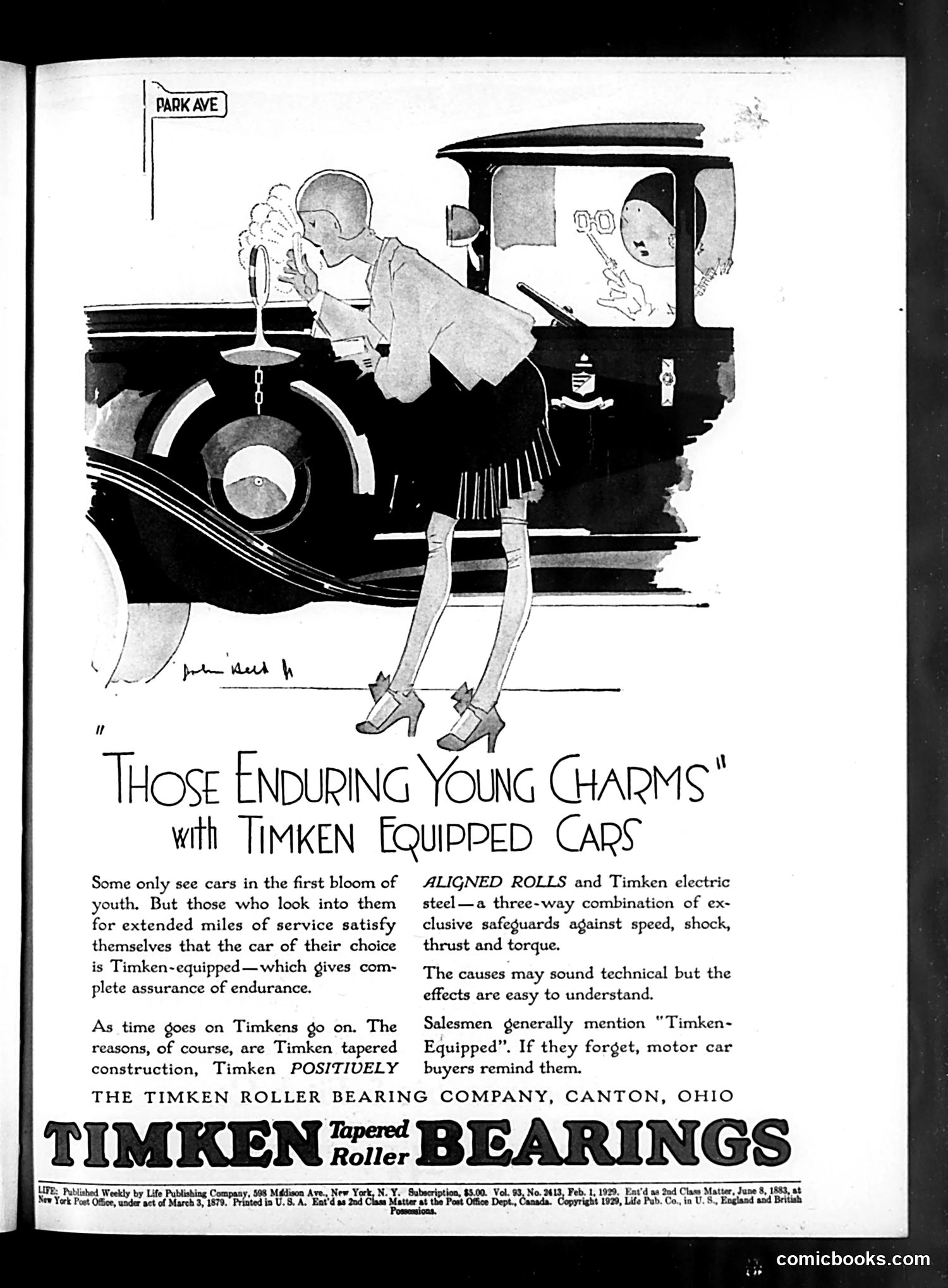
This is primarily an **advertisement**, not political satire. The page promotes Timken Tapered Roller Bearings for automobiles. The illustration depicts a stylishly dressed woman posing next to a 1920s automobile, emphasizing the car's elegance and durability. The headline "Those Enduring Young Charms" plays on the phrase "enduring charm" to suggest that Timken-equipped cars maintain their appeal and performance over time—just as the woman's youthful attractiveness endures. The ad claims Timken bearings provide "complete assurance of endurance" against speed, shock, and torque damage. The copy targets car buyers by noting that while some only appreciate new cars, discerning purchasers recognize that Timken-equipped vehicles offer superior longevity and reliability. This is marketing, not commentary or satire.
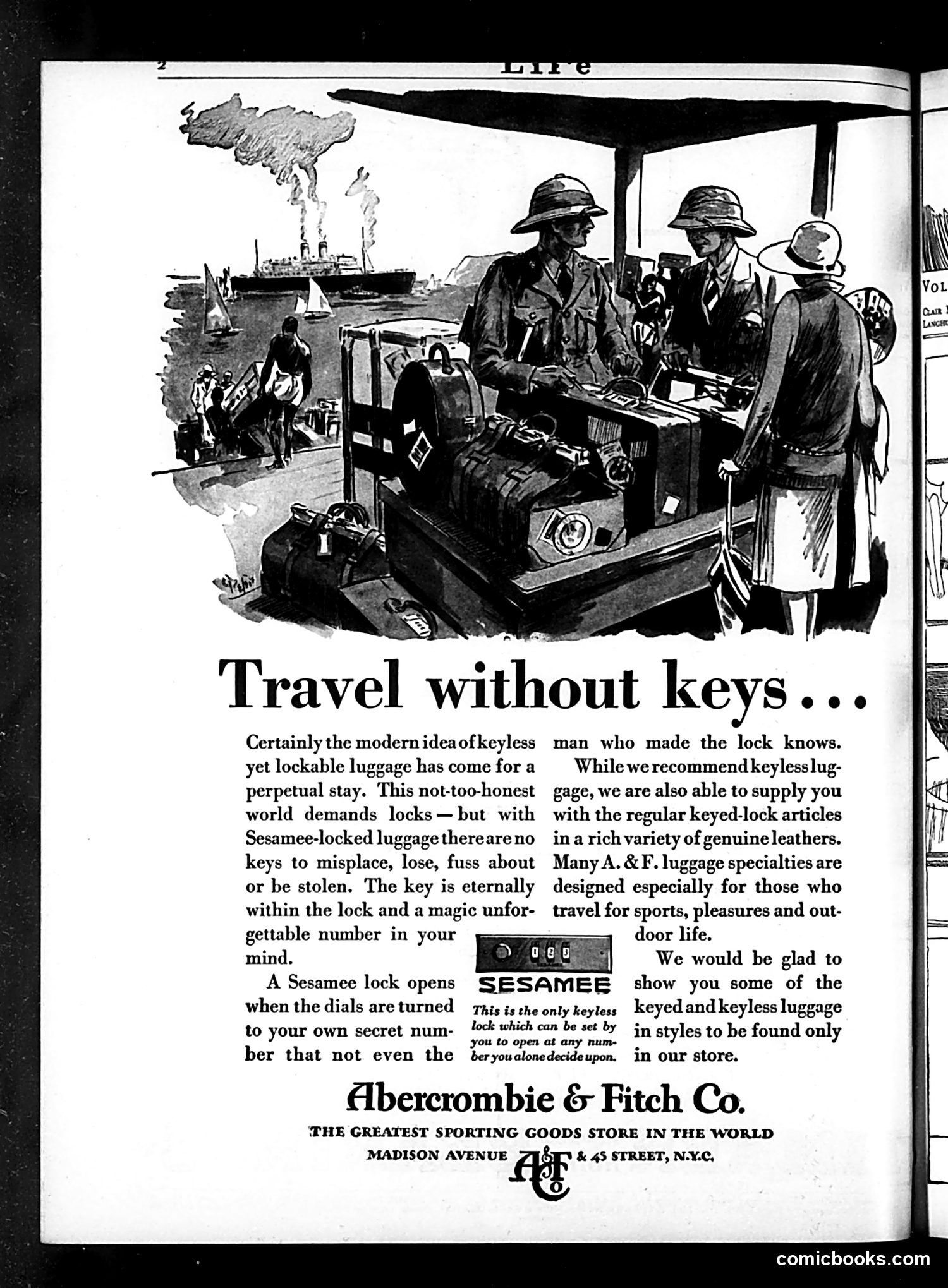
This is primarily a **Sesamee luggage lock advertisement** placed in Life magazine, not political satire or cartoon content. The illustration depicts a customs or travel inspection scene at a port, showing officials examining luggage. The ad promotes "keyless" Sesamee locks—combination locks where "the key is eternally within the lock" via a secret number only the owner knows. The social context reflects early-20th-century travel anxieties: theft of luggage during international journeys. The advertisement positions the Sesamee lock as solving the problem of lost or stolen keys during travel, while maintaining security. Abercrombie & Fitch, presenting itself as "the greatest sporting goods store in the world," marketed this as a luxury travel solution for affluent customers. The "joke" is the liberation from carrying physical keys—a modern convenience claim for its era.
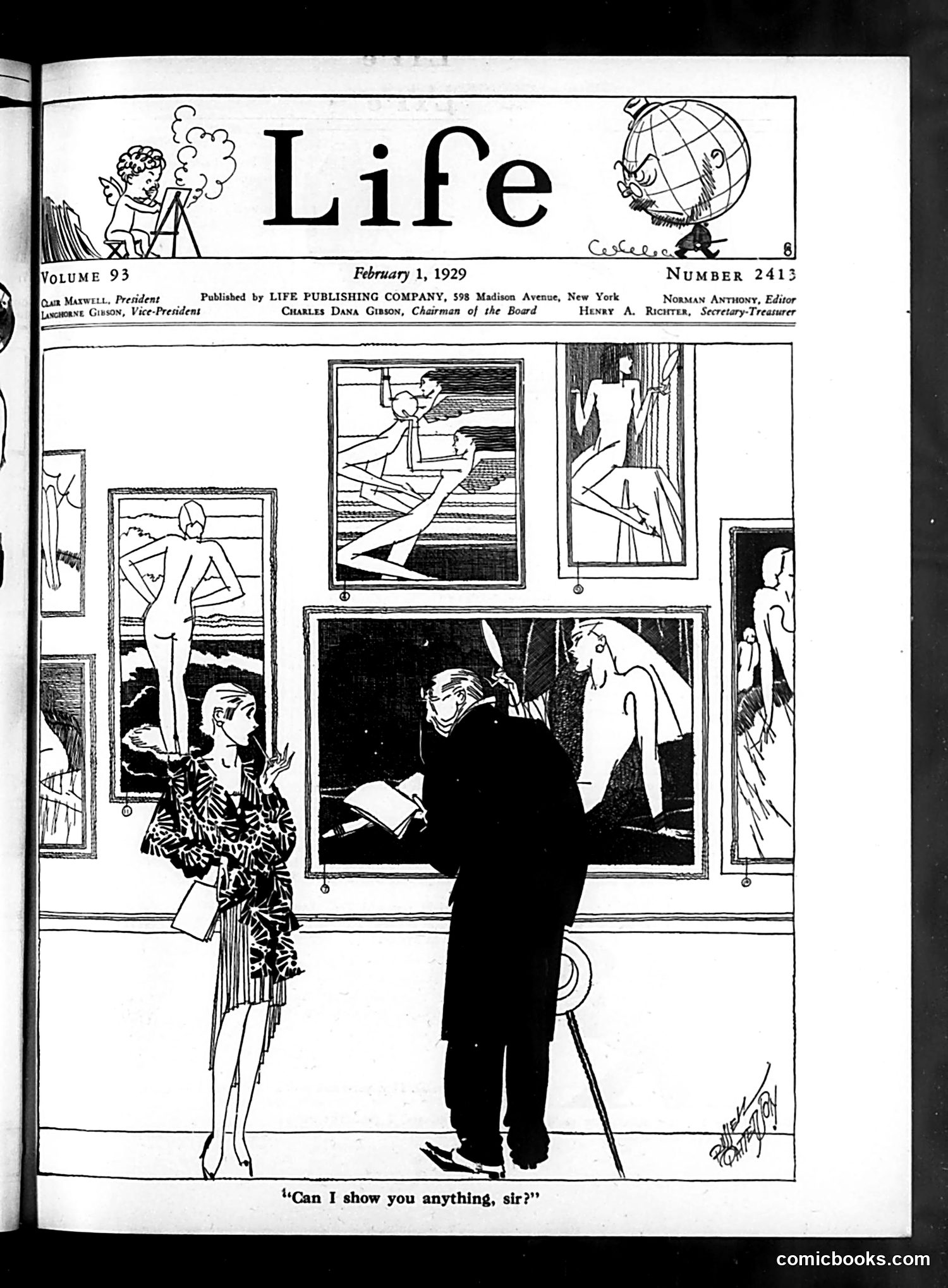
This cover depicts an art gallery scene where a well-dressed woman in fashionable 1920s attire stands beside a man in formal wear examining nude figure paintings on display. The caption reads: "Can I show you anything, sir?" The satire appears to target the art world of the Jazz Age—specifically the tension between modern artistic expression (featuring nude subjects) and polite society's pretense of propriety. The woman's elegant but somewhat knowing demeanor, combined with the suggestive caption, implies she's a gallery attendant or seller using social charm to market provocative artwork to wealthy patrons. This reflects 1920s anxieties about modernism, sexuality in art, and commercialism—poking fun at how even transgressive cultural products become commodified and sold through conventional social niceties.
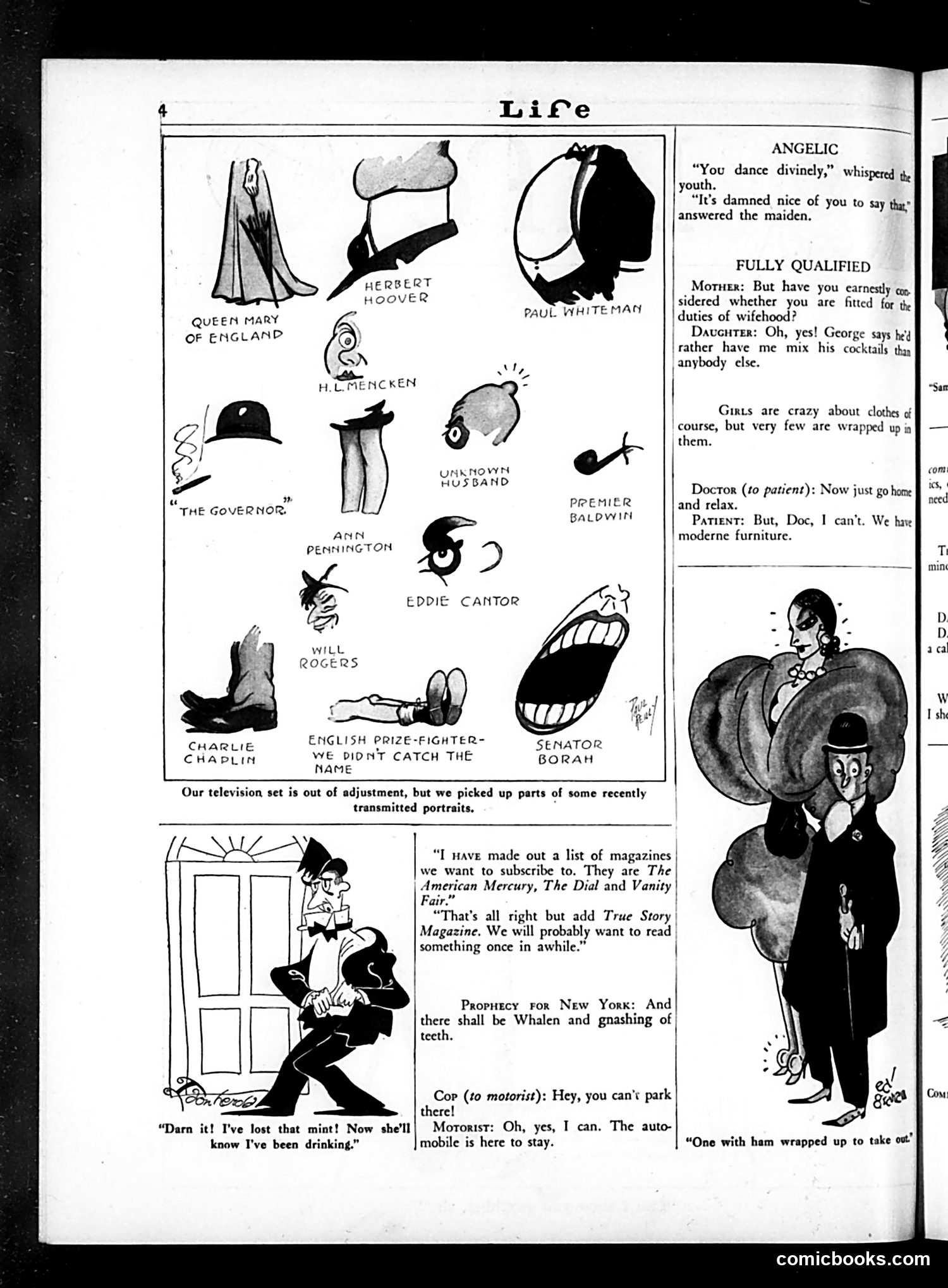
This page contains satirical cartoons mocking prominent early 20th-century figures. The top section shows caricatures labeled with names like "Queen Mary of England," "Herbert Hoover," and "Charlie Chaplin," suggesting these are visual jokes about public personalities of the era. The middle cartoon depicts a man losing his "mint" (likely a romantic interest), with dialogue about drinking—a common Prohibition-era joke given alcohol's illegality at the time. The right side contains humor about domestic life, including a doctor-patient exchange about modern furniture and a "Prophecy for New York" joke about whales and teeth. The overall tone is irreverent celebrity mockery and social commentary typical of Life magazine's satirical humor during this period.
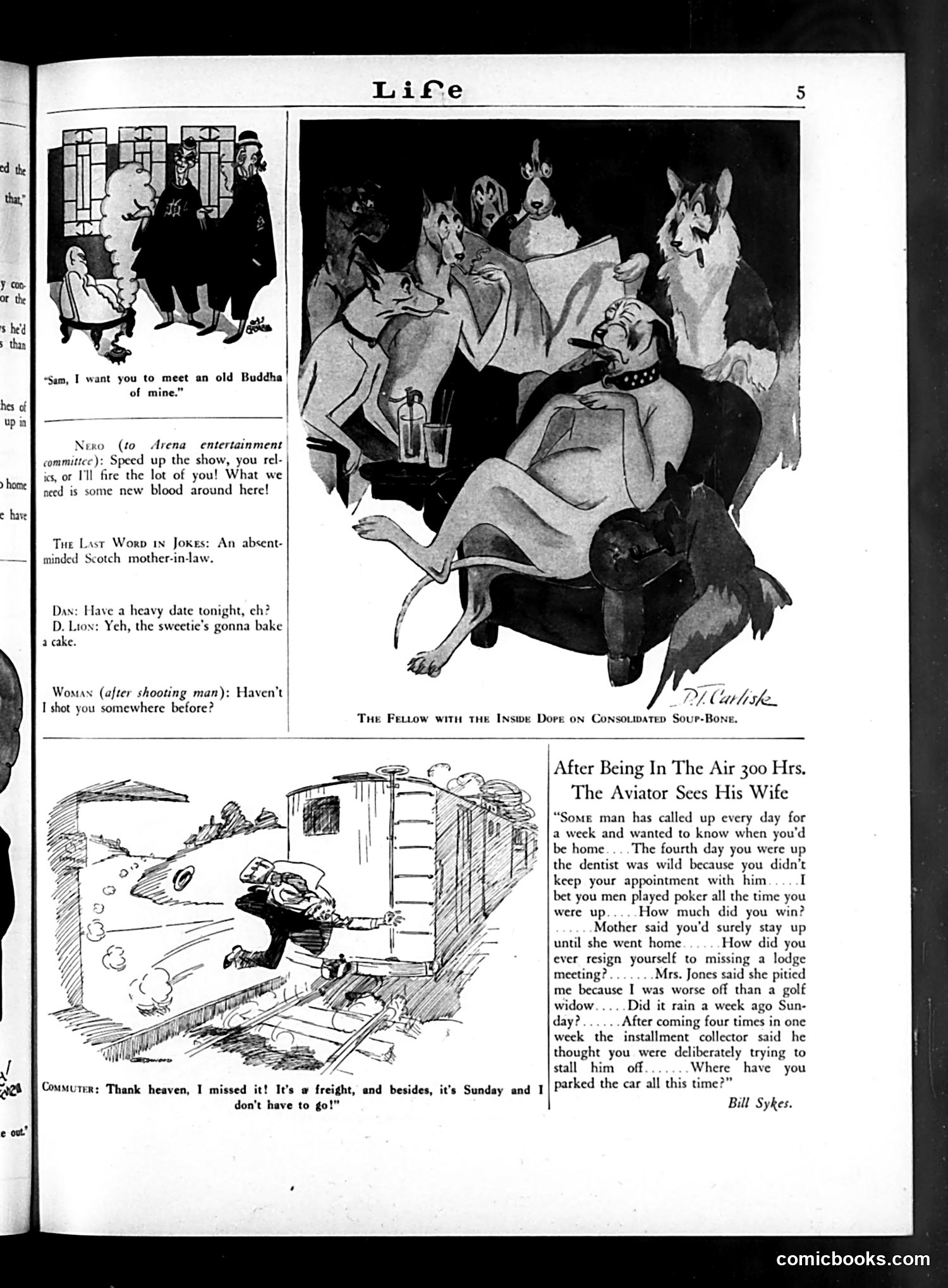
This page contains three separate humorous items: 1. **Top cartoon**: A small figure meets society types at what appears to be a formal gathering. The joke concerns introducing "an old Buddha of mine"—likely mocking pretentious socialites who collected exotic art or spiritual curiosities as status symbols. 2. **Main illustration**: Titled "The Fellow with the Inside Dope on Consolidated Soup-Bone," it depicts a man surrounded by dogs in what appears to be a living room. The satire targets someone claiming exclusive knowledge or insider information—here comically about dog food—suggesting gullibility of those who believe such claims. 3. **Bottom section**: An article about an aviator reuniting with his wife after 300 hours of flight, humorously detailing her complaints about his extended absence and various domestic mishaps, satirizing the neglect wives experienced during aviation's early boom.
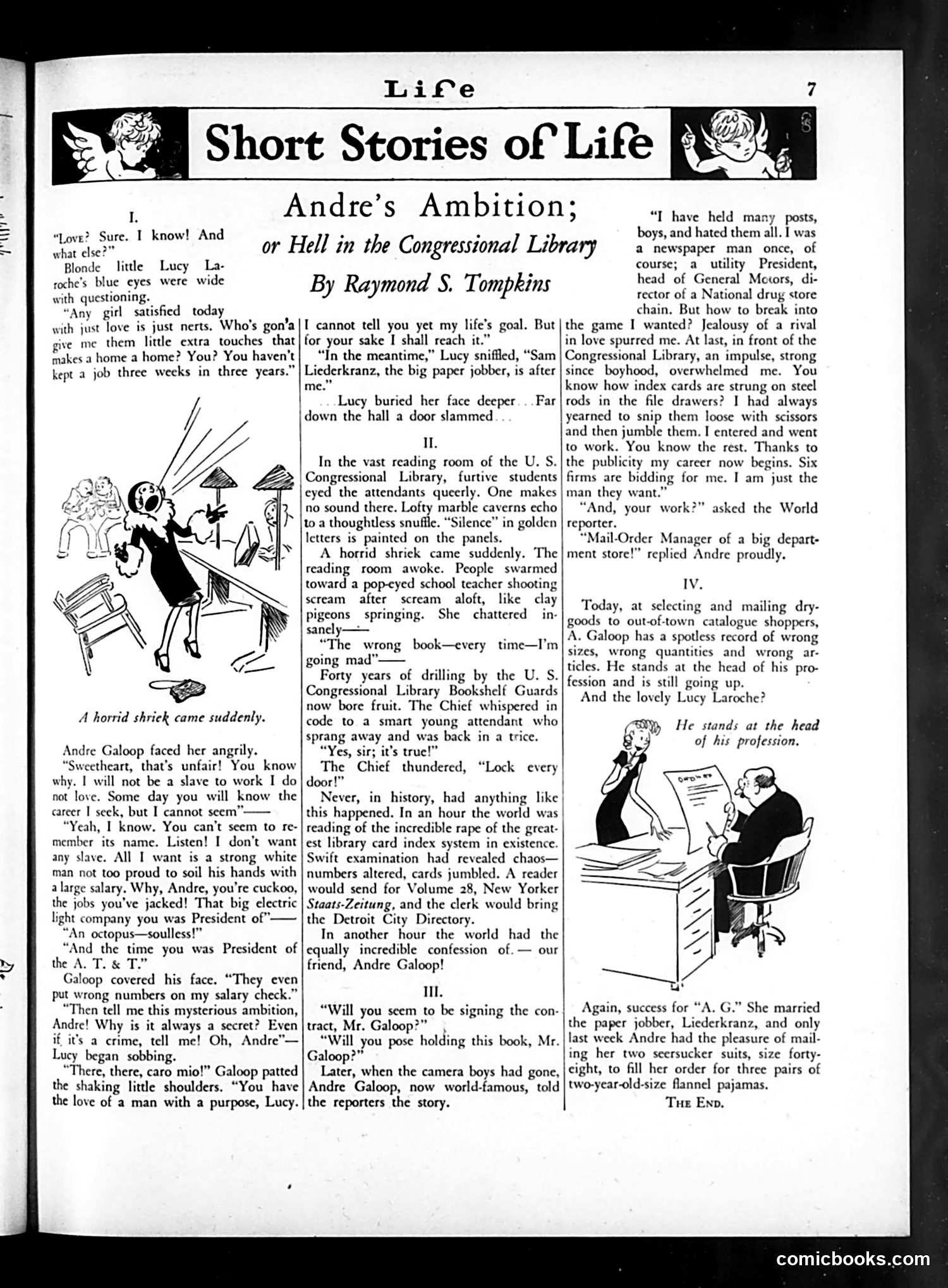
This short story by Raymond S. Tompkins satirizes bureaucratic work, specifically in the Library of Congress. The protagonist Andre Galoop seeks ambition and advancement but discovers that even prestigious government positions involve tedious, repetitive labor—cataloging books and managing cards and index systems. The satire targets early-20th-century office culture: the contrast between romantic career aspirations and mundane reality. Lucy LaRoche represents the romantic ideal, but Andre must choose between love and climbing the bureaucratic ladder. The story mocks both the rigidity of government work and ambition itself—suggesting that prestigious careers like "Mail-Order Manager" of a department store or library administrator offer only shallow success and paperwork drudgery.
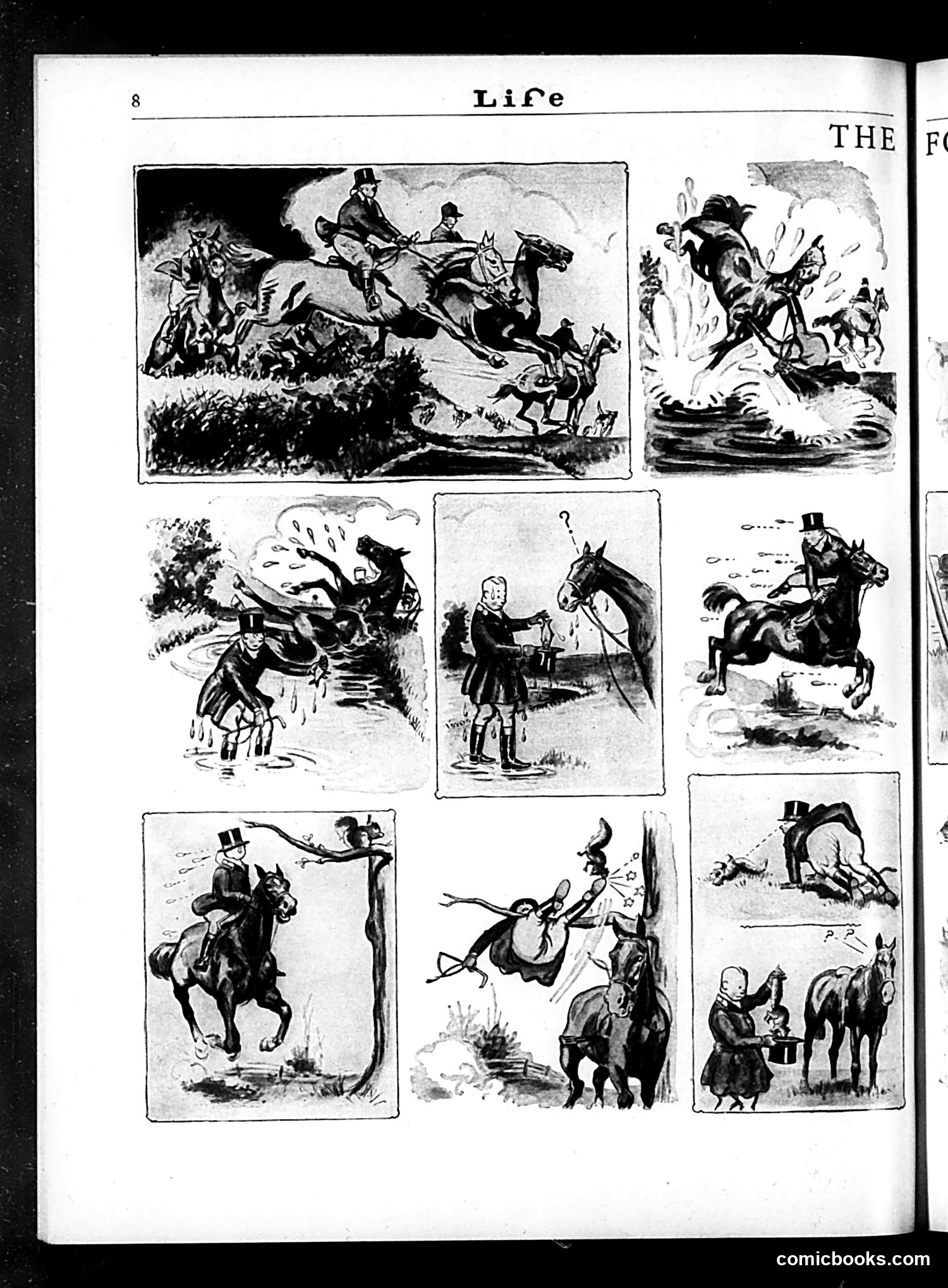
This appears to be a humorous comic strip about horseback riding and fox hunting, popular aristocratic pastimes in early 20th-century America. The sequential panels depict a gentleman rider (identifiable by his top hat and formal attire) repeatedly failing at various aspects of horsemanship—jumping fences, controlling his mount, and staying mounted. The satire targets upper-class pretensions to sporting prowess; the joke is that despite their refined appearance and fashionable dress, wealthy people often prove incompetent at the actual physical demands of their leisure activities. The exaggerated falls and mishaps create slapstick humor. This reflects Life magazine's satirical approach to mocking American high society's pretensions and social affectations during the Gilded Age/Progressive Era.
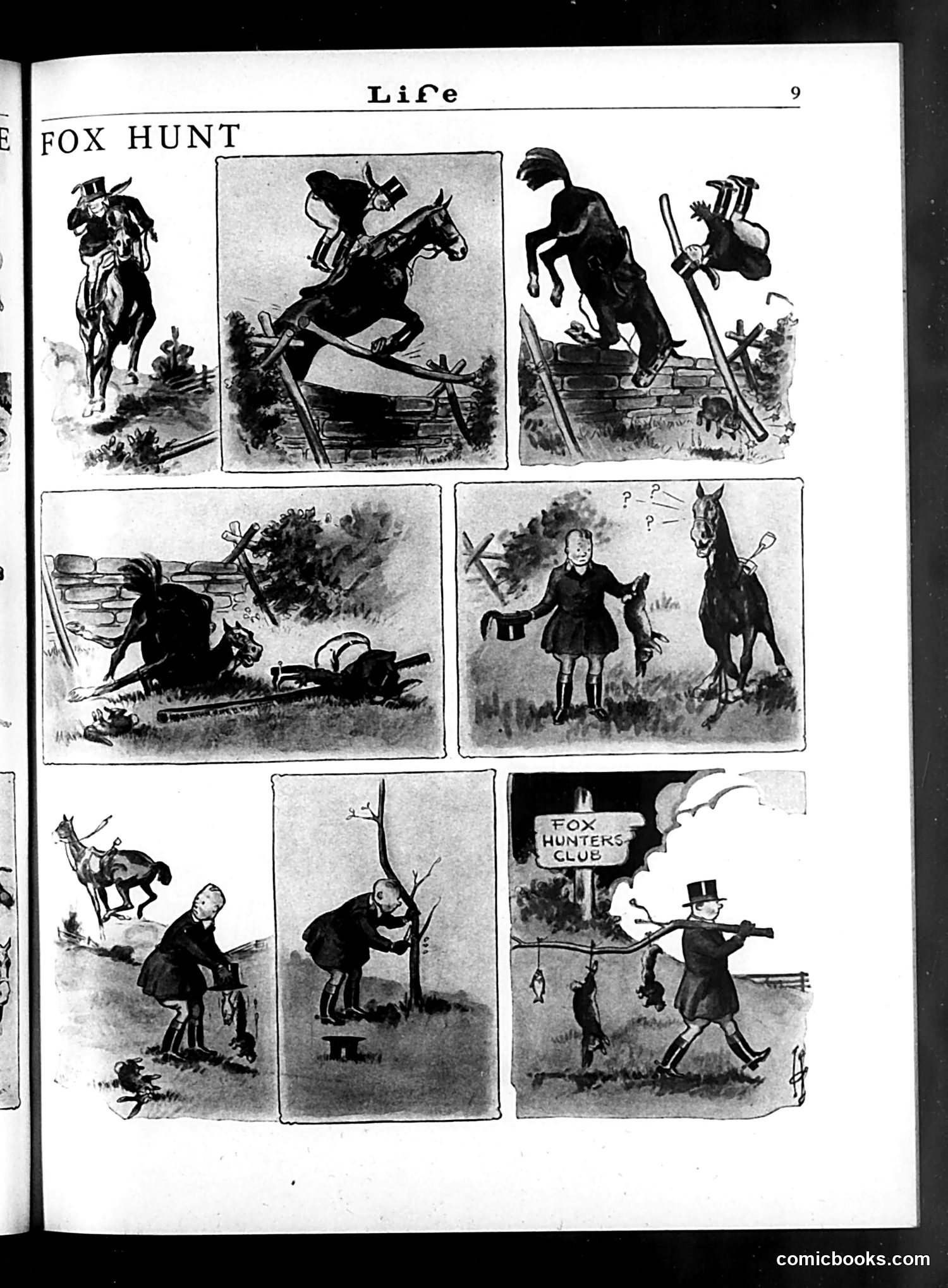
This is a multi-panel comic strip satirizing fox hunting, the traditional British aristocratic sport. The narrative follows hunters pursuing a fox across countryside obstacles—jumping fences on horseback, dismounting to search terrain, encountering a woman with a horse (possibly a fellow hunter or local), and ending at a "Fox Hunters' Club" where hunters display their catch. The satire appears to mock the formality and often-absurd complications of the hunt tradition: the elaborate ritual, the frequent tumbles and mishaps, and the gap between the sport's pretensions and its chaotic reality. The final panel suggests the hunters' proud presentation of their kill at the club, likely commenting on the vanity surrounding this upper-class pursuit.
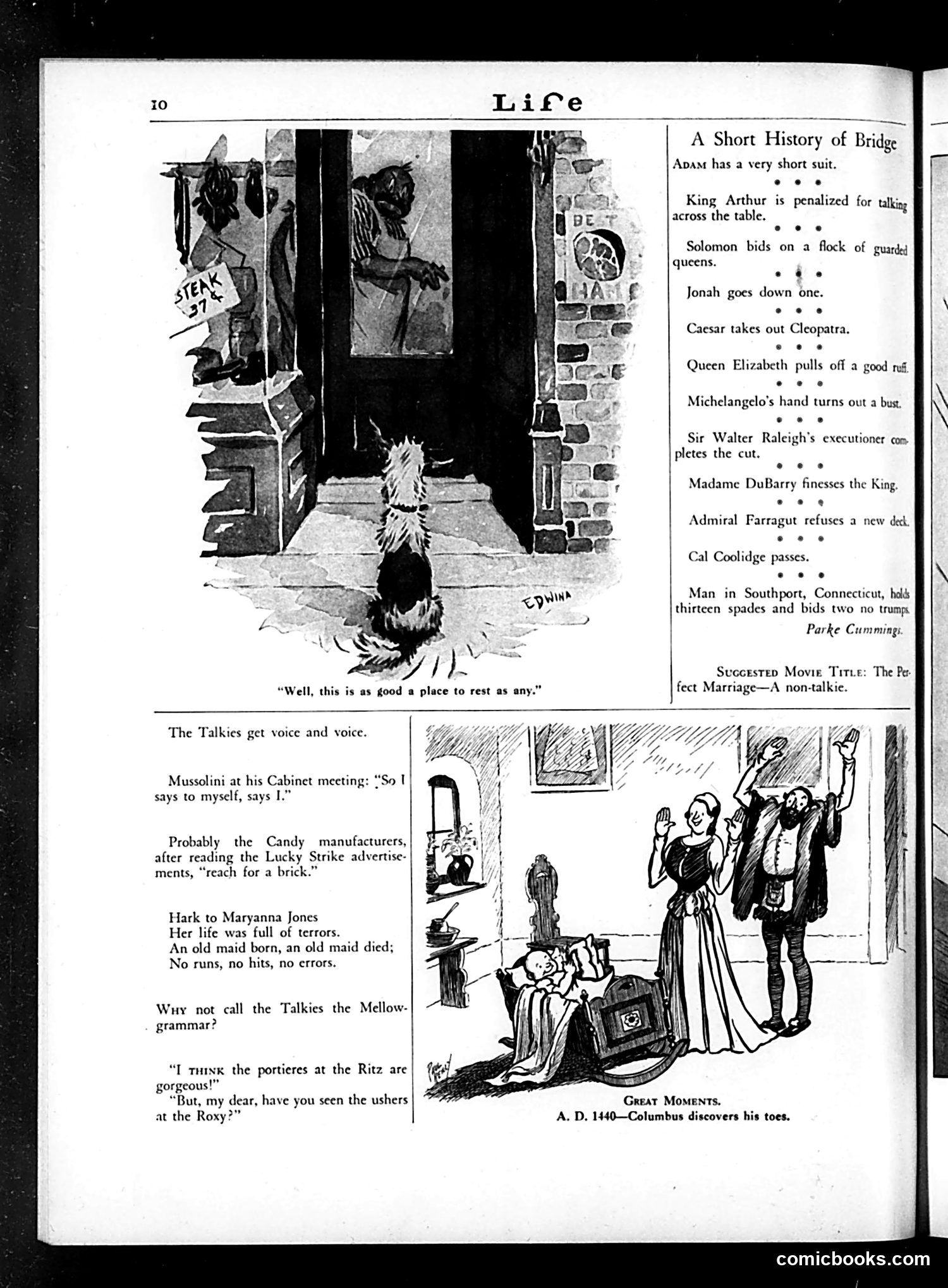
This page from *Life* magazine (appears to be early 20th century based on style) contains brief satirical quips and two cartoons. **Top cartoon**: Shows a vagrant resting in a doorway marked "Steak 57¢." The caption "Well, this is as good a place to rest as any" humorously contrasts the shabby setting with the expensive restaurant sign above—mocking either the vagrant's obliviousness or the absurdity of high-priced dining during economically uncertain times. **Bottom cartoon**: Titled "Great Moments—A.D. 1540—Columbus discovers his toes," shows Columbus looking down in apparent discovery while courtiers react with exaggerated surprise. This is slapstick humor mocking Columbus, though the specific joke's intent remains unclear without more historical context. The page also includes brief satirical one-liners about contemporary figures and events, typical of *Life*'s humor format.
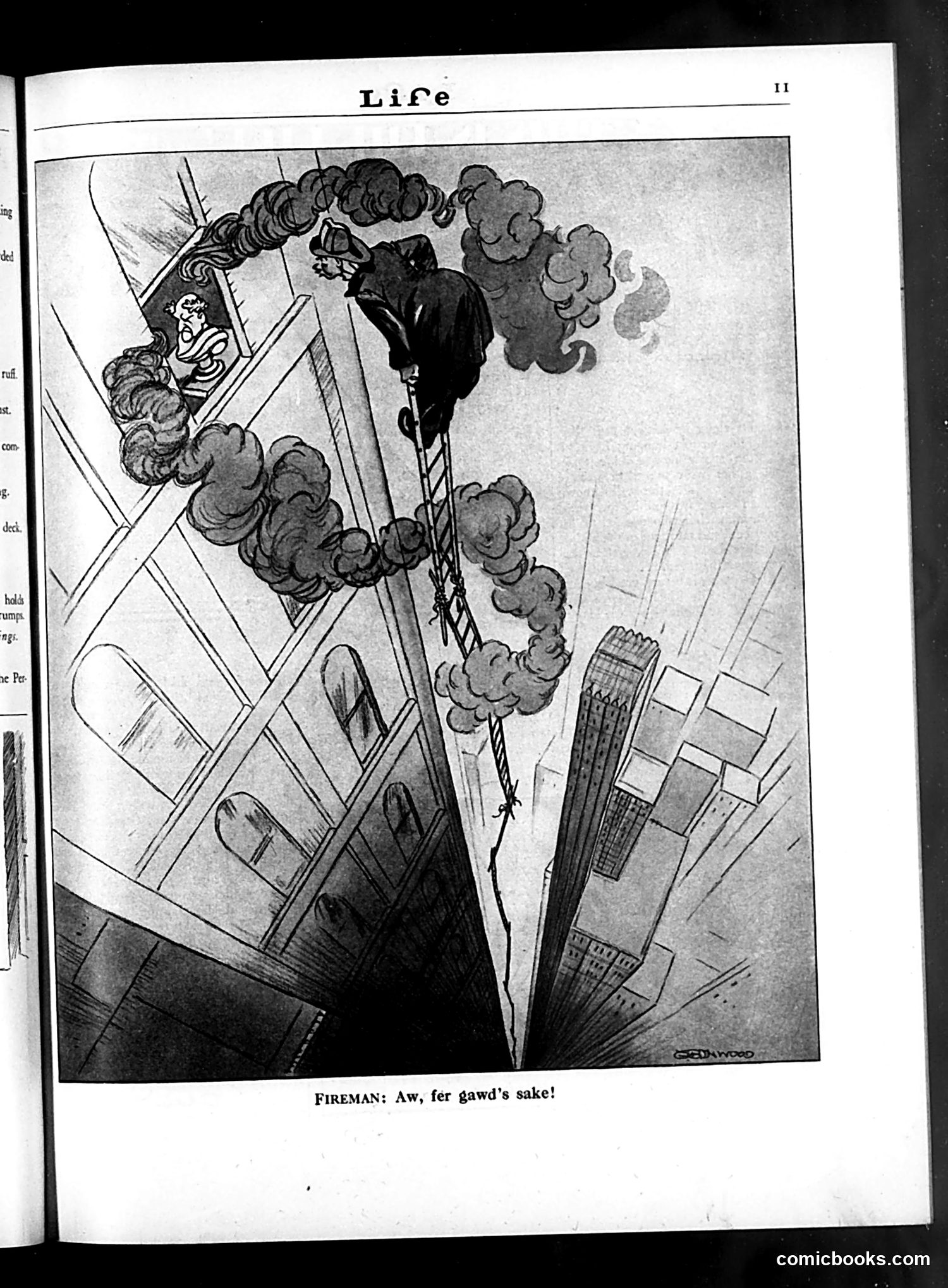
This cartoon depicts a fireman climbing a tall building amid heavy smoke, with the caption "Aw, fer gawd's sake!" The image appears to be a satirical commentary on urban fire emergencies and the dangers firefighters face in densely built city environments. The exaggerated smoke clouds and the fireman's apparent frustration suggest commentary on either: - The difficulty of firefighting in modern skyscrapers, or - Inefficiency or danger in contemporary fire response procedures The fireman's colloquial exclamation conveys exasperation, though the specific reference remains unclear without additional context. The dramatic perspective and architectural detail emphasize the scale and peril of the situation. This likely reflects early-20th-century American concerns about urban safety and firefighting challenges in rapidly expanding cities.
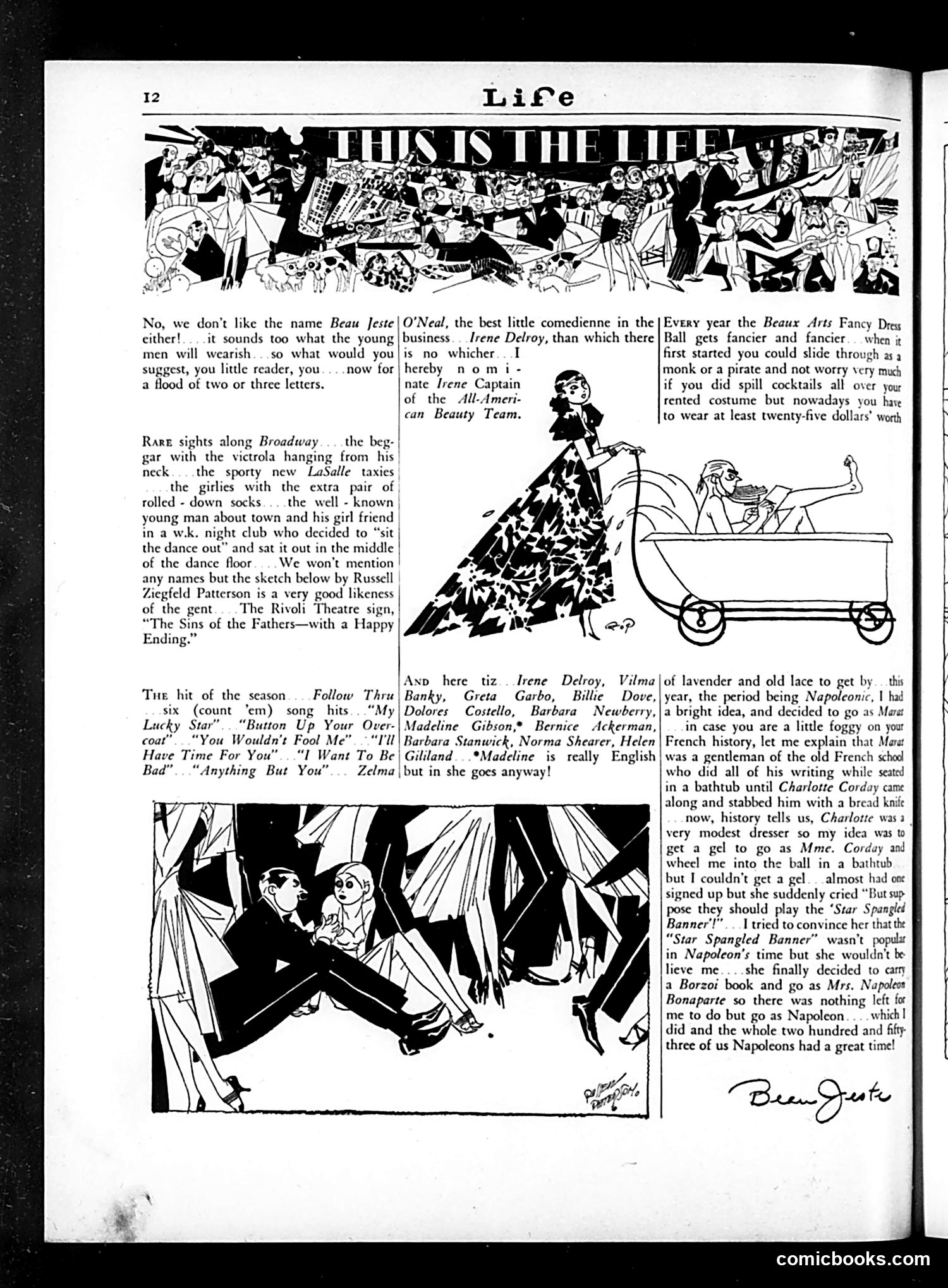
This is a lifestyle/entertainment column by Beau Jeste (a pen name the author jokes about), discussing Broadway social scenes and theatrical gossip. The top illustration shows the vibrant chaos of 1920s nightlife—crowds at dance halls and parties. The main cartoon depicts a woman in an elaborate patterned dress arriving at what appears to be a formal venue, while a man pushes a baby carriage. This satirizes the era's gender role reversals during the Jazz Age, mocking the contrast between women's increasingly bold public presence and traditional domesticity. The text discusses actress Irene Delroy and theatrical performances, including references to costume balls where attendees wore expensive rented costumes—commentary on nouveau-riche conspicuous consumption during the prosperous 1920s.
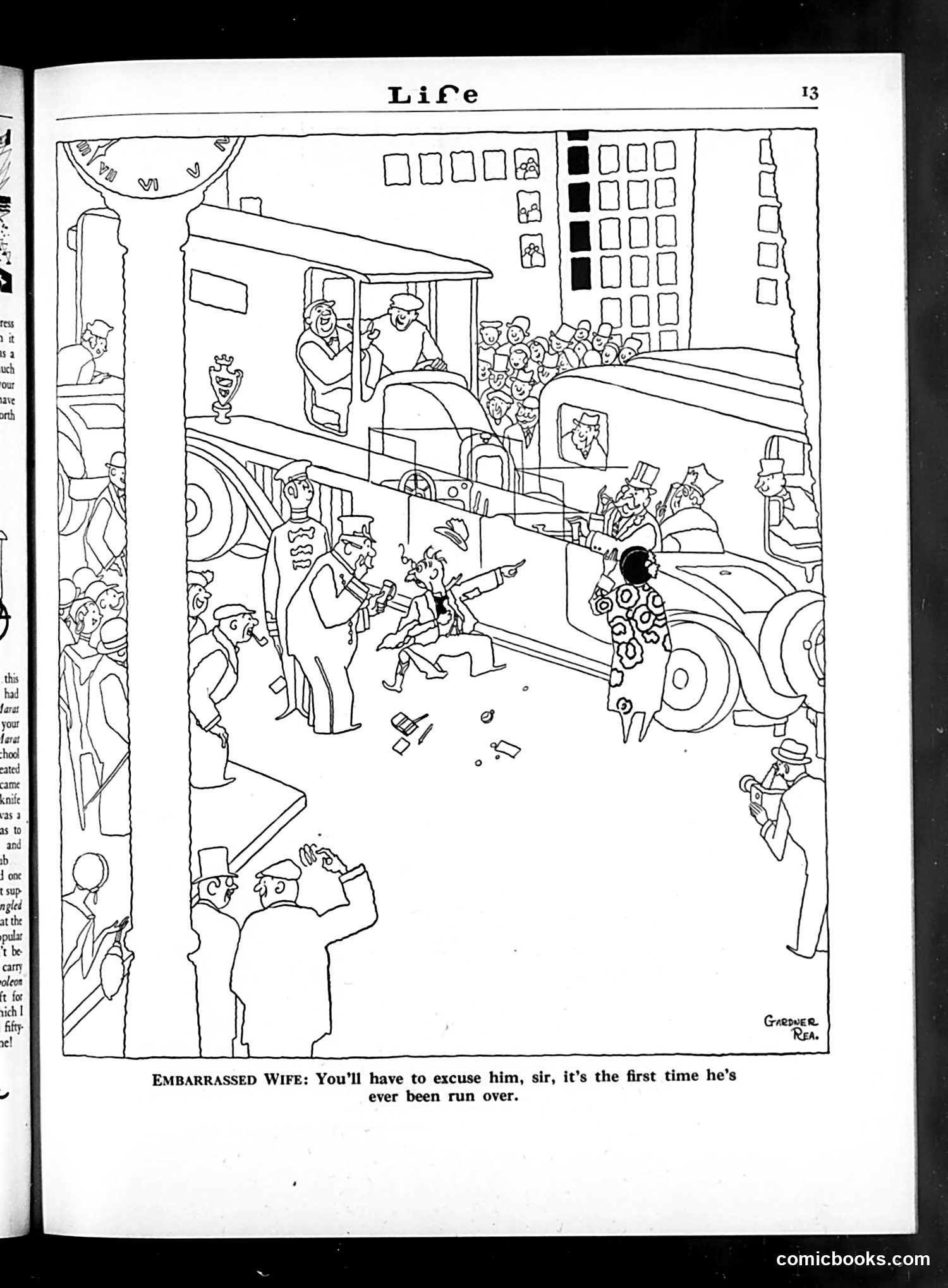
This is a single-panel cartoon by Greber showing a chaotic street scene with a person apparently run over by a vehicle. An "Embarrassed Wife" apologizes to what appears to be an authority figure (possibly a policeman or official), explaining: "You'll have to excuse him, sir, it's the first time he's ever been run over." The joke is absurdist humor playing on the phrase "first time" — typically used to excuse inexperience in normal activities. Here it's applied darkly to being struck by a vehicle, treating a serious accident with comedic understatement. The cartoon satirizes both the wife's bizarrely apologetic tone and society's tendency to excuse or minimize dangerous situations. This reflects early-to-mid 20th-century American humor's embrace of dark, deadpan comedy about urban hazards and traffic accidents.
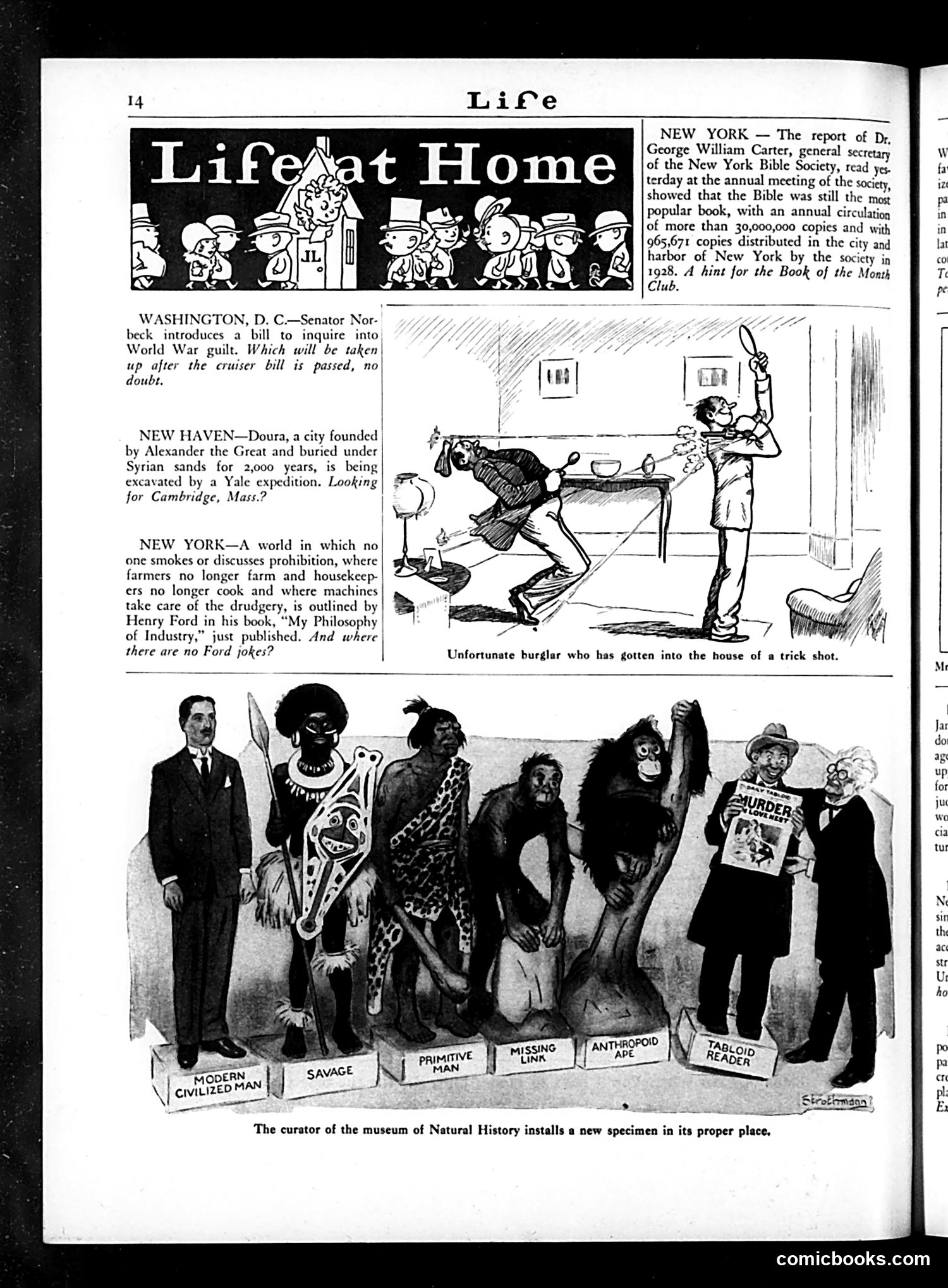
This page contains three distinct items: **Top cartoon**: A visual gag about a burglar who encounters a "trick shot" marksman in a home—the homeowner is shooting at targets while the burglar tumbles through the space, accidentally becoming part of the shooting practice. **Bottom cartoon**: A satirical museum display labeled "The curator of the museum of Natural History installs a new specimen in its proper place." It shows a "Modern Civilized Man" alongside specimens labeled "Savage," "Primitive Man," "Missing Link," "Anthropoid Ape," and "Tabloid Reader"—sarcastically suggesting that the tabloid-reading modern man belongs in the same evolutionary/anthropological display as primitive specimens. This mocks both tabloid readers and pseudo-scientific racial classification theories popular in the era. **Text items**: Brief news jokes about Senator Norbeck's bill, archaeological excavations, and Henry Ford's philosophy.
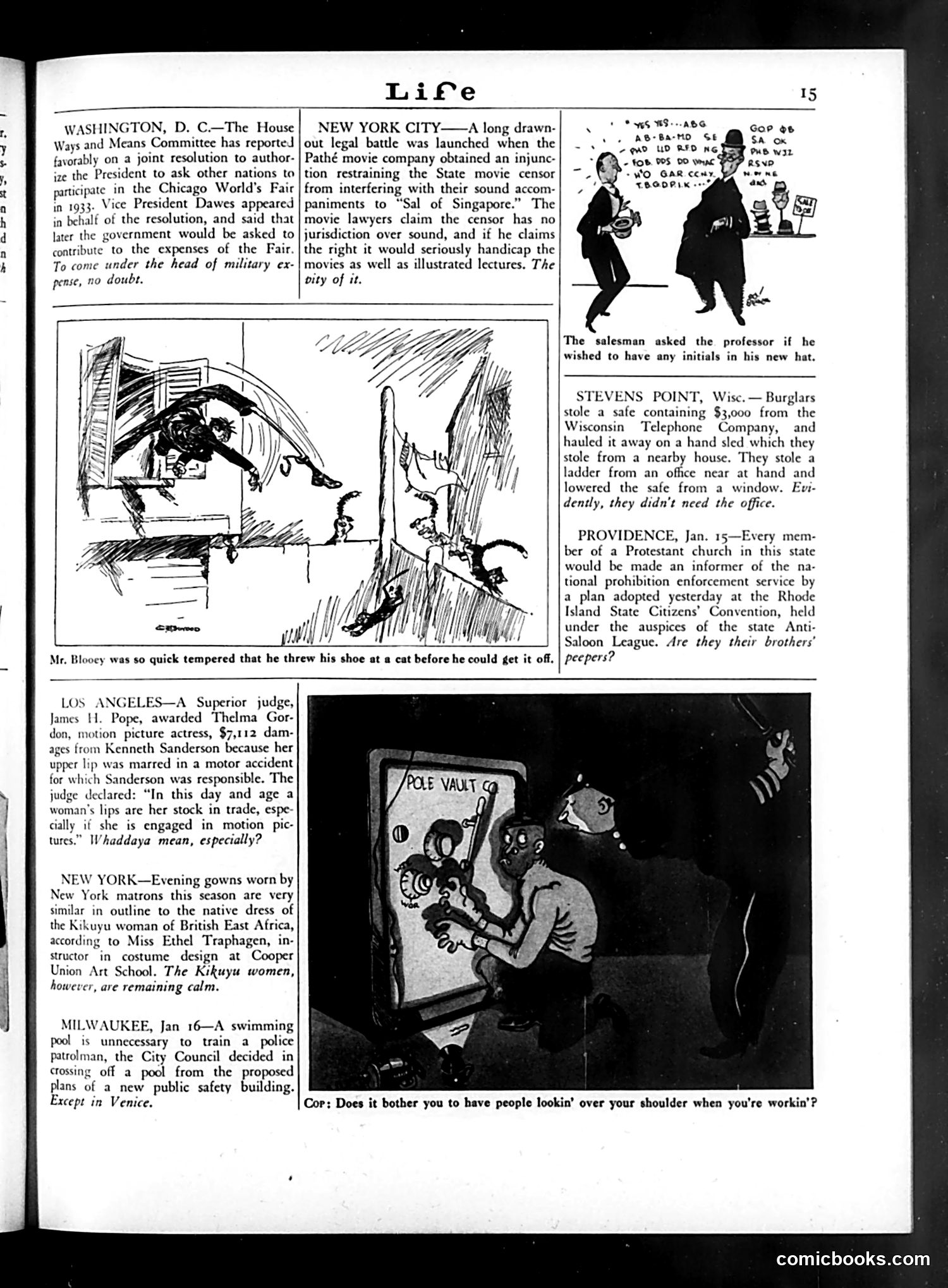
This page contains several brief news items with accompanying illustrations and humor. The main cartoon shows a man so angry at a cat that he throws his shoe before the cat can escape—visual humor about quick temper. A photograph shows a police officer at what appears to be a safe or vault, with the caption joking: "Cop: Does it bother you to have people lookin' over your shoulder when you're workin'?" This is workplace humor about the awkwardness of being observed during tasks. The news briefs cover mundane civic matters: a judge's ruling about a woman's lips in a motor accident case, fashion comparisons to African dress, and a decision about swimming pools for police training. The tone is satirical, treating trivial bureaucratic decisions as newsworthy absurdities typical of Life magazine's satirical approach.
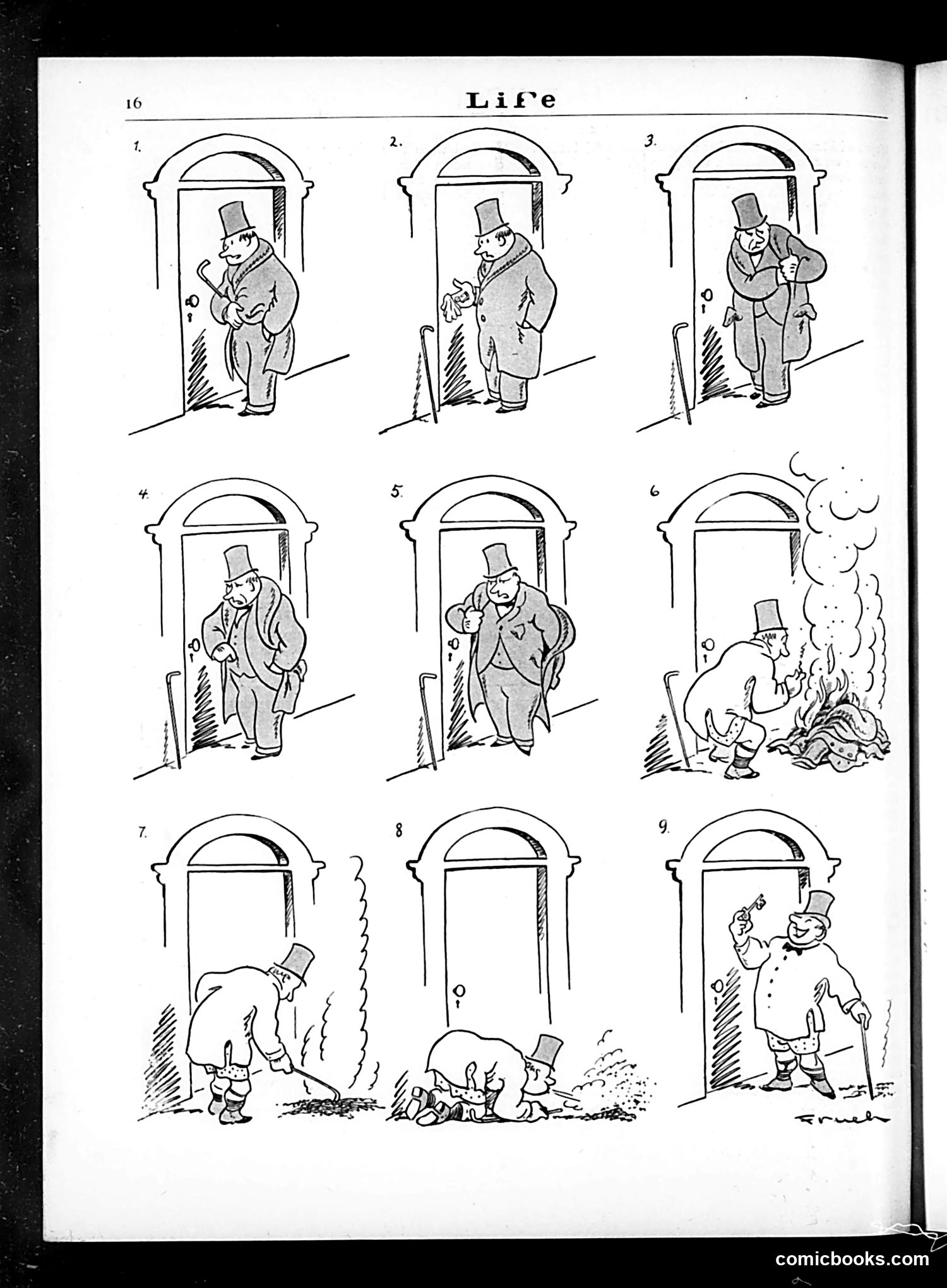
This nine-panel comic strip titled "Life" uses visual narrative to satirize a well-dressed gentleman in a top hat attempting to enter a doorway. The sequence progresses from him standing at the door (panels 1-5), to setting a fire outside it (panel 6), to crouching beside the flames (panels 7-8), and finally appearing with another similarly-dressed figure among the ashes (panel 9). The satire appears to comment on desperation or extreme measures—the figure literally burns down his circumstances to gain entry or escape. Without identifying the specific gentleman or historical context, the strip seems to mock either social climbing, persistence despite failure, or the absurd lengths people take to achieve goals. The top hat suggests commentary on upper-class pretension.
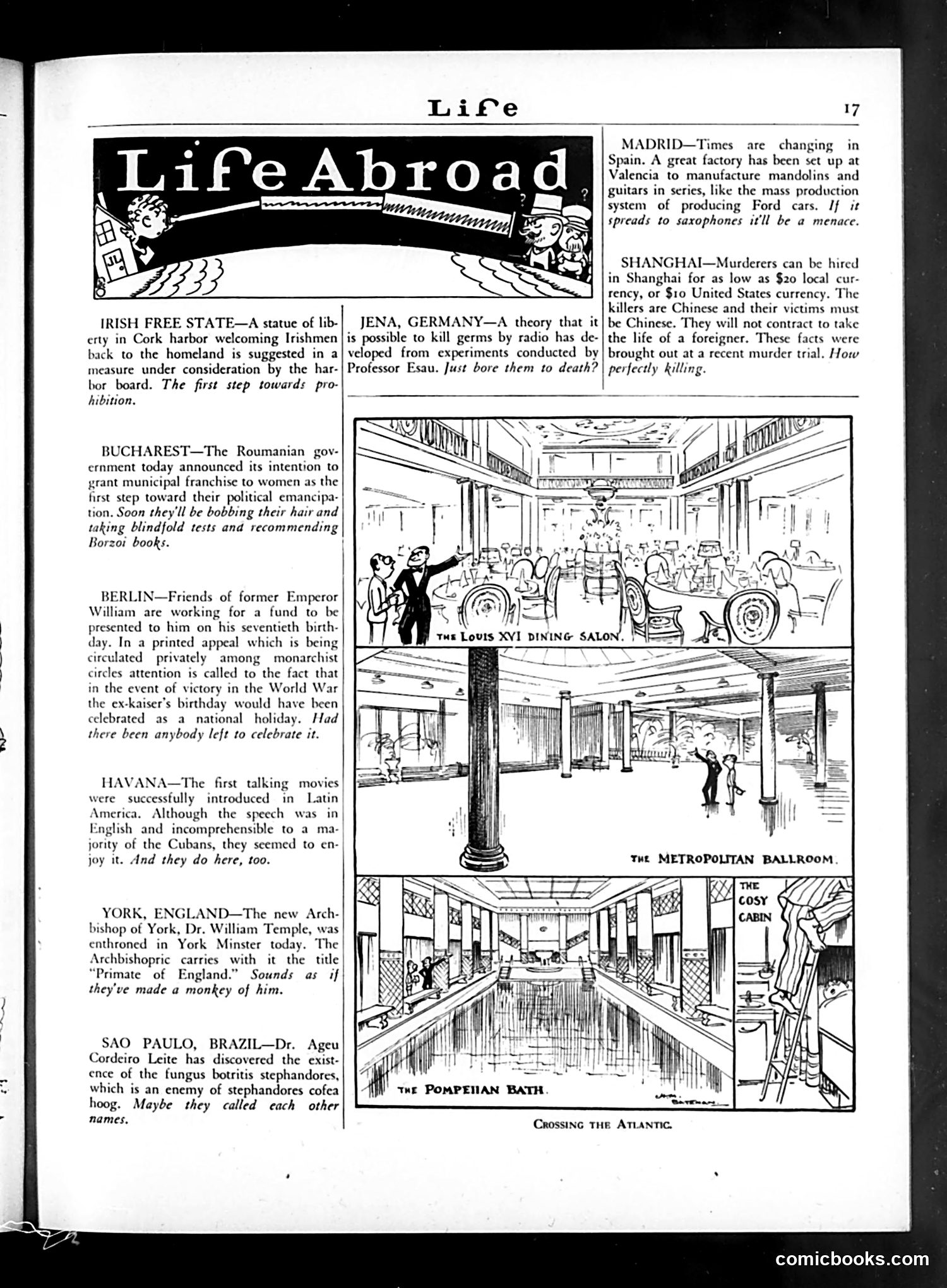
This "Life Abroad" section is a humor column about international news items, not a political cartoon. The content mixes social commentary with satirical observations: **Key items include:** - Irish independence efforts and proposed liberty statue - Romanian women's suffrage announcement - A German scientist's theory about killing germs via radio (labeled sarcastically: "Just bore them to death?") - Shanghai's hire-able murderers for $30 (dark satire about lawlessness) - Former German Emperor's 70th birthday celebration (mocking monarchists' nostalgia) The three sketches on the right ("Crossing the Atlantic") depict luxury ship amenities—the Louis XVI Dining Salon, Metropolitan Ballroom, Pompeian Bath, and Cosy Cabin—likely contrasting opulent first-class accommodations with modest steerage conditions, a common satirical target during the 1920s.
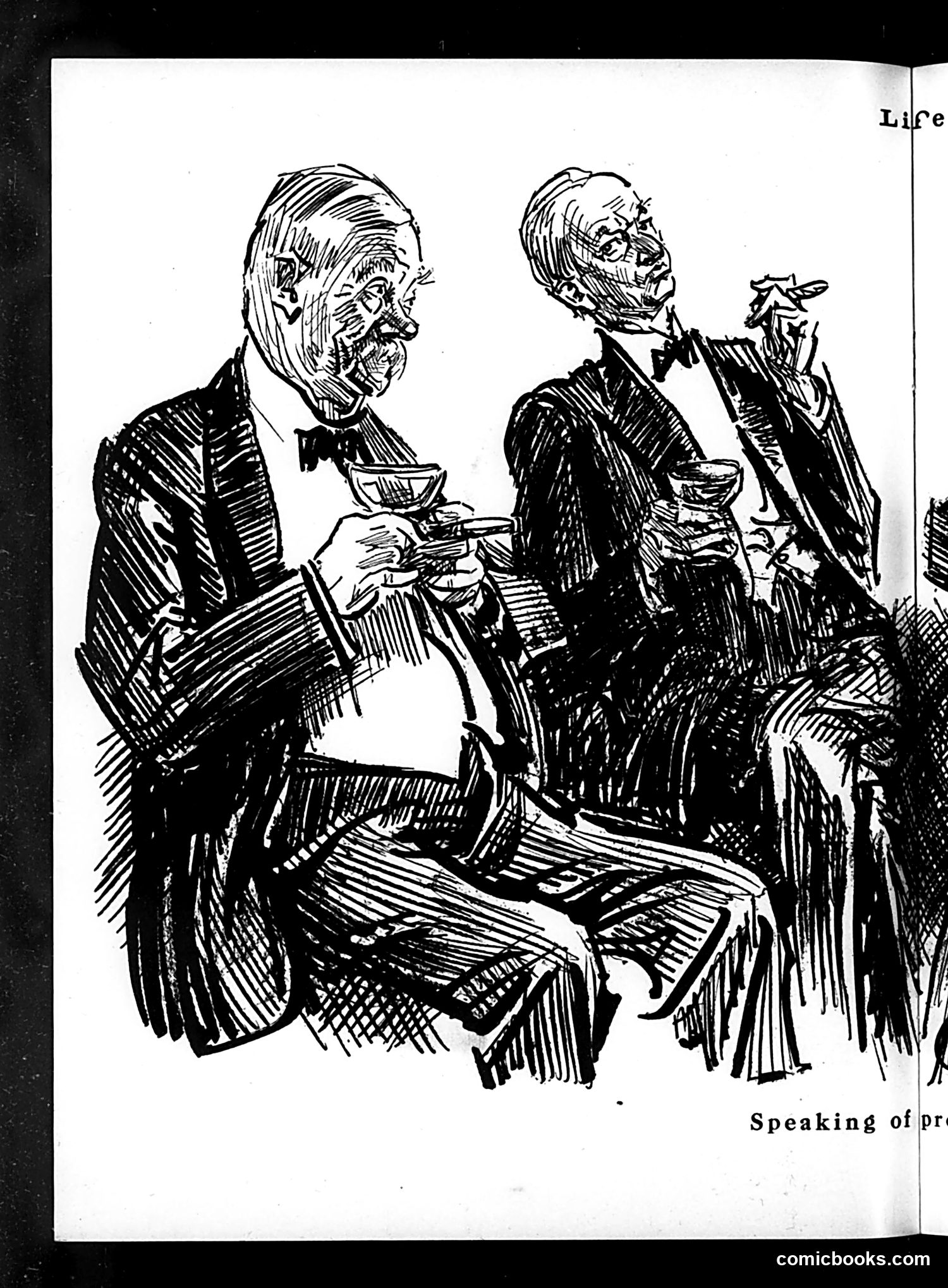
This is a pen-and-ink satirical cartoon from *Life* magazine depicting two formally dressed gentlemen in tuxedos, holding cocktails and appearing to converse. The caption reads "Speaking of pr[ices]" (cut off), suggesting the cartoon comments on pricing or financial matters. The caricatured figures appear to be wealthy or upper-class men engaged in social discourse. Without additional context about the specific issue date or visible identifying features, I cannot definitively name these individuals. The satire likely mocks either pretentious wealthy conversation, economic discussion among the elite, or a specific contemporary political/business topic related to prices or costs. The formal attire and cocktail setting indicate commentary on high society or business circles during the period *Life* was published.
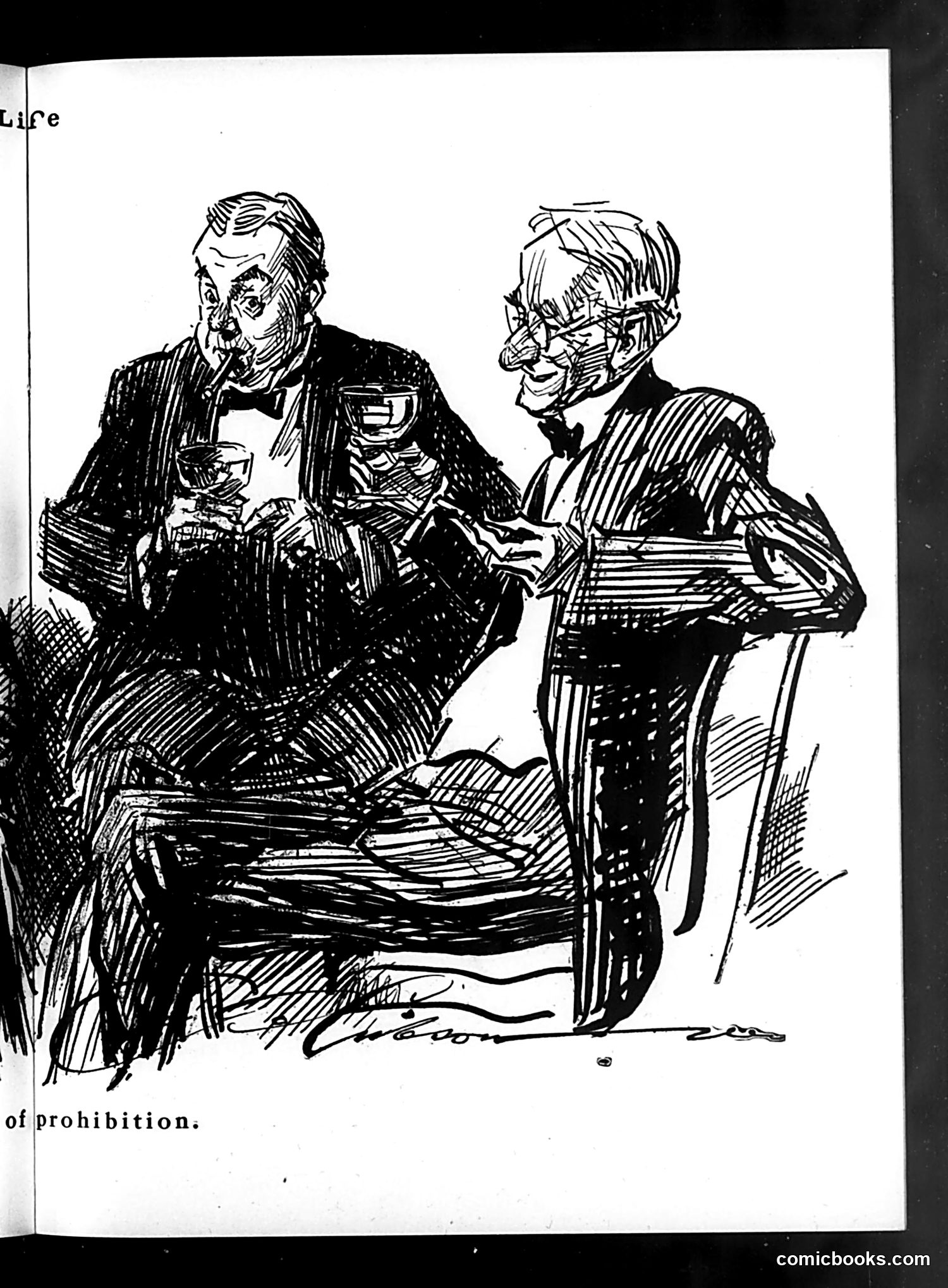
This is a satirical cartoon depicting two well-dressed men in formal attire (tuxedos and bow ties) sharing drinks at what appears to be a table. The caption reads "Life of prohibition," suggesting ironic commentary on Prohibition-era hypocrisy. The cartoon likely mocks the contradiction between Prohibition laws (which banned alcohol sales) and the reality that wealthy, elite individuals continued drinking illegally. The exaggerated facial expressions and caricature style emphasize the ridiculousness of the situation. The figures appear to represent upper-class society members who flouted the law while it theoretically applied to everyone, highlighting how Prohibition was often unenforced among the powerful while affecting ordinary citizens. This reflects common satirical critiques of the era's selective law enforcement.
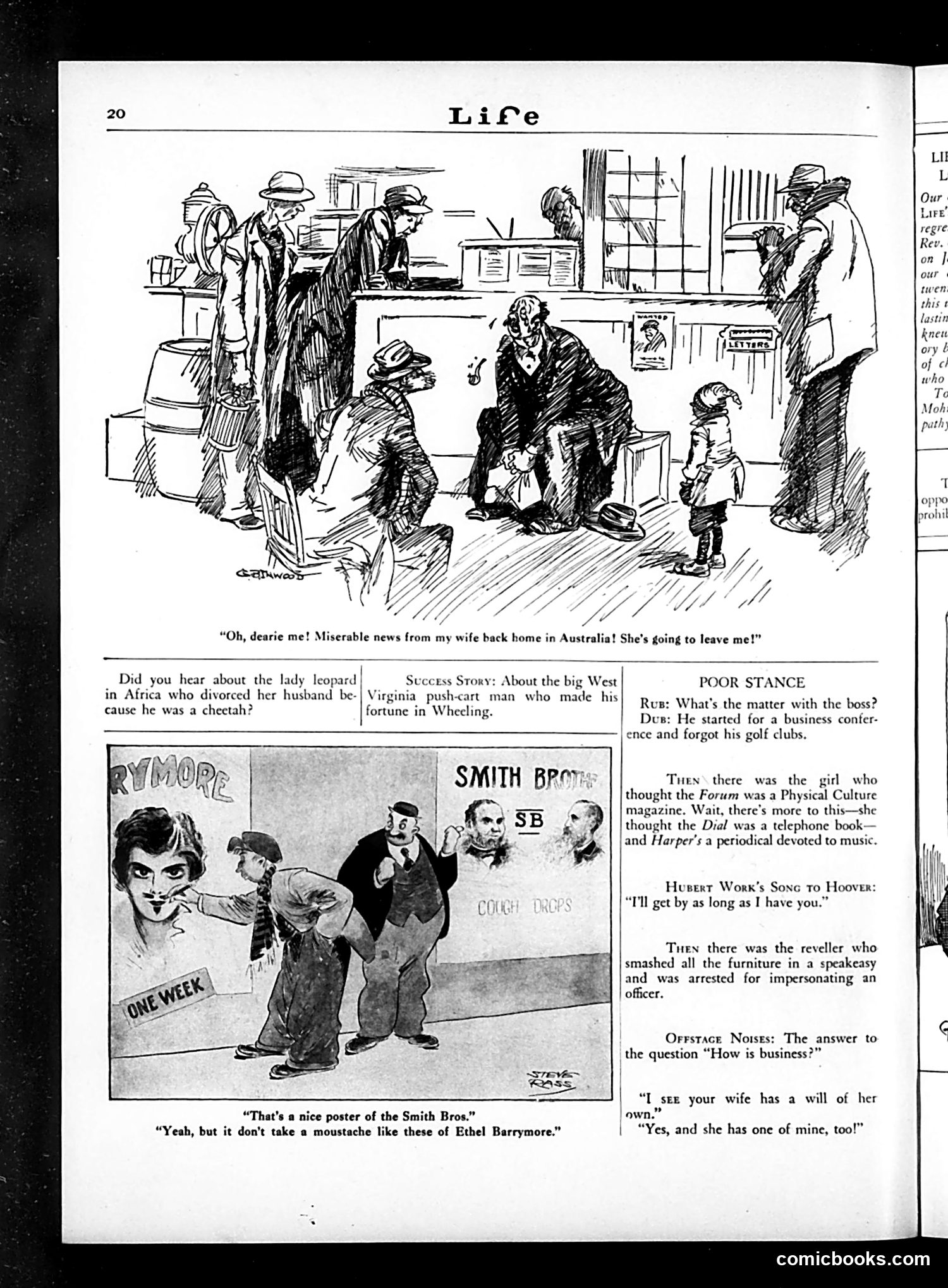
This is a humor page from *Life* magazine featuring several unrelated jokes and a cartoon about the Smith Brothers (identifiable by the "SB" mark and their famous beards—they were a well-known cough-drop brand). **Main cartoon**: References Ethel Barrymore, the famous actress known for her distinctive appearance, suggesting the Smith Brothers' iconic mustaches are comparable to her theatrical look. **Humor themes throughout**: - A man receiving news his Australian wife will leave him (likely playing on distant colonial relationships) - Various mild domestic and social comedy ("Poor Stance," the wife's will) - References to 1920s speakeasies (illegal alcohol bars during Prohibition) - Mockery of magazine confusion (mistaking *Forum* for fitness, *Dial* for a phone book) **Context**: These are generic jokes typical of 1920s-era *Life*—wordplay, marital humor, and light social satire. The speakeasy reference dates this to Prohibition era. Nothing appears politically charged; this is straightforward entertainment humor for the period's readership.
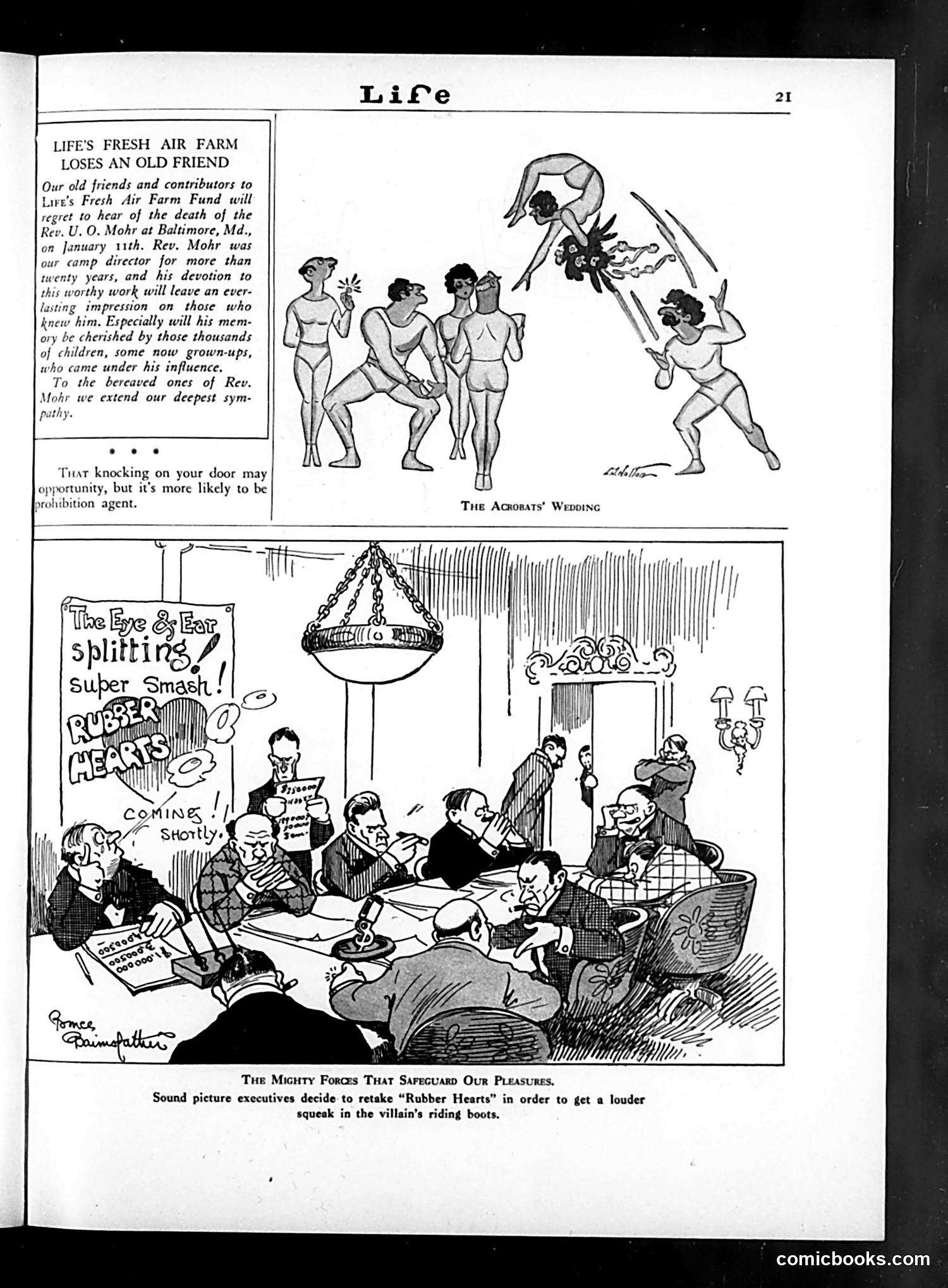
**Top Section:** An obituary tribute to Rev. U.O. Mohr, director of Life magazine's Fresh Air Farm Fund for over twenty years—a charitable program providing camp experiences for underprivileged children. The accompanying illustration titled "The Acrobats' Wedding" depicts young athletes in a playful, energetic scene. **Bottom Cartoon:** A satirical jab at early sound film technology. Film executives gather around discussing a retake of "Rubber Hearts," debating whether to re-shoot a scene simply to capture a louder squeaking sound from a villain's riding boots. The satire mocks the obsessive focus on sound effects in newly-minted "talkies"—how studios prioritized trivial audio details over narrative substance, suggesting the technology was driving filmmaking decisions rather than serving storytelling. **Side Note:** A quip about Prohibition agents knocking on doors (referencing 1920s alcohol enforcement). The page reflects post-silent-film Hollywood's early fascination with sound as a novelty rather than artistic tool.
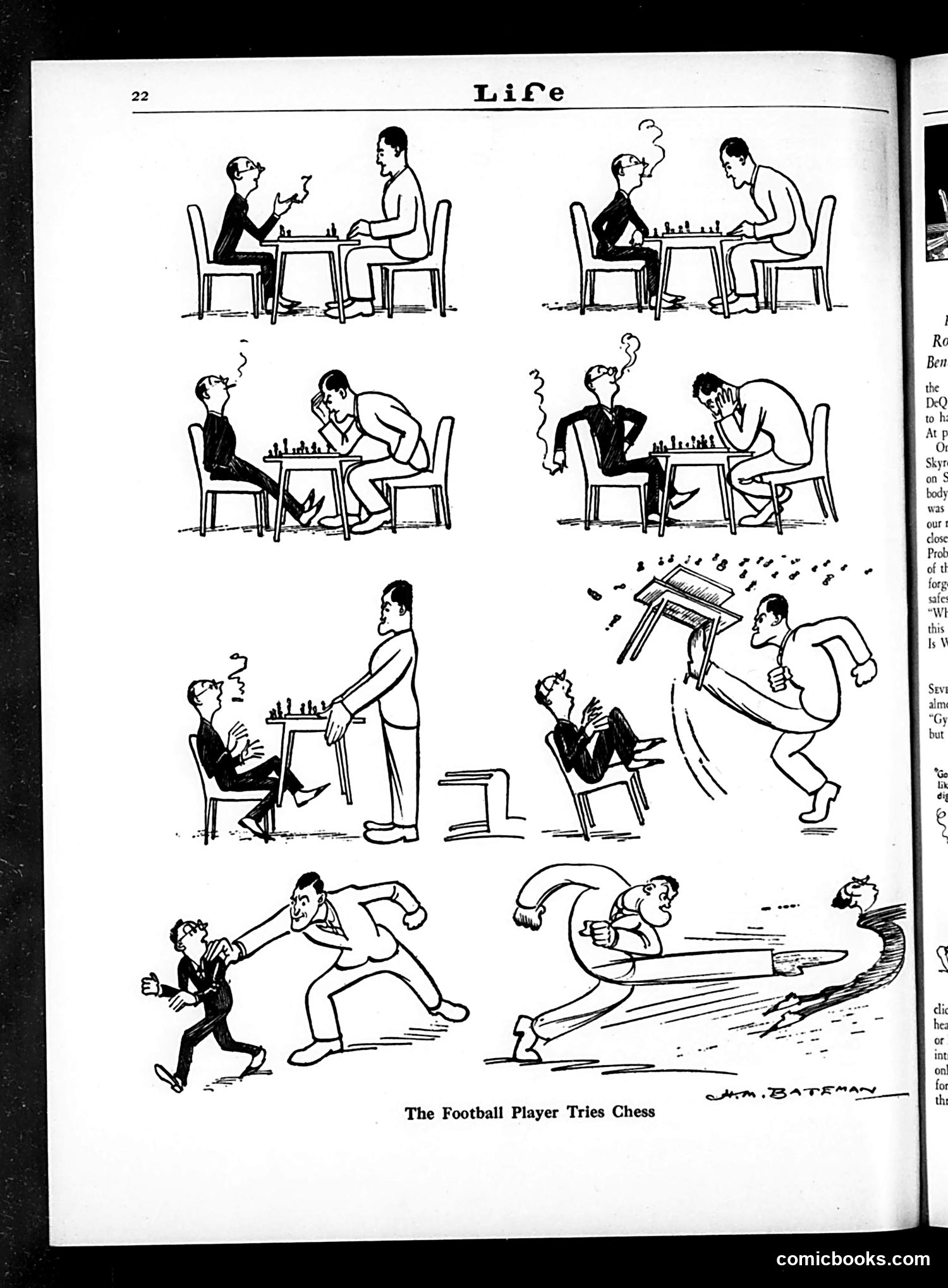
This satirical comic strip depicts a football player attempting to play chess—a game requiring careful strategy and contemplative thinking. The sequence shows the player's growing frustration as he sits across from an opponent. The humor lies in the contrast between football (an aggressive, physical, action-oriented sport) and chess (a cerebral, patient game of calculated moves). The football player's temperament—shown increasingly agitated across the panels—is fundamentally incompatible with chess's demands. By the final panels, he abandons the game entirely, apparently resorting to physical aggression. The satire mocks the stereotype of football players as intellectually limited and prone to physicality rather than strategic thinking, while also commenting on the vastly different mindsets required by different pursuits.
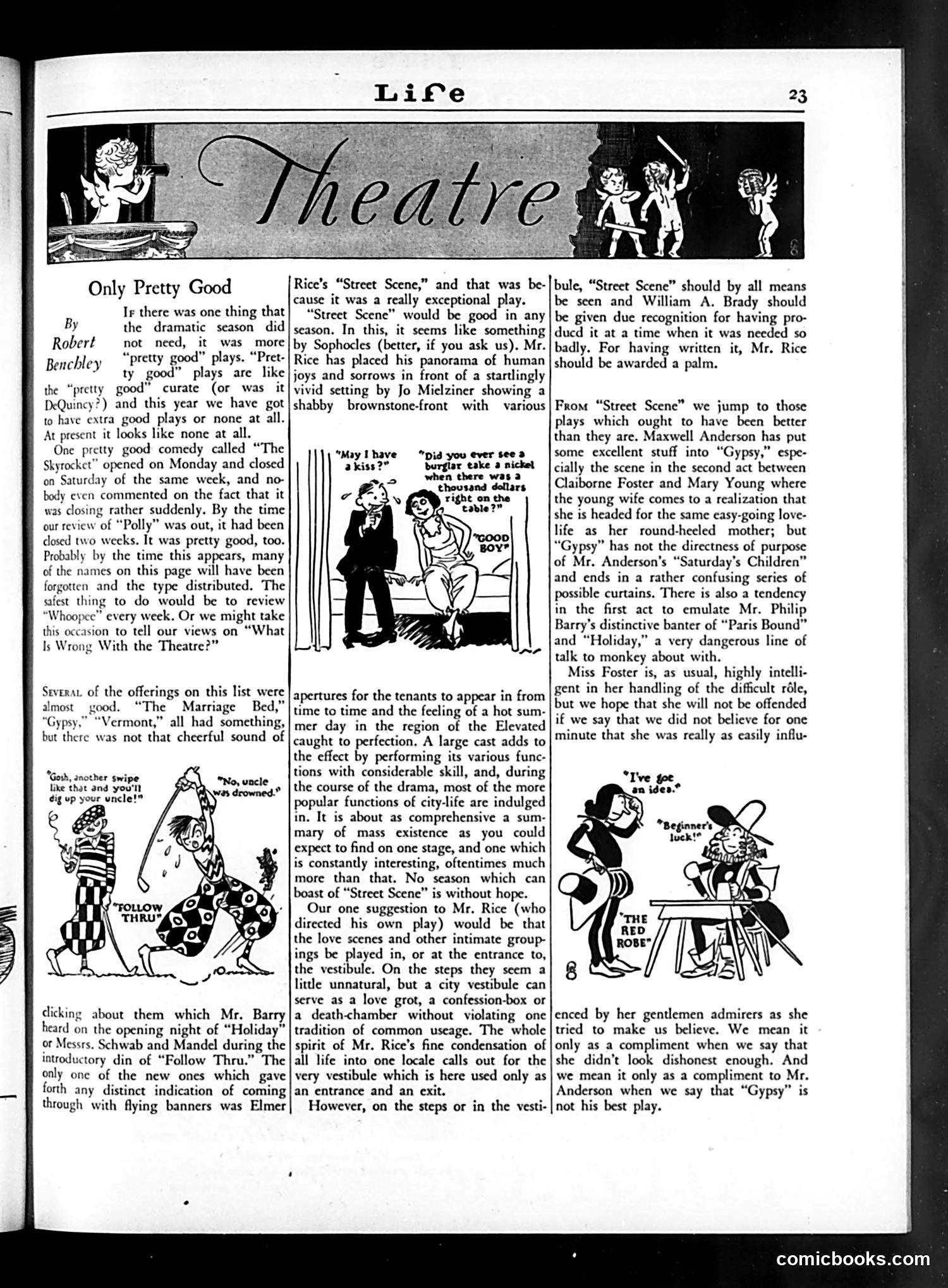
Robert Benchley's column critiques the 1928 Broadway season, lamenting a glut of mediocre plays. He argues the theatre needs *excellent* productions, not merely "pretty good" ones. **Key points:** - **"Street Scene"** by Elmer Rice is praised as genuinely exceptional—compared to Sophocles—with vivid staging by Jo Mielziner depicting tenement life. Benchley's only suggestion: move intimate scenes from the front steps into the vestibule for better dramatic effect. - **Other plays mentioned** ("Gypsy," "The Marriage Bed," "Vermont") had merit but lacked distinction. "The Skyrocket" closed after one week without notice. - **The cartoons** appear to illustrate theatrical absurdities—a couple's domestic quarrel, slapstick business about money—typical of the "pretty good" comedies he dismisses. Benchley's satire targets theatrical mediocrity: productions that are competent but forgettable, closing unnoticed while critics scramble to review them.
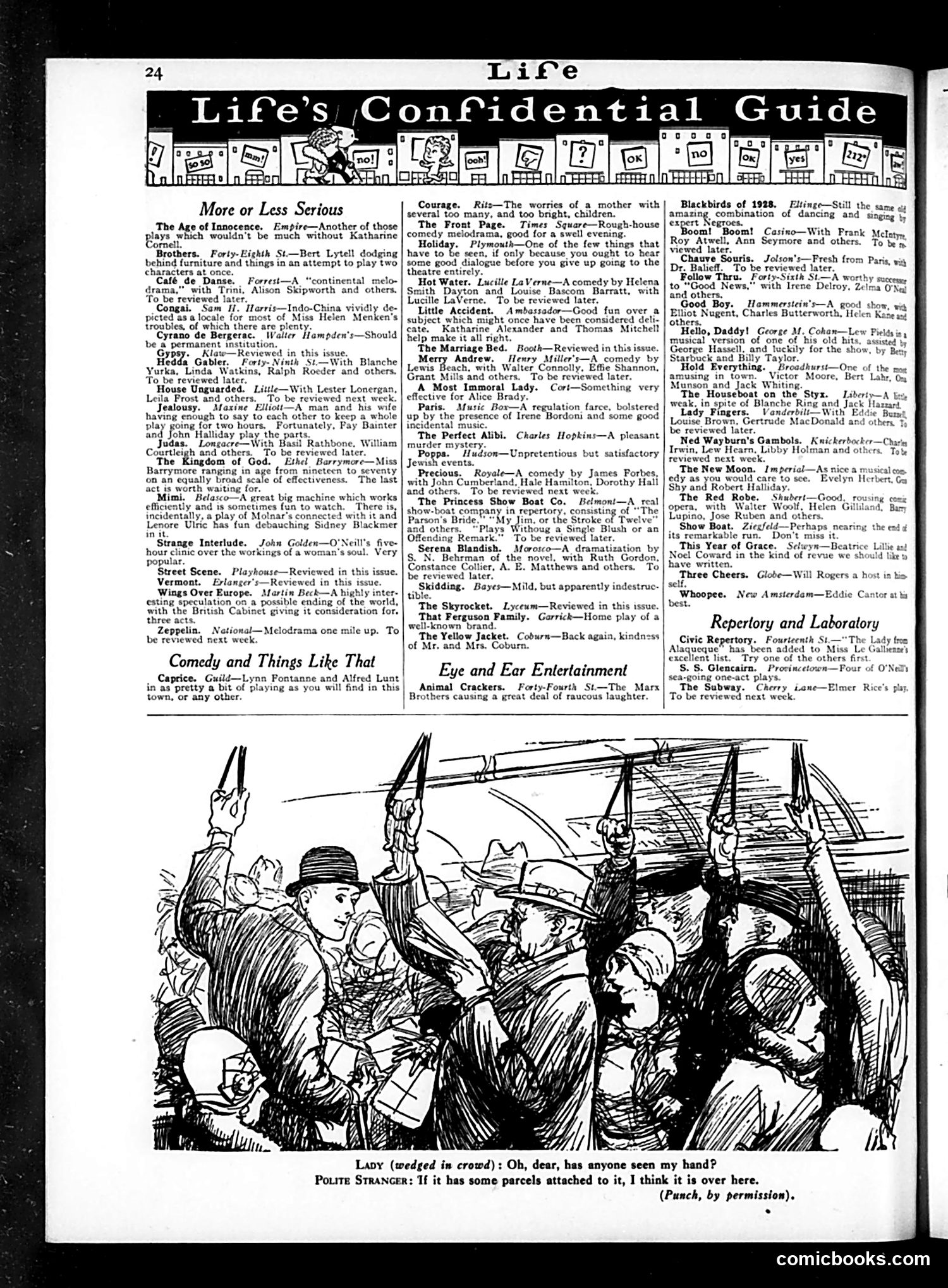
This page from *Life* magazine features theater reviews and a single political cartoon at the bottom. The cartoon depicts a crowded, chaotic scene—likely a ship or public gathering—where a well-dressed lady (wedged in a crowd) asks a "Polite Stranger" if he's seen her hand. He replies that if it has parcels attached, he thinks it's "over here." **The Satire:** This is a gentle joke about urban overcrowding and the loss of personal space in modern life. The lady has literally lost her hand in the crush of bodies—a humorous exaggeration of how tightly packed crowds had become in cities (possibly referencing immigration or post-war population density). The "Polite Stranger's" deadpan response—locating her hand by its parcels rather than recognizing it as a person—amplifies the absurdity of treating people as mere objects in a crowd. The cartoon reflects *Life* magazine's satirical commentary on contemporary American social anxieties about urbanization and mass society.
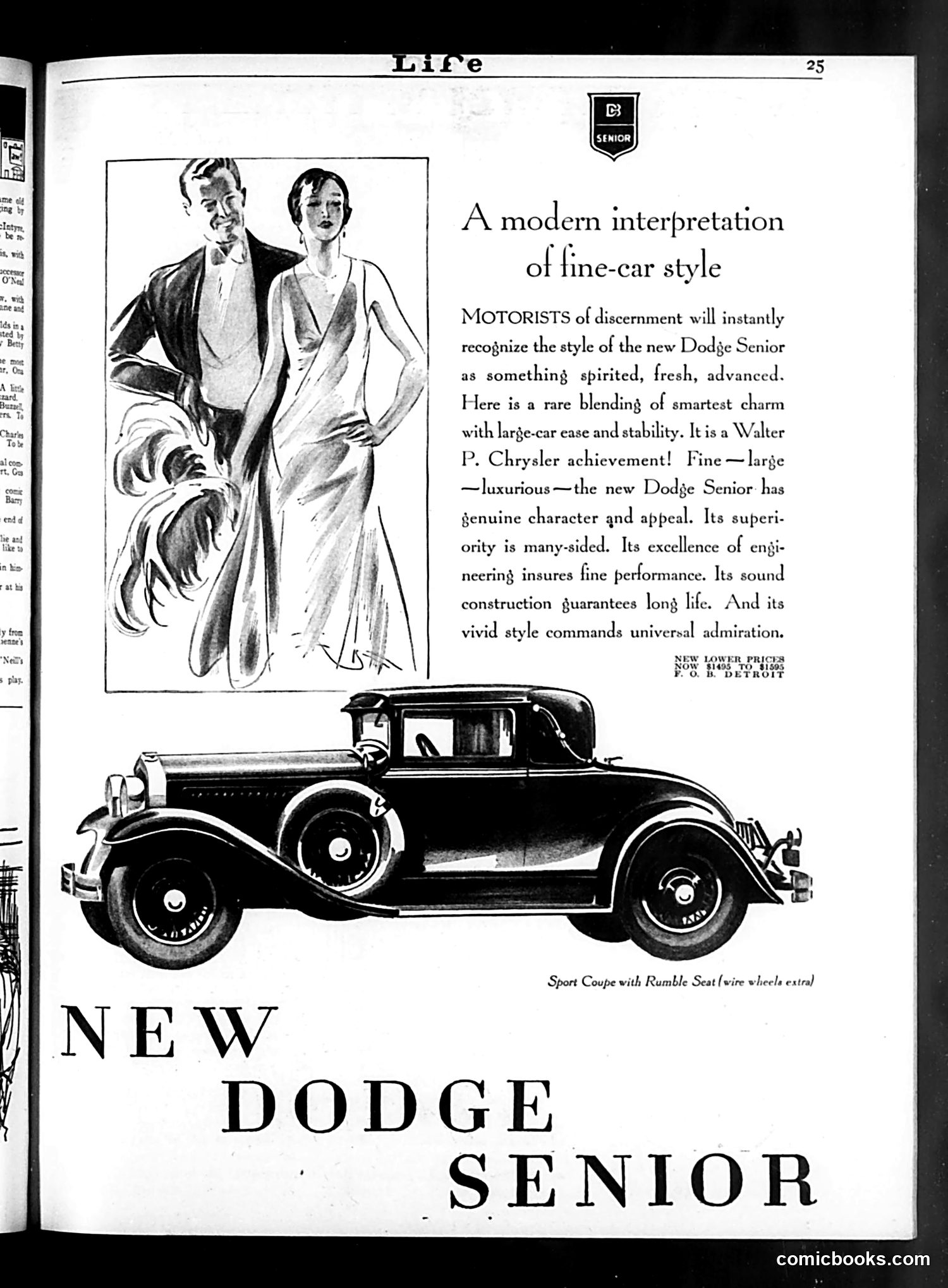
This is **not a cartoon or satire**—it's a straightforward automobile advertisement from Life magazine, likely from the late 1920s based on the car's design and styling. The page features: - **Upper illustration**: A stylized drawing of a well-dressed couple (man in tuxedo, woman in evening wear) with a small dog, representing the aspirational lifestyle associated with owning this vehicle - **Main content**: Advertising copy praising the new Dodge Senior as embodying modern automotive style and engineering - **Lower illustration**: The actual car—a Sport Coupe with rumble seat—shown in profile **Context for modern readers**: The advertisement appeals to "motorists of discernment" and emphasizes luxury, reliability, and fashion-forward design. Walter P. Chrysler's name appears as a prestige marker. The pricing ($1,495–$1,595) and focus on style alongside engineering reflect the 1920s boom in consumer automobiles as status symbols, not mere transportation. This represents period advertising strategy: linking car ownership to sophistication and social standing.
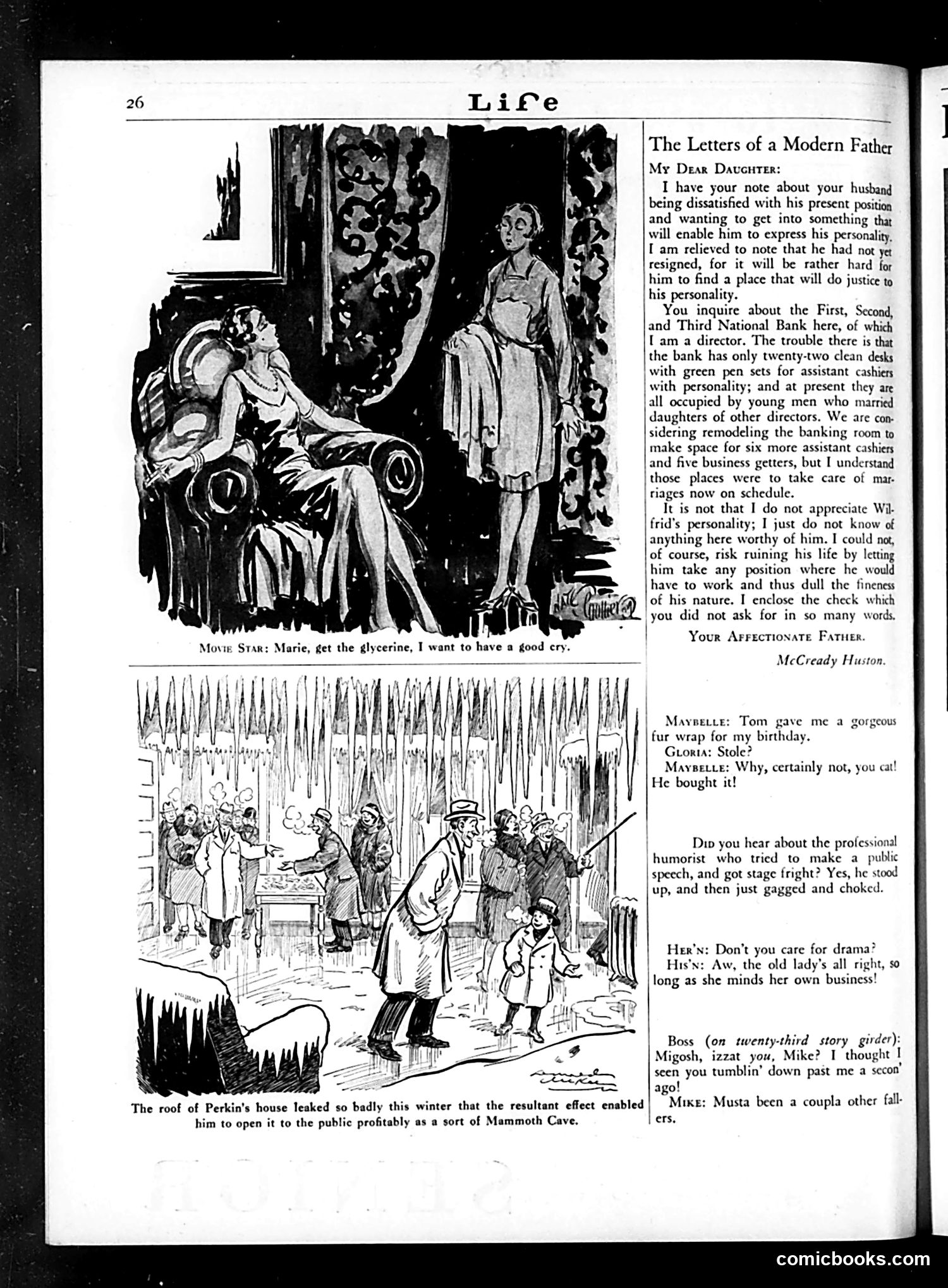
This page satirizes early-20th-century upper-class anxiety about employment and entitlement. The main piece mocks a wealthy bank director who writes to his daughter explaining why her husband—despite wanting a position that lets him "express his personality"—cannot be hired. The satire is sharp: the director admits the bank has desks reserved exclusively for sons-in-law of other directors, yet claims *no suitable position exists* for the son-in-law because meaningful work would "dull the fineness of his nature." The joke exposes nepotism masquerading as principle—the father sends money instead of a job, enabling idleness while congratulating himself on protecting the young man from labor. The secondary cartoons and jokes below continue this theme of absurdity: a woman's expensive fur wrap ("bought," not stolen), a failed humorist, workplace banter about falling workers. Together, they ridicule privilege, nepotism, and the fiction that avoiding work preserves one's dignity.
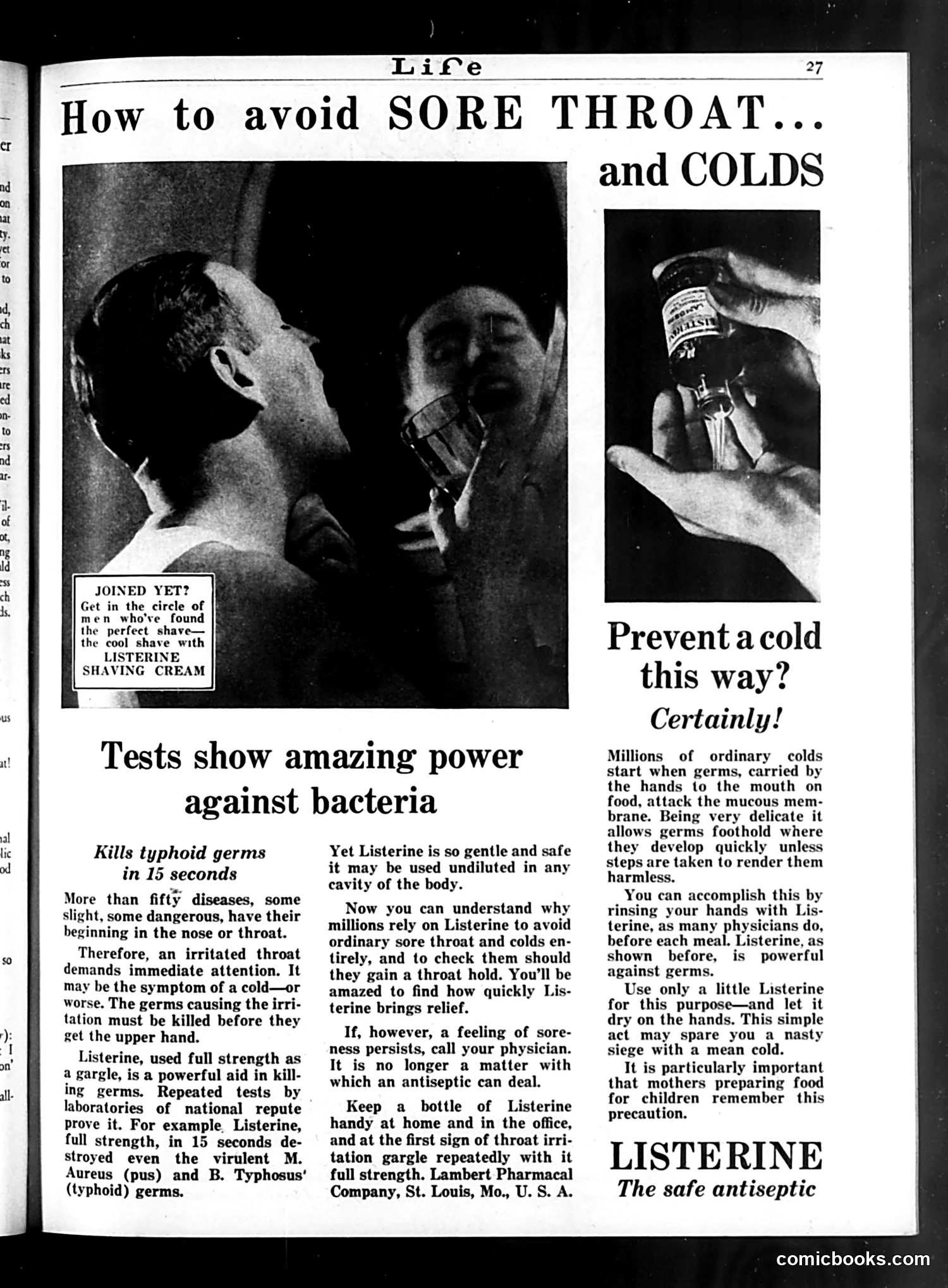
This is a **vintage advertisement**, not a cartoon or satire. It's a Listerine product promotion from Life magazine (likely 1920s-1930s based on design). The page contains two separate ads for Listerine antiseptic: 1. **Left side**: A shaving cream advertisement showing men discussing "the perfect shave" with Listerine shaving cream, claiming it kills bacteria like typhoid germs in 15 seconds. 2. **Right side**: A cold-prevention ad suggesting rinsing hands with Listerine before meals to stop germs from entering the mouth via food. **Historical context for modern readers**: This reflects pre-antibiotic era medicine (pre-1940s) when antiseptics were promoted as near-universal remedies for bacterial infections. The claims are wildly exaggerated by modern standards—Listerine cannot prevent colds (caused by viruses, not bacteria) or cure typhoid. The ads exploit genuine public health concerns about disease while overselling a mouthwash product as a medical solution. This aggressive medicinal marketing was common before modern FDA regulations.
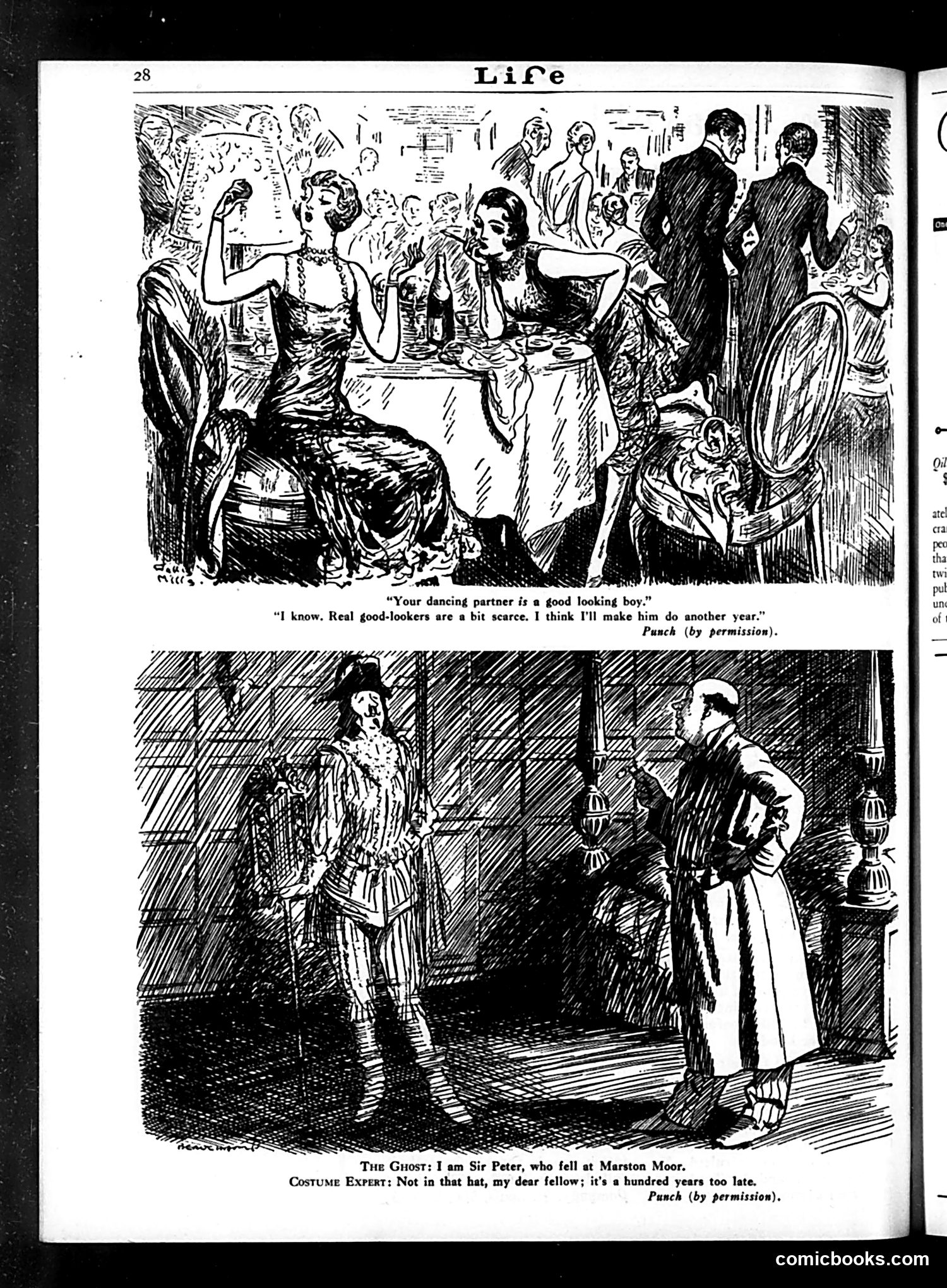
This page contains two reprinted cartoons from *Punch*, the British satirical magazine. **Top cartoon:** A social satire on wartime dating. A woman at a party remarks that good-looking men are scarce, so she plans to "make him do another year"—implying she'll keep her dancing partner around for military service rather than let him leave. This reflects WWI-era anxieties about male recruitment and women's roles in encouraging (or controlling) men's wartime participation. **Bottom cartoon:** A costume/historical accuracy joke. A ghost claims to be Sir Peter who died at Marston Moor (a 1644 English Civil War battle), but a costume expert corrects him—the hat he's wearing didn't exist for another century. The humor lies in the pedantic anachronism: even ghosts can't escape historical accuracy when dressing for the period. Both cartoons use light social satire typical of *Punch*'s genteel humor.
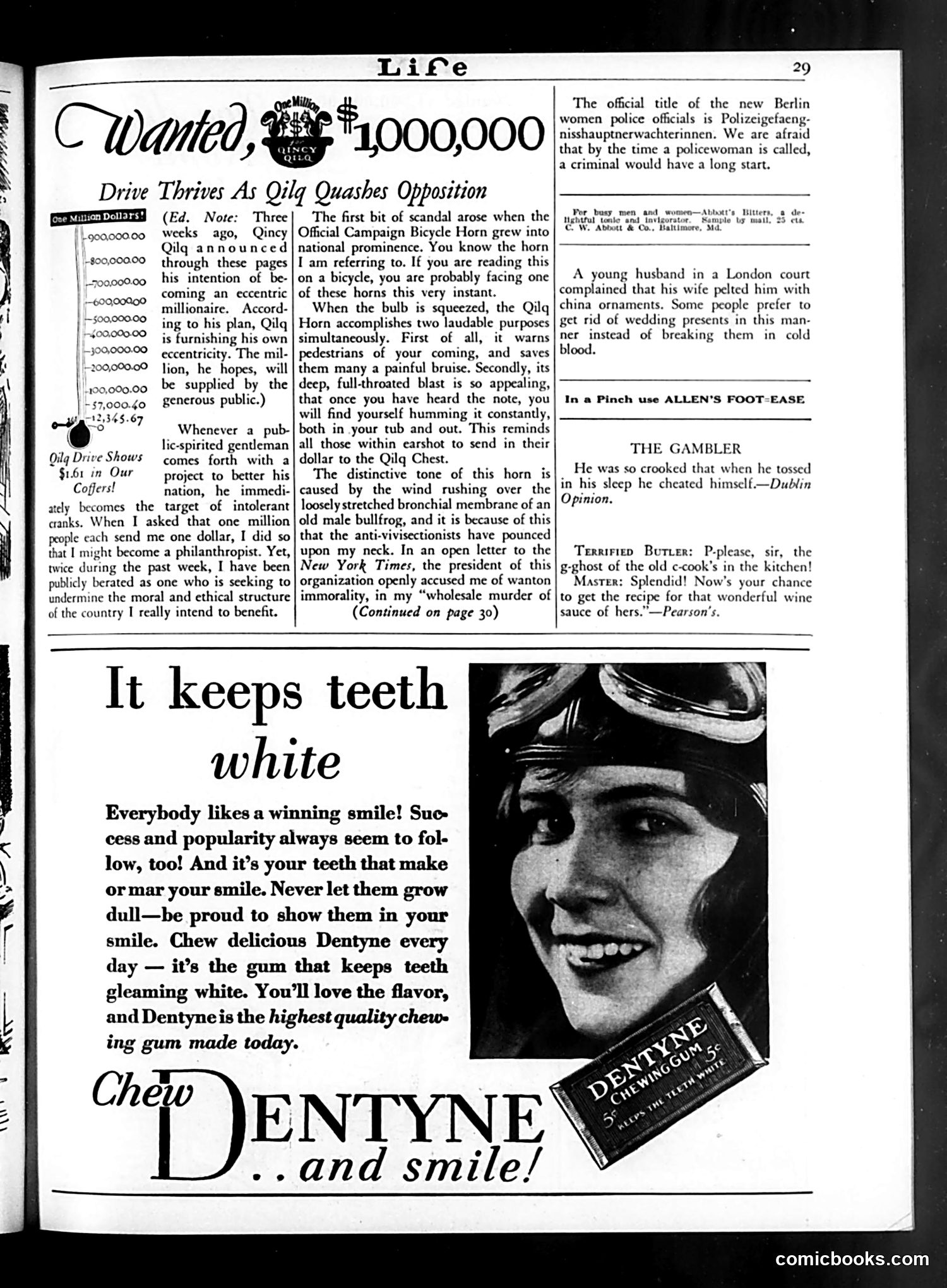
This page contains a satirical piece about "Qilq," a fictional character attempting to become an eccentric millionaire by soliciting one dollar donations from the public. The satire mocks his scheme and the absurd defenses he offers. The main joke: Qilq created an "Official Campaign Bicycle Horn" made from a bullfrog's vocal membrane to promote his fundraising. When animal-rights activists (anti-vivisectionists) protested this cruelty, Qilq responded indignantly, claiming his intentions are philanthropic while simultaneously acknowledging he's killing frogs for the horns. The humor lies in the contradiction: Qilq presents himself as a public benefactor while defending an indefensibly cruel scheme. The page satirizes both naive fundraising grifts and the self-righteous excuses wealthy individuals make for questionable behavior. The remainder of the page consists of period advertisements (Dentyne gum, Abbott's Bitters) and brief humor columns—standard Life magazine filler content.
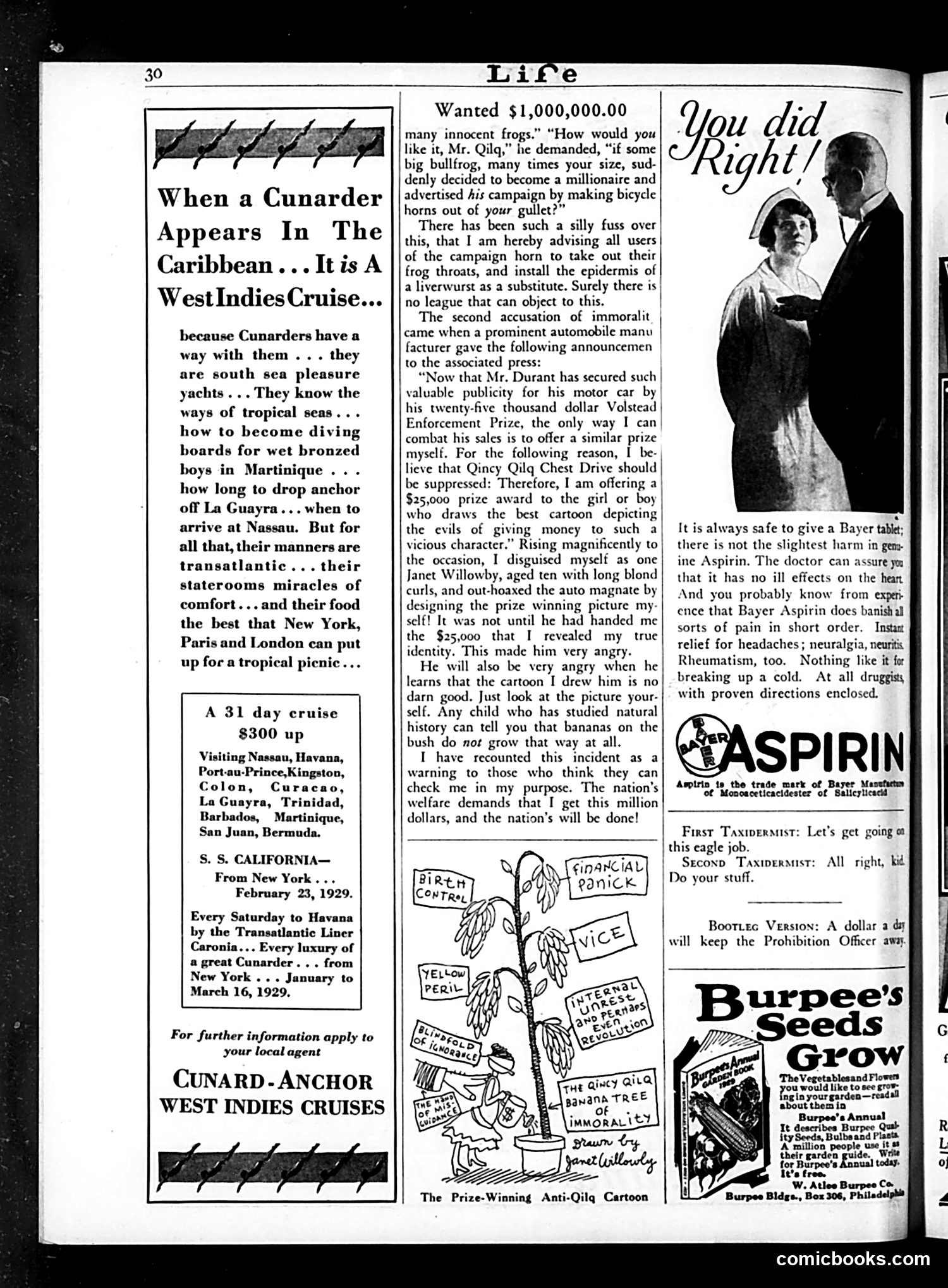
This page contains satirical content centered on a fictional character named "Qilcy Qilq," who appears to be Life's ongoing comedic target. The main cartoon depicts Qilq as a tree bearing various labeled fruits representing social vices and scandals of 1929—including "Birth Control," "Financial Panic," "Vice," "Internal Revenue," and "Immorality." The accompanying text humorously recounts Qilq's supposed wrongdoings: manufacturing campaign horns from frog throats and offering prize money for anti-Qilq cartoons (which the narrator claims to have won fraudulently). The satire mocks both Qilq's immoral behavior and those who attempt to combat it through publicity stunts. The page also includes unrelated advertisements (Cunard cruises, Aspirin, Burpee Seeds) and brief taxidermy humor, typical of Life's mixed-content format from this era.
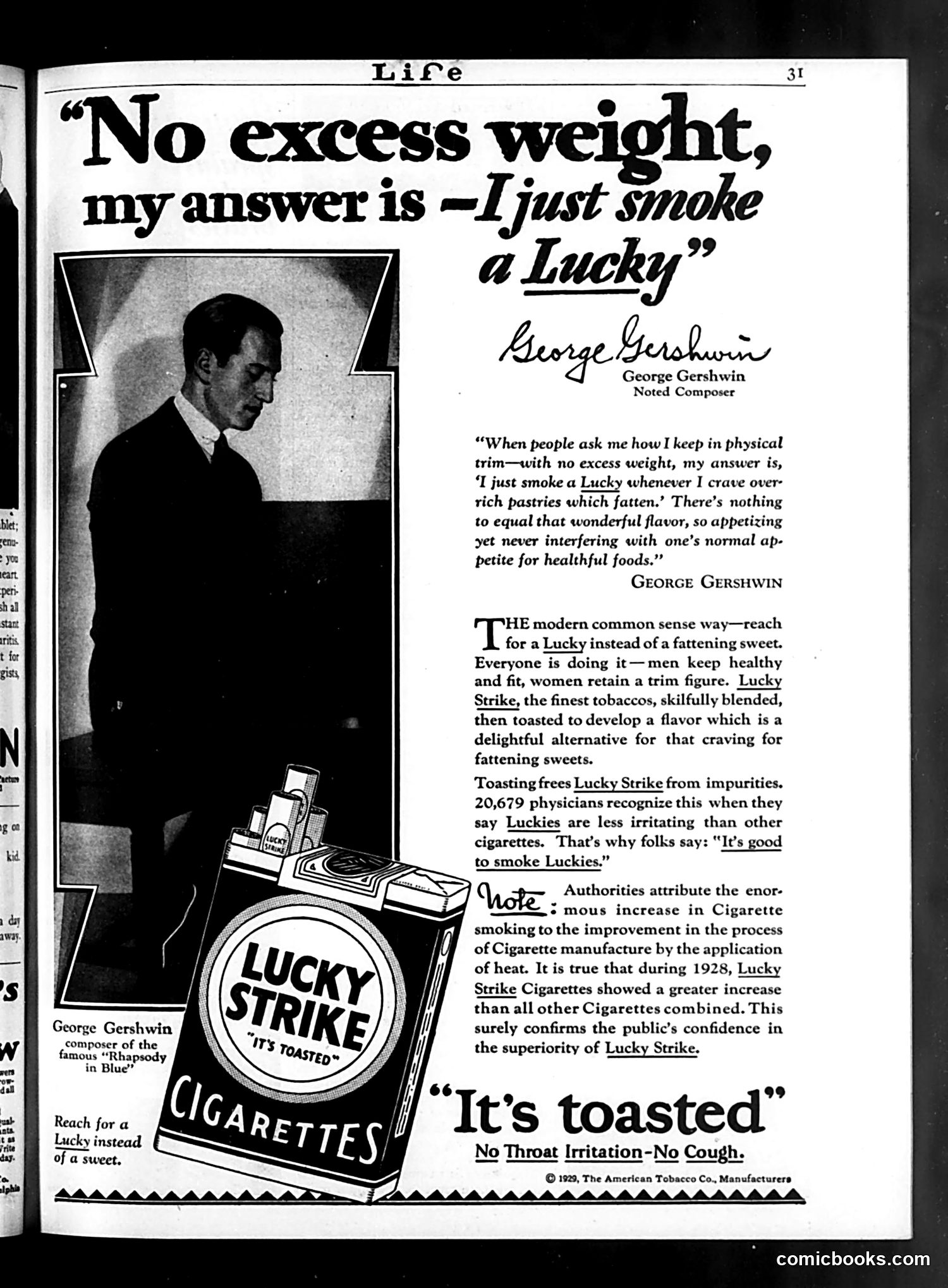
This is a **Lucky Strike cigarette advertisement**, not satire—it's a genuine 1929 marketing campaign featuring composer George Gershwin as an endorser. The ad exploits early 20th-century anxieties about weight and appearance by positioning cigarettes as appetite suppressants: smoking replaces eating sweets, helping men stay "healthy and fit" and women maintain "a trim figure." This was a common marketing strategy before health dangers were widely acknowledged. The "20,679 physicians" claim and "toasting" process emphasized safety, a typical tactic when smoking's risks were emerging. The phrase "It's toasted" became Lucky Strike's signature slogan. Modern readers should recognize this as predatory advertising using celebrity endorsement and pseudo-scientific health claims to sell an addictive, carcinogenic product—particularly targeting women's body image concerns. Such ads are now illegal. The page reveals how brazenly tobacco companies once marketed cigarettes as healthful.
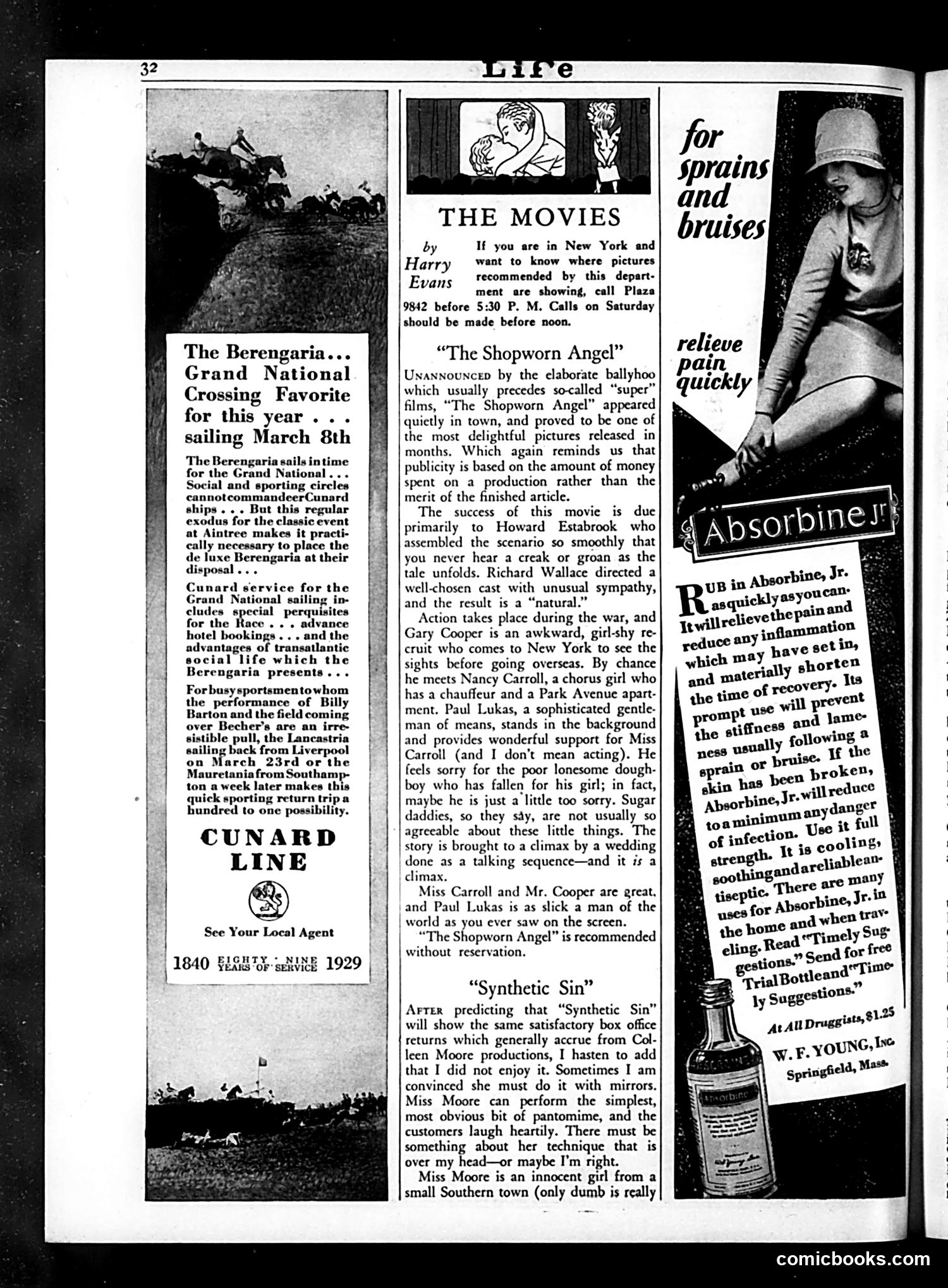
This page combines shipping advertisements with movie reviews—primarily advertising content rather than satire. **Left side:** A Cunard Line advertisement for the luxury ship *Berengaria*, sailing March 8th. The ad exploits wealthy sportsmen's interests by noting the ship's convenient timing for attending the Grand National steeplechase horse race at Aintree (a major British sporting event). It's a tongue-in-cheek pitch: the ad sarcastically suggests that wealthy social circles practically "commandeer" Cunard ships for this annual ritual, making the *Berengaria* an essential luxury for serious horse-racing enthusiasts. **Center/right:** Movie reviews by "Harry Evans" covering two 1929 films—*The Shopworn Angel* (praised for its smooth direction despite minimal publicity) and *Synthetic Sin* (criticized, though the reviewer acknowledges Colleen Moore's mysterious appeal to audiences). **Far right:** Advertisement for Absorbine Jr., a medicinal liniment for sprains and bruises, featuring a soldier in a military helmet. The page reflects 1920s consumer culture and emerging cinema criticism.
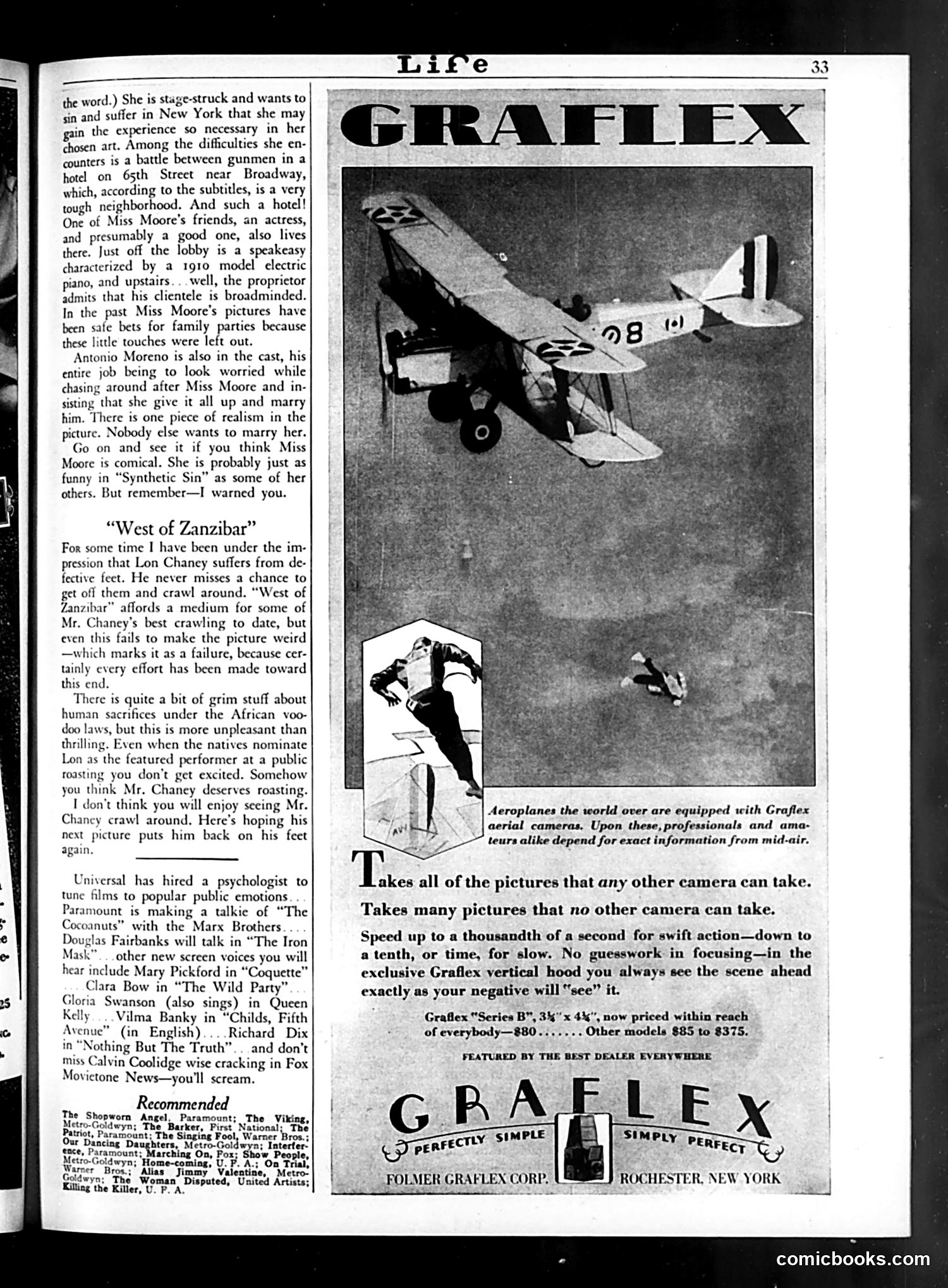
This page contains film reviews alongside a Graflex camera advertisement. The reviews discuss recent movies: **"Synthetic Sin"** stars Colleen Moore as an aspiring actress seeking experience in New York's rough neighborhoods, including a hotel near Broadway with a speakeasy. The critic notes Moore's films were previously "family safe" but this one includes edgier content—though still finds it not particularly funny. **"West of Zanzibar"** features Lon Chaney, whom the critic humorously suggests has "defective feet" because he constantly crawls around rather than walk. The film involves African voodoo rituals and human sacrifice, which the reviewer finds more unpleasant than thrilling. The critic jokingly suggests Chaney "deserves roasting" and hopes his next film puts him "back on his feet again." The page reflects 1920s cinema concerns: morality debates about film content, physical comedy acting styles, and exotic/colonial adventure narratives. The humor relies on wordplay and implied criticism of both actors' performance choices.
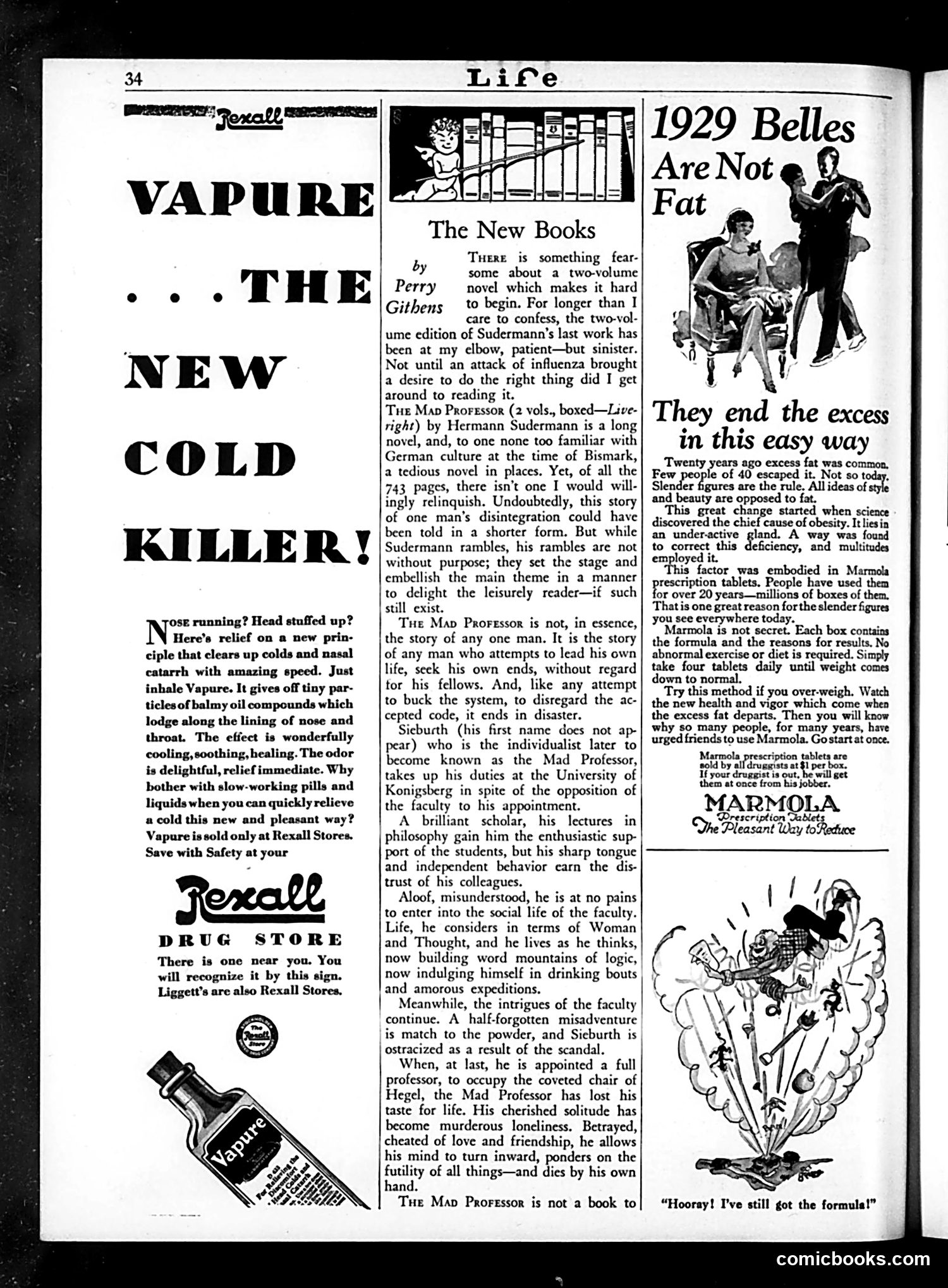
This page mixes advertising with a book review, typical of 1920s magazines. **Left side:** A Vapure cold remedy advertisement using the hard-sell approach common to the era—promising dramatic relief from congestion through inhaled oil compounds. **Center:** A review of Hermann Sudermann's "The Mad Professor," a German novel about an individualistic university philosopher who defies social convention, becomes isolated, and ultimately dies by suicide. The reviewer praises its length and philosophical depth. **Right side:** An advertisement for Marmola obesity tablets, targeting women specifically. It reflects 1920s beauty standards—the "1929 Belles" are "not fat." The ad claims science discovered obesity's "chief cause" (an underactive gland) and promotes a 20-year-old "prescription tablet" solution. This represents the era's emerging diet culture and pharmaceutical marketing to women's appearance anxieties. The juxtaposition is revealing: serious literary content surrounded by advertisements promoting quick pharmaceutical fixes for bodily "problems."
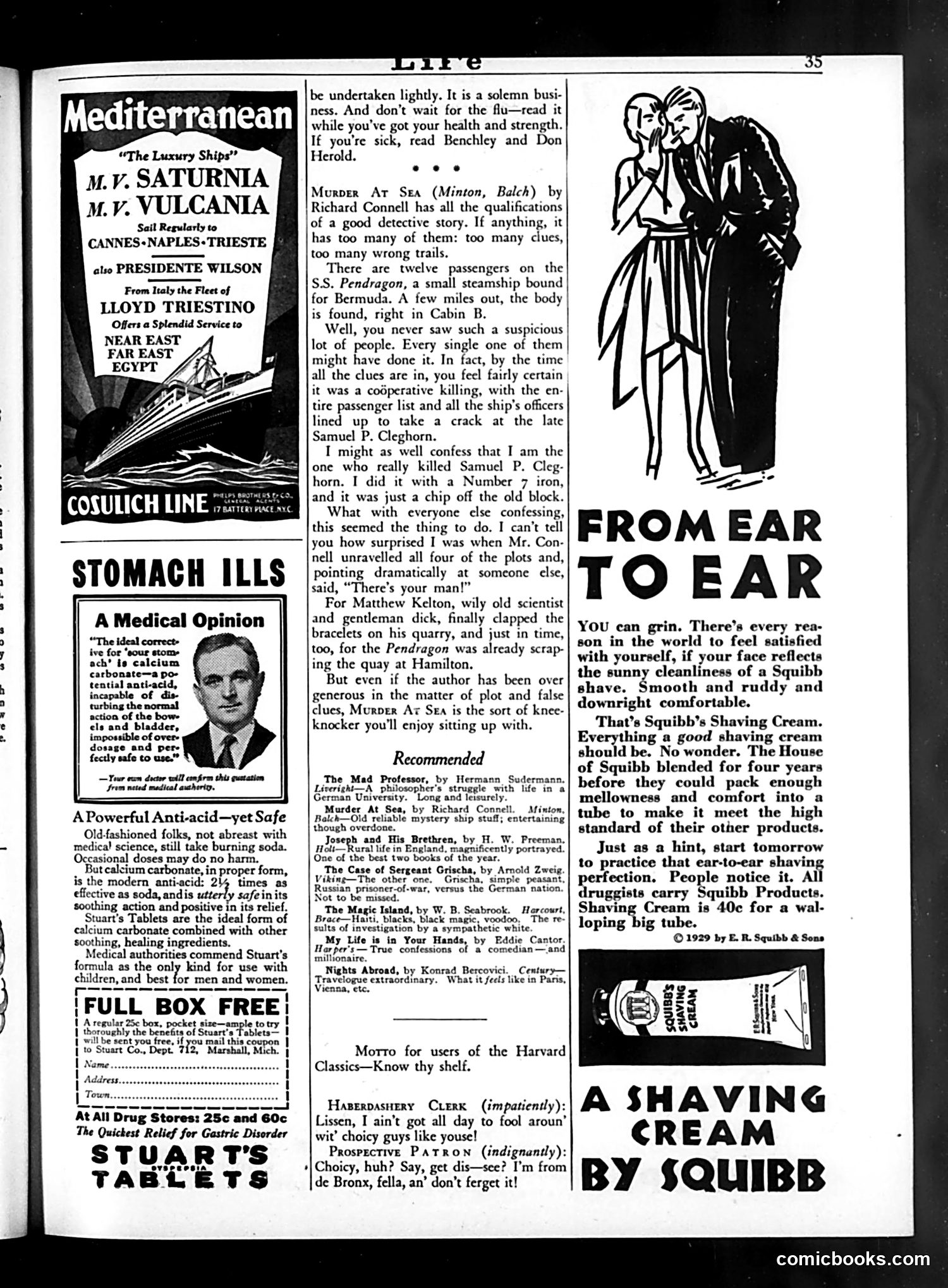
This page is primarily **advertising**, not political satire. The main content is a full-page ad for **Squibb's Shaving Cream** (bottom right), featuring an illustration of a man and woman in 1920s dress. The woman appears delighted—the "ear to ear" headline references a satisfied grin. The ad copy emphasizes that Squibb's shaving cream produces a smooth, comfortable shave, noting the company spent "four years" perfecting the formula. It's positioned as superior to competitors. The page also contains **book reviews** (middle section) and **vintage medical advertisements** for digestive tablets and ocean liners (left side). These are typical of *Life* magazine's mixed-content format—satire, reviews, and paid advertising alongside each other. There is no political content or social satire visible on this page.
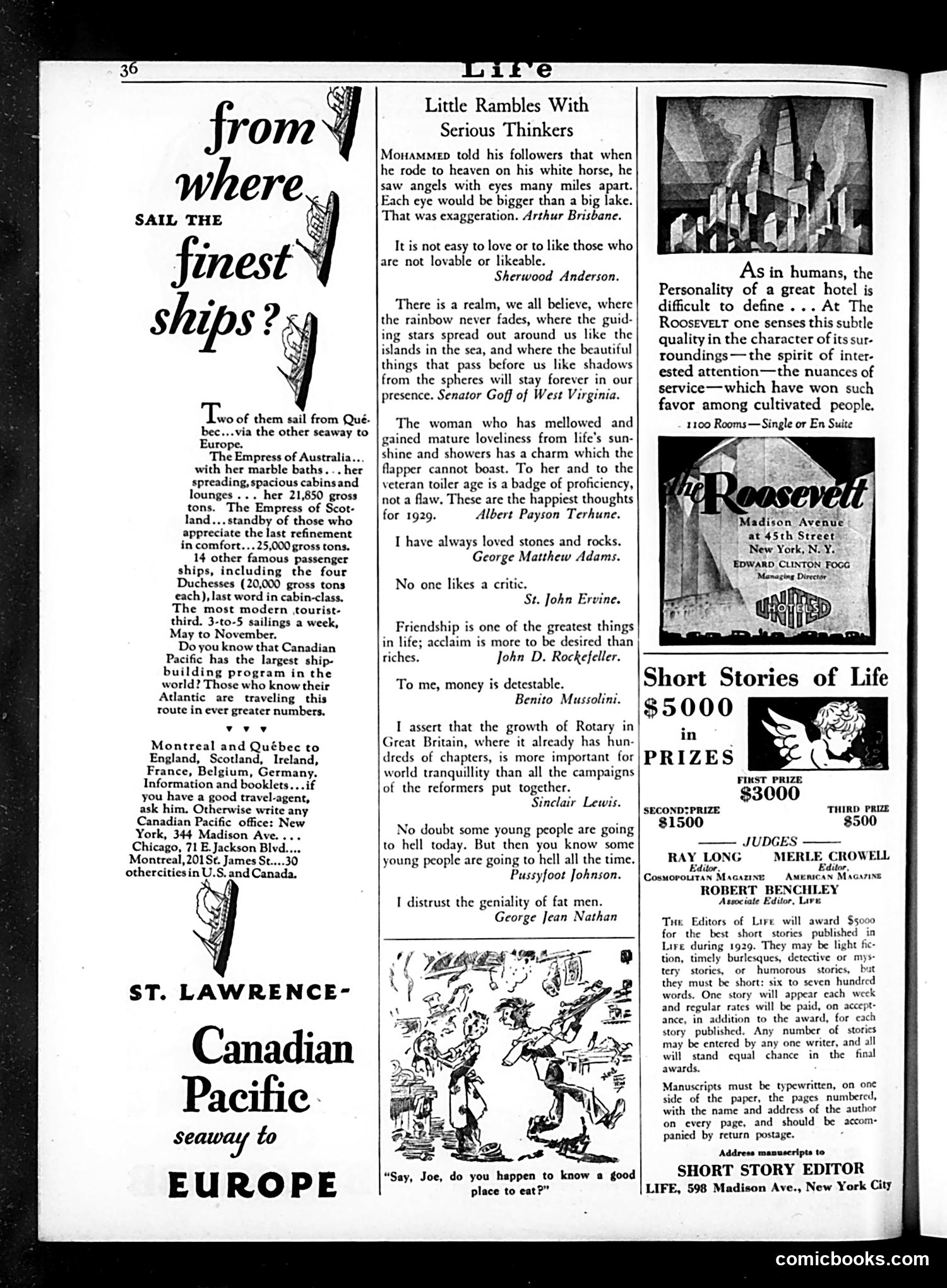
This page combines advertisements with a "Little Rambles with Serious Thinkers" column—a satirical feature presenting quotations from famous figures (Arthur Brisbane, Sherwood Anderson, Senator Goff, John D. Rockefeller, Benito Mussolini, and others). The satire likely works through **juxtaposition and incongruity**. The column mixes genuinely thoughtful observations with absurd or contradictory statements—for example, Mussolini claiming "money is detestable" creates obvious irony given his political position. The opening anecdote about Mohammed exaggerating angels' eye sizes sets a tone mocking grandiose claims. The cartoon at bottom shows a figure asking "Say, Joe, do you happen to know a good place to eat?"—likely satirizing the era's casual social interactions or perhaps advertising-speak itself. Surrounding content includes ship advertisements and a short-story contest with $5000 in prizes, reflecting 1920s Life magazine's dual function: sophisticated satire mixed with consumer advertising.
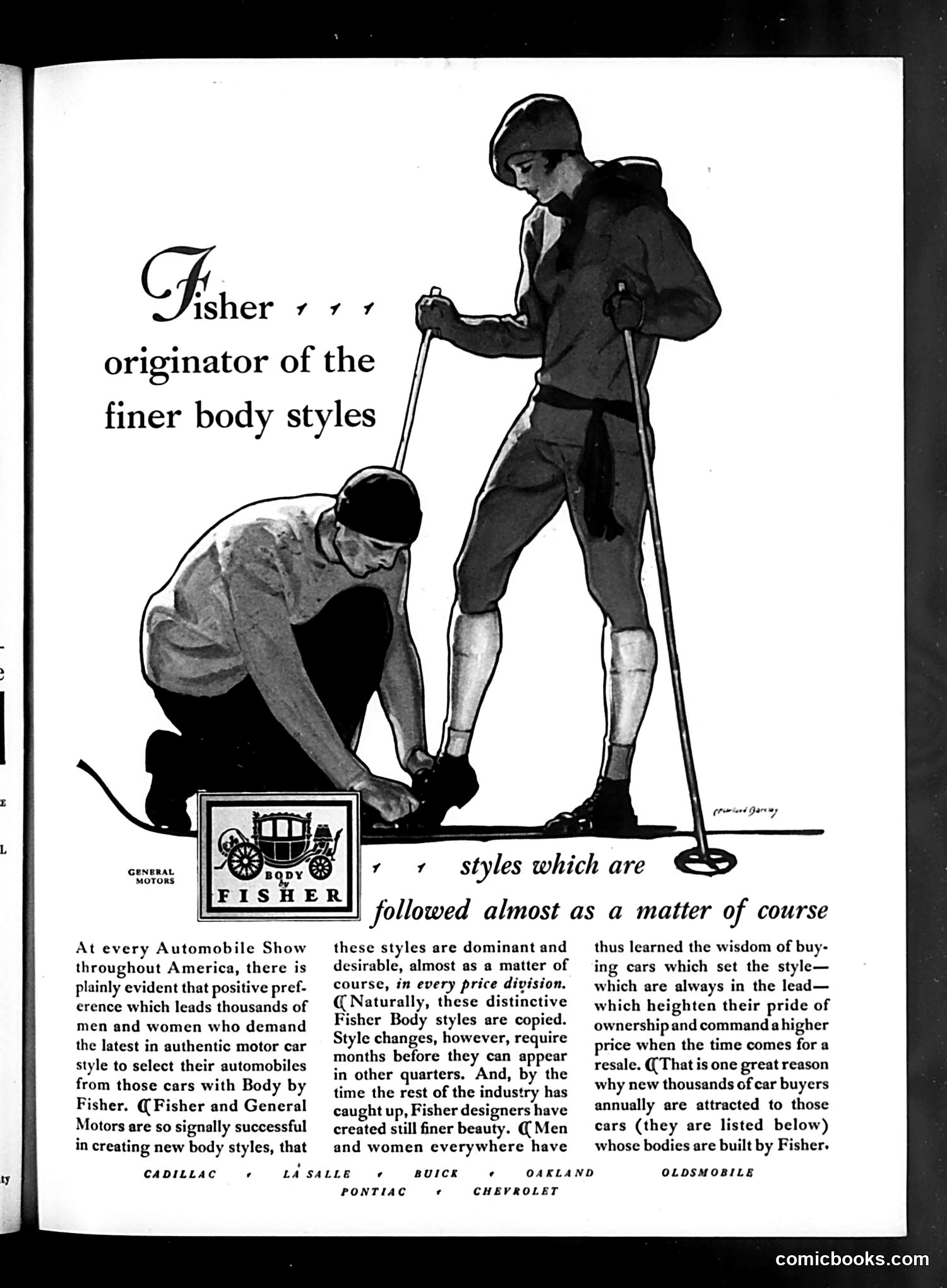
This is a **General Motors advertisement**, not political satire. It promotes Fisher Body, GM's coachbuilding division, as the originator of superior automobile styling. The illustration shows two men examining a car—likely depicting Fisher designers or quality inspectors—to establish Fisher as the authority on automotive aesthetics. The ad's central claim is that Fisher Body styles dominate the market and are widely imitated, but Fisher always stays ahead through continuous design innovation. The text emphasizes that Fisher-bodied cars command higher resale prices and that multiple GM brands (Cadillac, Buick, Pontiac, Chevrolet, Oldsmobile, etc.) use Fisher bodies, positioning the company as essential to automotive prestige. For modern readers: this reflects 1920s-30s consumer culture where "styling" was becoming a major selling point, and companies aggressively marketed design leadership as justification for premium pricing. The ad essentially argues: buying Fisher means buying the trend-setter, not the imitator.
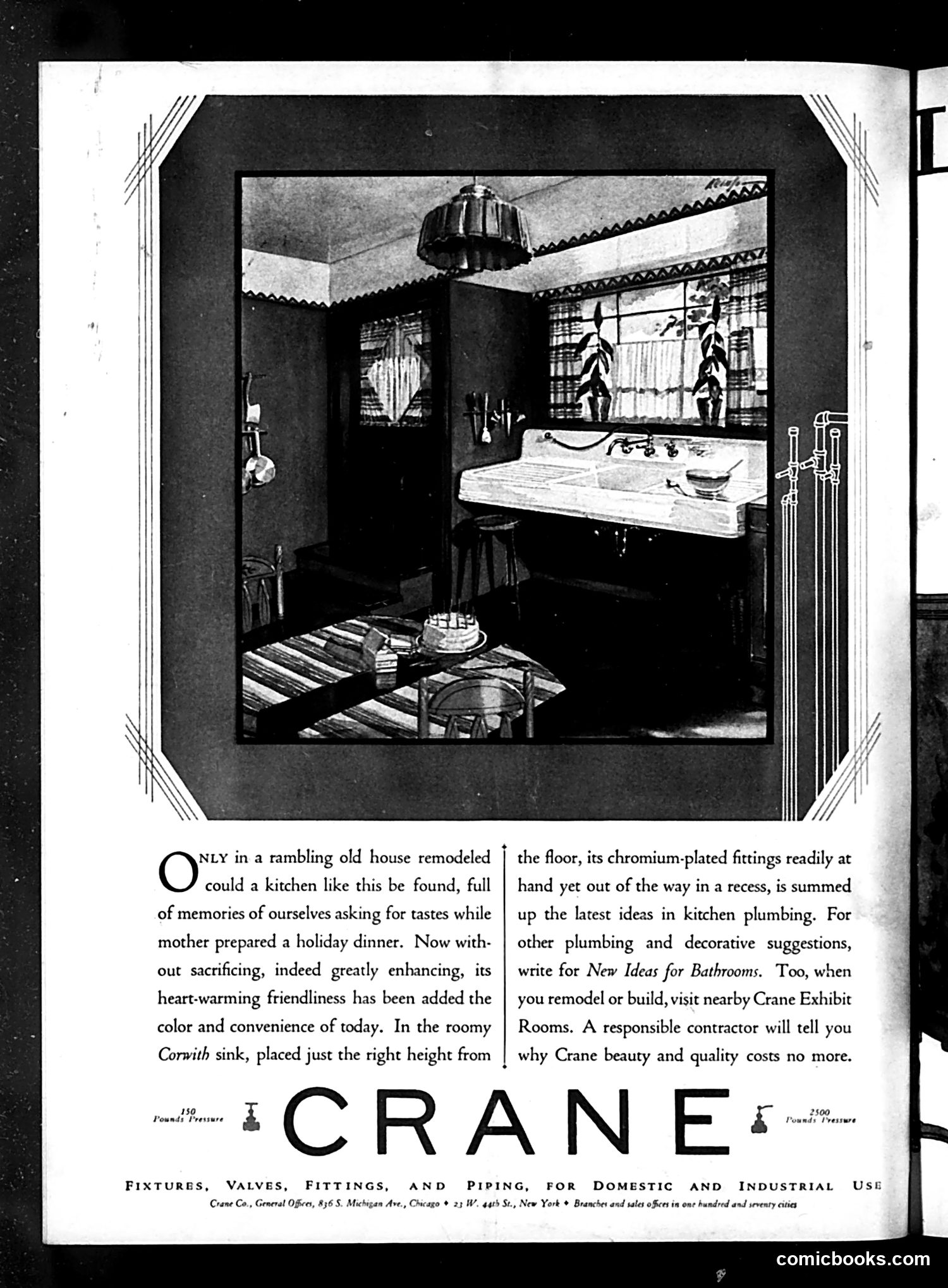
This is **not a cartoon or satire page**—it's a **full-page advertisement** for Crane plumbing fixtures from what appears to be a mid-20th-century issue of *Life* magazine. The image shows a modernized bathroom/kitchen with a Cornith sink, chromium-plated fixtures, and period-appropriate design. The accompanying text uses nostalgic marketing language, contrasting old-fashioned "rambling" houses with contemporary convenience and style. The ad appeals to homeowners considering renovations by promising that modern Crane products enhance rather than sacrifice the "heart-warming friendliness" of older homes. It encourages readers to visit Crane Exhibit Rooms and consult contractors. This represents typical mid-century American advertising strategy: leveraging nostalgia while promoting modern consumer goods as accessible upgrades that maintain traditional values.