
Life, 1929-03-08 · page 27 of 44
Life — March 8, 1929 — page 27: what you’re looking at
What you’re looking at
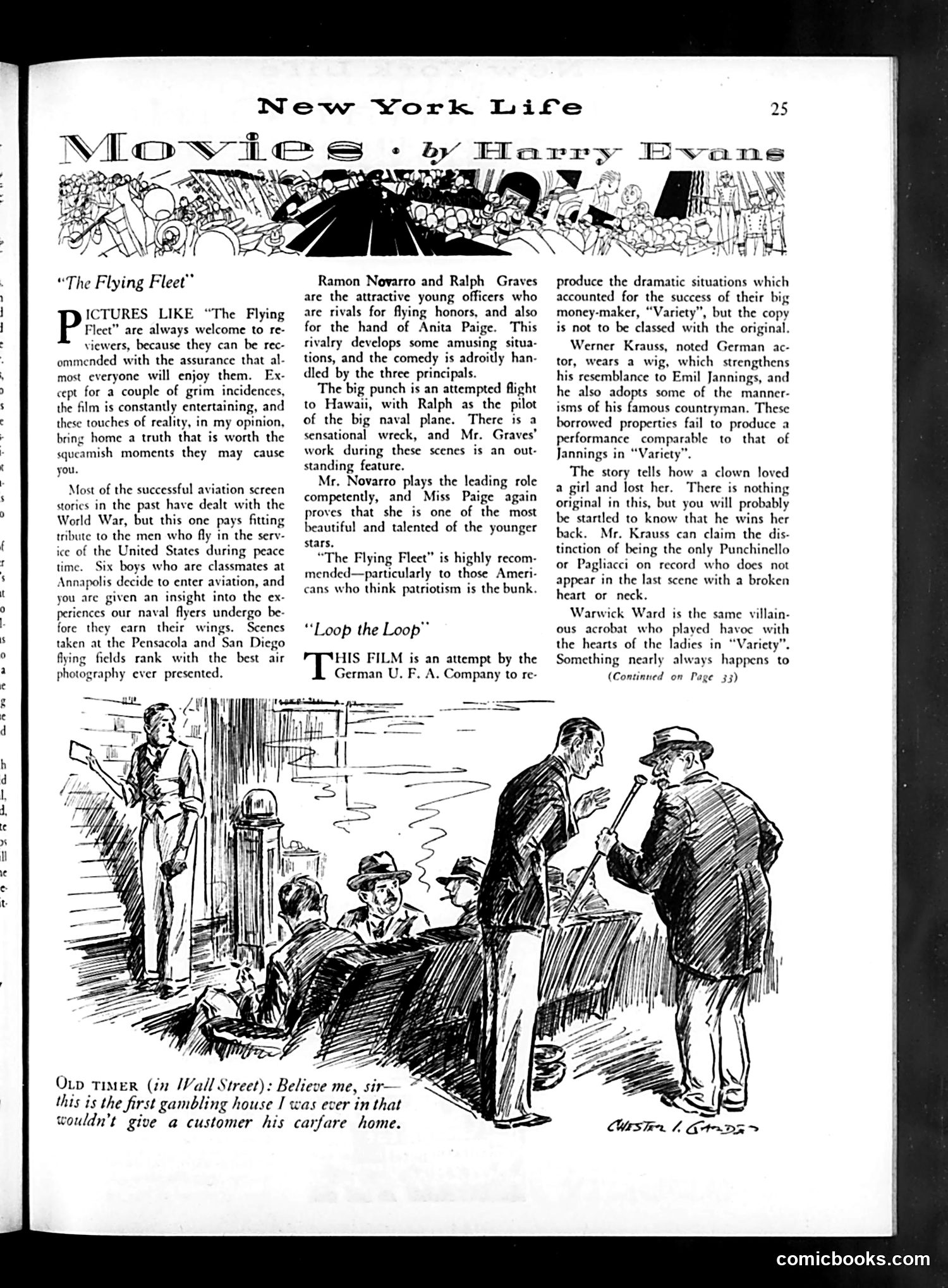
This page reviews two 1920s films. "The Flying Fleet" is a military aviation drama about Navy pilots training at Pensacola and San Diego, featuring romantic rivalry between officers Ramon Novarro and Ralph Graves over actress Anita Paige. The reviewer praises it as patriotic entertainment, notably excluding "grim incidences" that ground the fantasy—a reference to realistic crash scenes. The cartoon below satirizes Wall Street greed during the 1920s stock-market boom. An elderly man in a gambling den (metaphorically comparing stock speculation to gambling) boasts this is the first such establishment that didn't give losing customers carfare home—meaning it was so ruthless it left them completely broke. The joke highlights how stock market gambling impoverished ordinary people, a concern that would prove prescient before the 1929 Crash.
📄 Transcribed text from this page (OCR, searchable)
Machine-transcribed from the original scan — historical spelling and the odd misread are preserved.
New York Life 25 “The Flying Fleet’® ICTURES LIKE “The Flying Fleet” are always welcome to re- viewers, because they can be rec- ommended with the assurance that al- most everyone will enjoy them. Ex- cept for a couple of grim incidences, the film is constantly entertaining, and these touches of reality, in my opinion, bring home a truth that is worth the squeamish moments they may cause you. Most of the successful aviation screen storics in the past have dealt with the World War, but this one pays fitting tribute to the men who fly in the serv- ice of the United States during peace time. Six boys who are classmates at Annapolis decide to enter aviation, and you are given an insight into the ex- periences our naval flyers undergo be- fore they earn their wings. Scenes taken at the Pensacola and San Diego flying fields rank with the best air photography ever presented. Ramon Novarro and Ralph Graves are the attractive young officers who are rivals for flying honors, and also for the hand of Anita Paige. This rivalry develops some amusing situa- tions, and the comedy is adroitly han- dled by the three principals. The big punch is an attempted flight to Hawaii, with Ralph as the pilot of the big naval plane. There is a sensational wreck, and Mr. Graves’ work during these scenes is an out- standing feature. Mr. Novarro plays the leading role competently, and Miss Paige again proves that she is one of the most beautiful and talented of the younger stars. “The Flying Fleet” is highly recom- mended—particularly to those Ameri- cans who think patriotism is the bunk. “Loop the Loop” HIS FILM is an attempt by the German U. F. A. Company to re- Otp TIMER (in Wall Street): Believe me, sir— 7 this is the first gambling house I was ever in that wouldn't give a customer his carfare home. produce the dramatic situations which accounted for the success of their big money-maker, “Variety”, but the copy is not to be classed with the original. Werner Krauss, noted German ac- tor, wears a wig, which strengthens his resemblance to Emil Jannings, and he also adopts some of the manner- isms of his famous countryman. These borrowed properties fail to produce a performance comparable to that of Jannings in “Variety”. The story tells how a clown loved a girl and lost her. There is nothing original in this, but you will probably be startled to know that he wins her back. Mr. Krauss can claim the dis- tinction of being the only Punchinello or Pagliacci on record who does not appear in the last scene with a broken heart or neck. Warwick Ward is the same villain- ous acrobat who played havoc with the hearts of the ladies in “Variety”. Something nearly always happens to (Continued on Page 33) comicbooks.com