
Life, 1929-03-08 · page 28 of 44
Life — March 8, 1929 — page 28: what you’re looking at
What you’re looking at
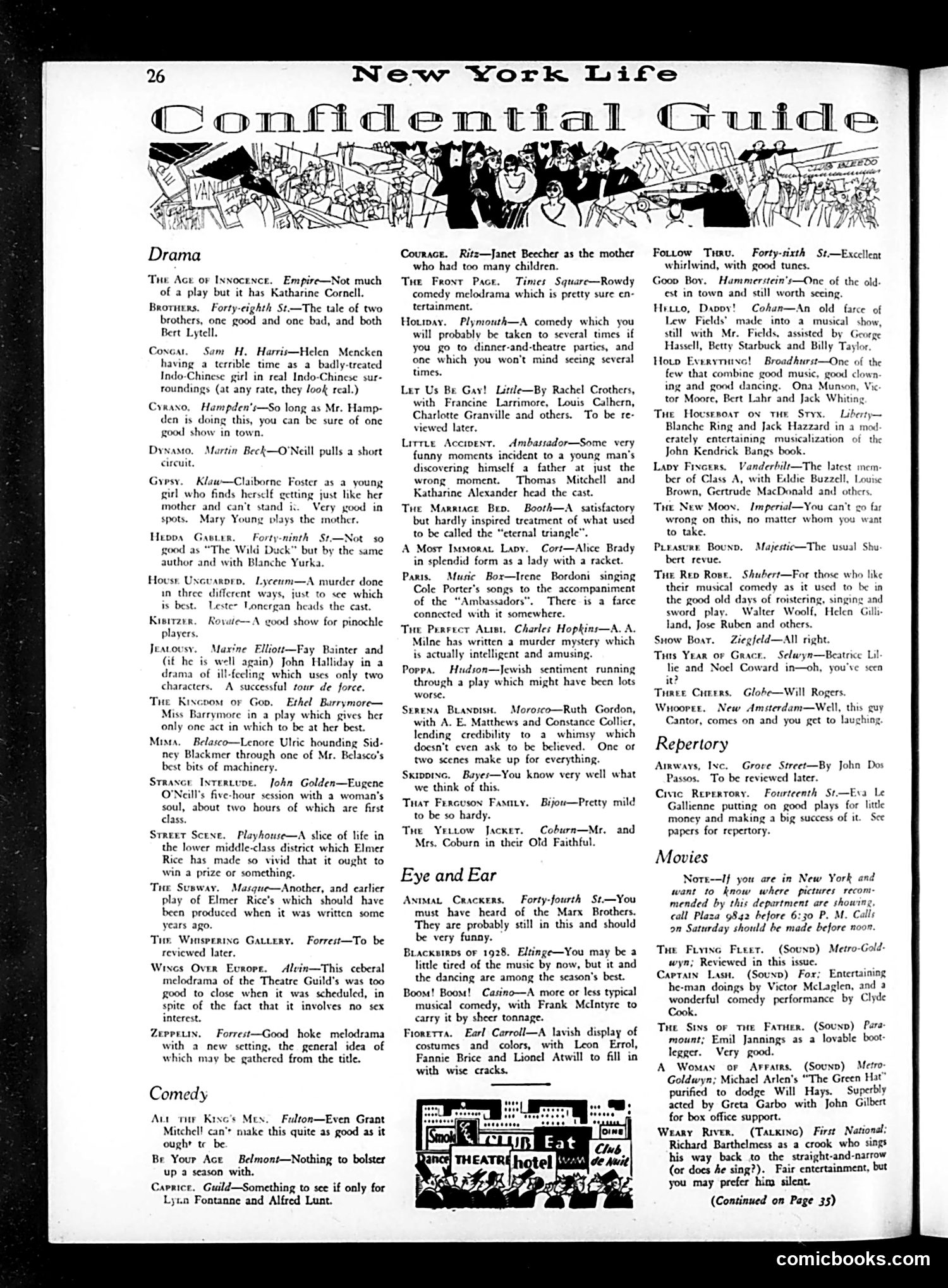
This is a **theater review section**, not a political cartoon page. It's a satirical guide to Broadway shows running in New York, likely from the mid-1920s based on the references (Eugene O'Neill plays, Elmer Rice works, Cole Porter songs). The "satire" is gentle: each show gets a brutally honest one-line summary—often mocking the plot, questioning the quality, or noting what makes it worthwhile. For example, *Kipitzer* is "A good show for pinochle players" (implying you won't miss much if you're distracted), and *By Your Age* gets "Nothing to bolster up a season with." The small illustration at bottom shows a theater marquee, reinforcing the theatrical theme. This reflects 1920s entertainment journalism: witty, dismissive commentary on commercial theater as insider entertainment criticism for a sophisticated urban readership.
📄 Transcribed text from this page (OCR, searchable)
Machine-transcribed from the original scan — historical spelling and the odd misread are preserved.
26 New York Life eT ee (*uide ‘Tut Act or Innocence. Empire—Not much of a play but it has Katharine Cornell. Broruens. Forty-eighth St-—The tale of two brothers, one good and one bad, and both Bert Lytell. Conca. Sam H. Harris—Helen Mencken having a terrible time as a badly-treated Indo-Chinese girl in real Indo-Chinese sur- roundings (at any rate, they ook real.) Cynaxo, Hampden's—So long as Mr. Hamp- den is doing this, you can be sure of one good show in town, Dywamo. Martin Beck—O'Neill pulls a short circuit. Gypsy. Klaw—Claiborne Foster as a young girl who finds hersclf getting just like her mother and can’t stand ix. Very good in spots. Mary Young plays the mother. Heopa Gaster. Forty-ninth St—Not so good as “The Wild Duck” but by the same author and with Blanche Yurka. Hous Uxcvarprp, Lycenm—A murder done in three different ways, just to see which is best. Lester Lonergan heads the cast. Kisirzer. Rovule—A good show for pinochle players. Jeatousy. Maxine Elliott—Fay Bainter and (it he is well again) John Halliday in a drama of ill-feeling which uses only two characters, A successful tour de force. Tue Kixcoom or Goo, Ethel Burrymore— Miss Barrymore in a play which gives her only one act in which to be at her best. Mima. Belasco—Lenore Ulric hounding Sid- ney Blackmer through one of Mr. Belasco’s best bits of machinery. Srraxce Intertuve. John Golden—Eugene O'Neill's five-hour session with a woman's soul, about two hours of which are first class. Srreet Scene. Playhouse—A slice of life in the lower middle-class district which Elmer Rice has made so vivid that it ought to win a prize or something. Tite Susway, Masque—Another, and earlier play of Elmer Rice's which should have been produced when it was written some years ago. Tur, Winsperixc Gattery. reviewed later. Wives Over Evrope. Alvin—This ceberal melodrama of the Theatre Guild's was too good to close when it was scheduled, in spite of the fact that it involves no sex interest. Zerrttin, Forrest—Good hoke melodrama with a new setting, the general idea of which may be gathered from the title. Forrest—To be Comedy Aut rir Kixo’s Mes. Fulton—Even Grant Mitchel! can’* make this quite as good as it ough? te be. Br Your Ace Belmont—Nothing to bolster up a season with. Caprice. Guild—Something to see if only for Lynn Fontanne and Alfred Lunt. Courace. Ritz—Janet Beecher as the mother who had too many children. Tue Froxt Pace. Times Square—Rowdy comedy melodrama which is pretty sure en- tertainment. Hourpay. Plymouth—A comedy which you will probably be taken to several times if you go to dinner-and-theatre parties, and one which you won't mind seeing several umes. Ler Us Be Gay! Little—By Rachel Crothers, with Francine Larrimore, Louis Calhern, Charlotte Granville and others. To be re- viewed later. Lrrrte Accivent. Ambassador—Some very funny moments incident to a young man’s discovering himself a father at just the wrong moment. Thomas Mitchell and Katharine Alexander head the cast. THe Marrtace Bro. Booth—A satisfactory but hardly inspired treatment of what used to be called the “eternal triangle”. A Most Imaorat Lapy. Cort—Alice Brady in splendid form as a lady with a racket. Panis. Music Bor—Irene Bordoni singing Cole Porter's songs to the accompaniment of the “Ambassadors”. There is a farce connected with it somewhere. Tue Perrecr Avist, Charles Hopkins— Milne has written a murder mystery which is actually intelligent and amusing. Poppa. Hudson—Jewish sentiment running through a play which might have been lots worse. Serena Branvistt. Morosco—Ruth Gordon, with A. E. Matthews and Constance Collier, lending credibility to a whimsy which doesn’t even ask to be believed. One or two scenes make up for everything. Sxippinc. Bayes—You know very well what we think of this. Tuat Frrcuson Fasary. to be so hardy. Tue Yettow Jacket. Coburn—Mr. Mrs. Coburn in their Old Faithful. Eye and Ear Axttat Crackers. Forty-fourth St—You must have heard of the Marx Brothers. They are probably still in this and should be very funny. Biacksinns oF 1928. Eltinge—You may be a little tired of the music by now, but it and the dancing are among the season's best. Boos! Boost! Casino—A more of less typical musical comedy, with Frank McIntyre to carry it by sheer tonnage. Fioretta. Earl Carroll—A lavish display of costumes and colors, with Leon Errol, Fannie Brice and Lionel Atwill to fill in with wise cracks. Bijow—Pretty mild and Fottow Turv. Forty-sixth St—Excellent whirlwind, with good tunes. Gooo Boy. Hammerstein's—One of the old. est in town and still worth seeing. Hrtto, Davov! Cohan—An old farce of Lew Fields’ made into a musical show, still with Mr. Fields, assisted by George Hassell, Betty Starbuck and Billy Taylor. Hovp Everymuve! Broadhurst—One of the few that combine good music, good clown. ing and good dancing. Ona Munson, Vic- tor Moore, Bert Lahr and Jack Whiting. Tue Hovsenoat ox tHe Styx. Liberty Blanche Ring and Jack Hazzard in a crately entertaining musicalization of John Kendrick Bangs book. Lavy Fivcers. Vanderbilt—The latest imem- ber of Class A, with Eddie Buzzell, Louise Brown, Gertrude MacDonald and ot! Tut New Moov. Imperial—You can’t ¢ wrong on this, no matter whom you want to take. Prrasure Bounn. bert revue. Tue Rev Rose. Shubert—For those who like their musical comedy as it used to be in the good old days of roistering, singing and sword play. Walter Woolf, Helen Gilli- land, Jose Ruben and others, Snow Boar. Ziegfeld—All right. Tuts Year or Grace. Selwyn—Beatrice Lil- lie and Noel Coward in—oh, you've seen it? Tunee Curers, Globe—Will Rogers. Whoopee. New Amsterdam—Well, this guy Cantor, comes on and you get to laughing. Majestic—The usual Shu Repertory Airways, Ive. Grove Street-—By John Dos Passos. To be reviewed later. Civic Revextory. Fourteenth St—Exa Le Gallienne putting on good plays for litle money and making a big success of it. Sce papers for repertory. Movies Note-—I} you are in New York and want to know where pictures recon mended by this department are showing, call Plaza 9842 before 6:30 P. M. Calls on Saturday should be made before noon. Tue Fivinc Freer. (Sounp) Metro-Gold- wyn; Reviewed in this issue. Captain Last. (Sounp) For; Entertaining he-man doings by Victor McLaglen, and 2 wonderful comedy performance by Clyde Cook. Tue Sins or te Fatiter. (Sounn) Para- mount; Emil Jannings as a lovable boot- legger. Very good. A Womas or Arratrs. (Sounn) Metro: Goldwyn; Michael Arlen’s “The Green Hat" purified to dodge Will Hays. Superbly acted by Greta Garbo with John Gilbert for box office support. Weary River. (Tarxino) First National; Richard Barthelmess as a crook who sings his way back to the straight-and- narrom (or does he sing?). Fair entertainment, you may prefer him silent. (Continued on Page 35) comicbooks.com