
Life, 1929-04-05 · page 33 of 56
Life — April 5, 1929 — page 33: what you’re looking at
What you’re looking at
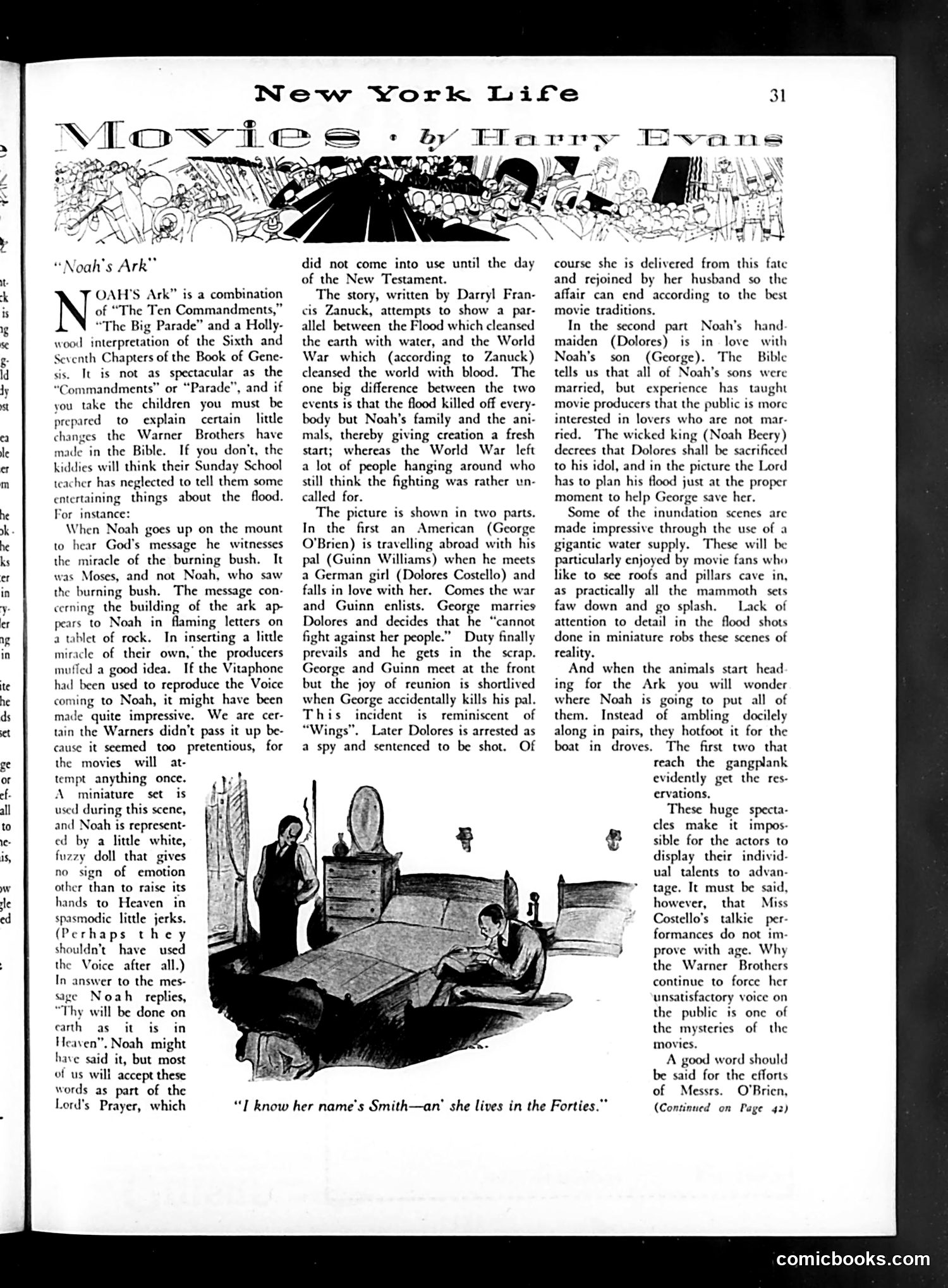
This is a **film review by Harry Evans** critiquing Warner Brothers' 1928 religious epic "Noah's Ark." **The Main Critique:** Evans sarcastically attacks the film's historical and biblical inaccuracies and heavy-handed messaging. Director Darryl Zanuck explicitly parallels the Biblical Flood with World War I—positioning both as divine cleansings. Evans finds this comparison absurd: the Flood killed everyone except Noah's family, giving creation a "fresh start," whereas WWI left survivors who "still think the fighting was rather uncalled for." **Specific Issues Highlighted:** - Mixing biblical stories (using Moses' burning bush for Noah) - Inserting miracles not in scripture - Misquoting the Lord's Prayer - Prioritizing romantic subplots over biblical accuracy because audiences prefer "lovers who are not married" **The Cartoon:** Shows a domestic scene captioned "I know her name's Smith—an' she lives in the Forties," illustrating how the film replaces biblical narratives with contemporary melodrama. Evans' satire targets Warner Brothers' treatment of sacred material as mere spectacle, sacrificing accuracy for box-office appeal and romantic sentimentality.
📄 Transcribed text from this page (OCR, searchable)
Machine-transcribed from the original scan — historical spelling and the odd misread are preserved.
New York Life “Noah's Ark” OAH’S Ark” is a combination N of “The Ten Commandments,” “The Big Parade” and a Holly- wood interpretation of the Sixth and Seventh Chapters of the Book of Gene- sis. It is not as spectacular as the “Commandments” or “Parade”, and if you take the children you must be prepared to explain certain little the Warner Brothers have made in the Bible. If you don’t, the kiddies will think their Sunday School teacher has neglected to tell them some entertaining things about the flood. For instance: When Noah goes up on the mount to hear God's message he witnesses the miracle of the burning bush. It was Moses, and not Noah, who saw the burning bush. The message con- cerning the building of the ark ap- pears to Noah in flaming letters on a tablet of rock. In inserting a litle miracle of their own, the producers mutled a good idea. If the Vitaphone had been used to reproduce the Voice coming to Noah, it might have been made quite impressive. We are cer- tain the Warners didn’t pass it up be- cause it seemed too pretentious, for the movies will at- tempt anything once. A miniature set is used during this scene, and Noah is represent- ed by a little white, fuzzy doll that gives no sign of emotion other than to raise its hands to Heaven in spasmodic little jerks. (Perhaps they shouldn't. have used the Voice after all.) In answer to the mes- sage Noah _ replies, “Thy will be done on cath as it is’ in Heaven”. Noah might have said it, but most of us will accept these words as part of the Lord's Prayer, which cr did not come into use until the day of the New Testament. The story, written by Darryl Fran- cis Zanuck, attempts to show a par- allel between the Flood which cleansed the earth with water, and the World War which (according to Zanuck) cleansed the world with blood. The one big difference between the two events is that the flood killed off every- body but Noah’s family and the ani- mals, thereby giving creation a fresh start; whereas the World War left a lot of people hanging around who still think the fighting was rather un- called for. The picture is shown in two parts. In the first an American (George O'Brien) is travelling abroad with his pal (Guinn Williams) when he meets a German girl (Dolores Costello) and falls in love with her. Comes the war and Guinn enlists. George marries Dolores and decides that he “cannot fight against her people.” Duty finally prevails and he gets in the scrap. George and Guinn meet at the front but the joy of reunion is shortlived when George accidentally kills his pal. This incident is reminiscent of “Wings”. Later Dolores is arrested as a spy and sentenced to be shot. Of “T know her name's Smith—an’ she lives in the Forties.” 31 rPeS Evans \W/ - ¥ course she is delivered from this fate and rejoined by her husband so the affair can end according to the best movie traditions. In the second part Noah's hand maiden (Dolores) is in love with Noah's son (George). The Bible tells us that all of Noah’s sons were married, but experience has taught movie producers that the public is more interested in lovers who are not mar- ried. The wicked king (Noah Beery) decrees that Dolores shall be sacrificed to his idol, and in the picture the Lord has to plan his flood just at the proper moment to help George save her. Some of the inundation scenes are made impressive through the use of a gigantic water supply. These will be particularly enjoyed by movie fans who like to see roofs and pillars cave in, as practically all the mammoth sets faw down and go splash. — Lack of attention to detail in the flood shots done in miniature robs these scenes of reality. And when the animals start head ing for the Ark you will wonder where Noah is going to put all of them. Instead of ambling docilely along in pairs, they hotfoot it for the boat in droves. The first two that reach the gangplank evidently get the res- ervations, These huge specta- cles make it impos- sible for the actors to display their individ- ual talents to advan- tage. It must be said, however, that Miss Costello’s talkie _ per- formances do not im- prove with age. Why the Warner Brothers continue to force her unsatisfactory voice on the public is one of the mysteries of the movies. A good word should be said for the efforts of Messrs. O'Brien, (Continued on Page 42) comicbooks.com