
A complete issue · 56 pages · 1929
Life — April 5, 1929
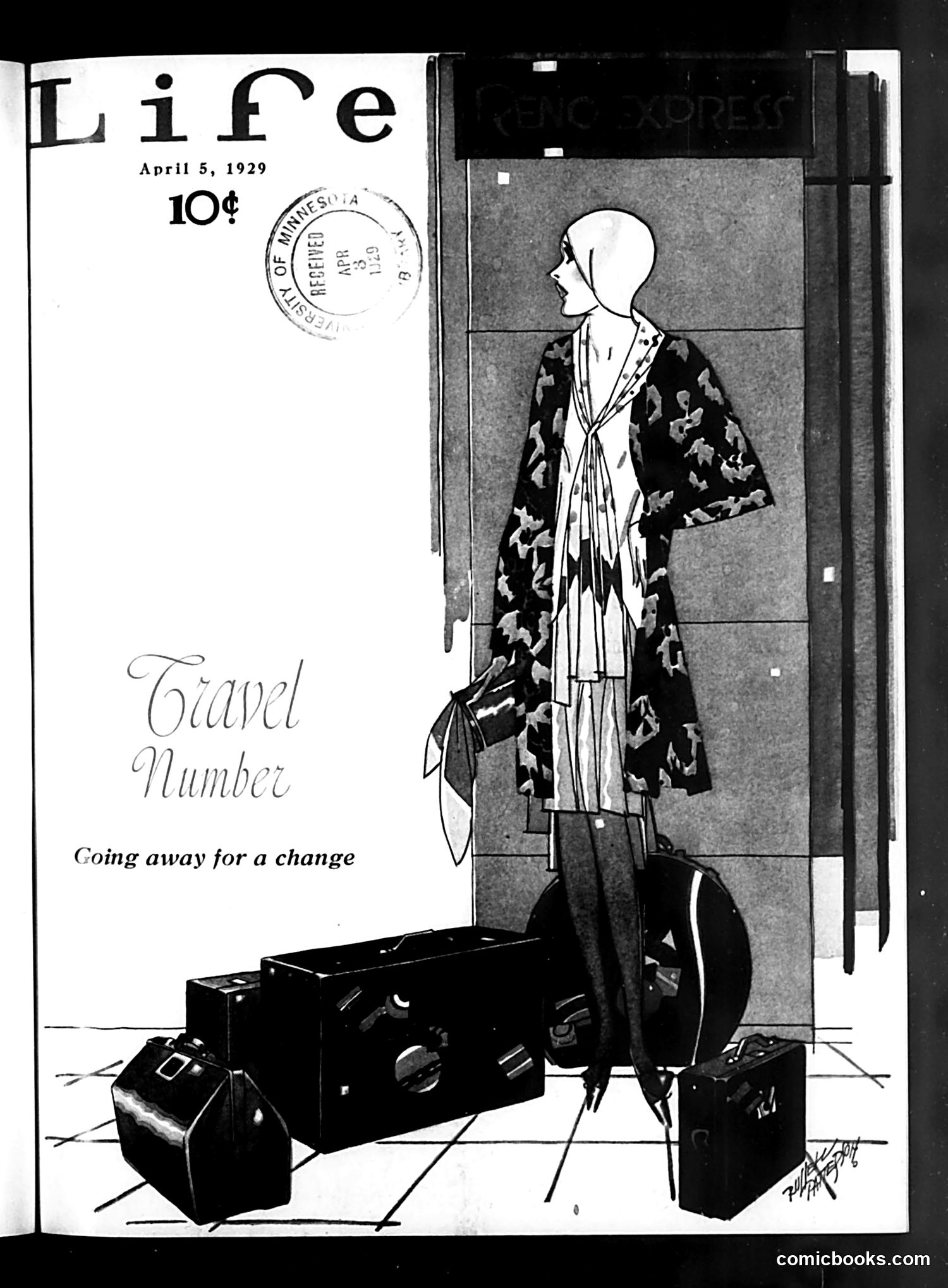
This is a "Travel Number" cover featuring a stylishly dressed woman departing on a journey, surrounded by luggage and travel cases. The subtitle reads "Going away for a change," suggesting leisure travel. The illustration depicts 1920s fashion—a cloche hat, patterned coat, and streamlined silhouette typical of the era. The satire likely comments on the era's travel culture and fashion consciousness among the wealthy during the prosperous late 1920s. The "10¢" price and magazine masthead establish this as Life's satirical take on contemporary society. Without additional context from interior pages, the specific satirical target remains unclear, though it appears to mock fashionable travelers or perhaps the obsession with vacation travel among the affluent before the 1929 stock market crash.
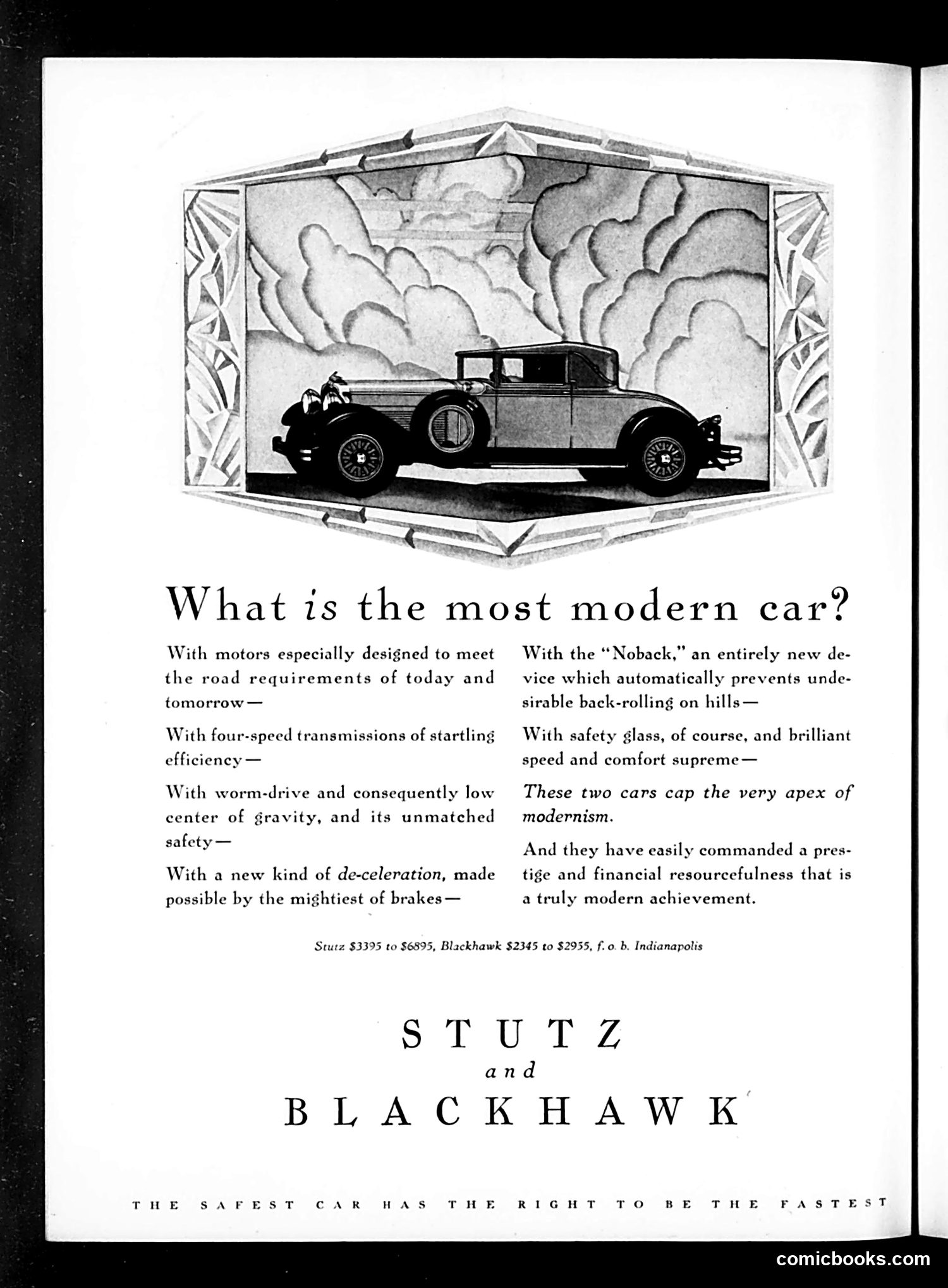
This page is **primarily an advertisement**, not satire or political commentary. It promotes Stutz and Blackhawk automobiles, marketing them as representing "the very apex of modernism" in 1920s-era automotive design. The advertisement lists technical features presented as cutting-edge: four-speed transmissions, worm-drive systems, safety glass, and a "Noback" anti-rollover device. The stylized illustration depicts a luxury sedan against an art deco backdrop. The only potentially humorous element is the tagline "THE SAFEST CAR HAS THE RIGHT TO BE THE FASTEST"—a paradox suggesting these vehicles achieve both safety and performance simultaneously, which may have been tongue-in-cheek given 1920s technology limitations. This represents straightforward automotive marketing rather than political or social satire.
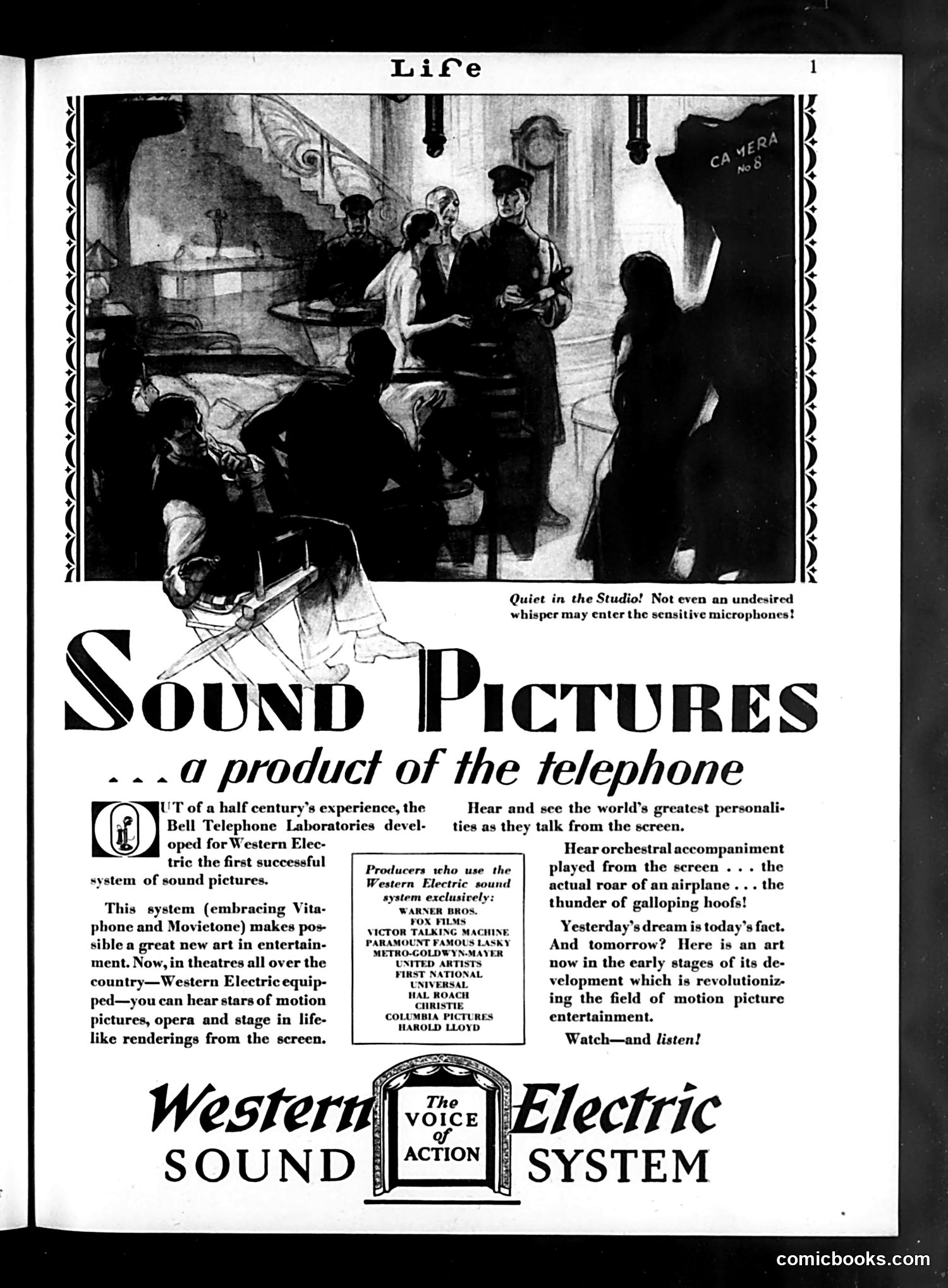
This is primarily a **Western Electric advertisement**, not satirical content. It promotes the company's sound system for motion pictures, labeled "The Voice of Action." The image shows a film studio scene with microphones and recording equipment, illustrating how sound is captured during movie production. The caption emphasizes the need for absolute silence during recording: "Not even an undesired whisper may enter the sensitive microphones!" The advertisement highlights Western Electric's technological achievement in developing synchronized sound for films—a revolutionary innovation in the late 1920s. It lists major studios using their system (Warner Bros., Paramount, etc.) and promotes sound pictures as the future of entertainment, urging readers to "Watch—and listen!" This reflects the industry's excitement about the transition from silent to "talking" pictures.
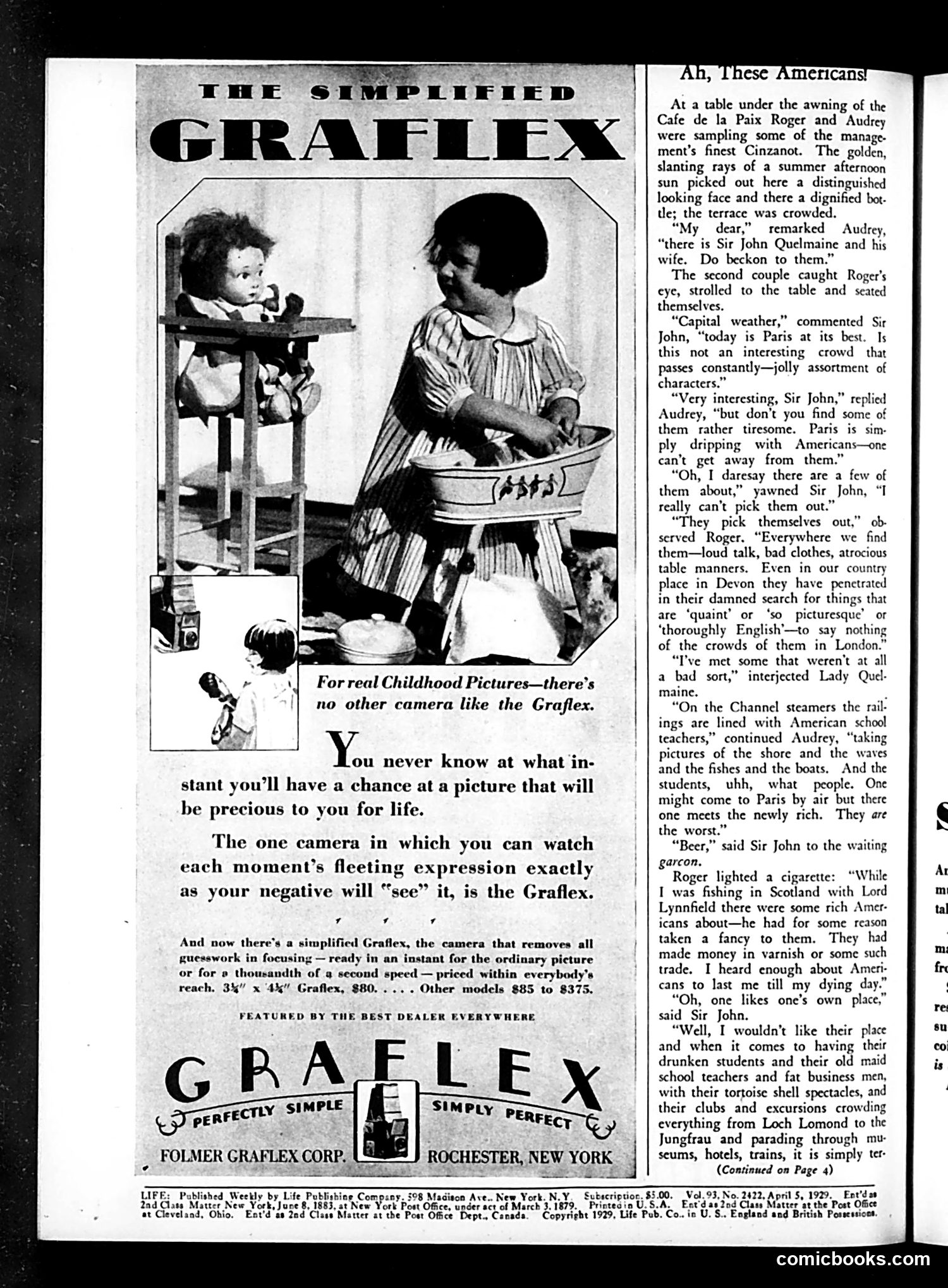
This page is primarily a **product advertisement** for the Graflex camera (left side), not political satire. The ad emphasizes the camera's simplicity for capturing candid childhood moments. The right column contains a **satirical dialogue** between British characters (Sir John Quelmaine, Audrey, and Roger) discussing American tourists in Paris. The satire mocks Americans for being loud, poorly dressed, having bad manners, and constantly seeking "quaint" or "picturesque" experiences. The British speakers express disdain for what they view as American vulgarity and pretension, contrasting it with their own refined sensibilities. This reflects 1920s-era Anglo-American cultural tensions and British stereotypes about American tourists abroad.
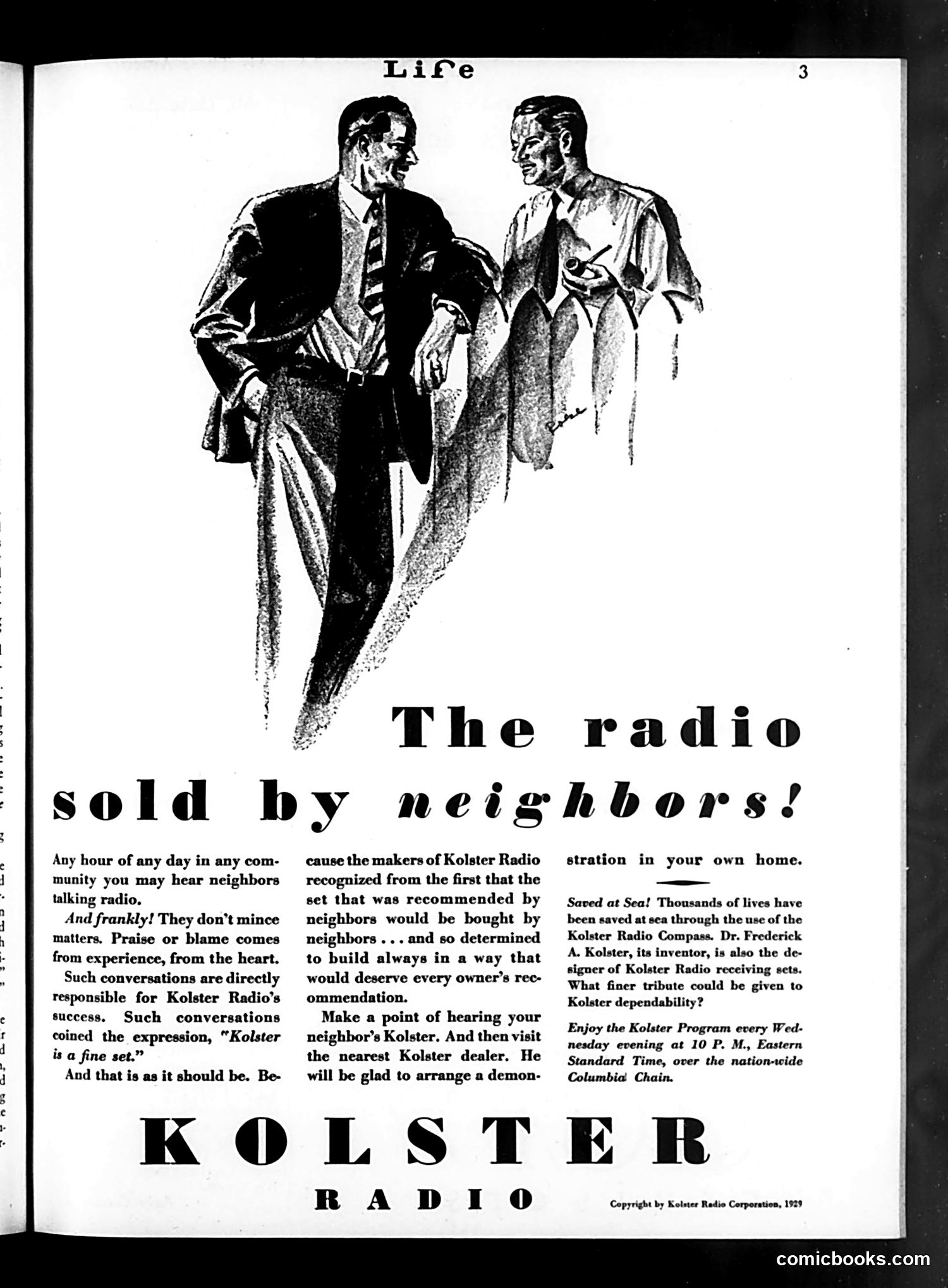
This is a **Kolster Radio advertisement**, not political satire. The page shows two men in conversation—appearing to be neighbors—to illustrate the tagline "The radio sold by neighbors!" The ad's pitch: Kolster radios achieve success through word-of-mouth recommendations. The text emphasizes that neighbors' personal endorsements ("Kolster is a fine set") drive sales more effectively than formal advertising. The ad notes that Dr. Frederick A. Kolster, the inventor, designed sets for "dependability," and promotes a Wednesday evening radio program on the Columbia Chain network. This reflects early 1920s marketing strategy: leveraging social trust and community recommendation to sell consumer electronics during radio's rapid adoption period. The illustration style and gentle humor are typical of Life magazine's advertising approach.
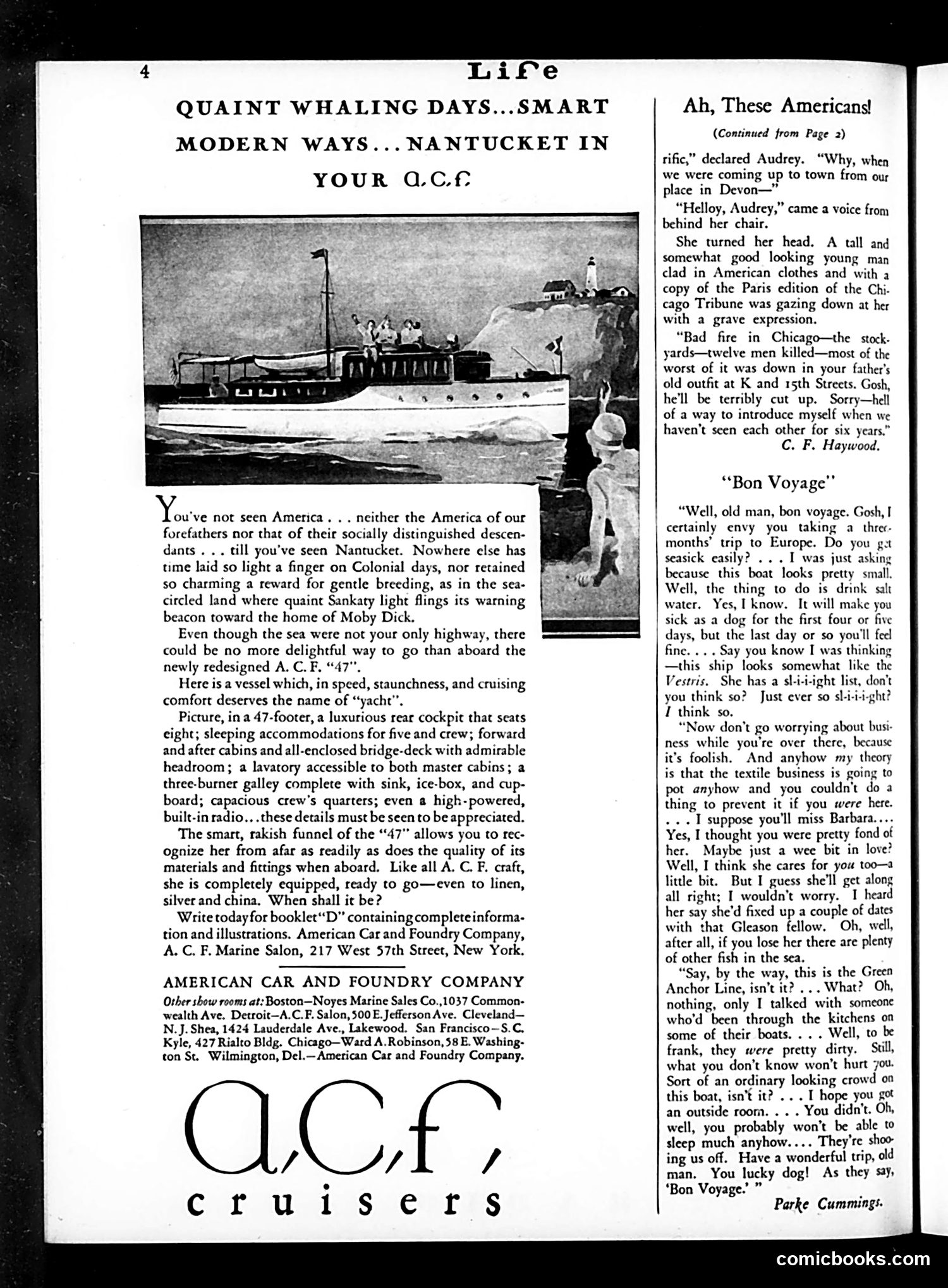
This page is primarily **advertising** for A.C.F. (American Car and Foundry Company) yachts, rather than political satire or comics. The top half features a photograph of a motor yacht with accompanying promotional text describing its luxurious amenities—sleeping quarters, galley, radio, and other features—aimed at wealthy Americans interested in leisure cruising. The right column contains "Bon Voyage," a humorous letter from one traveler to another about taking a European trip aboard ship. It's social commentary on leisure travel among the affluent, with light jokes about seasickness and shipboard life, but contains no political content or sharp satire. This reflects Life magazine's dual purpose: satirical commentary alongside high-end consumer advertising for the magazine's affluent readership.
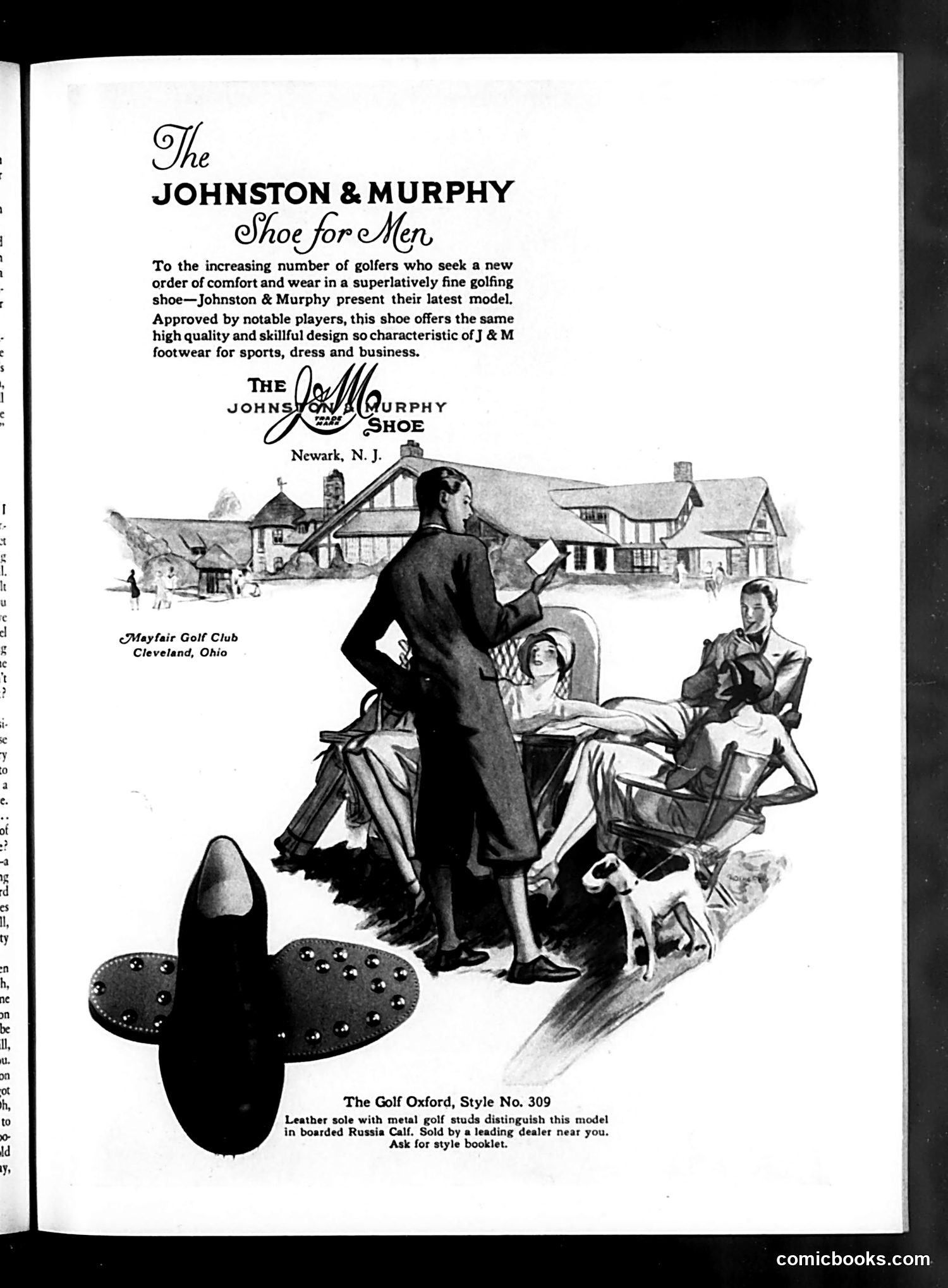
This is an **advertisement for Johnston & Murphy golf shoes**, not satire or political commentary. The page promotes their "Golf Oxford, Style No. 309" model designed specifically for golfers. The illustration depicts a leisure scene at Mayfair Golf Club in Cleveland, Ohio, showing well-dressed people relaxing at the clubhouse. The shoe itself (shown enlarged at bottom left) features a leather sole with metal golf studs for traction on grass. The advertising copy emphasizes that Johnston & Murphy applies the same quality craftsmanship to golf footwear as their dress and business shoes. For modern readers, this reflects early 20th-century golf's status as an upscale recreational activity associated with country clubs and the affluent—not the democratized sport it later became.
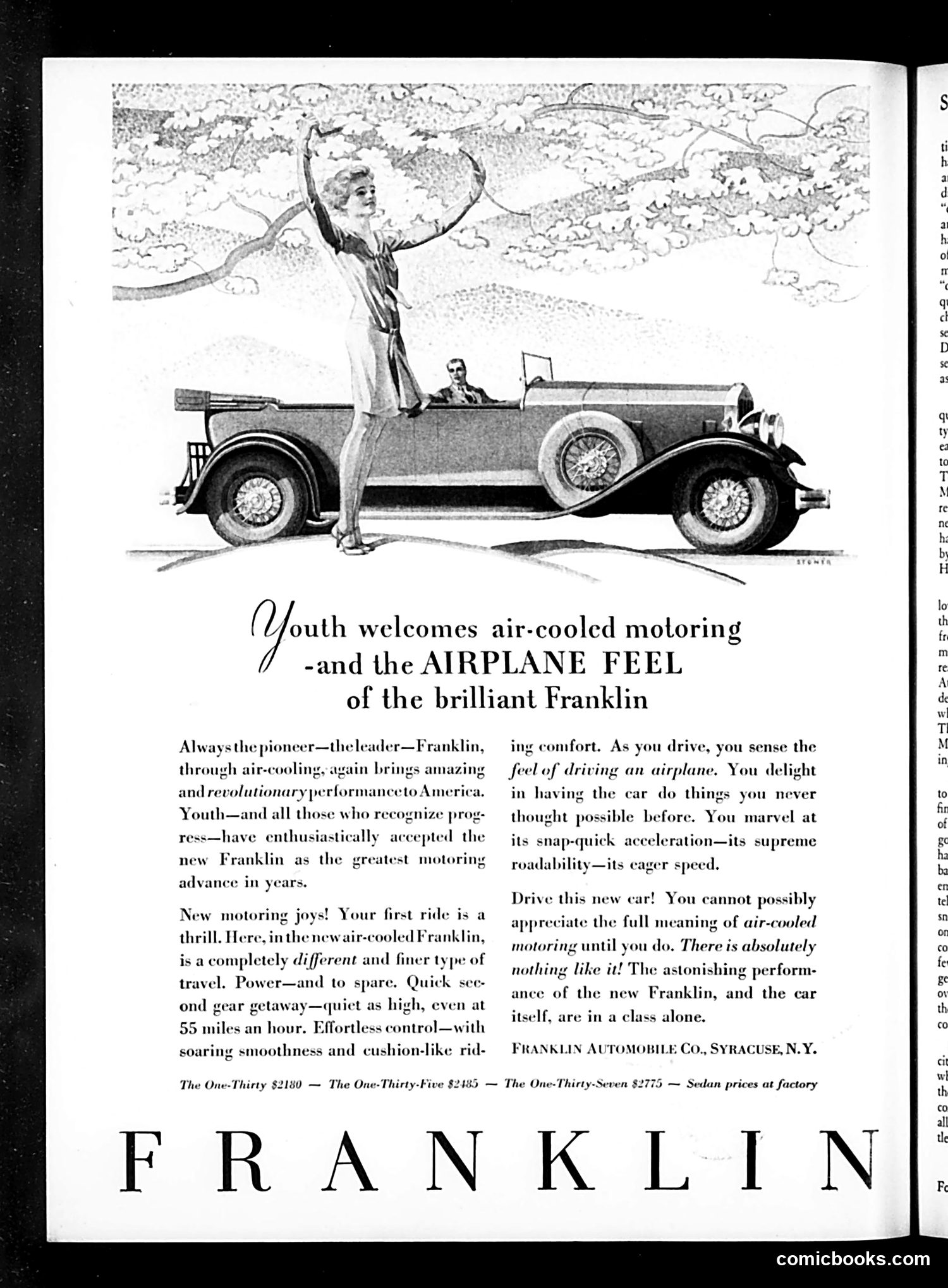
This is **an advertisement, not a political cartoon or satire**. It's a Franklin automobile ad from the 1920s-1930s era (based on styling and typography). The illustration shows a woman standing triumphantly on a Franklin car with her arms raised, while a man drives. The ad promotes the Franklin's air-cooled engine as revolutionary and appeals to "youth" seeking modern motoring experiences. The "airplane feel" reference reflects the contemporary cultural fascination with aviation—presenting the car as cutting-edge technology. The emphasized words ("different," "revolutionary," "supreme," "air-cooled") highlight the Franklin's main selling point: its innovative cooling system, which was genuinely distinctive compared to water-cooled competitors. This is mainstream commercial messaging celebrating technological progress, not political satire.
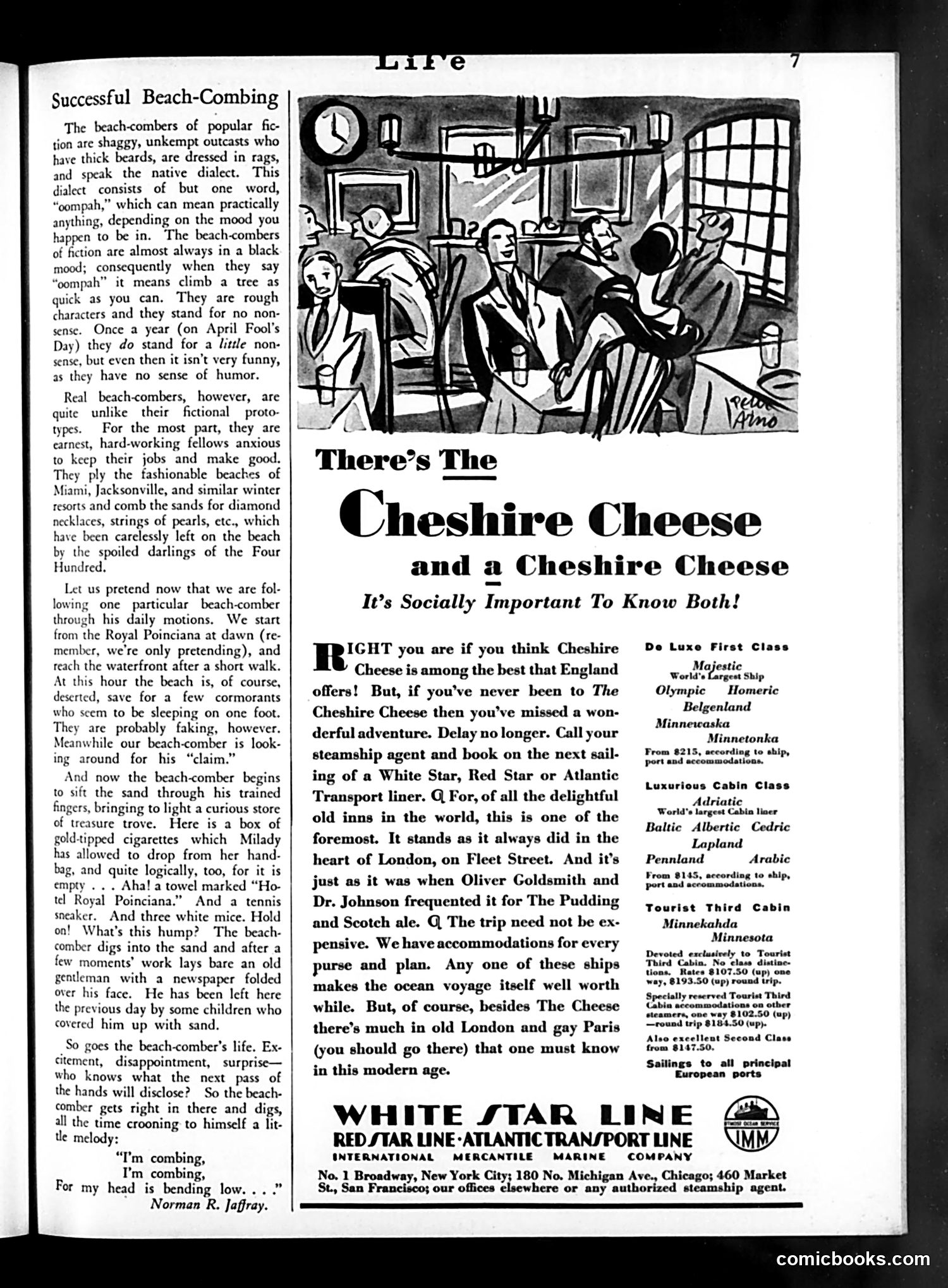
This page contains satirical commentary on "beach-combing" (searching beaches for valuables) alongside unrelated advertising. **The Cartoon:** A single panel by artist "Ralston Vino" depicts five well-dressed people indoors, apparently socializing or relaxing. The satire appears to mock fictional portrayals of beach-combers versus reality—the article contrasts romanticized literary "beach-combers" (shaggy, dialect-speaking outcasts in popular fiction) with actual beach-combers, who are described as "earnest, hard-working fellows" employed at fashionable resorts. **The Cartoon's Point:** Unclear from the image alone whether the depicted figures represent beach-combers themselves or the fashionable resort-goers they serve. The cartoon likely illustrates the gap between literary stereotype and mundane reality. **Advertisement:** The lower half promotes White Star Line ocean travel, emphasizing luxury cabins and mentioning the Cheshire Cheese restaurant in London—purely commercial content unrelated to the satirical article above.
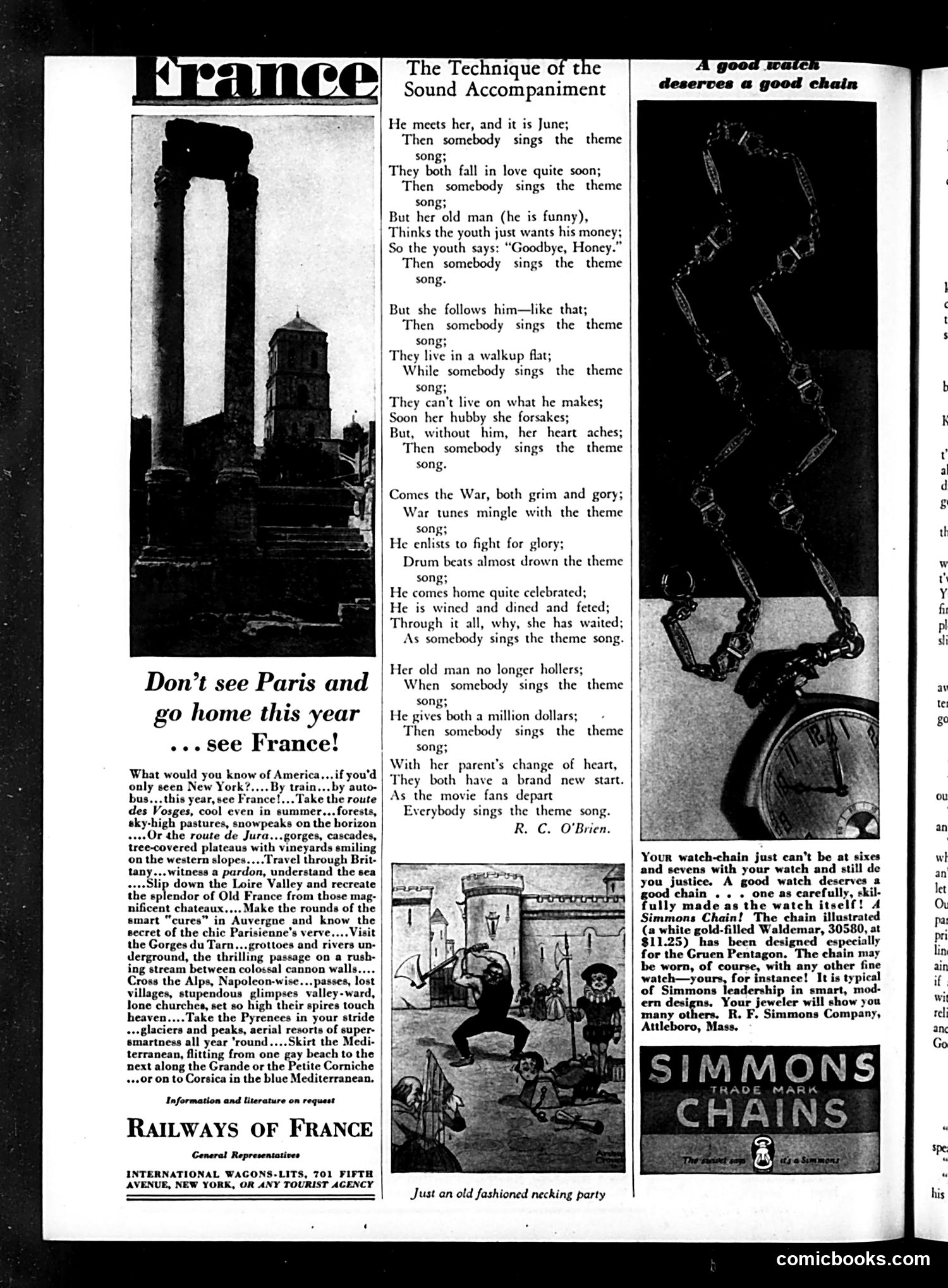
This page contains primarily **advertisements and promotional content** rather than political satire. The main items are: 1. **"The Technique of the Sound Accompaniment"** — a poem by R.C. O'Brien describing how a theme song repeatedly plays during a movie's narrative, following a couple from romance through war and reconciliation. This mocks the heavy-handed use of musical leitmotifs in early sound films. 2. **Railways of France advertisement** — a tourism pitch encouraging Americans to visit France rather than just New York. 3. **Simmons watch chain advertisement** — promoting quality jewelry. 4. **Two photographs** — depicting Parisian street scenes and what appears to be a social gathering. The page reflects 1920s-30s consumer culture and early cinema conventions rather than political commentary.
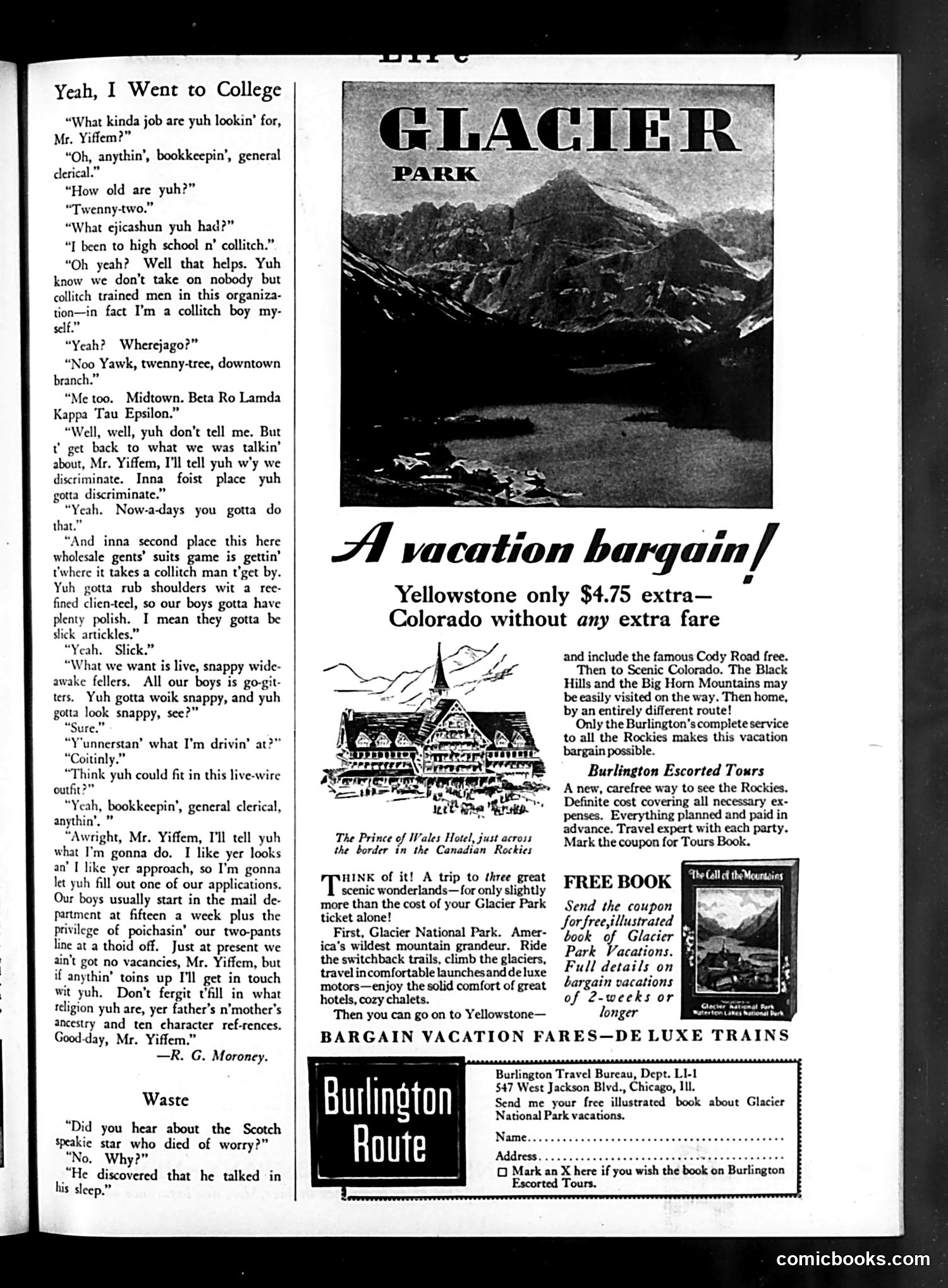
This page is primarily **advertising**, not political satire. The dominant content is a Burlington Route travel advertisement promoting a vacation bargain to Glacier National Park and Yellowstone, emphasizing affordability ("$4.75 extra" to Yellowstone). The left side contains two brief humor pieces: 1. **"Yeah, I Went to College"** - A satirical dialogue mocking a job interview where a young college graduate seeks work. The interviewer dismisses the applicant, noting the company only hires "collitch trained men" and praising workers who are "snappy" and ambitious—implying the college education is worthless. 2. **"Waste"** - A short joke about a Scottish speaker who "died of worry" after discovering he talked in his sleep. Both pieces are light social commentary typical of Life's humor tradition, not serious political satire.
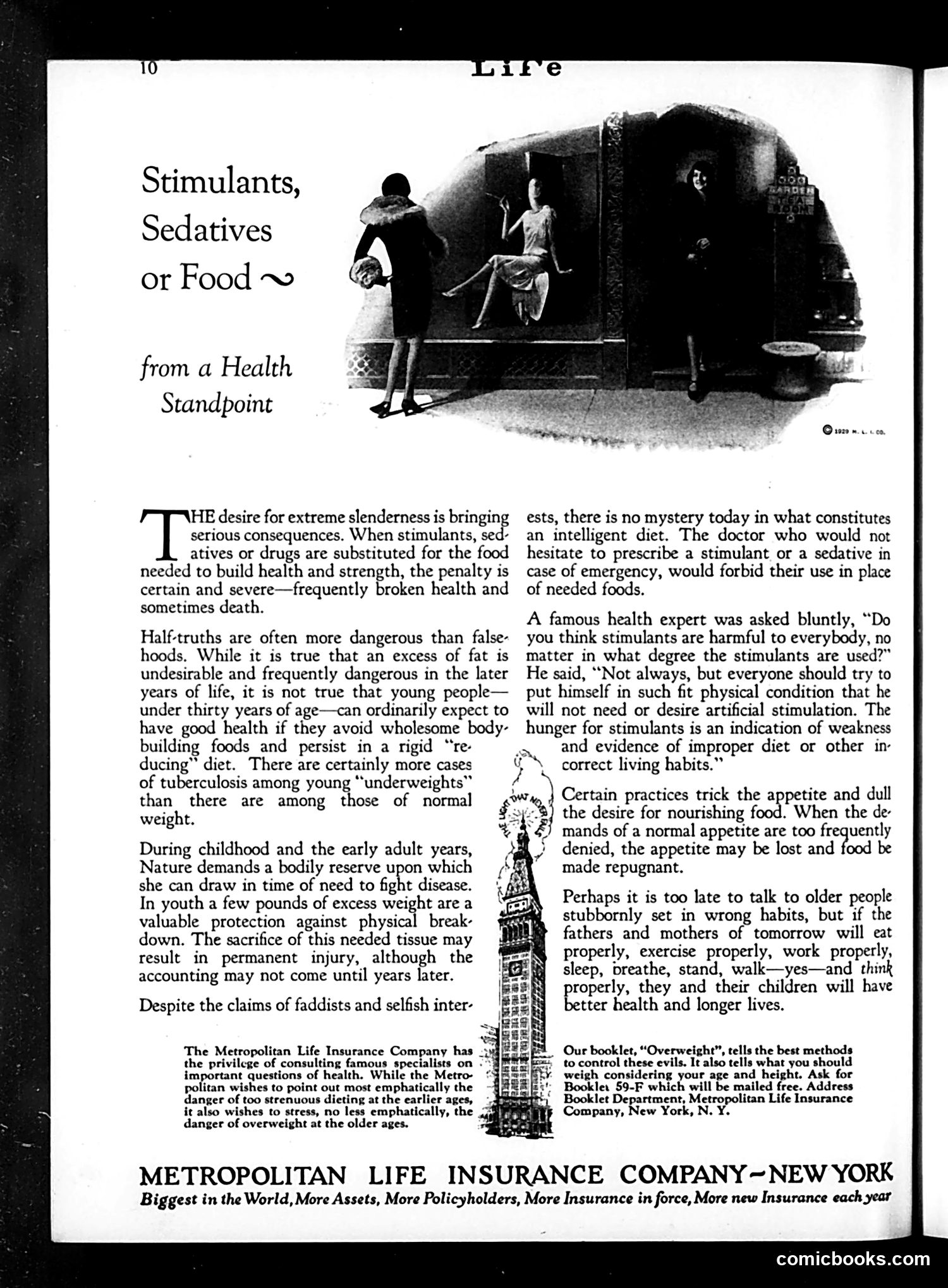
This is primarily a **Metropolitan Life Insurance Company advertisement**, not satire. The page addresses a genuine health concern of the era: the cultural obsession with extreme thinness, particularly among young women. The illustration shows what appears to be a thin woman being examined or fitted (possibly for clothing), reflecting early 20th-century beauty standards that prized slenderness. The text argues against dangerous weight-loss practices by substituting "stimulants, sedatives or drugs" for proper nutrition. A health expert is quoted warning that artificial stimulant use indicates "weakness and evidence of improper diet or incorrect living habits." The ad promotes balanced health through proper eating, exercise, sleep, and work—advocating for parental modeling of good habits for future generations. It concludes by offering a free booklet titled "Overweight" to help readers determine appropriate weight based on age and height. This represents early corporate health messaging disguised as public service advertising.
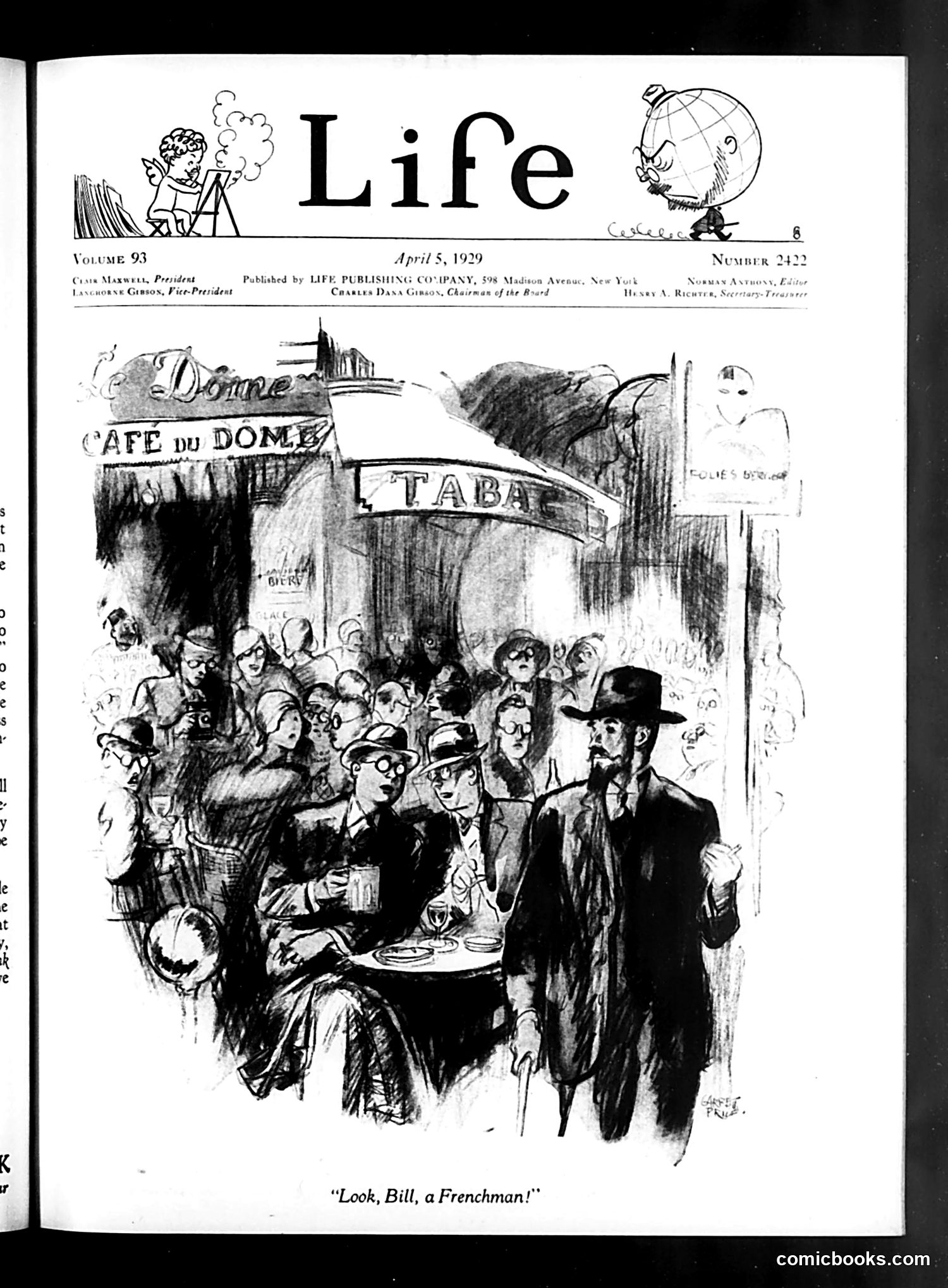
This satirical cartoon depicts a crowded scene at "Café du Dôme" and "Tabac" (real Parisian establishments popular with expatriates). The caption "Look, Bill, a Frenchman!" suggests American tourists in Paris pointing out a local among the crowd of what appear to be fellow Americans. The satire targets American expatriates in 1920s Paris—wealthy tourists or residents who populated these famous cafés. By implying that a actual Frenchman is difficult to spot amid the throng of Americans, the cartoon mocks the insularity and dominance of American visitors in French cultural spaces. It comments on the phenomenon of American cultural imperialism and tourists' obliviousness to local culture, a common theme in Jazz Age satire.
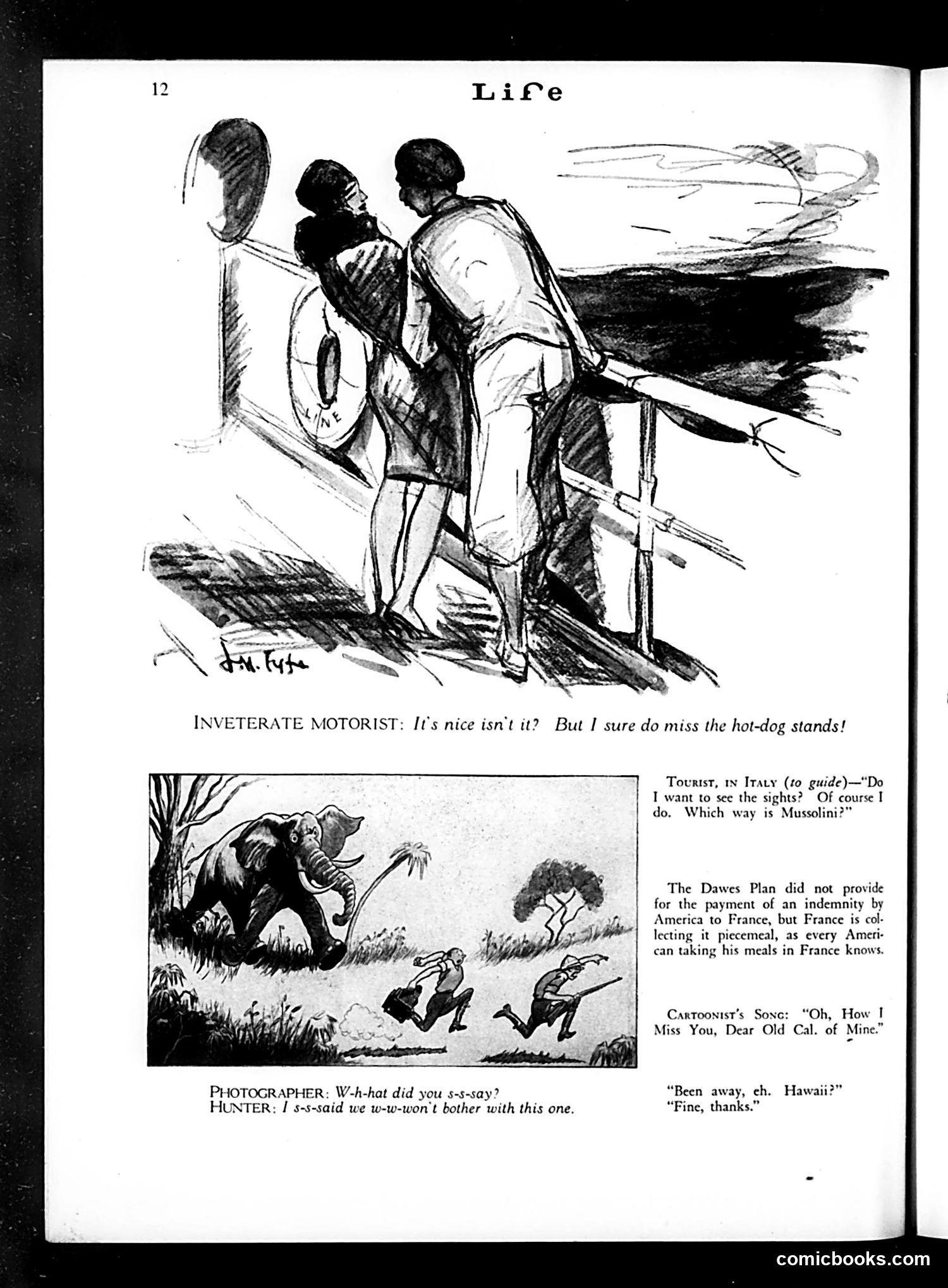
This page contains three separate satirical pieces: 1. **Top cartoon**: An "Inveterate Motorist" nostalgically admires a sailboat while driving, saying he misses "hot-dog stands"—mocking how car culture has displaced traditional roadside attractions and nostalgia for pre-automobile leisure. 2. **Middle cartoon**: A hunter and photographer encounter an elephant in Africa. The joke plays on miscommunication: the photographer mishears the hunter's "s-s-said we w-w-won't bother with this one" as approval to photograph it, creating comedic confusion. 3. **Right column**: Brief satirical items including a tourist in Italy asking directions to Mussolini, commentary on the Dawes Plan's lack of indemnity provisions for American meal expenses in France, and a song reference to California ("Old Cal. of Mine"). The humor reflects 1920s American concerns: automobile culture, imperial adventure tourism, post-WWI reparations, and nostalgia for simpler times.
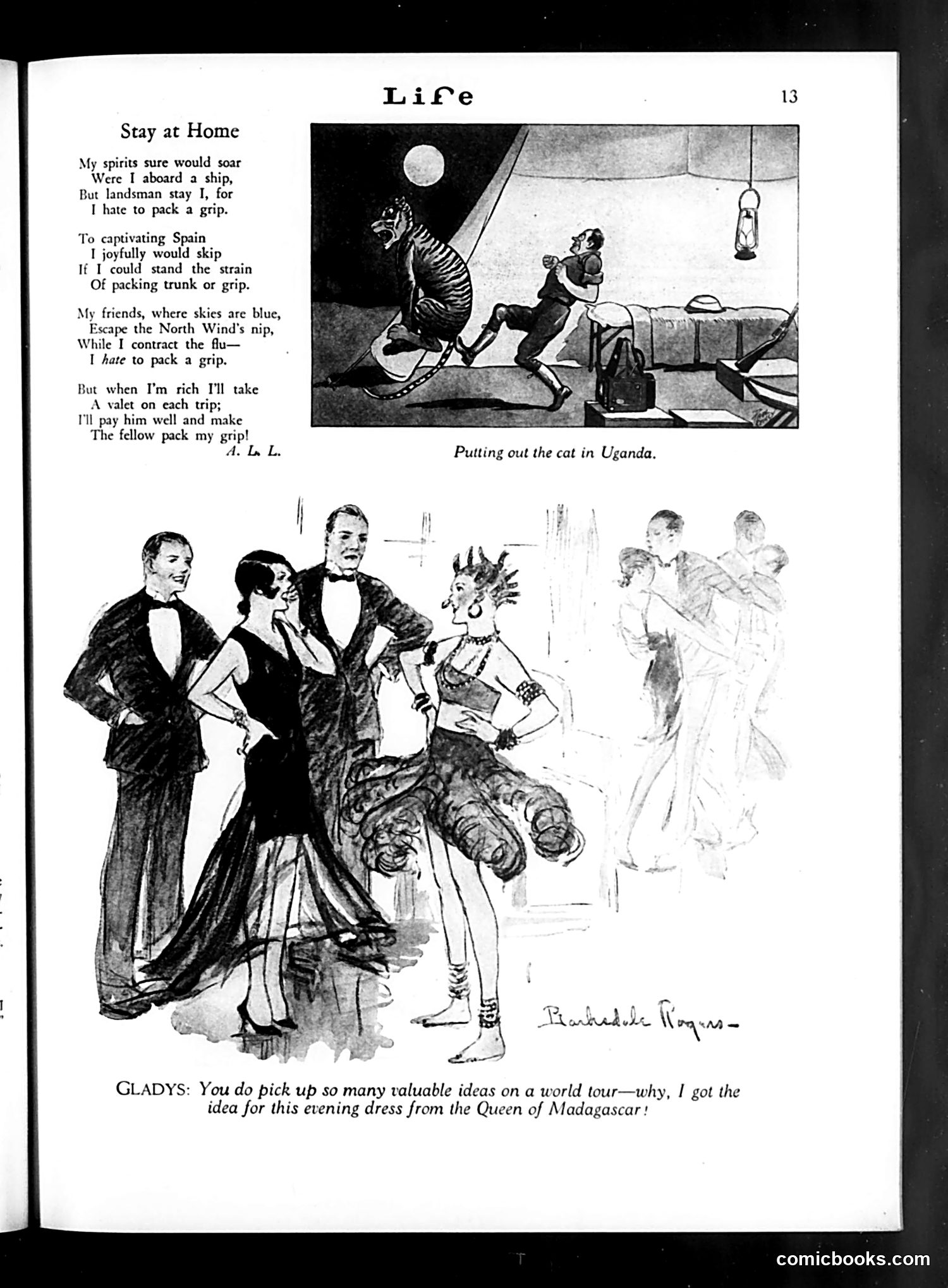
This page contains two separate pieces: **Top: "Stay at Home" Poem** - A humorous poem by A. L. L. about the author's reluctance to travel despite adventure's appeal. The accompanying illustration shows someone "putting out the cat in Uganda," suggesting exotic travel. The joke is that despite dreaming of world travel, the author dislikes packing. **Bottom: "Gladys" Cartoon** - A social satire showing a fashionable woman in an elaborate evening gown inspired by "the Queen of Madagascar." Three men admire her dress while others react behind them. The humor lies in how world travel and exotic experiences—whether real or imagined—influence fashion and social aspiration among the wealthy. Gladys claims her exotic inspiration grants her cultural sophistication and style authority. Both pieces mock upper-class fascination with foreign travel as a status symbol.
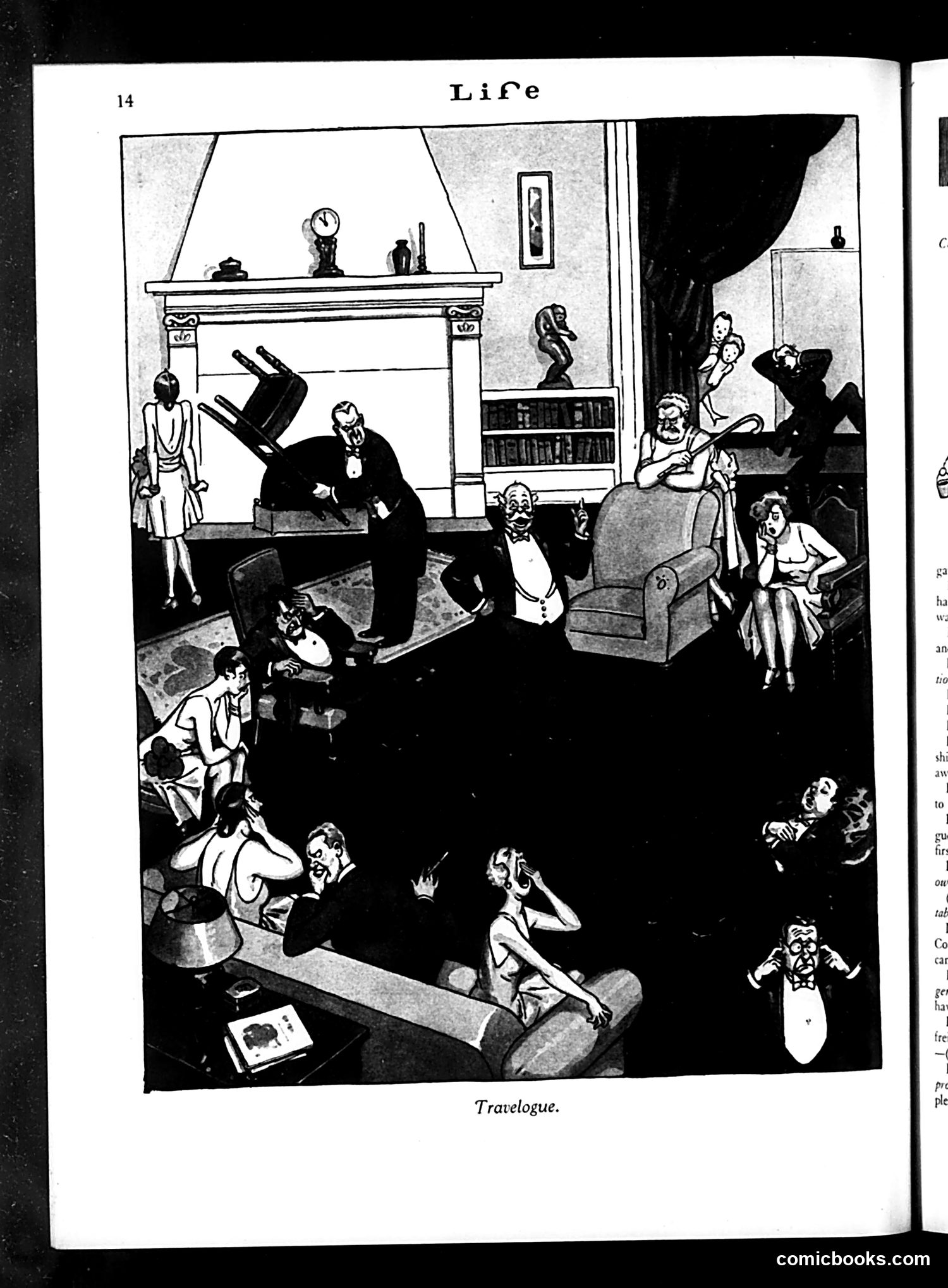
This illustration satirizes a formal parlor gathering where guests appear to be viewing a travel presentation or lecture. The central figure—a well-dressed man in formal attire—gestures dramatically, seemingly performing an enthusiastic travelogue (a popular early-20th-century entertainment featuring exotic travel stories). The humor derives from the guests' reactions: some appear bored, distracted, or sleeping, while others seem uncomfortably cramped on furniture. The contrast between the speaker's animated delivery and the audience's evident disinterest mocks the tedium of amateur travel lectures—a common social obligation of the era. The cartoon satirizes both pretentious social gatherings and the gap between a performer's enthusiasm and audience engagement, capturing a timeless social awkwardness.
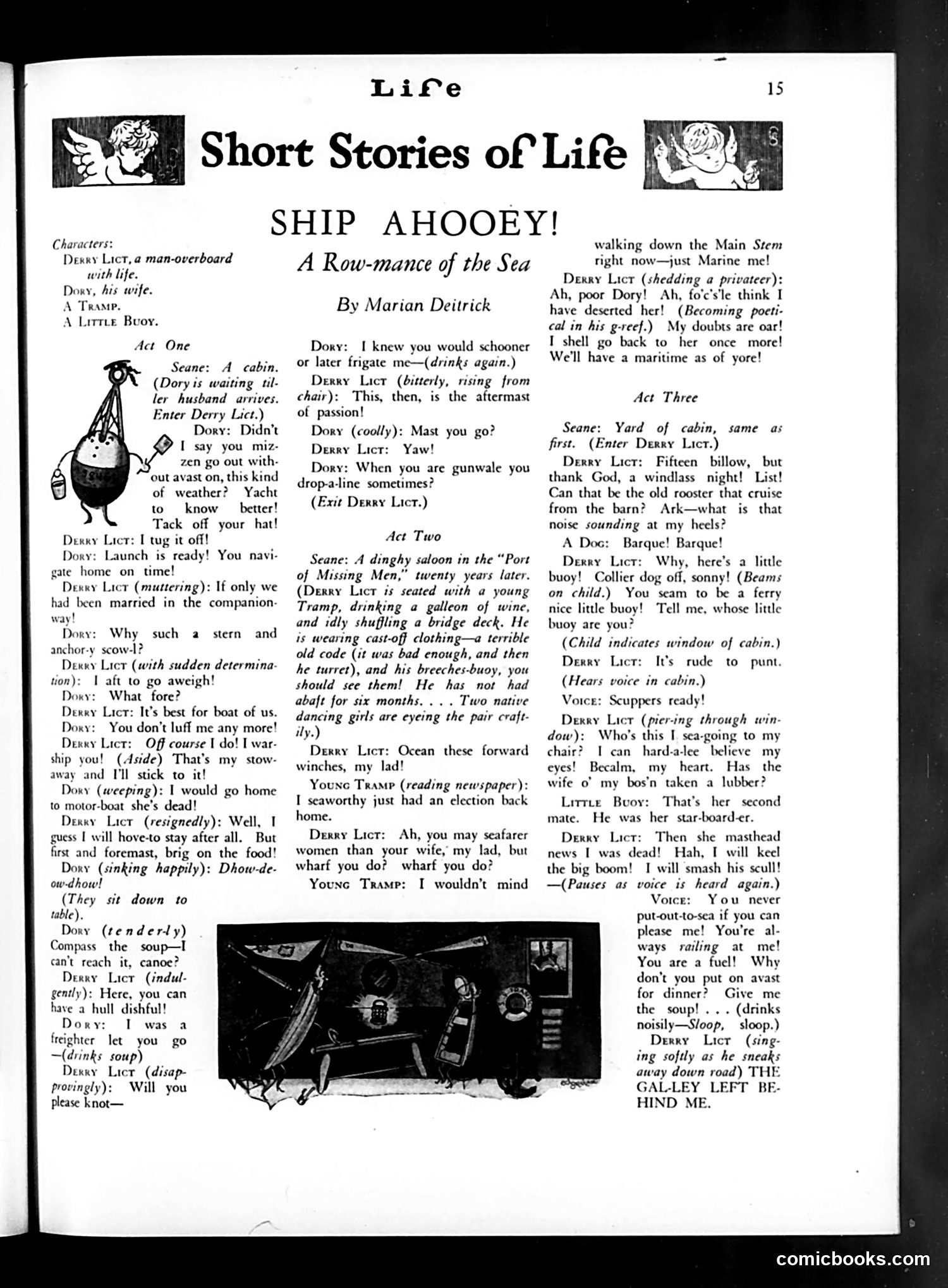
This is a comedic play script by Marian Deitrick featuring two working-class characters: Derry Lict (a man-overboard), his wife Dory, a tramp, and a little boy. The humor derives from malapropisms, crude sailor dialect, and domestic marital conflict set aboard ship. The "romance" involves Derry's drunken misadventures, his wife's complaints about life at sea, and various nautical mishaps. The satire gently mocks lower-class maritime life—the drinking, poor grammar, bickering spouses, and rough conditions—while portraying sailors as hapless but likeable characters. The central joke appears to be the contrast between romantic notions of seafaring life versus its gritty, mundane reality of poverty and marital discord.
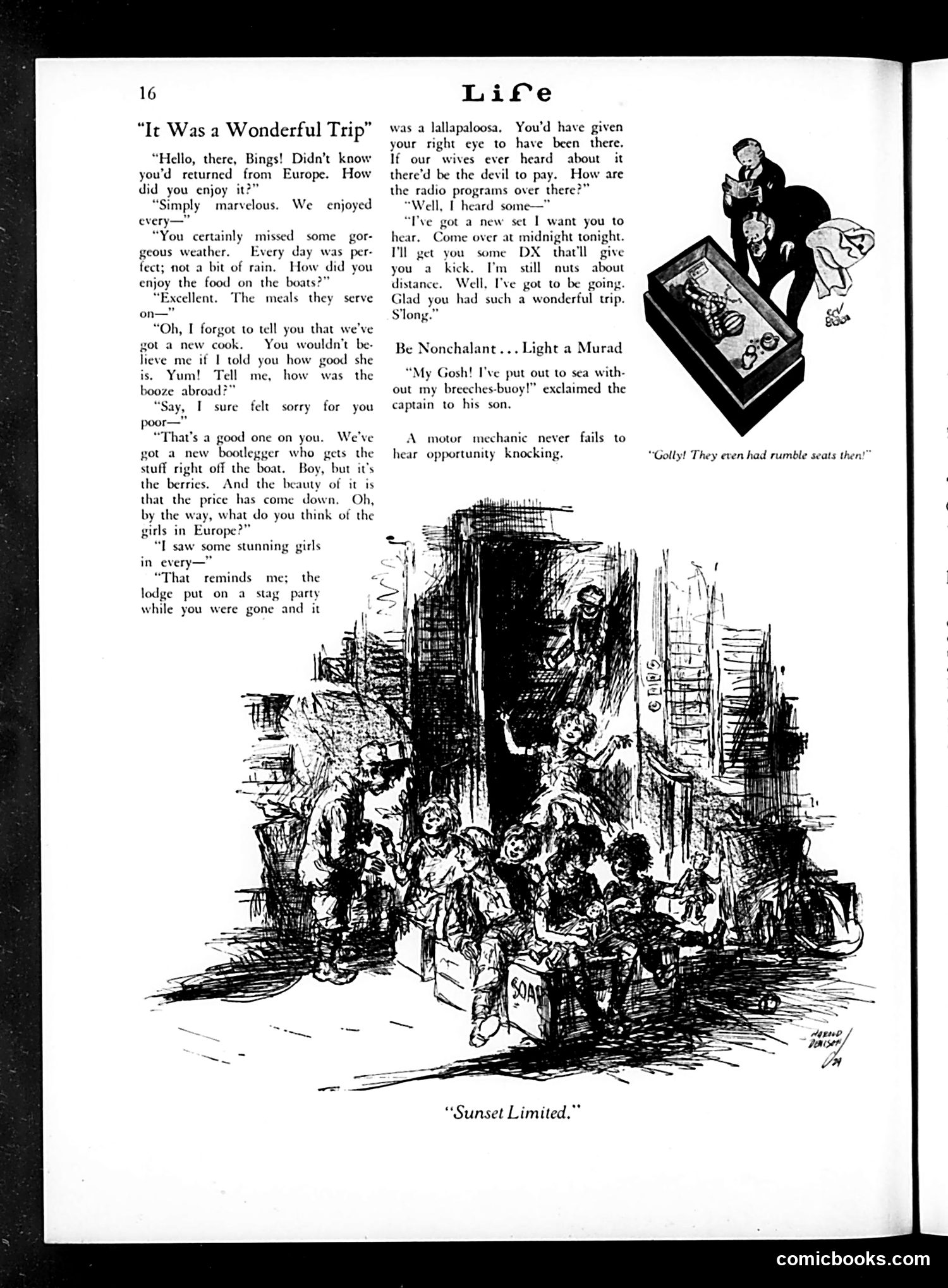
This page contains two humorous dialogues about returning from a European trip and a seaside mishap. The upper section, "It Was a Wonderful Trip," depicts friends discussing travel experiences—mentioning European weather, shipboard food, a new cook, and a "boozelogger" (bootlegger, referencing Prohibition-era alcohol smuggling). The speaker boasts about European girls. The lower cartoon, "Sunset Limited," illustrates a captain who's put out to sea without his breeches. The visual joke shows children gathered around a soap box on a dock, with the embarrassed captain visible in the distance on his ship—a slapstick scenario about accidental undress. Both pieces are lighthearted domestic humor typical of 1920s Life magazine satire, focusing on travel mishaps and social embarrassment rather than political commentary.
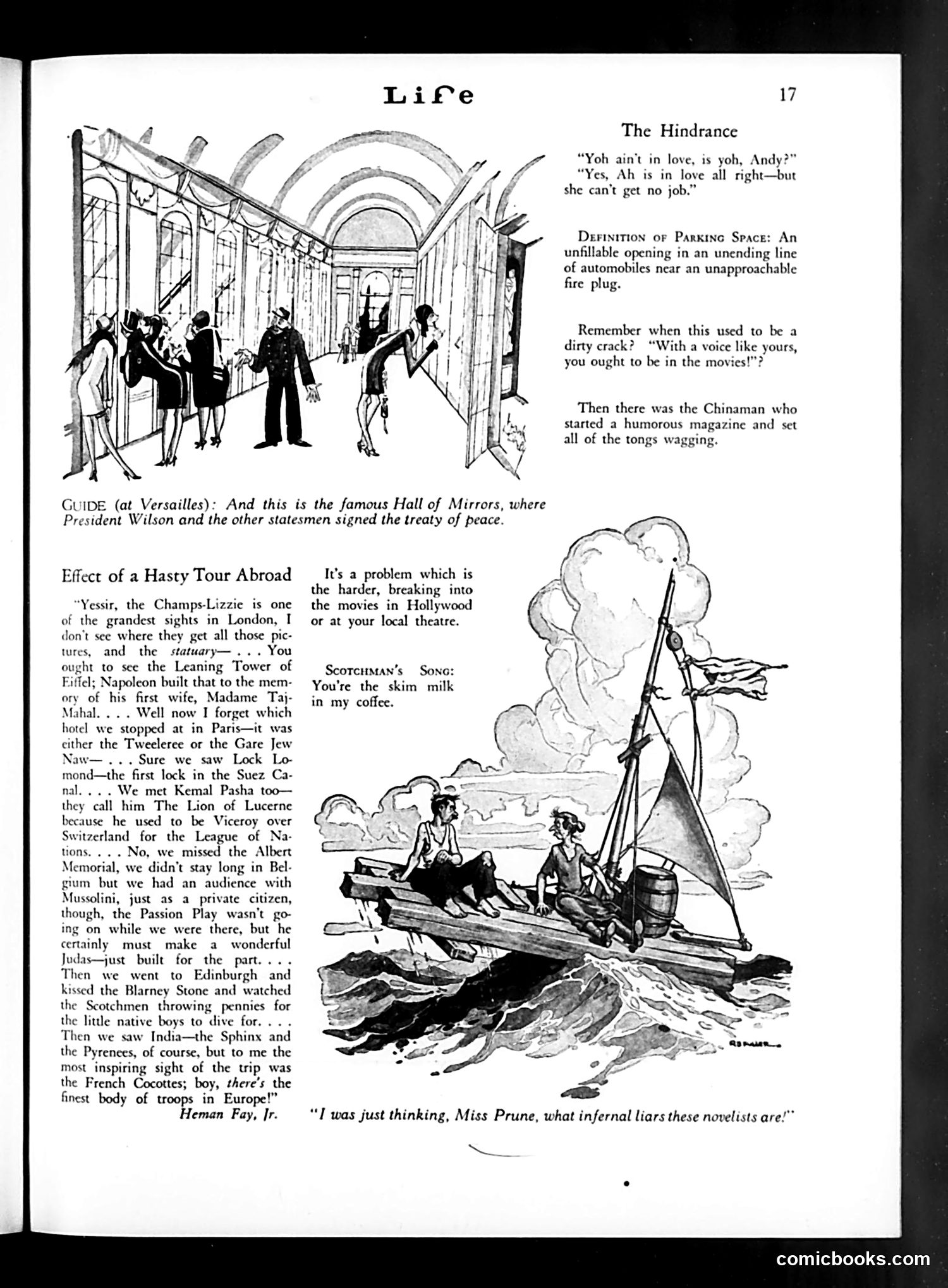
This page contains three separate satirical pieces: 1. **"The Hindrance"**: A joke about romantic obstacles—a man can't pursue a relationship because the woman "can't get no job," satirizing economic barriers to courtship during what appears to be an economically difficult period. 2. **"Effect of a Hasty Tour Abroad"**: A humorous account by someone (Herman Fay, Jr.) who visited famous European sites but admits forgetting details, having confused multiple locations. It mocks tourists who rush through landmarks without retention. 3. **"Scotchman's Song"**: A brief Scottish dialect joke about skim milk in coffee. The main cartoon shows a man and woman on a cliff with the caption about "infernal liars these novelists are"—mocking romantic fiction's unrealistic portrayal of adventure. The artwork emphasizes the gap between literary romance and mundane reality.
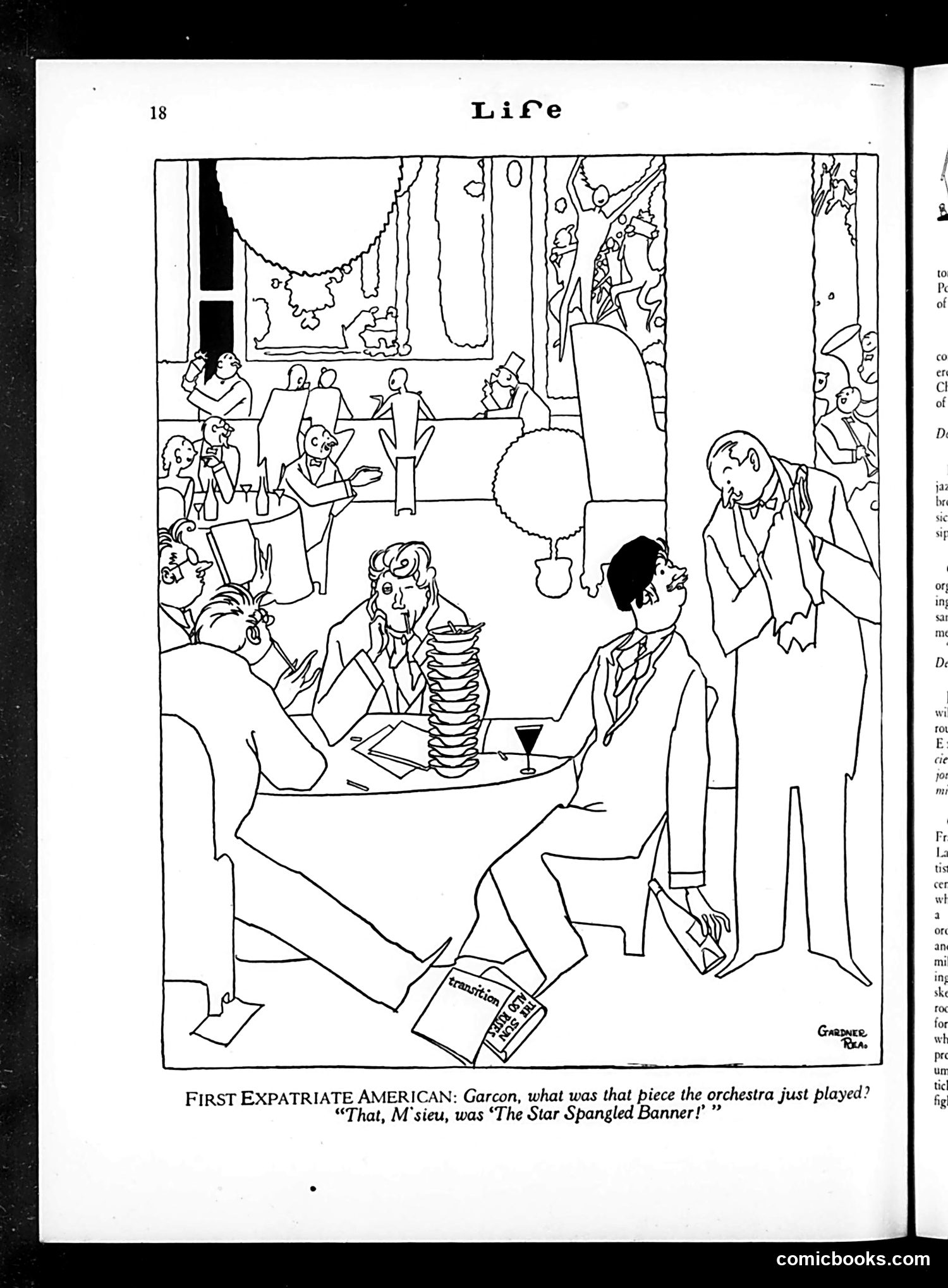
This Life magazine cartoon satirizes American expatriates in Paris during the early 20th century. The scene depicts an upscale Parisian restaurant or nightclub where well-dressed Americans are dining and socializing. The joke centers on cultural pretension: a newly arrived American ("Garçon" likely refers to the French waiter) asks another expatriate what orchestral piece was just performed. The response—"The Star Spangled Banner"—exposes the expatriate's ignorance. Despite living abroad and adopting European sophistication, he doesn't recognize America's own national anthem when hearing it. The satire mocks expatriates who embrace European culture while remaining disconnected from their American heritage, suggesting their cosmopolitan affectations mask fundamental cultural ignorance or amnesia.
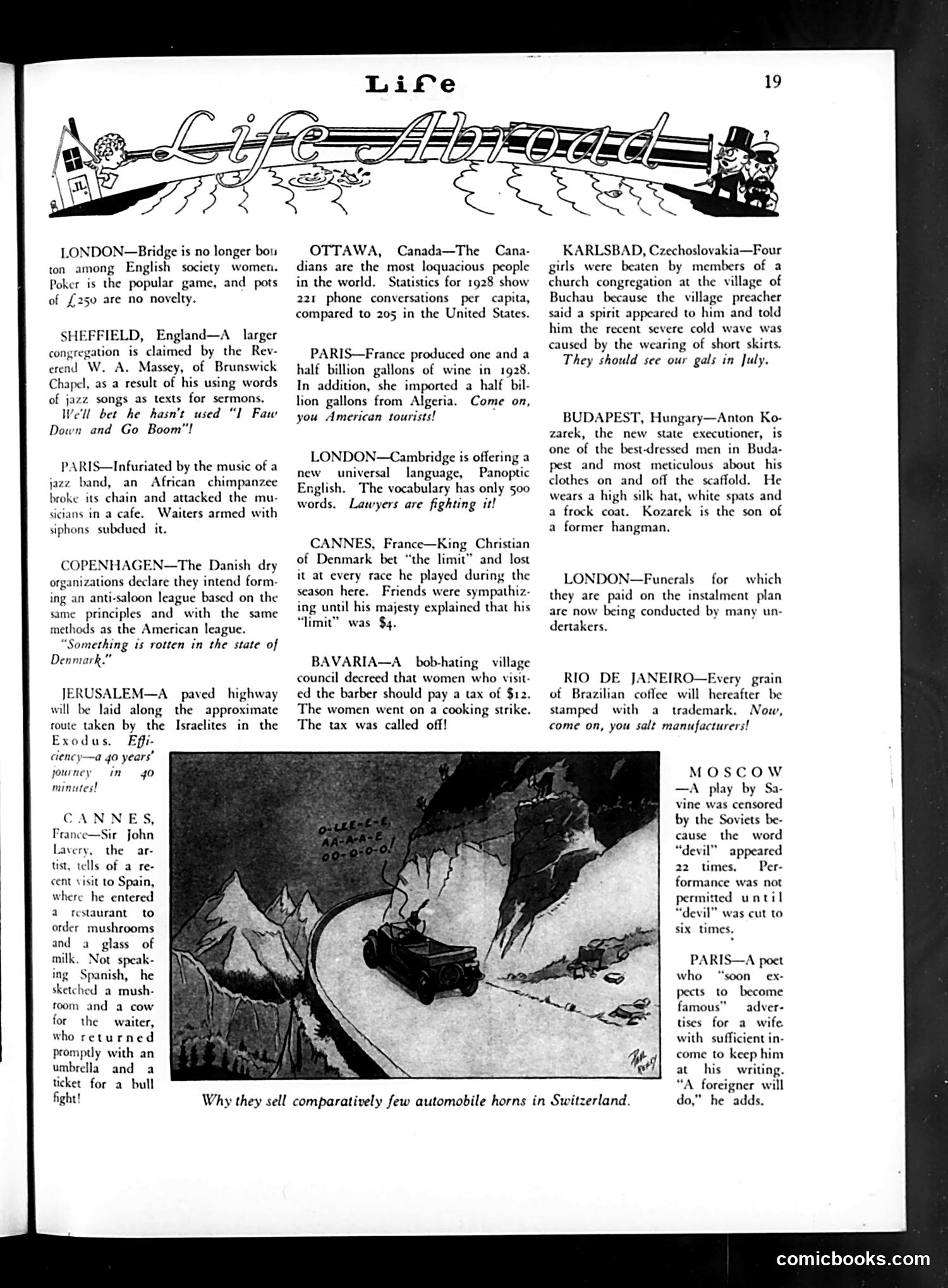
This page collects humorous international dispatches—brief satirical observations about 1920s global culture. The central cartoon shows a car careening off a Swiss mountain road, captioned "Why they sell comparatively few automobile horns in Switzerland"—the joke being that horns are unnecessary when reckless driving eliminates the need for warnings. The surrounding items mock contemporary trends: English women gambling at poker, a Danish reverend using jazz lyrics in sermons, a chimpanzee attacking jazz musicians in Paris, and (most pointedly) Bavarian church members beating girls for wearing short skirts because a preacher blamed cold weather on "immodest" clothing. Other items mock national stereotypes—Canadians' phone addiction, French wine consumption, Soviet censorship cutting "devil" from 22 mentions to six, and a desperate Parisian poet advertising for a wealthy wife. The humor relies on contrasting "civilized" progress (modern technology, efficient highways) with absurd provincial attitudes and bureaucratic nonsense. It's period satire targeting both international peculiarities and Jazz Age modernity itself.
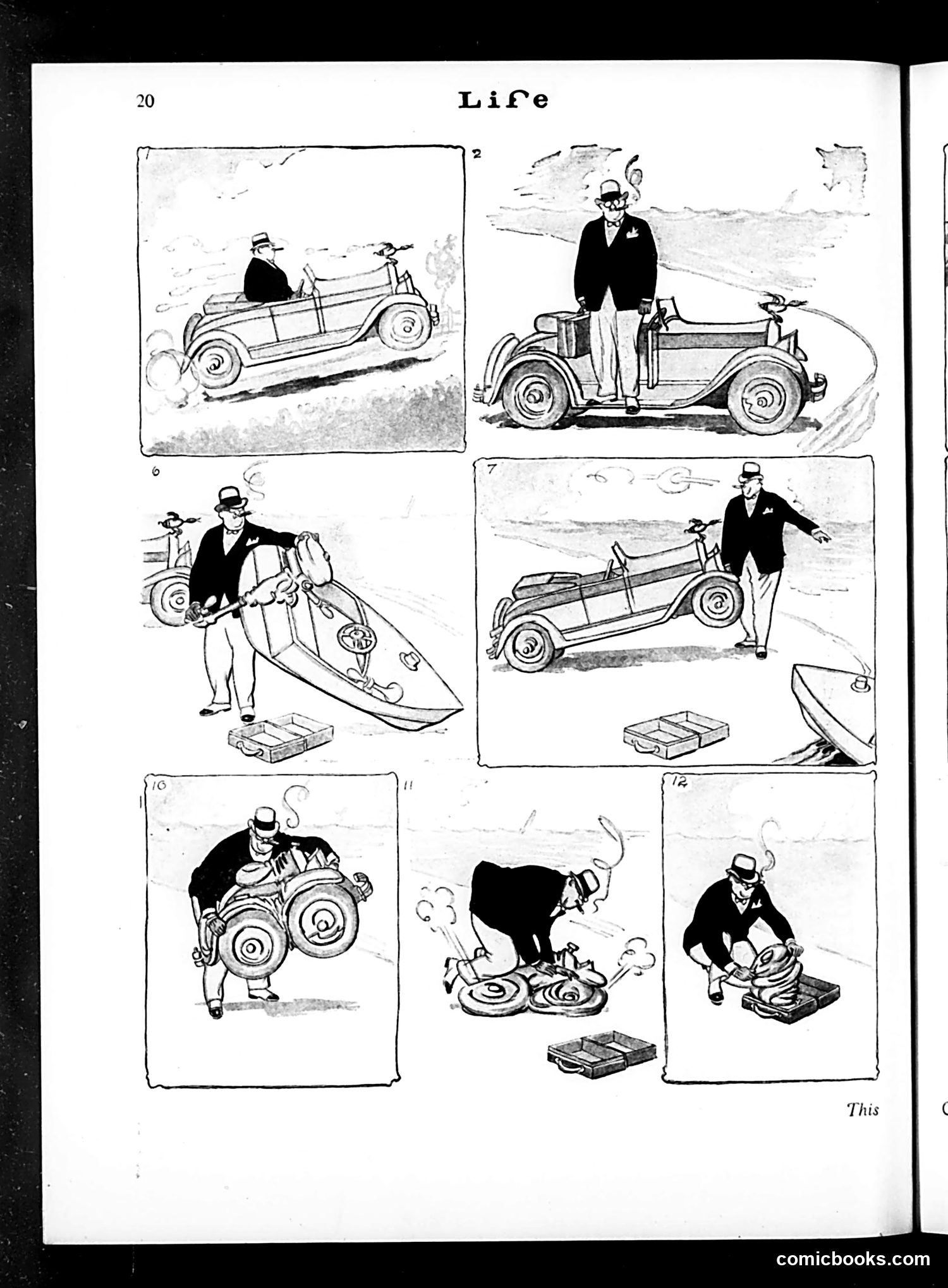
This page from *Life* magazine presents a humorous sequential narrative about automobile ownership and maintenance. The comic follows a well-dressed gentleman through the lifecycle of car ownership: driving it home proudly, posing with it, converting it into a boat (panels 6-7, an absurdist joke), and finally depicted struggling with mechanical repairs—carrying large wheels and working on engine parts. The satire targets the frustrations of early automobile ownership: the initial pride of possession contrasted with the demanding, expensive upkeep required. The conversion to a boat appears comedic commentary on how impractical or troublesome the vehicle becomes. The final panels show him literally weighed down by maintenance burdens, capturing the gap between automobiles' promised freedom and their actual expense and labor demands—a relatable concern for 1920s-era readers as car ownership was becoming widespread.
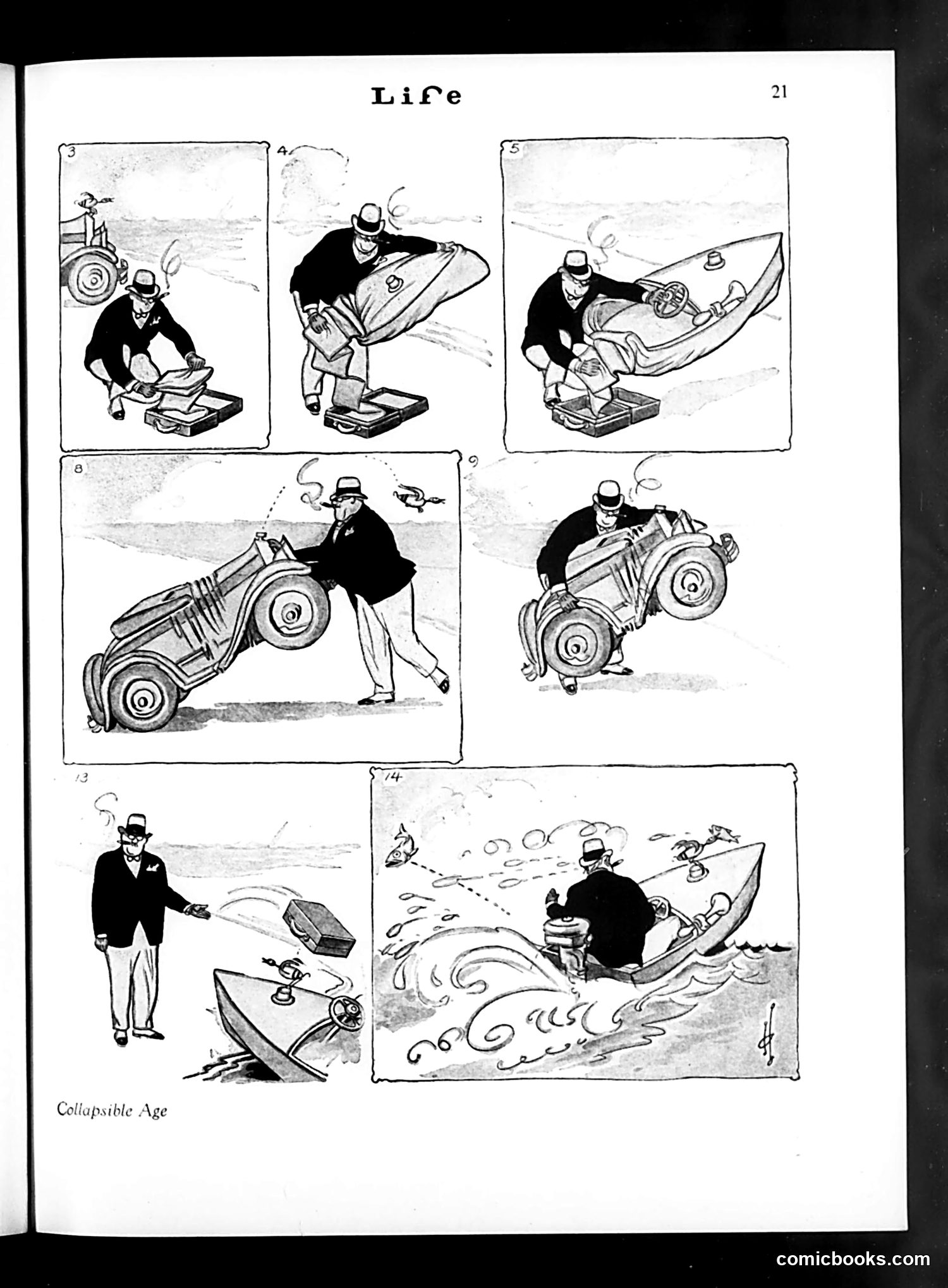
This satirical comic strip depicts the "Collapsible Age," showing a man repeatedly assembling and disassembling what appears to be a collapsible motorboat or vehicle. The sequence progresses from careful construction (panels 3-4) to increasingly chaotic operation (panels 6-9), culminating in the vessel collapsing entirely in water. The satire targets early 20th-century consumer culture's obsession with portable, space-saving gadgets and modern conveniences. The "collapsible" trend reflected both genuine innovation and marketing hype. The joke suggests these clever contraptions, while initially appealing, are fundamentally unreliable—they collapse literally and figuratively when actually used. The well-dressed protagonist's frustration underscores the gap between promotional promises and practical reality, mocking both manufacturers' claims and consumers' naive optimism about modern technology.
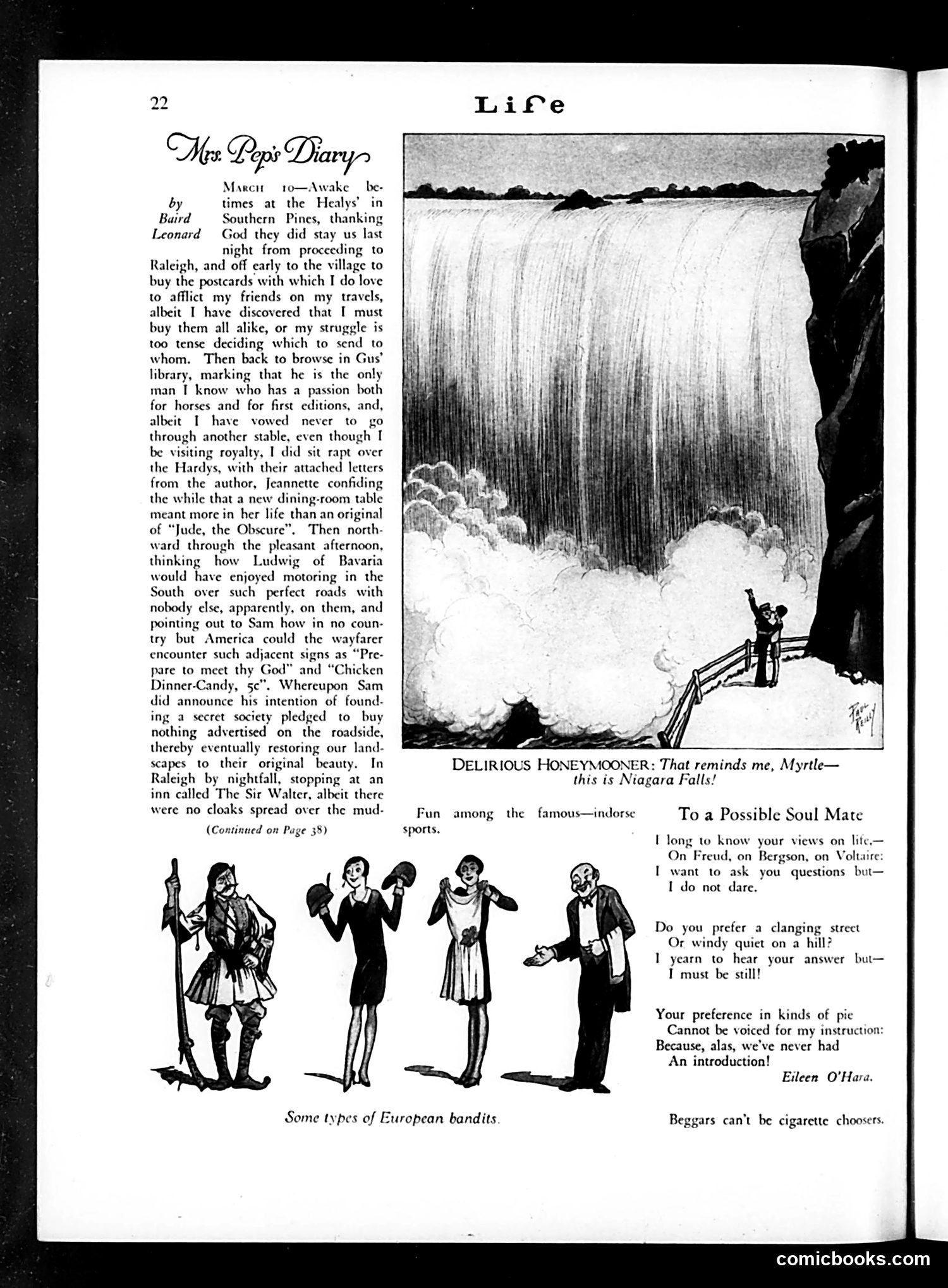
**Mrs. Pep's Diary** (top left) is a humorous travel narrative satirizing American roadside culture. The author mocks the contradiction between America's natural beauty and its commercial tackiness—specifically the jarring juxtaposition of religious warning signs ("Prepare to meet thy God") alongside cheap food advertisements ("Chicken Dinner-Candy, 5c"). One character jokingly proposes founding a secret society to boycott roadside advertising to restore landscape beauty. This reflects 1920s-era concerns about commercialism despoiling the American countryside. **"Delirious Honeymooner"** (top right) is a single-panel cartoon showing a couple at Niagara Falls with the caption playing on the location's clichéd association with honeymoons. **"Some types of European bandits"** (bottom) depicts four caricatured figures in period costume, likely satirizing European criminal or political stereotypes, though context is unclear without additional information. **"To a Possible Soul Mate"** (right) is a humorous poem about romantic frustration and social awkwardness, ending with the quip "Beggars can't be cigarette choosers."
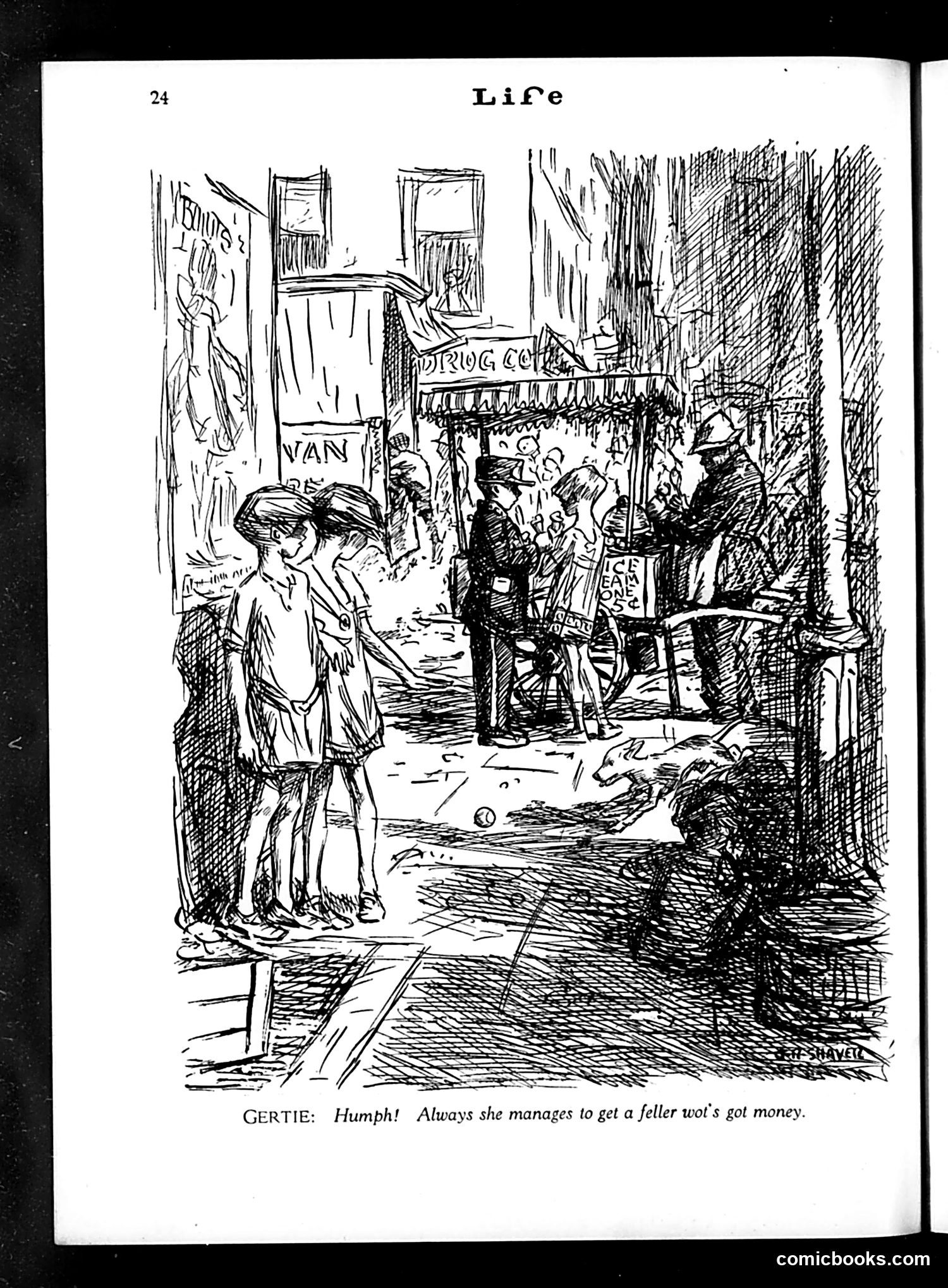
This single-panel cartoon depicts a street scene, likely from early 20th-century urban America. A woman named Gertie (speaking in the caption) observes another woman successfully attracting a wealthy man's attention at what appears to be a storefront or social gathering. The satire targets female dating and marriage strategies, suggesting that some women are skilled at pursuing men specifically for financial gain rather than romantic reasons. The phrase "a feller wot's got money" uses working-class dialect to emphasize the mercenary nature of the pursuit. The joke reflects period anxieties about women's economic dependence and their perceived manipulation of courtship. The cartoon presents this as Gertie's envious commentary on another woman's "talent" for securing affluent suitors—satirizing both women's limited economic options and stereotypes about female gold-digging.
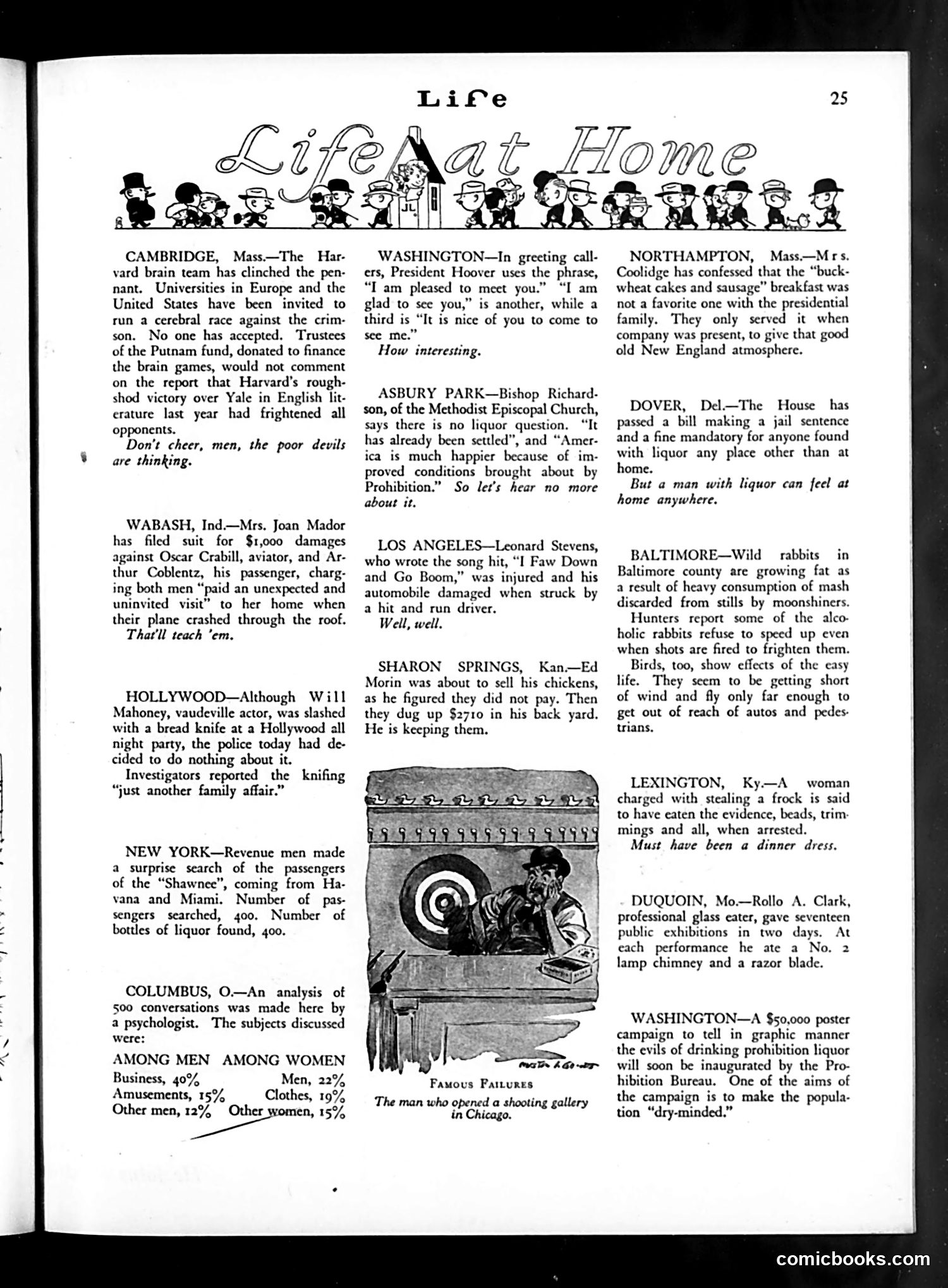
This page from *Life* magazine satirizes American life during Prohibition (1920-1933). The cartoons and brief news items mock the law's failures through ironic commentary: The **shooting gallery cartoon** depicts "Famous Failures"—a man who opened a shooting gallery in Chicago, suggesting this business inevitably failed. The **text jokes** highlight Prohibition's absurdity: a woman ate a stolen dress (including beads), wild rabbits became intoxicated from discarded moonshine, and revenue agents found 400 bottles of liquor on 400 searched passengers—a perfect ratio suggesting rampant smuggling. A Delaware bill mandating jail time for home liquor possession is mocked: "But a man with liquor can feel at home anywhere"—suggesting the law is unenforceable. The page ridicules both Prohibition's hypocrisy (President Hoover's bland greetings, Mrs. Coolidge's fake breakfast preferences) and its ineffectiveness, presenting widespread drinking and bootlegging as inevitable despite legal restrictions.
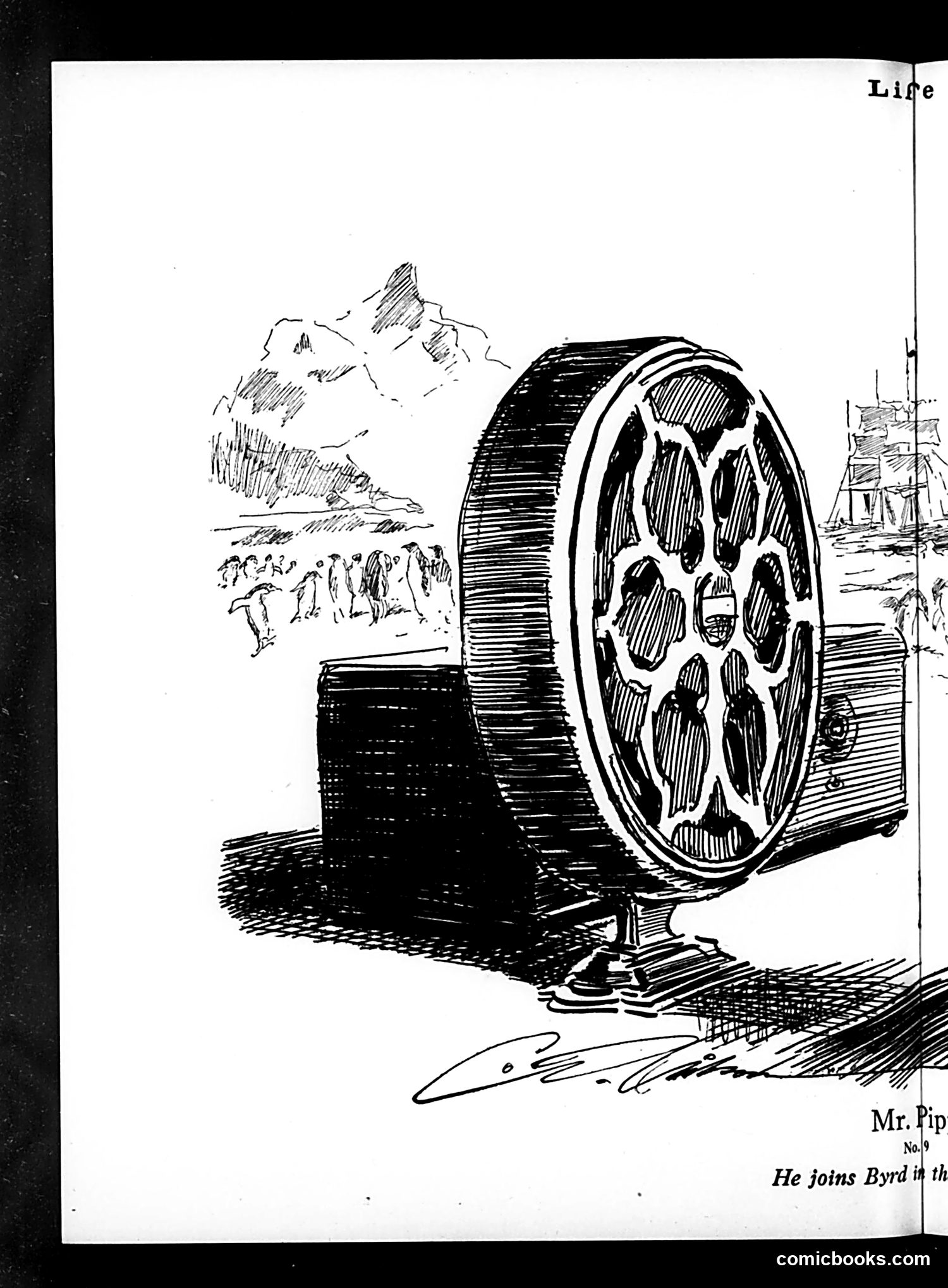
This page appears to be from a serial comic or illustrated story called "Mr. Pip" (episode No. 9). The visible OCR text references someone joining "Byrd," though the complete context is cut off. The illustration shows a large film reel or movie projector in a maritime setting, with mountains and a sailing ship visible in the background. Small figures on shore suggest an expedition or exploration scenario. Without the full text or clearer context, I cannot definitively identify the political/social satire or explain the specific reference to "Byrd." The maritime and exploration imagery suggests this may relate to a famous polar or geographical expedition, possibly Admiral Byrd's Antarctic explorations (1920s-1930s), but I cannot confirm this from the visible evidence alone. The incomplete caption limits interpretation.
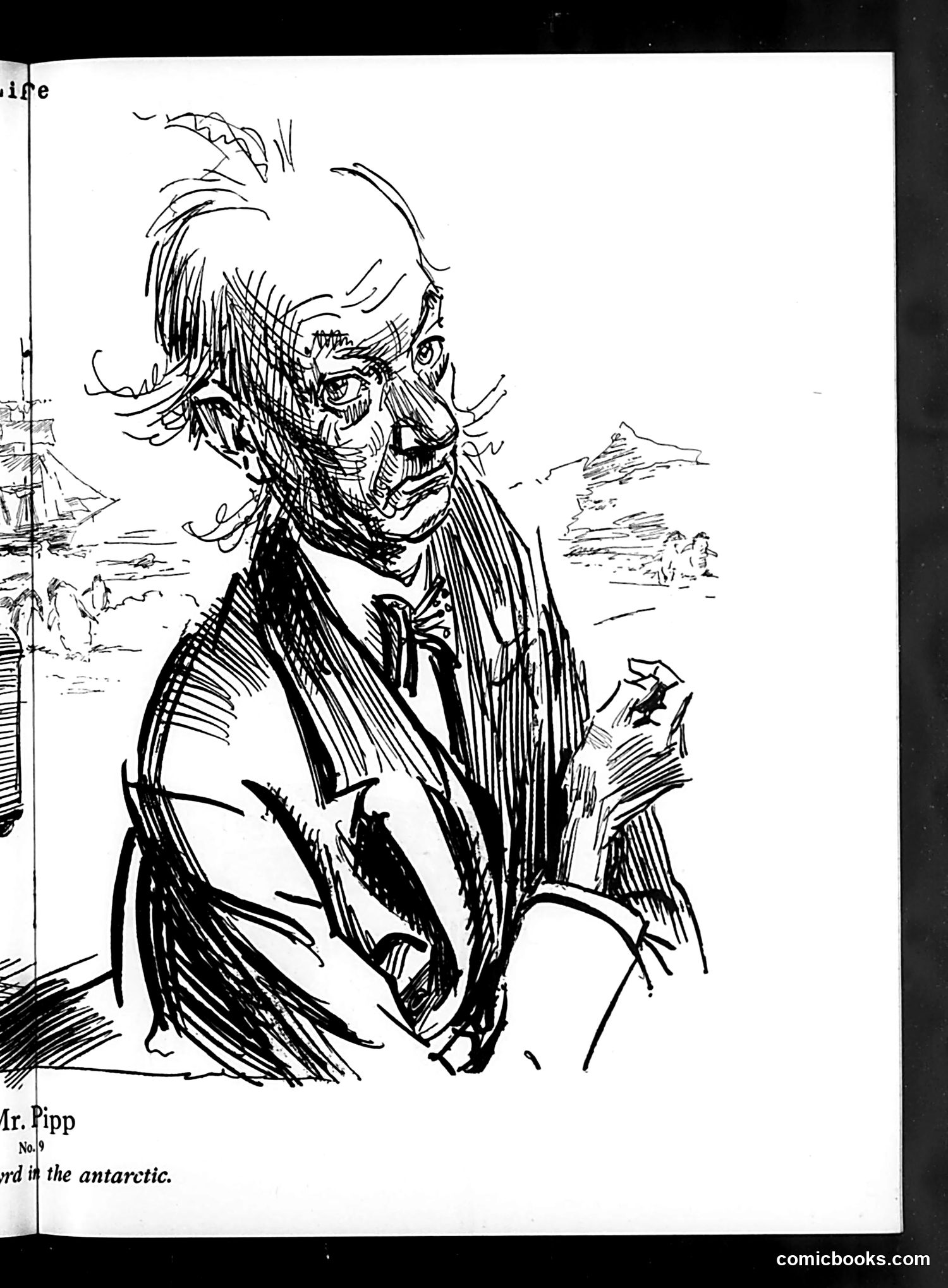
This page features a sketch labeled "Mr. Pipp" (No. 9) with the caption "ord in the antarctic" (likely "Word in the Antarctic"). The drawing shows a caricatured figure with exaggerated facial features—prominent nose, distinctive hair, and period clothing. The sketch style is characteristic of early 20th-century political cartooning, using line work to convey both likeness and satirical expression. Without the complete caption or additional context visible on this page, the specific political or social reference remains unclear. The Antarctic reference suggests this may relate to polar exploration or adventure narratives popular in that era. The identity of "Mr. Pipp" and the satirical point require additional page context to determine with certainty.
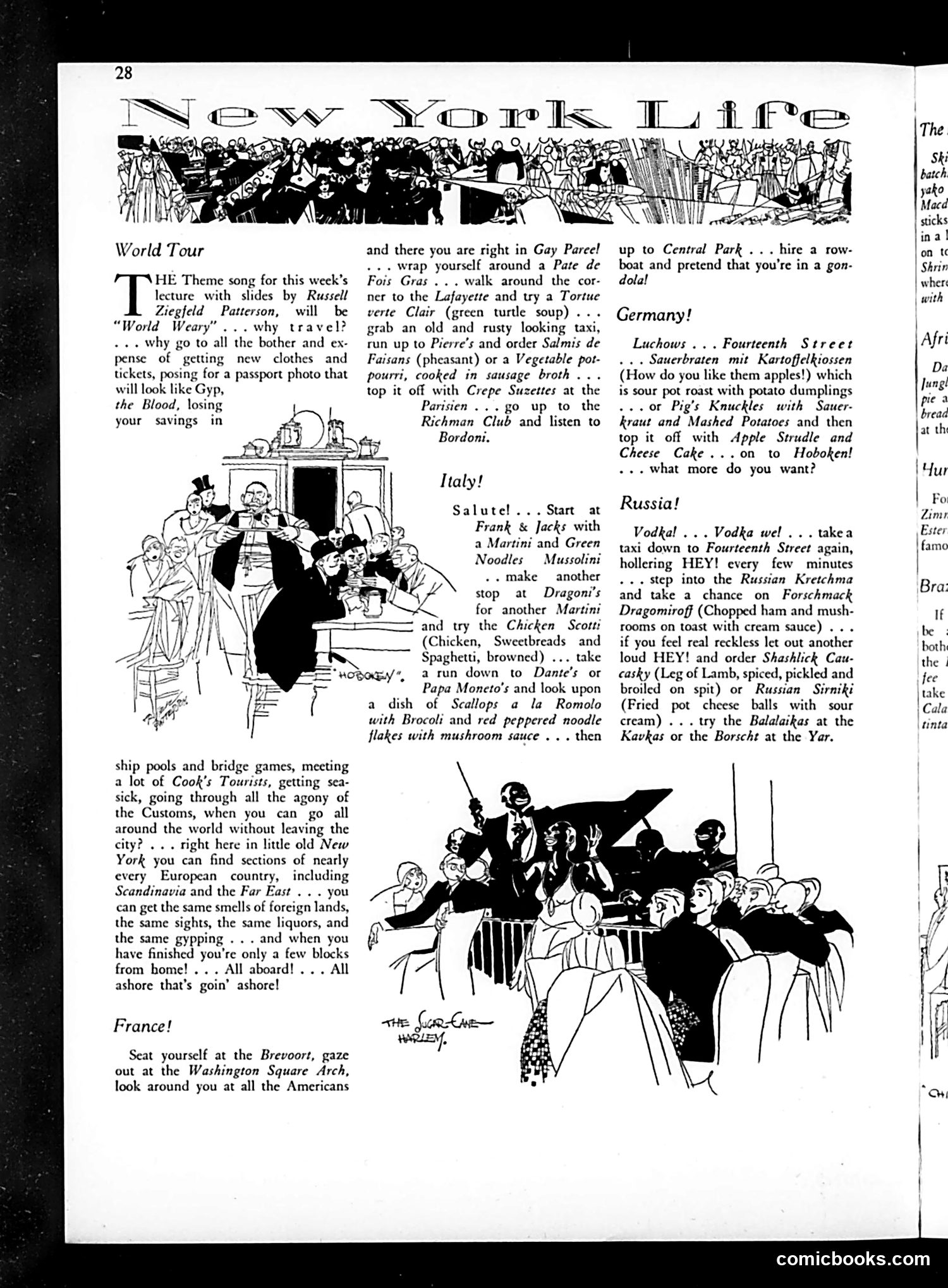
This piece satirizes wealthy Americans' wanderlust by arguing they needn't travel abroad: New York City itself contains ethnic neighborhoods replicating European experiences. The author (Russell Ziegfeld Patterson) suggests visiting restaurants and districts in Manhattan to simulate France, Italy, Germany, and Russia without expense or effort. The humor targets two things: first, the superficiality of "armchair tourism"—reducing entire nations to food and stereotypes. Second, it mocks the ethnic enclaves' authenticity, suggesting they're merely pale imitations ("gypping" included). References like Luchow's (a famous German restaurant on 14th Street) and Hoboken indicate real Manhattan establishments catering to immigrant communities. The accompanying cartoons depict diners in these ethnic restaurants, emphasizing the comic contrast between pretending to travel and remaining in New York. This reflects pre-WWII attitudes about immigrant neighborhoods as exotic-yet-accessible curiosities for American leisure.
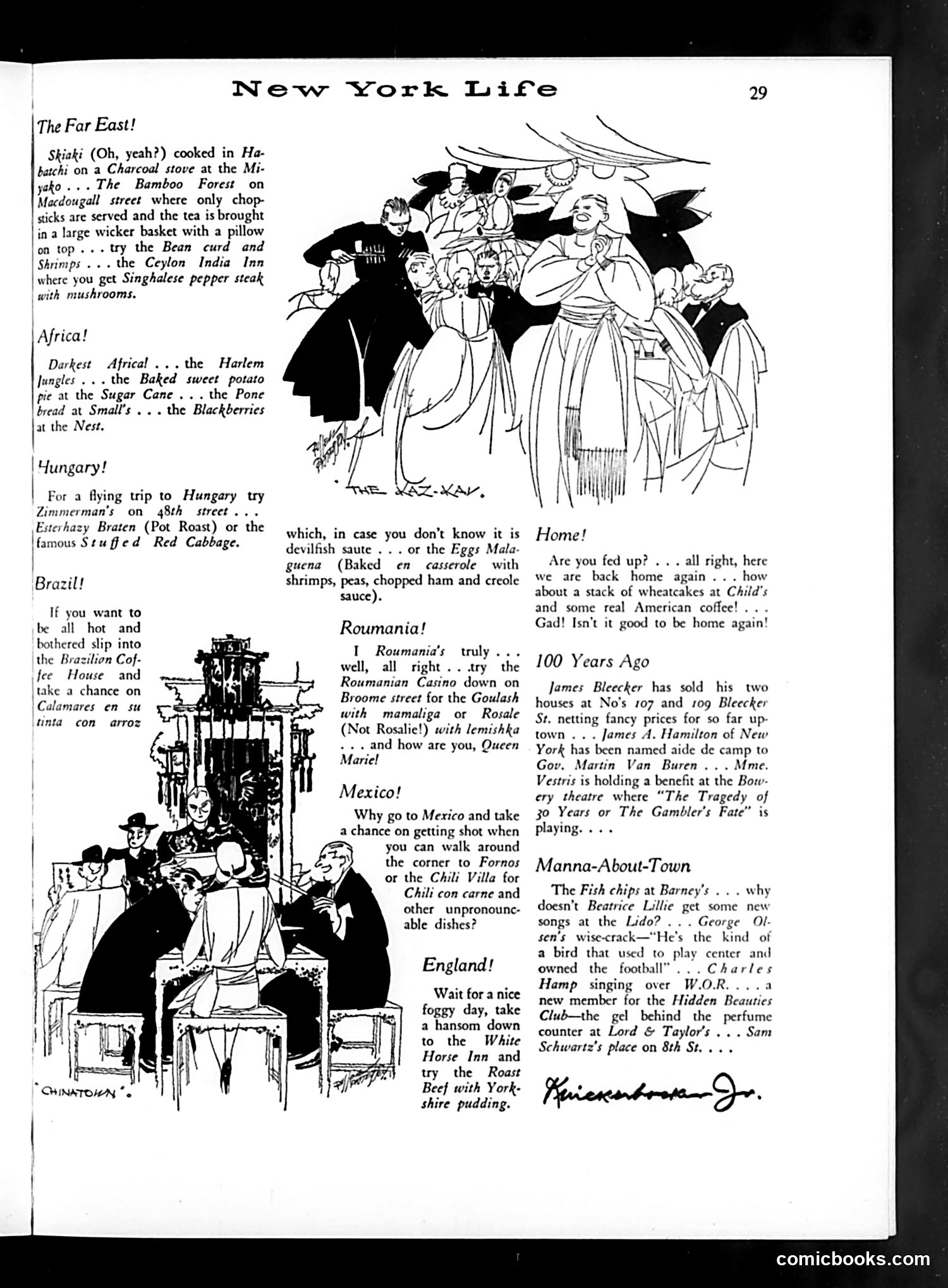
This page satirizes the era's fascination with "exotic" dining experiences. The main article humorously guides New Yorkers to immigrant neighborhoods and restaurants offering cuisines from around the world—China, India, Africa, Hungary, Brazil, Romania, Mexico, and England—all accessible within Manhattan. The satire works on two levels: First, it mocks the casual, superficial way wealthy New Yorkers "toured" foreign cultures through food, treating entire countries as entertainment ("take a chance on getting shot" in Mexico). Second, it playfully stereotypes these cuisines and the neighborhoods where they're found, particularly Harlem ("Darkest Africa") and Chinatown. The cartoons illustrate the contrast between these "adventurous" dining trips and homesick Americans yearning for "real American coffee" and wheatcakes—suggesting that despite cosmopolitan pretensions, New Yorkers ultimately preferred familiar comfort food. The humor assumes readers would recognize the immigrant restaurant establishments and ethnic neighborhoods referenced.
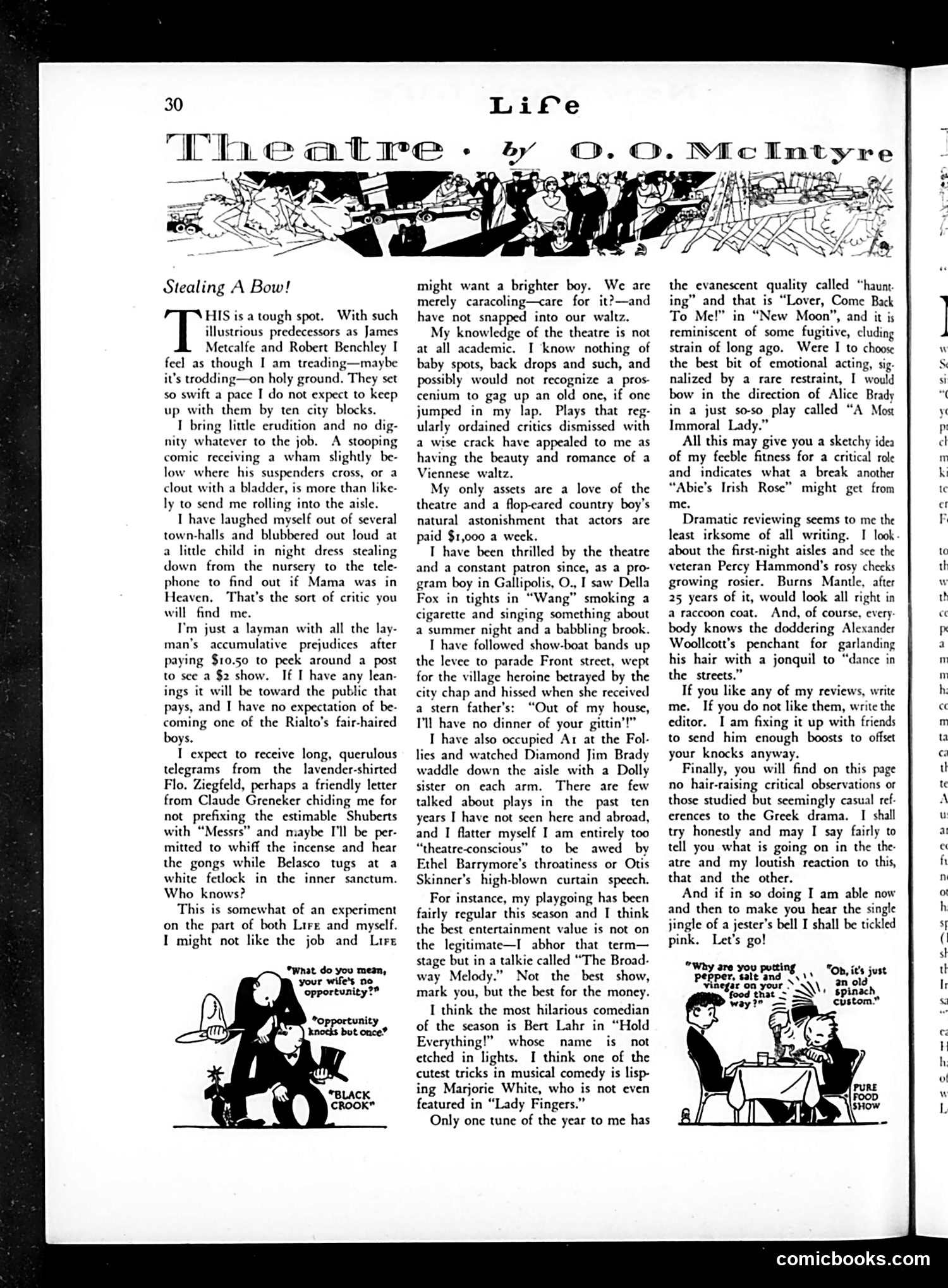
This is O.O. McIntyre's inaugural theatre column for *Life* magazine. McIntyre establishes himself as an anti-snob critic—deliberately unpretentious and focused on popular entertainment rather than academic theatrical knowledge. He references actual theatre figures: **Flo Ziegfeld** and the **Shubert brothers** (major Broadway producers), **David Belasco** (legendary theatre impresario), and performers like **Ethel Barrymore** and **Otis Skinner**. McIntyre's point: he'll judge theatre by what entertains paying audiences, not critical establishment standards. He explicitly praises the talkie "Broadway Melody" and comedian **Bert Lahr** over prestigious Broadway productions, deliberately challenging highbrow taste-makers. The cartoons below—one showing "Opportunity," another about "Pure Food"—appear to be unrelated Life magazine gag cartoons typical of the period's satirical content.
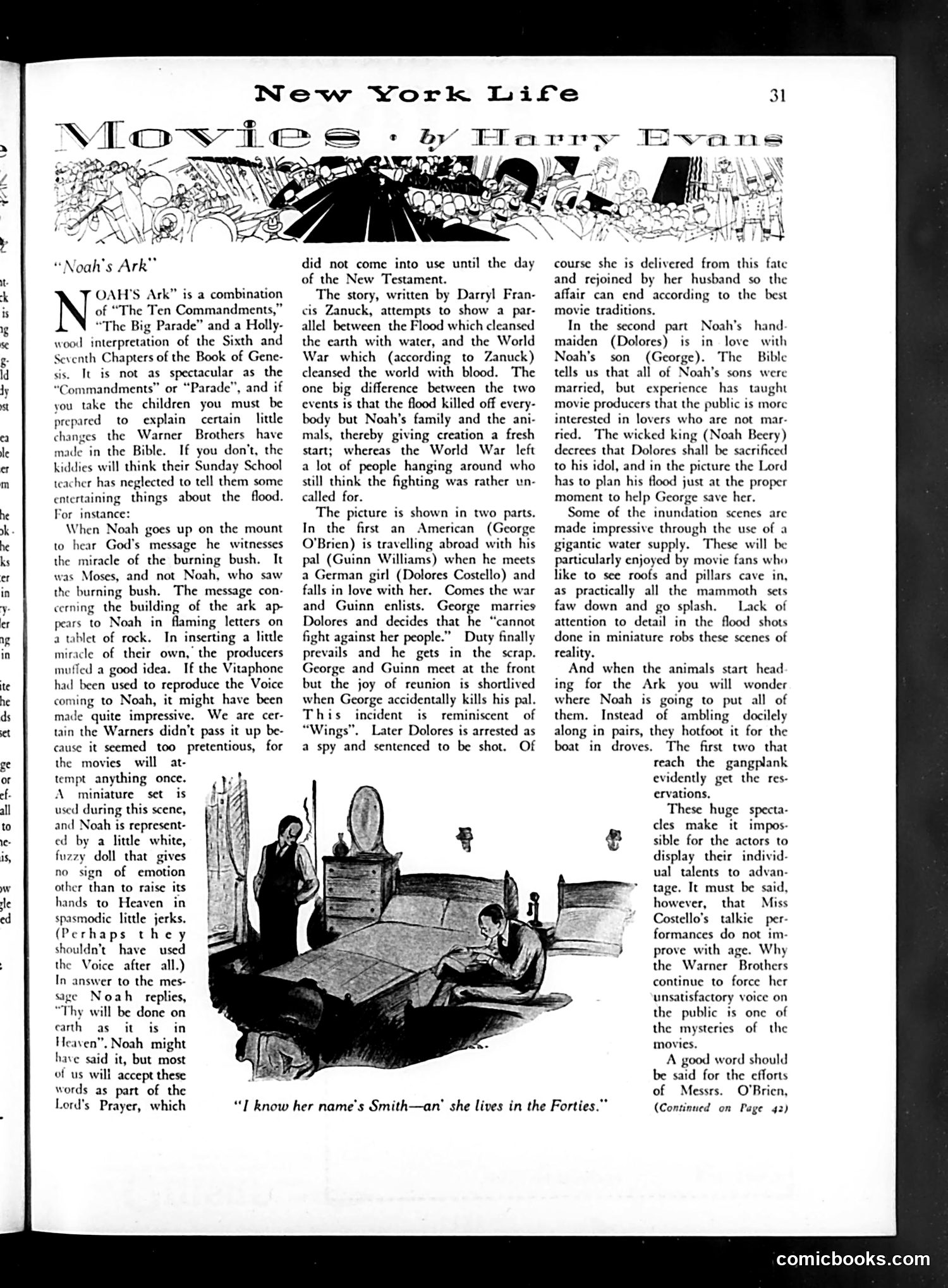
This is a **film review by Harry Evans** critiquing Warner Brothers' 1928 religious epic "Noah's Ark." **The Main Critique:** Evans sarcastically attacks the film's historical and biblical inaccuracies and heavy-handed messaging. Director Darryl Zanuck explicitly parallels the Biblical Flood with World War I—positioning both as divine cleansings. Evans finds this comparison absurd: the Flood killed everyone except Noah's family, giving creation a "fresh start," whereas WWI left survivors who "still think the fighting was rather uncalled for." **Specific Issues Highlighted:** - Mixing biblical stories (using Moses' burning bush for Noah) - Inserting miracles not in scripture - Misquoting the Lord's Prayer - Prioritizing romantic subplots over biblical accuracy because audiences prefer "lovers who are not married" **The Cartoon:** Shows a domestic scene captioned "I know her name's Smith—an' she lives in the Forties," illustrating how the film replaces biblical narratives with contemporary melodrama. Evans' satire targets Warner Brothers' treatment of sacred material as mere spectacle, sacrificing accuracy for box-office appeal and romantic sentimentality.
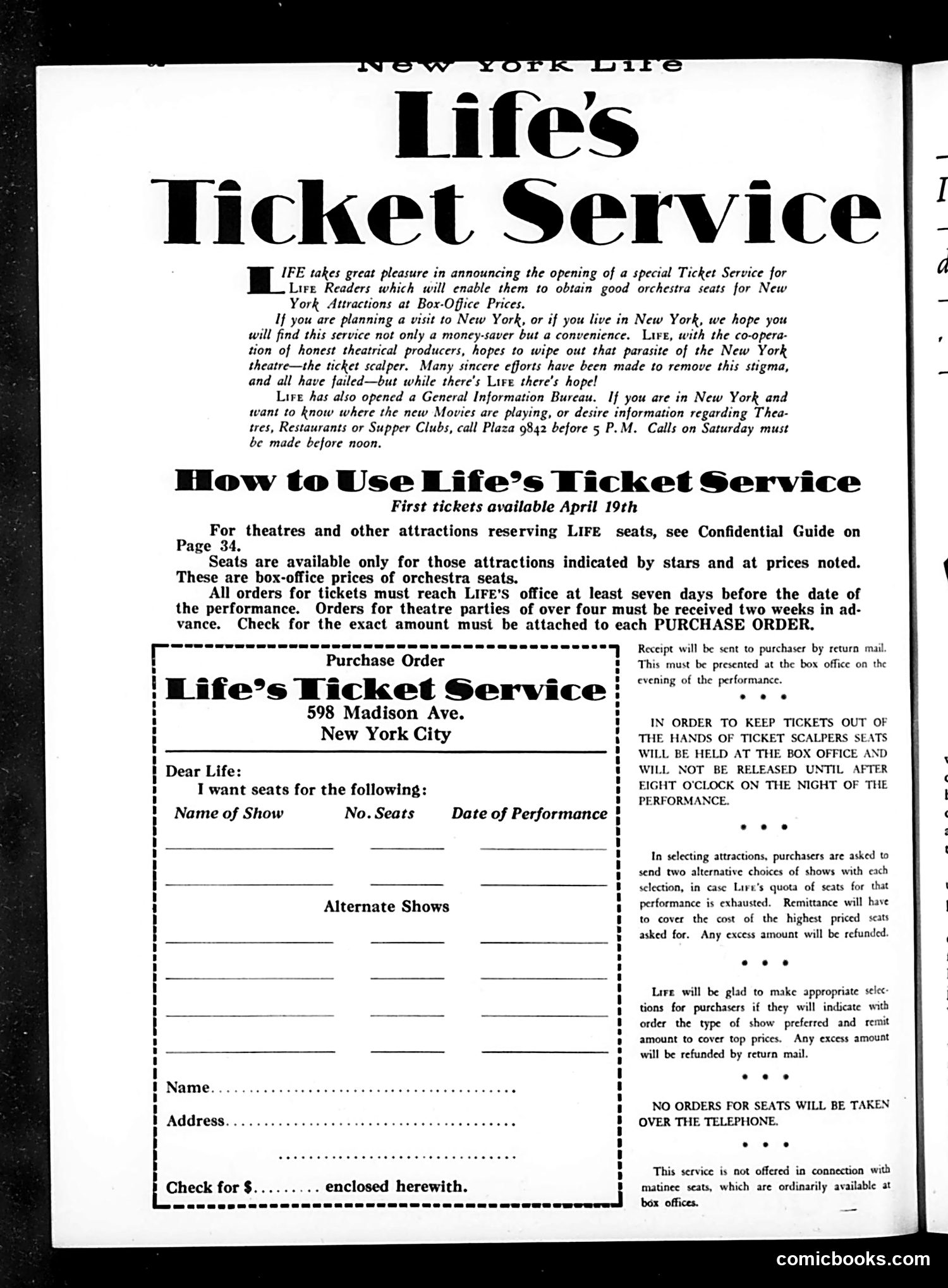
This is not a cartoon but rather a **service advertisement** from Life magazine announcing a new ticket-selling service for New York theater seats. The social context: Life positions itself as combating **ticket scalpers**—middlemen who bought theater tickets and resold them at inflated prices, a widespread problem in early 20th-century entertainment. The service promises "box-office prices" directly to readers, positioning Life and cooperating theaters as ethical alternatives to scalpers, described here as a "parasite." The practical details reveal the anti-scalping strategy: seats held at box offices until 8 P.M. performance night (preventing advance resale), advance ordering required (seven days minimum), and strict payment procedures. Readers submit purchase orders with checks directly to Life's office at 598 Madison Avenue. This reflects genuine Progressive-era anxiety about exploitative middlemen and represents an early attempt by a major magazine to leverage its reader base for consumer protection.
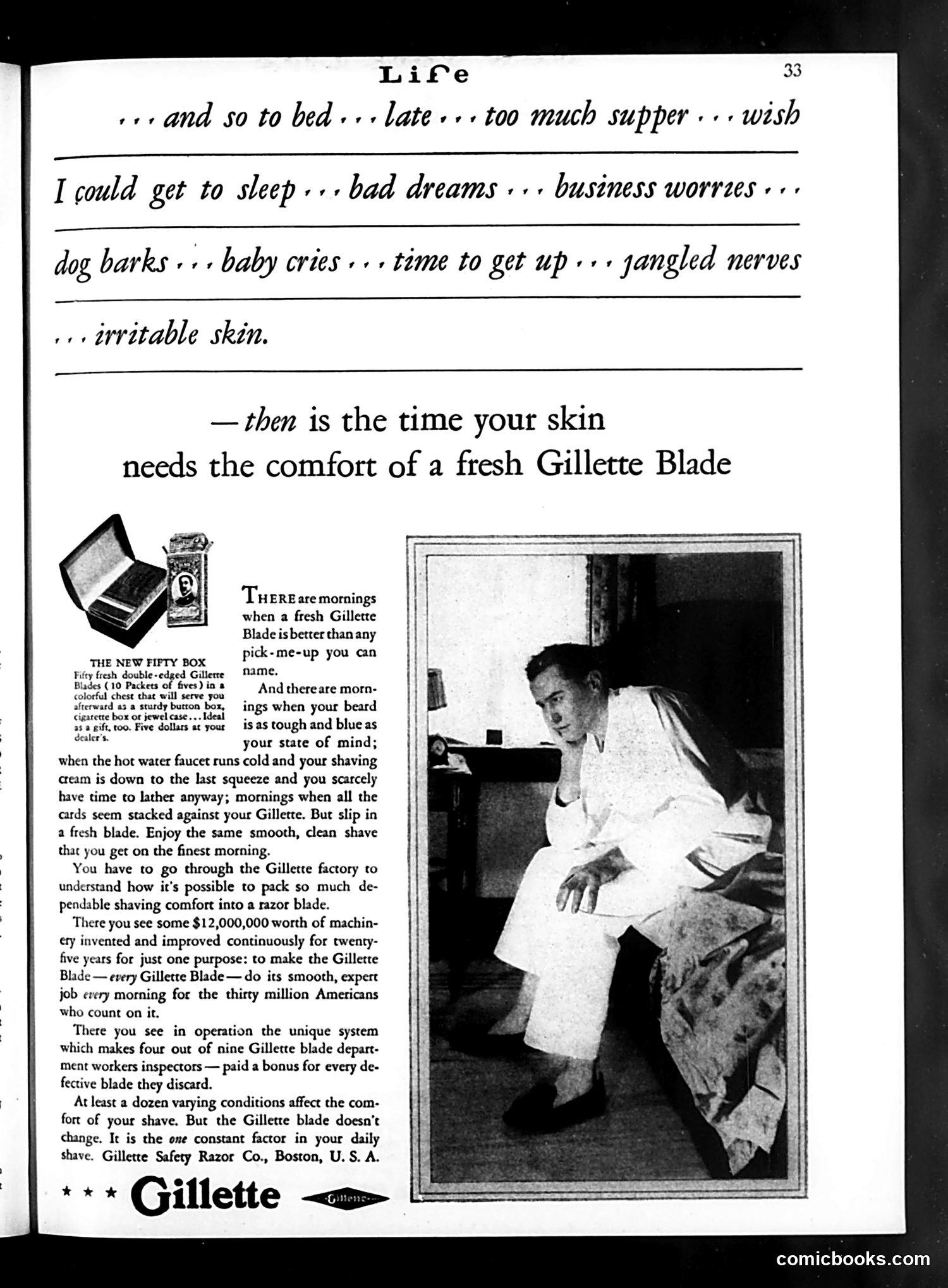
This is a **product advertisement**, not political satire. It promotes Gillette Safety Razor blades by depicting the anxieties of modern morning routines. The ad opens with relatable complaints—late nights, poor sleep, business worries, disruptions from dogs and babies, jangled nerves, irritable skin—establishing that mornings are stressful. The pitch: a fresh Gillette blade provides "comfort" amid this chaos. The accompanying photograph shows a man shaving, illustrating the product in use. The text emphasizes manufacturing quality: $12 million in machinery, 25-year continuous improvement, and a quality-control system where inspectors receive bonuses for rejecting defective blades. This appeals to consumer confidence. The message: while external conditions vary unpredictably, Gillette blades remain consistently reliable—"the one constant factor in your daily shave." It's a straightforward consumer pitch using emotional relatability rather than humor or satire.
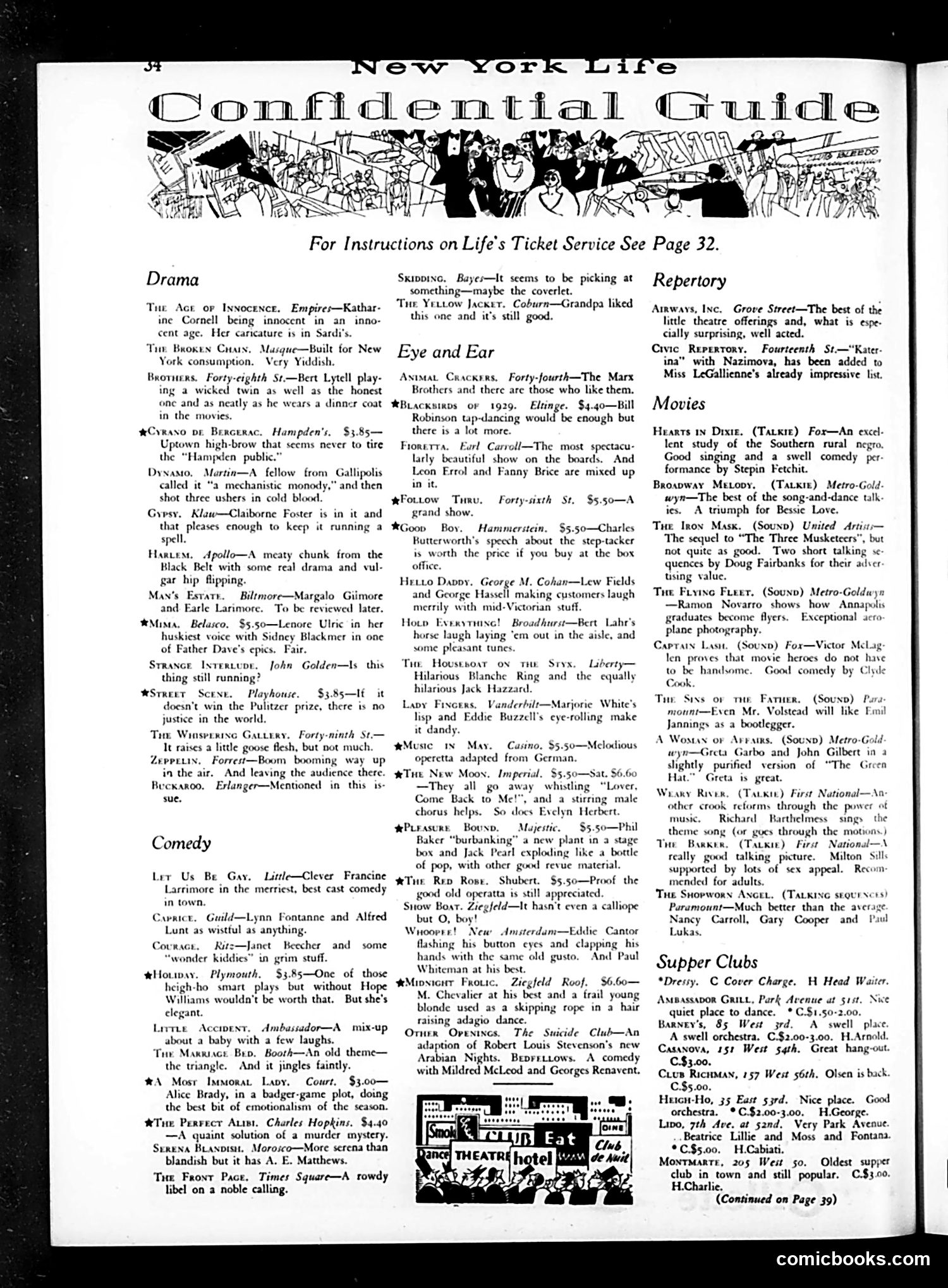
This is **not a political cartoon page** but rather a theater review section from Life magazine's "Confidential Guide" to New York entertainment. The page catalogs current Broadway productions across categories: Drama, Comedy, Eye and Ear (musicals/revues), Movies, and Supper Clubs. The satirical humor is **embedded in the brief, witty capsule reviews** themselves—not in visual cartoons. For example, reviewers mock productions with quips: one play is called "a mechanistic monody" that supposedly inspired someone to shoot ushers; another is questioned with "Is this thing still running?" Notable names appear: the Marx Brothers, Fanny Brice, Bert Lahr, and Charles Chaplin, representing 1920s vaudeville and early cinema stars. The small illustration at bottom shows a theater storefront advertising "Sardi's" restaurant—the famous Broadway hangout mentioned in the text. **The satire targets:** overwrought theatrical pretension, mediocre productions, and the absurdity of New York's theater scene itself—typical of Life's comedic approach to urban culture.
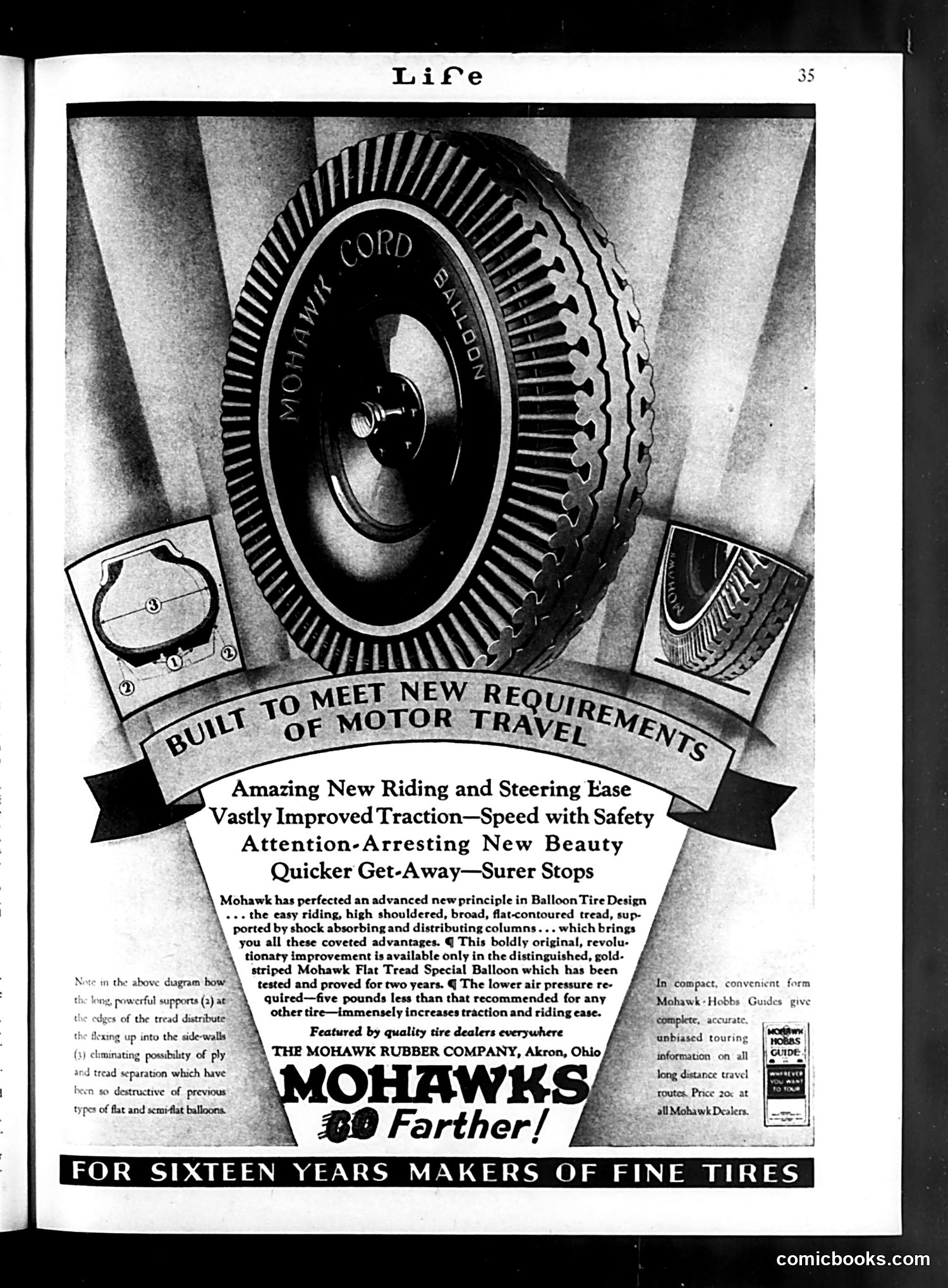
This is **not a cartoon or satire**—it's a straightforward **automobile tire advertisement** from Life magazine (page 35). The Mohawk Rubber Company advertises their new "Flat Tread Special Balloon" tire, emphasizing technical innovations: improved riding comfort, better traction, safer stopping, and faster acceleration. The ad highlights that their design uses lower air pressure than competitors while maintaining performance—a genuine engineering claim they'd tested for two years. The visual shows a large tire displayed prominently with technical diagrams flanking it, and includes a small "Mohawk Hobbs" touring guide promotion. The phrase "Go Farther!" is their marketing slogan. This represents early 20th-century automotive advertising before tire safety became a major public concern. There is no political content, caricature, or satire present—Life's pages included substantial advertising alongside editorial content.
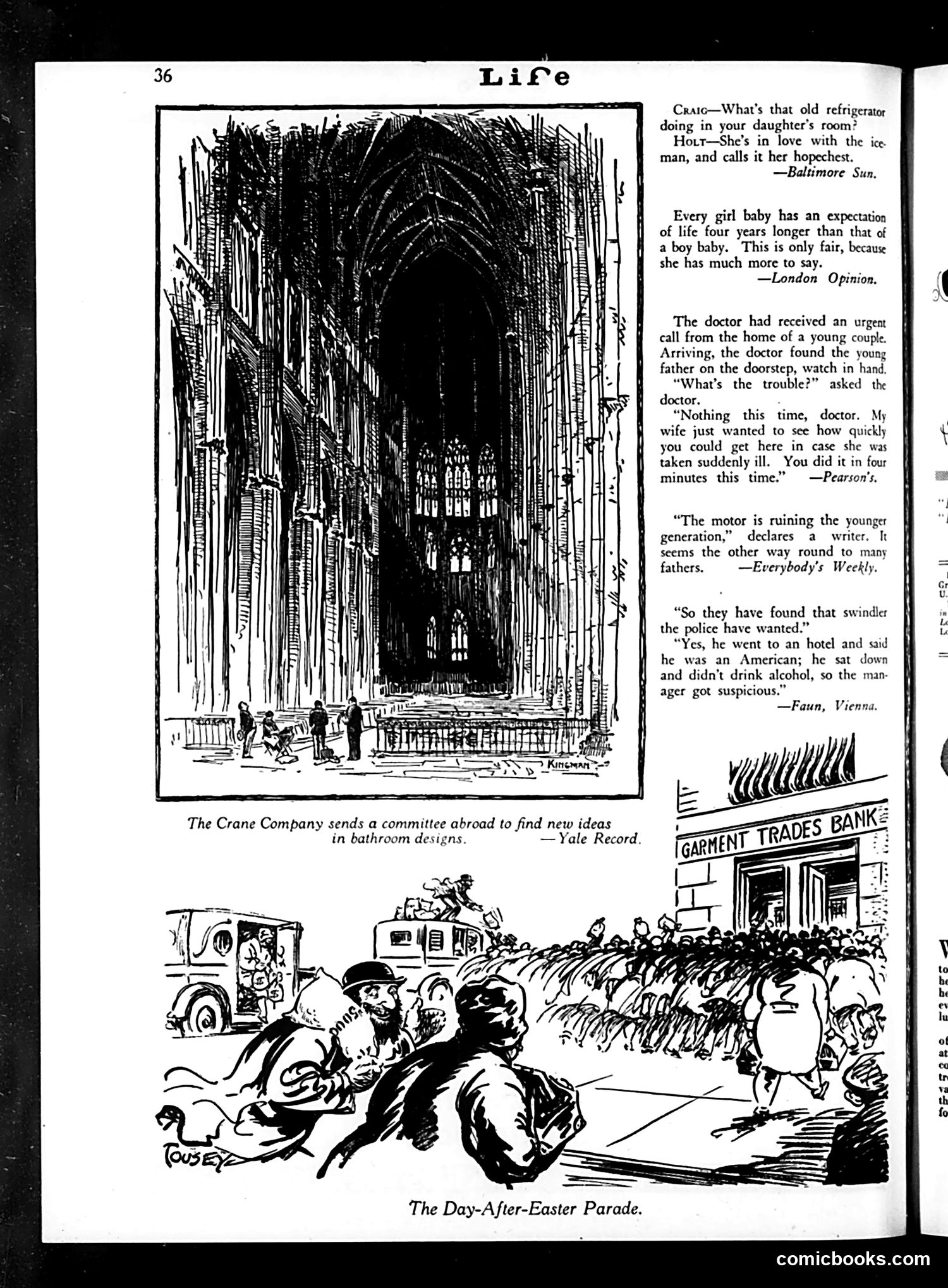
**Top Cartoon:** A architectural interior (cathedral or grand building) captioned as "The Crane Company sends a committee abroad to find new ideas in bathroom designs." This is absurdist humor—Crane was a real bathroom fixtures manufacturer. The joke mocks corporate pretension by suggesting they'd send executives to Europe to study grand architecture for inspiration on... toilets and sinks. It's satirizing both corporate self-importance and the disconnect between high art and mundane utility. **Bottom Cartoon:** "The Day-After-Easter Parade" depicts chaos with people, cars, and what appear to be eggs or round objects scattered everywhere. This likely mocks the commercialized Easter celebration and the chaotic consumer frenzy that follows the holiday—suggesting Easter has become about material excess rather than religious meaning. The page also contains brief humorous quotes about courtship, women's longevity, a doctor's house call, automobiles corrupting youth, and a swindler caught by his sobriety—typical satirical commentary on 1920s social life and mores.
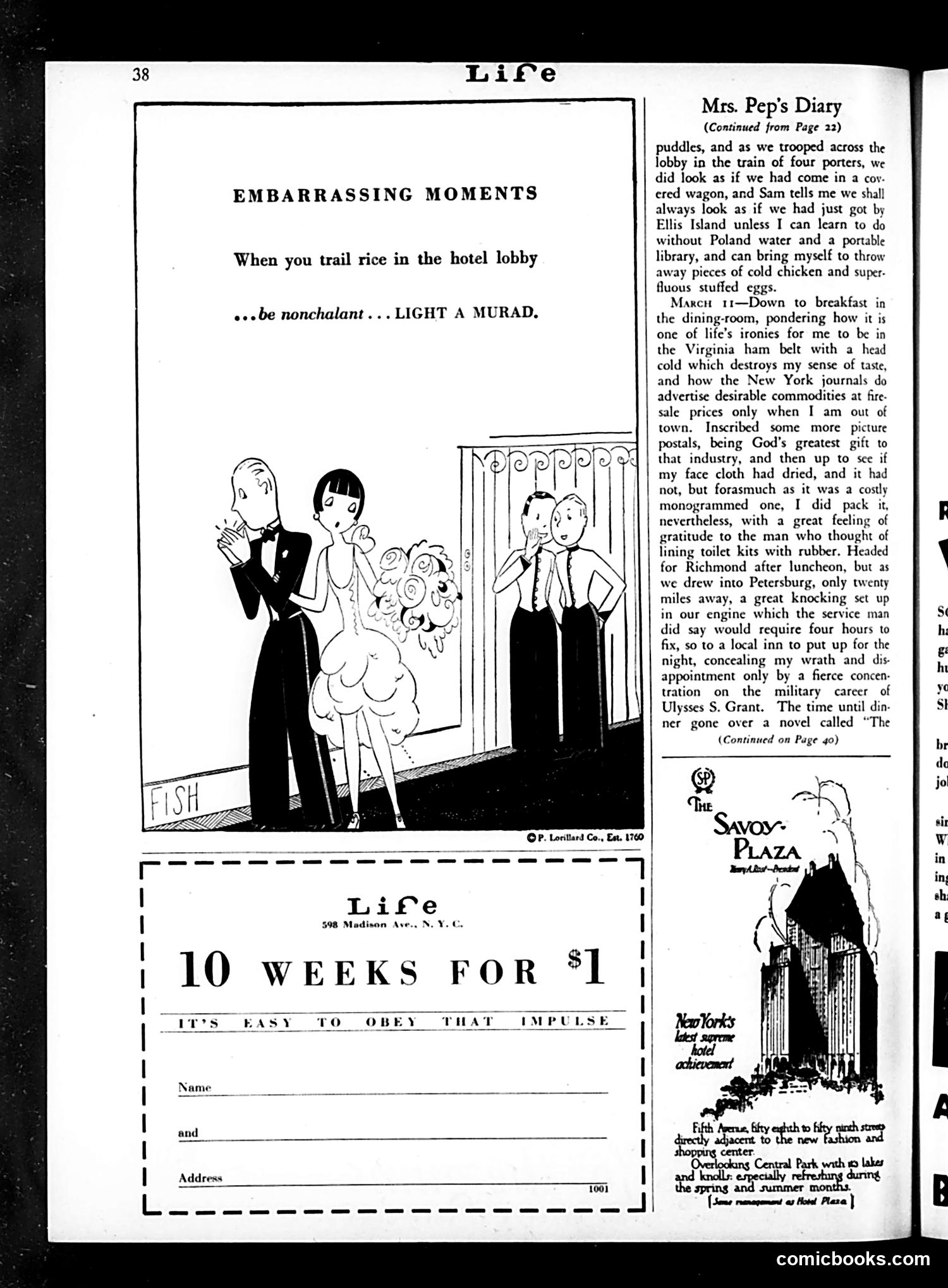
This page contains a single-panel cartoon titled "Embarrassing Moments" that satirizes social anxiety and product advertising in the 1920s-30s era. **The Joke:** A couple has accidentally trailed rice through a hotel lobby (likely from a wedding), creating an embarrassing situation that reveals their newlywed status. The cartoon's punchline suggests the solution: smoke a Murad cigarette to appear "nonchalant" and mask the embarrassment. **The Satire:** This is absurdist humor mocking how advertising promised that consumer products could solve social problems and boost confidence. The suggestion that smoking could make an awkward moment disappear reflects the era's widespread belief in cigarettes as sophisticated, anxiety-reducing status symbols. **The Advertisement:** Below the cartoon, Life magazine runs a subscription offer ("10 weeks for $1"), and a Savoy-Plaza hotel advertisement appears on the right—fitting placement given the cartoon's hotel-lobby setting. The page exemplifies how Life magazine blended humor with advertising, often making the ads themselves part of the satirical content.
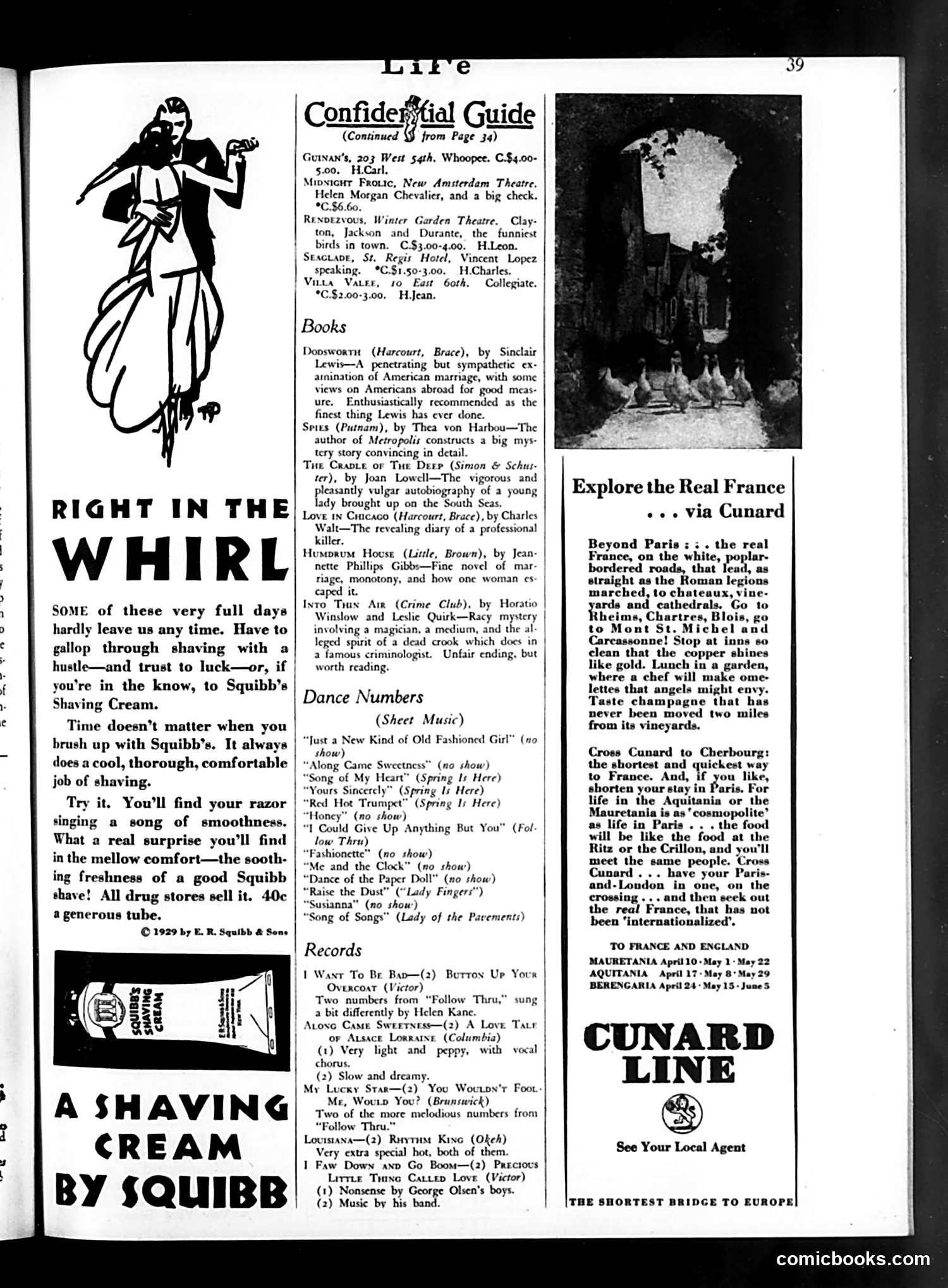
This page from Life magazine contains primarily **advertising and entertainment listings** rather than political satire. The main visual element is a **Squibb's Shaving Cream advertisement** featuring a stylized illustration of a man shaving in a hurried, exaggerated manner—reflecting the page's humorous headline "RIGHT IN THE WHIRL," which jokes about modern life's hectic pace. The ad copy plays on 1920s anxieties about time management, suggesting that busy professionals need reliable grooming products. The rest of the page lists **Broadway entertainments, books, dance numbers, and records**—typical Life magazine content from the prosperous late 1920s. Notable are references to current shows like "Spring Is Here" and "Follow Thru," and book recommendations including Sinclair Lewis's *Dodsworth*. The **Cunard Line advertisement** promotes travel to France, appealing to affluent readers interested in European tourism. There is **no significant political or satirical content** on this particular page—it's primarily commercial and entertainment-focused.
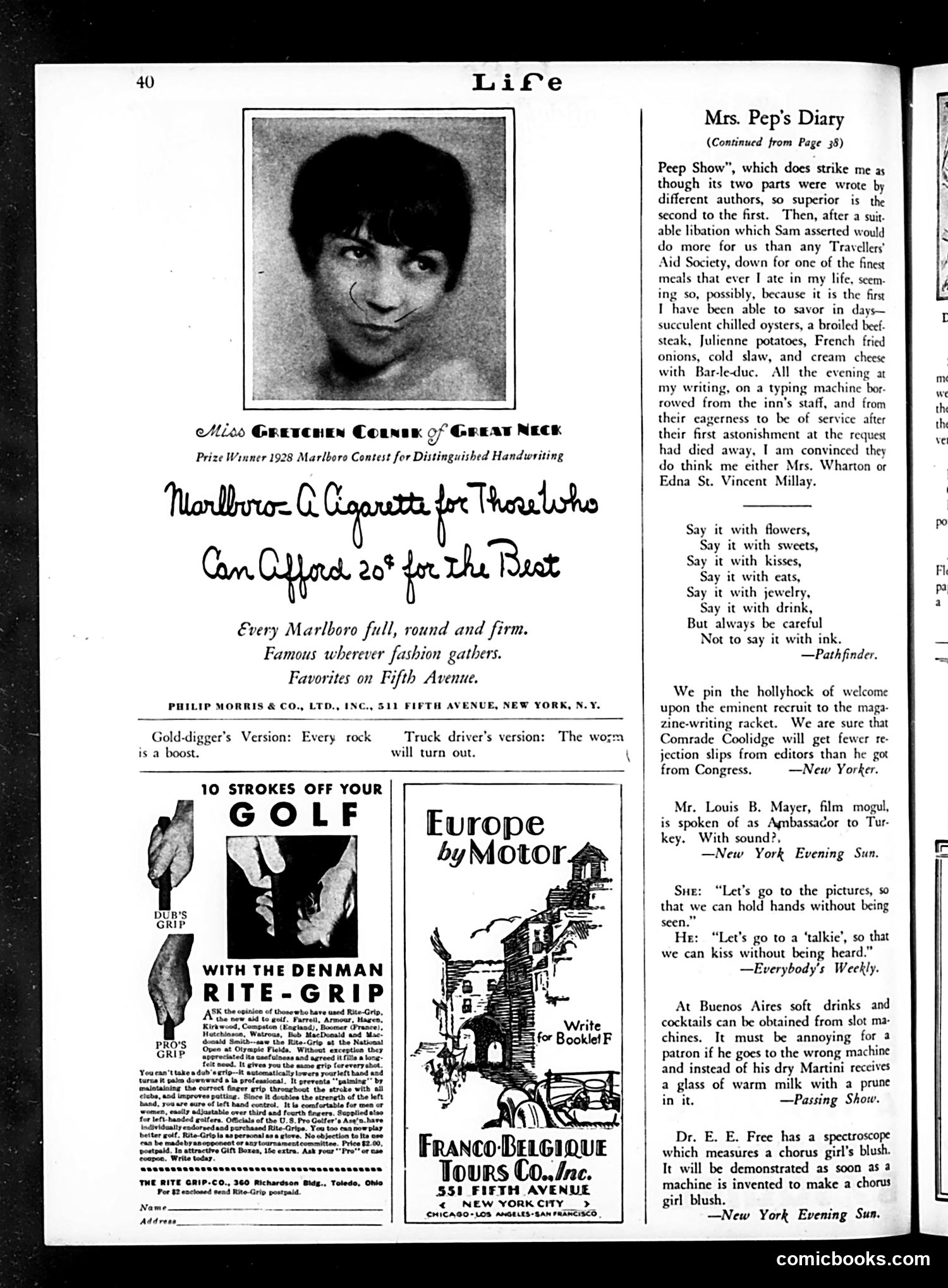
This page is primarily **advertising and humor columns** rather than political cartoons. The main content includes: **Advertisement Section:** A portrait of "Miss Gretchen Cosnsk of Great Neck," winner of a 1928 Marlboro handwriting contest, accompanied by cigarette and golf-grip product ads. **Humor Columns:** "Mrs. Pep's Diary" (continued from prior page) contains satirical social commentary typical of 1920s Life magazine—witty observations about theater, dining, and urban life. **Sidebar Jokes:** Brief humorous pieces from various publications mock contemporary topics: silent vs. "talkie" movies, film industry figures like Louis B. Mayer, vending machines in Buenos Aires, and a scientist measuring chorus girls' blushes—all reflecting 1920s-30s popular culture concerns. The humor is gentle, society-focused satire rather than hard political commentary. The page reflects Jazz Age concerns: cinema technology, consumerism, and urban sophistication.
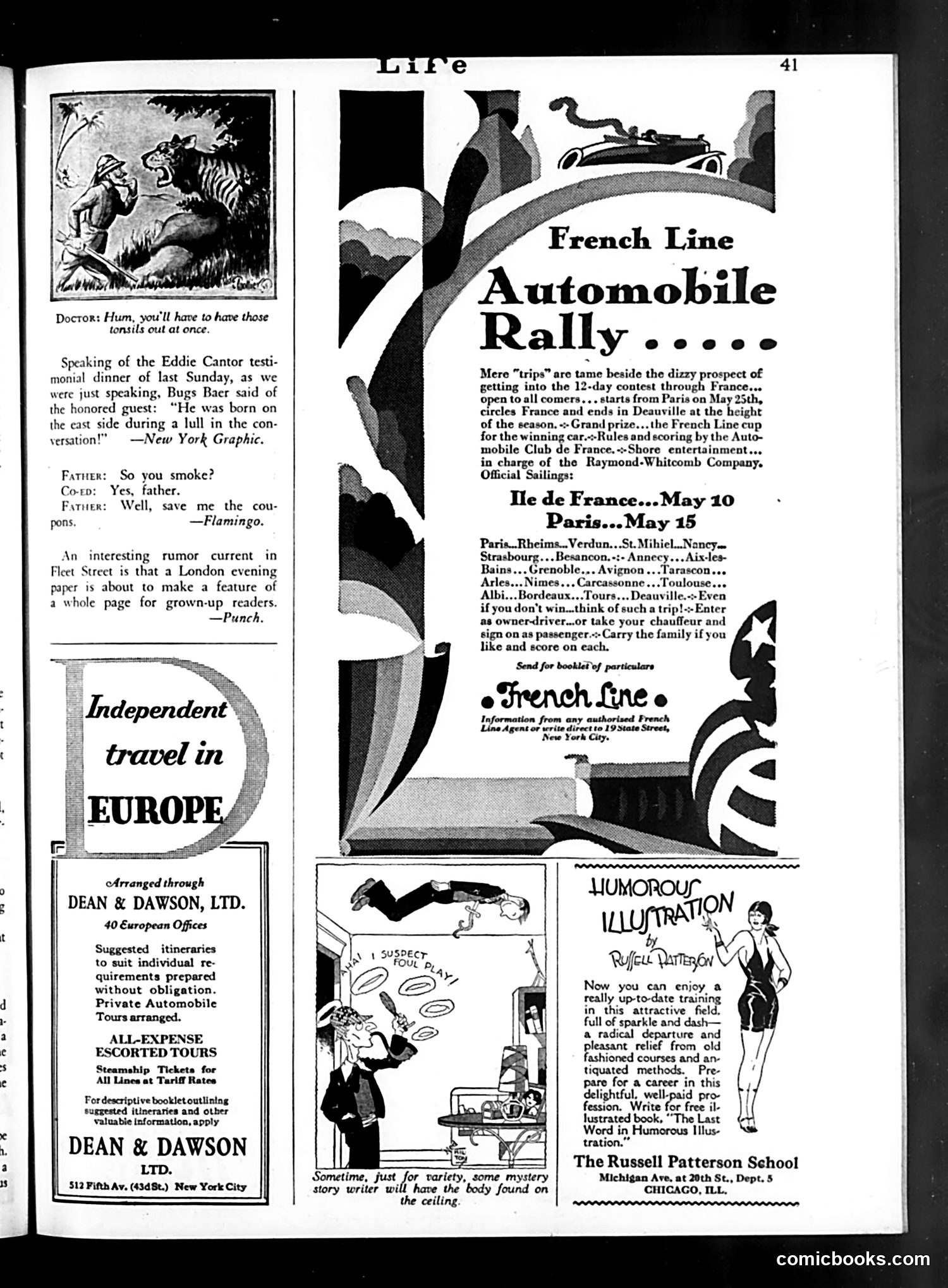
This page is primarily **advertising**, with small humor snippets interspersed. The cartoons are brief, conventional jokes: **Top left cartoon**: A doctor tells a patient he needs tonsils removed. The humor references Eddie Cantor (a popular entertainer of the era), quoting humorist Bugs Baer's joke that Cantor "was born on the east side during a lull in the conversation"—meaning he's perpetually talkative. **Other humor items**: Brief one-liners about smoking, cigarette coupons, and a London newspaper planning a page "for grown-up readers" (satirizing lowbrow journalism). **Main content**: Advertisements for travel (Dean & Dawson touring company), a French Line automobile rally through France, and the Russell Patterson School for humorous illustration training. The page reflects 1920s leisure culture—luxury travel, automobiles, entertainment careers—rather than political satire. The humor is mild, domestic, and advertising-adjacent rather than cutting social commentary.
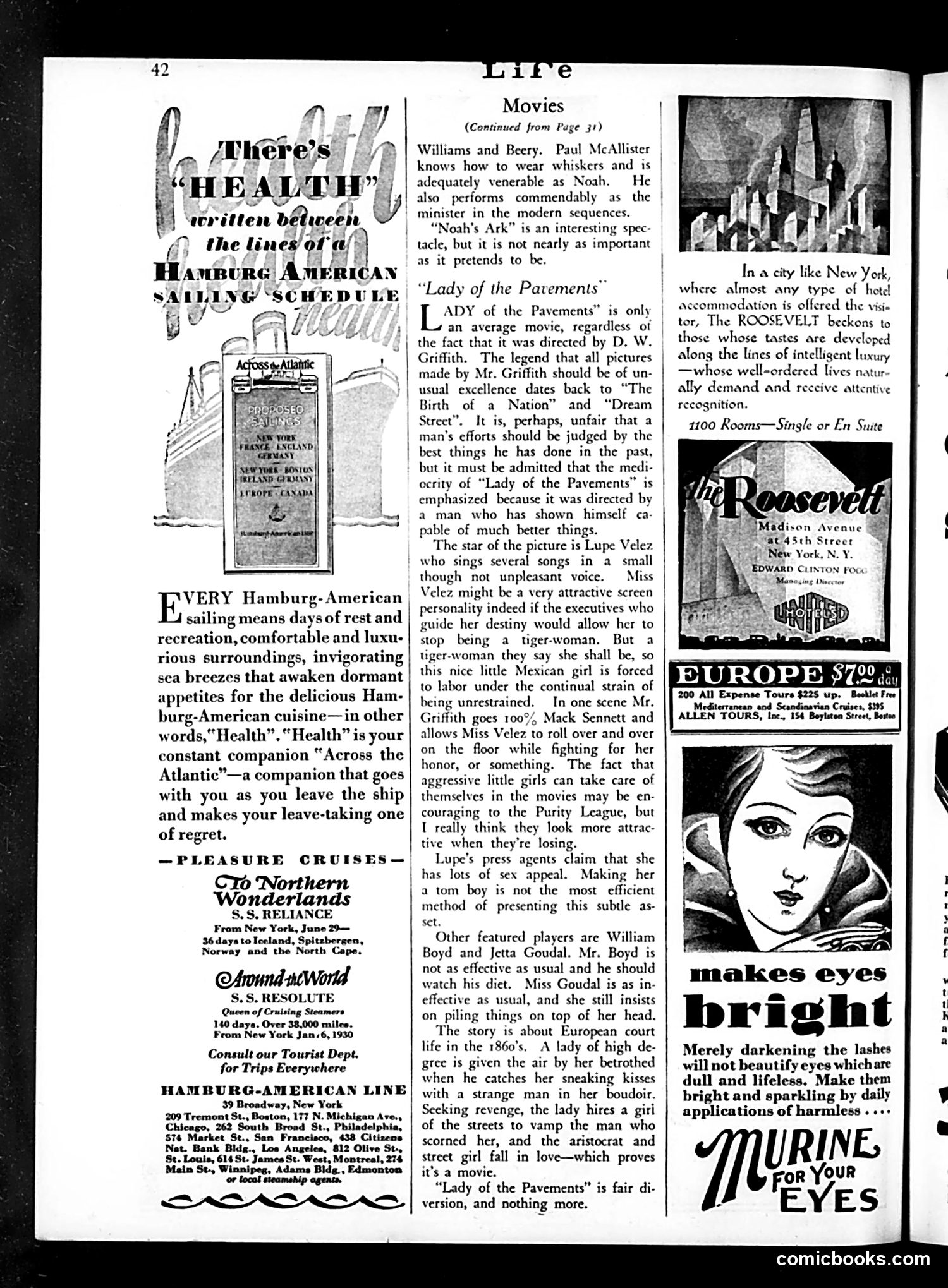
This page combines a Hamburg-American cruise line advertisement with a movie review column. **The Advertisement (left):** Promotes luxury ocean travel on Hamburg-American steamships, emphasizing "Health" as the constant companion of transatlantic voyages. It lists multiple cruise options and shipping company offices nationwide—typical 1920s-era corporate advertising. **The Movie Review (center-right):** Critiques D.W. Griffith's film "Lady of the Pavements," starring Mexican actress Lupe Velez. The reviewer complains that Griffith, once celebrated for "Birth of a Nation" and "Dream Street," has produced only an average picture. The main criticism targets how studio executives force Velez into a "tiger-woman" persona rather than leveraging her actual sex appeal. The plot involves a street girl hired to seduce an aristocrat—typical melodrama. The tone is somewhat condescending toward both the film and its star, reflecting period attitudes about Mexican performers and "B-movie" productions.
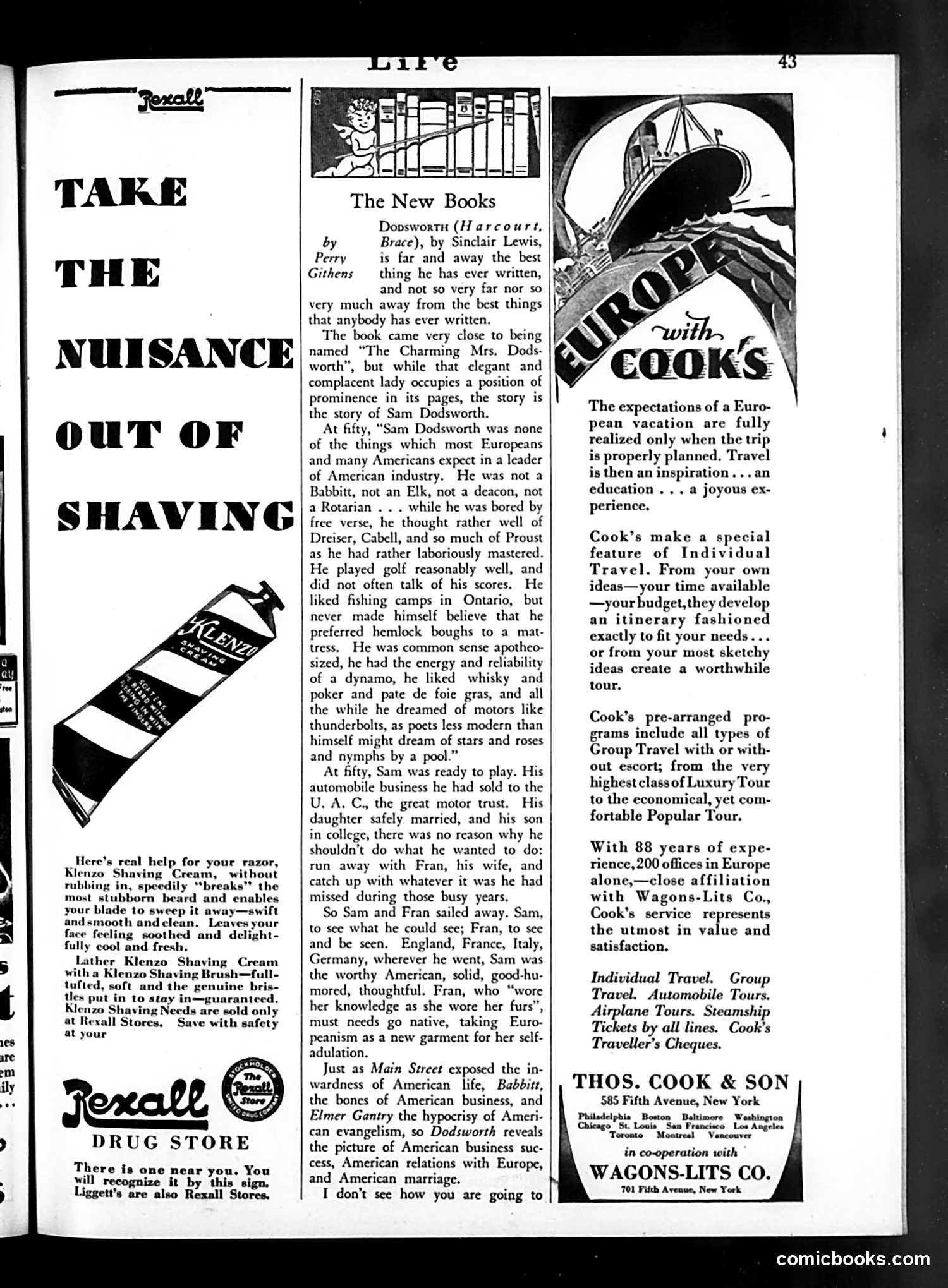
This page combines a **Rexall shaving cream advertisement** (left) with a **book review** (center-right) and **travel agency advertisement** (right). The main content is Perry Githens' review of Sinclair Lewis's novel *Dodsworth*. Githens praises it as Lewis's best work, describing protagonist Sam Dodsworth as an atypical American industrialist—cultured, unpretentious, and thoughtful rather than the stereotypical greedy businessman. The novel follows Sam and his wife Fran's European vacation after he sells his auto business, exposing differences in how Americans and Europeans approach culture and marriage. The review contextualizes *Dodsworth* within Lewis's body of social criticism (following *Main Street* and *Babbitt*), positioning it as an examination of American business success and transatlantic relations. The advertisements flanking the review—for shaving products and luxury travel—are period typical for *Life*, a magazine targeting affluent, educated readers interested in both consumer goods and literary culture.
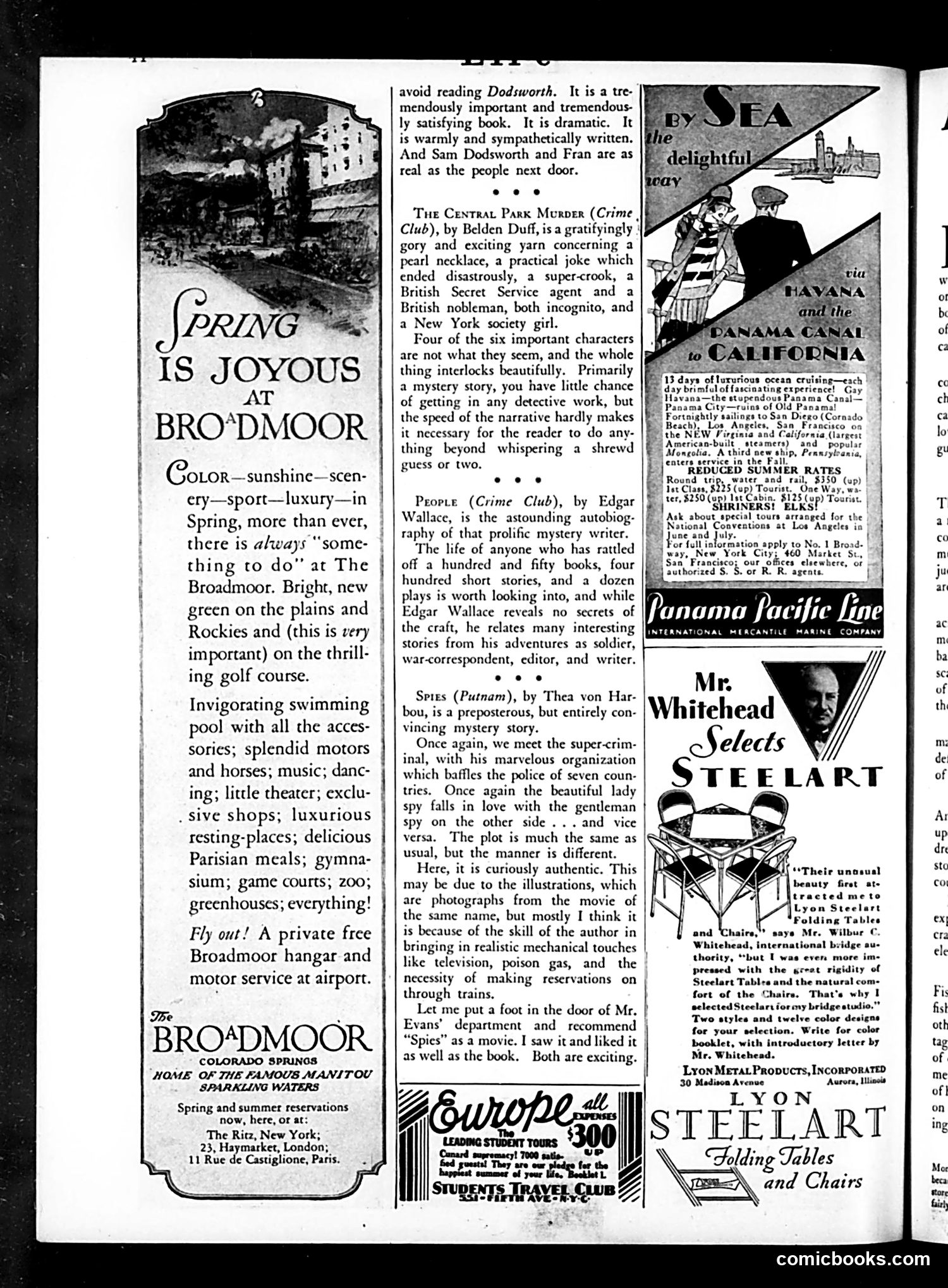
This page consists primarily of **book reviews and travel/furniture advertisements** rather than political cartoons. The book section reviews contemporary mystery and crime novels: *Dodsworth*, *The Central Park Murder*, *People* (Edgar Wallace's autobiography), and *Spies*. These are straightforward literary recommendations typical of 1920s-30s Life magazine. The advertisements promote luxury destinations (The Broadmoor resort, Panama Pacific cruise line) and furniture (Steelart folding tables and chairs), reflecting the magazine's affluent readership. The only visual element is a small illustration of ocean travelers, accompanying cruise advertising. **No political satire or social commentary is present.** This appears to be a standard editorial-advertising page aimed at upper-class readers interested in leisure travel, literature, and consumer goods during the interwar period.
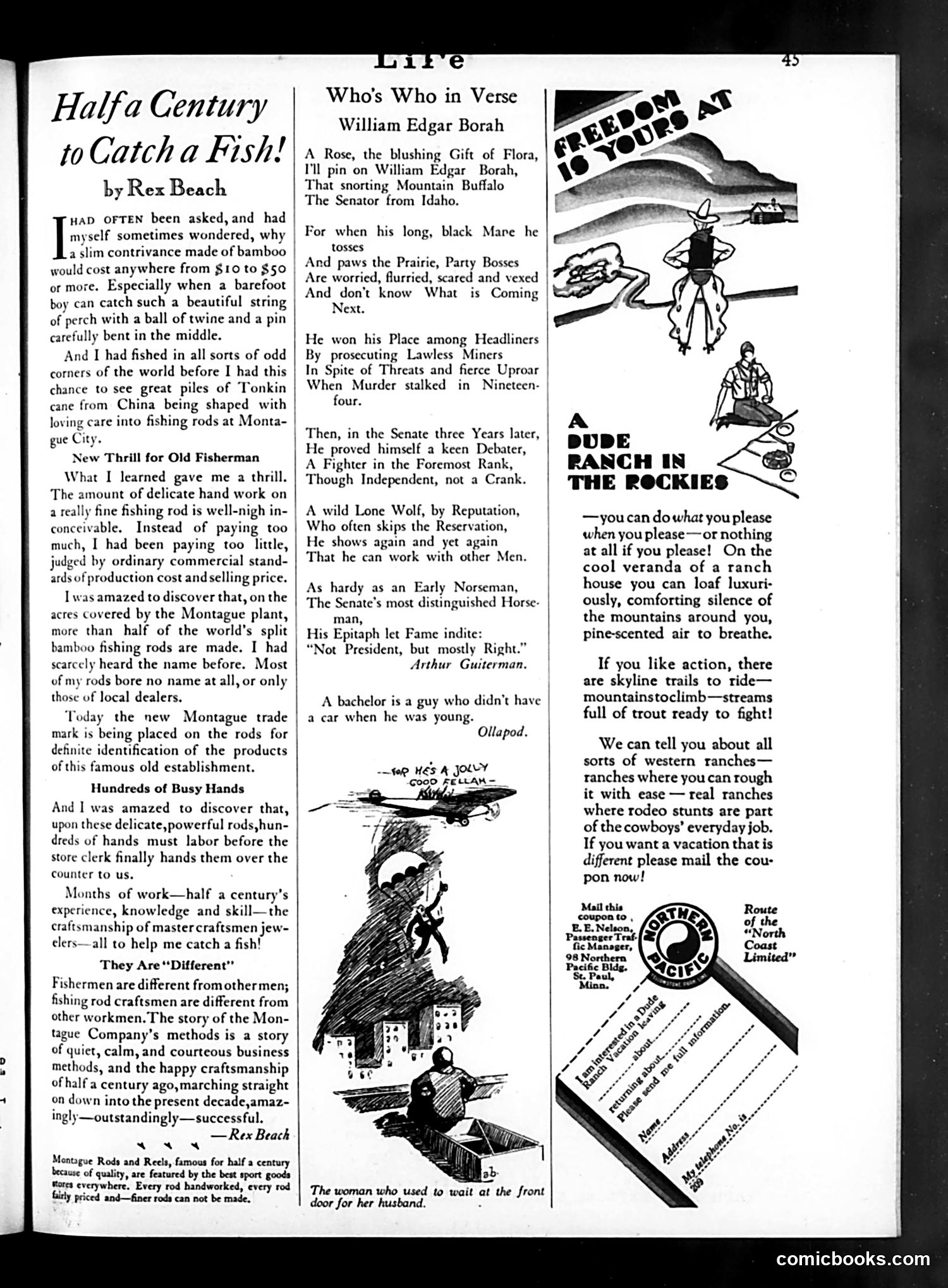
This page contains three distinct elements: **Main Article**: Rex Beach's essay on Montague fishing rods celebrates American craftsmanship—specifically how bamboo fishing rods require months of skilled labor despite their modest price. The piece promotes the Montague Company's dedication to quality and tradition, framed as a factory tour discovery. This is essentially advertorial content disguised as journalism. **"Who's Who in Verse"**: Arthur Guiterman's satirical poem about Senator William Edgar Borah of Idaho characterizes him as a wild, unpredictable "Mountain Buffalo" and "Lone Wolf"—independent-minded and prone to bucking party leadership. The verse suggests Borah is effective ("mostly Right") but difficult to control, using equestrian metaphors to mock his stubbornness. **Advertisements**: A dude ranch advertisement and miscellaneous comic one-liners about bachelors and housewives fill remaining space. The page targets affluent readers interested in quality goods and political commentary.
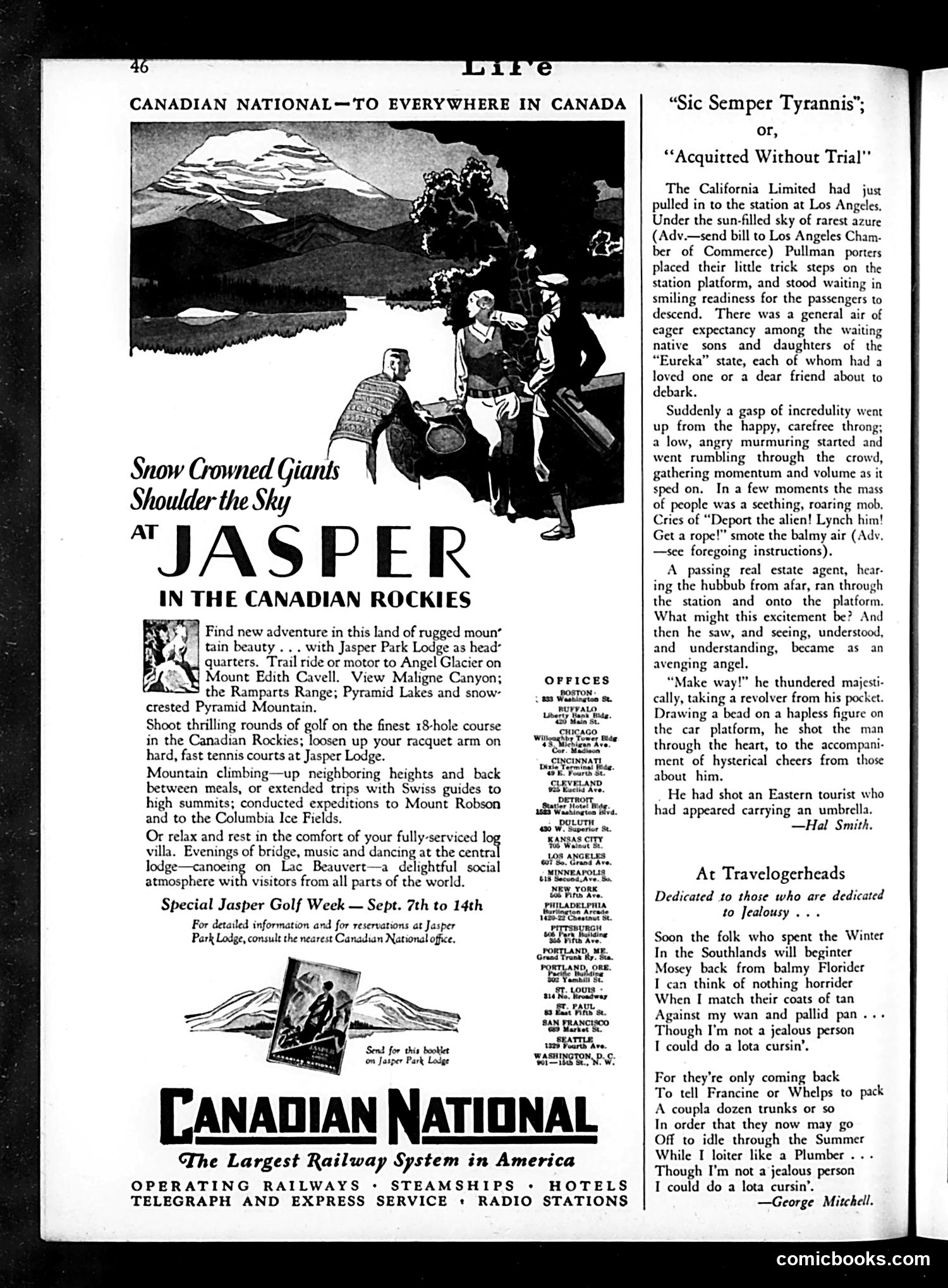
This page is primarily **advertising** for Canadian National Railway's Jasper Park Lodge in the Rocky Mountains, featuring scenic imagery and amenities (golf, hiking, lodging). The text content consists of two satirical short stories: 1. **"Sic Semper Tyrannis"** ("Thus Always to Tyrants"): A dark satire about mob hysteria in Los Angeles. A real estate agent shoots an Eastern tourist dead—not for any crime, but simply for carrying an umbrella, a symbol of Eastern/non-California identity. The mob cheers. The satire mocks California nativism, xenophobia, and violent prejudice against outsiders. 2. **"At Travelogerheads"**: A lighter verse about winter travel envy—someone jealously resents vacationers returning from Florida with tans, wanting them to pack away their evidence of leisure. Both pieces reflect 1920s-30s American anxieties: regional prejudice, anti-immigrant sentiment, and class/lifestyle tensions. The first is notably sharp social criticism masked as humor.
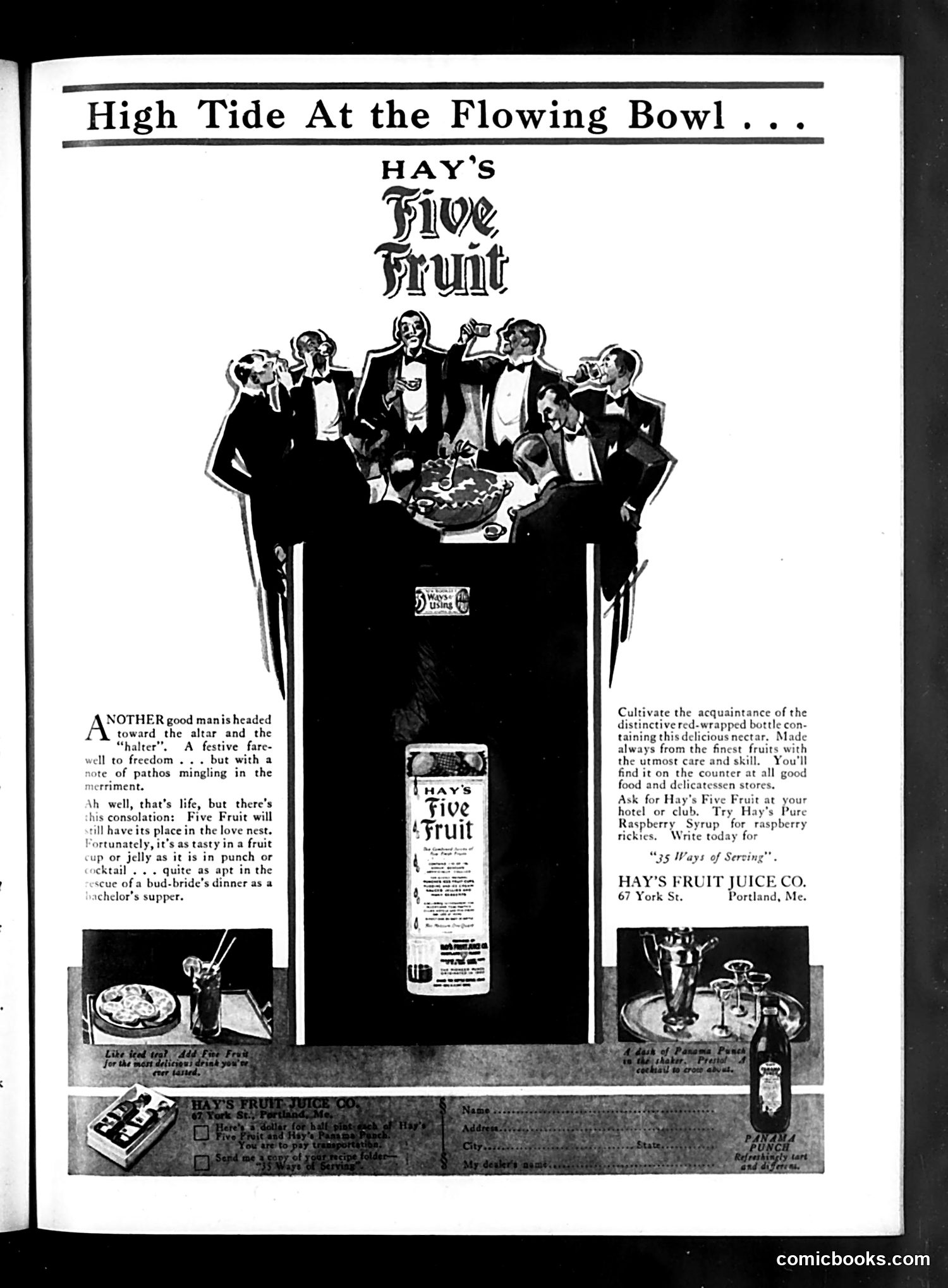
This is primarily a **product advertisement** for Hay's Five Fruit juice, disguised as humorous editorial content. The "cartoon" depicts a bachelor's final night before marriage—a traditional "stag party" theme—with formally dressed men gathered around a bowl of punch at what appears to be a celebratory gathering. The joke plays on the phrase "flowing bowl" (a classical reference to drinking and merriment) while using the occasion to pitch the fruit juice as an essential ingredient for both bachelor parties and subsequent married life. The text humorously frames marriage as loss of freedom ("headed toward the altar and the 'halter'") while asserting the juice will remain a consolation in domestic life. The supporting images show serving suggestions for the product in various contexts. This represents early 20th-century **advertorial content**—blending editorial humor with product promotion—a common magazine practice of that era. The satire is gentle; it's primarily selling a beverage rather than making sharp political commentary.
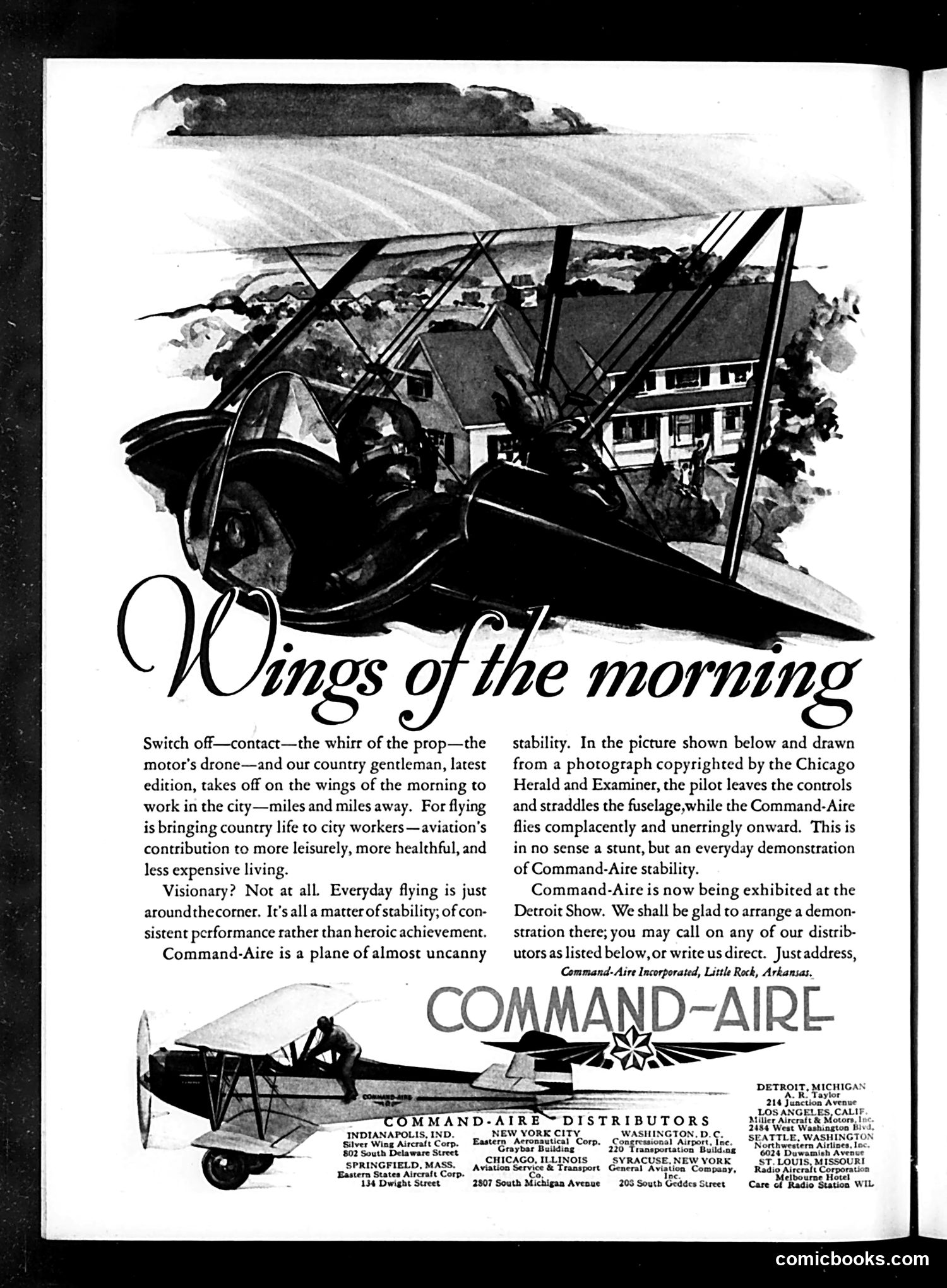
This is primarily a **product advertisement**, not political satire. It promotes the Command-Aire airplane to a 1920s-30s audience. The image shows a pilot casually straddling the aircraft's fuselage with hands off the controls—a dramatic demonstration meant to prove the plane's stability and reliability. The text frames this as "everyday" aviation capability, not a stunt. The pitch targets affluent "country gentlemen" who could commute from rural areas to cities for work, positioning aviation as enabling a more leisurely, healthful lifestyle. The advertisement emphasizes stability and "consistent performance rather than heroic achievement," reflecting early aviation's shift from daredevil spectacle toward practical, commercial transportation. The numerous distributor locations listed (Detroit, Los Angeles, Chicago, etc.) suggest this ran nationally during the period when private aircraft manufacturing competed aggressively for civilian buyers.
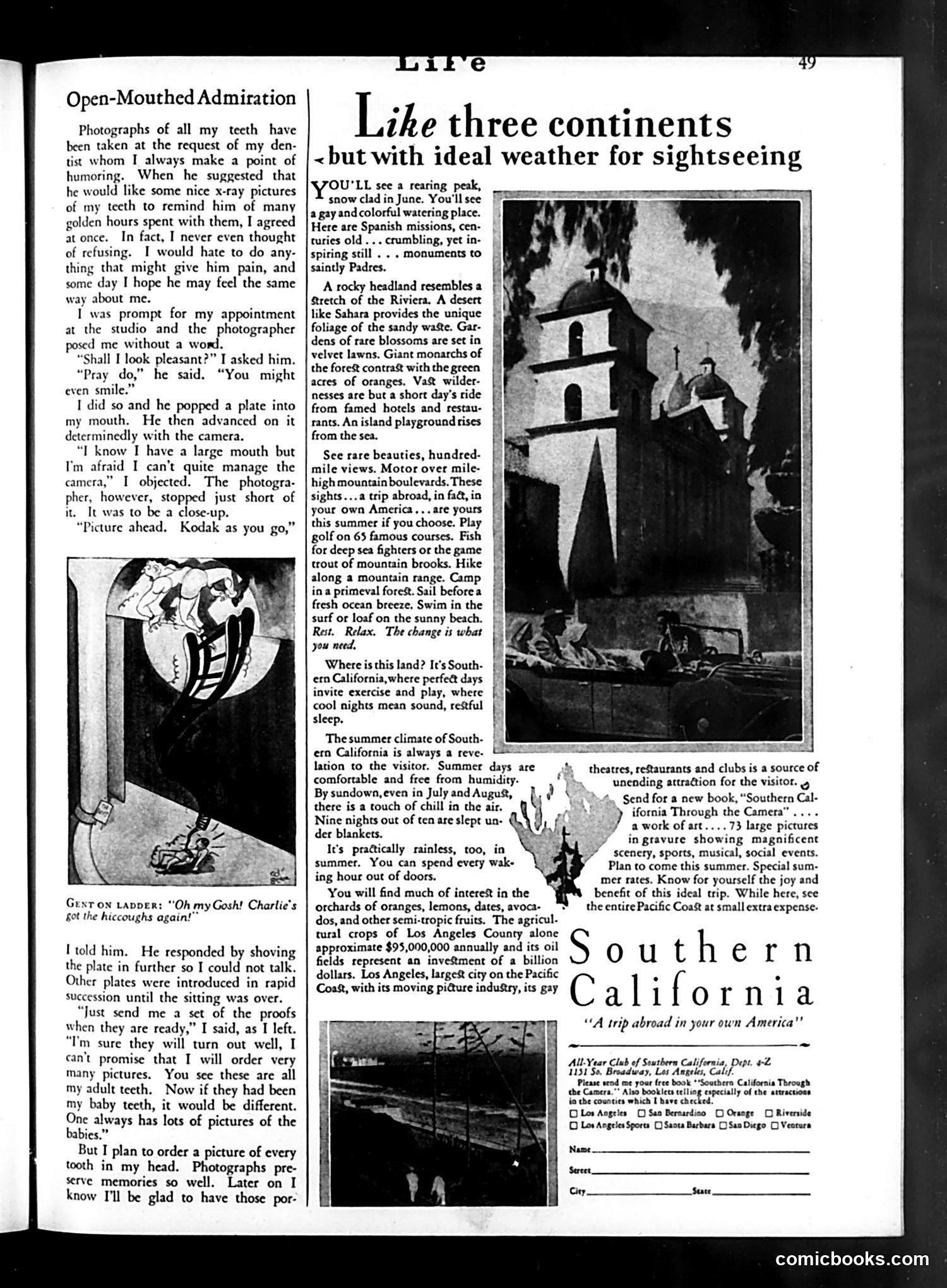
This page combines humor and advertising. The main article, "Open-Mouthed Admiration," is a comedic first-person narrative about dental X-rays. The author describes visiting a photographer for tooth portraits at their dentist's request. The humor relies on the absurdity of the situation—the photographer struggling to fit a camera in the author's mouth, and the author's deadpan reflection that they'll order pictures of each individual tooth as keepsakes, noting this would have been more practical with baby teeth. The accompanying illustration (labeled "Gent on Ladder") shows a man on a ladder with hiccoughs, reinforcing the theme of physical comedy involving the mouth. The right side features a tourism advertisement for Southern California, promoting its varied landscapes and leisure activities. This is straightforward promotional content rather than satire, typical of Life magazine's mixed editorial-advertising format.
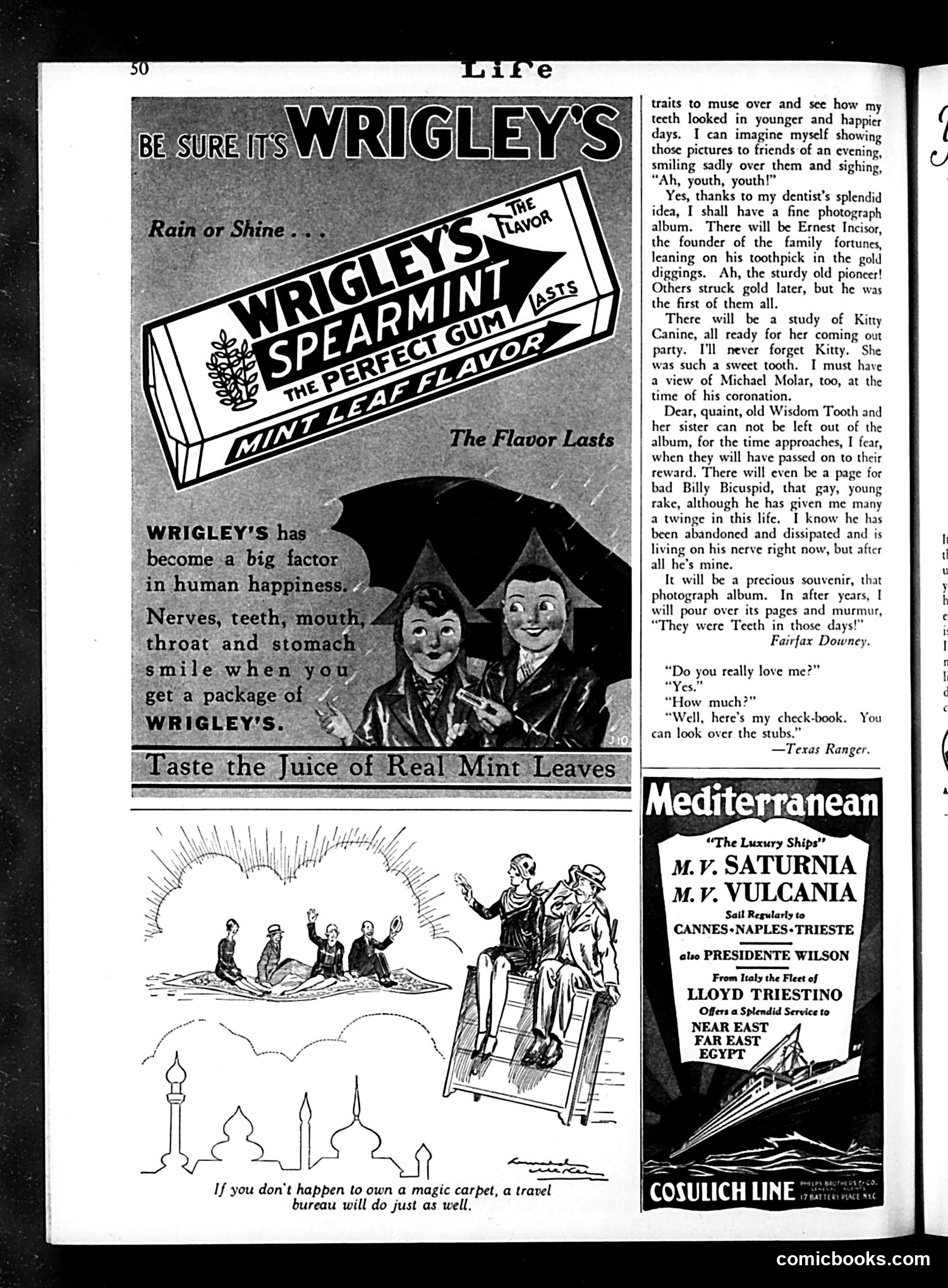
This page contains satirical humor pieces rather than political commentary. The main content is a humorous essay by Fairfax Downey about a dentist's idea: photographing patients' teeth to show them how their teeth looked in youth. Downey extends this joke by imagining a family photo album of his teeth, personifying each tooth with names like "Ernest Incisor" and "Kitty Canine," treating them as family members with biographical narratives (gold prospector, debutante, etc.). Below this is a separate joke about romantic love measured by a woman's checkbook. The page is dominated by **advertisements**: a large Wrigley's spearmint gum ad (emphasizing lasting flavor and health benefits), and smaller ads for Mediterranean cruise lines and travel services. This is largely a commercial page with light humor, not political satire. The content reflects 1920s consumer culture and leisure travel advertising.
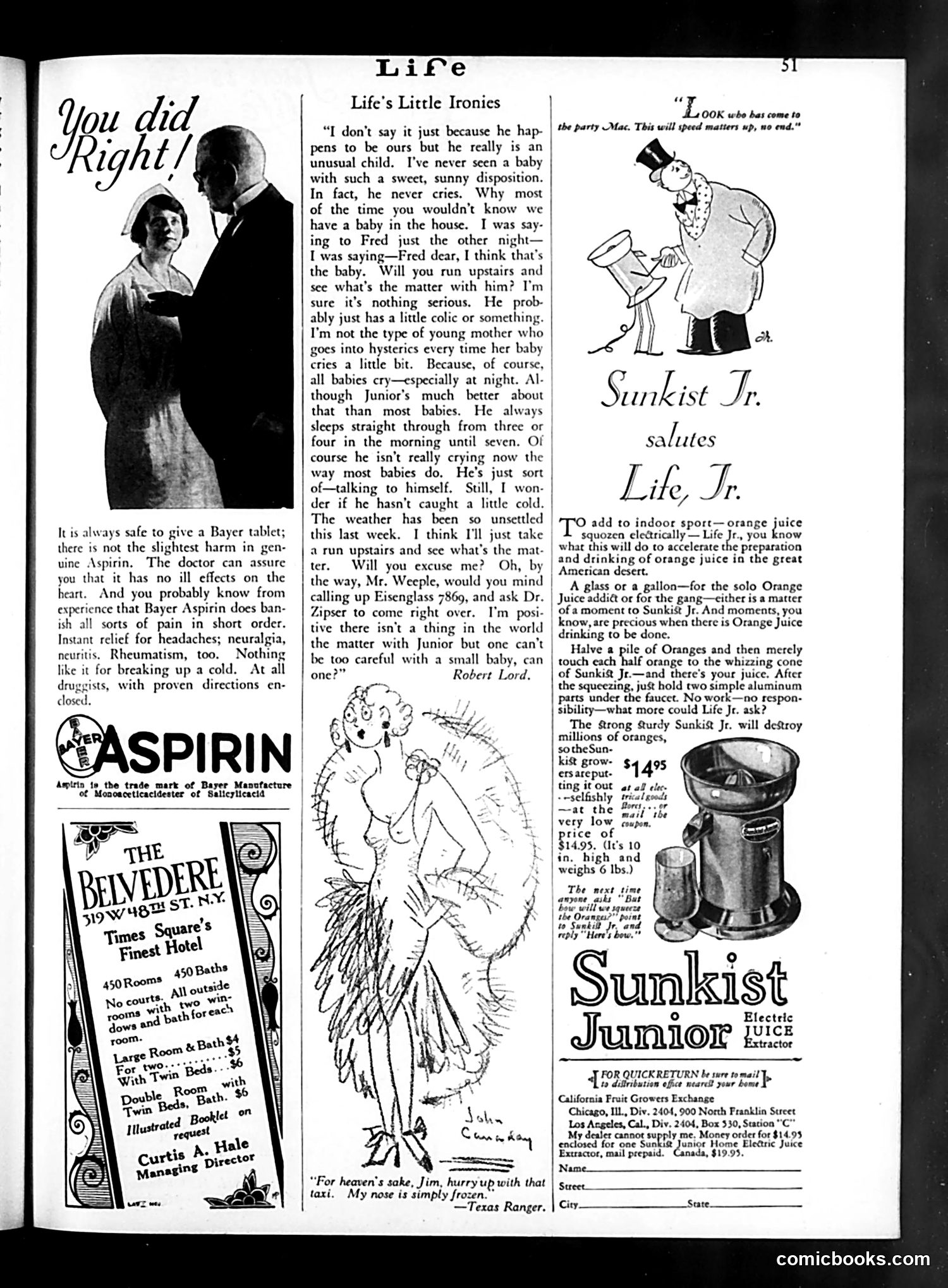
This page from *Life* magazine mixes satirical content with advertising, typical of 1920s-30s humor publications. **"Life's Little Ironies"** (center) satirizes overly protective new mothers through dramatic irony. A mother insists her baby is unusually well-behaved and never cries, then immediately contradicts herself—the baby is currently "talking to himself" (crying), the weather is "unsettled" (so she's calling the doctor), and she's generally anxious despite claiming calm confidence. Robert Lord's caption mocks the hypocrisy of mothers who brag about their children's exceptional behavior while simultaneously fussing over trivial concerns. **Side cartoons** include a brief gag about a frozen nose at a taxi stand, and a society joke about someone arriving at a party with an unspecified item that will "speed matters up." **Advertisements** for Bayer Aspirin and Sunkist Jr. (an electric orange juicer) dominate the layout—standard product promotion of the era emphasizing convenience and modern technology. The page reflects period anxieties about motherhood, consumerism, and the appeal of new electrical appliances for home use.
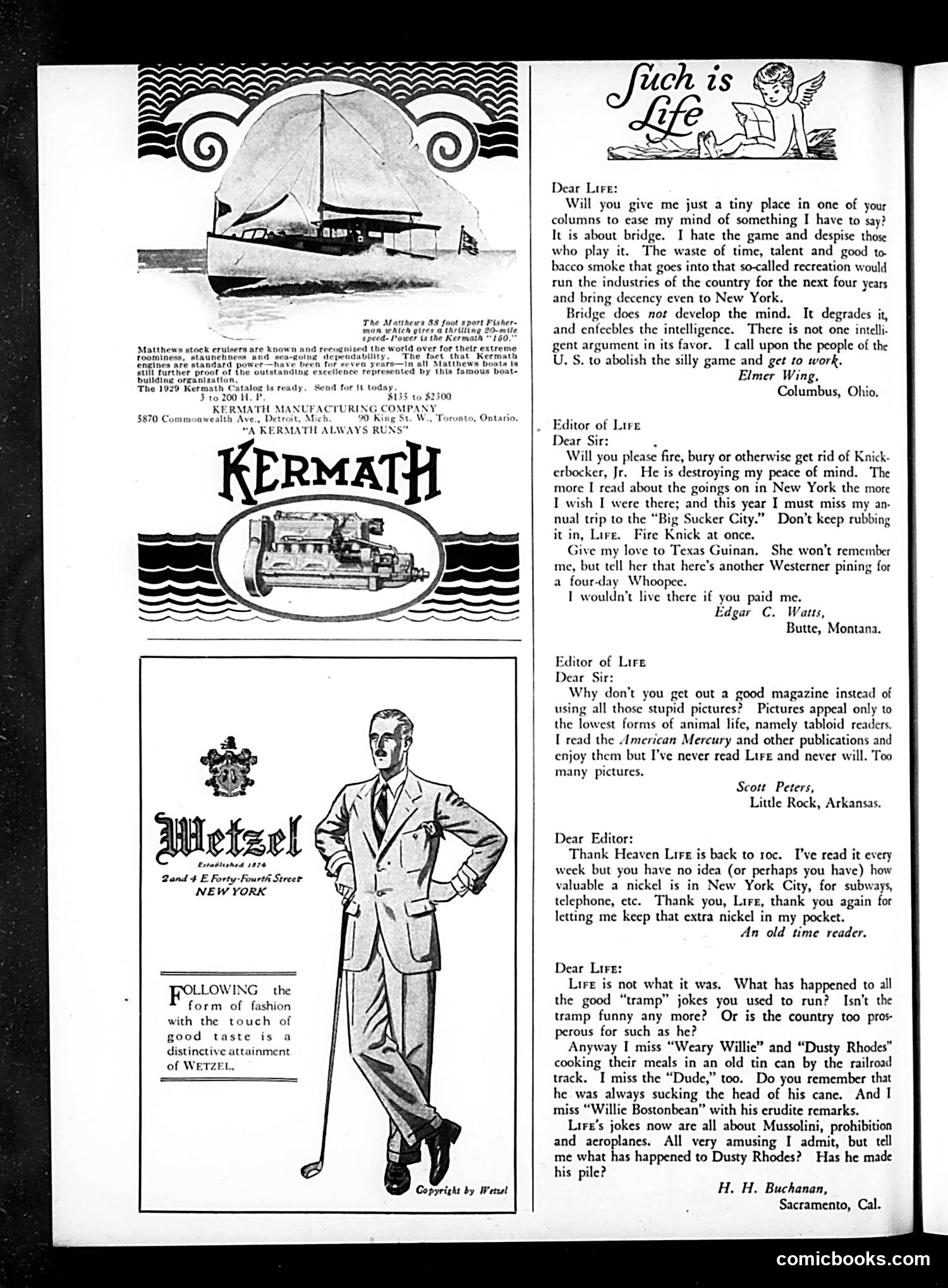
This page showcases **reader letters** to Life magazine, a major American satirical publication. The letters reveal contemporary social concerns: **Key References:** - **Bridge**: A reader condemns the card game as time-wasting and mentally degrading—reflecting early 20th-century debates about leisure and productivity. - **Knickerbocker, Jr.**: A Life columnist writing about New York nightlife; one reader laments missing the city's glamorous scene. - **Texas Guinan**: A famous speakeasy hostess during Prohibition, referenced as a symbol of New York's illicit nightlife. - **"Weary Willie" and "Dusty Rhodes"**: Tramp characters from earlier Life cartoons; a reader nostalgically requests their return, lamenting that current humor focuses on topical issues (Mussolini, prohibition, aviation). The page reflects 1920s anxieties: changing morality, Prohibition's effects, and nostalgia for simpler humor. The advertisements (Kermath engines, Wetzel clothing) anchor this in commercial American culture.
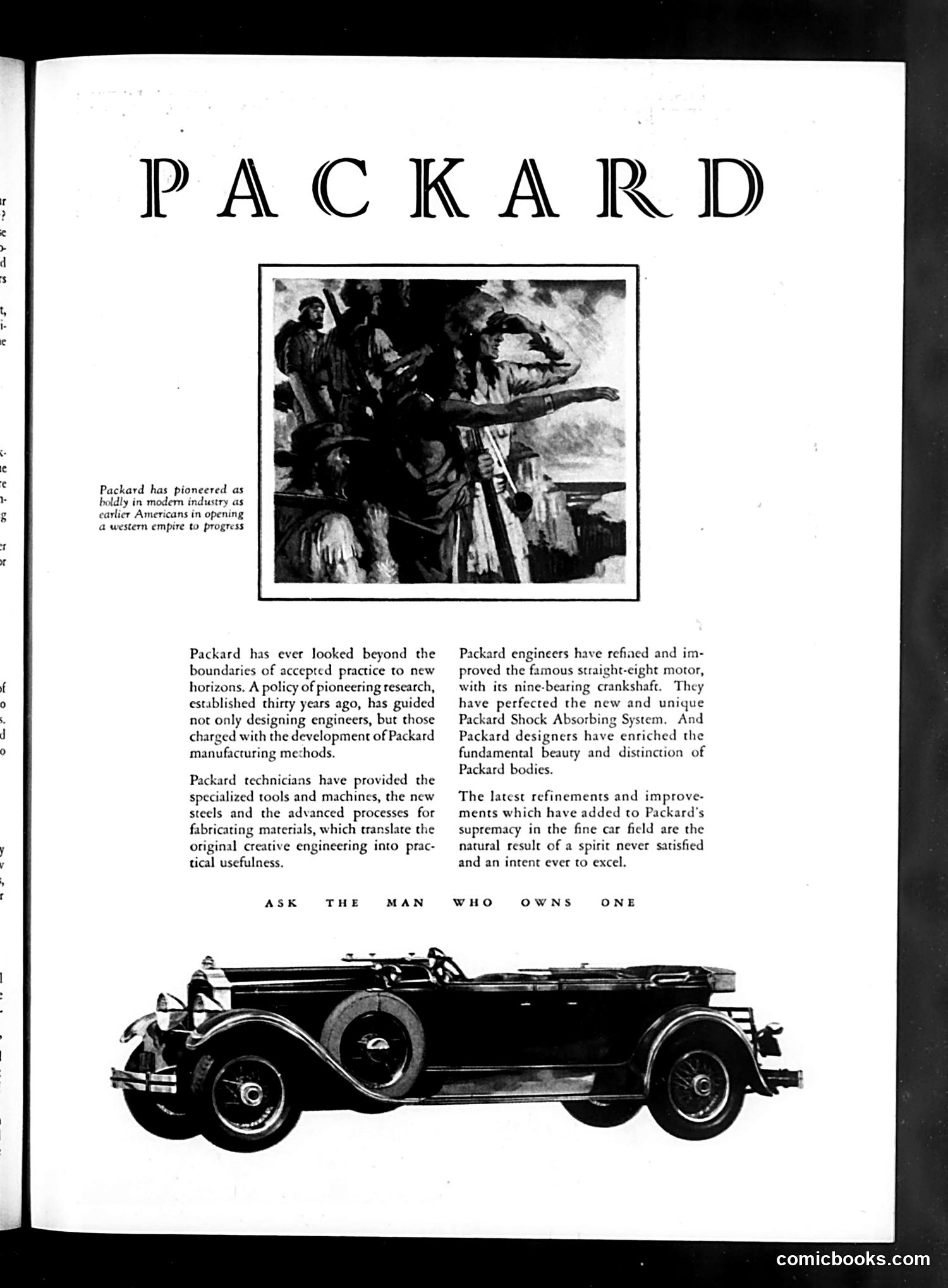
This is **not a cartoon or satire**—it's a **Packard automobile advertisement** from Life magazine's early 20th century. The page uses patriotic imagery comparing Packard's industrial innovation to American frontier expansion ("earlier Americans in opening a western empire to progress"). The photograph shows workers with industrial equipment, positioning the company as a pioneer of modern manufacturing. The advertisement emphasizes Packard's engineering achievements: refined straight-eight motors, shock-absorbing systems, and quality bodies. The slogan "ASK THE MAN WHO OWNS ONE" was Packard's actual marketing tagline, appealing to prestige and reliability. The side-profile illustration shows a luxury convertible automobile, typical of 1920s-30s advertising aesthetics. **For modern readers:** This represents how luxury car brands marketed themselves through claims of technological superiority and American industrial progress—a common advertising strategy of the era.
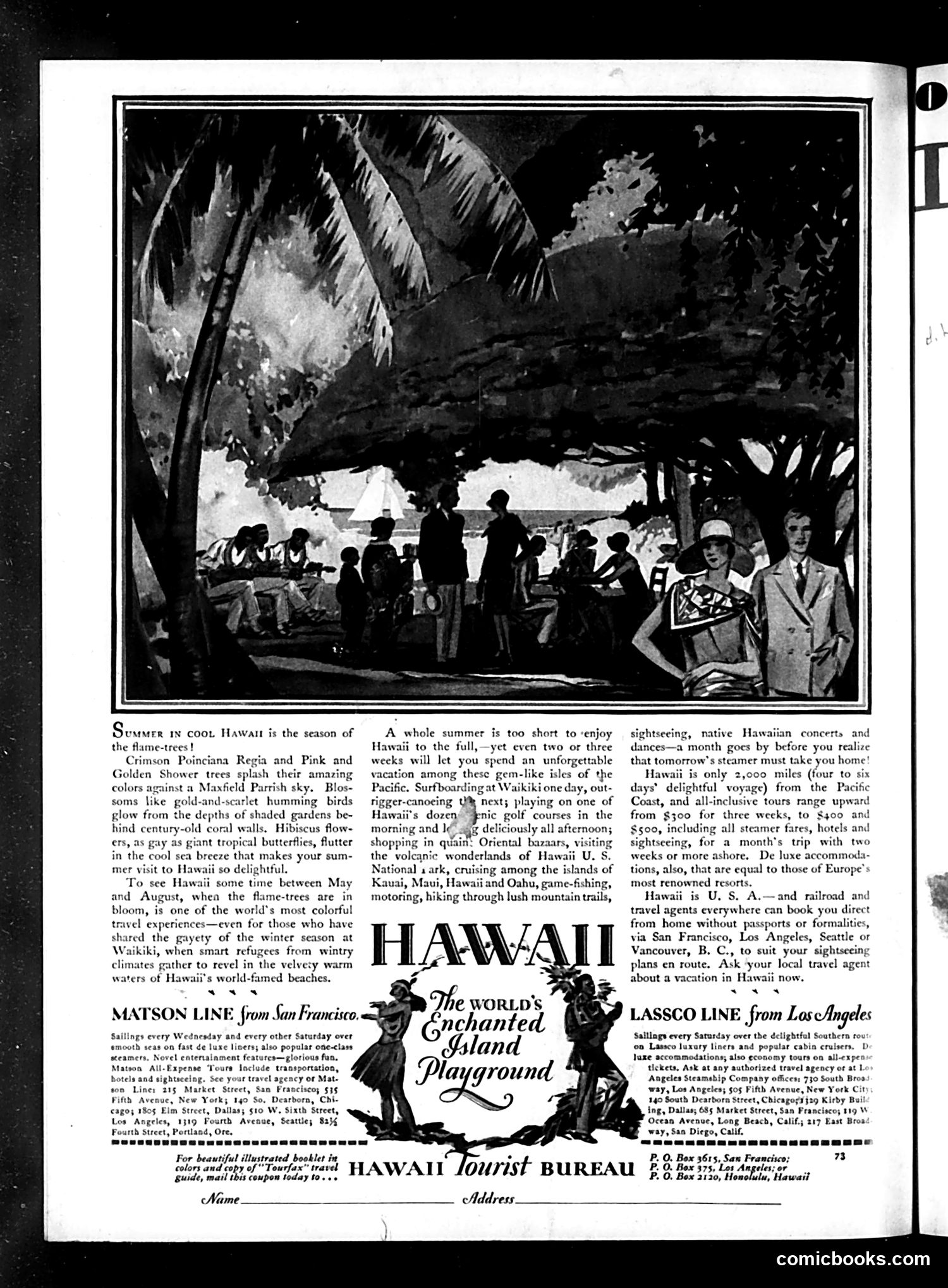
This page is primarily a **travel advertisement** rather than political satire. It promotes Hawaii as a vacation destination, emphasizing the islands' natural beauty (flame-trees, hibiscus flowers) and leisure activities (surfboarding, golf, shopping, sightseeing). The text references Hawaiian culture ("Oriental bazaars," "native Hawaiian converts and dances") in the romantic, exoticizing language typical of 1920s-30s tourism marketing. The page advertises passage via the **Matson Line** (from San Francisco) and **Lassco Line** (from Los Angeles), with pricing ranging from $300-$400 for multi-week trips. The illustration depicts tourists relaxing under palm trees at what appears to be a beach resort, suggesting leisure and escape from mainland life. This reflects early-20th-century American tourism's emergence as a commercial industry, positioning Hawaii as an accessible exotic destination for wealthy travelers.