
Life, 1929-04-19 · page 30 of 52
Life — April 19, 1929 — page 30: what you’re looking at
What you’re looking at
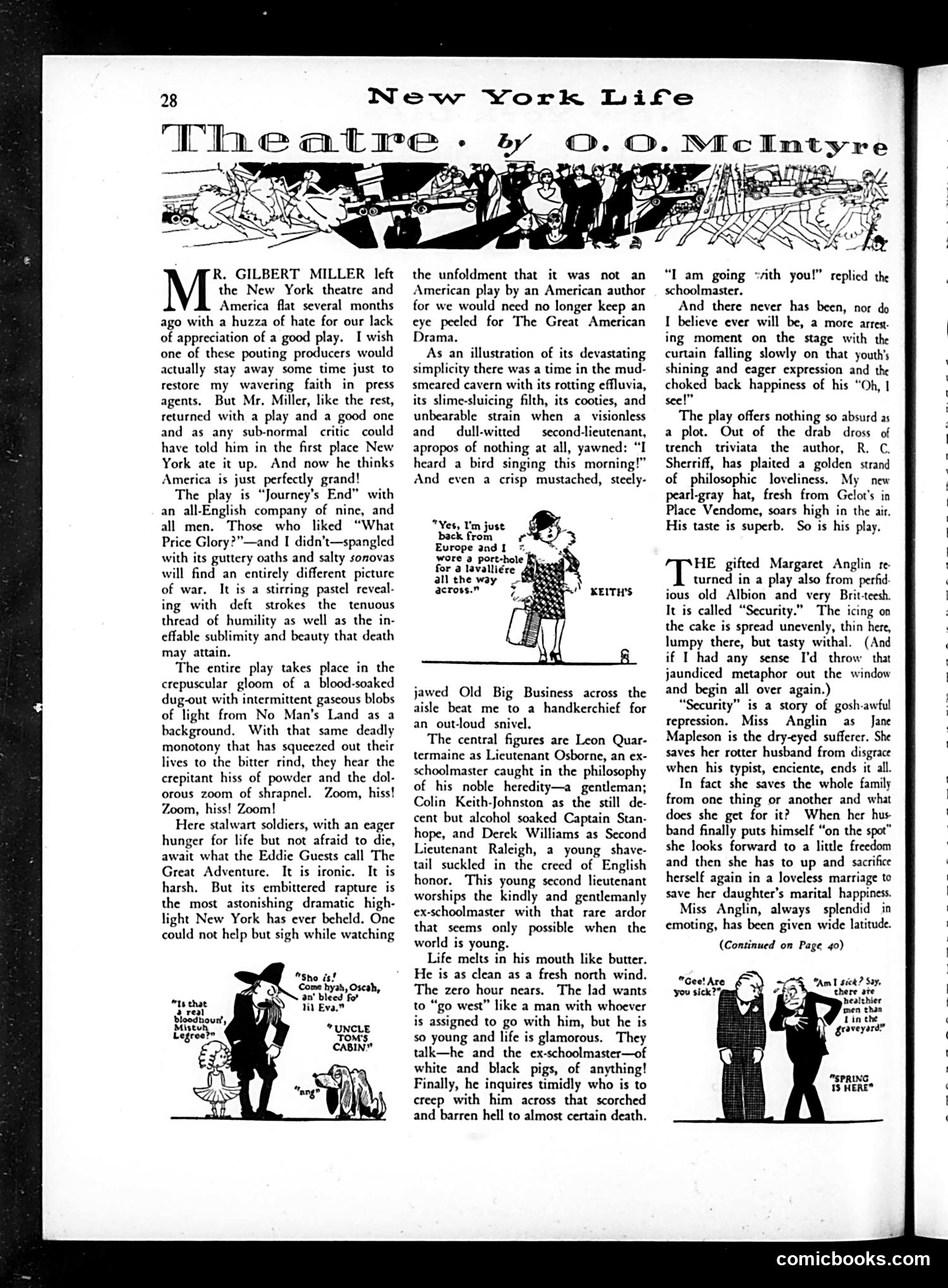
This page reviews the British war play "Journey's End," which opened in New York. The critic praises the production while making satirical points about American theatre producers and audiences. The cartoons mock theatrical pretension: one shows a character boasting about traveling to Europe with a porthole worn "for a lavallière" (a type of pendant)—satirizing shallow affectation. Another depicts "Uncle Tom's Cabin" stereotypes, likely contrasting melodramatic American theatre with the play's sophistication. The review's central irony: Mr. Gilbert Miller, a producer who *left* America complaining about lack of appreciation for good plays, now returns with a successful British play—proving New Yorkers *do* appreciate quality. The critic sarcastically suggests Miller's sudden love for America stems from commercial success, not changed circumstances. The play itself dramatizes WWI trench warfare with restraint and emotional depth, contrasting with earlier American war plays like "What Price Glory?"
📄 Transcribed text from this page (OCR, searchable)
Machine-transcribed from the original scan — historical spelling and the odd misread are preserved.
28 New York Life ae atre. oa R. GILBERT MILLER left M the New York theatre and America flat several months ago with a huzza of hate for our lack of appreciation of a good play. I wish one of these pouting producers would actually stay away some time just to restore my wavering faith in press agents. But Mr. Miller, like the rest, returned with a play and a good one and as any sub-normal critic could have told him in the first place New York ate it up. And now he thinks America is just perfectly grand! The play is “Journey’s End” with an all-English company of nine, and all men. Those who liked “What Price Glory?”—and I didn’t—spangled with its guttery oaths and salty sonovas will find an entirely different picture of war. It is a stirring pastel reveal- ing with deft strokes the tenuous thread of humility as well as the in- effable sublimity and beauty that death may attain. The entire play takes place in the crepuscular gloom of a blood-soaked dug-out with intermittent gaseous blobs of light from No Man’s Land as a background. With that same deadly monotony that has squeezed out their lives to the bitter rind, they hear the crepitant hiss of powder and the dol- orous zoom of shrapnel. Zoom, hiss! Zoom, hiss! Zoom! Here stalwart soldiers, with an eager hunger for life but not afraid to die, await what the Eddie Guests call The Great Adventure. It is ironic, It is harsh. But its embittered rapture is the most astonishing dramatic high- light New York has ever beheld. One could not help but sigh while watching ne hyah, | 3] an’ shoe » the unfoldment that it was not an American play by an American author for we would need no longer keep an eye peeled for The Great American Drama. As an illustration of its devastating simplicity there was a time in the mud- smeared cavern with its rotting effluvia, its slime-sluicing filth, its cooties, and unbearable strain when a_visionless and — dull-witted —_second-lieutenant, apropos of nothing at all, yawned: “I heard a bird singing this morning!” And even a crisp mustached, steely- "Yes pak juse back from 3 Europe and I wore a port-hol for a lavalliére all the way across.” jawed Old Big Business across the aisle beat me to a handkerchief for an outloud snivel. The central figures are Leon Quar- termaine as Lieutenant Osborne, an ex- schoolmaster caught in the philosophy of his noble heredity—a gentleman; Colin Keith-Johnston as the still de- cent but alcohol soaked Captain Stan- hope, and Derek Williams as Second Lieutenant Raleigh, a young shave- tail suckled in the creed of English honor. This young second lieutenant worships the kindly and gentlemanly ex-schoolmaster with that rare ardor that seems only possible when the world is young. Life melts in his mouth like butter. He is as clean as a fresh north wind. The zero hour nears. The lad wants to “go west” like a man with whoever is assigned to go with him, but he is so young and life is glamorous. They talk—he and the ex-schoolmaster—of white and black pigs, of anything! Finally, he inquires timidly who is to creep with him across that scorched and barren hell to almost certain death. oy O.oO. Raciney re “I am going «vith you!” replied the schoolmaster. And there never has been, nor do I believe ever will be, a more arrest. ing moment on the stage with the curtain falling slowly on that youth's shining and eager expression and the choked back happiness of his “Oh, | see!” The play offers nothing so absurd as a plot. Out of the drab dross of trench triviata the author, R. C. Sherriff, has plaited a golden strand of philosophic loveliness. My new pearl-gray hat, fresh from Gelot’s in Place Vendome, soars high in the air. His taste is superb. So is his play. HE gifted Margaret Anglin te turned in a play also from perfid- ious old Albion and very Brit-teesh. It is called “Security.” The icing on the cake is spread unevenly, thin here, lumpy there, but tasty withal. (And if I had any sense I'd throw that jaundiced metaphor out the window and begin all over again.) “Security” is a story of gosh-awful repression. Miss Anglin as Jane Mapleson is the dry-eyed sufferer. She saves her rotter husband from disgrace when his typist, enciente, ends it all. In fact she saves the whole family from one thing or another and what does she get for it? When her hus band finally puts himself “on the spot” she looks forward to a little freedom and then she has to up and sacrifice herself again in a loveless marriage to save her daughter's marital happiness. Miss Anglin, always splendid in emoting, has been given wide latitude. (Continued on Page 40) "Am | sick? Say, “SPRING 13 HERE* comicbooks.com