
A complete issue · 52 pages · 1929
Life — April 19, 1929
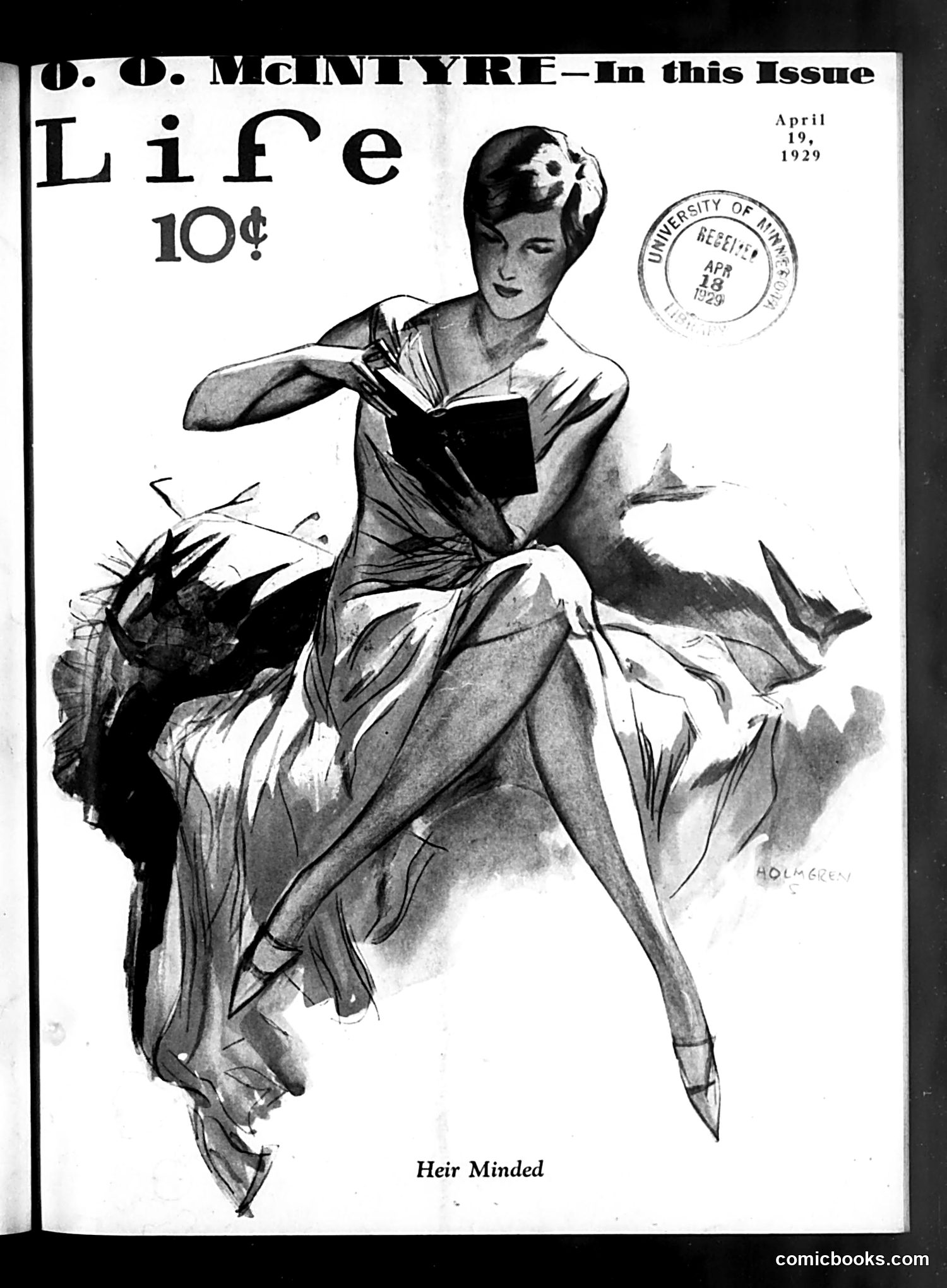
This is a **cover illustration**, not a political cartoon. The artwork by Holmgren depicts a stylized woman in flowing garments, reading a book while appearing to float or dance among large flowers. The title "Heir Minded" suggests the figure is preoccupied with intellectual or literary pursuits. The satire likely comments on **1920s attitudes toward educated women**—the playful juxtaposition of a scholarly woman (absorbed in reading) with romantic, decorative imagery (flowers, flowing dress) may mock either contemporary expectations that women remain aesthetically ornamental despite their intelligence, or conversely, mock overly intellectual women's pretensions. The context and specific target remain unclear without additional period documentation.
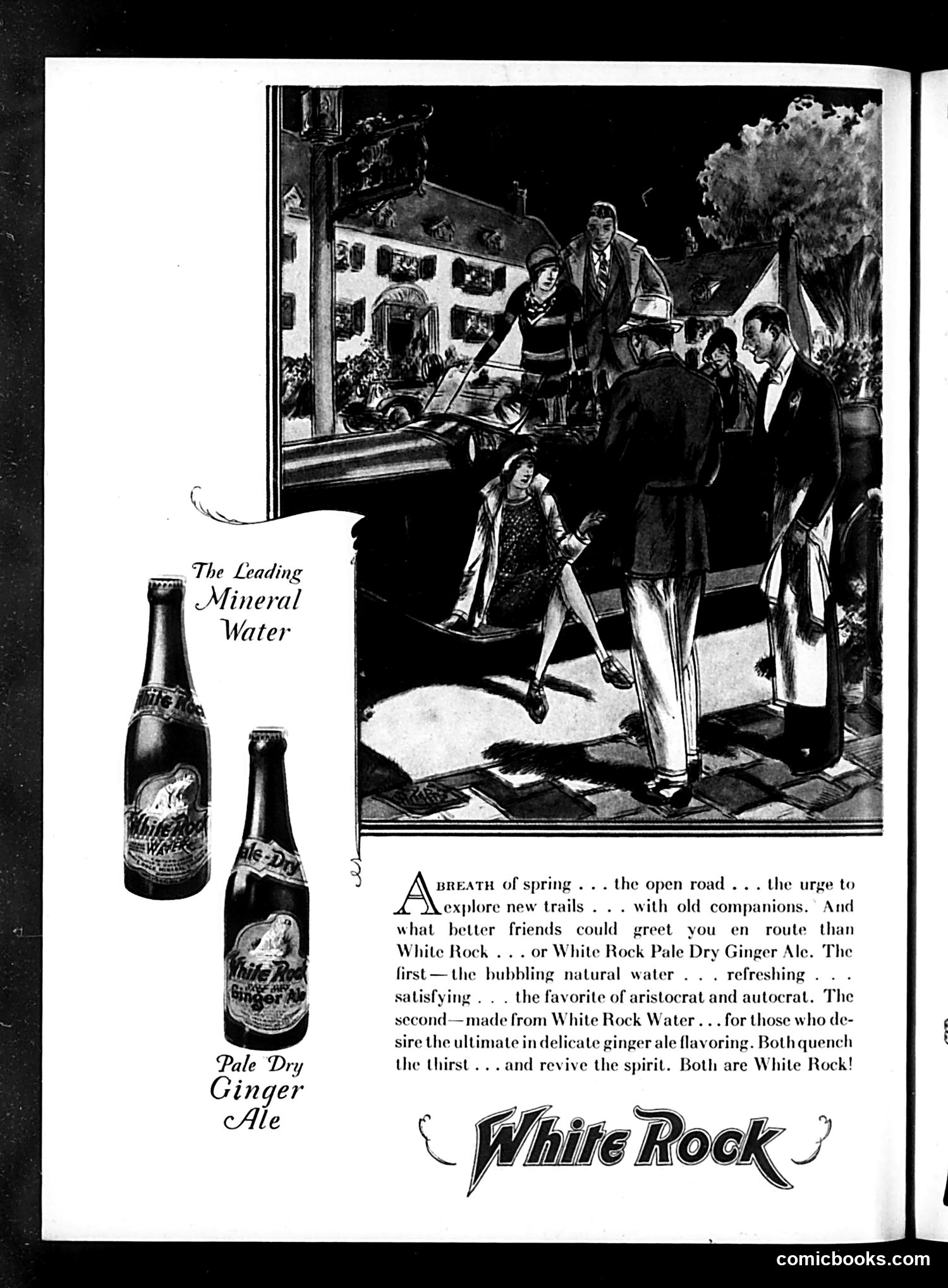
This is primarily a **product advertisement**, not political satire. It promotes White Rock brand mineral water and ginger ale as beverages for spring social occasions. The illustration depicts an affluent couple arriving at what appears to be an upscale evening gathering or party. The scene emphasizes social sophistication—"the favorite of aristocrat and autocrat," the text claims. The advertisement associates White Rock products with leisure, friendship, and refined taste. It targets wealthy consumers by positioning the beverages as essential to stylish social life. The "breath of spring" and "open road" language appeals to recreational leisure activities popular among the well-to-do. This represents typical early-20th-century luxury product marketing rather than editorial commentary.
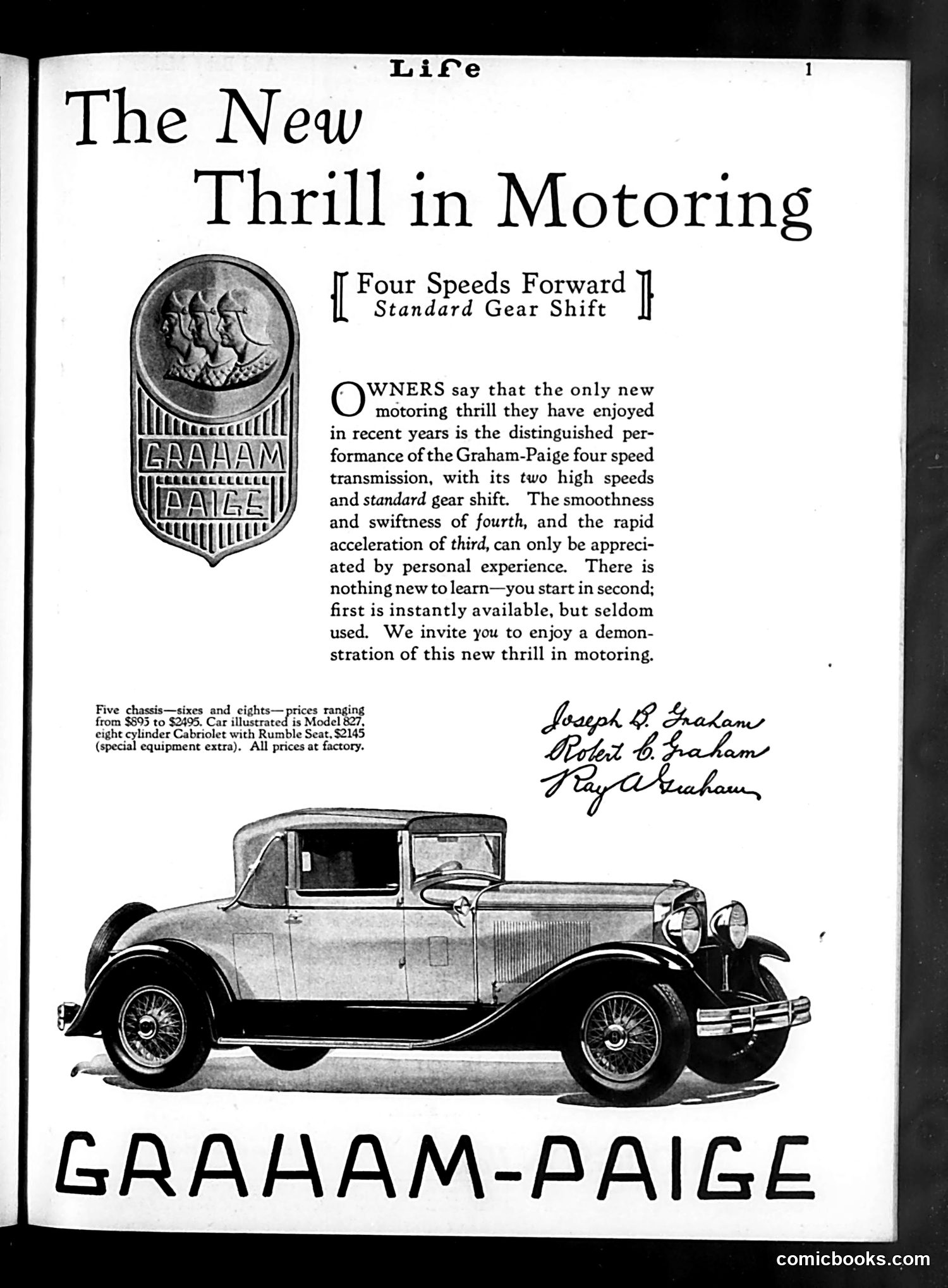
This is **not a political cartoon or satire** — it's a straightforward automobile advertisement for Graham-Paige cars, published in Life magazine. The page promotes the Graham-Paige's new four-speed transmission with a standard gear shift as a novel motoring innovation. The ad emphasizes the smoothness and acceleration of the higher gears, particularly the third and fourth speeds. The car pictured is a 1920s-era coupe model. Three signatures appear (Joseph A. Graham, Robert C. Graham, and Ray A. Graham), likely company principals. The only potentially humorous element is the claim that this transmission feature represents "the only new motoring thrill" owners have enjoyed recently — suggesting the automotive industry had become somewhat stagnant in innovation at this time.
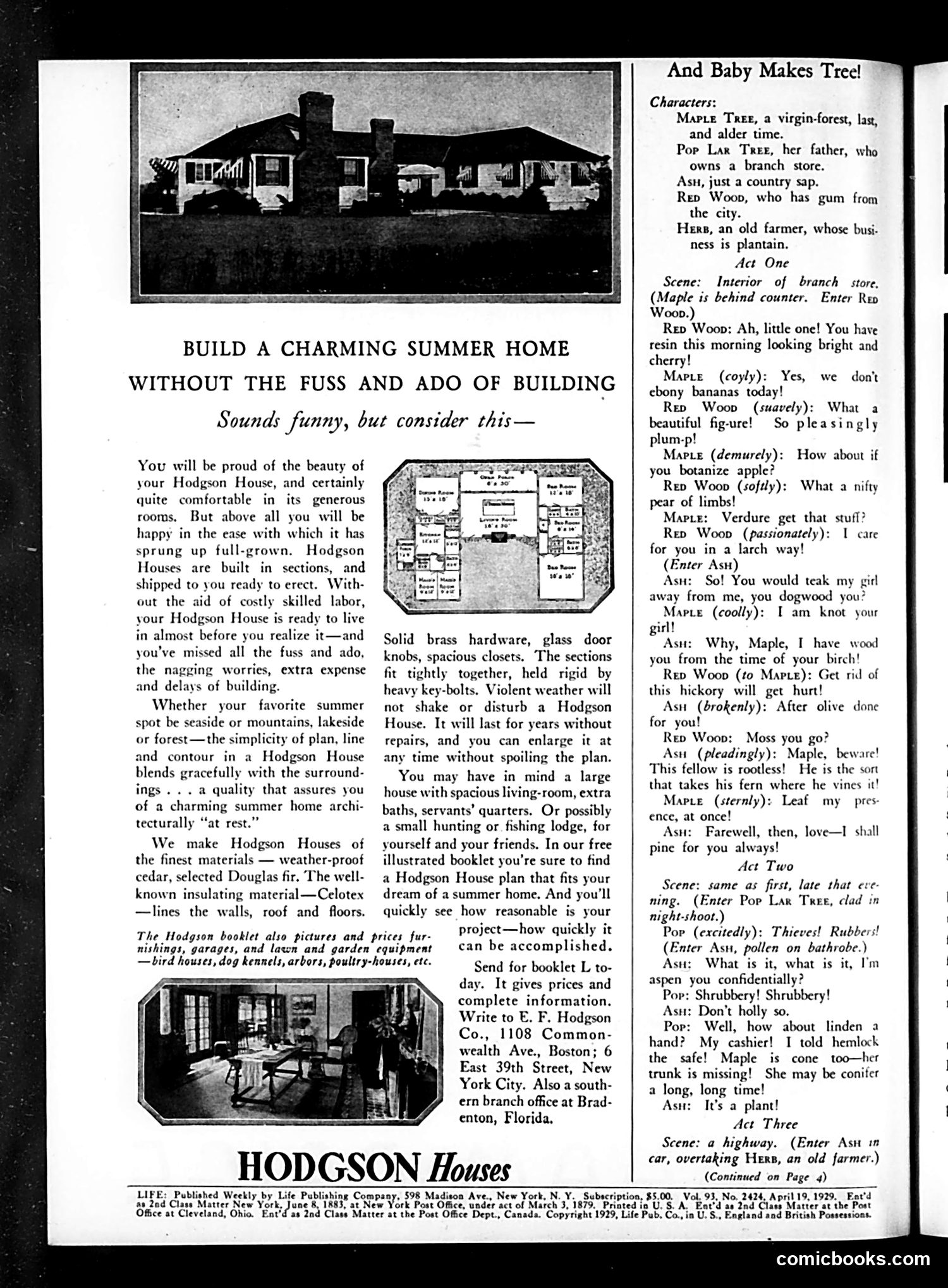
This page is **primarily advertising**, not political satire. It promotes Hodgson Houses, prefabricated summer homes shipped in sections and assembled on-site. The advertisement emphasizes convenience and affordability for middle-class buyers seeking vacation properties. On the right side is a one-act play titled "And Baby Makes Tree!" featuring characters like Maple Tree and Pop Lar Tree (obvious botanical puns). This appears to be light comedic filler content, likely satirizing domestic situations or romantic misunderstandings through anthropomorphized tree characters—typical of Life magazine's humor style. The page reflects 1920s consumer culture and the growing market for leisure homes, while the play offers gentle, pun-based comedy rather than political commentary.
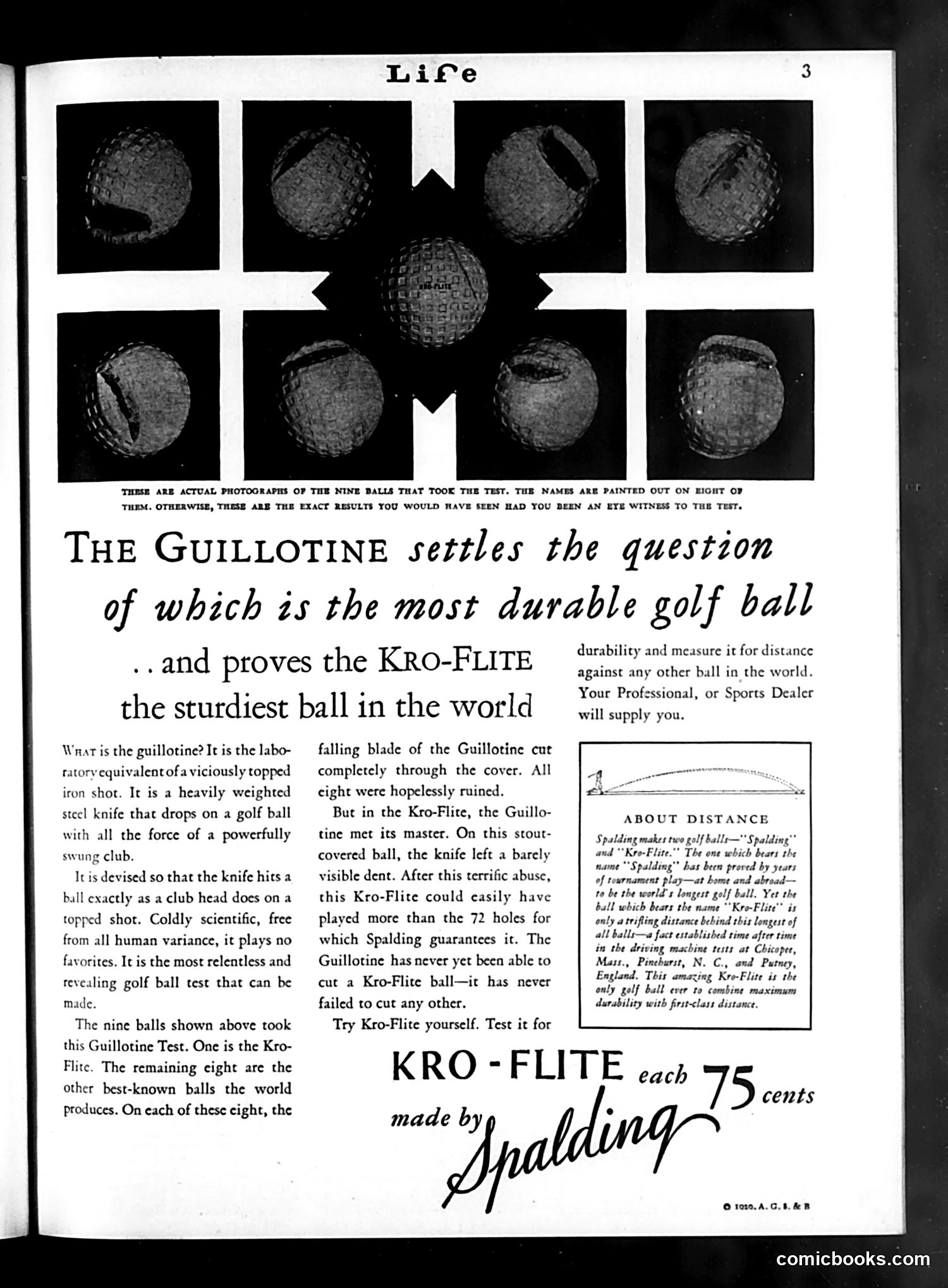
This page is **not a cartoon or satire**—it's a straightforward product advertisement for Kro-Flite golf balls, made by Spalding. The content describes a durability test called "the Guillotine," where a weighted steel blade drops onto golf balls to measure their resistance to damage. Nine test balls are shown in photographs at the top; one is a Kro-Flite, the other eight are competing brands. The advertisement claims that while the Guillotine blade damaged all eight competitors, it barely dented the Kro-Flite, proving it "the sturdiest ball in the world." The price is listed as 75 cents each. This is vintage advertising emphasizing product superiority through scientific-seeming demonstration rather than satire or political content.
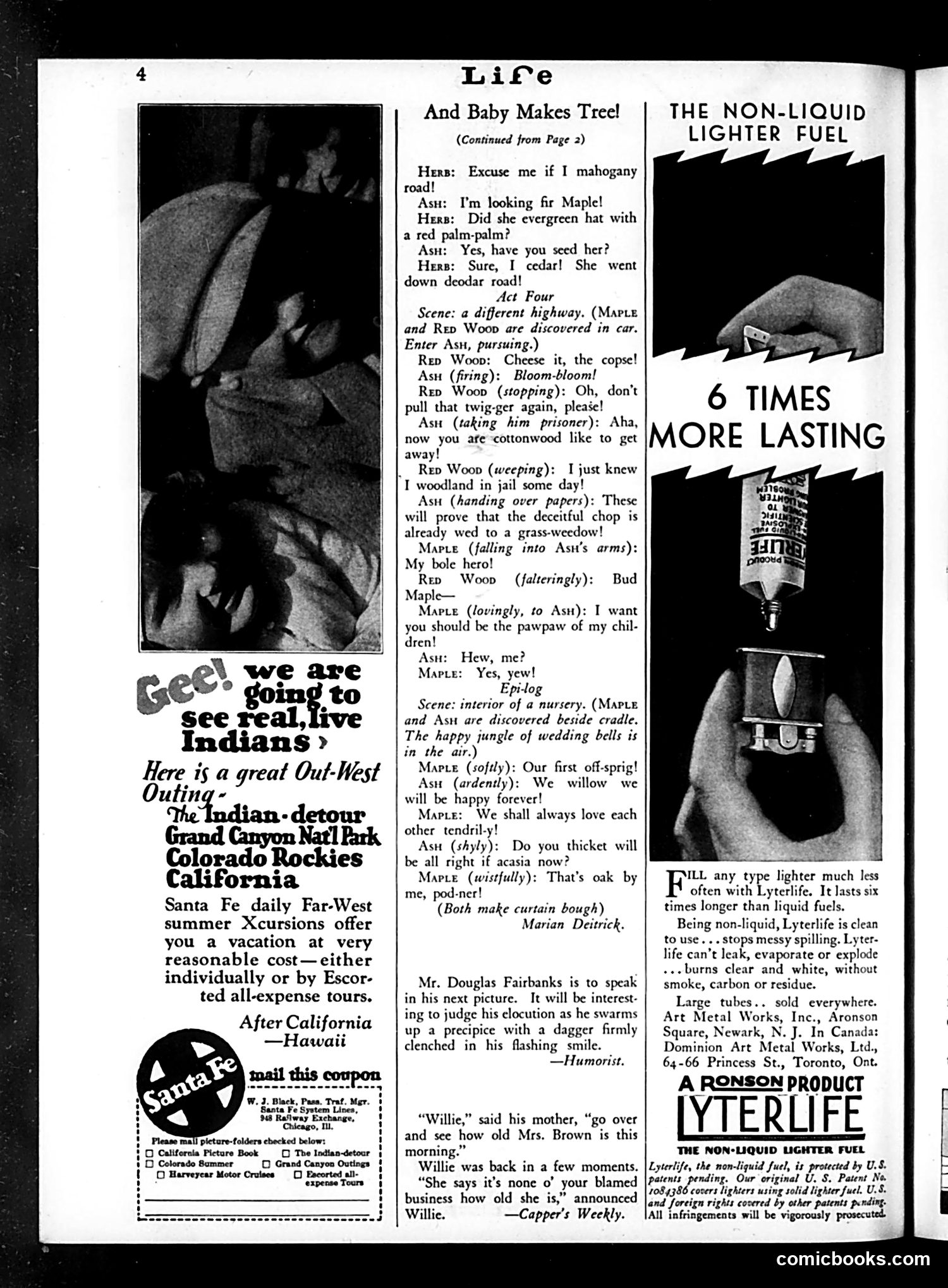
This page is primarily **advertising and entertainment content**, not political satire. The left side features a play excerpt titled "And Baby Makes Tree" — a humorous dialogue between woodland characters (Herb, Ash, Red Wood, Maple) about love and marriage in nature. It's light theatrical comedy. Below that is a **Santa Fe Railway advertisement** promoting western vacation tours to the Grand Canyon, Colorado Rockies, and California, with an option for Hawaii extension. This targets affluent leisure travelers. The right side advertises **Lyterlife**, a non-liquid lighter fuel product, emphasizing its durability (lasting "6 times more" than liquid fuels) and safety advantages. The page reflects early-to-mid 20th-century consumer culture: theatrical humor, travel promotion, and product marketing targeted at middle/upper-class readers.
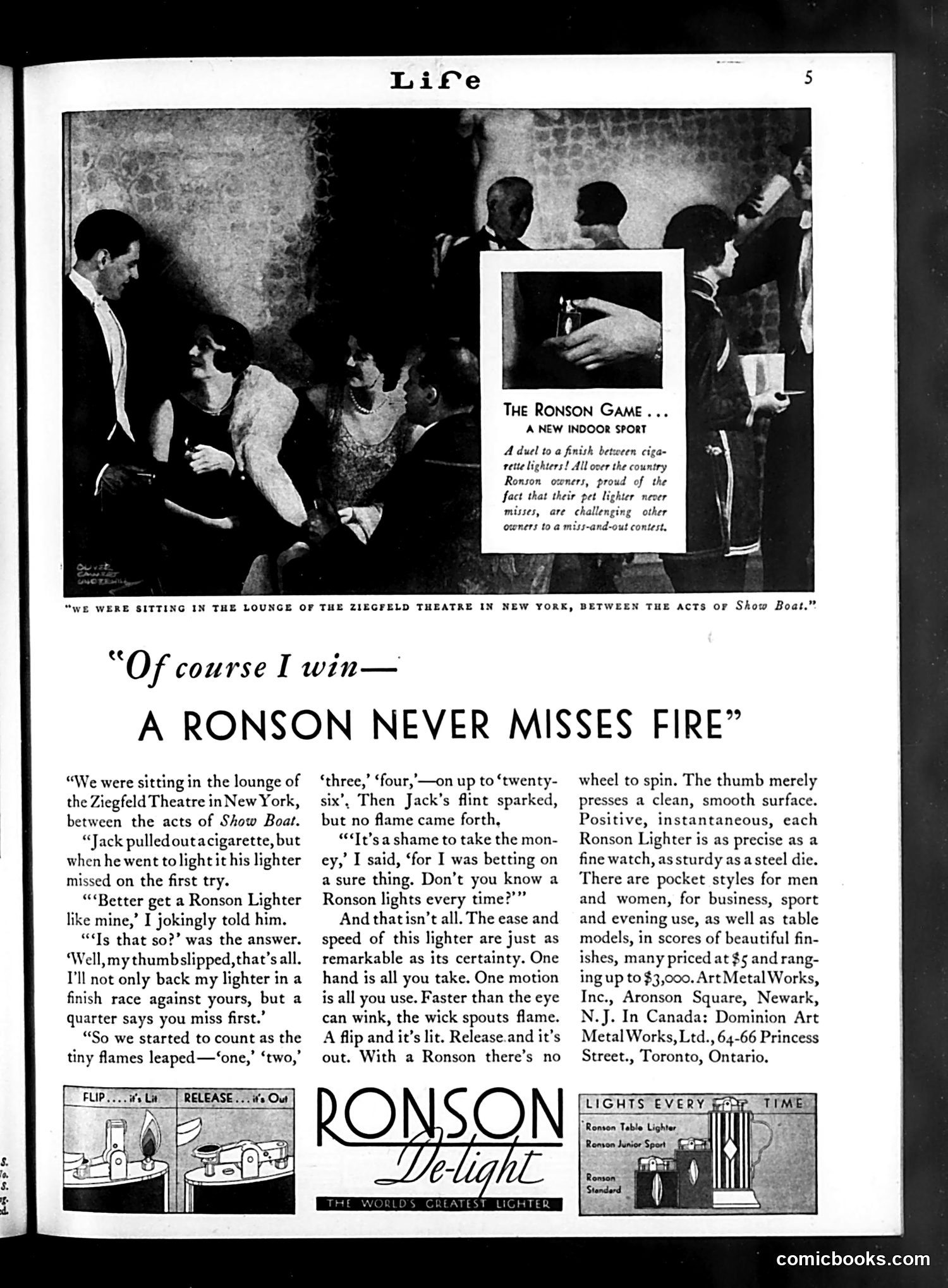
This is primarily a **Ronson lighter advertisement** disguised as editorial content—a common practice in early 20th-century magazines. The framing narrative describes a bet between cigarette smokers at the Ziegfeld Theatre during *Show Boat* (a famous 1927 musical). One man claims his Ronson lighter never fails to ignite; the other skeptically challenges this reliability. The "joke" is that Ronson lighters are so dependable they become a status symbol and conversation piece. The ad emphasizes precision engineering and instant performance—key selling points for luxury lighters of the era. The small inset photograph shows "The Ronson Game," apparently a novelty competition among lighter owners, suggesting Ronson had cultivated a devoted consumer culture around their product. This represents advertising-as-entertainment, when brands leveraged social situations to build brand loyalty.
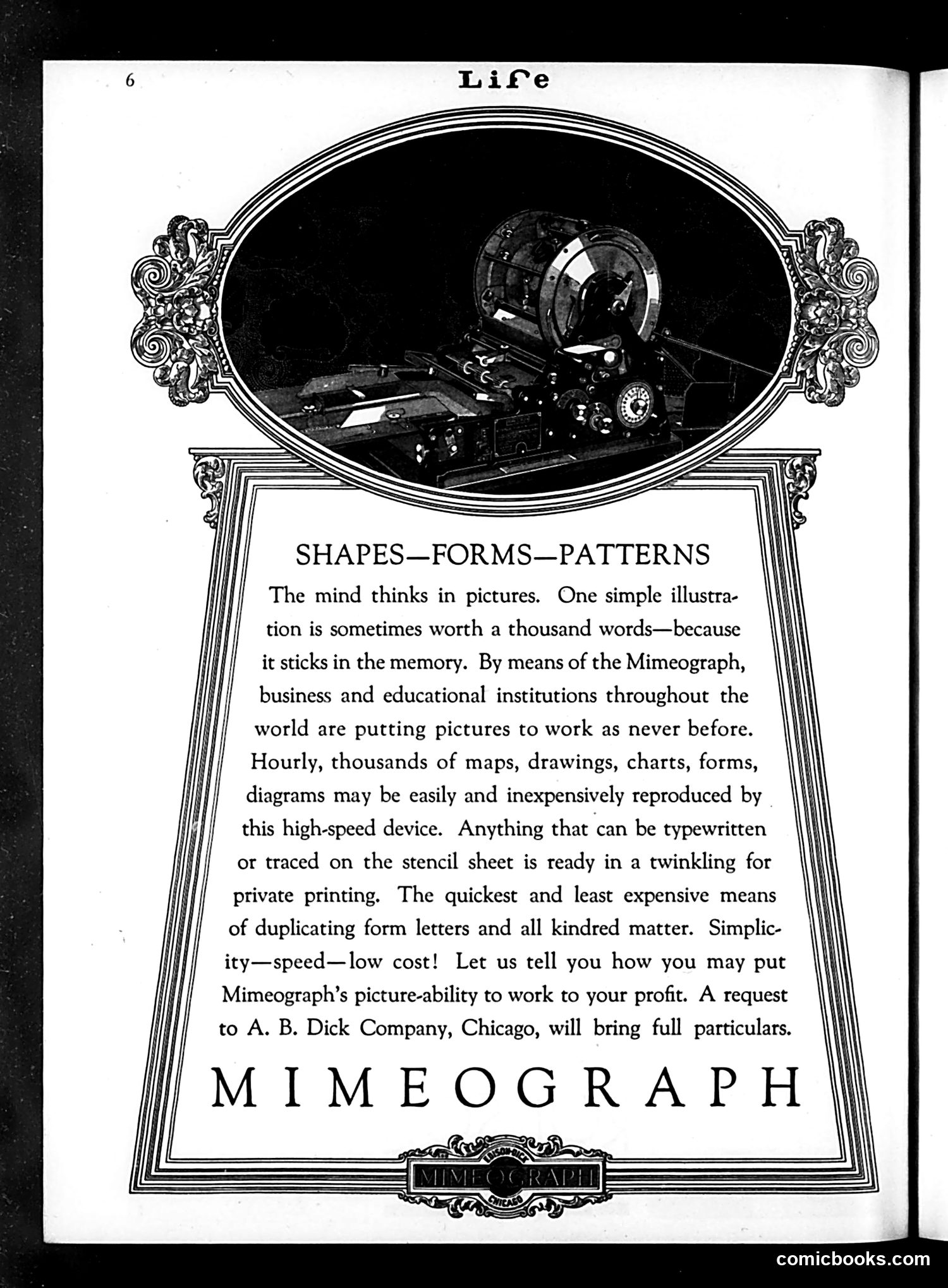
This page is primarily an advertisement for the Mimeograph machine, placed in *Life* magazine. The ad features a photograph of an early mimeograph device at the top and promotes its utility for business and educational institutions. The ad makes no satirical point—it's straightforward marketing copy. It emphasizes the machine's speed and low cost for reproducing "maps, drawings, charts, forms, diagrams" and "form letters." The appeal to both businesses and schools reflects the early 20th-century enthusiasm for new office technology that could democratize document reproduction. There are no political cartoons, caricatures, or satirical commentary on this page. It's simply a technical product advertisement showcasing the mimeograph as a revolutionary (for its time) reproduction device.
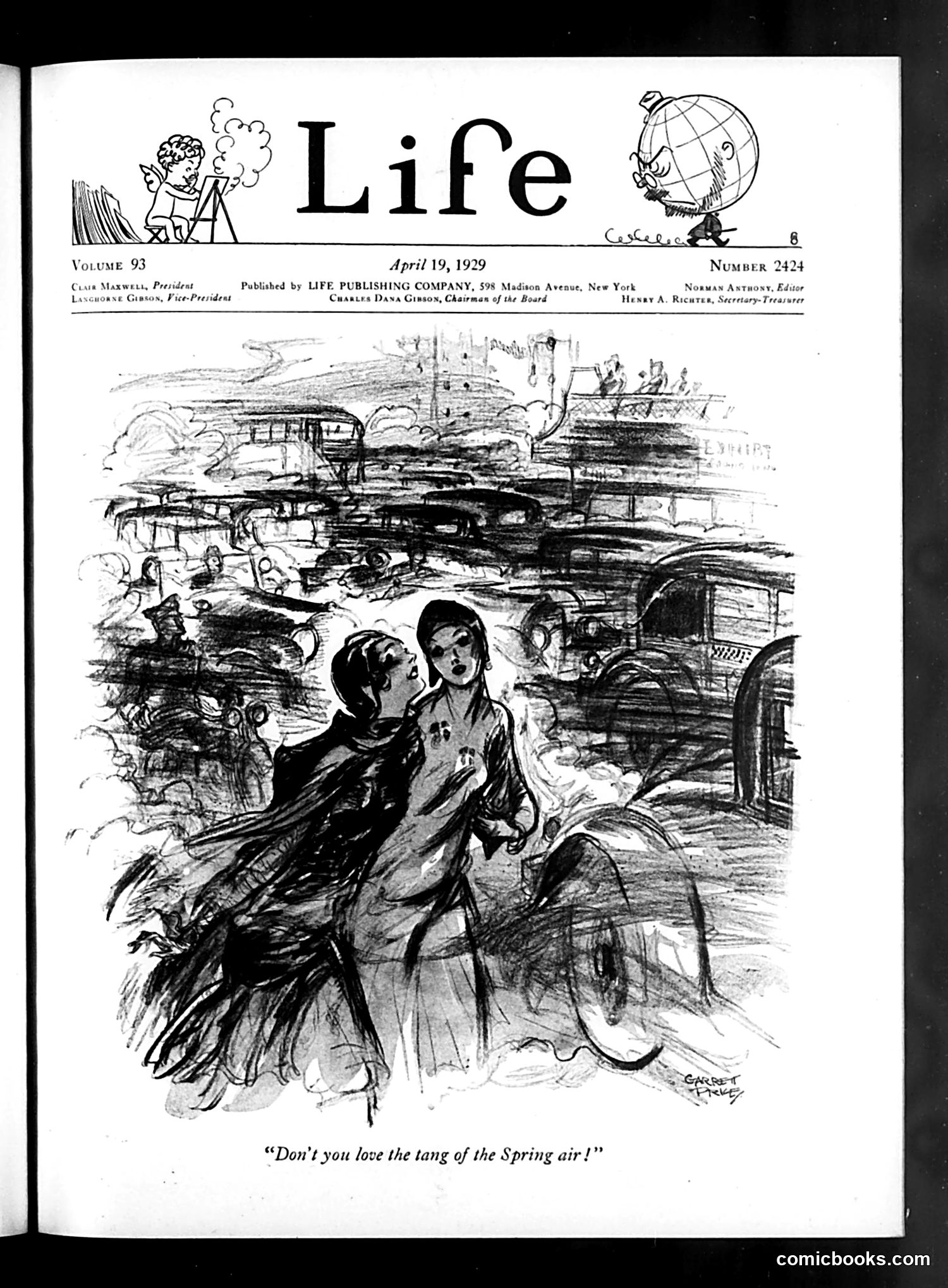
This is the cover illustration for *Life* magazine's satirical issue. The sketch depicts two figures in an automobile—a woman in a dark coat and a man in lighter clothing—appearing romantic or intimate while driving through what looks like a rural or industrial area with buildings and vehicles visible in the background. The caption reads: "Don't you love the tang of the Spring air!" This is a romantic/flirtation scene that appears to play on the contrast between claiming appreciation for nature's fresh spring air while actually engaged in a more intimate moment with a companion. It's gentle humor about courtship and the excuses couples make during romantic outings. The style and setting suggest this is typical of *Life*'s humorous domestic and social commentary from this era.
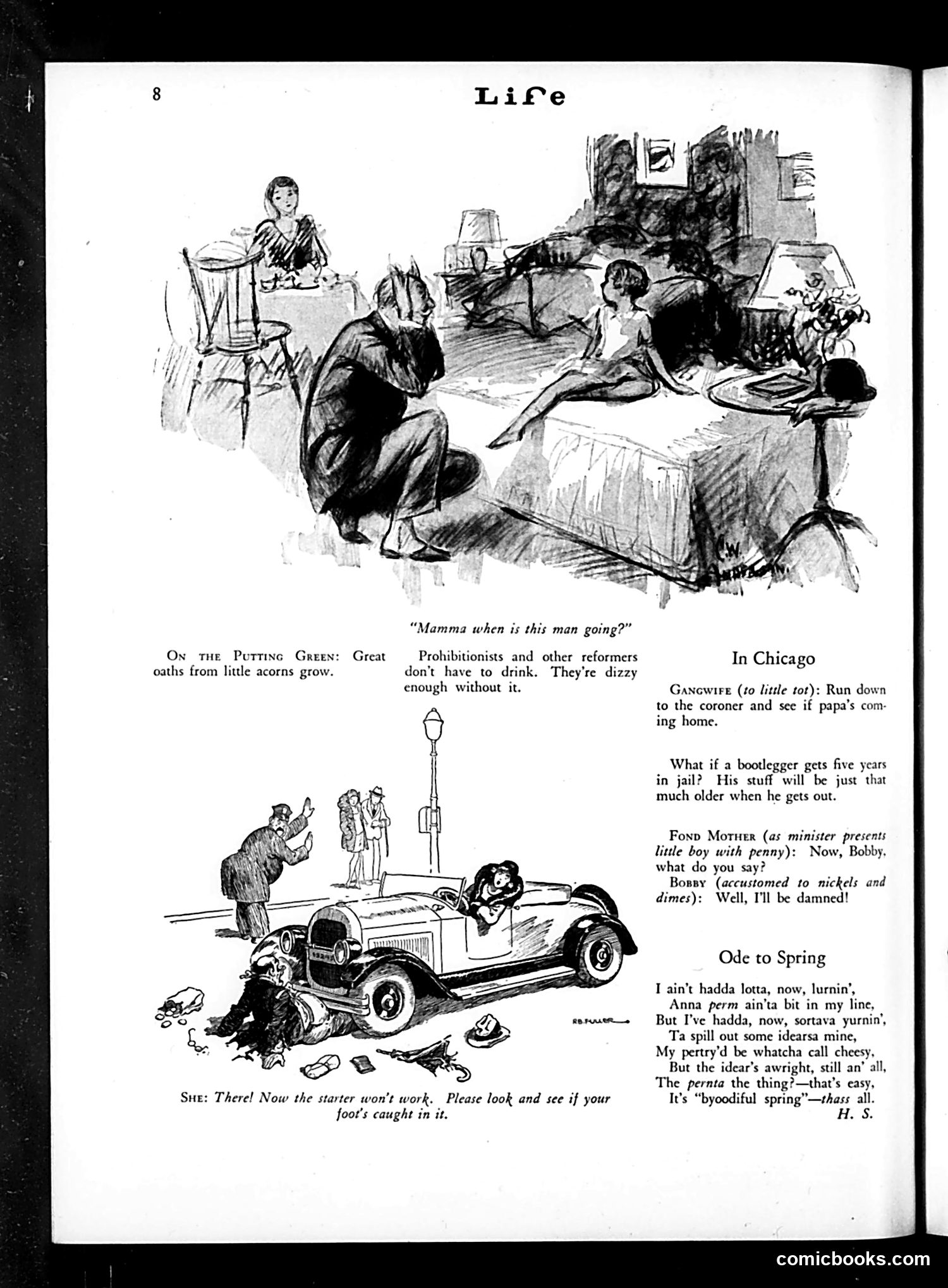
This page contains three satirical items from what appears to be the Prohibition era (likely 1920s-1930s based on references to bootleggers and alcohol). **Top cartoon**: Shows a domestic scene with the caption "Mamma when is this man going?" — mocking men lingering during social calls. **Middle cartoon**: Depicts a car accident with scattered coins and a man thrown from the vehicle. The caption "She: There! Now the starter won't work. Please look and see if your foot's caught in it" satirizes the newfangled automobile and incompetent drivers. **Right column**: Contains brief humorous items mocking Prohibition reformers, bootleggers facing jail time, and a poem "Ode to Spring" using casual dialect. The humor relies on contemporary readers' familiarity with Prohibition's unpopularity and criminal consequences.
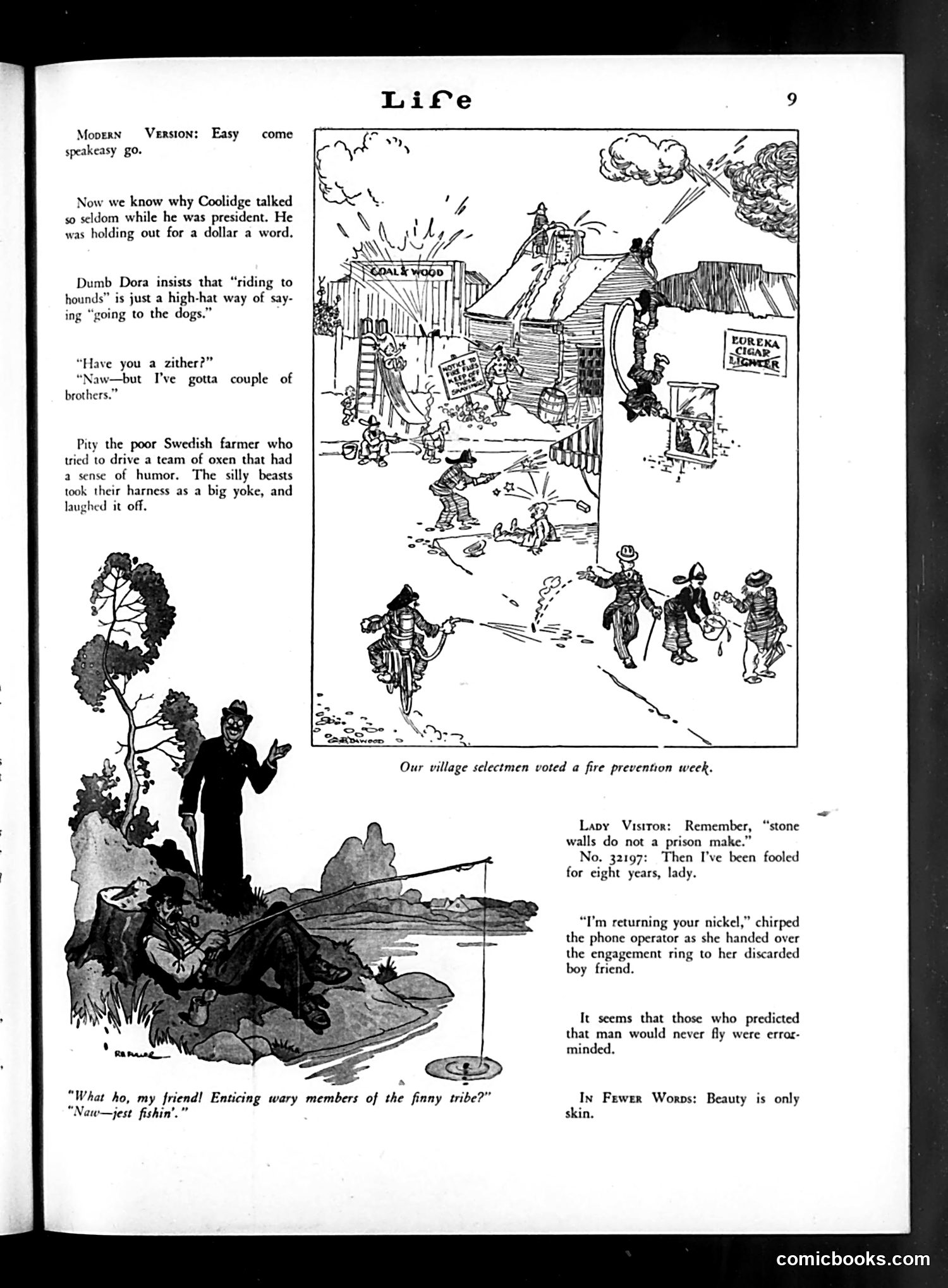
This page contains several brief humorous anecdotes and illustrations typical of Life's satirical format: **Main cartoon** (top right): Shows a chaotic village scene labeled "Our village selectmen voted a fire prevention week." The illustration depicts numerous accidents and mishaps occurring simultaneously—people falling, objects flying—satirizing the irony of a safety initiative producing its opposite effect. **Lower cartoon**: A fishing scene where someone asks "What ho, my friend! Enticing wary members of the finny tribe?" The response "Nay—jest fishin'" uses wordplay on "jest" (just/jesting). **Text snippets** mock various subjects: Coolidge's terseness, Swedish farmers' sense of humor, and include observations like "Beauty is only skin" (a closing aphorism). The page exemplifies Life's early 20th-century blend of visual gags and witty commentary on American life.
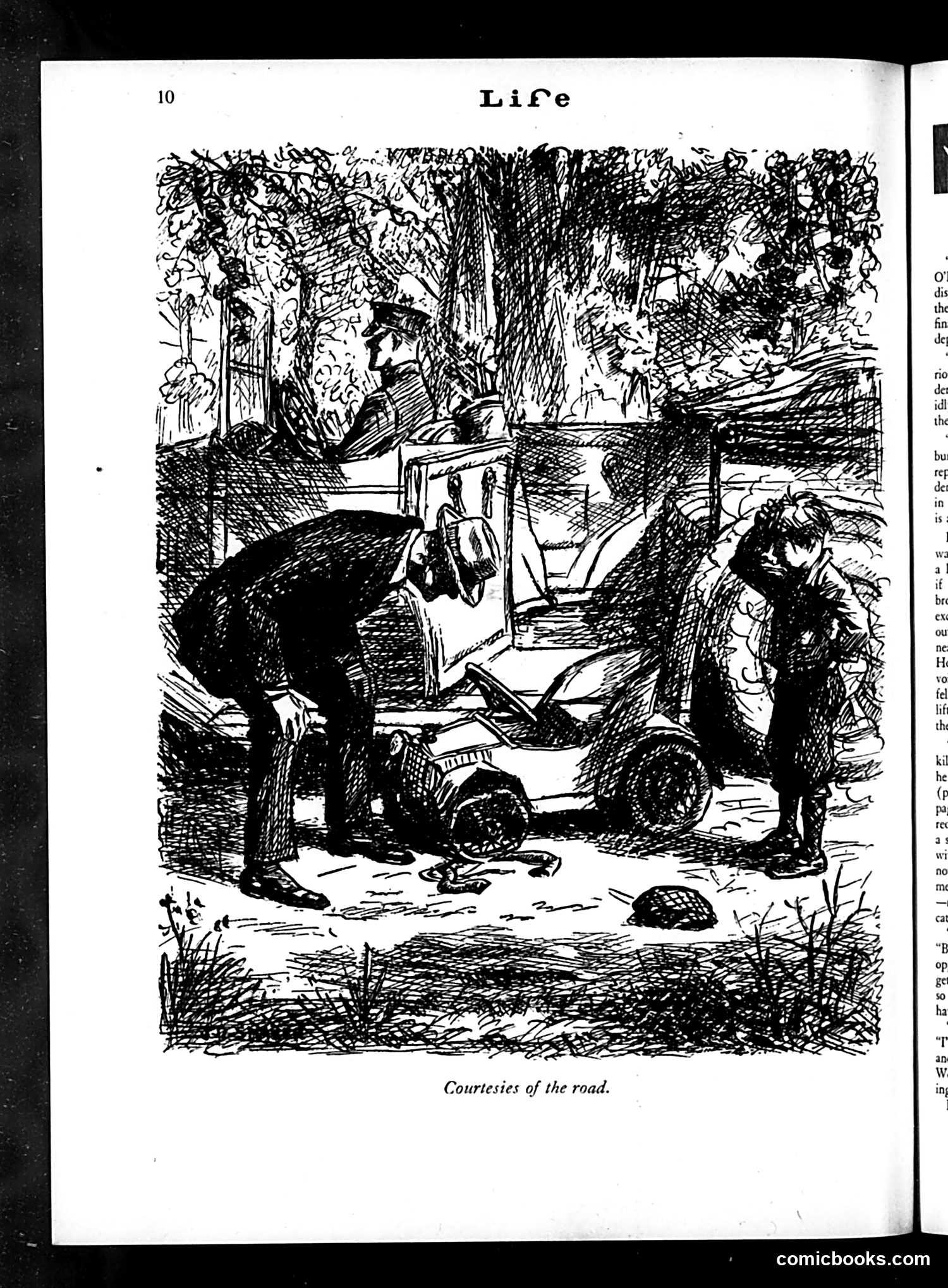
This satirical illustration depicts a breakdown or accident scene on a country road, showing what appears to be early automobile era social interaction. The cartoon likely critiques road etiquette or courtesy among motorists—a relevant concern as automobiles were becoming common and sharing roads with pedestrians and horse-drawn vehicles created new social tensions. The figures appear to be exchanging greetings or assistance, suggesting either genuine politeness or possibly ironic commentary on how motorists actually treated one another. The natural woodland setting and the presence of what looks like an overturned or disabled vehicle emphasize the clash between modern transportation and rural life. Without the full magazine context, the specific satirical target remains unclear, though the title suggests commentary on automobile driver behavior standards.
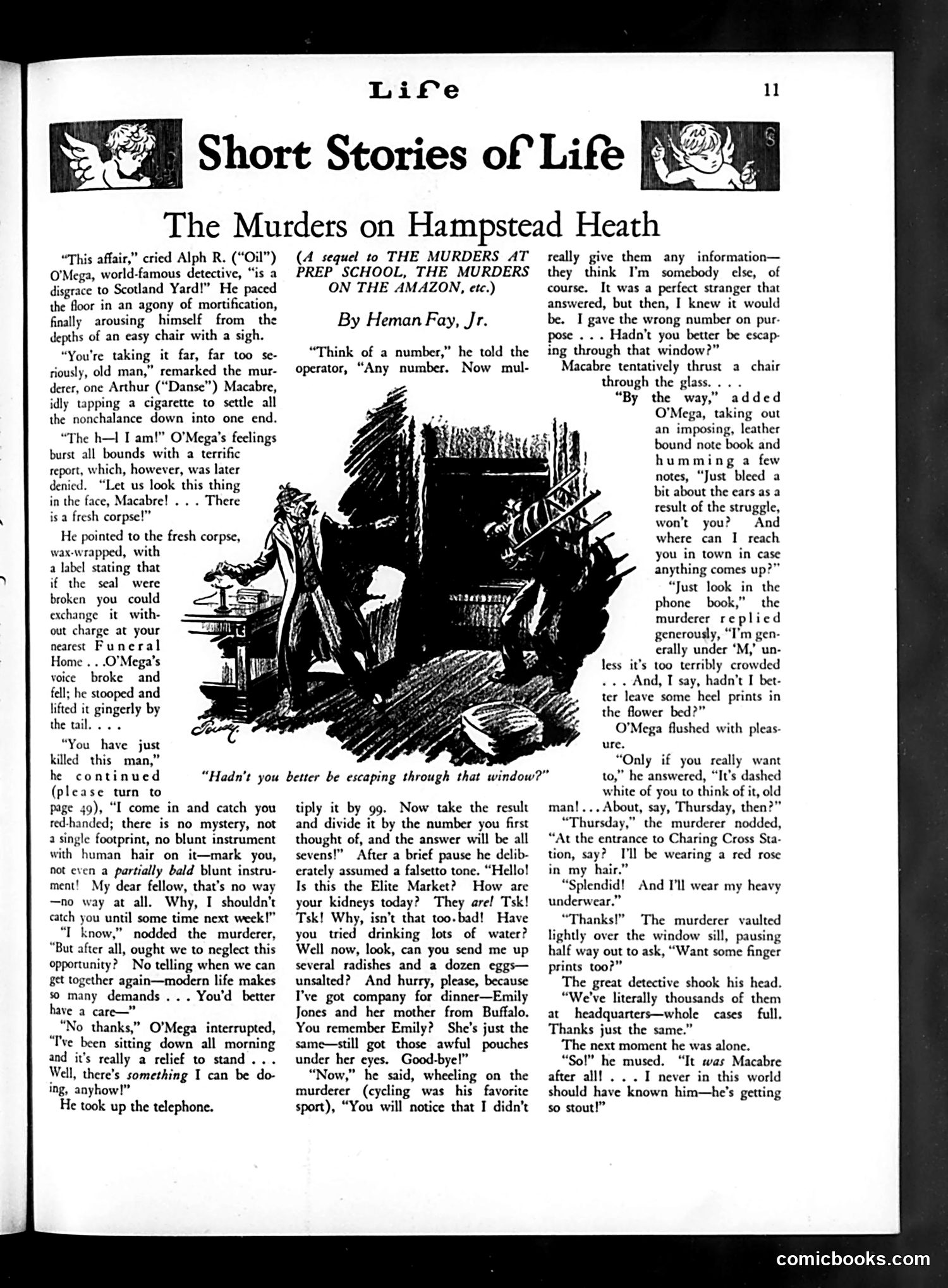
This is a short mystery story by Heman Fay, Jr., presented as serialized fiction in *Life* magazine. The page shows the opening installment of what's labeled as "a sequel to THE MURDERS AT PREP SCHOOL, THE MURDERS ON THE AMAZON, etc." The story features detectives O'Mega and Macabre investigating a murder. The narrative employs a comedic mystery formula with humorous dialogue and absurd clues (the murderer provides cryptic instructions involving phone numbers and radishes). The accompanying illustration shows the detectives examining a corpse and considering an escape through a window. This appears to be *Life*'s satirical take on popular detective fiction conventions of the era, using exaggerated dialogue and illogical plot elements for comedic effect.
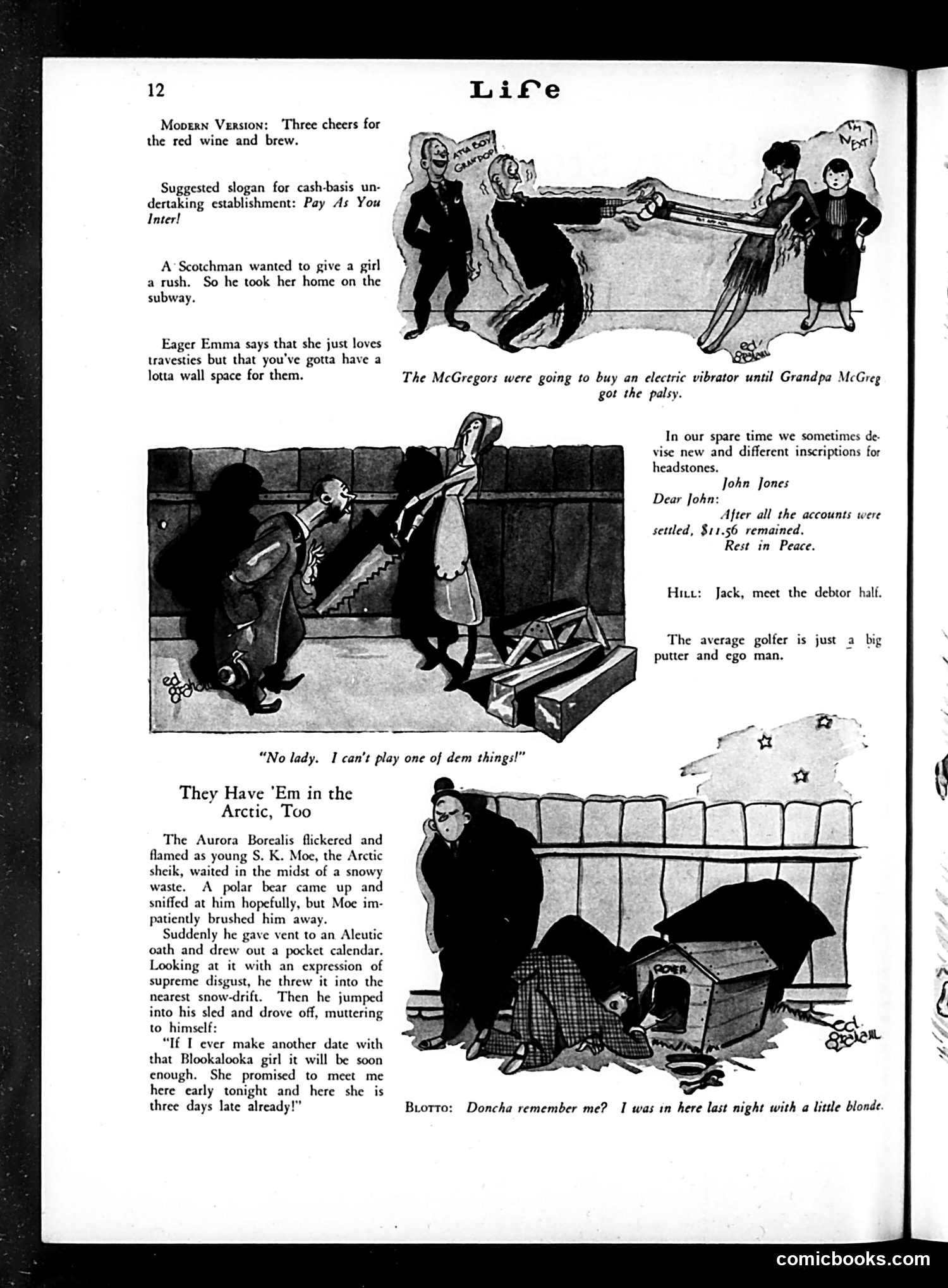
This page contains several unrelated satirical humor pieces typical of Life's format: 1. **Top cartoon**: Shows people with a large sheet, captioned about the McGregors considering buying an electric vibrator until "Grandpa McGreg got the palsy"—a joke about elderly tremors mimicking the device's function. 2. **Middle cartoon**: A man at what appears to be a pool hall or bar says "No lady, I can't play one of dem things!"—likely referencing pool/billiards or another recreational activity. 3. **Arctic story**: A humorous anecdote about S.K. Moe, an "Arctic sheik," who breaks a date with a Inuit woman named Doncha by throwing his calendar into a snowdrift—playing on stereotypes and the difficulty of keeping appointments in remote locations. The page demonstrates Life's mix of visual gags and short comedic narratives.
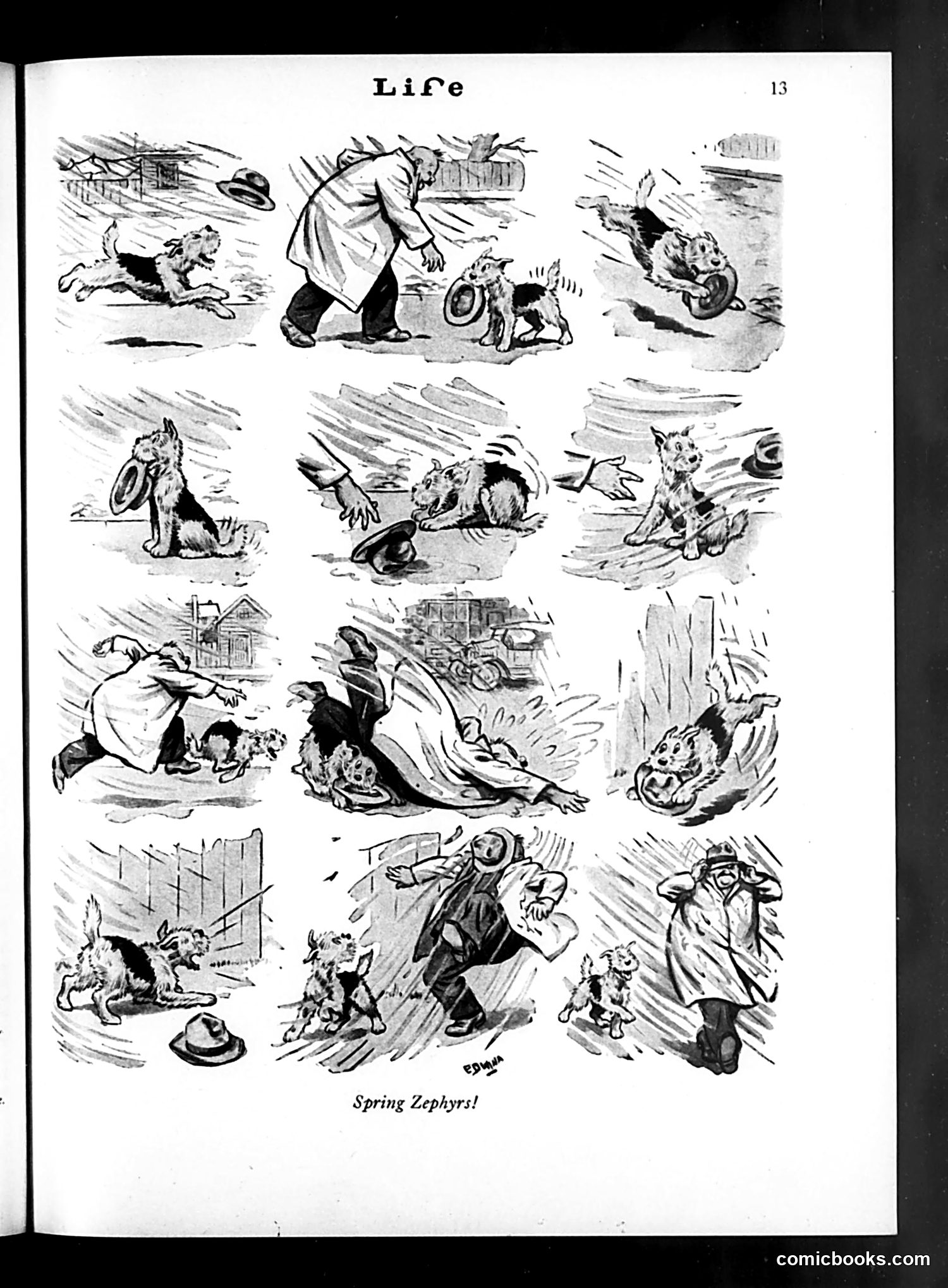
This page presents a comic strip showing dogs and people caught in spring windstorms. The twelve panels depict various humorous scenarios of wind-related chaos: dogs chasing hats, people struggling with umbrellas, clothing and objects flying away, and general disorder as "zephyrs" (gentle breezes) unexpectedly become violent gusts. The humor is straightforward slapstick: the contrast between spring's promised gentleness and the actual destructive force of the wind creates comedic situations. Dogs appear throughout as recurring characters, suggesting this may be a recurring feature in Life magazine. There's no apparent political satire here—it's purely observational humor about seasonal weather and its comic effects on everyday people and pets.
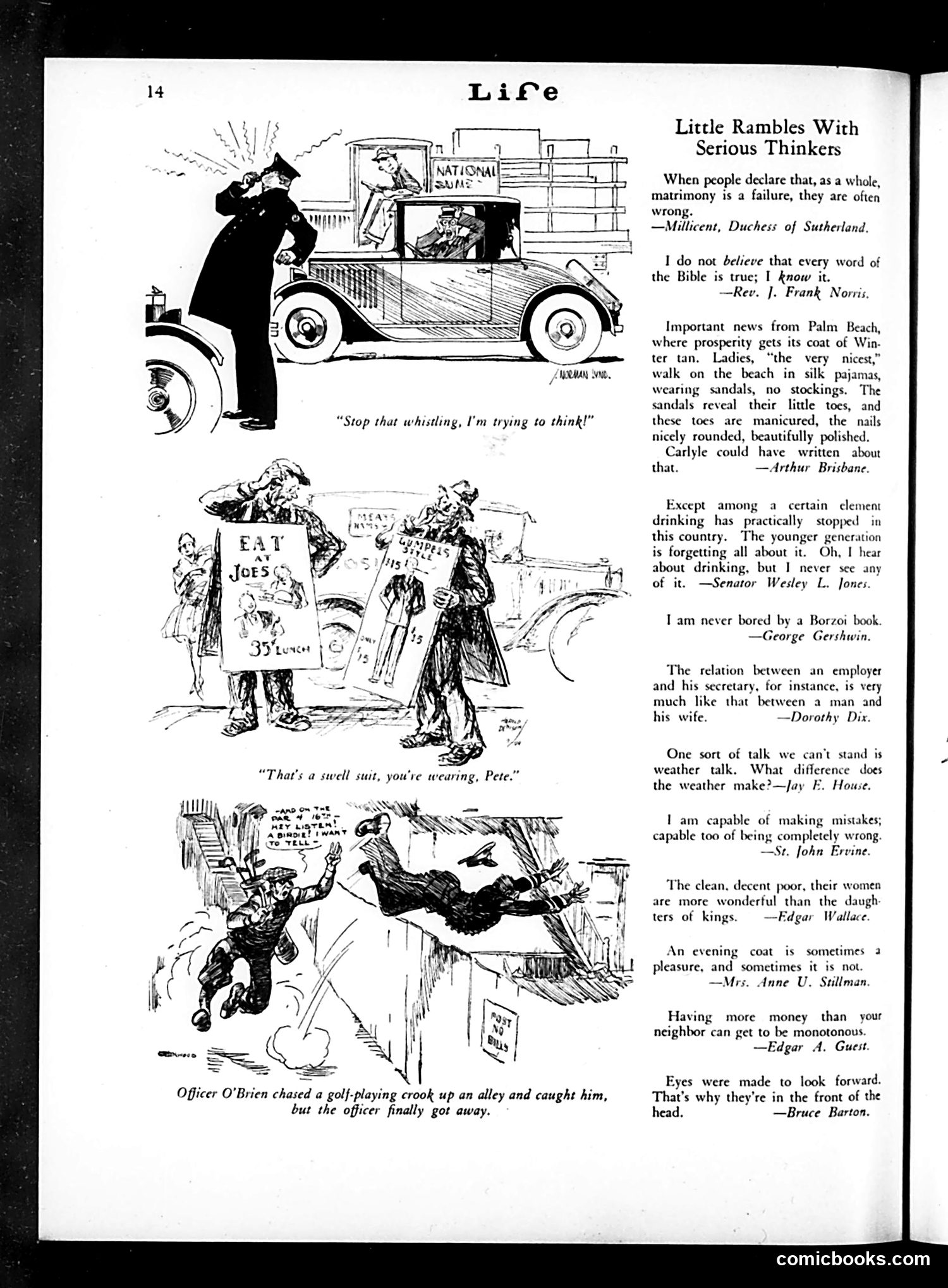
This page features three cartoon vignettes alongside witty quotations from public figures and writers. The top cartoon shows a man in a car telling the driver "Stop that whistling, I'm trying to think!"—satirizing intellectual pretension. The middle cartoon depicts two shabby men in front of an "Eat at Joe's" sign discussing fashion ("That's a swell suit, you're wearing, Pete")—mocking working-class aspirations. The bottom cartoon shows Officer O'Brien chasing a golf-playing crook through an alley—a humorous commentary on misplaced priorities or law enforcement. The accompanying quotes touch on marriage, religion, drinking, and social class, offering satirical observations on American life and society. The overall tone is gentle, class-conscious humor typical of Life magazine's editorial stance.
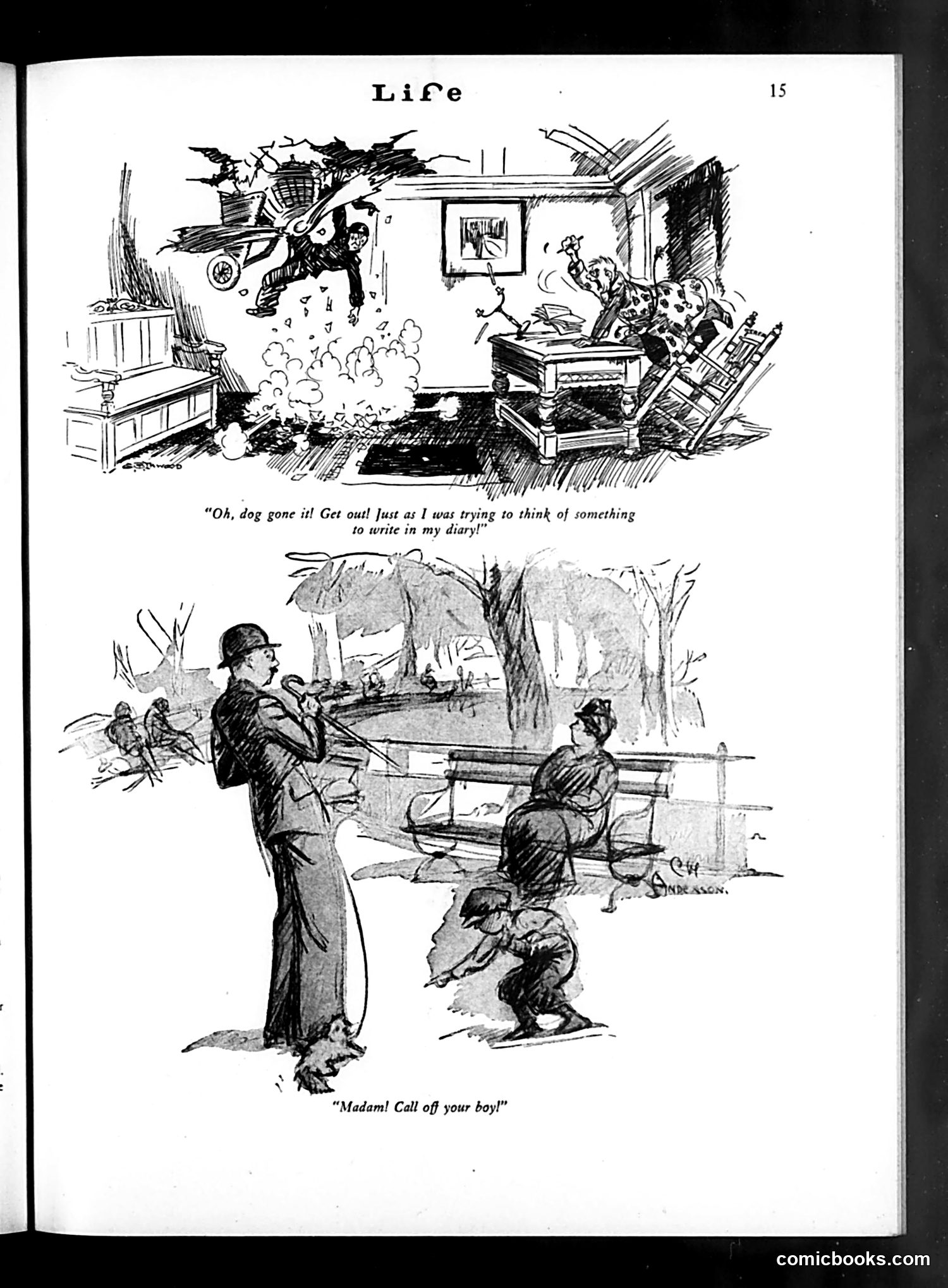
This page contains two unrelated cartoons satirizing domestic life: **Top cartoon:** A chaotic home office scene where a dog has destroyed papers and furniture. The caption reads, "Oh, dog gone it! Get out! Just as I was trying to think of something to write in my diary!" The joke mocks the common frustration of being interrupted by a pet while attempting creative or personal writing—a relatable domestic complaint. **Bottom cartoon:** Shows a woman calling to a boy carrying a long pole or stick, with other children visible. The caption reads, "Madam! Call off your boy!" The humor appears to target mothers' inability to control their children's mischievous behavior in public spaces, a common social anxiety of the era. Both jokes rely on everyday domestic frustrations familiar to Life's middle-class readership.
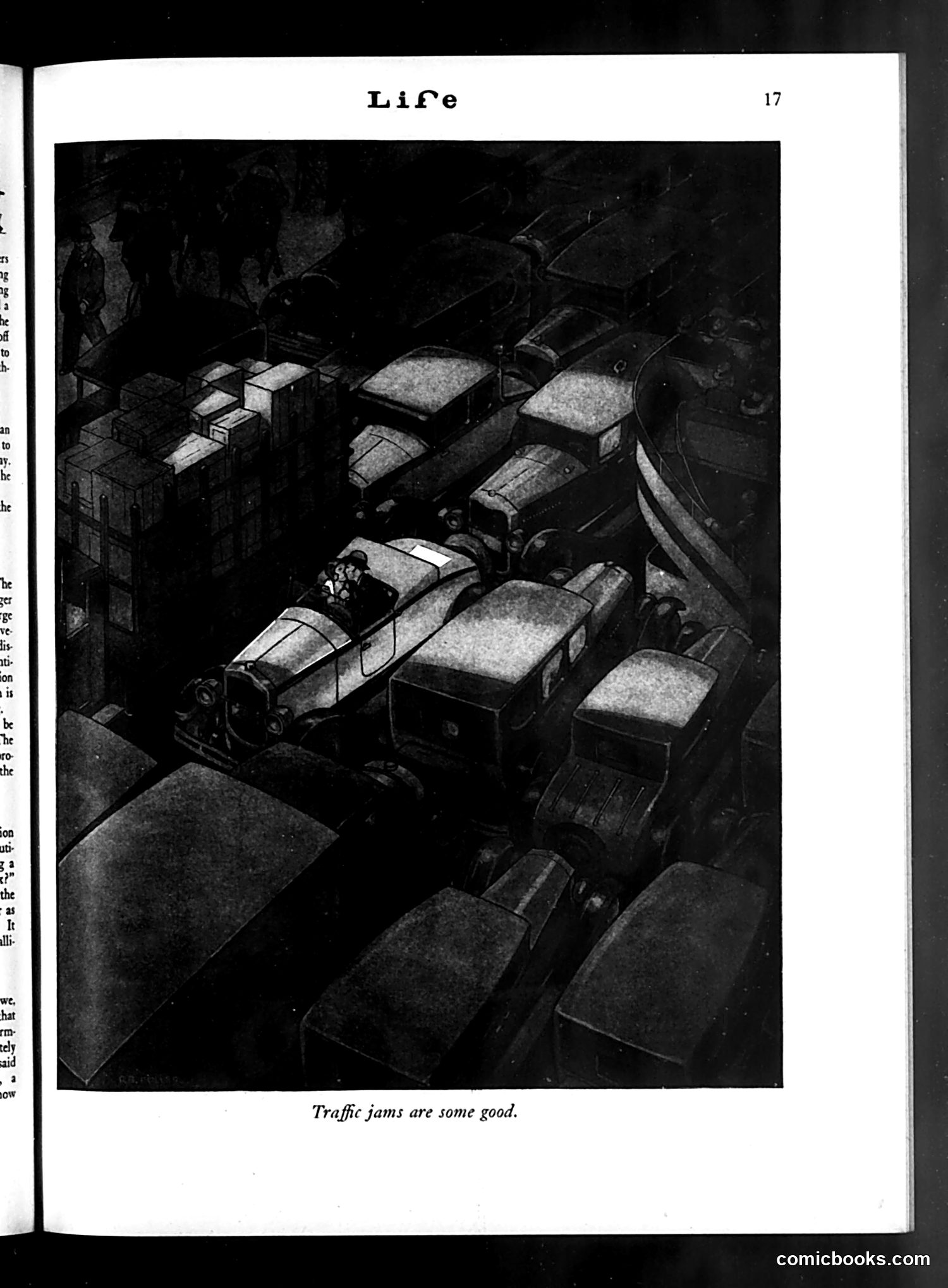
This is a photograph rather than a cartoon, showing an overhead view of multiple delivery trucks or commercial vehicles parked closely together, with what appears to be cargo or goods loaded on them. One figure is visible among the vehicles. The caption reads: "Traffic jams are some good." The satirical point appears to be ironic commentary on traffic congestion. Rather than treating traffic jams as purely negative (as most would), the caption suggests they have some benefit—likely implying that the congestion forces vehicles to slow down or stop, preventing worse accidents, or perhaps commenting on how gridlock inadvertently creates employment or economic activity for delivery services and traffic management. The humor lies in finding an optimistic silver lining to an otherwise universally frustrating urban problem.
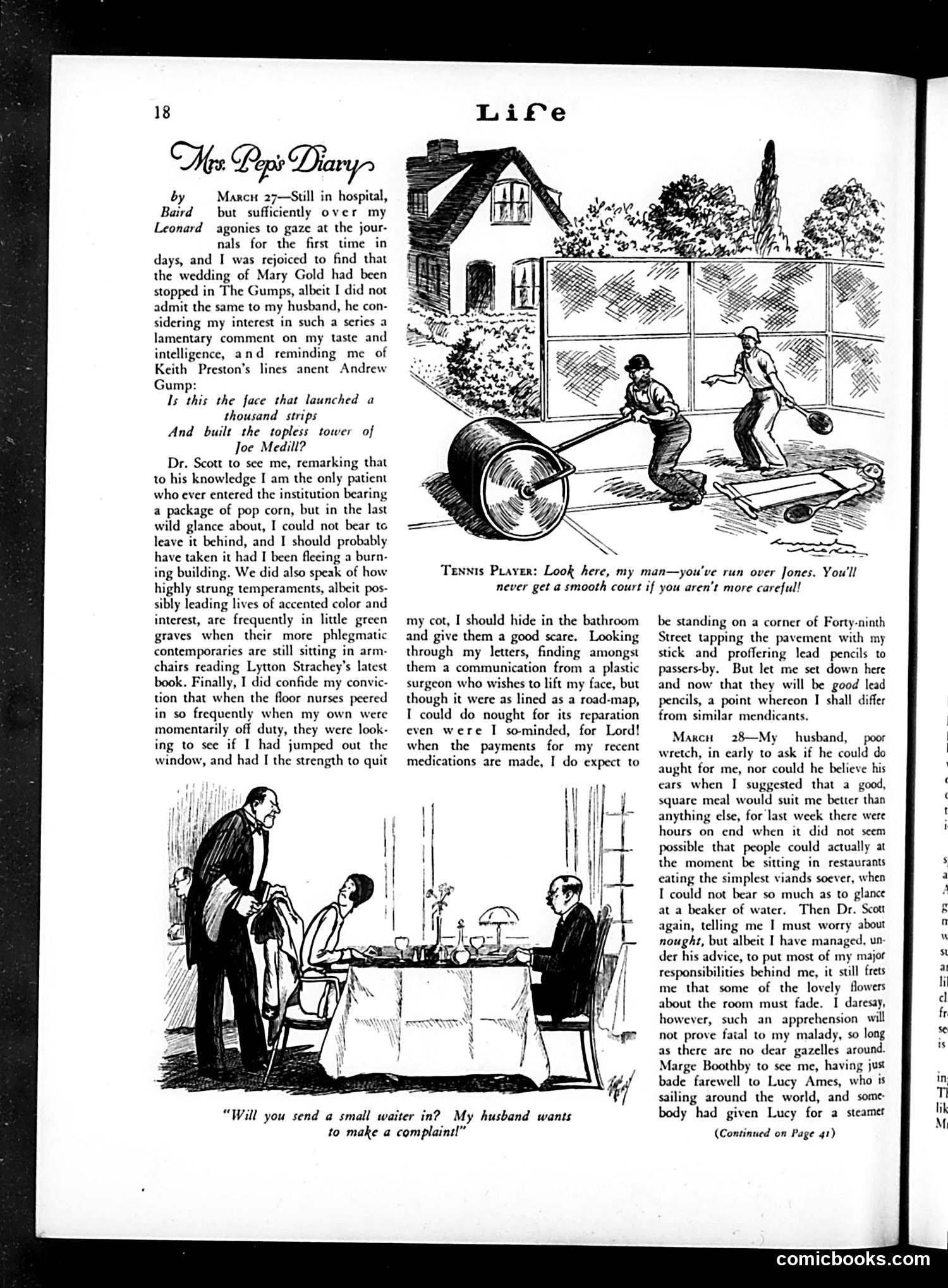
This is a humorous diary entry column by Elinor Leonard, illustrated with two cartoons satirizing domestic life and social etiquette of the early 20th century. The **top cartoon** depicts a tennis match where a player warns a teammate about running over "Jones," suggesting casual disregard for an injured person—satirizing both careless sportsmanship and class indifference. The **bottom cartoon** shows a waiter responding to a complaint with the caption "Will you send a small waiter in? My husband wants to make a complaint!"—a joke about marital discord being aired publicly at a restaurant, mocking both spousal conflict and proper dining etiquette. The diary text describes hospital stay experiences and domestic irritations, using humor to comment on gender relations, medical care, and social pretensions of the era.
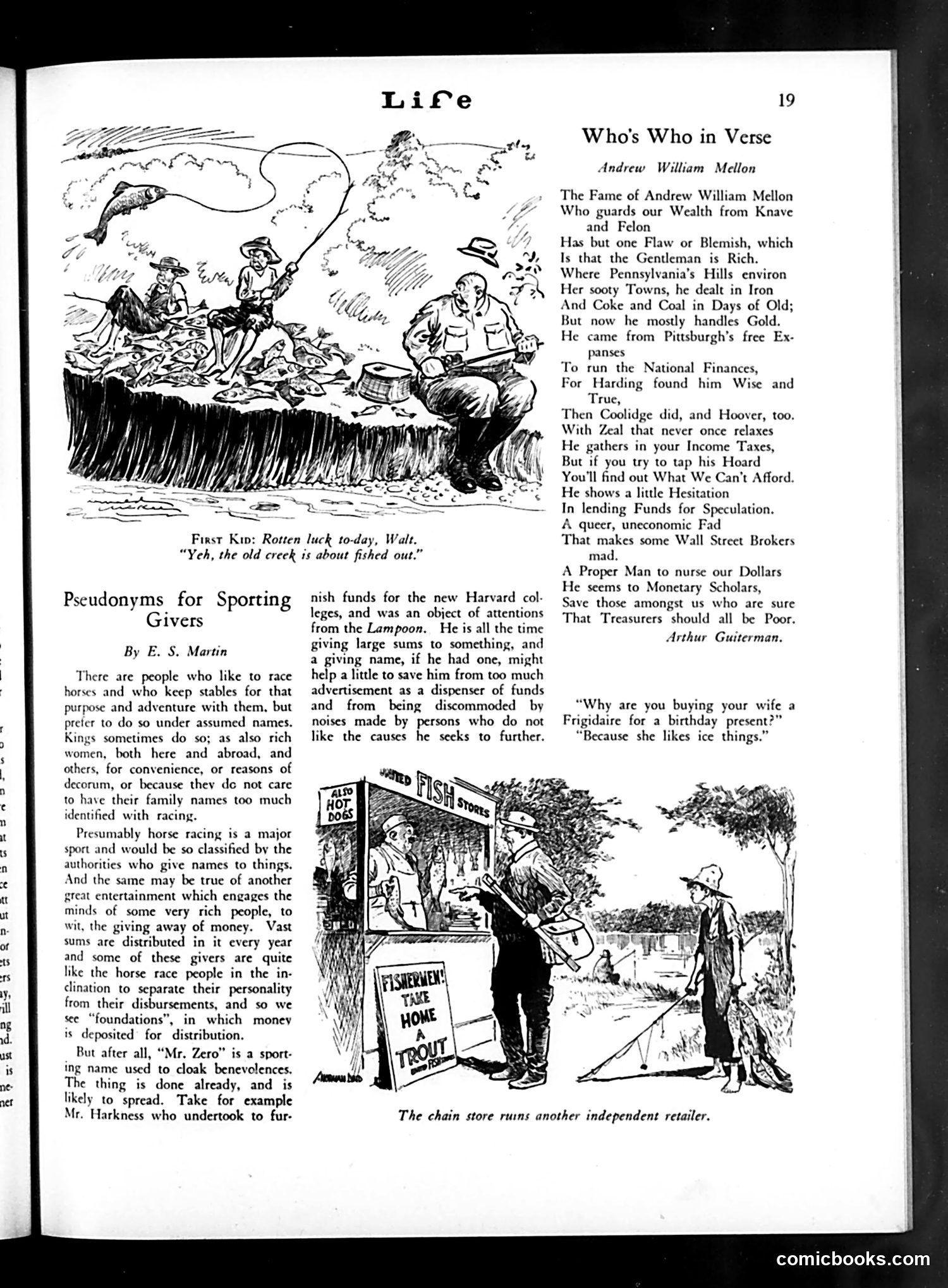
This page contains two distinct pieces of political satire targeting wealth and philanthropy in 1920s America. **"Who's Who in Verse" mocks Treasury Secretary Andrew Mellon.** The poem acknowledges Mellon's wealth and financial competence under Republican administrations (Harding, Coolidge, Hoover), but criticizes him as a hypocrite: he zealously collects taxes from ordinary citizens while protecting his own vast fortune and refusing to fund speculation. The satire's point is that Mellon aggressively extracts money from the public but resists lending or distributing his own wealth—a contradiction in a Treasury Secretary. **"Pseudonyms for Sporting Givers" satirizes wealthy philanthropists** like Mr. Harkness who hide behind "foundations" and anonymous giving. The article argues that rich donors use these structures to avoid public recognition and the "noises" (complaints) from those who dislike their chosen causes. It mocks the hypocrisy of wealthy men wanting credit for generosity while evading scrutiny. Both pieces critique how the wealthy manipulate systems—taxation, philanthropy, anonymity—to maintain power and avoid accountability.
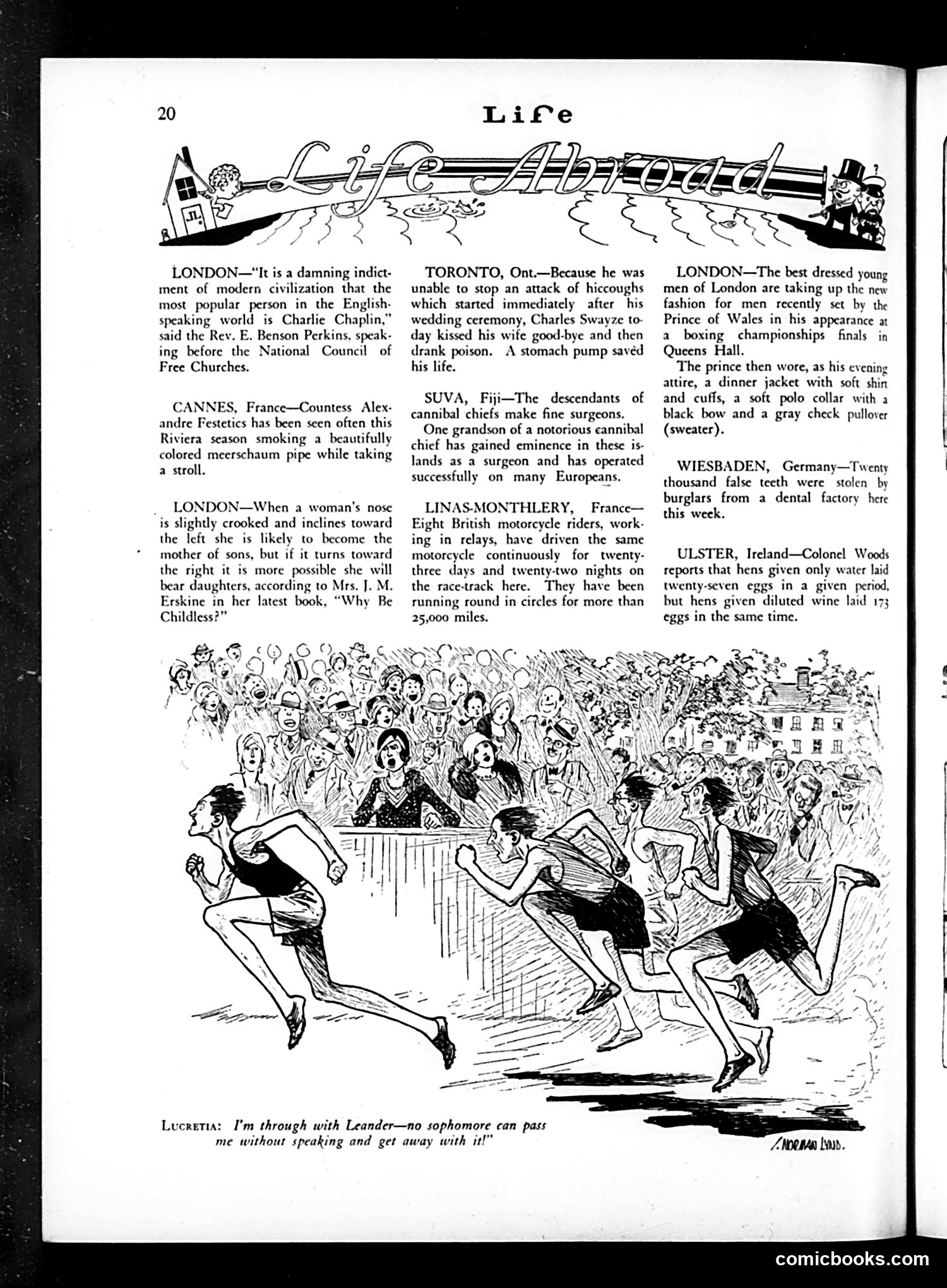
This page from *Life* magazine consists of humorous short news items ("Life-Abridged") from around the world, plus one cartoon at the bottom. **The News Items** mock contemporary absurdities: a clergyman's complaint that Charlie Chaplin is too popular; a countess smoking a meerschaum pipe (considered unfeminine); pseudo-scientific claims about nose shape predicting children's sex; a man attempting suicide over hiccoughs; and dubious claims about Fijian surgeons descending from cannibals, British motorcycle endurance stunts, and—most absurdly—hens laying more eggs when given wine instead of water. **The Cartoon** features "Lucretia" as a young woman running past onlookers, declaring she's "through with Leander" because no sophomore can pass her without speaking and "get away with it"—a joke about her attractiveness and willingness to publicly confront males who ignore her. The page's humor relies on the era's fascination with oddball international news, pseudo-science, and social commentary about changing gender norms (women smoking, fashion trends set by royalty).
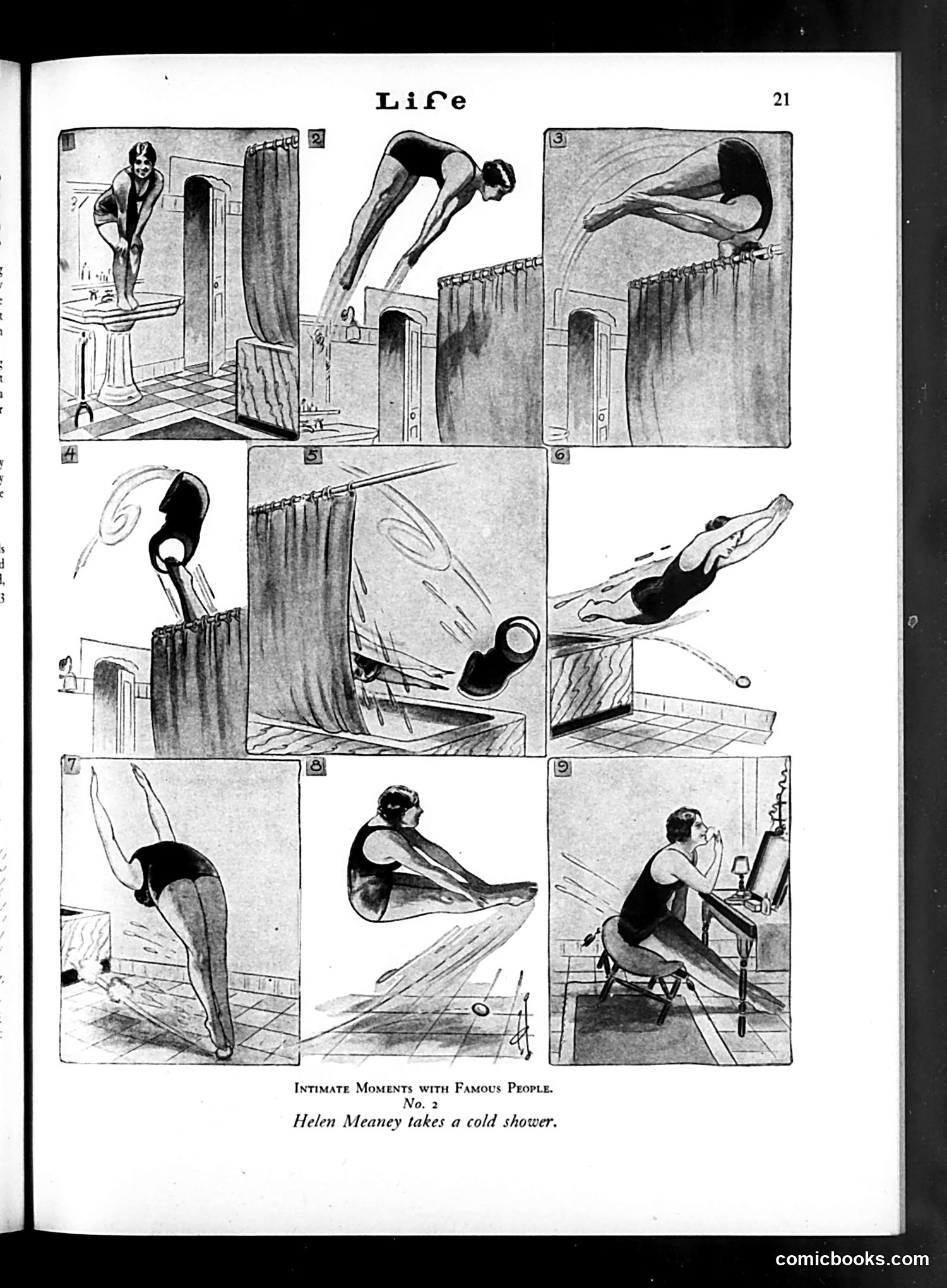
This is a humorous multi-panel comic sequence titled "Intimate Moments with Famous People, No. 2" from *Life* magazine. The panels depict a woman (identified as Helen Meaney) progressively undressing for and taking a cold shower, moving through various stages—testing water temperature, diving into a bathtub, toweling off, and ultimately sitting at a vanity. The humor appears to rely on the everyday mundanity of bathing rituals, presented as an "intimate moment" with a "famous person." This satirizes celebrity culture and voyeuristic interest in famous individuals' private lives by depicting something completely unglamorous and ordinary. The joke likely mocks readers' curiosity about celebrities' personal routines.
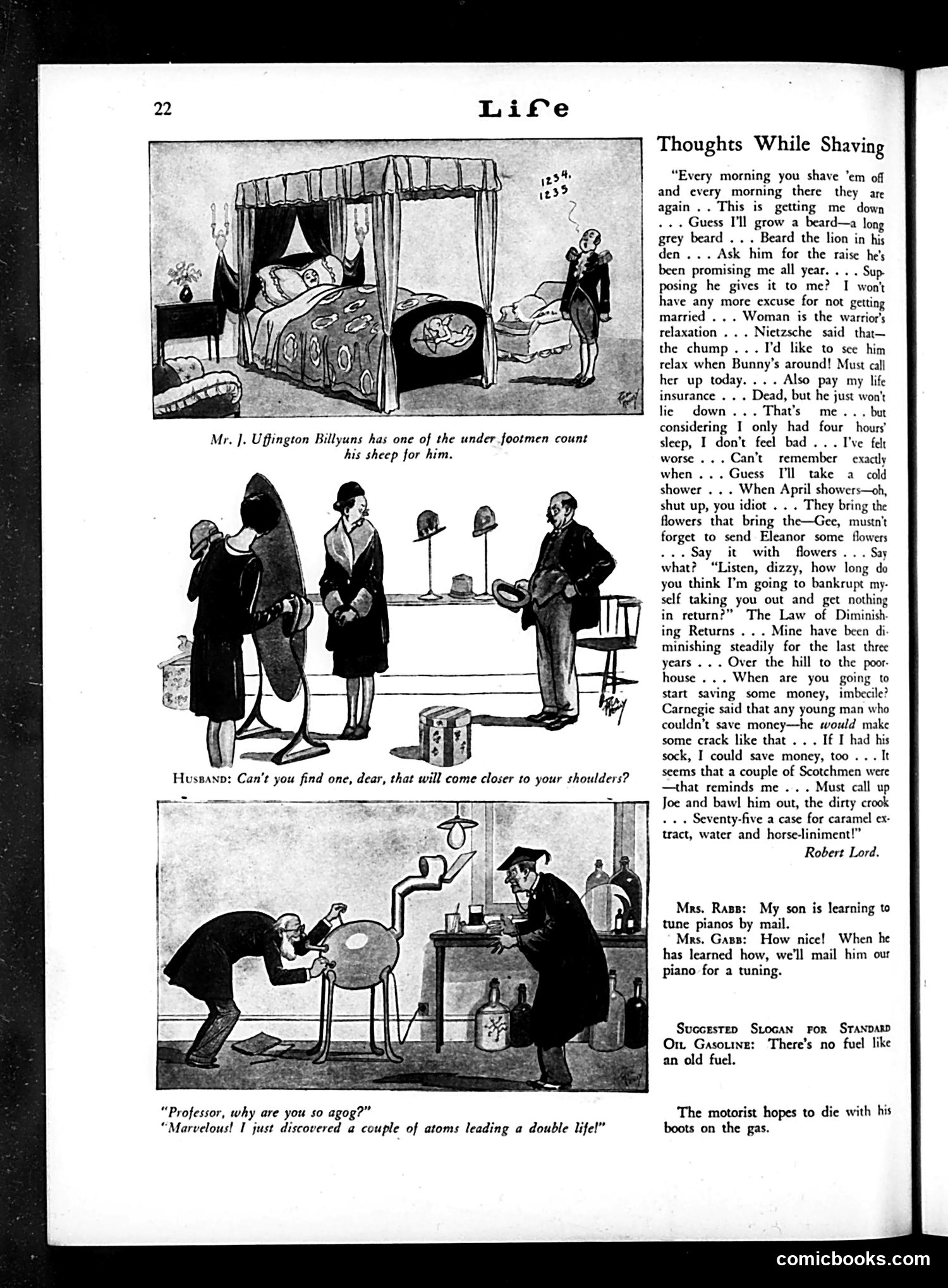
This page presents early 20th-century American humor through three distinct formats: **"Thoughts While Shaving"** is a stream-of-consciousness monologue capturing a working man's anxious morning ruminations—worried about asking his boss for a raise, marriage prospects, financial obligations, and romantic entanglements. It reflects working-class anxiety and the era's social expectations around marriage and economic security. **The cartoon scenes** satirize wealthy absurdity: a rich man (Mr. Uffington Billyuns) employs servants to count his sheep; a husband seeks companionship closer to his "shoulders" (marital complaint); a professor excitedly claims atoms lead "double lives" (mocking pseudo-scientific pretension). **Brief joke exchanges** mock inefficiency (piano tuning by mail) and contain period wordplay ("fuel like an old fuel"). The humor reflects 1920s-era concerns: class disparities, marriage friction, financial stress, and intellectual pretension. The magazine's satirical voice targets both working-class anxieties and upper-class ridiculousness.
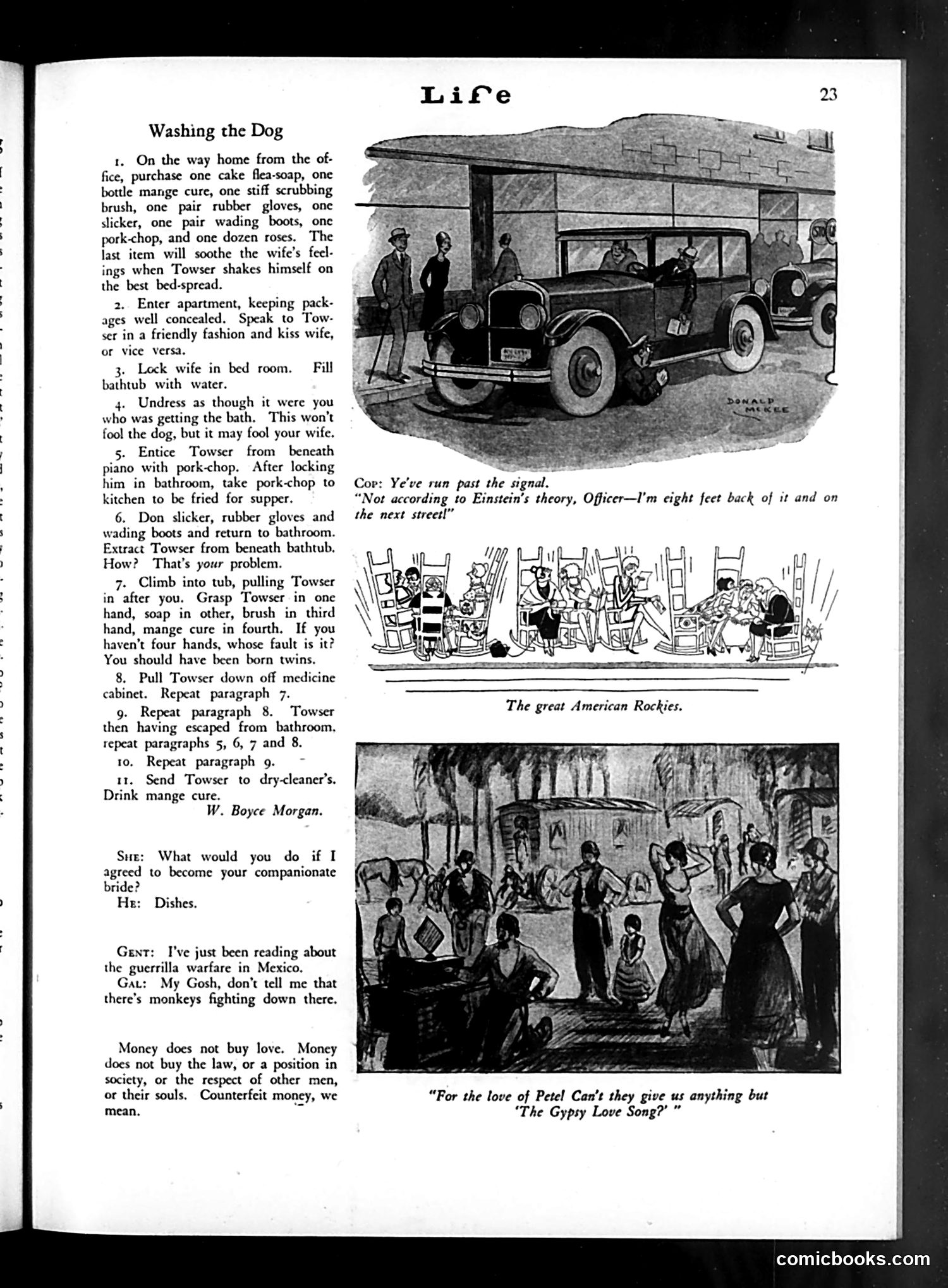
This page contains several brief humorous pieces typical of early 20th-century American satire: **"Washing the Dog"** is a comedic instruction piece by W. Boyce Morgan depicting the chaos of bathing a dog named Towser. The joke relies on the absurdity of the steps—requiring four hands, the dog repeatedly escaping, and ultimately suggesting sending the dog to a dry-cleaner and drinking the mange cure. It satirizes domestic frustration and the impossibility of the task. The other small jokes mock contemporary concerns: a "companionate bride" (a 1920s concept of marriage partners as equals), confusion about monkeys in Mexico, and a driver misapplying Einstein's relativity theory to traffic violations. The cartoons show a car at a garage, and a scene captioned "The great American Rockies" with people in rocking chairs, and a final image mocking repetitive music selection, likely at a social venue. The page exemplifies Life's style: irreverent, domestic-focused humor targeting middle-class readers' everyday frustrations and pretensions.
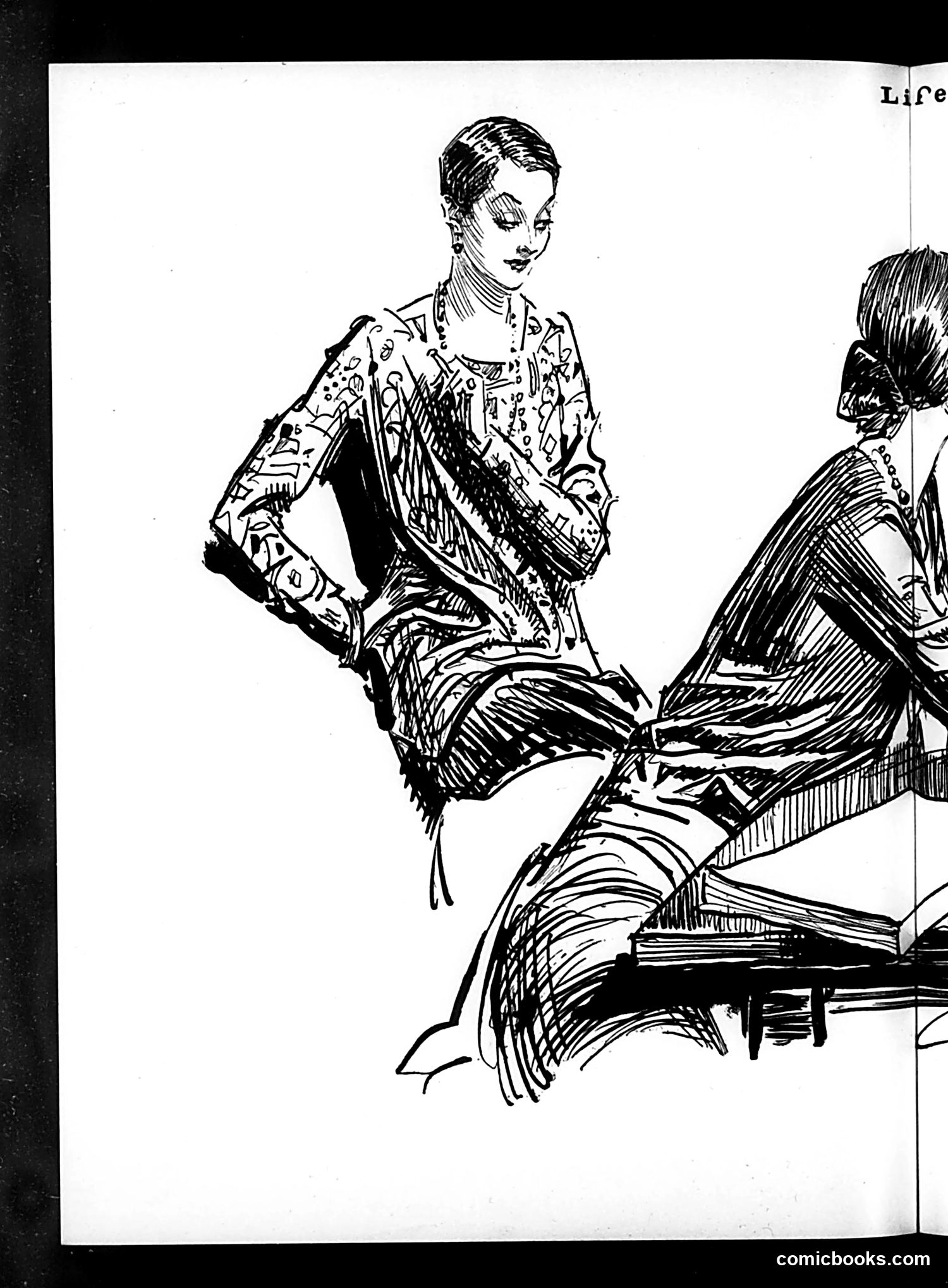
This appears to be a fashion illustration rather than a political cartoon. The image shows two figures in 1920s-style clothing—a woman standing in an ornately patterned jacket and a seated figure partially visible on the right. The illustration emphasizes fashionable dress of the era, with detailed line work showing textile patterns and tailoring. The page header reads "Life," confirming this is from the satirical magazine, which regularly published fashion commentary and social observations. However, without readable OCR text providing context, the specific satirical point—if any—remains unclear. It may critique fashion trends, social pretension, or contemporary style conventions of the period, but the image alone doesn't convey definitive political or social messaging.
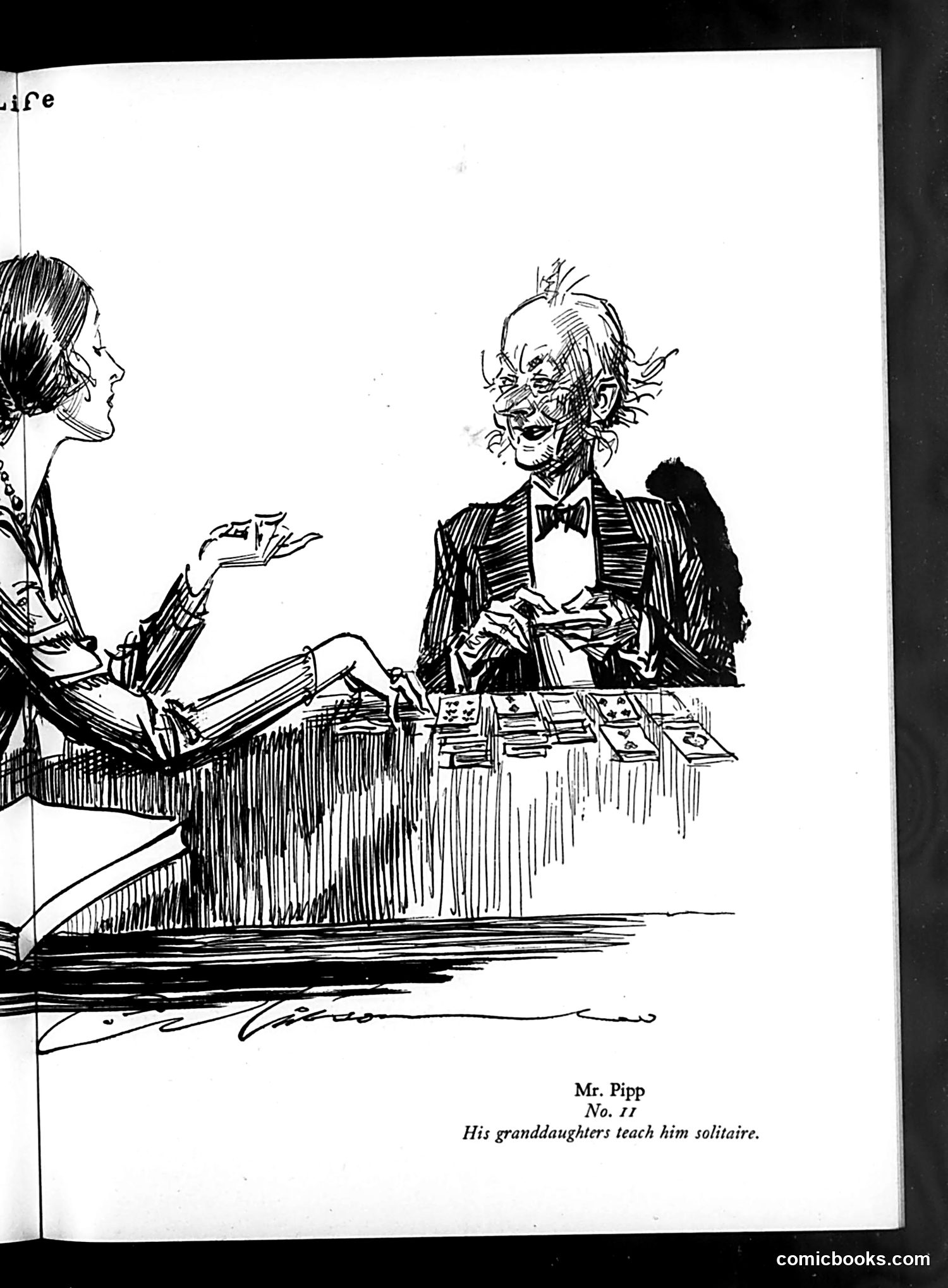
This is a satirical illustration from *Life* magazine featuring a character named Mr. Pipp. The cartoon depicts an elderly man with exaggerated, demonic facial features (horns, wrinkled grimace) dressed formally in a tuxedo, seated at a table with playing cards spread before him. A woman on the left gestures toward the cards. The caption states "His granddaughters teach him solitaire," suggesting a domestic scene of family members introducing the old man to card games. The grotesque caricature of Mr. Pipp—appearing almost devil-like—creates satirical contrast with the innocent, wholesome activity described. Without additional context about who Mr. Pipp represents, the exact target of satire remains unclear, though the exaggerated facial features may mock a specific public figure or type.
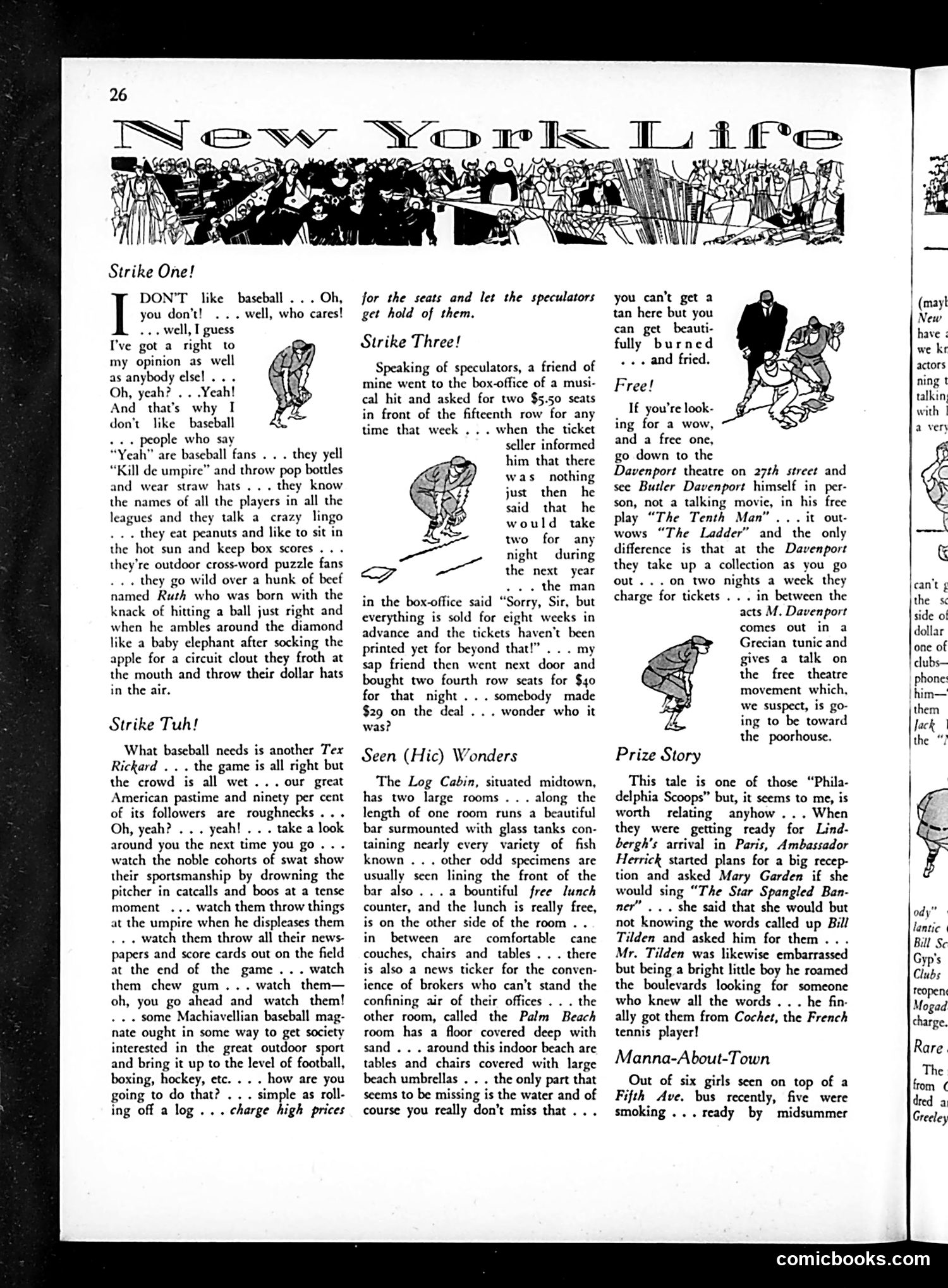
This page satirizes baseball fans and New York entertainment venues circa the 1920s. **The Baseball Satire ("Strike One/Two/Three"):** The author mocks baseball enthusiasts as uncultured "roughnecks"—they yell, throw bottles, wear straw hats, obsess over player statistics, and eat peanuts in the hot sun. The piece references Babe Ruth (the "hunk of beef named Ruth") as an example of what captivates these fans. The satire suggests baseball's appeal lies in lowbrow spectacle rather than sport. Notably, "Tex Rickard" (a famous boxing promoter) is invoked as a model—implying baseball needs commercialization and high ticket prices to attract "society." **The Speculators Strike:** A follow-up anecdote mocking ticket scalping—a man could buy orchestra seats weeks in advance at inflated prices ($40 for seats listed at $5.50), with middlemen profiting $29 per ticket. **Venue Notices:** Brief descriptions of upscale Manhattan establishments (The Log Cabin, Palm Beach room, Davenport theatre) promoting their amenities and free entertainment. The overall tone reflects 1920s-era class anxiety about baseball's mass appeal versus "refined" entertainment.
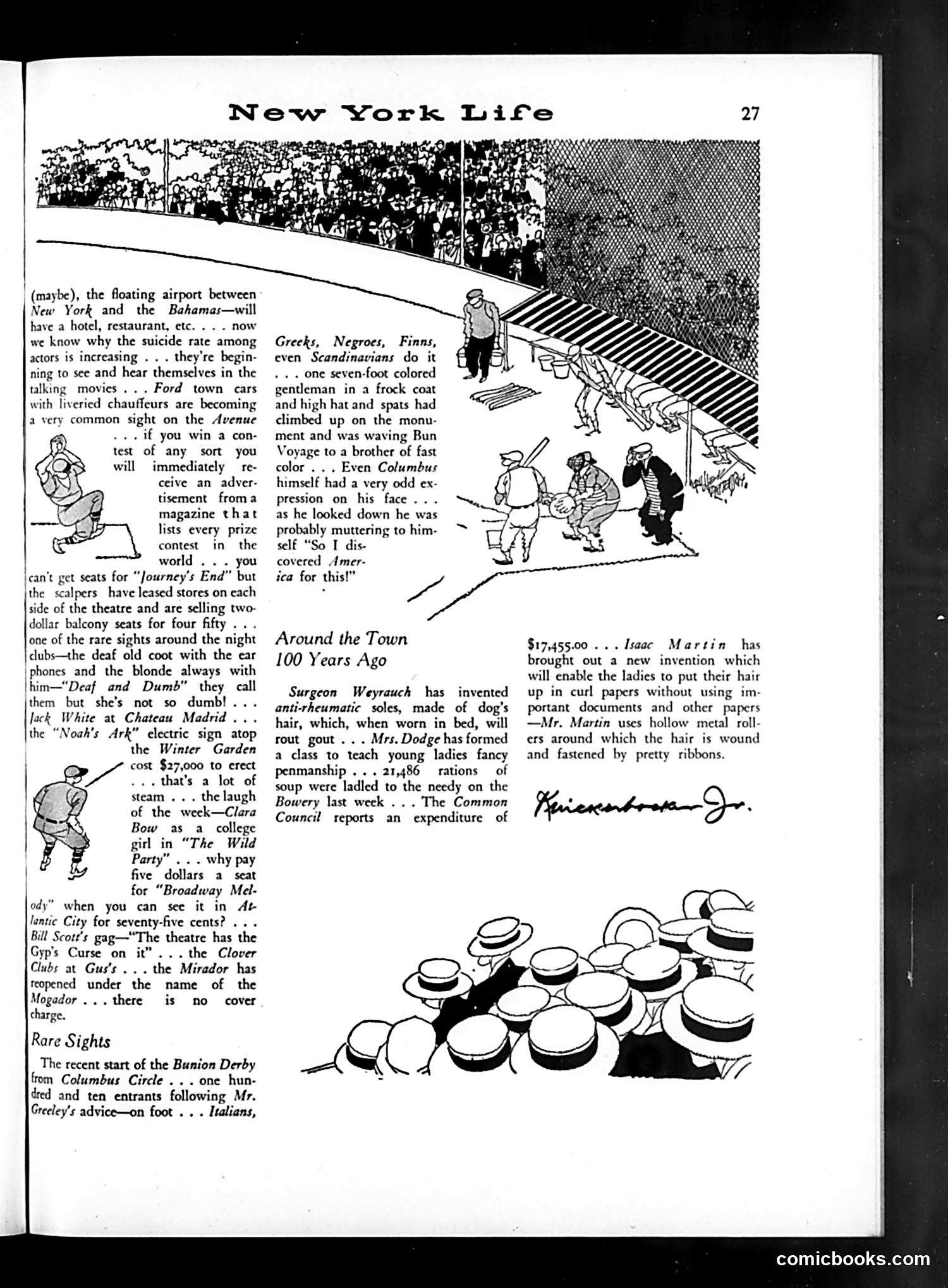
This page from Life magazine contains brief satirical observations about 1920s New York society, plus an illustration of the "Bunion Derby"—a cross-country footrace that began in Columbus Circle. The cartoon depicts diverse runners (identified by ethnicity: Italians, Greeks, Finns, Scandinavians, and "a seven-foot colored gentleman") participating in this novelty race. The humor derives from the Columbus statue's implied dismay at seeing his discovery's legacy reduced to this spectacle. The text column "Around the Town—100 Years Ago" offers humorous fake historical items (anti-rheumatic dog-hair shoe soles, hollow metal hair rollers) as parody of old newspaper advertisements. The main satire mocks 1920s excess: talking pictures alienating actors, scalpers profiting from Broadway shows, theater superstitions, and conspicuous consumption among the wealthy—all snapshots of Jazz Age New York frivolity.
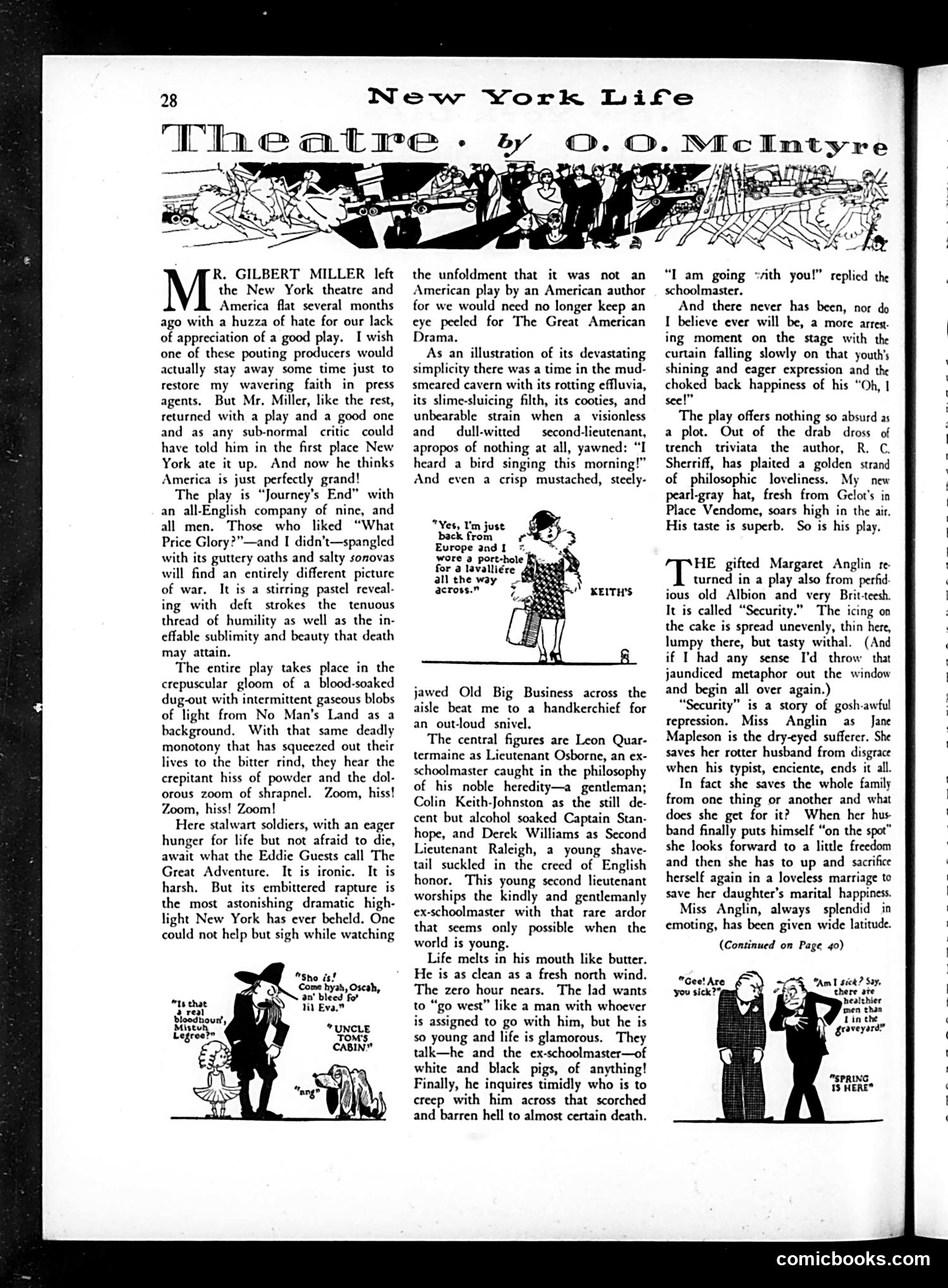
This page reviews the British war play "Journey's End," which opened in New York. The critic praises the production while making satirical points about American theatre producers and audiences. The cartoons mock theatrical pretension: one shows a character boasting about traveling to Europe with a porthole worn "for a lavallière" (a type of pendant)—satirizing shallow affectation. Another depicts "Uncle Tom's Cabin" stereotypes, likely contrasting melodramatic American theatre with the play's sophistication. The review's central irony: Mr. Gilbert Miller, a producer who *left* America complaining about lack of appreciation for good plays, now returns with a successful British play—proving New Yorkers *do* appreciate quality. The critic sarcastically suggests Miller's sudden love for America stems from commercial success, not changed circumstances. The play itself dramatizes WWI trench warfare with restraint and emotional depth, contrasting with earlier American war plays like "What Price Glory?"
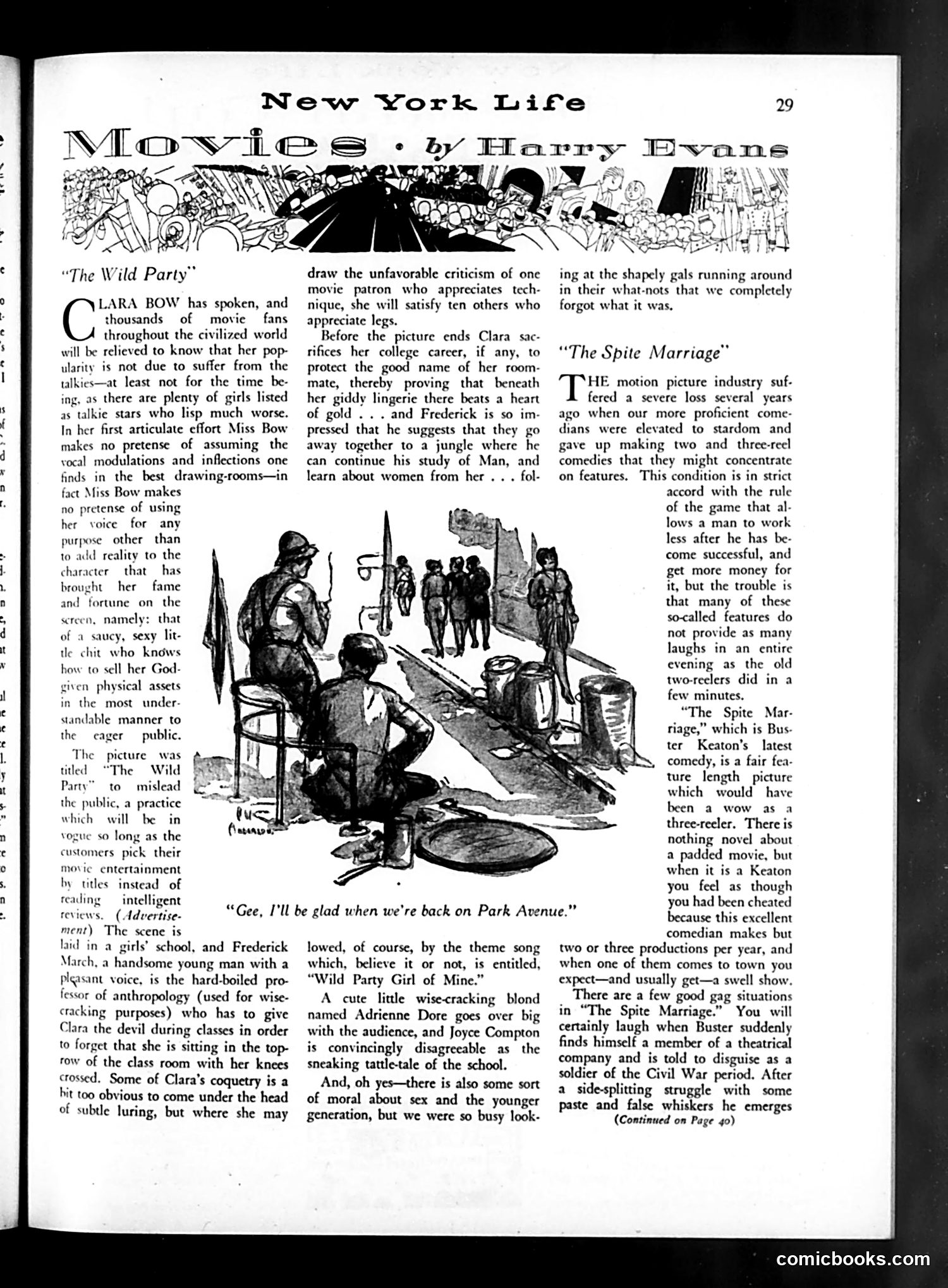
This page reviews two contemporary films. "The Wild Party" stars Clara Bow, a silent-film sex symbol whose first talkie (sound film) is being scrutinized. The reviewer celebrates her unaffected, natural delivery and her ability to use her physical appearance effectively, treating her sexual appeal as her genuine talent rather than a flaw. The plot involves a schoolgirl and her professor; the caption joke mocks how little substance matters when viewers are distracted by "shapely gals." "The Spite Marriage" features Buster Keaton. The reviewer complains that successful comedians now make padded feature-length films when they could deliver more laughs in shorter two or three-reel comedies. The implication: Hollywood prioritizes money over quality, and comedians become lazier after achieving stardom. Both reviews display the era's frank attitudes toward sex appeal and cynicism about commercial film-making practices.
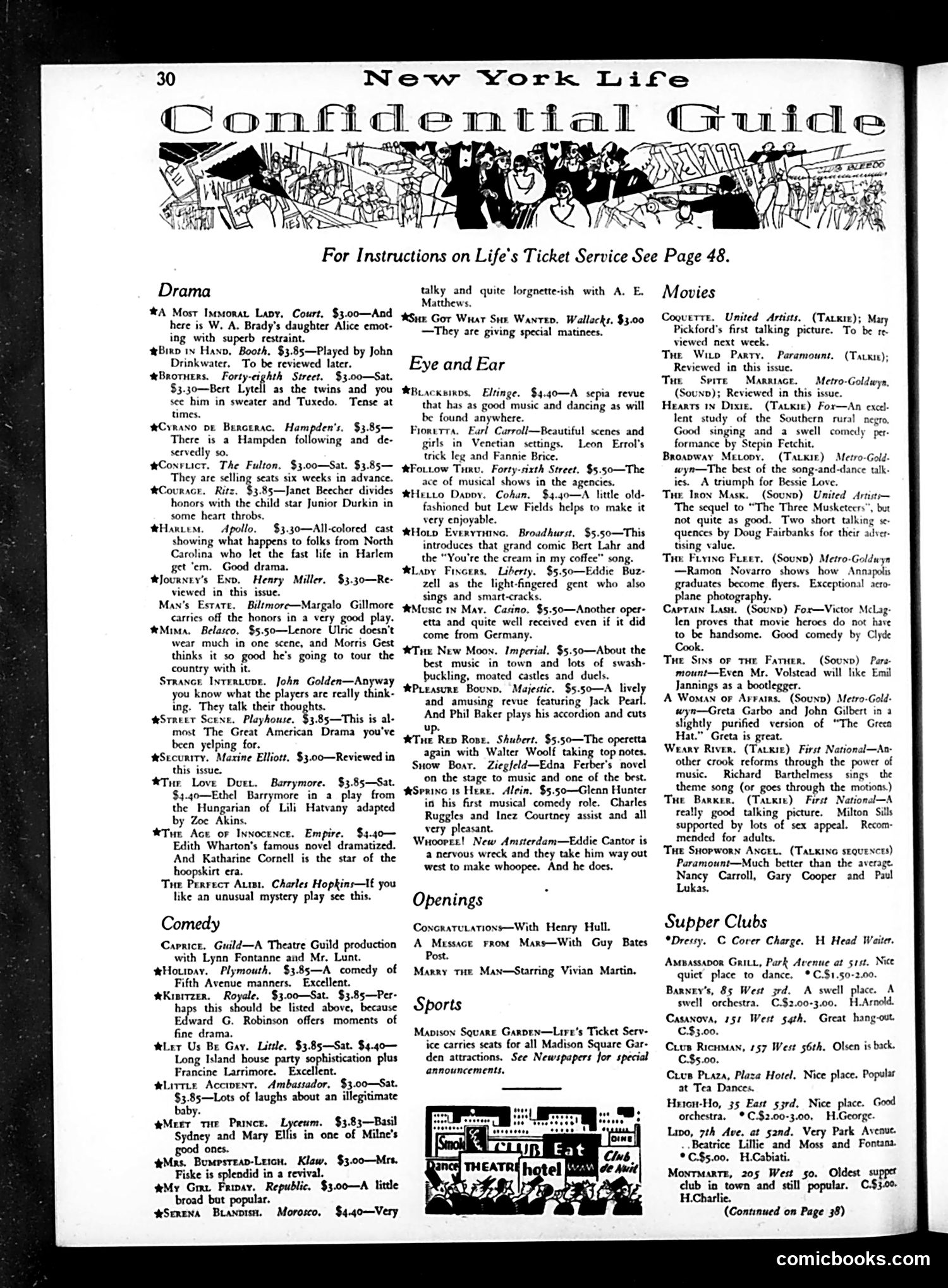
This page is a **theater and entertainment listings guide** from Life magazine, not a political cartoon. It contains no satire or caricature to analyze. The content consists of: 1. **Drama section**: Capsule reviews of Broadway plays with theater names, ticket prices (ranging $1.00-$5.50), and brief critical commentary on performances. 2. **Comedy, Eye and Ear (musicals), Sports, Openings, and Supper Clubs sections**: Similar theater/entertainment listings and reviews. 3. **Small illustration**: A simple line drawing of theaters/storefronts labeled "Theatre Hotel" and "Club" (bottom center). The page serves as a practical entertainment guide for 1920s New York audiences, offering recommendations and pricing information. References include performers like Ethel Barrymore, Lenore Ulric, and Bert Lahr, but these are straightforward cast listings rather than satirical commentary.
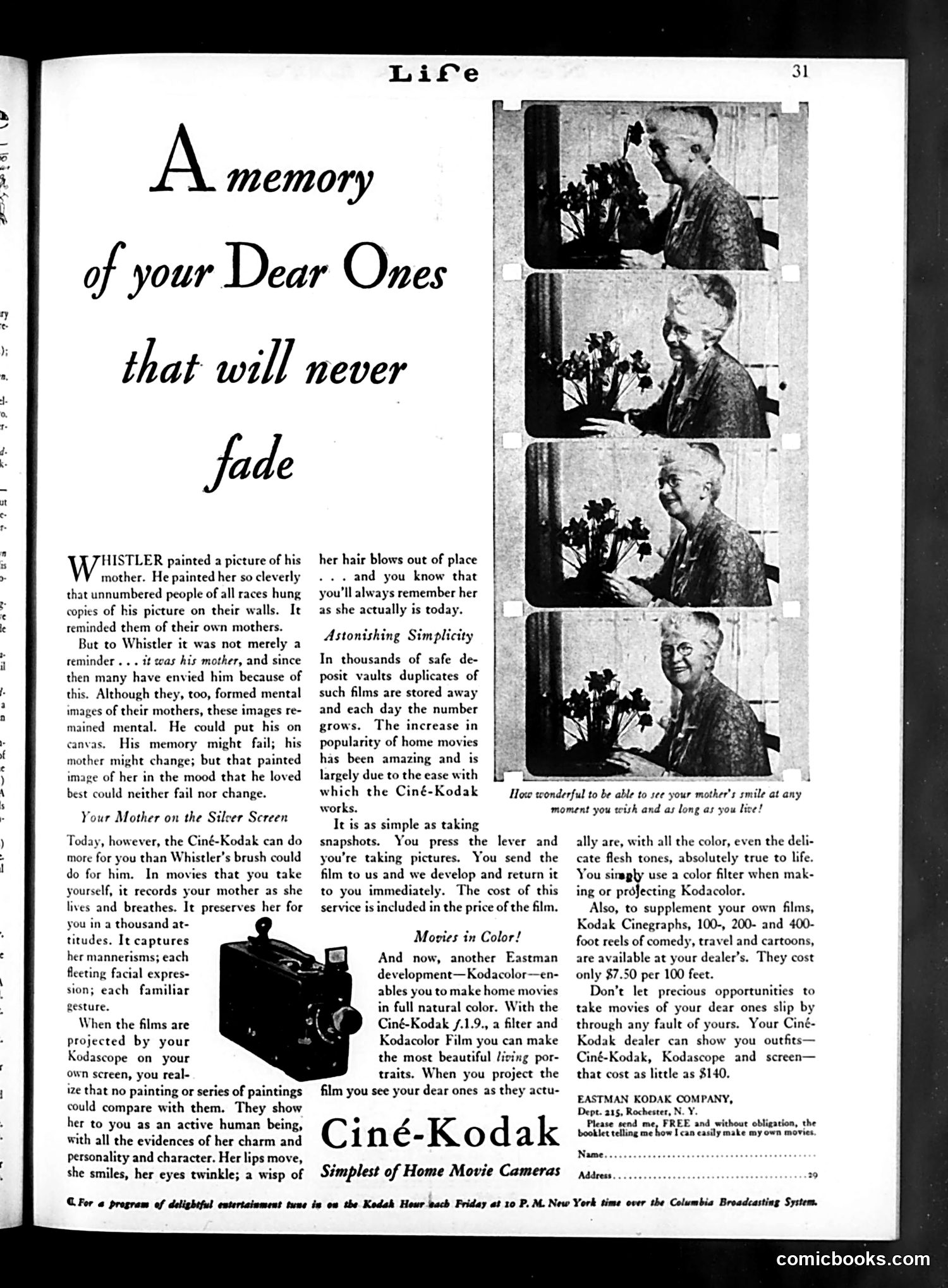
This is primarily a **product advertisement**, not satire or political commentary. It promotes Eastman Kodak's home movie camera system to American consumers. The page references **James McNeill Whistler**, the 19th-century painter famous for his portrait of his mother, to establish an emotional framework: just as Whistler's painted portrait preserved his mother's memory, Kodak's movie cameras now offer something superior—living, moving images that capture personality, gesture, and authentic presence. The "satire" is gentle and implicit: the advertisement subtly argues that technology has surpassed fine art at capturing and preserving human memory. Where a painting is static, film shows "her lips move, she smiles, her eyes twinkle." The ad emphasizes **accessibility** ("Astonishing Simplicity") and sentimentality—preserving mothers and loved ones—while promoting new color film technology and affordable equipment packages starting at $140. This reflects 1930s-40s consumer marketing: technology as democratic, emotionally resonant, and family-centered.
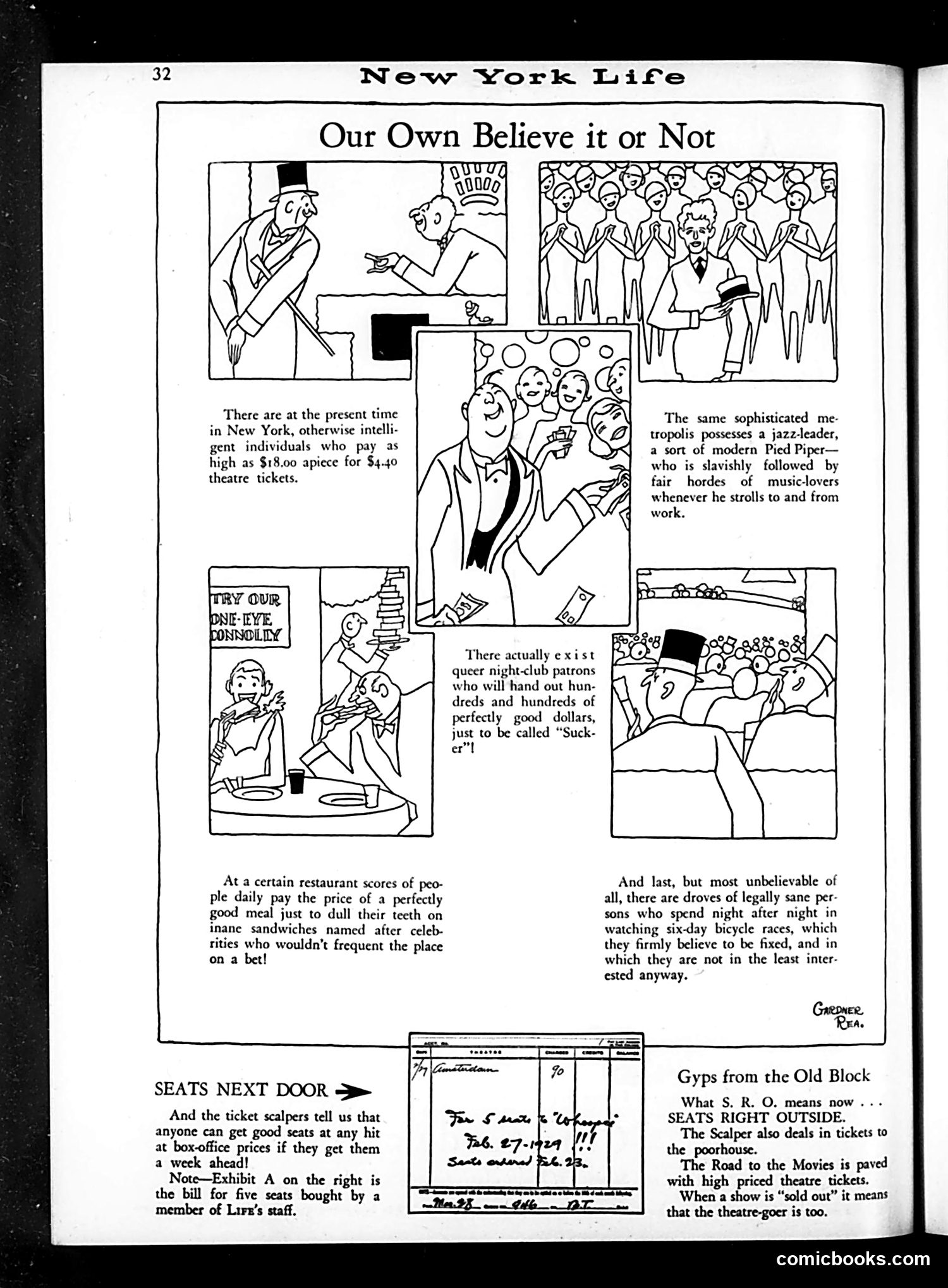
This page satirizes absurd spending habits of New Yorkers in the Jazz Age. The cartoonist (signed "Cesare") mocks the wealthy and aspirational middle class for wasteful expenditures: - **Theatre scalping**: Paying $18 for $4.40 tickets—exploitative ticket reselling - **Celebrity-named sandwiches**: Overpriced restaurant gimmicks named after celebrities who wouldn't actually eat there - **Jazz-leader worship**: Crowds following a bandleader like the Pied Piper - **Night clubs**: Patrons knowingly called "suckers" yet willingly paying inflated prices - **Six-day bicycle races**: Attending "fixed" events they don't believe in or care about The "Believe It or Not" title parodies the popular contemporary odditorium feature. The sidebar jokes about theatrical tickets use "S.R.O." (Standing Room Only) wordplay. The overall message: New Yorkers spend money foolishly on entertainment, either through exploitation or self-delusion.
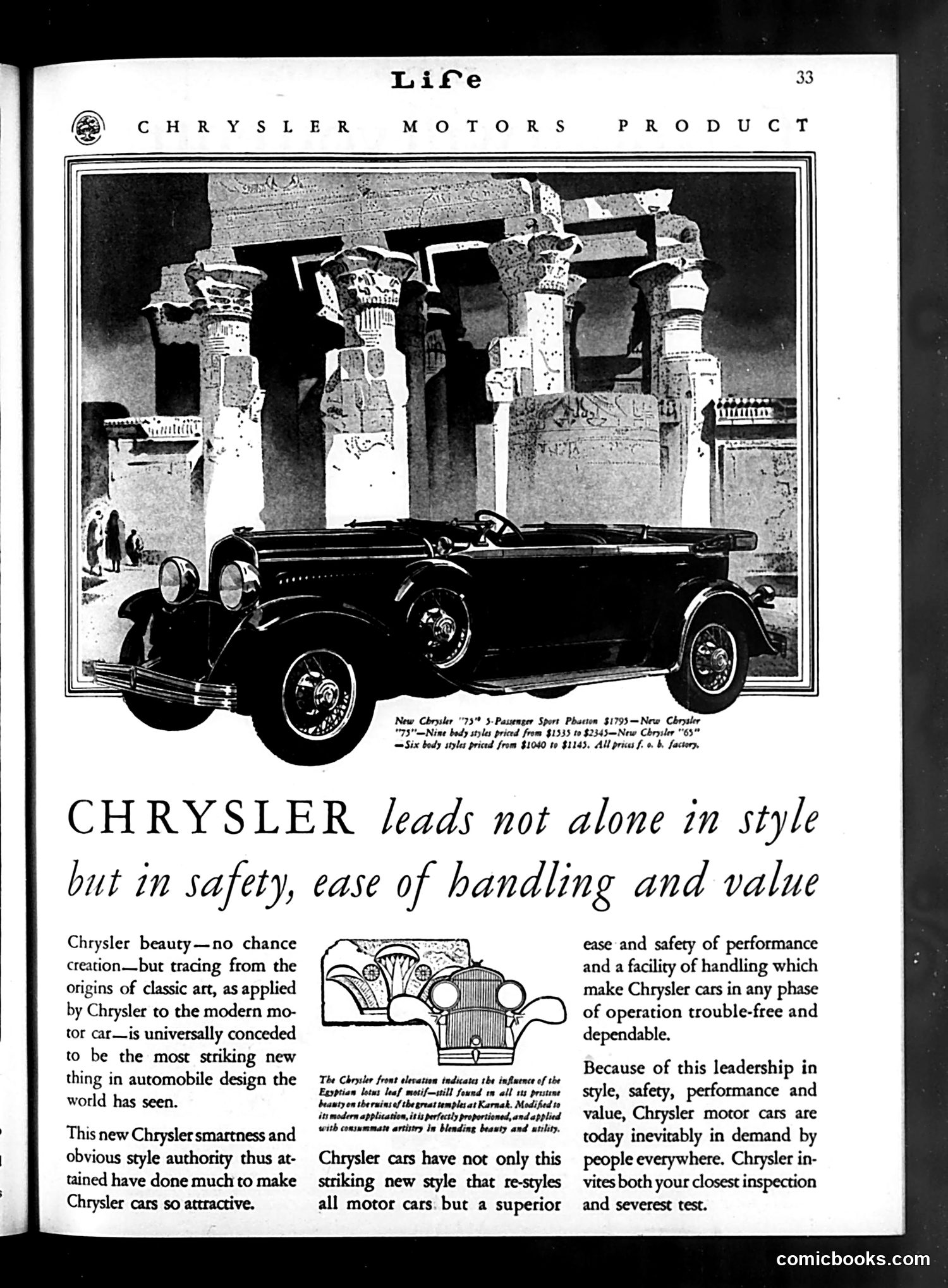
This is **not satire or political commentary** — it's a straightforward automobile advertisement from Life magazine (page 33), likely from the late 1920s or early 1930s. The page promotes Chrysler's new "73" and "65" models, featuring a luxury convertible photographed against Egyptian temple columns. The advertisement argues that Chrysler's styling derives from classical artistic principles — specifically citing Egyptian lotus-leaf motifs visible in temple architecture at Karnak. The appeal combines modernist design language with classical legitimacy: Chrysler claims its cars represent timeless aesthetic principles, not mere fashion. The text emphasizes practical virtues alongside style: safety, ease of handling, and value. For modern readers, this reflects how 1920s-30s luxury marketers positioned automobiles as refined objects worthy of serious aesthetic consideration, borrowing authority from high art and ancient civilizations to justify premium pricing.
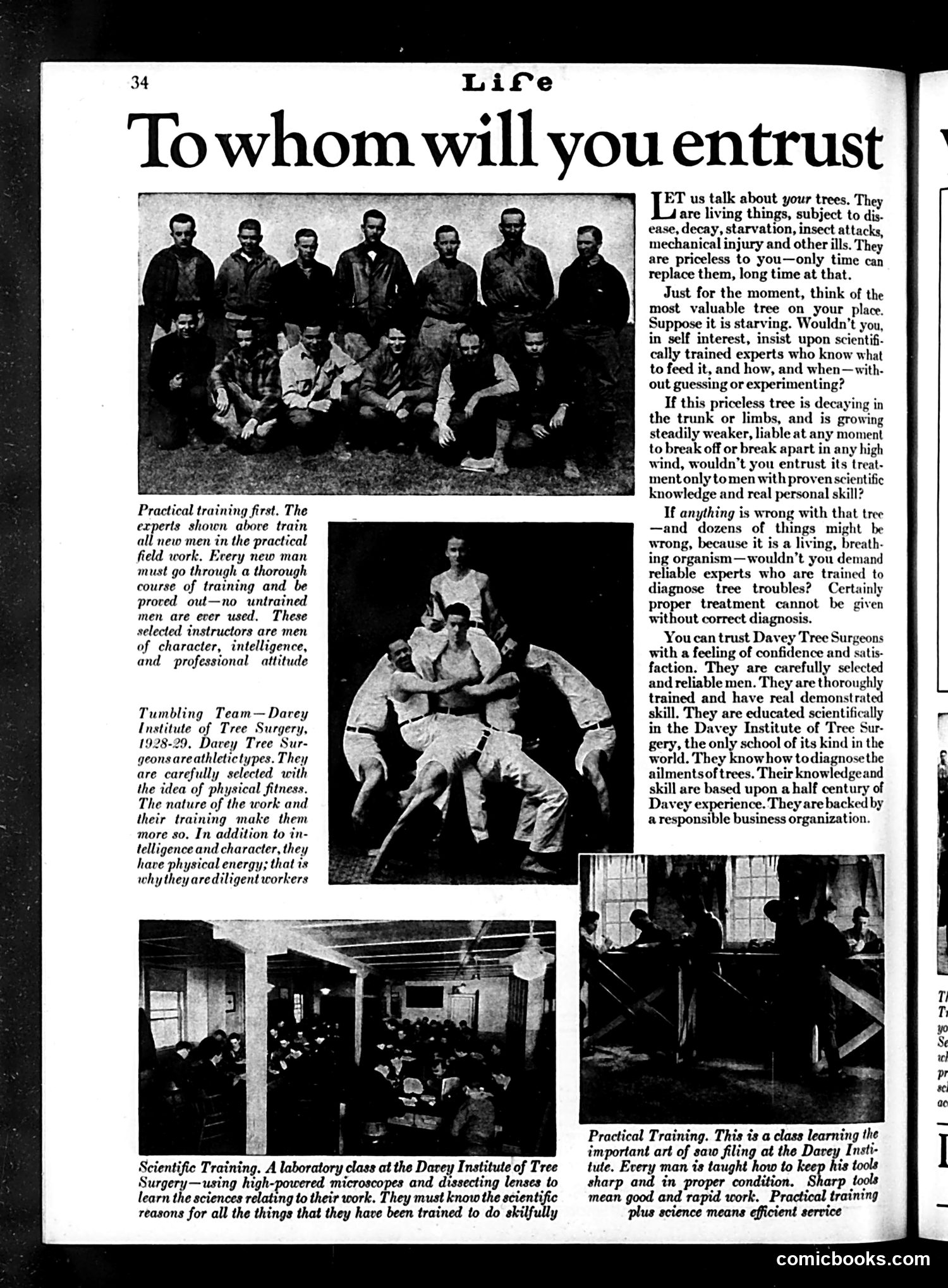
This is **not a cartoon or satire**—it's a **corporate advertisement** for the Davey Tree Surgery company, circa 1928-29. The page uses photographs and testimonial rhetoric to promote Davey as the only trustworthy tree-care provider. It argues that just as you'd demand scientifically trained experts for a valuable, living tree's medical care, you should hire Davey's surgeons—not untrained workers. The images show: a "tumbling team" of athletic Davey employees (emphasizing physical fitness and character), laboratory training with microscopes, and practical instruction in tool maintenance and saw-filing. The text stresses that Davey operates "the only school of its kind in the world" and has "half century of Davey experience." This is **professional credentialing through education propaganda**—establishing Davey as the monopoly expert, not a satire of anything. It reflects 1920s-30s American marketing that positioned specialized professional training as a selling point.
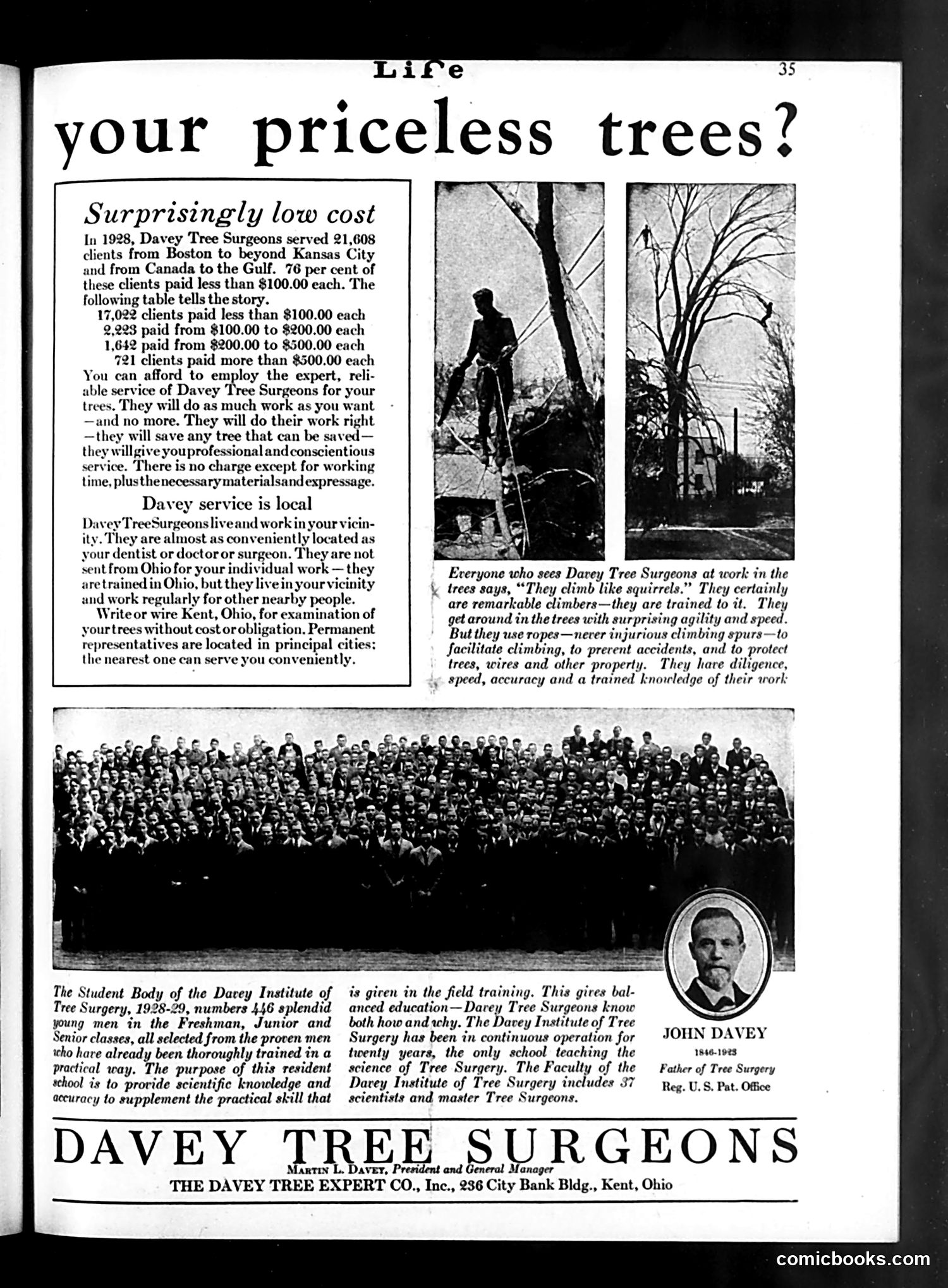
This is **not a cartoon or satire**—it's a full-page advertisement for Davey Tree Surgeons, a tree-care service based in Kent, Ohio. The ad emphasizes affordability and professionalism. It notes that in 1928, the company served over 21,000 clients across a broad geographic area, with 76% paying under $100. The marketing pitch stresses: - **Local convenience** (representatives in major cities, not sent from Ohio) - **Professional training** (they operate the Davey Institute of Tree Surgery, the only school teaching scientific tree surgery) - **Safety practices** (using ropes rather than climbing spurs to protect trees and workers) The page includes a large photograph of the student body and a portrait of John Davey (1846-1923), identified as the "Father of Tree Surgery," legitimizing the enterprise through its founder's legacy. This represents early-20th-century American commercial advertising emphasizing expertise, scalability, and scientific credibility to justify service pricing.
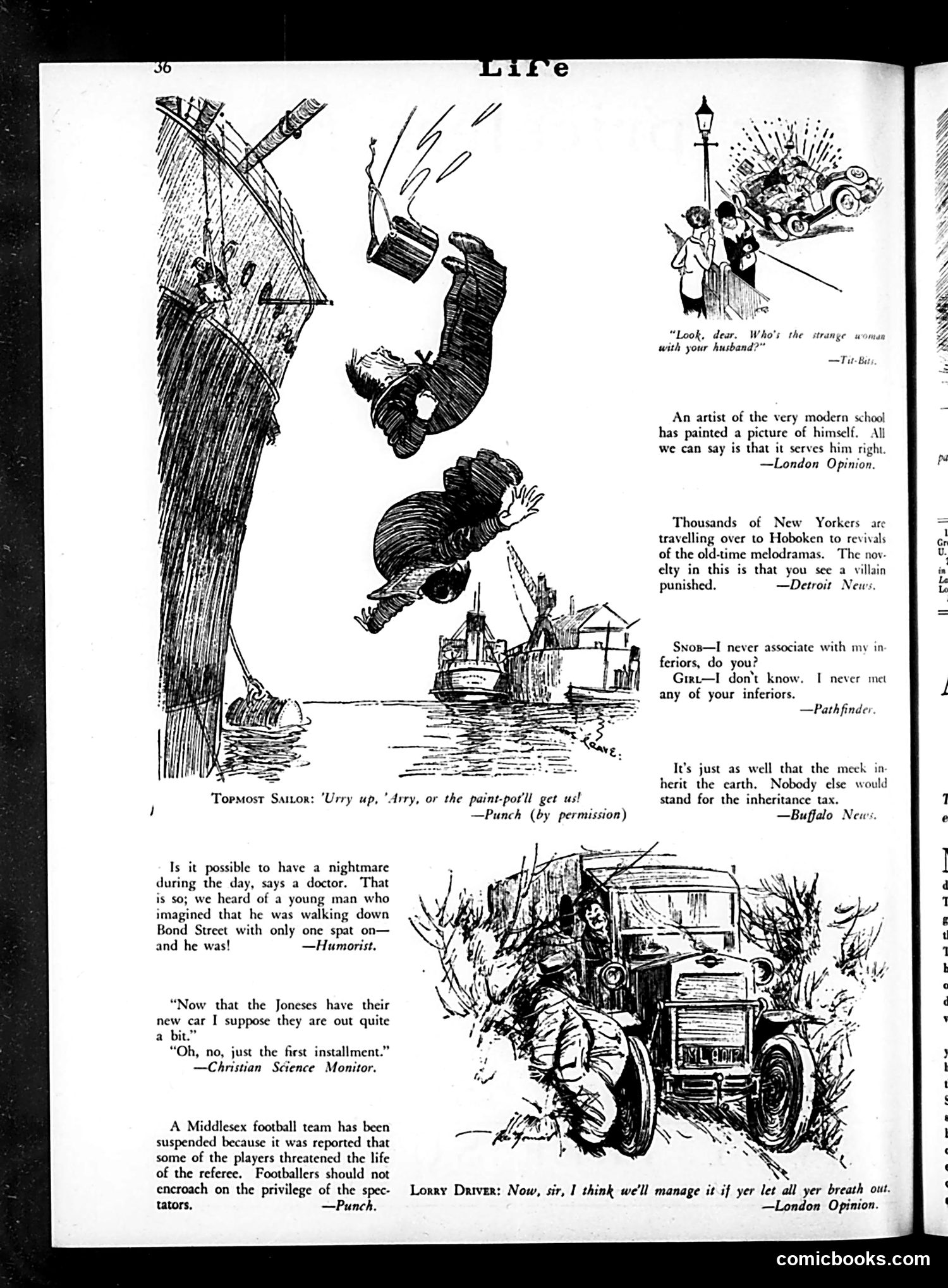
This page collects brief satirical jokes and cartoons typical of early 20th-century humor magazines: **Top cartoon**: Two sailors falling from a ship's rigging while painting, with the caption "Urry up, 'Arry, or the paint-pot'll get us!" — a slapstick visual gag about workplace danger. **Main cartoons**: The "Lorry Driver" sketch depicts a motor vehicle stuck in brush, with the driver asking a passenger to hold their breath to reduce weight—mocking either automotive reliability or passenger anxiety about new cars. **Text jokes** mock: - Modern art (an artist painting himself deserves the result) - Hoboken melodrama revivals (novelty is seeing villains punished, unlike real life) - Social pretension (the "no inferiors" exchange) - Installment buying culture (the Joneses can't afford their car outright) - Class tensions (meek people inheriting while facing inheritance taxes) The humor reflects 1920s anxieties: rapid motorization, consumer debt, social climbing, and modern art's incomprehensibility. All content derives from contemporary newspapers and magazines credited in attribution lines.
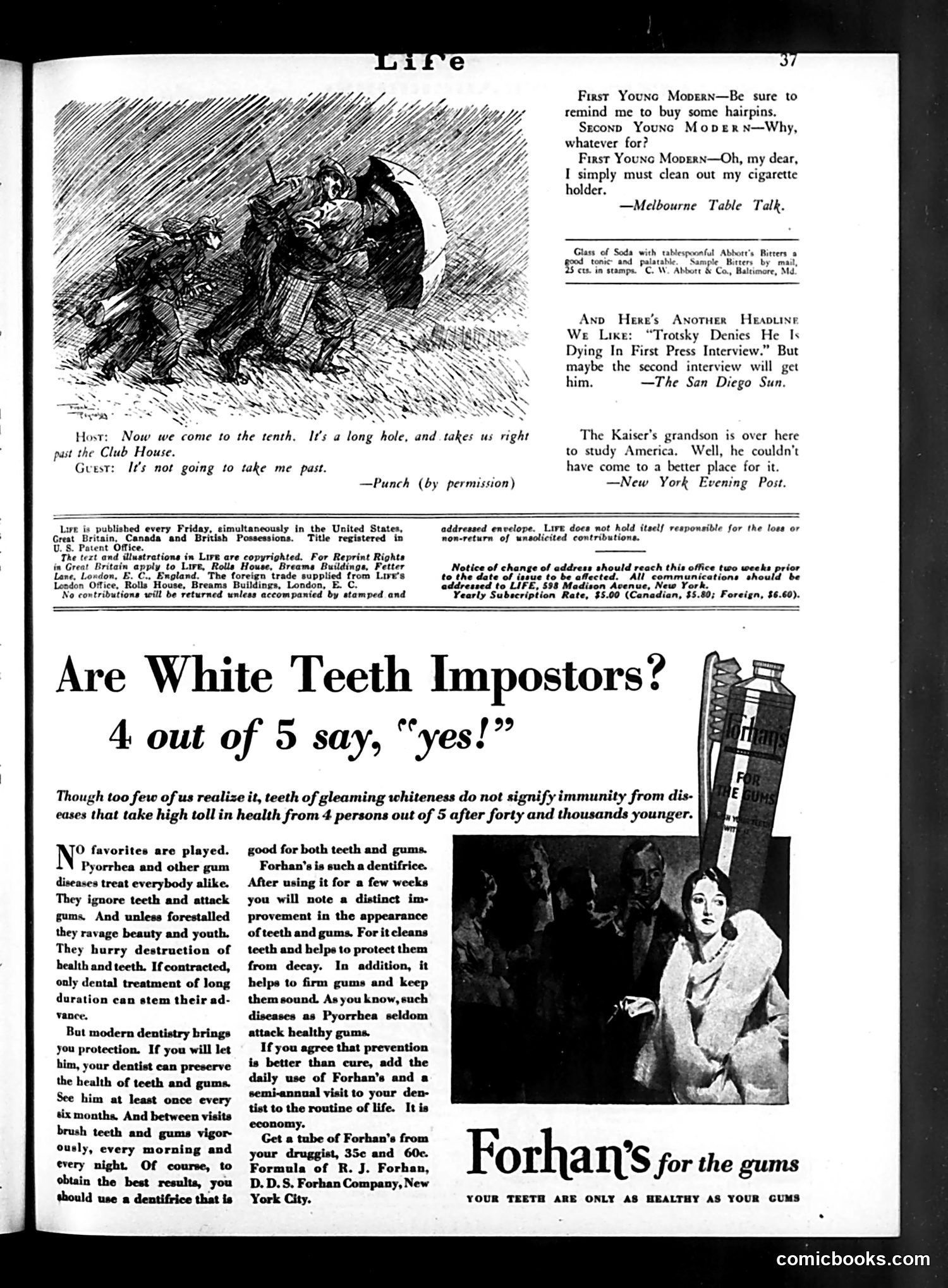
This page contains **multiple brief satirical items** typical of Life's format, plus a full-page advertisement. **The cartoons/jokes:** - A golf-course exchange where a guest refuses to be taken "past" the Club House—likely satirizing exclusionary country-club attitudes or class snobbery - Two "Young Modern" women discussing cleaning a cigarette holder with hairpins—mocking 1920s flapper culture and women's casual smoking habits - A quip about Trotsky (Russian revolutionary) denying he's dying, with the joke that a second interview might succeed—dark commentary on political instability/violence of the Soviet era - A jab at the Kaiser's grandson studying America, suggesting America itself is a poor influence **The advertisement** occupies the lower half, promoting **Forhan's toothpaste**, emphasizing that white teeth don't prevent gum disease (pyorrhea), a genuine health concern in this era. The ad argues prevention through daily brushing is cheaper than extensive dental treatment. The overall page reflects 1920s American anxieties: class boundaries, changing gender roles, international political chaos, and emerging consumerist health messaging.
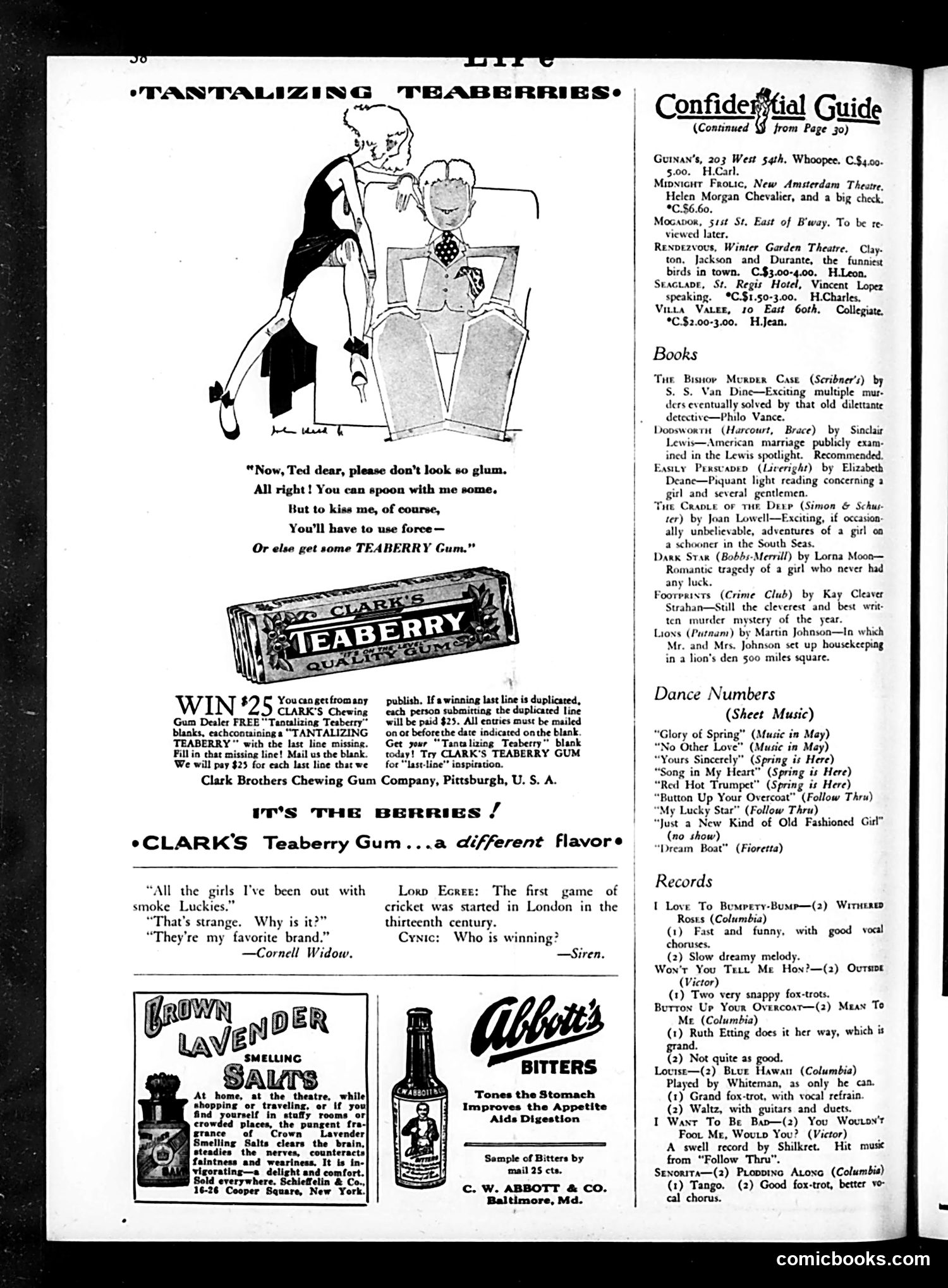
The page is primarily **advertising and entertainment listings** from Life magazine's "Confidential Guide" section, mixed with period ads. The main cartoon depicts a **flirtation scene** typical of 1920s dating culture. A young man leans toward a seated woman with the caption presenting his pitch: he'll let her "spoon" (cuddle) and eat teaberry gum with him, but kissing requires "force"—or she should chew Teaberry Gum instead. This is a **sexual innuendo joke**: the gum serves as a humorous substitute for physical intimacy, playing on the era's courtship rules where women were expected to resist male advances. The satire reflects **Jazz Age social anxieties** about changing dating norms and female independence. The "force" reference, though presented comedically, hints at contemporary debates over consent and romantic expectations. The page also advertises **shows, books, and records**—Helen Morgan, Jimmy Durante, and mystery novels were contemporary entertainments. The competing ads (Teaberry Gum, Abbott's Bitters, Brown Lavender Salts) target the magazine's affluent, urban readership.
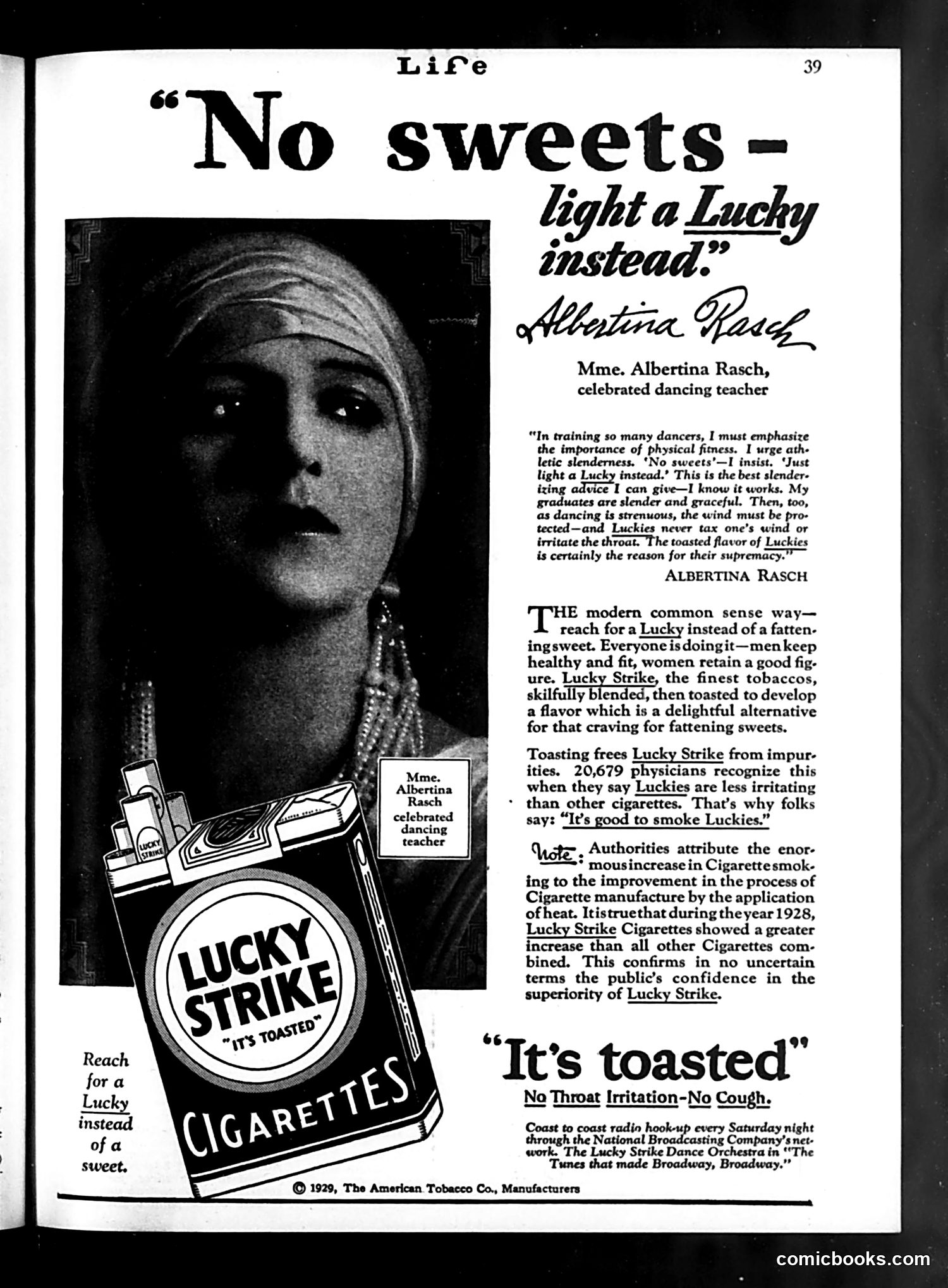
This is primarily a **cigarette advertisement**, not satire—though it reveals attitudes that seem absurd today. The page features **Albertina Rasch**, a real celebrated dance instructor, endorsing Lucky Strike cigarettes as a diet aid. The pitch: replace candy with cigarettes to stay slim and healthy. The ad claims smoking suppresses appetite, doesn't irritate throats, and that 20,679 physicians endorse it. **The historical context**: This represents pre-regulation tobacco marketing that exploited health anxieties (particularly women's weight concerns) and falsely cited medical authority. The "toasted" process is emphasized as a health benefit. The accompanying radio promotion ("Lucky Strike Dance Orchestra") normalized smoking as glamorous and modern. **What's jarring for modern readers**: The brazen health claims, celebrity endorsement by a fitness professional, and the casual positioning of cigarettes as a healthy lifestyle choice—all made before tobacco's dangers were publicly acknowledged and regulated.
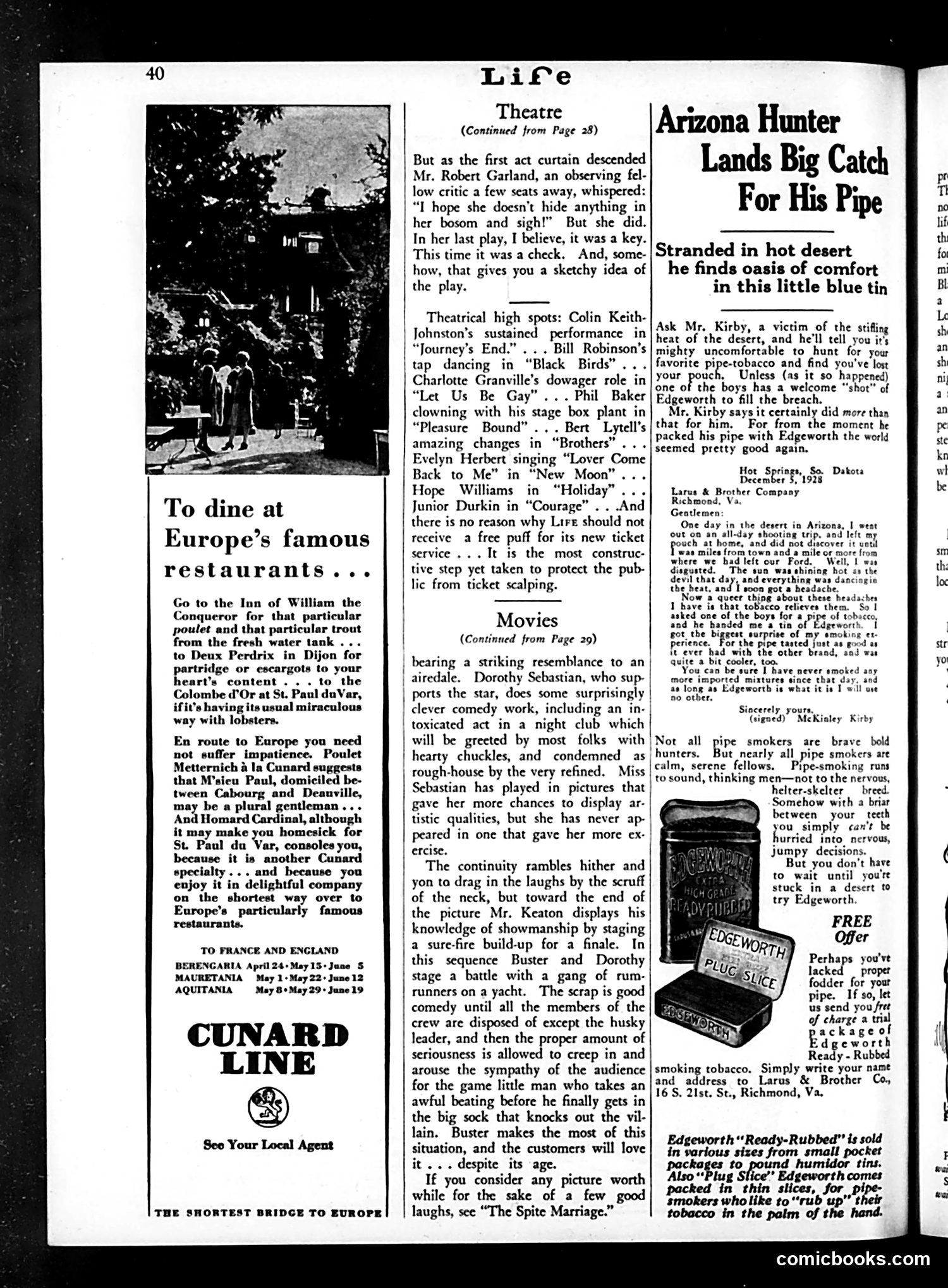
This page contains three distinct sections: **advertising, theater criticism, and a product endorsement.** The **Cunard Line advertisement** promotes luxury ocean travel to Europe, emphasizing fine dining at famous restaurants accessible via their ships—a pitch to wealthy travelers. The **theater and movies reviews** discuss contemporary Broadway shows and films, mentioning performers like Colin Keith-Johnston and Buster Keaton. The theater critic notes an actress's habit of hiding props in her bosom for dramatic effect—seemingly a recurring theatrical affectation the reviewer gently mocks. The **"Arizona Hunter" section** is an advertorial—disguised advertising presented as editorial content. It tells a narrative about a desert traveler finding comfort in Edgeworth pipe tobacco, presented as testimonial. The accompanying product images show tobacco tins. **For modern readers:** This reflects 1920s advertising practices where tobacco was openly promoted without health warnings, and advertorials seamlessly blended with editorial content. The "oasis of comfort" metaphor uses the desert setting to suggest the product provides relief and pleasure—standard marketing rhetoric of the era.
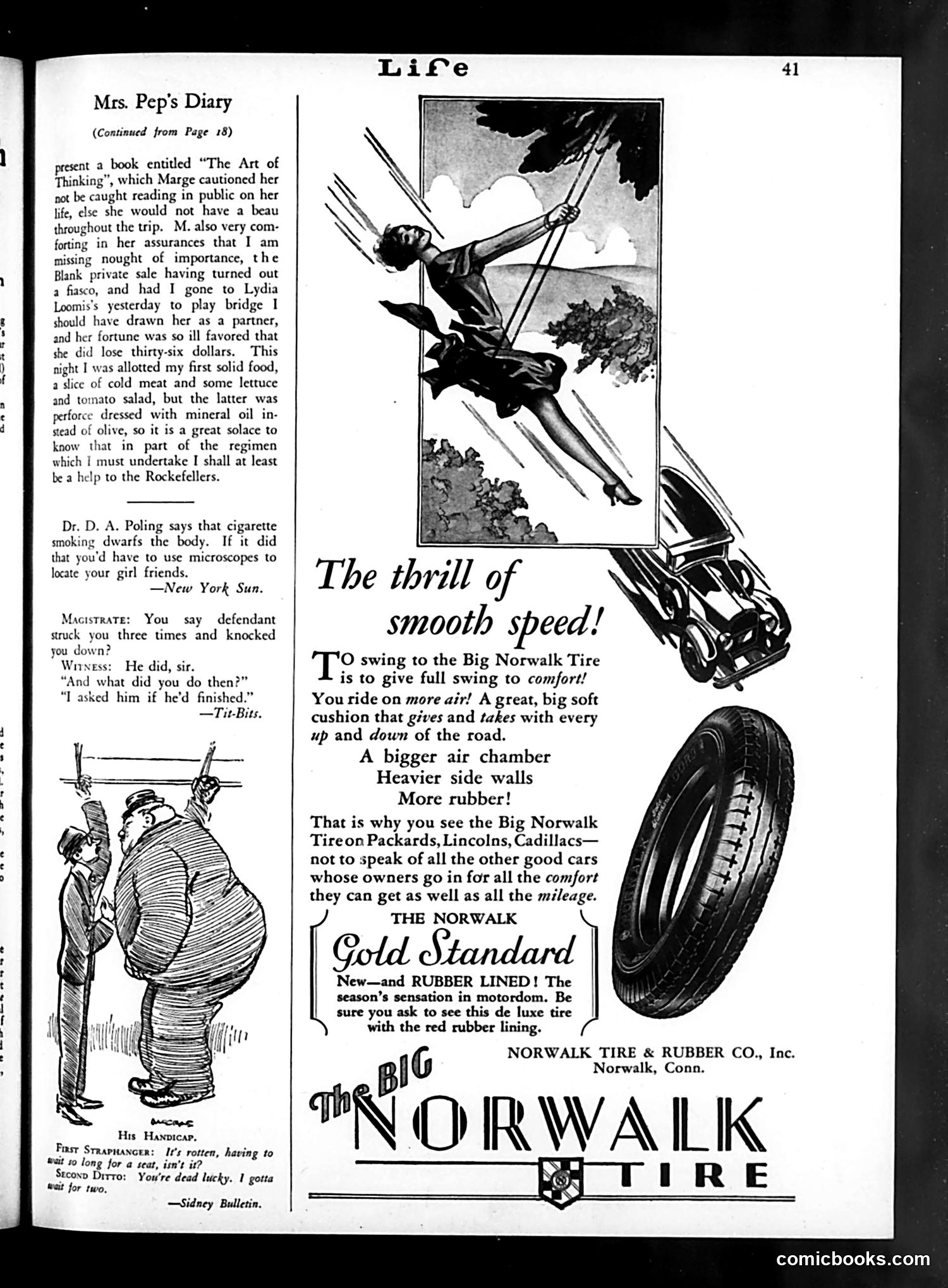
This page mixes humor columns with advertising. **Mrs. Pep's Diary** satirizes upper-class social pretensions—a woman recovering from illness describes trivial concerns (a bridge game loss of thirty-six dollars, salad dressed with mineral oil instead of olive). The humor targets wealthy anxieties and the superficiality of high society. Below, brief comic exchanges mock modern life: a doctor claims cigarette smoking stunts growth (the joke being girls would become invisible); a magistrate joke plays on repeated physical violence; taxi-stand humor complains about waiting for seats. The dominant content is a **Norwalk Tire advertisement** featuring a woman on a swing—symbolizing comfort and smooth motion. It targets affluent car owners (Packards, Lincolns, Cadillacs), emphasizing the tire's air-cushioning technology as luxury. The ad represents early automotive marketing emphasizing comfort over mere transportation.
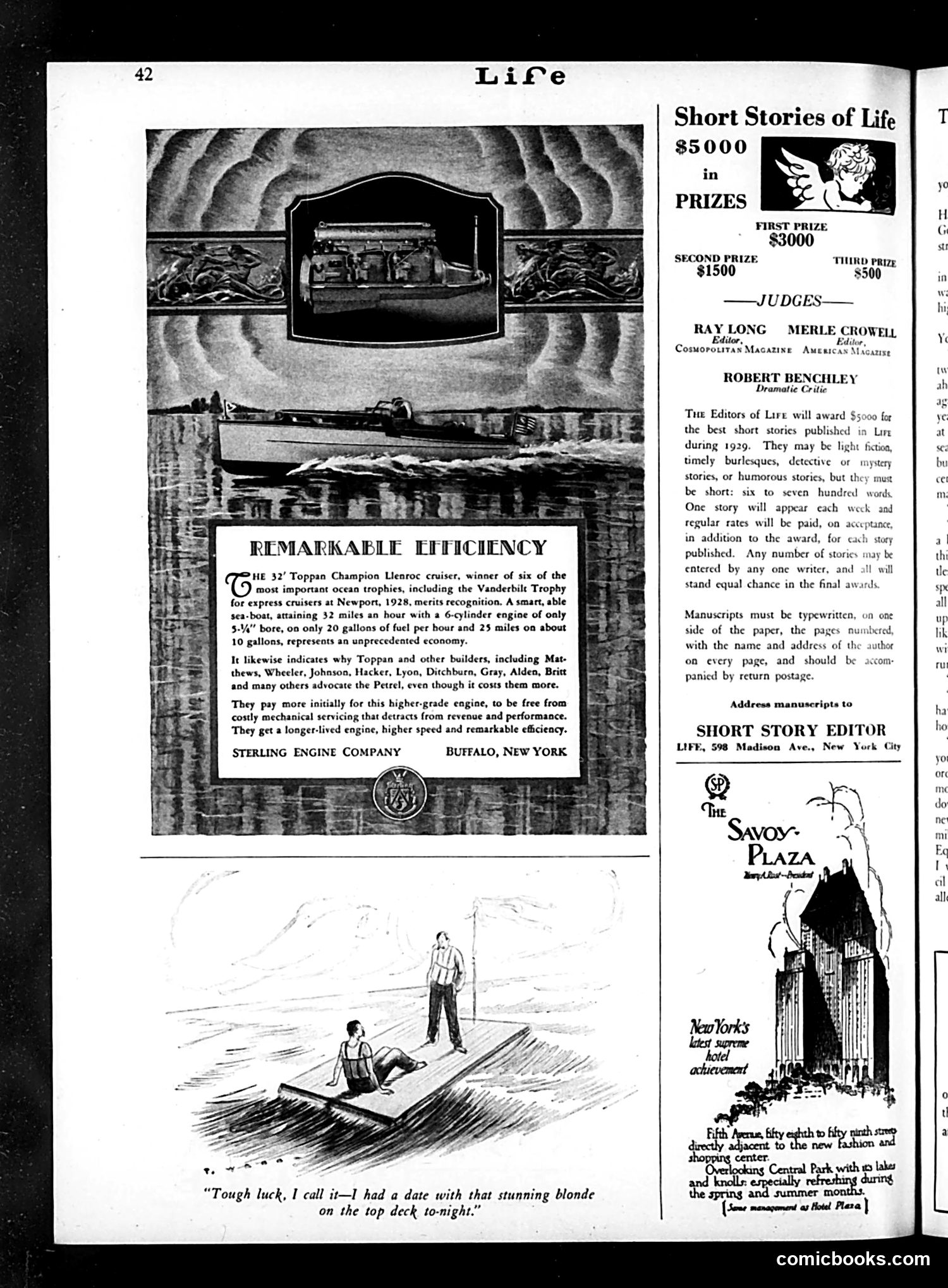
This page combines advertising with humor and a contest announcement. The main advertisement promotes Sterling Engine Company's marine engines, using the racing yacht "Llenroc" as proof of efficiency—highlighting its high speed on minimal fuel consumption. The ad appeals to boat builders by arguing that higher-quality engines justify their cost through reliability and performance. Below is a single-panel cartoon showing two men on a boat: one seated, one standing. The caption reads: "Tough luck, I call it—I had a date with that stunning blonde on the top deck to-night." The joke appears to reference the boat's efficient fuel economy: the man missed his romantic encounter because the boat ran so efficiently it didn't need to refuel—and thus dock—as expected. The right column announces Life magazine's 1929 short-story contest, offering $5,000 in prizes and featuring judges including humorist Robert Benchley.
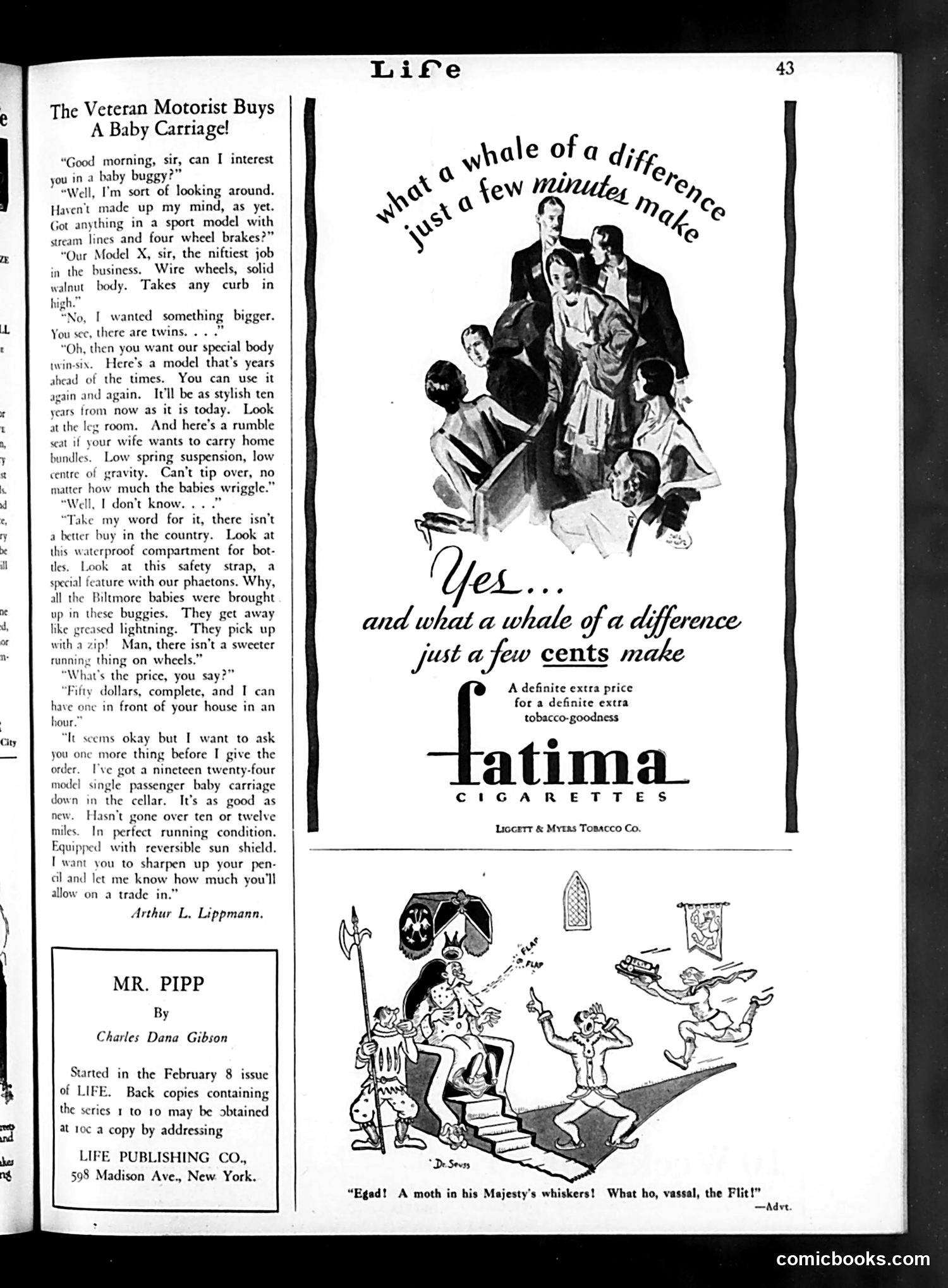
**"The Veteran Motorist Buys a Baby Carriage"** is a humorous dialogue satirizing how 1920s automobile culture had infiltrated everyday life. A car salesman pitches a baby buggy using automotive language—"sport model," "streamlines," "four wheel brakes," "wire wheels," "low spring suspension." The joke is that this ordinary product is being marketed with automobile specifications and luxury features (mentioning wealthy "Biltmore babies"). The punchline: the customer asks for a trade-in allowance on his old 1924 baby carriage—treating it exactly like a used car, complete with mileage ("ten or twelve miles") and condition reports. This reflects the 1920s obsession with cars as status symbols and the period's consumerist mindset of trading up constantly. The **Fatima cigarettes advertisement** features cherubs/cupids in classical style—a common advertising approach claiming product sophistication and quality through aesthetic imagery. The bottom **Dr. Seuss cartoon** (identifiable by the artist's signature) is a whimsical, unrelated humorous illustration about a moth in a king's beard.
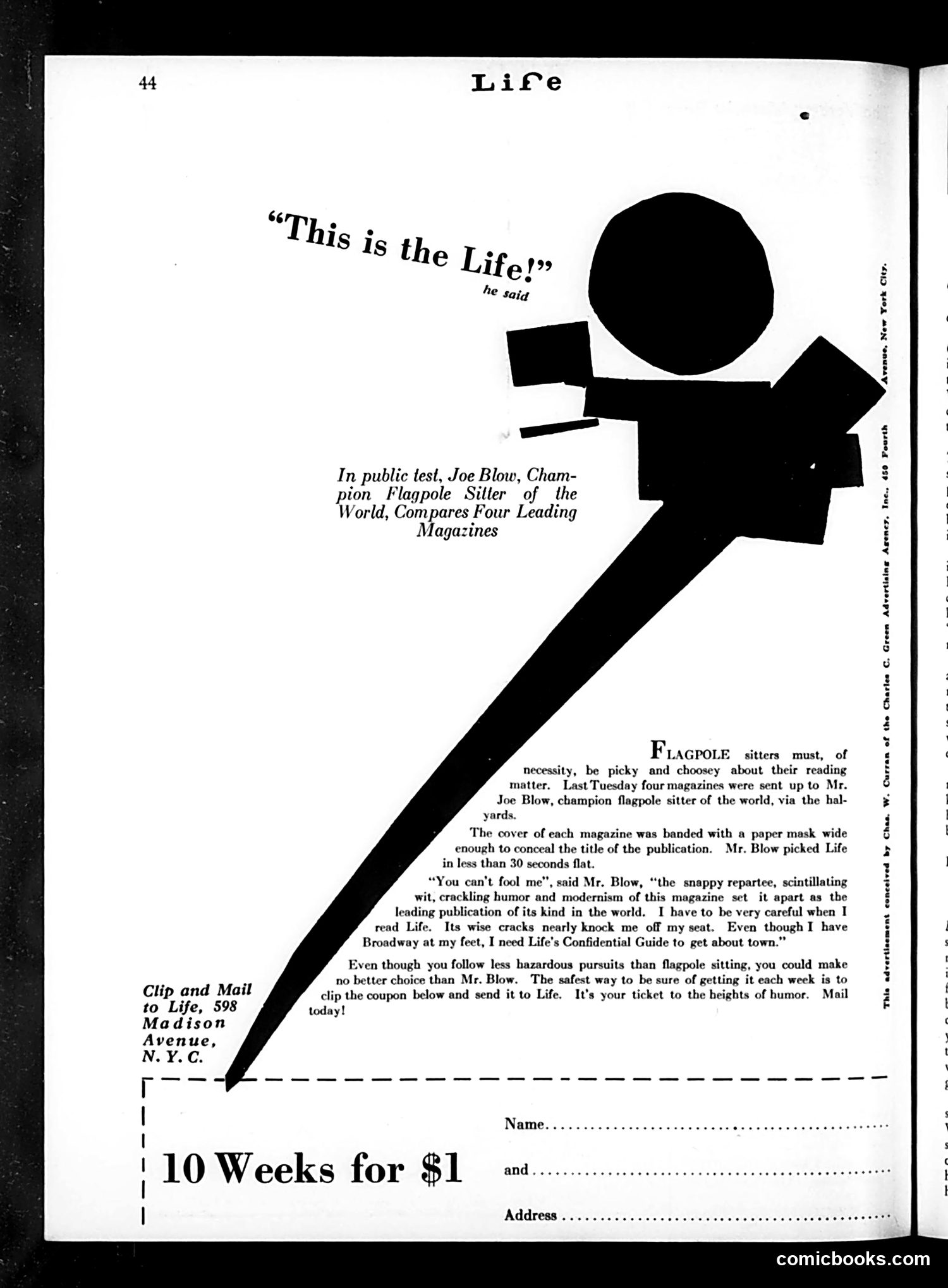
This is a **Life magazine subscription advertisement** from the 1920s-30s era, using absurdist humor to promote the publication. **The Setup:** "Joe Blow, Champion Flagpole Sitter of the World" is a test subject who must choose *Life* magazine from four competitors, all disguised with paper masks. He identifies it in under 30 seconds. **The Joke:** Flagpole sitting was an actual fad craze of this period—people competed to sit atop flagpoles for extended periods. The satire uses this ridiculous pursuit to suggest that even someone engaged in such a pointless activity can recognize *Life's* superior quality through its distinctive "snappy repartee, scintillating wit, crackling humor and modernism." **The Appeal:** The ad argues that *Life's* humor is so distinctive and abundant that it's instantly recognizable—and that readers need it as a "Confidential Guide" to navigate modern life, even if they lack the extreme distractions of flagpole sitting. **Purpose:** This playful, self-promoting advertisement positions *Life* as the era's leading humorous magazine through absurdist endorsement.
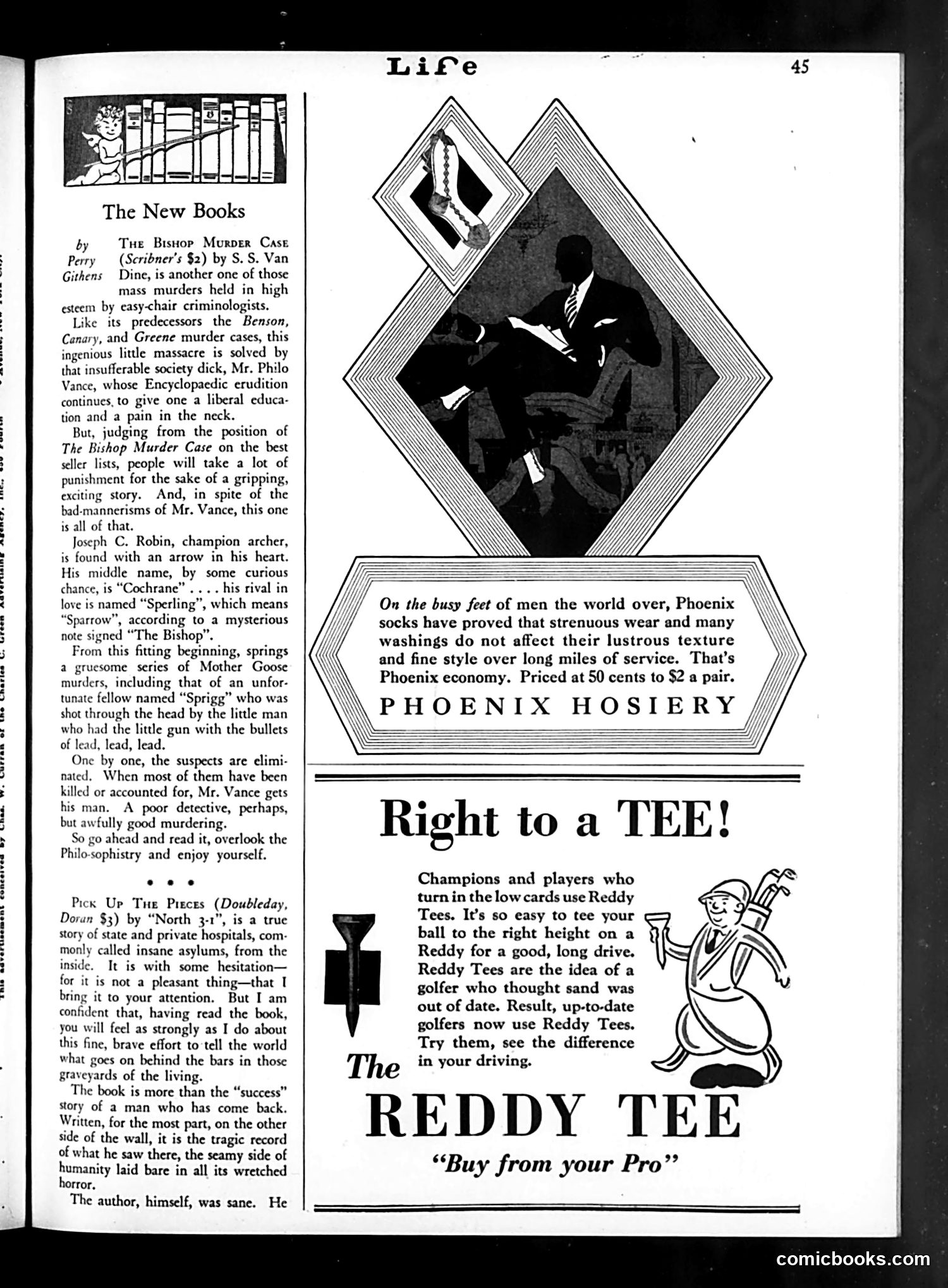
This page contains **book reviews and advertisements** rather than political cartoons. The reviews critique popular mystery novels, particularly S.S. Van Dine's "The Bishop Murder Case," featuring detective Philo Vance solving murders based on Mother Goose nursery rhyme themes. The reviewer mocks Vance as an insufferable "society dick" whose pretentious erudition ("Philo-sophistry") annoys readers, yet the book sells well anyway due to its gripping plot. The second review praises "Pick Up the Pieces"—an exposé of mental asylums written from inside by a formerly institutionalized author, treating institutional abuse as serious social commentary. The page's advertisements promote **Phoenix hosiery** and **Reddy Tees** (golf tees), typical commercial content. No political satire or caricature is present; this is standard magazine editorial and advertising content from the 1920s-30s era.
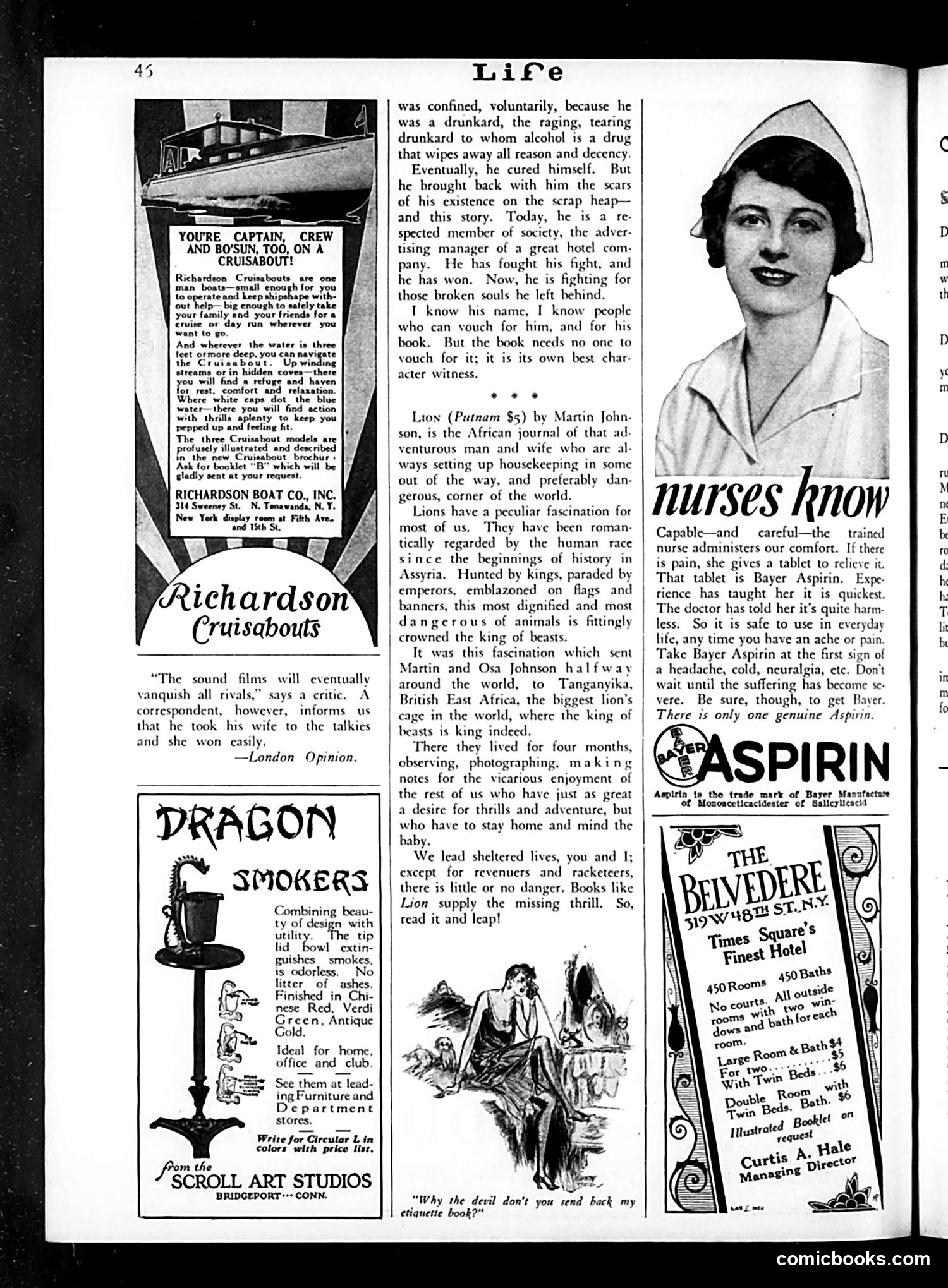
This page mixes **advertisements with book reviews**, typical of 1920s-era Life magazine format. **The main review** discusses *Lion* by Martin Johnson—a nonfiction account of the author and his wife's four-month African expedition photographing lions in Tanganyika. The reviewer emphasizes lions' historical significance (portrayed on royal banners, hunted by kings) and argues the book satisfies readers' desire for adventure without actual danger. There's a gentle joke about safely experiencing thrills "while you mind the baby." **The advertisements** are period-typical: Richardson Cruisabouts (small recreational boats), Dragon Smokers (decorative ash receptacles), Bayer Aspirin (marketed via nurses' endorsement), and The Belvedere hotel. **The cartoon** shows a woman asking a man why he hasn't returned her etiquette book—a mild domestic humor joke about social propriety. The page reflects 1920s middle-class leisure interests: safe adventure tourism, home furnishings, and health products marketed through professional authority figures.
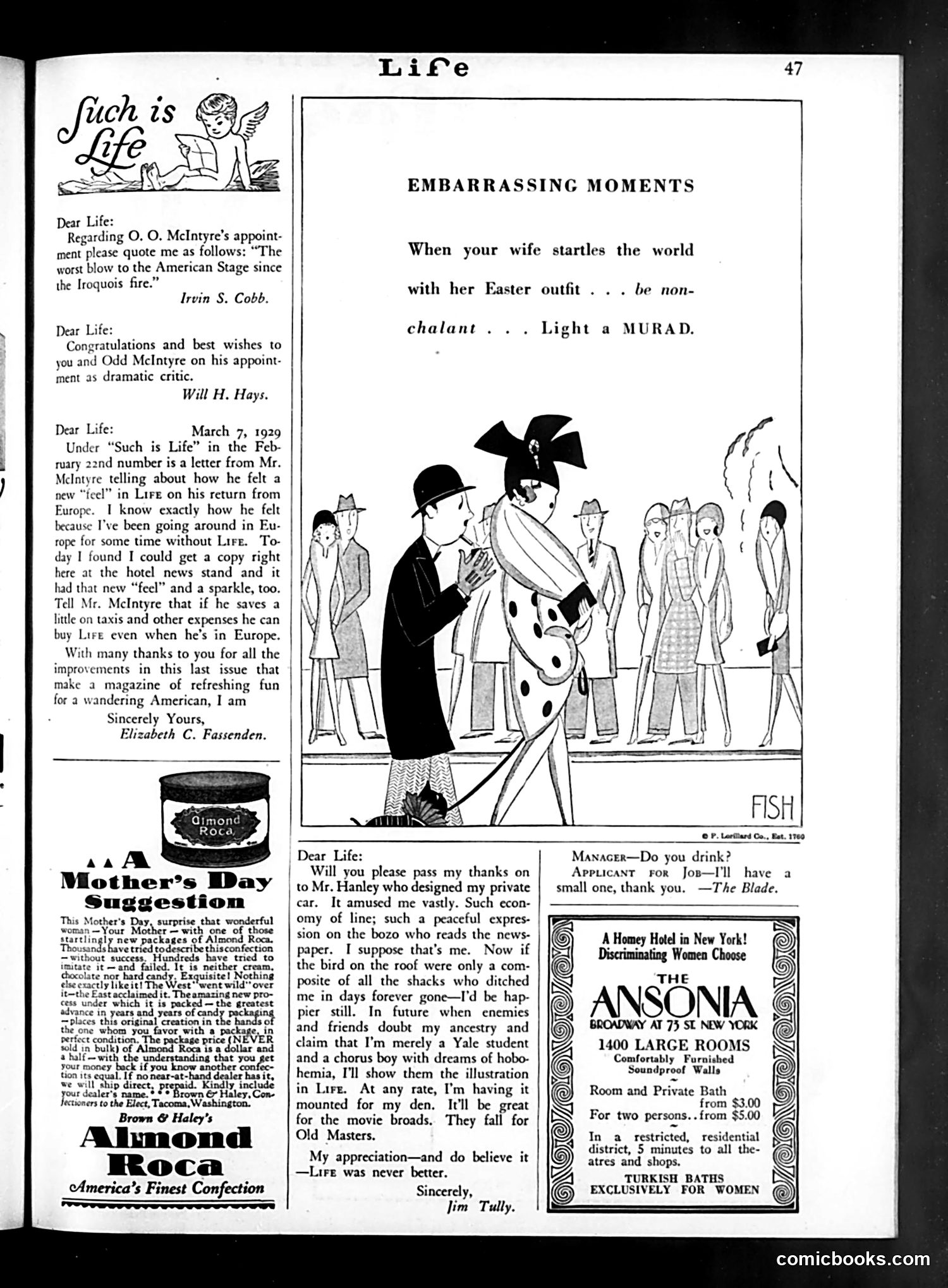
This page contains reader letters praising *Life* magazine and O. O. McIntyre's appointment as dramatic critic, plus advertisements and a cartoon. The main cartoon, titled "Embarrassing Moments," depicts a woman wearing an elaborate Easter outfit with an enormous bow, startling onlookers on a city street. The joke satirizes the social embarrassment of wearing an ostentatiously fashionable outfit—the woman's dramatic Easter ensemble draws stares from passersby. The caption suggests lighting a Murad cigarette to appear nonchalant when your wife makes such a conspicuous fashion statement. This reflects 1920s social anxieties about public propriety and gender performance: a wife's bold fashion choice could embarrass her husband socially. The humor targets both the wife's extravagant taste and the husband's discomfort with drawing attention. The page is primarily composed of advertisements (Almond Roca candy, The Ansonia hotel) and reader correspondence, with this single-panel cartoon as the main editorial content.
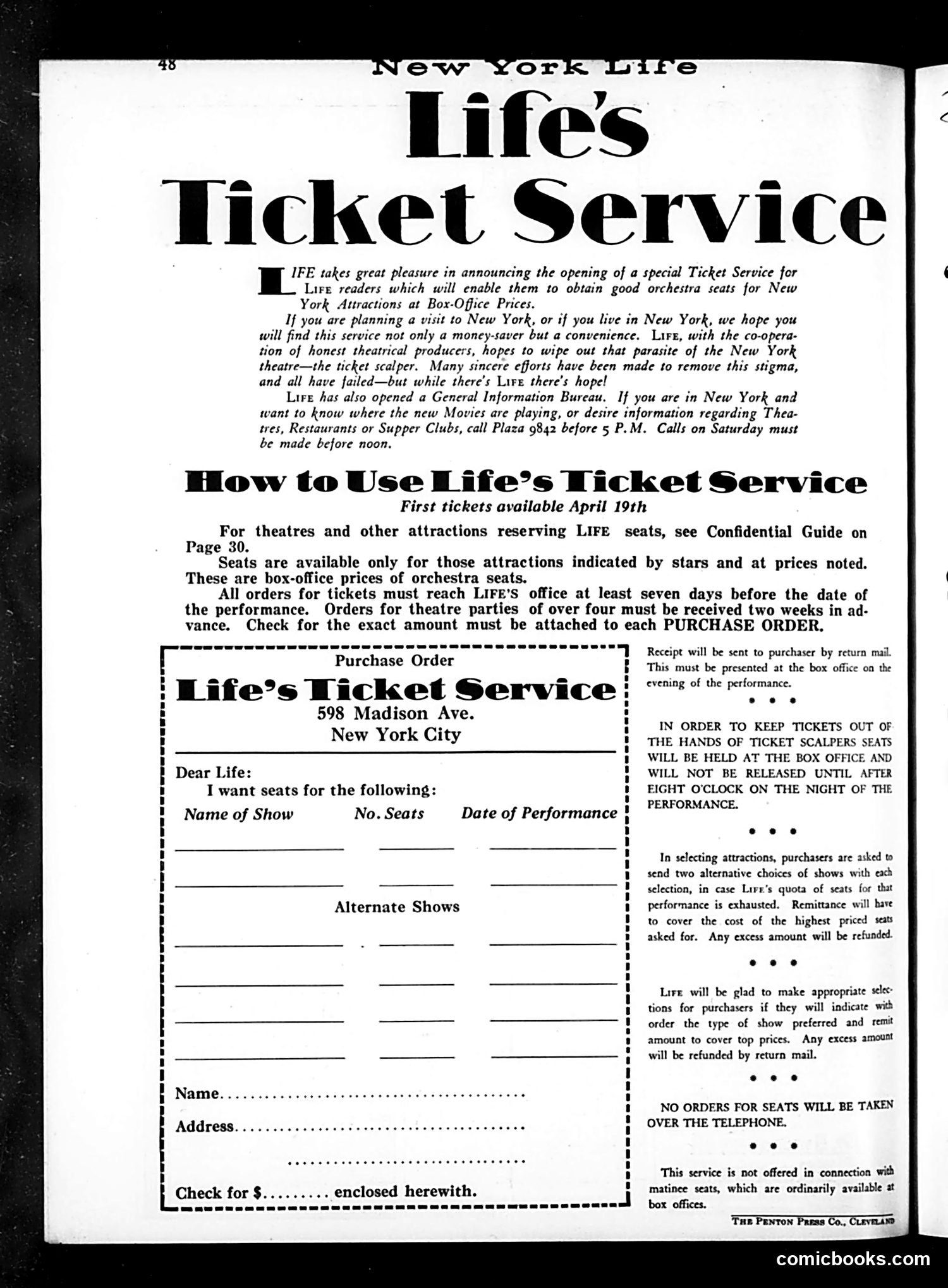
This page is an advertisement for a new service Life magazine is launching: a theatrical ticket broker for New York attractions. Rather than being satirical commentary, it's a genuine service announcement aimed at readers. The key innovation was combating **ticket scalpers**—middlemen who bought up tickets and resold them at inflated prices, a widespread problem in early 20th-century theater. Life partnered with "honest theatrical producers" to sell orchestra seats at box-office prices directly to readers, bypassing scalpers entirely. The service included practical features: a General Information Bureau for theater/restaurant recommendations, mail-order ticket purchasing with advance payment, and deliberately delayed ticket release (8 P.M. on performance night) to prevent scalpers from obtaining seats early. Orders required seven days' notice and alternative show choices in case performances sold out. This reflects a real social frustration—theater accessibility being controlled by profiteers—which Life positioned itself as helping solve through direct consumer access.
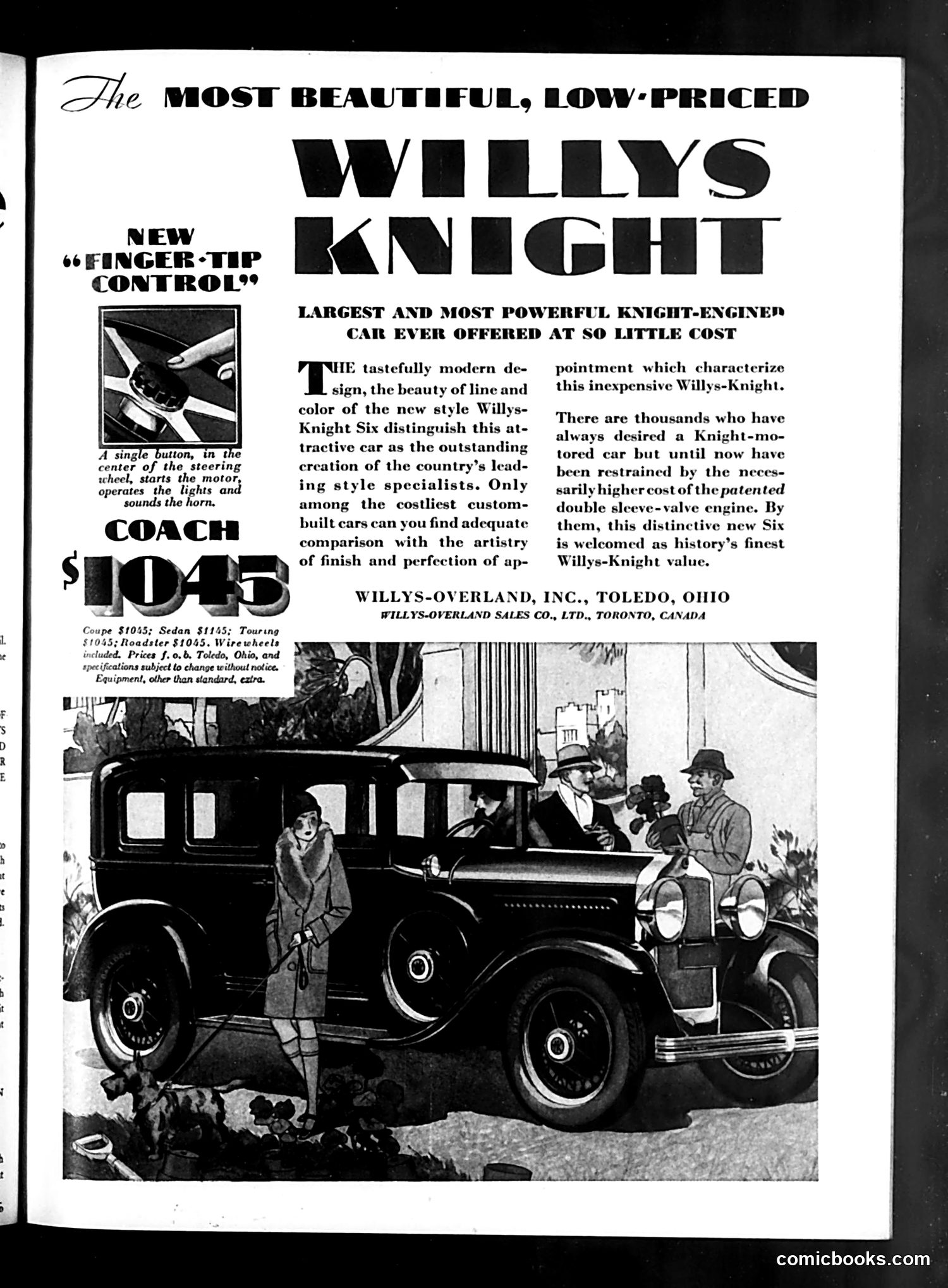
This is primarily a **car advertisement**, not political satire. It advertises the Willys-Knight Six automobile, highlighting its affordability (starting at $1,045) and advanced features like the "finger-tip control" steering wheel button that starts the motor and operates lights and horn. The illustrated scene shows well-dressed people admiring the vehicle, emphasizing its appeal to middle-class buyers. The ad's main pitch is that this car offers luxury features—particularly its patented "double sleeve-valve engine"—at an unusually low price point, making Knight-motored cars accessible beyond the wealthy. The "new style" design and emphasis on "tastefully modern" aesthetics reflect 1920s-era marketing. No satire or political commentary is evident; this is straightforward commercial promotion positioning an American automobile manufacturer's product as offering exceptional value.
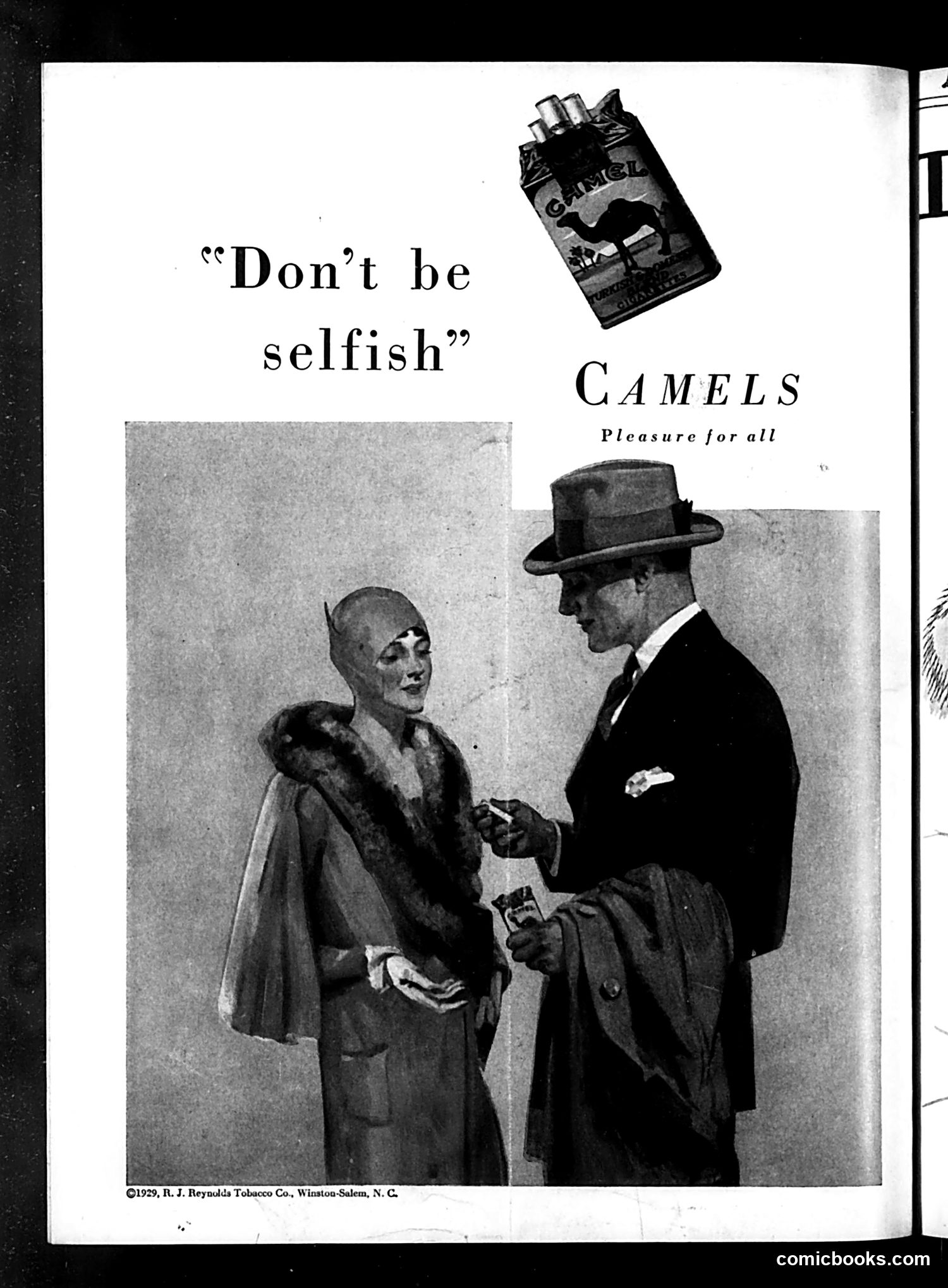
This is a **Camel cigarette advertisement** from 1929, not editorial satire. The image shows two well-dressed figures in formal attire—a woman and man—exchanging cigarettes, with the tagline "Don't be selfish" and "Pleasure for all." The ad's messaging implies that sharing cigarettes is a social courtesy and sign of generosity. This reflects early-20th-century cigarette marketing that normalized smoking as a sophisticated, convivial activity. The phrase "Don't be selfish" suggests offering cigarettes to others was considerate behavior. For modern readers: this represents pre-health-warning tobacco advertising that actively encouraged smoking by framing it as socially desirable and generous—marketing tactics that would later face severe restrictions.