
Life, 1929-04-26 · page 15 of 36
Life — April 26, 1929 — page 15: what you’re looking at
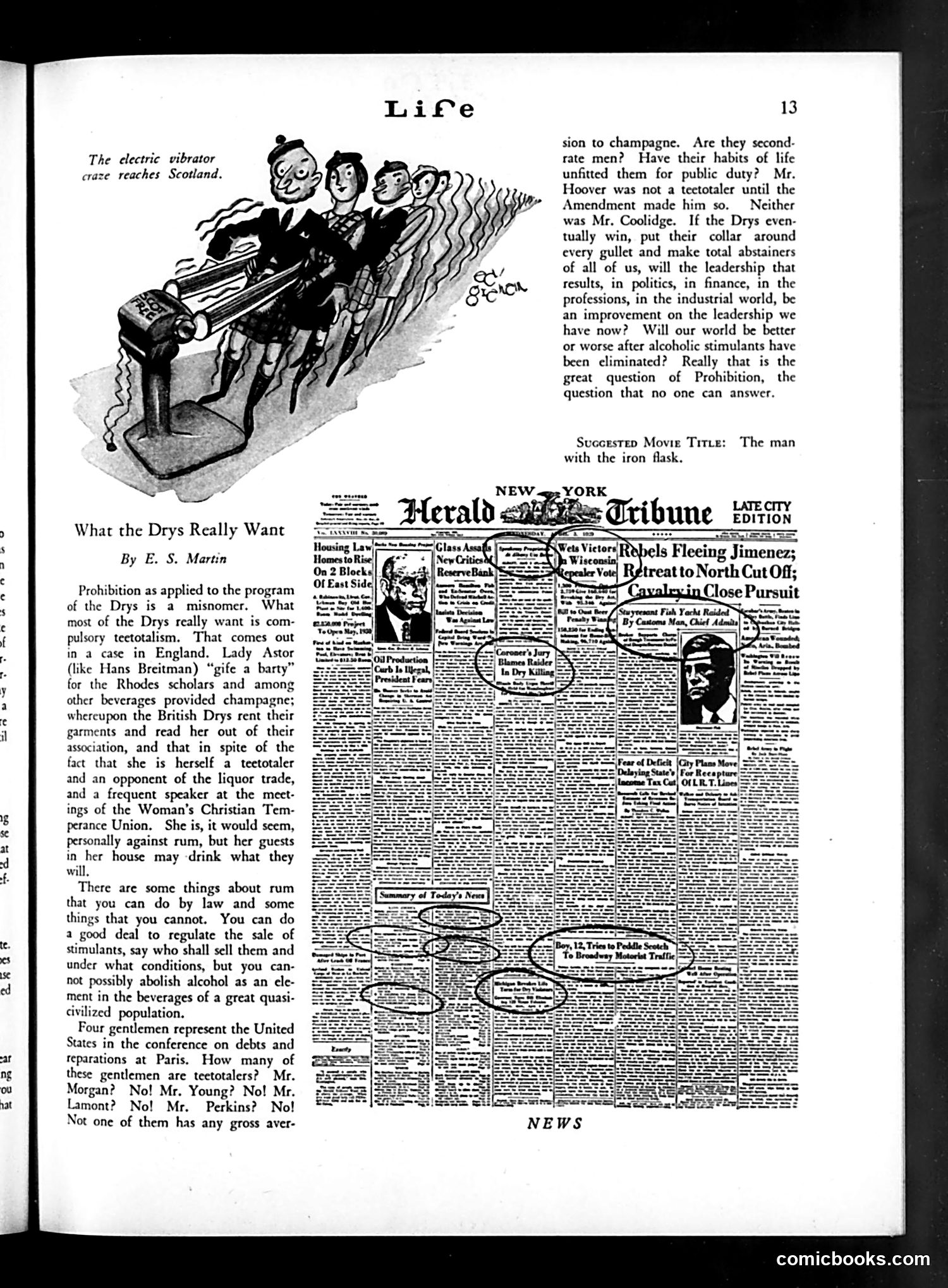
What you’re looking at
The cartoon "The electric vibrator craze reaches Scotland" satirizes a health fad where mechanical vibrators were marketed as therapeutic devices. The illustration shows people being violently shaken by a vibrating machine, exaggerating the craze's popularity. The accompanying article "What the Drys Really Want" by E.S. Martin critiques Prohibition advocates. Martin argues that while Prohibitionists claim moral superiority, their actual goal is total control—forcing abstinence on everyone, even those who drink responsibly. He questions whether eliminating alcohol will truly improve leadership and society, calling this "the great question of Prohibition, the question that no one can answer." The page includes a New York Herald Tribune newspaper facsimile, typical of Life's layout mixing commentary with contemporary news.
📄 Transcribed text from this page (OCR, searchable)
Machine-transcribed from the original scan — historical spelling and the odd misread are preserved.
The electric vibrator craze reaches Scotland. What the Drys Really Want By E. S. Martin Prohibition as applied to the program of the Drys is a misnomer. What most of the Drys really want is com- pulsory teetotalism, That comes out in a case in England. Lady Astor (like Hans Breitman) “gife a barty” for the Rhodes scholars and among other beverages provided champagne: whereupon the British Drys rent their garments and read her out of their association, and that in spite of the fact that she is herself a teetotaler and an opponent of the liquor trade, and a frequent speaker at the meet- ings of the Woman's Christian Tem- perance Union. She is, it would seem, personally against rum, but her guests in her house may -drink what they will. There are some things about rum that you can do by law and some things that you cannot. You can do a good deal to regulate the sale of stimulants, say who shall sell them and under what conditions, but you can- not possibly abolish alcohol as an ele- ment in the beverages of a great quasi- civilized population. Four gentlemen represent the United States in the conference on debts and Teparations at Paris. How many of these gentlemen are teetotalers? Mr. Morgan? No! Mr. Young? No! Mr. Lamont? No! Mr. Perkins? No! Not one of them has any gross aver- 13 sion to champagne. Are they second- rate men? Have their habits of life unfitted them for public duty? Mr. Hoover was not a tectotaler until the Amendment made him so. Neither was Mr. Coolidge. If the Drys even- tually win, put their collar around every gullet and make total abstainers of all of us, will the leadership that results, in politics, in finance, in the professions, in the industrial world, be an improvement on the leadership we have now? Will our world be better or worse after alcoholic stimulants have been eliminated? Really that is the great question of Prohibition, the question that no one can answer. Svuccestep Movie Trtte: The man with the iron flask. YORK ar ‘ LATE CITY byl EDITION comicbooks.com