
A complete issue · 36 pages · 1929
Life — April 26, 1929
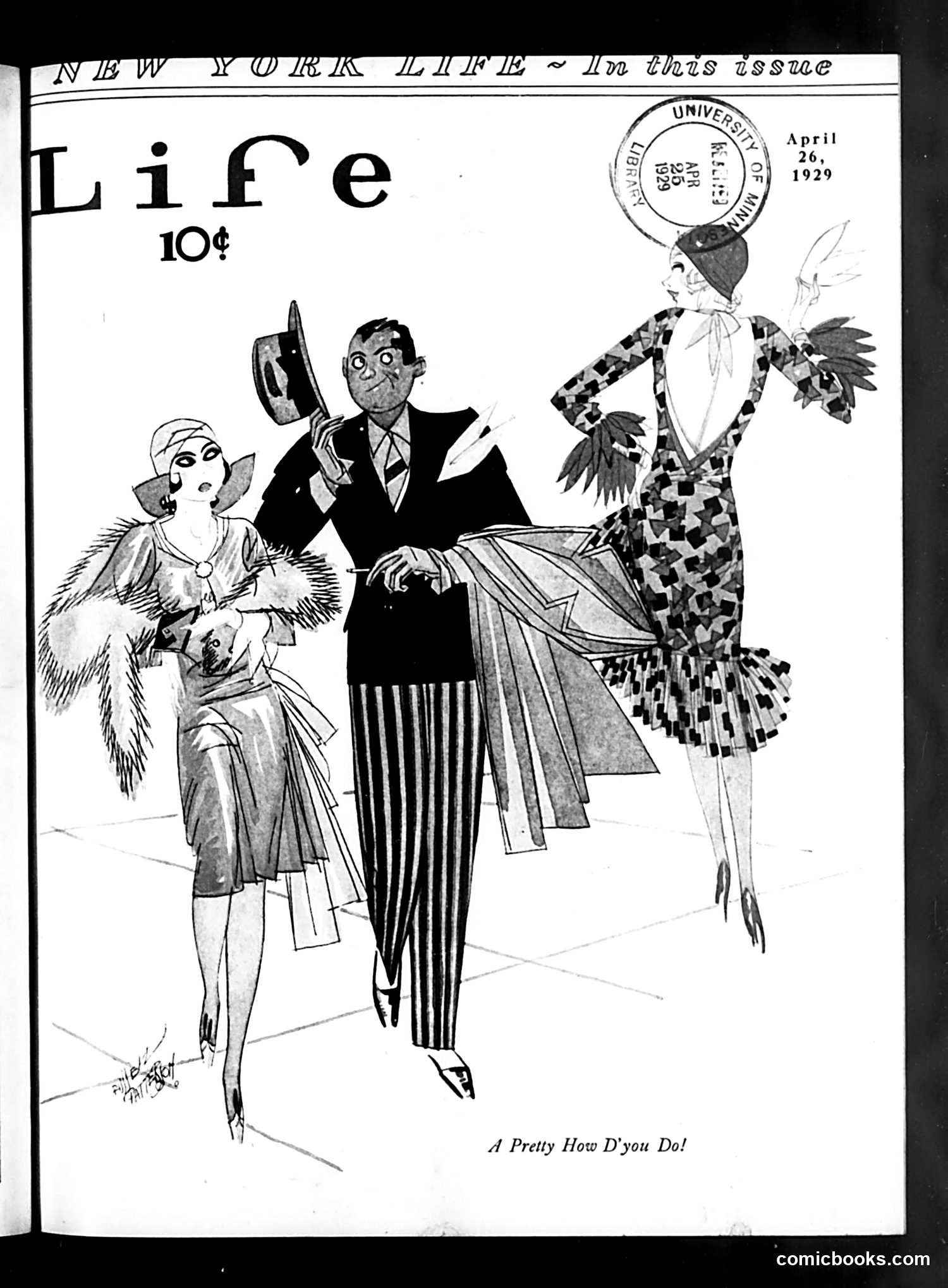
This cover depicts a fashionable 1920s scene titled "A Pretty How D'you Do!" The illustration shows three figures in period dress: two women in stylish outfits with fur stoles and a man in the center wearing vertically-striped trousers and holding what appears to be a hat or fan. The satire likely comments on social etiquette or romantic entanglements of the Jazz Age era. The exaggerated expressions and theatrical poses suggest the humor centers on awkward social situations or flirtation dynamics. The title's phrase "A Pretty How D'you Do!" was period slang for an embarrassing or awkward predicament. Without additional context from the magazine's text, the specific social commentary remains unclear, though it appears to mock 1920s dating customs or social pretensions.
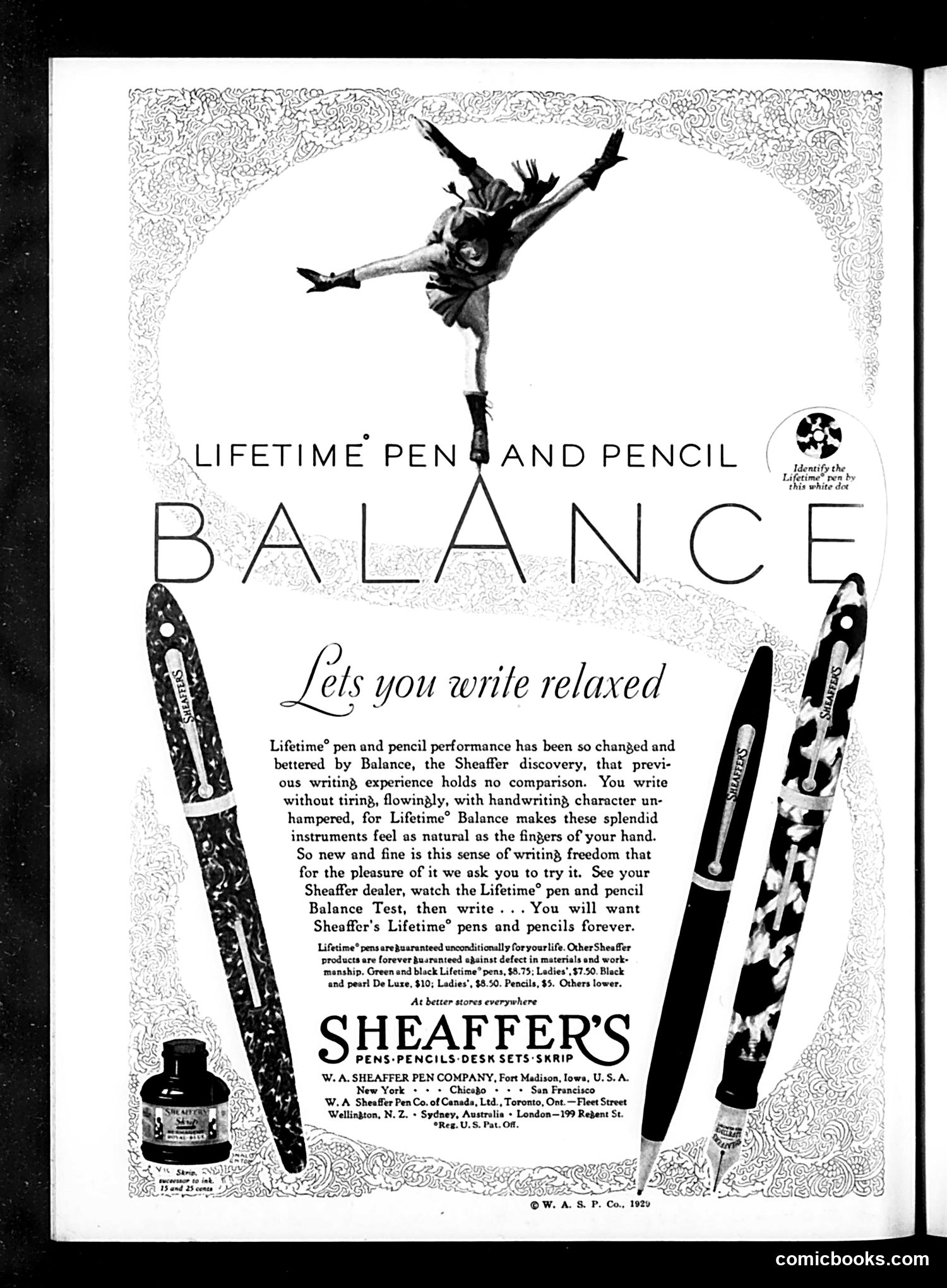
This is **primarily an advertisement**, not editorial content or satire. It promotes Sheaffer's Lifetime pens and pencils, featuring their "Balance" technology. The illustration shows a stylized figure performing an acrobatic balancing act—standing on one leg in an exaggerated pose. This visual metaphor demonstrates the pens' superior balance and stability, the claimed innovation that sets them apart. The ad's messaging emphasizes that Sheaffer's Balance design allows users to write "relaxed" and "without tiring," with "handwriting character unhampered." The acrobat represents ease and control—if the pens balance this well, writing feels effortless. There is **no political satire or social commentary** here. This is straightforward commercial promotion using visual wordplay (the balance theme) to market writing instruments.
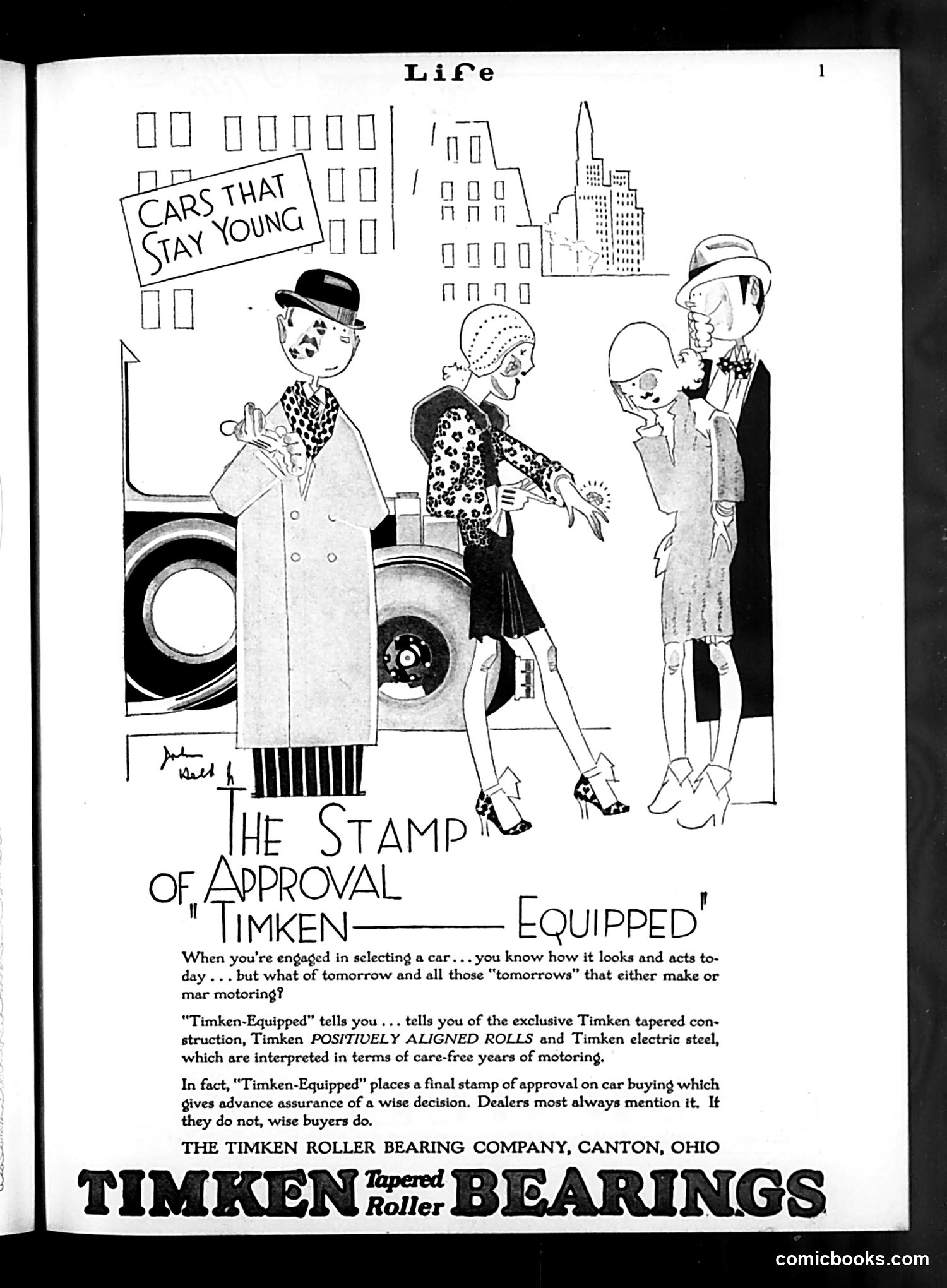
This is primarily a **Timken Roller Bearings advertisement** disguised as editorial content. The cartoon depicts three fashionably dressed figures examining a car, with the headline "The Stamp of Approval 'Timken-Equipped.'" The satire targets **car-buying culture**: the ad mocks how consumers judge automobiles by superficial appearance and trends ("how it looks and acts today") rather than mechanical quality. The "stamp of approval" concept suggests that Timken bearings provide invisible, technical assurance beyond what style-conscious buyers typically consider. The exaggerated caricatures of well-dressed urbanites represent the target market—people concerned with fashionable appearance. The joke: they can't see bearings, but should trust the Timken endorsement as a "wise decision" regardless. This blends satire with product promotion, typical of interwar advertising strategy.
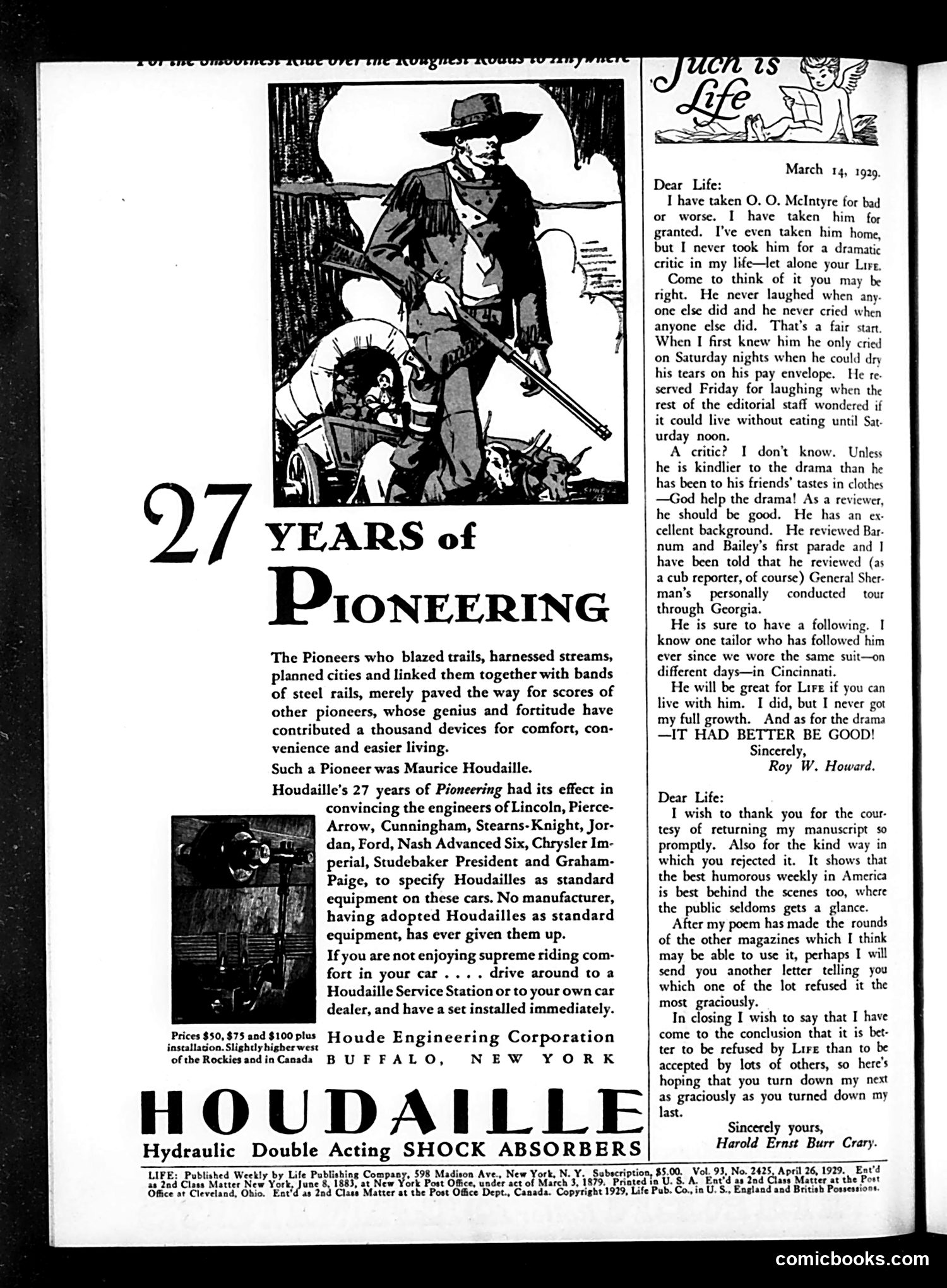
This page is primarily **advertising for Houdaille shock absorbers**, not political satire. The main illustration depicts a cowboy or frontier pioneer figure with a rifle, accompanying text titled "27 YEARS of PIONEERING." The ad argues that Houdaille shock absorbers, like historical pioneers, have established themselves as standard equipment on major automobile brands (Lincoln, Pierce-Arrow, Stutz, Ford, Nash, Chrysler, and others). The "pioneering" metaphor positions the product as foundational and trustworthy. The right side contains reader letters to "Such is Life" (the magazine's advice column), including one from Roy W. Howard praising a drama critic and another thanking the editor for manuscript consideration. This is straightforward commercial advertising dressed in Americana imagery—no political commentary or satire is present.
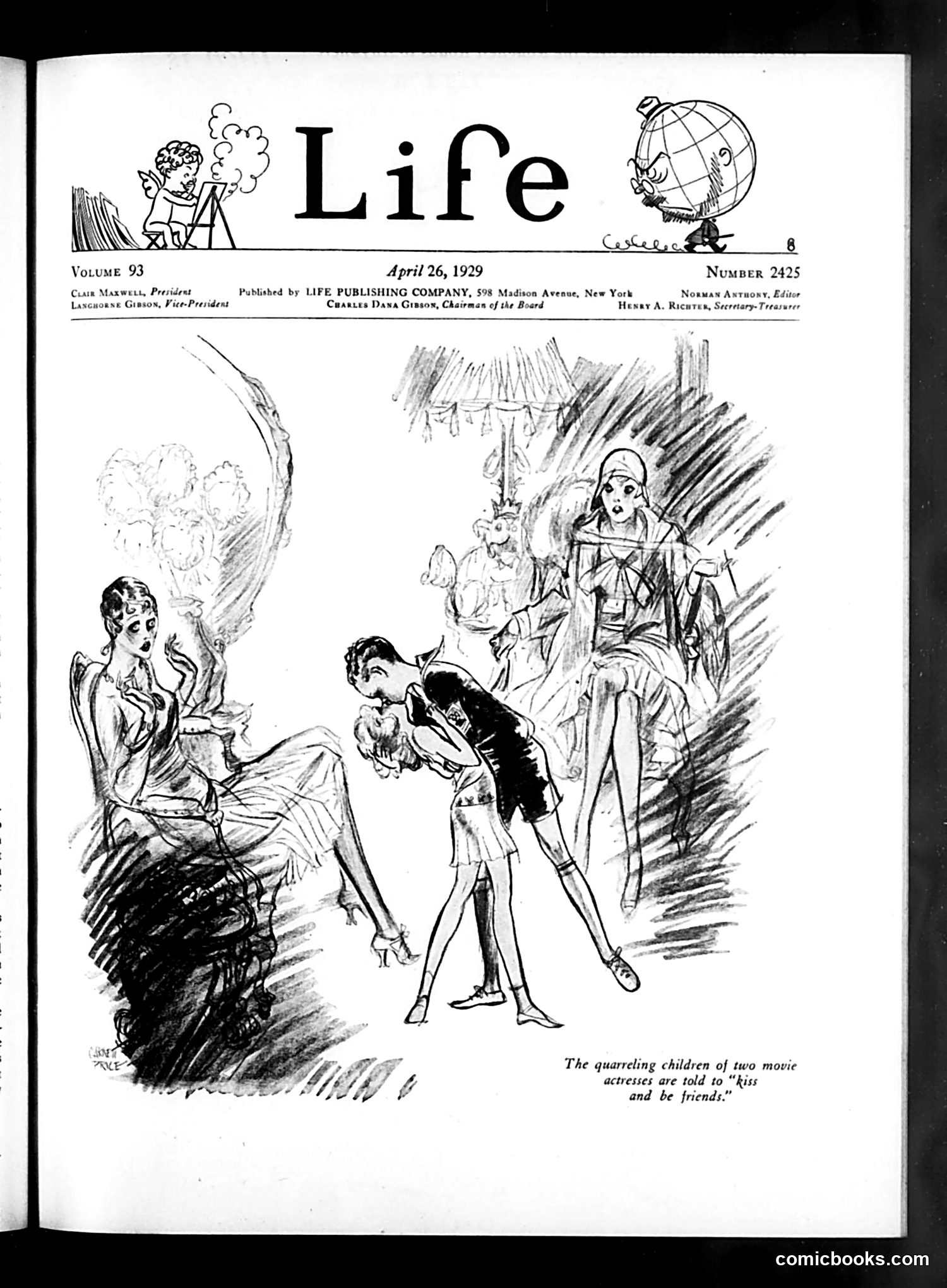
This illustration satirizes Hollywood's movie industry dynamics. The caption reads: "The quarreling children of two movie actresses are told to 'kiss and be friends.'" The cartoon depicts two children from feuding actresses being forced to reconcile as a publicity stunt. The sketch shows them awkwardly complying with the directive while adults (likely studio handlers or mothers) observe in the background. The satire targets how Hollywood studios manufactured public narratives and controlled stars' personal lives and images, even involving their children. It mocks the artificiality of the industry—where genuine conflict is papered over with orchestrated "friendly" moments for media consumption. This reflects 1929 anxieties about entertainment industry manipulation and the blurred line between authentic relationships and manufactured celebrity spectacle.
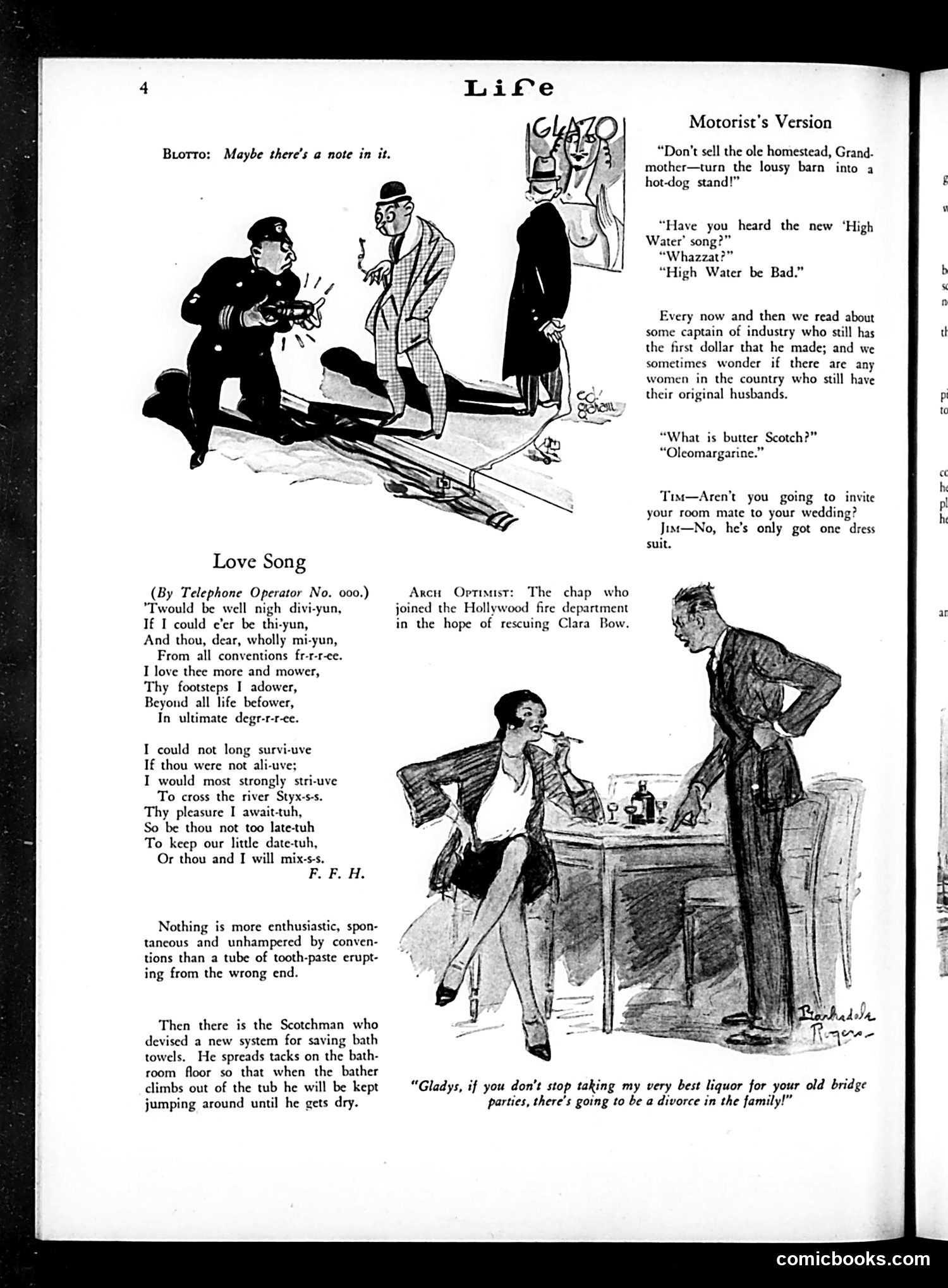
This page from *Life* magazine contains three separate pieces of humor: **Top cartoon**: Shows a sailor discovering a note in a bottle. The joke plays on the cliché of messages in bottles, suggesting mundane rather than romantic content. **"Love Song"**: A humorous poem by a telephone operator expressing romantic longing in exaggerated, flowery language—satirizing overwrought sentimentality and the operator's access to private conversations. **Bottom cartoon**: A domestic scene where a woman threatens her husband with divorce over his consumption of liquor at bridge parties. It satirizes marital conflict over alcohol use and social drinking habits—likely referencing Prohibition-era tensions (when alcohol was legally restricted but socially consumed). The overall page mocks romantic pretension, workplace gossip, and domestic discord through humor typical of 1920s American satire.
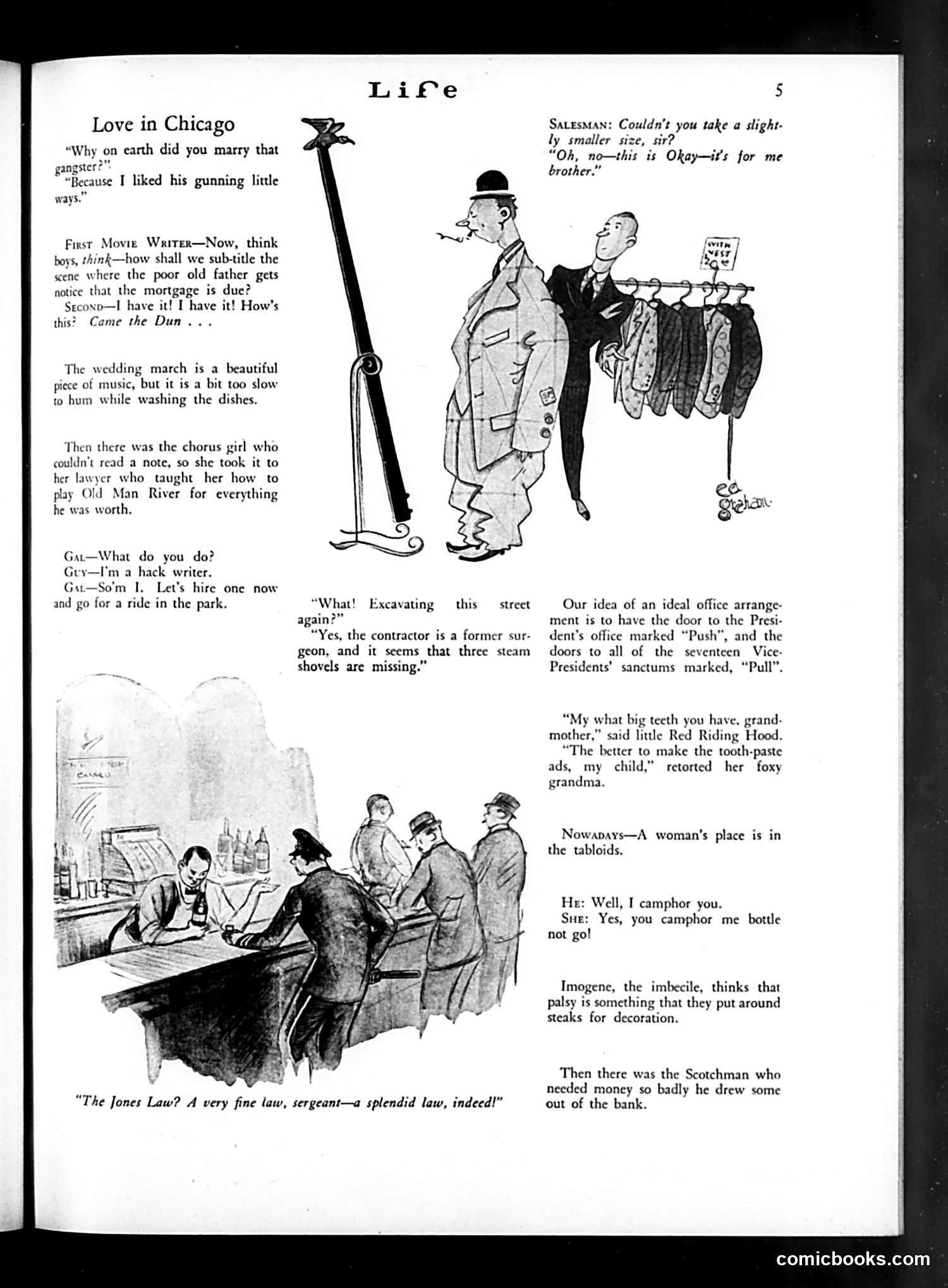
This page contains several brief humorous sketches and one-liners typical of Life's satirical humor: **"Love in Chicago"** mocks domestic life—a woman married a gangster for his "cunning little ways." **The movie writer exchange** satirizes Hollywood's formulaic storytelling, where writers struggle to create dramatic subtitles for mundane situations like mortgage notices. **The clothing rack cartoon** shows a salesman trying to sell undersized coats, with a joke about accommodating the customer's size. **"Excavating this street again?"** jokes about perpetual street construction and missing steam shovels—likely referencing Chicago's constant infrastructure work. **The remaining quips** target women's tabloid culture, dental hygiene advertising, gender roles ("woman's place is in the tabloids"), and banking fraud. The page represents early 20th-century American urban humor: cynical about marriage, Hollywood, commerce, and city life.
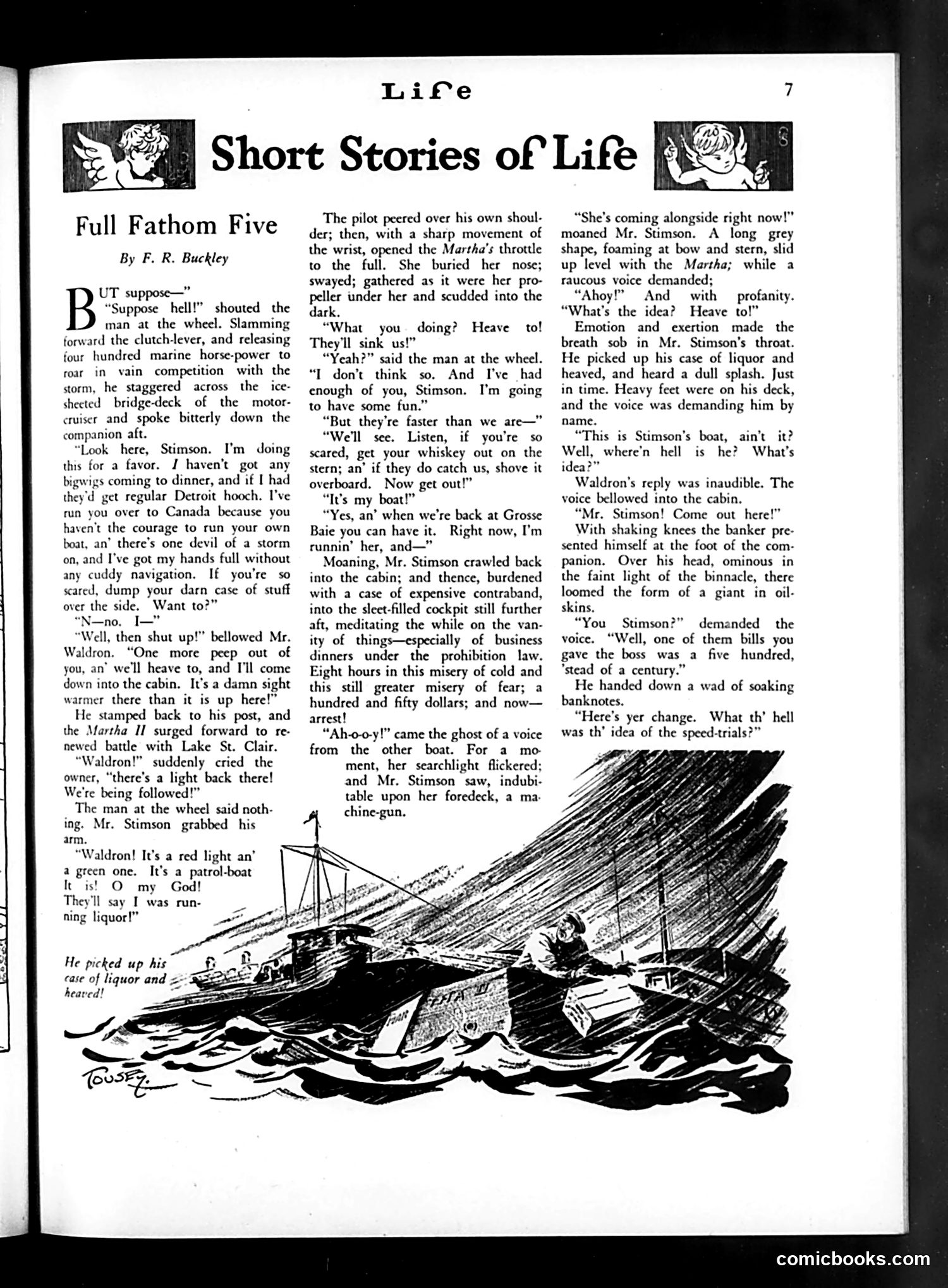
This is a short story about two men on boats during Prohibition. Mr. Stimson is captaining a motorboat when Mr. Waldron appears in a speedboat, urging him to flee because a patrol boat is chasing them. Stimson initially refuses, but after Waldron threatens to ram him and mentions "speed-trials," Stimson agrees to race. The illustration shows their boats in rough seas as they attempt to escape. The story satirizes Prohibition-era bootlegging: wealthy men engaged in illegal liquor smuggling, the cat-and-mouse game with authorities, and the casual rule-breaking among the affluent. The narrative tone is darkly comic about men willing to risk danger and legal consequences for profit and thrills.
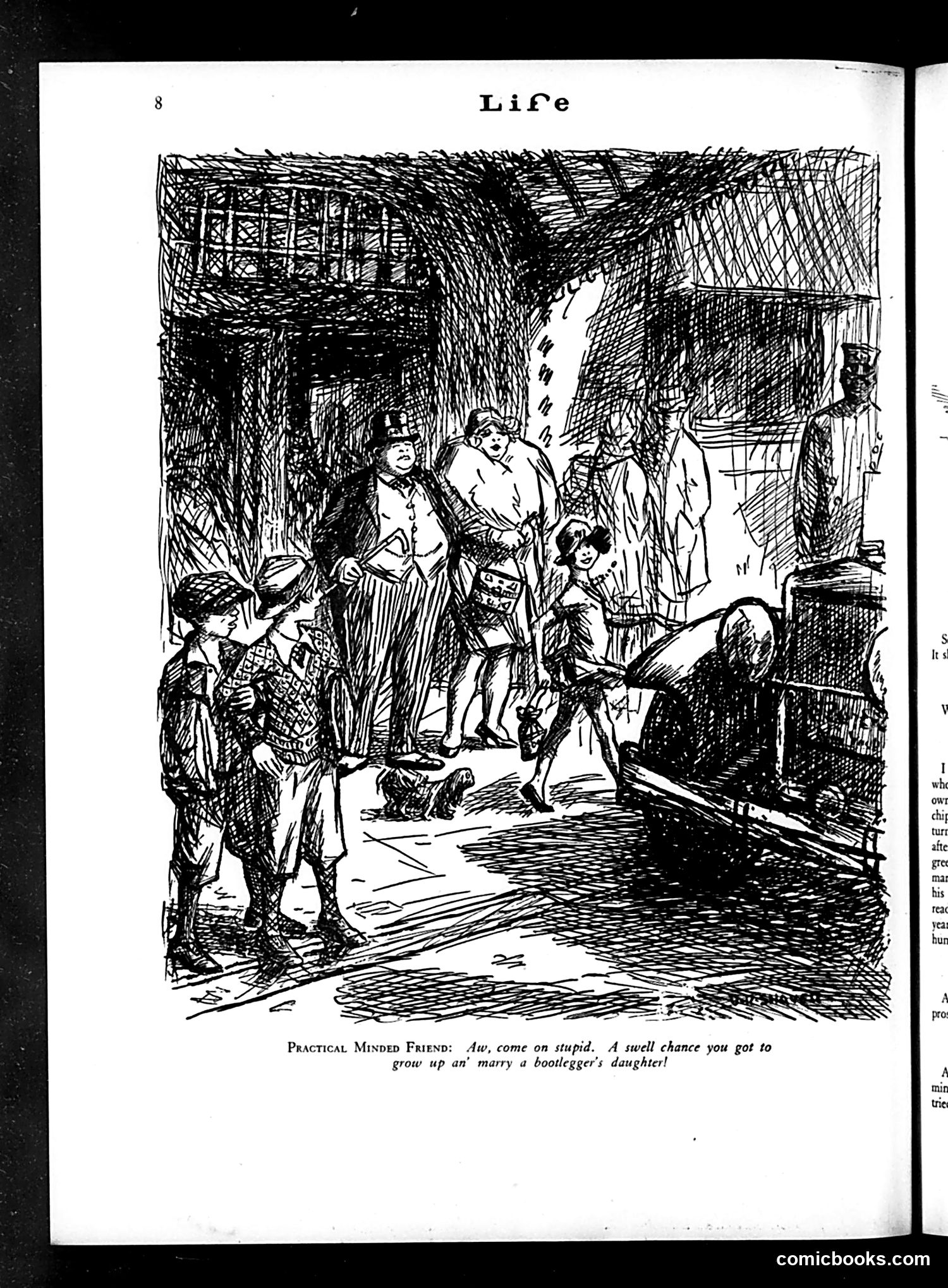
This cartoon titled "Practical Minded Friend" depicts a street scene with working-class children. The caption reads: "Aw, come on stupid. A swell chance you got to grow up an' marry a bootlegger's daughter!" The satire references Prohibition (the ban on alcohol sales, 1920-1933). The "practical minded friend" is cynically advising another child that their best prospect for upward social mobility is marrying into a bootlegger's family—criminals who illegally produced and sold alcohol. The joke mocks both the desperation of poor children's limited life prospects and the irony that during Prohibition, bootleggers became wealthy and socially prominent enough to be considered desirable in-laws. It's dark social commentary on poverty, crime, and the era's economic inequality.
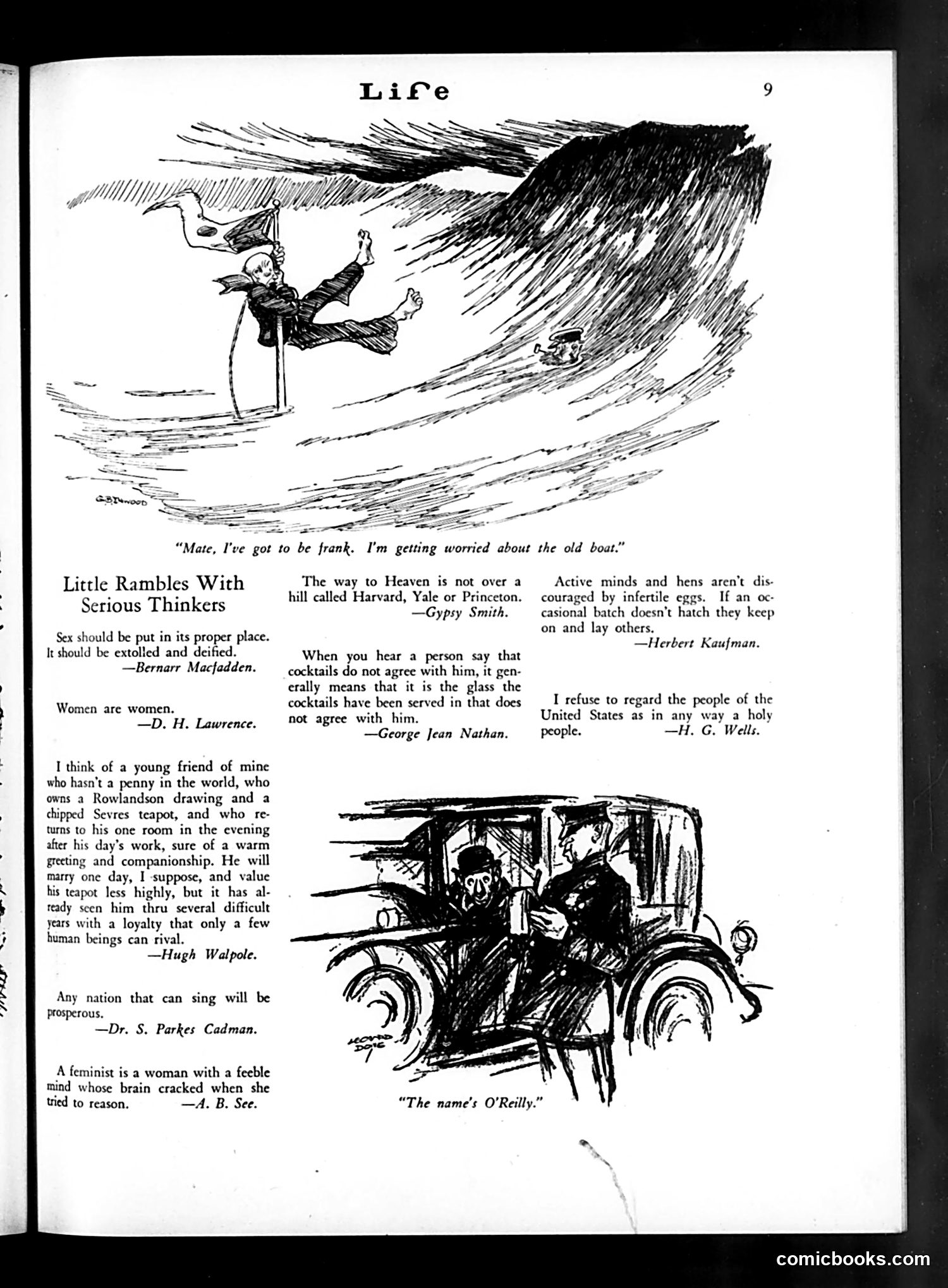
This page contains two cartoons and several quoted aphorisms. The top cartoon depicts a figure on a tightrope above turbulent water, worried about "the old boat," suggesting anxiety during uncertain times—likely referencing economic or political instability of the publication's era. The bottom cartoon shows two figures in an old automobile labeled "The name's O'Reilly," appearing to be a visual pun or ethnic joke common to early 20th-century American humor. The surrounding quotations are satirical observations on various topics: education, gender relations, nationalism, feminism, and social class. They mock intellectualism, pretension, and conventional wisdom—typical of *Life* magazine's satirical approach during this period. The cartoons and quotes together represent the magazine's satirical commentary on contemporary American society and politics.
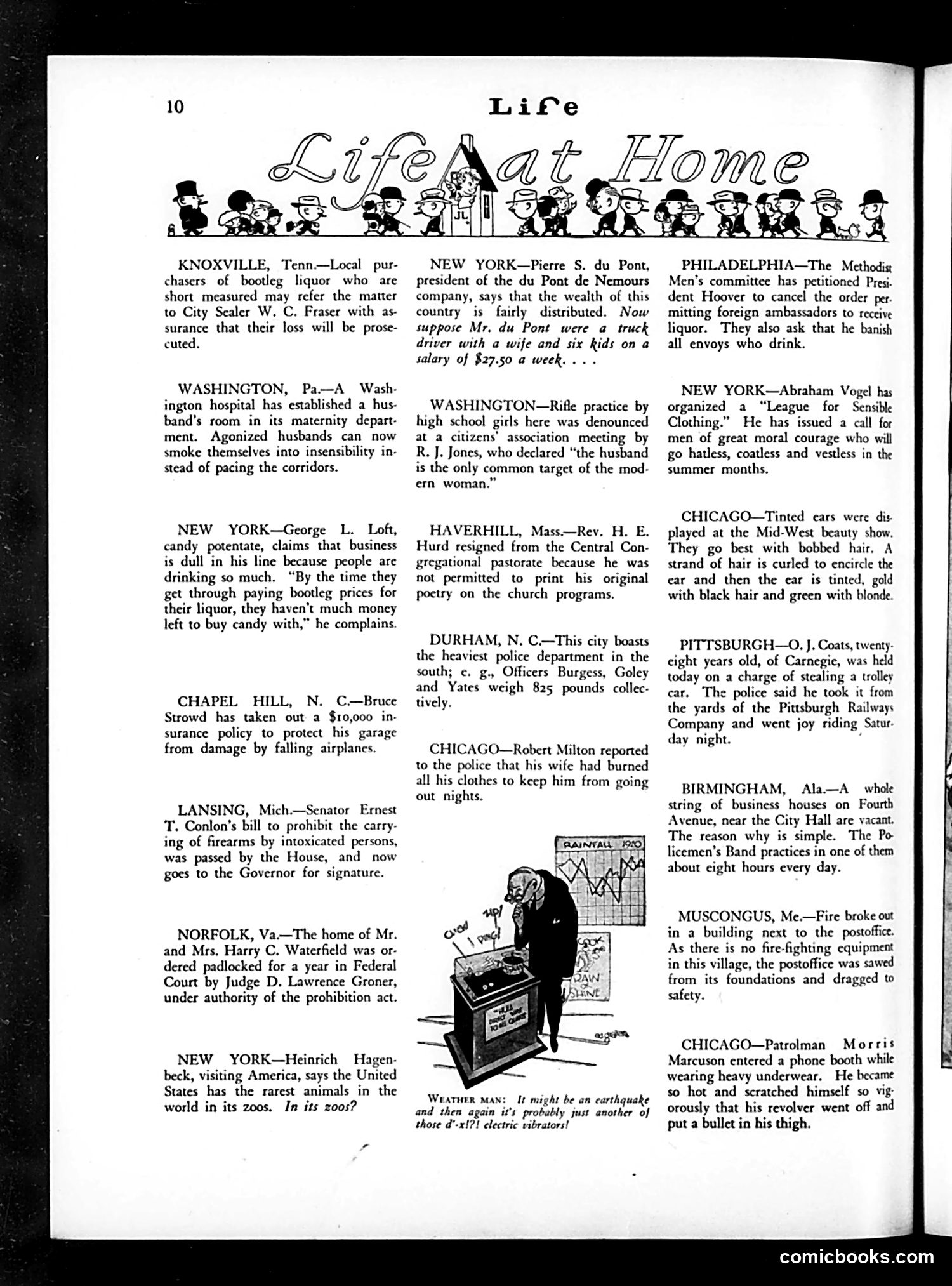
This page contains a cartoon captioned "Weather Man: It might be an earthquake and then again it's probably just another of those d—d! electric vibrators!" The illustration depicts a man in formal attire experiencing violent vibrations from what appears to be a mechanical device or machine. The satire targets the early 20th-century fad of electric vibrators, which were heavily marketed as therapeutic devices for various ailments. The joke relies on the confusion between earthquake tremors and the intense vibrations produced by these machines—suggesting the vibrator is so powerful it mimics seismic activity. This reflects period anxiety about new electrical technology and satirizes the overmarketing of dubious "health" devices to consumers.
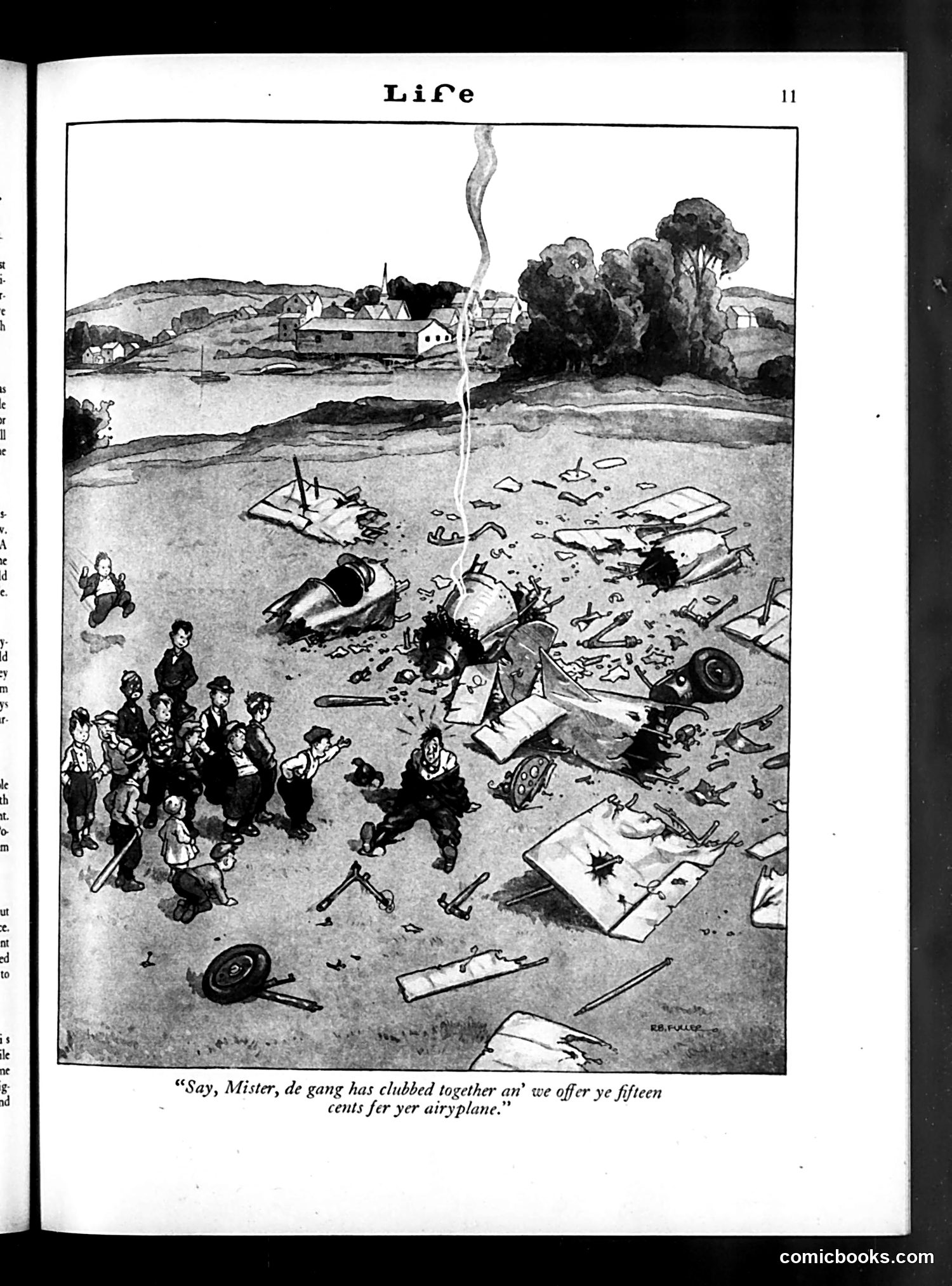
This is a satirical cartoon from *Life* magazine depicting a group of people gathered around wreckage at what appears to be an aircraft crash site near a coastal village. The caption reads: "Say, Mister, de gang has clubbed together an' we offer ye fifteen cents fer yer airplane." The satire targets the early aviation era when airplanes were still novel and experimental. The joke suggests that crashed aircraft were so commonplace and worthless that a group of working-class people could pool their meager resources (fifteen cents) to purchase one. The dialect speech ("de gang," "fer yer") suggests lower-class characters. This reflects anxieties about aviation safety and the experimental nature of early flight, mocking both the fragility of these machines and the casual attitude toward aviation disasters during this period.
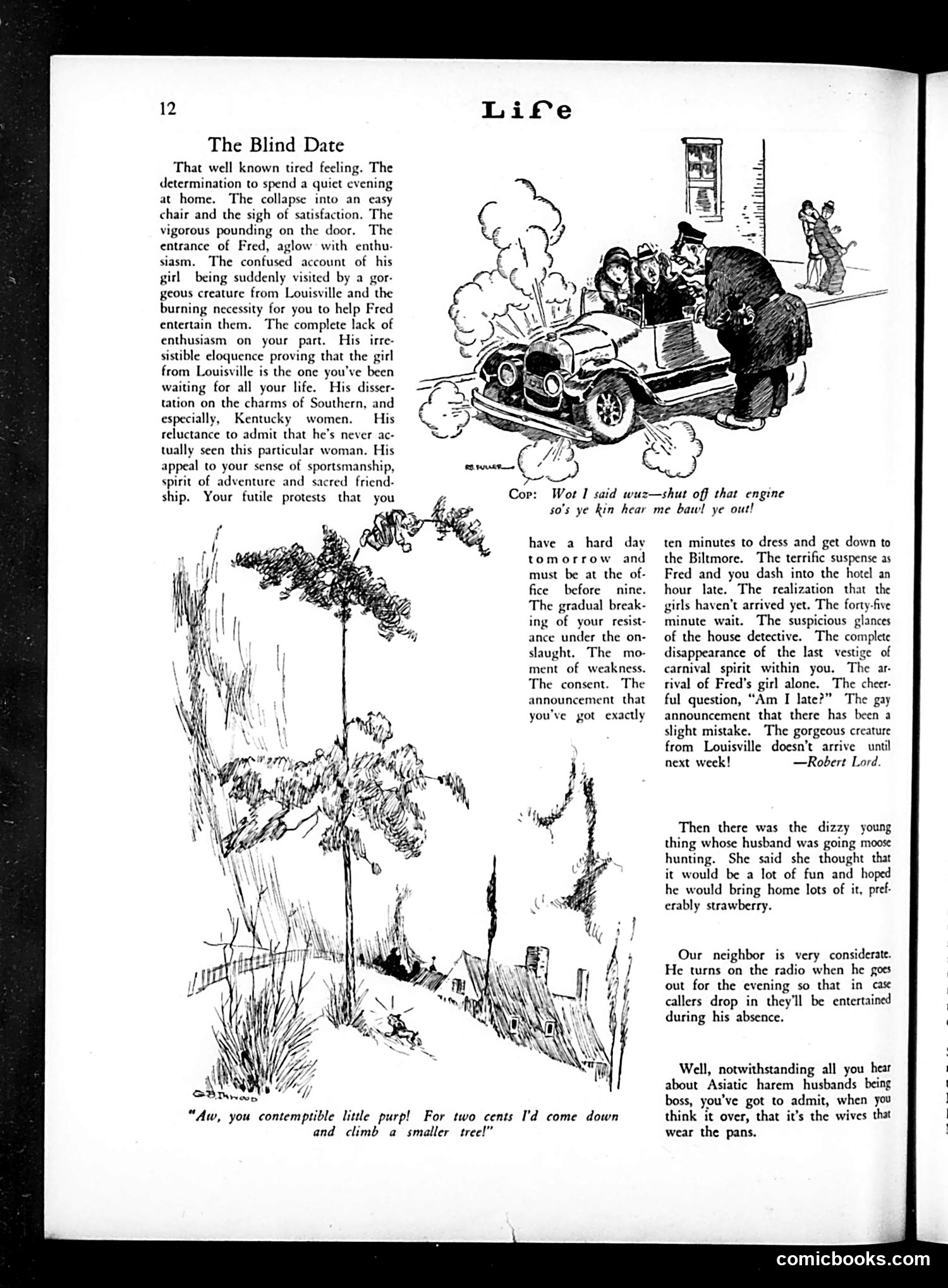
This page satirizes the social anxiety of blind dates in what appears to be the early-to-mid 20th century. The main cartoon shows a car accident occurring during a blind date setup, with the caption playing on the phrase "that engine's kin hear me bawl ye out!" The article mocks the predictable frustrations: the reluctant man, the overhyped girl from Louisville who disappoints, the last-minute scramble to meet downtown, and the underlying awkwardness of arranged romantic meetings. The secondary sketches (left side) appear to illustrate rural or rustic characters—possibly contrasting sophistication with country life—fitting Life magazine's typical humor comparing urban and rural American experiences. The humor relies on readers' shared experience with failed romantic setups and social obligations of the era.
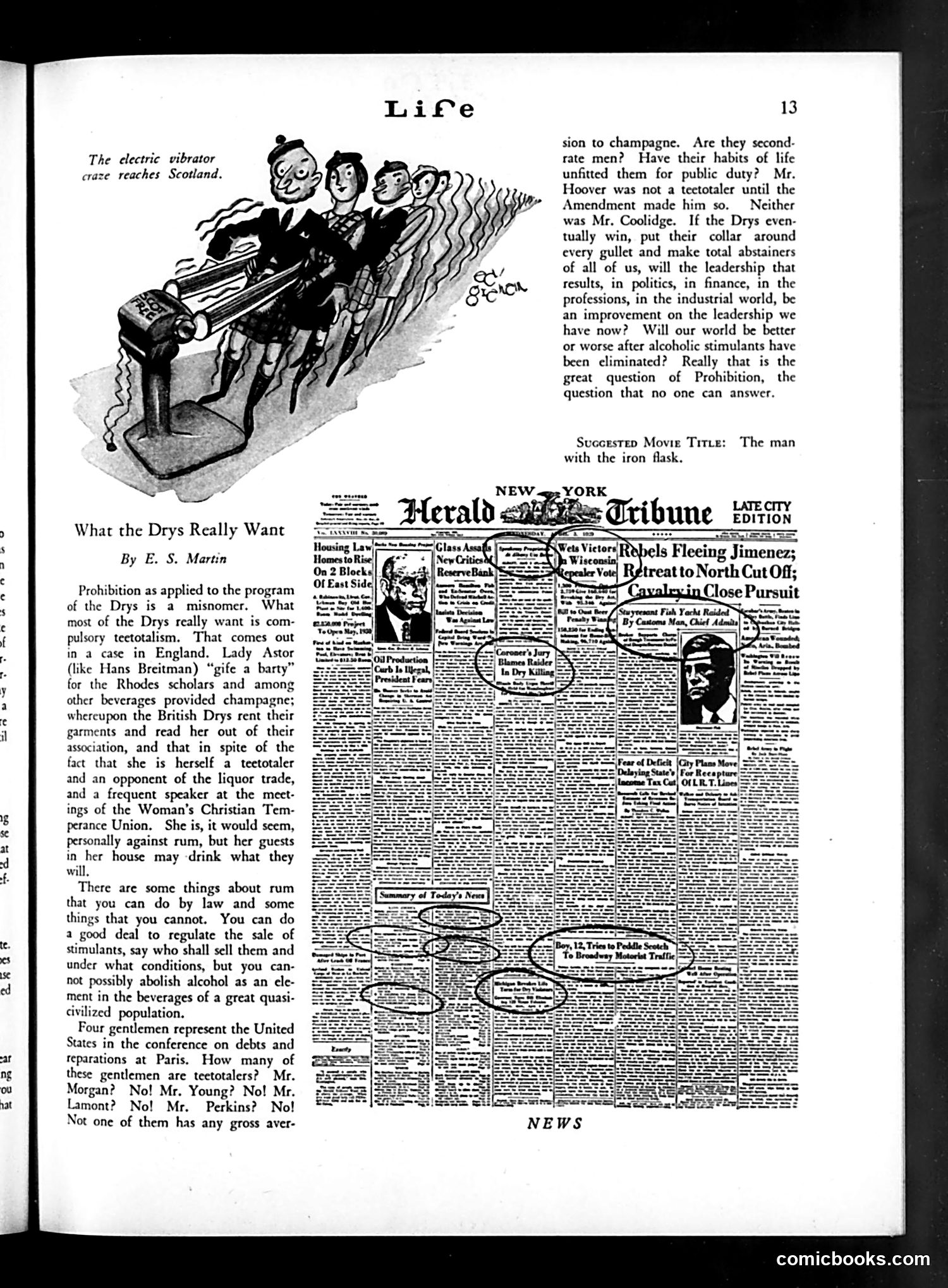
The cartoon "The electric vibrator craze reaches Scotland" satirizes a health fad where mechanical vibrators were marketed as therapeutic devices. The illustration shows people being violently shaken by a vibrating machine, exaggerating the craze's popularity. The accompanying article "What the Drys Really Want" by E.S. Martin critiques Prohibition advocates. Martin argues that while Prohibitionists claim moral superiority, their actual goal is total control—forcing abstinence on everyone, even those who drink responsibly. He questions whether eliminating alcohol will truly improve leadership and society, calling this "the great question of Prohibition, the question that no one can answer." The page includes a New York Herald Tribune newspaper facsimile, typical of Life's layout mixing commentary with contemporary news.
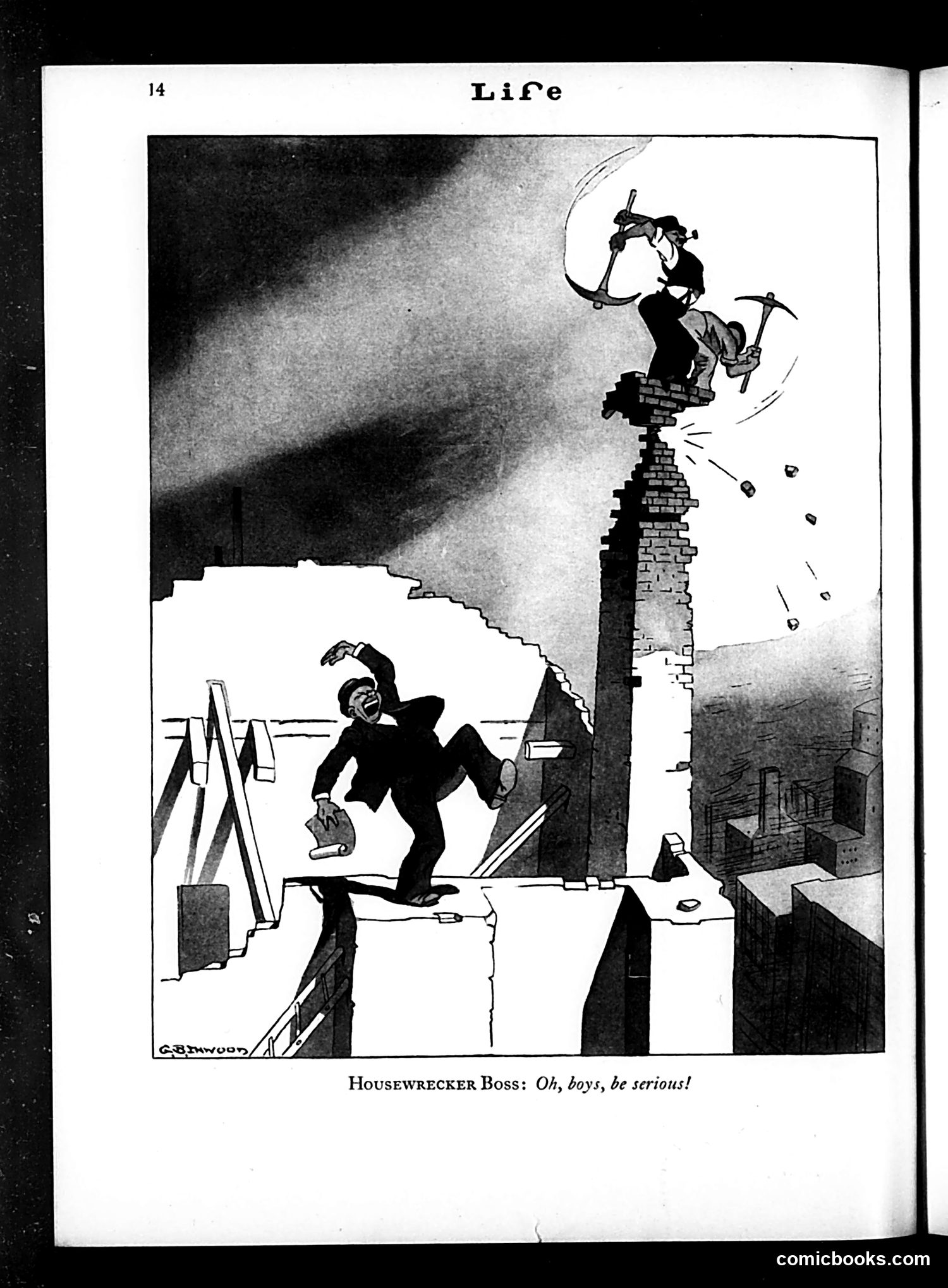
This single-panel cartoon depicts a construction site accident. A worker stands precariously atop a tall, crumbling brick chimney or structure, appearing to lose his balance while wielding tools (an axe and pickaxe visible). Below, a supervisor on a lower platform shouts "Oh, boys, be serious!" — seemingly oblivious to the obvious danger above. The satire targets reckless workplace safety attitudes, specifically mocking bosses who demand productivity while ignoring hazardous conditions. The title "Housewrecker Boss" suggests this depicts demolition work, historically among America's most dangerous occupations. The cartoon critiques callous management prioritizing work completion over worker welfare — a relevant social commentary for the industrial era when Life magazine published this piece.
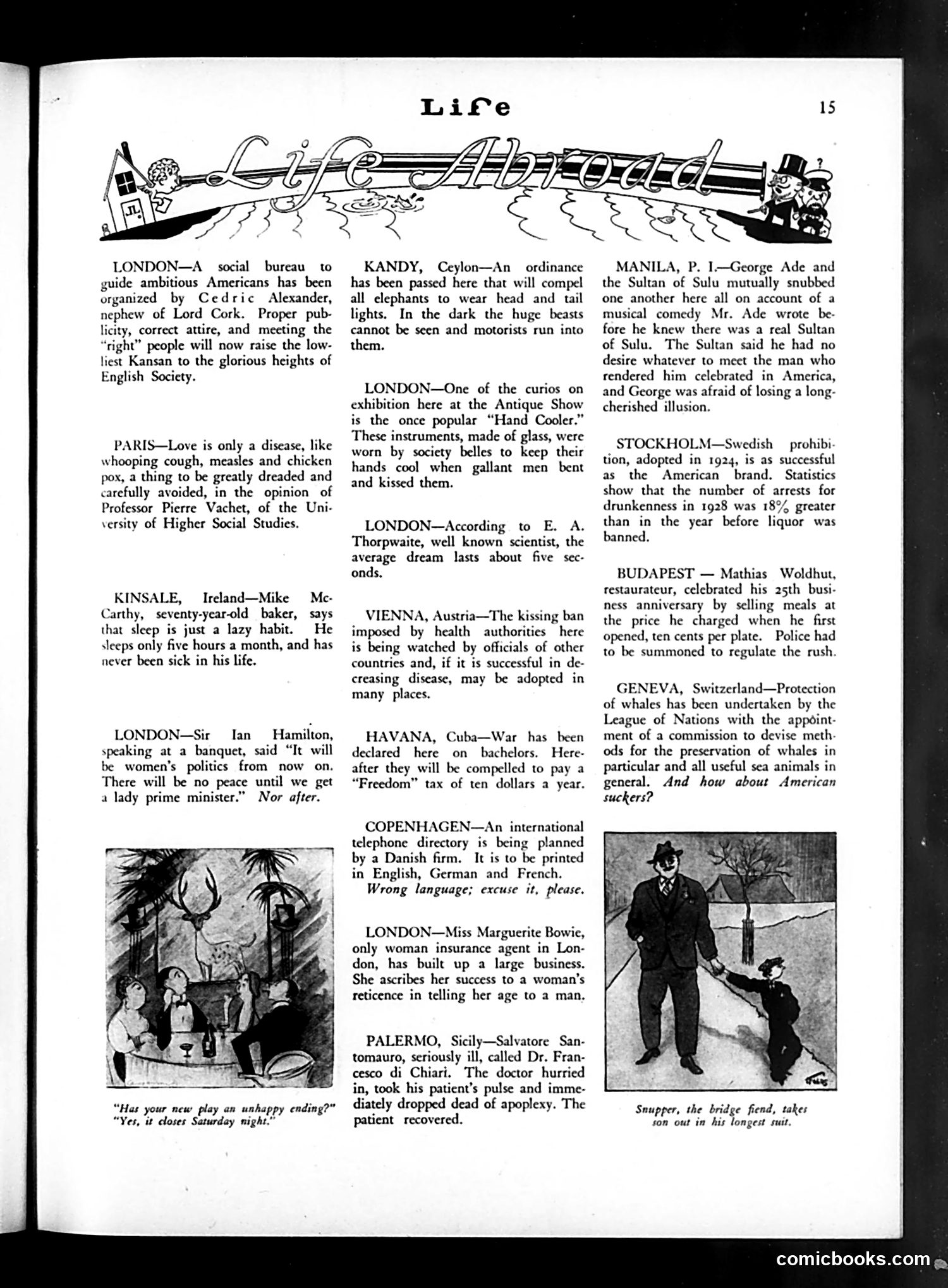
This page contains brief news-style humor items from various cities, typical of Life's satirical format. Two photographs accompany the text: 1. **Left image**: Shows what appears to be a social gathering or party scene with multiple figures and decorative elements. The caption reads: "Has your new play an unhappy ending?" / "Yes, it closes Saturday night." This is a theatrical joke about a play's poor reception. 2. **Right image**: Depicts a man in formal attire with a small child. The caption states: "Snapper, the bridge fiend, takes son out on his longest suit." This is a pun on bridge-playing terminology ("longest suit") applied literally to a father-child outing. The page's humor relies on wordplay and observational comedy rather than political satire.
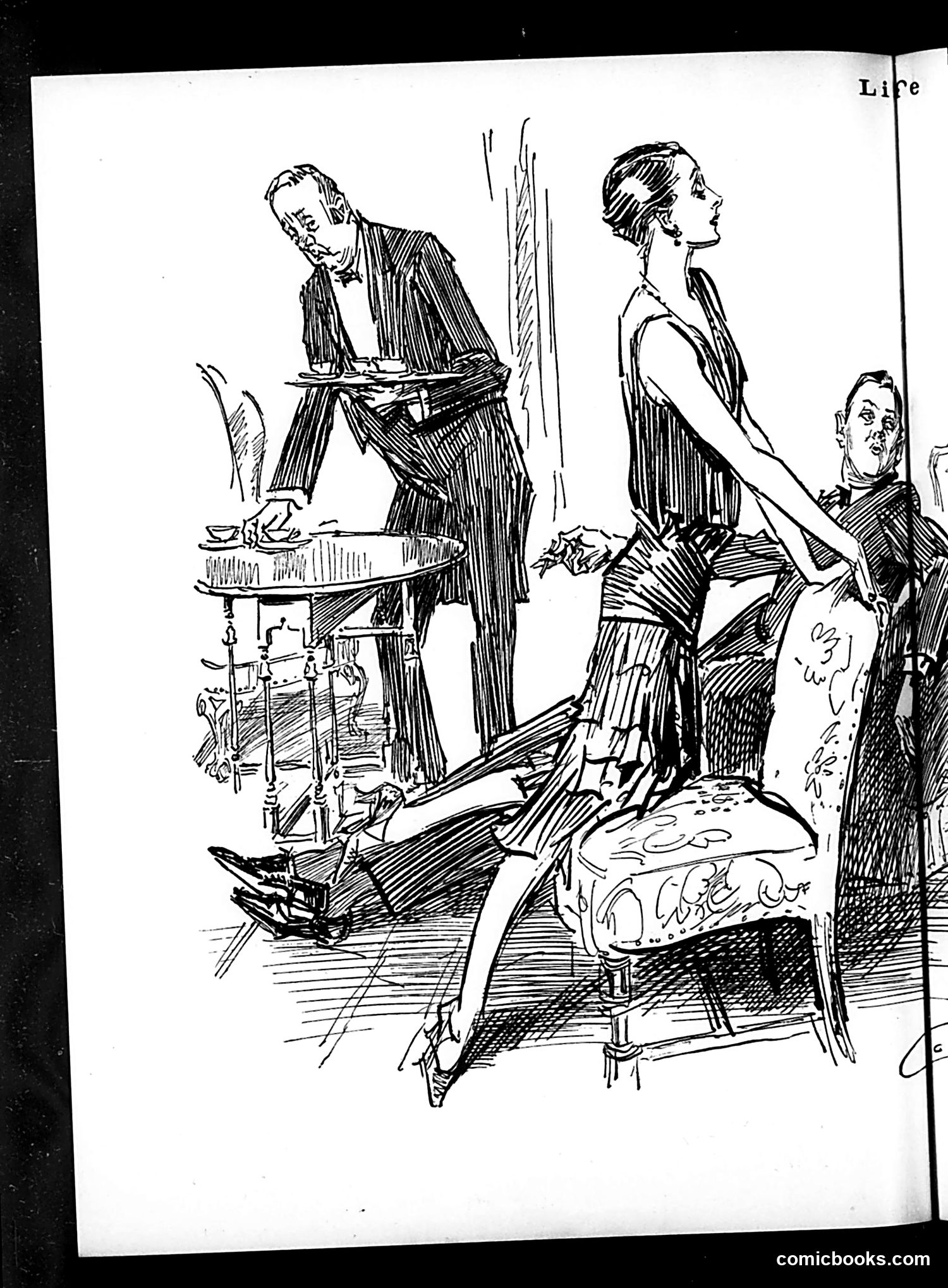
This page from *Life* magazine shows a social satire scene in an elegant interior. A formally-dressed waiter bends over a small table serving tea or coffee to three figures: a well-dressed woman seated prominently in the center, a man in formal attire visible on the right, and another man partially visible on the left. The satire appears to target high-society dining etiquette and class distinctions. The exaggerated postures and the waiter's deferential pose suggest mockery of the formality and pretension of upper-class social rituals. The woman's prominent, somewhat affected positioning and the men's studied poses indicate the cartoon jokes about the artificial manners and social performance characteristic of wealthy society gatherings in the early 20th century.
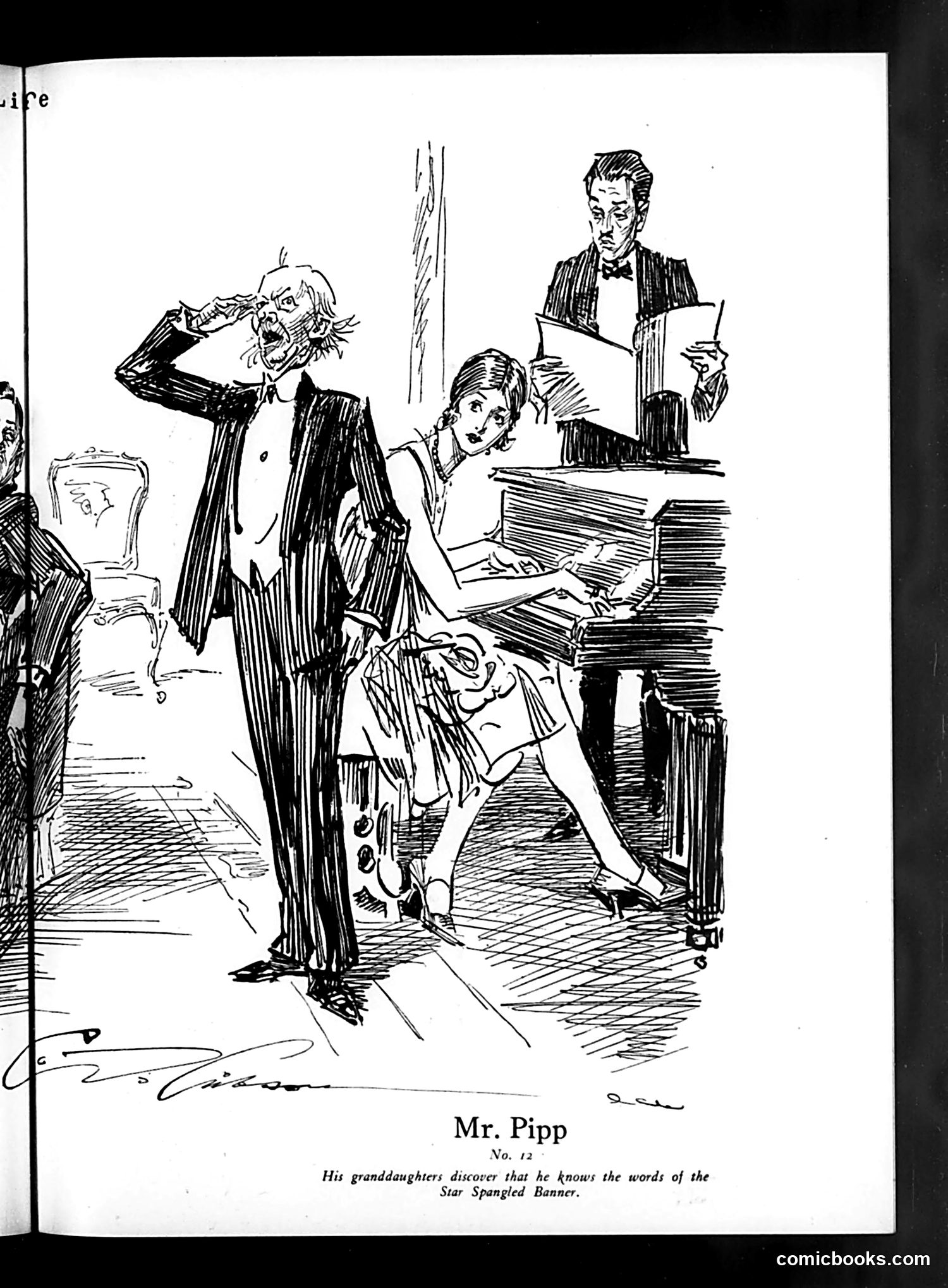
This cartoon, labeled "No. 12," depicts a domestic scene where Mr. Pipp appears distressed (hand to head) while his granddaughters discover he knows the words to "The Star-Spangled Banner," the American national anthem. The humor suggests that in this era, it was noteworthy or surprising that an adult man—particularly one of apparent leisure or wealth (indicated by his formal attire and the office setting with stacked papers)—could recite the national anthem. The cartoon satirizes either general civic ignorance among the educated classes, or possibly mocks pretentious individuals who fail at basic patriotic knowledge. The granddaughters' discovery appears to embarrass or fluster Mr. Pipp, though the exact satirical target remains unclear without additional context about the "Pipp" character series.
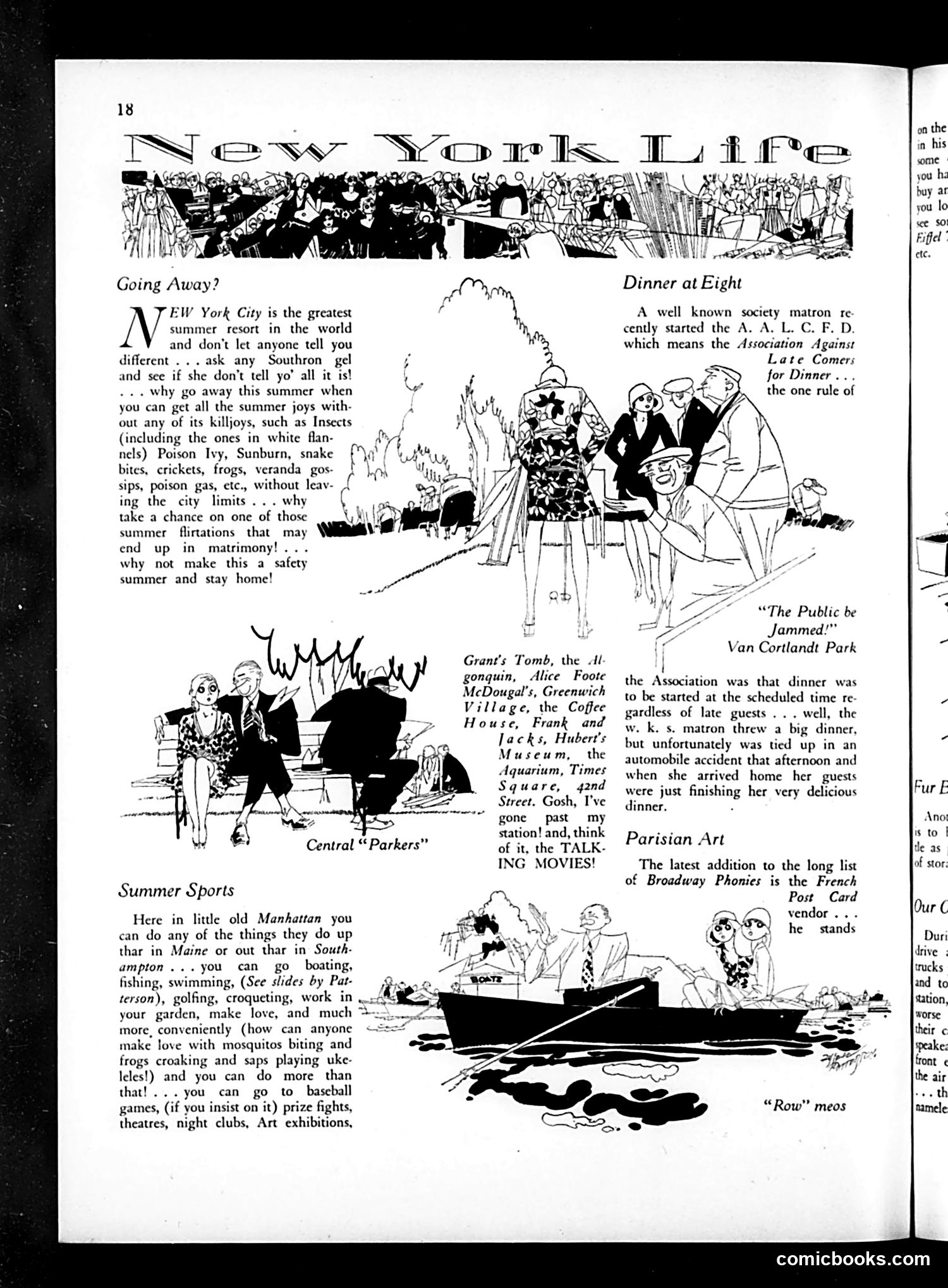
This page from *Life* magazine satirizes summer leisure activities for affluent New Yorkers. The "Going Away?" section mocks why wealthy urbanites flee the city during summer—listing actual dangers like poison ivy, snakes, insects, and gas. The irony is that these "summer flirtations" and escape attempts often fail to improve one's situation. The cartoons illustrate specific Manhattan attractions and activities: Central Park scenes, Grant's Tomb, and various entertainment venues. The "Dinner at Eight" section humorously describes a society matron's dinner party disrupted by an automobile accident—suggesting that even carefully planned social events collapse into chaos. The "Summer Sports" and "Parisian Art" sections continue this satirical tone, mocking both recreational activities and cultural pretensions of the New York elite.
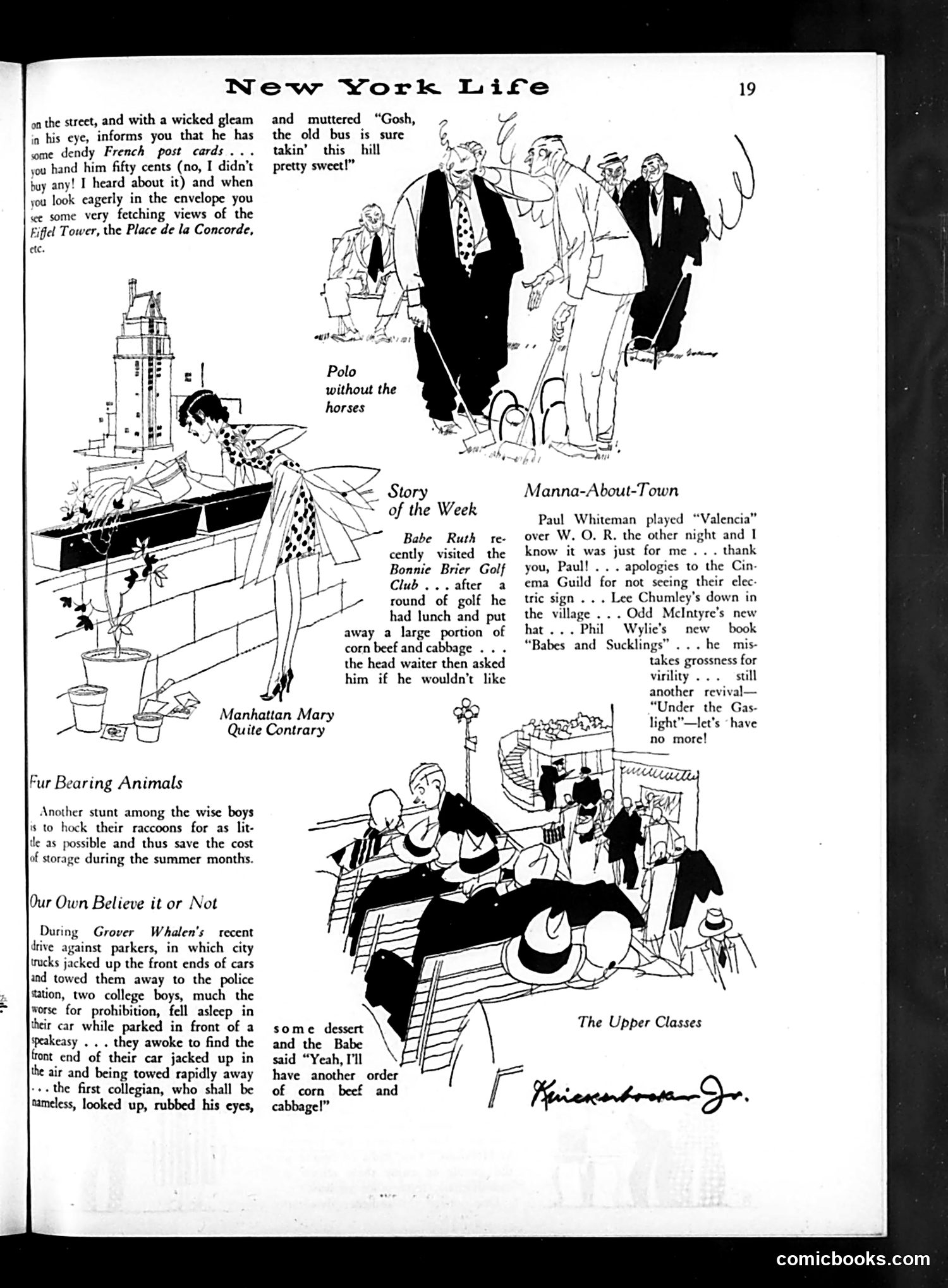
This page from *Life* magazine contains several satirical vignettes about 1920s New York society: **"Manhattan Mary Quite Contrary"** depicts a woman on a ship throwing French postcards overboard—mocking the common scam of selling tourists cheap postcards of Parisian landmarks instead of the promised risqué "French postcards" (euphemism for pornography). **"Story of the Week"** jokes about baseball star Babe Ruth's legendary appetite, describing his massive consumption of corned beef and cabbage at a golf club. **"Our Own Believe it or Not"** satirizes Prohibition-era enforcement under NYC's Parks Commissioner Grover Whalen: two drunk college boys parked outside a speakeasy wake to find their car being towed, exemplifying the absurdity of aggressive parking enforcement during the Prohibition era. **"Polo without the Horses"** (unclear reference without additional context). The cartoons capture Jazz Age New York humor: tourist gullibility, celebrity excess, Prohibition hypocrisy, and bureaucratic overreach.
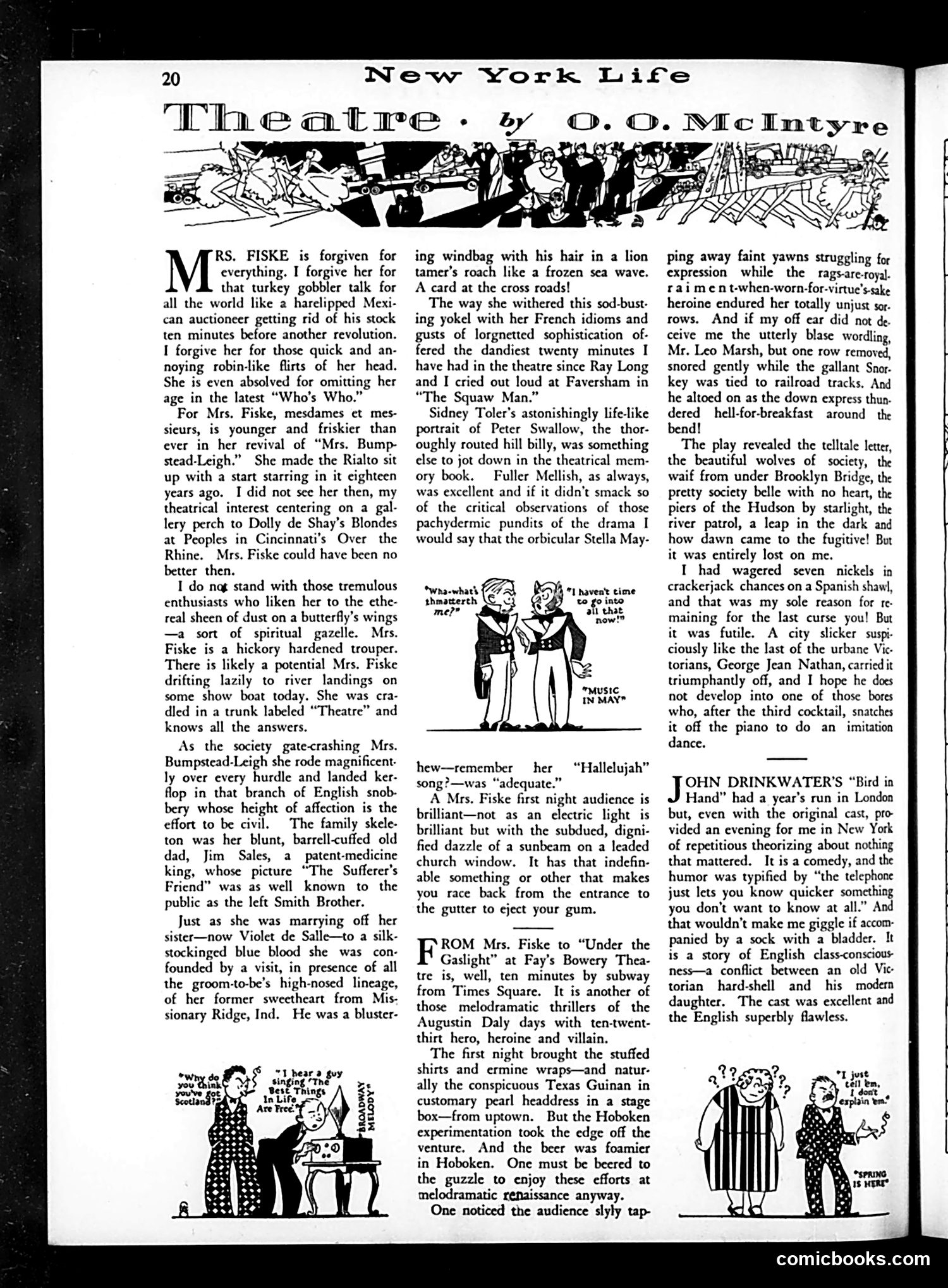
This is O.O. McIntyre's theatre column reviewing two productions. The main subject is actress **Mrs. Fiske** in her revival of "Mrs. Bumpstead-Leigh," a comedy about a socially-climbing woman who tries to hide her crude patent-medicine-king father while marrying off her sister to English nobility. McIntyre praises Fiske as a seasoned professional ("hickory hardened trouper") and celebrates a particular scene where she verbally demolishes a rural suitor using French sophistication. The column also briefly covers "Under the Gaslight" at Fay's Bowery Theatre—a melodrama from the Augustin Daly era. McIntyre notes that **Texas Guinan**, a famous speakeasy hostess, attended in her characteristic pearls, and jokes that the Hoboken location and weak beer diminished the experience. The small cartoons appear to be comic illustrations accompanying the theatrical gossip.
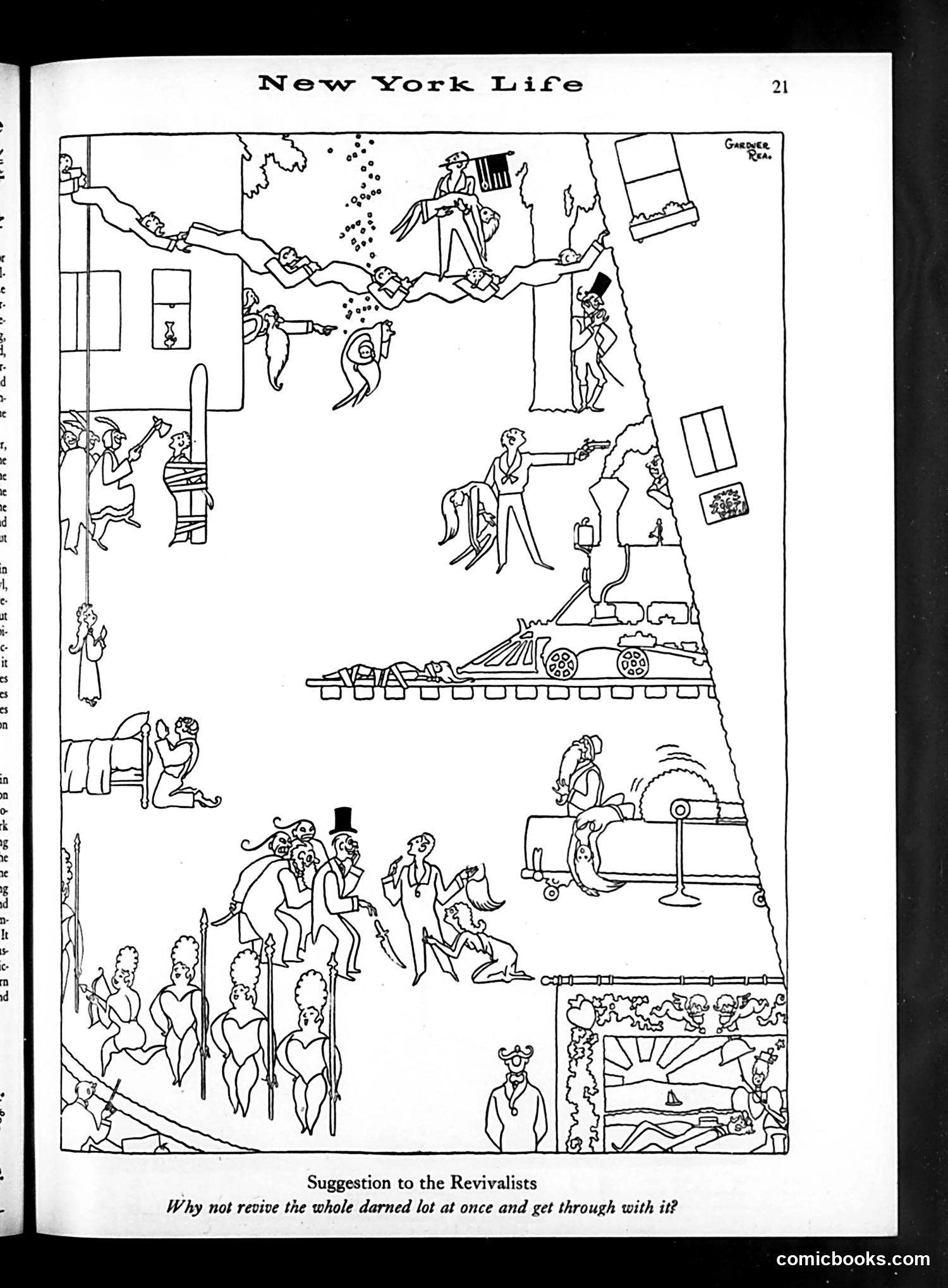
This is a single satirical cartoon occupying the full page. The title "Suggestion to the Revivalists" mocks religious revival meetings—popular evangelical events of the era where preachers sought mass spiritual conversions. The cartoon depicts a chaotic scene across multiple levels showing various sinful or frivolous activities: gambling, drinking, dancing, boxing, train wrecks, and general debauchery. The satire suggests that rather than conducting individual conversions one at a time, revivalists should simply attempt to "revive the whole darned lot at once"—convert all these sinners simultaneously. The joke criticizes both the ambitious scope of revival movements and the pervasive moral problems in society. It's darkly humorous commentary on whether mass salvation is even feasible given the extent of contemporary vice and chaos depicted throughout the crowded composition.
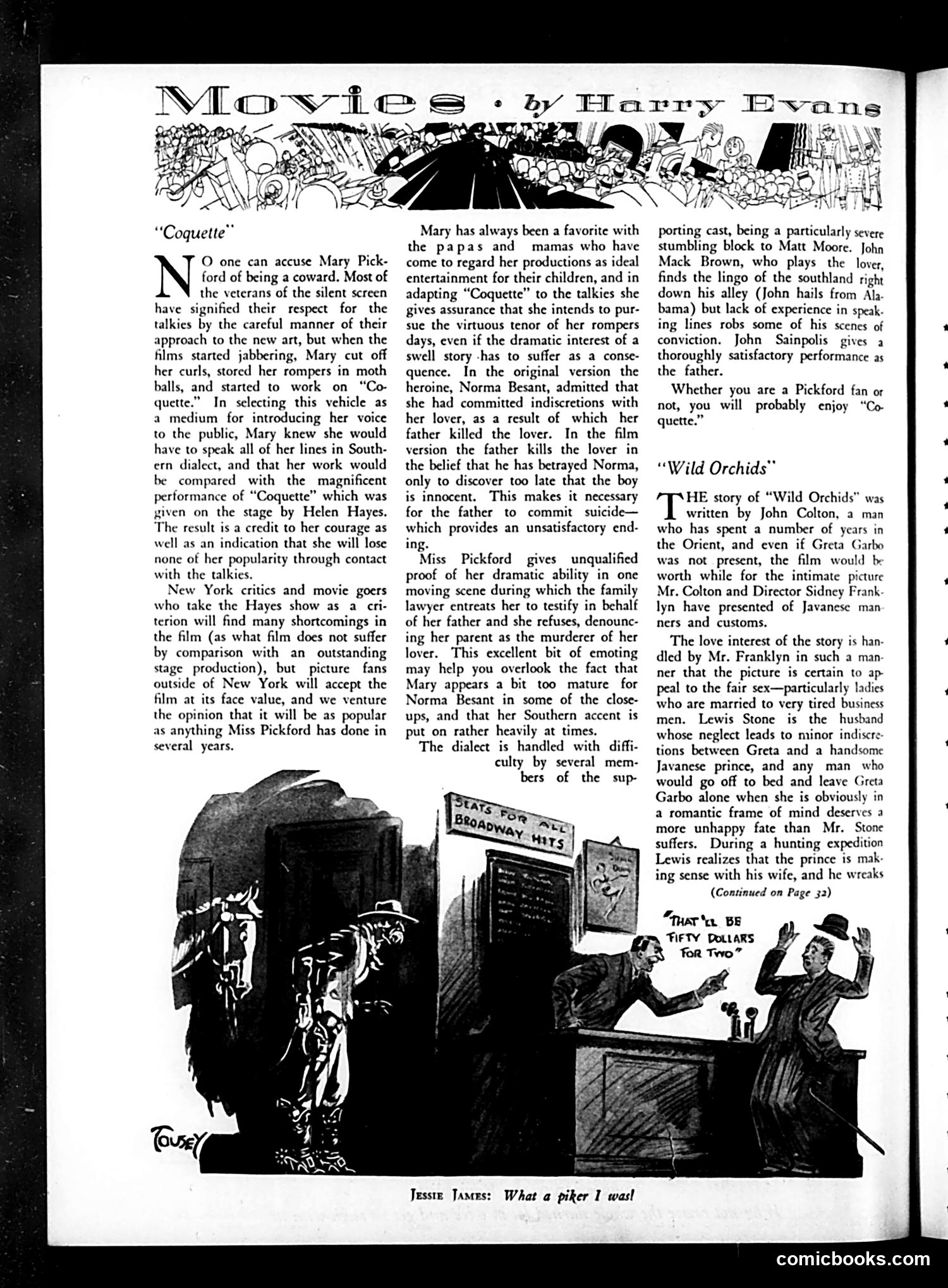
This page contains two movie reviews by Harry Evans discussing early "talkie" films. The **"Coquette" review** praises Mary Pickford's courage in transitioning to sound cinema with a Southern dialect role, comparing her performance favorably to Helen Hayes's stage version. The review notes she modified her famous image (cutting her curls, abandoning "romper" roles) to pursue more mature material, though the plot was sanitized for her family-audience demographic. The **"Wild Orchids" review** discusses a film set in Java, praising its authentic cultural detail. It appears to market the film to married women by featuring a plot about infidelity—specifically a neglected wife tempted by a Javanese prince while her tired businessman husband ignores her. The bottom cartoon ("Jessie James: What a piker I was!") likely satirizes the film industry's sensationalism, suggesting even criminals would be embarrassed by movie exaggeration. The exact reference is unclear without additional context.
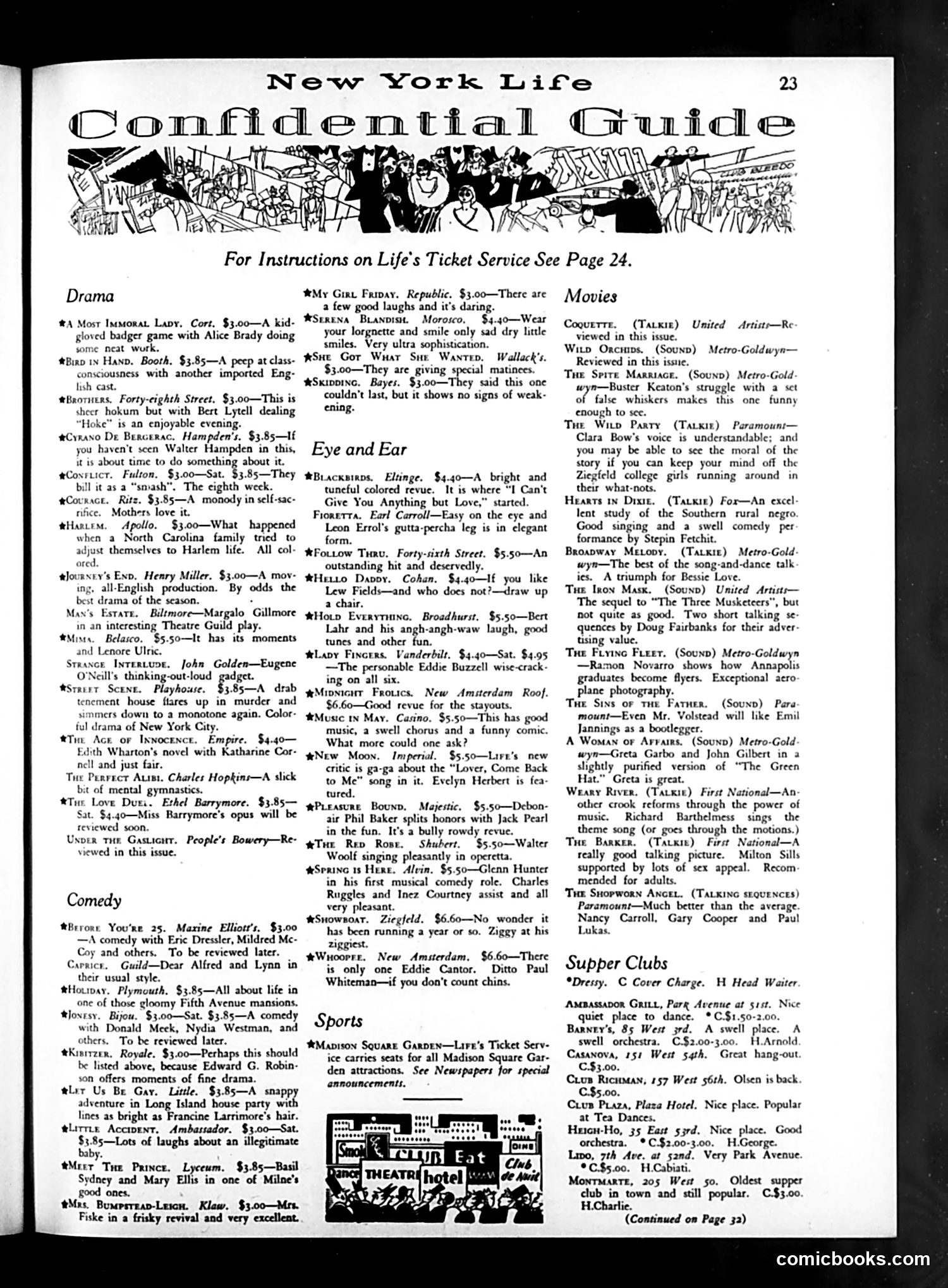
This is a **theater and entertainment listings page** from Life magazine—essentially a 1920s version of a modern entertainment weekly. It's not primarily satirical; rather, it's a practical guide to New York's theatrical offerings. The page lists **Broadway shows, movies, and nightclubs** with brief reviews and admission prices. The language reflects 1920s theatrical criticism: reviewers use phrases like "smash," "hokum," and "gutta-percha leg" (comedian Leon Errol's specialty). Notable are the racial designations—one show is explicitly labeled "All colored," reflecting the era's segregated entertainment landscape. The **illustration at top** shows a stylized crowd scene typical of Life's graphic style, depicting New York nightlife energy. Bottom includes an advertisement for "Club" venues (the Eat Theatre Hotel Club). This page survives as a historical snapshot of what entertained educated, affluent New Yorkers circa the 1920s, including Broadway theater's prominence in urban culture.
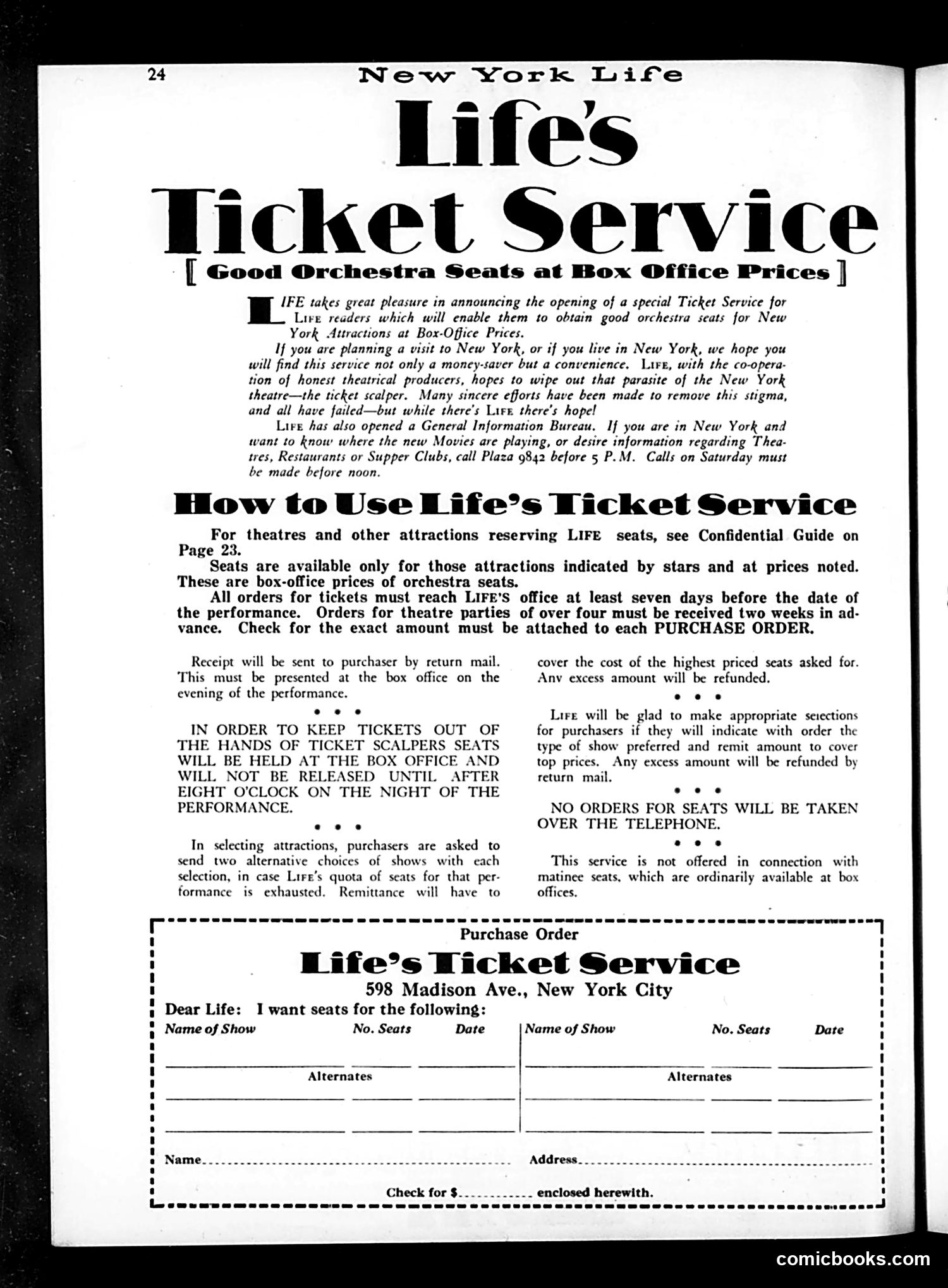
This page is not a cartoon but a service announcement and order form. Life magazine is advertising a new ticket-selling service designed to combat **ticket scalping**—the practice of reselling theater tickets at inflated prices above box-office rates. The service's stated purpose was to provide New York theater seats at legitimate box-office prices, positioning Life as an honest intermediary against "that parasite of the New York theatre—the ticket scalper." Anti-scalping measures included holding tickets at the box office until 8 PM on performance night to prevent resale. This reflects early 20th-century concerns about theatrical ticket fraud. The ad emphasizes the service as both a "money-saver" and convenience for Life readers planning New York visits. The accompanying purchase order form allowed readers to request seats for multiple shows with alternate choices, requiring checks sent to Life's Madison Avenue office.
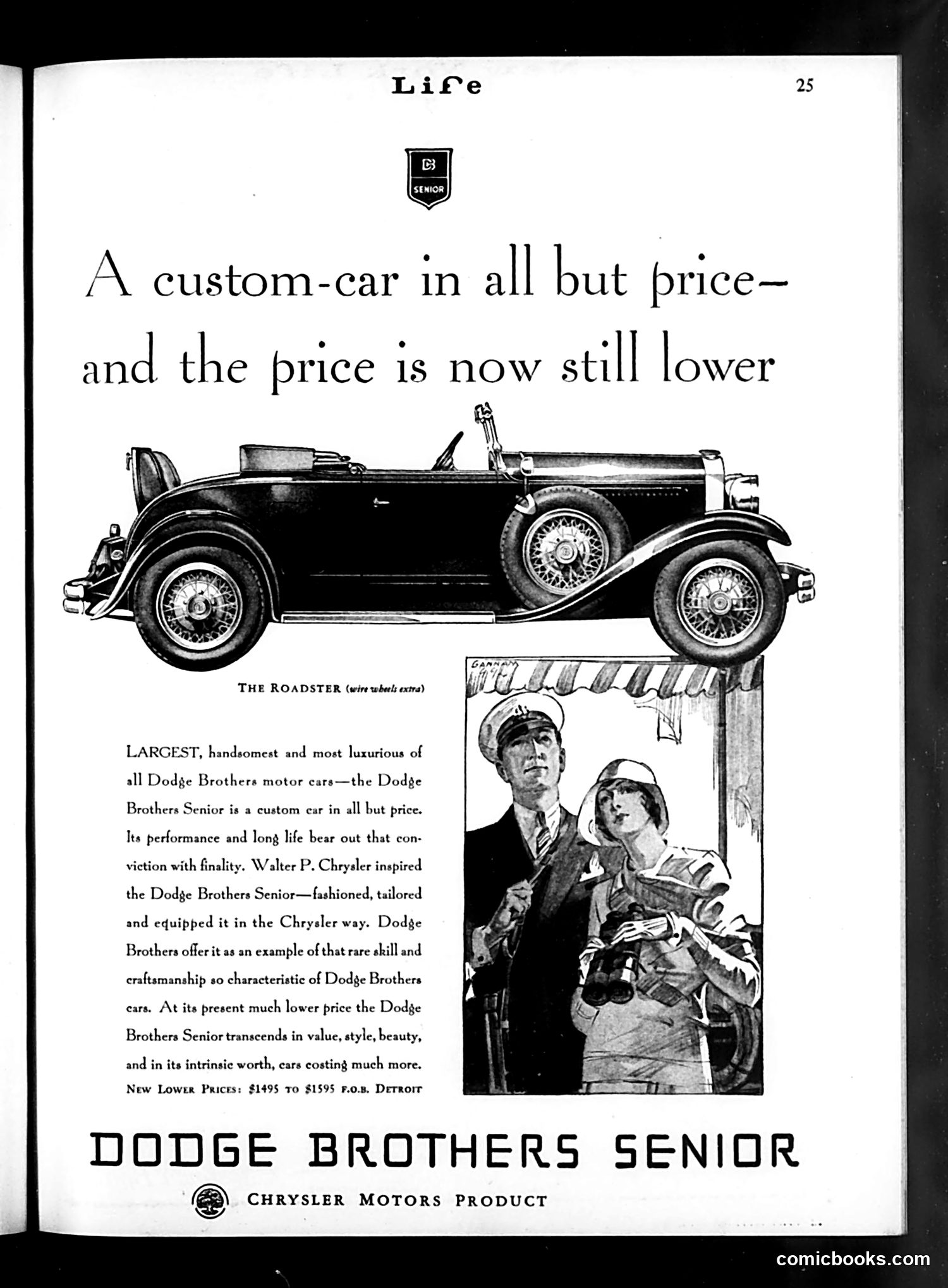
This is **not a cartoon or satire** — it's a straightforward automobile advertisement from Life magazine (page 25). The page advertises the Dodge Brothers Senior roadster, a luxury car now under Chrysler Motors ownership. The ad emphasizes that despite its "custom car" quality and craftsmanship (attributed to Walter P. Chrysler's influence), the price has been reduced to $1,495-$1,595, making it competitive with less-luxurious vehicles. The accompanying illustration shows a well-dressed couple examining the vehicle, suggesting upwardly-mobile consumers. The text stresses durability, skill, and value — positioning the car as a practical luxury purchase. This represents 1920s automotive marketing during Chrysler's expansion, when the company was acquiring and repositioning existing brands like Dodge Brothers to compete across price points.
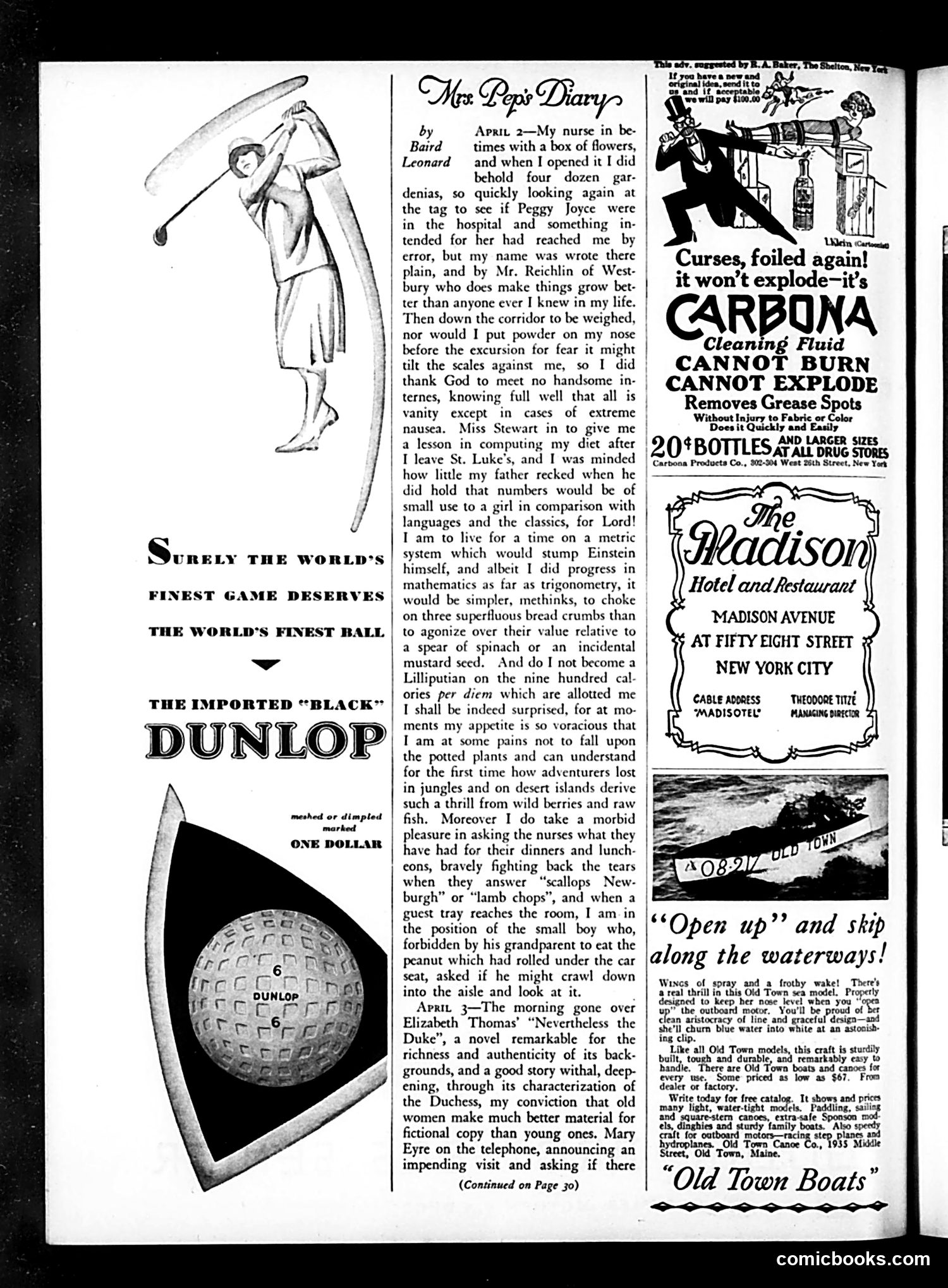
This page features "Mrs. Pep's Diary," a serialized humor column by Baird Leonard. The entry describes a hospital patient's observations during recovery, employing witty, literary commentary on mundane experiences—weighing, diet calculations, and forbidden foods while convalescing. The satire targets several things: the patient's pretentious reflections (comparing calorie-counting to Einstein's problems), the absurdity of strict medical diets, and the wistful torture of watching others eat while restricted. References to "Peggy Joyce" (likely a contemporary socialite), casual mentions of hospital romance ("handsome internes"), and literary allusions create humor through contrast between elevated language and trivial circumstances. The column exemplifies Life magazine's style: sophisticated, class-conscious satire aimed at educated readers familiar with literature and high society gossip. The diary form allowed weekly serialized commentary on everyday frustrations experienced by the urban middle-upper class.
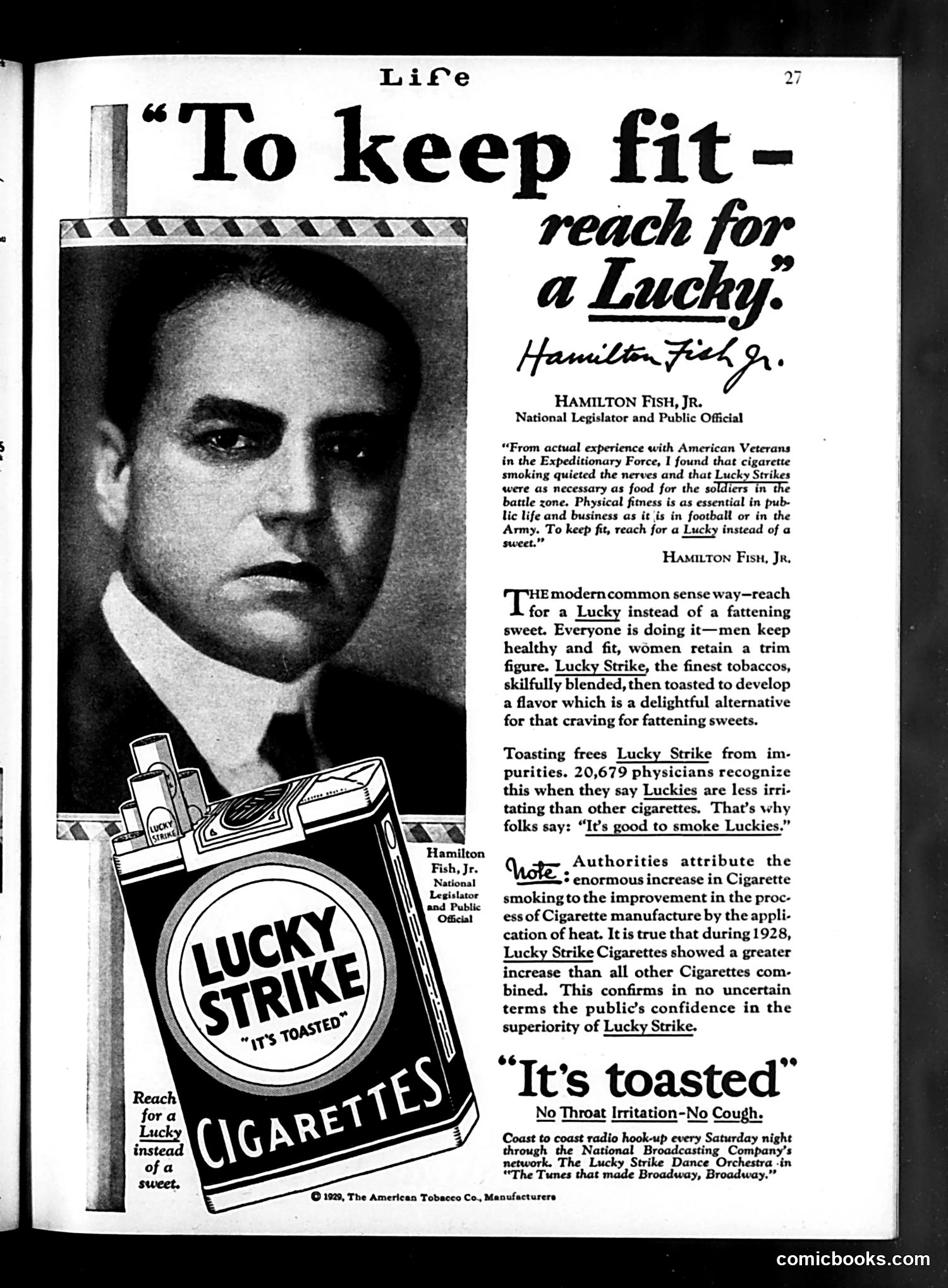
This is a **cigarette advertisement**, not satire—though it's remarkable by modern standards for its health claims. It features Hamilton Fish Jr., a real U.S. Congressman, endorsing Lucky Strike cigarettes as a fitness aid rather than a sweet indulgence. The ad's central pitch: smoking keeps you thin and fit. Fish claims soldiers in WWI found cigarettes necessary for "nerves" and physical fitness. The ad cites "20,679 physicians" supporting Lucky Strikes as less irritating than competitors, and credits the toasting process with reducing impurities. By today's standards, this is darkly ironic—using a public official to market cigarettes as healthful, citing fabricated medical endorsements, and promoting smoking as an appetite suppressant. In 1929, before widespread understanding of tobacco's dangers, such claims were commonplace marketing strategy.
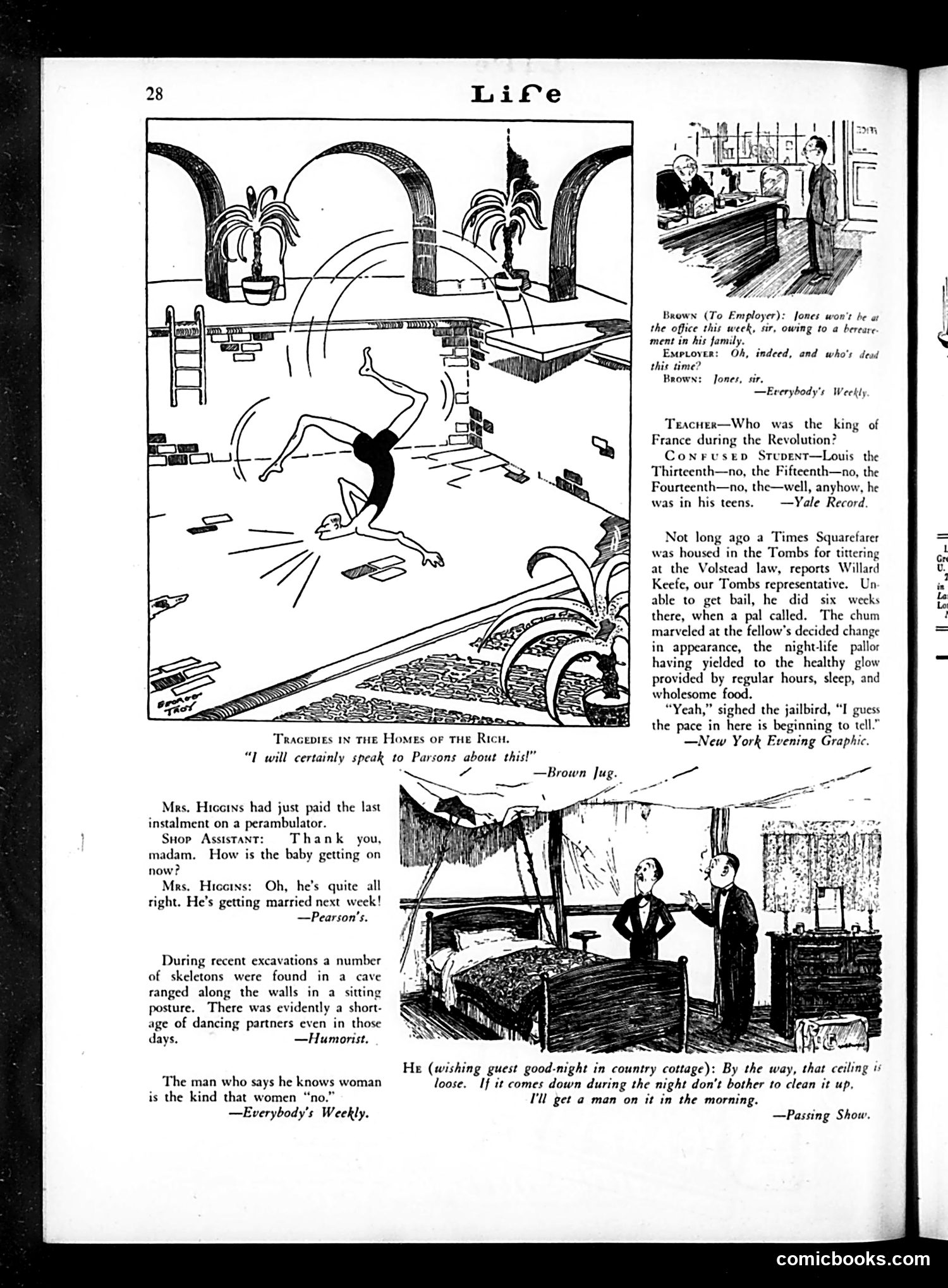
This satirical page contains multiple short jokes typical of early 20th-century humor magazines: **Main cartoon ("Tragedies in the Homes of the Rich"):** A wealthy person's home is flooded with water while occupants slip and fall. The caption "I will certainly speak to Parsons about this!" satirizes how the rich blame servants (Parsons, likely their butler) for disasters, deflecting personal responsibility. **Other jokes target:** - A woman bragging her baby is "getting married next week"—absurdist humor about rushing children into adulthood - A teacher confused about French Revolutionary history (mixing up Louis XIII, XV, XIV)—mocking educational incompetence - A prisoner who improves physically in jail, suggesting civilian life (especially during Prohibition—"Volstead law") is more brutal than incarceration - A houseguest warned not to clean up fallen ceiling plaster—dark humor about negligent homeowners The page reflects 1920s American anxieties: class tensions, educational failure, Prohibition's social chaos, and domestic disorder. The humor is observational rather than explicitly political.
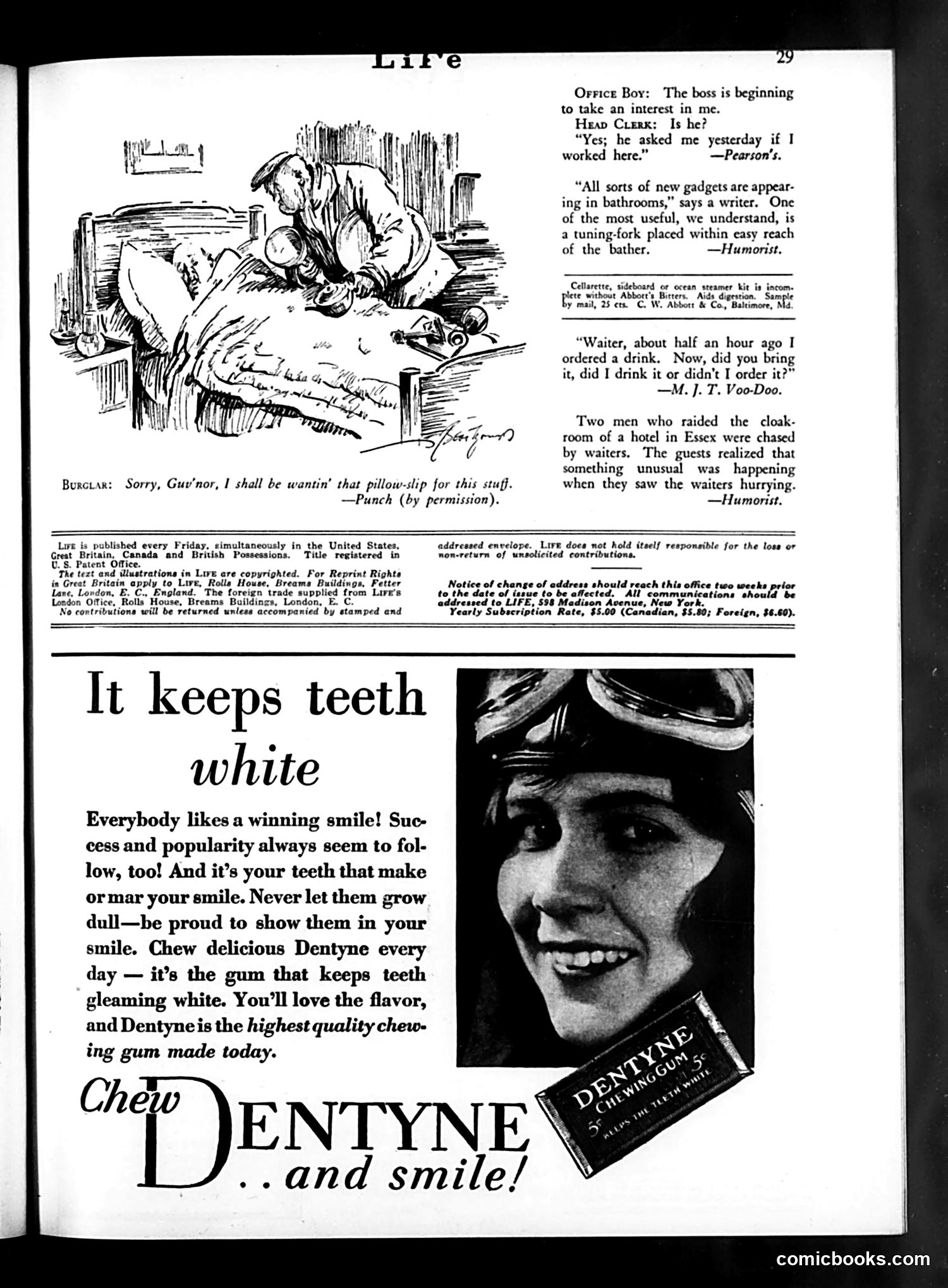
This page contains several brief humorous anecdotes typical of early 20th-century satirical magazines, plus a Dentyne chewing gum advertisement. The cartoons mock workplace dynamics and social situations: an office boy so invisible his boss doesn't recognize him; a waiter's forgetfulness about whether a customer received their drink; and a burglar asking for a pillowcase to carry stolen goods—treating the theft with absurd politeness ("Sorry, Guv'nor"). The main illustration shows a burglar ransacking a bedroom while the occupant sleeps, captioned with the burglar's polite request for the pillowcase, satirizing genteel British speech even in criminal circumstances. The page's lower half shifts to a Dentyne advertisement featuring a smiling woman, promoting teeth-whitening through chewing gum—a typical period ad equating white teeth with "success and popularity." The humor reflects pre-WWI British/American satirical sensibilities: workplace awkwardness, servant/class dynamics, and absurdist situations presented without elaborate setup.
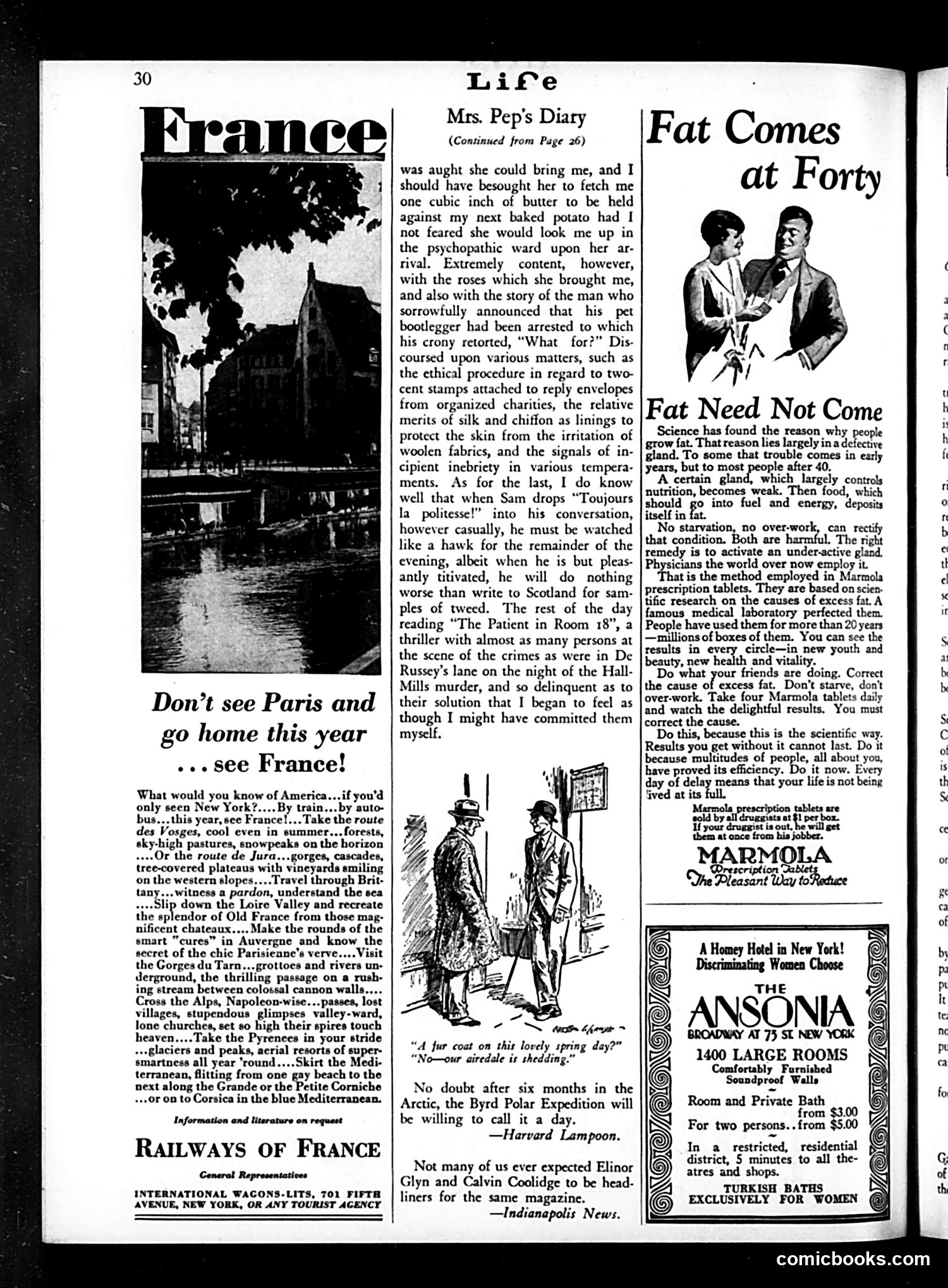
This page contains primarily **advertisements and filler content** rather than political satire. The main elements are: 1. **"Don't see Paris and go home this year...see France!"** — A Railways of France tourism advertisement encouraging American travelers to explore the French countryside beyond Paris, with lyrical descriptions of regional attractions (Loire Valley châteaux, Alps, Mediterranean coast). 2. **"Mrs. Pep's Diary"** — A serialized humor column discussing mundane domestic matters and social observations, including a joke about a "pet bootlegger" (referencing Prohibition-era illegal alcohol suppliers). 3. **"Fat Comes at Forty"** and **Marmola advertisement** — Health/diet advertising promoting a prescription tablet claimed to address thyroid deficiency causing weight gain. 4. **The Ansonia Hotel advertisement** — New York City lodging promotion. The page reflects **1920s consumer culture**: tourism marketing to affluent Americans, Prohibition-era humor, and emerging diet/pharmaceutical advertising. There is no significant political cartoon or satirical commentary present.
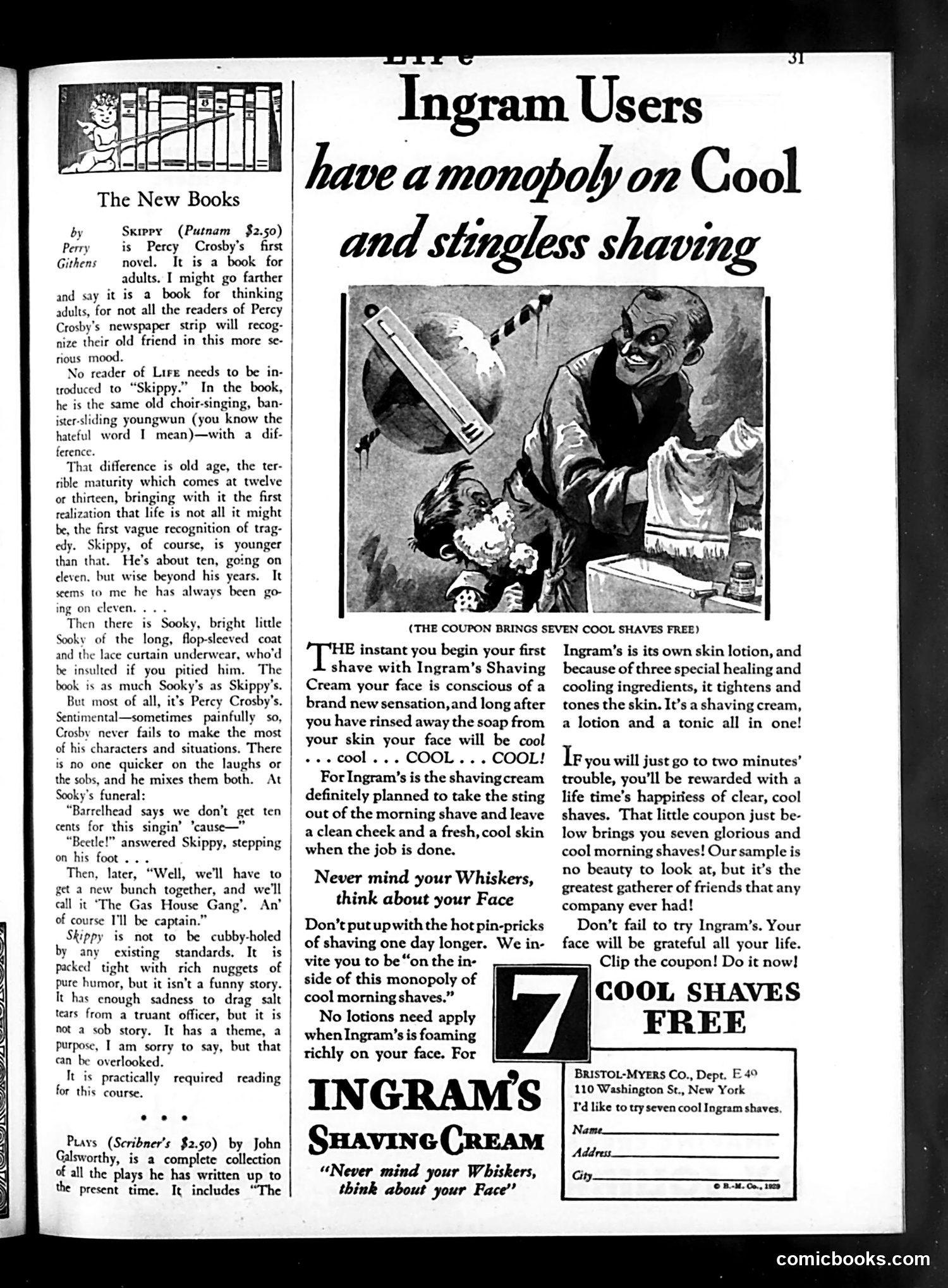
This page combines a book review with a period advertisement. The left column reviews Percy Crosby's novel "Skippy," based on his popular newspaper comic strip character. The reviewer praises Crosby's ability to blend humor with pathos, describing how the mature Skippy (age ten, "going on eleven") confronts life's sadness alongside comedy. The dominant right side is a **full-page advertisement for Ingram's Shaving Cream**. The mock-serious headline claims Ingram users "have a monopoly on Cool and stingless shaving." The illustration shows an exaggerated caricature of a man shaving a child's face, humorously playing on the ad's promise of a painless shave. The copy satirically inverts normal grooming priorities—"Never mind your Whiskers, think about your Face"—emphasizing cooling and toning benefits over actual hair removal. A coupon offers seven free shaves, typical of period marketing tactics. The satire lies in the absurdly grandiose claims about a mundane product.
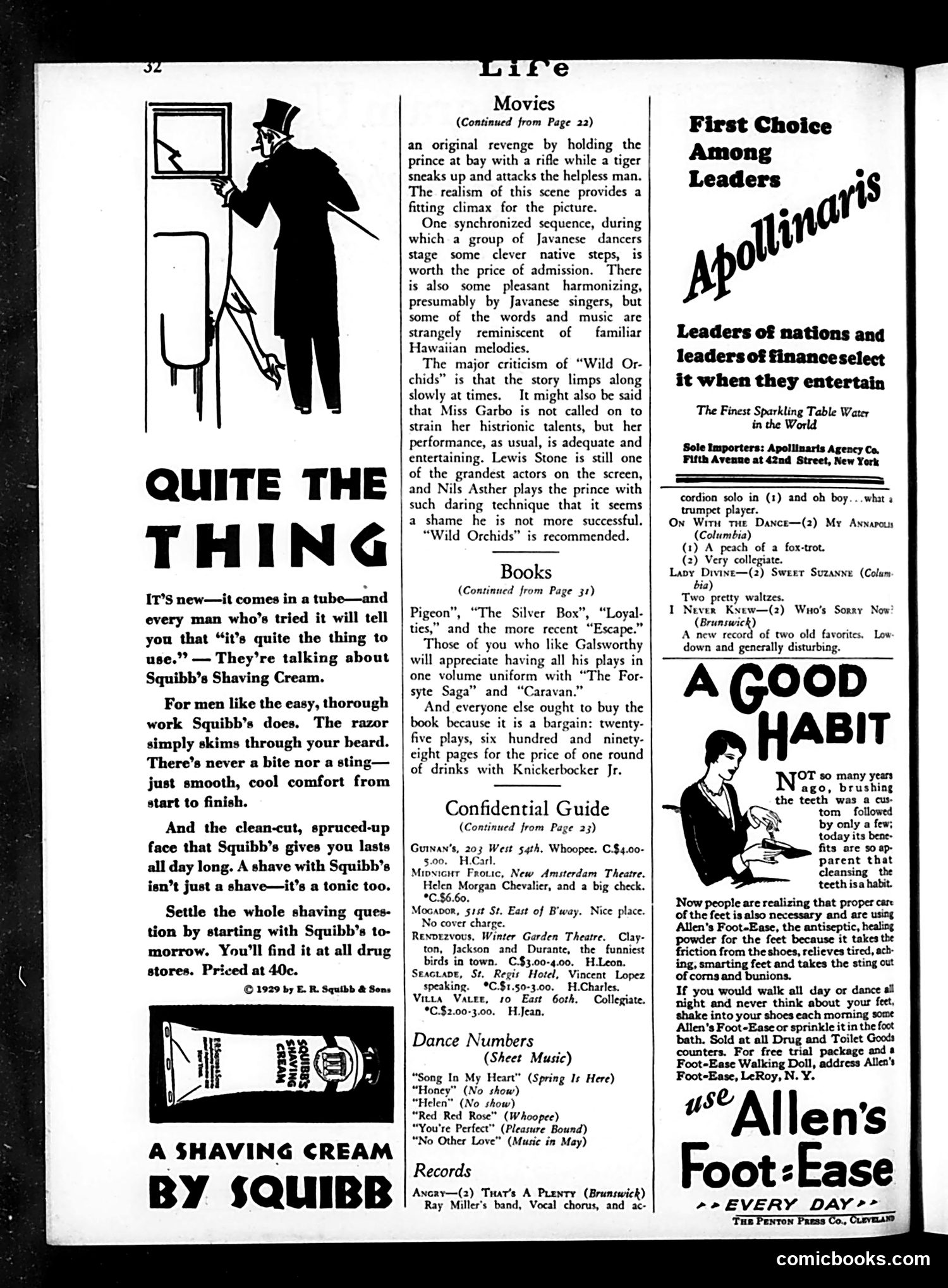
This page is primarily **advertising content**, not political satire. The main cartoon illustrates a Squibb's Shaving Cream advertisement (circa 1929), showing a well-dressed man in a top hat examining his freshly shaved face in a mirror. The accompanying text emphasizes the product's smoothness and comfort—selling the idea that proper grooming is a mark of refinement and masculinity. The cartoon's style is typical of 1920s commercial art: elegant, aspirational, and targeted at middle-class male consumers. The phrase "quite the thing" means fashionable or desirable. The page also contains **entertainment reviews** (movies, books, records, dance music) and advertisements for other luxury products like Apollinaris sparkling water and Allen's Foot-Ease powder—all marketing to affluent readers during the pre-Depression era. This reflects Life magazine's dual function: satirical commentary alongside high-end commercial advertising.
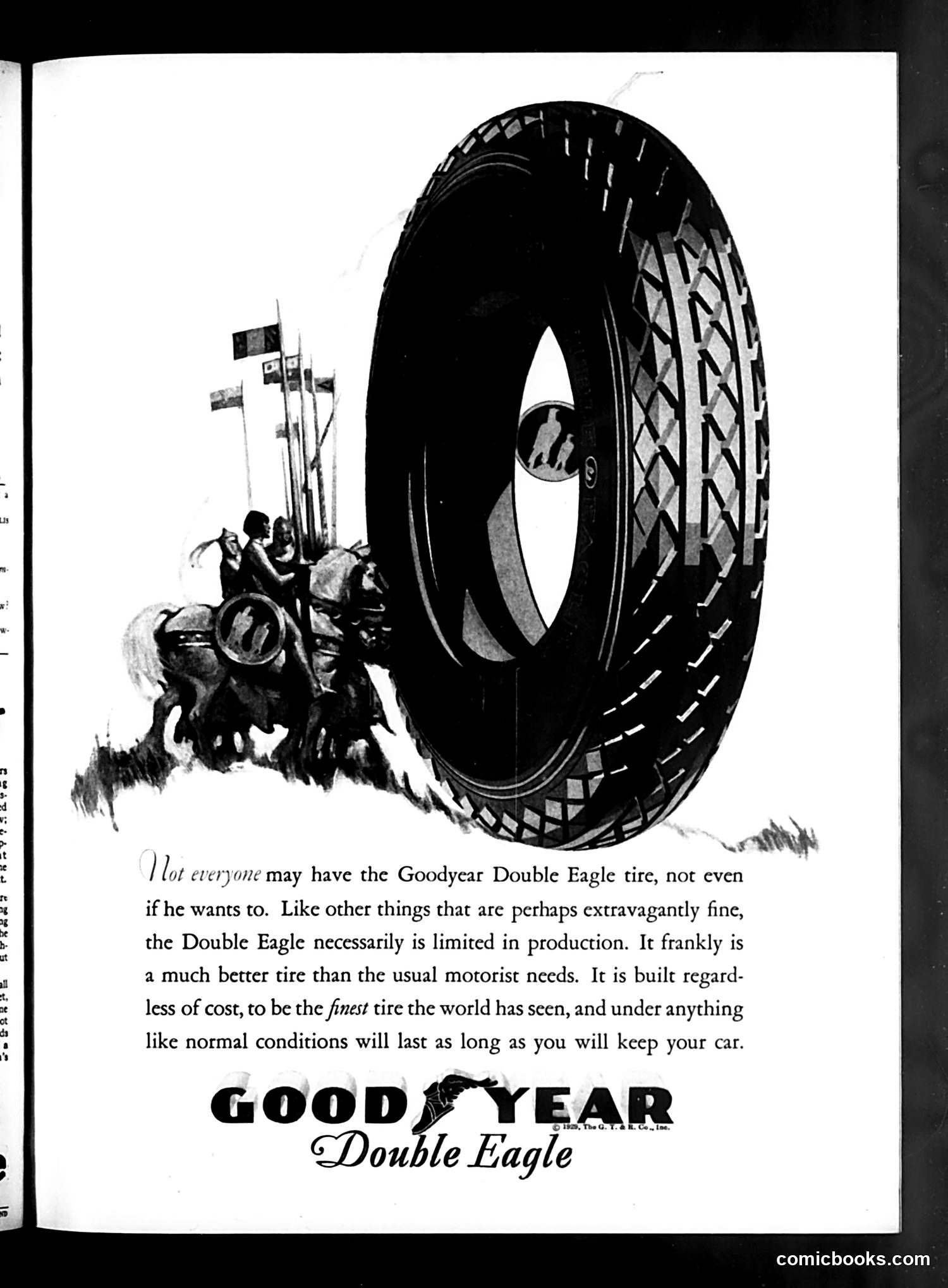
This is a **Goodyear tire advertisement**, not political satire. The page features an illustration of a massive tire with small figures examining it, positioned beneath flags. The ad's text makes an exclusivity appeal: the Double Eagle tire is so superior that it's intentionally limited in production—not everyone can have one, even if they want it. The copywriting positions the product as luxuriously over-engineered ("built regardless of cost") for ordinary driving needs, appealing to affluent consumers who value prestige and quality above practicality. The illustration dramatizes the tire's impressive scale and construction quality. This appears to be vintage advertising from an era when Life magazine ran substantial advertisements alongside editorial content. The tone reflects early-to-mid 20th-century marketing strategy: positioning consumer goods as status symbols tied to exclusivity and superior craftsmanship.
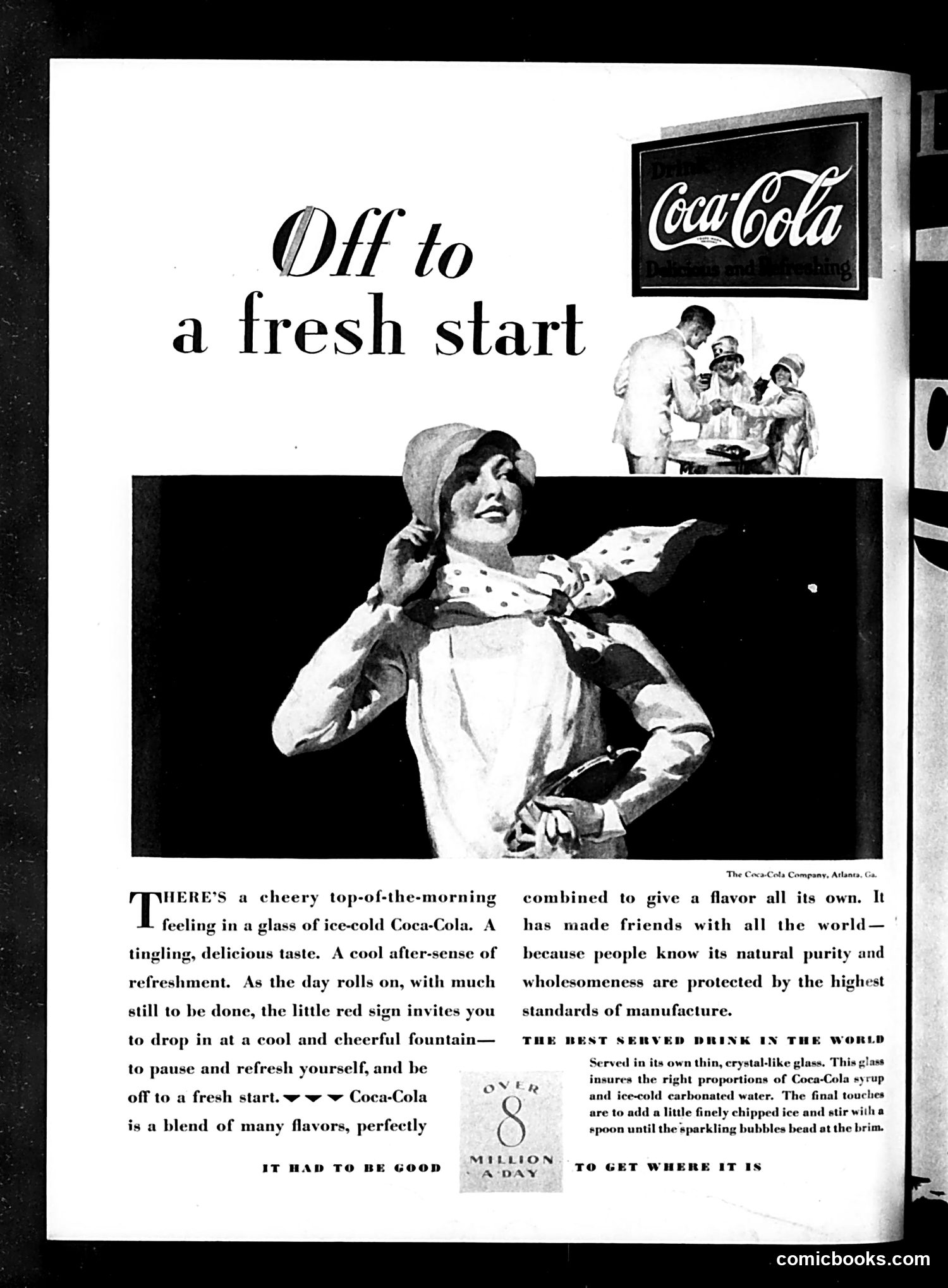
This is a **Coca-Cola advertisement**, not a political cartoon or satire. The page features a woman in 1920s attire (headscarf, period dress) preparing for her day, with the tagline "Off to a fresh start." The ad emphasizes Coca-Cola as an energizing morning beverage that provides refreshment and renewed vigor for daily tasks. The "8 Million a Day" badge suggests the drink's massive popularity. The copy stresses "natural purity" and "highest standards of manufacture"—marketing claims designed to assure consumers of quality and safety. The secondary image shows a soda fountain scene, reflecting the era when Coca-Cola was primarily consumed at public fountains rather than from bottles. This is straightforward commercial advertising aimed at early-20th-century consumers, with no satirical or political content.