
Life, 1929-04-26 · page 24 of 36
Life — April 26, 1929 — page 24: what you’re looking at
What you’re looking at
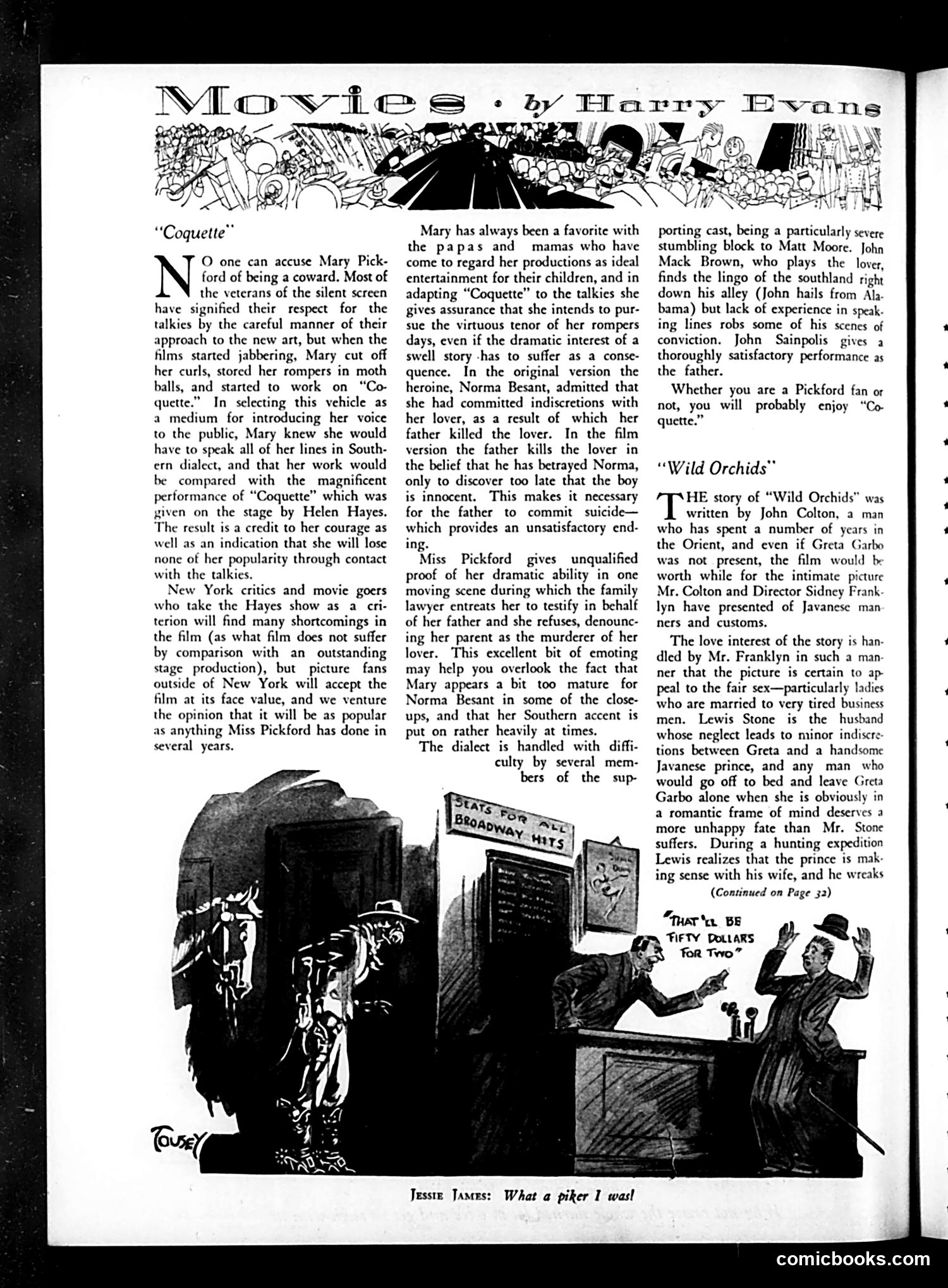
This page contains two movie reviews by Harry Evans discussing early "talkie" films. The **"Coquette" review** praises Mary Pickford's courage in transitioning to sound cinema with a Southern dialect role, comparing her performance favorably to Helen Hayes's stage version. The review notes she modified her famous image (cutting her curls, abandoning "romper" roles) to pursue more mature material, though the plot was sanitized for her family-audience demographic. The **"Wild Orchids" review** discusses a film set in Java, praising its authentic cultural detail. It appears to market the film to married women by featuring a plot about infidelity—specifically a neglected wife tempted by a Javanese prince while her tired businessman husband ignores her. The bottom cartoon ("Jessie James: What a piker I was!") likely satirizes the film industry's sensationalism, suggesting even criminals would be embarrassed by movie exaggeration. The exact reference is unclear without additional context.
📄 Transcribed text from this page (OCR, searchable)
Machine-transcribed from the original scan — historical spelling and the odd misread are preserved.
“Coquette” O one can accuse Mary Pick- N ford of being a coward. Most of the veterans of the silent screen have signified their respect for the talkies by the careful manner of their approach to the new art, but when the films started jabbering, Mary cut off her curls, stored her rompers in moth balls, and started to work on “Co- quette.” In selecting this vehicle as a medium for introducing her voice to the public, Mary knew she would have to speak all of her lines in South- ern dialect, and that her work would be compared with the magnificent performance of “Coquette” which was given on the stage by Helen Hayes. The result is a credit to her courage as well as an indication that she will lose none of her popularity through contact with the talkies, New York critics and movie goers who take the Hayes show as a cri- terion will find many shortcomings in the film (as what film does not suffer by comparison with an outstanding stage production), but picture fans outside of New York will accept the film at its face value, and we venture the opinion that it will be as popular as anything Miss Pickford has done in several years. Mary has always been a favorite with the papas and mamas who have come to regard her productions as ideal entertainment for their children, and in adapting “Coquette” to the talkies she gives assurance that she intends to pur- sue the virtuous tenor of her rompers days, even if the dramatic interest of a swell story -has to suffer as a conse- quence. In the original version the heroine, Norma Besant, admitted that she had committed indiscretions with her lover, as a result of which her father killed the lover. In the film version the father kills the lover in the belief that he has betrayed Norma, only to discover too late that the boy is innocent. This makes it necessary for the father to commit suicide— which provides an unsatisfactory end- ing. Miss Pickford gives unqualified proof of her dramatic ability in one moving scene during which the family lawyer entreats her to testify in behalf of her father and she refuses, denounc- ing her parent as the murderer of her lover. This excellent bit of emoting may help you overlook the fact that Mary appears a bit too mature for Norma Besant in some of the close- ups, and that her Southern accent is put on rather heavily at times. The dialect is handled with diffi- culty by several mem- bers of the sup- Jesste James: What a piker I was! porting cast, being a particularly severe stumbling block to Matt Moore. John Mack Brown, who plays the lover, finds the lingo of the southland right down his alley (John hails from Ala. bama) but lack of experience in speak- ing lines robs some of his scenes of conviction, John Sainpolis gives a thoroughly satisfactory performance as the father. Whether you are a Pickford fan or not, you will probably enjoy “Co- quette.” “Wild Orchids” HE story of “Wild Orchids” was written by John Colton, a man who has spent a number of years in the Orient, and even if Greta Garbo was not present, the film would b worth while for the intimate picture Mr. Colton and Director Sidney Frank- lyn have presented of Javanese man ners and customs. The love interest of the story is han- dled by Mr. Franklyn in such a man ner that the picture is certain to ap peal to the fair sex—particularly ladies who are married to very tired business men. Lewis Stone is the husband whose neglect leads to minor indiscre- tions between Greta and a handsome Javanese prince, and any man who would go off to bed and leave Greta Garbo alone when she is obviously in a romantic frame of mind deserves a more unhappy fate than Mr. Stone suffers. During a hunting expedition Lewis realizes that the prince is mak- ing sense with his wife, and he wreaks (Continued on Page 32) “Tust BE m FIFTY DOLLARS Tor Two” comicbooks.com