
Life, 1929-05-10 · page 11 of 44
Life — May 10, 1929 — page 11: what you’re looking at
What you’re looking at
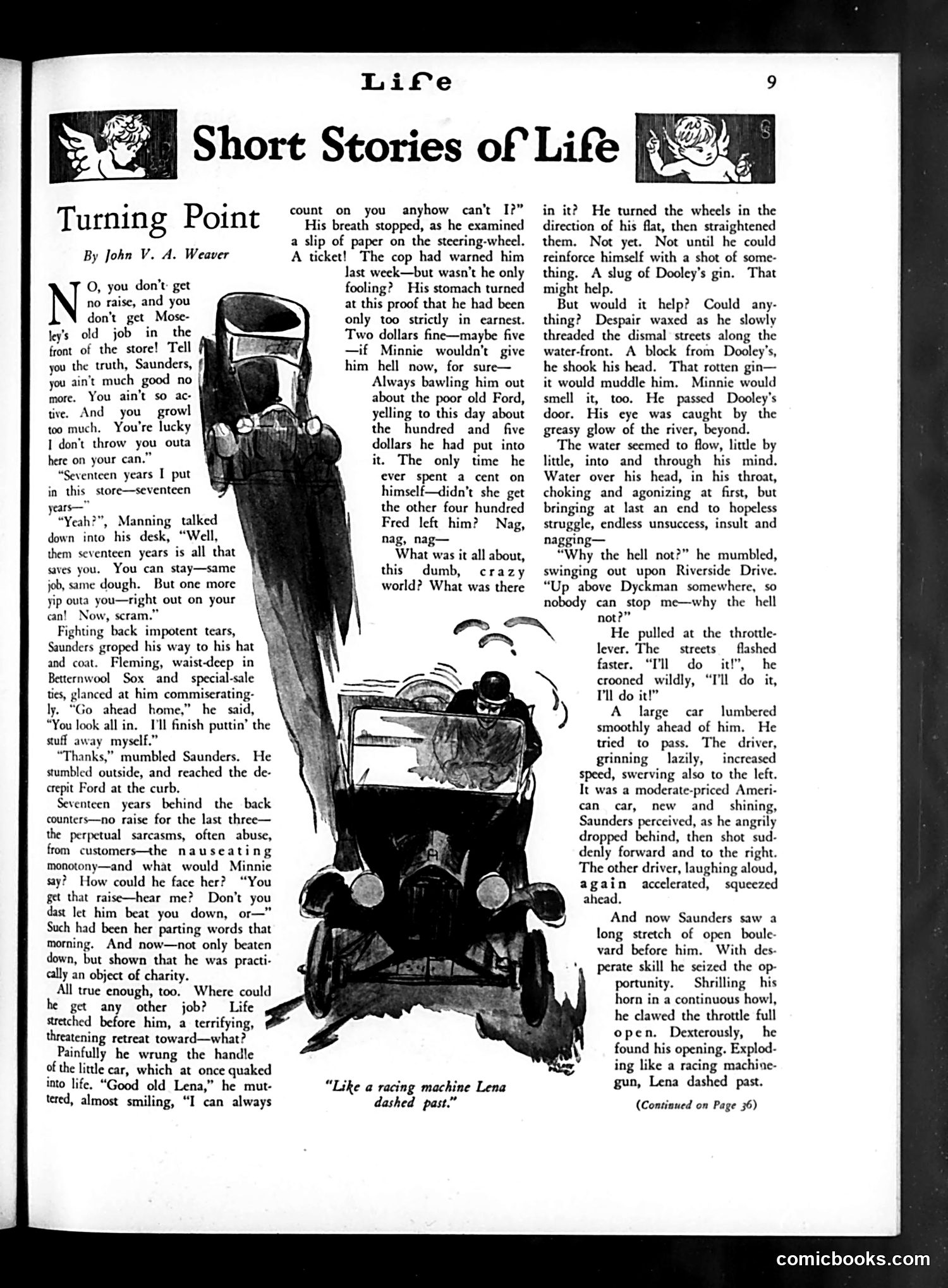
This is a short story (continued on page 36) about a man named Saunders who drives an old, unreliable Ford taxi. After seventeen years working the same job in a store, he's been fired by his boss Manning. Desperate and humiliated, Saunders drives recklessly through the city streets in his jalopy, contemplating suicide ("Why the hell not?"). The story's "turning point" comes when a newer, expensive car passes him aggressively. Rather than despair, this confrontation provokes Saunders to compete—he accelerates wildly, reclaiming a sense of agency and will to live through the driving challenge. The satire portrays how economic hardship and job loss can lead to desperation, while suggesting that even small moments of defiant action can restore human dignity and the will to survive.
📄 Transcribed text from this page (OCR, searchable)
Machine-transcribed from the original scan — historical spelling and the odd misread are preserved.
Turning Point By John V. A. Weaver O, you don’t: get N no raise, and you don’t get Mose- ky's old job in the P front of the store! Tell you the truth, Saunders, f you ain’t much good no more. You ain't so ac- tive. And you growl too much. You're lucky I don’t throw you outa here on your can.” “Seventeen years I put in this store—seventeen years—" “Yeah?”, Manning talked down into his desk, “Well, them seventeen years is all that saves you. You can stay—same job, same dough. But one more yip outa you—right out on your can! Now, scram.” Fighting back impotent tears, Saunders groped his way to his hat and coat. Fleming, waist-deep in Betternwool Sox and special-sale ties, glanced at him commiserating- ly. “Go ahead home,” he said, “You look all in. I'll finish puttin’ the suff away myself.” “Thanks,” mumbled Saunders. He stumbled outside, and reached the de- crepit Ford at the curb. Seventeen years behind the back counters—no raise for the last three— the perpetual sarcasms, often abuse, from customers—the nauseating monotony—and what would Minnie say? How could he face her? “You get that raise—hear me? Don’t you dast let him beat you down, or—” Such had been her parting words that morning. And now—not only beaten down, but shown that he was practi- ally an object of charity. All true enough, too. Where could he get any other job? Life stretched before him, a terrifying, threatening retreat toward—what? Painfully he wrung the handle of the little car, which at once quaked into life. “Good old Lena,” he mut- tered, almost smiling, “I can always Life count on you anyhow can't I?” His breath stopped, as he examined a slip of paper on the steering-wheel. A ticket! The cop had warned him Jast week—but wasn’t he only fooling? His stomach turned at this proof that he had been only too strictly in earnest. Two dollars fine—maybe five —if Minnie wouldn't give him hell now, for sure— Always bawling him out about the poor old Ford, yelling to this day about the hundred and five dollars he had put into it. The only time he ever spent a cent on himself—didn't she get the other four hundred Fred left him? Nag, nag, nag— What was it all about, this dumb, crazy world? What was there “Like a racing machine Lena dashed past.” Ig Short Stories of Life we. : in it? He turned the wheels in the direction of his flat, then straightened them. Not yet. Not until he could reinforce himself with a shot of some- thing. A slug of Dooley’s gin. That might help. But would it help? Could any- thing? Despair waxed as he slowly threaded the dismal streets along the water-front. A block from Dooley’s, he shook his head. That rotten gin— it would muddle him. Minnie would smell it, too. He passed Dooley’s door. His eye was caught by the greasy glow of the river, beyond. The water seemed to flow, little by litle, into and through his mind. Water over his head, in his throat, choking and agonizing at first, but bringing at last an end to hopeless struggle, endless unsuccess, insult and nagging— “Why the hell not?” he mumbled, swinging out upon Riverside Drive. “Up above Dyckman somewhere, so nobody can stop me—why the hell not?” He pulled at the throttle- lever. The streets _ flashed faster. “I'll do it!”, he crooned wildly, “I'll do it, T'll do it!” A large car lumbered smoothly ahead of him. He tried to pass. The driver, grinning lazily, increased speed, swerving also to the left. It was a moderate-priced Ameri- can car, new and _ shining, Saunders perceived, as he angrily dropped behind, then shot sud- denly forward and to the right. The other driver, laughing aloud, again accelerated, squeezed ahead. And now Saunders saw a long stretch of open boule- vard before him. With des- perate skill he seized the op- portunity. Shrilling his horn in a continuous howl, he clawed the throttle full open. Dexterously, he found his opening. Explod- ing like a racing machine- gun, Lena dashed past. (Continued on Page 36) comicbooks.com