
A complete issue · 44 pages · 1929
Life — May 10, 1929
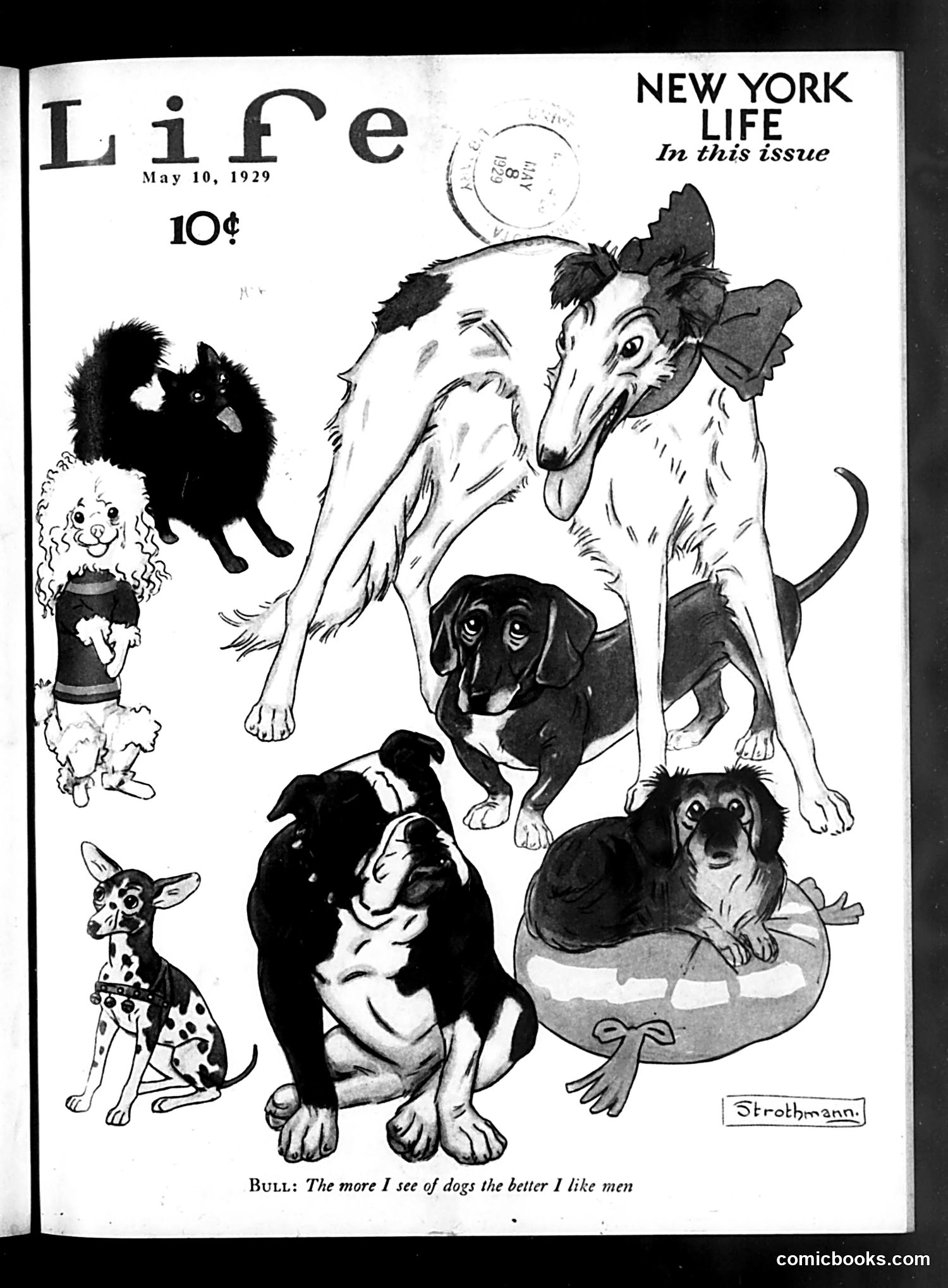
This cover illustration by Strothmann depicts various dogs with the caption: "BULL: The more I see of dogs the better I like men." The cartoon is a misanthropic joke inverting the common saying "the more I see of men, the better I like dogs." Various dog breeds and sizes are shown—some groomed and dressed (one wearing a bow), others plain—suggesting that even diverse humanity pales in comparison to canine virtue. The humor relies on cynicism about human nature, a common satirical theme in 1920s publications. The artist presents dogs as superior to people in character and behavior, a gentle jab at contemporary society rather than commentary on specific events or figures. It's essentially a "dogs are better than humans" gag rendered in period cartoon style.
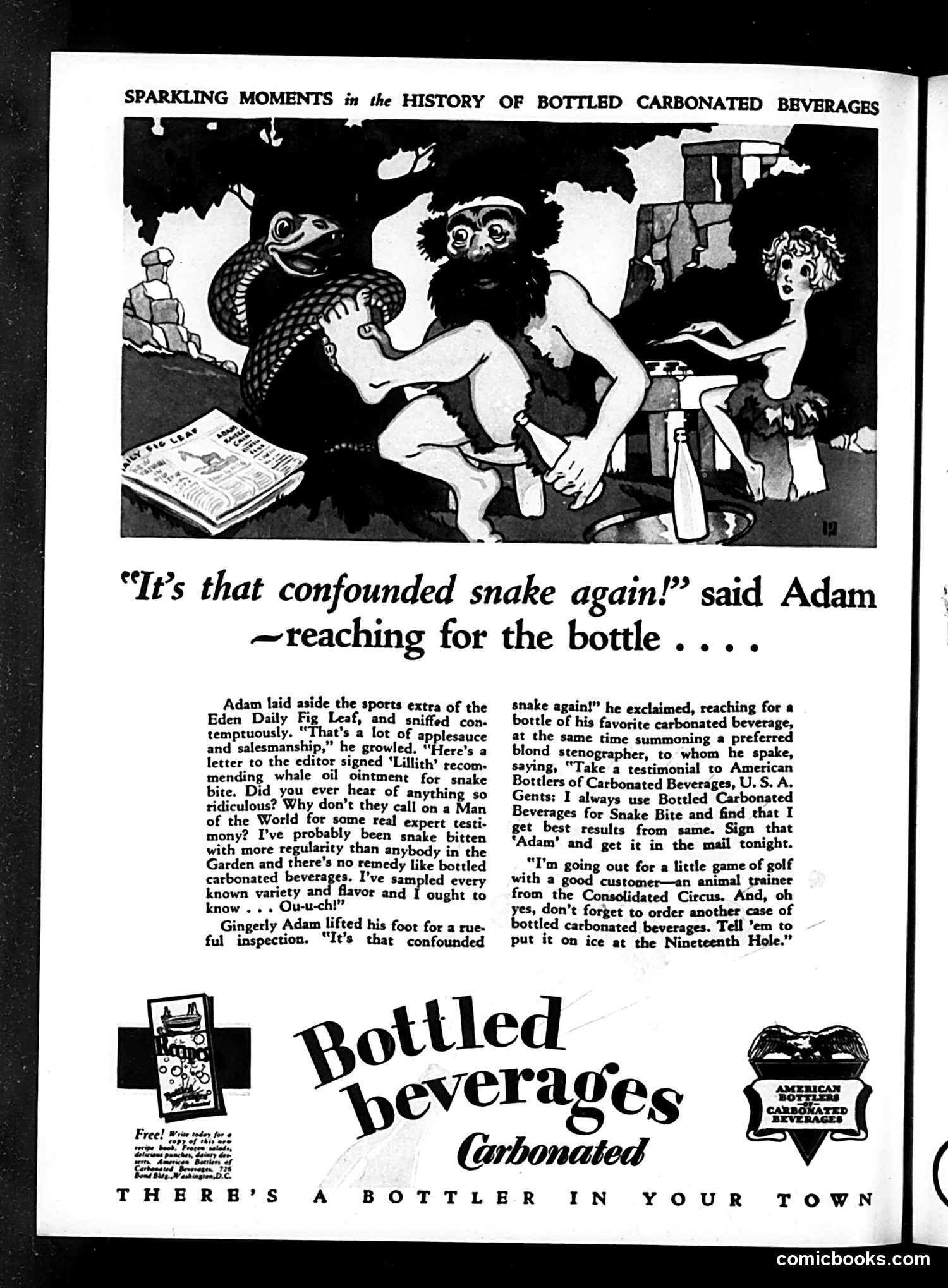
This is primarily an **advertisement for Bottled Carbonated Beverages**, not political satire. The page presents a humorous narrative featuring "Adam" (likely representing an everyman consumer) encountering various fantastical creatures—a snake, an owl, and other surreal figures. The joke centers on a snake causing trouble, prompting Adam to reach for a bottle of carbonated beverage as a solution or remedy. The accompanying text describes Adam's endorsement of the product, mentioning he uses it for "Snake Bite" and recommending it to others, including references to ordering more for social occasions. The carnival/circus atmosphere and whimsical characters create comedic appeal designed to sell the product through humor rather than serious messaging. This appears to be mid-20th century advertising targeting general consumer appeal.
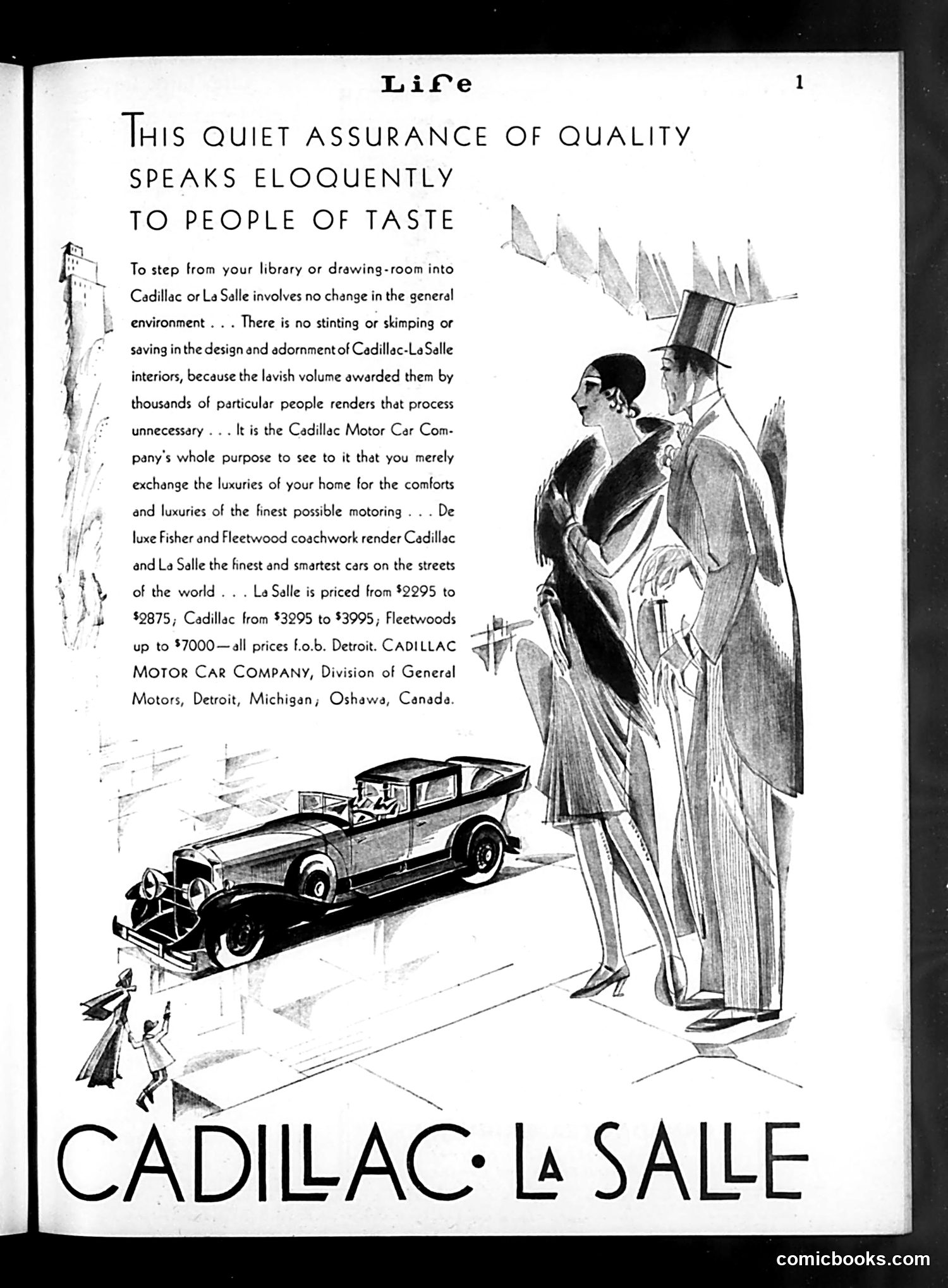
This is a luxury automobile advertisement, not political satire. The illustration depicts elegantly dressed figures of leisure examining a Cadillac-La Salle motorcar, emphasizing the vehicle's appeal to wealthy, tasteful consumers. The ad's central argument is that Cadillac and La Salle cars represent "quiet assurance of quality" for discerning people. It claims owners can seamlessly transition from refined home environments to equally luxurious automobiles without compromising comfort or status. The text lists pricing ($2,295-$7,000) and highlights superior coachwork by Fisher and Fleetwood. The illustration style and messaging reflect 1920s advertising conventions targeting the upper class—suggesting car ownership as a mark of sophisticated taste and social standing rather than mere transportation.
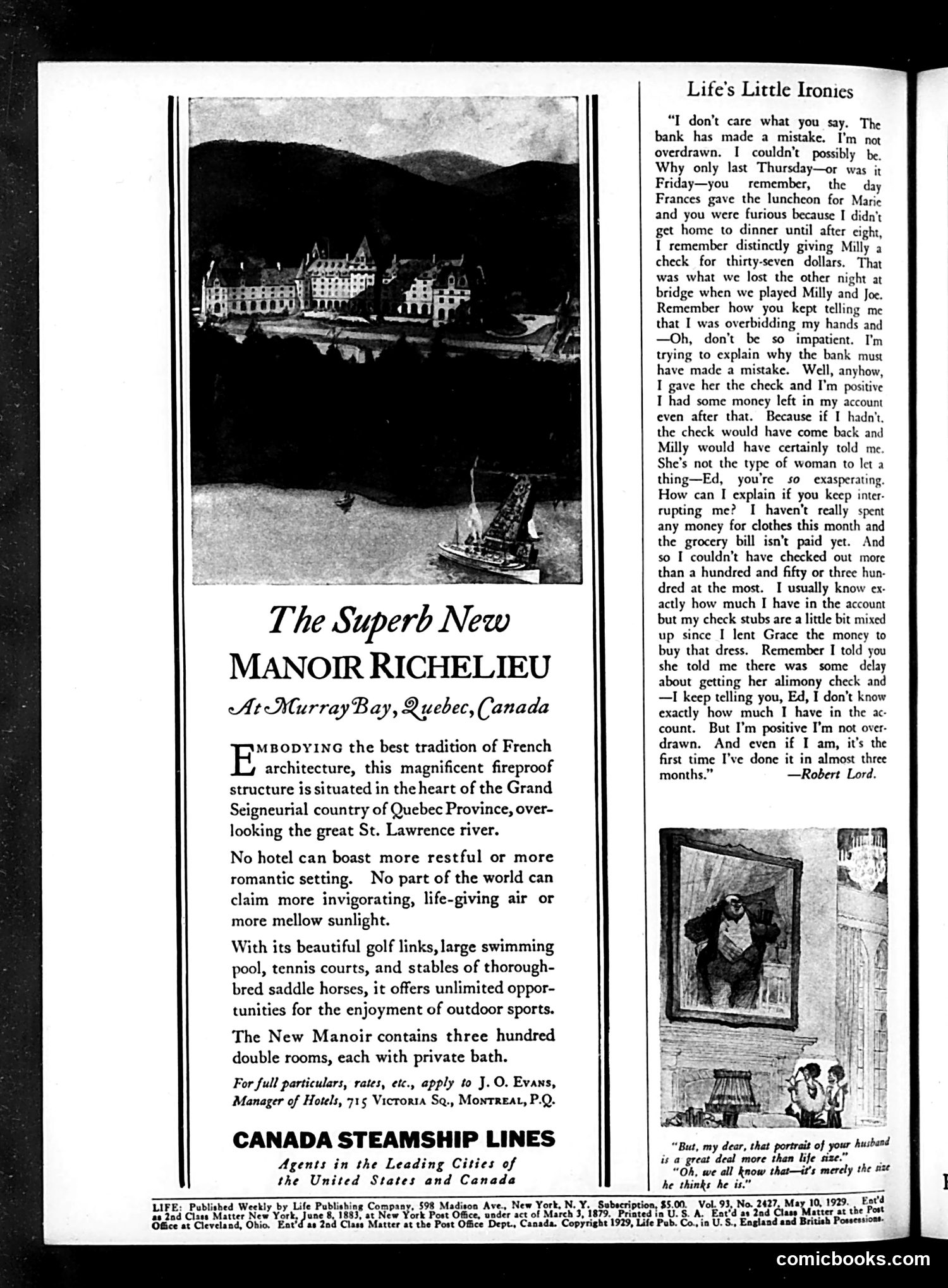
This page is primarily **advertising, not satire or political commentary**. The left side features a full advertisement for Manoir Richelieu, a luxury hotel at Murray Bay, Quebec, emphasizing French architecture, golf, swimming, and 300 guest rooms. The right side contains "Life's Little Ironies," a **humorous domestic anecdote** (attributed to Robert Lord) about marital finances. A wife defends herself against her husband Ed's accusation that she's overdrawn their bank account, detailing recent expenses and arguing she couldn't possibly be overdrawn. The accompanying illustration shows what appears to be a couple discussing household matters. This represents typical early-20th-century *Life* magazine content: advertisements mixed with light humor about middle-class domestic life, rather than political satire. The "irony" is the wife's defensive, detailed explanation of spending.
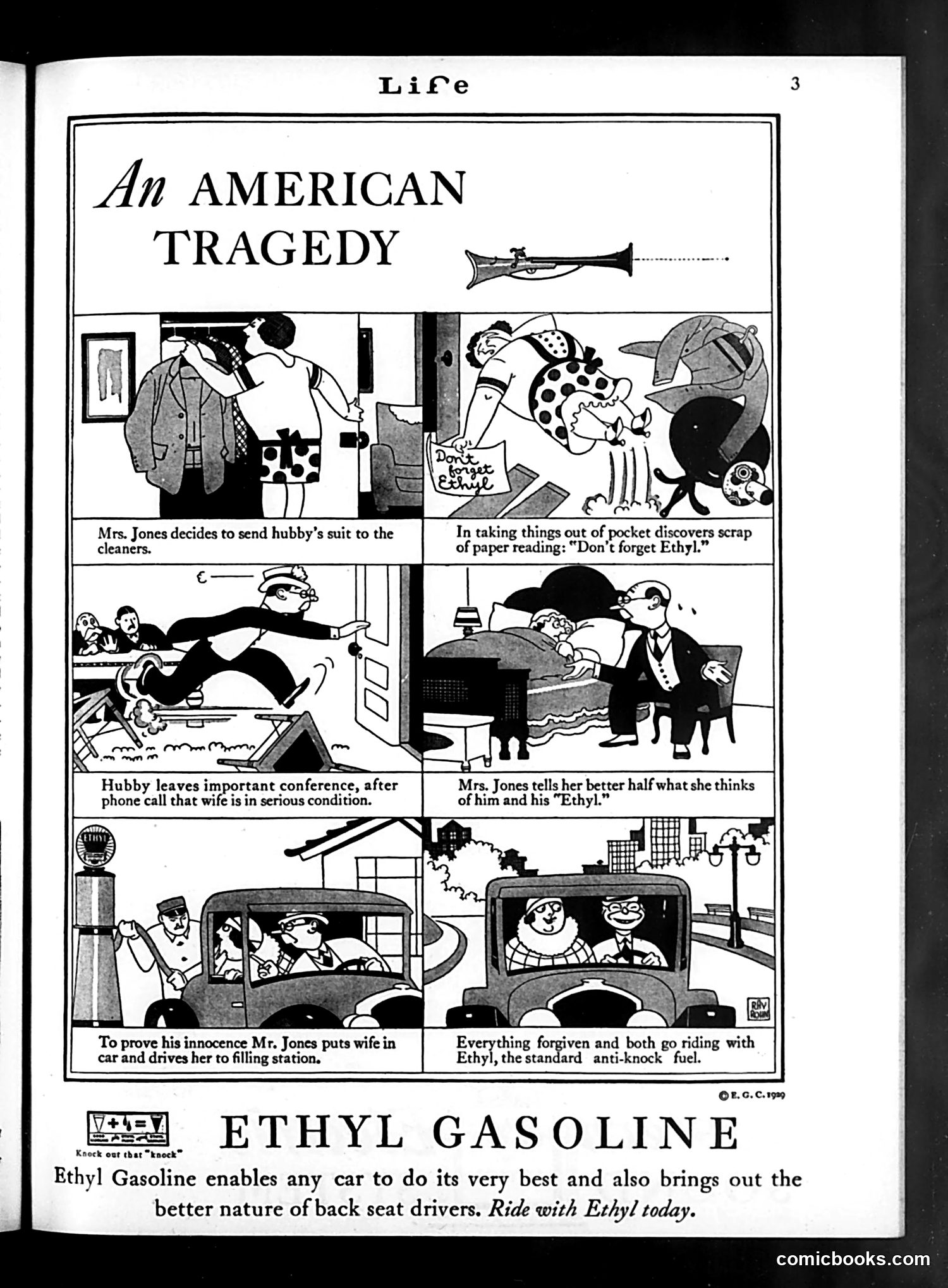
This is a satirical comic strip advertisement for Ethyl Gasoline, a brand that added tetraethyl lead to fuel. The "tragedy" follows Mr. Jones through a domestic crisis: his wife sends his suit to cleaners, discovers a scrap of paper with "Ethyl" written on it, assumes it's a woman's name, and tells him she thinks poorly of him and his mysterious "Ethyl." The husband rushes to an important business conference to prove his innocence, then takes his wife to a gas station where they discover "Ethyl" is merely the gasoline brand. The ad's joke: marital conflict resolved through the product itself. The satire mocks both domestic suspicion and aggressive advertising by treating a gasoline brand as worthy of causing serious relationship drama.
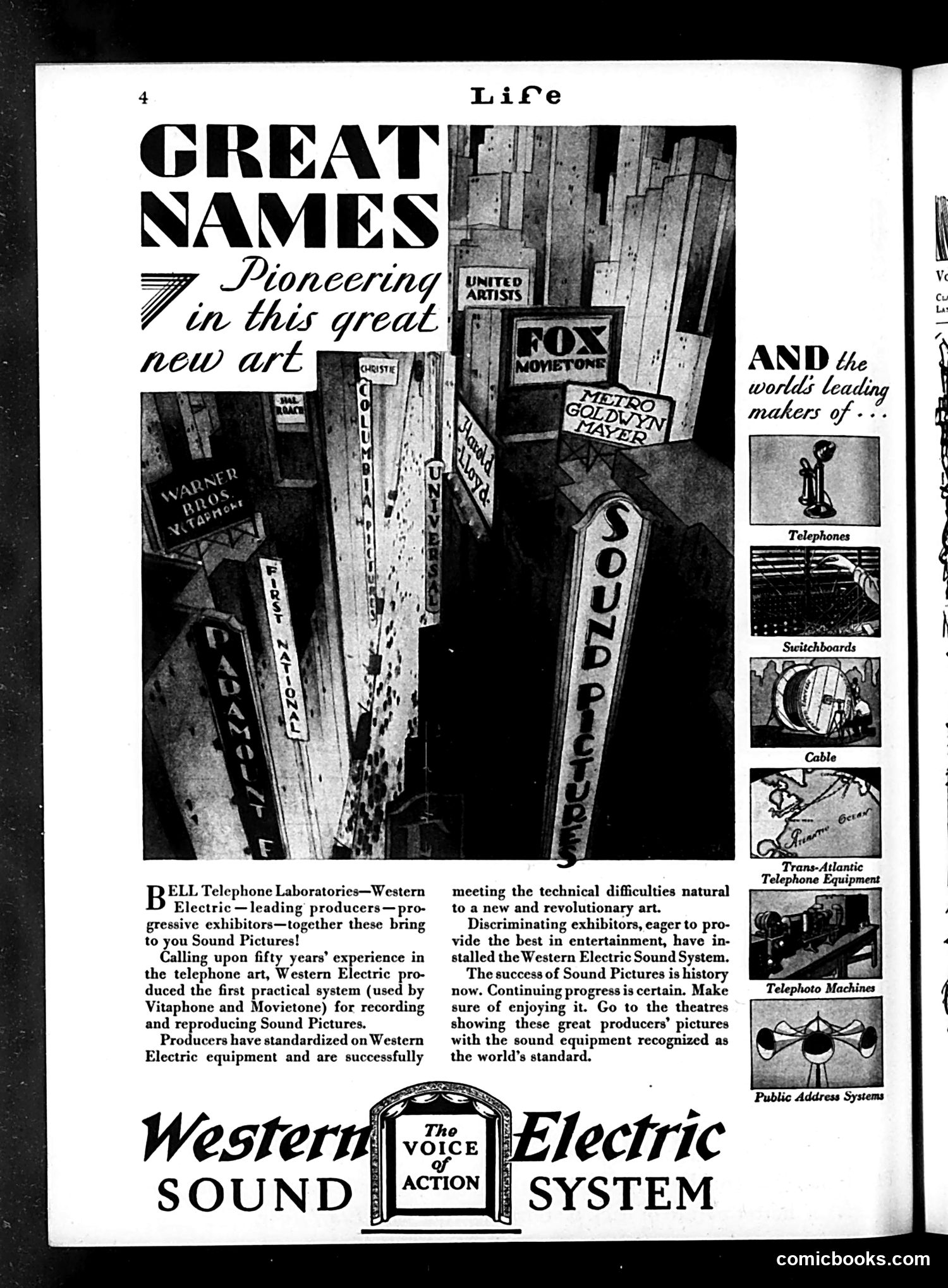
This page is **primarily an advertisement**, not satire or political commentary. It promotes Western Electric's Sound System, marketed as "The Voice of Action." The central image shows studio logos and signage (Warner Bros., Fox Movietone, United Artists, Metro-Goldwyn-Mayer), photographed at an angle to suggest the modern architecture of early sound-film studios. The headline "Great Names Pioneering in this great new art" references major film studios adopting Western Electric's synchronized sound technology for motion pictures—a recent innovation in the late 1920s. The right sidebar advertises Western Electric's broader product line: telephones, switchboards, cable, telegraph equipment, and public address systems. This is essentially a corporate advertisement celebrating the company's role in establishing synchronized sound in cinema.
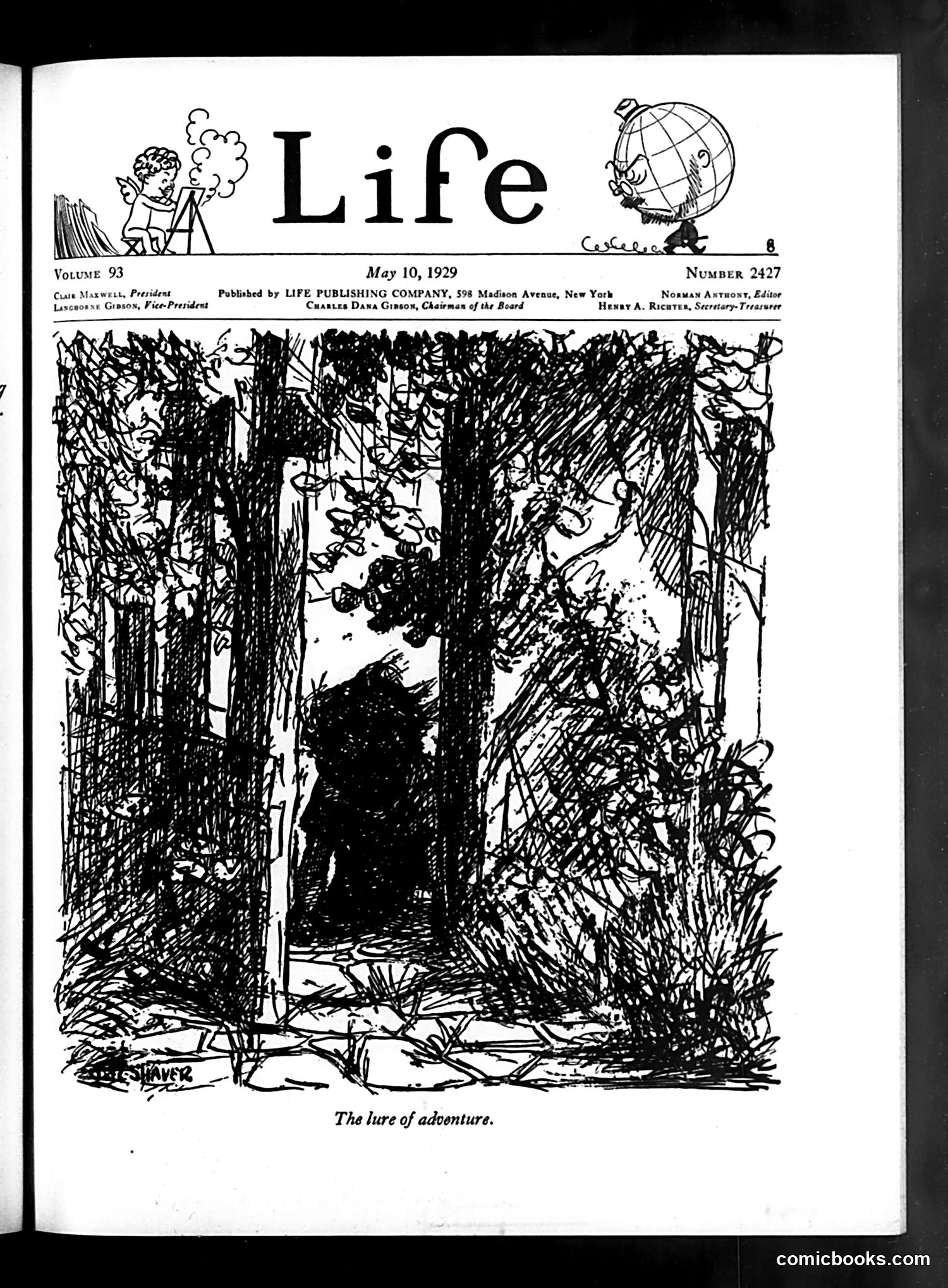
This is the cover of *Life* magazine from May 10, 1929—just months before the stock market crash. The illustration shows a dark, overgrown garden or forest path with tangled vegetation framing an open doorway or passage, captioned "The lure of adventure." The image appears to be a romantic or evocative illustration rather than political satire. It depicts adventure as an alluring but somewhat wild, untamed prospect—the dense foliage creating both mystery and danger. The drawing style is expressive ink work, signed (likely by the artist). Without additional interior content visible, the specific satirical point is unclear. However, the timing—just before the Great Depression—could suggest irony about adventure during economically optimistic times, though this remains speculative.
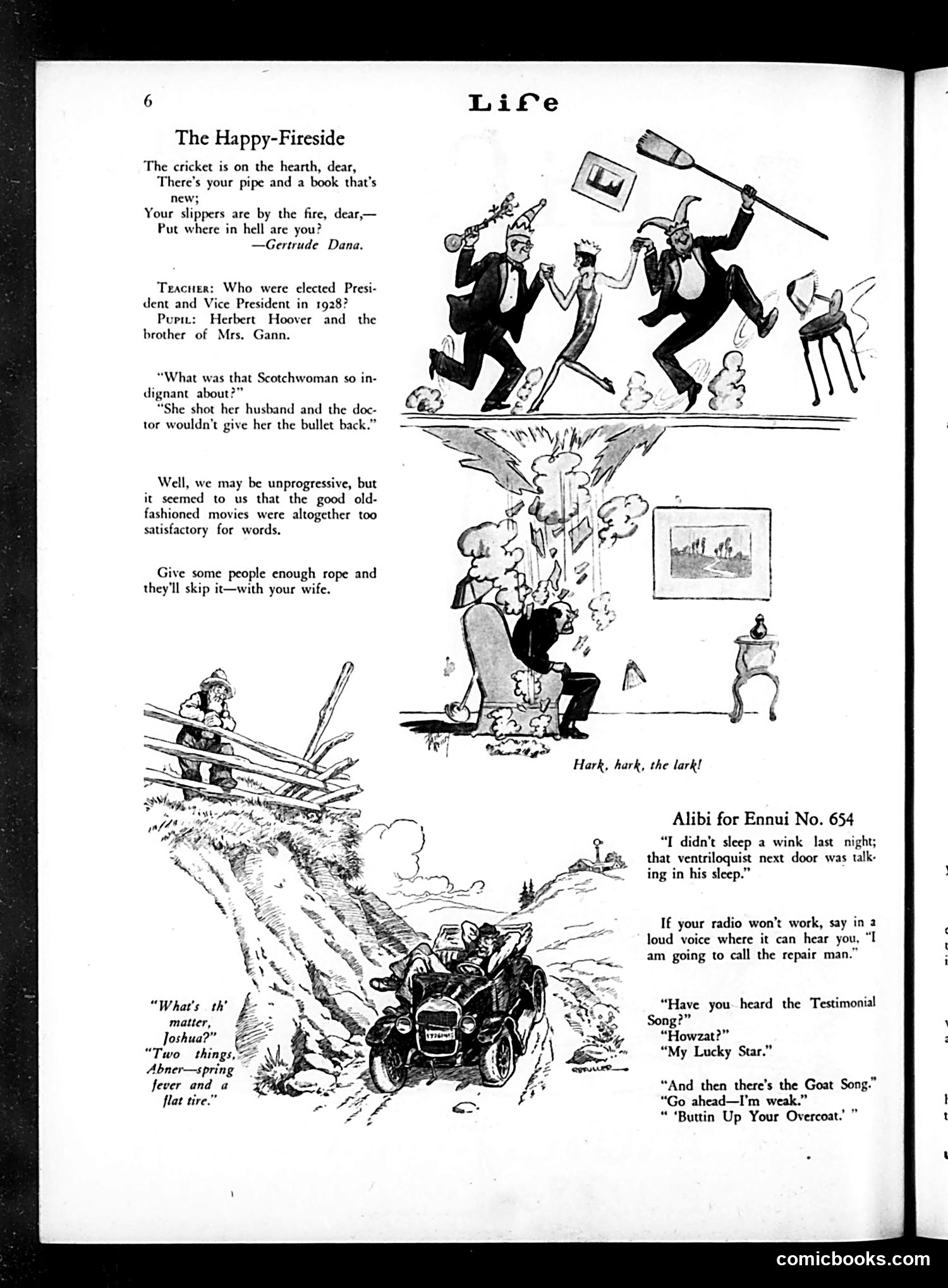
**"The Happy-Fireside" Section:** This page contains humorous quotations and anecdotes. The teacher-pupil exchange references the 1928 U.S. presidential election, mentioning Herbert Hoover and his brother-in-law as Vice Presidential candidates—likely satirizing either the candidates or election coverage. **Cartoon Illustrations:** The sketches depict domestic chaos: figures celebrating wildly by a fireplace, someone plummeting down stairs, and a car stuck in a ditch. These appear to illustrate the accompanying witticisms about marital discord and misadventure, typical of Life's satirical humor about American home life and relationships during this era. **"Alibi for Ennui No. 654":** Lists humorous excuses people use, including radio malfunctions and song parodies, reflecting popular entertainment references of the period.
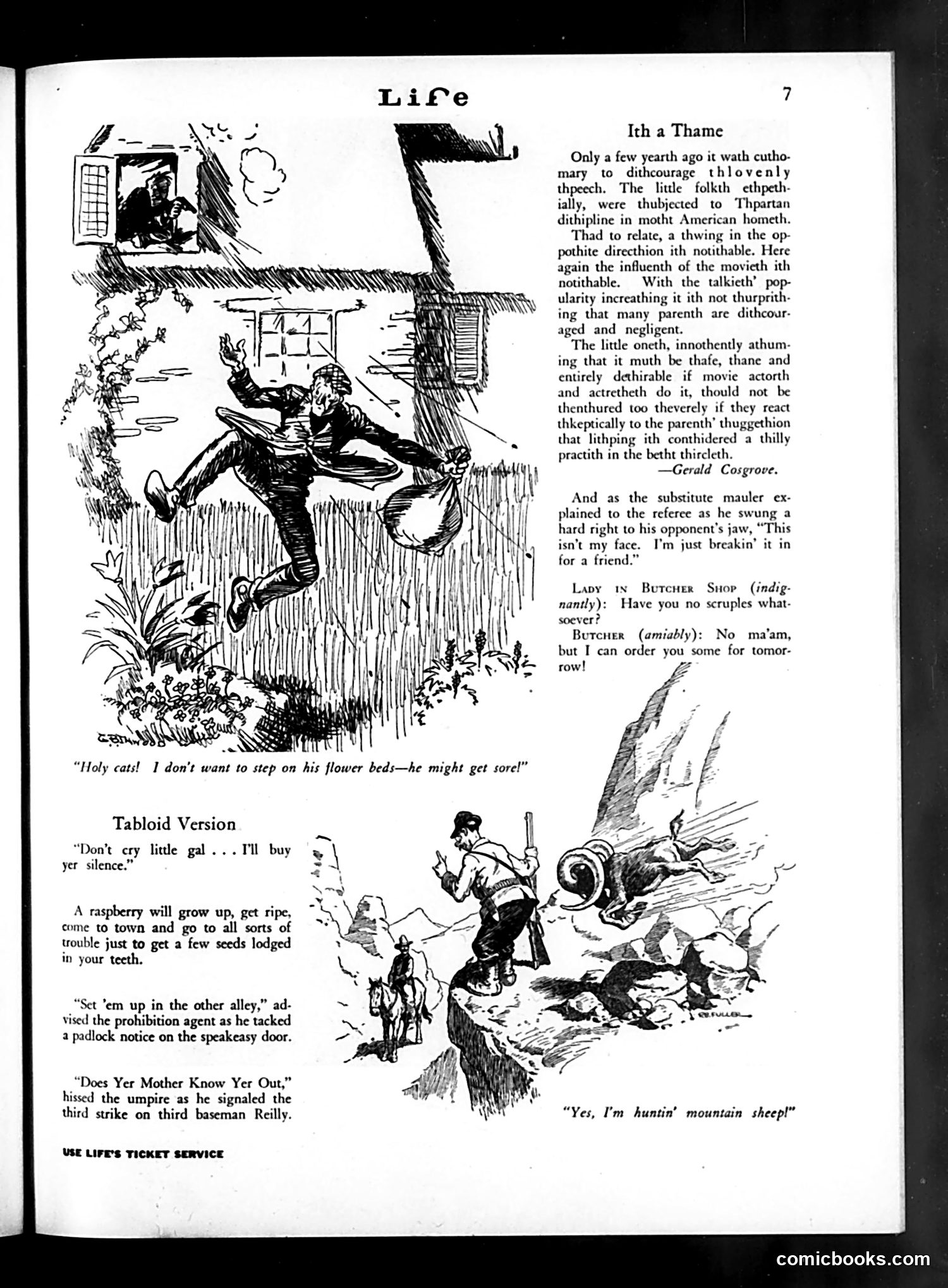
This page contains humorous short pieces and illustrations rather than political cartoons. **Top illustration**: Shows a man leaping away from a house, captioned "Holy cats! I don't want to step on his flower beds—he might get sore!" The joke satirizes suburban anxiety about damaging a neighbor's prized garden. **"Tabloid Version" section**: Parodies sensationalist tabloid journalism through exaggerated crime/scandal headlines, mocking the low-brow newspaper style popular in the era. **"Ith a Thames"**: A satirical essay criticizing thievery and movie morality—attacking both thieves and parents who neglect children, suggesting cinema may encourage bad behavior. **Bottom illustration**: Depicts a hunter declaring "Yes, I'm huntin' mountain sheep!" while riding what appears to be a comical animal—likely a joke about tall tales or dubious hunting claims.
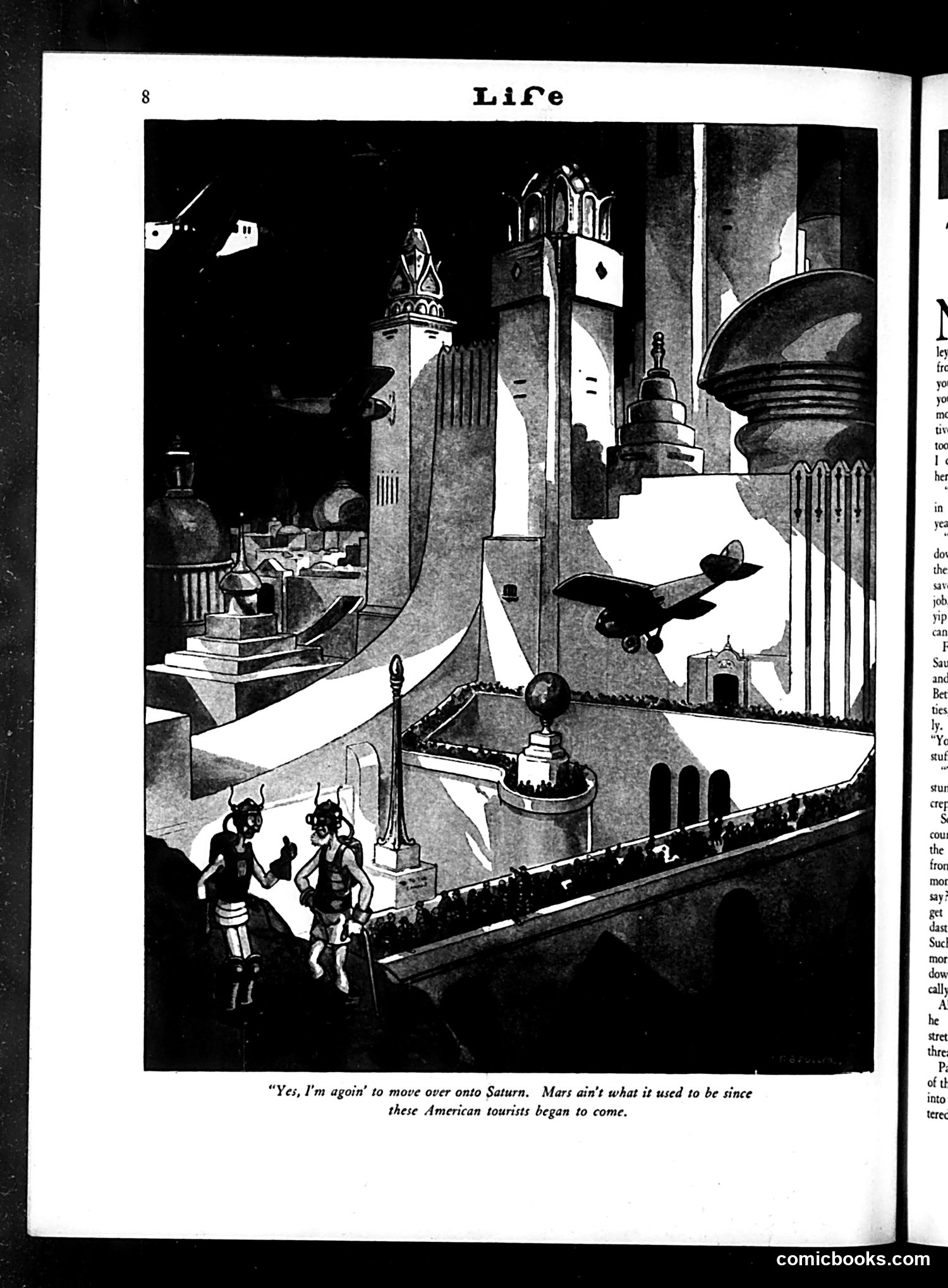
This futuristic science-fiction cartoon depicts two figures on Mars discussing tourism. One says: "Yea, I'm agoin' to move over onto Saturn. Mars ain't what it used to be since these American tourists began to come." **The Satire:** The joke satirizes American tourism culture by suggesting that even fictional alien planets have become overrun with American visitors, who apparently degrade the quality of wherever they go. The speaker, appearing to be a Martian resident, laments that Mars has lost its original character due to American tourist invasion—implying that American travelers were seen as loud, disruptive, or culturally insensitive enough to ruin even an imaginary destination. This reflects early-20th-century anxieties about American tourists abroad and their reputation for vulgarity or cultural obliviousness.
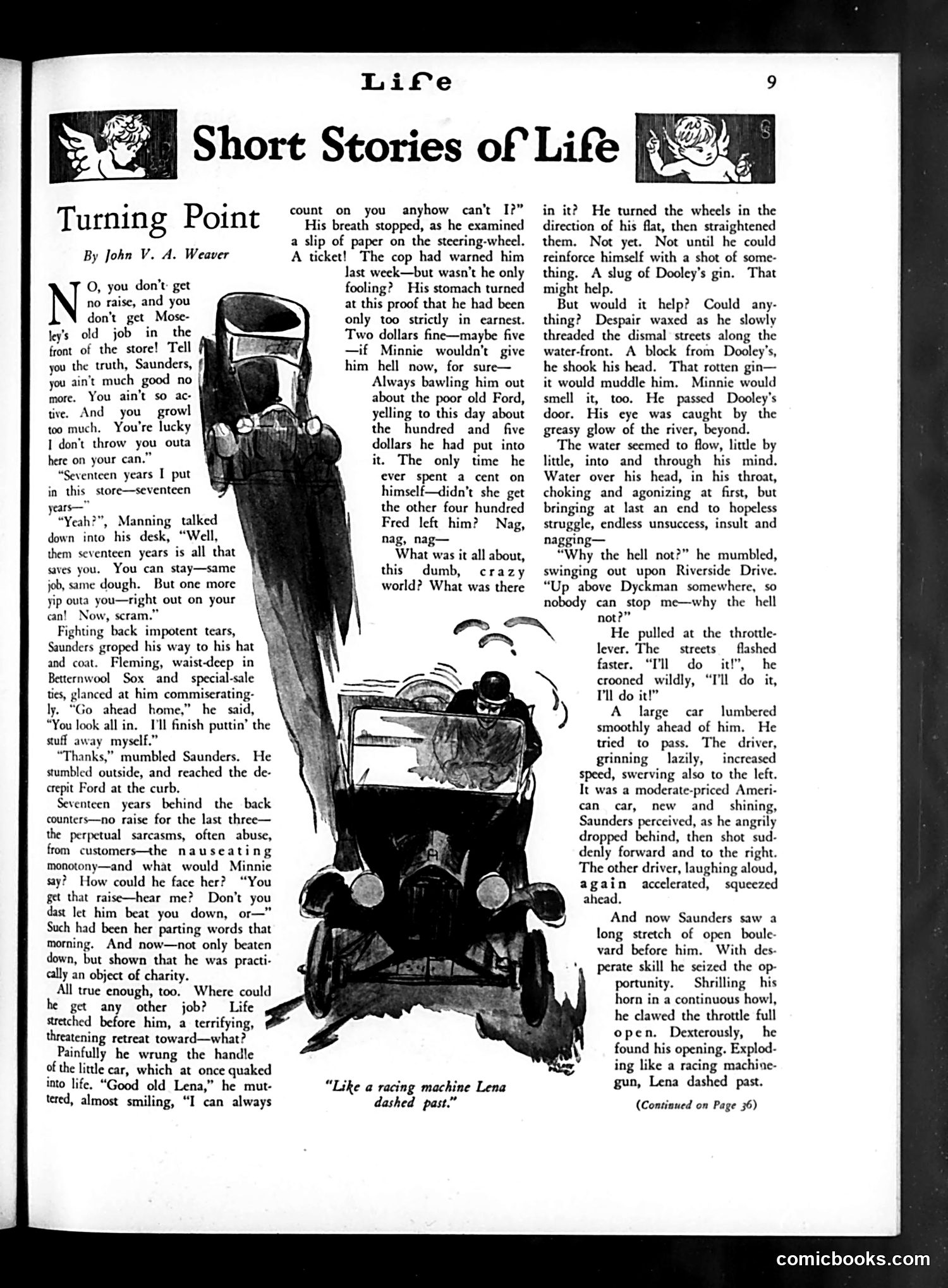
This is a short story (continued on page 36) about a man named Saunders who drives an old, unreliable Ford taxi. After seventeen years working the same job in a store, he's been fired by his boss Manning. Desperate and humiliated, Saunders drives recklessly through the city streets in his jalopy, contemplating suicide ("Why the hell not?"). The story's "turning point" comes when a newer, expensive car passes him aggressively. Rather than despair, this confrontation provokes Saunders to compete—he accelerates wildly, reclaiming a sense of agency and will to live through the driving challenge. The satire portrays how economic hardship and job loss can lead to desperation, while suggesting that even small moments of defiant action can restore human dignity and the will to survive.
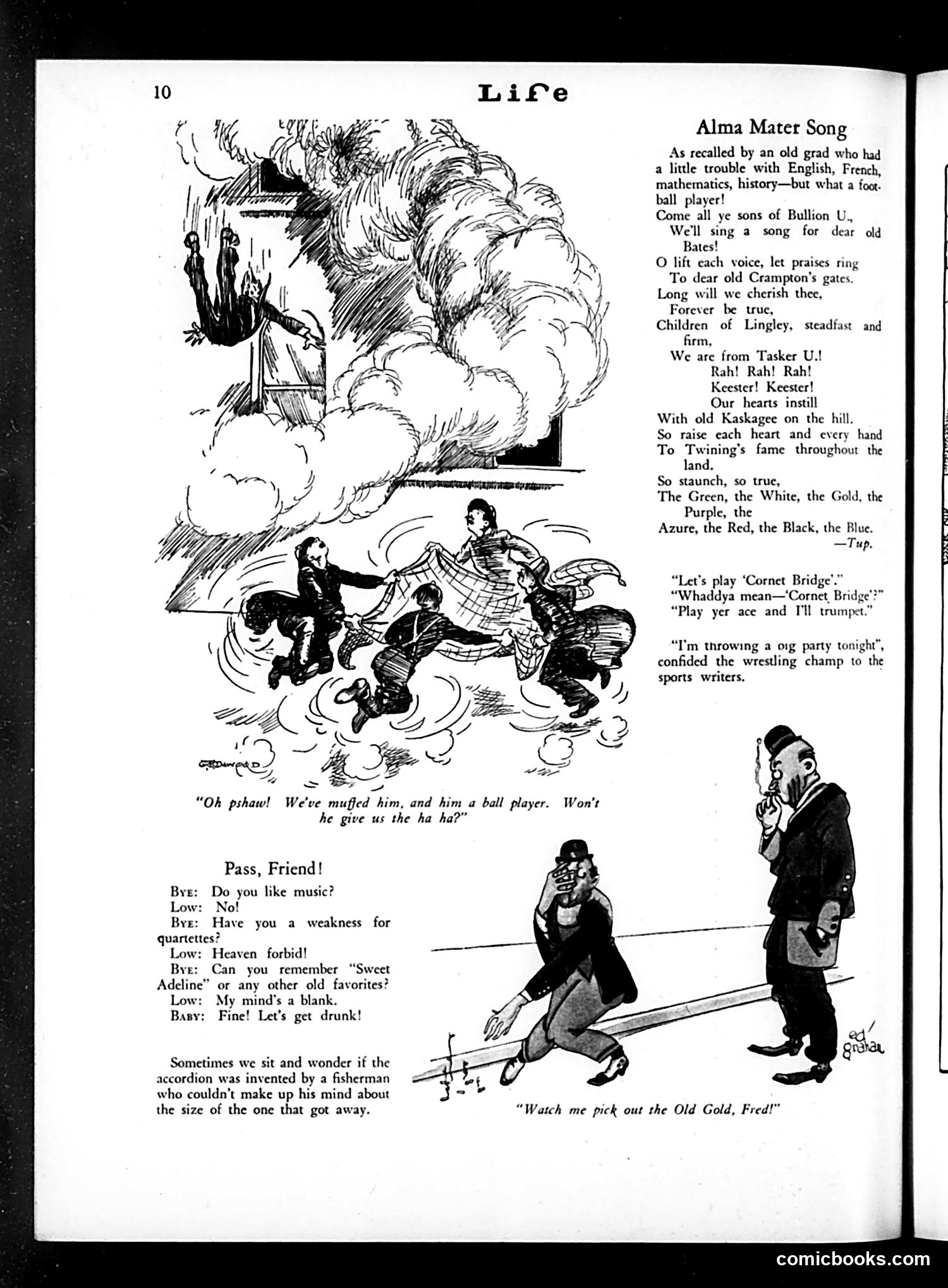
This page from *Life* magazine celebrates college culture, specifically an "Alma Mater Song" from Bullion U. (likely a fictional or generic reference). The content mixes nostalgia with gentle satire of collegiate traditions. The illustrations depict college life: students playing games, drinking, and socializing. The "Pass, Friend!" dialogue is a humorous drunk exchange questioning someone's musical taste and memory of old songs, culminating in "Let's get drunk!"—satirizing student revelry. The bottom cartoon shows two men with a fishing rod, one asking the other to "pick out the Old Gold, Fred!"—likely referencing Old Gold cigarettes, a popular brand of the era, inserted as a casual product mention. The overall tone is affectionate mockery of undergraduate excess and tradition, with vintage advertising integration typical of *Life*'s satirical style.
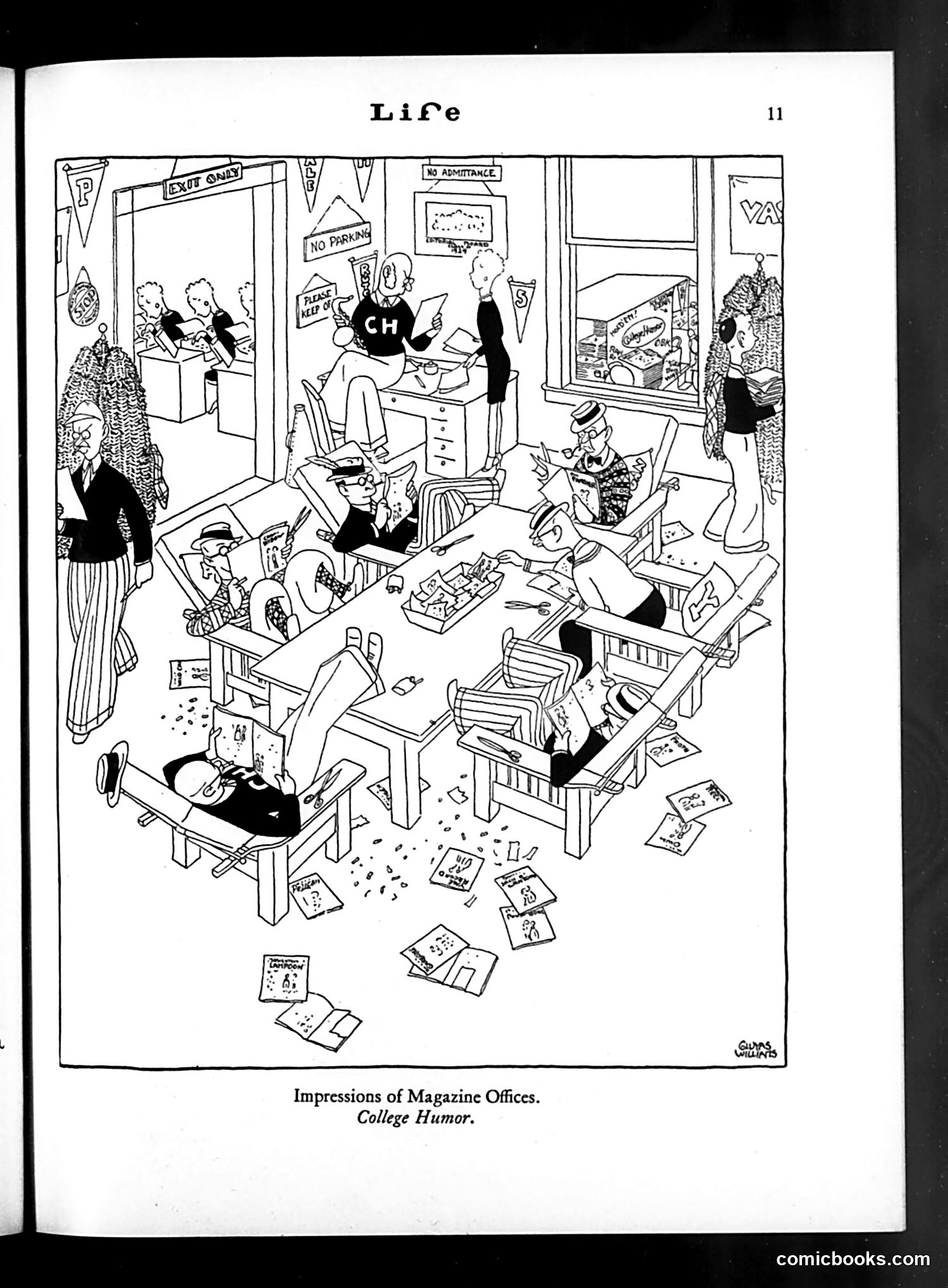
This cartoon satirizes the chaotic operations of magazine editorial offices, likely from the early 20th century. The scene depicts multiple staff members in various states of disarray: people slouching in chairs reading manuscripts, papers scattered across the floor, someone reclined casually, and office furniture in disarray. The "CH" figure at the desk appears to be an editor or manager trying to maintain order amid the mayhem. Signs reading "EXIT ONLY," "NO PARKING," and "NO ADMITTANCE" mock the professional pretenses of the operation. The satire suggests magazine offices were characterized by laziness, inefficiency, and unprofessional conduct despite their aspirations to respectability—a commentary on the gap between editorial ambitions and workplace reality in publishing.
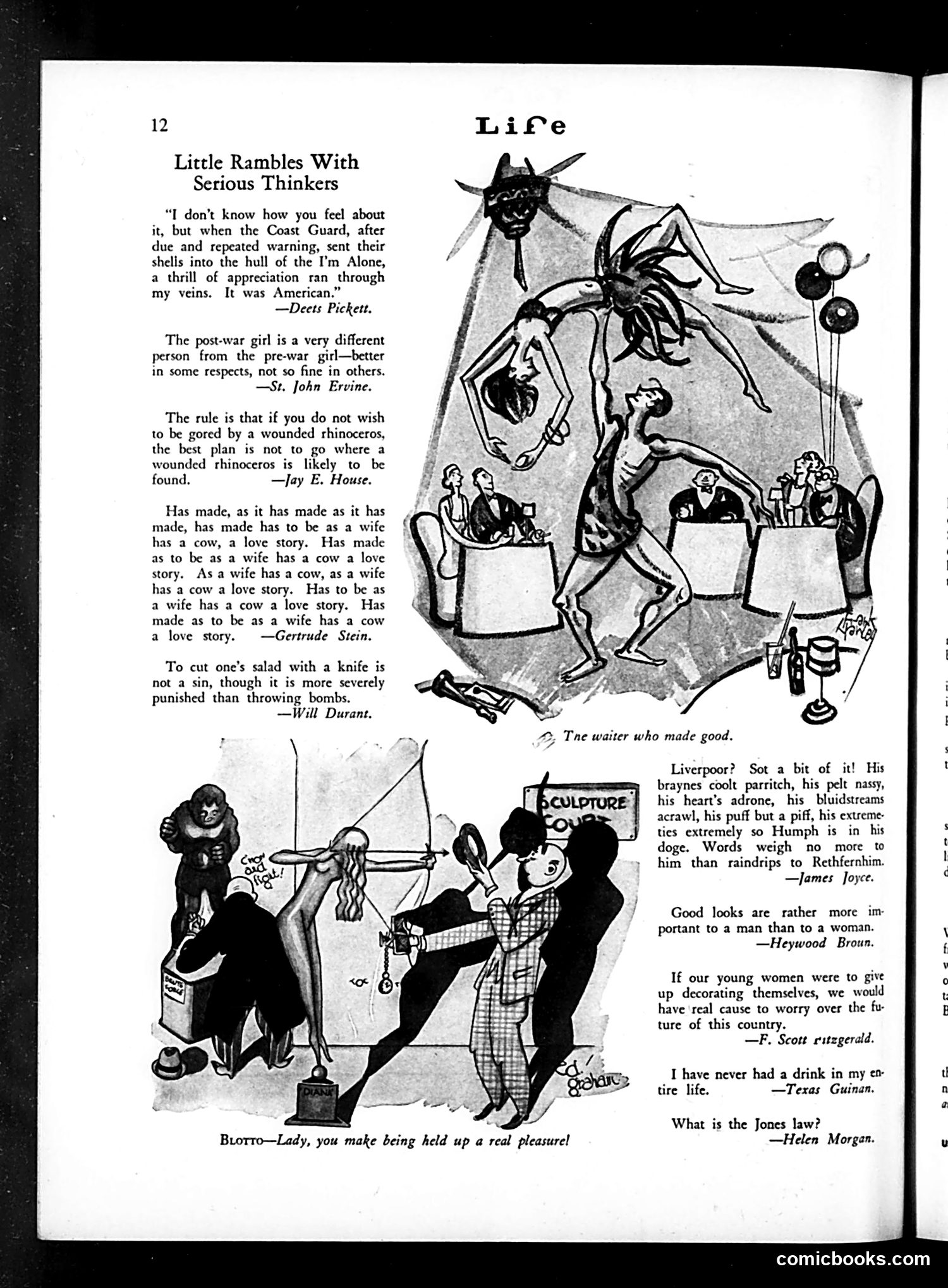
This page features "Little Rambles With Serious Thinkers"—a collection of witty quotations from notable figures, paired with satirical cartoons. **Top Cartoon:** Shows giant insects (a fly and spider) looming over a formal dinner party. The satire appears to mock social pretension—elegant diners remain oblivious to absurd danger, suggesting the upper class ignores obvious problems. **Bottom Cartoon:** Depicts an archer aiming at a sculpture labeled "SCULPTURE" while others pose nearby. The caption "Blotto—Lady, you make being held up a real pleasure!" suggests drunken behavior and questionable conduct at what appears to be an art exhibition, satirizing both artistic pretension and post-Prohibition drinking culture. Both cartoons use exaggeration to mock contemporary social behaviors and attitudes of the era.
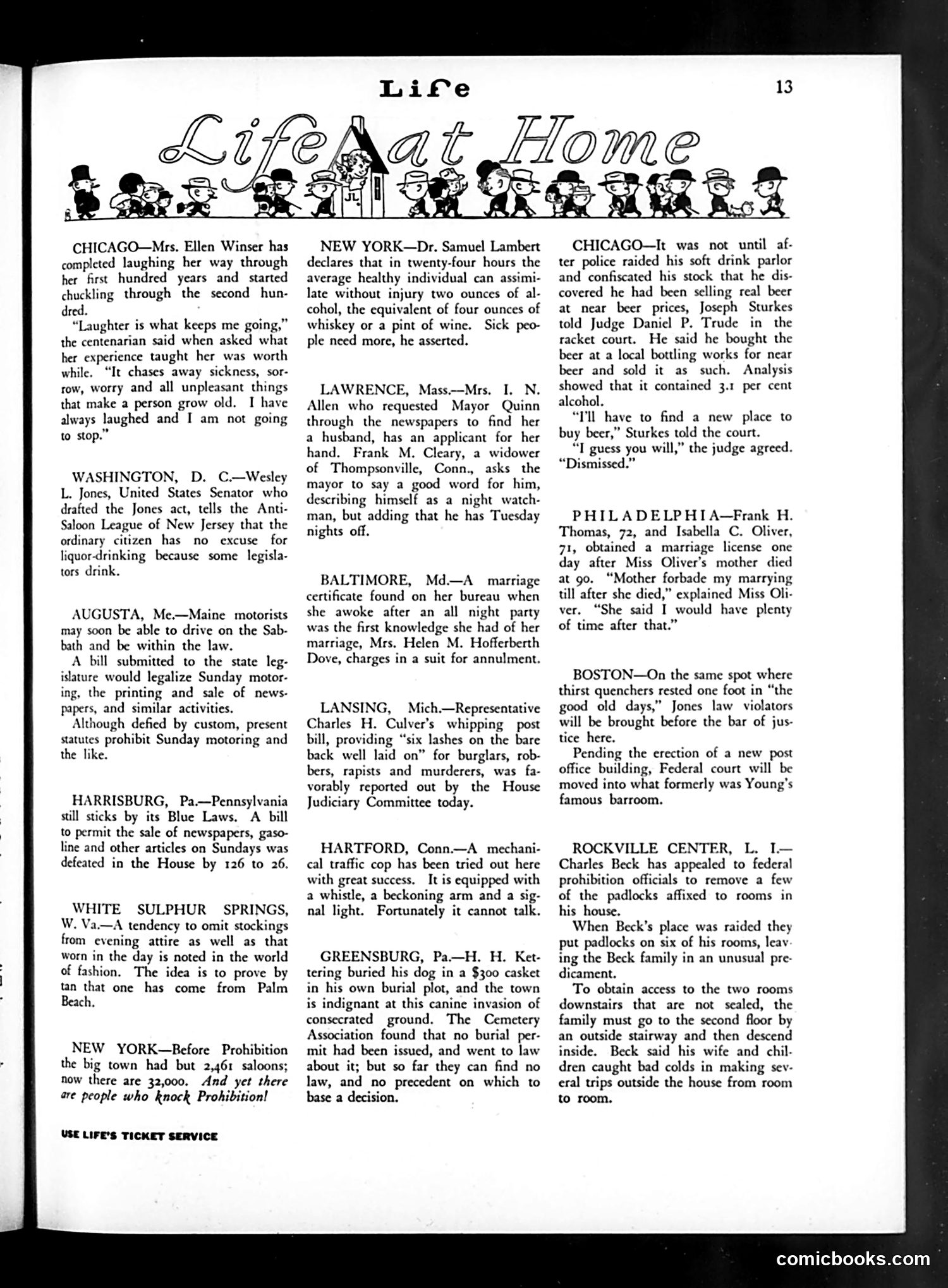
This page contains a humor column featuring brief anecdotes from various American cities. The decorative header shows silhouettes of people in 1920s attire, establishing the era. The content satirizes contemporary social issues, primarily **Prohibition**. Multiple items mock alcohol enforcement: a Chicago beer-selling case, a New York comparison of pre-Prohibition saloons to current numbers, and a Pennsylvania reference to "Blue Laws." Other items humorously address marriage, burial practices, and housing regulations. The final entry notes New York *previously* had 2,461 saloons but now has 33,000—with the pointed observation: "And yet there are people who knock Prohibition!" This reveals the magazine's skeptical, satirical stance toward Prohibition's effectiveness, suggesting the ban created more illegal drinking than it prevented. The humor is gentle social commentary typical of 1920s Life magazine.
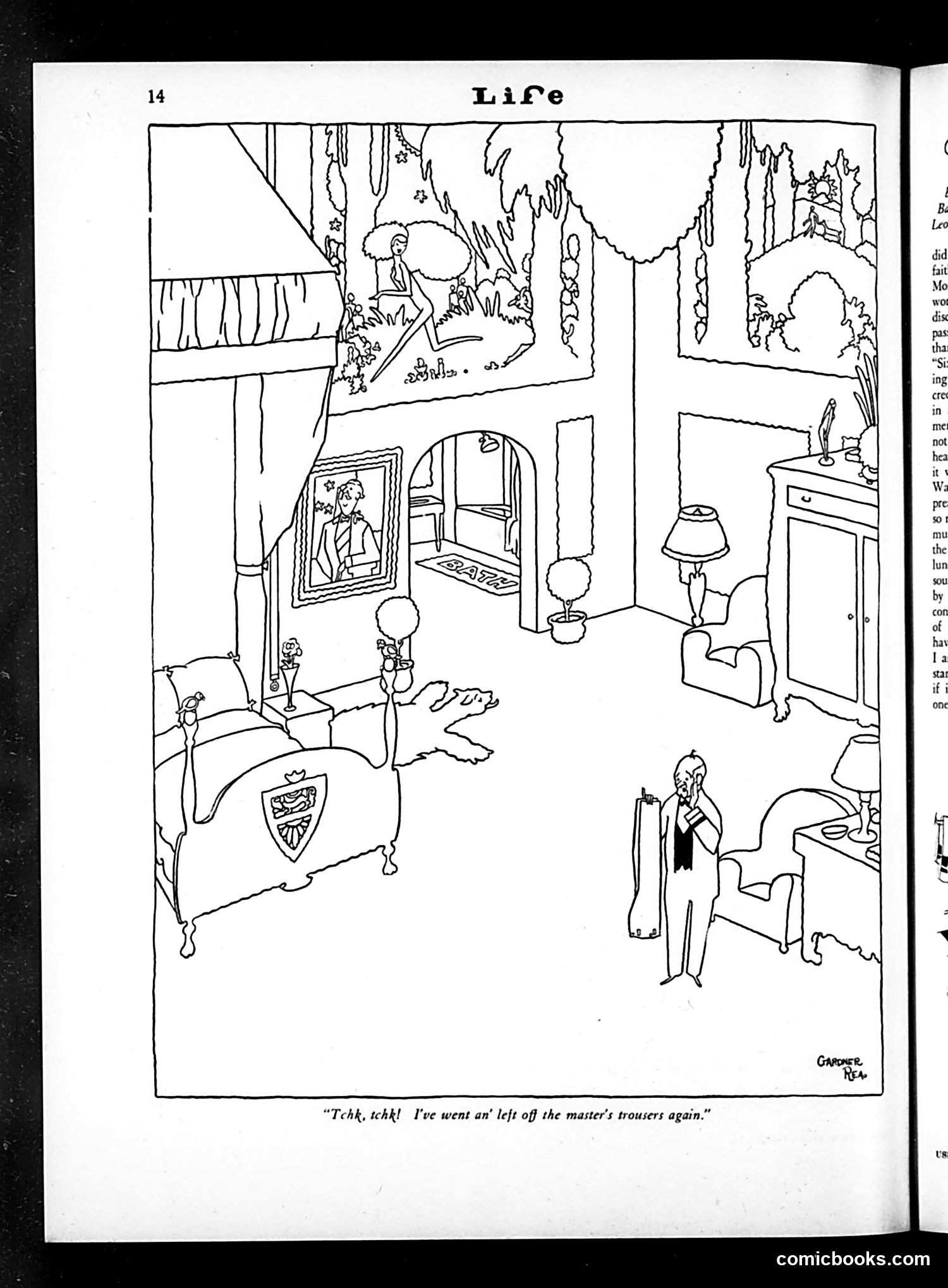
This cartoon depicts a domestic servant (likely a maid, given the historical context) explaining to their employer: "Tsk, tsk! I've went an' left off the master's trousers again." The humor relies on a class-based joke common to early 20th-century Life magazine: the comedic incompetence of working-class domestic help. The servant's malapropism ("I've went") reinforces the stereotype of uneducated lower-class workers. The embarrassing situation—repeatedly forgetting to launder the employer's trousers—plays on anxieties about trusting household servants with important tasks. The cartoon satirizes both the servant's incompetence and, implicitly, the employer's dependence on domestic labor. It's gentle workplace humor targeting servant stereotypes typical of the era's satirical publications.
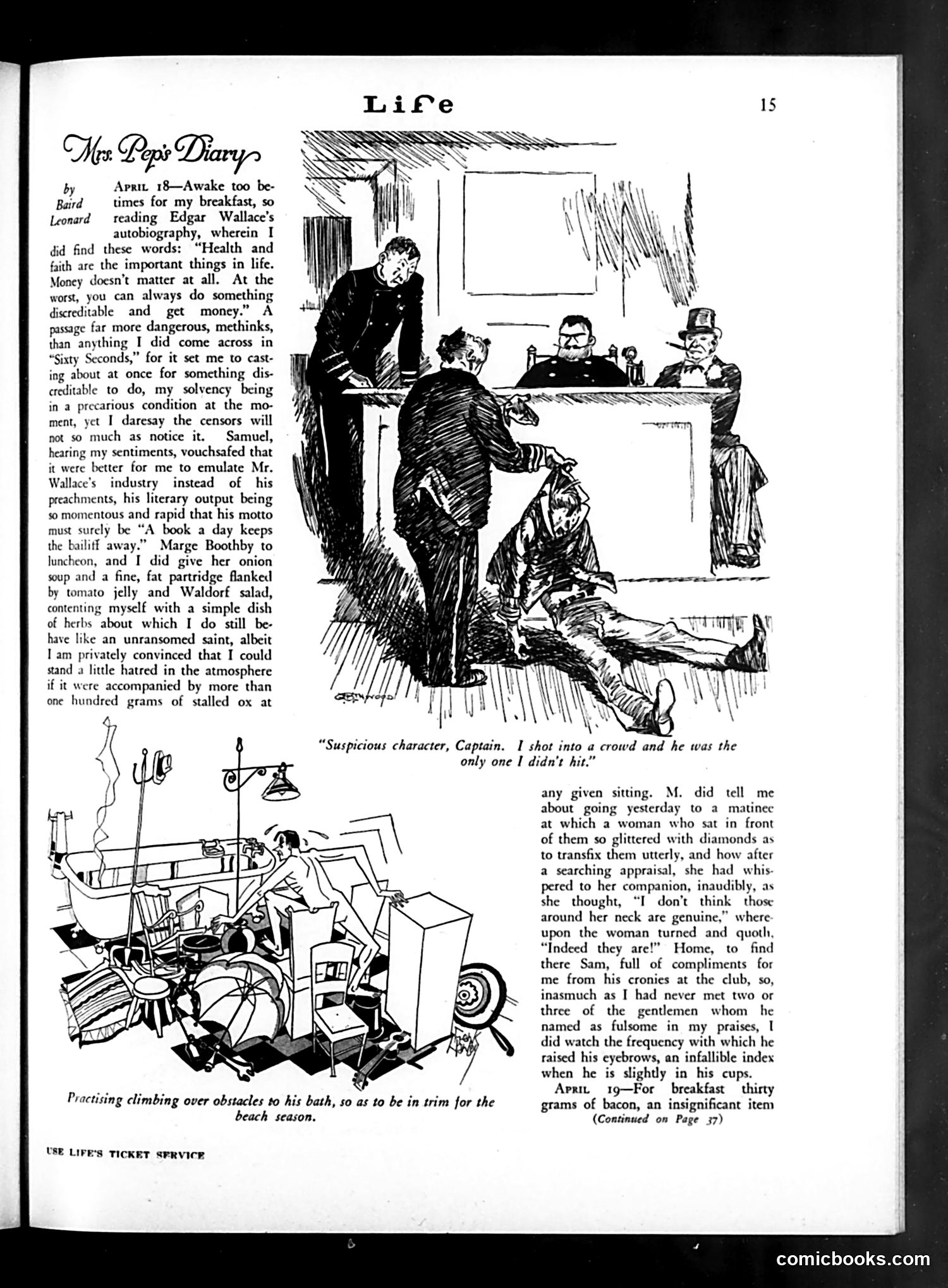
This page features **"The Pop's Diary"** by Baird Leonard, a serialized humor column appearing in *Life* magazine (dated April 18). The entry mocks the author's pretensions about reading Edgar Wallace's autobiography, which inspires reflections on wealth, respectability, and social climbing. The **upper illustration** depicts what appears to be a courtroom or formal interrogation scene, captioned with dialogue about shooting someone in a crowd. This satirizes dramatic crime fiction popular in the era. The **lower cartoon** shows an elaborate contraption of household items and obstacles, captioned about "practicing climbing over obstacles to his bath" for beach season—mocking obsessive physical fitness routines and vanity. Together, these mock early-20th-century middle-class aspirations toward literary sophistication and physical self-improvement.
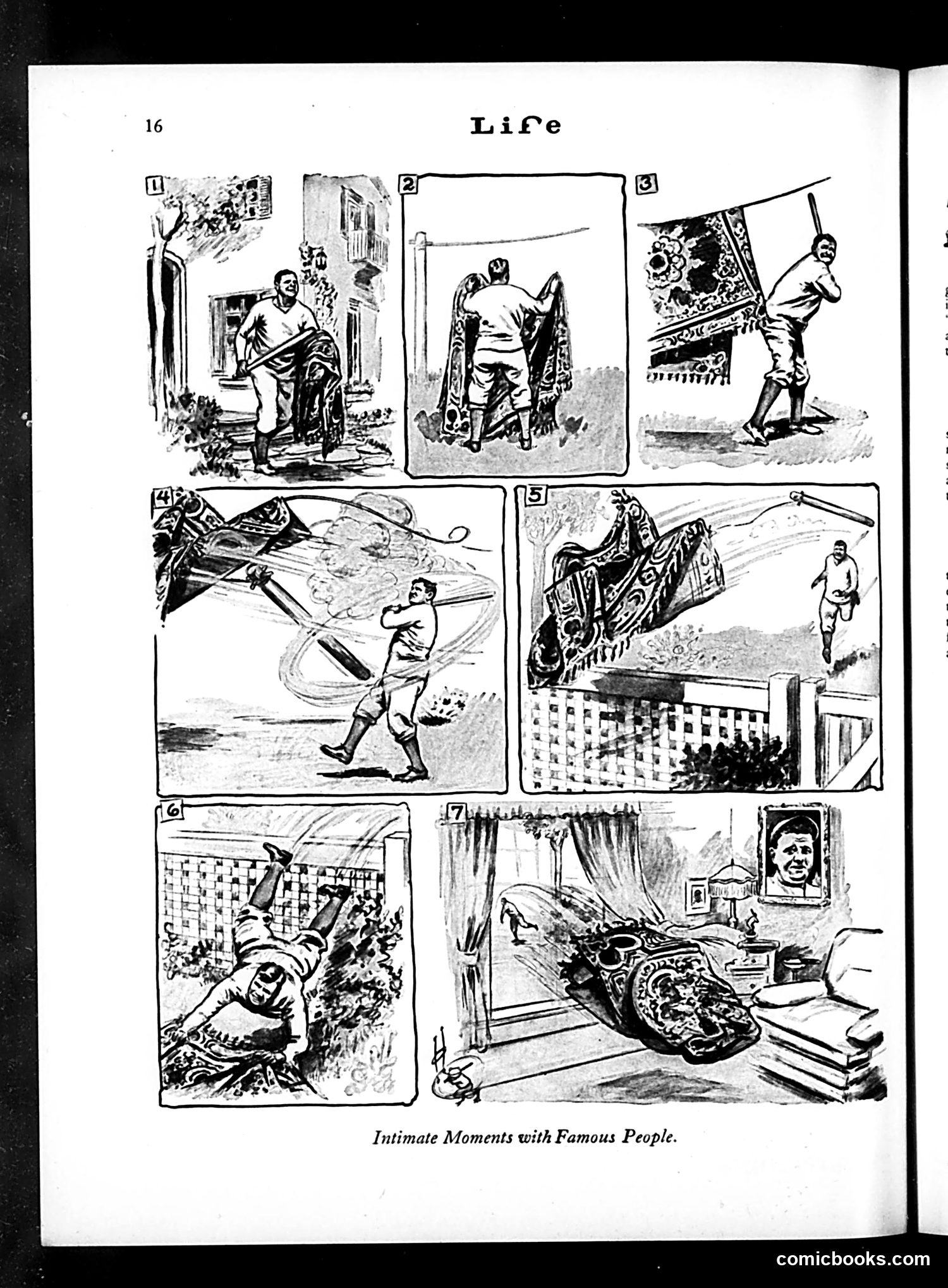
This page from *Life* magazine presents a seven-panel comic strip titled "Intimate Moments with Famous People." The subtitle indicates these are meant to be humorous glimpses into the private lives of celebrities or public figures. The panels depict various leisure activities: someone with a guitar, figures with decorative fabrics or carpets, kite-flying, cricket or similar sports, running, what appears to be someone reclining outdoors, and finally an indoor domestic scene with books and portraits. Without identifying specific individuals, the satire appears to mock the gap between public personas and private conduct of famous people—suggesting their "intimate moments" are mundane, undignified, or contradict their public images. The humor relies on readers recognizing who these figures represent, context now lost to modern audiences.
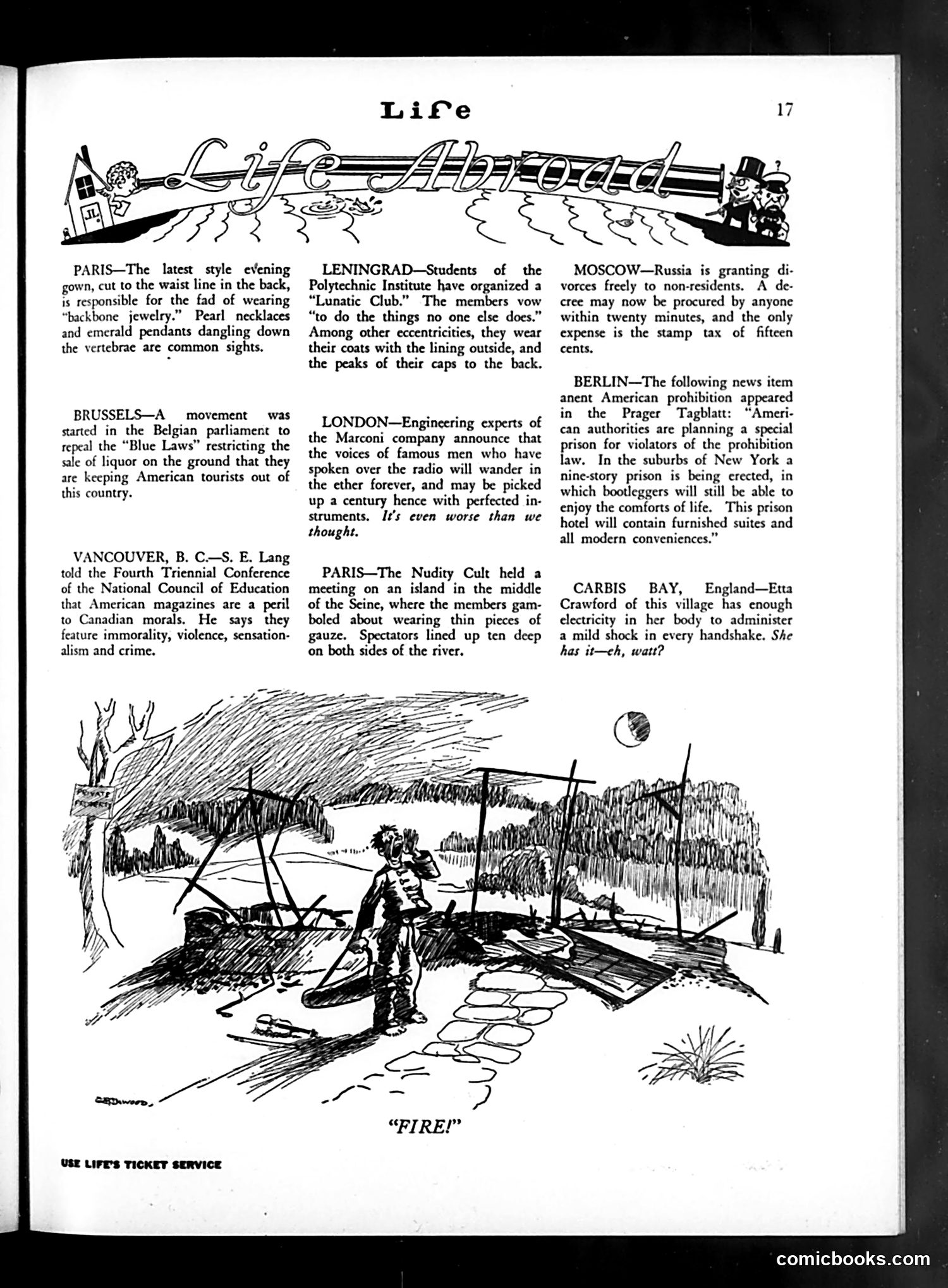
The cartoon depicts a soldier or military figure in a trench or fortified position, appearing to give a firing command. The sketch style and wartime setting suggest this is commentary on **military operations, likely from World War I era** (given Life's publication period and the trench warfare imagery). The single-word caption "FIRE!" creates dark humor through ambiguity—it could reference: - Actual combat orders - The absurdity/chaos of warfare - Military miscommunication The page's text snippets about international news (Paris fashion, Berlin prison construction, Russian divorces) are disconnected from the cartoon, suggesting this is a **satirical humor section** using juxtaposition. Without clearer context or dating information visible, the specific military/political situation referenced remains somewhat unclear, though the anti-war sentiment appears intentional.
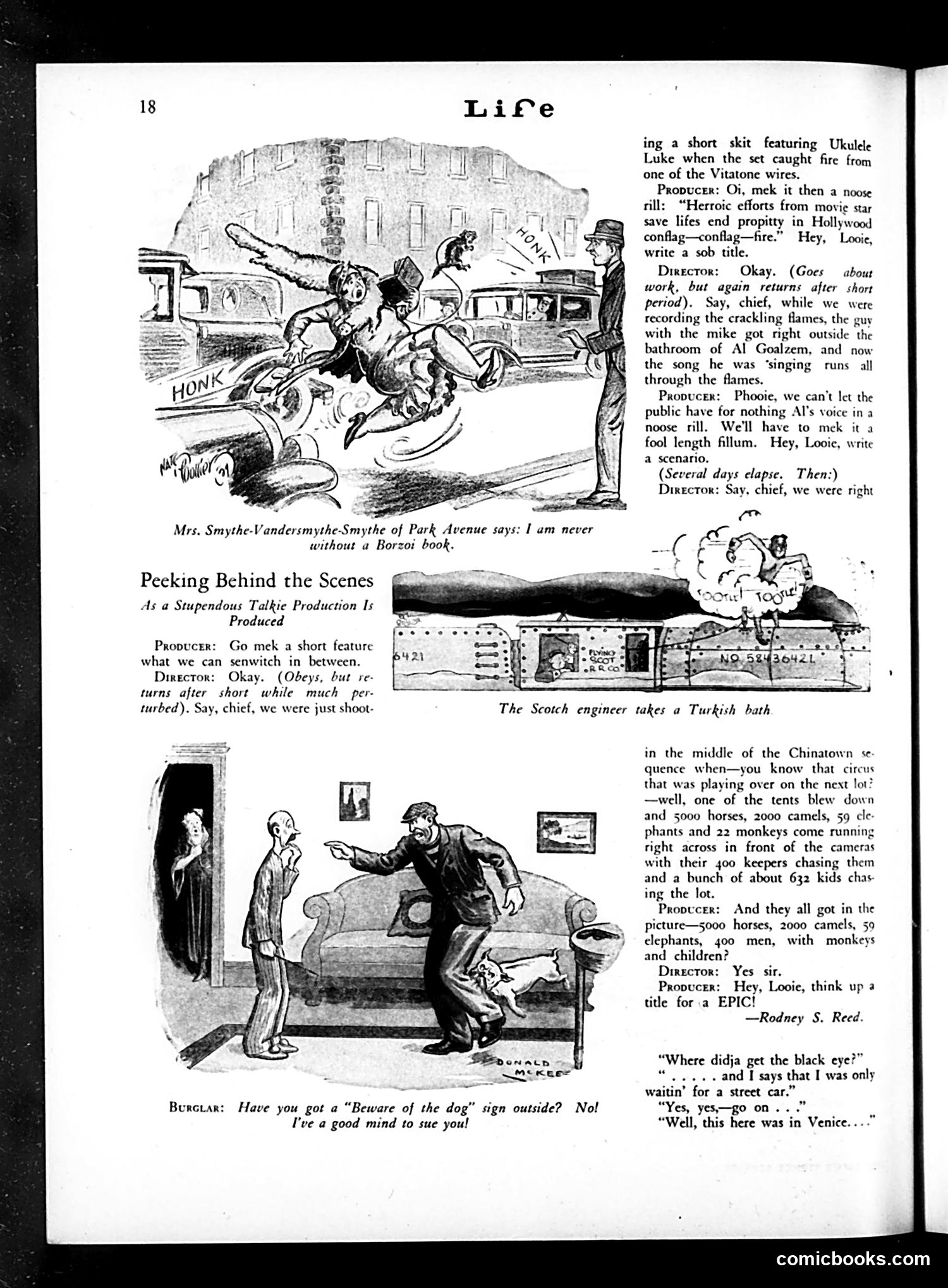
This page satirizes early Hollywood film production around the 1920s-30s. The top cartoon mocks a slapstick silent film scene where actors perform dangerous stunts (a car crash with "HONK" sound effect). The dialogue between Producer, Director, and others reveals the chaos of early talkies—the newly introduced sound films created technical nightmares, as the microphone placement interfered with action scenes. The middle cartoon, titled "Peeking Behind the Scenes," shows a burglar seeking a "Beware of the dog" sign, satirizing Hollywood's absurd production values and the gap between reality and cinematic illusion. The bottom illustration depicts a film director attempting to manage massive crowd scenes (5,000 horses, 2,000 camels, etc.), poking fun at studios' extravagant, logistically chaotic spectacle-driven filmmaking.
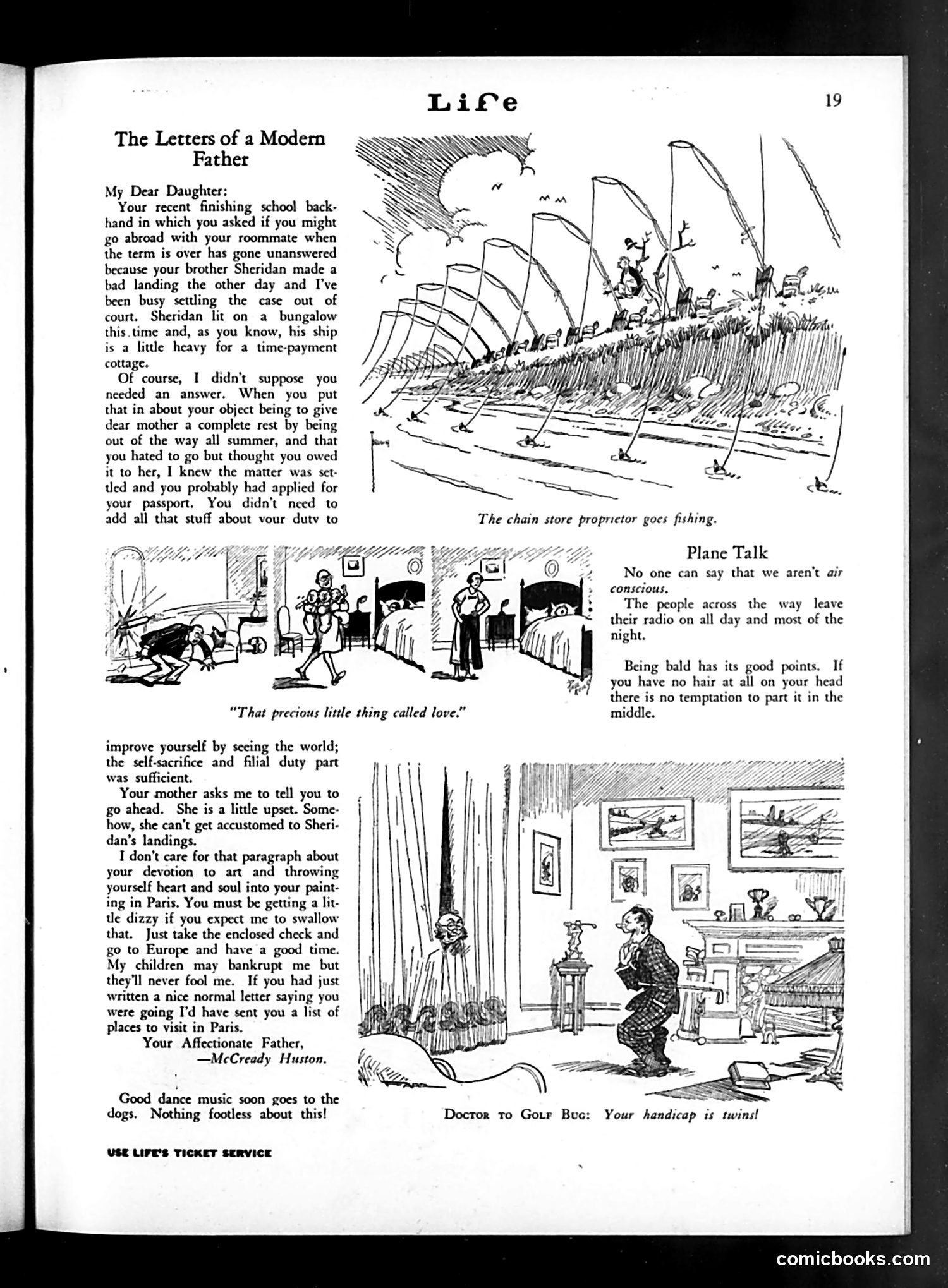
This page contains satirical commentary on 1920s American life, presented through three distinct pieces: **"The Letters of a Modern Father"** is a humorous letter from a father to his daughter. The satire targets wealthy, indulgent youth: the daughter asks to study art in Paris under the guise of self-improvement and filial duty, but her father sees through the transparent excuse. He's also dealing with his son Sheridan's reckless aviation crashes (crashing planes into bungalows repeatedly). The father's dry wit exposes how young people use noble-sounding justifications for frivolous travel while parents quietly fund their escapades. **"Plane Talk"** offers brief observational humor about airplane culture and baldness—references to 1920s fascination with aviation and cosmetic concerns. **The cartoons** illustrate everyday domestic and professional scenes with gentle mockery of modern life: a couple's argument over "that precious little thing called love," radio obsession, and a doctor-golfer joke. The overall theme: satirizing the wealthy leisure class, generational disconnect, and modern technological preoccupations of the era.
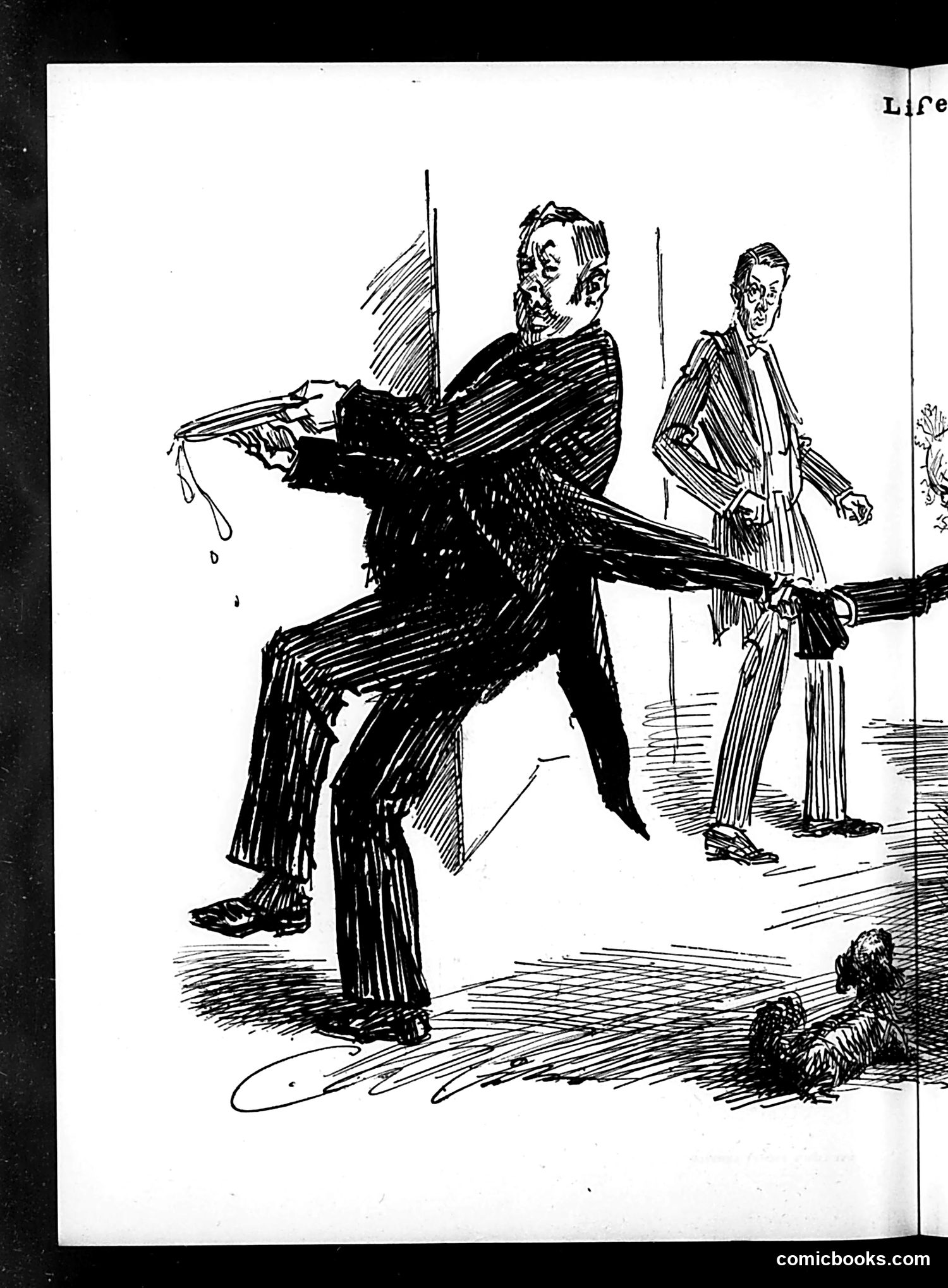
This is a satirical cartoon from *Life* magazine showing a man in formal attire performing an exaggerated, acrobatic pose—appearing to lose his balance or deliberately contorting himself—while holding what looks like a fishing rod or similar implement. Two other well-dressed men observe him with expressions of concern or amusement. Without additional text or caption visible on this page, the specific political or social target remains unclear. However, the cartoon likely satirizes either: - A public figure's attempts to maintain composure or credibility during scandal - Absurd political maneuvering or compromises - Someone trying to juggle contradictory positions The exaggerated body language and the observers' reactions suggest ridicule of undignified behavior by someone of apparent status. More context from surrounding page content would clarify the specific reference.
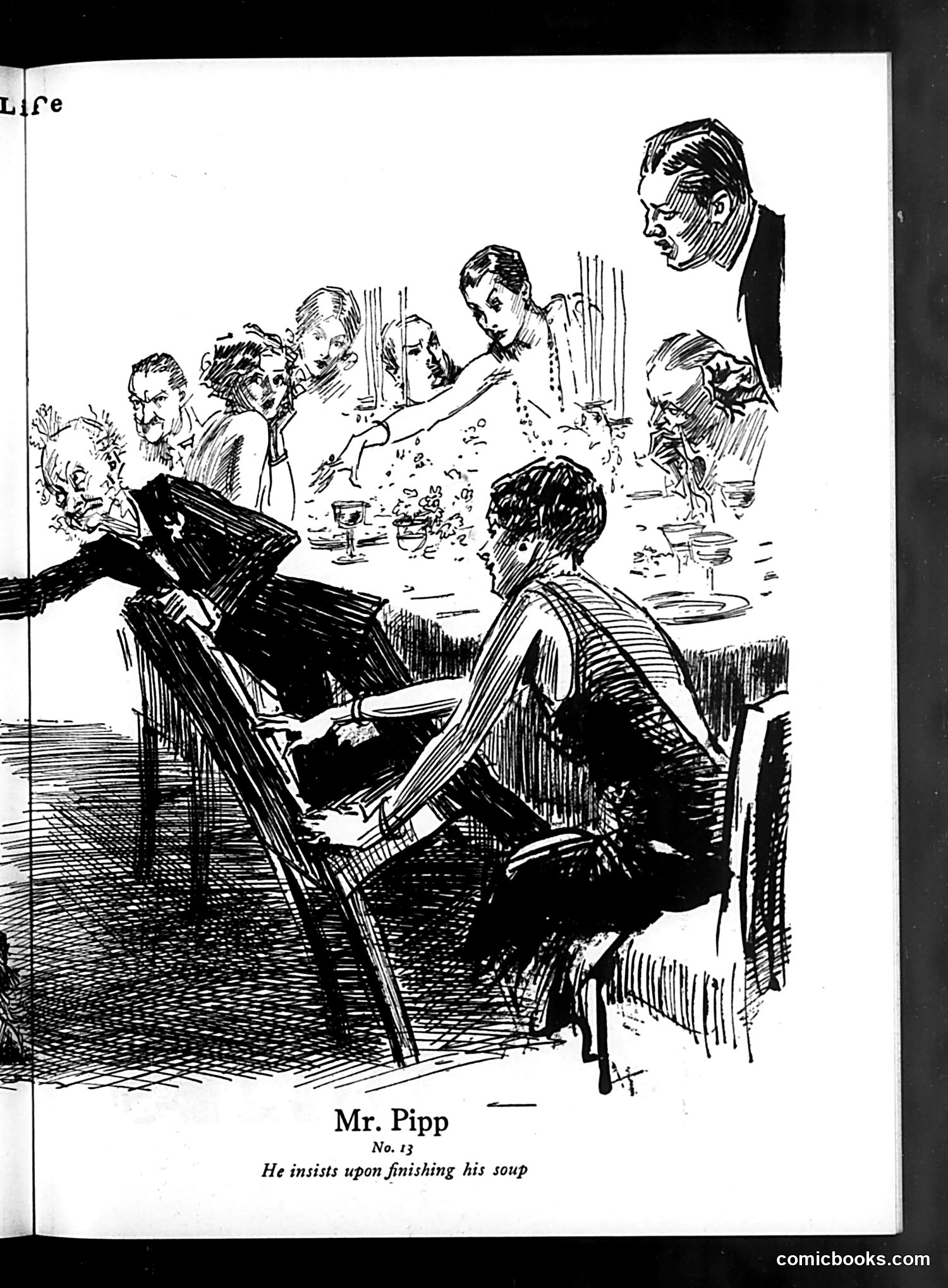
This cartoon depicts a dining scene where a man identified as "Mr. Pipp" sits at a table with other diners and servers. The caption states he "insists upon finishing his soup," suggesting the humor involves stubbornness or poor manners—perhaps he's consuming soup messily or taking excessive time while others wait, or he's socially inept in some way that creates awkwardness around the table. Without additional context about who "Mr. Pipp" is or what contemporary situation this references, the specific satirical target remains unclear. This appears to be part of a numbered series about this character. The cartoon likely mocks a particular recognizable public figure or social type of the era through this domestic scene.
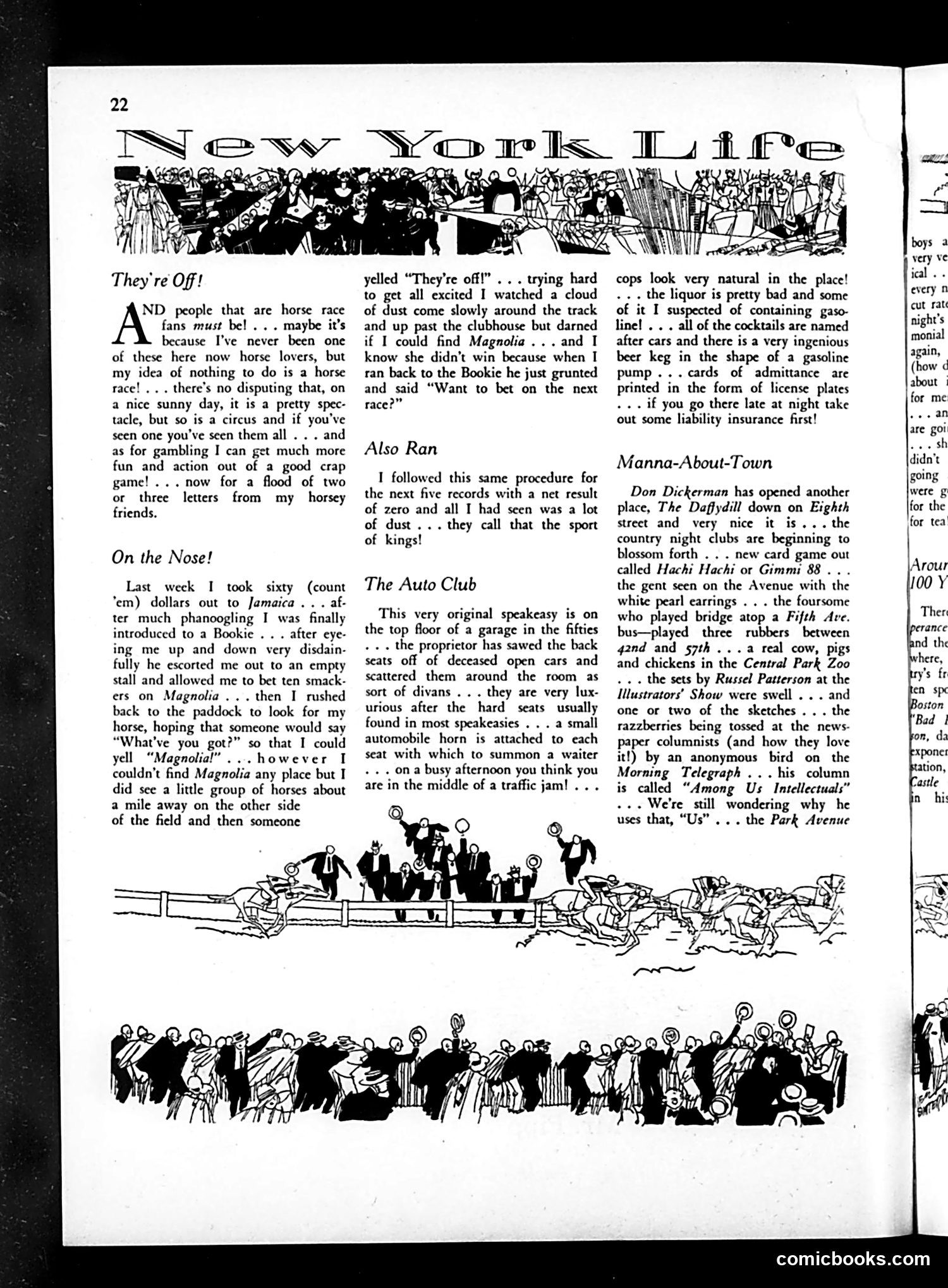
This is a humorous column satirizing Manhattan nightlife and leisure activities circa the 1920s (Prohibition era). The author mocks horse racing enthusiasts, describing his Jamaica racetrack experience as tedious—watching distant dust clouds rather than actual horses, betting money on invisible animals ("Magnolia"). The "Auto Club" speakeasy is the page's centerpiece joke: an illegal bar disguised as a garage, using salvaged car seats as furniture and automobile horns to summon waiters. The satire targets both Prohibition-era speakeasies' absurd concealment and wealthy New Yorkers' appetite for novelty nightlife. Cocktails are car-themed; warnings about "liability insurance" mock reckless patrons. "Manna-About-Town" gossip updates readers on new nightclubs, society gossip, and a card game called "Hachi Hachi," alongside society snippets. The satirical edge mocks the frivolous preoccupations of Manhattan's leisure class during the Jazz Age. The illustrations show crowded speakeasies and racetrack scenes reflecting the era's social venues.
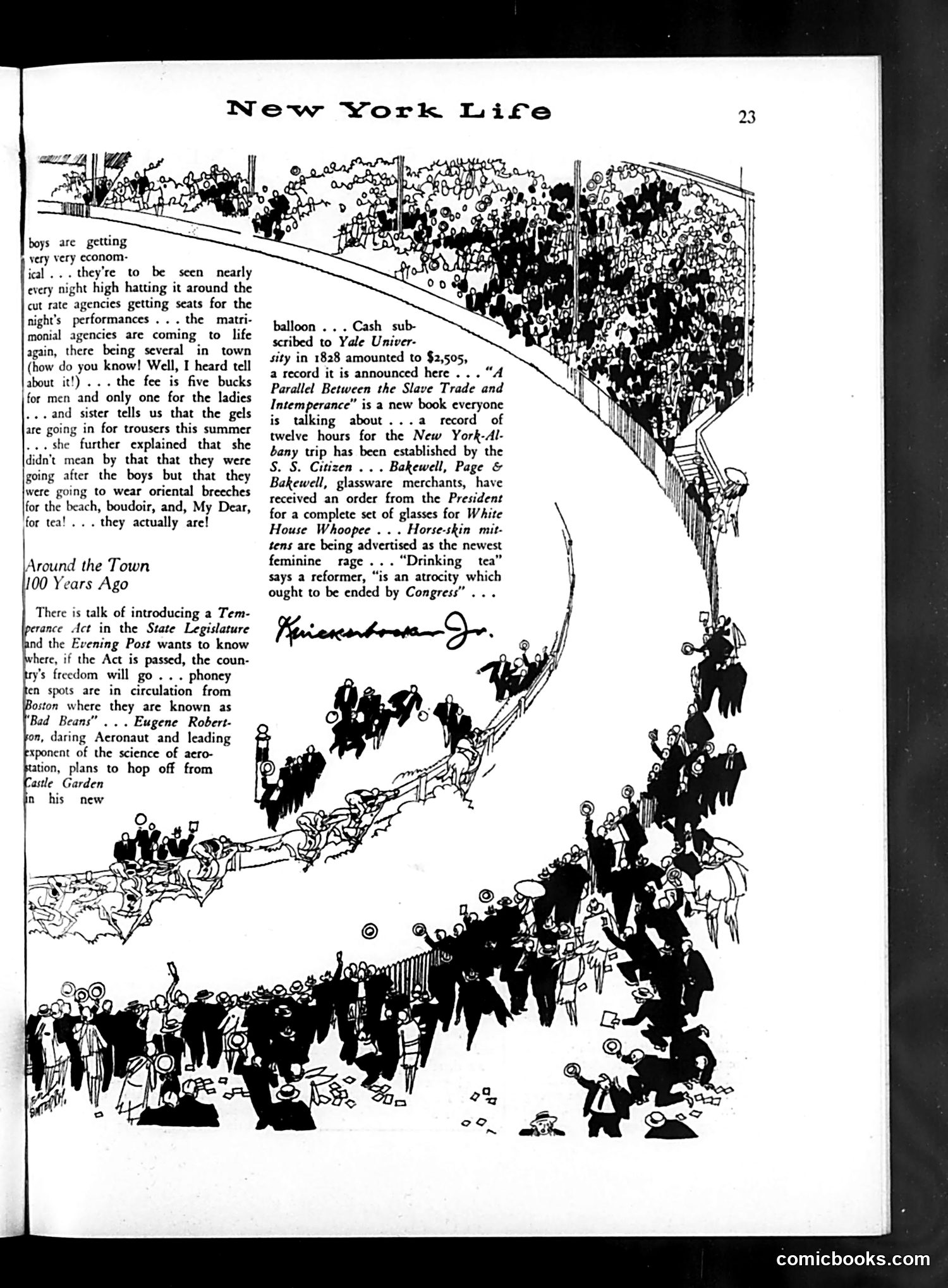
This page combines humorous social commentary about turn-of-the-century New York with a historical retrospective ("Around the Town 100 Years Ago"). **Contemporary Content (top):** Satirizes young men's penny-pinching at discount ticket agencies and the revival of matrimonial (matchmaking) agencies. The joke about women wearing "oriental breeches" for beach and tea outings mocks changing fashion norms and suggests women's increasing independence. **Historical Section:** Lists amusing absurdities from circa 1820s New York: proposed temperance legislation, counterfeit coins called "Bad Beans," an aeronaut planning to launch from Castle Garden, and reformers' ridiculous claims (like Congress banning tea). The cartoon map below illustrates these activities across New York geography. **Overall Point:** Contrasts past oddities with present-day economic concerns, suggesting human follies are timeless. The satire targets both reformist excess and youthful penny-pinching—universal targets of humor across eras.
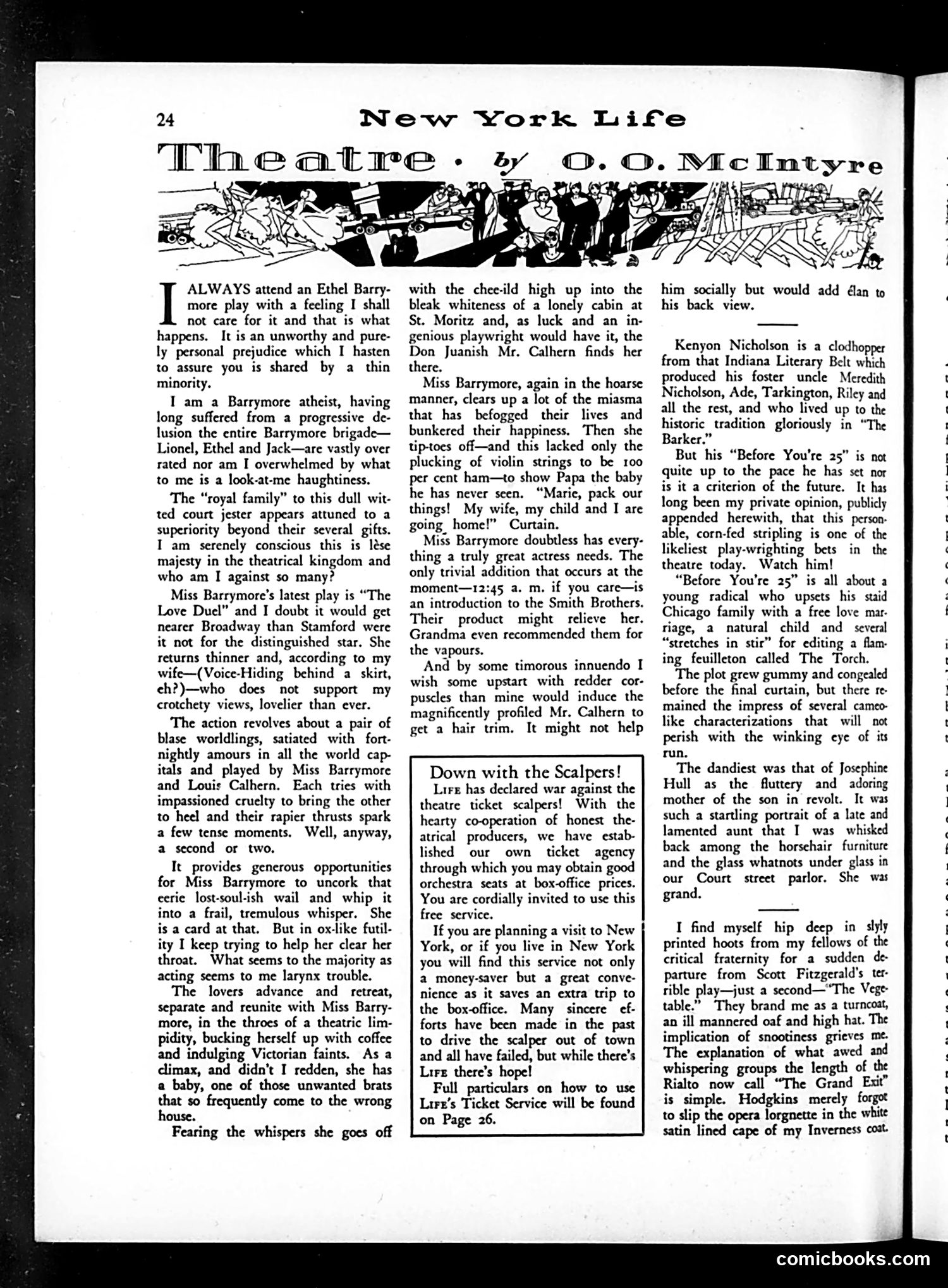
O.O. McIntyre's theater review mocks actress Ethel Barrymore and her play "The Love Duel." McIntyre is a self-described "Barrymore atheist" who dismisses the entire Barrymore acting family (Lionel, Ethel, and Jack) as overrated and pretentious—calling them a "royal family" undeserving of their celebrity worship. His satire targets Barrymore's signature theatrical mannerism: her "eerie lost-soul-ish wail and whip it into a frail, tremulous whisper," which he attributes to laryngitis rather than acting skill. He sarcastically praises Louis Calhern's costar work while mockingly suggesting Calhern needs a haircut. The column also advertises Life magazine's new ticket agency, positioning itself against theater scalpers. McIntyre's acerbic tone—blending personal opinion with theatrical critique—typifies Life's satirical approach to celebrity and entertainment culture of the era.
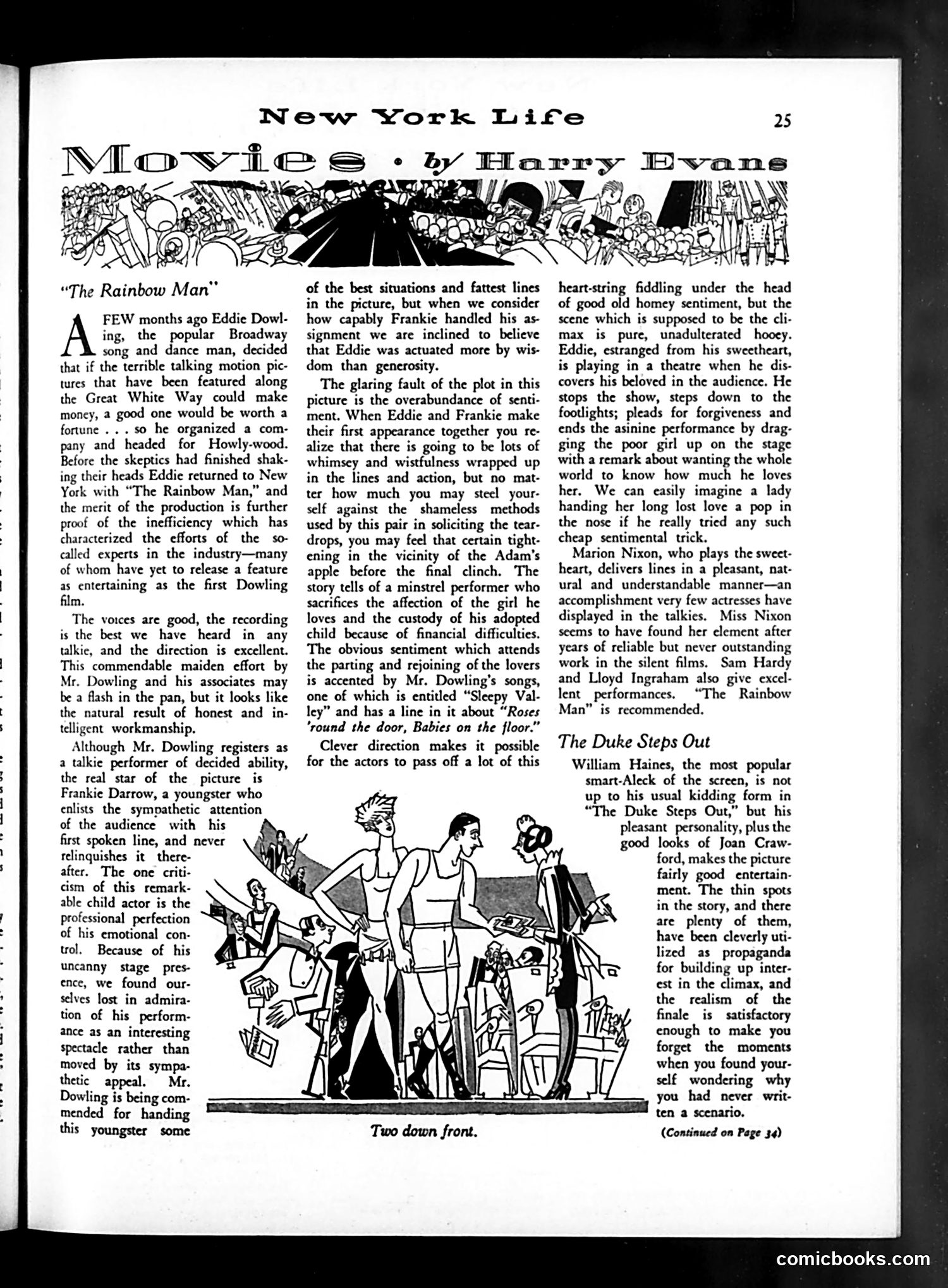
This page reviews Eddie Dowling's early talking picture "The Rainbow Man." The critic praises the film's technical quality (voices, recording, direction) and particularly commends child actor Frankie Darrow's performance, though notes his professionalism is almost *too* perfect—more impressive as spectacle than emotionally moving. The main criticism targets excessive sentimentality in the plot about a minstrel performer who sacrifices love and custody due to financial hardship. The critic finds the climax especially ridiculous: Dowling's character stops a theatrical performance to plead forgiveness from his lost love in the audience, then drags her onstage—behavior the reviewer sarcastically suggests would earn him "a pop in the nose" rather than reconciliation. The illustration depicts this absurd scene. The review represents 1920s film criticism's tension between technical achievement and artistic restraint, mocking Hollywood's then-common use of melodramatic sentiment to manipulate audiences.
This page from *Life* magazine is primarily a **theater and entertainment guide**, not a political cartoon. It lists Broadway shows with brief reviews, ticket prices, and ordering information. The content reflects **1920s theatrical culture**: reviewers mention specific actors (Ethel Barrymore, Edward G. Robinson), theater locations, and prices ranging from $1.00 to $6.60. Notable are references to "Darkest Harlem" entertainment and "all-colored revue," reflecting the era's segregated but thriving African American theater scene. The satirical elements are subtle—brief, acerbic reviews (describing one play as "sheer hokum" and another's music as lacking quality) exemplify *Life*'s trademark witty dismissiveness toward mediocre productions. The illustration at the top appears to be decorative rather than a specific political cartoon. Without visible artist attribution or clearer visual detail, the exact satirical intent remains unclear.
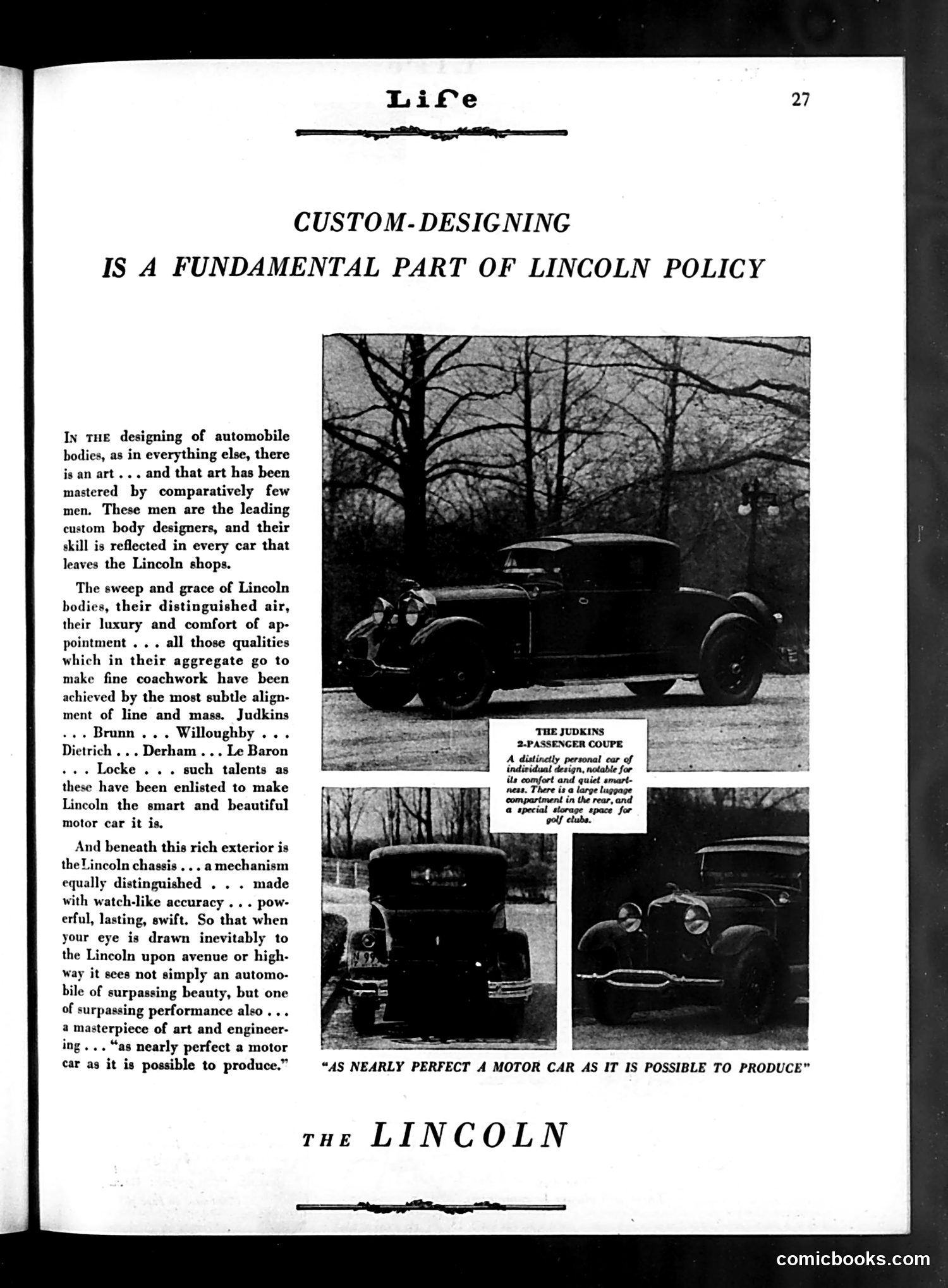
This is **not a cartoon or satire**—it's a **Lincoln automobile advertisement** from Life magazine (page 27). The page promotes Lincoln cars by emphasizing their custom design as a core business philosophy. The text names actual luxury coachbuilders of the era (Judkins, Brunn, Willoughby, Dietrich, Derham, Le Baron, Locke) whom Lincoln hired to create distinctive bodies. The three photographs show examples of custom Lincoln vehicles, including the featured "Judkins 2-Passenger Coupe." The advertisement's rhetoric positions Lincoln as both an artistic and engineering achievement—claiming the cars represent "art," "grace," and "performance" achieved through meticulous craftsmanship. The closing quote—"as nearly perfect a motor car as it is possible to produce"—functions as the campaign's central claim. For modern readers: this reflects a pre-mass-production luxury market where wealthy buyers could commission bespoke car designs from named artisans, a practice largely extinct today.
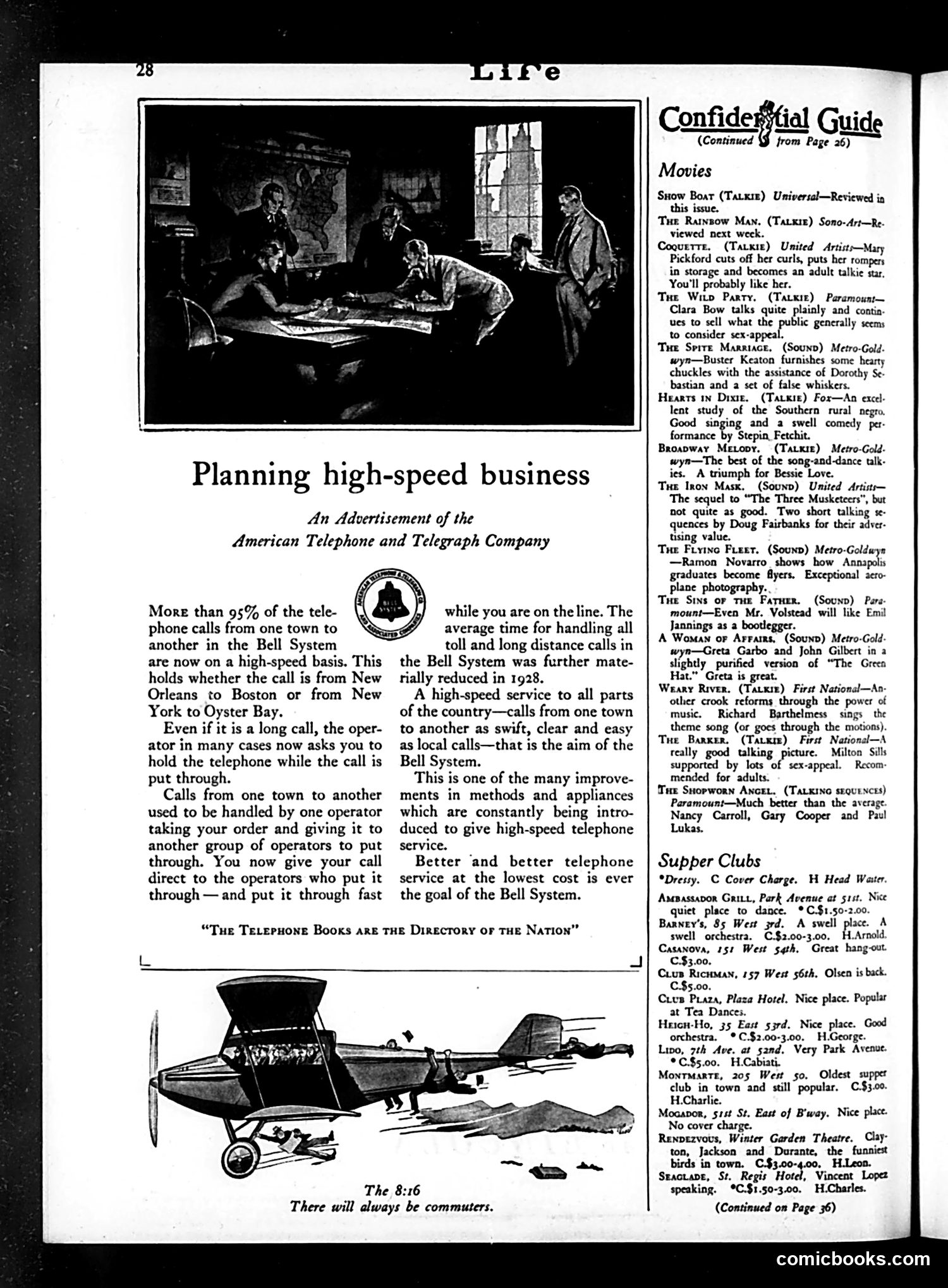
This page is primarily **advertising and entertainment listings**, not political satire. The large centerpiece is an **AT&T Bell System advertisement** explaining their improved long-distance telephone service as of 1928. The image shows businessmen using phones and a pneumatic tube system, illustrating "high-speed business" communication. The bottom illustration references "The 8:16" train, noting "There will always be commuters"—a mild joke about how despite faster phones, people still need trains for travel. The right column contains **movie reviews and supper club listings**—standard entertainment guides for a 1920s magazine. References include Mary Pickford, Buster Keaton, and Greta Garbo's current films. **No political satire is present.** This is essentially a services directory wrapped around corporate PR for the telephone company's modernization efforts.
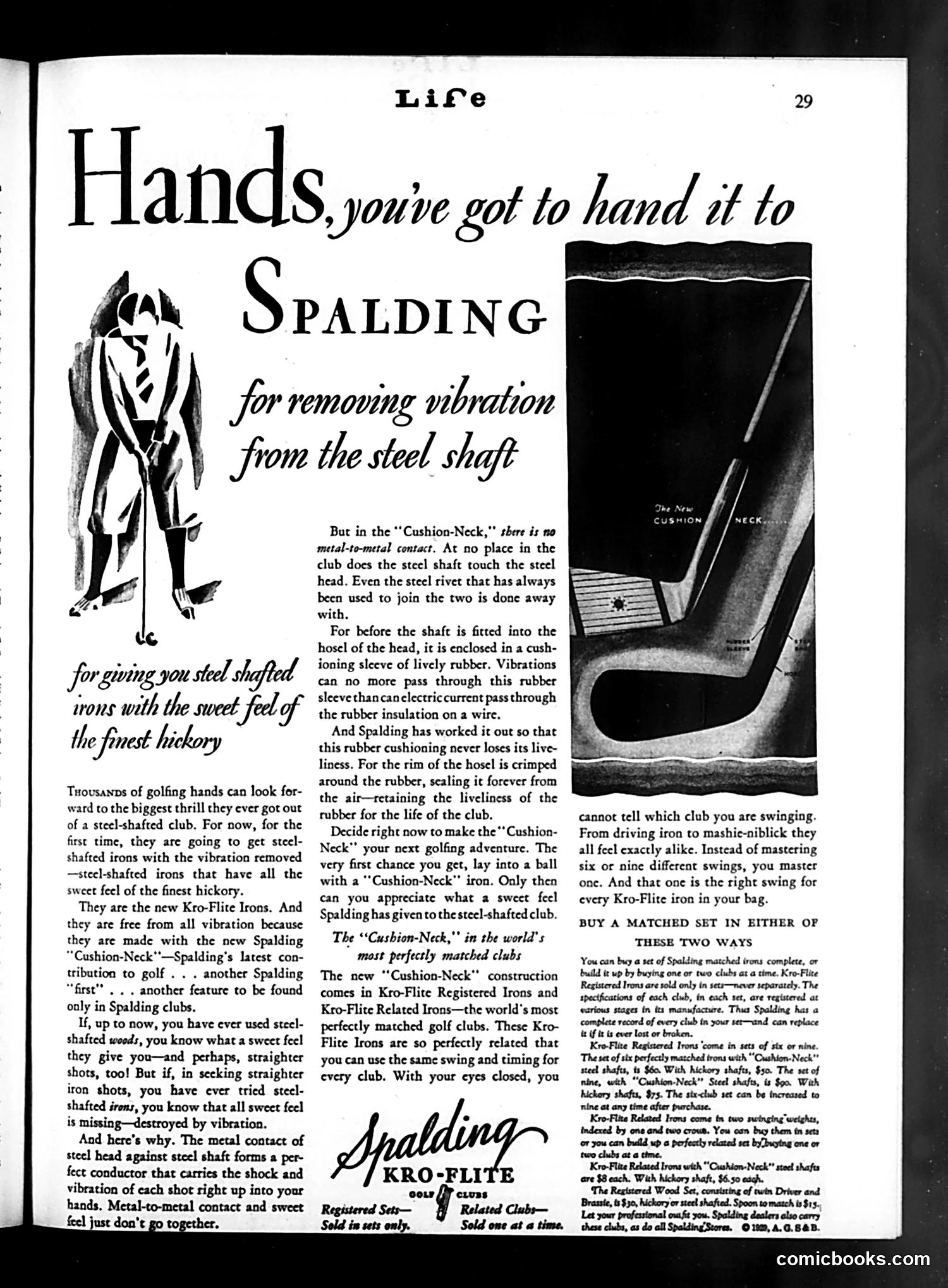
This page is **entirely a Spalding golf equipment advertisement** — not satire or political commentary. There are no cartoons or caricatures to analyze. The ad promotes Spalding's new "Kro-Flite" golf irons, specifically highlighting their "Cushion-Neck" innovation. The key selling point is vibration reduction: traditional steel-shafted irons transmitted shock through metal-to-metal contact between head and shaft, but Spalding's rubber-cushioned sleeve eliminates this, promising the "sweet feel of the finest hickory" (wooden clubs) with steel's durability. The left side shows an illustration of a golfer; the right displays a close-up diagram of the club's "Cushion-Neck" construction. The text emphasizes matched sets and customizable purchasing options. This reflects 1920s-30s golf equipment marketing, targeting affluent leisure golfers. No political or satirical content is present.
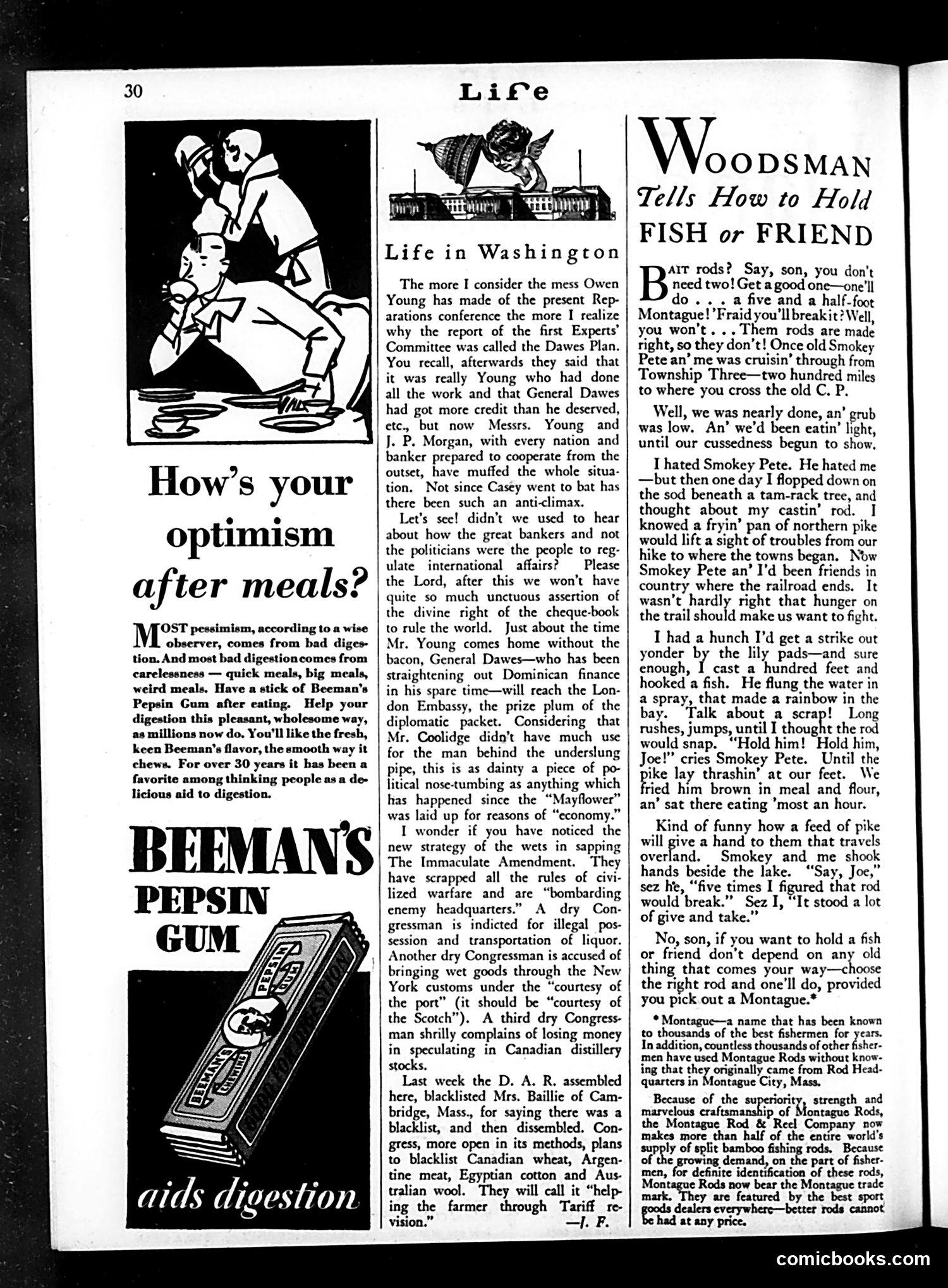
The left side features a **Beeman's Pepsin Gum advertisement**, using common early-20th-century advertising logic: pessimism stems from poor digestion, so chewing gum aids both digestion and optimism. The cartoon shows a distressed figure being comforted—a visual joke supporting the product claim. The center column, "Life in Washington," satirizes **Owen D. Young's failed reparations negotiations**. The author criticizes Young for bungling international finance talks that General Dawes previously handled successfully. The satire suggests that bankers—previously lauded as superior to politicians—have proven incompetent, undermining arguments for financial elite rule. The piece also mocks **Prohibition enforcement**, describing "dry" congressmen being targeted with legal actions by "wets" (alcohol advocates). The right side advertises **Montague fishing rods** through a narrative about two feuding outdoorsmen bonding over fishing—a charming product placement disguised as editorial storytelling.
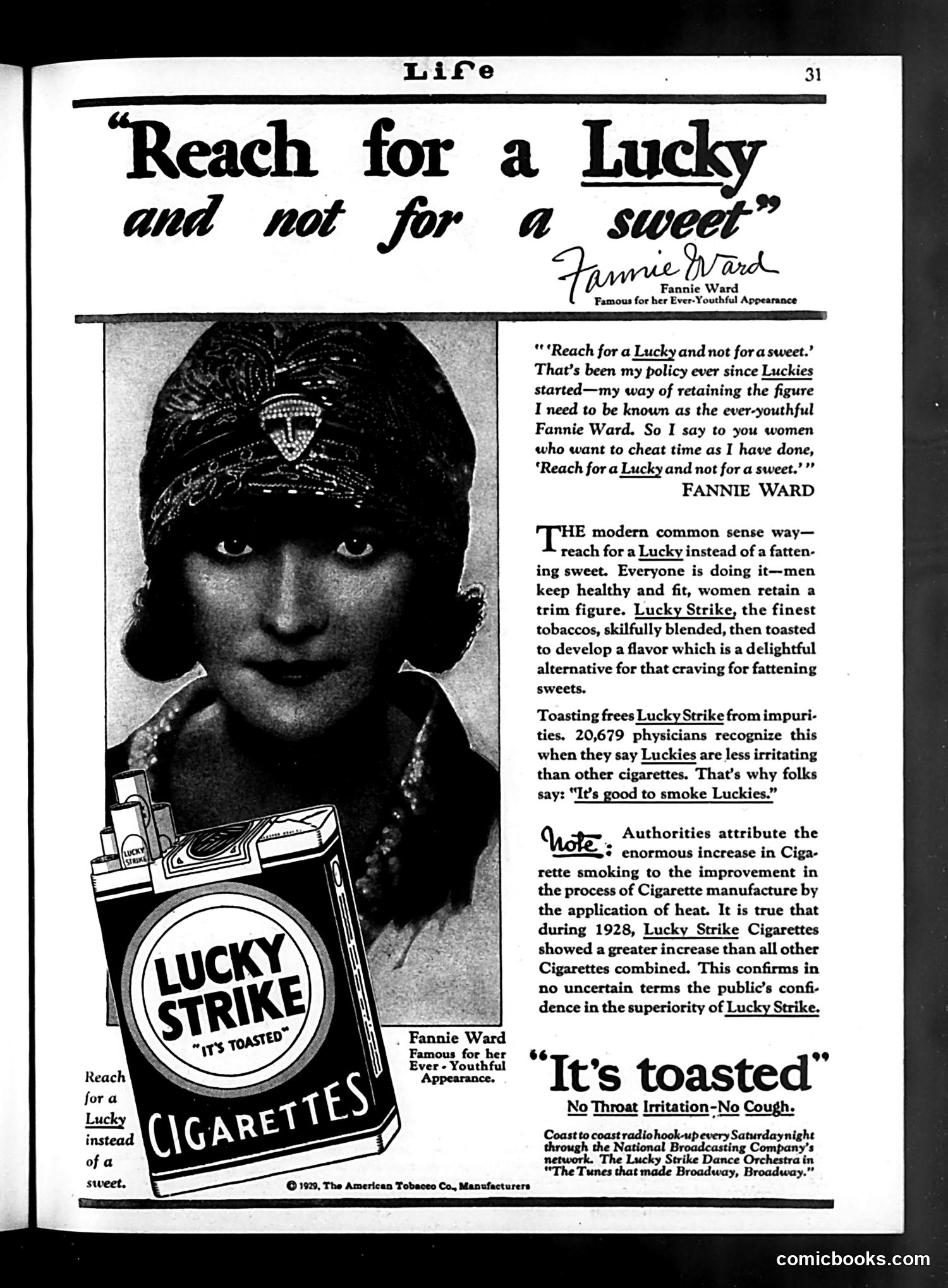
This is a **cigarette advertisement**, not satire, featuring actress Fannie Ward endorsing Lucky Strike cigarettes. The ad exploits women's anxieties about weight and aging by positioning cigarettes as a diet substitute—"reach for a Lucky and not for a sweet." Key claims made: - Smoking suppresses appetite and maintains youth/figure - 20,679 physicians endorse Luckies as "less irritating" - The "toasting" process removes impurities - Lucky Strike outsold competitors in 1928 **Modern context**: This represents pre-FDA regulation tobacco marketing, when cigarette companies made unsubstantiated health claims and used celebrity endorsements to target women specifically. The messaging—equating smoking with beauty, youth, and self-control—was deliberately manipulative. Today such advertising would be illegal.
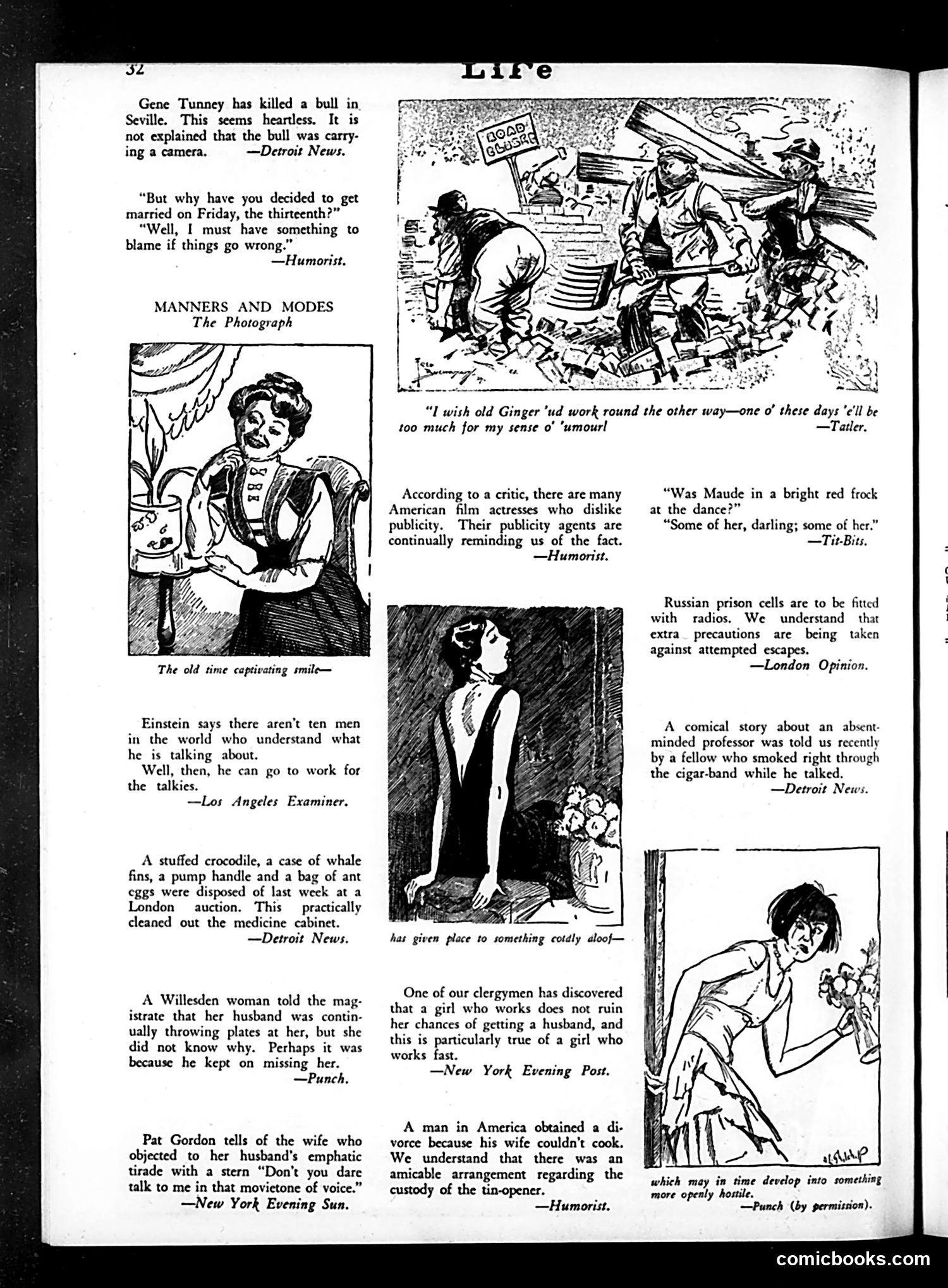
This page from *Life* collects brief satirical quips and cartoons lampooning early 20th-century social customs and news. Key items: **Gene Tunney reference**: The boxer famously killed a bull in Spain; the joke mocks his brutality by absurdly claiming the bull carried a camera—implying Tunney wanted privacy from press coverage. **Einstein joke**: Plays on Einstein's fame despite public incomprehension of his theories; suggests he should work in silent films (where talking isn't required). **Social satire**: Items mock marriage anxieties (marrying on Friday the 13th for an excuse), wives who dislike publicity yet employ publicists, and domestic violence treated as comedic (a husband "missing" his wife with thrown plates). **The cartoons** show a woman primping (vanity), another in an awkward pose, illustrating how formal etiquette and beauty standards were becoming "coldly aloof" rather than genuinely charming. The humor relies on period-specific anxieties: emerging celebrity culture, gender relations, and the gap between public propriety and private dysfunction.
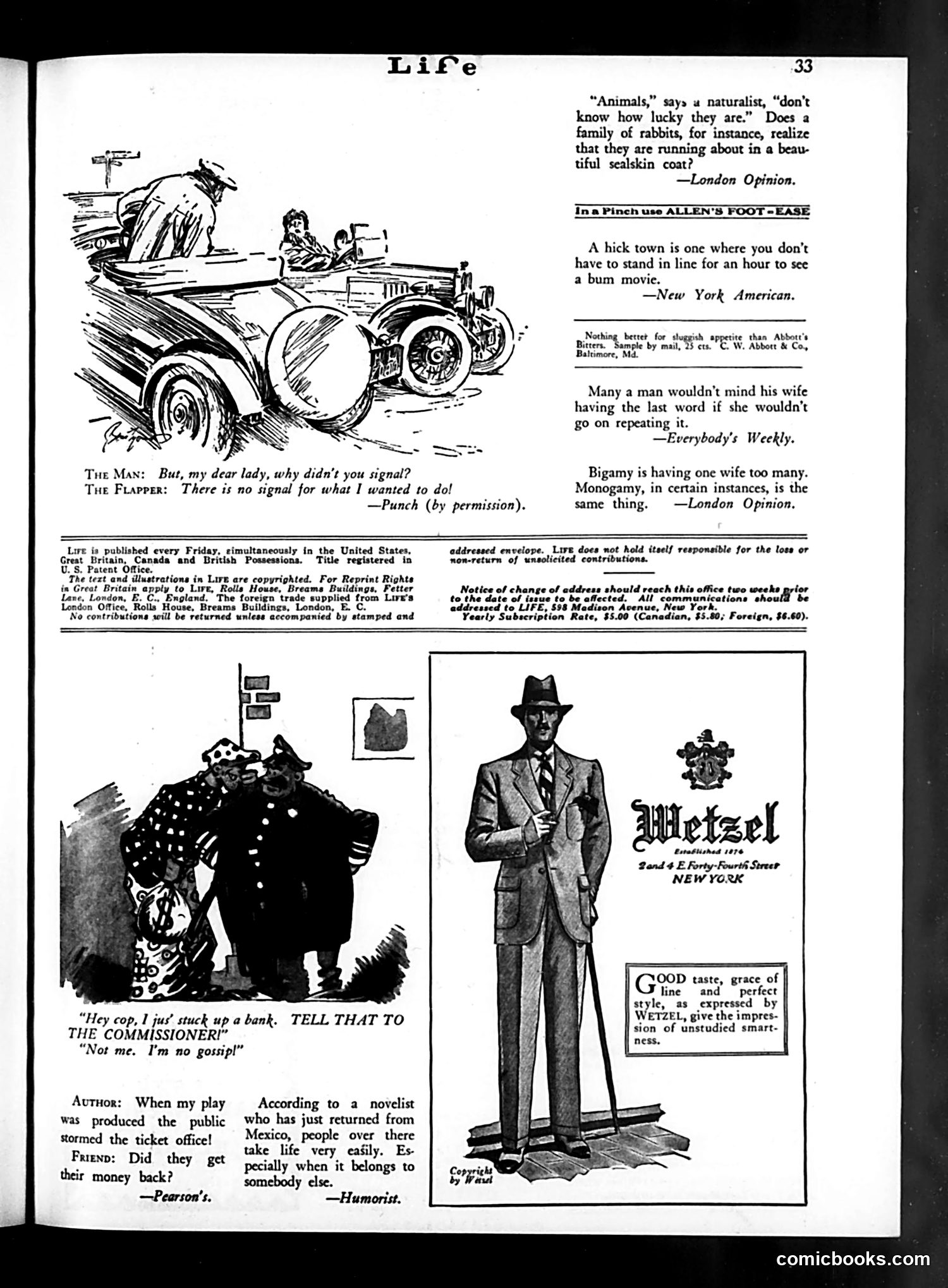
This page from *Life* magazine collects brief satirical quips and jokes alongside advertisements, typical of early 20th-century humor publications. The main cartoon depicts a car accident where a man asks a woman why she didn't signal; she replies there's "no signal for what I wanted to do"—satirizing reckless or incompetent driving. The surrounding text contains short jokes mocking various social targets: naturalists who anthropomorphize animals; small-town movie theaters; nagging wives; bigamy and marriage; corrupt police who won't inform on criminals; and Mexican attitudes toward life and death. These represent period attitudes—some now considered offensive stereotypes. The lower section shows a Wetzel clothing advertisement featuring a well-dressed man, emphasizing refined taste and style. The jokes reflect *Life*'s formula: irreverent social commentary mixed with consumerist appeals, aimed at educated urban readers amused by cynical observations about modern life, relationships, and human nature.
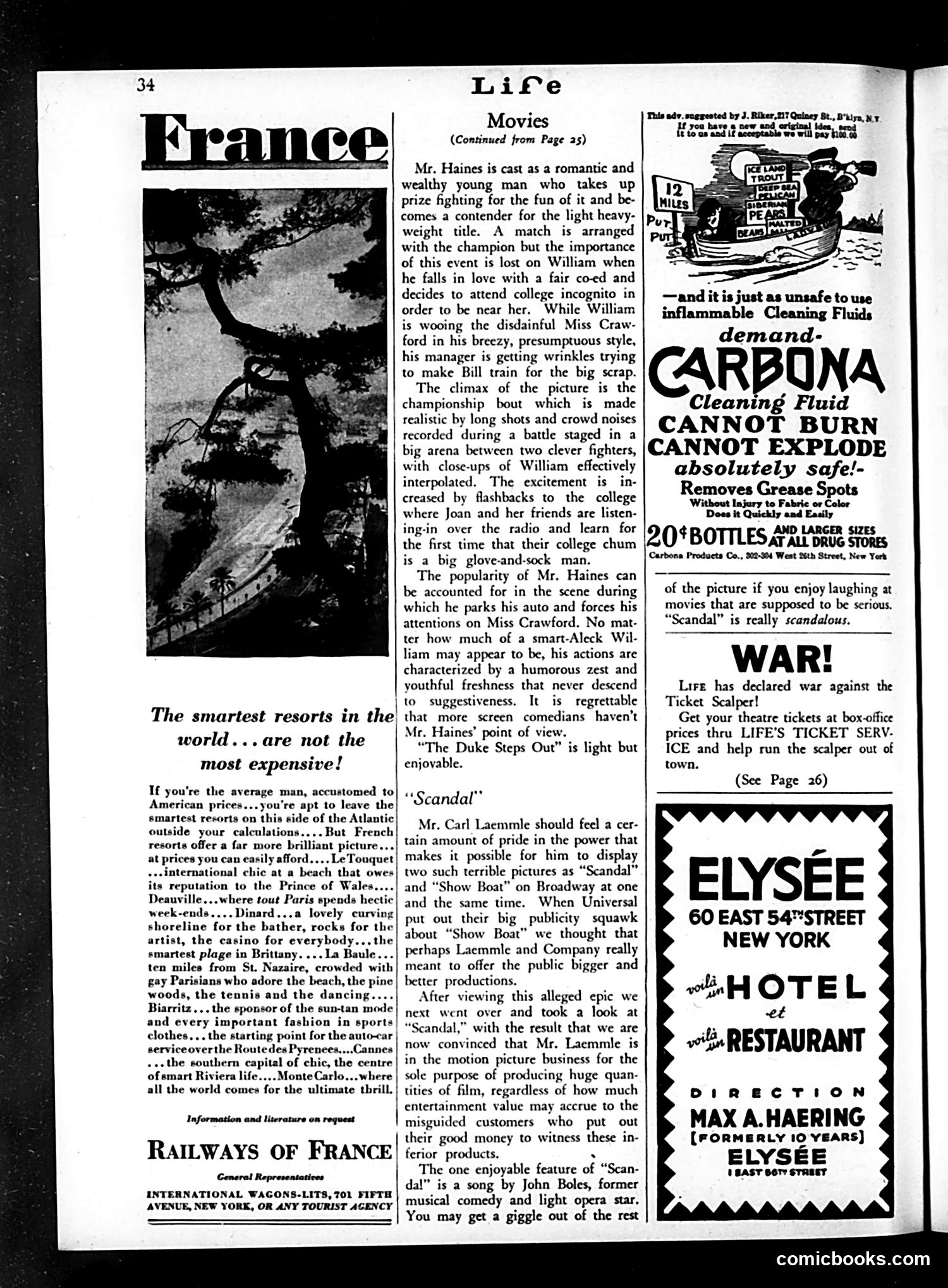
This page contains a France tourism advertisement and movie reviews from Life magazine (appears to be 1920s-era). **The Advertisement:** The left column promotes French resort towns—Deauville, Biarritz, Monte Carlo, etc.—as affordable luxury destinations compared to American resorts. The pitch: you'll get more "chic" for less money in France. **The Movie Reviews:** The right side critiques films starring William Haines ("The Duke Steps Out") and reviews "Scandal" and "Show Boat." The critic praises Haines' comedic charm but heavily criticizes producer Carl Laemmle, accusing him of prioritizing film quantity over quality—essentially manufacturing mediocre movies for profit regardless of entertainment value. The only redeeming moment in "Scandal" is apparently a song by John Boles. The small cartoon in the upper right (labeled "This ad") appears to be an unrelated advertisement for Carbona cleaning fluid, emphasizing its safety.
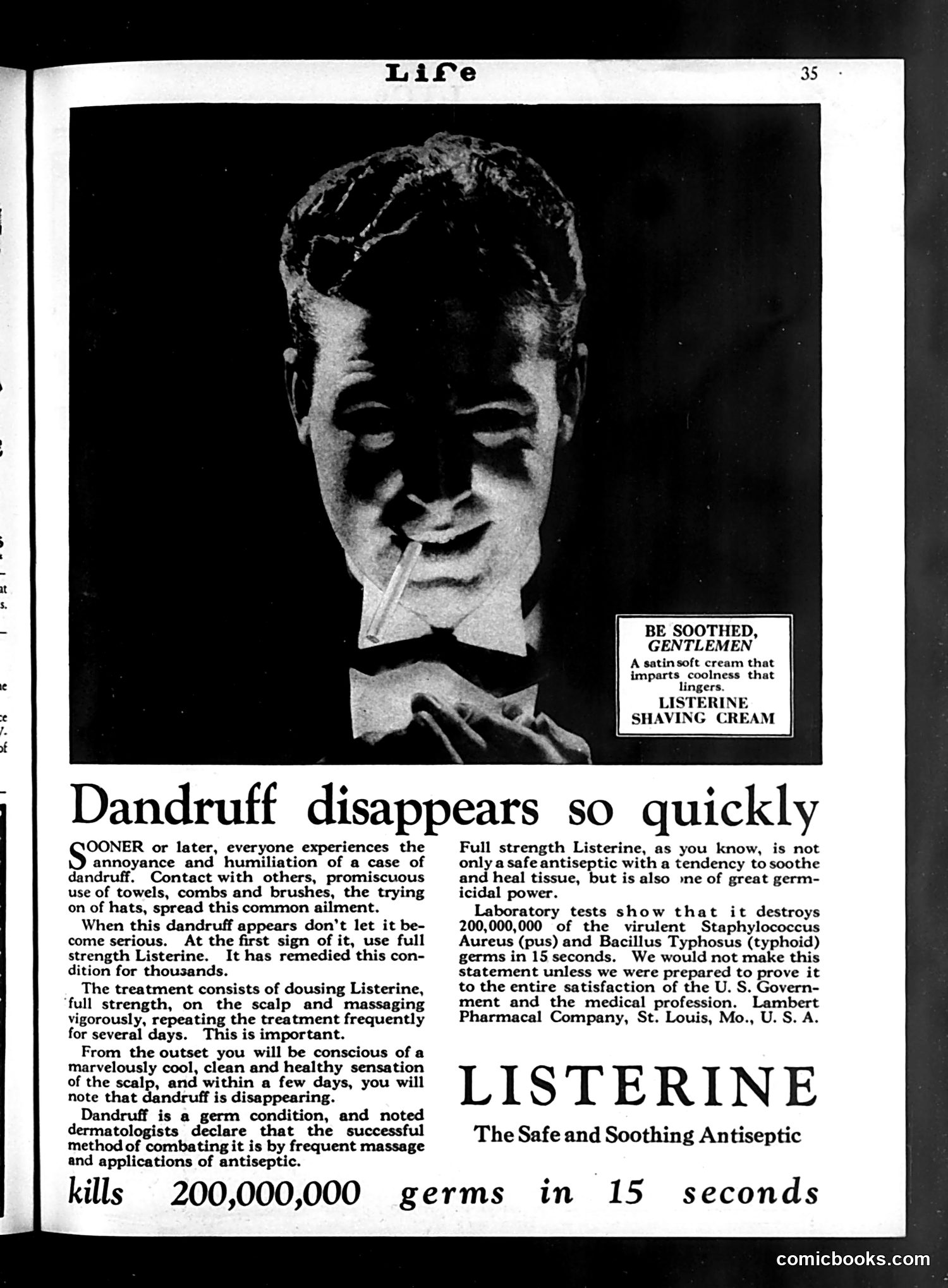
This is a full-page advertisement for Listerine antiseptic, not satire or political commentary. The image shows a well-dressed man in formal attire (tuxedo and bow tie) with a satisfied expression, promoting the product's use as a dandruff treatment. The ad exemplifies early 20th-century marketing by: 1. **Shaming tactics**: Emphasizing dandruff as a source of "annoyance and humiliation" spread through social contact 2. **Scientific claims**: Citing specific germ-killing statistics (200,000,000 germs in 15 seconds) while claiming government approval 3. **Luxury branding**: The "Be Soothed, Gentlemen" tagline and formal presentation appeal to affluent male readers 4. **Medical authority**: References to dermatologists and laboratory tests to establish credibility The advertisement demonstrates how early commercial marketing exploited social anxieties about hygiene and appearance while making dramatic health claims with minimal actual evidence—practices that would later face regulatory scrutiny.
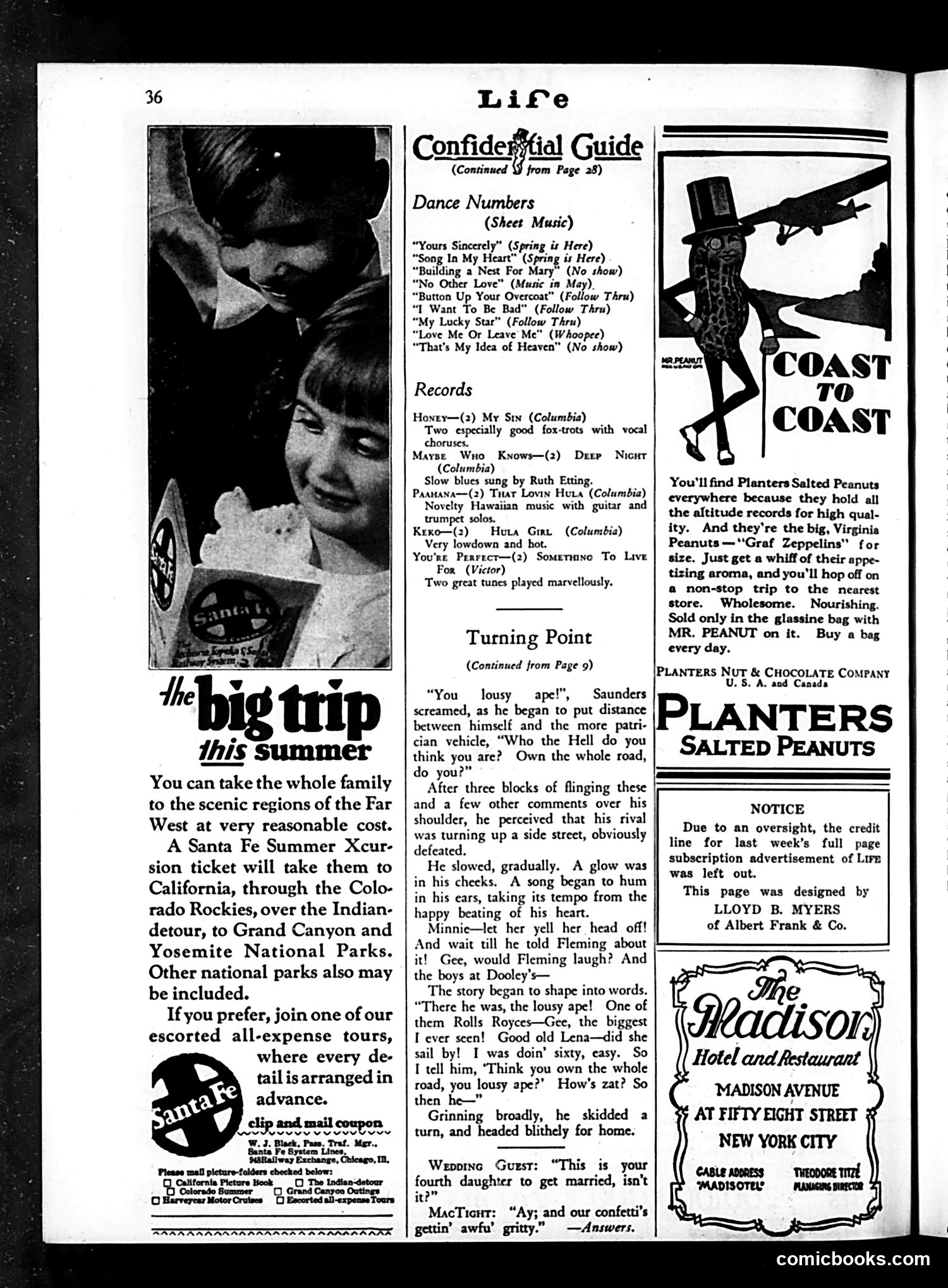
This page is primarily **advertising and filler content** from Life magazine, not political satire. The main elements are: 1. **"The Big Trip" (left)**: A Santa Fe Railway advertisement promoting summer vacation packages to Western destinations—California, Colorado Rockies, Grand Canyon, Yosemite. It's straightforward travel marketing aimed at middle-class families. 2. **"Turning Point" (center)**: A short story about a working-class man (Saunders) in a minor traffic dispute with someone in a luxury Rolls-Royce. The narrative celebrates his quick victory and his excitement telling friends about it—reflecting 1920s class tensions, but presented as light entertainment rather than satire. 3. **"Confidential Guide"**: Sheet music and record recommendations—typical entertainment listings. 4. **Planters Peanuts & Madison Hotel advertisements**: Standard commercial ads. The page reflects 1920s consumer culture and leisure travel, with subtle class consciousness in the traffic story, but lacks pointed political commentary. It's representative of Life's mix of entertainment, consumer culture, and light humor during this era.
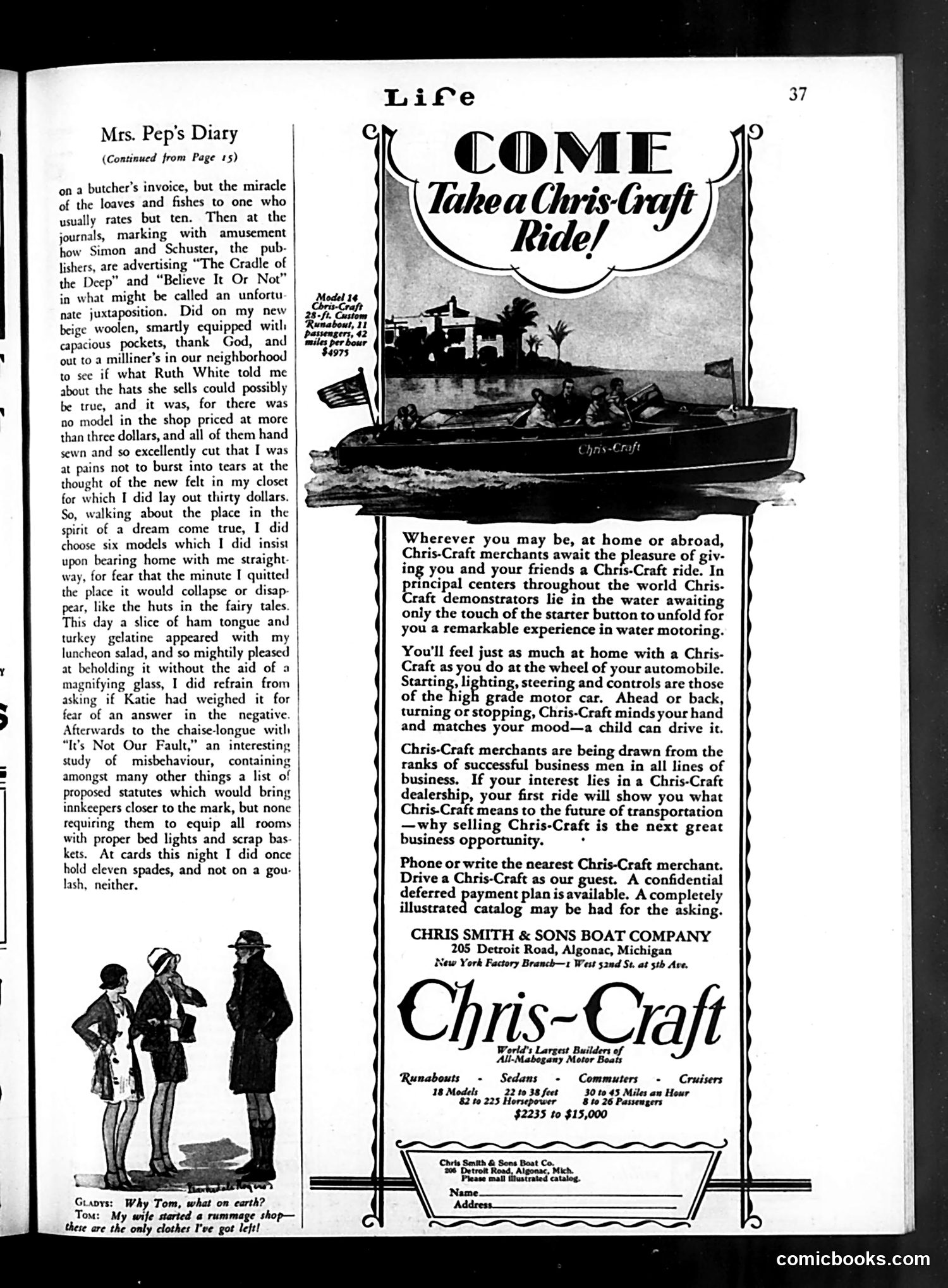
This page contains **Mrs. Pep's Diary** (a serialized humor column) and a **Chris-Craft motorboat advertisement**. ## The Diary Section The diary humorously documents a wealthy woman's mundane activities—shopping for economical hats, enjoying modest meals, reading books, and playing cards. The satire targets upper-class pretension: she's delighted discovering quality hats under three dollars and obsesses over holding "eleven spades" at cards. The tone mocks the breathless self-importance of society diary-keeping. A small cartoon at bottom shows a domestic joke: a husband arriving home to find his wife has started a rummage shop and given away all his clothes except what he's wearing. ## The Advertisement The right page is a substantial **Chris-Craft boat dealership ad**, marketing luxury motorboats as aspirational consumer goods. It emphasizes ease of operation ("a child can drive it") and positions Chris-Craft dealerships as a business opportunity for entrepreneurs. Prices range $2,235–$15,000 (substantial 1920s money). Together, these elements reflect the **1920s consumer culture**—the magazine targets affluent readers interested in both satirical social commentary and luxury purchasing opportunities.
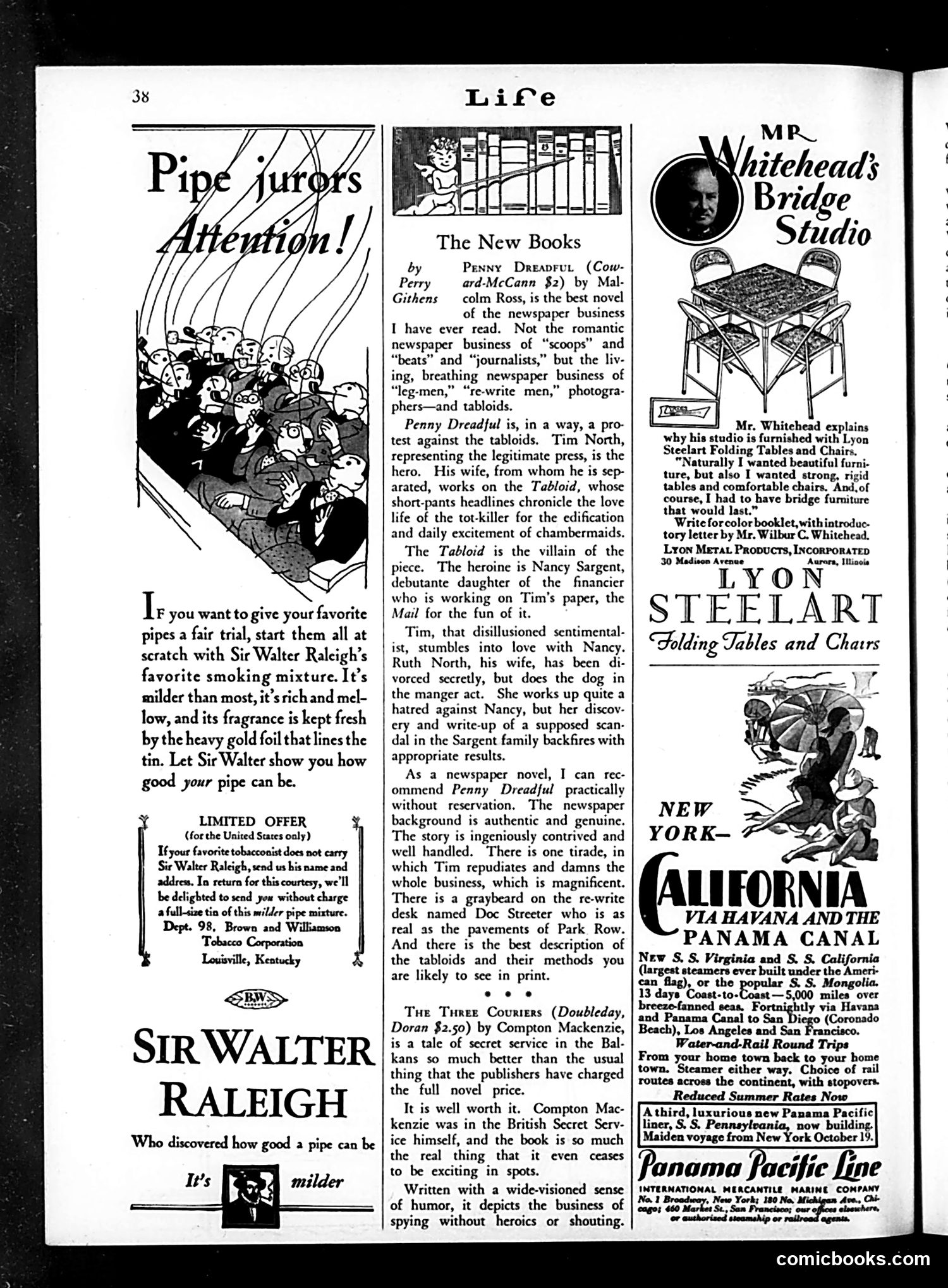
This page combines tobacco advertising with book reviews. The dominant element is a **Sir Walter Raleigh pipe tobacco ad** featuring a historical figure—the explorer/courtier Sir Walter Raleigh, who introduced tobacco to England in the 16th century. The ad's humor relies on this historical association, positioning Raleigh as having "discovered how good a pipe can be," thus lending prestige and authenticity to the product. The accompanying cartoon shows a crowded group of men smoking pipes, presumably satisfied customers. The advertiser uses Raleigh's historical credibility as comedic endorsement—the irony being that a famous historical figure is credited with discovering the superiority of *this particular* modern tobacco blend. The remainder of the page contains book reviews and competing advertisements (bridge furniture, steamship lines). The satirical magazine's editorial content appears minimal here; this is primarily a commercial page showcasing 1920s-30s advertising and consumer culture.
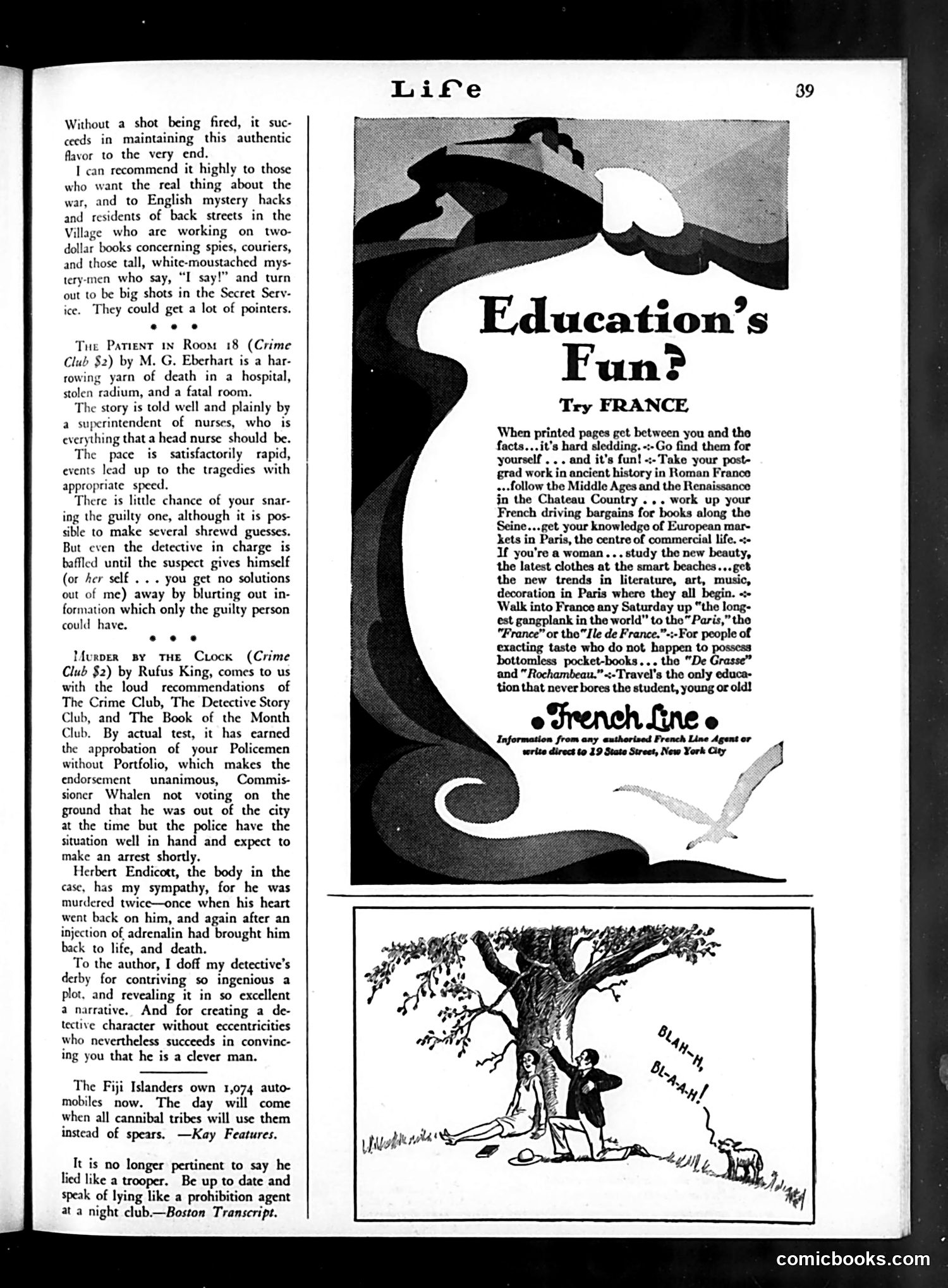
This page contains book reviews of three crime novels alongside a French Line shipping advertisement. The reviews are humorous critiques typical of Life's satirical style: **The text reviews** mock mystery and spy fiction genres popular in the 1920s-30s, poking fun at stereotypical "mystery-men who say, 'I say!'" and spy story clichés that amateur writers were imitating. **The advertisement** ("Education's Fun? Try France") promotes travel on French ocean liners as educational tourism—a tongue-in-cheek pitch suggesting that experiencing France firsthand beats reading about it. It appeals to both serious scholars and wealthy women seeking fashion and cultural trends. **The cartoon** (bottom) shows two figures under a tree saying "Blah-h, blah-h!"—a visual joke about tedious conversation, likely commenting on modern society's shallow talk, a common Life satire theme. **The final quips** mock outdated expressions ("lied like a trooper") and Prohibition-era dishonesty, reflecting 1920s-30s America's cynicism about government officials and the failed alcohol ban.
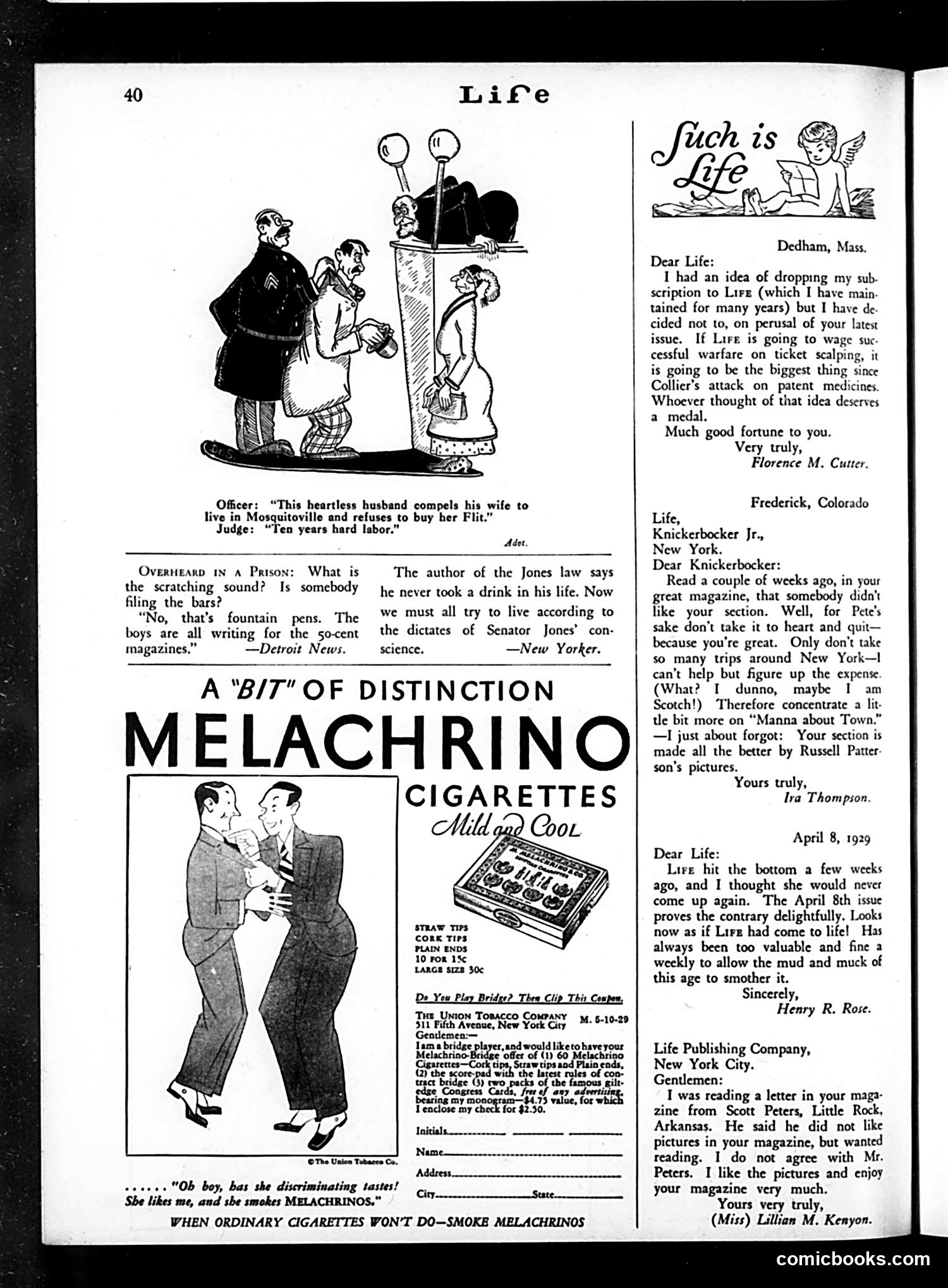
This page contains reader letters and advertisements rather than political cartoons. The main content includes: **Top cartoon**: A judge sentencing a husband to "ten years hard labor" for forcing his wife to live in "Mosquitoville" and refusing to buy her "Flit" (an insecticide brand). The joke satirizes domestic complaints treated as criminal offense. **Brief jokes**: Includes a prison joke about fountain pens mimicking file scratches, and commentary on Senator Jones's abstinence law. **Main advertisement**: Melachrino cigarettes, marketed as a "bit of distinction" with the tagline "Oh boy, has she discriminating tastes! She likes me, and she smokes MELACHRINOS." The ad uses gendered appeals typical of 1920s advertising. **Reader letters**: Mostly praise for *Life*'s editorial content, including its campaign against ticket scalping. One reader criticizes excessive New York coverage; another defends the magazine's use of illustrations. The page primarily functions as advertising and reader engagement rather than satirical commentary.
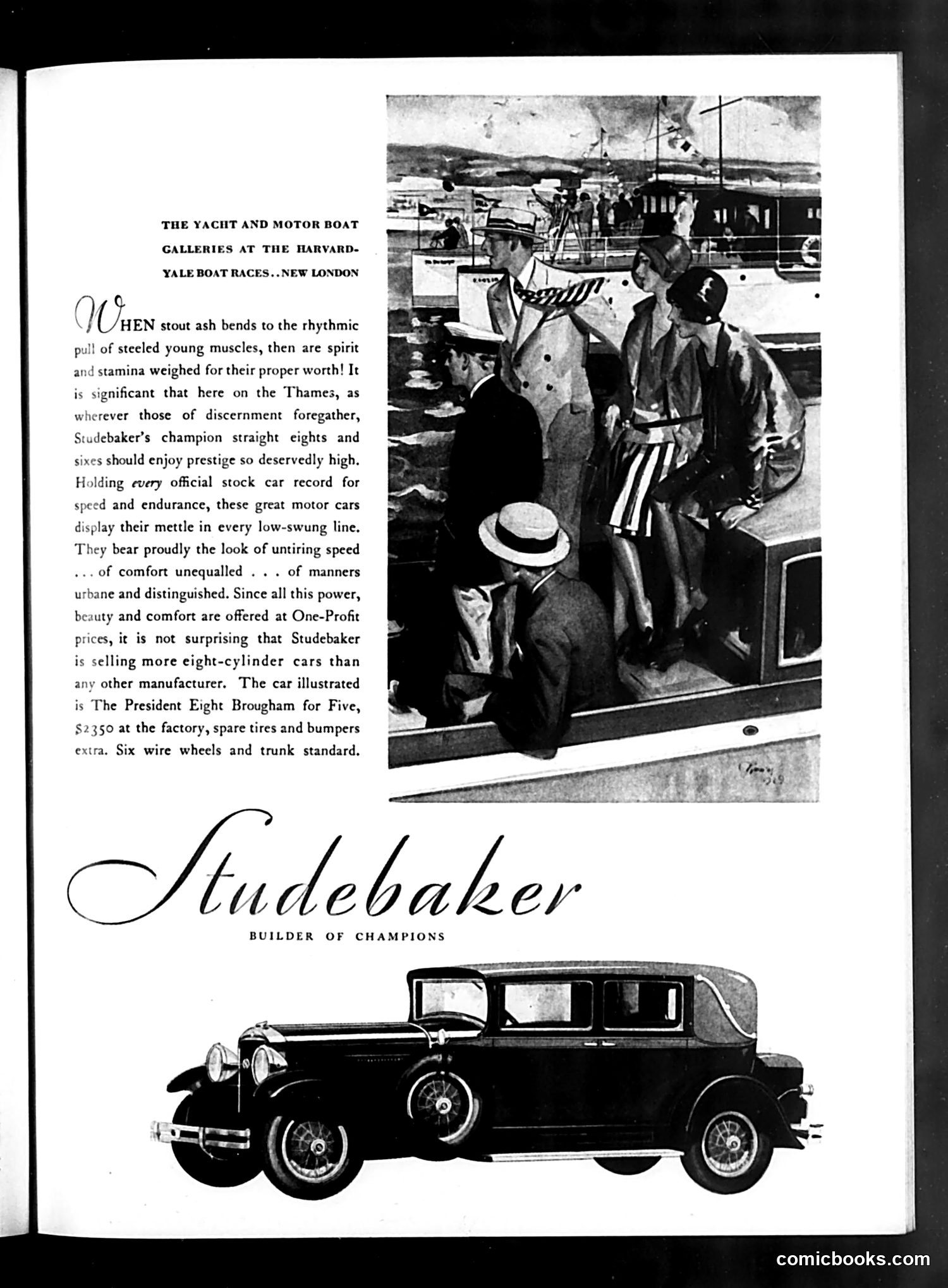
This is a **Studebaker automobile advertisement**, not satire or political commentary. The page uses the prestigious Harvard-Yale boat races at New London as an aspirational backdrop to market luxury cars. The top photograph shows well-dressed spectators at the yacht and motor boat galleries viewing the races—representing an affluent, discerning audience. The ad argues that just as these wealthy observers appreciate quality in competitive athletics, they similarly recognize Studebaker's superiority in automobiles. The text emphasizes the car's speed records, comfort, and "urbane and distinguished" styling while highlighting its competitive pricing ("One-Profit prices"). The illustrated President Eight Brougham model is priced at $2,350 (substantial for the era). This is **straightforward luxury marketing** leveraging social prestige and competitive achievement to sell vehicles to the upper-middle and upper classes—no satire intended.
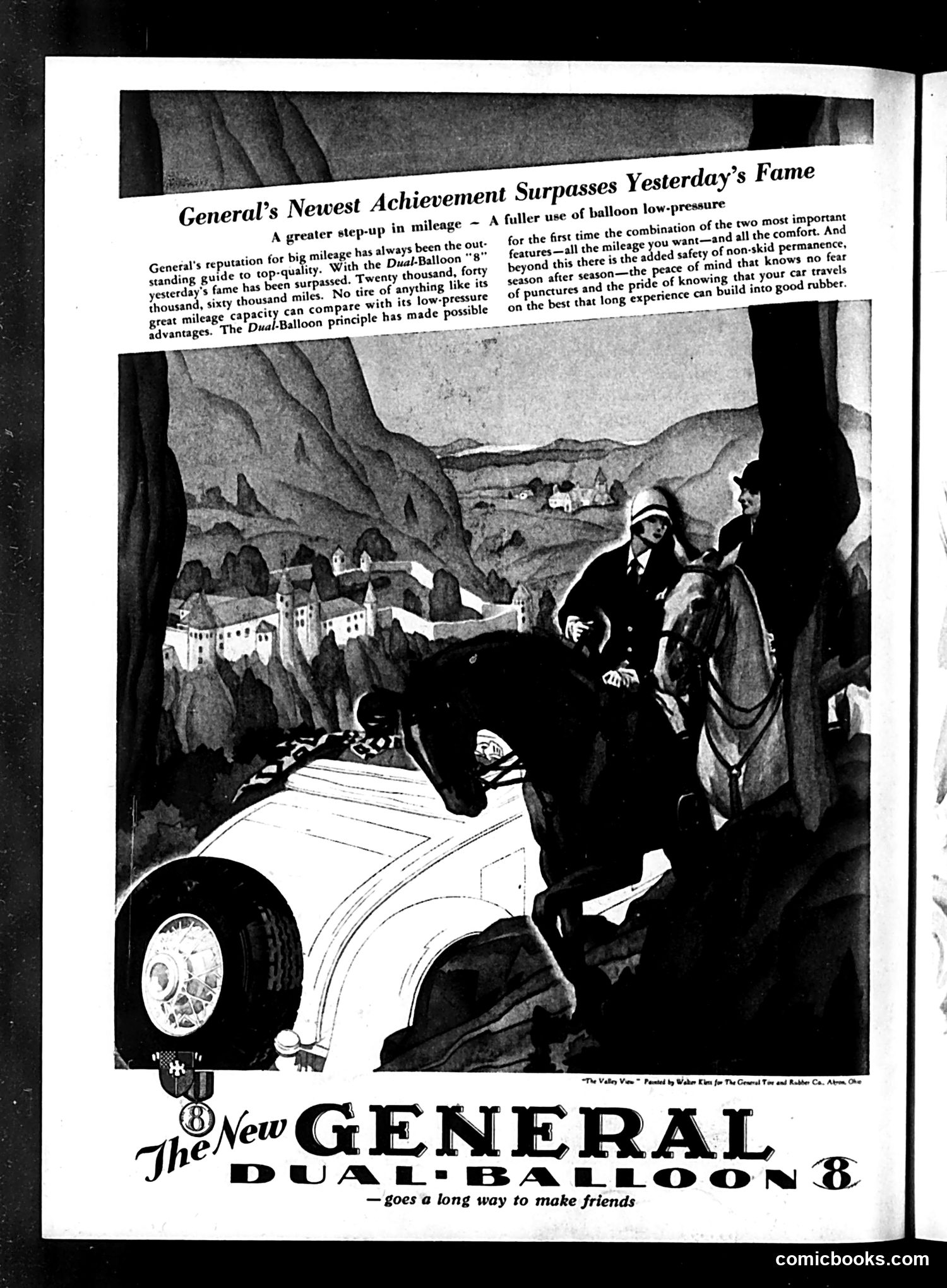
This is an **advertisement**, not a political cartoon or satire. It promotes General Tire's new "Dual-Balloon 8" tire, featuring low-pressure balloon tires. The illustrated scene depicts a vintage automobile traveling through a European mountain landscape (suggested by the castles and architecture), with well-dressed passengers observing the scenery. This romanticized setting emphasizes the tire's reliability and comfort for long-distance touring. The ad's message targets early 20th-century motorists concerned with **mileage and durability**. It claims the Dual-Balloon design combines two important features: greater mileage capacity and improved comfort/safety through low-pressure technology. The headline "General's Newest Achievement Surpasses Yesterday's Fame" positions this as an innovation superior to previous tire designs. The tagline "goes a long way to make friends" uses a pun on both tire longevity and social acceptance—implying reliable transportation builds reputation. This reflects the period when automobiles were still relatively novel status symbols.