
Life, 1929-05-10 · page 15 of 44
Life — May 10, 1929 — page 15: what you’re looking at
What you’re looking at
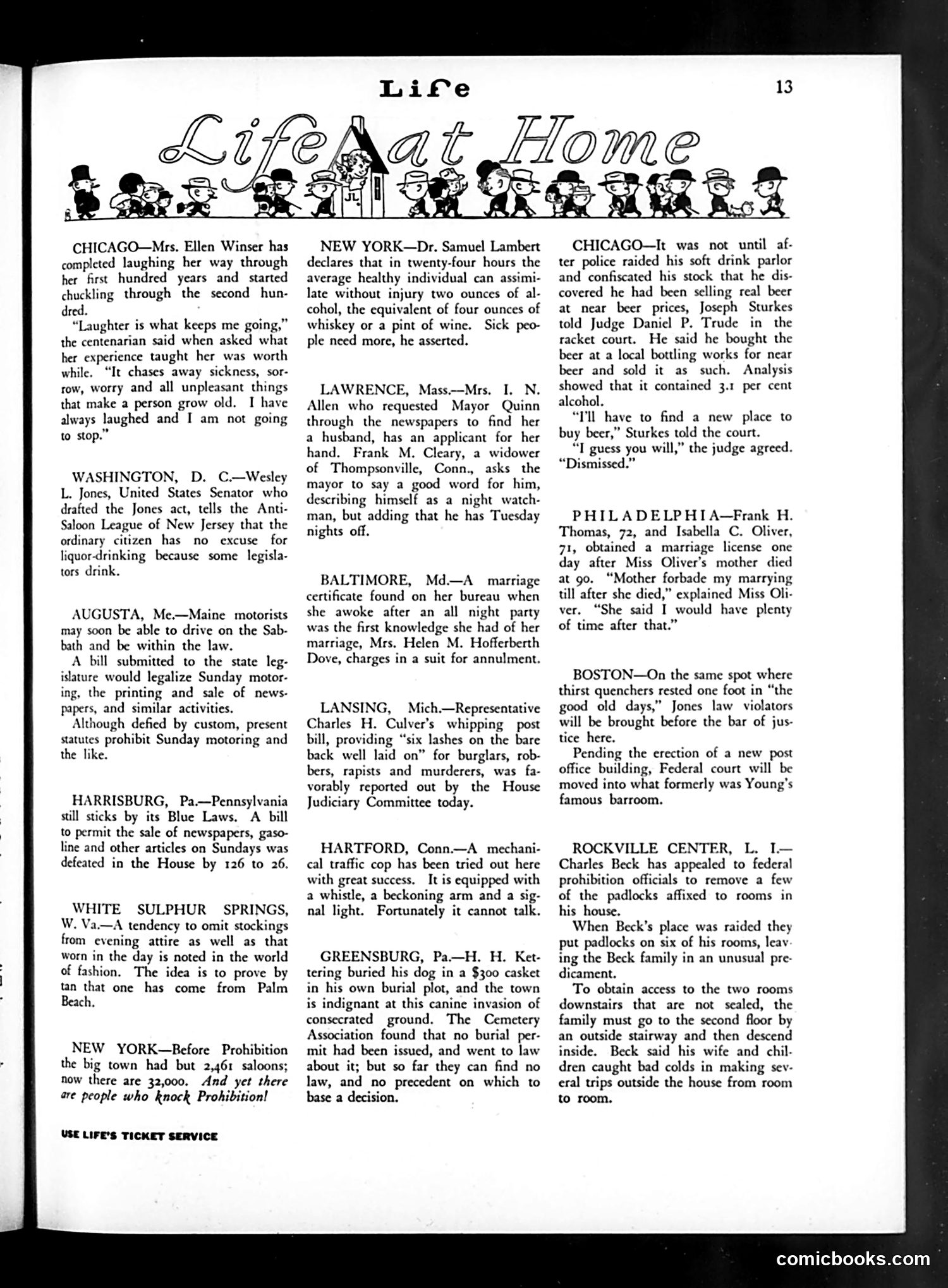
This page contains a humor column featuring brief anecdotes from various American cities. The decorative header shows silhouettes of people in 1920s attire, establishing the era. The content satirizes contemporary social issues, primarily **Prohibition**. Multiple items mock alcohol enforcement: a Chicago beer-selling case, a New York comparison of pre-Prohibition saloons to current numbers, and a Pennsylvania reference to "Blue Laws." Other items humorously address marriage, burial practices, and housing regulations. The final entry notes New York *previously* had 2,461 saloons but now has 33,000—with the pointed observation: "And yet there are people who knock Prohibition!" This reveals the magazine's skeptical, satirical stance toward Prohibition's effectiveness, suggesting the ban created more illegal drinking than it prevented. The humor is gentle social commentary typical of 1920s Life magazine.
📄 Transcribed text from this page (OCR, searchable)
Machine-transcribed from the original scan — historical spelling and the odd misread are preserved.
CHICAGO—Mrs. Ellen Winser has completed laughing her way through her first hundred years and started chuckling through the second hun- dred. “Laughter is what keeps me going,” the centenarian said when asked what her experience taught her was worth while. “It chases away sickness, sor- row, worry and all unpleasant things that make a person grow old. I have always laughed and I am not going to stop.” WASHINGTON, D. C.—Wesley L. Jones, United States Senator who drafted the Jones act, tells the Anti- Saloon League of New Jersey that the ordinary citizen has no excuse for liquor-drinking because some legisla- tors drink. AUGUSTA, Me.—Maine motorists may soon be able to drive on the Sab- bath and be within the law. A bill submitted to the state leg- islature would legalize Sunday motor- ing, the printing and sale of news- papers, and similar activities. Although defied by custom, present statutes prohibit Sunday motoring and the like. HARRISBURG, Pa.—Pennsylvania still sticks by its Blue Laws. A bill to permit the sale of newspapers, gaso- line and other articles on Sundays was defeated in the House by 126 to 26. WHITE SULPHUR SPRINGS, W. Va—A tendency to omit stockings from evening attire as well as that worn in the day is noted in the world of fashion. The idea is to prove by tan that one has come from Palm Beach, NEW YORK—Before Prohibition the big town had but 2,461 saloons; now there are 32,000. And yet there are people who knock Prohibition! USE LIFE’S TICKET SERVICE NEW YORK—Dr. Samuel Lambert declares that in twenty-four hours the average healthy individual can assimi- late without injury two ounces of al- cohol, the equivalent of four ounces of whiskey or a pint of wine. Sick peo- ple need more, he asserted. LAWRENCE, Mass.—Mrs. I. N. Allen who requested Mayor Quinn through the newspapers to find her a husband, has an applicant for her hand. Frank M. Cleary, a widower of Thompsonville, Conn., asks the mayor to say a good word for him, describing himself as a night watch- man, but adding that he has Tuesday nights off, BALTIMORE, Md.—A_ marriage certificate found on her bureau when she awoke after an all night party was the first knowledge she had of her marriage, Mrs. Helen M. Hofferberth Dove, charges in a suit for annulment. LANSING, Mich.—Representative Charles H. Culver’s whipping post bill, providing “six lashes on the bare back well laid on” for burglars, rob- bers, rapists and murderers, was fa- vorably reported out by the House Judiciary Committee today. HARTFORD, Conn.—A_mechani- cal traffic cop has been tried out here with great success. It is equipped with a whistle, a beckoning arm and a sig- nal light. Fortunately it cannot talk. GREENSBURG, Pa.—H. H. Ket- tering buried his dog in a $300 casket in his own burial plot, and the town is indignant at this canine invasion of consecrated ground. The Cemetery Association found that no burial per- mit had been issued, and went to law about it; but so far they can find no law, and no precedent on which to base a decision. CHICAGO—It was not until af- ter police raided his soft drink parlor and confiscated his stock that he dis- covered he had been selling real beer at near beer prices, Joseph Sturkes told Judge Daniel P. Trude in the racket court. He said he bought the beer at a local bottling works for near beer and sold it as such. Analysis showed that it contained 3.1 per cent alcohol. “I'll have to find a new place to buy beer,” Sturkes told the court. “I guess you will,” the judge agreed. “Dismissed.” PHILADELPHIA—Frank H. Thomas, 72, and Isabella C. Oliver, 71, obtained a marriage license one day after Miss Oliver's mother died at go. “Mother forbade my marrying till after she died,” explained Miss Oli- ver, “She said I would have plenty of time after that.” BOSTON—On the same spot where thirst quenchers rested one foot in “the good old days,” Jones law violators will be brought before the bar of jus- tice here. Pending the erection of a new post office building, Federal court will be moved into what formerly was Young's famous barroom. ROCKVILLE CENTER, L. I— Charles Beck has appealed to federal prohibition officials to remove a few of the padlocks affixed to rooms in his house. When Beck's place was raided they put padlocks on six of his rooms, leav ing the Beck family in an unusual pre- dicament. To obtain access to the two rooms downstairs that are not sealed, the family must go to the second floor by an outside stairway and then descend inside. Beck said his wife and chil- dren caught bad colds in making sev- eral trips outside the house from room to room. comicbooks.com