
Life, 1929-05-10 · page 26 of 44
Life — May 10, 1929 — page 26: what you’re looking at
What you’re looking at
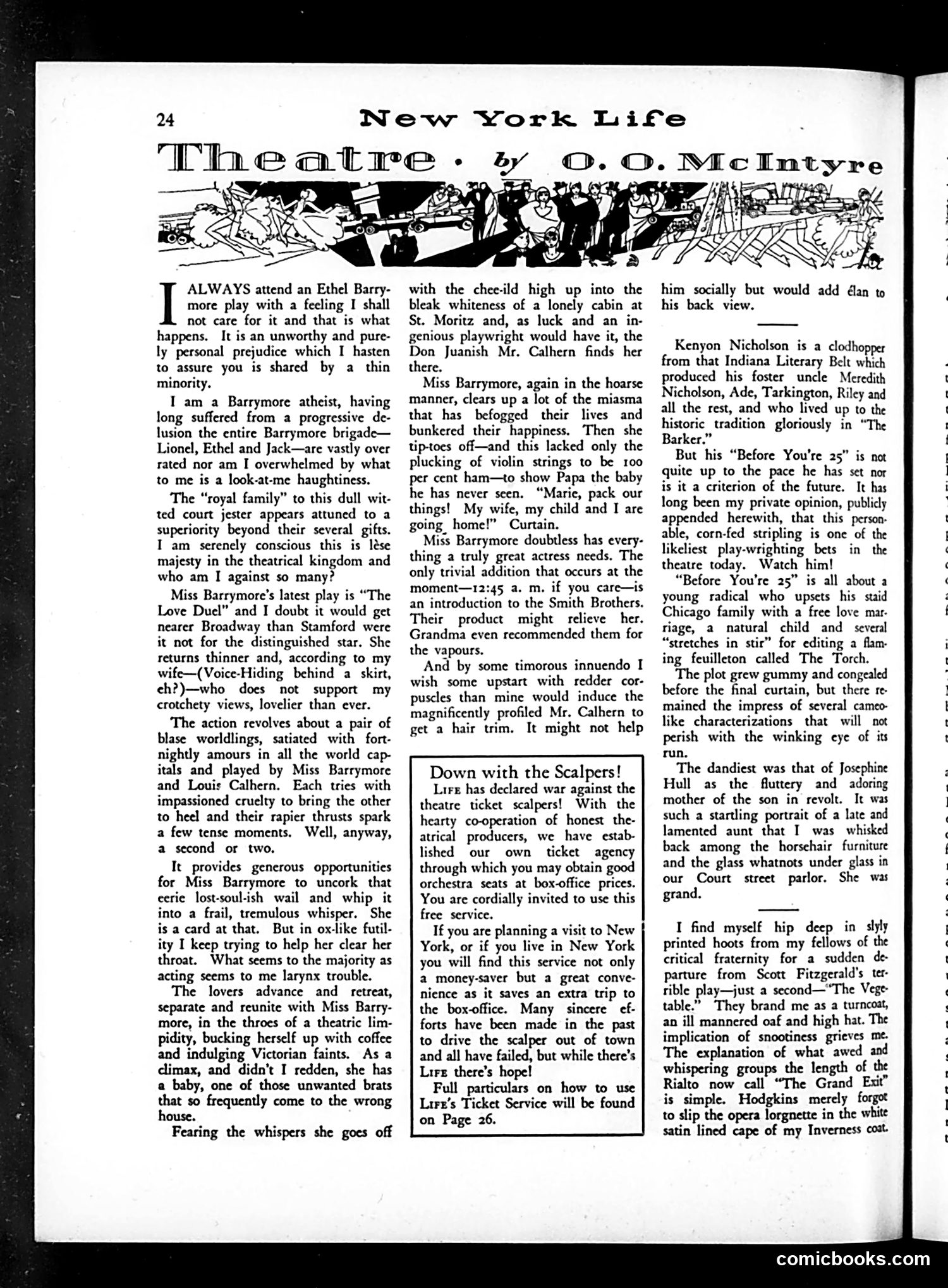
O.O. McIntyre's theater review mocks actress Ethel Barrymore and her play "The Love Duel." McIntyre is a self-described "Barrymore atheist" who dismisses the entire Barrymore acting family (Lionel, Ethel, and Jack) as overrated and pretentious—calling them a "royal family" undeserving of their celebrity worship. His satire targets Barrymore's signature theatrical mannerism: her "eerie lost-soul-ish wail and whip it into a frail, tremulous whisper," which he attributes to laryngitis rather than acting skill. He sarcastically praises Louis Calhern's costar work while mockingly suggesting Calhern needs a haircut. The column also advertises Life magazine's new ticket agency, positioning itself against theater scalpers. McIntyre's acerbic tone—blending personal opinion with theatrical critique—typifies Life's satirical approach to celebrity and entertainment culture of the era.
📄 Transcribed text from this page (OCR, searchable)
Machine-transcribed from the original scan — historical spelling and the odd misread are preserved.
24 New York Life more play with a feeling I shall not care for it and that is what happens. It is an unworthy and pure- ly personal prejudice which I hasten to assure you is shared by a thin minority. I am a Barrymore atheist, having long suffered from a progressive de- lusion the entire Barrymore brigade— Lionel, Ethel and Jack—are vastly over rated nor am I overwhelmed by what to me is a look-at-me haughtiness. The “royal family” to this dull wit- ted court jester appears attuned to a superiority beyond their several gifts. I am serenely conscious this is lése majesty in the theatrical kingdom and who am I against so many? Miss Barrymore's latest play is “The Love Duel” and I doubt it would get nearer Broadway than Stamford were it not for the distinguished star. She returns thinner and, according to my wife—(Voice-Hiding behind a. skirt, eh?)—who does not support my crotchety views, lovelier than ever. The action revolves about a pair of blase worldlings, satiated with fort- nightly amours in all the world cap- itals and played by Miss Barrymore and Louis Calhern. Each tries with impassioned cruelty to bring the other to heel and their rapier thrusts spark a few tense moments. Well, anyway, a second or two. It provides generous opportunities for Miss Barrymore to uncork that eerie lost-soul-ish wail and whip it into a frail, tremulous whisper. She is a card at that. But in ox-like futil- ity I keep trying to help her clear her throat. What seems to the majority as acting seems to me larynx trouble. The lovers advance and retreat, separate and reunite with Miss Barry- more, in the throes of a theatric lim- pidity, bucking herself up with coffee and indulging Victorian faints. As a climax, and didn’t I redden, she has a baby, one of those unwanted brats that so frequently come to the wrong house. Fearing the whispers she goes off I ALWAYS attend an Ethel Barry- with the chee-ild high up into the bleak whiteness of a lonely cabin at St. Moritz and, as luck and an in- genious playwright would have it, the Don Juanish Mr. Calhern finds her there. Miss Barrymore, again in the hoarse manner, clears up a lot of the miasma that has befogged their lives and bunkered their happiness. Then she tip-toes off—and this lacked only the plucking of violin strings to be 100 per cent ham—to show Papa the baby he has never seen. “Marie, pack our things! My wife, my child and I are going home!” Curtain. Miss Barrymore doubtless has every- thing a truly great actress needs. The only trivial addition that occurs at the moment—12:45 a. m. if you care—is an introduction to the Smith Brothers. Their product might relieve her. Grandma even recommended them for the vapours. And by some timorous innuendo I wish some upstart with redder cor- puscles than mine would induce the magnificently profiled Mr. Calhern to get a hair trim. It might not help Down with the Scalpers! Lire has declared war against the theatre ticket scalpers! With the hearty co-operation of honest the- atrical producers, we have estab- lished our own ticket agency through which you may obtain good orchestra seats at box-office prices. You are cordially invited to use this free service. If you are planning a visit to New York, or if you live in New York you will find this service not only a money-saver but a great conve- nience as it saves an extra trip to the box-office. Many sincere ef- forts have been made in the past to drive the scalper out of town and all have failed, but while there's Lire there’s hope! Full particulars on how to use Lire’s Ticket Service will be found on Page 26. him socially but would add an to his back view. Kenyon Nicholson is a clodhopper from that Indiana Literary Belt which produced his foster uncle Meredith Nicholson, Ade, Tarkington, Riley and all the rest, and who lived up to the historic tradition gloriously in “The Barker.” But his “Before You're 25” is not quite up to the pace he has set nor is it a criterion of the future. It has long been my private opinion, publicly appended herewith, that this person- able, corn-fed stripling is one of the likeliest play-wrighting bets in the theatre today. Watch him! “Before You're 25” is all about a young radical who upsets his staid Chicago family with a free love mar- riage, a natural child and several “stretches in stir” for editing a flam- ing feuilleton called The Torch. The plot grew gummy and congealed before the final curtain, but there re mained the impress of several cameo- like characterizations that will not perish with the winking eye of its run. The dandiest was that of Josephine Hull as the fluttery and adoring mother of the son in revolt. It was such a startling portrait of a late and lamented aunt that I was whisked back among the horsehair furniture and the glass whatnots under glass in our Court street parlor. She was grand. I find myself hip deep in slyly printed hoots from my fellows of the critical fraternity for a sudden de- parture from Scott Fitzgerald's ter- rible play—just a second—“The Vege- table.” They brand me as a turncoat, an ill mannered oaf and high hat. The implication of snootiness grieves me. The explanation Ang Cyr whispering grou, ¢ length o! Rialto now ccall’ “The Grand Exit” is simple. Hodgkins merely forgot to slip the opera lorgnette in the white satin lined cape of my Inverness coat. comicbooks.com