
Life, 1929-06-07 · page 30 of 48
Life — June 7, 1929 — page 30: what you’re looking at
What you’re looking at
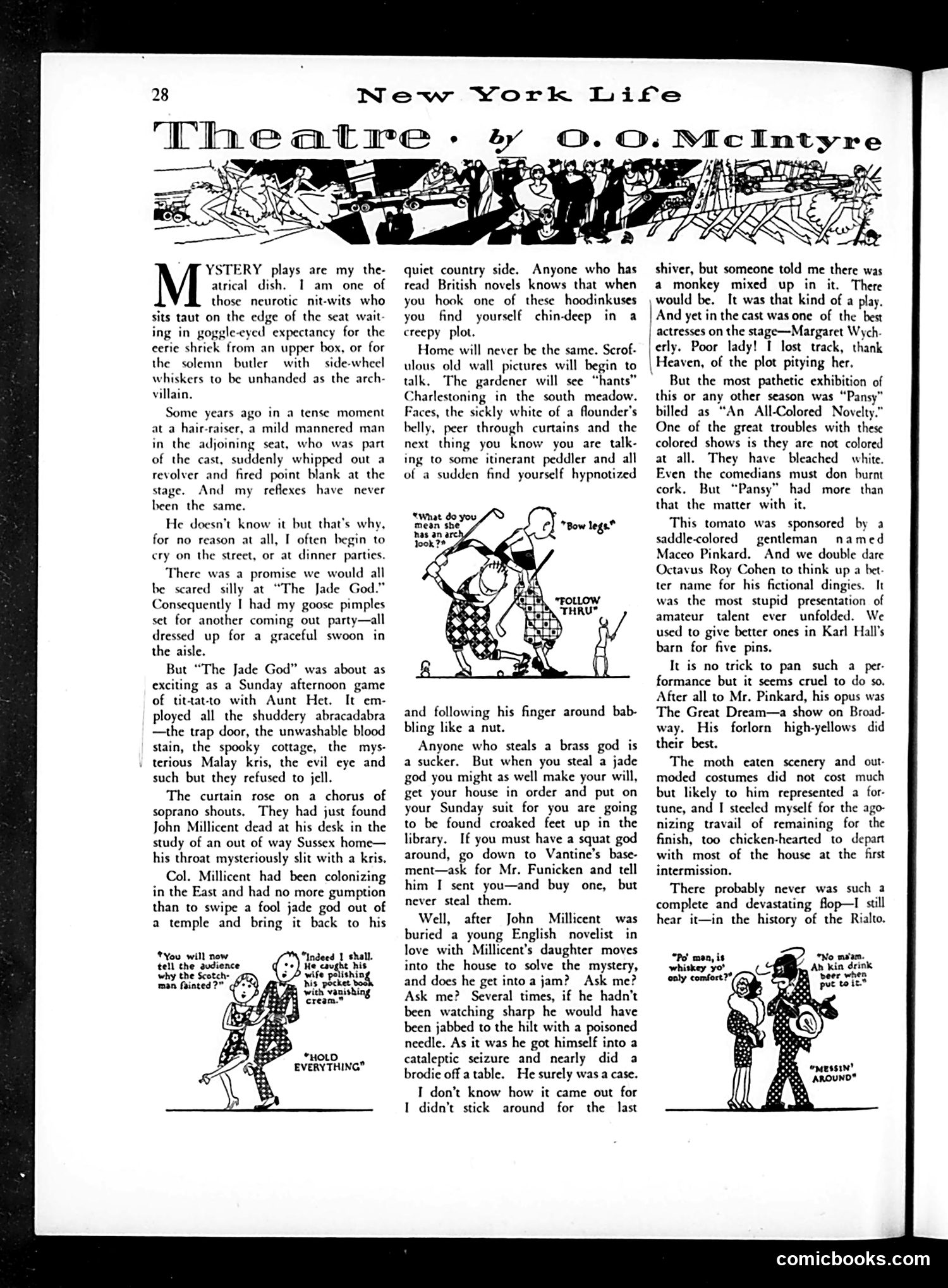
This is a theatre review column by O.O. McIntyre critiquing current Broadway productions. McIntyre satirizes the tired conventions of mystery plays—particularly "The Jade God," which disappoints despite employing all the standard gothic clichés: trap doors, blood stains, spooky cottages, and mysterious daggers (a Malay kris). The column mocks the plot's predictability: stealing a sacred jade idol from a temple triggers supernatural consequences. McIntyre also criticizes "Pansy," billed as an "All-Colored Novelty," for failing authentically—the colored performers wear "bleached white" makeup and burnt cork, suggesting the production lacks genuine African American representation and relies on racist theatrical traditions. The cartoons illustrate McIntyre's comedic asides about theatre-goers' overwrought reactions. McIntyre emerges as a witty observer of Broadway's recycled formulas and entertainment industry compromises.
📄 Transcribed text from this page (OCR, searchable)
Machine-transcribed from the original scan — historical spelling and the odd misread are preserved.
New York Life YSTERY plays are my the- atrical dish. I am one of those neurotic nit-wits who sits taut on the edge of the seat wait ing in yoggle-eyed expectancy for the eerie shrick from an upper box, or for the solemn butler with — side-whcel whiskers to be unhanded as the arch- villain, Some years ago in a tense moment at a hair-raiser, a mild mannered man in the adjoining seat, who was part of the cast, suddenly whipped out a revolver and fired point blank at the stage. And my reflexes have never been the same. He doesn’t know it but that’s why, for no reason at all, I often begin to cry on the street, or at dinner parties. There was a promise we would all be scared silly at “The Jade God.” Consequently | had my goose pimples set for another coming out party—all dressed up for a graceful swoon in the aisle. But “The Jade God” was about as exciting as a Sunday afternoon game of tittatto with Aunt Het. It em- ployed all the shuddery abracadabra —the trap door, the unwashable blood stain, the spooky cottage, the mys- terious Malay kris, the evil eye and such but they refused to jell. The curtain rose on a chorus of soprano shouts. They had just found John Millicent dead at his desk in the study of an out of way Sussex home— his throat mysteriously slit with a kris. Col. Millicent had been colonizing in the East and had no more gumption than to swipe a fool jade god out of a temple and bring it back to his *You will now tell the audience why the Scotch- man fainted?" by O.O.MeIntyre i as | “y 5 quiet country side. Anyone who has read British novels knows that when you hook one of these hoodinkuses you find yourself chin-deep in a creepy plot. Home will never be the same. Scrof- ulous old wall pictures will begin to talk, The gardener will see “hants” Charlestoning in the south meadow. Faces, the sickly white of a flounder’s belly, peer through curtains and the next thing you know you are talk- ing to some itinerant peddler and all of a sudden find yourself hypnotized and following his finger around bab- bling like a nut. Anyone who steals a brass god is a sucker. But when you steal a jade god you might as well make your will, get your house in order and put on your Sunday suit for you are going to be found croaked feet up in the library. If you must have a squat god around, go down to Vantine’s base- ment—ask for Mr. Funicken and tell him I sent you—and buy one, but never steal them. Well, after John Millicent was buried a young English novelist in love with Millicent’s daughter moves into the house to solve the mystery, and does he get intoa jam? Ask me? Ask me? Several times, if he hadn't been watching sharp he would have been jabbed to the hilt with a poisoned needle. As it was he got himself into a cataleptic seizure and nearly did a brodie off a table. He surely was a case. I don’t know how it came out for I didn’t stick around for the last "a shiver, but someone told me there was a monkey mixed up in it. There would be. It was that kind of a play. | And yet in the cast was one of the best | | actresses on the stage—Margaret Wych- erly. Poor lady! [I lost track, thank | Heaven, of the plot pitying her. But the most pathetic exhibition of this or any other season was “Pansy” billed as “An All-Colored Novelty.” One of the great troubles with these colored shows is they are not colored at all, They have bleached white. Even the comedians must don burnt cork, But “Pansy” had more than that the matter with it. This tomato was sponsored by a saddle-colored gentleman named Maceo Pinkard. And we double dare Octavus Roy Cohen to think up a bet- ter name for his fictional dingies. It was the most stupid presentation of amateur talent ever unfolded. We used to give better ones in Karl Hall’s barn for five pins. It is no trick to pan such a per- formance but it seems cruel to do so. After all to Mr. Pinkard, his opus was The Great Dream—a show on Broad- way. His forlorn high-yellows did their best. The moth eaten scenery and out- moded costumes did not cost much but likely to him represented a for- tune, and I steeled myself for the ago- nizing travail of remaining for the finish, too chicken-hearted to depart with most of the house at the first intermission. There probably never was such a complete and devastating flop—I still hear it—in the history of the Rialto. "No er in deinl An kin drial omessin’ ‘AROUNO® comicbooks.com