
Life, 1929-06-07 · page 31 of 48
Life — June 7, 1929 — page 31: what you’re looking at
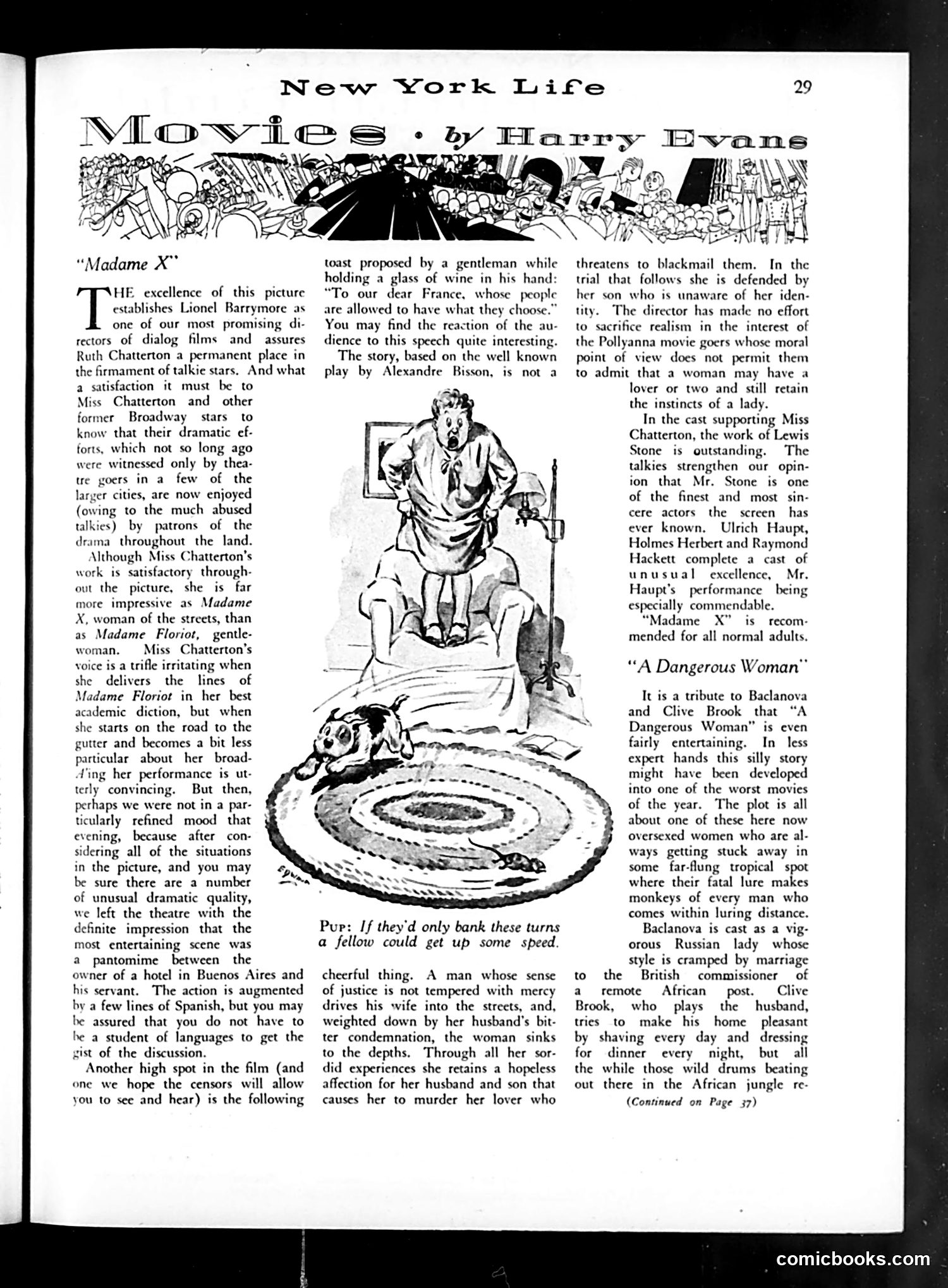
What you’re looking at
This page reviews two films from the early "talkie" era (sound films). **"Madame X"** stars Ruth Chatterton and is directed by Lionel Barrymore. The reviewer praises the film's dramatic realism—it depicts a woman driven to prostitution by her harsh husband, who later defends herself in court without knowing her son is her lawyer. The reviewer notably approves that the film doesn't sanitize this morally complex story for prudish audiences. A highlighted scene shows a humorous pantomime between a Buenos Aires hotel owner and servant, and includes a patriotic toast to France's freedoms. **"A Dangerous Woman"** stars Baclanova and Clive Brook. The reviewer dismisses this as a "silly story" about an "oversexed woman" stranded in a tropical location—apparently a well-worn plot device. The review suggests only skilled performers like Brook and Baclanova prevent it from being terrible. Both reviews reflect 1920s attitudes about cinema's moral content and the novelty of sound films featuring Broadway actors.
📄 Transcribed text from this page (OCR, searchable)
Machine-transcribed from the original scan — historical spelling and the odd misread are preserved.
New York Life “Madame X” r | NHE excellence of this picture establishes Lionel Barrymore as one of our most promising di- rectors of dialog films and assures Ruth Chatterton a permanent place in the firmament of talkie stars. And what a satisfaction it must be to Miss Chatterton and other former Broadway stars to know that their dramatic ef- forts, which not so long ago were witnessed only by thea- tre goers in a few of the larger cities, are now enjoyed (owing to the much abused talkies) by patrons of the drama throughout the land. \lthough Miss Chatterton’s work is satisfactory through- out the picture, she is far more impressive as Madame X, woman of the streets, than as Madame Floriot, gentle- woman. Miss Chatterton’s voice is a trifle irritating when she delivers the lines of Madame Floriot in her best academic diction, but when she starts on the road to the gutter and becomes a bit less particular about her broad- ding her performance is ut- terly convincing. But then, perhaps we were not in a par- ticularly refined mood that evening, because after con- sidering all of the situations in the picture, and you may be sure there are a number of unusual dramatic quality, we left the theatre with the definite impression that the most entertaining scene was a pantomime between the owner of a hotel in Buenos Aires and his servant. The action is augmented by a few lines of Spanish, but you may be assured that you do not have to he a student of languages to get the gist of the discussion. Another high spot in the film (and one we hope the censors will allow you to see and hear) is the following byY Fia toast proposed by a gentleman while holding a glass of wine in his hand: “To our dear France, whose people are allowed to have what they choose.” You may find the reaction of the au- dience to this speech quite interesting. The story, based on the well known play by Alexandre Bisson, is not a Pur: [If they'd only bank these turns a fellow could get up some speed. cheerful thing. A man whose sense of justice is not tempered with mercy drives his wife into the streets, and, weighted down by her husband's bit- ter condemnation, the woman sinks to the depths. Through all her sor- did experiences she retains a hopeless affection for her husband and son that causes her to murder her lover who 29 rry Hwans LANs | threatens to blackmail them. In_ the trial that follows she is defended by her son who is unaware of her iden- tity. The director has made no effort to sacrifice realism in the interest of the Pollyanna movie goers whose moral point of view does not permit them to admit that a woman may have a lover or two and still retain the instincts of a lady. In the cast supporting Miss Chatterton, the work of Lewis Stone is outstanding. The talkies strengthen our opin- ion that Mr. Stone is one of the finest and most sin- cere actors the screen has ever known, Ulrich Haupt, Holmes Herbert and Raymond Hackett complete a cast of unusual excellence, Mr. Haupt’s performance being especially commendable. “Madame X” is recom- mended for all normal adults. “A Dangerous Woman" Tt is a tribute to Baclanova and Clive Brook that “A Dangerous Woman” is even fairly entertaining. In less expert hands this silly story might have been developed into one of the worst movies of the year. The plot is all about one of these here now oversexed women who are al- ways getting stuck away in some far-flung tropical spot where their fatal lure makes monkeys of every man who comes within luring distance. Baclanova is cast as a vig- orous Russian lady whose style is cramped by marriage British commissioner of African post. Clive Brook, who plays the husband, tries to make his home pleasant by shaving every day and dressing for dinner every night, but all the while those wild drums beating out there in the African jungle re- (Continued on Page 37) to the a remote comicbooks.com