
Life, 1929-06-07 · page 41 of 48
Life — June 7, 1929 — page 41: what you’re looking at
What you’re looking at
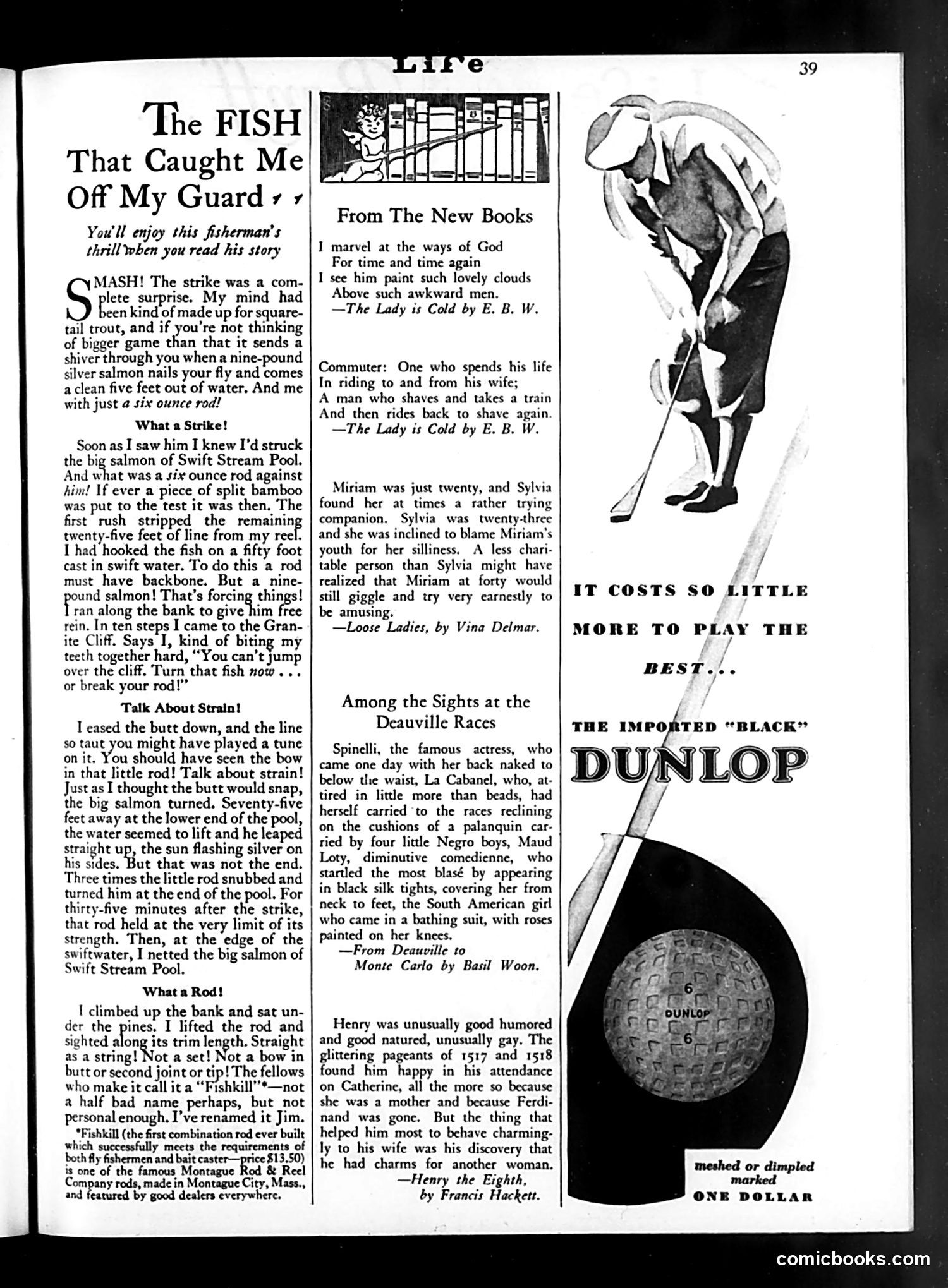
This is primarily a **fishing advertisement disguised as editorial content**—a common Life magazine format of the 1920s-30s. The main story, "The Fish That Caught Me Off My Guard," is a dramatic first-person fishing narrative that builds tension around landing a nine-pound salmon with a supposedly fragile rod. The payoff is subtle product placement: the unnamed "Fishkill" rod (actually a Montague brand) performed flawlessly under extreme strain, proving its quality. The right column contains **literary excerpts and gossipy society items**—typical Life filler showcasing contemporary novels and scandalous European high-society behavior (actresses at the Deauville Races appearing semi-nude or in provocative outfits). The **Dunlop golf ball advertisement** (bottom right) is straightforward product marketing. The implicit message: this magazine appeals to affluent, sporting gentlemen interested in quality equipment, literature, and society gossip. The fishing story validates the Montague rod through narrative rather than direct claims—a subtle advertising technique.
📄 Transcribed text from this page (OCR, searchable)
Machine-transcribed from the original scan — historical spelling and the odd misread are preserved.
"The FISH That Caught Me Off My Guard 7 » You'll enjoy this fisherman's thrill when you read his story lete surprise. My mind had n kind of made up for square- tail trout, and if you're not thinking of bigger game than that it sends a shiver through you when a nine-pound silver salmon nails your fly and comes aclean five feet out of water. And me with just @ six ounce rod! What a Strike! Soon as I saw him I knew I'd struck the big salmon of Swift Stream Pool. And what was a six ounce rod against him! If ever a piece of split bamboo was put to the test it was then. The first rush stripped the remainin; twenty-five feet of line from my reel. I had hooked the fish on a fifty foot cast in swift water. To do this a rod must have backbone. But a_nine- pound salmon! That's forcing things! ran along the bank to give him free rein. In ten steps I came to the Gran- ite Cliff. Says I, kind of biting my teeth together hard, “You can’t jump over the cliff. Turn that fish now... or break your rod!”’ Talk About Strain! I eased the butt down, and the line so taut you might have played a tune on it. You should have seen the bow in that little rod! Talk about strain! Just as I thought the butt would snap, the big salmon turned. Seventy-five feet away at the lower end of the pool, the water seemed to lift and he leaped straight up, the sun flashing silver on his sides. But that was not the end. Three times the little rod snubbed and turned him at the end of the pool. For thirty-five minutes after the strike, that rod held at the very limit of its strength. Then, at the edge of the swiftwater, I netted the big salmon of Swift Stream Pool. What a Rod! ' climbed up the bank and sat un- der the pines. I lifted the rod and sighted al ong its trim length. Straight as a string! Not a set! Not a bow in butt or second joint or tip! The fellows who make it call it a ““Fishkill”*—not a half bad name perhaps, but not personal enough. I’ve renamed it Jim. “Fishkill (the first combination rod ever built which successfully meets the requirements of both fly fishermen and bait caster—price $13.50) is one of the famous Montague Rod & Reel Company rods, made in Montague City, Mass., and featured by good dealers everywhere. Sie: The strike was a com- From The New Books I marvel at the ways of God For time and time again I sce him paint such lovely clouds Above such awkward men. —The Lady is Cold by E. B. W. Commuter: One who spends his life In riding to and from his wife; A man who shaves and takes a train And then rides back to shave again. —The Lady is Cold by E. B. W. Miriam was just twenty, and Sylvia found her at times a rather trying companion. Sylvia was twenty-three and she was inclined to blame Miriam's youth for her silliness. A less chari- table person than Sylvia might have realized that Miriam at forty would still giggle and try very earnestly to be amusing. —Loose Ladies, by Vina Delmar. Among the Sights at the Deauville Races Spinelli, the famous actress, who came one day with her back naked to below the waist, La Cabanel, who, at- tired in little more than beads, had herself carried ‘to the races reclining on the cushions of a palanquin car- tied by four little Negro boys, Maud Loty, diminutive comedienne, who startled the most blasé by appearing in black silk tights, covering her from neck to feet, the South American girl who came in a bathing suit, with roses painted on her knees. —From Deauville to Monte Carlo by Basil Woon. Henry was unusually good humored and good natured, unusually gay. The glittering pageants of 1517 and 1518 found him happy in his attendance on Catherine, all the more so because she was a mother and because Ferdi- nand was gone. But the thing that helped him most to behave charming- ly to his wife was his discovery that he had charms for another woman. —Henry the Eighth, by Francis Hackett. / IT COSTS SO LITTLE MORE TO PLAY THE BEST... THE IMPORTED “BLACK” meshed or dimpled marked ONE DOLLAR comicbooks.com