
Life, 1929-06-21 · page 15 of 40
Life — June 21, 1929 — page 15: what you’re looking at
What you’re looking at
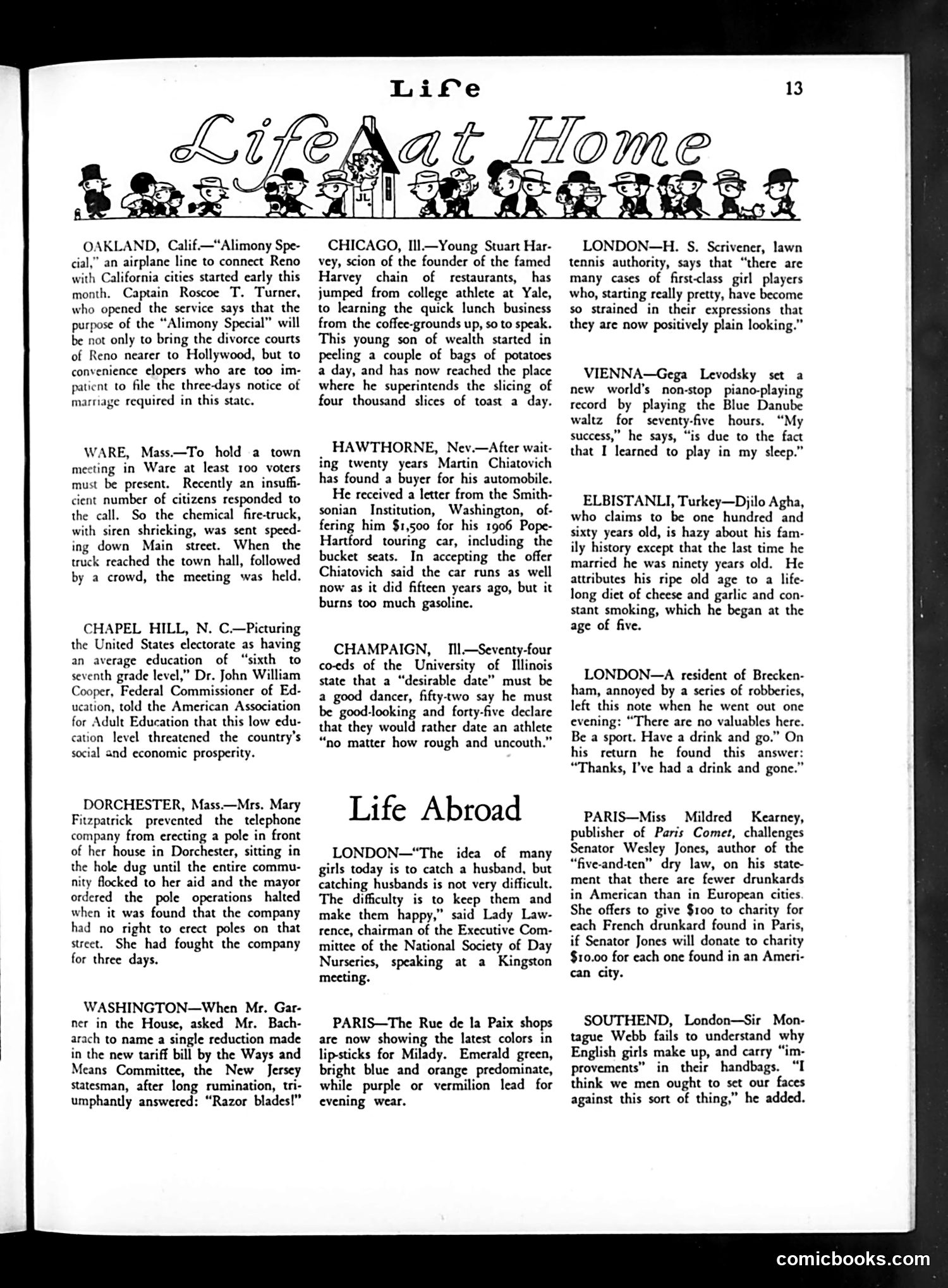
This page from *Life* magazine contains brief humorous anecdotes rather than political cartoons. The header illustration shows a row of stylized figures in formal dress. The "Life at Home" section offers American domestic humor: an airline service connecting California cities, a wealthy Chicago heir learning the restaurant business by making toast, a Massachusetts town requiring all voters present for meetings, and commentary on tariff negotiations. The "Life Abroad" section includes observations about British courtship customs, French fashion trends, and an Irishman's longevity attributed to diet and smoking. The satire is gentle and social rather than sharply political—poking fun at business inexperience, bureaucratic procedures, and cultural differences between nations. The humor reflects 1920s-era American attitudes toward wealth, European customs, and modernity.
📄 Transcribed text from this page (OCR, searchable)
Machine-transcribed from the original scan — historical spelling and the odd misread are preserved.
OAKLAND, Calif—‘Alimony Spe- cial,” an airplane line to connect Reno with California cities started early this month. Captain Roscoe T. Turner, who opened the service says that the purpose of the “Alimony Special” will be not only to bring the divorce courts of Reno nearer to Hollywood, but to convenience elopers who are too im- patient to file the three-days notice of marriage required in this statc. WARE, Mass.—To hold a town meeting in Ware at least 100 voters must be present. Recently an insuffi- cient number of citizens responded to the call. So the chemical fire-truck, with siren shrieking, was sent speed- ing down Main street. When the truck reached the town hall, followed by a crowd, the meeting was held. CHAPEL HILL, N. C.—Picturing the United States electorate as having an average education of “sixth to seventh grade level,” Dr. John William Cooper, Federal Commissioner of Ed- ucation, told the American Association for Adult Education that this low edu- cation level threatened the country’s social and economic prosperity. DORCHESTER, Mass.——Mrs. Mary Fitzpatrick prevented the telephone company from erecting a pole in front of her house in Dorchester, sitting in the hole dug until the entire commu- nity flocked to her aid and the mayor ordered the pole operations halted when it was found that the company had no right to erect poles on that street. She had fought the company for three days. WASHINGTON—When Mr. Gar- ner in the House, asked Mr. Bach- arach to name a single reduction made in the new tariff bill by the Ways and Means Committee, the New Jersey statesman, after long rumination, tri- umphandy answered: “Razor blades!” CHICAGO, Ill—Young Stuart Har- vey, scion of the founder of the famed Harvey chain of restaurants, has jumped from college athlete at Yale, to learning the quick lunch business from the coffee-grounds up, so to speak. This young son of wealth started in peeling a couple of bags of potatoes a day, and has now reached the place where he superintends the slicing of four thousand slices of toast a day. HAWTHORNE, Nev.—After wait- ing twenty years Martin Chiatovich has found a buyer for his automobile. He received a letter from the Smith- sonian Institution, Washington, of- fering him $1,500 for his 1906 Pope- Hartford touring car, including the bucket seats. In accepting the offer Chiatovich said the car runs as well now as it did fifteen years ago, but it burns too much gasoline. CHAMPAIGN, _ IIl.—Seventy-four co-eds of the University of Illinois state that a “desirable date” must be a good dancer, fifty-two say he must be good-looking and forty-five declare that they would rather date an athlete “no matter how rough and uncouth.” Life Abroad LONDON—“The idea of many girls today is to catch a husband, but catching husbands is not very difficult. The difficulty is to keep them and make them happy,” said Lady Law- rence, chairman of the Executive Com- mittee of the National Society of Day Nurseries, speaking at a Kingston meeting. PARIS—The Rue de la Paix shops are now showing the latest colors in lip-sticks for Milady. Emerald green, bright blue and orange predominate, while purple or vermilion lead for evening wear. LONDON—H. S. Scrivener, lawn tennis authority, says that “there are many cases of first-class girl players who, starting really pretty, have become so strained in their expressions that they are now positively plain looking.” VIENNA—Gega Levodsky set a new world’s non-stop piano-playing record by playing the Blue Danube waltz for seventy-five hours. “My success,” he says, “is due to the fact that I learned to play in my sleep.” ELBISTANLI, Turkey—Djilo Agha, who claims to be one hundred and sixty years old, is hazy about his fam- ily history except that the last time he married he was ninety years old. He attributes his ripe old age to a life- long diet of cheese and garlic and con- stant smoking, which he began at the age of five. LONDON-—A resident of Brecken- ham, annoyed by a series of robberies, left this note when he went out one evening: “There are no valuables here. Be a sport. Have a drink and go.” On his return he found this answer: “Thanks, I’ve had a drink and gone.” PARIS—Miss Mildred Kearney, publisher of Paris Comet, challenges Senator Wesley Jones, author of the “five-and-ten” dry law, on his state- ment that there are fewer drunkards in American than in European cities She offers to give $100 to charity for each French drunkard found in Paris, if Senator Jones will donate to charity $10.00 for each one found in an Ameri- can city. SOUTHEND, London—Sir Mon- tague Webb fails to understand why English girls make up, and carry “im- provements” in their handbags. “I think we men ought to set our faces against this sort of thing,” he added. comicbooks.com