
A complete issue · 40 pages · 1929
Life — June 21, 1929
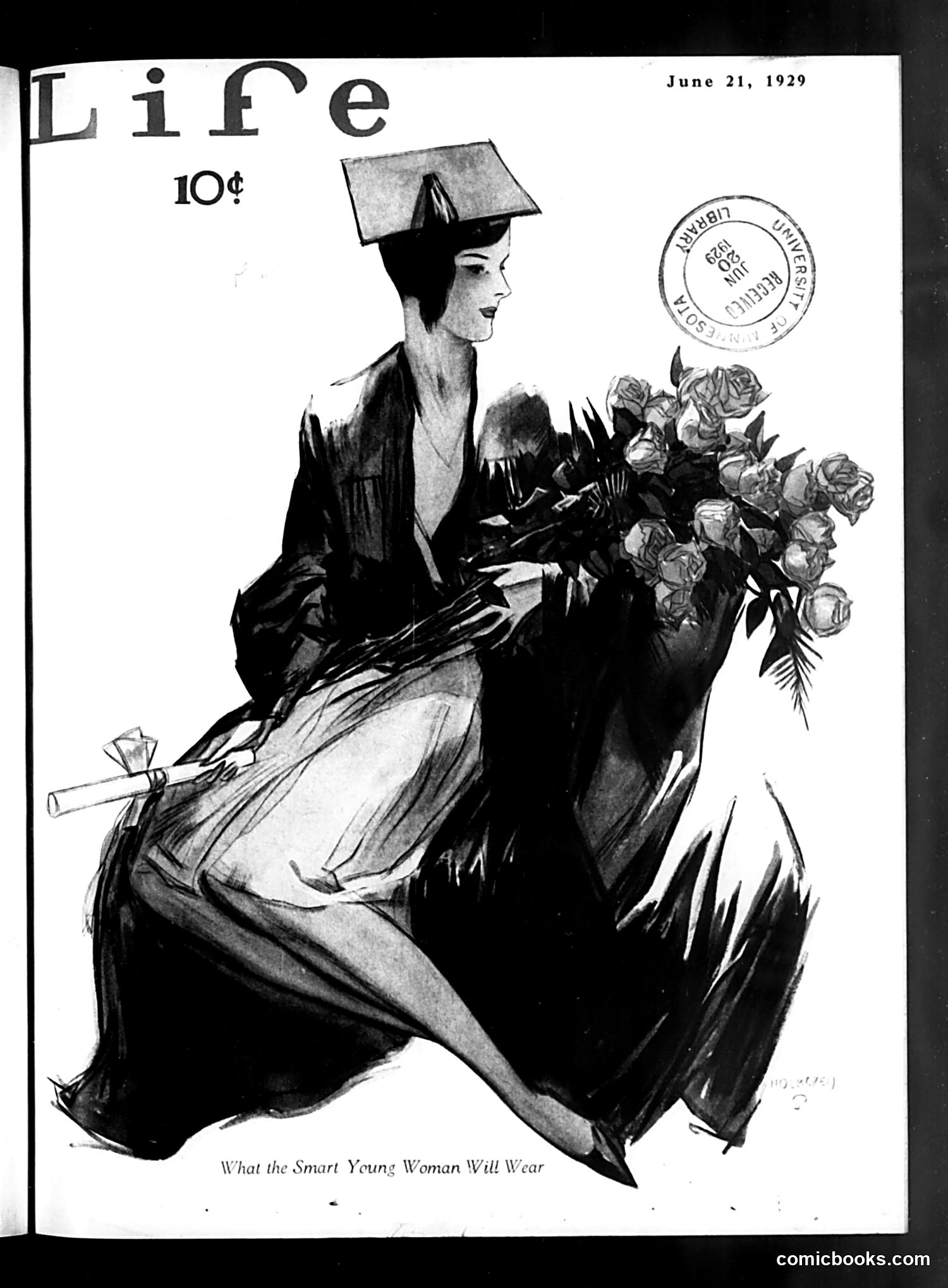
This is a fashion cover illustration rather than political satire. The caption "What the Smart Young Woman Will Wear" indicates it's a style commentary for contemporary readers. The drawing depicts a fashionable woman in 1920s attire: a geometric, architectural hat (characteristic of late-1920s design), a dark jacket with dramatic styling, and a flowing skirt. She carries roses and what appears to be a diploma or scroll, suggesting the "smart young woman" is both educated and fashionable. This reflects the "flapper" era and post-suffrage women's culture—when women gained voting rights (1920) and greater social freedom. The illustration celebrates modern, independent femininity for the emerging generation. The 10¢ price tag indicates this was affordable popular media aimed at middle-class audiences.
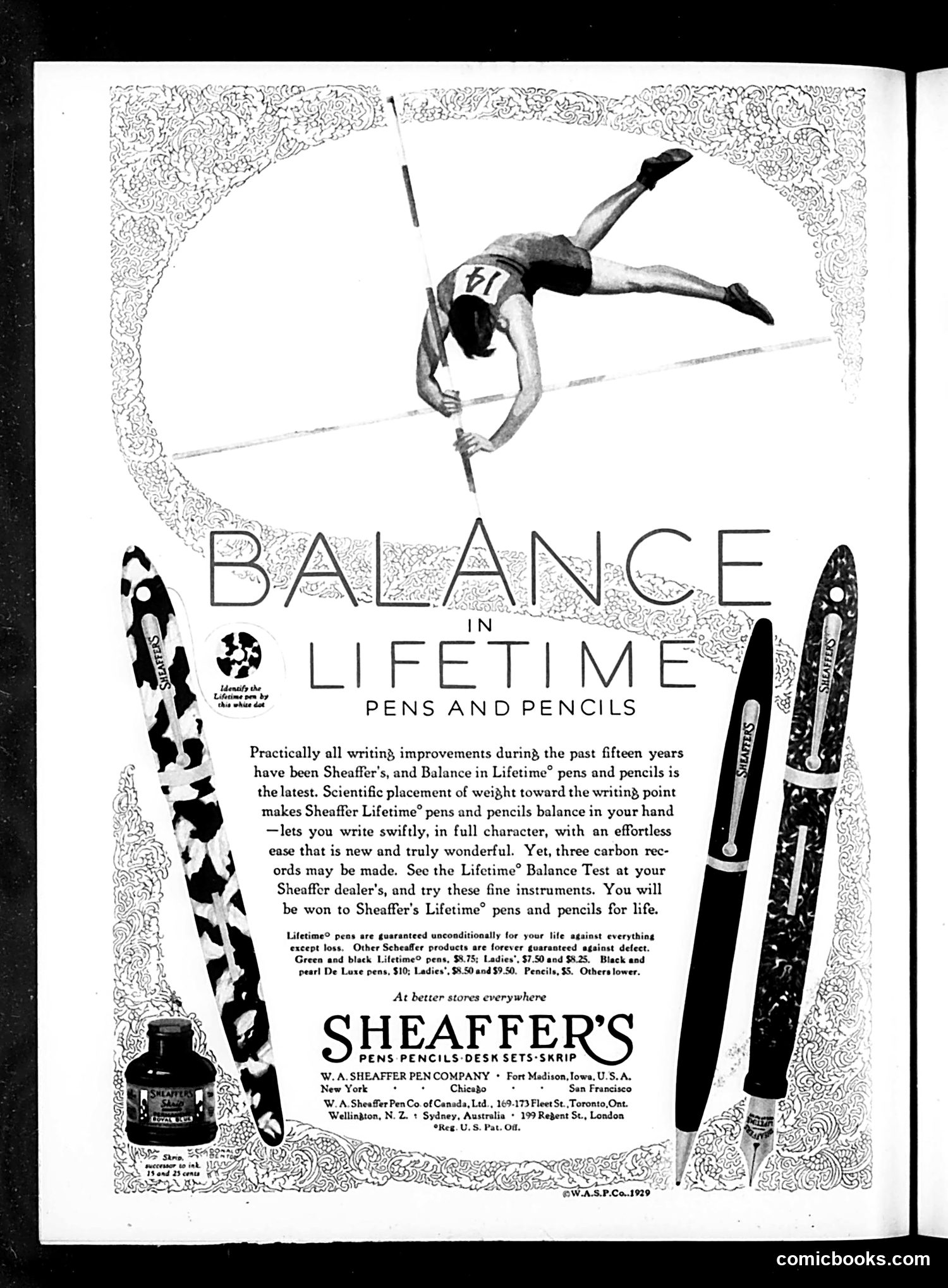
This is a **Sheaffer's pen advertisement**, not political satire. The page promotes "Balance in Lifetime" pens and pencils through an athletic metaphor. The central image shows a diver in mid-air performing a balanced handstand dive, wearing a competition number. This illustrates the advertisement's core claim: that Sheaffer pens achieve perfect weight distribution toward the writing point, allowing users to "write swiftly, in full character, with an effortless ease." The ornamental border and stylized fountain pens on either side were typical 1920s design elements. The bottom notes Sheaffer's lifetime guarantee and lists prices and retail locations across America and internationally. For modern readers: this represents how early 20th-century advertising used athletic achievement and physical balance as metaphors for product quality.
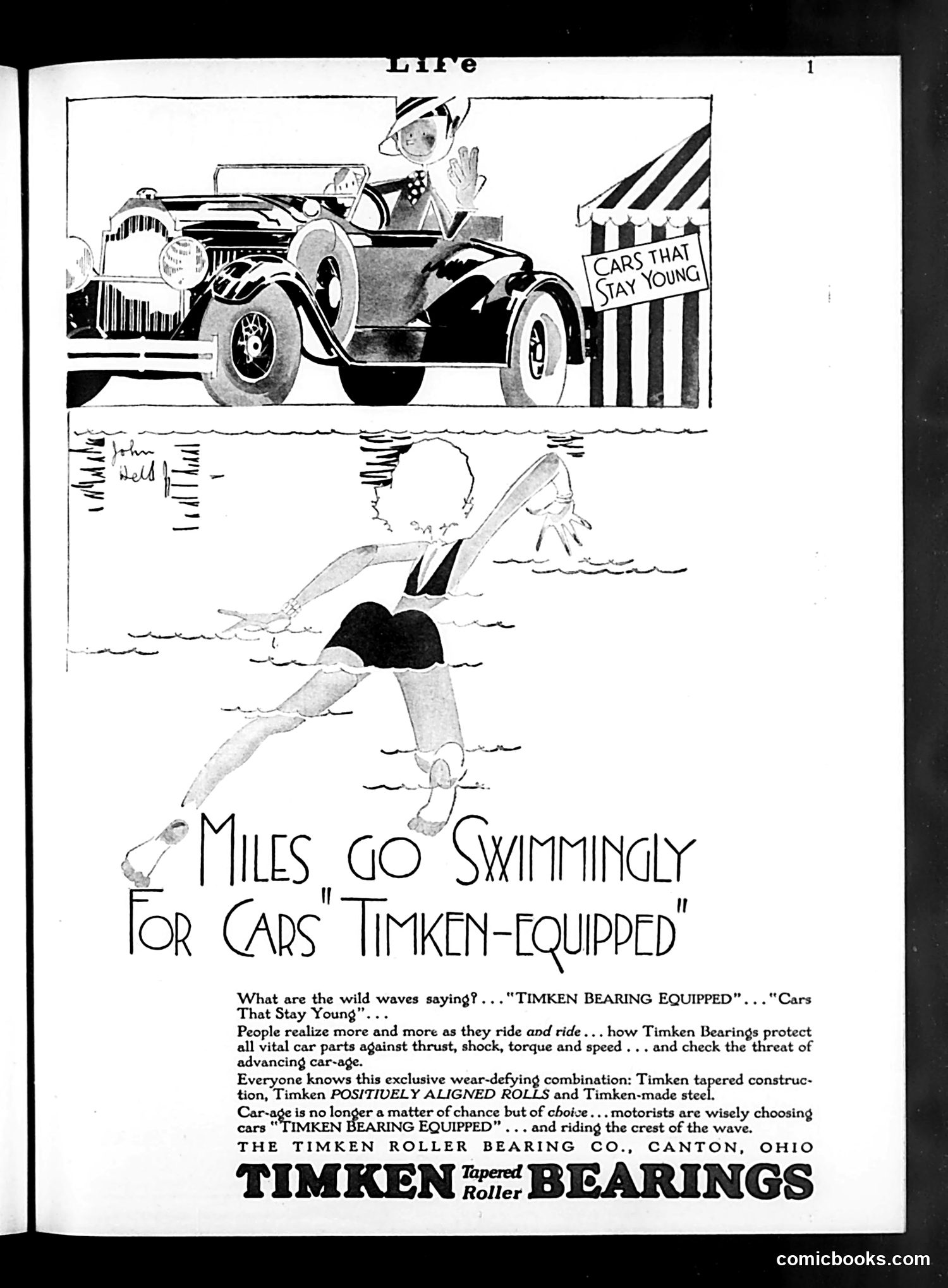
This is primarily **advertising content**, not political satire. The page promotes Timken tapered roller bearings for automobiles. The visual joke contrasts two scenarios: the top panel shows a car with happy occupants passing a roadside sign ("Cars That Stay Young"), while the bottom panel depicts a swimmer doing the crawl stroke, captioned "Miles Go Swimmingly For Cars 'Timken-Equipped.'" The pun plays on "swimming" (moving smoothly through water) to suggest that Timken-bearing-equipped cars move smoothly and effortlessly, like a skilled swimmer. The ad copy claims these bearings protect vital car parts against wear and age, allowing vehicles to remain youthful performers. This reflects early-20th-century automotive advertising's emphasis on mechanical reliability and longevity.
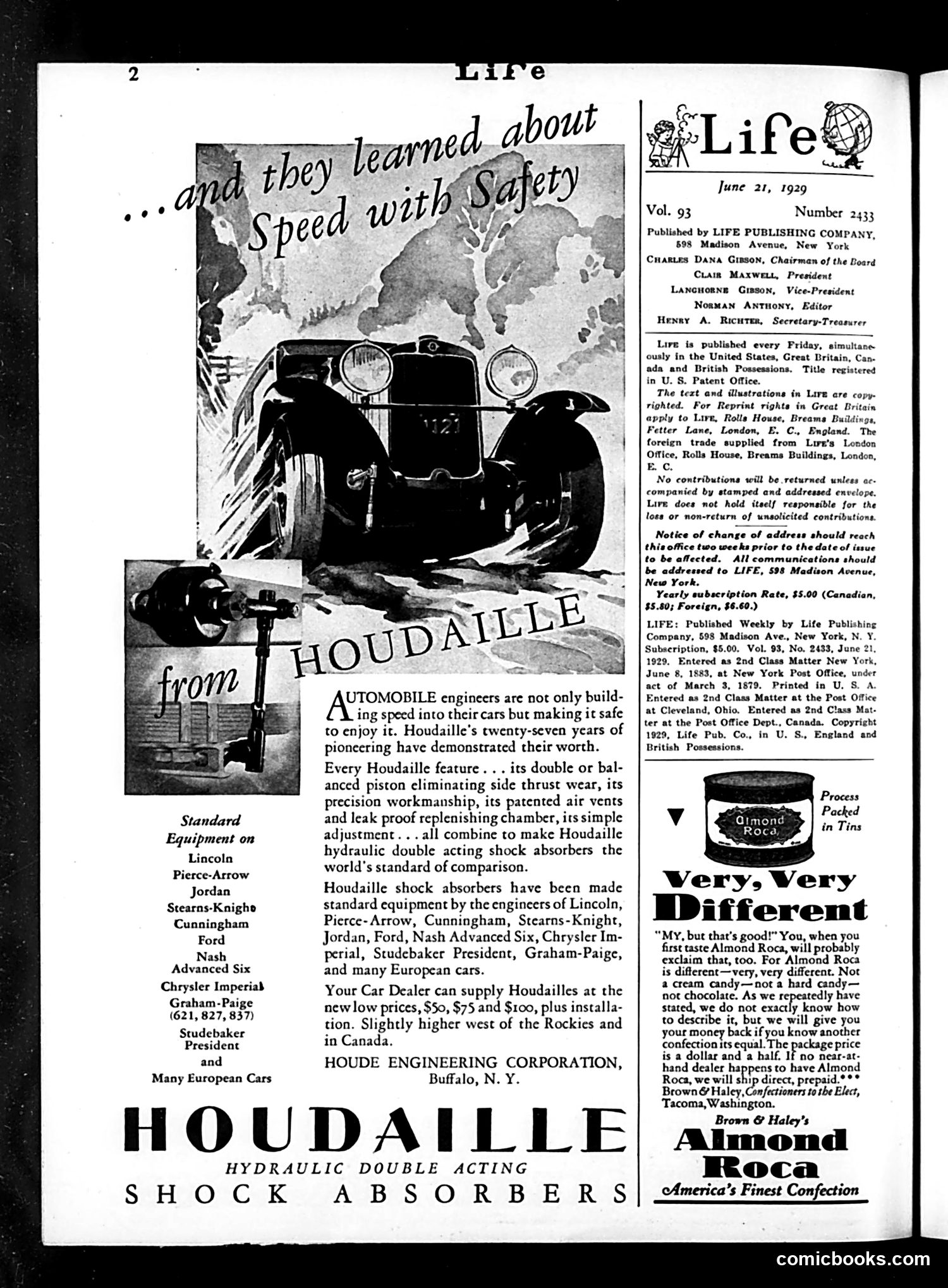
This page is predominantly **advertising**, not satire or political commentary. The main content advertises **Houdaille shock absorbers** for automobiles. The large illustration shows a dramatic car navigating a mountain road with the caption "...and they learned about Speed with Safety from HOUDAILLE." The advertisement emphasizes Houdaille's engineering features—double-balanced pistons, precision workmanship, and hydraulic shock absorbers—claiming these make vehicles both fast and safe. It lists major automobile manufacturers (Lincoln, Chrysler, Nash, etc.) that used Houdaille equipment as "standard." A secondary ad promotes **Brown & Haley's Almond Roca** candy as "America's Finest Confection." There is no political satire present. The page reflects 1929 consumer marketing targeting car buyers and candy consumers.
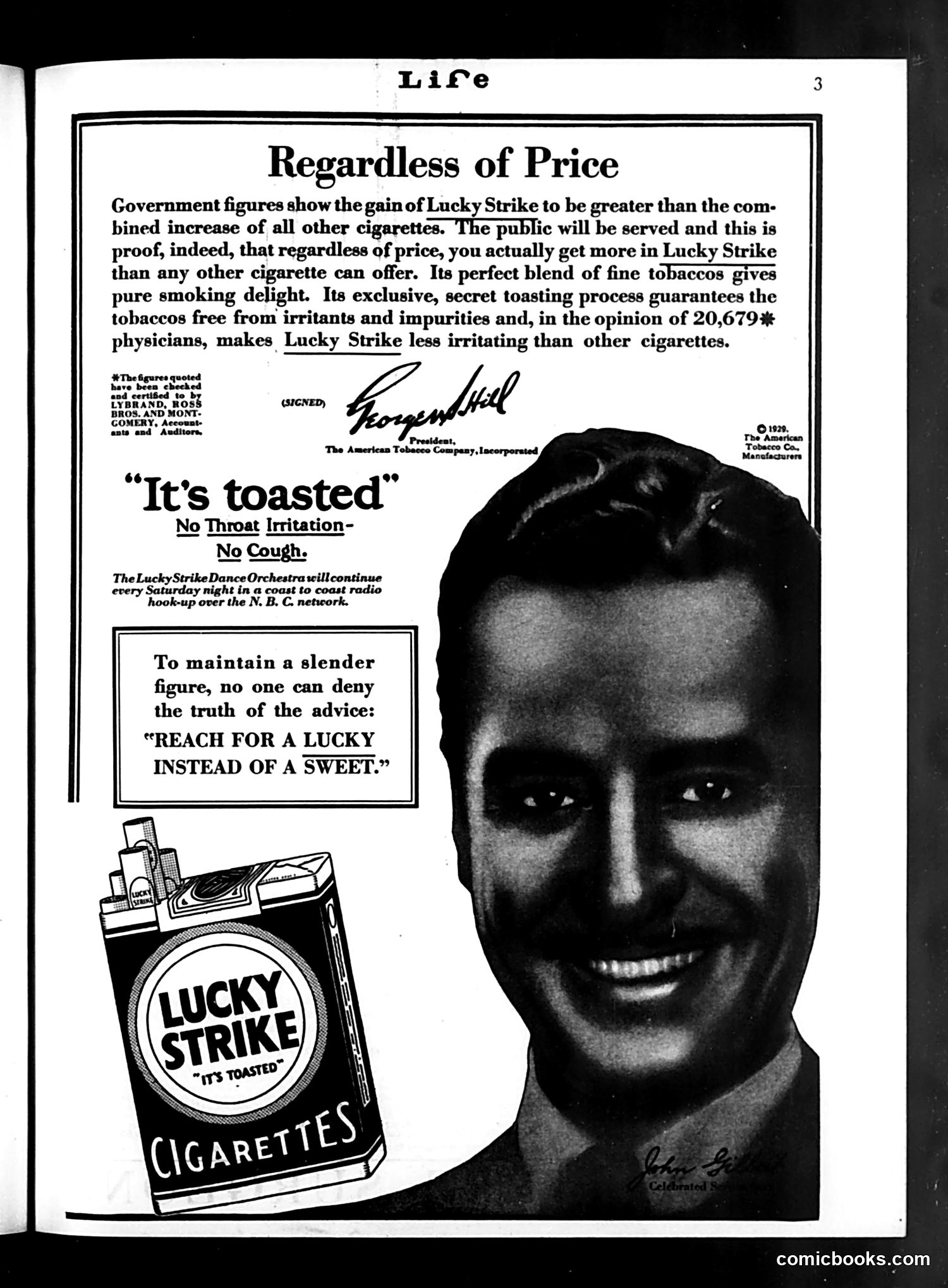
This is primarily a **cigarette advertisement**, not satire. The page promotes Lucky Strike cigarettes from The American Tobacco Company, dated 1929. The advertisement makes several now-notorious health claims: that Lucky Strike cigarettes are "less irritating than other cigarettes" and endorsed by "20,679 physicians." It prominently features the slogan "It's toasted" (their claimed unique process) and includes the infamous tagline "Reach for a Lucky instead of a sweet"—targeting women concerned about weight. The large photograph shows a smiling man (likely an entertainer or public figure of the era, though not identified here). For modern readers: this exemplifies pre-regulation tobacco marketing that made unsubstantiated health claims and explicitly marketed cigarettes as weight-loss aids—practices now recognized as deceptive and prohibited.
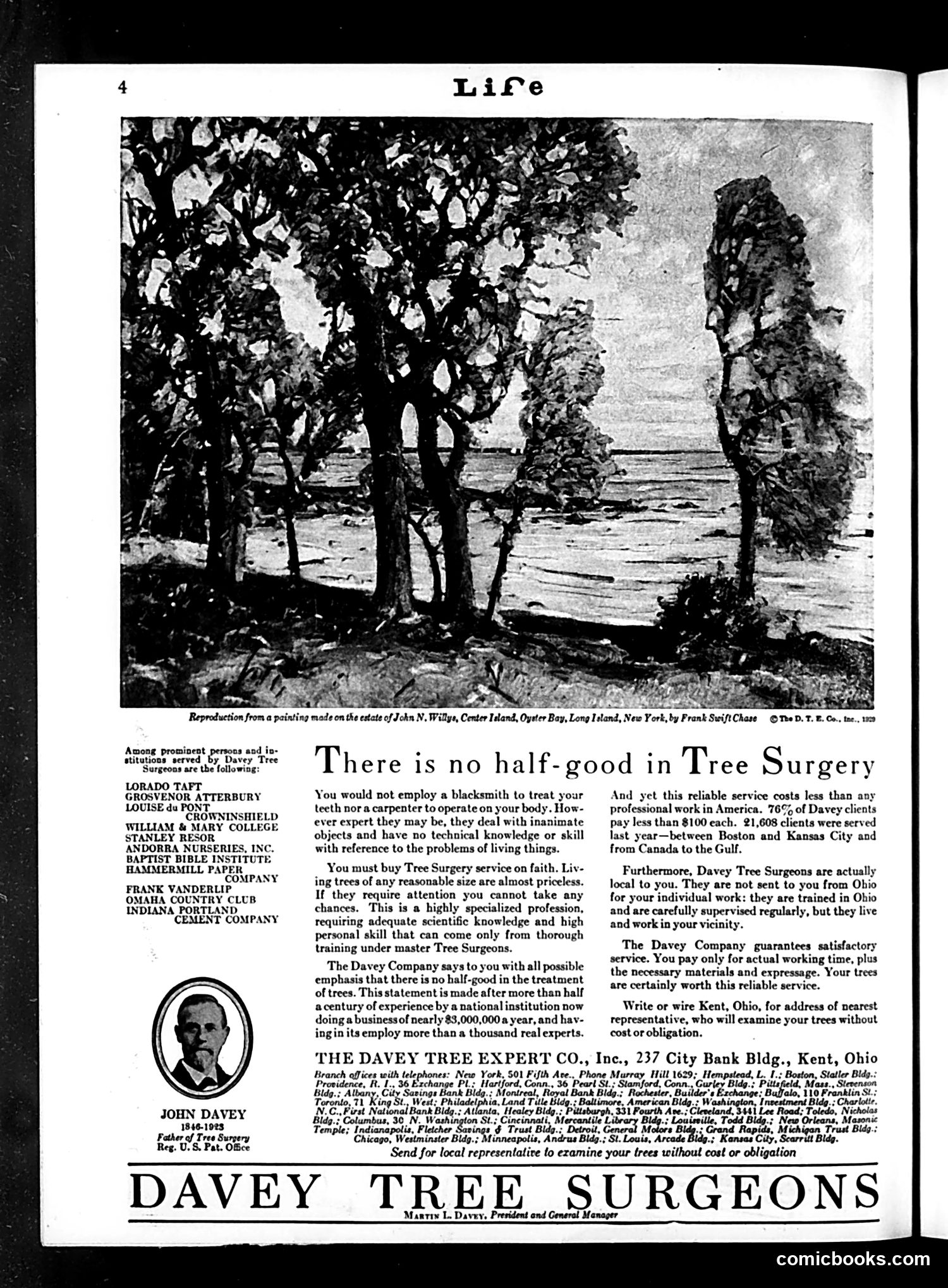
This page is **primarily an advertisement**, not satirical content. It promotes "Davey Tree Surgeons," a tree care company, featuring a photograph of trees beside water and a portrait of founder John Davey (1848-1925). The advertisement's rhetorical strategy uses a quasi-satirical framing—the headline "There is no half-good in Tree Surgery" positions professional arboriculture as a serious, skilled trade requiring expertise comparable to medicine or blacksmithing. This appears designed to legitimize and professionalize tree care as a service. The text emphasizes that Davey's company employs trained specialists, operates across multiple regions (Canada to the Gulf), guarantees satisfaction, and charges only for actual work performed. There is no political satire or social commentary evident on this page—it is straightforward commercial advertising from the early 20th century.
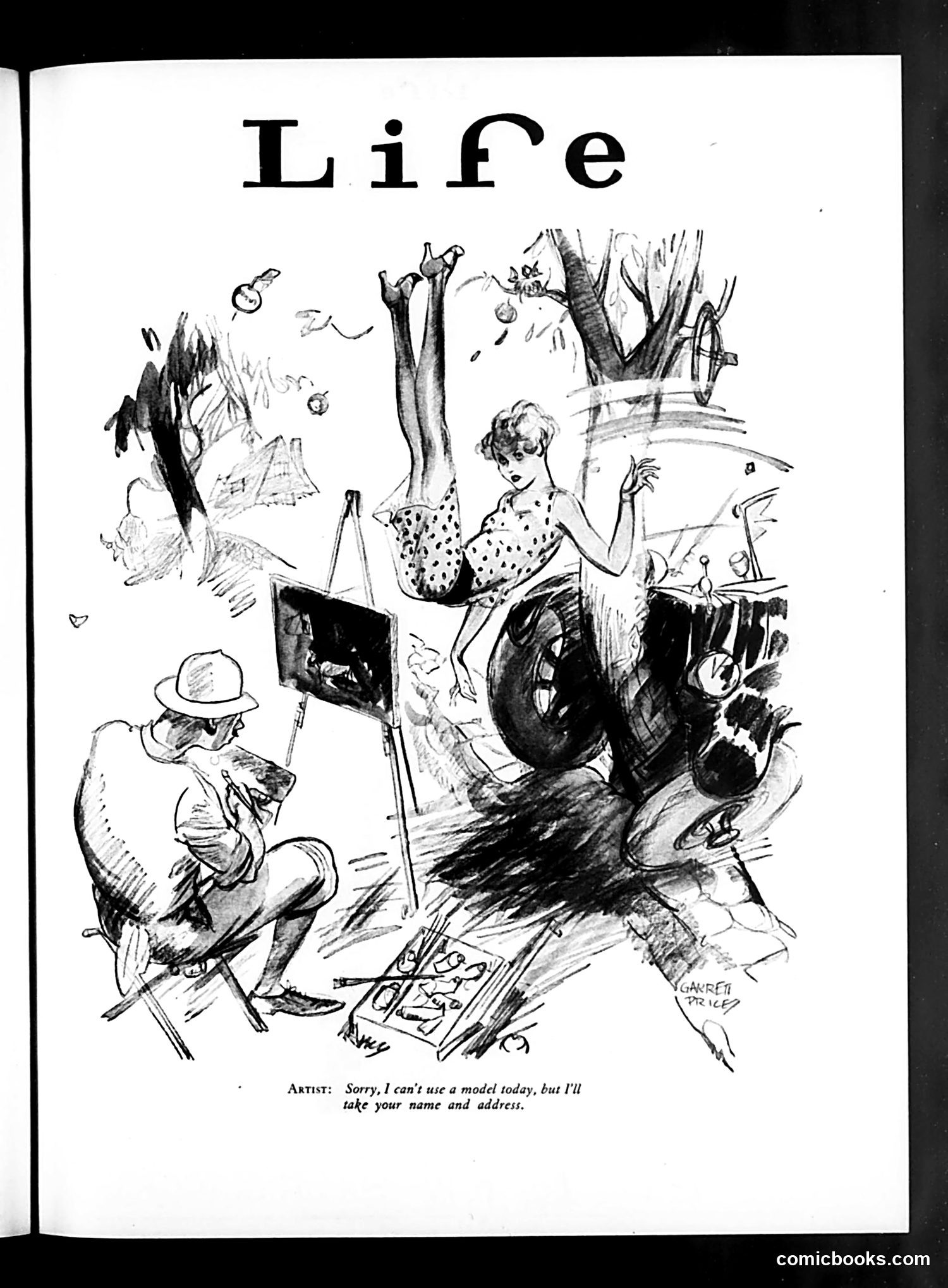
This cartoon satirizes the artistic profession, specifically the practice of artists using live models. The scene shows an artist (lower left, wearing a hat) sketching or painting a young woman posed on a stool in what appears to be a studio setting, surrounded by artistic equipment and sketches. The caption's joke is that the artist tells the woman he cannot use her as a model today, but will take her name and address—implying he's interested in her romantically rather than professionally. This is satirical commentary on the stereotype of male artists attempting to seduce women under the pretense of needing models, or using modeling as a pretext for romantic advances. The cartoon mocks both artistic pretension and opportunistic behavior toward women.
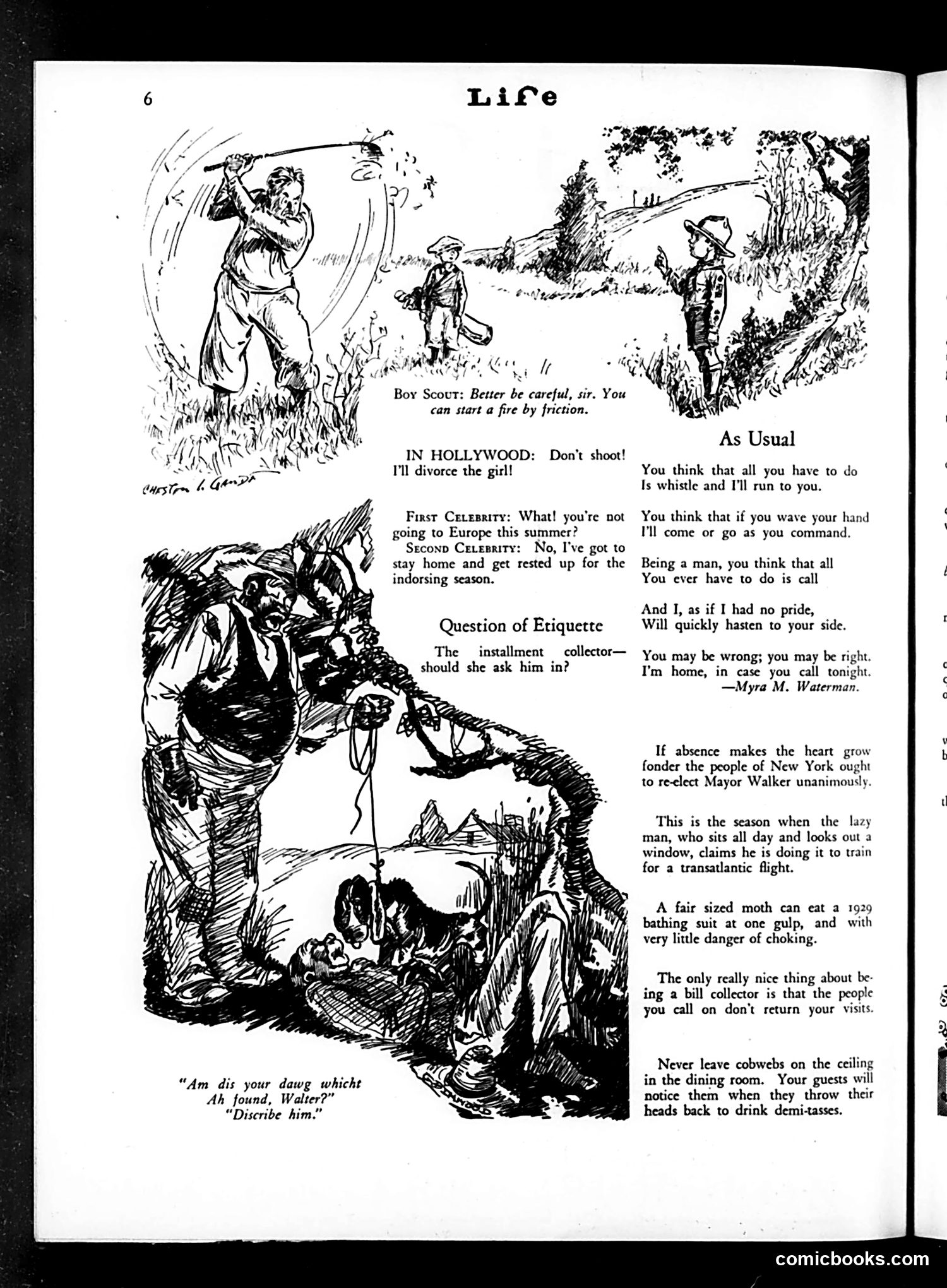
This page contains satirical commentary and humor typical of Life magazine's social critique. **Top cartoon**: A Boy Scout warns about fire safety while a man swings an axe—likely mocking overzealous safety culture. **Middle section**: "As Usual" presents humorous observations about modern manners and relationships, including jokes about Hollywood divorce ("Don't shoot! I'll divorce the girl"), the etiquette of romantic pursuit, and absurdist observations (a moth eating a 1929 bathing suit; lazy men claiming transatlantic flight training). **Bottom cartoon**: Depicts an installment collector confronting someone about a debt ("Am dis your dawg which Ah found, Walter?"), satirizing working-class financial struggles during what appears to be the Depression era. The page reflects 1920s-30s American society's anxieties about modernization, consumer debt, and changing social customs.
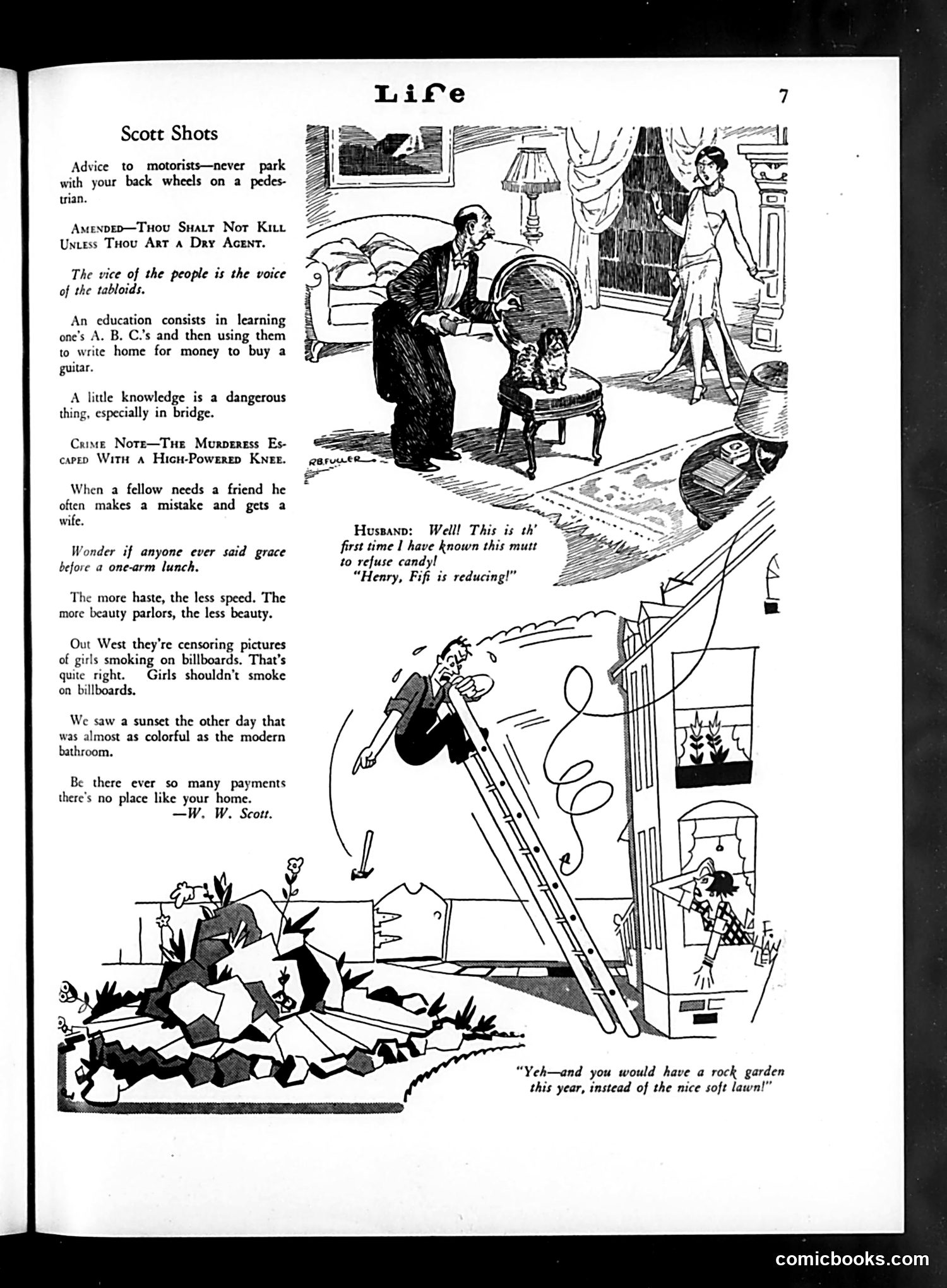
This page contains **Scott Shots**—a humor column with several cartoons and witticisms attributed to W. W. Scott. The main cartoon shows a **husband discovering his wife with a man**, captioned: "Well! This is th' first time I have known this mutt to refuse candy! 'Henry, Fish is reducing!'" The joke plays on the social expectation that women constantly seek candy/sweets while dieting, implying the woman's companion is suspicious because he won't accept offered candy. A second cartoon depicts someone **falling from a ladder while cleaning gutters/exterior**, with a caption about preferring a "rock garden" to a "nice soft lawn"—suggesting the fall's impact creates destructive garden damage. The column includes brief satirical observations about motorists, education, crime, and social customs typical of 1920s-era humor—targeting contemporary manners and behaviors.
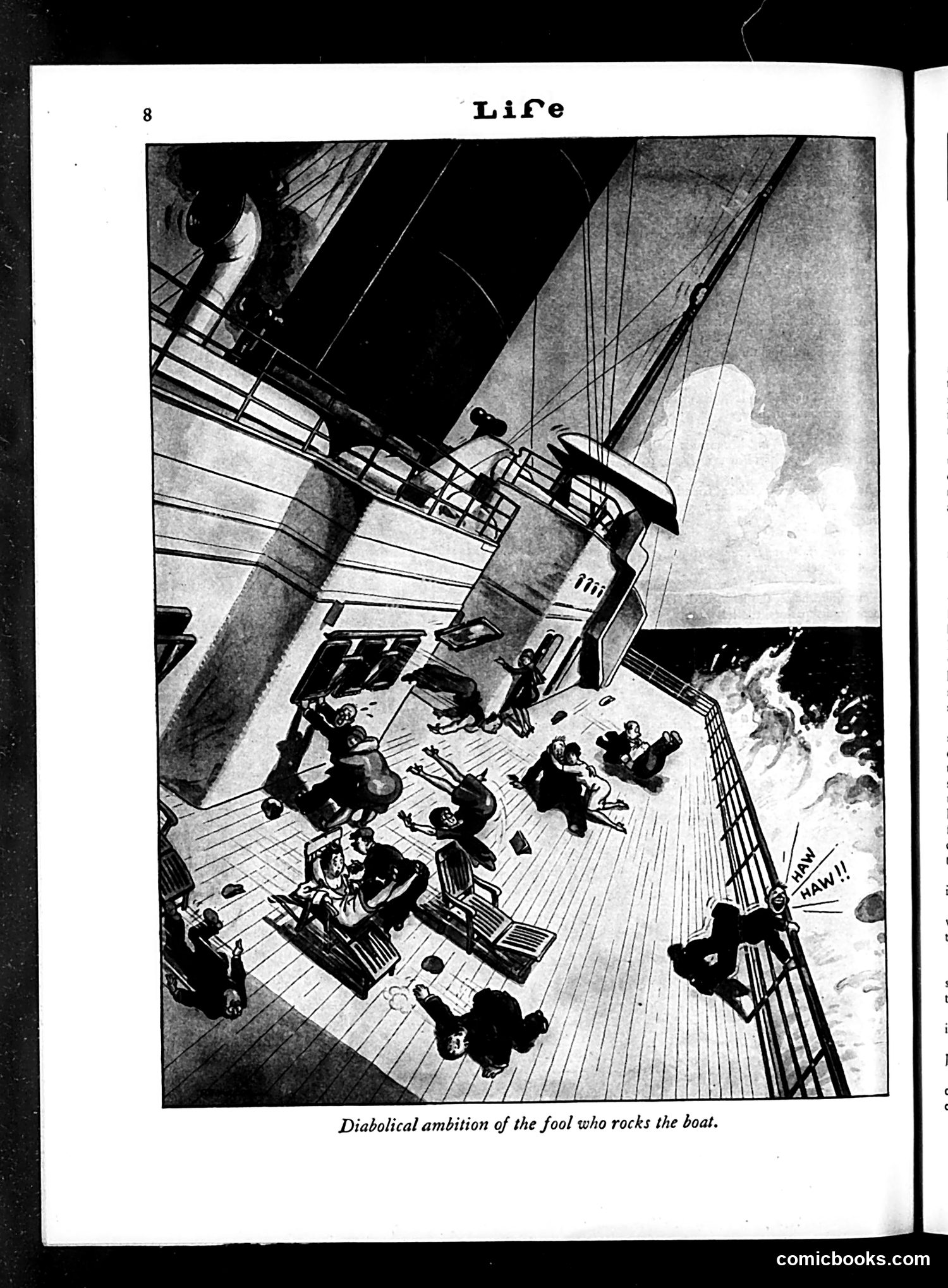
This satirical cartoon depicts passengers on a ship's deck in apparent chaos—some reclining, others gesturing dramatically. The caption condemns someone for "rocking the boat," a metaphor for destabilizing an established situation. The image critiques a disruptor or troublemaker aboard a vessel (likely metaphorical for society or a specific institution). The satirist portrays this person as foolish and reckless, endangering the comfort and stability of others aboard. The dramatic reactions of passengers suggest panic or alarm caused by the disruption. This reflects early 20th-century satirical concerns about agitators, reformers, or revolutionaries who challenged the status quo, portraying such figures as irresponsible rather than principled.
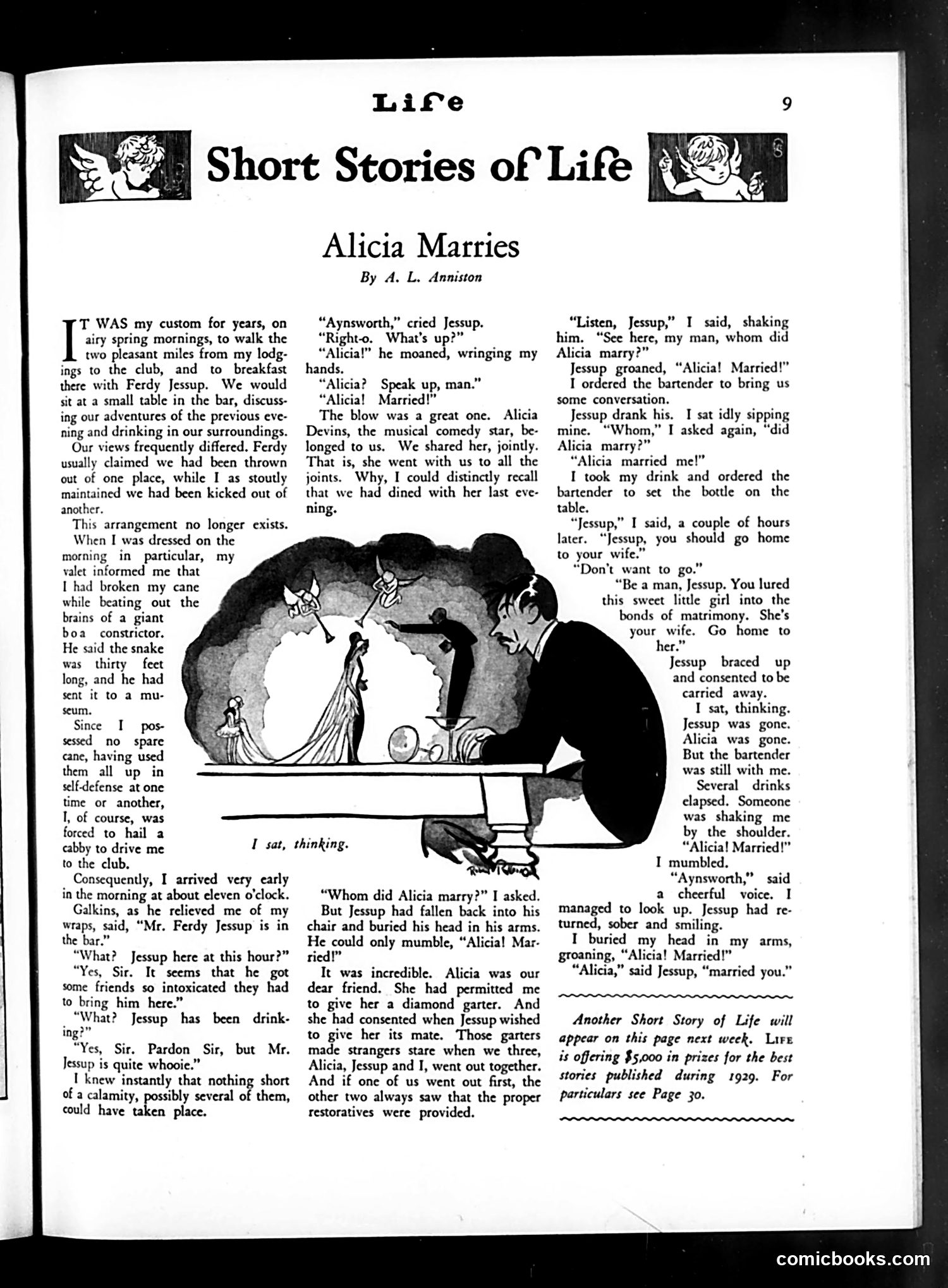
This is a literary short story by A. L. Anniston, not a political cartoon. The accompanying illustration shows a social scene at what appears to be a nightclub or bar. The narrative satirizes the social dynamics of the era: a narrator and his friend Ferdy frequented a club where they'd encounter Alicia Devins, a musical comedy star. The satire centers on masculine entitlement and social hypocrisy—the men feel they "owned" Alicia through shared outings, yet when she marries someone named Jessup, they're shocked and wounded by her autonomy. The story mocks how men of this period viewed women's independence and their own presumed claims on women's availability. The piece reflects 1920s social attitudes about gender and relationships.
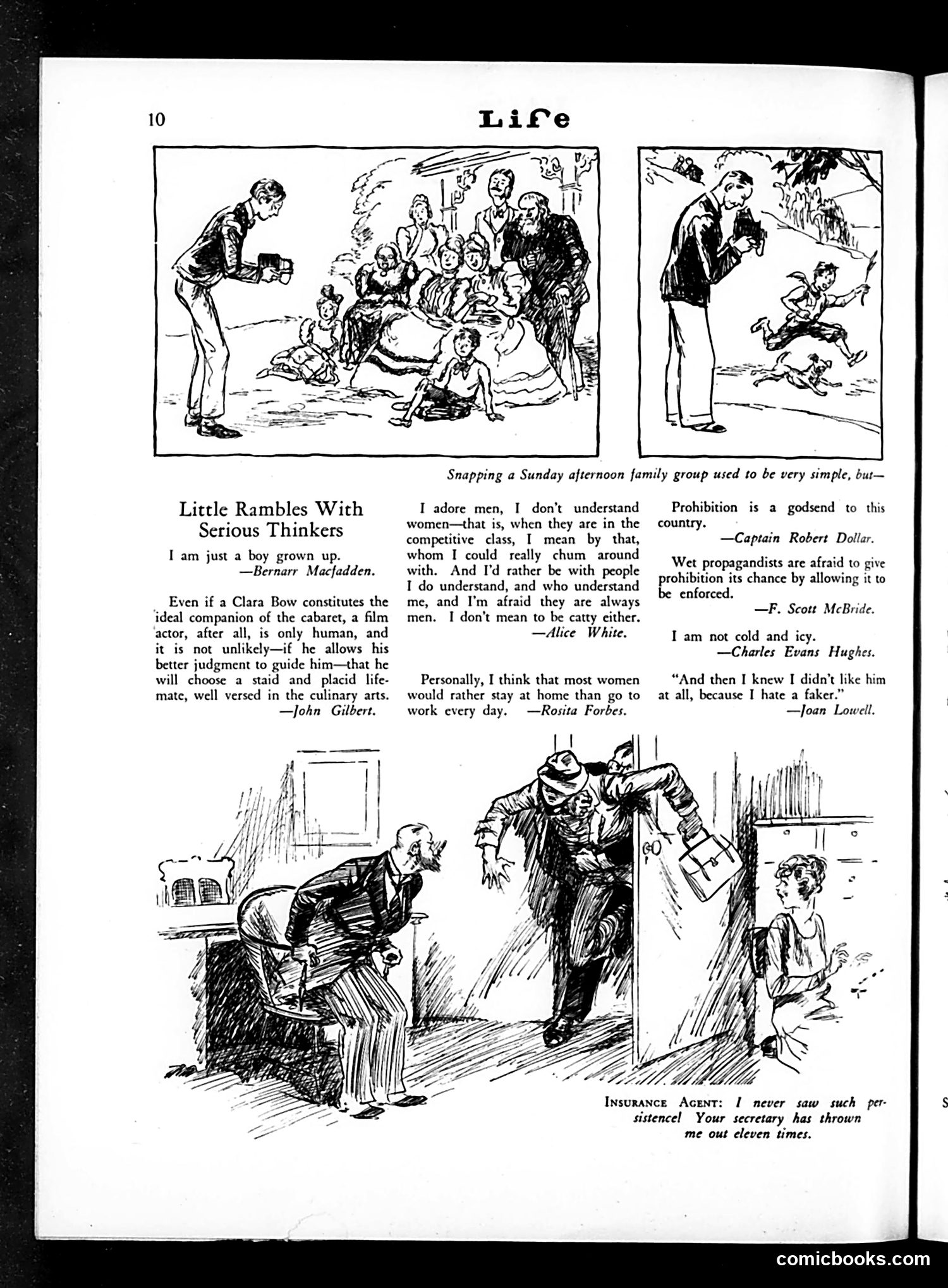
This page combines social commentary with humor about early 20th-century attitudes toward women and prohibition. **Top cartoons**: Show a man photographing children at play, contrasting "simple" Sunday family activities with more chaotic modern behavior—likely satirizing changing social norms. **"Little Rambles With Serious Thinkers"**: A series of quotes from prominent figures (Bernard MacFadden, John Gilbert, Alice White, etc.) expressing opinions on gender roles, women's work, and prohibition. The quotes reveal period attitudes: women should stay home, prohibition is beneficial, and competitive women are problematic. **Bottom cartoon**: An insurance agent tells a man his secretary has been fired eleven times—satirizing workplace instability, possibly reflecting on women entering the workforce. The page overall satirizes contemporary debates about gender, domesticity, and social policy during the prohibition era.
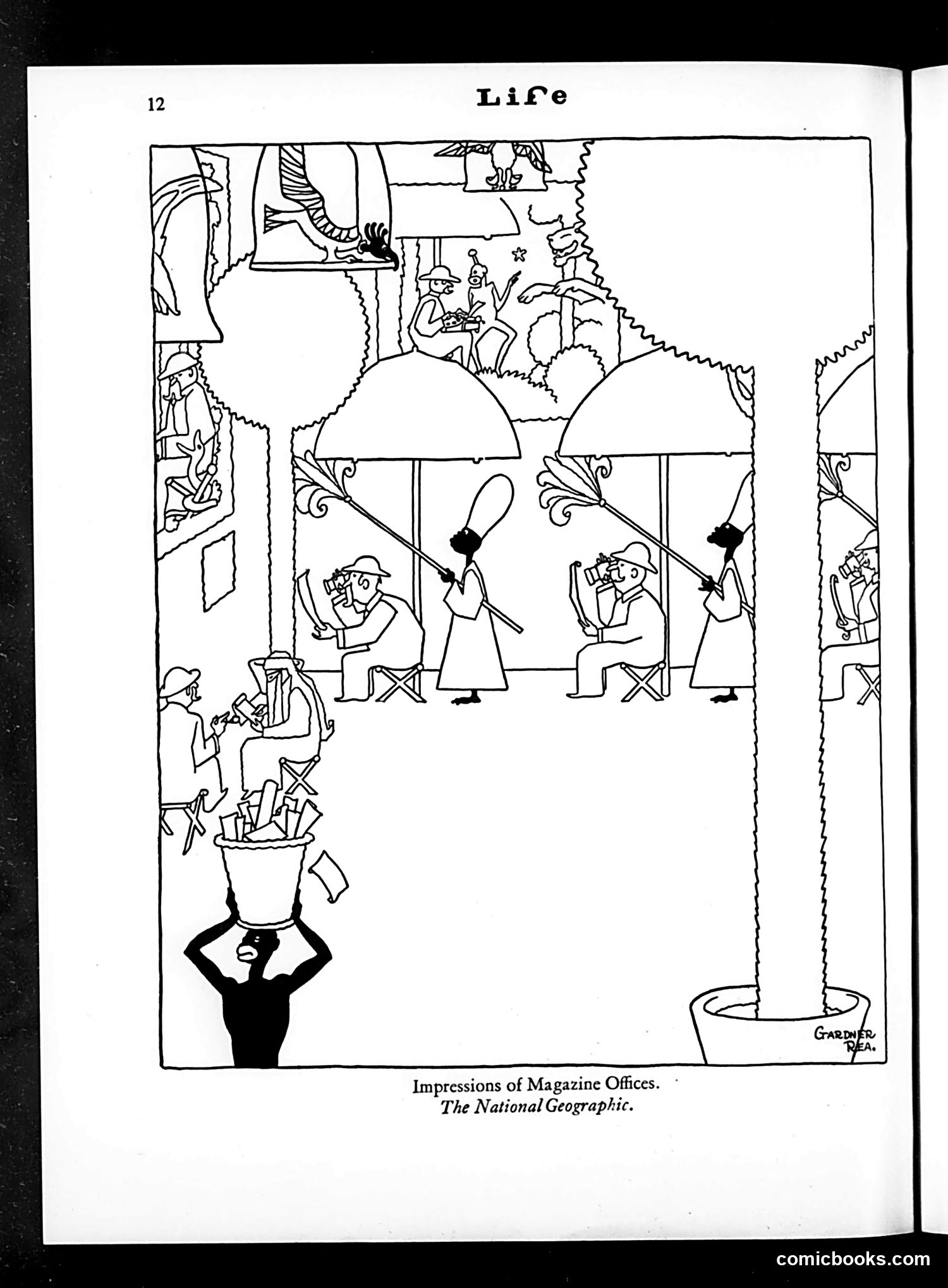
This Life magazine cartoon satirizes the National Geographic's office culture through exaggerated workplace hierarchy and absurdity. The image shows a tall office building where: - **Lower floors** depict ordinary workers in cramped, chaotic conditions with overflowing baskets and stressed employees - **Upper floors** show well-dressed, leisurely staff relaxing under umbrellas and lamps, apparently uninvolved in actual work - **A giant figure at bottom** literally carries the entire operation on their head, suggesting ordinary workers bear the weight of management's comfort The satire targets the disconnect between hardworking staff and comfortable upper management—a timeless workplace critique about hierarchical inefficiency and the exploitation of labor beneath privileged decision-makers.
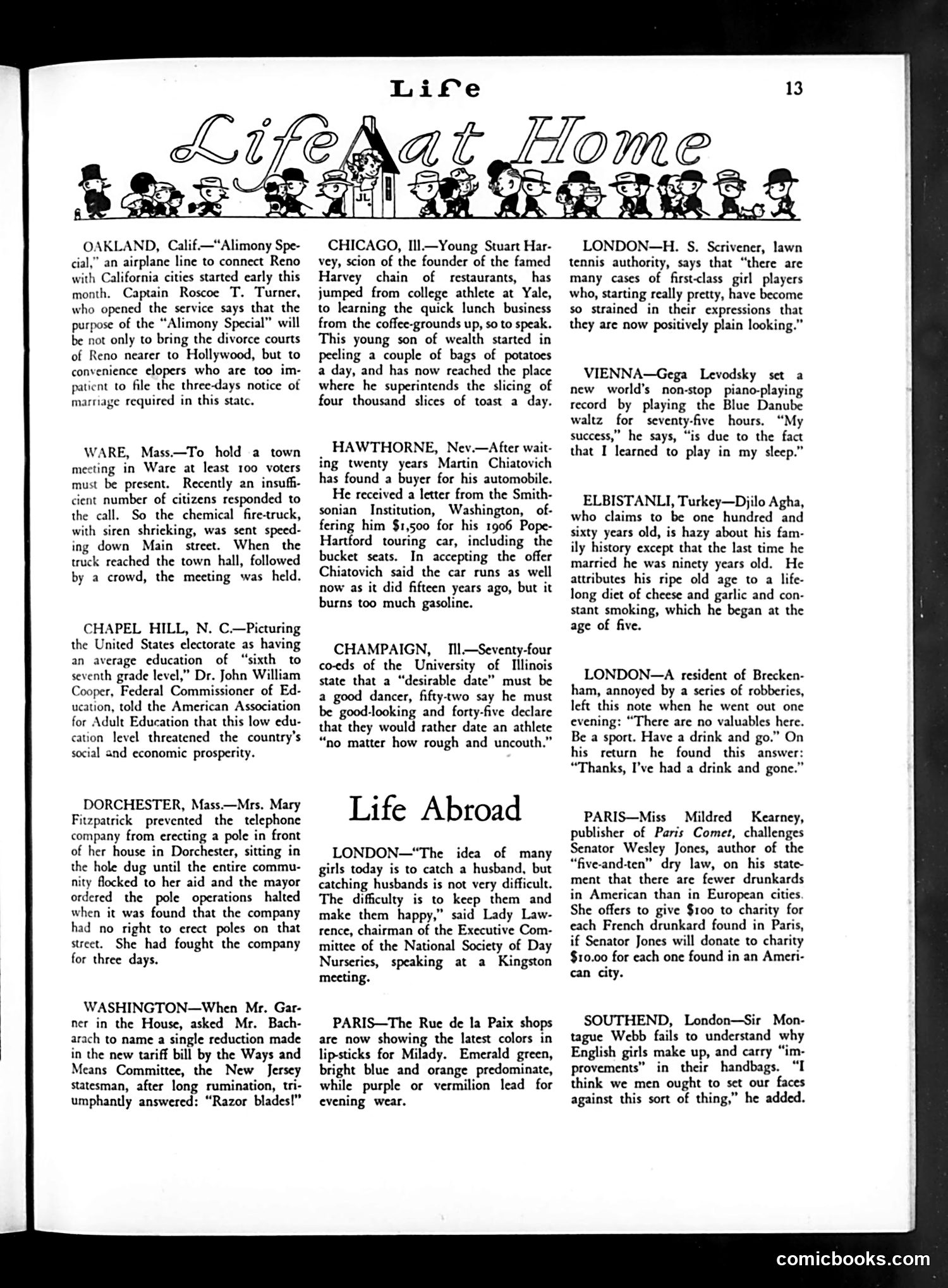
This page from *Life* magazine contains brief humorous anecdotes rather than political cartoons. The header illustration shows a row of stylized figures in formal dress. The "Life at Home" section offers American domestic humor: an airline service connecting California cities, a wealthy Chicago heir learning the restaurant business by making toast, a Massachusetts town requiring all voters present for meetings, and commentary on tariff negotiations. The "Life Abroad" section includes observations about British courtship customs, French fashion trends, and an Irishman's longevity attributed to diet and smoking. The satire is gentle and social rather than sharply political—poking fun at business inexperience, bureaucratic procedures, and cultural differences between nations. The humor reflects 1920s-era American attitudes toward wealth, European customs, and modernity.
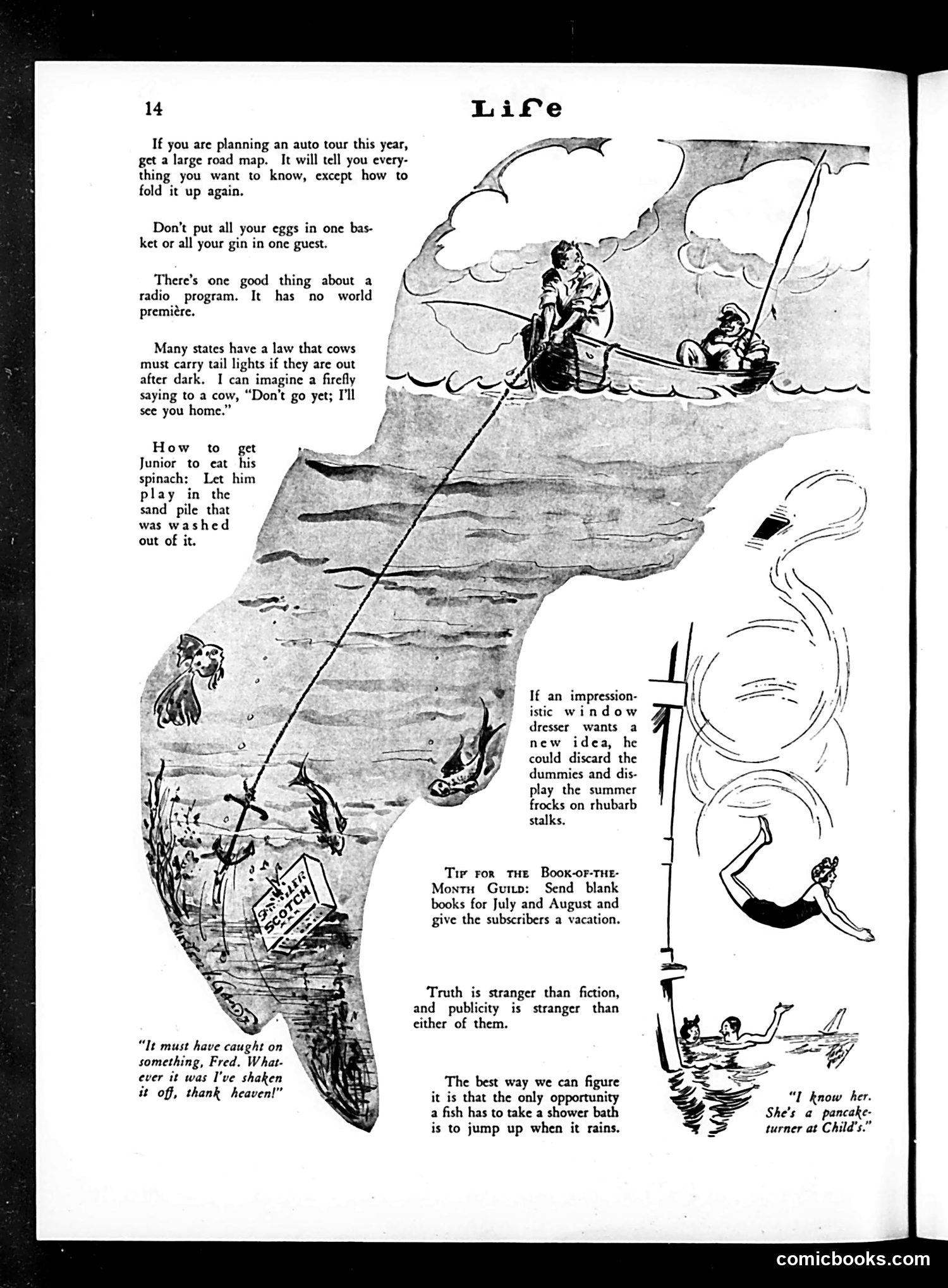
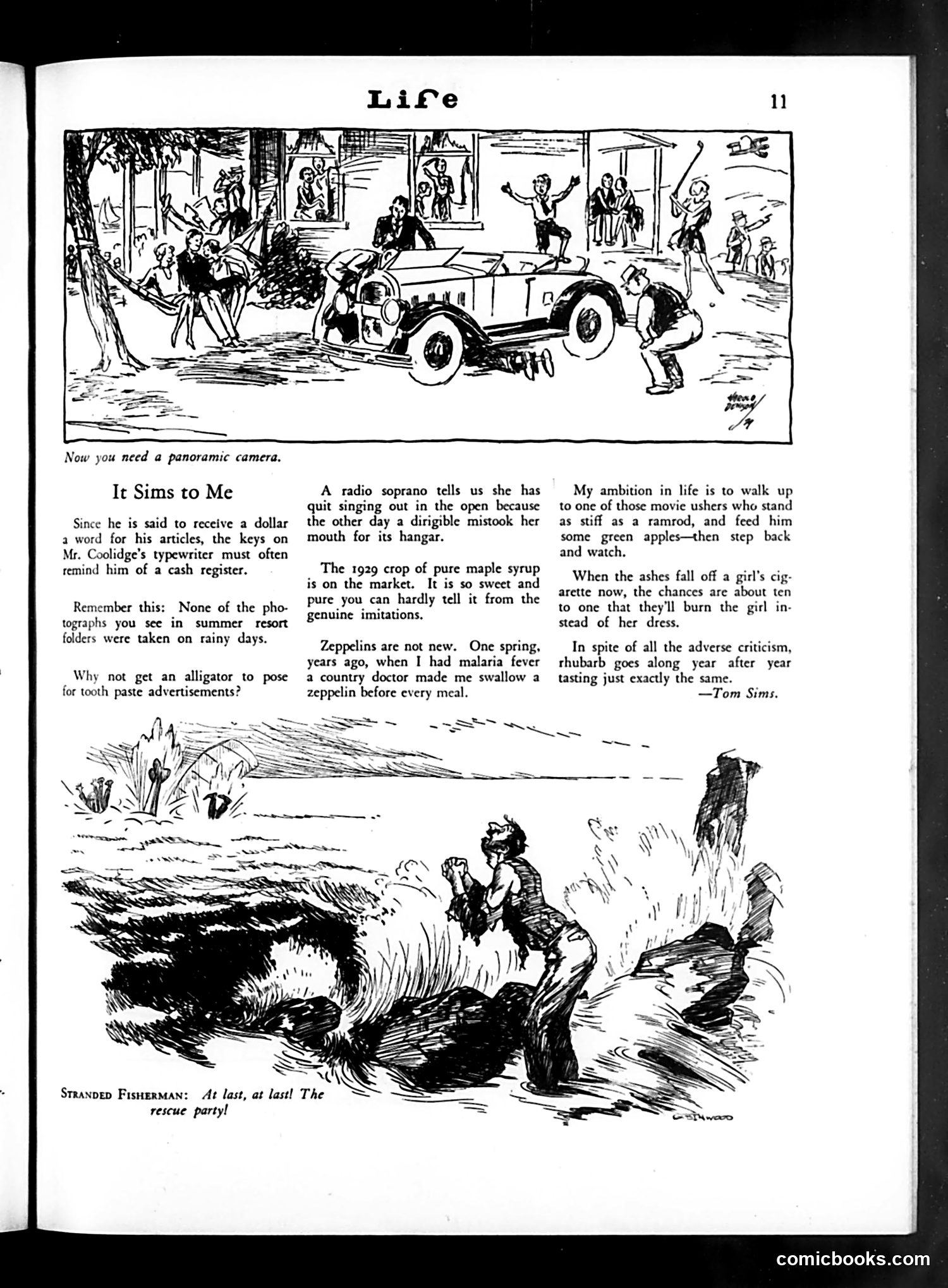
This page contains a series of brief, unrelated jokes and observations typical of Life's satirical humor section. The content includes practical quips about auto touring, radio programs, state laws about cattle tail lights, and parenting tips. The illustrations depict fishing scenes and domestic life vignettes. One cartoon shows people fishing from a boat in clouds (likely a heavenly or fantastical setting), while another illustrates a child fishing. The bottom-right corner shows a figure doing exercises or diving. The humor is light and observational rather than politically charged—poking fun at everyday situations like getting children to eat spinach, window dressing displays, and fish bathing habits. The tone reflects early 20th-century American magazine satire focused on domestic life and social customs rather than contemporary events.
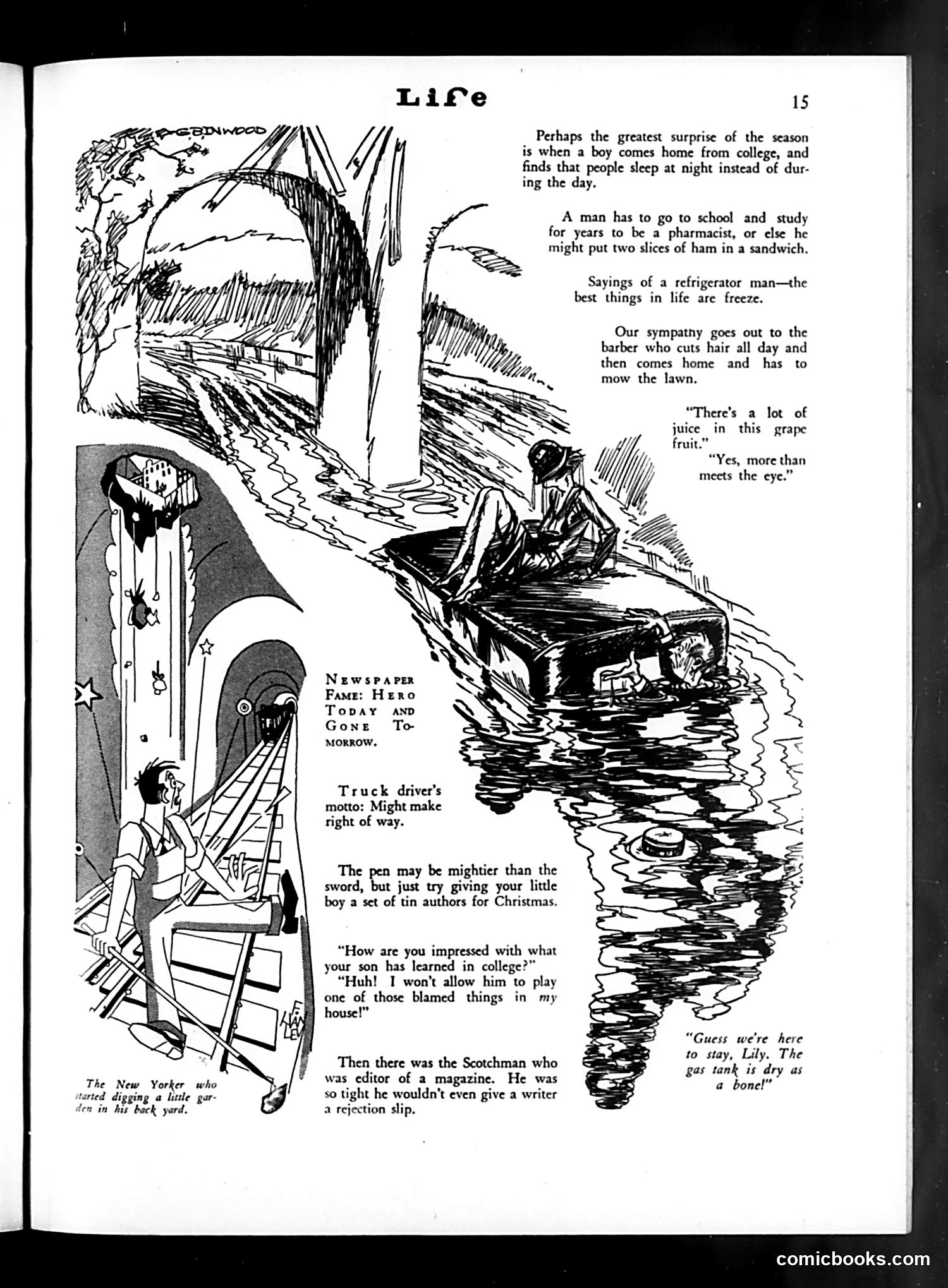
This page from *Life* magazine contains satirical observations about everyday American life, presented through vignettes and cartoons. The humor targets various social groups: college students surprising parents by sleeping at night; the demanding schedules of working professionals; and suburban homeowners burdened with lawn care. A notable illustration depicts a newspaper editor rejecting a writer's submission so harshly he won't even provide a rejection slip—a jab at editorial gatekeeping and the humiliation of aspiring authors. Another cartoon shows a truck driver asserting right-of-way, satirizing road aggression. The overall theme mocks the contradictions and frustrations of modern American life, from professional ambitions to domestic drudgery, using gentle irony rather than harsh political critique.
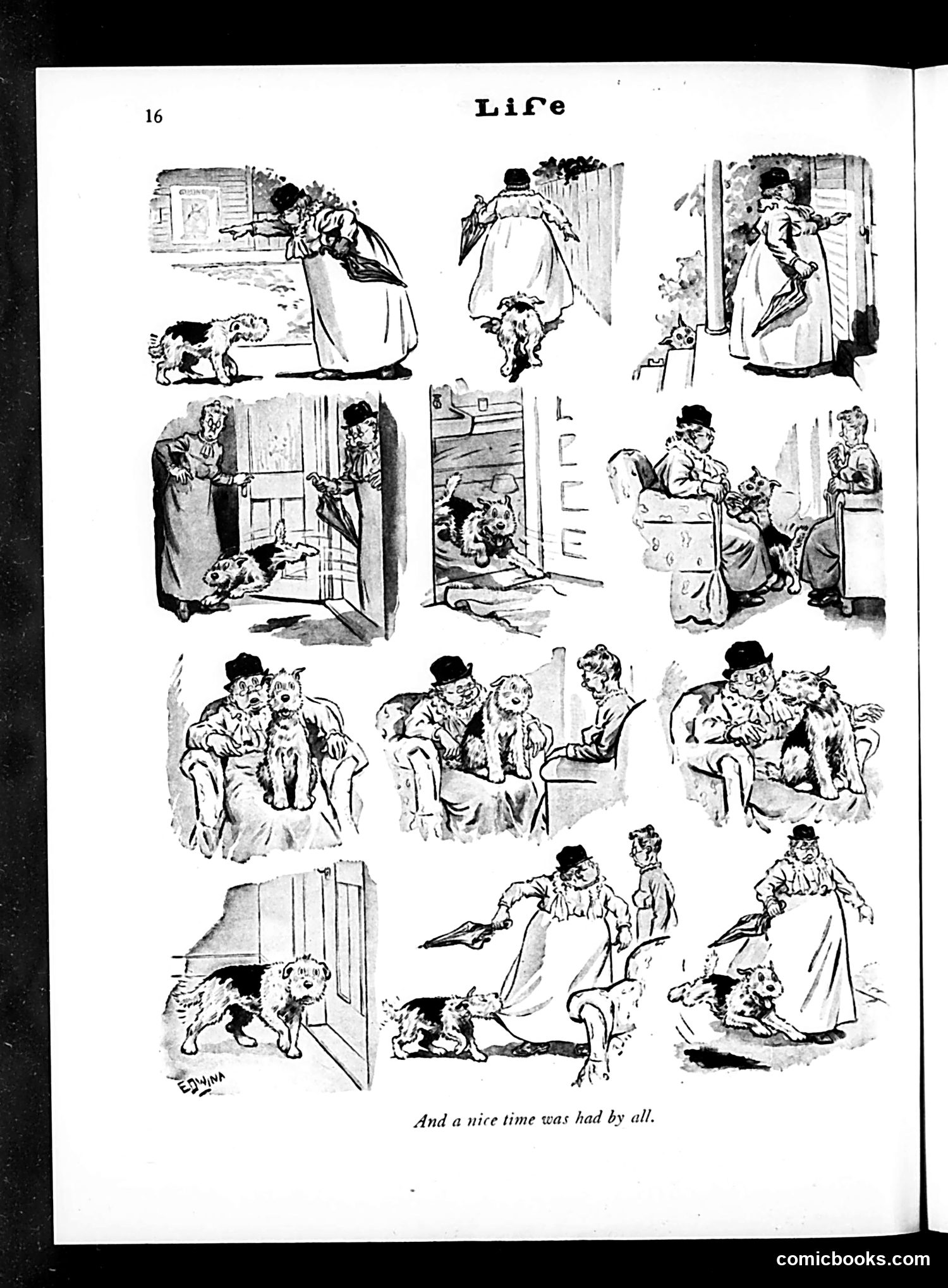
This page presents a comic strip narrative titled "Life" depicting domestic scenes with women, children, and small dogs. The sequential panels show various indoor and outdoor settings—doorways, sitting rooms, and gardens—where women interact with children and pets. The caption at bottom reads "And a nice time was had by all," which appears ironic given the visual chaos depicted: children appear mischievous or unruly, dogs are energetic and disruptive, and the women seem to be managing pandemonium rather than enjoying themselves. This likely satirizes idealized Victorian/Edwardian domesticity—the notion that childcare and household management constitute leisure or happiness. The gap between the cheerful caption and the hectic visual reality is the joke: the cartoonist suggests domestic life with children and pets is actually exhausting rather than the peaceful ideal promoted in period literature.
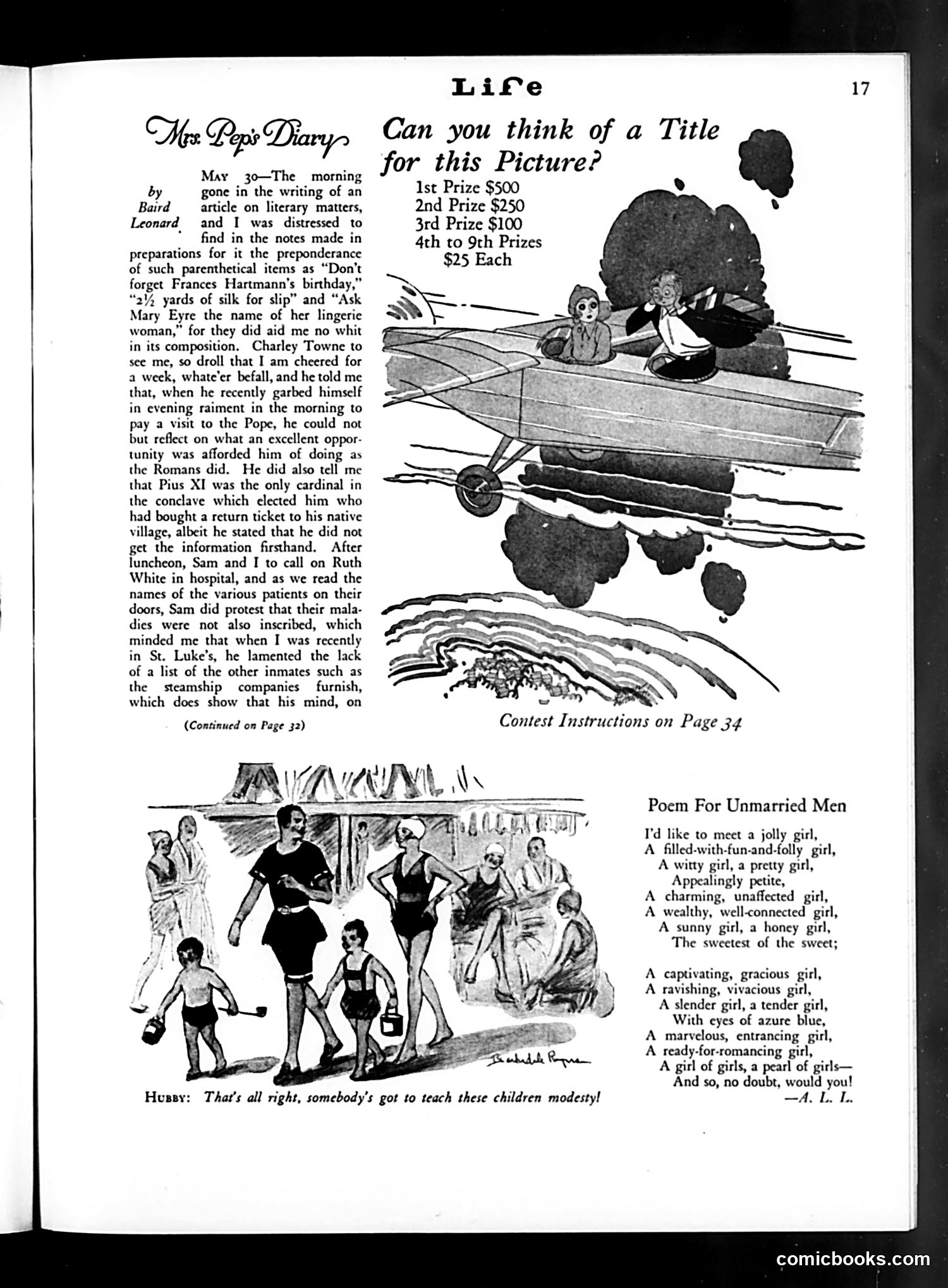
This page contains two separate satirical pieces: **Upper section:** A diary entry by "Mrs. Peps" discussing literary and social gossip, including references to Frances Hartmann's birthday and visits to Rome. This appears to be society-page satire mocking upper-class pretension. **Lower cartoon:** Depicts a beach or swimming scene with adults and children in various states of undress. The caption reads: "HENRY: That's all right, somebody's got to teach these children modesty!" The joke satirizes parental hypocrisy—an adult figure suggests teaching children modesty while surrounded by scantily-clad beachgoers, implying adults themselves lack proper decorum. This mocks Victorian-era contradictions between preached moral standards and actual behavior. The page also features a poetry contest for picture titles and a "Poem for Unmarried Men."
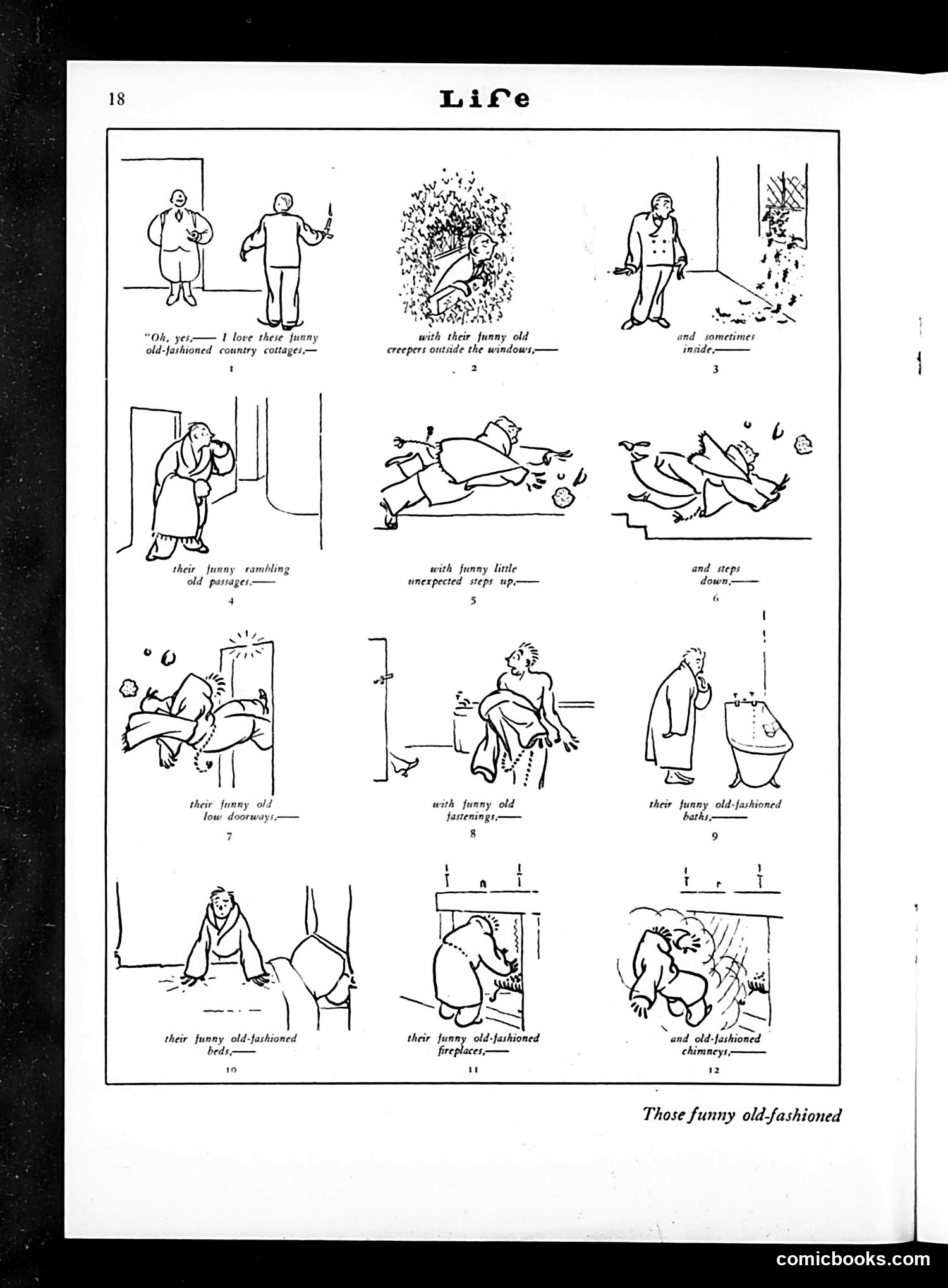
This page from *Life* magazine presents a 12-panel comic strip titled "Those funny old-fashioned" (title incomplete). The strip satirizes the charm and quirks of old-fashioned architecture and home features through humorous domestic scenarios. The panels depict: - Old cottages and creepers (climbing ivy) - Rambling hallways and passages - Unexpected steps and uneven floors - Low doorways requiring stooping - Old-fashioned fasteners and latches - Period baths, beds, fireplaces, and chimneys The satire gently mocks how residents must navigate these charming but impractical features—constantly bumping heads, tripping on steps, struggling with outdated mechanisms. The joke targets middle-class nostalgia for "quaint" old homes while highlighting their genuine inconvenience and discomfort, suggesting romanticizing the past overlooks real problems.
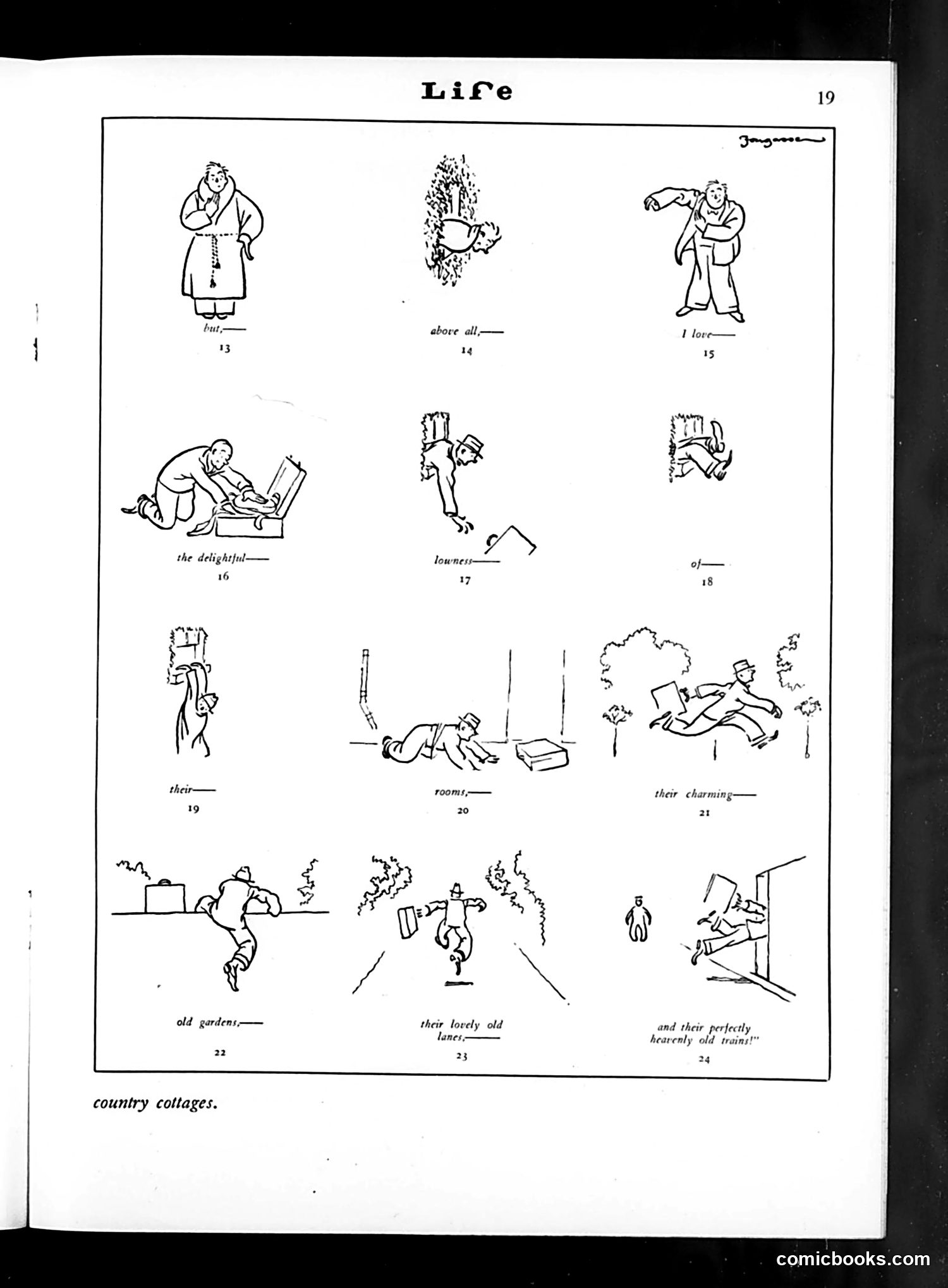
This page satirizes romanticized notions of rural English life and "country cottages." The numbered vignettes mock people who idealize the countryside while ignoring its realities. The cartoons show contrasting images: idealized pastoral scenes (old gardens, lovely lanes, charming trains) alongside humorous depictions of actual country life—including an elderly gardener struggling with physical labor, people dealing with rustic inconveniences, and notably, "their perfectly heavenly old trains" paired with a drawing of what appears to be a decrepit, malfunctioning railway. The satire targets the British middle class's nostalgic fantasies about rural England—the notion that country living is quaint and idyllic—while the illustrations reveal the messy, uncomfortable, and often inconvenient reality. The final jab at "heavenly old trains" particularly mocks the gap between romantic perception and functional inadequacy.
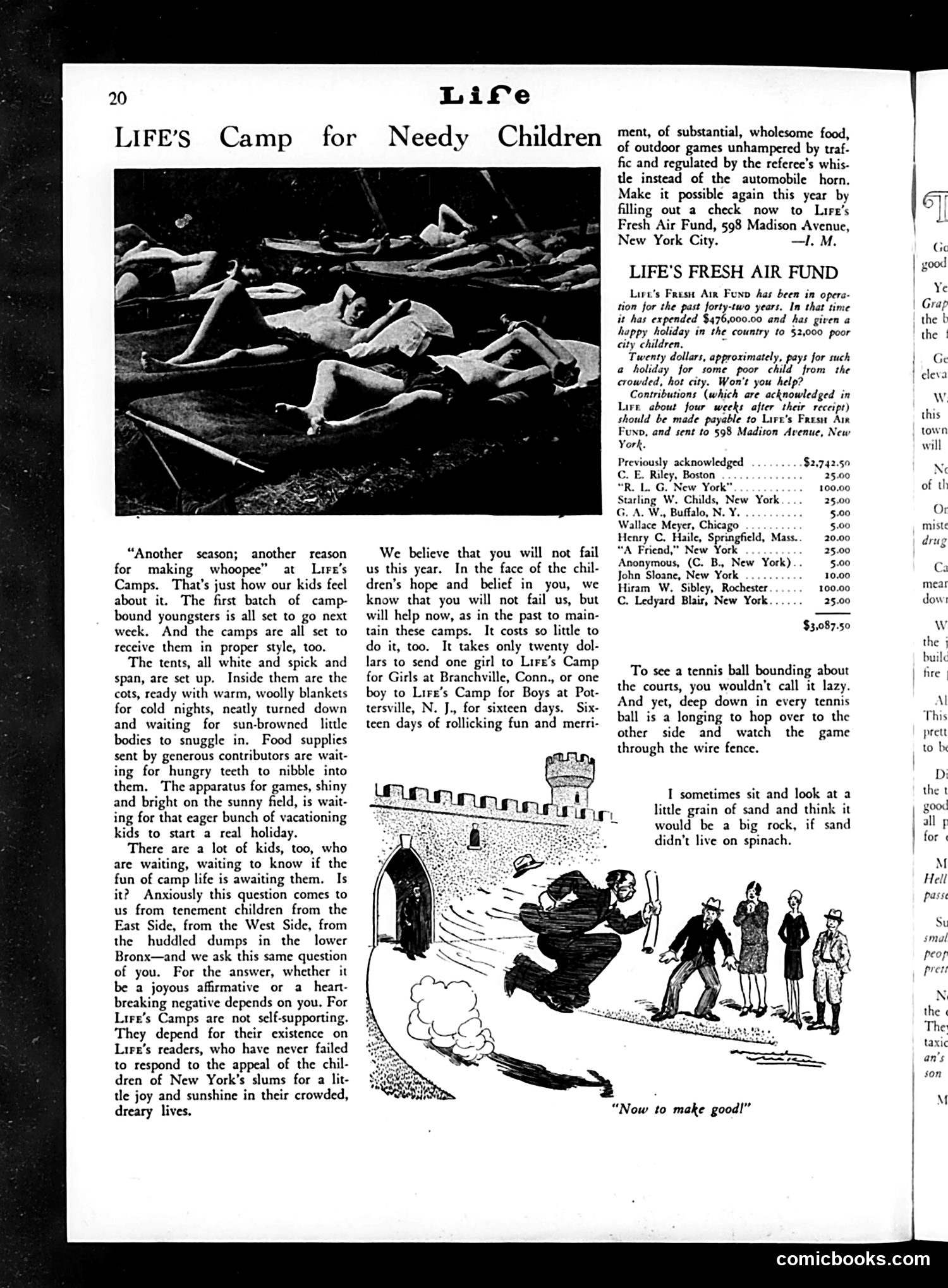
This page is a fundraising appeal for Life magazine's Fresh Air Fund, which sends poor children from New York City tenements to summer camps. The photo shows children resting at camp; the cartoon depicts a child sliding down a castle wall while adults watch, captioned "Now to make good!"—suggesting both the joy of camp and the hope that underprivileged children will improve their circumstances. The text emphasizes that only $20 sends one child to camp for sixteen days of "wholesome food" and outdoor recreation away from crowded, polluted city streets. Life frames this as a moral obligation to readers, noting the fund has operated forty-two years and served 52,000 children. The listed donations show actual contributors. The appeal targets the magazine's affluent readership, urging them to "make whoopee" (have fun) by enabling poor children the same opportunity. The underlying message reflects Progressive Era attitudes: that fresh air, nature, and wholesome leisure could reform and uplift urban poor children.
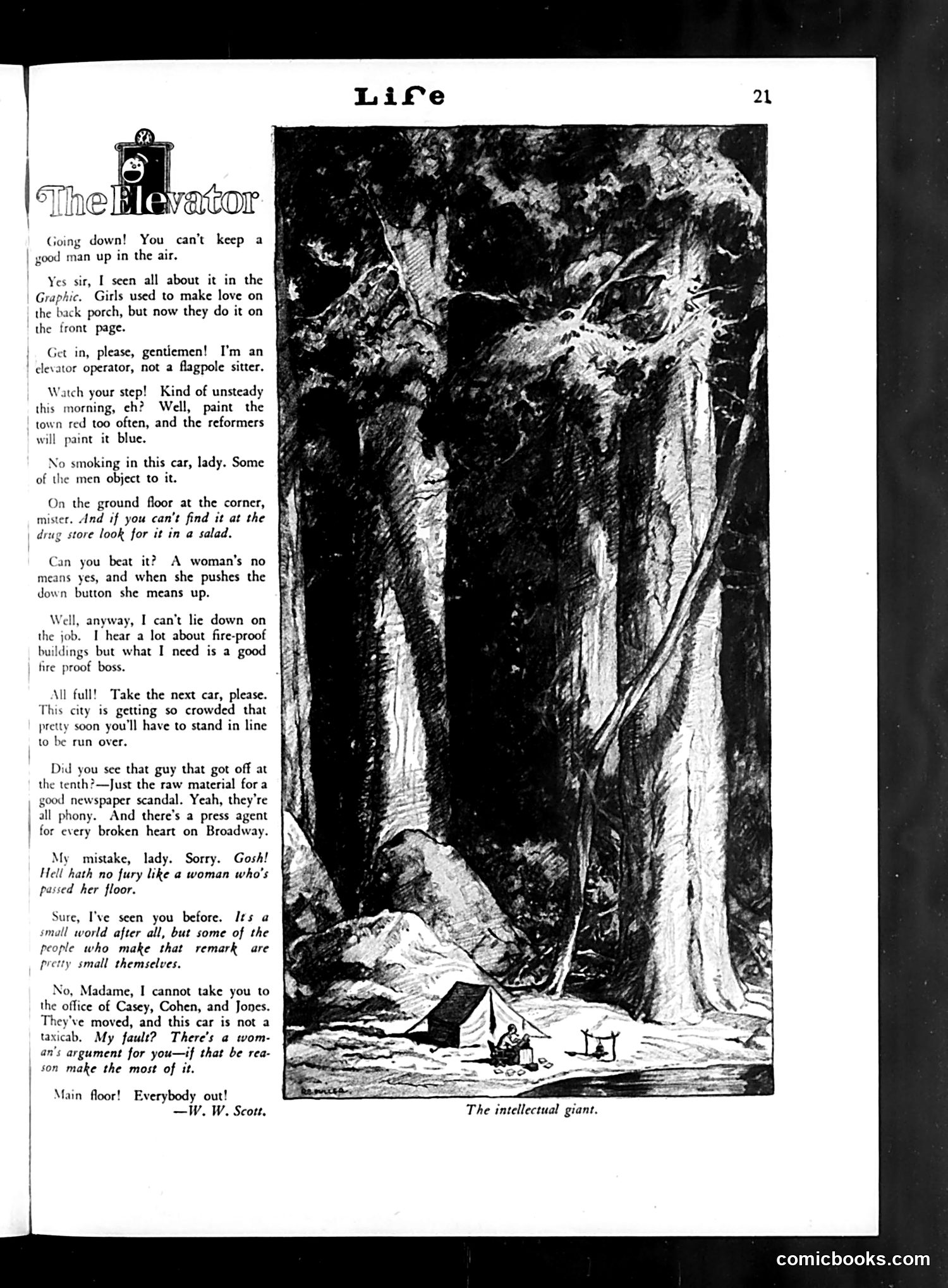
This is a single-panel humor piece satirizing urban life and social attitudes of the early 20th century. An elevator operator delivers a stream of wisecracks to passengers, touching on contemporary concerns: changing morality (young couples now courting publicly rather than on back porches), women's behavior and reasoning, urban overcrowding, newspaper scandal-mongering, Prohibition-era reformers ("paint the town red"), and workplace frustrations. The humor relies on period stereotypes—women are illogical ("a woman's argument"), their "no means yes," and they're vain about missing their floor. The accompanying illustration shows a forest giant, captioned "The intellectual giant," likely reinforcing the operator's sardonic commentary on human nature. The satire targets both social pretension and the anxieties of rapid urbanization and changing social norms that characterized the era.
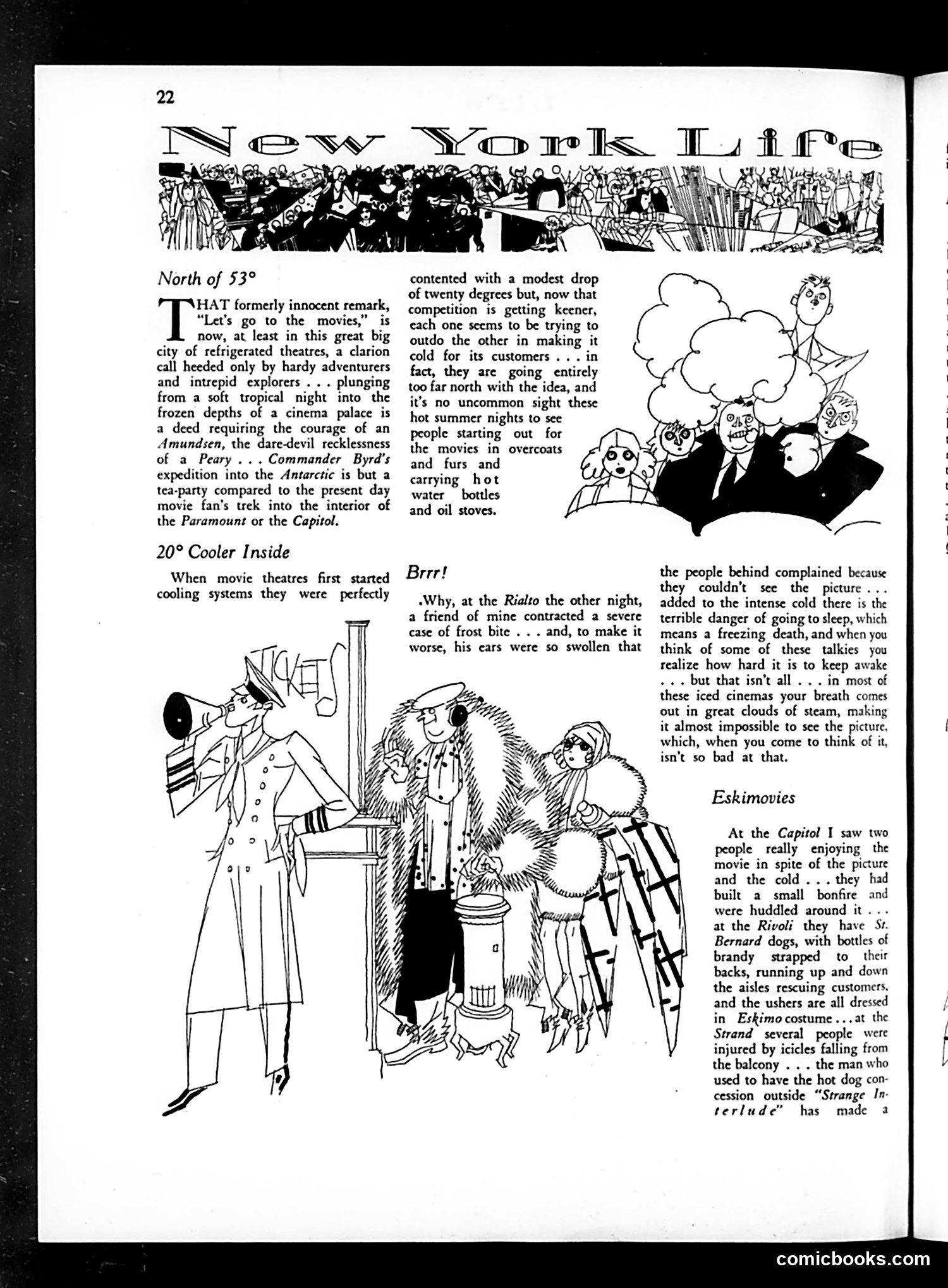
This 1920s Life magazine page satirizes movie theater air-conditioning competition in New York City. The article lampoons theaters that have escalated cooling systems to absurd extremes in summer, creating arctic conditions to outcompete rivals. The satire works through exaggeration: patrons wear overcoats and carry hot water bottles to movies; one theater patron contracts frostbite; another's swollen ears block other viewers' sight lines. The humor peaks in the "Eskimovies" section, describing theaters with bonfires, St. Bernard rescue dogs carrying brandy, ushers in Eskimo costumes, and falling icicles causing injuries. The cartoons illustrate the contrast between tropical summer heat outside and frigid theater interiors. References to Arctic explorers (Amundsen, Peary, Byrd) emphasize the implausibility of the cold. The satire targets both theaters' competitive excess and moviegoers' willingness to endure extreme discomfort for entertainment—even bad "talkies" (early sound films). It's gentle social commentary on commercial one-upmanship and American consumer culture circa the late 1920s.
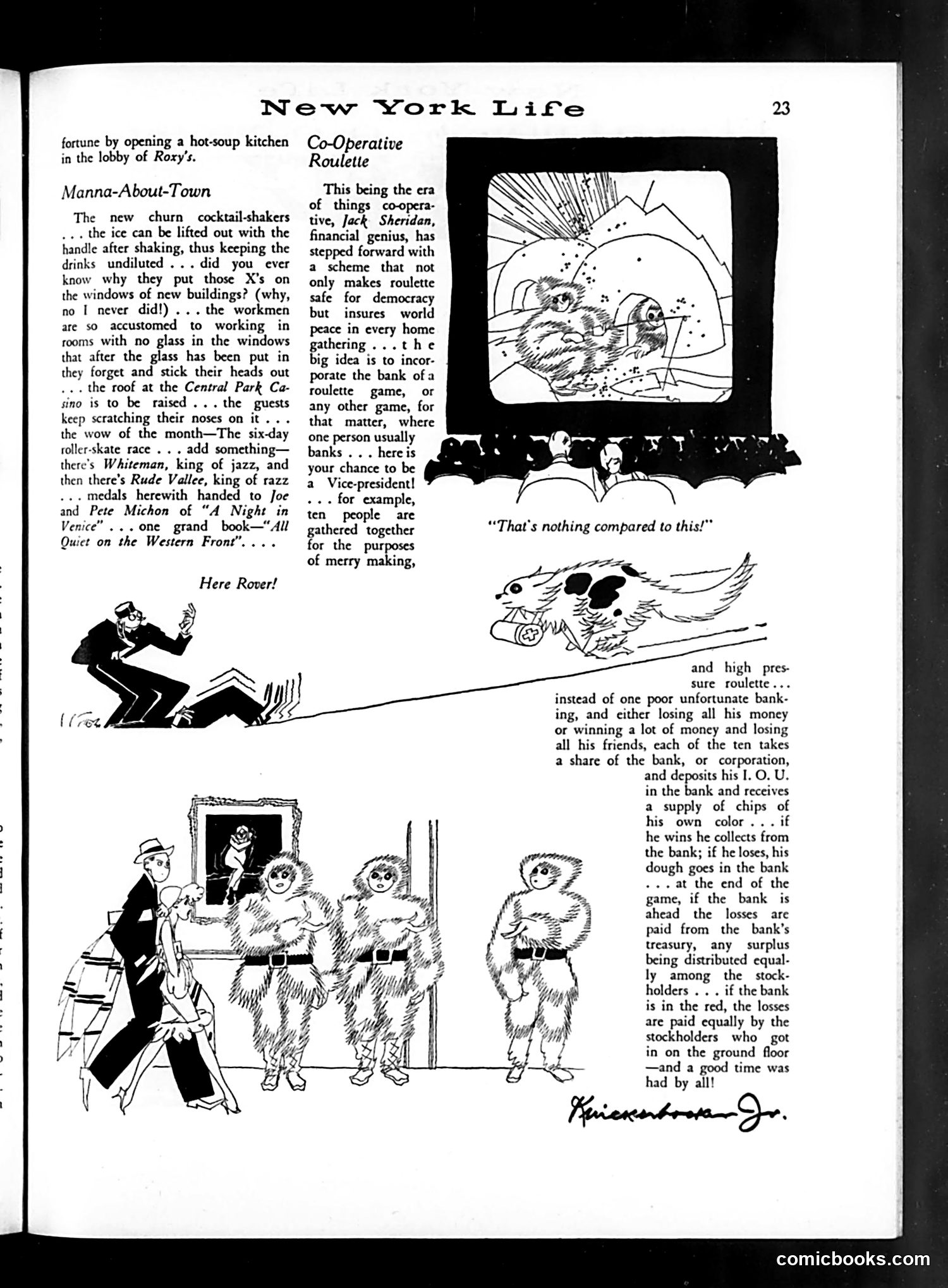
This 1920s *Life* magazine page satirizes the era's enthusiasm for cooperative business schemes and gambling. The main feature, "Co-Operative Roulette," mocks a proposed gambling game where ten people collectively "incorporate" as stockholders of the bank, each depositing IOUs and receiving colored chips. Winners collect from the shared bank; losers' losses are pooled. The satire targets two things: the period's earnest embrace of cooperative economics as a solution to social problems, and the absurdity of applying legitimate business structures to casual gambling to make it seem respectable and "safe for democracy." The accompanying illustrations show the scheme's inevitable chaos—people in costumes losing money while pretending it's a democratic enterprise. The "Manna-About-Town" section is typical society gossip commentary referencing jazz-age figures like Paul Whiteman (bandleader) and Rudy Vallée, along with observations about New York nightlife and fashions.
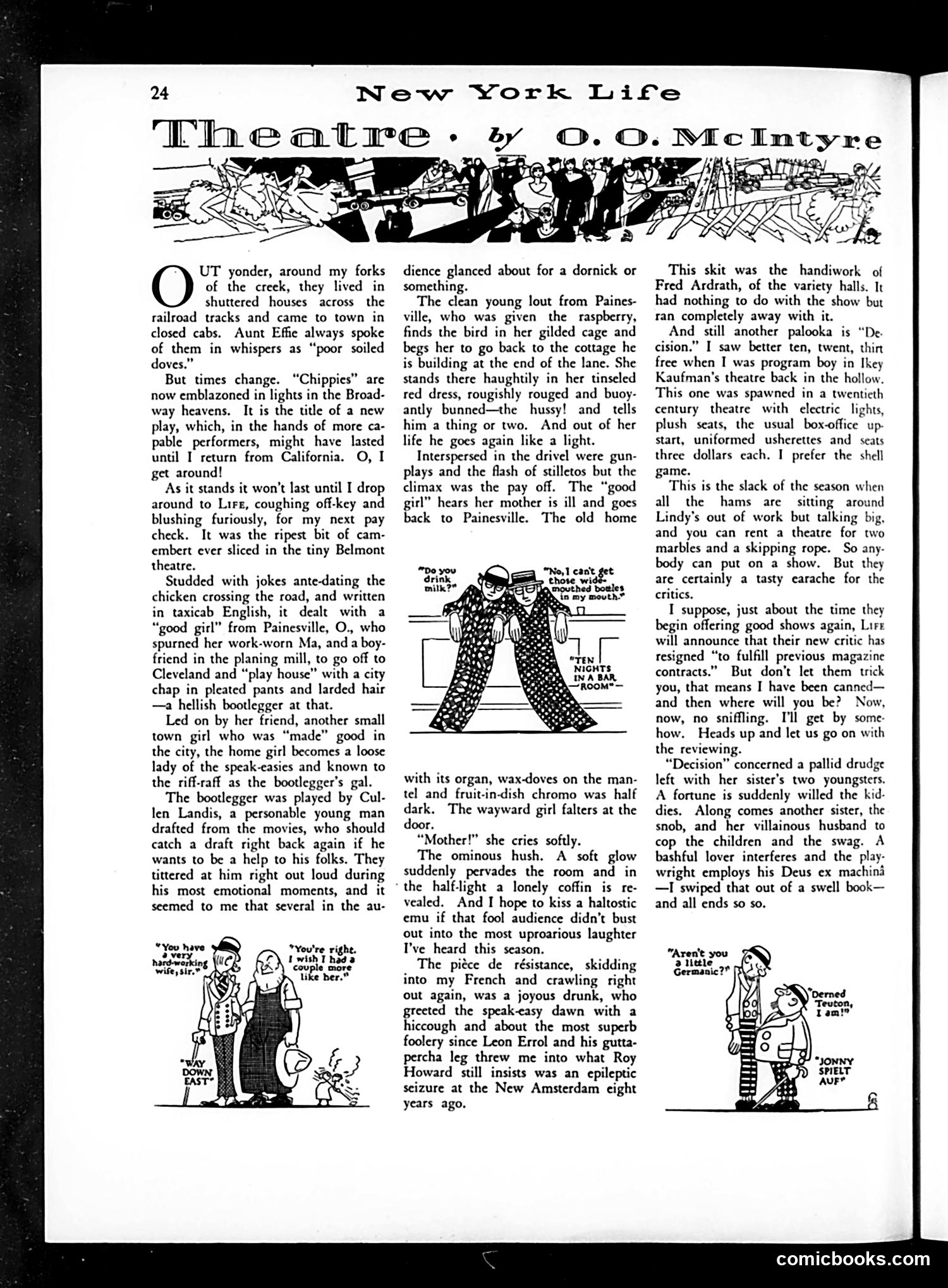
This theater review column satirizes both a mediocre Broadway play called "Chippies" and the broader state of theater during what appears to be an off-season slump. **The play itself:** A melodramatic morality tale about a small-town Ohio girl ("good girl" from Painesville) who becomes a prostitute in the city after being corrupted by another woman, only to return home to find her mother dying. The reviewer mocks its cheap sentimentality—the audience laughs hysterically at the coffin scene rather than being moved. **The satire:** McIntyre ridicules both the terrible writing and acting (calling the dialogue "taxicab English," the plot devices ancient), while also mocking theater-goers' poor taste. He notes that during the slow season, anyone can rent a theater cheaply, so amateur productions proliferate. **The small illustrations** show character sketches and dialogue from the play, emphasizing its corniness. The column's tone is one of weary sophistication—McIntyre positions himself as an experienced theater-goer who finds contemporary Broadway beneath contempt.
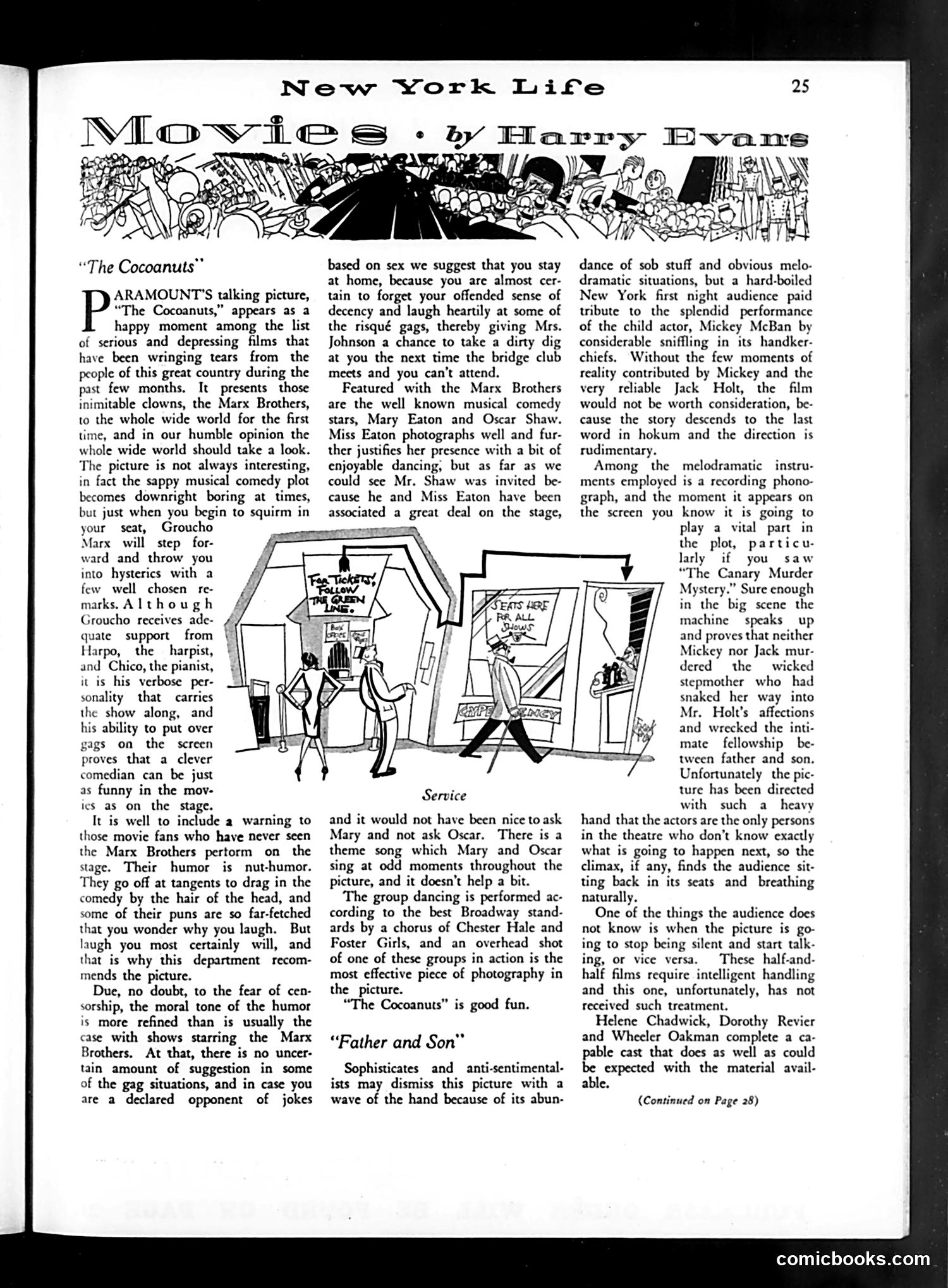
This page reviews two early talking pictures. **"The Cocoanuts"** is Paramount's film debut of the Marx Brothers—Groucho, Harpo, and Chico—whose vaudeville stage act was already famous. The reviewer praises Groucho's verbal comedy and quick wit as the film's strength, though the musical plot is "sappy" and boring. He warns prudish viewers that the humor contains risqué sexual innuendo that might offend, and notes the supporting cast (Mary Eaton, Oscar Shaw) adds little value. **"Father and Son"** features child actor Mickey McBan and Jack Holt in a melodrama heavy on emotional manipulation—what the critic dismissively calls "hokum." The review mocks the film's reliance on theatrical devices like a recording phonograph as plot mechanisms (referencing "The Canary Murder Mystery"). Both reviews capture early sound film's growing pains: stage comedians adapting to cinema, musical numbers disrupting narrative flow, and melodramatic conventions feeling overwrought in this new medium.
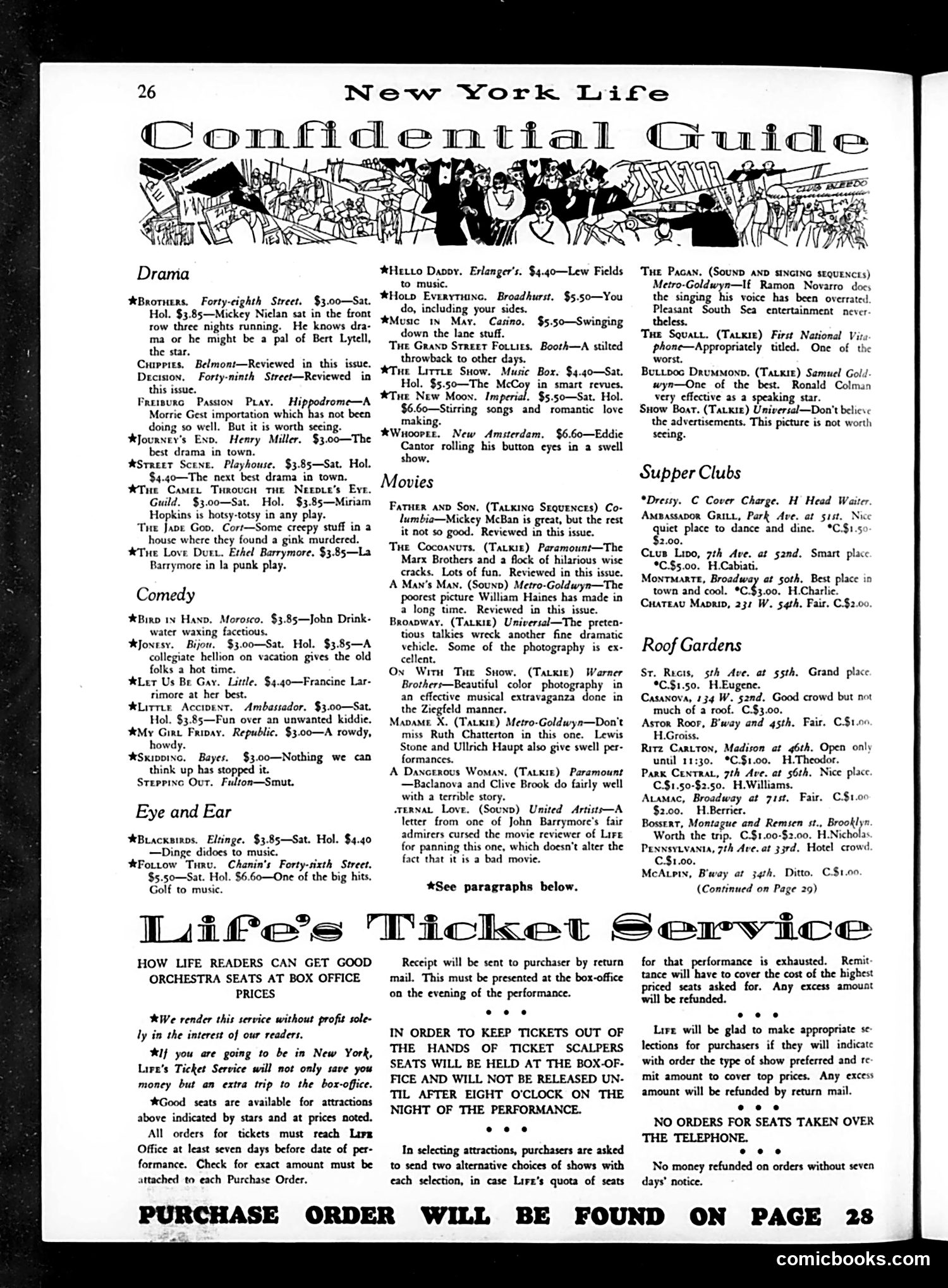
This is a theater and entertainment guide from Life magazine, listing Broadway shows, movies, and nightlife venues with brief critical reviews and prices. The asterisks (*) mark recommended attractions. **Key Context:** - This appears to be from the late 1920s (references to early "talking pictures"/talkies, Mickey McBan, Marx Brothers) - Prices range from $1.00–$6.60, indicating Depression-era theater costs - Reviews use period slang ("hotsy-totsy," "rowdy, howdy," "smut") to rate shows - The guide includes a ticket service allowing readers to purchase seats directly through Life magazine - "Sound and singing sequences" indicates cinema's recent transition to synchronized sound **The Satire:** The brief, punchy reviews mock shows with colorful dismissals ("punk play," "One of the worst") while praising hits. Life's tone is irreverent toward Broadway and entertainment, using wit rather than detailed analysis. This reflects how magazines functioned as cultural arbiters for urban audiences. The page is primarily functional advertising/editorial content, not a political cartoon.
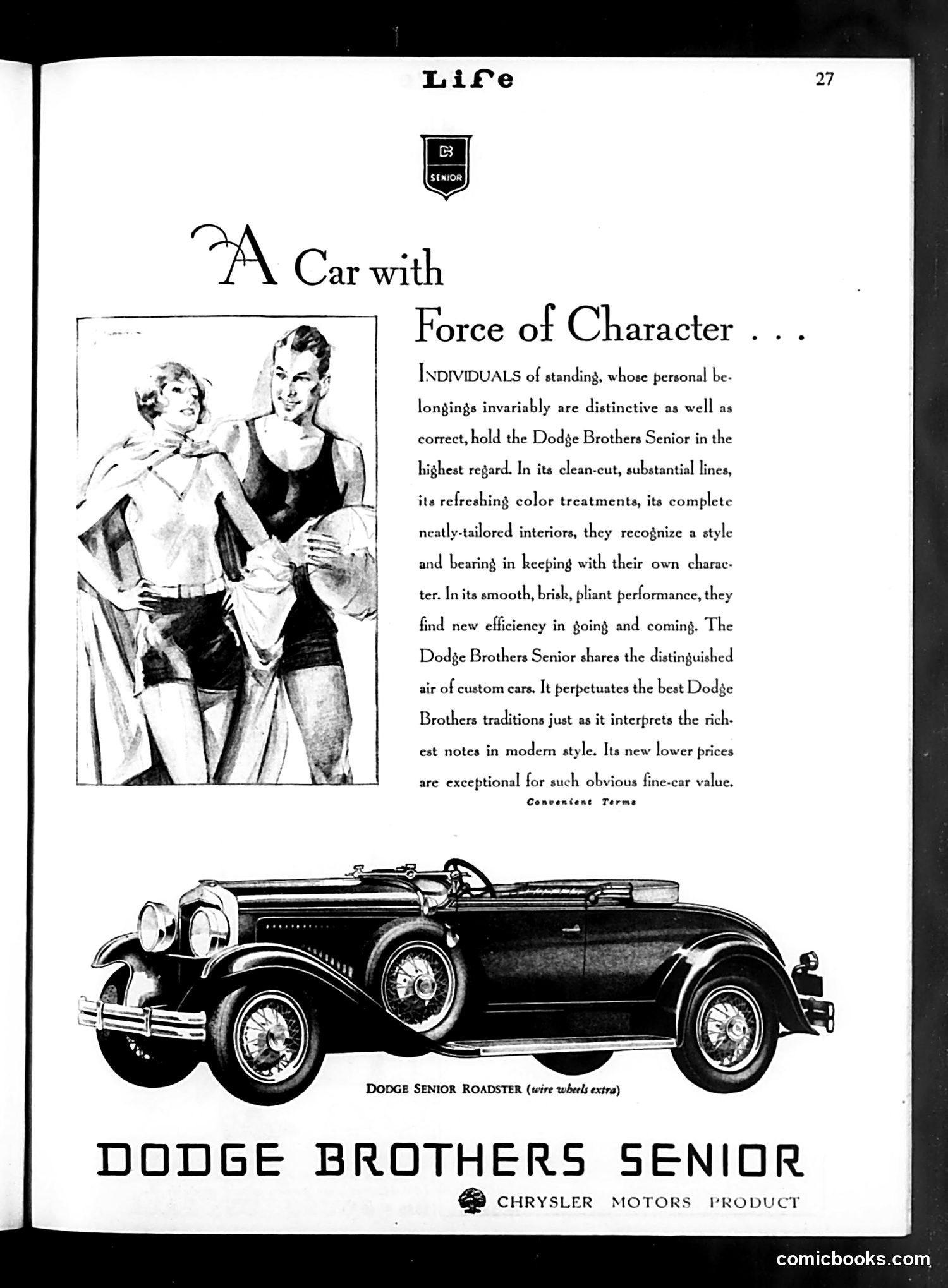
This is primarily **advertising**, not satire or political commentary. The page features a Dodge Brothers Senior automobile advertisement from Life magazine. The illustration shows two fashionably-dressed women in 1920s style (shorter hair, modern clothing) examining or posing with the car. The accompanying text uses aspirational language—"individuals of standing," "distinctive," "custom cars"—to market the vehicle as a status symbol for the socially prominent. The "force of character" headline suggests the car reflects the owner's refined personality and taste. The advertisement emphasizes style, performance, and "new lower prices," appealing to upper-middle-class consumers who want luxury without the highest cost. The Chrysler Motors branding indicates this is a corporate advertisement promoting their Dodge division. There is no apparent satire or political message—it's straightforward automotive marketing using period conventions of gender and class aspiration.
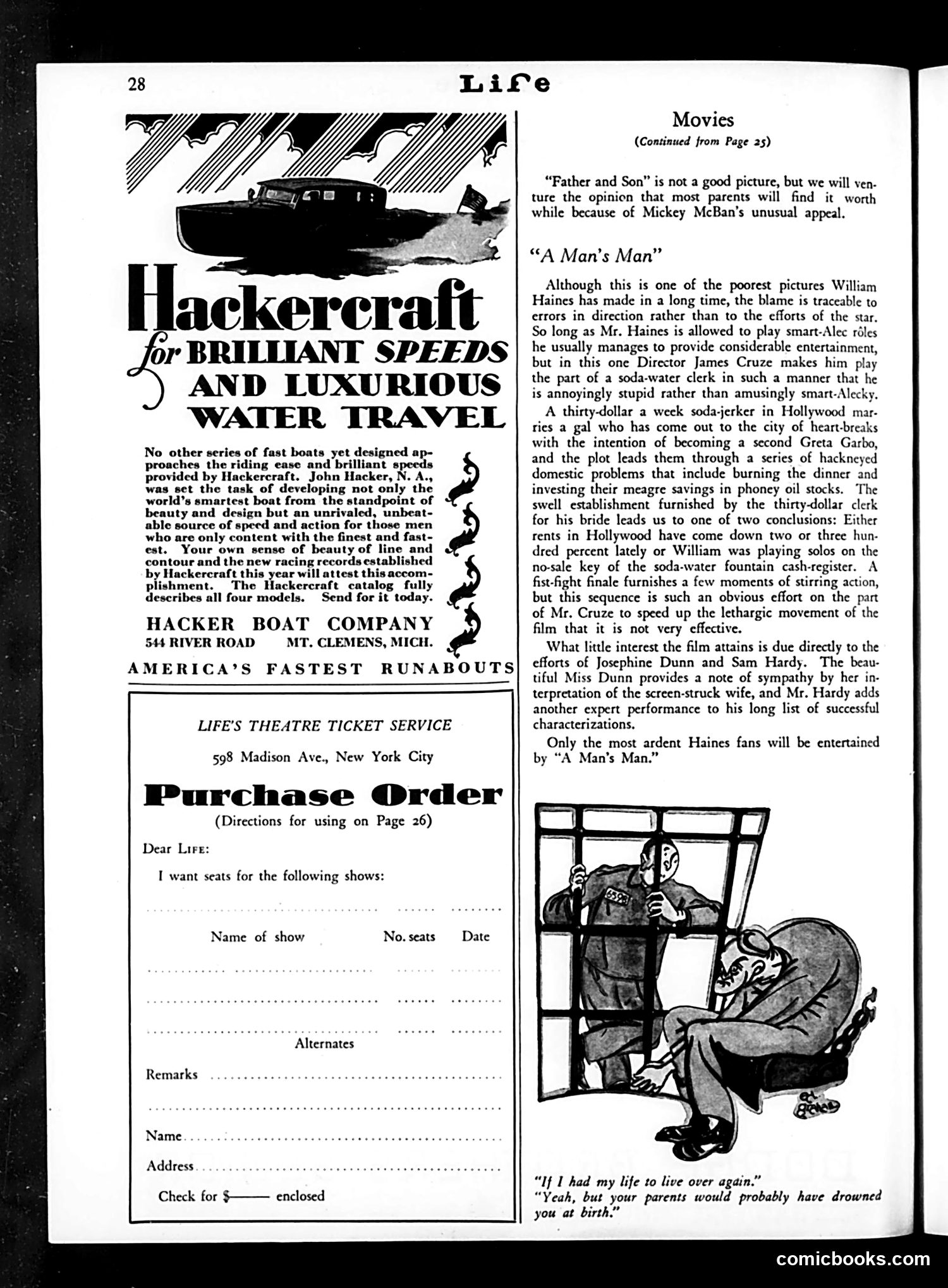
This page is primarily **advertising and service features**, not political satire. The left side contains a full-page advertisement for Hackercraft speedboats, targeting wealthy leisure consumers with promises of "brilliant speeds and luxurious water travel." Below that is a theatre ticket ordering form for Life's ticket service. The right side contains **movie reviews** (continued from page 25). The reviews critique two 1920s films: "Father and Son" (featuring Mickey McBan) and "A Man's Man" (starring William Haines, directed by James Cruze). The critic harshly judges "A Man's Man," describing Haines's role as a soda-fountain clerk as "annoyingly stupid" and criticizing the director's heavy-handed attempts to enliven a sluggish plot with forced action sequences. The cartoon at bottom shows a domestic humor gag: someone at a window expressing regret about reliving life, with a companion's brutal retort about his parents. This is period comedic commentary on domestic dissatisfaction, not political satire.
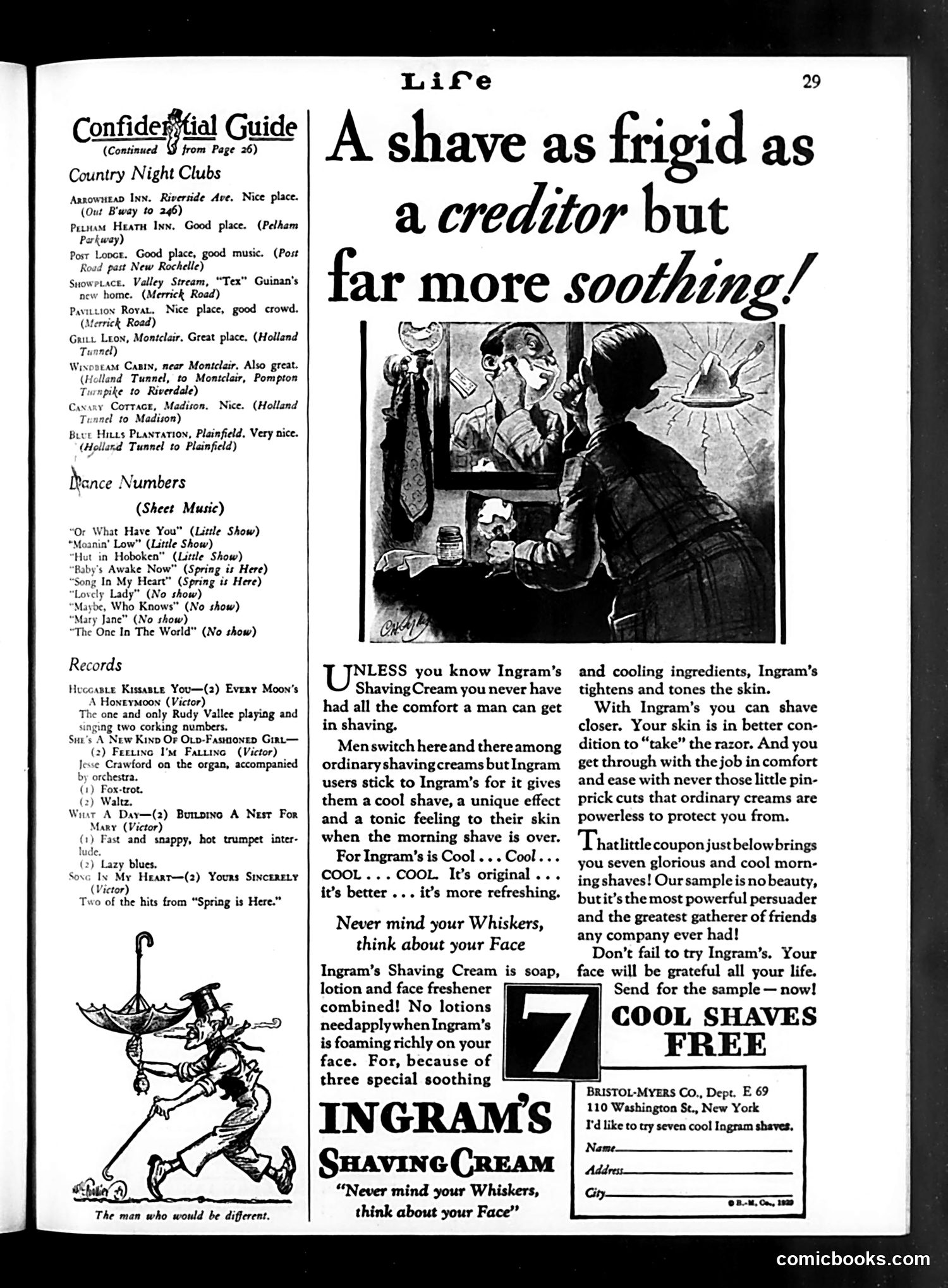
This page is primarily **advertising**, not satire. The large illustration shows a man shaving while a woman watches approvingly—a common trope in 1920s-30s advertising depicting domestic approval of grooming products. The headline's humor is straightforward wordplay: comparing the shaving cream's cooling sensation to "a creditor" (unpleasant, "frigid") but claiming it's actually "soothing"—a mild, gentle joke selling the product's refreshing properties. The left sidebar lists **country nightclubs** (including Tex Guinan's establishment, a famous Prohibition-era speakeasy), dance numbers, and records—typical Life magazine content from this era. The small cartoon of "the man who would be different" appears to be unrelated decorative filler. The coupon at bottom offers free samples, a standard advertising mechanism. This is straightforward commercial promotion with light humor, not political or social satire.
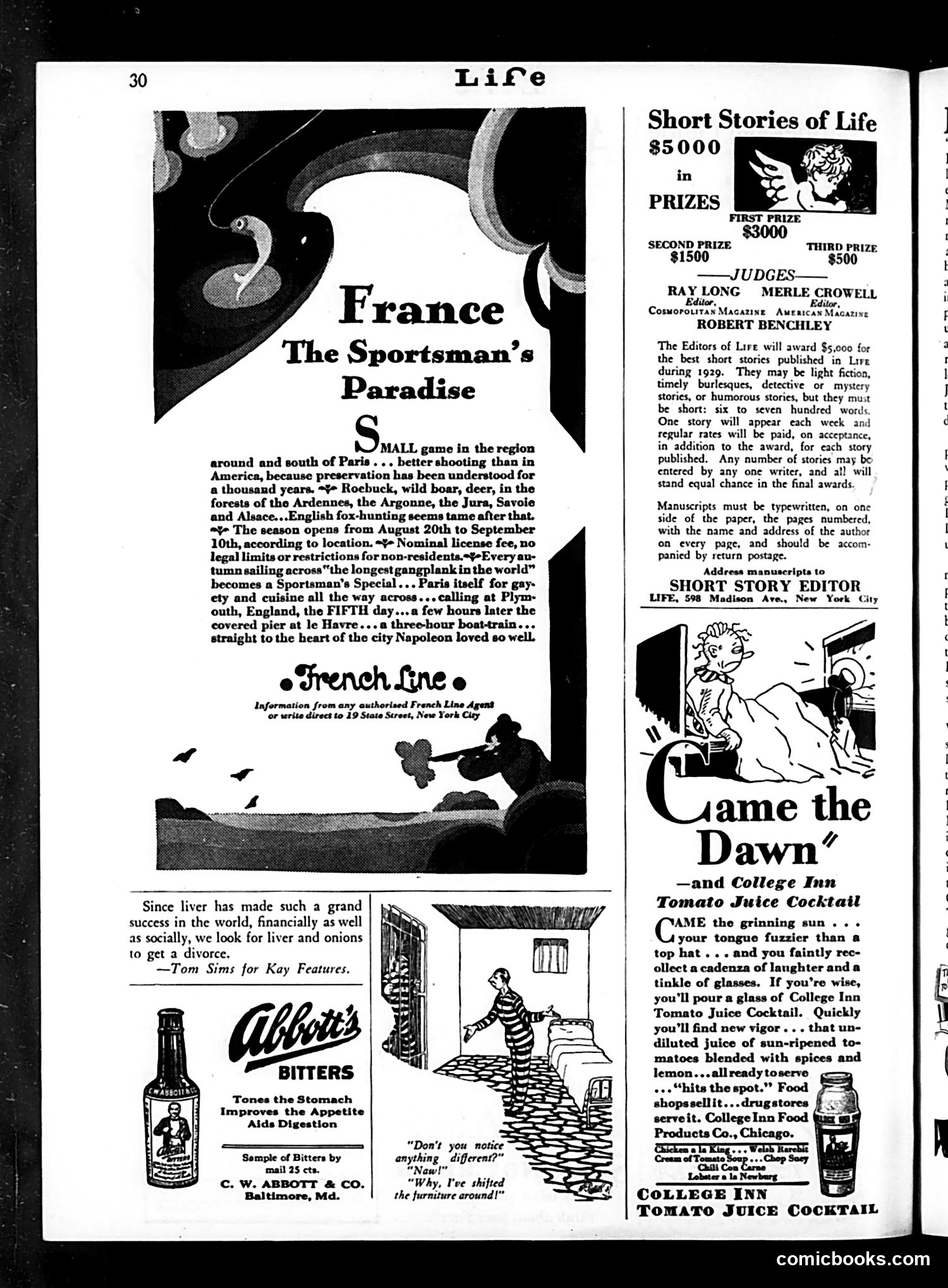
This page combines travel advertising, humor, and contests typical of 1929 Life magazine. **Main Content:** The dominant left section advertises French Line steamship travel, promoting France as "The Sportsman's Paradise" for hunting. It emphasizes superior European game preservation versus America, luxury amenities, and the journey from Paris to English ports—classic 1920s affluent tourism marketing. **Humor:** A small cartoon by Tom Sims jokes about liver and onions "getting a divorce"—a dated pun on celebrity divorces, reflecting 1920s tabloid culture. Below, an Abbott's Bitters ad features a couple where rearranging furniture goes unnoticed, implying domestic monotony. **Right Section:** Life's short-story contest ($5,000 prize) solicits fiction from readers, with judges including editor Ray Long and humorist Robert Benchley. The "Came the Dawn" illustration appears to be satirical fiction accompanying the contest announcement. **Overall:** This is a typical magazine page blending aspirational travel, domestic humor, and reader engagement contests—reflecting 1920s middle to upper-class American leisure culture.
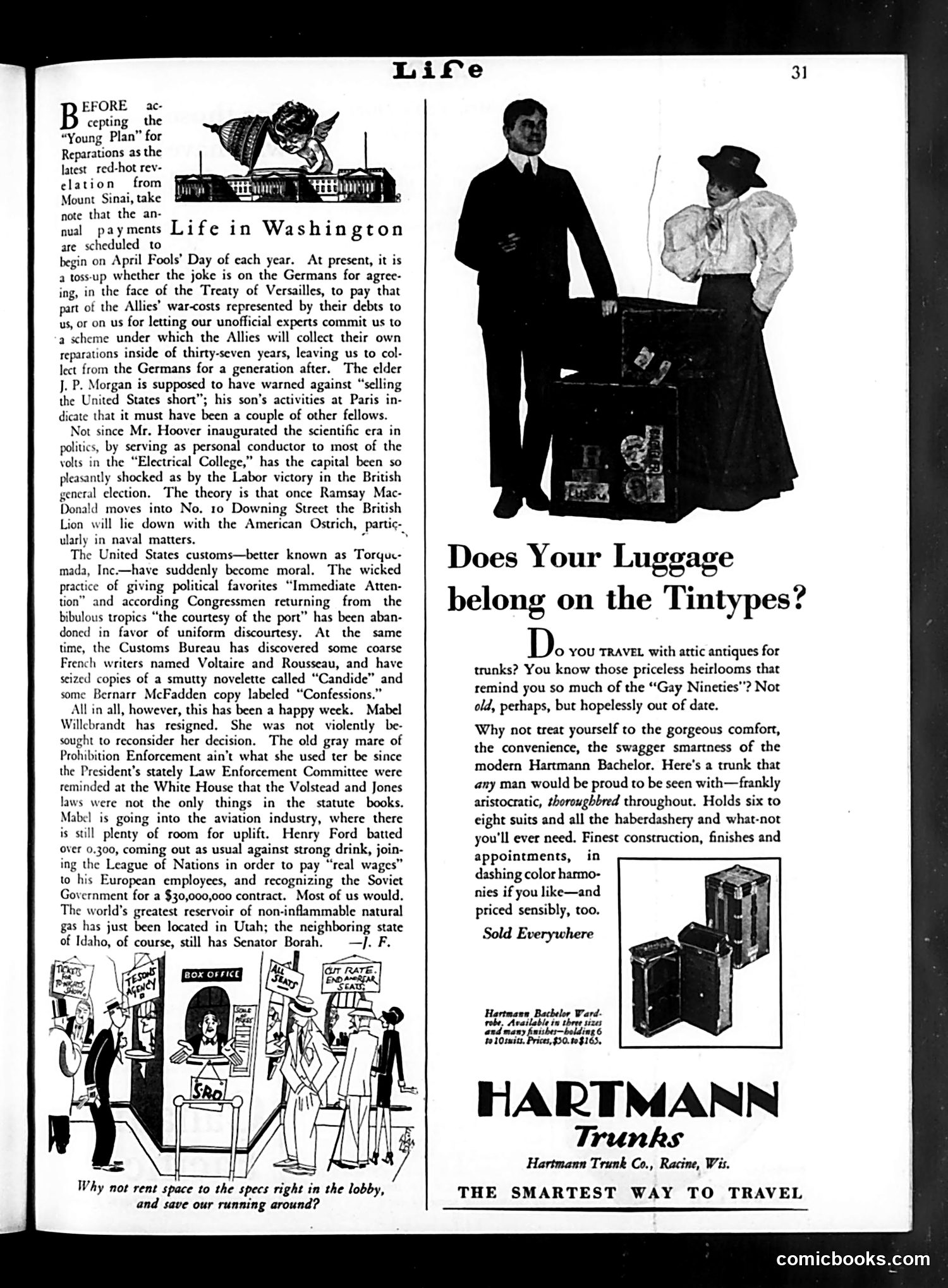
The left column contains satirical commentary on contemporary 1920s politics. The "Young Plan" reference concerns German reparations payments scheduled to begin on April Fools' Day—Life's joke being that either Germany foolishly agreed to impossible terms or the Allies/US accepted a scheme benefiting them only generations later. The piece also mocks: the recent British Labour election victory under Ramsay MacDonald; U.S. Customs Bureau's sudden moral crusade (seizing "Candide" and other works); and the resignation of **Mabel Willbrandt**, the Prohibition Enforcement official whose departure is sarcastically celebrated as ending aggressive enforcement of Prohibition laws. The right side is a **Hartmann Trunks advertisement** contrasting outdated luggage ("Gay Nineties" antiques) with modern, aristocratic travel cases—a straightforward luxury goods pitch to contemporary readers. The bottom cartoon (OCR incomplete) appears to satirize inefficient lobby/waiting room practices.
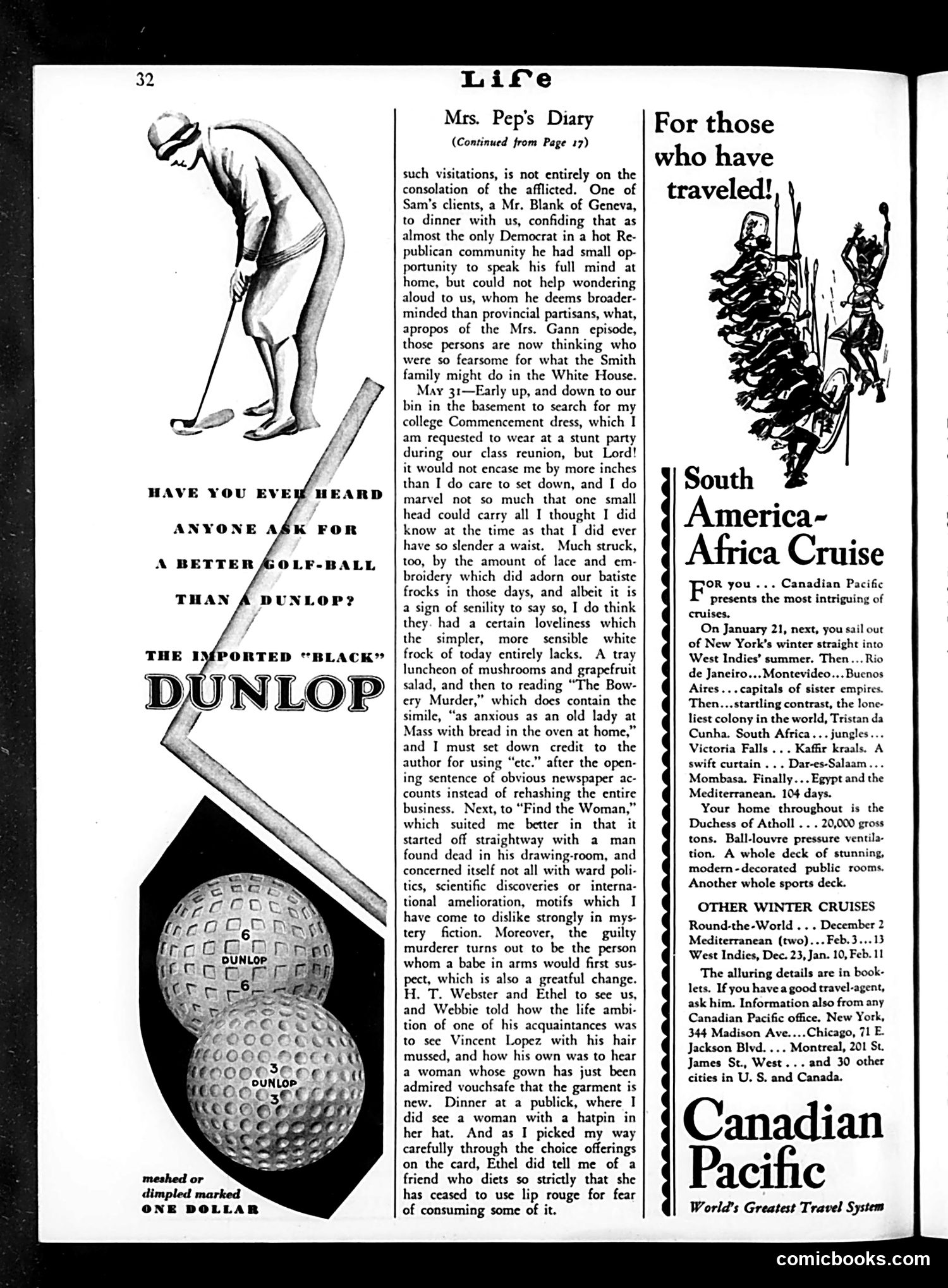
This page combines satirical editorial content with period advertising. The left side features a **Dunlop golf ball advertisement** mocking the product's quality—the illustration shows a golfer in an exaggerated bent posture, humorously suggesting the ball is defective. The center column continues "Mrs. Pep's Diary," a satirical society column lampooning upper-class concerns. The diary references the "Mrs. Gann episode"—likely referring to Dolly Gann (sister of Vice President Charles Curtis), whose social standing sparked 1920s Washington controversy. The entry mockingly juxtaposes trivial concerns (finding an old dress, reading detective novels) with political anxieties about Democratic representation in Republican communities. The right side advertises luxury cruises to South America and Africa, targeting wealthy travelers. The "Duchess of Atholl" ship advertisement emphasizes colonial destinations, reflecting the era's imperial tourism attitudes. Overall, the page satirizes consumer culture, elite social pretensions, and the leisure interests of the American upper class during the interwar period.
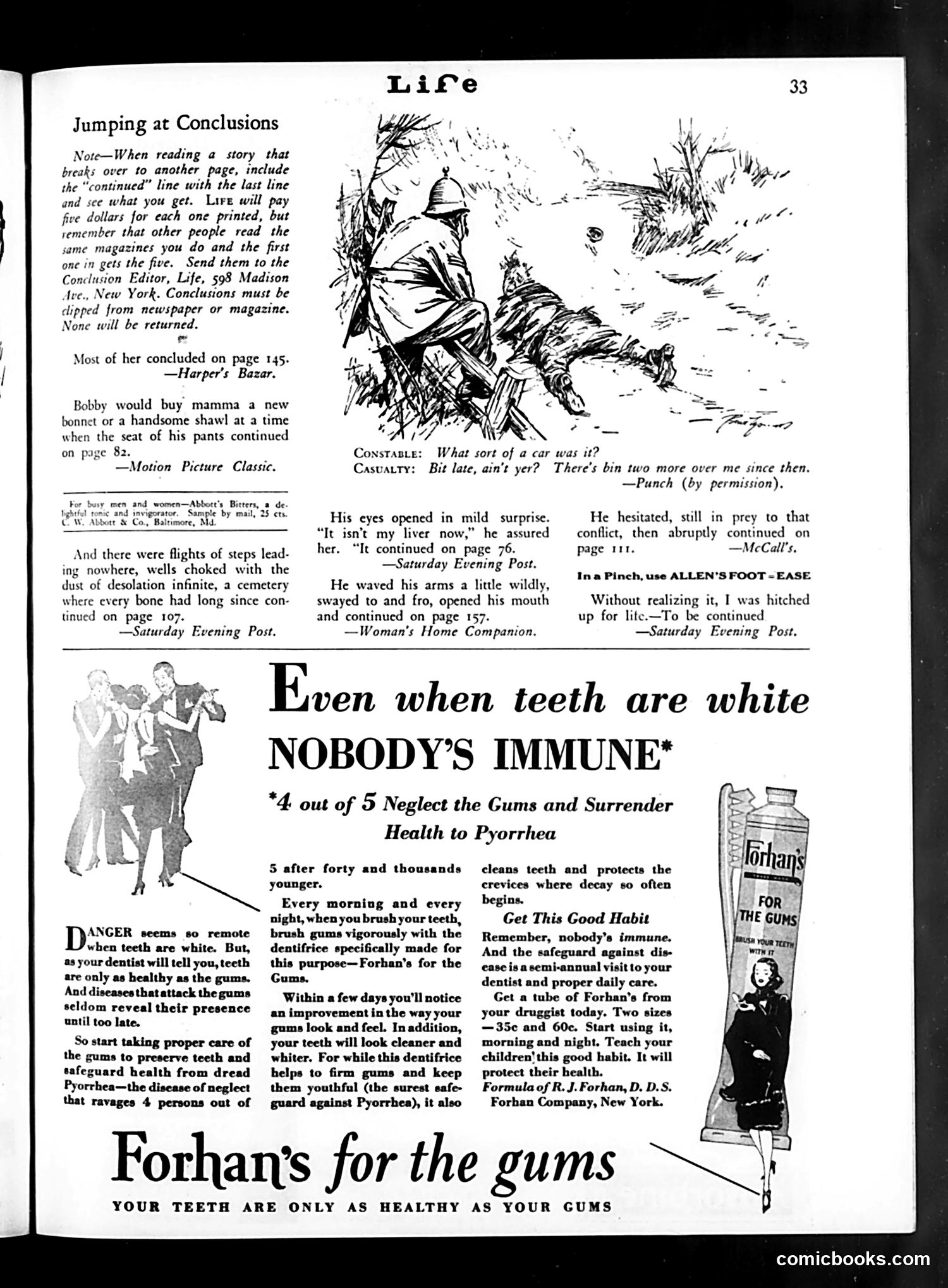
This is a humor feature exploiting a common editorial error: when magazine stories continued across pages, awkward juxtapositions occurred when readers combined the story's final line with the next article's opening line. The page shows examples where this accident creates absurd results. For instance, a story about buying a bonnet "continued on page 82"—which happens to be where a piece about pants begins, creating unintended comedy. Similarly, "It isn't my liver now" followed by "continued on page 76" produces a non-sequitur. The feature invited readers to submit their own found examples for five dollars, creating a participatory game. The joke relies entirely on the mechanical nature of magazine layout and the comedy of accidental juxtaposition rather than intentional satire. The lower half is a Forhan's toothpaste advertisement about gum disease (pyorrhea).
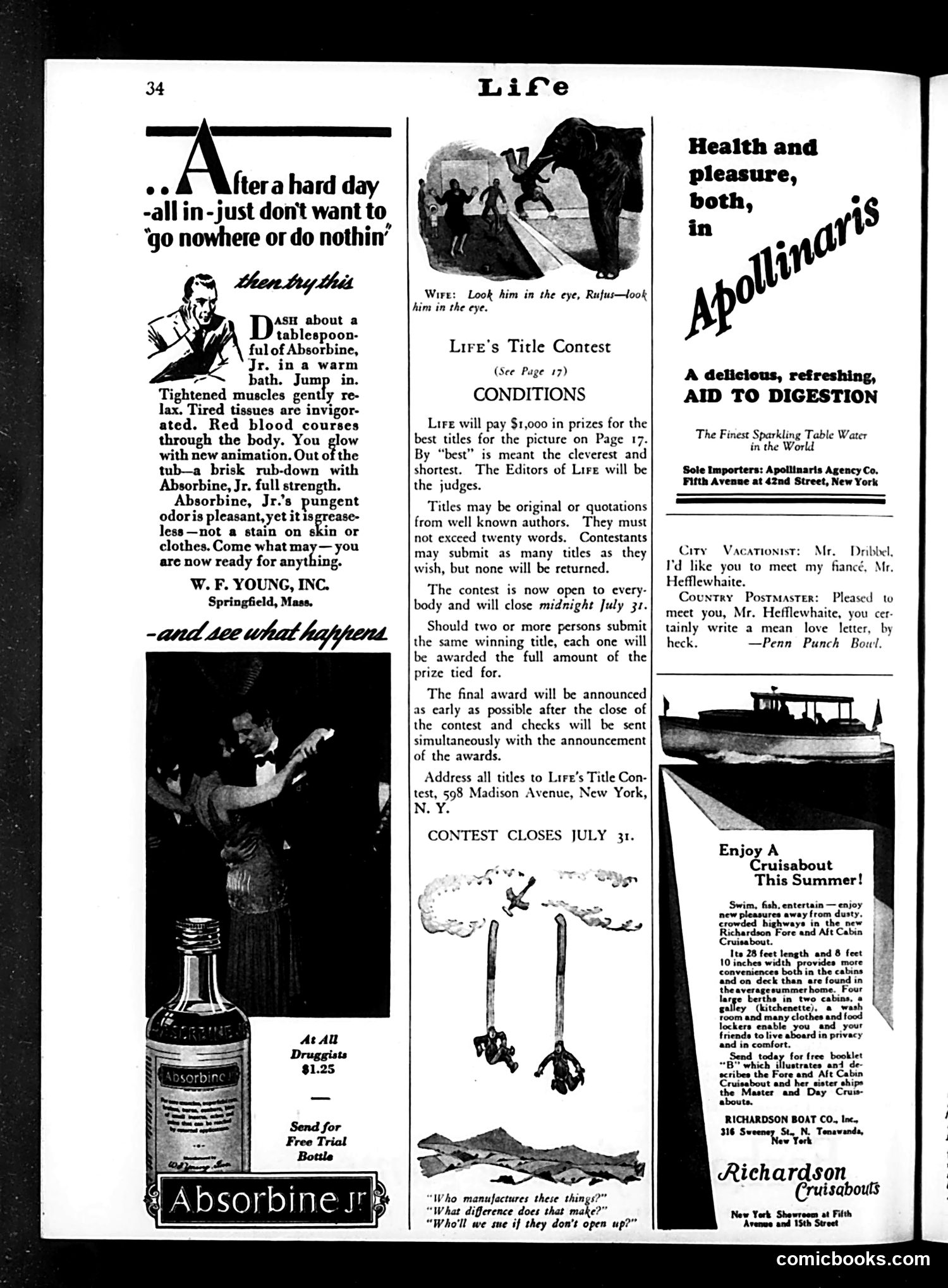
This page is primarily **advertising with minimal editorial content**. The dominant feature is a full-page ad for Absorbine Jr., a liniment product marketed for muscle soreness and fatigue recovery—the ad's headline promises relief "after a hard day." The page includes: 1. **A small cartoon** (upper right): Shows a wife instructing her husband to "look him in the eye, Rufus." The context is unclear without the referenced Page 17 image, but it appears related to Life's title-writing contest offering $1,000 in prizes for clever captions. 2. **Brief humor snippets**: Including a joke about a city vacationist meeting a country postmaster who compliments his "mean love letter" writing. 3. **Product advertisements**: For Apollinaris sparkling water (digestive aid) and Richardson Cruisabout boats. The page is essentially a **commercial vehicle** with minor satirical content—typical of Life magazine's business model blending advertising revenue with editorial material.
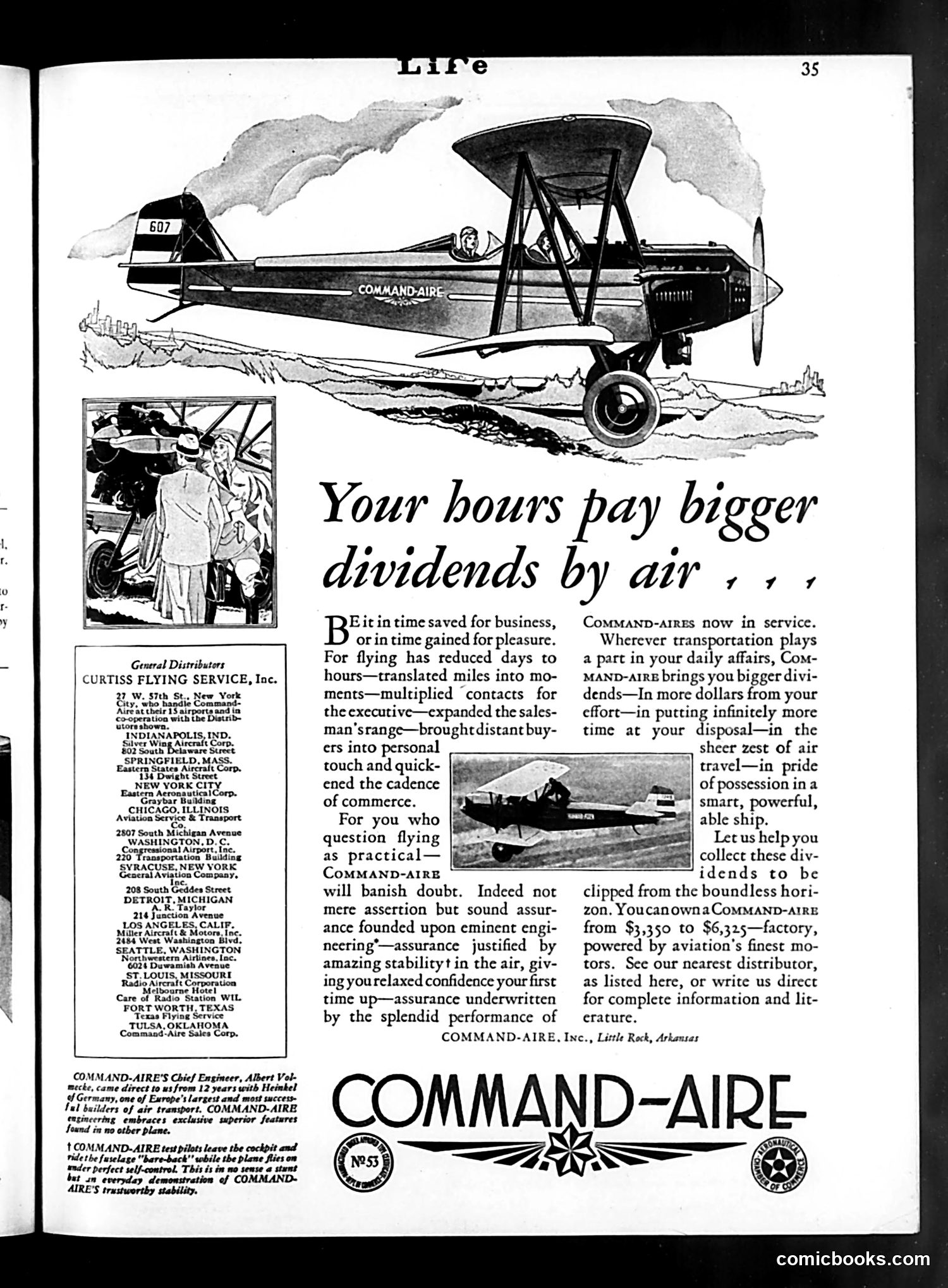
This is primarily **advertising, not satire or political commentary**. The page promotes Command-Aire aircraft to business executives. The advertisement emphasizes aviation's practical benefits: saving business travel time, expanding salesmen's territories, and increasing productivity ("your hours pay bigger dividends by air"). It targets affluent professionals who can afford private planes ($3,350–$6,325). A small inset illustration shows a pilot and businessman, reinforcing the target audience. The ad establishes credibility by highlighting the Chief Engineer's 12 years experience with Germany's Heinkel aircraft manufacturer and claims about the plane's stability—notably mentioning test pilots ride on the fuselage during flight to demonstrate trustworthiness. The distributed dealer network listed suggests this was a major commercial push during aviation's early commercialization period. This reflects 1920s-30s optimism about private aircraft becoming accessible to business professionals—a vision that didn't materialize as predicted.
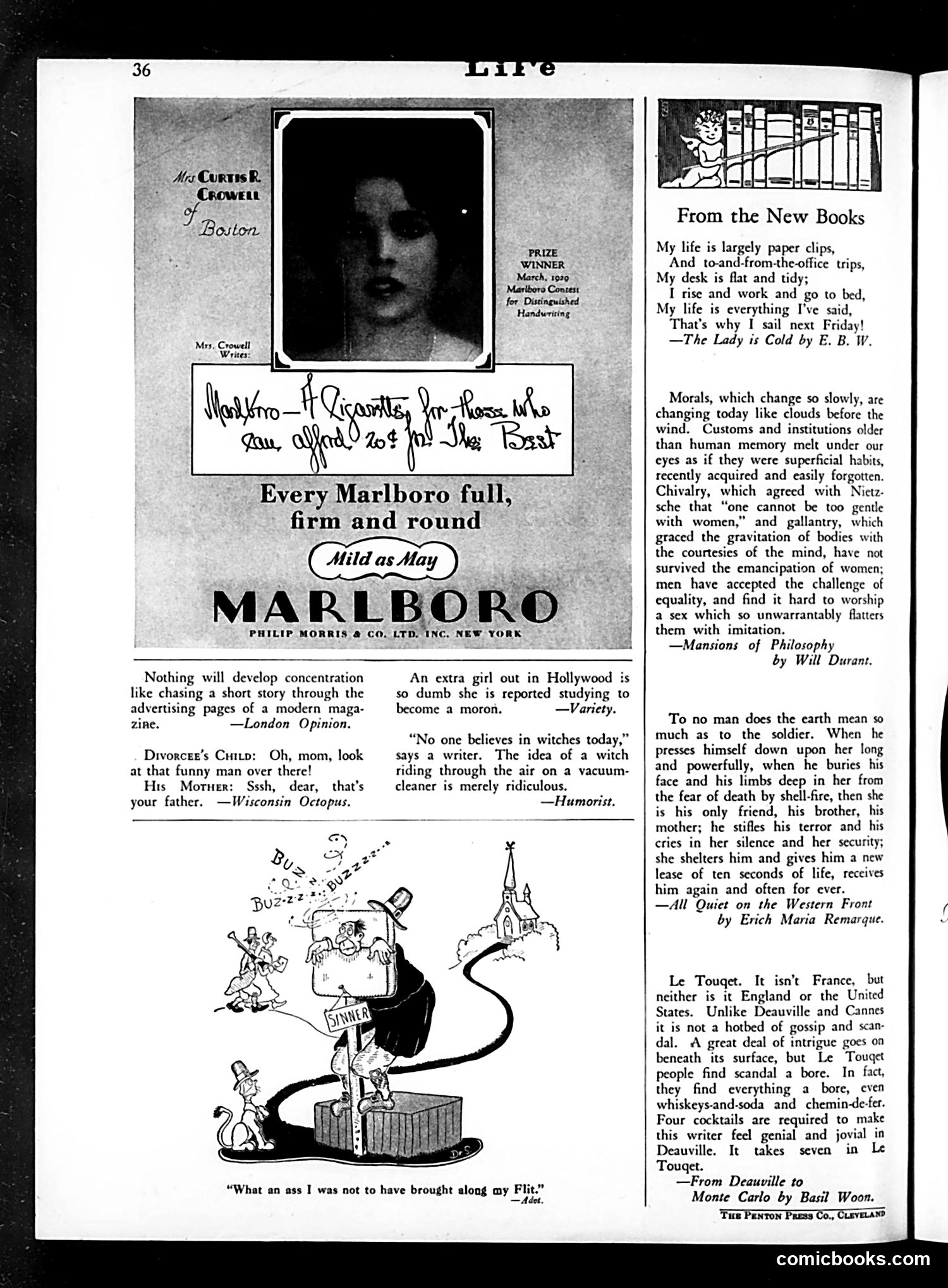
This page combines advertisements, brief jokes, and literary excerpts typical of Life magazine's format. **The main cartoon** depicts a figure labeled "SINNER" caught in a trap or contraption—a visual pun on the phrase "What an ass I was not to have brought along my Flit," referencing Flit insecticide (a popular contemporary product). The joke plays on someone being caught by their own foolishness. **The jokes** mock contemporary absurdities: a magazine reader struggling to follow stories interrupted by ads; a divorcing father mistaken for a "funny man" by his ex-wife's child; and Hollywood's perceived stupidity. **Literary excerpts** discuss modern social changes—particularly women's emancipation challenging traditional chivalry—and wartime experiences, suggesting this is from the 1920s-30s era. **The Marlboro advertisement** at top features a Boston woman's handwriting, promoting cigarettes as "mild as May." Overall, the page reflects Jazz Age satire targeting modern life's contradictions: consumer culture, changing gender roles, and shallow celebrity culture.
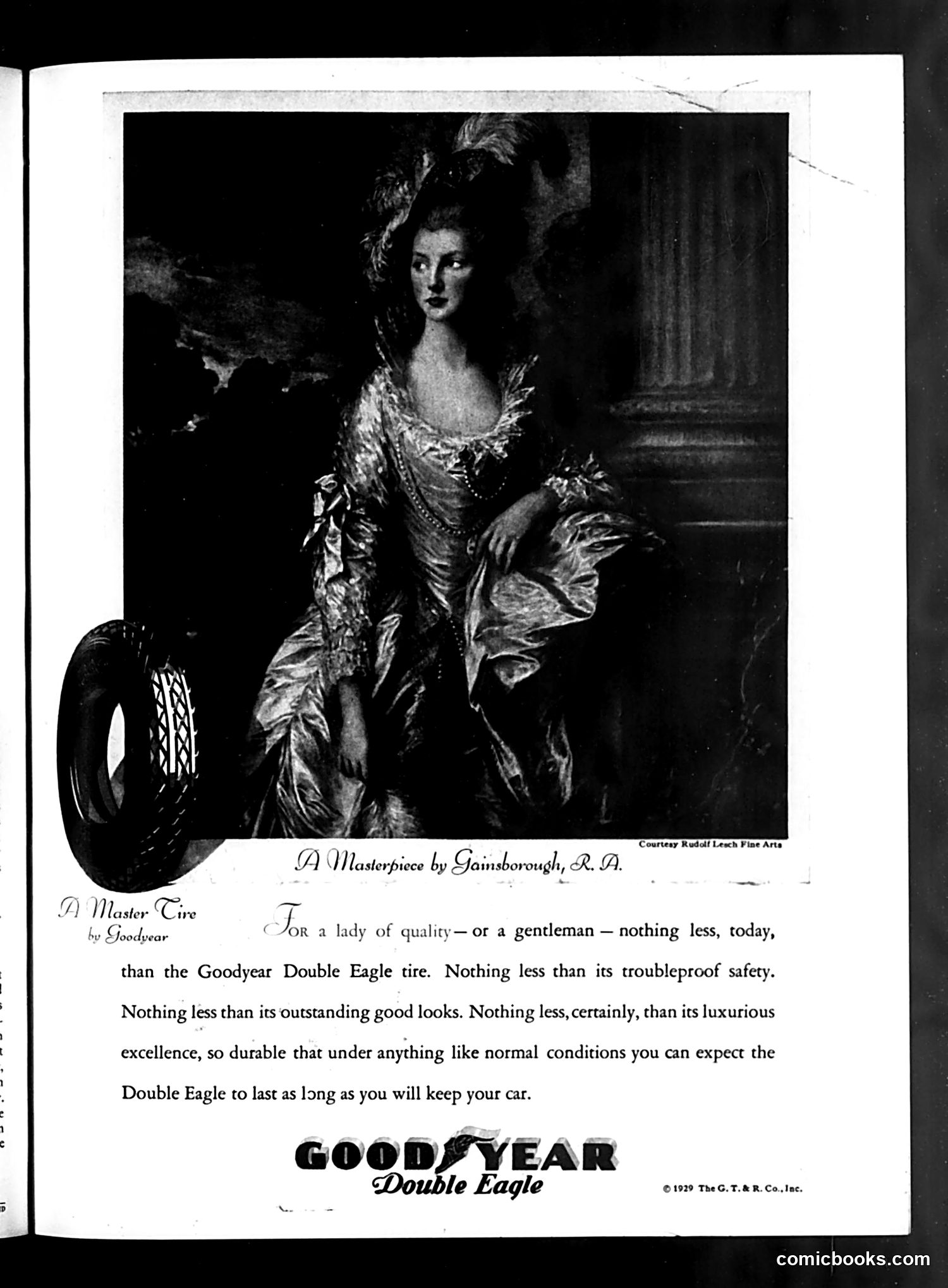
This is primarily a **Goodyear tire advertisement** (1929), not political satire. It uses a classical painting reference—"A Masterpiece by Gainsborough, R.A."—to market the Double Eagle tire to affluent consumers. The ad's strategy is aspirational: by pairing the tire with an 18th-century portrait of an elegantly dressed woman (appearing to reference Thomas Gainsborough's society portraits), Goodyear associates their product with luxury, refinement, and timeless quality. The copy explicitly targets "a lady of quality—or a gentleman," emphasizing that the tire represents elegance and durability befitting the wealthy. The humor is subtle: the comparison equates a tire's durability and appearance with fine art—suggesting the tire is both beautiful and lasting. This reflects 1920s advertising trends that positioned consumer goods as status symbols and lifestyle statements rather than mere practical items.
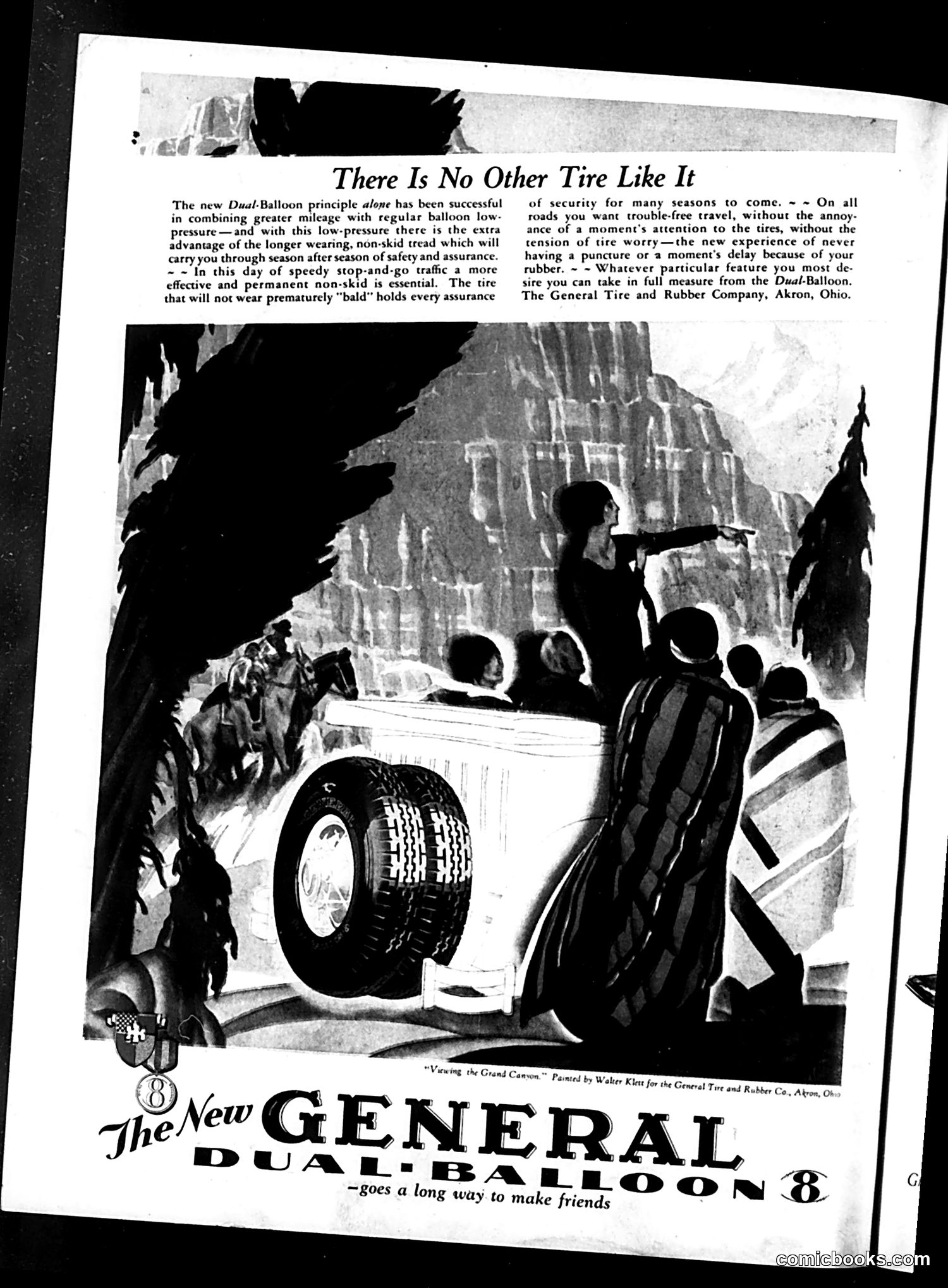
This is primarily a **tire advertisement**, not political satire. It promotes General Tire and Rubber Company's "Dual-Balloon" tire technology. The illustration depicts a scenic moment—appears to be the Grand Canyon based on the caption—where passengers in an open vehicle admire the landscape. The tire itself is prominently displayed in the foreground. The ad's messaging targets 1920s motorists concerned with **practical reliability**: puncture resistance, longevity ("won't wear prematurely 'bald'"), traction ("non-skid"), and low-pressure comfort. The tagline "goes a long way to make friends" is a light-hearted appeal to trouble-free motoring. There is no political cartoon or satire here—it's straightforward consumer advertising using an appealing lifestyle image (leisurely auto travel through natural wonders) to sell tires. The page demonstrates how Life magazine mixed editorial content with advertising revenue.