
Life, 1929-06-21 · page 38 of 40
Life — June 21, 1929 — page 38: what you’re looking at
What you’re looking at
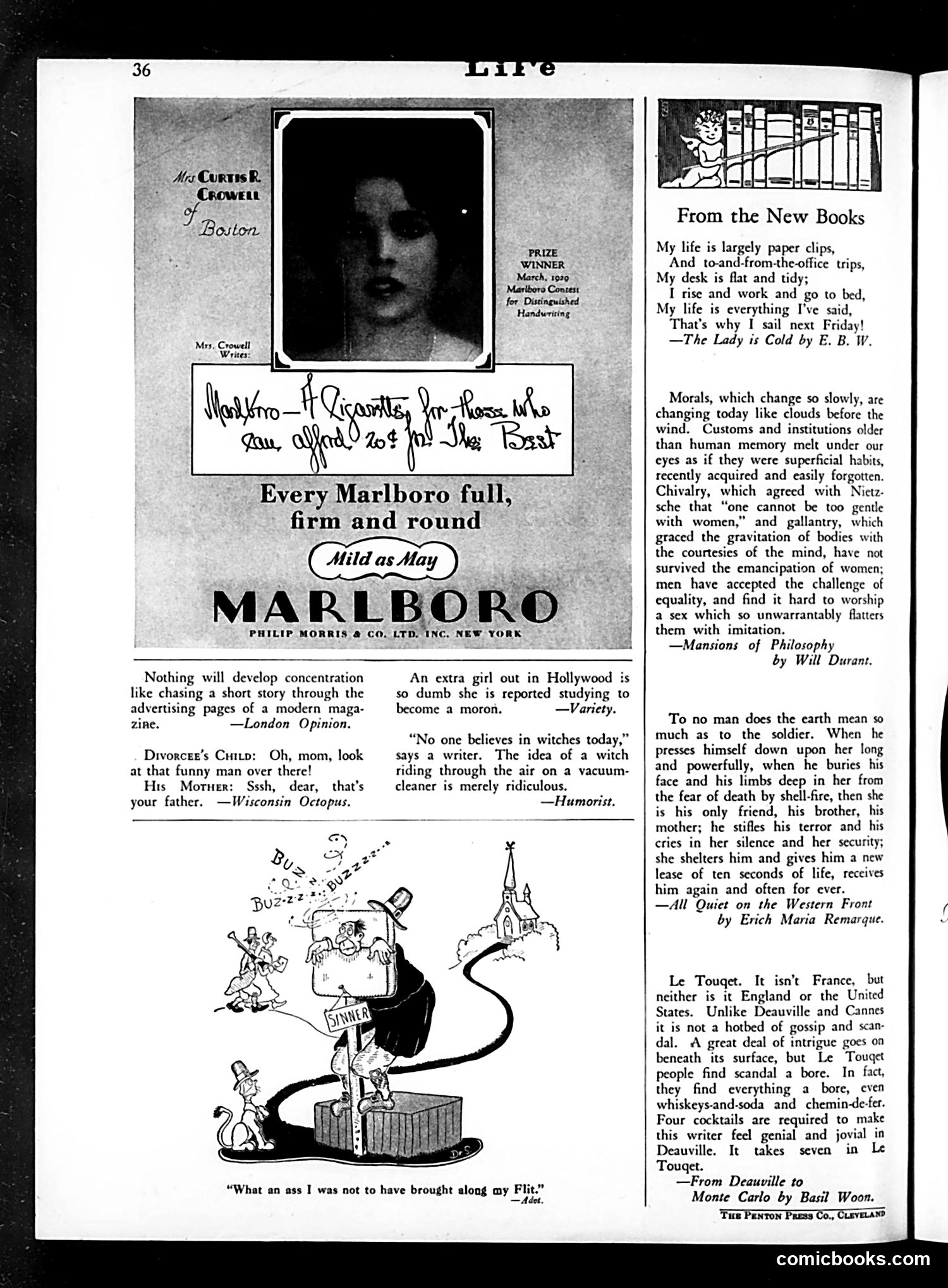
This page combines advertisements, brief jokes, and literary excerpts typical of Life magazine's format. **The main cartoon** depicts a figure labeled "SINNER" caught in a trap or contraption—a visual pun on the phrase "What an ass I was not to have brought along my Flit," referencing Flit insecticide (a popular contemporary product). The joke plays on someone being caught by their own foolishness. **The jokes** mock contemporary absurdities: a magazine reader struggling to follow stories interrupted by ads; a divorcing father mistaken for a "funny man" by his ex-wife's child; and Hollywood's perceived stupidity. **Literary excerpts** discuss modern social changes—particularly women's emancipation challenging traditional chivalry—and wartime experiences, suggesting this is from the 1920s-30s era. **The Marlboro advertisement** at top features a Boston woman's handwriting, promoting cigarettes as "mild as May." Overall, the page reflects Jazz Age satire targeting modern life's contradictions: consumer culture, changing gender roles, and shallow celebrity culture.
📄 Transcribed text from this page (OCR, searchable)
Machine-transcribed from the original scan — historical spelling and the odd misread are preserved.
Ars Curis R Crowe Boston Mrs. Crowell Ww Handwriting Every Marlboro full, firm and round PHILIP MORRIS @ CO. LTD. INC. NEW YORK Nothing will develop concentration like chasing a short story through the advertising pages of a modern maga- zine. —London Opinion. Divorcee’s Cuttp: Oh, mom, look at that funny man over there! His Morner: Sssh, dear, that’s your father. —Wisconsin Octopus. An extra girl out in Hollywood is so dumb she is reported studying to become a moron. —Variety. “No one believes in witches today,” says a writer. The idea of a witch riding through the air on a vacuum- cleaner is merely ridiculous. —Humorist. “What an ass I was not to have brought along my Elie From the New Books My life is largely paper clips, And to-and-from-the-office trips, My desk is flat and tidy; I rise and work and go to bed, My life is everything I've said, That's why I sail next Friday! —The Lady is Cold by E. B. W. Morals, which change so slowly, are changing today like clouds before the wind. Customs and institutions older than human memory melt under our eyes as if they were superficial habits, recently acquired and easily forgotten. Chivalry, which agreed with Nietz- sche that “one cannot be too gentle with women,” and gallantry, which gtaced the gravitation of bodies with the courtesies of the mind, have not survived the emancipation of women; men have accepted the challenge of equality, and find it hard to worship a sex which so unwarrantably flatters them with imitation. —Mansions of Philosophy by Will Durant. To no man does the earth mean so much as to the soldier. When he presses himself down upon her long and powerfully, when he buries his face and his limbs deep in her from the fear of death by shell-fire, then she is his only friend, his brother, his mother; he stifles his terror and his cries in her silence and her security; she shelters him and gives him a new lease of ten seconds of life, receives him again and often for ever. —All Quiet on the Western Front by Erich Maria Remarque. Le Touget. It isn’t France, but neither is it England or the United States. Unlike Deauville and Cannes it is not a hotbed of gossip and scan- dal. A great deal of intrigue goes on beneath its surface, but Le Touget people find scandal a bore. In fact, they find everything a bore, even whiskeys-and-soda and chemin-de-fer. Four cocktails are required to make this writer feel genial and jovial in Deauville. It takes seven in Le Touget. —From Deauville to Monte Carlo by Basil Woon. Tun Penton Pass Co., CLEVELAND comicbooks.com