
Life, 1929-08-16 · page 9 of 36
Life — August 16, 1929 — page 9: what you’re looking at
What you’re looking at
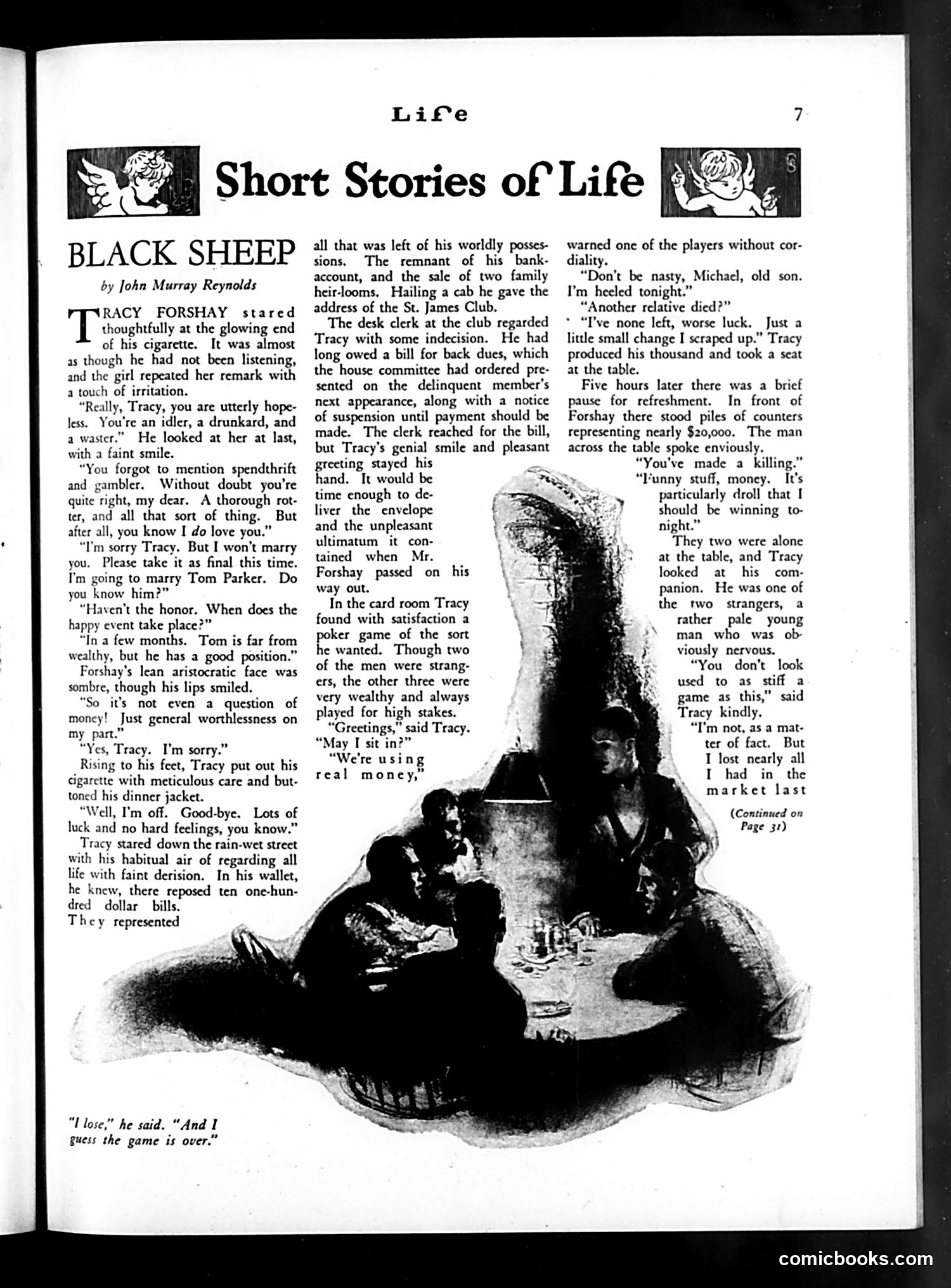
This is a short story, not political satire. The narrative follows Tracy Forshay, a man of modest means who is estranged from his wealthy family. He visits the St. James Club and discovers he owes back dues; the club threatens suspension. The accompanying illustration depicts Tracy at a table with a companion, discussing finances. The story explores themes of social class, debt, and family rejection—Tracy has become the family's "black sheep," abandoned by relatives despite his genteel background. The central irony: Tracy is broke and socially isolated despite his aristocratic connections, highlighting the precarious position of the impoverished gentry during the early 20th century. The narrative concerns personal failure rather than political commentary.
📄 Transcribed text from this page (OCR, searchable)
Machine-transcribed from the original scan — historical spelling and the odd misread are preserved.
Life Short Stories of Life BLACK SHEEP by John Murray Reynolds RACY FORSHAY stared thoughtfully at the glowing end of his cigarette. It was almost as though he had not been listening, and the girl repeated her remark with a touch of irritation. “Really, Tracy, you are utterly hope- less. You're an idler, a drunkard, and a waster.” He looked at her at last, with a faint smile. “You forgot to mention spendthrift and gambler. Without doubt you're quite right, my dear. A thorough rot- ter, and all that sort of thing. But after all, you know I do love you.” “I'm sorry Tracy. But I won't marry you. Please take it as final this time. I'm going to marry Tom Parker. Do you know him?” “Haven't the honor. When does the happy event take place?” “In a few months. Tom is far from wealthy, but he has a good position.” Forshay’s lean aristocratic face was sombre, though his lips smiled. “So it’s not even a question of moncy! Just general worthlessness on my part.” “Yes, Tracy. I’m sorry.” Rising to his feet, Tracy put out his cigarette with meticulous care and but- toned his dinner jacket. “Well, I'm off. Good-bye. Lots of luck and no hard feelings, you know.” Tracy stared down the rain-wet street with his habitual air of regarding all life with faint derision. In his wallet, he knew, there reposed ten one-hun- dred dollar _ bills. They represented “I lose,” he said. “And 1 guess the game is over.” all that was left of his worldly posses- sions. The remnant of his bank- account, and the sale of two family heirlooms, Hailing a cab he gave the address of the St. James Club. The desk clerk at the club regarded Tracy with some indecision. He had long owed a bill for back dues, which ¢ house committee had ordered pre- sented on the delinquent member's next appearance, along with a notice of suspension until payment should be made. The clerk reached for the bill, but Tracy's genial smile and pleasant greeting stayed his hand. It would be time enough to de- liver the envelope and the unpleasant ultimatum it con- tained when Mr. Forshay passed on his way out. In the card room Tracy found with satisfaction a poker game of the sort he wanted. Though two of the men were strang- ers, the other three were very wealthy and always played for high stakes. “Greetings,” said Tracy. “May I sit in?” “We're using real money,” * “I've none left, worse luck. warned one of the players without cor- diality. “Don't be nasty, Michael, old son. I’m heeled tonight.” “Another relative died?” Just a litle small change I scraped up.” Tracy produced his thousand and took a seat at the table. Five hours later there was a brief pause for refreshment. In front of Forshay there stood piles of counters representing nearly $20,000. The man across the table spoke enviously. “You've made a killing.” “lunny stuff, money. It’s particularly droll that I should be winning to- night.” They two were alone at the table, and Tracy looked at his com- panion. He was one of the two strangers, a rather pale young man who was ob- viously nervous. “You don’t look used to as stiff a game as this,” said Tracy kindly. “T'm not, as a mat- ter of fact. But T lost nearly all I had in the market last (Continued on Page 31) comicbooks.com