
A complete issue · 36 pages · 1929
Life — August 16, 1929
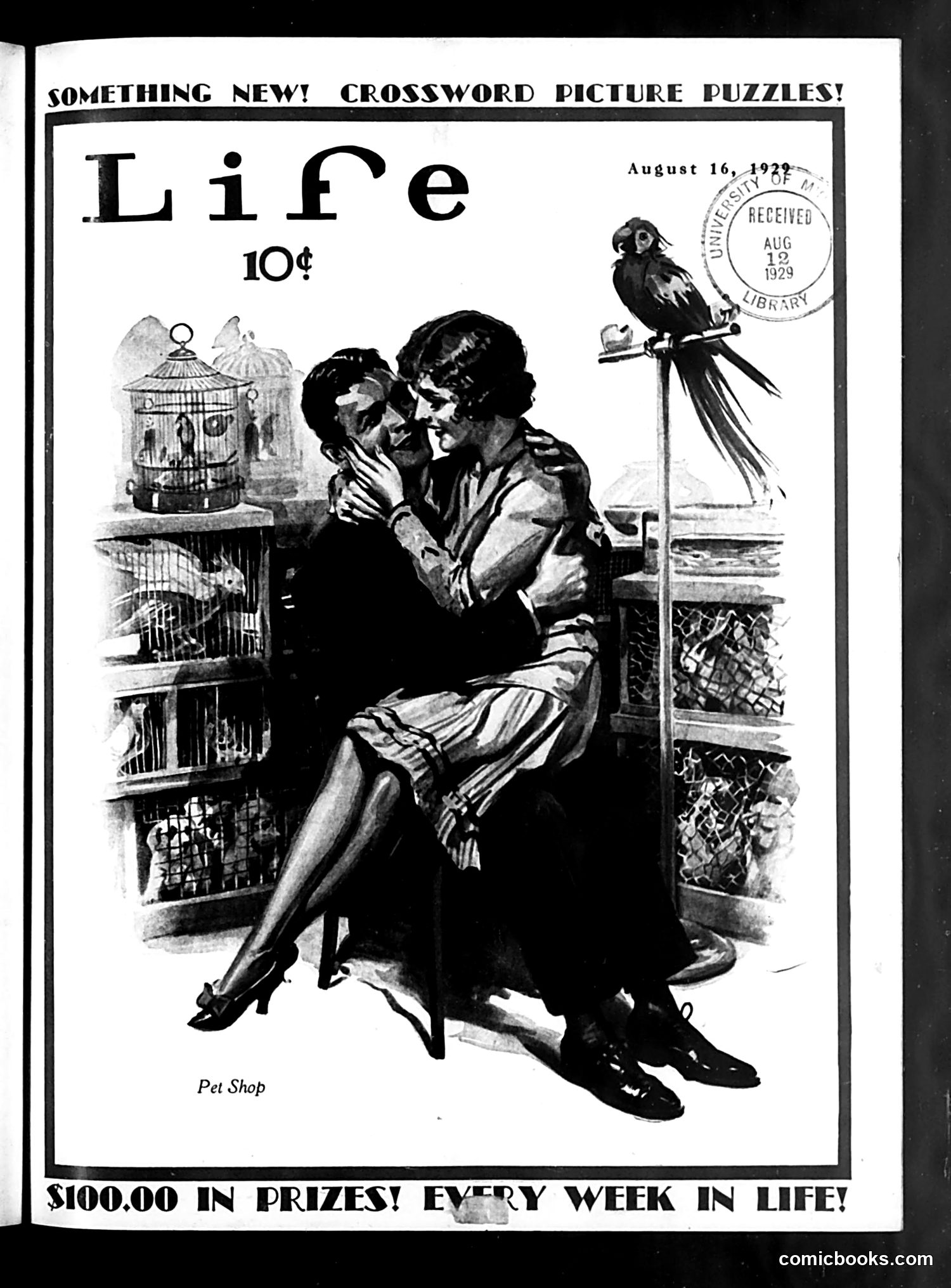
This illustration shows a romantic couple at a pet shop, with birdcages visible in the background and a parrot on a perch. The caption reads simply "Pet Shop." The humor appears to be a visual double entendre typical of 1920s Life magazine satire. The romantic embrace in a pet shop setting, combined with the prominent display of caged birds and the perched parrot, likely plays on period slang or social commentary about courtship and relationships. The Art Deco illustration style was characteristic of the magazine's sophisticated humor aimed at urban, educated readers of the Jazz Age. The page advertises crossword picture puzzles and weekly prizes, indicating this was part of Life's entertainment and games section rather than political commentary.
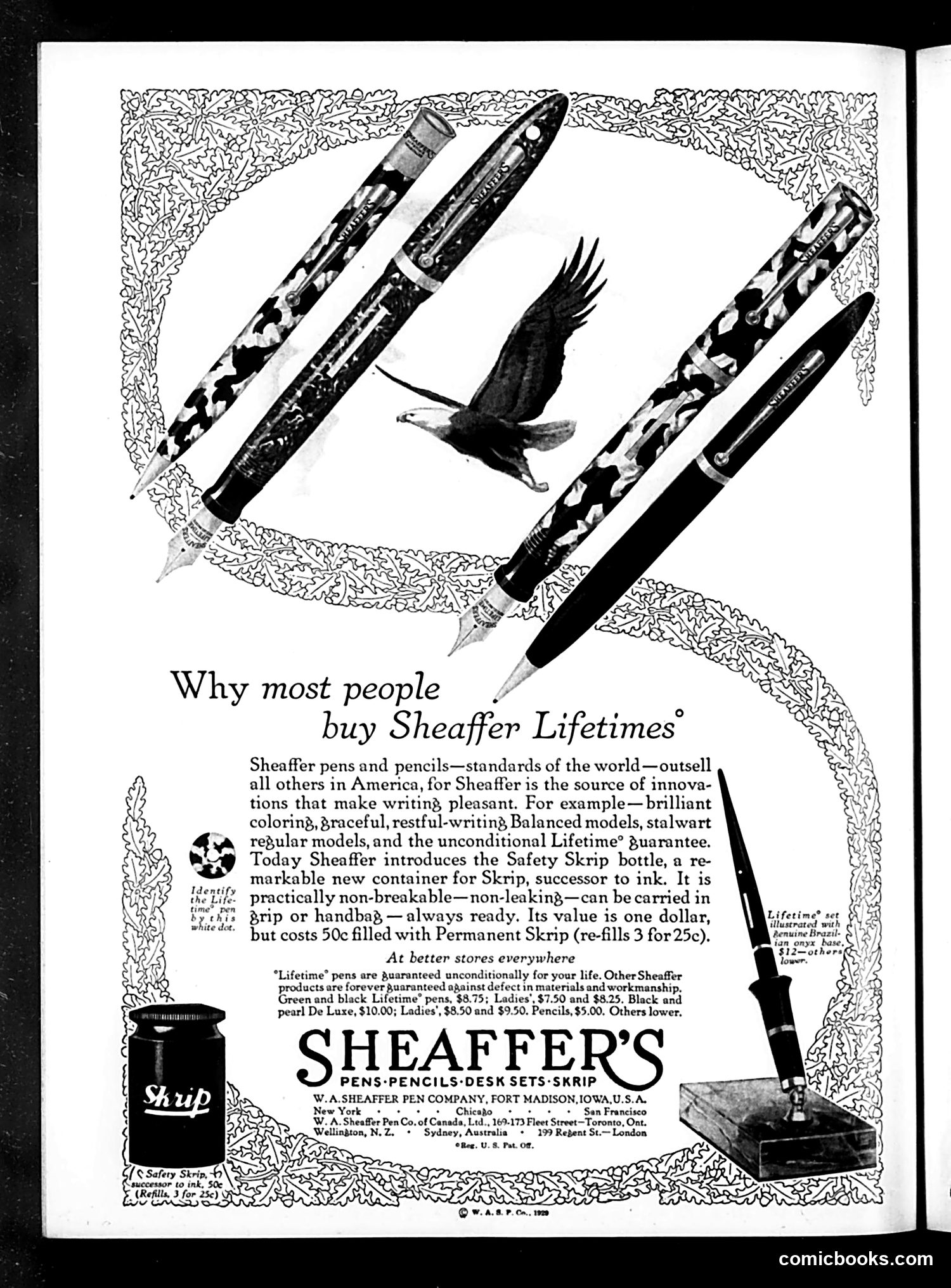
This is a **product advertisement**, not political satire. It promotes Sheaffer fountain pens and pencils, marketed as superior writing instruments. The page features several decorative pens arranged around an illustration of a bird in flight, set within an ornamental leaf-pattern border. The ad emphasizes Sheaffer's "Lifetime" guarantee and highlights their new Safety Skrip bottle—described as "practically non-breakable" and "non-leaking." The copy claims Sheaffer pens "outsell all others in America" and stresses innovations in writing quality and durability. Pricing information indicates Lifetime pens ranged from $3 to $10, with pencils from $5 and up—substantial costs for the era. The advertisement lists multiple international locations where products were available. There is no political cartoon or social satire present on this page.
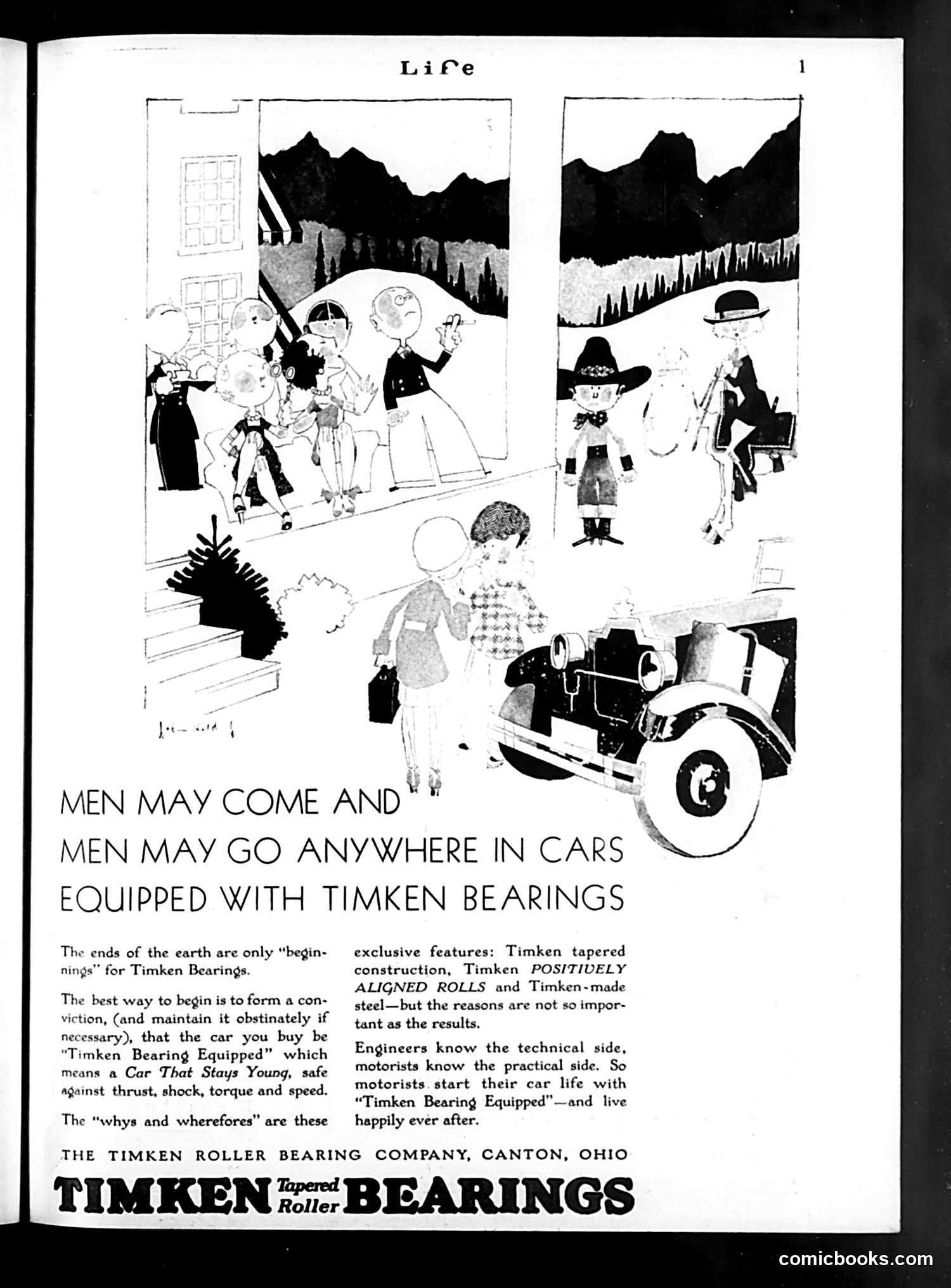
This page is primarily **advertising**, not editorial content or satire. It's a Timken Roller Bearings advertisement from *Life* magazine. The illustration depicts a leisure scene—people arriving at and departing from what appears to be a mountain resort or vacation destination via automobile. The ad's message is aspirational: cars equipped with Timken bearings enable freedom of movement and travel ("Men may come and men may go anywhere in cars"). The text emphasizes product reliability ("a Car That Stays Young, safe against thrust, shock, torque and speed") and appeals to both engineers and ordinary motorists. This reflects 1920s-era automotive advertising that positioned quality components as enabling the new automobile lifestyle. There is no political satire or social commentary—it's straightforward commercial promotion targeting consumers with discretionary income.
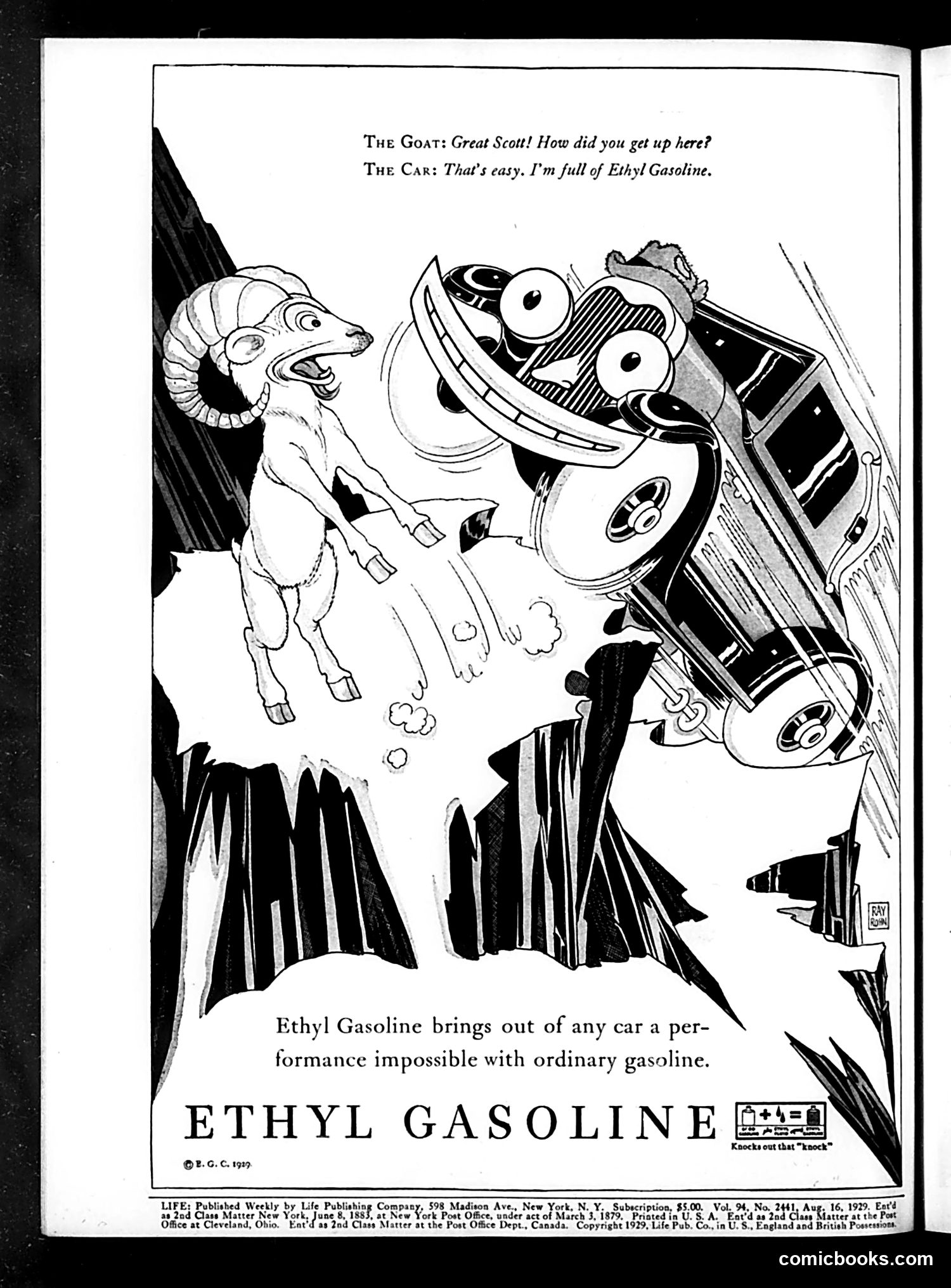
This is an **advertisement**, not political satire. It promotes Ethyl Gasoline through a humorous cartoon showing a goat and an anthropomorphic car conversing at the edge of a cliff. **The joke:** The goat asks how the car reached this impossible height. The car replies it's "full of Ethyl Gasoline"—implying the fuel provides extraordinary performance. The visual gag is that only a goat (known for climbing steep terrain) could normally reach such a place, yet the car has done so. **The sales pitch:** The bottom text claims Ethyl Gasoline delivers performance "impossible with ordinary gasoline," suggesting superior power and capability. This reflects 1920s automotive advertising that used surreal humor and exaggeration to market fuel additives as performance enhancers to American consumers discovering automobiles.
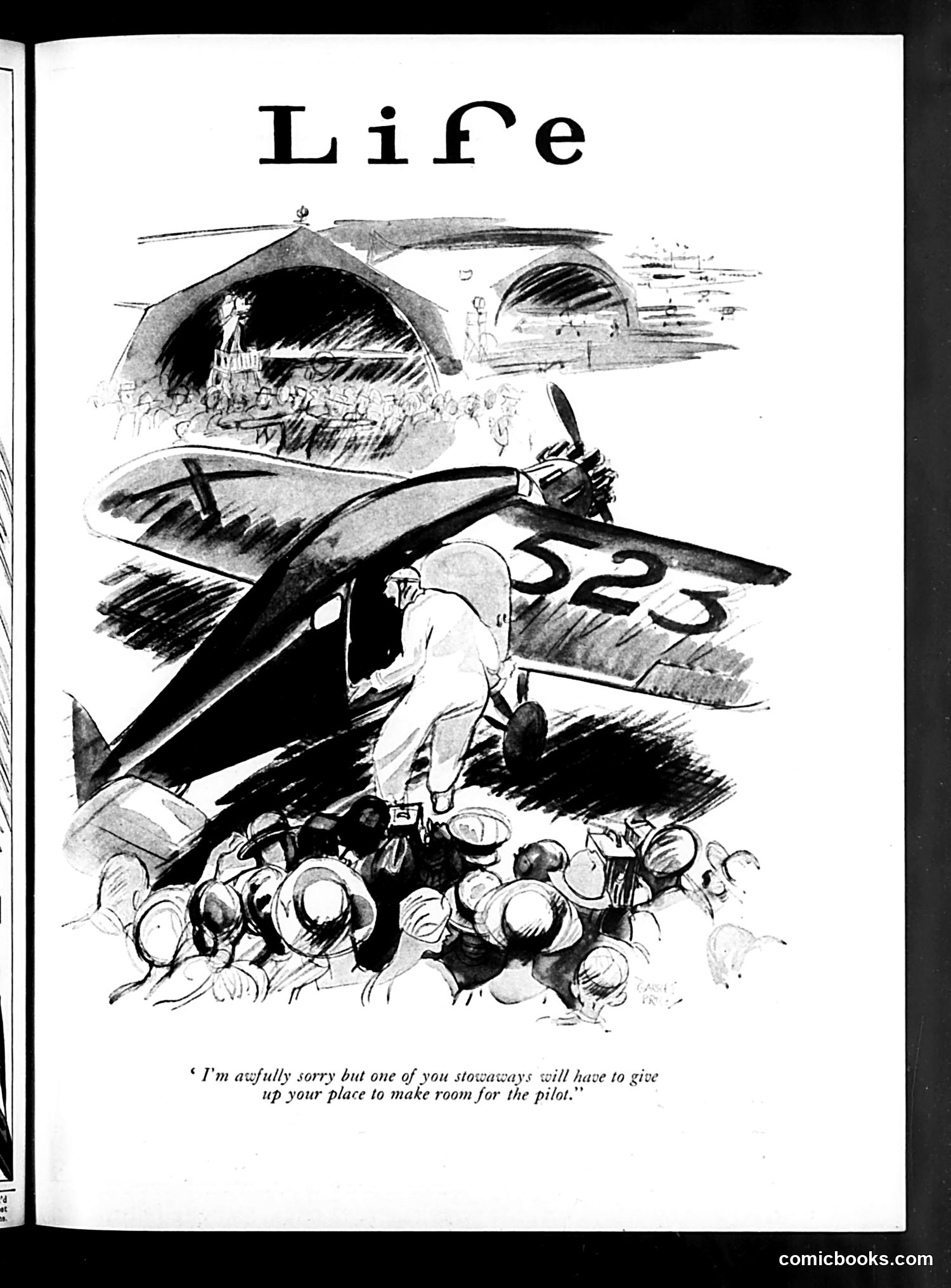
This page titled "Life" depicts a wartime scene with satirical humor about air travel priorities. A pilot stands before a crowd of civilians (wearing hats, suggesting ordinary people) boarding an aircraft marked with the number 323. The caption reads: "I'm awfully sorry but one of you stowaways will have to give up your place to make room for the pilot." The satire critiques overcrowded civilian aircraft during wartime—likely WWII era based on the aircraft design and military context. The joke inverts expectations: civilians have illegally squeezed aboard, yet they're being asked to voluntarily disembark to accommodate the actual pilot. It comments on transportation chaos and the absurdity of wartime logistics, where even essential personnel struggle to secure passage amid civilian desperation to travel.
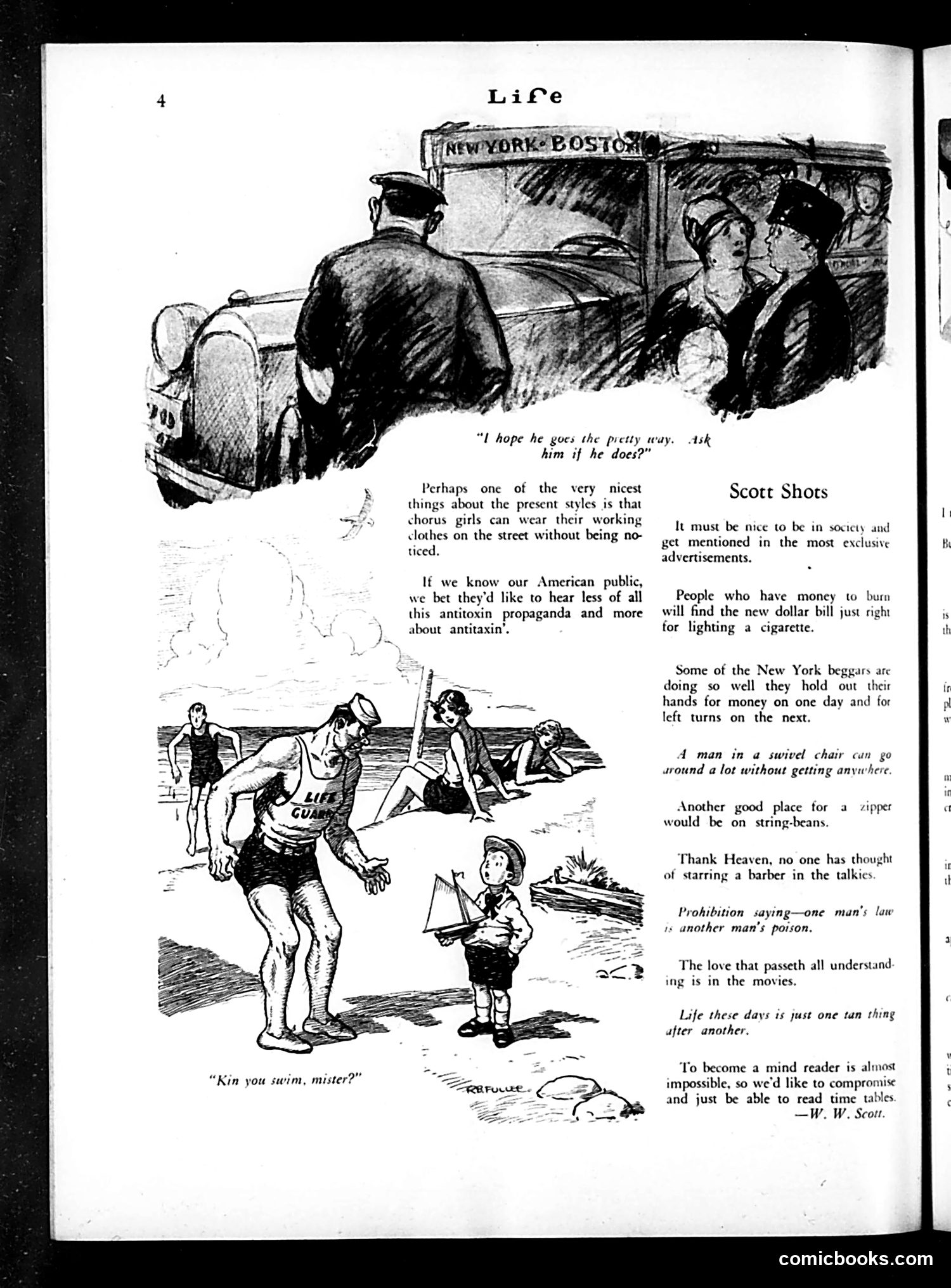
This page contains two cartoons and a humorous column titled "Scott Shots." **Top cartoon**: Shows a New York-Boston bus with a passenger asking "I hope he goes the pitty way, ask him if he does?" The joke appears to reference driving habits or route choices, though the specific context is unclear. **Bottom cartoon**: Depicts a beach scene where an adult asks a child "Kin you swim, mister?" This is a straightforward humorous observation about childhood at the beach. **"Scott Shots" column**: Offers satirical social commentary on contemporary life—mocking society's pretensions, Prohibition, wealth disparities, and popular culture (talkies/early cinema). The observations are general social satire rather than targeting specific political figures or events. The page is primarily light satirical humor typical of Life magazine's entertainment focus.
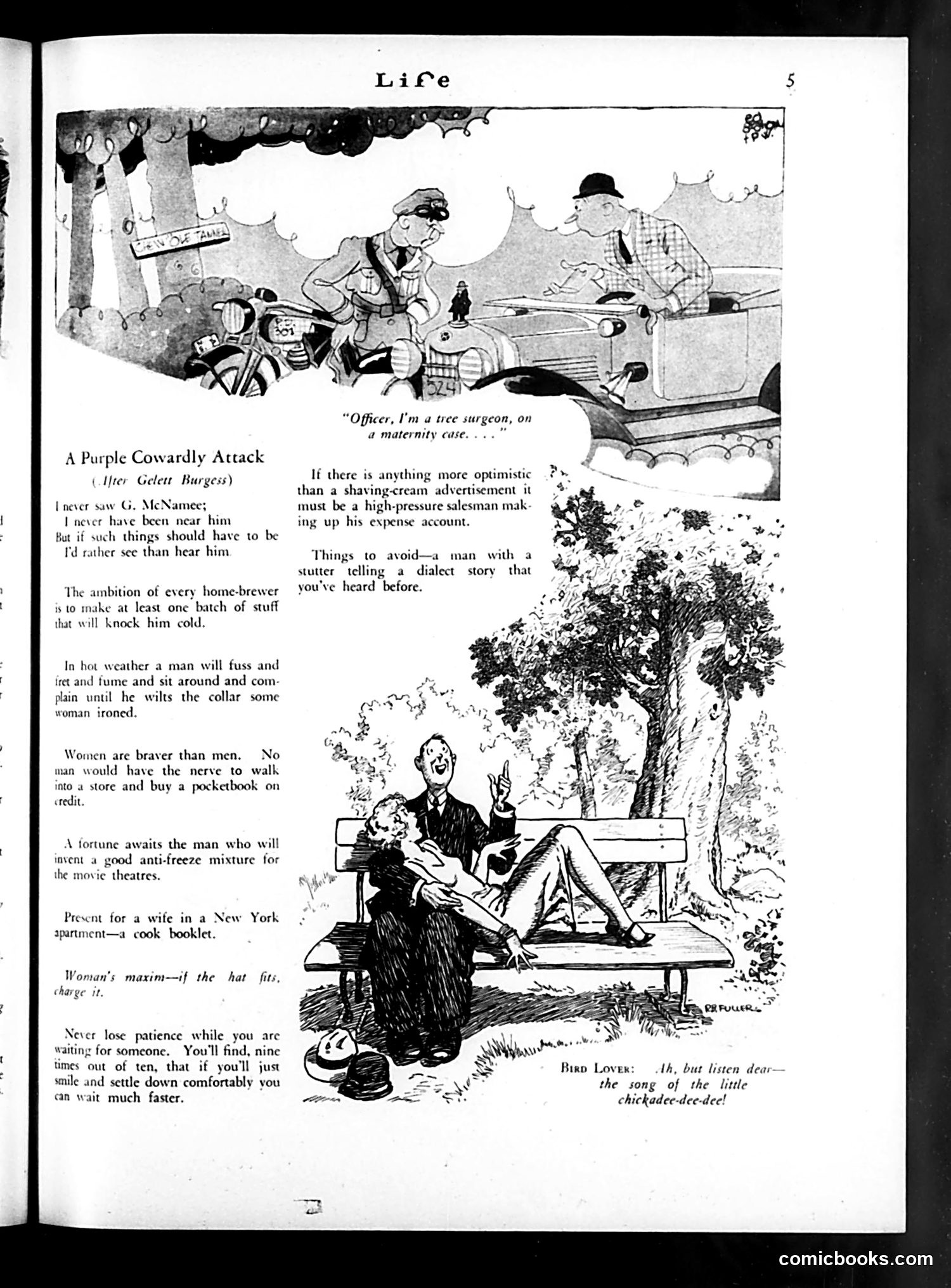
**Top Cartoon: "A Purple Cowardly Attack"** This cartoon satirizes someone named G. McNamee (identity unclear from context). The humorous poem criticizes his cowardice, suggesting the author would rather avoid hearing about him. The cartoon shows what appears to be a uniformed officer on a motorcycle claiming to be "a tree surgeon, on a maternity case"—an absurd excuse suggesting incompetence or dishonesty in an official role. **Bottom Cartoon: "Bird Lovers"** A couple on a park bench listens to a bird's song. The man appears delighted while the woman looks uncomfortable or unamused. The caption parodies romantic sentiment, mocking couples who pretend nature is charming while actually being bored or irritated. Both cartoons mock pretense and social conventions of the era.
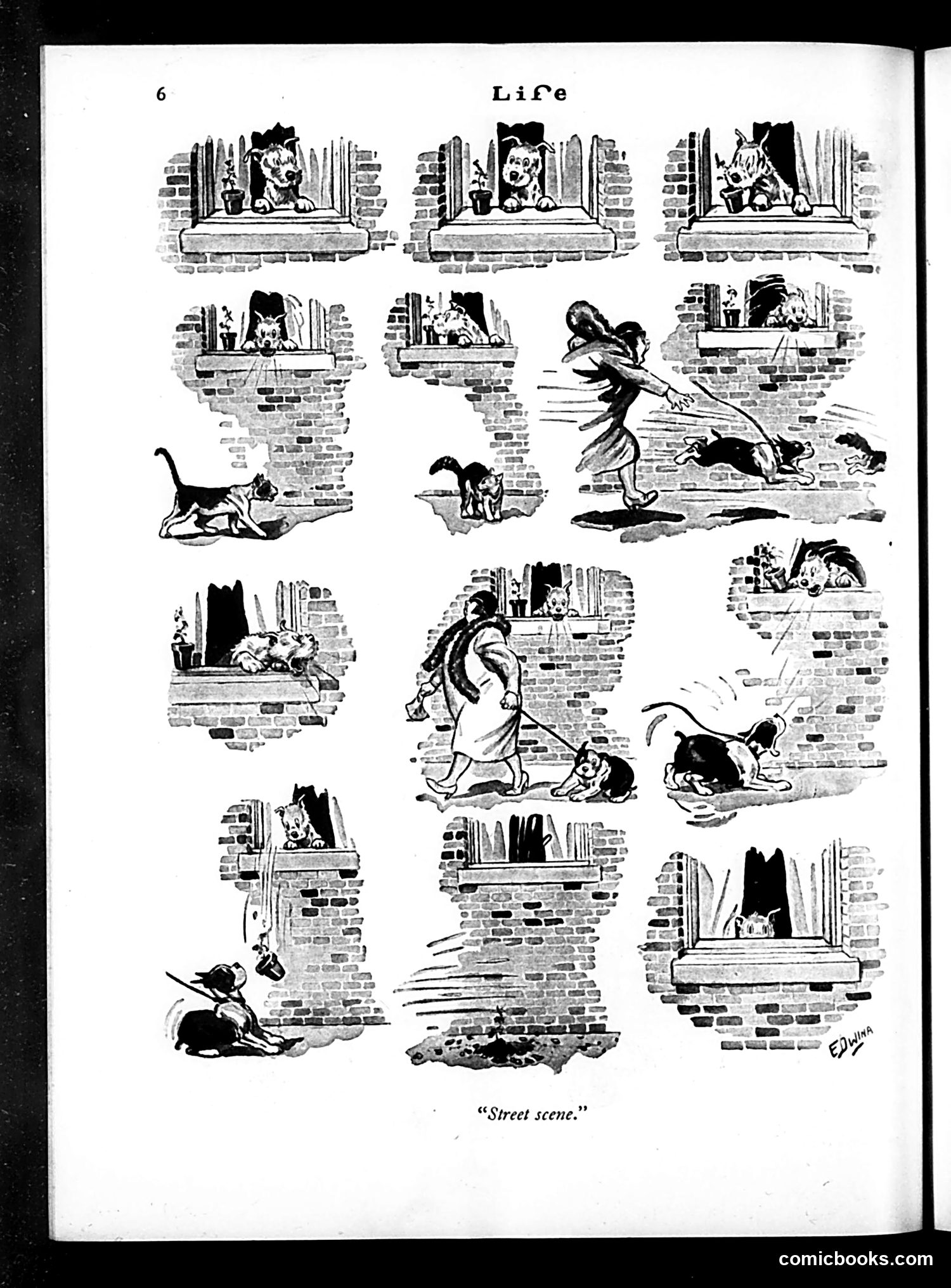
This is a series of sequential comic panels depicting a street scenario involving a woman, a man, and dogs. The caption reads "Street scene," suggesting it portrays everyday urban life. The narrative appears to show an interaction between a well-dressed couple and stray dogs on the street. The woman appears to be reacting with alarm or disgust to the dogs' presence, while the man responds in some manner. The final panels show the dogs' reaction or consequence. Without additional context about the specific publication date or artist signature visible (appears to be "E.D." or similar), the exact satirical target remains unclear. The cartoon likely satirizes middle-class attitudes toward urban poverty or homelessness represented by the dogs, or possibly critiques social indifference to street conditions.
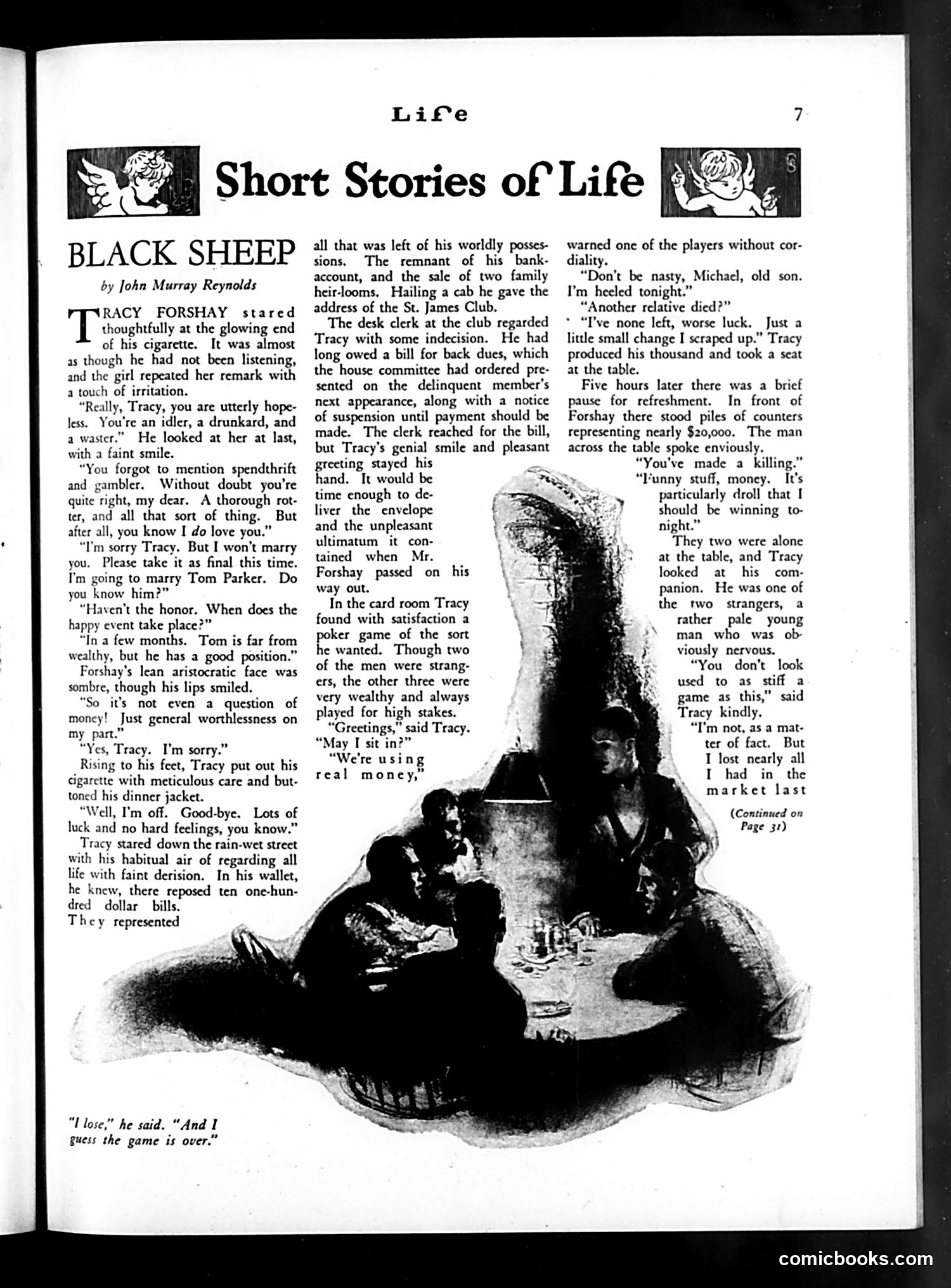
This is a short story, not political satire. The narrative follows Tracy Forshay, a man of modest means who is estranged from his wealthy family. He visits the St. James Club and discovers he owes back dues; the club threatens suspension. The accompanying illustration depicts Tracy at a table with a companion, discussing finances. The story explores themes of social class, debt, and family rejection—Tracy has become the family's "black sheep," abandoned by relatives despite his genteel background. The central irony: Tracy is broke and socially isolated despite his aristocratic connections, highlighting the precarious position of the impoverished gentry during the early 20th century. The narrative concerns personal failure rather than political commentary.
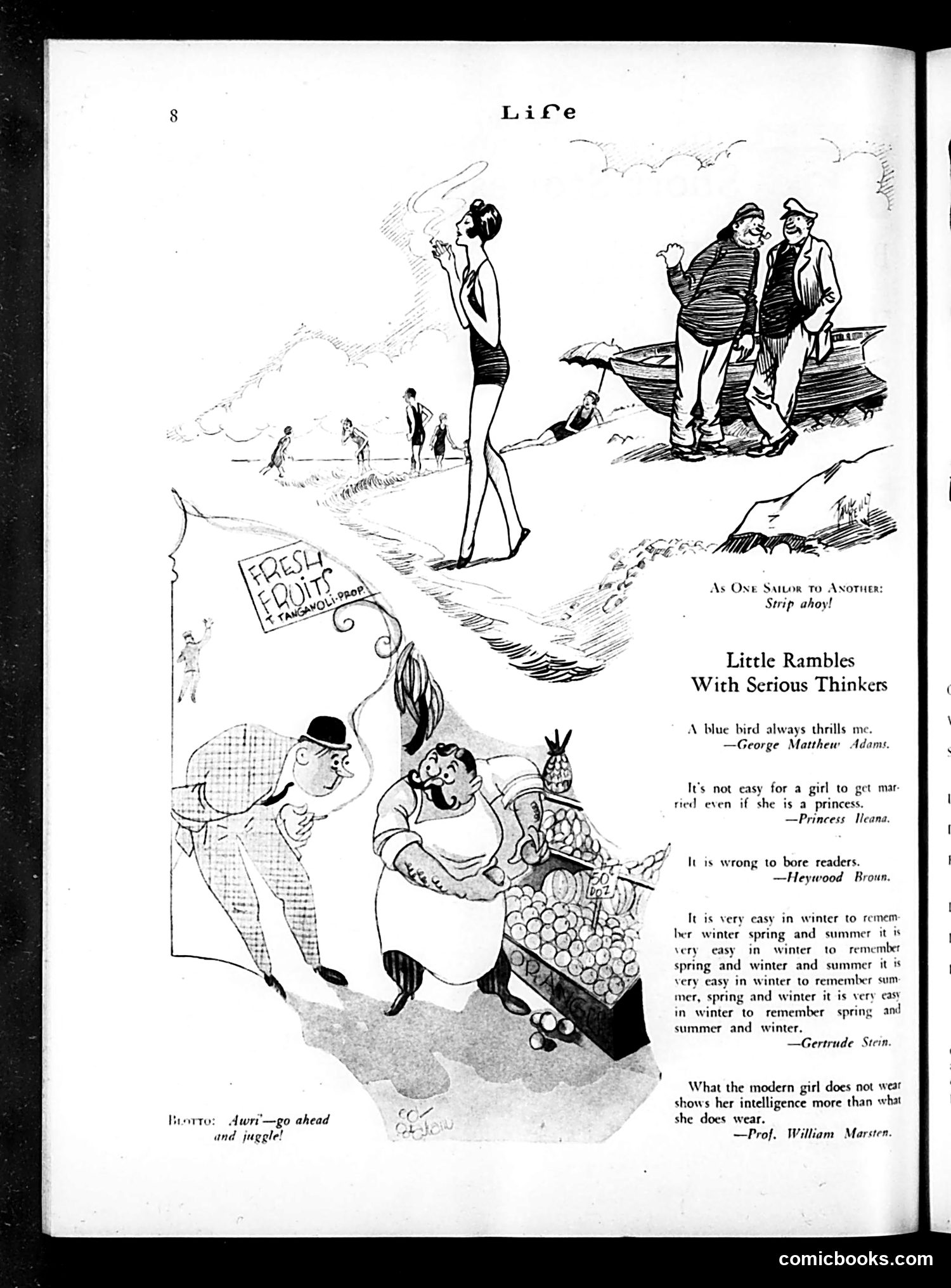
This page contains two main cartoons satirizing early 20th-century social behaviors: **Upper cartoon**: Depicts a woman in a bathing suit at what appears to be a beach or swimming area, with sailors and onlookers nearby. The caption "As One Sailor to Another: Strip ahoy!" suggests satire about changing women's fashion and public swimming conventions, likely mocking both the increasing visibility of women's bodies in swimwear and sailors' reactions. **Lower cartoon**: Shows a vendor selling "Fresh Fruit" with caricatured figures. The caption "Blotto: Awri—go ahead and juggle!" appears to reference intoxication, possibly satirizing Prohibition-era behavior or fruit vendors as fronts for alcohol sales. **Right section**: "Little Rambles With Serious Thinkers" collects witty quotes on modern life, fashion, and gender roles, mocking contemporary intellectual pretension while offering social commentary on women's changing roles and fashion choices.
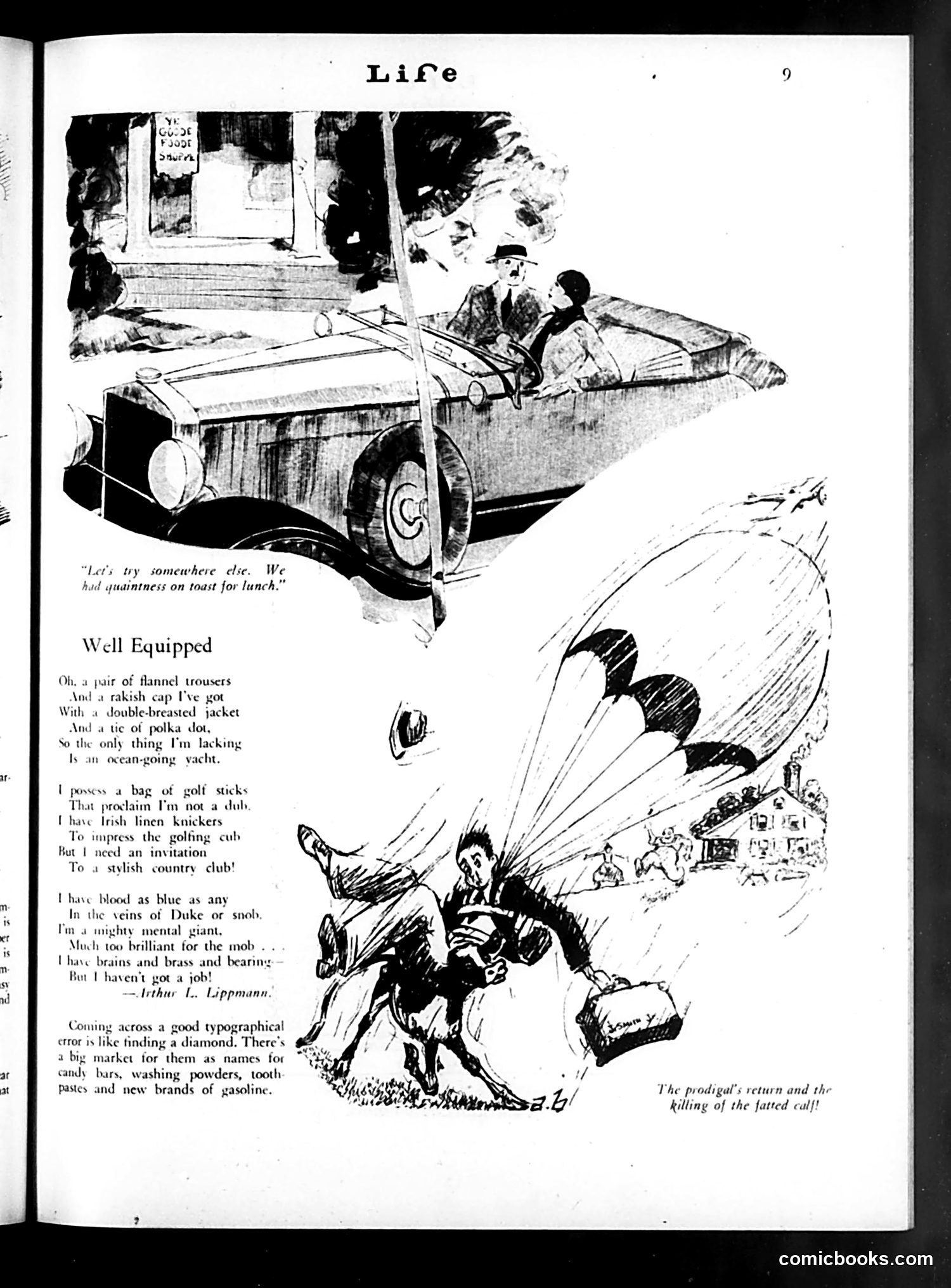
This page contains two satirical cartoons about class and aspiration in early 20th-century America. **"Well Equipped"** (top text section) mocks a character who boasts of aristocratic credentials—blue blood, Irish linen, golf clubs, a country club membership—yet has "brains and brass and bearing" but lacks a job. The satire targets the genteel unemployed: those with social pretensions and expensive accessories but no actual employment or practical value. **The lower cartoon** depicts a dramatic scene where a pedestrian's parachute fails, killing the "latted calf" (likely a servant or social inferior, referenced in the biblical parable of the prodigal son). The visual pun suggests the ironic "return" of someone to their proper station through catastrophe rather than redemption. Both pieces mock class pretension and the gap between appearance and reality in American society.
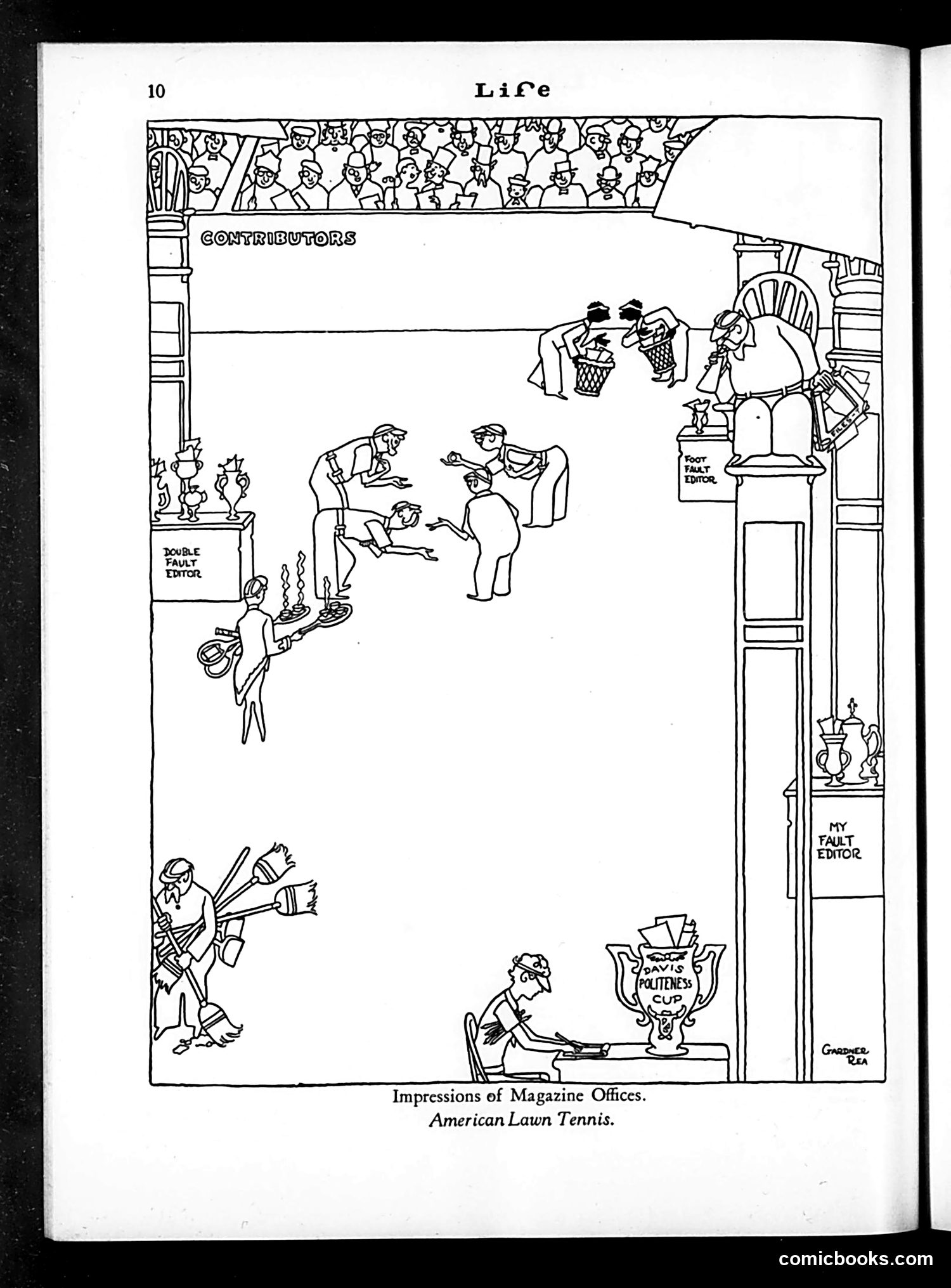
This satirical cartoon depicts the chaos of a magazine office, specifically one covering lawn tennis. The humor derives from showing editorial dysfunction through exaggerated roles: - **"Double Fault Editor"** (left): Makes mistakes, shown juggling flaming objects - **"Foot Fault Editor"** (right): Appears to oversee trophies and awards - **"My Fault Editor"** (far right): Takes blame for problems The central figures show editors and staff arguing, playing instruments, and generally creating mayhem rather than producing serious content. The "Politeness Cup" trophy at bottom suggests ironic commentary on civility. The joke mocks magazine management as incompetent and blame-shifting, with each editor responsible for different types of failures. Tennis terminology ("double fault," "foot fault") cleverly parallels editorial mishaps, satirizing both the sport's coverage and office politics of the era.
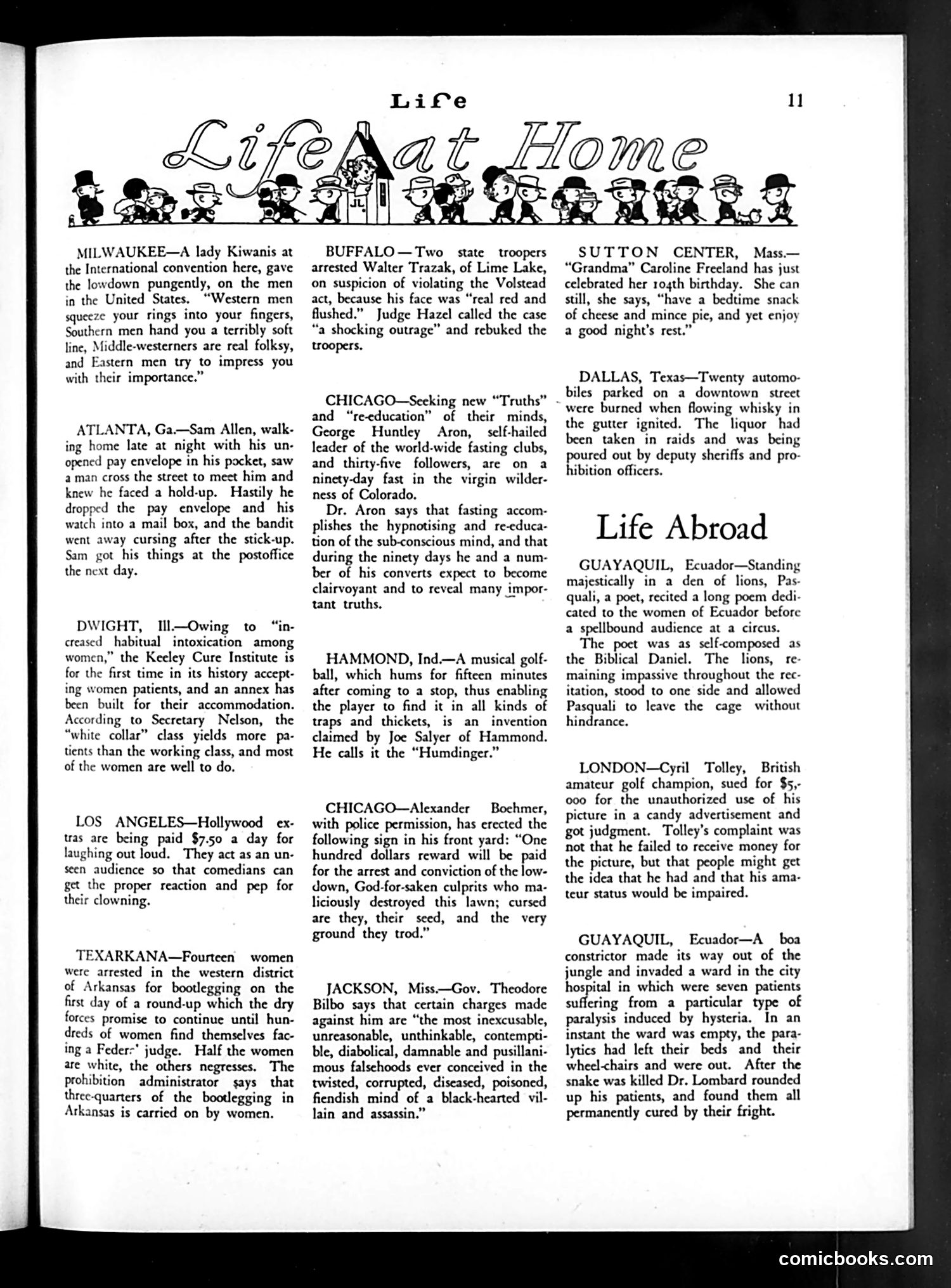
This page from *Life* magazine presents humorous short anecdotes organized by geographic location, a typical format for the publication's satirical commentary on American life. The cartoon header shows a row of small figures in formal dress, establishing a lighthearted tone. The stories mock various regional and social behaviors: Milwaukee men's hand-squeezing contests, Southern versus Eastern male posturing, Hollywood extras' low pay, Arkansas women bootleggers during Prohibition, Chicago's fasting clubs claiming self-improvement, and municipal oddities like Hammond, Indiana's musical golf-ball invention. The "Life Abroad" section parallels this domestic humor with international anecdotes about poets in Ecuador and legal disputes in London. Overall, the page satirizes American regional stereotypes, Prohibition-era crime, and contemporary social trends through brief, comedic observations rather than sustained political commentary.
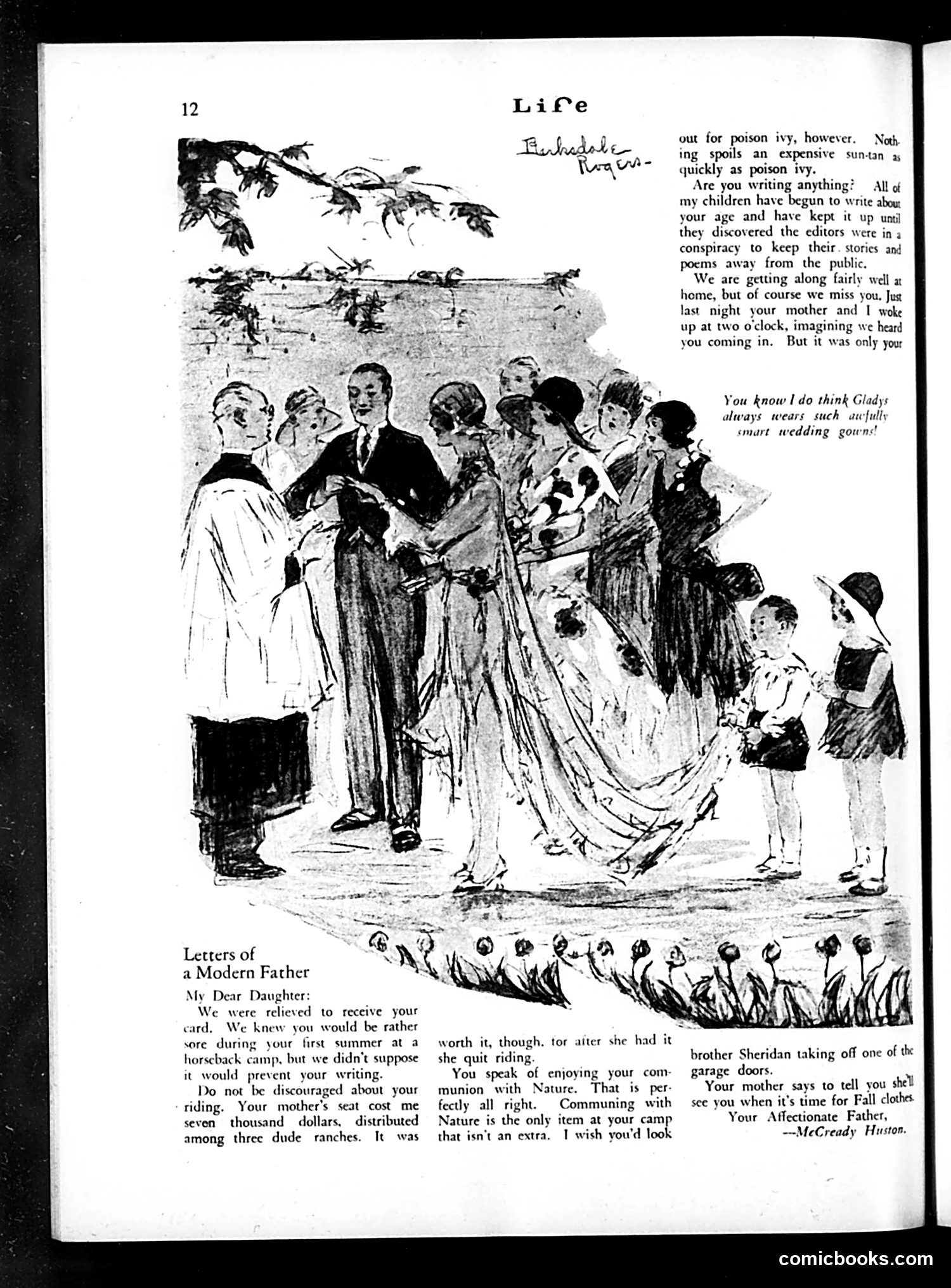
This page presents a satirical advice column from a father to his daughter about summer camp experiences. The illustration depicts a wedding or formal social gathering with well-dressed adults and children. The satire centers on class anxieties and parental expectations. The father boasts about his wife's expensive riding horse (seven thousand dollars distributed among three dude ranches), while cautioning his daughter not to be discouraged about her own modest accomplishments. He emphasizes "communing with Nature" as the camp's value, though he dismisses it as "not an extra"—suggesting wealthy parents view rustic experiences as necessary character-building despite their artificial nature. The cartoon mocks how affluent early-20th-century parents rationalized expensive summer camps and leisure activities as educational rather than purely recreational or status-conscious.
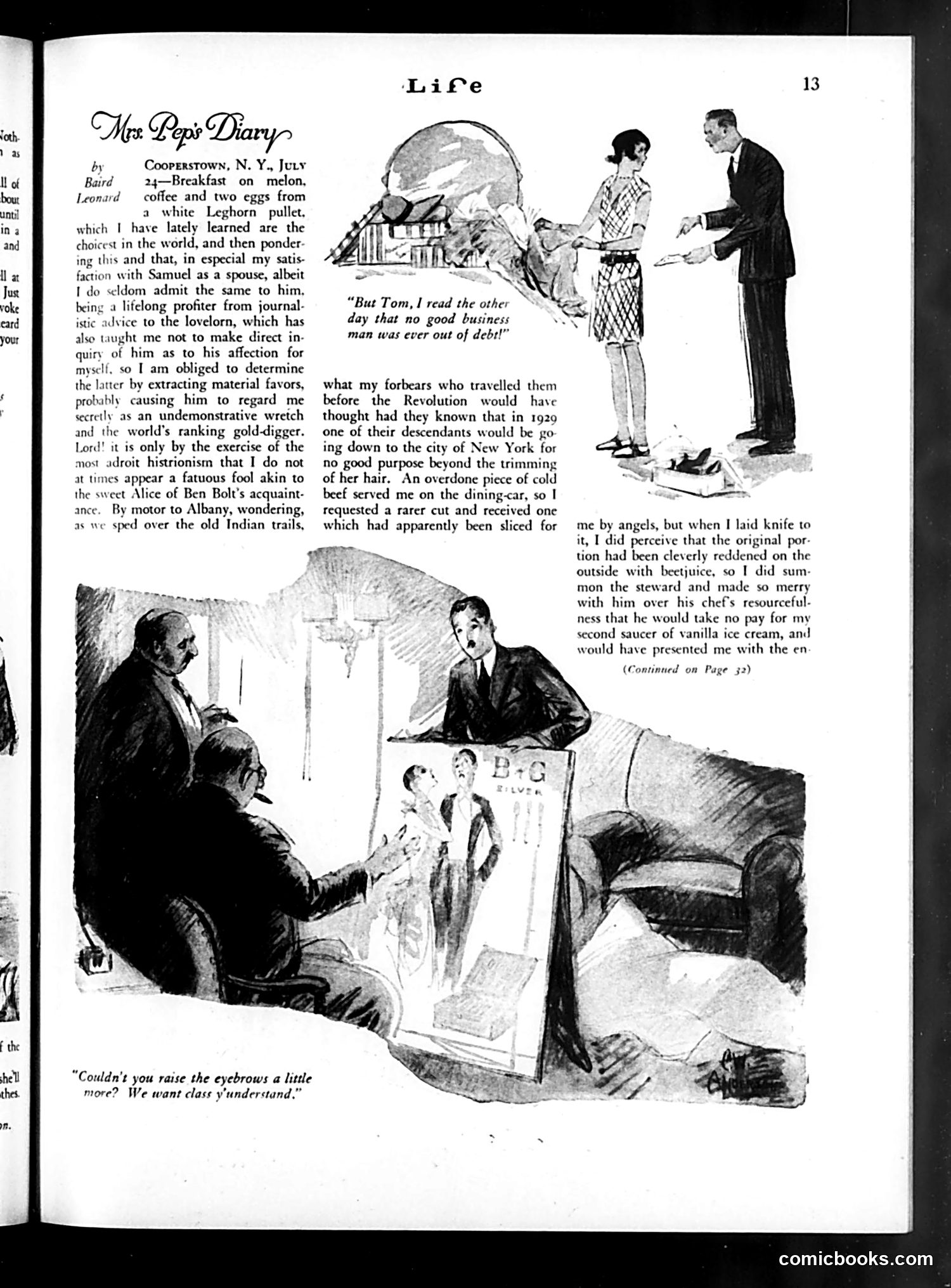
This page from *Life* magazine presents a humorous domestic narrative by Baird Leonard set in Cooperstown, N.Y. The text satirizes 1920s social anxieties about debt and financial propriety. The upper cartoon shows a man and woman discussing business ethics—"no good business man was ever out of debt"—mocking contemporary attitudes toward financial obligations. The lower cartoon depicts what appears to be a portrait-sitting or art appraisal, with the caption "Couldn't you raise the eyebrows a little more? We want class y'understand," poking fun at affectation and pretensions to gentility. Together, these pieces humorously critique middle-class obsessions with respectability, financial standing, and social appearance during the post-WWI era.
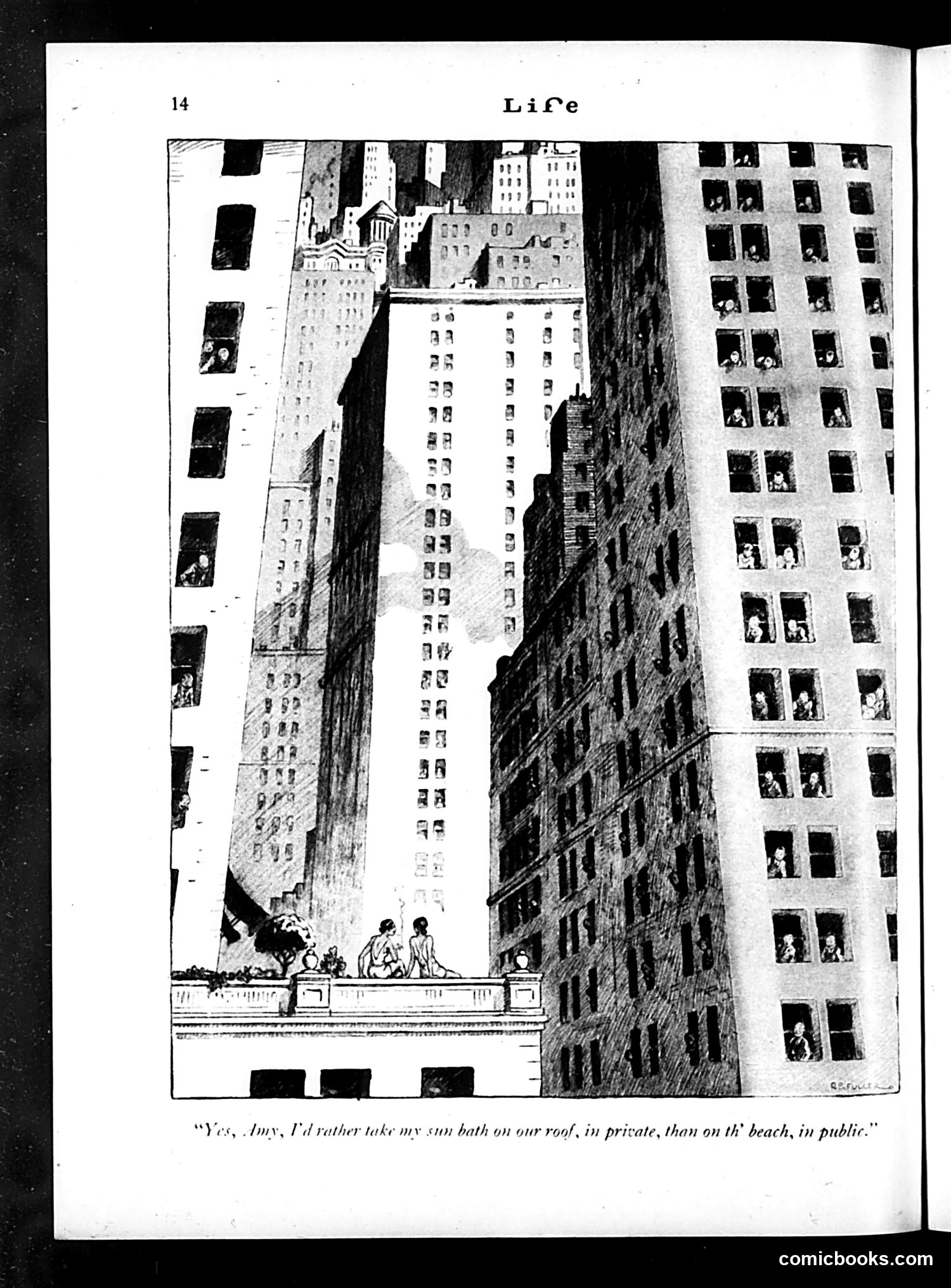
This cartoon depicts an urban rooftop scene in what appears to be early 20th-century New York City, showing tall apartment buildings framing a narrow street canyon. Two figures sit on a rooftop with a child, where one says to the other: "Yes, Amy, I'd rather take my sun bath on our roof, in private, than on th' beach, in public." The satire mocks urban density and privacy concerns of city dwellers. Rather than enjoying leisure at public beaches like wealthier Americans, working-class apartment residents must resort to rooftops for sun exposure. The joke highlights the cramped conditions of tenement living and the irony that even basic activities like sunbathing become exercises in finding privacy within crowded cities—a commentary on the social stratification and living conditions of urban America.
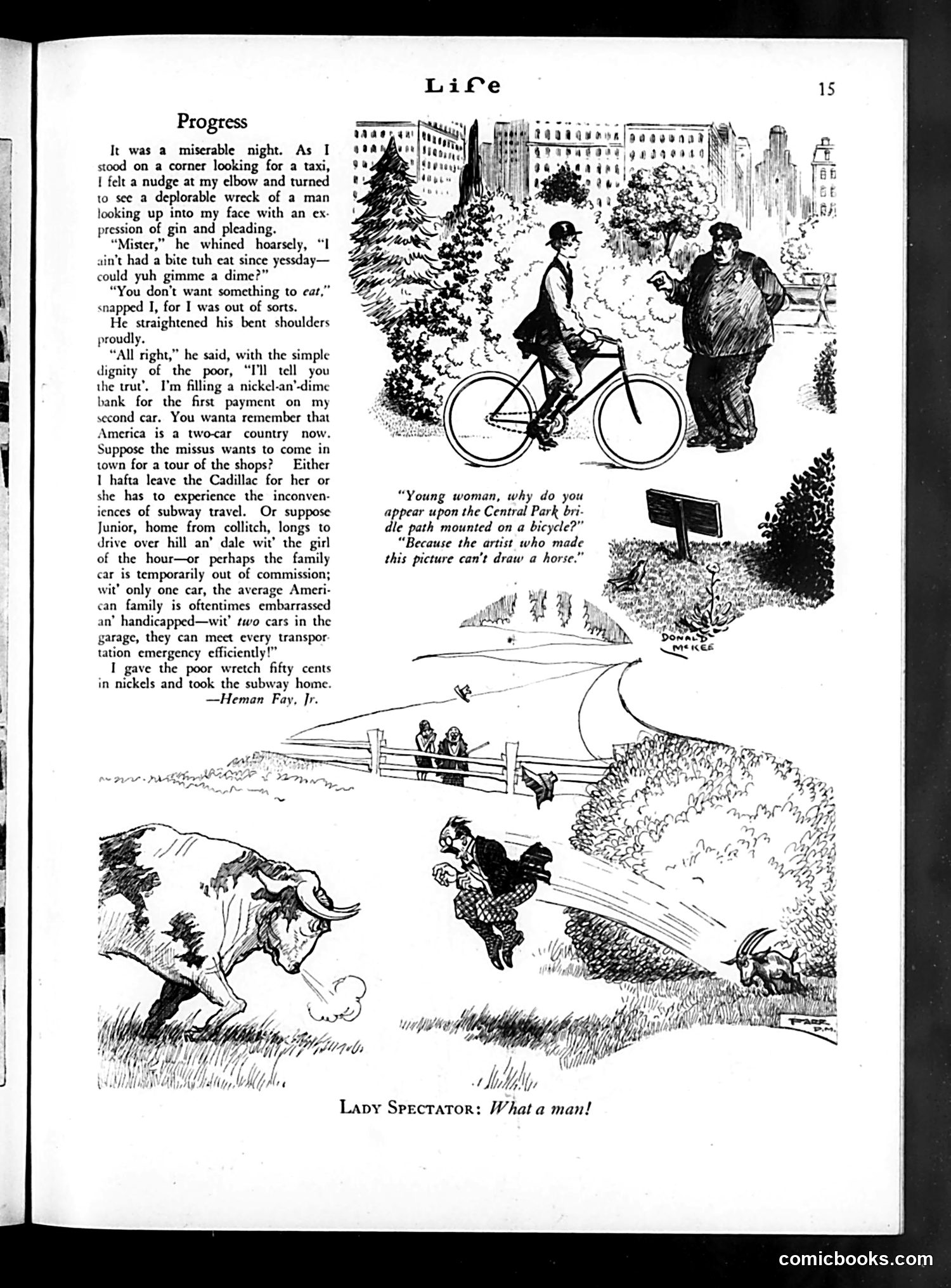
This page satirizes American materialism and two-car ownership. The lead story mocks a poor man's desperate pitch to buy a nickel-and-dime bank product by claiming America now needs two cars per family—a then-radical consumerist argument. The humor lies in the absurdity: the protagonist suggests this as a solution to traffic and transportation problems. The cartoon series below, captioned "Lady Spectator: What a man!", depicts an athletic man performing increasingly impressive feats (jumping, running, vaulting). The satire appears to mock either the idealization of masculine athleticism or advertising's exaggerated claims about human capability—contrasting sharply with the bumbling poor man above, suggesting class-based commentary on who gets celebrated in American culture.
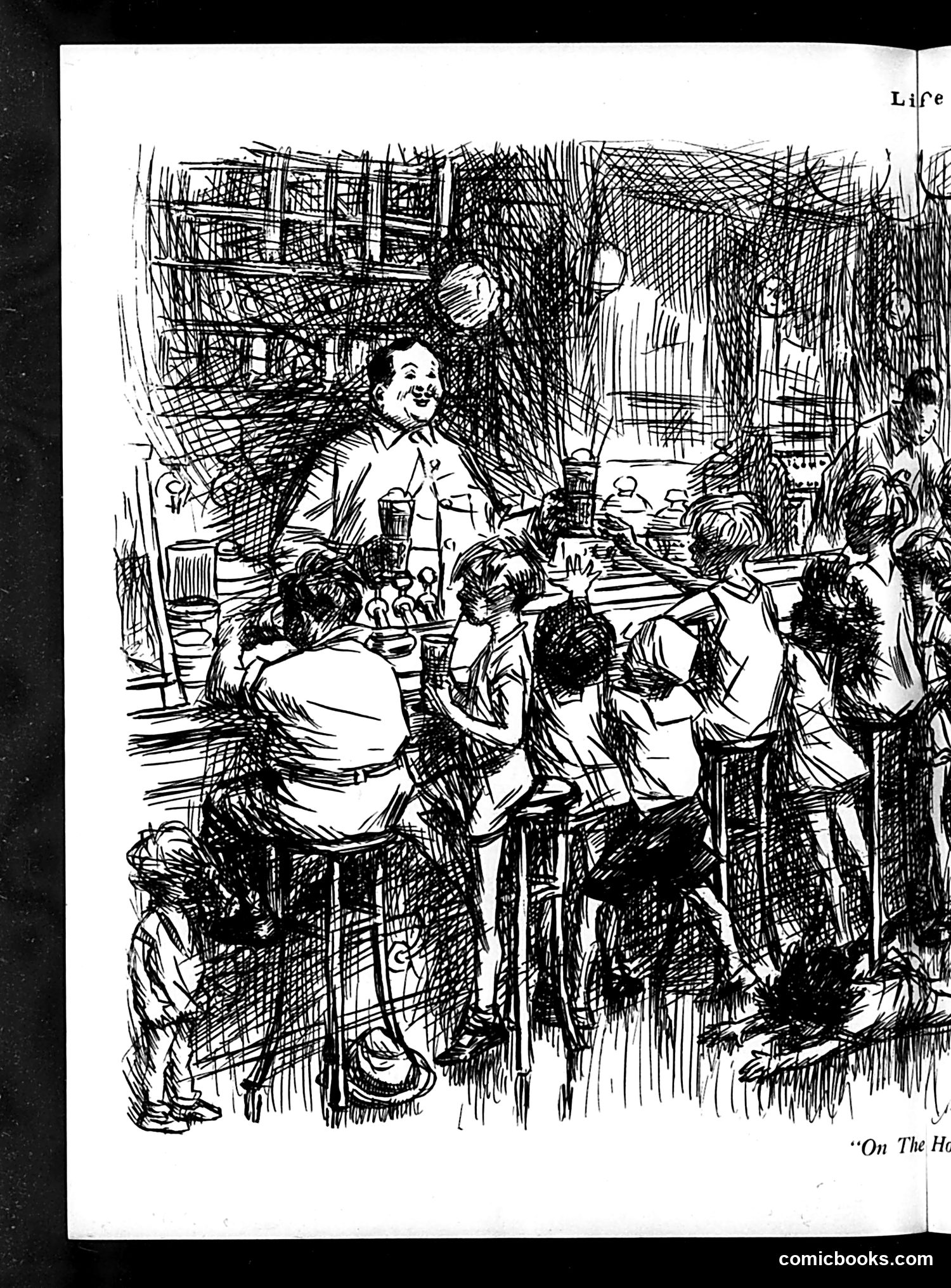
This ink sketch depicts a domestic dining scene, likely satirizing early-20th-century American family life or social customs. A rotund, smiling man stands at the head of a crowded table surrounded by children and what appears to be family members in a modest interior space. The cramped composition and cross-hatching suggest either poverty or overcrowding—possibly commentary on working-class living conditions or large family sizes. The partial caption reads "On The Ho[use]" (likely "On The House"), suggesting the scene relates to hospitality, charity, or domestic obligation. Without the full caption or additional context, the specific satirical target remains unclear—it could reference family economics, household management, or social welfare practices of the era.
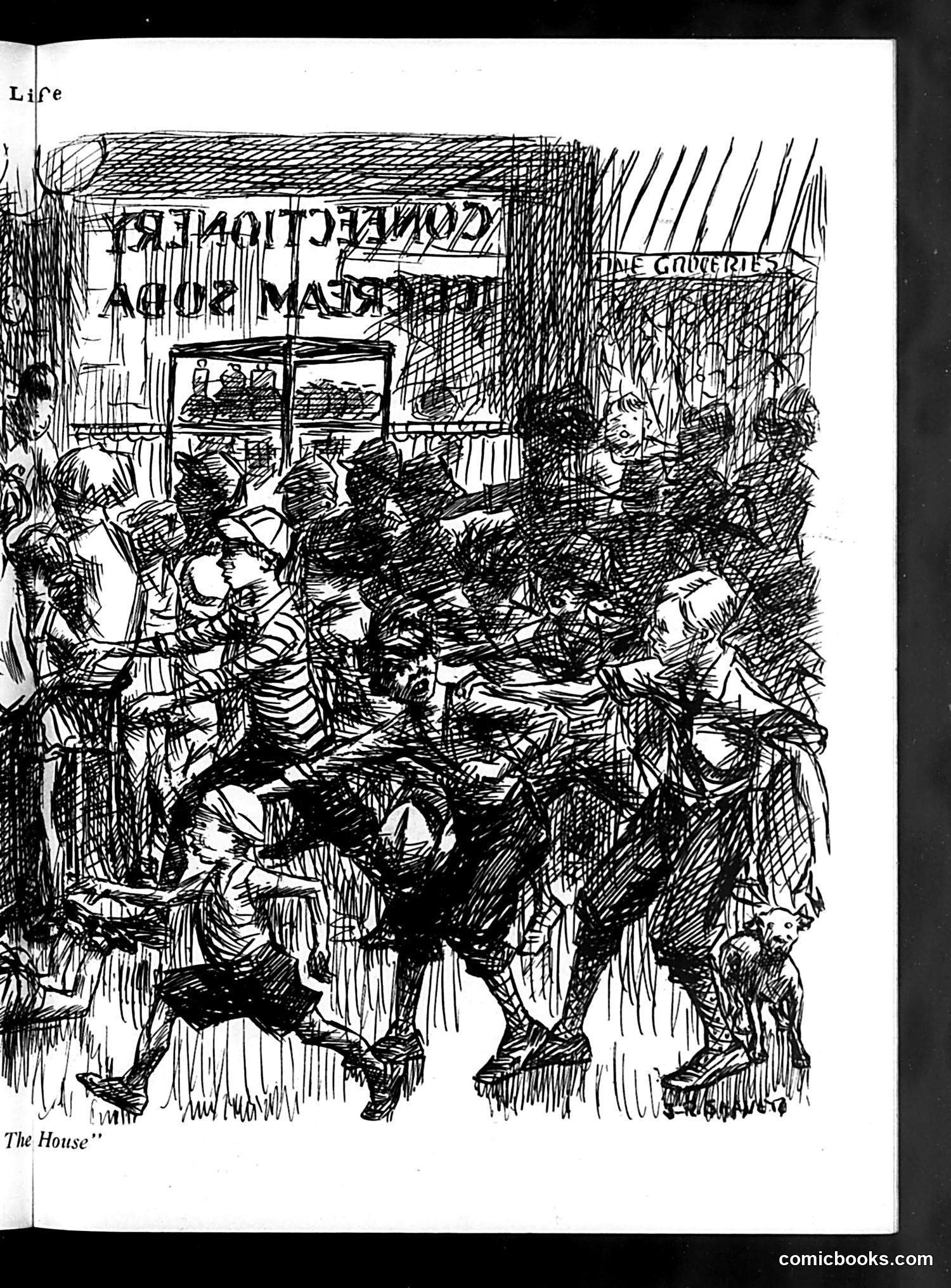
This sketch depicts a crowded, chaotic scene inside what appears to be a grocery store or market ("The House"). The composition shows numerous figures engaged in some kind of frenzied activity or commotion around display stands and goods. The title "The House" likely refers to the House of Representatives, and the crowded, disorderly scene appears to satirize congressional proceedings as chaotic and unruly. The dense, sketchy linework emphasizes the confusion and cacophony of the gathering. Without clearer identifying details or captions naming specific politicians, the exact political moment being mocked remains unclear, though the satire targets legislative dysfunction or disorder—a recurring theme in Life's political commentary during the early-to-mid 20th century.
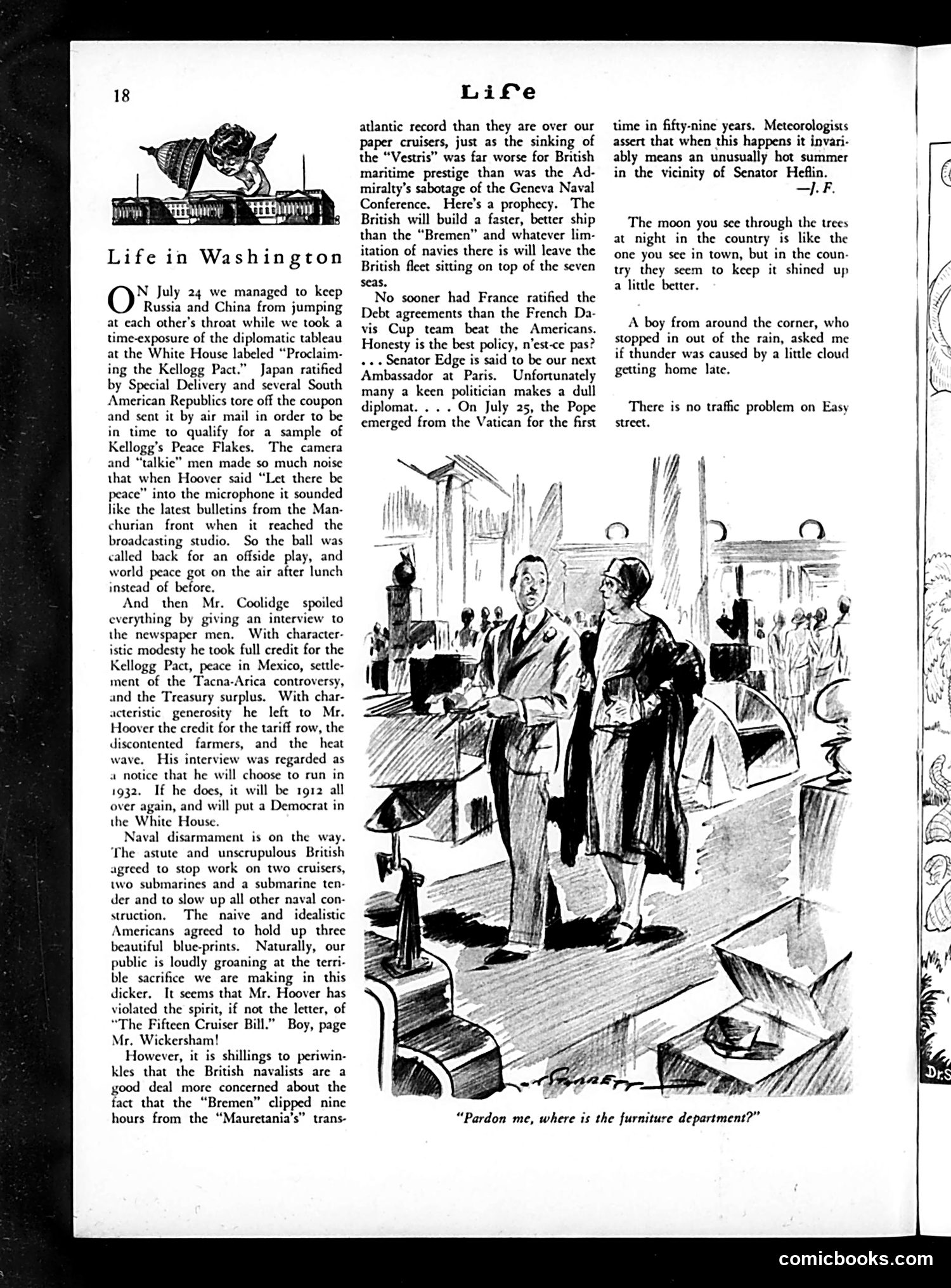
This page satirizes President Hoover's diplomatic efforts and public relations strategy during the early Depression era. The text discusses naval disarmament negotiations, tariff policy, and Hoover's attempts to manage his public image through media (radio broadcasts, newspaper interviews). The cartoon depicts a confused man in what appears to be a government building or office, asking "Pardon me, where is the furniture department?" The joke likely mocks the Hoover administration's perceived inadequacy or disorganization during the economic crisis—suggesting the government itself is as confusing and unhelpful as a poorly-run store. The surrounding commentary criticizes Hoover for both taking credit for successes and deflecting blame for failures (tariff issues, economic problems), portraying him as politically calculating.
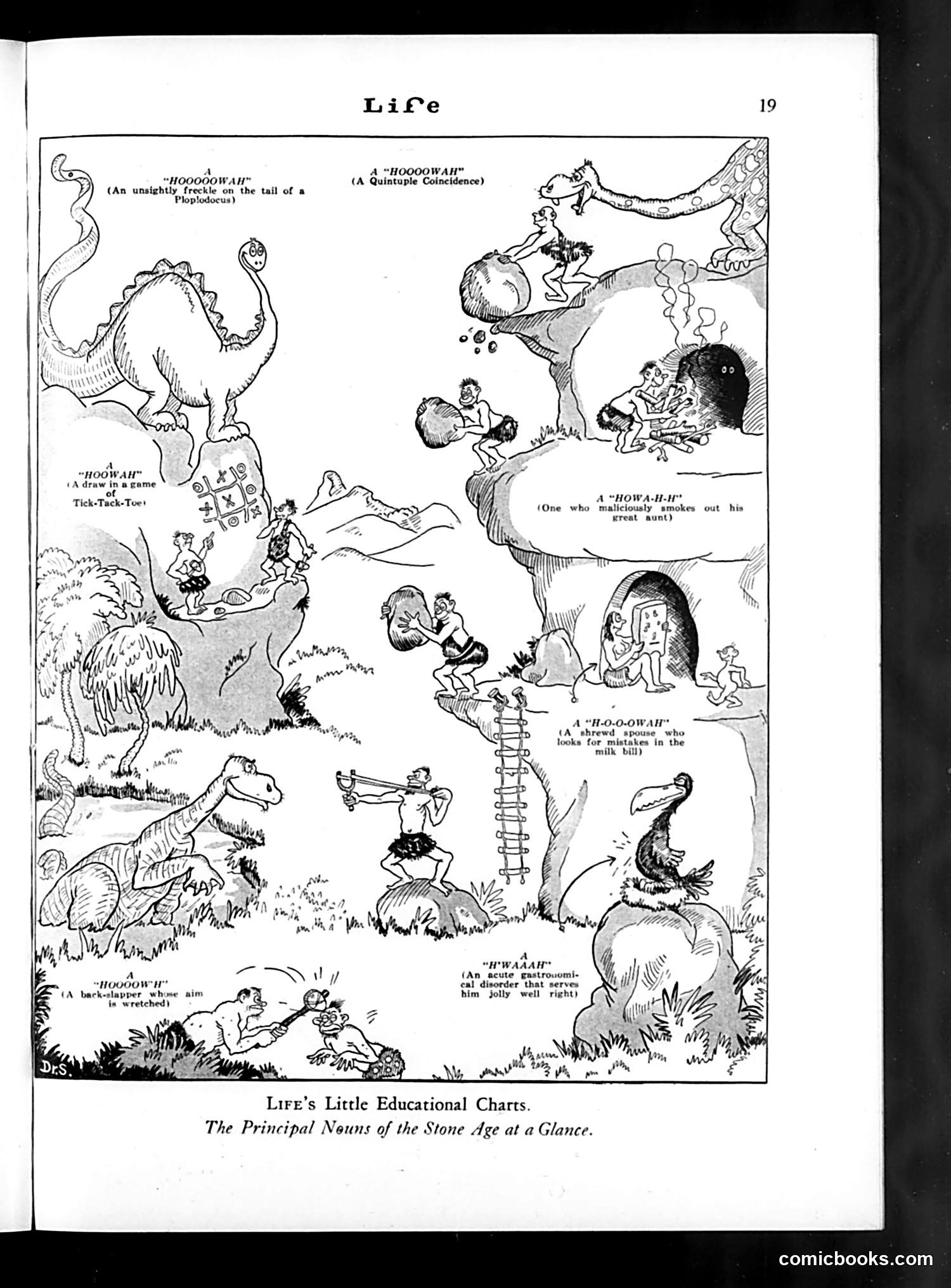
This is a humorous educational chart that uses prehistoric creatures and cavemen to create puns on the word "hoowah" (and variants). The joke plays on a common educational format—the instructional chart—by creating fake definitions that are actually wordplay jokes. Each labeled scene presents a different situation with a punning definition: a freckled dinosaur, a tic-tac-toe game, someone smoking out their aunt, a wife checking milk bills, someone with indigestion, and a clumsy back-slapper. These absurd scenarios are presented as if they were legitimate "Stone Age nouns," satirizing dry educational materials by replacing real definitions with nonsensical but clever verbal puns. The satire mocks pedantic educational content through deliberate silliness, treating trivial situations as if they were important historical terms worth cataloging.
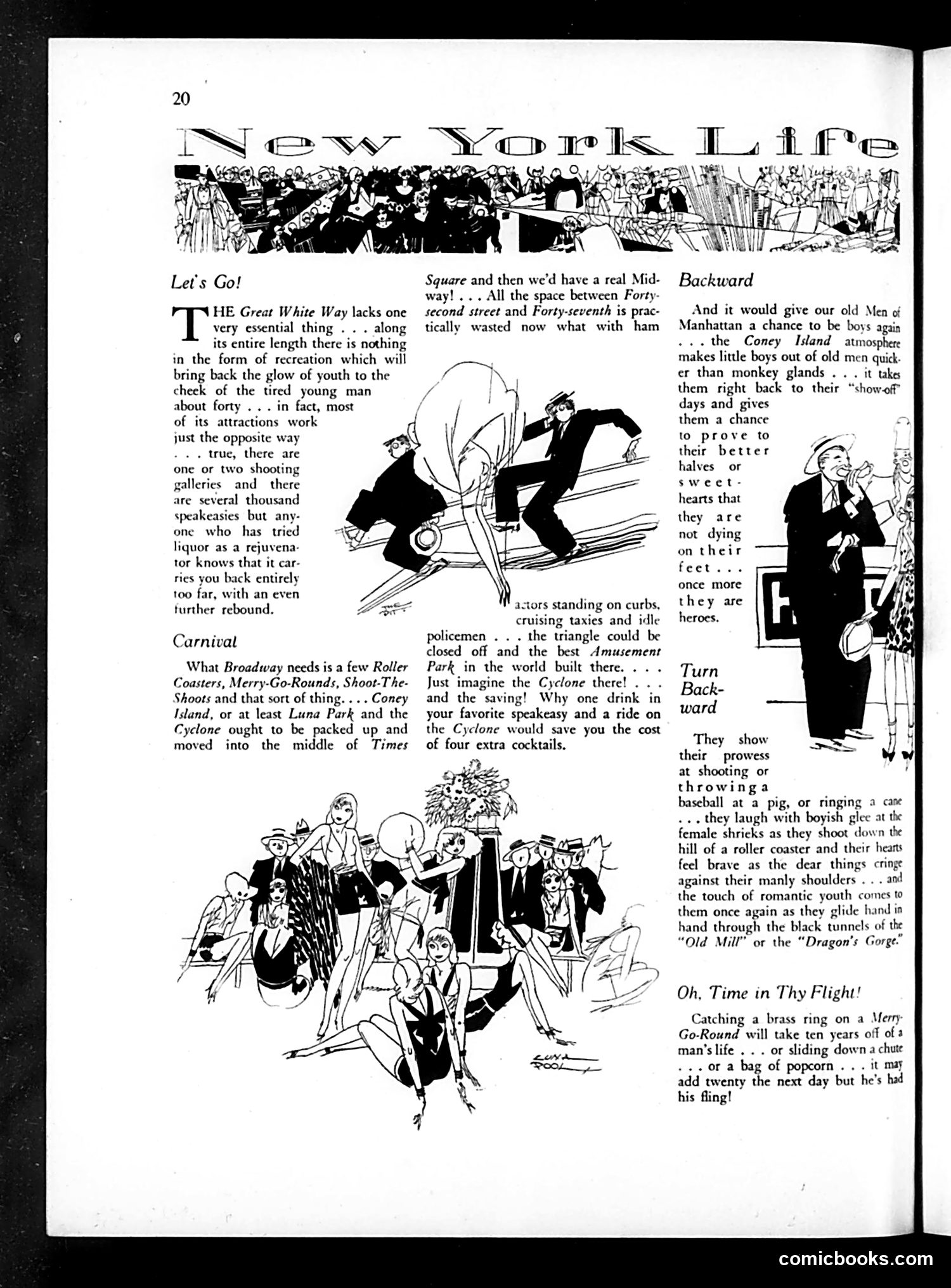
This is a satirical proposal to relocate Coney Island amusement park attractions to Broadway's Times Square area. The author argues that Broadway lacks recreational value for middle-aged men, offering only theaters and speakeasies—the latter being counterproductive for rejuvenation. The cartoon illustrates couples enjoying carnival rides like roller coasters and Ferris wheels. The satire's point: amusement parks restore youthful vitality to aging men better than Broadway's conventional entertainment. References to "Monkey glands" (a 1920s pseudo-scientific rejuvenation treatment) and the nostalgic description of proving one's vigor through carnival activities suggest post-WWI anxieties about aging masculinity. The speakeasy mention dates this to Prohibition era. The proposal is tongue-in-cheek social commentary—criticizing both Broadway's stagnation and suggesting that simple, childlike pleasures offer better psychological rejuvenation than either alcohol or legitimate theater.
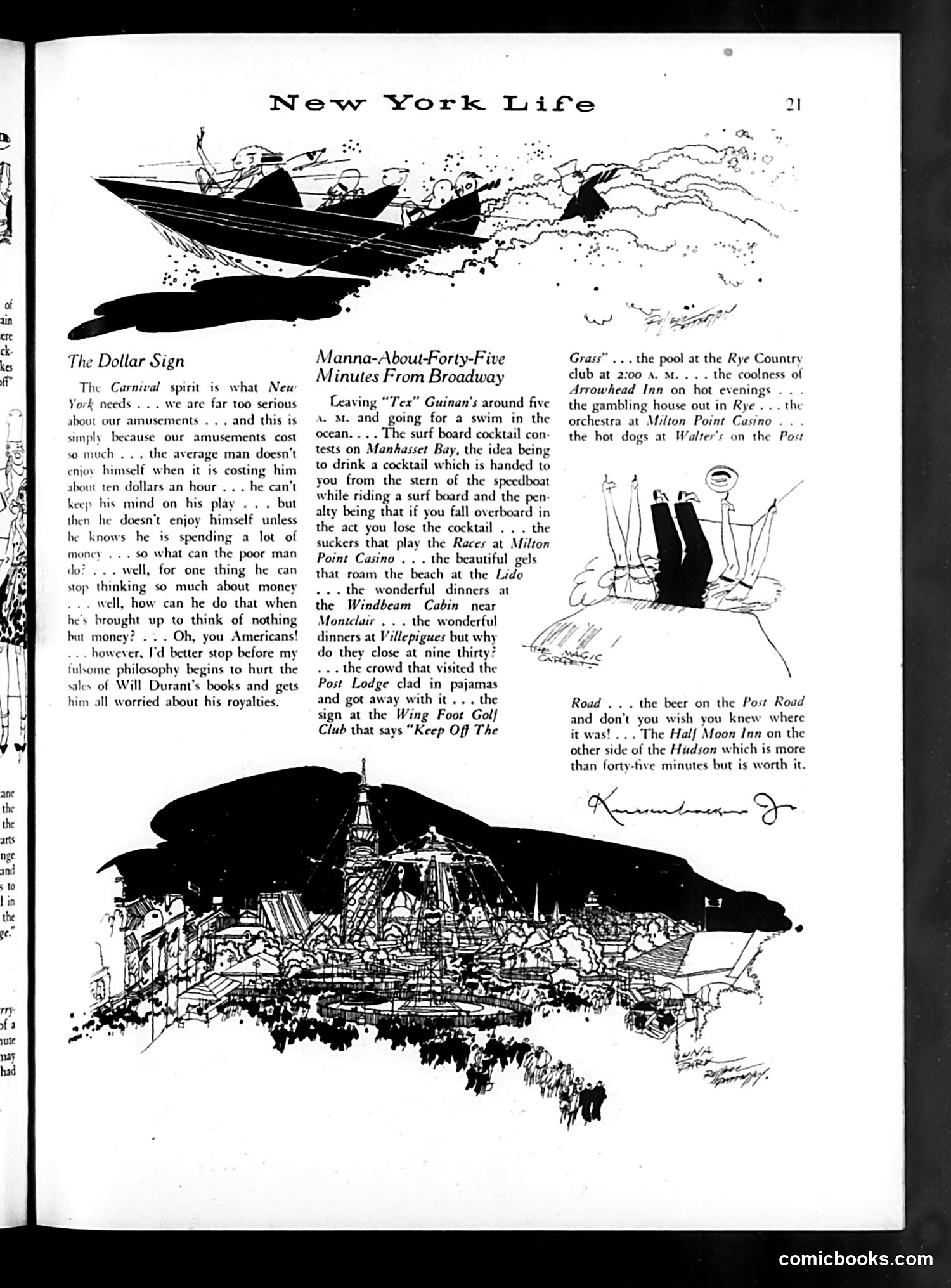
This page satirizes American materialism and leisure culture in the Jazz Age. "The Dollar Sign" column mocks how average Americans can't enjoy themselves because they're constantly calculating the cost—worried they're spending roughly ten dollars per hour on entertainment. The author sarcastically suggests Americans are psychologically trapped by money-consciousness, unable to relax even during amusements. "Manna-About-Forty-Five Minutes From Broadway" catalogs upscale entertainment venues near New York City, referencing real locations like Tex Guinan's (a famous speakeasy), Manhasset Bay, and various nightclubs and restaurants. The tone is gossipy and name-dropping, highlighting the era's nouveau-riche leisure activities: cocktail contests, gambling, and fashionable dining spots where people flout Prohibition laws (the "beer on the Post Road" reference). The illustrations depict speedboats and crowded venues, emphasizing the frantic, expensive entertainment lifestyle being both celebrated and gently mocked.
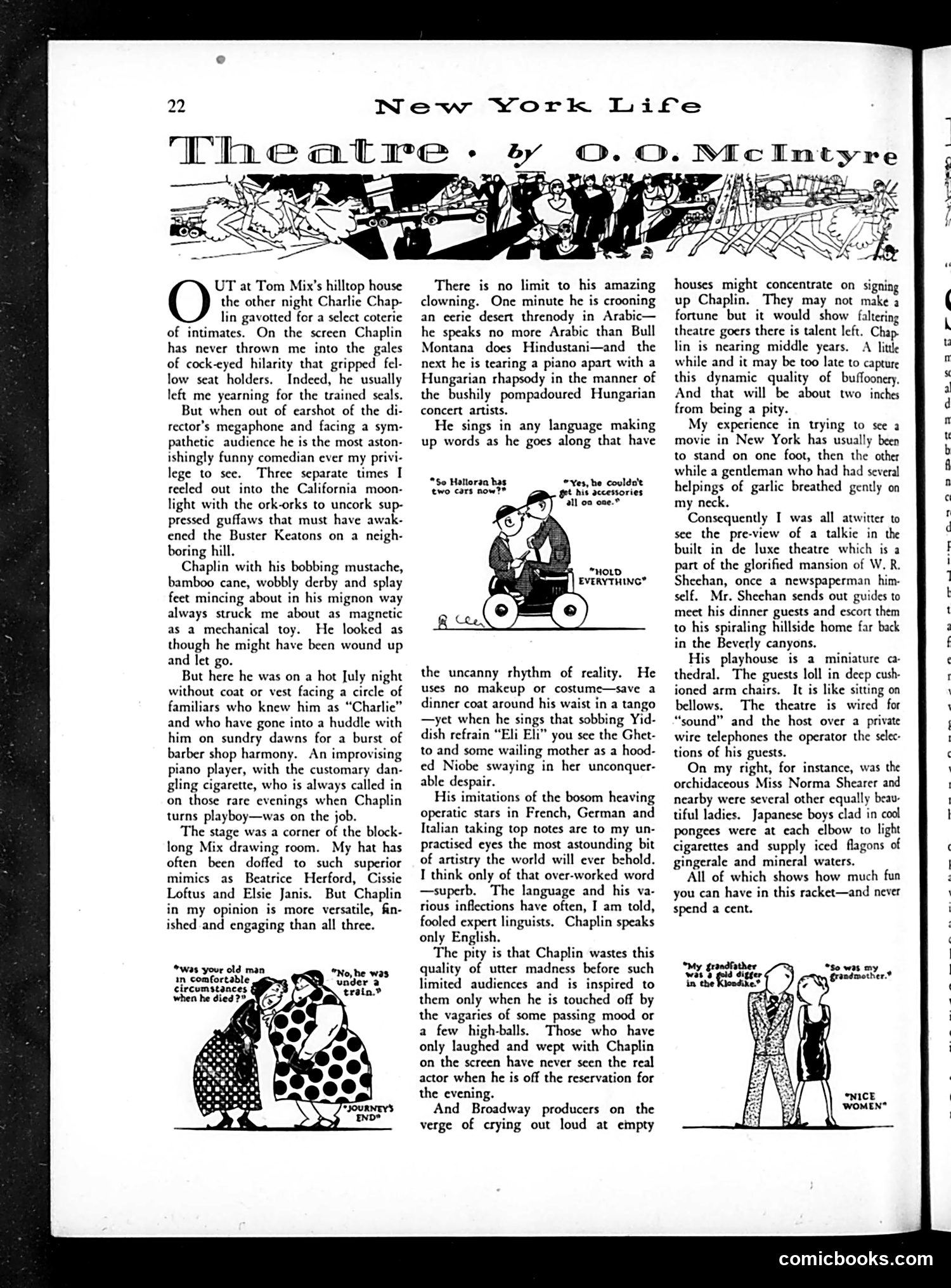
This is O.O. McIntyre's theatre review praising **Charlie Chaplin's private performance** at Tom Mix's home. The column contrasts Chaplin's screen persona—which the writer found mechanically unfunny—with his "off the reservation" live comedic genius when performing informally for intimate audiences. The cartoons illustrate anecdotes: one shows Chaplin improvising dialogue ("Hold everything!"), another depicts audience members making social commentary. The humor lies in contrasting Chaplin's apparent simplicity onscreen with his sophisticated mimicry abilities—he performs operatic imitations, sings convincingly in multiple languages (despite knowing no Arabic or Yiddish), and creates emotional depth through pure physical acting. McIntyre's satire targets Broadway producers for missing Chaplin's talent and audiences who only appreciate him filtered through cinema, arguing his genius is wasted on small, drunk gatherings rather than public stages. The final cartoon mocks New York moviegoing conditions—overcrowded venues with inconsiderate patrons.
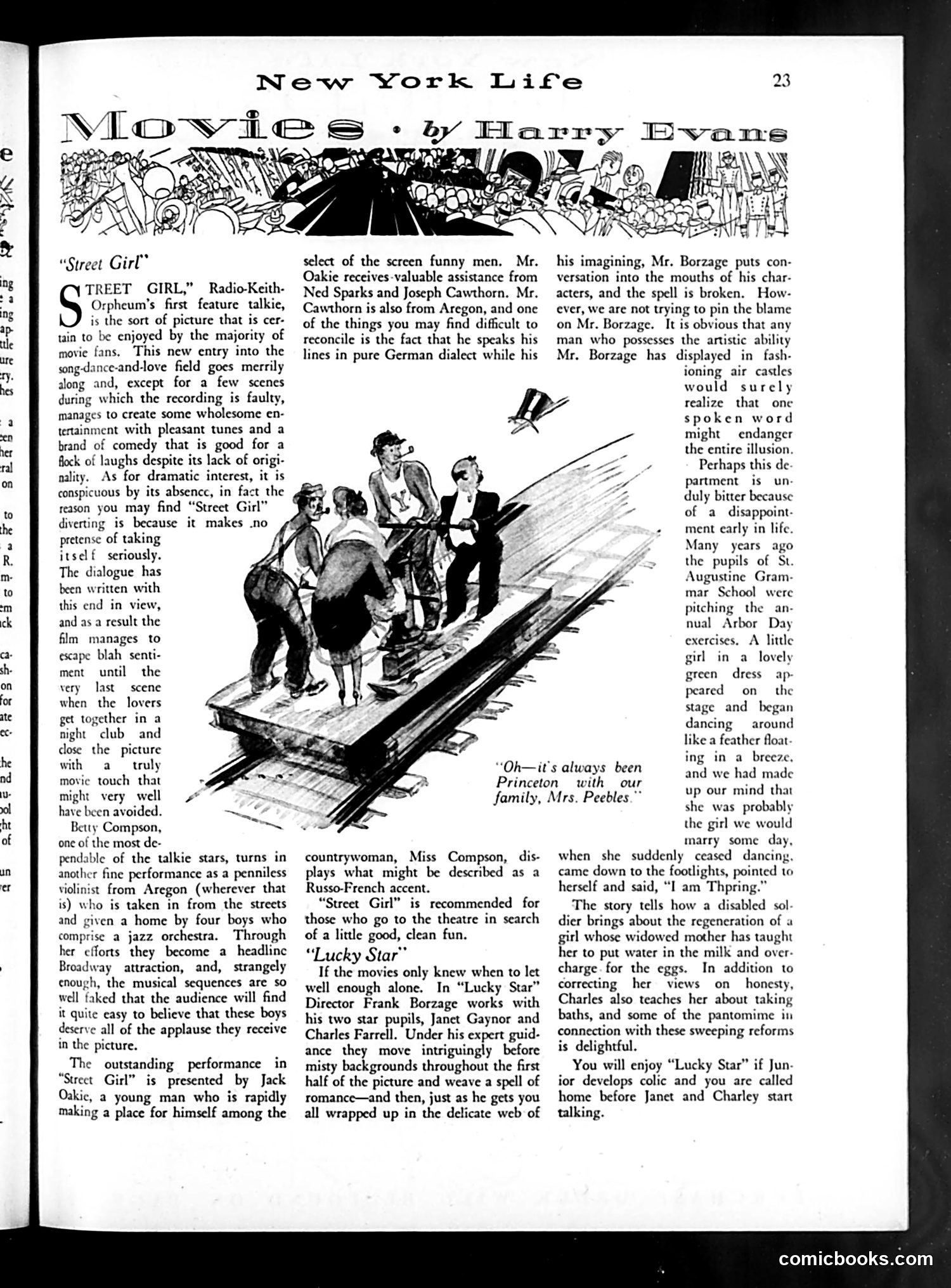
This is a film review column by Harry Evans covering two early "talkie" (sound) films from circa 1929. **"Street Girl"** is reviewed as a light musical comedy featuring Betty Compson and Jack Oakie. The reviewer praises its entertainment value while noting it lacks dramatic depth—intentionally so. A humorous observation criticizes the casting inconsistency: Joseph Cawthorn, supposedly from "Aregon," speaks in a German dialect while his scene partner (also from Aregon) uses a "Russo-French accent"—an absurdity the film doesn't acknowledge. **"Lucky Star"** features Frank Borzage directing Janet Gaynor and Charles Farrell. The reviewer criticizes Borzage for adding dialogue to what were effective silent sequences, arguing that spoken words destroy the romantic spell he'd carefully constructed. The critique includes a wry personal anecdote about childhood disappointment—when a dancing girl at an Arbor Day pageant spoke, shattering the reviewer's enchantment. Both reviews reflect early sound cinema's growing pains: the technology was new, and filmmakers hadn't yet mastered balancing visual storytelling with dialogue.
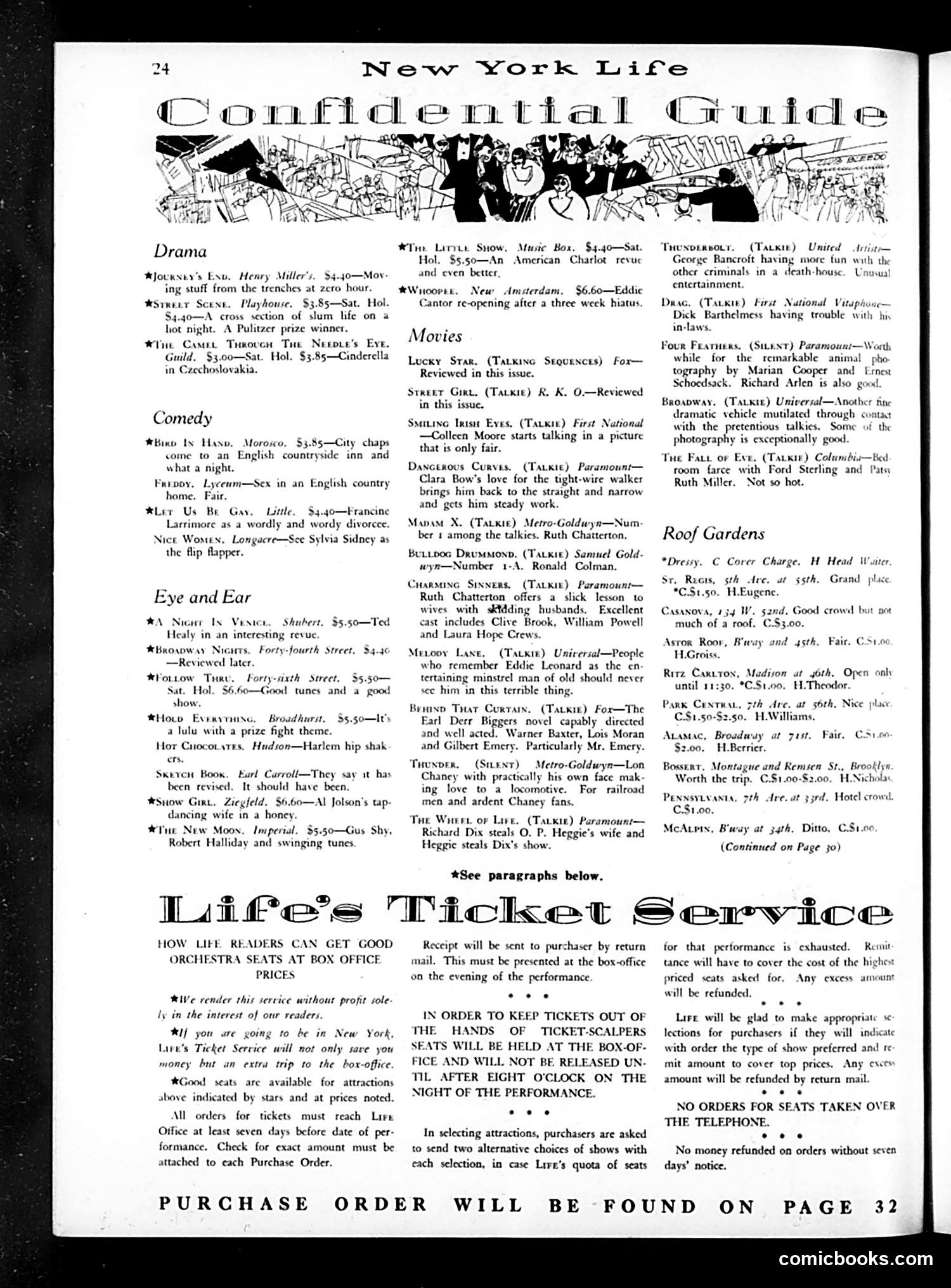
This page is **not a political cartoon** but rather an **entertainment and culture guide** — a weekly feature of Life magazine during the Jazz Age. The "Confidential Guide" section reviews Broadway plays, movies, and nightlife venues in New York City. The cartoon header (a stylized illustration of theater-goers and performers) is decorative, not satirical. The actual content provides: - **Theater reviews** of Broadway productions with ticket prices and brief critiques (e.g., Henry Miller's, the Shubert) - **Movie reviews** noting whether films are "talkie" (sound) or silent—significant in 1929, when talking pictures were still novel - **Nightclub/roof garden recommendations** with cover charges The asterisks (*) mark standout recommendations. References to performers like Al Jolson, Lon Chaney, and Clara Bow indicate contemporary celebrity draws. The emphasis on sound technology ("Talkie") reflects this transitional moment in cinema history. This is a **consumer guide** for affluent New Yorkers, not political satire.
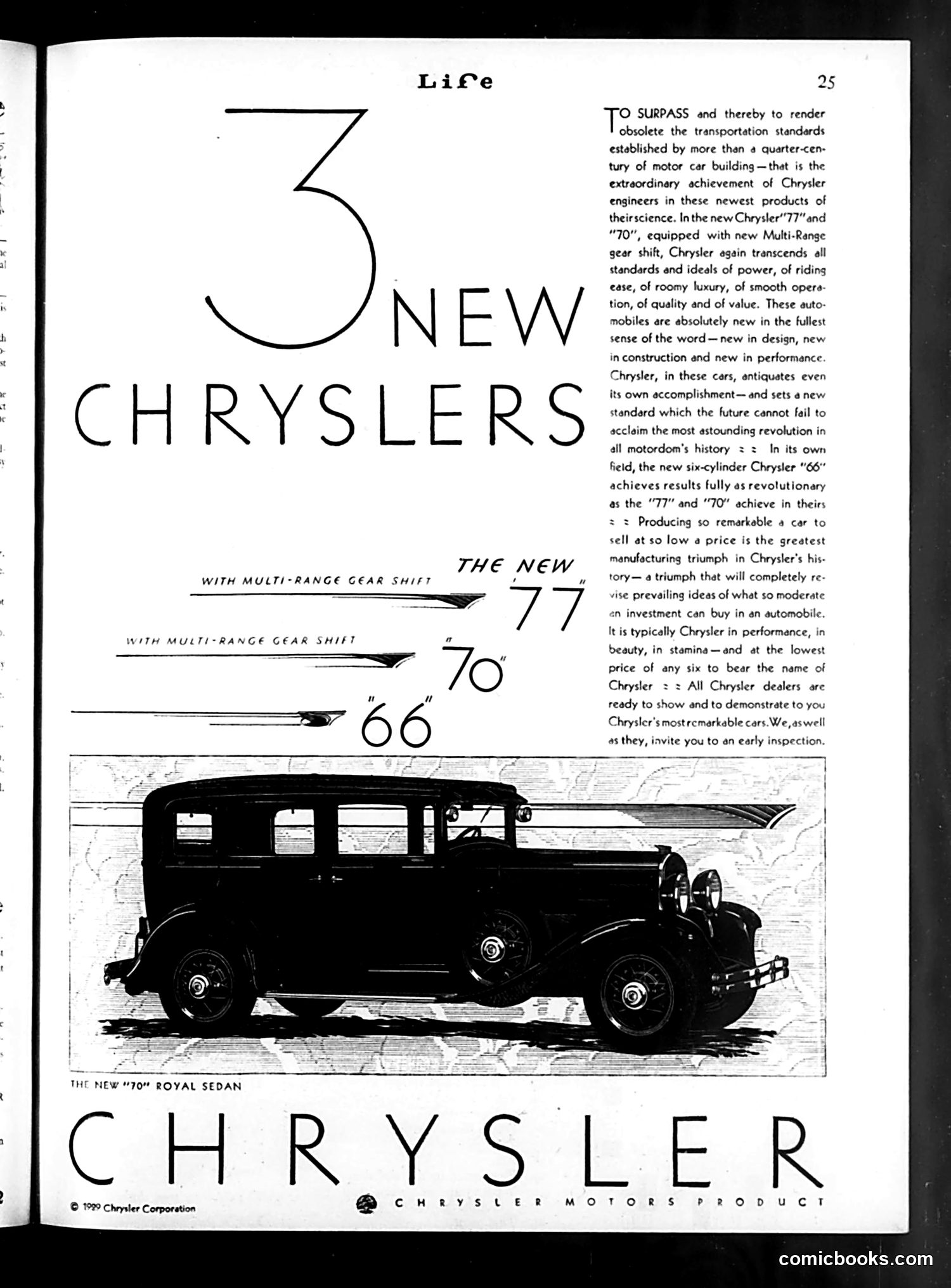
This is **not a cartoon or satire** — it's a straightforward **automobile advertisement** from Chrysler Motors, circa 1924 (based on the car style and "© 1924 Chrysler Corporation" copyright). The page advertises three new Chrysler models: the "77," "70," and "66," emphasizing their revolutionary features, particularly the new Multi-Range gear shift. The copy claims these cars surpass all previous automotive standards in power, comfort, luxury, and value. The single image shows a side profile of the "70" Royal Sedan, a closed automobile typical of the 1920s era. **For modern readers:** This represents peak automotive marketing confidence of the Jazz Age, when cars were still luxury goods. The breathless language about "revolution" and "surpassing standards" reflects how genuinely novel automobile improvements were to consumers of that era. The emphasis on "low price" indicates Chrysler was positioning itself as more affordable than competitors, competing in an emerging mass-market segment.
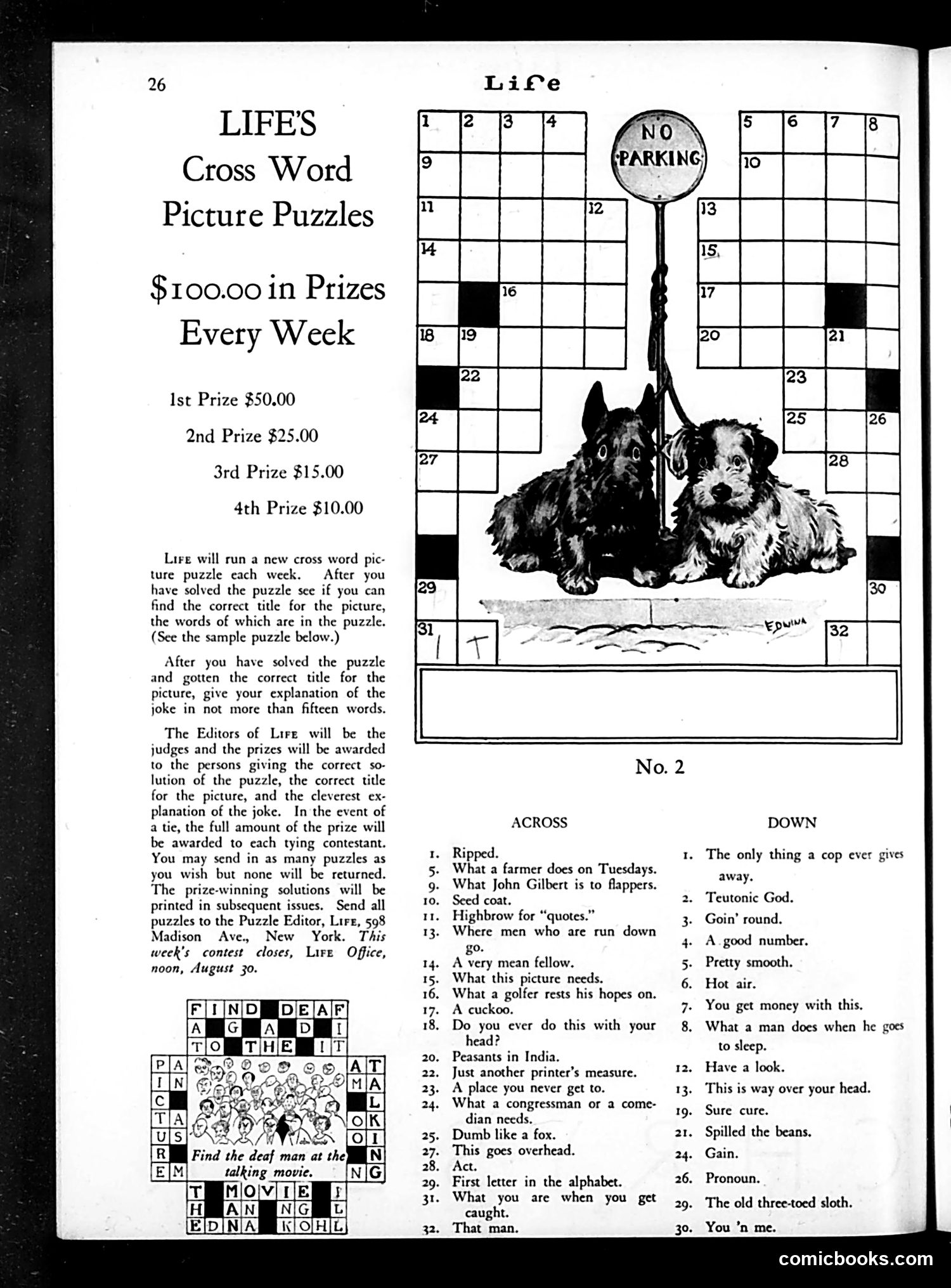
This page presents a weekly puzzle contest from *Life* magazine offering $100 in prizes. The format combines a crossword puzzle with an illustration; solvers must identify the puzzle's solution, find the picture's correct title (using words from the completed crossword), and explain the joke in fifteen words or fewer. The sample puzzle shown depicts two small dogs holding a "NO PARKING" sign—a visual joke about enforcement and authority. The crossword clues are contemporary references: mentions of "John Gilbert" (a silent film star), "talking movie" (the emerging sound film technology), and "flappers" all ground this in the late 1920s. This was typical *Life* entertainment content: accessible word puzzles combined with visual humor, appealing to middle-class readers seeking both mental challenge and satirical commentary on modern life.
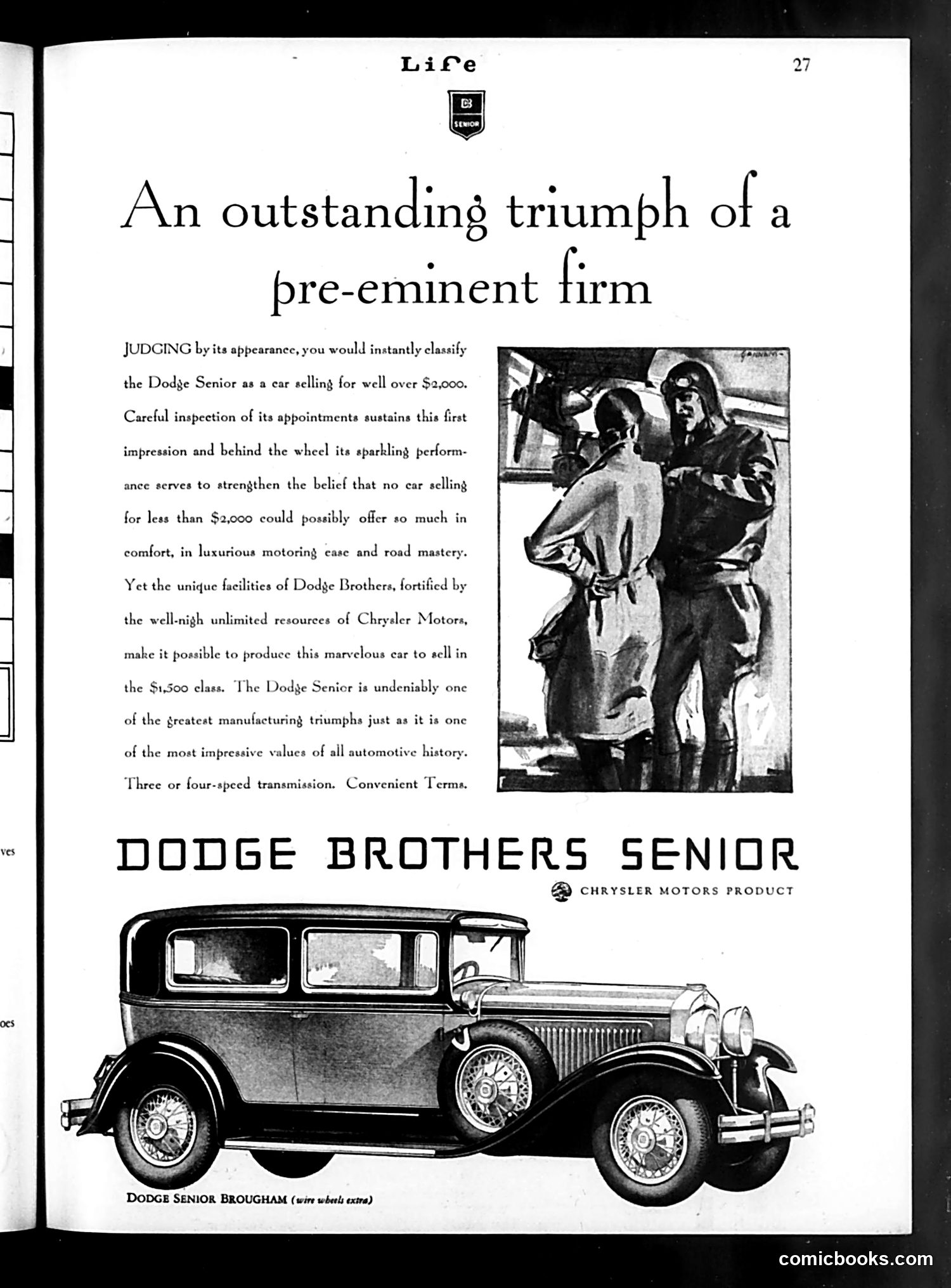
This is a **car advertisement**, not a satirical cartoon. The page promotes the Dodge Senior automobile, a Chrysler Motors product. The advertisement's primary pitch is a **value proposition**: the car looks and performs like a luxury vehicle costing over $2,000, yet sells for $1,500—presenting this price gap as a "manufacturing triumph." The accompanying photograph shows well-dressed men examining the vehicle, suggesting prestige and quality inspection. The text emphasizes comfort, road performance, and convenient financing terms to appeal to middle-class buyers. The bottom illustration displays the Dodge Senior Brougham model with wire wheels. For modern readers: this represents early-20th-century automotive marketing, when such price differences were genuinely remarkable and manufacturers touted affordability as revolutionary achievement. The aspirational messaging—that buyers could afford luxury—was itself a significant sales innovation.
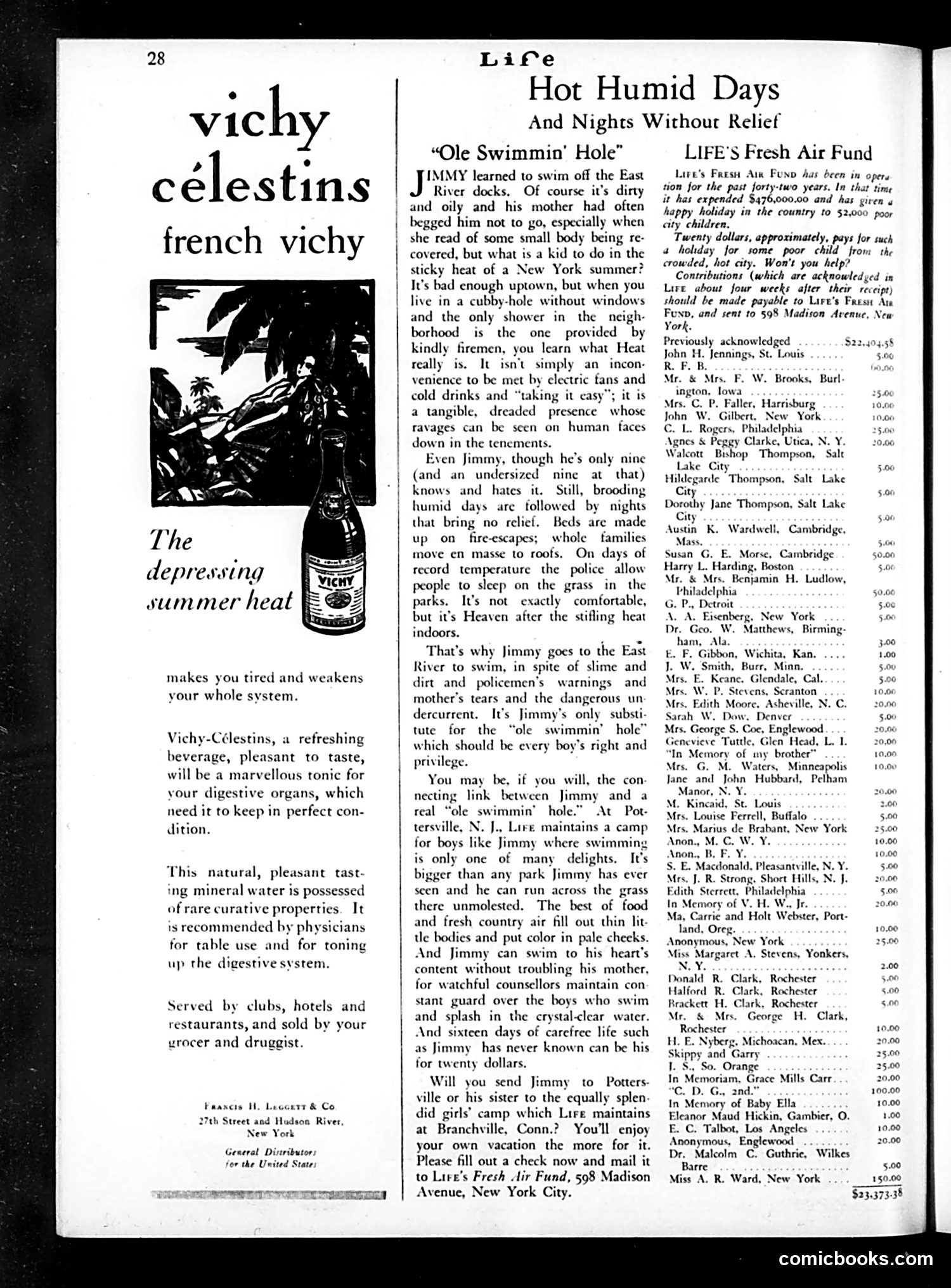
This page combines two distinct elements: a French mineral water advertisement (Vichy-Célestins) and a charitable fundraising appeal for *Life* magazine's Fresh Air Fund. **The Advertisement (left):** Promotes Vichy bottled water as relief from oppressive summer heat, claiming it tones the digestive system and is recommended by physicians. **The Main Content (right):** A narrative about "Jimmy," a poor nine-year-old boy from crowded tenement housing in New York City who swims illegally in the dirty East River during brutal summers because his apartment lacks windows or showers. The piece uses Jimmy as a sympathetic figure to solicit donations for *Life*'s Fresh Air Fund—a genuine charitable program offering poor urban children two-week summer camp vacations in rural New Jersey and Connecticut. **The Social Context:** This reflects early 20th-century Progressive Era concerns about urban poverty, child welfare, and public health. The contrast between Jimmy's dangerous urban reality and the idyllic country camp represents the era's belief that fresh air and nature were essential remedies for city children's physical and moral development. The fundraising goal: twenty dollars per child (approximately $650 in modern value).
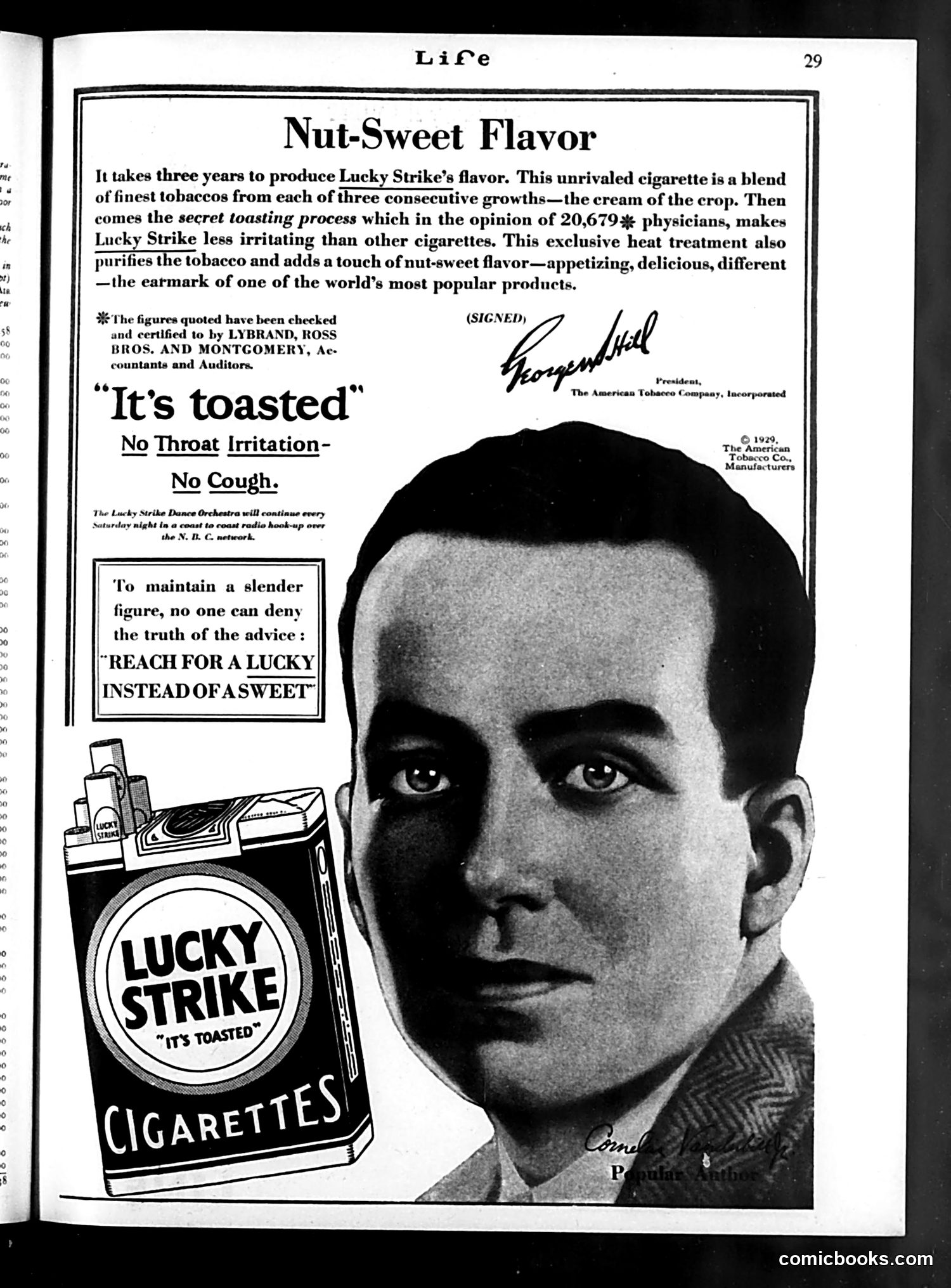
This is a **cigarette advertisement**, not satire—though modern readers will find it jaw-droppingly misleading by today's standards. The ad promotes Lucky Strike cigarettes using pseudo-scientific claims: that a special "toasting process" makes them less irritating than competitors, citing "20,679 physicians" (a suspiciously precise figure). It includes a fake audit stamp from accounting firms to appear credible. The slogan **"Reach for a Lucky instead of a sweet"** targets women concerned about weight—a marketing innovation positioning cigarettes as diet aids. This was part of Lucky Strike's famous 1920s campaign to expand female smoking by reframing cigarettes as slimming alternatives to candy. The page also advertises the Lucky Strike Dance Orchestra radio program, common sponsorship practice. By modern standards, every health claim here is false or deceptive. This represents pre-FDA regulation advertising when tobacco companies made unsubstantiated medical claims freely.
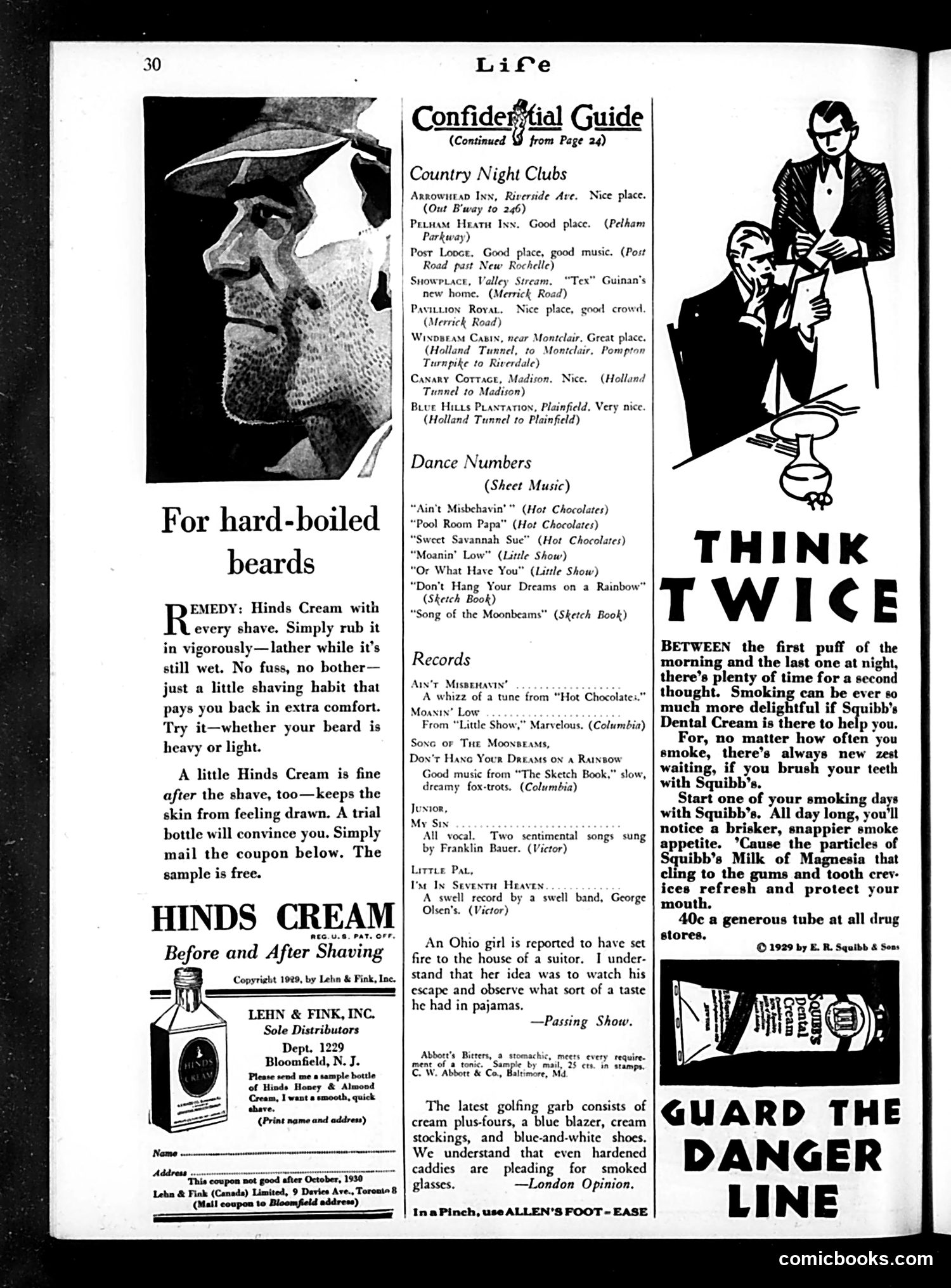
This page is primarily **advertising and entertainment listings** rather than political satire. The main content includes: **Left side:** A Hinds Cream shaving product ad with a caricatured male face, emphasizing comfort for men with tough beards. **Center:** A "Confidential Guide" listing speakeasies and nightclubs around New York during Prohibition—venues like "Tex Guinan's" (a famous speakeasy operator). This reflects the era's illegal alcohol culture. Also listed are dance numbers and records from Broadway shows like "Hot Chocolates" and "Little Show." **Right side:** A Squibb's Dental Cream ad with an illustration of a man smoking, promoting teeth-brushing between cigarettes. **Bottom:** Brief humorous anecdotes, including one about an Ohio woman setting fire to a suitor's house to observe his pajama taste—typical period gossip-column humor. The page captures 1929 consumer culture: Prohibition-era nightlife, smoking as routine, and targeted grooming products for men.
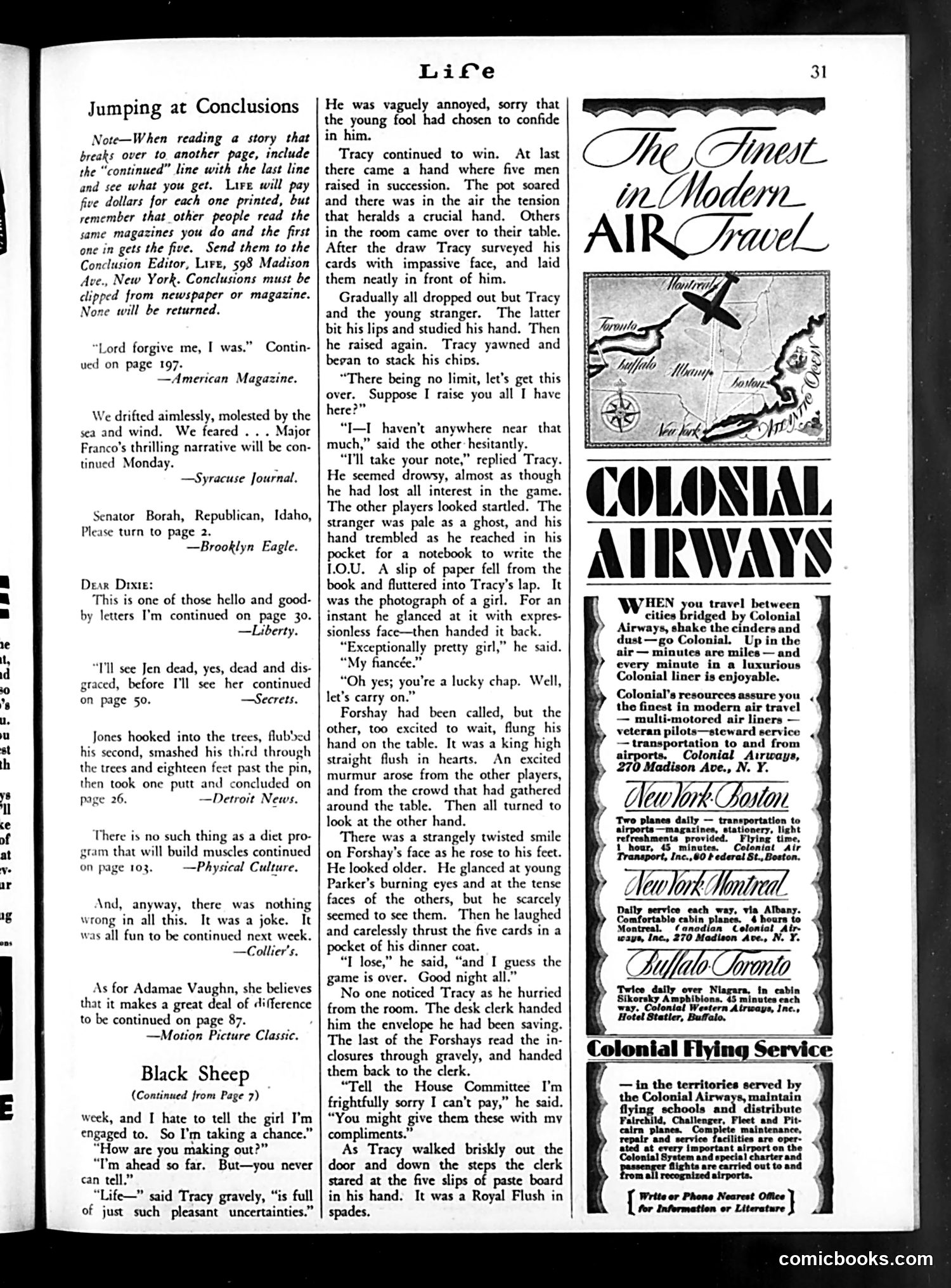
This page satirizes a common magazine publishing practice: stories continued on later pages. Life's humor section invites readers to submit unintentionally absurd "conclusions" created by reading a story's final line immediately before the "continued on page X" notice—creating accidental dark comedy. Examples include "Lord forgive me, I was [continued on page 197]" (American Magazine) and "I'll see Jen dead, yes, dead and disgraced, before I'll see her continued on page 50" (Secrets). The joke exploits how magazine pagination could accidentally transform innocent narrative continuations into seemingly shocking confessions or threats. The "Black Sheep" story excerpt below shows typical serialized fiction of the era—a gambling tale with dramatic tension. This feature playfully mocks both magazine editing and reader attention, offering five dollars for each published submission.
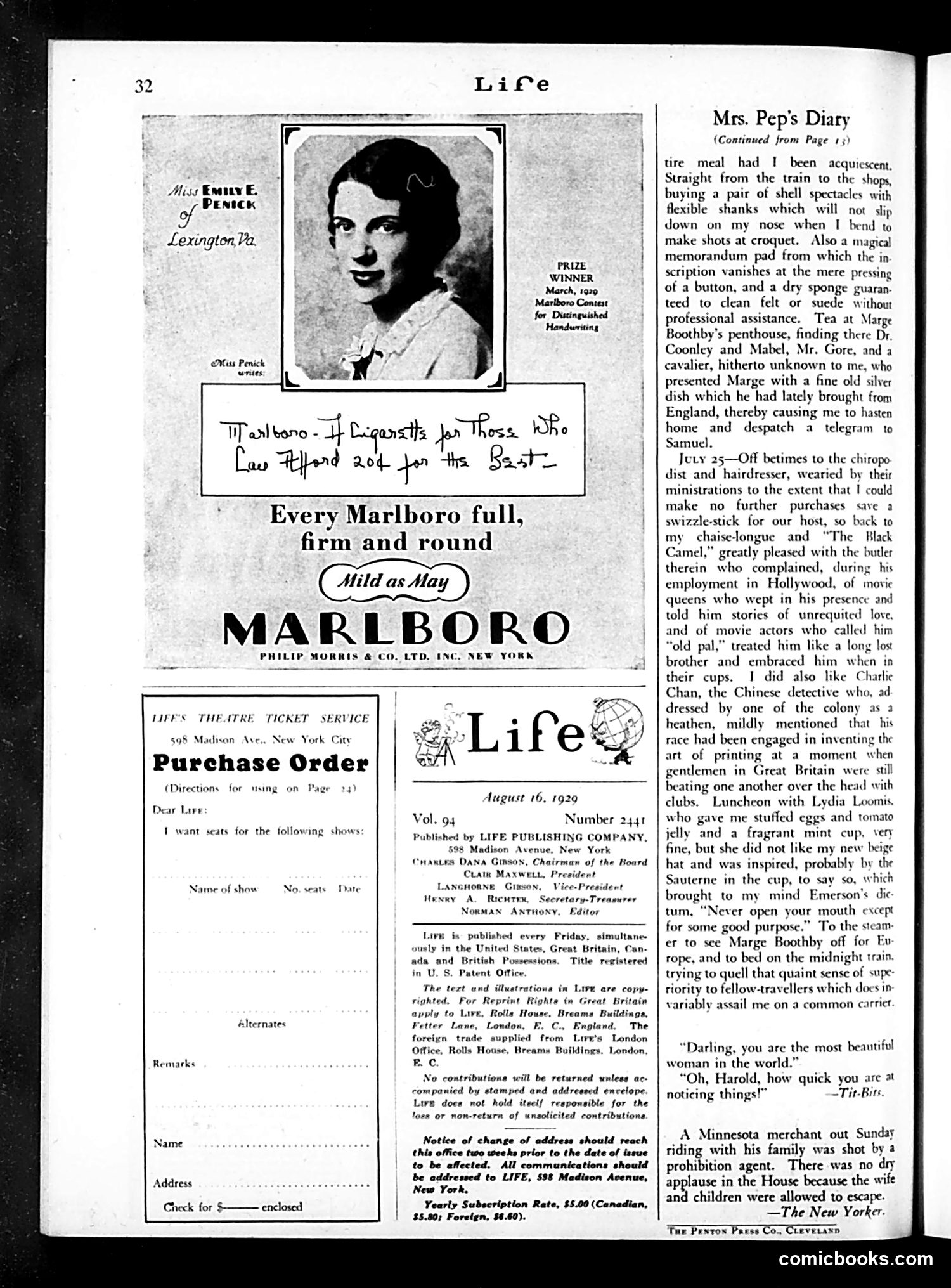
This page contains primarily **advertising and administrative content** from *Life* magazine (August 16, 1929), not political cartoons. The main elements are: 1. **Marlboro cigarette advertisement** featuring Miss Emily E. Penick of Lexington, Virginia, with her endorsement (handwritten inscription). This represents early cigarette marketing using celebrity/society figure testimonials—a common practice before tobacco health warnings were mandated. 2. **"Mrs. Pep's Diary"** — a serialized humor column describing upper-class social activities (shopping, tea parties, theater-going). The references to "Charlie Chan" and dismissive characterizations reflect 1929 attitudes; the humor targets wealthy leisure pursuits and social pretension. 3. **Theatre ticket service and subscription information** — practical magazine business content. The page reflects *Life's* era as a satirical magazine for affluent readers, mixing entertainment gossip, consumer culture, and social observation.
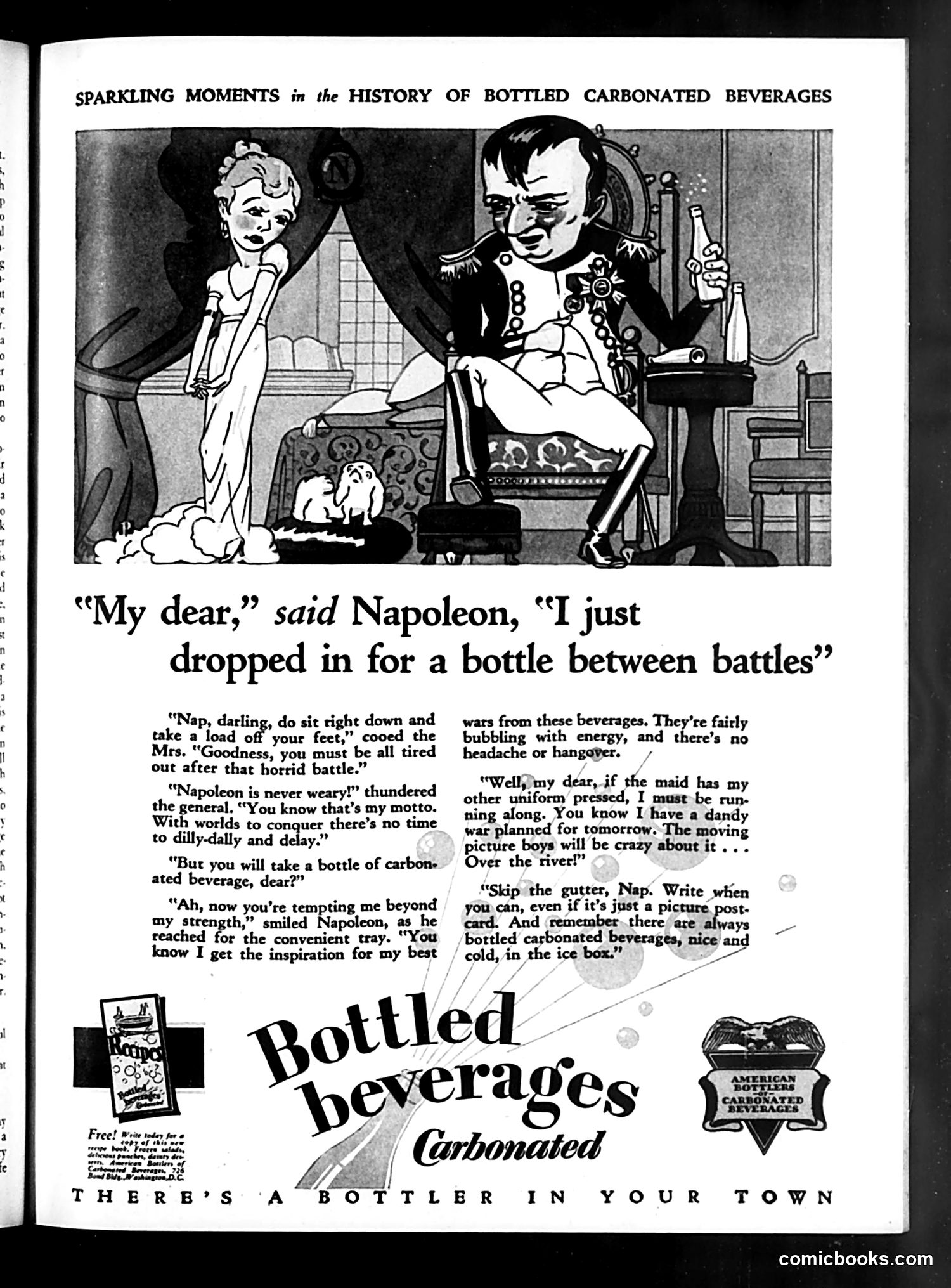
This is an advertisement for bottled carbonated beverages disguised as historical satire. The cartoon depicts Napoleon Bonaparte visiting his wife between military campaigns. She persuades him to drink a carbonated beverage, which he credits with inspiring his military victories and providing energy without headache or hangover. The humor relies on anachronism—Napoleon (early 1800s) enjoying modern bottled sodas—and absurdist logic: the wife suggests the beverages' "bubbling energy" fuels his conquests. The satire gently mocks both Napoleon's grandiose self-image ("Napoleon is never weary!") and the exaggerated health claims of carbonated drinks. This appears to be vintage advertising from Life magazine, using historical figures and comic scenarios to promote bottled sodas as energizing, consequence-free beverages. The "sparkling moments" headline plays on both the fizz and the comedic tone.
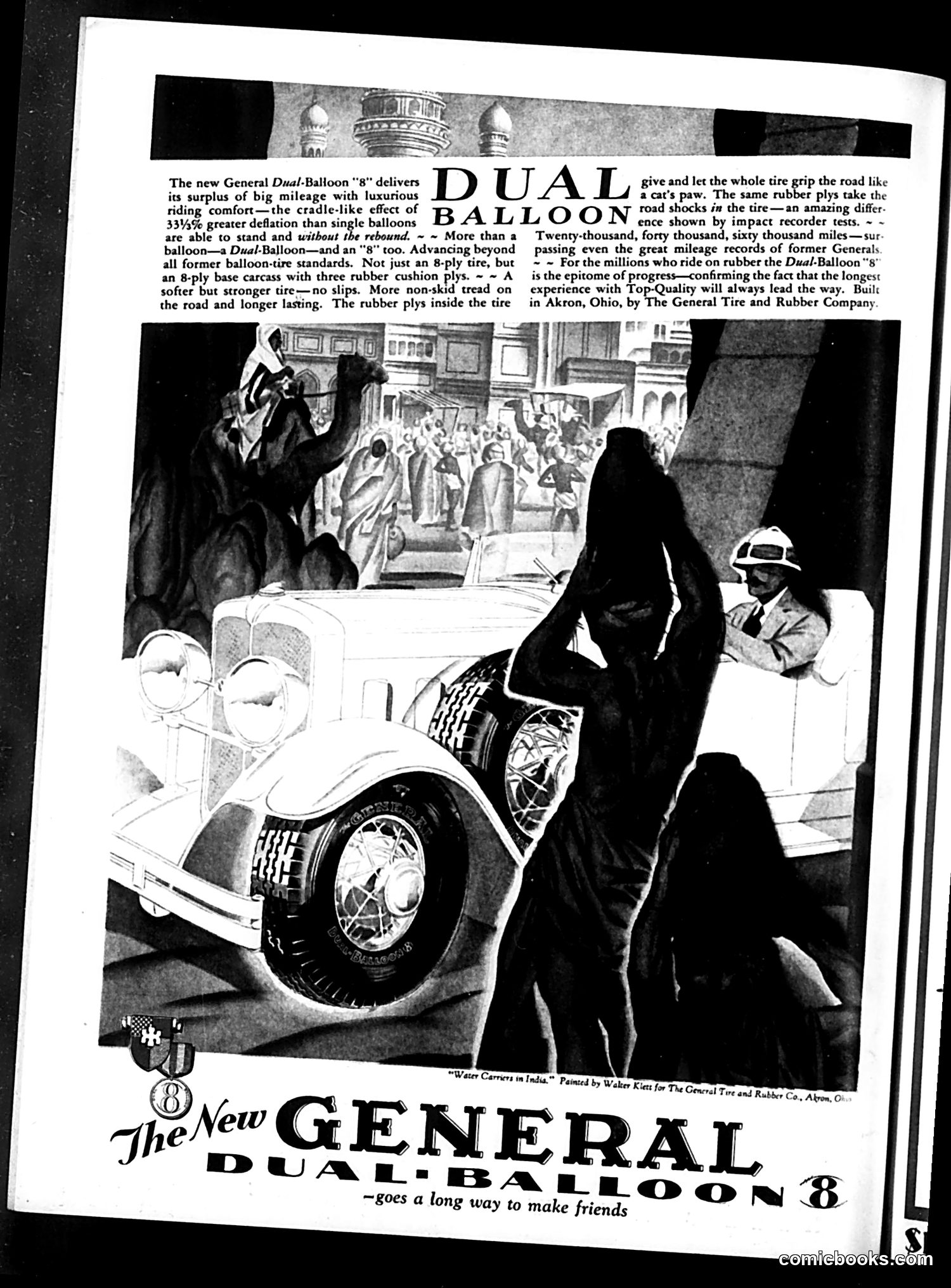
This is a **General Tire and Rubber Company advertisement**, not political satire. It promotes the new "Dual-Balloon 8" tire, marketed as a luxury automotive product. The illustration depicts a wealthy couple in an automobile in what appears to be India or another exotic location (the painting behind shows architectural monuments; the caption references "West Carriers in India"). The fancy car with prominent dual-balloon tires is displayed as a status symbol. The sales pitch emphasizes the tire's superior comfort ("cradle-like effect"), durability (tested to 60,000 miles), and grip ("like a cat's paw"). The tagline "goes a long way to make friends" suggests that owning these quality tires enhances one's social standing. This reflects 1920s-30s consumer culture where tire technology was a genuine innovation and luxury automobiles signified wealth and sophistication.