
Penny Dreadfuls, 1857 · page 166 of 394
Agnes, or, Beauty and Pleasure — page 166: what you’re looking at
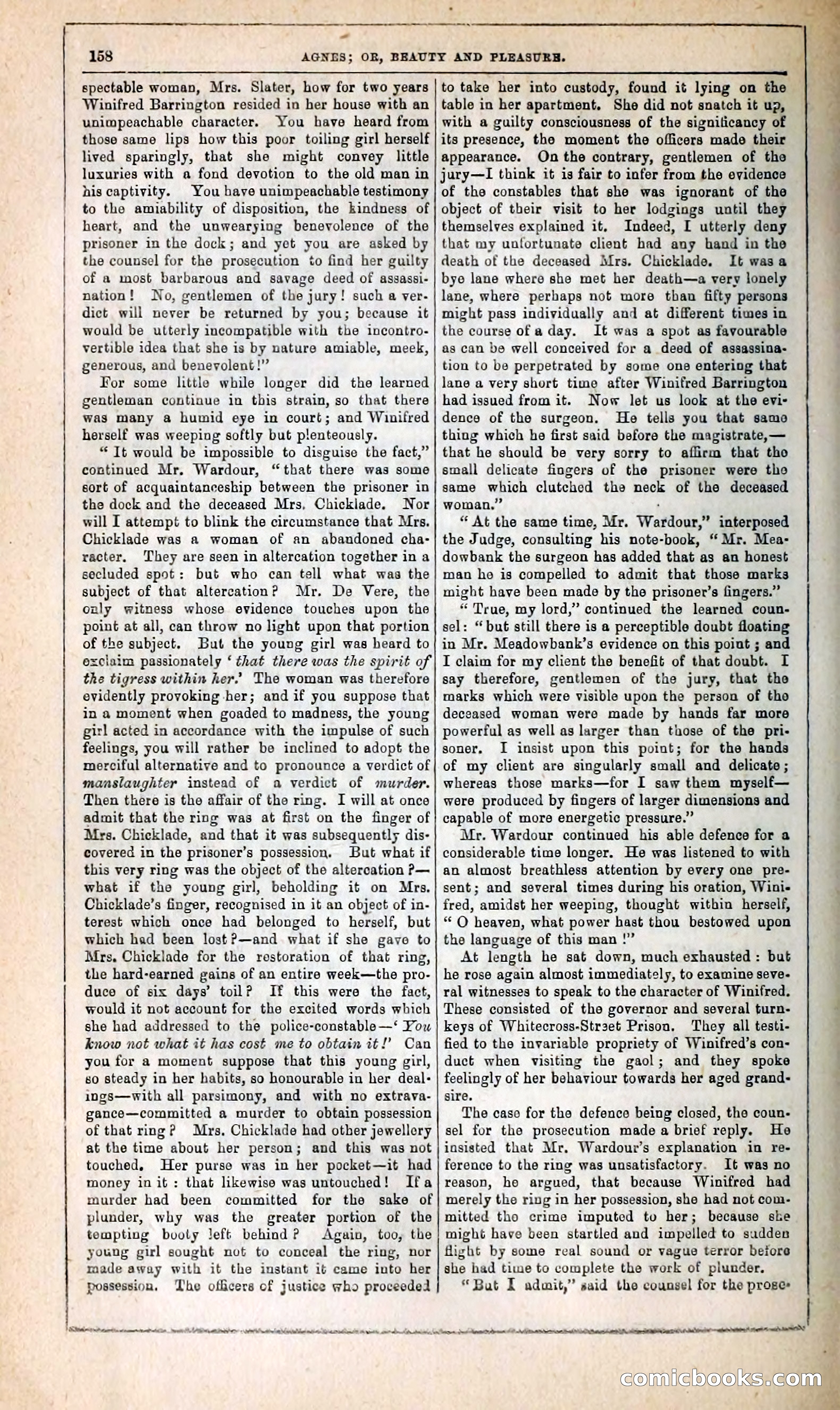
A restored page from Penny Dreadfuls, 1857. Page through the whole issue in the reader above.
📄 Transcribed text from this page (OCR, searchable)
Machine-transcribed from the original scan — historical spelling and the odd misread are preserved.
a eg ee ee eee Se es See ee ee ee or - 158 spectable woman, Mrs. Slater, how for two years Winifred Barrington resided in her house with an unimpeachable character. You have heard from those same lips how this poor toiling girl herself lived sparingly, that she might convey little luxuries with a fond devotion to the old man in his captivity. You have unimpeachable testimony to the amiability of disposition, the kindness of heart, and the unwearying benevolence of the prisoner in the dock; and yet you are asked by the counsel for the prosecution to find her guilty of a most barbarous and savage deed of assassi- nation! No, gentlemen of the jury! such a ver- dict will never be returned by you; because it would be utterly incompatible with the incontro- vertible idea that she is by nature amiable, meek, generous, and benevolent!” For some little while longer did the learned gentleman continue in this strain, so that there was many a humid eye in court; and Winifred herself was weeping softly but plenteously. “It would be impossible to disguise the fact,” continued Mr. Wardour, “that there was some sort of acquaintanceship between the prisoner in the dock and the deceased Mrs, Chicklade. Nor will I attempt to blink the circumstance that Mrs. Chicklade was a woman of an abandoned cha- racter. They are seen in altercation together in a secluded spot: but who can tell what was the subject of that altercation? Mr. De Vere, the ozly witness whose evidence touches upon the point at all, can throw no light upon that portion of the subject. But the young girl was heard to exciaim passionately ‘ that there was the spirit of the tigress within her.’ The woman was therefore evidently provoking her; and if you suppose that in a moment when goaded to madness, the young girl acted in accordance with the impulse of such feelings, you will rather be inclined to adopt the merciful alternative and to pronounce a verdict of manslaughter instead of a verdict of murder. Then there is the affair of the ring. I will at once admit that the ring was at first on the finger of Mrs. Chicklade, and that it was subsequently dis- covered in the prisoner’s possession. But what if this very ring was the object of the altercation P— what if the young girl, beholding it on Mrs, Chicklade’s finger, recognised in it an object of in- terest which once had belonged to herself, but which had been lost?—and what if she gaye to Mrs, Chicklade for the restoration of that ring, the hard-earned gains of an entire week—the pro- duce of six days’ toil? If this were the fact, would if not account for the excited words which she had addressed to the police-constable—‘ You know not what it has cost me to obtain it!’ Can you for a moment suppose that this young girl, so steady in her habits, so honourable in her deal- ings—with all parsimony, and with no extrava- gance—committed a murder to obtain possession of that ring? Mrs, Chicklade had other jewellery at the time about her person; and this was not touched. Her purse was in her pocket—it had money init: that likewise was untouched! Ifa murder had been committed for the sake of plunder, why was the greater portion of the tempting bvoly left behind? Again, too, the young girl sought not to conceal the ring, nor made away with it the instant it came into her possession. ‘The officers of justice who proceeded AGNES; OR, BEAUTY AND PLEASURE. - to take her into custody, found it lying on the | table in her apartment. She did not snatch it up, with a guilty consciousness of the signilicancy of its presence, the moment the officers made their appearance. On the contrary, gentlemen of the jury—lI think it is fair to infer from the evidence of the constables that she was ignorant of the object of their visit to her lodgings until they themselves explained it, Indeed, [ utterly deny that my unfortunate client had any hand in the death of the deceased Mrs. Chicklade. It wasa bye lane where she met her death—a very lonely lane, where perbaps not more than fifty persons might pass individually and at different times in the course of aday. It was a spot as favourable as can be well conceived for a deed of assassina- tion to be perpetrated by some one entering that lane a very short time after Winifred Barrington had issued from it. Now let us look at the evi- dence of the surgeon. He tells you that samo thing which he first said before the magistrate,— that he should be very sorry to aflirm that tho small delicate fingers of the prisoner were tho same which clutched the neck of the deceased woman,” “ At the same time, Mr. Wardour,” interposed the Judge, consulting his note-book, “ Mr. Mea- dowbank the surgeon has added that as an honest man he is compelled to admit that those marks might have been made by the prisoner’s fingers.” * True, my lord,” continued the learned coun- sel: “but still there is a perceptible doubt floating in Mr. Meadowbank’s evidence on this poiut ; and I claim for my client the benefit of that doubt. I say therefore, gentlemen of the jury, that tho marks which were visible upon the person of tho deceased woman were made by hands far more powerful as well as larger than tuose of the pri- soner, I insist upon this point; for the hands of my client are singularly small and delicate ; whereas those marks—for I saw them myself— were produced by fingers of larger dimensions and capable of more energetic pressure.” Mr. Wardour continued his able defence for a considerable time longer. He was listened to with an almost breathless attention by every one pre- sent; and several times during his oration, Wini- fred, amidst her weeping, thought within herself, “ O heaven, what power hast thou bestowed upon the language of this man !” At length he sat down, much exhausted: but he rose again almost immediately, to examine seve- ral witnesses to speak to the character of Winifred. These consisted of the governor and several turn- keys of Whitecross-Str3et Prison. They all testi- fied to the invariable propriety of Winifred’s con- duct when visiting the gaol; and they spoke feelingly of her behaviour towards her aged grand- sire. The caso for the defence being closed, the coun- sel for the prosecution made a brief reply. He insisted that Mr. Wardour’s explanation in re- ference to the ring was unsatisfactory. It was no reason, he argued, that because Winifred had merely the ring in her possession, she had not com- mitted tho crime imputed to her; because ske might have been startled and impelled to sudden flizht by some real sound or vague terror beiore she had time to complete the work of plunder. * But I admit,” said the counsel for the proses Gomicbooks;com | ~~ - =. ee