
Penny Dreadfuls, 1857 · page 167 of 394
Agnes, or, Beauty and Pleasure — page 167: what you’re looking at
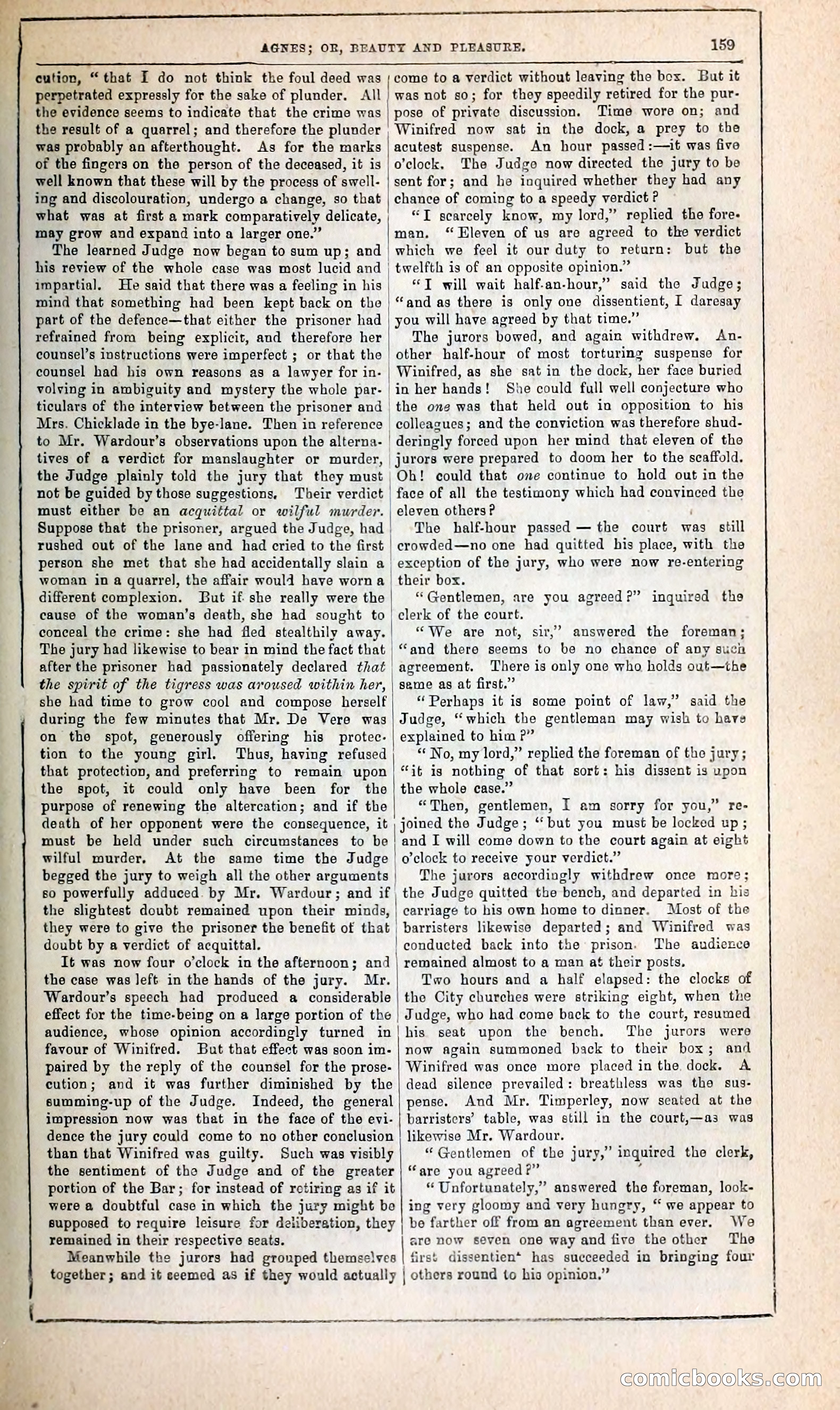
A restored page from Penny Dreadfuls, 1857. Page through the whole issue in the reader above.
📄 Transcribed text from this page (OCR, searchable)
Machine-transcribed from the original scan — historical spelling and the odd misread are preserved.
f 4 . om AGNES; OR, BEAUTY AND PLEASURE, a cution, “that I do not think the foul deed was ; come to a verdict without leaving the box. But it perpetrated expressly for the sake of plunder. All _ the evidence seems to indicate that the crime was the result of a quarrel; and therefore the plunder was probably an afterthought. As for the marks of the fingers on the person of the deceased, it is well known that these will by the process of swell- ing and discolouration, undergo a change, so that what was at first a mark comparatively delicate, may grow and expand into a larger one.” The learned Judge now began to sum up; and his review of the whole case was most lucid and | impartial. He said that there was a feeling in his mind that something had been kept back on the part of the defence—that either the prisoner had refrained from being explicit, and therefore her counsel’s instructions were imperfect ; or that the counsel had his own reasons as a lawyer for in- volving in ambiguity and mystery the whole par- ticulars of the interview between the prisoner and Mrs. Chicklade in the bye-lane. Then in reference tives of a verdict for manslaughter or murder, the Judge plainly told the jury that they must not be guided by those suggestions, Their verdict must either be an acquittal or wilful murder. Suppose that the prisoner, argued the Judge, had | rushed out of the lane and had cried to the first person she met that she had accidentally slain a woman in a quarrel, the affair would have worna different complexion. But if she really were the cause of the woman’s death, she had sought to conceal the crime: she had fled stealthily away. The jury had likewise to bear in mind the fact that after the prisoner had passionately declared that the spirit of the tigress was aroused within her, she had time to grow cool and compose herself during the few minutes that Mr. De Vere was on the spot, generously offering his protec- tion to the young girl. Thus, having refused that protection, and preferring to remain upon the spot, it could only have been for the purpose of renewing the altercation; and if the death of her opponent were the consequence, it must be held under such circumstances to be wilful murder, At the same time the Judge begged the jury to weigh all the other arguments s0 powerfully adduced. by Mr. Wardour; and if the slightest doubt remained upon their minds, they were to give the prisoner the benefit of that doubt by a verdict of acquittal. It was now four o’clock in the afternoon; and the case was Jeft in the hands of the jury. Mr. Wardour’s speech had produced a considerable effect for the time-being on a large portion of the audience, whose opinion accordingly turned in favour of Winifred. But that effect was soon im- paired by the reply of the counsel for the prose- eution; and it was further diminished by the summing-up of the Judge. Indeed, the general impression now was that in the face of the evi- dence the jury could come to no other conclusion than that Winifred was guilty. Such was visibly the sentiment of tho Judge and of the greater portion of the Bar; for instead of rotiring as if it were a doubtful case in which the jury might bo 159 was not so; for they speedily retired for the pur- pose of private discussion. Time wore on; and Winifred now sat in the dock, a prey to the acutest suspense. An hour passed :—it was five o’clock, The Judge now directed the jury to be sent for; and he inquired whether they had any chance of coming to a speedy verdict ? “T scarcely know, my lord,” replied the fore- man. “Eleven of us are agreed to the verdict which we feel it our duty to return: but the twelfth is of an opposite opinion.” JT will wait half-an-hour,” said the Judge; “and as there is only one dissentient, I daresay you will have agreed by that time.” The jurors bowed, and again withdrew. An- other half-hour of most torturing suspense for Winifred, as she sat in the dock, her face buried in her hands! She could full well conjecture who the ong was that held out in opposition to his colleagues; and the conviction was therefore shud- to Mr. Wardour’s observations upon the alterna- | deringly forced upon her mind that eleven of tho jurors were prepared to doom her to the scaffold. Ob! could that one continue to hold out in the face of all the testimony which had convinced the eleven others? The half-hour passed — the court was still crowded—no one had quitted his place, with the exception of the jury, who were now re-entering their box. _ agreement. “Gentlemen, are you agreed?” inquired the clerk of the court. “We are not, sir,’ answered the foreman; ‘and there seems to be no chance of any such There is only one who holds owt—the seme as at first.” “Perhaps it ig some point of law,” said the Judge, “which the gentleman may wish to have explained to him P” “No, my lord,” replied the foreman of the jury; “if is nothing of that sort: his dissent is upon the whole case.” “Then, gentlemen, I am sorry for you,” re- joined the Judge; “but you must be locked up ; and I will come down to the court again at eight o’clock to receive your verdict.” The jurors accordingly withdrew once more; the Judge quitted the bench, and departed in his carriage to his own home to dinner. Most of the barristers likewise departed; and Winifred was conducted back into the prison. The audience remained almost to a man at their posts, Two hours and a half elapsed: the clocks of the City churches were striking eight, when the 3) | Judge, who had come back to the court, resumed his seat upon the bench. The jurors were now again summoned back to their box; and Winifred was once more placed in the dock. A dead silence prevailed: breathless was the sus- pense. And Mr. Timperley, now seated at the barristers’ table, was still in the court,—a3 was likewise Mr. Wardour. “Gentlemen of the jury,” inquired the clerk, “are you agreed?” F “ Unfortunately,” answered the foreman, look- ing very gloomy and very hungry, “ we appear to b supposed to require leisure for deliberation, they | be farther off from an agreement than ever, We remained in their respective seats. are now seven one way and five the other The Meanwhile the jurors had grouped themeelves | tirst dissentien* has succeeded in bringing four together; and it eeemed as if they would actually | others round to his opinion.” wa re wer een en Comiclooolks ° ae OimM