
Penny Dreadfuls, 1857 · page 237 of 394
Agnes, or, Beauty and Pleasure — page 237: what you’re looking at
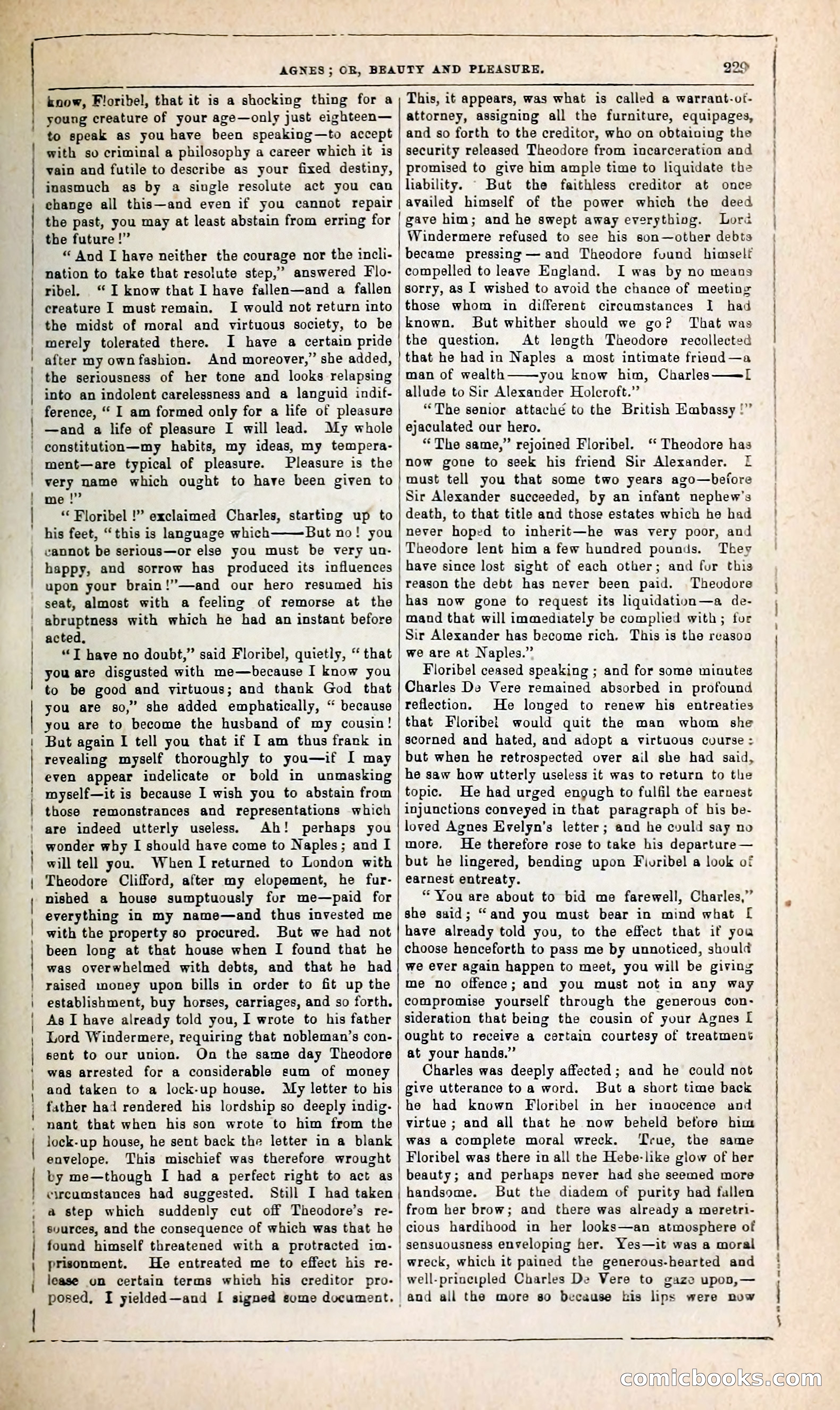
A restored page from Penny Dreadfuls, 1857. Page through the whole issue in the reader above.
📄 Transcribed text from this page (OCR, searchable)
Machine-transcribed from the original scan — historical spelling and the odd misread are preserved.
eee ee ee et eens a ee a ES ER eS eee oe _———e ee en — AGNES; OR, BEAUTY AND PLEASURE, 229 know, Filoribel, that it is a shocking thing for a young creature of your age—only just eighteen— to speak as you have been speaking—to accept with so criminal a philosophy a career which it is vain and futile to describe as your fixed destiny, inasmuch as by a single resolute act you can change all this—and even if you cannot repair the past, you may at least abstain from erring for the future !” “ And I have neither the courage nor the incli- nation to take that resolute step,” answered Flo- ribel. ‘ I know that I have fallen—and a fallen creature I must remain. I would not return into the midst of moral and virtuous society, to be merely tolerated there. I have a certain pride after my ownfashion. And moreover,” she added, the seriousness of her tone and looks relapsing into an indolent carelessness and a languid indif- ference, “ I am formed only for a hfe of pleasure —and a life of pleasure I will lead. My whole constitution—my habits, my ideas, my tempera- ment—are typical of pleasure. Pleasure is the very name which ought to have been given to me !” ‘« Floribel !” exclaimed Charles, starting up to his feet, “this is language which But no! you cannot be serious—or else you must be very un- happy, and sorrow has produced its influences upon your brain!’”’—and our hero resumed his seat, almost with a feeling of remorse at the abruptmess with which he had an instant before acted, “‘T have no doubt,” said Floribel, quietly, “ that you are disgusted with me—because I know you to be good and virtuous; and thank God that you are so,” she added emphatically, “ because you are to become the husband of my cousin! But again I tell you that if I am thus frank in revealing myself thoroughly to you—if I may even appear indelicate or bold in unmasking myself—it is because I wish you to abstain from those remonstrances and representations which are indeed utterly useless. Ah! perhaps you wonder why I should have come to Naples; and I will tell you. WhenI returned to London with Theodore Clifford, after my elopement, he fur- nished a house sumptuously fur me—paid for everything in my name—and thus invested me with the property so procured. But we had not been long at that house when I found that he was overwhelmed with debts, and that he had raised money upon bills in order to fit up the establishment, buy horses, carriages, and so forth. As I have already told you, I wrote to his father Lord Windermere, requiring that nobleman’s con- sent to our union. On the same day Theodore was arrested for a considerable sum of money aod taken to a lock-up house. My letter to his father had rendered his lordship so deeply indig- nant that when his son wrote to him from the lock-up house, he sent back the letter in a blank envelope. This mischief was therefore wrought by me—though [I had a perfect right to act as circumstances had suggested. Still I had taken a step which suddenly cut off Theodore’s re- suurces, and the consequence of which was that he found himself threatened with a protracted im- prisonment. He entreated me to effect his re- lease on certain terms which his creditor pro- posed, I yielded—and [| signed eume document. -_~>—— This, it appears, was what is called a warrant-ot- attorney, assigning all the furniture, equipages, and so forth to the creditor, who on obtaining the security released Theodore from incarceration and promised to give him ample time to liquidate the liability. - But the faithless creditor at once availed himself of the power which the deed gave him; and he swept away everythiog. Lord Windermere refused to see his son—other debts became pressing —and Theodore fvund himself compelled to leave England. I was by no means sorry, as I wished to avoid the chance of meeting those whom in different circumstances J had known. But whither should we goP That was the question. At length Theodore recollected that he had in Naples a most intimate friend—a man of wealth you know him, Charles——lI allude to Sir Alexander Holcroft.”’ “The senior attaché to the British Embassy!” ejaculated our hero. “The same,” rejoined Floribel. ‘‘ Theodore has now gone to seek his friend Sir Alexander. L must tell you that some two years ago—before Sir Alexander succeeded, by an infant nephew's death, to that title and those estates which he had never hoped to inherit—he was very poor, and Theodore lent him a few hundred pounds. They have since lost sight of each other; and fur this reason the debt has never been paid. Theodore has now gone to request its liquidation—a de- mand that will immediately be complied with; for Sir Alexander has become rich. This is the reasoo we are at Naples.” Floribel ceased speaking ; and for some minutee Charles De Vere remained absorbed in profound reflection. He longed to renew his entreaties that Floribei would quit the man whom she scorned and hated, and adopt a virtuous course : but when he retrospected over ail she had said, he saw how utterly useless it was to return to the topic. He had urged enough to fulfil the earnest injunctions conveyed in that paragraph of his be- loved Agnes Evelyn’s letter; and he cvuld say no more. He therefore rose to take his departure — but he lingered, bending upon Fivribel a look of earnest entreaty. * You are about to bid me farewell, Charles,” she said; “and you must bear in mind what [ have already told you, to the effect that if you choose henceforth to pass me by unnoticed, should we ever again happen to meet, you will be giving me no offence; and you must not in any way compromise yourself through the generous con- sideration that being the cousin of your Agnes L Ought to receive a certain courtesy of treatment at your hands.” Charles was deeply affected; and he could not give utterance toa word. But a short time back he had known Floribel in her inavcence and virtue ; and all that he now beheld betore him was a complete moral wreck. ‘True, the same Floribel was there in all the Hebe-like glow of her beauty; and perhaps never had she seemed more handsome. But the diadem of purity had fallen from her brow; and there was already a meretri- cious hardihood in her looks—an atmosphere of sensuousness enveloping her. Yes—it was a moral wreck, which it pained the generous-hearted and | well-principled Charles De Vere to gaze upop,— 'and all the more so because bis lips were now CoOMmiclooolkks Om