
Penny Dreadfuls, 1857 · page 238 of 394
Agnes, or, Beauty and Pleasure — page 238: what you’re looking at
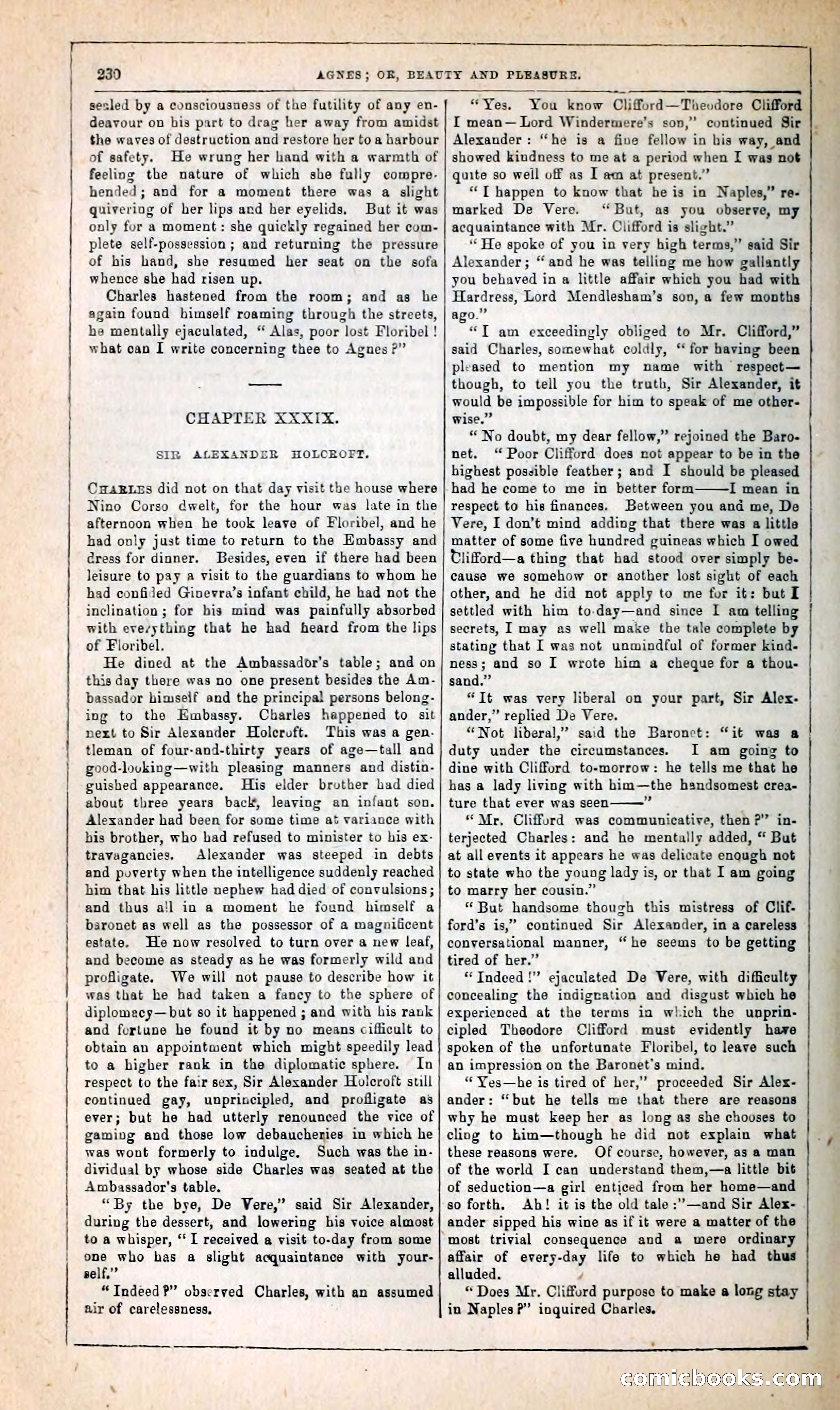
A restored page from Penny Dreadfuls, 1857. Page through the whole issue in the reader above.
📄 Transcribed text from this page (OCR, searchable)
Machine-transcribed from the original scan — historical spelling and the odd misread are preserved.
eee 239 sesled by a consciousness of the futility of any en- deavour on bis part to drag her away from amidst the waves of destruction and restore her to a harbour of safety. He wrung her hand with a warmth of feeling the nature of which she fully compre- hended; and for a moment there was a slight quiveriog of her lips ard her eyelids, But it was only for a moment: she quickly regained her com- plete self-possession; and returning the pressure of his hand, she resumed her seat on the sofa whence she had risen up. Charles hastened from the room; and as he again found himself roaming through the streets, he mentally ejaculated, “ Alas, poor lost Floribel ! what oan I write concerning thee to Agnes ?” —_——— CHAPTER XXXIX. SIR ALEXANDER HOLCEOFT. CHaRLEs did not on that day visit the house where Nino Corso dwelt, for the hour was late in the afternoon when he took leave of Floribel, and he had only just time to return to the Embassy and Gress for dinner. Besides, even if there had been leisure to pay a visit to the guardians to whom he had confijed Ginevra’s infant child, he had not the inclination; for bis mind was painfully absorbed with evesything that he had heard from the lips of Floribel. He dined at the Ambassador’s table; and on this day there was no one present besides the Am- bassador himseif and the principal persons belong- ing to the Embassy. Charles happened to sit next to Sir Alexander Holeroft. This was a gen- tleman of four-and-thirty years of age—tall and good-louking—with pleasing manners and distin- guished appearance. His elder brother had died about three years back, leaving an infant son. Alexander had been for some time at variance with his brother, who had refused to minister to his ex- travagancies. Alexander was steeped in debts and poverty when the intelligence suddenly reached him that his little nephew had died of convulsions; and thus a!l in a moment he found himself a baronet as well as the possessor of a magnificent estate. He now resolved to turn over a new leaf, and become as steady as he was formerly wild and profligate. We will not pause to describe how it was that he had taken a fancy to the sphere of diplomecy—but so it happened ; and with his rank and fortune he found it by no means cifficult to obtain an appointment which might speedily lead to a higher rank in the diplomatic sphere. In respect to the fair sex, Sir Alexander Holeroft stull continued gay, uuprincipled, and profligate as ever; but he had utterly renounced the vice of gaming and those low debauchenies in which he was wont formerly to indulge. Such was the in- dividual by whose side Charles was seated at the Ambassador's table. “By the bye, De Vere,” said Sir Alexander, during the dessert, and lowering his voice almost to a whisper, ‘I received a visit to-day from some one who has a slight acquaintance with your- self,” “Indeed ?” observed Charles, with an assumed air of carelessness, AGNES; OR, BEAUTY AND PLEASURE. You know Cliffurd—Thevodore Clifford | — ‘Yes. I mean— Lord Windermere’s son,” continued Sir Alexander: “he is a fine fellow in bis way, and showed kindness to me at a period when I was not quite so weil off as I am at present.” *‘T happen to know that he is in Naples,” re- marked De Vere. “But, as you observe, my acquaintance with Mr. Clifford is slight.” ‘‘ He spoke of you in very high terms,” said Sir Alexander; “and he was telling me how gallantly you behaved in a little affair which you had with Hardress, Lord Mendlesham’s son, a few months ago.” “T am exceedingly obliged to Mr. Clifford,” said Charles, somewhat coldly, “ for having been pleased to mention my name with respect— though, to tell you the trutb, Sir Alexander, it would be impossible for him to speak of me other- wise.” “No doubt, my dear fellow,” rejoined the Baro- net. ‘ Poor Clifford does not appear to be in the highest possible feather; and I should be pleased had he come to me in better form I mean in respect to hie finances. Between you and me, De Vere, I don’t mind adding that there was a little matter of some five hundred guineas which I owed Clifford—a thing that had stood over simply be- cause we somehow or another lost sight of each other, and he did not apply to me for it: but I settled with him to-day—and since I am telling secrets, I may as well make the tale complete by stating that I was not unmindful of former kind- ness; and so I wrote him a cheque for a thou- sand.” “Tt was very liberal on your part, Sir Alex. ander,” replied De Vere. “Not liberal,” said the Baronet: “it was a duty under the circumstances. I am going to dine with Clifford to-morrow: he tells me that he has a lady living with bim—the handsomest crea- ture that ever was seen 4 “Mr, Cliffurd was communicative, then ?” in- terjected Charles: and he mentally added, “ But at all events it appears he was delicate enough not to state who the young lady is, or that I am going to marry her cousin.” “ But handsome though this mistress of Clif- ford’s is,” continued Sir Alexander, in a careless conversational manner, “he seems to be getting tired of her.” “ Indeed !” ejaculated De Vere, with difficulty concealing the indigration and disgust which he experienced at the terms in which the unprin- cipled Theodore Clifford must evidently have spoken of the unfortunate Floribel, to leave such an impression on the Baronet’s mind. “ Yes—he is tired of her,” proceeded Sir Alex- ander: “but he tells me that there are reasons why he must keep her as long as she chooses to cling to him—though he did not explain what these reasons were. Of course, however, as a man of the world I can understand them,—a little bit of seduction—a girl enticed from her home—and so forth. ander sipped his wine as if it were a matter of the most trivial consequence and a mere ordinary affair of every-day life to which he had thus alluded. / “Does Mr. Clifford purpose to make a long stay in Naples?” inquired Charles, Gomicbooks, co a eS Ah! it is the old tale :”—and Sir Alex- eee