
Penny Dreadfuls, 1857 · page 247 of 394
Agnes, or, Beauty and Pleasure — page 247: what you’re looking at
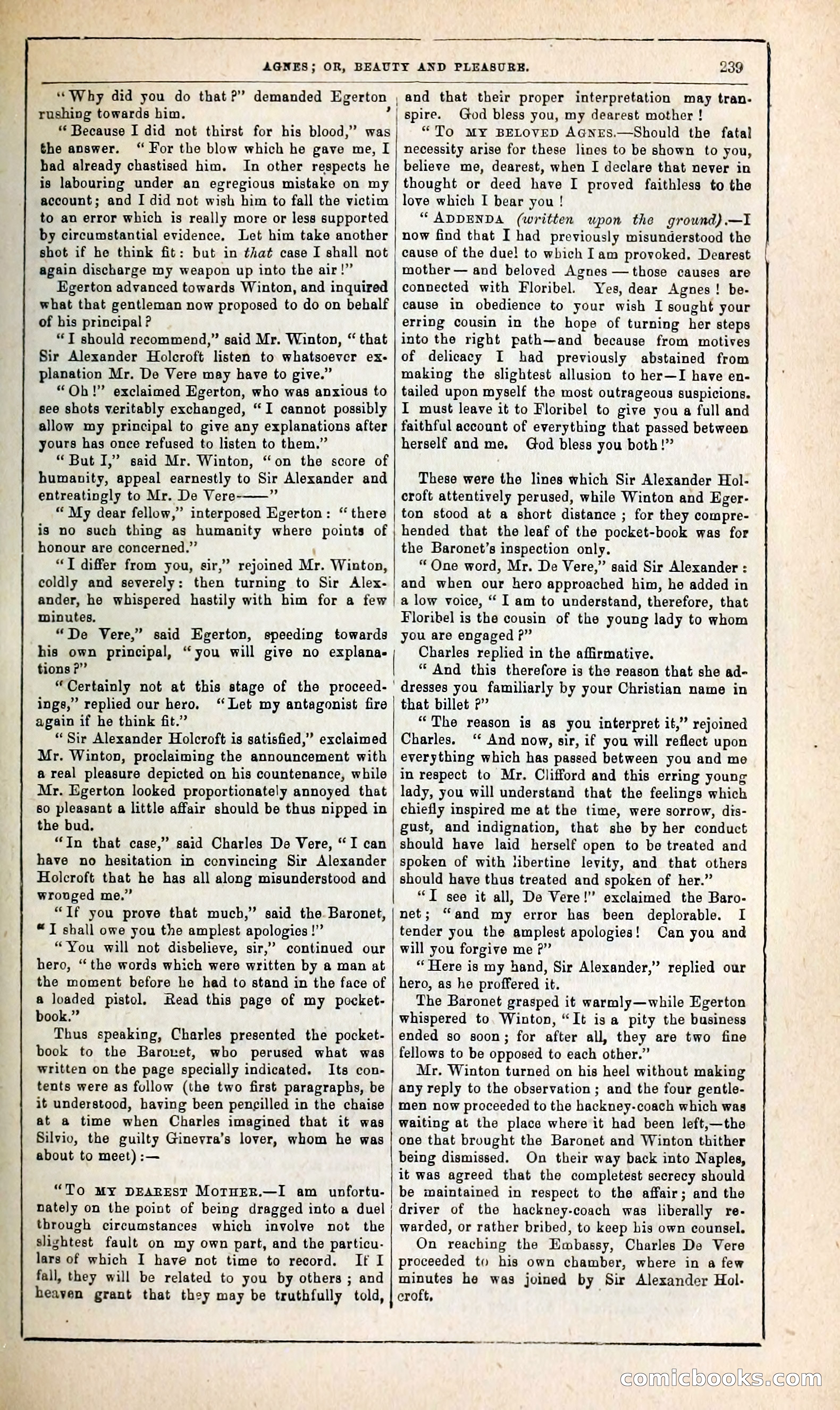
A restored page from Penny Dreadfuls, 1857. Page through the whole issue in the reader above.
📄 Transcribed text from this page (OCR, searchable)
Machine-transcribed from the original scan — historical spelling and the odd misread are preserved.
AGNES; OR, BEAUTY AND PLEASURE, 239 ‘“Why did you do that ?” demanded Egerton rushing towards him. ** Because I did not thirst for his blood,” was the answer. “ For the blow which he gave me, I had already chastised him. In other respects he is labouring under an egregious mistake on my account; and I did not wish him to fall the victim to an error which is really more or less supported by circumstantial evidence, Let him take another shot if he think fit: but in that case I shall not again discharge my weapon up into the air!” Egerton advanced towards Winton, and inquired what that gentleman now proposed to do on behalf of his principal ? “T should recommend,” said Mr. Winton, “ that Sir Alexander Holcroft listen to whatsoever ex- planation Mr. De Vere may have to give.” _ “Oh!” exclaimed Egerton, who was anxious to see shots veritably exchanged, “I cannot possibly allow my principal to give any explanations after yours has once refused to listen to them.” “But I,” said Mr. Winton, “on the score of humanity, appeal earnestly to Sir Alexander and entreatingly to Mr. De Vere ‘ “ My dear fellow,” interposed Egerton: “there is no such thing as humanity where points of honour are concerned.” ' “JT differ from you, sir,” rejoined Mr. Winton, coldly and severely: then turning to Sir Alex- ander, he whispered hastily with him for a few minutes. “De Vere,” said Hegerton, speeding towards his own principal, “you will give no explana- tions P” “Certainly not at this stage of the proceed- ings,” replied our hero, “Let my antagonist fire again if he think fit.” “Sir Alexander Holcroft is satisfied,” exclaimed Mr. Winton, proclaiming the announcement with a real pleasure depicted on his countenance, while Mr. Egerton looked proportionately annoyed that so pleasant a little affair should be thus nipped in the bud. “In that case,” said Charles De Vere, “I can have no hesitation in convincing Sir Alexander Holcroft that he has all along misunderstood and wrouged me.” “If you prove that much,” said the. Baronet, “TI shall owe you the amplest apologies !” “You will not disbelieve, sir,” continued our hero, “the words which were written by a man at the moment before he had to stand in the face of a loaded pistol. ead this page of my pocket- book.” Thus speaking, Charles presented the pocket- book to the Baronet, who perused what was written on the page specially indicated. Its con- tents were as follow (the two first paragraphs, be it understood, having been pencilled in the chaise at a time when Charles imagined that it was Silvio, the guilty Gineyra’s lover, whom he was about to meet) :— “To My DEAREST MotuER.—I am unfortu- nately on the point of being dragged into a duel through circumstances which involve not the slightest fault on my own part, and the particu- lars of which I have not time to record. If I fall, they will be related to you by others ; and heayen grant that they may be truthfully told, r | spire. , and that their proper interpretation may tran- God bless you, my dearest mother ! “To MY BELOVED AGNES.—Should the fatal necessity arise for these lines to be shown to you, believe me, dearest, when I declare that never in thought or deed have I proved faithless to the love which I bear you ! “ADDENDA (written upon the ground). —I now find that I had previously misunderstood the cause of the due! to which I am provoked. Dearest mother — and beloved Agnes —those causes are connected with Floribel. Yes, dear Agnes! be- cause in obedience to your wish I sought your erring cousin in the hope of turning her steps into the right path—and because from motives of delicacy I had previously abstained from making the slightest allusion to her—I have en- tailed upon myself the most outrageous suspicions. I must leave it to Floribel to give you a full and faithful account of everything that passed between herself and me, God bless you both!” These were the lines which Sir Alexander Hol- croft attentively perused, while Winton and Eger- ton stood at a short distance ; for they compre- hended that the leaf of the pocket-book was for the Baronet’s inspection only. “One word, Mr. De Vere,” said Sir Alexander : and when our hero approached him, he added in | a low voice, “ I am to understand, therefore, that Floribel is the cousin of the young lady to whom you are engaged ?” Charles replied in the affirmative. “And this therefore is the reason that she ad- dresses you familiarly by your Christian name in that billet ?” “The reason is as you interpret it,” rejoined Charles. ‘“ And now, sir, if you will reflect upon everything which has passed between you and me in respect to Mr. Clifford and this erring young lady, you will understand that the feelings which chiefly inspired me at the time, were sorrow, dis- gust, and indignation, that she by her conduct should have laid herself open to be treated and spoken of with libertine levity, and that others | should have thus treated and spoken of her.” “T see it all, De Vere!” exclaimed the Baro- net; “and my error has been deplorable. I tender you the amplest apologies! Can you and will you forgive me ?” ‘Here is my hand, Sir Alexander,” replied our hero, as he proffered it. The Baronet grasped it warmly—while Egerton whispered to. Winton, “It isa pity the business ended so soon; for after all, they are two fine fellows to be opposed to each other.” Mr. Winton turned on his heel without making any reply to the observation; and the four gentle- men now proceeded to the hackney-coach which was waiting at the place where it had been left,—the one that brought the Baronet and Winton thither being dismissed. On their way back into Naples, it was agreed that the completest secrecy should be maintained in respect to the affair; and the | driver of the hackney-coach was liberally re- warded, or rather bribed, to keep his own counsel. On reaching the Embassy, Charles De Vere proceeded to his own chamber, where in a few minutes he was joined by Sir Alexander Hol- croft, Comiclooolks ee ee Onn