
Penny Dreadfuls, 1857 · page 248 of 394
Agnes, or, Beauty and Pleasure — page 248: what you’re looking at
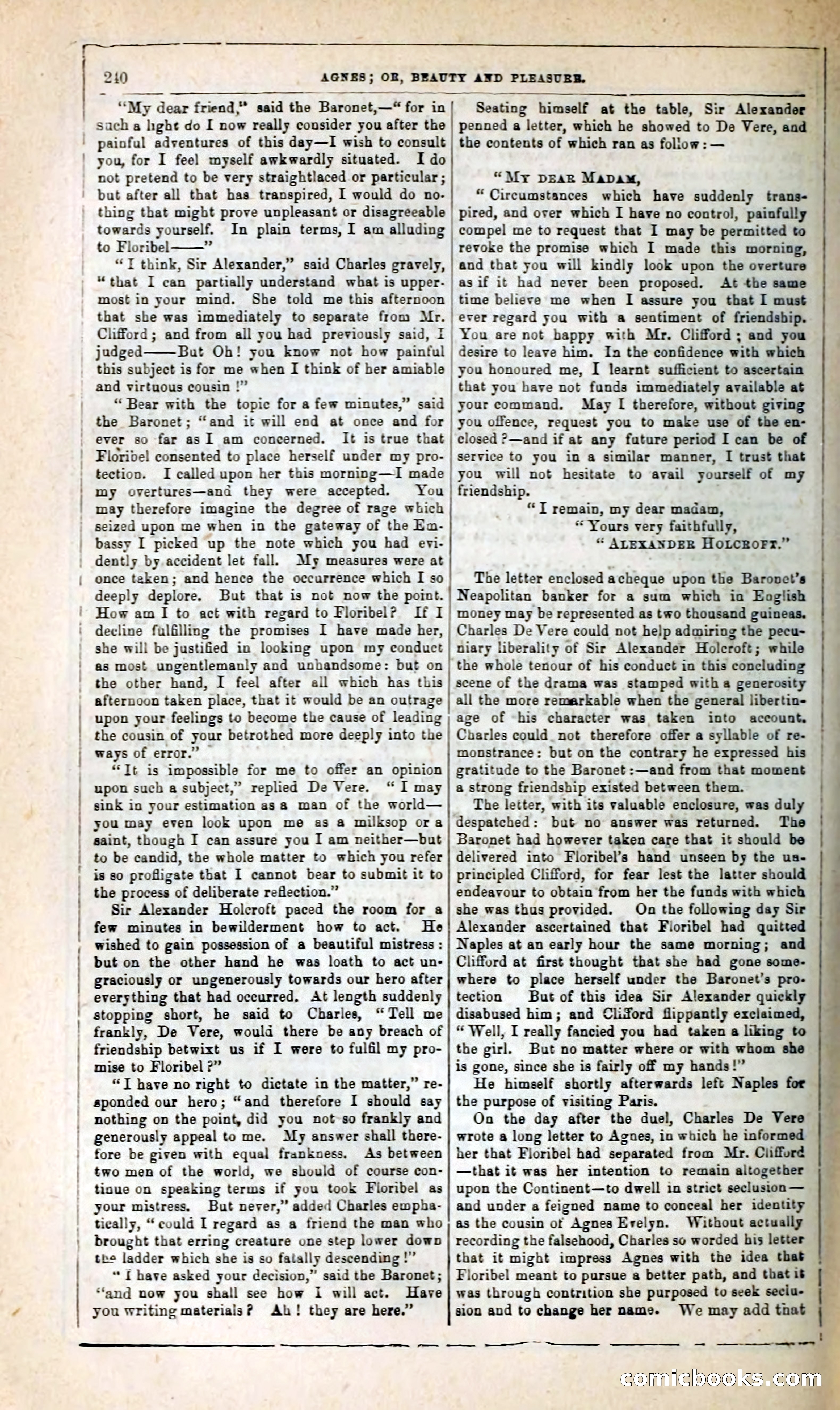
A restored page from Penny Dreadfuls, 1857. Page through the whole issue in the reader above.
📄 Transcribed text from this page (OCR, searchable)
Machine-transcribed from the original scan — historical spelling and the odd misread are preserved.
ae ee ee ee 2 ee eee, eee a8 eee *“*“My dear friend,” said the Baronet,—* for in sach a hght do I now really consider you after the paioful adventures of this day—I wish to consult you, for I feel myself awkwardly situated. I do not pretend to be very straightlaced or particular ; but after all that has transpired, I would do no- thing that might prove unpleasant or disagreeable towards yourself. In plain terms, I am alluding to Floribel “I think, Sir Alexander,” said Charles gravely, “that I can partially understand what is upper- most in your mind. She told me this afternoon that she was immediately to separate from Mr. AGNES; OR, BEAUTY AND PLEASUEB. Seating himself at the table, Sir Alexander penned a letter, which he showed to De Vere, and © the contents of which ran as follow: — 7 “My pear Mapa, “ Circumstances which have suddenly trans- pired, and over which I have no control, painfally compel me to request that I may be permitted to revoke the promise which I made this morning, and that you will kindly look upon the overture asif it had never been proposed. At the same time believe me when I assure you that I must ever regard you with a sentiment of friendship. Clifford; and from all you had previously said, I | You are not happy with Mr. Clifford ; and you judged But Ob! you know not how painful this subject is for me when I think of her amiable and virtuous cousin !” “Bear with the topic for a few minutes,” the Baronet; “and it will end at once and for ever so far as I am concerned. It is true that Florivel consented to place herself under my pro- tection. I called upon her this morning—I made | my overtures—and they were accepted. You may therefore imagine the degree of rage which seized upon me when in the gateway of the Em- bassy I picked up the note which you had eyvi- dently by. accident let fall. My measures were at once taken; and hence the occurrence which I so deeply deplore. But that is not now the point. How am I to act with regard to Floribel? If I decline fulfilling the promises I have made her, she will be justified in looking upon my conduct as most ungentlemanly and unhandsome: but on the other hand, I feel after all which has this afternoon taken place, that it would be an outrage upon your feelings to become the cause of leading the cousin of your betrothed more deeply into the ways of error.’ “Tt is impossible for me to offer an opinion upon such a subject,” replied De Vere. “I may sink in your estimation asa man of the world— you may even look upon me as a milksop ora saint, though I can assure you I am neither—but to be candid, the whole matter to which you refer is so profligate that I cannot bear to submit it to the process of deliberate reflection.” Sir Alexander Holcroft paced the room for a few minutes in bewilderment how to act. He wished to gain possession of a beautiful mistress : but on the other hand he was loath to act un- graciously or ungenerously towards our hero after everything that had occurred. At length suddenly stopping short, he said to Charles, “Tell me frankly, De Vere, would there be any breach of friendship betwixt us if I were to fulfil my pro- mise to Floribel ?” “T have no right to dictate in the matter,” re- sponded our hero; “and therefore I should say nothing on the point, did you not so frankly and generously appeal to me. My answer shall there- fore be given with equal frankness. As between two men of the world, we should of course con- tinue on speaking terms if you took Floribel as your mistress. But never,” added Charles empha- tically, “could I regard as a friend the man who brought that erring creature one step lower down tre ladder which she is so fatally descending !” “ { have asked your decision,” said the Baronet; ‘“‘and now you shall see how i will act. Have you writing materials? Ab! they are here.” | Es your command. : desire to leave him. In the confidence with which you honoured me, I learnt sufficient to ascertain | that you have not funds immediately available at May [ therefore, without giving you offence, request you to make use of the en- closed ?—and if at any future period I can be of service to you in a similar manner, I trust that you will not hesitate to avail yourself of my fcieniishap. “T remain, my dear madam, * Yours very faithfully, “ ALEXANDER HOLCROF?.” ES = The letter enclosed a cheque upon the Baronct’s Neapolitan banker for a sum which in Eoglish money may be represented as two thousand guineas. Charles De Vere could not help admiring the pecu- niary liberality of Sir Alexander Holeroft ; while the whole tenour of his conduct in this concluding scene of the drama was stamped with a generosity all the more remarkable when the general libertin- age of -his character was taken into account. Charles could not therefore offer a syllable of re- monstrance: but on the contrary he expressed his gratitude to the Baronet :—and from that moment a strong friendship existed between them. The letter, with its valuable enclosure, was duly despatched: but no answer was returned. The Baronet had however taken care that it should be delivered into Floribel’s hand unseen by the ua- principled Clifford, for fear lest the latter should endeavour to obtain’ from her the funds with which she was thus provided. On the following day Sir Alexander ascertained that Floribel had quitted Naples at an early hour the same morning; and Clifford at first thought that she bad gone some- where to place herself under the Baronet’s pro- tection But of this idea Sir Alexander quickly disabused him; and Clifford flippantly exclaimed, “ Well, I really fancied you had taken a liking to the girl. But no matter where or with whom she is gone, since she is fairly off my hands!” He himself shortly afterwards left Naples for the purpose of visiting Paris. Ono the day after the duel, Charles De Vero” wrote a long letter to Agnes, in which he informed — her that Floribel had separated from Mr. Clifford —that it was her intention to remain altogether upon the Continent—to dwell in strict seclusion — and under a feigned name to conceal her identity as the cousin of ” Agnes Evelyn. Without actually recording the falsehood, Charles so worded his letter that it might impress Agnes with the idea that Floribel meant to pursue a better path, and thatié [ was through contrition she purposed to seek seclu- } sion and to change her name. We may add that aren 6 ee ae « ¥ ee ee ee d:. weer _-_-eooo —— — Comichbooksicom