
Penny Dreadfuls, 1857 · page 394 of 394
Agnes, or, Beauty and Pleasure — page 394: what you’re looking at
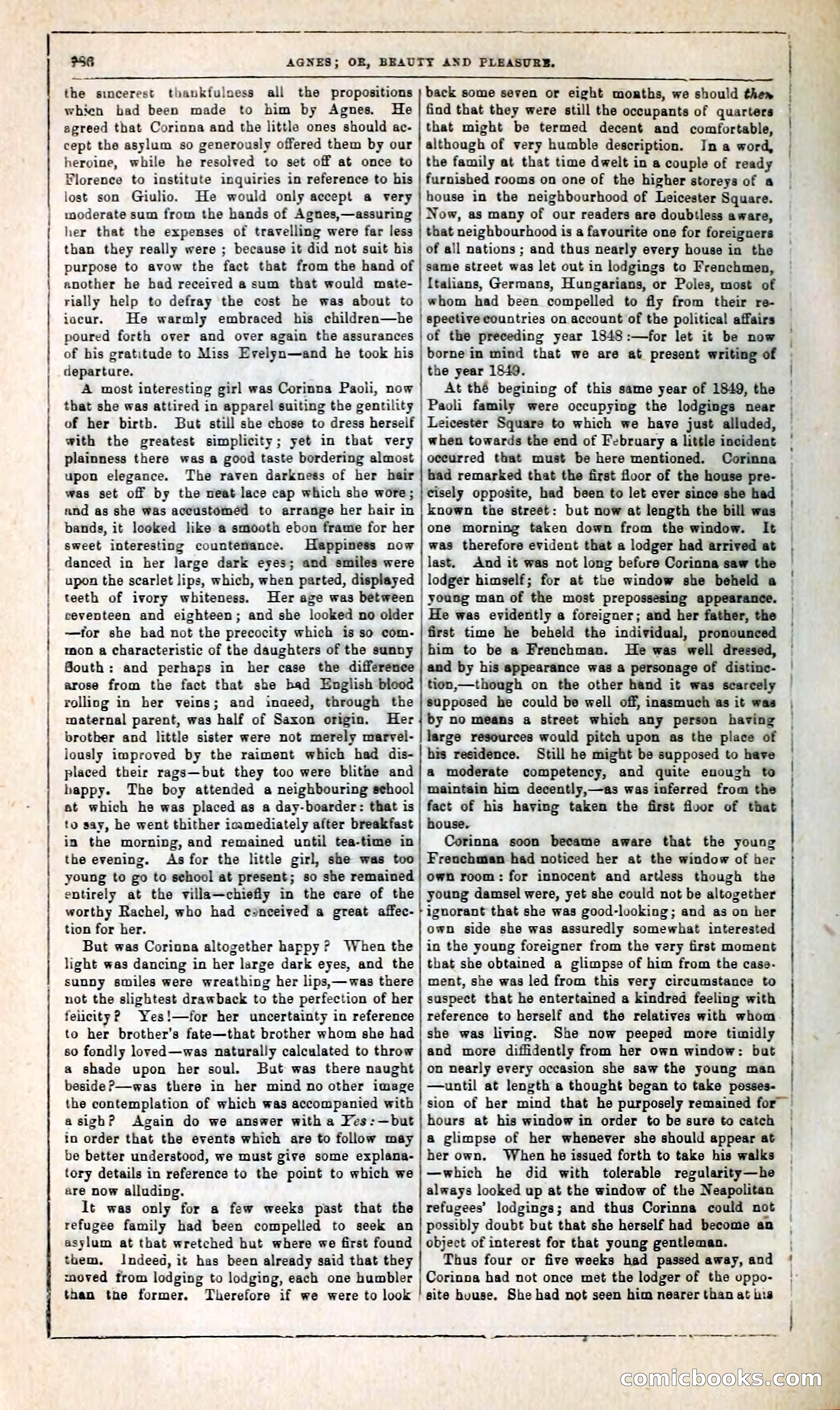
A restored page from Penny Dreadfuls, 1857. Page through the whole issue in the reader above.
📄 Transcribed text from this page (OCR, searchable)
Machine-transcribed from the original scan — historical spelling and the odd misread are preserved.
ee ee eee —_— — ——_ 256 a the sincerest thankfuloess all the propositions whieh bad been made to him by Agnes. He agreed that Corinna and the little ones should ac- cept the asylum so generously offered them by our heroine, while he resolved to set off at once to Florence to institute inquiries in reference to his lost son Giulio. He would only accept a very mooderate sum from the hands of Agnes,—assuring her that the expenses of travelling were far less than they really were ; because it did not suit his purpose to avow the fact that from the hand of another he bad received a sum that would mate- AGNES; OR, BEAUTY AND PLEASURE. back some seven or eight moaths, we should thes find that they were still the occupants of quarters that might be termed decent and comfortable, although of very humble description. In a word, the family at that time dwelt in a couple of ready furnished rooms on one of the higher storeys of a house in the neighbourhood of Leicester Square. Now, as many of our readers are doubtless aware, that neighbourhood is a favourite one for foreigners of all nations ; and thus nearly every house in the same street was let out in lodgings to Frenchmen, Italians, Germans, Hungarians, or Poles, most of rially help to defray the cost he was about to | whom had been compelled to fly from their re- locur. He warmly embraced his children—he | speetive countries on account of the political affairs poured forth over and over again the assurances | of the preceding year 1848:—for let it be now of his gratitude to Miss Evelyn—and he took his departure. A most interesting girl was Corinna Paoli, now that she was attired in apparel suiting the gentility of her birth. But still she chose to dress herself with the greatest simplicity; yet in that very plainness there was a good taste bordering almost upon elegance. The raven darkness of her hair was set off by the neat lace cap which she wore; and as she was accustomed to arrange her hair in bands, it looked like a smooth ebon frauie for her sweet interesting counteflance. Happiness now danced in her large dark eyes; and smiles were upon the scarlet lips, which, when parted, displayed teeth of ivory whiteness. Her age was between ceventeen and eighteen; and she looked no older —for she had not the precocity which is so com- mon a characteristic of the daughters of the sunny South: and perhaps in her case the difference arose from the fact that she bad English blooc rolling in her veins; and inaeed, through the maternal parent, was half of Saxon origin. Her brother and little sister were not merely marvel- lously improved by the raiment which had dis- placed their rags—but they too were blithe and happy. The boy attended a neighbouring sehool at which he was placed as a day-boarder: that is to say, he went thither icamediately after breakfast in the morning, and remained until tea-time in the evening. As for the little girl, she was too young to go to sehool at present; so she remained entirely at the villa—chiefly in the care of the worthy Rachel, who had csnceived a great affec- tion for her. But was Corinna altogether happy? When the light was dancing in her large dark eyes, and the sunby smiles were wreathing her lips,—was there not the slightest drawback to the perfection of her felicity? Yes!—for her uncertainty in reference to her brother’s fate—that brother whom she had so fondly loved—was naturally calculated to throw a shade upon her soul. But was there naught beside ?——-was there in her mind no other image the contemplation of which was accompanied with asigh? Again do we answer with a Fes:—but tn order that the events which are to follow may be better understood, we must give some explana- tory details in reference to the point to which we are now alluding. It was only for a few weeks past that the refugee family had been compelled to seek an asylum at that wretched hut where we first found them. Indeed, it has been already said that they snoved from lodging to lodging, each one humbler than the former. Therefore if we were to look TTT ssl sissies enn hhh teeeeeeees-—esiessthass>-ee borne in mind that we are at present writing of the year 1849. At thé begining of this same year of 1849, the Paoli family were occupying the lodgings near Leicester Square to which we have just alluded, when towards the end of February a little incident occurred that must be here mentioned. Corinna bad remarked that the first floor of the house pre- cisely opposite, had been to let ever since she had known the street: but now at length the bill was one morning taken down from the window. It was therefore evident that a lodger had arrived at last. And it was not long befure Corinna saw the lodger himself; for at the window she beheld a young man of the most prepossesing appearance. He was evidently a foreigner; and her father, the first time he beheld the individual, pronounced him to be a Frenchman. He was well dressed, and by his appearance was a personage of distinc- tion,—though on the other hand it was scarcely supposed he could be well off, inasmuch as it was by no means a street which any person having large resources would pitch upon as the place of his residence. Still he might be supposed to have a moderate competency, and quite enough to maintain him decently,—as was inferred from the fact of his having taken the first fluor of that house. Corinna soon became aware that the young Frenchman had noticed her at the window of her own room: for innocent and artless though the young damsel were, yet she could not be altogether ignorant that she was good-looking; and as on her own side she was assuredly somewhat interested in the young foreigner from the very first moment that she obtained a glimpse of him from the case- ment, she was led from this very circumstance to suspect that he entertained a kindred feeling with reference to herself and the relatives with whom she was living. She now peeped more timidly and more diffidently from her own window: but on nearly every occasion she saw the young man —until at length a thought began to take posses- sion of her mind that he purposely remained for hours at his window in order to be sure to catch a glimpse of her whenever she should appear at her own. When he issued forth to take his walks —which he did with tolerable regularity—he always looked up at the window of the Neapolitan refugees’ lodgings; and thus Corinna could not possibly doubt but that she herself had become an object of interest for that young gentleman. Thus four or five weeks had passed away, and Corinna had not once met the lodger of the oppo- site house. She had not seen him nearer than at ius SS EO COMmcooolxs eet we eee. reer a a ee ne ee a ee ae ee eS com a