
Penny Dreadfuls, 1857 · page 395 of 394
Agnes, or, Beauty and Pleasure — page 395: what you’re looking at
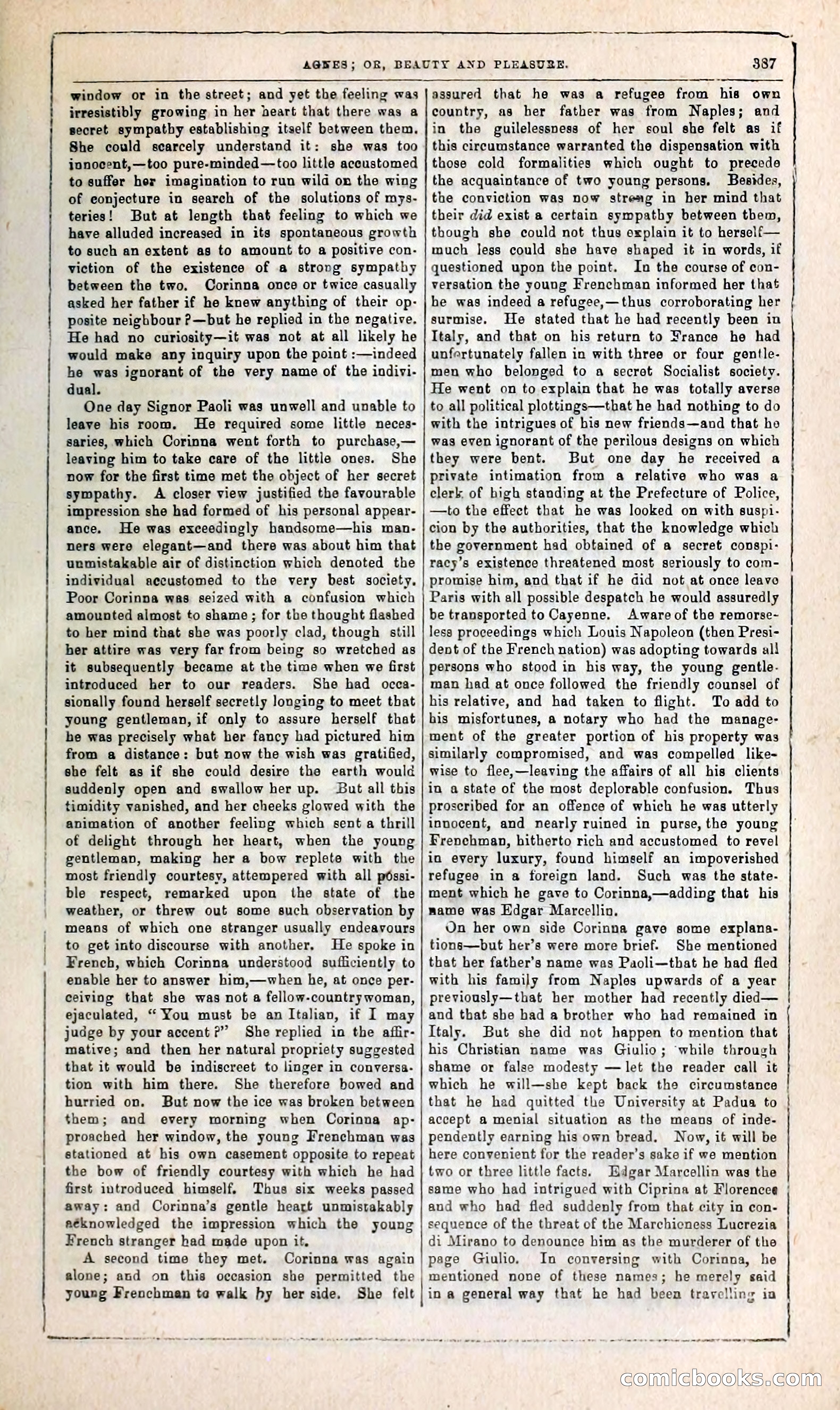
A restored page from Penny Dreadfuls, 1857. Page through the whole issue in the reader above.
📄 Transcribed text from this page (OCR, searchable)
Machine-transcribed from the original scan — historical spelling and the odd misread are preserved.
AGES; OR, BEAUTY AND PLEASURE. window or in the street; and yet the feeling was irresistibly growing in her heart that there was a secret sympathy establishing itself between them. She could scarcely understand it: she was too jnnoeent,—too pure-minded—too little accustomed to suffer her imagination to run wild on the wing of eonjecture in search of the solutions of mys- teries! But at length that feeling to which we have alluded increased in its spontaneous growth to such an extent as to amount to a positive con- viction of the existence of a strong sympathy between the two. Corinna once or twice casually asked her father if he knew anything of their op- posite neighbour ?—but he replied in the negative. He had no curiosity—it was not at all likely he would make any inquiry upon the point :—indeed he was ignorant of the very name of the indivi- dual. One day Signor Paoli was unwell and unable to leave his room. He required some little neces- saries, which Corinna went forth to purchase,— leaving him to take care of the little ones. She now for the first time met the object of her secret sympathy. A closer view justified the favourable impression she had formed of his personal appear- ance. He was exceedingly handsome—his man- ners were elegant—and there was about him that unmistakable air of distinction which denoted the individual accustomed to the very best society. Poor Corinna was seized with a confusion which amounted almost to shame; for the thought flashed to her mind that she was poorly clad, though still her attire was very far from being so wretched as it subsequently became at the time when we first introduced her to our readers. She had occa- sionally found herself secretly longing to meet that young gentleman, if only to assure herself that he was precisely what her fancy had pictured him from a distance: but now the wish was gratified, she felt as if she could desire the earth would suddenly open and swallow her up. But all this timidity vanished, and her cheeks glowed with the animation of another feeling which sent a thrill of delight through her heart, when the young gentleman, making her a bow replete with the most friendly courtesy, attempered with all possi- ble respect, remarked upon the state of the weather, or threw out some such observation by means of which one stranger usually endeavours to get into discourse with another, He spoke in French, which Corinna understood sufficiently to enable her to answer him,—when he, at once per- ceiving that she was not a fellow-country woman, ejaculated, “ You must be an Italian, if I may judge by your accent?” She replied in the affir- mative; and then her natural propriety suggested that it would be indiscreet to linger in conversa- tion with him there. She therefore bowed and hurried on. But now the ice was broken between them; and every morning when Corinna ap- proached her window, the young Frenchman was stationed at his own casement opposite to repeat the bow of friendly courtesy with which he had first introduced himself. Thus six weeks passed away: and Corinna’s gentle heart unmistakably néknowledged the impression which the young French stranger had made upon it. A second time they met. Corinna was again alone; and on this occasion she permitted the young Frenchman te walk by her side. 387 assured that he was a refugee from his own country, as her father was from Naples; and in the guilelessness of her soul she felt as if this circumstance warranted the dispensation with those cold formalities which ought to precede the acquaintance of two young persons, Besides, the conviction was now streng in her mind that their did exist a certain sympathy between them, though she could not thus explain it to herself— much Jess could she have shaped it in words, if questioned upon the point. In the course of con- versation the young Frenchman informed her that he was indeed a refugee,—thus corroborating her surmise. He stated that he had recently been in Italy, and that on his return to Hrance he had unfertunately fallen in with three or four gentle- men who belonged to a secret Socialist society. He went on to explain that he was totally averse to all political plottings—that he had nothing to do with the intrigues of his new friends—and that he was even ignorant of the perilous designs on which they were bent. But one day he received a private intimation from a relative who was a elerk. of high standing at the Prefecture of Police, —to the effect that he was looked on with suspi- cion by the authorities, that the knowledge which the government had obtained of a secret conspi- racy’s existence threatened most seriously to com- promise him, and that if he did not at once leavo Paris with all possible despatch he would assuredly be transported to Cayenne. Awareof the remorse- less proceedings which Louis Napoleon (then Presi- dent of the French nation) was adopting towards all persons who stood in his way, the young gentle- man had at once followed the friendly counsel of his relative, and had taken to flight. To add to bis misfortunes, a notary who had the manage- ment of the greater portion of his property was similarly compromised, and was compelled like- wise to flee,—leaving the affairs of all his clients in a state of the most deplorable confusion. Thus proscribed for an offence of which he was utterly innocent, and nearly ruined in purse, the young Frenchman, bitherto rich and accustomed to revel in eyery luxury, found himself an impoverished refugee in a foreign land. Such was the state- ment which he gave to Corinna,—adding that his mame was Edgar Marcellin. On her own side Corinna gave some explana- tions—but her’s were more brief. She mentioned that her father’s name was Paoli—that he had fled with his family from Naples upwards of a year previously—that her mother had recently died— and that she had a brother who had remained in Italy. But she did not happen to mention that his Christian name was Giulio; while through shame or false modesty —let the reader call it which he will—she kept back the circumstance | that he had quitted the University at Padua to accept a menial situation as the means of inde- pendently earning his own bread. Now, it will be here convenient for the reader’s sake if we mention two or three little facts. dgar Marcellin was the same who had intrigued with Ciprina at Florencce and who had fled suddenly from that city in con- sequence of the threat of the Marchicness Lucrezia di Mirano to denounce him as the murderer of the page Giulio, In conversing with Corinna, he | mentioned none of these names; he merely said She felt |in a general way that he had been travelling ia Comiclooolkks LLL LL LL LE AN . SR ti a “eee A me ee eer es ee, Olin