
Penny Dreadfuls, 1857 · page 396 of 394
Agnes, or, Beauty and Pleasure — page 396: what you’re looking at
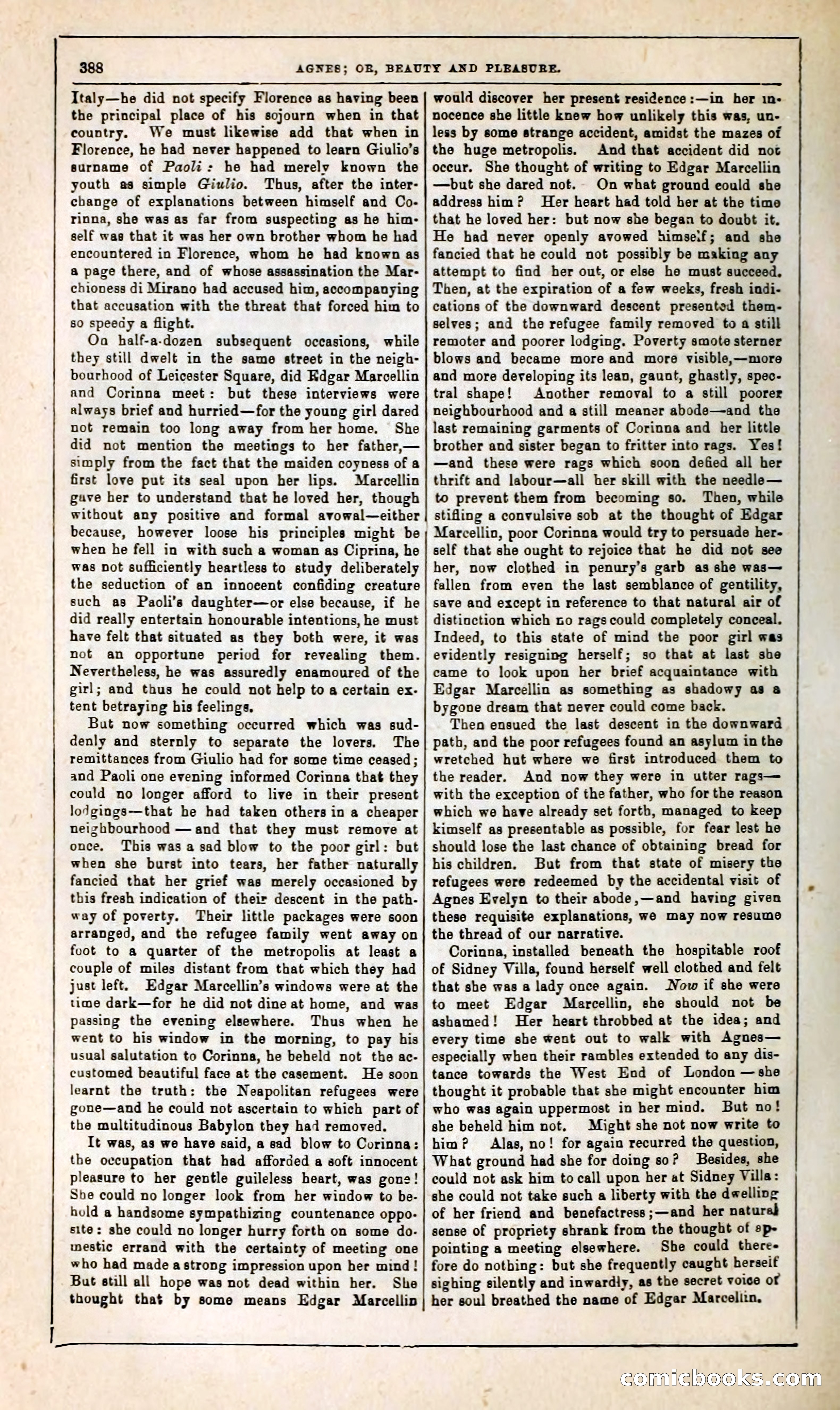
A restored page from Penny Dreadfuls, 1857. Page through the whole issue in the reader above.
📄 Transcribed text from this page (OCR, searchable)
Machine-transcribed from the original scan — historical spelling and the odd misread are preserved.
—< 388 AGNES; OR, BEAUTY AND PLEASURE, Italy—he did not specify Florence as having been the principal place of his sojourn when in that country. We must likewise add that when in Florence, he had never happened to learn Giulio’s surname of Paoli: he had merely known the youth as simple Giulio. Thus, after the inter- change of explanations between himself and Co- rinna, she was as far from suspecting as he him- self was that it was her own brother whom he had encountered in Florence, whom he had known as @ page there, and of whose assassination the Mar- chioness di Mirano had accused him, accompanying that accusation with the threat that forced him to so speedy a flight. Oo half-a-dozen subsequent occasions, while they still dwelt in the same street in the neigh- bourhood of Leicester Square, did Kdgar Marcellin and Corinna meet: but these interviews were always brief and hurried—for the young girl dared not remain too long away from her home. She did not mention the meetings to her father,— simply from the fact that the maiden coyness of a first love put its seal upon her lips. Marcellin gave her to understand that he loved her, though without any positive and formal avowal—either because, however loose his principles might be when he fell in with such a woman as Ciprina, he was not sufficiently heartless to study deliberately the seduction of an innoeent confiding creature such as Paoli’s daughter—or else because, if he did really entertain honourable intentions, he must have felt that situated as they both were, it was not an opportune period for revealing them. Nevertheless, he was assuredly enamoured of the girl; and thus he could not help to a certain ex- tent betraying his feelings, But now something occurred which was sud- denly and sternly to separate the lovers. The remittances from Giulio had for some time ceased; and Paoli one evening informed Corinna that they could no longer afford to live in their present lodgings—that he had taken others in a cheaper neizhbourhood —and that they must remove at once. This was a sad blow to the poor girl: but when she burst into tears, her father naturally fancied that her grief was merely occasioned by this fresh indication of their descent in the path- way of poverty. Their little packages were soon arranged, and the refugee family went away on foot to a quarter of the metropolis at least a couple of miles distant from that which they had just left. Edgar Marcellin’s windows were at the time dark—for he did not dine at home, and was passing the evening elsewhere. Thus when he went to his window in the morning, to pay his usual salutation to Corinna, he beheld not the ac- customed beautiful face at the casement. He soon learnt the truth: the Neapolitan refugees were gone—and he could not ascertain to which part of the multitudinous Babylon they had removed. It was, as we have said, a sad blow to Corinna: the occupation that had afforded a soft innocent | pleasure to her gentle guileless heart, was gone! Sbe could no longer look from her window to be- hold a handsome sympathizing countenance oppo- site: she could no longer hurry forth on some do. mestic errand with the certainty of meeting one who had made a strong impression upon her mind! But still all hope was not dead within her. She thought that by some means Edgar Marcellin would discover her present residence :—in her in- nocence she little knew how unlikely this was, un- less by some strange accident, amidst the mazes of the huge metropolis. And that accident did not occur. She thought of writing to Edgar Marcellin —but she dared not. On what ground eould she address him? Her heart had told her at the time that he loved her: but now she began to doubt it. He had never openly avowed himseif; and she fancied that he could not possibly be making any attempt to find her out, or else he must succeed, Then, at the expiration of a few weeks, fresh indi- cations of the downward descent presented them- selves; and the refugee family removed to a still remoter and poorer lodging. Poverty smote sterner blows and became more and more visible,—more and more developing its lean, gaunt, ghastly, spec- tral shape! Another removal to a still poorer neighbourhood and a still meaner abode—and the last remaining garments of Corinna and her little brother and sister began to fritter into rags. Yes! —and these were rags which soon defied all her thrift and labour—all ber skill with the needle— to prevent them from becoming so. Then, while stifling a convulsive sob at the thought of Edgar Marcellin, poor Corinna would try to persuade her- self that she ought to rejoice that he did not see her, now clothed in penury’s garb as she was— fallen from even the last semblance of gentility, save and except in reference to that natural air of distinction which no rags could completely conceal. Indeed, to this state of mind the poor girl was evidently resigning herself; so that at last she came to look upon her brief acquaintance with Edgar Marcellin as something as shadowy as a bygone dream that never could come back. Then ensued the last descent in the downward path, and the poor refugees found an asylum in the wretched hut where we first introduced them to the reader. And now they were in utter rags— with the exception of the father, who for the reason which we have already set forth, managed to keep kimself as presentable as possible, for fear lest he should lose the last chance of obtaining bread for his children. But from that state of misery the refugees were redeemed by the accidental visit of Agnes Evelyn to their abode,—and having given these requisite explanations, we may now resume the thread of our narrative. Corinna, installed beneath the hospitable roof of Sidney Villa, found herself well clothed and felt that she was a lady once again. Now if she were to meet Edgar Marcellin, she should not be ashamed! Her heart throbbed at the idea; and every time she went out to walk with Agnes— especially when their rambles extended to any dis- tance towards the West End of London —she thought it probable that she might encounter him who was again uppermost in her mind. But no! she beheld him not. Might she not now write to him? Alas, no! for again recurred the question, What ground had she for doing so? Besides, she could not ask him to call upon her at Sidney Villa: she could not take such a liberty with the dwelling of her friend and benefactress;—and her natural sense of propriety shrank from the thought of sp- pointing a meeting elsewhere. She could there- fore do notbing: but she frequently caught herseif sighing silently and inwardly, as the secret voice of her soul breathed the name of Edgar Marcelitn. GComilcbooks