
Penny Dreadfuls, 1857 · page 123 of 394
Agnes, or, Beauty and Pleasure — page 123: what you’re looking at
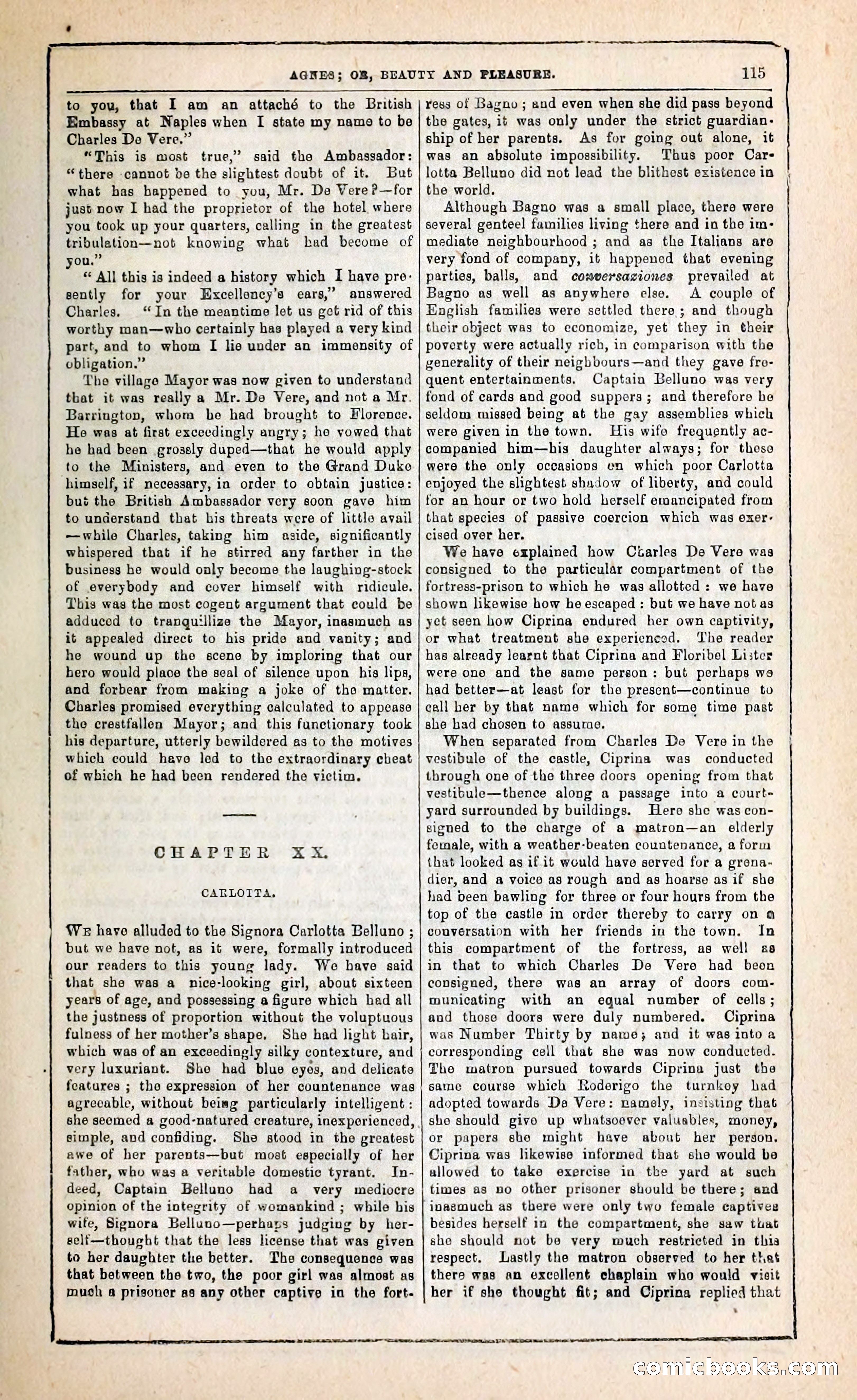
A restored page from Penny Dreadfuls, 1857. Page through the whole issue in the reader above.
📄 Transcribed text from this page (OCR, searchable)
Machine-transcribed from the original scan — historical spelling and the odd misread are preserved.
AGNES; OB, BEAUTY AND PLEASURE. ‘ See Te ee nner nnn nce cen LL ree 115 to you, that I am an attaché to the British Embassy at Naples when I state my namo to be Charles De Vere.” “This is most true,” said the Ambassador: “there cannot be the slightest doubt of it. But what has happened to you, Mr. De Vere?—for just now I had the proprietor of the hotel where you took up your quarters, calling in the greatest tribulation—not knowing what had become of ou.’’ “ All this is indeed a history which I have pre: sently for your Excellency’s ears,’ answered Charles. ‘In the meantime let us got rid of this worthy man—who certainly has played a very kind part, and to whom [I lie under an immensity of obligation.” The village Mayor was now given to understand that it was really a Mr. De Vere, and not a Mr. Barrington, whom he had brought to Florence. He was at first exceedingly angry; ho vowed that he had been grossly duped—that he would apply to the Ministers, and even to the Grand Duke himself, if necessary, in order to obtain justice: bus the British Ambassador very soon gave him to understand that his threats were of little avail —while Charles, taking him aside, significantly whispered that if he stirred any farther in the business he would only become the laughing-stock of everybody and cover himself with ridicule. This was the most cogent argument that could be adduced to trangutilize the Mayor, inasmuch as it appealed direct to his pride and vanity; and he wound up the scene by imploring that our hero would place the seal of silence upon his lips, and forbear from making a joke of tho matter. Charles promised everything calculated to appease the crestfallen Mayor; and this functionary took his departure, utterly bewildered as to tho motives which could havo led to the extraordinary cheat of which he had been rendered the victim. CHAPTER XX CARLOITA. WE havo alluded to the Signora Carlotta Belluno ; but we have not, as it were, formally introduced our readers to this young lady. We have said that she was a_ nice-looking girl, about sixteen years of age, and possessing a figure which had all the justness of proportion without the voluptuous fulness of her mother’s shape, She had light bair, which was of an exceedingly silky contexture, and very luxuriant. She had blue eyes, and delicate features ; the expression of her countenance was agrecable, without beisg particularly intelligent : she seemed a good-natured creature, inexperienced, simple, and confiding. She stood in the greatest awe of her parents—but moat especially of her father, who was a veritable domestic tyrant. In- deed, Captain Belluno had a very mediocre opinion of the integrity of womankind ; while his wife, Signora Belluno—perhaps judging by her- seli—thought that the less license that was given to her daughter the better. The consequence was that between the two, the poor girl was almost as mush a prisoner as any other captive in the fort- ress of Bagno ; and even when she did pass beyond the gates, it was only under the strict guardian: ship of her parents. As for going out alone, it was an absolute impossibility. Thus poor Cars lotta Belluno did not lead the blithest existence in the world. Although Bagno was a small place, there were several genteel families living there and in the im- mediate neighbourhood ; and as the Italians are very fond of company, it happenod that evening parties, balls, and coswersaziones prevailed at Bagno as well as anywhere else. A couple of English families were settled there ; and though their object was to economize, yet they in their poverty were actually rich, in comparison with the generality of their neigbbours—and they gave fro- quent entertainments, Captain Belluno was very fond of cards and good suppers; and therefore he seldom missed being at the gay assemblies which were given in the town. His wifo frequently ac- companied him—his daughter always; for theso were the only occasions en which poor Carlotta enjoyed the slightest shadow of liberty, and could for an hour or two hold herself emancipated from that species of passive coercion which was exer- cised over her. We have explained how Ctarles De Vere was consigned to the particular compartment of the fortress-prison to which he was allotted : we have shown likewise how he escaped : but we have not as yet seen how Ciprina endured her own captivity, or what treatment she experienced. The reader has already learnt that Ciprina and Floribel Lister were ono and the same person: but perhaps we had better—at least for the present—continue to eall her by that name which for some time past she had chosen to assume. When separated from Charles De Vere in the vestibule of the castle, Ciprina was conducted through one of the three doors opening from that vestibule—thence along a passage into a court- yard surrounded by buildings. Here she was con- signed to the charge of a matron—an elderly female, with a weather-beaten countenance, a form that looked as if it would have served for a grena- dier, and a voice as rough and as hoarse as if she had been bawling for three or four hours from the top of the castle in order thereby to carry on a conversation with her friends in the town. In this compartment of the fortress, as well se in that to which Charles De Vero had beon consigned, there was an array of doors com- municating with an equal number of cells; aud those doors were duly numbered. Ciprina was Number Thirty by name; and it was into a corresponding cell that she was now conducted. @he matron pursued towards Ciprina just the same course which Roderigo the turnkey had adopted towards De Vere: namely, insisting that she should give up whatsoever valuables, money, or papers she might have about her person, Ciprina was likewise informed that she would be allowed to take exercise in the yard at such times as no other prisoner should be there; and inasmuch as there were only two female captivee besides herself in the compartment, she saw tuat she should not be very wuch restricted in thia respect. Lastly the matron observed to her that there was an excellent chaplain who would vieit her if she thought fit; and Ciprina replied that 5}