
Penny Dreadfuls, 1857 · page 124 of 394
Agnes, or, Beauty and Pleasure — page 124: what you’re looking at
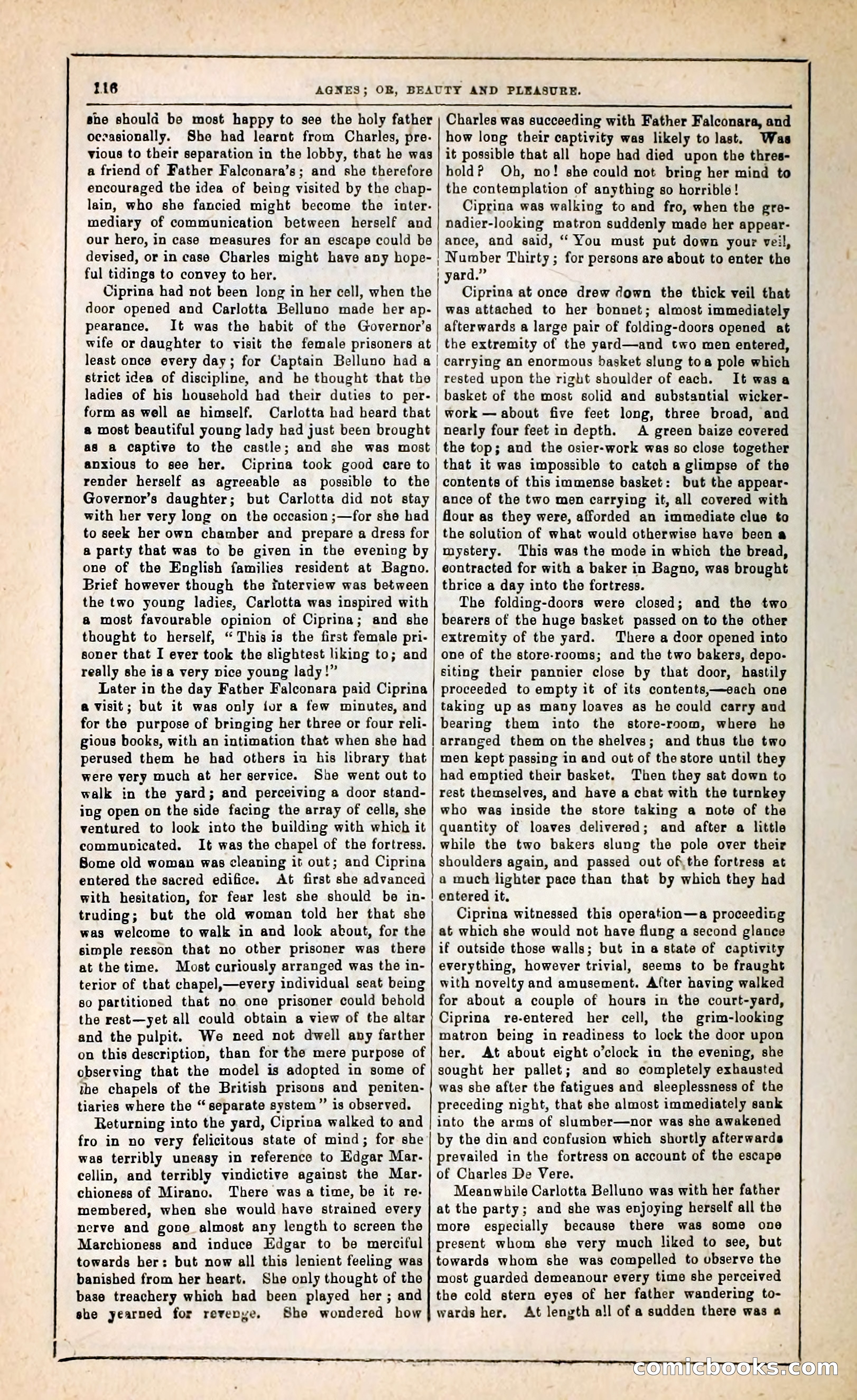
A restored page from Penny Dreadfuls, 1857. Page through the whole issue in the reader above.
📄 Transcribed text from this page (OCR, searchable)
Machine-transcribed from the original scan — historical spelling and the odd misread are preserved.
116 AGNES; OR, BEAUTY AND PLEASURE. she should be most happy to see the holy father oczasionally. She had learnt from Charles, pre- vious to their separation in the lobby, that he was a friend of Father Falconara’s; and she therefore encouraged the idea of being visited by the chap- lain, who she fancied might become the inter- mediary of communication between herself and our hero, in case measures for an escape could be | devised, or in case Charles might have any hope- ful tidings to convey to her. Ciprina had not been long in her cell, when the door opened and Carlotta Belluno made her ap- pearance. It was the habit of the Governor’s wife or daughter to visit the female prisoners at least once every day; for Captain Belluno had a strict idea of discipline, and he thought that the ladies of his household bad their duties to per- form as well ag himself. Carlotta had heard that a most beautiful young lady had just been brought as a captive to the castle; and she was most anxious to see her. Ciprina took good care to render herself as agreeable as possible to the Governor’s daughter; but Carlotta did not stay with her very long on the occasion ;—for she had to seek her own chamber and prepare a dress for a party that was to be given in the evening by one of the English families resident at Bagno. Brief however though the interview was between the two young ladies, Carlotta was inspired with a most favourable opinion of Ciprina; and she thought to herself, “This is the first female pri- soner that I ever took the slightest liking to; and really she is a very pice young lady!” Later in the day Father Falconara paid Ciprina a visit; but it was only iur a few minutes, and for the purpose of bringing her three or four reli- gious books, with an intimation that when she had perused them he had others ia his library that were very much at her service. She went out to walk in the yard; and perceiving a door stand- ing open on the side facing the array of celle, she ventured to look into the building with which it commupicated. It was the chapel of the fortress. Some old woman was cleaning it out; and Ciprina entered the sacred edifice. At first she advanced with hesitation, for fear lest she should be in- truding; but the old woman told her that she was welcome to walk in and look about, for the simple reeson that no other prisoner was there at the time. Most curiously arranged was the in- terior of that chapel,—every individual seat being so partitioned that no one prisoner could behold the rest—yet all could obtain a view of the altar and the pulpit. We need not dwell any farther on this description, than for the mere purpose of observing that the model is adopted in some of the chapels of the British prisons and peniten- tiaries where the “ separate system” is observed. Returning into the yard, Ciprina walked to and fro in no very felicitous state of mind; for she was terribly uneasy in reference to Edgar Mar. cellin, and terribly vindictive against the Mar. chioness of Mirano. There was a time, be it re- membered, when she would have strained every nerve and gone almost any length to screen the Marchioness and induce Edgar to be merciful towards her: but now all this lenient feeling was banished from her heart. She only thought of the base treachery which had been played her ; and she yearned for revenye. She wondered how RE Ae ae ee BT Tern anaes OI GOOOKS. CO _————— a i Charles was succeeding with Father Falconara, and how long their captivity was likely to last. Was it possible that all hope had died upon the thres- hold? Oh, no! she could not bring her mind to the contemplation of anything so horrible! Ciprina was walking to and fro, when the gre- nadier-looking matron suddenly made her appear- ance, and said, “ You must put down your veil, Number Thirty; for persons are about to enter the yard.” Ciprina at once drew down the thick veil that was attached to her bonnet; almost immediately afterwards a large pair of folding-doors opened at the extremity of the yard—and two men entered, carrying an enormous basket slung toa pole which rested upon the right shoulder of each. It wasa basket of the most solid and substantial wicker- work — about five feet long, three broad, and nearly four feet in depth. A green baize covered the top; and the osier-work was so close together that it was impossible to catch a glimpse of the contents of this immense basket: but the appear- ance of the two men carrying it, all covered with flour as they were, afforded an immediate clue to the solution of what would otherwise have been a mystery. This was the mode in which the bread, eontracted for with a baker in Bagno, was brought thrice a day into the fortress. The folding-doors were closed; and the two bearers of the huge basket passed on to the other extremity of the yard. There a door opened into one of the store-rooms; and the two bakers, depo- siting their pannier close by that door, hastily proceeded to empty it of its contents,—each one taking up as many loaves as he could carry aud bearing them into the store-room, where he arranged them on the shelves; and thus the two men kept passing in and out of the store until they had emptied their basket. Then they sat down to reat themselves, and have a chat with the turnkey who was inside the store taking a note of the quantity of loaves delivered; and after a little while the two bakers slung the pole over their shoulders again, and passed out of, the fortress at a much lighter pace than that by which they had entered it. Ciprina witnessed this operation—a proceeding at which she would not have flung a second glance if outside those walls; but in a state of captivity everything, however trivial, seems to be fraught with novelty and amusement. After having walked for about a couple of hours in the court-yard, Ciprina re-entered her cell, the grim-looking matron being in readiness to lock the door upon her. At about eight o’clock in the evening, she sought her pallet; and so completely exhausted was she after the fatigues and sleeplessness of the preceding night, that she almost immediately sank into the arms of slumber—nor was she awakened by the din and confusion which shortly afterwards prevailed in the fortress on account of the escape of Charles De Vere. Meanwhile Carlotta Belluno was with her father at the party; and she was enjoying herself all the more especially because there was some one present whom she very much liked to see, but towards whom she was compelled to observe the most guarded demeanour every time she perceived the cold stern eyes of her father wandering to- wards her. At length all of a sudden there was a |