
Penny Dreadfuls, 1857 · page 278 of 394
Agnes, or, Beauty and Pleasure — page 278: what you’re looking at
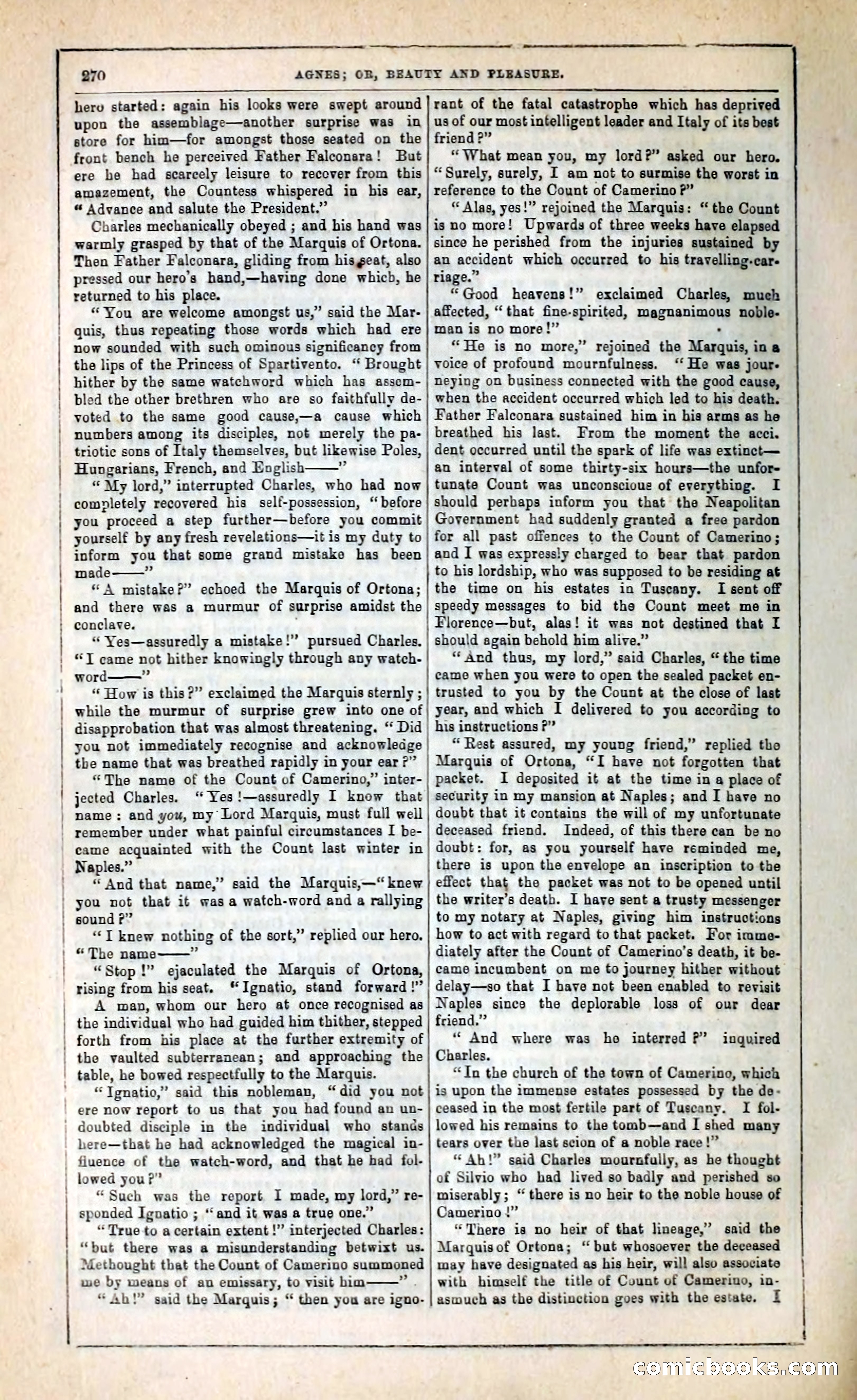
A restored page from Penny Dreadfuls, 1857. Page through the whole issue in the reader above.
📄 Transcribed text from this page (OCR, searchable)
Machine-transcribed from the original scan — historical spelling and the odd misread are preserved.
s el 270 hero started: again his looks were swept around upon the assemblage—another surprise was in store for him—for amongst those seated on the front bench he perceived Father Falconara! But ere he had scarcely leisure to reccver from this amazement, the Countess whispered in his ear, “ Advance and salute the President.” Charles mechanically obeyed ; and his hand was warmly grasped by that of the Marquis of Ortona. Then Father Falconara, gliding from hisgeat, also pressed our hero’s hand,—having done which, he returned to his place. “You are welcome amongst us,” said the Mar- quis, thus repeating those words which had ere now sounded with such ominous significancy from the lips of the Princess of Spartivento. “ Brought hither by the same watchword which has assom- bled the other brethren who are so faithfully de- voted to the same good cause,—a cause which numbers among its disciples, not merely the pa- triotic sons of Italy themselves, but likewise Poles, Hungarians, French, and English ” “ My lord,” interrupted Charles, who had now completely recovered his self-possession, “ before you proceed a step further—before you commit yourself by any fresh revelations—it is my duty to inform you that some grand mistake has been made “ «A mistake?” echoed the Marquis of Ortona; and there was a murmur of surprise amidst the conclave. “ Yes—assuredly a mistake!” pursued Charles. “T came not hither knowingly through any watch- word “4 “‘ How is this?” exclaimed the Marquis sternly ; while the murmur of surprise grew into one of disapprobation that was almost threatening. “ Did | you not immediately recognise and acknowledge | the name that was breathed rapidly in your ear?” “The name of the Count of Camerino,” inter- jected Charles. ‘“‘ Yes!—assuredly I know that name: and you, my Lord Marquis, must full well remember under what painful circumstances I be- came acquainted with the Count last winter in Naples.” “ And that mame,” said the Marquis,—“ knew _ you not that it was a watch-word and a rallying | sound ?” ‘“<T knew nothing of the sort,” replied our hero. “The name 4 “Stop !” ejaculated the Marquis of Ortona, rising from his seat. “Ignatio, stand forward !” A wan, whom our hero at once recognised as the individual who had guided him thither, stepped forth from bis place at the further extremity of the vaulted subterranean; and approaching the | table, he bowed respectfully to the Marquis. “‘Tgnatio,” said this nobleman, “did you not ere now report to us that you had found an un- | doubted disciple in the individual who stands here—that he had acknowledged the magical in- _ fiuence of the watch-word, and that he had fol- ————————_- = lowed you?” “Such was the report I made, my lord,” re- sponded Ignatio ; ‘‘ and it was a true one.” “True to a certain extent!” interjected Charles: “but there was a misunderstanding betwixt us. Methought that the Count of Camerino summoned we by means of an emissary, to visit him “¢ “Ah!” said the Marquis; “ then you are igno- AGNES; OR, BEAUTY AND PLEASURE. rant of the fatal catastrophe which has deprived us of our most intelligent leader and Italy of its best friend ?” “What mean you, my lord?” asked our hero. * Surely, surely, I am not to surmise the worst in reference to the Count of Camerino ?” “ Alas, yes!” rejoined the Marquis: “ the Count is no more! Upwards of three weeks have elapsed since he perished from the injuries sustained by an accident which occurred to his travelling-car- riage.” “Good heavens!” exclaimed Charles, mueh affected, “‘that fine-spirited, magnanimous noble- man is no more!” . “He is no more,” rejoined the Marquis, ina voice of profound mournfulness. ‘“‘ He was jour. neying on business connected with the good cause, when the accident occurred which led to his death. Father Falconara sustained him in his arms as he breathed his last. From the moment the acci. dent occurred until the spark of life was extinct— an interval of some thirty-six hours—the unfor- tunate Count was unconscious of everything. I should perbaps inform you that the Neapolitan Government had suddenly granted a free pardon for all past offences to the Count of Camerino; and I was express!y charged to bear that pardon to his lordship, who was supposed to be residing at the time on his estates in Tuscany. I sent off speedy messages to bid the Count meet me in Florence—but, alas! it was not destined that I should again behold him alive.” “Ard thus, my lord,” said Charles, “ the time came when you were to open the sealed packet en- trusted to you by the Count at the close of last year, and which I delivered to you according to his instructions ?” “ Rest assured, my young friend,” replied the Marquis of Ortona, “I have not forgotten that packet. I deposited it at the time in a place of security in my mansion at Naples; and I have no doubt that it contains the will of my unfortunate deceased friend. Indeed, of this there can be no doubt: for, as you yourself have reminded me, there is upon the envelope an inscription to the effect that the packet was not to be opened until the writer’s deatb. I have sent a trusty messenger to my notary at Naples, giving him instructions how to act with regard to that packet. For imme- diately after the Count of Camerino’s death, it be- came incumbent on me to journey hither without delay—so that I have not been enabled to revisit Naples since the deplorable loss of our dear friend.” “And where was he interred ?” Charles. “Tn the church of the town of Camerino, which is upon the immense estates possessed by the de- ceased in the most fertile part of Tuscany. I fol- lowed his remains to the tomb—and I shed many tears over the last scion of a noble race!” ** Ah!” said Charles mournfully, as he thought af Silvio who had lived so badly and perished so miserably; “ there is no heir to the noble house of Camerino !” “There is no heir of that lineage,’ said the Marqguisof Ortona; “but whosoever the deceased may have designated as his heir, will also associate with himself the title of Count of Camerino, in- asmuch as the distinction goes with the estate. I lnguired