
Penny Dreadfuls, 1857 · page 279 of 394
Agnes, or, Beauty and Pleasure — page 279: what you’re looking at
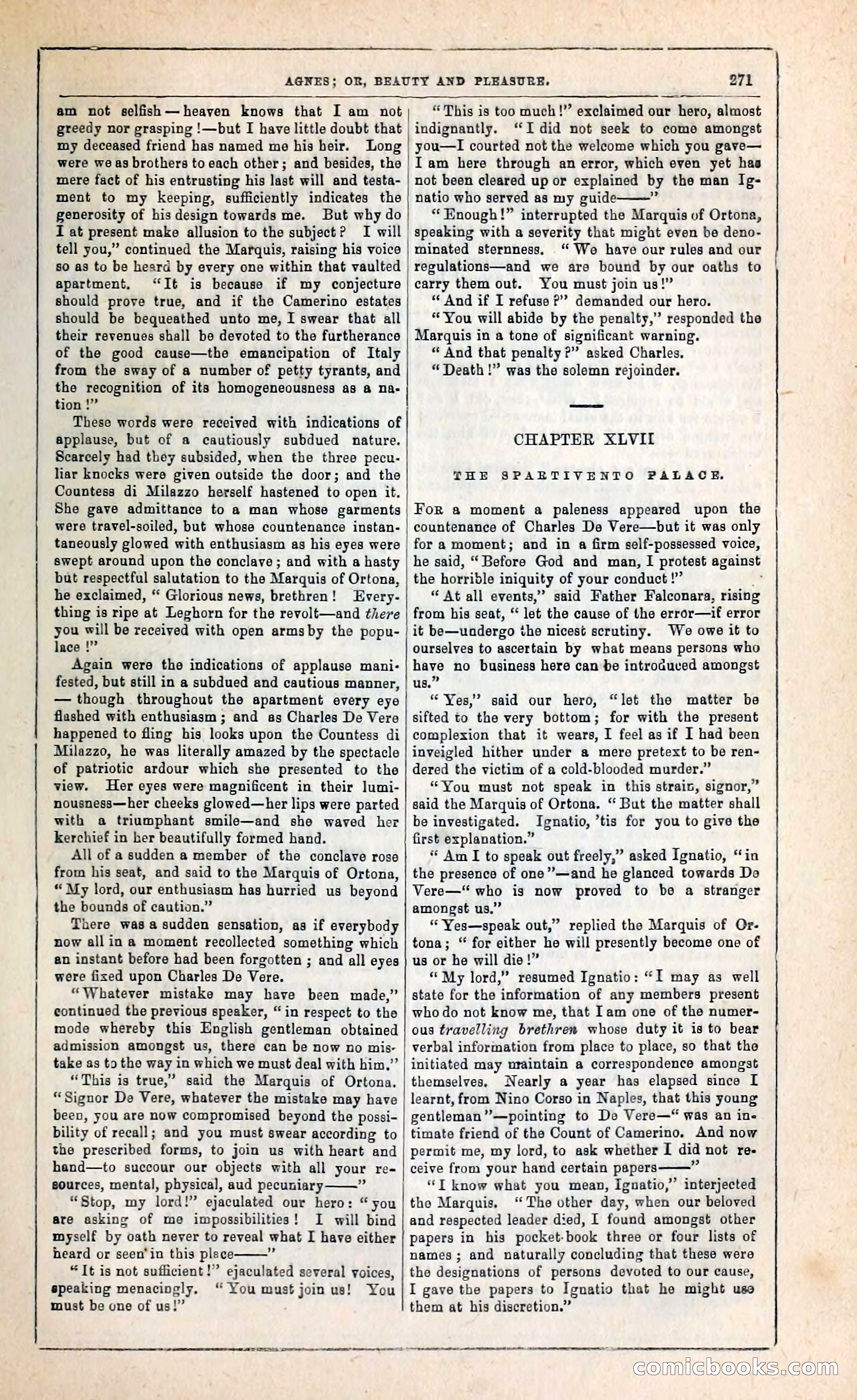
A restored page from Penny Dreadfuls, 1857. Page through the whole issue in the reader above.
📄 Transcribed text from this page (OCR, searchable)
Machine-transcribed from the original scan — historical spelling and the odd misread are preserved.
AGNES; OR, BEAUTY AND PLEASURE, am not selfish—heayen knows that I am not greedy nor grasping !—but I have little doubt that my deceased friend has named me his heir. Long were we as brothers to each other; and besides, the mere fact of his entrusting his last will and testa- ment to my keeping, sufficiently indicates the generosity of his design towards me. But why do I at present make allusion to the subject? I will tell you,” continued the Marquis, raising his voice so as to be heard by every one within that vaulted apartment, “It is because if my conjecture should prove true, and if the Camerino estates should be bequeathed unto me, I swear that all their revenues shall be devoted to the furtherance of the good cause—the emancipation of Italy from the sway of a number of petty tyrants, and the recognition of its homogeneousness as a na- tion !” These words were received with indications of applause, but of a cautiously subdued nature. Scarcely had they subsided, when the three pecu- liar knocks were given outside the door; and the Countess di Milazzo herself hastened to open it. She gave admittance to a man whose garments were travel-soiled, but whose countenance instan- taneously glowed with enthusiasm as his eyes were swept around upon the conclave; and with a hasty but respectful salutation to the Marquis of Ortona, he exclaimed, * Glorious news, brethren! Lvery- thing is ripe at Leghorn for the revolt—and there you will be received with open armsby the popu- lace !” Again were the indications of applause mani- fested, but still in a subdued and cautious manner, — though throughout the apartment every eye flashed with enthusiasm; and as Charles De Vere happened to fling his looks upon the Countess di Milazzo, he was literally amazed by the spectacle of patriotic ardour which she presented to the view. Her eyes were magnificent in their lumi- nousness—her cheeks glowed—her lips were parted with a triumphant smile—and she waved her kerchief in her beautifully formed hand. All of a sudden a member of the conclave rose from his seat, and said to the Marquis of Ortona, “ My lord, our enthusiasm has hurried us beyond the bounds of caution.” There was a sudden sensation, as if everybody now allin a moment recollected something which an instant before had been forgotten ; and all eyes were fixed upon Charles De Vere. “Whatever mistake may have been made,” continued the previous speaker, “in respect to the mode whereby this English gentleman obtained admission amongst us, there can be now no mis- take as to the way in which we must deal with him,” “This is true,’ said the Marquis of Ortona. “Signor De Vere, whatever the mistake may have been, you are now compromised beyond the possi- bility of recall; and you must swear according to the prescribed forms, to join us with heart and hand—to succour our objects with all your re- sources, mental, physical, aud pecuniary “ “Stop, my lord!” ejaculated our hero: “you are asking of me impossibilities! I will bind myself by oath never to reveal what I have either heard or seen’ in this plece a “It is not sufficient!” ejaculated several voices, speaking menacingly. “ You must joinus! You must be one of us!” LPS er ee eR rrr re 271 “This is too much!” exclaimed our hero, almost indignantly. ‘“Idid not seek to come amongst you—I courted not the welcome which you gave— Iam here through an error, which even yet has not been cleared up or explained by the man Ig- natio who served as my guide " “Enough!” interrupted the Marquis of Ortona, speaking with a severity that might even be deno- minated sternness, ‘ We have our rules and our regulations—and we are bound by our oaths to carry them out. You must join us!” “‘ And if I refuse P? demanded our hero. “You will abide by the penalty,” responded the Marquis in a tone of significant warning. “ And that penalty?” asked Charles. “ Death !” was the solemn rejoinder. CHAPTER XLVII THE SPAETIVENTO PALACE. For a8 moment a paleness appeared upon the countenance of Charles De Vere—but it was only for a moment; and in a firm self-possessed voice, he said, “ Before God and man, I protest against the horrible iniquity of your conduct!” * At all events,” said Father Falconara, rising from his seat, ** let the cause of the error—if error it be—undergo the nicest scrutiny. We owe it to ourselves to ascertain by what means persons who have no business here can be introduced amongst us.” © Yes,” said our hero, “let the matter be sifted to the very bottom; for with the present complexion that it wears, I feel as if I had been inveigled hither under a mere pretext to be ren- dered the victim of a cold-blooded murder.” “You must not speak in this strain, signor,” said the Marquis of Ortona. “ But the matter shall be investigated. Ignatio, ’tis for you to give the first explanation.” * Am TI to speak out freely,” asked Ignatio, “in the presence of one”—and he glanced towards Do Vere—“ who is now proved to be a stranger amongst us,” **'Yes—speak out,” replied the Marquis of Or- tona; “ for either he will presently become one of us or he will die!” “My lord,” resumed Ignatio: “I may as well state for the information of any members present who do not know me, that Iam one of the numer- ous travelling brethren whose duty it is to bear verbal information from place to place, so that the initiated may uraintain a correspondence amongst themselves. Nearly a year has elapsed since I learnt, from Nino Corso in Naples, that this young gentleman”—pointing to De Vere—“ was an ine timate friend of the Count of Camerino. And now permit me, my lord, to ask whether [ did not re- ceive from your hand certain papers “‘T know what you mean, Ignatio,” interjected the Marquis, ‘The other day, when our beloved and respected leader died, I found amongst other papers in his pocket-book three or four lists of names ; and naturally concluding that these were the designations of persons devoted to our cause, I gave the papers to Ignatio that he might uso them at his discretion.” |e nr ee ae rm ee lNOO@LK CO) 5}